
Moser A.P., Folkman S. Buried Pipe Design
Подождите немного. Документ загружается.

com
pressed air. Lines can be installed at a greater depth without a
drastic effect on the cost. The depth factor becomes increasingly impor-
tant as congestion is increased. Safety is enhanced as workers are not
required to enter trenches or tunnels. The finished product (carrier)
pipe can be jacked directly without the need of a separate casing pipe.
Major limitations
The capital cost of microtunneling equipment is high. However, the
process uses a closed-face microtunnel boring machine (MTBM) and it
can be used in a wide range of soil condition. Applicable soil types
range from highly unstable to very firm materials. The MTBM will
have difficulty in soils with boulders with sizes greater than 20 or
30 percent of the machine diameter and there are problems caused by
obstructions, such as old manmade structures. Traditionally, one of the
Pipe Installation and Trenchless Technology 579
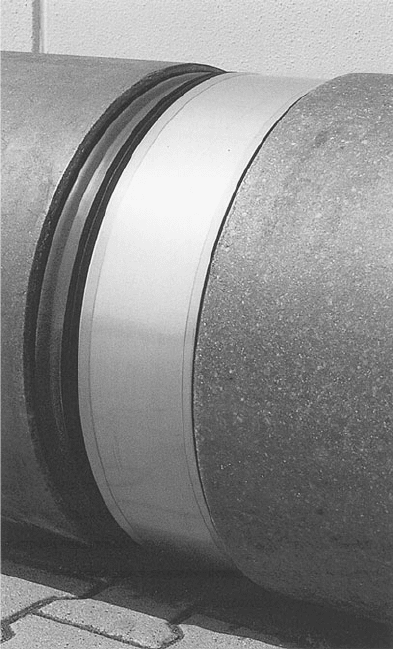
Figure 8.19 Example of flush-type joint.
major limitations of microtunneling methods has been the inability to
utilize flexible or low strength pipes such as PVC or PE.
Components of microtunnel boring
machine (MTBM)
The MTBM is capable of controlling rotation or roll by means of either
a bidirectional drive on the cutter head or by the use of fins or grippers.
The MTBM cutter head is powered by electric or hydraulic motors. The
MTBM is articulated to enable remote steering of the system.
A display showing the position of the shield, in relation to a target,
is available to the operator at an operation console together with other
information such as face pressure, roll, pitch, steering attitude, and
valve positions. The MTBM has a “closed” face system capable of sup-
porting the full excavated area at all times. It has the capability of pos-
itively measuring the earth pressure at the face and counterbalancing
earth pressure.
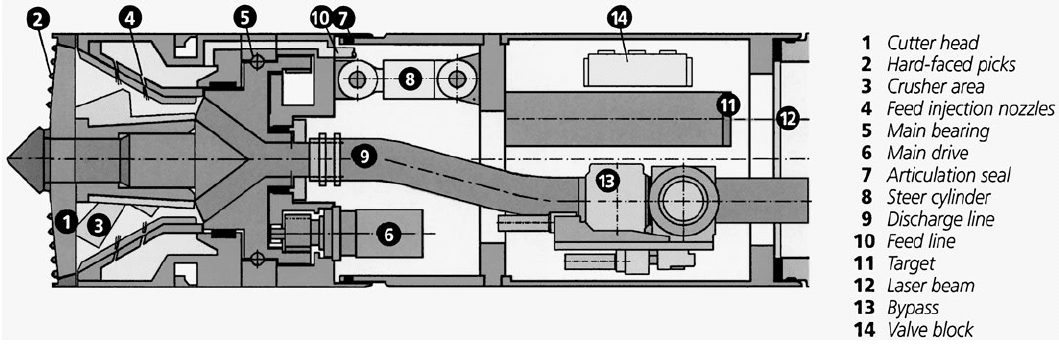
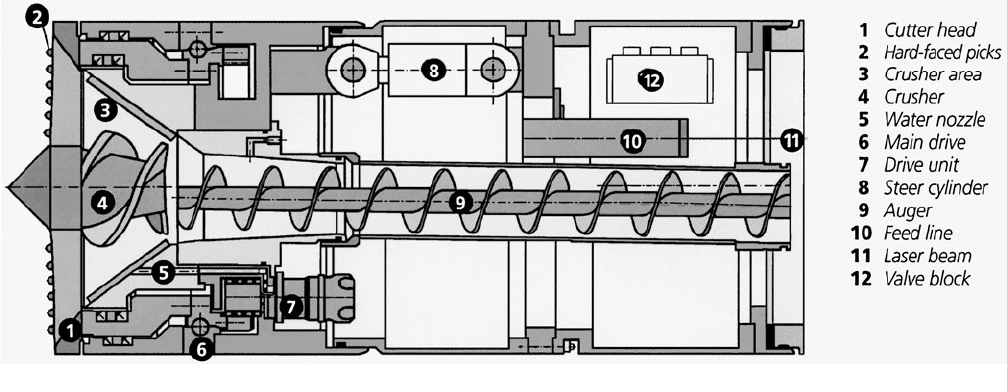
Automated spoil transportation. The spoil removal system for micro-
tunneling can be a slurry transportation system (Fig. 8.20) or a small
encased screwed auger conveyor system (Fig. 8.21). The automated
spoil transportation system should match the excavation rate to the
rate of spoil removal thereby maintaining settlement or heave within
tolerances specified in the contract documents. The balancing of
ground water pressures is achieved by the use of either a slurry pres-
sure or compressed air for the auger MTBM system. The system is
capable of any adjustment required to maintain face stability for the
particular soil condition encountered on the project. The system mon-
itors and continuously balances the ground water pressure to prevent
the loss of slurry and/or ground water.
In a slurry spoil transportation system, the ground water pressure is
managed by the use of the variable speeds slurry pumps, pressure control
valves, and a flow meter. A slurry bypass unit is included in the system to
allow the direction of flow to be changed and isolated, as necessary.
A separation process is provided when using the slurry transporta-
tion system. The process is designed to provide adequate separation of
the spoil from the slurry so that the clean slurry can be returned to the
cutting face for reuse. The type of separation process used is dependent
upon the size of the tunnel being constructed, the soil type being exca-
vated, and the space available for erecting the plant.
If an auger spoil transportation system is utilized, the ground water
pressures are managed by controlling the volume of spoil removal with
respect to the advance rate (earth pressure balance method) and the
application of compressed air to counterbalance earth pressure and
underground water.
580 Chapter Eight
581
Figure 8.20 Microtunneling machine with slurry material removal. (Courtesy of
Herrenknecht GmbH, Germany.)
582
Figure 8.21 Microtunneling machine with auger material removal. (Courtesy of
Herrenknecht GmbH, Germany.)
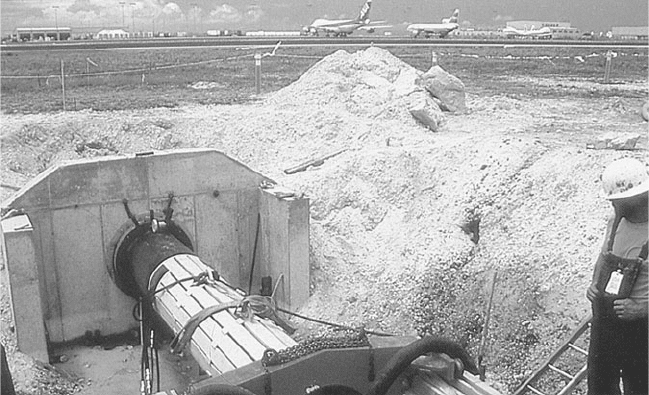
Pipe jacking equipment. The main jacks are mounted in a jacking frame
and are located in the drive (starting) shaft. The jacking frame succes-
sively pushes the MTBM along with a string of connected pipes toward
a receiving shaft (see Fig. 8.22). The jacking capacity of the system must
be sufficient to push the MTBM and the string of pipes through the
ground. Calculations must be made in advance to determine (1) face
excavation forces, (2) frictional forces, and (3) weight of the MTBM and
pipes. The jacking equipment installed must have a capacity greater
than the calculated theoretical jacking load to allow for a safety factor.
The hydraulic cylinder extension rate must be synchronized with the
excavation rate of the MTBM which is determined by the soil conditions.
Intermediate jacking stations are usually provided; for diameters
larger than 900 mm (36 in), or when the calculation of the total jack-
ing force needed to complete the installation exceeds 80 percent of the
capacity of the main jacks or the designed working compressive loads
allowed for the pipe. The jacking system must develop a uniform dis-
tribution of jacking forces on the end of the pipe by the use of spreader
rings and packing.
If the calculated jacking forces on the pipe are expected to exceed the
pipe design strength with a 2.5 to 1 safety factor, a pipe lubrication
system can be utilized. An approved lubricant is injected at the rear of
the MTBM and, if necessary, through the pipe walls to lower the fric-
tion developed on the surface of the pipe during jacking.
Pipe Installation and Trenchless Technology 583
Figure 8.22 Completely unnoticed by the constant air traffic, microtunneling takes place
directly under the active runway at the Honolulu International Airport. (Courtesy of
Herrenknecht GmbH, Germany.)
Remote control system. A remote control system is provided to allow
for the operation of the system without the need for personnel to enter
the microtunnel. The control equipment must integrate the system of
excavation and removal of soil and its simultaneous replacement by a
pipe. As each pipe section is jacked forward, the control system will
synchronize all of the operational functions of the system. The system
provides complete and adequate ground support at all times.
Active direction control. Line and grade are controlled by a guidance
system that relates the actual position of the MTBM to a design refer-
ence by a laser beam transmitted from the jacking shaft along the cen-
ter line of the pipe to a target mounted in the shield. The MTBM is
capable of maintaining grade to within 25 mm (1 in) and line to
within 38 mm (1.5 in). The line and grade tolerances are subject to
project and ground conditions.
The active steering information is monitored and transmitted to the
operation console. The minimum steering information available to the
operator on the control console usually includes the position relative to
the reference, role, inclination, attitude, rate of advance, installed
length, thrust force, and cutter head torque (see Fig. 8.23).
Jacking pipe. As mentioned previously, pipe used for jacking must be
round, have a smooth, uniform outer surface, and with watertight
joints that also allow for easy connections between pipes. Pipe lengths
must be within specified tolerances and pipe ends must be square and
smooth so that jacking loads are evenly distributed around the entire
pipe joint and such that point loads will not occur when the pipe is
jacked in a reasonably straight alignment. Pipe used for pipe jacking
is capable of withstanding all forces that will be imposed by the
process of installation, as well as the final in-place loading conditions.
The driving ends of the pipe and intermediate joints is protected
against damage as specified by the manufacturer. The detailed method
proposed to cushion and distribute the jacking forces is specified for
each particular pipe material.
Any pipe showing signs of failure may be required to be jacked
through to the reception shaft and removed. The pipe manufacturer’s
design jacking loads should not be exceeded during the installation
process. As an industry practice, the ultimate axial compressive strength
of the pipe must be a minimum of 2.5 times the design jacking loads of
the pipe. At the present time, the following pipe materials specially man-
ufactured for microtunneling operations are available (1) glassfiber rein-
forced polyester mortar (GRP) pipe, (2) reinforced concrete pipe (RCP),
(3) vitrified clay pipe (VCP), (4) steel pipe, (5) resin concrete pipe, (6) duc-
tile iron pipe, and (7) polyvinyl-chloride (PVC) pipe.
584 Chapter Eight
Conclusions
1. Renewal of existing buried pipelines is an attractive alternative
to traditional dig-up and replace. Liners are a successful means
of renewal. Plastic li ners stop leaks, resist corrosion and abra-
sion, and contribute some support to the casing for resisting soil
loads. There are several important means of classifying the
renewal technologies: design methodology, applicable size range,
type of material (indicative of chemical resistance), types and
degree of disruption, method of installation; and whether or not
bypass pumping is required. It should be noted that the pipeline
renewal technologies are advancing rapidly and utility owners,
Pipe Installation and Trenchless Technology 585
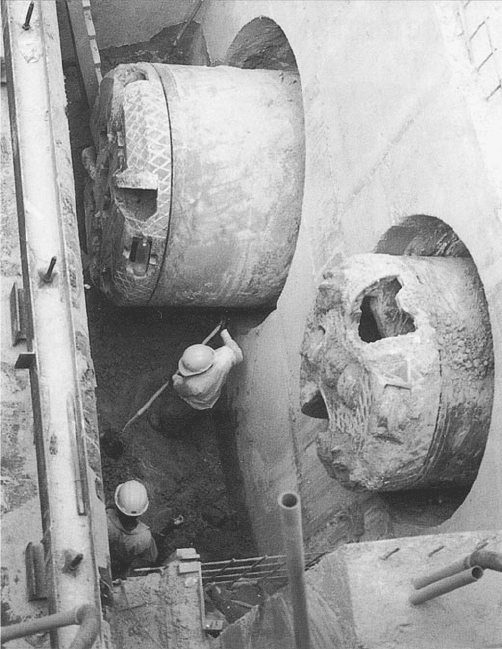
Figure 8.23 Parallel-drive microtunneling machines are right on tar-
get as they enter the receiving pit in Dubai.(Courtesy of
Herrenknecht GmbH, Germany.)
design engineers as well as contractors need to stay current with
the new capabilities and product developments. Design engineers
and utility owners need to consider technologies and products
offered by entrepreneurs who do not have an established product
history but their product may provide new capabilities unlisted in
any published book or industry literature.
2. In quick tests, plastic liners in good casings resist external hydro-
static pressure to near yield stress of the plastic. Quick tests are
easy to perform and provide a check on the compressive yield
strength of the plastic liners.
3. In the long term (50 years), the maximum persistent external
pressure on Insitupipe liners is not less than half the quick test
pressure. Maximum pressure in service is greater than half the
quick test pressure because pressure on buried pipes is not usu-
ally persistent, but fluctuates. Tests should be required to predict
long-term performance of all types of liners.
4. Design of liners based on quick tests in good casings should
include a safety factor to cover bad casings, high temperature
excursions, dynamic forces, etc. Experience with Insitupipe liners
tends toward a safety factor of two at the present state of the art.
Quick test pressure will increase as the temperature decreases.
Quick test pressure will decrease as the casing is deflected out-of-
round is broken, or corroded, etc.
5. From tests on Insitupipe, the long-term maximum allowable
external pressure is greater than the water table head encoun-
tered in most buried pipe installations. Most buried pipes have
less than 35 ft of soil cover and, consequently, less than the allow-
able 35 ft of head for Insitupipe at 50 years with a safety factor of
two. See Insitupipe long-term test results.
6. Due to the increasingly critical nature of installation or renewal
of utility systems in congested areas, and aging underground
infrastructure, the need for inspection, monitoring, assessment,
evaluation and documentation of underground utility systems
has increased. Closed-circuit television (CCTV) and the other
pipe inspection technologies provide means of condition assess-
ment and decision-making process on the specific type and
method of trenchless technology. The trenchless technology is
advancing very rapidly and the project participants need to keep
pace with the technology. There is a need to develop standard
guidelines on trenchless construction and renewal, to develop
standard specifications, and to train the workforce for these
advancing technologies.
586 Chapter Eight
References
1. American Society of Civil Engineers. 1999. Standard Construction Guidelines for
Microtunneling—Draft 1998. ASCE Standards. Reston,Va.
2. American Society of Civil Engineers. (2007). Pipe Bursting Projects. ASCE Manuals
and Reports on Engineering Practice, No. 112, Reston, Va.: American Society of Civil
Engineers.
3. American Society of Civil Engineers. (2006). Pipeline Research and Technology
Transfer Symposium. Proceedings of a Workshop Conducted on Sunday in
Conjunction with ASCE 2006 Pipeline Conference, Chicago, Illinois. Reston, Va.:
Pipeline Division of American Society of Civil Engineers.
4. American Society of Civil Engineers. (2005). Pipeline Design for Installation by
Horizontal Directional Drilling. ASCE Manuals and Reports on Engineering
Practice, Reston, Va.: American Society of Civil Engineers.
5. American Society of Civil Engineers. (2004). Horizontal Anger Boring Projects. ASCE
Manuals and Reports on Engineering Practice, No. 106. Reston, Va.: American
Society of Civil Engineers.
6. Atalah, A. and A. Hadala. 1996. Microtunneling Database for the United States and
Canada. No Dig Engineering 3(3):18–20 May/June 1993.
7. Bennett, R. D., L. K. Guice, S. Khan, and K. Staheli. 1995. Guidelines for Trenchless
Technology. Vicksburg, Miss: Construction Productivity Advancement Research
(CPAR) Program, U.S. Army Corps of Engineers, Waterways Experiment Station.
8. Bennett, D. and Perry A. Taylor. 1993. Construction of Microtunneling Test Facility
at WES and Preliminary Test Results. In Proceedings of the Trenchless Technology
Advanced Technical Seminar. Ruston, La.: Trenchless Technology Center.
9. Boyce, G. M. and E. M. Bried. 1994. Estimating the Social Cost Savings of Trenchless
Techniques. No-Dig Engineering 1(2) December.
10. Cruz, Jr., E. 1993. Microtunneling Under Difficult Conditions in New York City. In
Proceedings of Trenchless Technology: An Advanced Technical Seminar. January
1993. Ruston, La.: Trenchless Technology Center (TTC).
11. Das, B. M. 1994. Principles of Geotechnical Engineering. Boston, Ma.: PWS
Publishing Company.
12. Doherty, D. J. 1997. Design and Administration of Utility Projects Utilizing Multiple
Trenchless Technology Methods. No-Dig Engineering 4(3) May/June.
13. Duncan, I. C. Jr. 1992. Soils and Foundations for Architects and Engineers. New
York: Van Nostrand Reinhold.
14. Essex, R. J. 1997. Geotechnical Baseline Reports for Underground Construction. In
Proceedings of the Construction Congress V, pp 219–225. Reston, Va.: American
Society of Civil Engineers (ASCE).
15. Friant, J. E. and L. Ozdemir. 1994. Development of the High Thrust Mini-Disc
Cutter for Microtunneling Applications. No-Dig Engineering 1(1), June.
16. Gilman, B., D. Bennett, and K. Staheli. 1995. Preliminary Results of the 1994 CPAR
Microtunneling Testing Project. In Proceedings of the New Advances in Trenchless
Technology. St Joseph, Ma.: Missouri Western State College.
17. Hinze, J. 1997. Risk Assessment in Underground Construction: Uncertainty is
Certain. No-Dig Engineering, 4(3) May/June.
18. Iseley, D. T. and S. B. Gokhale. 1997. Synthesis of Highway Practice 242: Trenchless
Installations of Conduits Beneath Roadways. Washington, D.C.: Transportation
Research Board, National Research Council.
19. Mickie, J. L. 1996. Recognizing Different Soil Classification Systems. Trenchless
Technology, January.
20. Najafi, M. 1994. Trenchless Pipeline Rehabilitation: State-of-the-Art Review. Ruston,
La: Trenchless Technology Center.
21. Najafi, M. and V. K. Varma. 1996. Two Firsts for Iowa—Microtunneling and RCCP.
Trenchless Technology 5(12):36–37, December 1996.
22. Najafi, M. and D. T. Iseley. 1998. An Overview of Pipeline Renewal Methods. In 1st
Trenchless Technology Symposium Proceedings. Indianapolis: Indiana University
and Purdue University.
Pipe Installation and Trenchless Technology 587
23. Najafi, M. and D. T. Iseley. 1994. Evaluation of PVC Pipe for Microtunneling. In
Proceedings of the Symposium on Buried Plastic Pipe Technology.Philadelphia,
Pa.: American Society for Testing Materials.
24. Najafi, M 2005. Trenchless Technology: Pipeline and Utility Design, Construction
and Renewal, New York: McGraw-Hill.
25. Najafi, M. 2005. “Safety Precautions for Trenchless Excavation,” Excavation Safety
Guide 2005, Underground Focus Events, Chicago, Ill.
26. Najafi, M. (Co-Editor). 2006. Pipeline Research and Technology Transfer
Symposium, In Proceedings of a Workshop Conducted on Sunday, July 30, 2006, in
Conjunction with ASCE 2006 Pipeline Conference, Chicago, Illinois. Reston, Va.:
Pipeline Division of American Society of Civil Engineers.
27.
Najafi, M. (ed.). 2003. New Pipeline Technologies, Security and Safety, Two-Volume.
In Proceedings of the International Pipeline Conference in Baltimore, Reston, Va.:
Maryland by American Society of Civil Engineers.
28. Singh, B. K. 1997. Signifi cance of Total Quality Management in Trenchless
Technology. No-Dig Engineering 4(2), March/April.
29. Terzaghi, K. 1950. Geologic Aspects of Soft Ground Tunneling. In Applied
Sedimentation, ed. Editor P. Trask, New York: John Wiley and Sons, Inc.
30. Terzaghi, K., R. B. Peck, and G. Mesri. 1996. Soil Mechanics In Engineering Practice.
New York: John Wiley & Sons, Inc.
31. Tomforde, Larry. 1996. Pleasant Hill Relief Interceptor (Phase 3): U.S.
Manufacturers’ First MTBM Project. No-Dig Engineering 3(5), September/October
1996.
588 Chapter Eight