
Moulson A.J., Herbert J.M. Electroceramics: Materials, Properties, Applications
Подождите немного. Документ загружается.

the electroceramic constituents are present in the solid, liquid or vapour phases.
J. Will et al. [11] comprehensively reviews the technologies.
Solid phase
All the techniques in this category are regarded as economically viable so far as
very expensive equipment is not a requirement. As with all processes involving a
particulate solid ceramic there is shrinkage during the drying and firing stages
and the attendant risk of cracking.
Because of their widespread exploitation in the manufacture of electroceramic
components in general, the following technologies are discussed elsewhere in the
text; screen-printing (Section 4.2.2), slip-casting (Section 3.6.5), tape-casting
(Section 3.6.6), and calendering (Section 3.6.7).
Slurry–coating: Dense ceramic films have been successfully fabricated starting
with low solids content (1–2 vol. %) suspensions of powder in water or ethanol.
Multiple coatings may be applied to the particular substrate with controlled
drying between each. The coating is sintered in a final co-firing of substrate and
deposit. Care has to be taken to tailor the thermal expansivities of both substrate
and coating so as to avoid tensile stresses in the layer and consequential cracking.
Layer thicknesses in the range 5–30 mm have been successfully fabricated.
Electrophoretic deposition (EPD): In EPD advantage is taken of the electric
charge carried by a particle in suspension (see [6]). The charged particles are
carried towards a conducting substrate by an applied d.c. electric field. The
deposition rates can be fast and typically of order 1 mm min
1
. Because little or
no organics are involved (in contrast to tape-casting, for example) ‘burn-out’
procedures are unnecessary.
Transfer-printing: The method consists in screen-printing an ink pattern (see
Section 5.4.3 ‘wet process’) onto a water-soluble ‘paper’ substrate. A temporary
‘carrier overcoat’ layer (e.g. an acrylic) is then printed over the pattern. The
ceramic layer and overcoat are removed from the water-soluble paper and
‘squeegeed’ on to the chosen substrate. The substrate and transferred layer are
then co-fired, the carrier overcoat burning away.
Liquid phase
As in the case of the ‘solid phase’ approach, these techniques are economically
attractive because very expensive equipment is not a requirement.
Sol–gel process: The sol–gel process consists in first forming a ‘sol’ (particles
usually in the nm size range – or large molecules) from which a gel is derived.
The gel may be processed to form a powder or a film. A common route starts
with a solution of organometallic compounds (for example, isopropoxides of the
112 PROCESSING OF CERAMICS
TEAMFLY
Team-Fly
®
appropriate cations (e.g. Ba, Ti)) which are hydrolysed (e.g. by exposure to the
atmosphere) to form a gel. Films can be made by dripping or spraying the sol
onto a spinning substrate (200 r.p.m.), drying and firing.
Spray pyrolysis: An appropriate metal salt is sprayed from an atomizer onto a
hot substrate where decomposition occurs yielding the metal oxide. There are
advantages to be gained by electrically charging the droplets using an
‘electrostatic atomizer’ Deposition rates are quite low, typically in the range
1–10 mmh
1
.
Gaseous and vapour phases
Although, generally speaking, these techniques are expensive, some are being
actively explored, especially for fuel cell and high temperature superconductor
technologies.
Chemical vapour deposition (CVD): In CVD (see Section 4.2.1) process
reactant vapours (e.g. metal chlorides) are transported to the substrate where
they are adsorbed on the surface, the reaction and subsequent crystal growth
occurring on the substrate surface. Deposition rates typically lie in the
1–10 mmh
1
.
Electrochemical vapour deposition (EVD): A modification of the CVD
process, EVD has been developed specifically to grow a dense coating on a
porous substrate. A porous ceramic substrate divides a chamber into two
compartments, one containing the metal compound reactant and the other an
oxygen-containing reactant. The first step in the process is closure of the pores in
the substrate by the normal CVD process. Thereafter a dense layer grows by
essentially the Wagner oxidation process by which a coherent and fully dense
oxide film grows on a metal. Once a layer has grown by the CVD process and the
surface porosity is closed, then the metal oxide layer grows on the metal reactant
side, the oxygen ions arriving at the reaction site by solid state diffusion through
the layer. The resultant structure is a dense thin layer of oxide on a porous
substrate. Such a structure is exploited in solid oxide fuel cell (SOFC) technology
(see Fig. 4.33).
Physical vapour deposition (PVD): Evaporation–condensation consists
simply in evaporating a target ceramic and condensing the vapour onto a
substrate. For example a high power pulsed laser beam is directed onto the target
material, the intensity being such that in the outermost layers of the target the
atoms are ablated with the compound stoichiometry maintained. The ablated
atoms condense on a suitable substrate and a film develops. Currently growth
rates are low and typically approximately 1 mmh
1
.
SHAPING 113
Sputtering: Normal sputtering (see Section 4.2.1) is a well established
technology characterized by low deposition rates (typically or order 0.1 mmh
1
).
In ‘magnetron sputtering’ a magnet is positioned behind the target. It increases
the electron path in the plasma and hence the collision probabilities and
deposition rates. In ‘reactive d.c. magnetron sputtering’ the metal target atoms
react with intentionally introduced oxygen (for example) and the oxide is
deposited. Various oxide compositions and structures can be grown by varying
the target, introduced gas and sputter conditions. Magnetron sputtering
deposition rates of ceramics are relatively high, up to 10 mmh
1
being achieved.
3.7 High-temperature Processing
3.7.1 Densi¢cation
The ‘driving force’ for densification is the reduction in surface energy as the free
surfaces of particles disappear and how this is accomplished defines the terms
‘firing’, solid state sintering and liquid phase sintering.
The densification of tableware and electrical porcelain depends on the
formation of a glass phase developed principally from the ‘fluxes’ – feldspathic
minerals – which are a major constituent. The process is commonly referred to
as ‘firing’. The glass is formed at the firing temperature and wets the surface of
the solid phase. The surface tension forces pull the mass of particles together so
that a large fraction of the pores is filled with glass. There is always some
porosity as trapped gas cannot escape sufficiently quickly through the vitreous
phase. Because it forms a continuous network the glass has an important
influence on the electrical properties, in particular dielectric loss, so that electrical
porcelain, for example, is exploited only in applications where adequate
insulation is the prime requirement (see Section 5.5.1).
In the absence of a substantial glassy constituent densification is achieved
either by solid state or liquid phase sintering. In both processes the starting
compact consists of particles in the 1–10 mm size range held together by a
minimum amount of binder. After the binder is volatilized or decomposed and
burned out in the early stages of sintering, there is sufficient contact between the
particles to maintain the shape of the component. At temperatures of
approximately 0.8 to 0.9 T
m
(T
m
is the melting temperature in K) the constituent
ions have sufficient mobility for the solid state sintering process to take place.
In the early stages of solid state sintering the microstructure undergoes
changes mainly as a result of the surface diffusion of ions from convex surfaces
(where their energy is high) to the concavities at particle contact points (where
their energy is lower). This process brings about changes in microstructure but
no appreciable densification. Densification necessitates mass transport from
grains to pores, a process which commonly occurs by vacancy diffusion from
114 PROCESSING OF CERAMICS
regions close to the pore surface (where the vacancy concentration is high relative
to the equilibrium concentration in the bulk) to the grain boundaries which, by
virtue of their intrinsic disorder, act as vacancy sinks.
In liquid phase sintering the movement of ions is assisted by the presence of
small quantities of liquid in which the crystalline phase has limited solubility.
Mass transport occurs by a ‘solution precipitation’ process involving ions
dissolving at high energy sites and precipitating at low energy sites. Probably the
most common liquid phase sintered electroceramic component is the alumina
substrate for carrying microcircuits (see Section 5.5.5).
In both solid state and liquid phase sintering grain growth accompanies
densification, driven by the reduction in overall grain boundary energy. Grain
size can be an important determinant of mechanical and electrical properties and
therefore efforts are made to control it. Starting particle sizes, heating schedules
and chemical composition all influence grain size and the optimum conditions
have to be determined empirically.
Grain size can be controlled by exploiting differences in the grain growth and
densification kinetics. For example very ‘fast firing’ at temperatures higher than
the normal sintering temperature can effect full densification with minimum
grain growth. Hot-pressing (see Section 3.7.2) achieves full densification with
little grain growth. Appropriate annealing of a dense ceramic can be used to
increase grain size, should this be desirable.
Specific dopants for particular systems are known to control grain sizes but the
mechanisms are in the main conjectural. For example, in the solid state sintering
of Al
2
O
3
the addition of MgO leads to a fully dense, translucent ceramic widely
exploited in high pressure Na-vapour street lighting. However, intensive efforts
over half a century since the discovery have failed to reveal a definitive
explanation of the role of the MgO although it seems clear that control of grain
growth kinetics is crucial.
Typical microstructures developed by solid state sintering, liquid phase
sintering and firing a porcelain are shown in Fig. 5.20.
3.7.2 Hot-pressing
It is not always possible to obtain a low-porosity body by ‘pressureless sintering’,
i.e. by sintering at atmospheric pressure. For example, difficulties are experienced
with silicon nitride and silicon carbide. More commonly it may prove difficult to
combine the complete elimination of porosity with the maintenance of small
crystal size. These problems can usually by overcome by hot-pressing, i.e.
sintering under pressure between punches in a die, as shown in Fig. 8.9. The
pressure now provides the major part of the driving force eliminating porosity
and the temperature can be kept at a level at which crystal growth is minimized.
HIGH-TEMPERATURE PROCESSING 115
Care has to be taken in selecting materials for the die and punches. Metals are
of little use above 1000 8C because they become ductile, and the die bulges under
pressure so that the compact can only be extracted by destroying the die.
However, zinc sulphide (an infrared-transparent material) has been hot pressed
at 700 8C in stainless steel moulds. Special alloys, mostly based on molybdenum,
can be used up to 1000 8C at pressures of about 80 MPa (5 ton in
2
). Alumina,
silicon carbide and silicon nitride can be used up to about 1400 8C at similar
pressures and are widely applied in the production of transparent electro-optical
ceramics based on lead lanthanum zirconate as discussed in Section 8.2.1.
Graphite is widely used at temperatures up to 2200 8C and pressures between
10 and 30 MPa. At 1200 8C it has only a fraction of the strength of alumina,
silicon carbide or silicon nitride, but it retains its strength at higher temperatures
so that above 1800 8C it is the strongest material available. It has the
disadvantage, for processing many electroceramics, of generating a strongly
reducing atmosphere and needing some protection against oxidation. Like the
metals and silicon carbide it can be used as a susceptor for induction heating.
Although hot-pressing is usually regarded as an expensive process and only
simple shapes with a wide tolerance on dimensions can be made, it provides the
only route for several valuable materials. Continuous hot-pressing methods have
been developed for some magnetic ferrites and piezoelectric niobates. They offer
higher production rates but tool wear is very severe.
3.7.3 Isostatic hot-pressing
In isostatic hot-pressing (‘HIP’), sintering or a post-sintering operation is carried
out under a high gas pressure (typically 30–100 MPa). This method, like most
other sintering methods, was first developed for metals and is used routinely for
high-performance turbine blades and hip-joint prostheses.
A furnace is constructed within a high-pressure vessel and the objects to be
sintered are placed in it. Powders or pieces containing interconnected pores are
encapsulated in impervious envelopes of a ductile metal such as platinum or, in
the case of metals and some ceramics, of glass. Sintered bodies in which residual
pores are isolated need not be enclosed. A neutral gas such as nitrogen or argon
is introduced at a suitable pressure while the temperature is raised to the required
level.
The method has the advantage of avoiding interaction with die and punch
materials and allows the sintering of complex shapes in controlled atmospheres.
If the pieces concerned are small a large number can be processed in one
operation so that the expense involved is moderate. As with cold isostatic
pressing, the method avoids internal flaws and density variations due to the
shearing action caused by die-wall friction.
116 PROCESSING OF CERAMICS
An intermediate form of isostatic pressure sintering, sometimes referred to as
pseudo-isostatic hot-pressing, uses uniaxial hot-pressing apparatus but immerses
the object to be sintered in a refractory non-interacting powder within the die
and punches. This avoids the very considerable expense of building a furnace
inside a thick-walled pressure vessel but the results are inferior to those achieved
with true isostatic hot-pressing.
3.7.4 Glass-ceramics
Glass-ceramics are one of the relatively new members of the ceramics’ family and
an important electroceramic type. They were successfully developed during the
1950s and 1960s principally due to the pioneering work of S.D. Stookey at
Corning in the United States and are extensively exploited as electrical insulators
and in electronics ‘packaging’ technology (see Section 5.5.5).
In the manufacture of the most familiar glass ceramic articles (e.g. tableware
and the cooker hob), the process starts with making the glass shape by any one of
the standard glass-forming methods. The shape is then subjected to a two-stage
heat treatment. The first stage is at a relatively low temperature when crystal
nuclei form, and the second at a higher temperature when the crystals grow by
diffusion. The devitrification of the glass is, of course, a manifestation of the free
energy of the crystalline phase being lower than that of the randomly structured
vitreous phase from which it is derived. The final ceramic is a crystal–glass
composite with typically a few vol% residual glass and no porosity. The glass-
ceramic route offers close control over the relative amounts and natures of the
phases developed and consequently so too over chemical and physical properties.
Glass-ceramics can also be made starting from a powdered glass followed by a
single step combined sintering and controlled crystal nucleation and growth
steps. This route is the one most relevant to the electroceramics context.
Glass-ceramics based on the Li
2
O-Al
2
O
3
–SiO
2
can be tailored, principally
through varying the alumina content, to have linear thermal expansivities in the
range from close to zero to approximately 18 MK
1
. The low expansion
materials have excellent resistance to thermal shock whilst those with the higher
expansivities can be successfully joined to a range of metals.
The stages in the manufacture of a controlled atmosphere housing for a high
current electrical switch are illustrated in Fig. 3.7.
An important attribute in the electroceramics context is that, in contrast to a
glass which would soften and deform at high temperatures, the glass-ceramic is
relatively dimensionally stable up to temperatures close to the melting points of
the crystals, and therefore remains so during subsequent processing stages.
Because of this, coupled with the ability to control thermal expansivities, glass-
ceramics play an important role in microelectronics ‘packaging’ technology (see
Section 5.5.5).
HIGH-TEMPERATURE PROCESSING 117
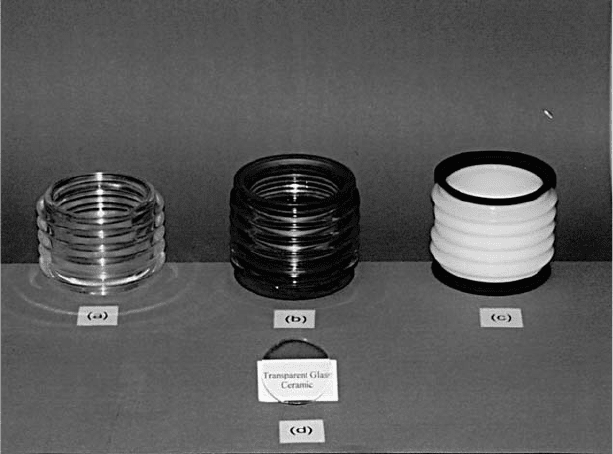
Electrical characteristics are controlled by the composition and size of the
crystals, slightly modified by the thin intergranular layer, the residue of the glass
phase. Optical transparency is determined to a large extent by scattering (see
Section 8.1.5) and necessitates controlling the crystallite size to about 50 nm
(Fig. 3.7).
A properly designed glass-ceramic is pore-free, mechanically strong (modulus
of rupture 250 MPa) and tough (fracture energy 17 J m
2
).
For the reader requiring an in depth discussion of glass-ceramics the classic
monograph by P.W. McMillan [12] is recommended, and also the articles very
relevant to electroceramics in the text edited by M.H. Lewis [13].
3.8 Finishing
The sintered bodies may require one or more of the machining, glazing and
metallizing operations known as ‘finishing’. Tool wear during shaping and
variations in shrinkage during drying and sintering contribute to a variation of
118 PROCESSING OF CERAMICS
Fig. 3.7 Stages in the fabrication of a glass-ceramic, gas-tight, high current switch housing:
(a) the formed glass shape, (b) 18% Cr stainless steel (linear thermal expansivity:
13 p.p.m. K
71
) flanges bonded to glass, (c) finished glass-ceramic component. The
transparency of the disc (d) results from a very small grain size. (Courtesy of Advanced
Ceramics Limited, UK.)
1–2% in the dimensions of pieces emerging from a furnace. Grinding and lapping
with abrasives, such as silicon carbide and diamond powder, can be used to bring
component dimensions to within the closest of engineering tolerances, but are
expensive operations except in the simplest of cases such as centreless grinding of
rods to diameter or adjusting the thickness of slabs.
Glazes are applied when particularly smooth or easily cleaned surfaces are
required. The glazes are applied as layers of powder by dipping the component in
a suitable slip or by spraying. They are fired on at temperatures sufficient to melt
them, generally in the range 600–1000 8C. The thermal expansion of the glaze
should be slightly less than that of the material to which it is applied so that it is
under compression after cooling, but the mismatch should not exceed 2–3 parts
in 10
6
8C
1
. A surface under compression can increase the strength of a body
significantly.
Metallizing may be required in order to provide an electrical contact or as part
of the process of joining a ceramic to a metal part. Metals in contact with
conductive or semiconductive ceramics must be chosen so that they do not
introduce unwanted barriers to the movement of current carriers. Aluminium,
silver, gold and Ni–Cr are all readily deposited by evaporation in a vacuum from
a heated source or by sputtering, but adhesion is not usually very good. Nickel
containing 10% or more of phosphorus (or boron) can be deposited from
solutions containing nickel salts and a reducing agent such as sodium
hypophosphite, but again with limited adhesion. Ceramic dielectrics are usually
coated with a paint containing silver or silver oxide particles mixed with a small
amount of a glass. This is fired on at 600–800 8C and gives very good adhesion
provided that the glass is matched chemically to the substrate so that, for
instance, it does not react strongly and become completely absorbed into the
substrate.
Many alumina parts such as klystron microwave windows and lead-throughs
(see Fig. 5.25) must form strong vacuum-tight joints with metals. In this case a
paint containing molybdenum and manganese powders is applied to the alumina
and fired on in wet hydrogen. Enough interaction occurs at the alumina surface
to form a strong bond and nickel is then deposited electrolytically on the
metallized surface. The ceramic can then be brazed to a metal using Cu–Ag
eutectic alloy.
3.9 Porous Materials
In the majority of electrical applications sintered ceramics are required to have
minimum porosity. Properties usually reach their optimum values at the highest
densities, whilst porosity in excess of 5–10% allows the ingress of moisture
leading to many serious problems. However, there are cases where porosity is
desirable: for example, in humidity and gas sensors and where thermal shock
POROUS MATERIALS 119
resistance is of overriding importance. Porous structures can be obtained in the
following ways.
1. Calcining at a high temperature so that considerable crystal growth takes
place and, after grinding coarsely, separating out particles in a limited size
range. Bodies compacted and sintered from such powders will have
continuous porosity and cavities as large as 30 mm. The total accessible
specific surface area will be low.
2. Underfiring an otherwise normally processed body. The pore structure will be
fine and the total accessible specific surface area high.
3. Mixing organic or carbon particles with diameters exceeding 20 mm into a
ceramic powder; cavities of corresponding size are left after burning out and
sintering. The content of such particles needs to exceed 20 vol.% if porosity is
to be continuous. This method allows a control over the final structure that is
largely independent of the sintering conditions.
4. High porosities are obtainable by using a high proportion of binder
containing a foaming agent. Gas is generated within a fluid binder–powder
mixture that subsequently becomes rigid through the polymerization of the
binder. The porosity may be either continuous or discontinuous according to
the formulation of the binder and is little changed by burn-out and sintering.
Materials containing large cavities (several millimetres) can be formed in this
way.
5. An existing porous structure, e.g. certain corals, can be reproduced by
impregnating it with wax and then dissolving out the original solid (calcium
carbonate in the case of coral). The porous wax structure is then impregnated
with a concentrated slip containing the ceramic powder. After drying, the wax
can be melted out and the ceramic fired. The method becomes more economic
if a suitable foam with a continuous porosity is impregnated with a slip and
then burned out. In this case the final ceramic structure corresponds to the
vacant spaces within the foam.
3.10 Processing and Electroceramics
Research and Development
Electroceramics, more so than any other branch of ceramics, relies heavily on
research and development for which a range of specialized ‘laboratory scale’
apparatus has been developed for comminution, spray-drying, pressing,
120 PROCESSING OF CERAMICS
tape-casting, screen-printing and sintering. The development scientist/engineer
also requires access to equipment to characterize materials with respect to crystal
structure, chemical composition and microstructure and in the case of powders,
particle size and size distribution, specific surface area etc. A well-appointed
electroceramics laboratory will also have access to X-ray diffraction, X-ray
fluorescence, scanning electron microscopy coupled with X-ray analysis, optical
microscopy, both reflected and transmitted light, Brunauer–Emmett–Teller
(BET)-type apparatus, sedimentometers and optical scattering analysers and, of
course, equipment for determining electrical, magnetic and electromechanical
properties (e.g. wide frequency band impedance analysers and apparatus for
measuring small changes in sample dimensions).
A small-scale, controlled atmosphere, gradient furnace is a valuable addition
to the laboratory since it allows optimum sintering conditions to be quickly
determined.
Taking precautions to keep inadvertent contamination to a minimum is
necessary for reliable interpretation of experimental data and the design of
equipment should be such that thorough cleaning between processing batches is
facilitated. The introduction of contaminants is particularly likely during
comminution and high energy bead attritor-milling offers significant advantages
over ball-milling in this regard.
Multilayer technology has arguably become the most important facet of
electroceramics technology and there is a constant drive to reduce layer
thicknesses, in the case of multilayer capacitors because of the higher volumetric
efficiencies achievable (see Section 5.4.3). This, and a general trend to micro-
fabrication, has made it essential to remove all risk of airborne contaminating
‘dust’ consisting of clothing fibres, dry skin flakes etc. Clean-room processing is
now commonplace not only on the laboratory scale but to an increasing extent
on the commercial production scale.
3.11 TheGrowthofSingleCrystals
The growth of single crystals having special relevance to electroceramics is
reviewed by A.L. Gentile and F.W. Ainger [14]. For some purposes materials
must be prepared as single crystals which is, in most cases, a more difficult and
expensive process than preparing the same compositions in polycrystalline
ceramic form. The perfection of a crystal structure is easily upset by impurities or
by small changes in conditions during its formation. The growth of crystals
usually involves a change of state from liquid or gas to solid, or from liquid
solution to solid. The atomic species in a fluid at any instant are arranged
randomly; during crystal growth they must take on the ordered structure of the
crystalline phase. Too rapid growth results in the trapping of disordered regions
in the crystal or in the nucleation of fresh crystals with varying orientations. The
THE GROWTH OF SINGLE CRYSTALS 121