
Moulson A.J., Herbert J.M. Electroceramics: Materials, Properties, Applications
Подождите немного. Документ загружается.

some aspects of their ferroelectric activity have to be suppressed and others
enhanced. A suitable compromise is achieved by a combination of composition
and ceramic structure as described in the relevant sections.
2.7.4 Mixtures of dielectrics
The properties of mixtures of phases depend on the distribution of the
components. The concept of ‘connectivity’ is useful in classifying different
types of mixture. The basis of this concept is that any phase in a mixture may be
self-connected in zero, one, two or three dimensions. Thus randomly dispersed
and separated particles have a connectivity of 0 while the medium surrounding
them has a connectivity of 3. A disc containing a rod-shaped phase extending
between its major surfaces has a connectivity of 1 with respect to the rods and of
3 with respect to the intervening phase. A mixture consisting of a stack of plates
of two different phases extending over the entire area of the body has a
82 ELEMENTARY SOLID STATE SCIENCE
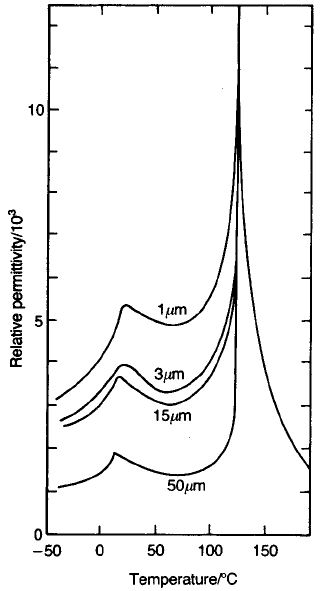
Fig. 2.48 The effect of grain size on the permittivity of a BaTiO
3
ceramic. (After K.
Kinoshita and A. Yamaji (1976) J Appl. Phys. 47, 371.)
TEAMFLY
Team-Fly
®
connectivity of 2–2. In all, 10 different connectivities are possible for mixtures of
two phases (0–0, 1–0, 2–0, 3–0, 1–1, 2–1, 3–1, 2–2, 3–2, 3–3). There are 20
possibilities for mixtures of three phases and 35 for mixtures of four phases.
The commonest case to have been analysed is that of 3–0 systems. James Clerk
Maxwell (1831–1879) deduced that the permittivity e
m
of a random dispersion of
spheres of permittivity e
1
in a matrix of relative permittivity e
2
is given by
e
m
¼ e
2
1 þ
3V
f
ðe
1
e
2
Þ
e
1
þ 2e
2
V
f
ðe
1
e
2
Þ
ð2:125Þ
where V
f
is the volume fraction occupied by the dispersed particles. The result is
independent of the size of the dispersed particles. For e
2
e
1
and V
f
40:1
Eq. (2.125) reduces to
e
m
¼ e
2
1
3V
f
2
ð2:126Þ
This formula can be used to convert the values of permittivity found for porous
bodies to the value expected for fully dense bodies.
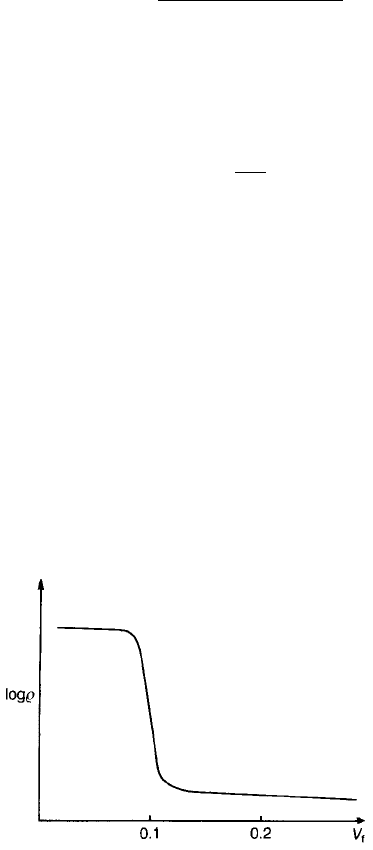
Eq. (2.125) gives results in good agreement with measurement when V
f
is less
than about 0.1. One reason for this limitation lies in the connectivity of the
dispersed phase. At higher volume concentrations the disperse phase forms
continuous structures that have a connectivity greater than zero. This is seen very
clearly in the resistance–volume concentration relations for dispersions of
conductive particles in insulating media (Fig. 2.49). The resistivity remains high
until a critical concentration in the neighbourhood of 0.05–0.2 is reached when it
drops by several orders of magnitude. There is a transition from a dispersion of
separated particles to one of connected aggregates.
A capacitor containing a two-phase 1–3 dielectric consisting of rods of
permittivity e
1
extending from one electrode to the other in a medium of
CHARGE DISPLACEMENT PROCESSES 83
Fig. 2.49 Log resistivity versus volume fraction of conductive particles in an insulating
matrix.
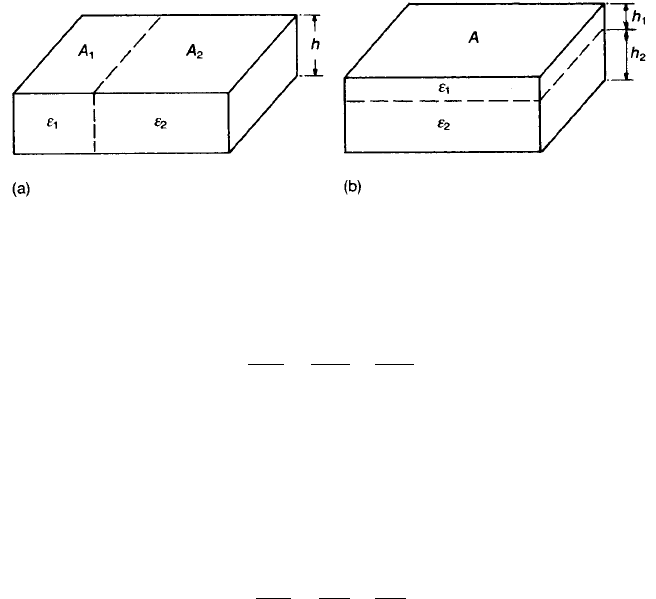
permittivity e
2
is equivalent in behaviour to the simple composite shown in Fig.
2.50(a). The structure in Fig. 2.50(a) consists of two capacitors in parallel so that
e
m
A
h
¼
e
1
A
1
h
þ
e
2
A
2
h
that is,
e
m
¼ð1 V
f
Þe
2
þ V
f
e
1
ð2:127Þ
A 2–2 connectivity dielectric with the main planes of the phases parallel to the
electrodes is equivalent to the structure shown in Fig. 2.50(b). In this case there
are effectively two capacitors in series so that
h
Ae
m
¼
h
1
Ae
1
þ
h
2
Ae
2
and
e
1
m
¼ð1 V
f
Þe
1
2
þ V
f
e
1
1
ð2:128Þ
Eqs (2.127) and (2.128) represent two extreme connectivity structures for
dielectrics. Both can be represented by the formula
e
n
m
¼ð1 V
f
Þe
n
2
þ V
f
e
n
1
ð2:129Þ
where n ¼1, or for a multiplicity of phases of partial volumes V
f
1
, V
f
2
, :::, V
f
i
e
n
m
¼
X
i
V
f
i
e
n
i
ð2:130Þ
The approximation x
n
¼ 1 þ nlnx is valid for small values of n and applying it to
Eq. (2.130) gives
lne
m
¼
X
i
V
f
i
lne
i
ð2:131Þ
Although the theoretical backing for Eq (2.131) is perhaps questionable, it
serves as a useful rule. It was first proposed by K. Lichtenecker [16] and can also
84 ELEMENTARY SOLID STATE SCIENCE
Fig. 2.50 Equivalent structures for dielectrics with (a) 1–3 and (b) 2–2 connectivity.
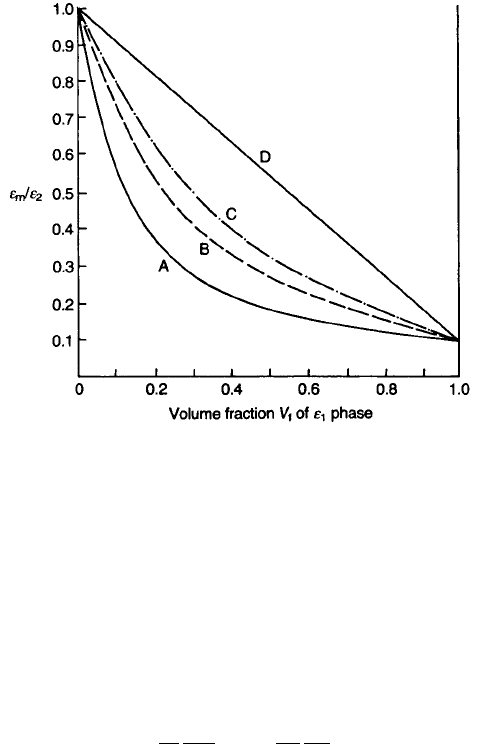
be applied to the electrical and thermal conductivity and the magnetic
permeability of mixed phases. Plots of Eqs (2.125), (2.127), (2.128) and (2.131)
are shown in Fig. 2.51 where it can be seen that both Lichtenecker’s and
Maxwell’s equations give predictions intermediate between those of the series
and parallel models.
Differentiation of Eq. (2.131) with respect to temperature leads to
1
e
m
@e
m
@T
¼
X
i
V
f
i
e
i
@e
i
@T
ð2:132Þ
which gives the temperature coefficient of permittivity for a mixture of phases
and, although not in exact agreement with observation, is a useful approximation.
2.7.5 Impedance spectroscopy
Impedance spectroscopy is discussed in depth in the monograph edited by J.Ross
Macdonald [17]. It has its origins in the classical work of K.S. Cole and R.H.
Cole, published more than 60 years ago, concerned with methods of plotting the
response of a dielectric material to applied voltages as a function of frequency.
The method assists in identifying observed relaxation effects with processes at the
atomic and microstructural levels. For a system having a single well-defined
CHARGE DISPLACEMENT PROCESSES 85
Fig. 2.51 Mixture relations for e
2
=e
1
¼ 10: curve A, equation (2.128) (phases in series); curve
B, equation (2.125) (Maxwell); curve C, equation (2.131) (Lichtenecker); curve D, equation
(2.127) (phases in parallel).
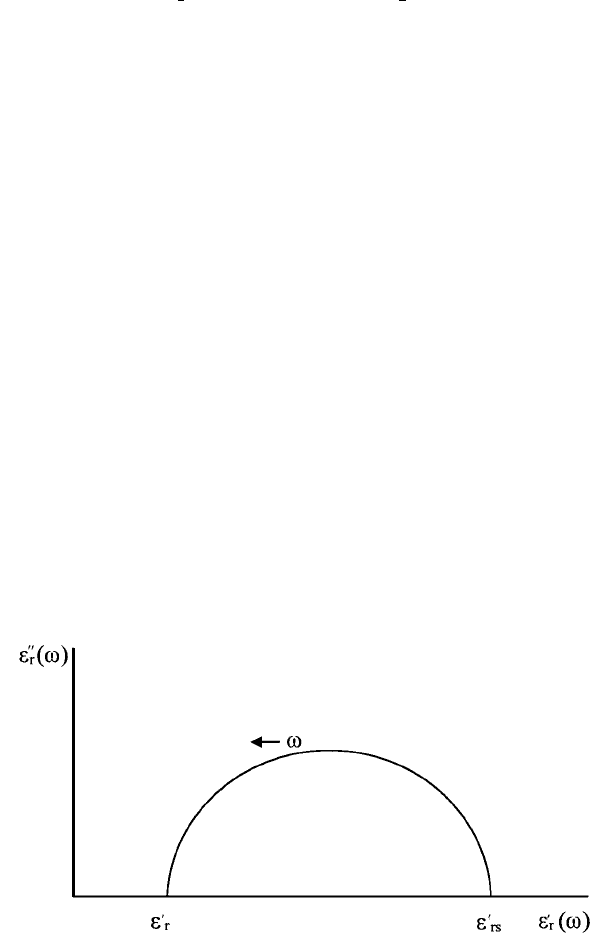
relaxation time the response would be in accordance with the Debye equations,
Eqs (2.117) and (2.118). A plot of e
00
r
(o) against e
0
r
(o) takes the form of a
semicircle.
This can be verified by eliminating (ot) between the two equations, leading to
fe
0
r
ðoÞ
1
2
ðe
0
rs
þ e
0
r 1
Þg
2
þ e
00
r
ðoÞ
2
¼
1
4
ðe
0
rs
e
0
r 1
Þ
2
, ð2:133Þ
the equation for the semi-circle shown in Fig. 2.52.
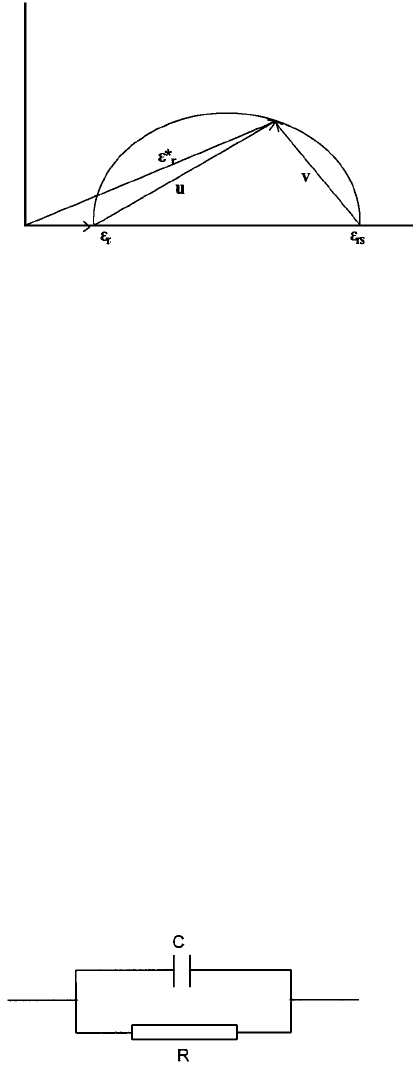
It is instructive, and more elegant, to prove the form of the plot as follows. In
the complex plane vectors e*
r
, e
r1
, e
rs
, u and v are defined as shown in Fig. 2.53.
A point on the curve (e
0
ðoÞ and e
00
ðoÞ at a particular frequency) is defined by
the vector e*
r
. From the figure
v ¼ u ðe
rs
e
r1
Þ, ð2:134Þ
(e
rs
e
r
) being a constant length.
The complex form of the Debye equation (Eq. (2.116)) is
ðe*
r
e
r1
Þð1 þ jotÞ¼ðe
rs
e
r1
Þð2:135Þ
From the figure e*
r
¼ e
r1
þ u and substituting this, and the expression for
(e
rs
e
r1
) given by Eq. (2.134), into Eq. (2.135) leads to v ¼jot u. This shows
that in the complex plane u and v are at right angles to each other; that is they
define points on a semicircle of diameter (e
rs
e
r1
).
When a voltage step is applied to the simple RC parallel circuit shown in
Fig. 2.54 the response current decays to zero in a manner describable by a single
relaxation time. The frequency response of the impedance also yields a semicircle
as shown below. Such a circuit can represent a ‘lossy’ capacitor, and more
elaborate combinations of resistors and capacitors correspondingly more
electrically complex materials and systems. It is this rather more general
approach which is described by ‘impedance spectroscopy’.
86 ELEMENTARY SOLID STATE SCIENCE
Fig. 2.52 Plot of the frequency response of the real and imaginary components of the relative
permittivity of a dielectric satisfying the Debye equations.
1
The impedance of the circuit Fig. 2.54 is
Z* ¼ Rð1 joRCÞ=ð1 þ o
2
R
2
C
2
Þð2:136Þ
so that the real and imaginary components are
Z
0
¼ R=ð1 þ o
2
R
2
C
2
Þð2:137Þ
and
Z
00
¼ oR
2
C=ð1 þ o
2
R
2
C
2
Þð2:138Þ
Since the time constant of the circuit is t ð¼ RCÞ the equations can be written
Z
0
¼ R=ð1 þ o
2
t
2
Þð2:139Þ
and
Z
00
¼ Rot=ð1 þo
2
t
2
Þð2:140Þ
which are of the same form as Eqs (2.117) and (2.118), that is Debye-like, with R
in the place of (e
0
rs
e
0
r1
).
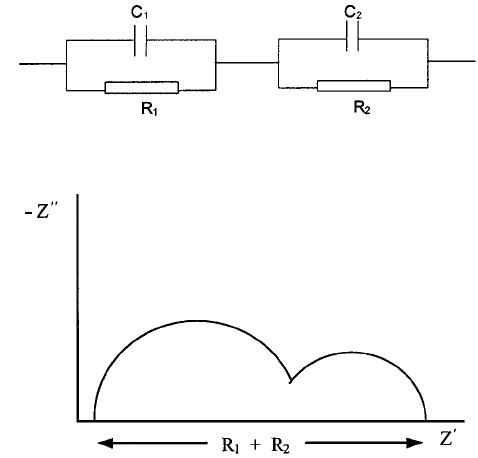
Two such circuits having different relaxation time constants and connected in
series lead to two semicircles as shown in Fig. 2.55(b). As in the case of any other
spectroscopic analysis the separate responses may overlap and the experimental
curve must then be resolved into its separate constituent semicircles. Impedance
spectroscopy makes use of other electrical parameters, including the ‘admittance’
(Y ¼Z
71
), to assist in quantifying the circuit parameters.
CHARGE DISPLACEMENT PROCESSES 87
Fig. 2.53 Permittivity as f(o) plotted in the complex plane.
1
Fig. 2.54 The equivalent circuit simulating a ‘lossy’ capacitor.
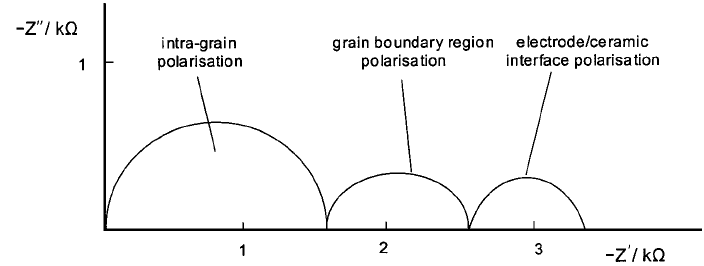
The frequency response of a real polycrystalline ceramic carrying metallic
electrodes may yield three well defined semicircles representing respectively
polarization processes associated with the interior of the grains, with the grain
boundary regions and with the electrode–ceramic interfacial region. Such a clear-
cut situation is illustrated in Fig. 2.56.
Impedance spectroscopy is a valuable addition to the range of techniques for
the electrical characterisation of materials and components, especially where
interfaces (e.g. metallic electrode/cathode or anode materials) are involved. This
is particularly so in the case of batteries and fuel cells, the subjects of the most
intensive research and development stimulated by the need to develop power
sources which reduce dependence on fossil fuels and their damage to the
environment (see Section 4.5.1).
In conclusion, the following extract from the Introduction to a text (V.V.
Daniel (1967) Dielectric Relaxation, Academic Press, 1967) dealing with
dielectric relaxation is thought-provoking.
Relaxation is a process. The term applies, strictly speaking, to linear systems
where a response and stimulus are proportional to one another in equilibrium.
Relaxation is a delayed response to a changing stimulus in such a system.
Dielectric relaxation occurs in dielectrics, that is in insulating materials with
negligible or small electrical conductivity. The stimulus is almost always an
88
ELEMENTARY SOLID STATE SCIENCE
Fig. 2.55 (a) Series-parallel RC circuit which could, depending on component values,
produce the frequency response shown in (b).
(a)
(b)
electrical field, the response a polarization. The time lag between field and
polarization implies an irreversible degradation of free energy to heat.
The objective of this monograph is to describe and interpret the time
dependence of the electrical response of dielectrics. Interpretation is difficult
because the observable relationship between polarization and field is simple in the
cases relevant for dielectric relaxation and because the measurements have
relatively little information content. The response of the dielectric can be
described by a set of linear differential equations and many models can be
described which correspond to the same differential equations. When the
dielectric relaxation of a given material has been measured the investigator is in
the position of a man presented with a black box which has two terminals. He
may apply alternating fields of various kinds and he may heat the box but he is
not allowed to look inside. And he finds that the box behaves as if it contained a
combination of capacitors and resistors.
The reaction of our investigator to the puzzle presented by the black box will
differ according to whether he is a mathematician, electrical engineer, physicist or
chemist. The mathematician will be satisfied by a description in terms of
differential equations and the engineer by an equivalent circuit. However the
physicist or chemist will want an interpretation in terms of the structure of the
material whose response can be represented by the black box. The materials
scientists will often be disappointed.
The relaxation of the polarization in response to a change of the field applied to
a material is not due directly to the pull of the field, as suggested by the naı
¨
ve
imagination. It is brought about by thermal motion, and fields of the magnitude
relevant to dielectric relaxation perturb the thermal motion only slightly.
The structural interpretation of dielectric relaxation is a difficult problem in
statistical thermodynamics. It can for many materials be approached by
considering dipoles of molecular size whose orientation or magnitude fluctuates
spontaneously, in thermal motion. The dielectric constant of the material as a
whole is arrived at by way of these fluctuations but the theory is very difficult
because of the electrostatic interaction between dipoles. In some ionic crystals the
analysis in terms of dipoles is less fruitful than an analysis in terms of thermal
vibrations. This also is a theoretically difficult task forming part of lattice
dynamics. In still other materials relaxation is due to electrical conduction over
paths of limited length. Here dielectric relaxation borders on semiconductor
physics.
CHARGE DISPLACEMENT PROCESSES 89
Fig. 2.56 Form of impedance plot for an yttria-stabilized zirconia (see Section 4.5.3.1(b)) at
4908C(p
O
2
¼ 10
2
atm.) based on data by E.J.L Schouler et al. (1983) Solid State Ionics 9 and
10, 989.
Problems
1. If the nucleus of an oxygen atom, scaled up to 1 m, is at your location estimate the
distance from you of the outer electrons. [Answer: 50 km]
2. For a hydrogen atom, show that the potential energy of the electron at distance R
from the nucleus is given by e
2
=4pe
0
R.
3. Show that there are 2n
2
electronic states available to electrons having principal
quantum number n.
4. Estimate the wavelength of the electrons in a 300 kV electron microscope. [Answer:
2.24 pm; 1.97 pm (relativistic)]
5. An electron beam is accelerated through a potential difference of 12 kV and falls onto
a copper target. Calculate the shortest-wavelength X-rays that can be generated.
[Answer: 103 pm]
6. In a metal oxide the oxygen ions are in a hexagonally close-packed array. Calculate
the size of an ion that would just fit (into (i) an octahedral interstice and (ii) a
tetrahedral interstice. [Answer: ð
p
21Þr
0
¼58 pm; ð
p
ð3=2Þ1Þr
0
¼31:5pm]
7. Calculate the crystal density of BaTiO
3
. The dimensions of the tetragonal unit cell
are: a ¼ 399:2 pm; c ¼ 403:6 pm. Relative atomic masses: O, 16.00; Ti, 47.90; Ba,
137.3. [Answer: 6022 kg m
3
]
8. Estimate the molar fraction of Schottky defects in a crystal of metal oxide MO at
2000 8C given that the formation enthalpy of a single defect is 2 eV. [Answer:
6:08 10
3
]
9. Using the Fermi function, estimate the temperature at which there is a 1%
probability that an electron in a solid will have an energy 0.5 eV above the Fermi
energy. [Answer: 1300 K]
10. In an experiment concerning the resistivity of ‘pure’ silicon carbide the specimen was
irradiated with electromagnetic radiation the frequency of which was steadily
increased. A large decrease in resistivity was observed at a wavelength of 412 nm. If
in the absence of radiation the resistivity of the specimen was 0.1 O m at room
temperature, estimate the intrinsic resistivity at 400 8C.
Comment on the realism of the estimate.
11. The electrical conductivity of KCl containing a small amount of SrCl
2
in solid
solution is measured over a temperature range where both intrinsic and extrinsic
behaviour is observed. It is assumed that the dominant intrinsic disorder is of the
Schottky type. The data fit the relationships
90 ELEMENTARY SOLID STATE SCIENCE
s
i
¼ 6:5 10
7
exp
2:3 10
4
T
Sm
1
s
e
¼ 5:3exp
8:2 10
3
T
Sm
1
in the intrinsic and extrinsic ranges respectively. Assuming that the dopant has led to
the formation of cation vacancies, estimate the enthalpy change associated with the
creation of a single Schottky defect. [Answer: 2.55 eV]
12. Derive the Nernst–Einstein relationship.
The electrical conductivity of sapphire in a particular crystallographic direction
was found to be 1.25 mS m
1
at 1773 K. An independent experiment on the same
material at the same temperature determined the oxygen tracer diffusion coefficient
to be 0.4 nm
2
s
1
, the diffusion occurring by a vacancy mechanism. Do these data
favour oxygen ion movement as the dominant charge transport mechanism?
(Relative atomic masses, Al ¼ 27 and O ¼16; density of sapphire, 3980 kg m
3
.)
13. A sample of potassium ferrite with the chemical formula K
þ
1:25
Fe
2þ
0:25
Fe
3þ
10:75
O
2
17
is a
mixed ionic/electronic conductor with the b-alumina structure (see Section 4.5). It
contains 4.0710
27
potassium ions per cubic metre located in the (001) planes. For
this material, the total electrical conductivity at 573 K is 1.5310
72
Sm
71
and the
diffusion coefficient at 573 K for potassium ions is 1.8910
714
m
2
s
71
. Calculate the
transport number for potassium ions at 573 K. If the energy of migration of
potassium ions is 23 kJ mol
71
, what will be the ionic conductivity of the sample at
298 K?
(Reproduced, in slightly modified form, by kind permission of the University of
Cambridge) [Answers: 0.016; 5.5710
76
Sm
1
]
14. From the data given in Fig. 2.12, together with other data given in the text, estimate
the ratio of electron concentration to hole concentration for ‘pure’ BaTiO
3
at 800 8C
and p
O
2
¼ 10
15
Pa. [Answer: of order 10
5
]
15. Estimate the band gap for BaTiO
3
from the minima in the s versus p
O
2
isotherms in
Fig. 2.12, together with other data drawn from the text. [Answer: 3:0 eV]
16. A square parallel-plate capacitor of side 10 mm and thickness 1 mm contains a
dielectric of relative permittivity 2000. Calculate the capacitance.
When 200 V is applied across the plates calculate (i) the electric field in the
dielectric, (ii) the total charge on one of the plates, (iii) the polarization in the
dielectric and (iv) the energy stored in the dielectric. [Answers: 1.77 nF; (i)
200 kV m
1
, (ii) 354 nC, (iii) 3.54 mC m
2
and (iv) 35 mJ]
17. Using the data given in Table 2.5 together with Eq. (2.89) calculate the relative
permittivity of the mineral forsterite (see Section 5.5.1). The orthorhombic cell
PROBLEMS 91