
Moulson A.J., Herbert J.M. Electroceramics: Materials, Properties, Applications
Подождите немного. Документ загружается.

threshold, given that a change in voltage of 1 nV on the pyroelectric element can be
detected. [Answer: 2.8 mWm
72
]
5. (a) Describe and justify a suitable route for preparing a ceramic for use as a
pyroelectric detector. The description should include co-precipitation, hot pressing,
control of porosity and grain size. (b) Describe a route for the construction of a thin
film PST-based pyroelectric array for thermal imaging.
6. Explain concisely the underlying physics of the l/4 radiation absorbing structure
shown in Fig. 7.13.
7. A ceramic pyroelectric material has the formula
PbZr
0.8
Fe
0.1
Nb
0.1
Ti
0.02
U
0.0021
O
3
What do each of these cations contribute?
8. What is the objection to using PZT compositions of the type developed for
piezoelectric applications in a pyroelectric infrared detector? What are the properties
needed and how have they been achieved?
9. A pyroelectric ceramic has a tan d of 0.005 arising solely due to dielectric losses
and e
r
¼ 250 at 100 Hz. What is the minimum resistivity that the ceramic can have
without incurring a 20% increase in tan d. What will be the consequent effect on
the noise-related figure of merit of a 20% increase? [Answers: 7.2610
8
O m; 10%
decrease]
Bibliography
1. Whatmore, R.W. (1986) Pyroelectric devices and materials, Rep. Prog. Phys., 49, 1335–
86.
2. Whatmore, R.W. and Watton, R. (2001) Pyroelectric Materials and Devices. In:
Infrared Detectors and Emitters: Materials and Devices , Kluwer Academic, Chapter 5,
pp. 99–148.
3. Smith, R.A., Jones, F.E. and Chasmar, R.P. (1957) The Detection and Measurement of
Infra-red Radiation, Clarendon Press, Oxford.
432 PYROELECTRIC MATERIALS
TEAMFLY
Team-Fly
®

8
ELECTRO-OPTIC CERAMICS
The last decade has seen an intensification of research and development effort
into ‘photonics’, a term embracing the many related optical technologies
harnessed principally for communications and the processing of information.
Specifically, it is concerned with generating, amplifying, detecting, guiding,
modulating, or modifying optical radiation and covers a range of interests
including lasers, opto-electronics, fibre-optics, non-linear optics, acousto-optics,
optical data storage and electro-optics. The focus of attention here is mainly on
the electro-optical effects in polar ceramics. However, the last decade has also
seen a strong interest grow in the non-linear properties of poled glasses and the
potential they have for modifying and controlling optical signals. The discussion
includes a brief summary of this development.
The article by G.H. Haertling [1], a pioneer in the field of electro-optical
ceramics, and the monographs by J.M. Herbert [2] and F. Aguillo
´
-Lo
´
pez et al.
[3], which cover much of the same ground as the present text but in greater detail,
are recommended to supplement the discussion. The classical work by M.E.
Lines and A.M. Glass [4] and the monograph by J.C. Burfoot and G.W. Taylor
[5] are invaluable. The text by R.M. Wood [6] and the review of ‘poled glasses’ by
W. Margulis et al. [7] are especially suited to the ‘materials’ student.
There are many books covering the background optics and that by A. Yariv
and P. Yeh [8] can be recommended.
8.1 Background Optics
To appreciate properly how electro-optic ceramics function, it is first necessary
to consider the nature of light and its interaction with dielectrics.
James Clerk Maxwell (1831–1879), against a background of experimental and
theoretical work by Andre
´
Ampe
`
re (1775–1836). Karl Gauss (1777–1855) and
Michael Faraday (1791–1867), developed the electromagnetic wave theory of
Electroceramics: Materials, Properties, Applications. 2nd Edition. Edited by A. J. Moulson and J. M. Herbert.
& 2003 John Wiley & Sons, Ltd: ISBN 0 471 49747 9 (hardback) 0 471 49748 7 (paperback)
light. Maxwell’s equations describe how an electromagnetic wave originates from
an accelerating charge and propagates in free space with a speed of
2.998610
8
ms
71
. An electromagnetic wave in the visible part of the spectrum
may be emitted when an electron changes its position relative to the rest of an
atom, involving a change in dipole moment. Light can also be emitted from a
single charge moving at high speed under the influence of a magnetic field:
because the charge follows a curved trajectory it is accelerating and, as a
consequence, radiating. The radiation, termed ‘synchrotron radiation’, is emitted
naturally from regions of the Universe, e.g. the Crab Nebula. An electromagnetic
wave in free space comprises an electric field E and a magnetic induction field B
which vibrate in mutually perpendicular directions in a plane normal to the wave
propagation direction. The E vector of a single sinusoidal plane-polarized wave
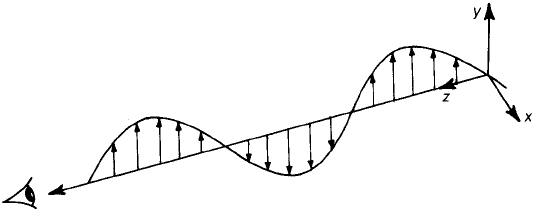
propagating in the z direction is shown in Fig. 8.1. The wave is polarized in the
y–z plane, and the convention is to describe the plane to which E is confined as
the plane of polarization.
Radiation from a single atom, say in an electric light bulb filament, only
persists in phase and polarization for a time of the order of 10
78
s, so that light
from such sources contains a random mixture of polarizations and phases as well
as a wide range of wavelengths. Such radiation is said to be unpolarized,
incoherent and white, but by various means (particularly the use of laser sources)
light can be obtained with a specified polarization, a coherence persisting for
times in the neighbourhood of 10
75
s and a linewidth of less than 10 Hz at a
frequency of 10
14
Hz. For many purposes the polarization is the simplest feature
to control optically and to alter electrically.
8.1.1 Polarized light
The various forms of polarization can be understood by considering a plane-
polarized wave travelling in the z direction. It can be resolved into two
434 ELECTRO-OPTIC CERAMICS
Fig. 8.1 E vector of a wave polarized in the y–z plane and propagating in the z direction
towards the observer.
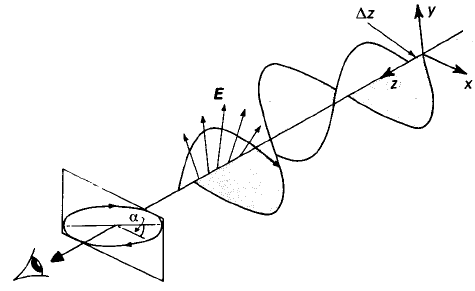
components, one polarized in the x–z plane and the other in the y–z plane, as
shown in Fig. 8.2. A phase difference can be established between the two
components, for instance by passage through a medium with an anisotropic
refractive index such that the velocity of the y–z wave is greater than that of the
x–z wave. This will cause the y–z wave to lead the x–z wave by a distance, say,
Dz, i.e. by a phase angle d ¼ 2pDz=l. d will remain constant when the light
emerges into an isotropic medium such as air.
Confining attention to the electric fields, we have for the x wave,
E
x
¼ E
0x
sinðkz otÞð8:1Þ
and for the y wave
E
y
¼ E
0y
sinðkz ot þ dÞð8:2Þ
in which E
0x
and E
0y
are the amplitudes, k is the propagation number ðk ¼ 2p=lÞ
and o is the angular frequency. The locus of the tip of the resultant E can now be
determined as the waves pass a plane z ¼ constant. If, for simplicity, we put z ¼ 0
in Eqs (8.1) and (8.2) we obtain
E
x
¼E
0x
sinðotÞ¼E
0x
sinðotÞð8:3Þ
and
E
y
¼ E
0y
sinðot þ dÞ¼E
0y
sinðot dÞ
Then
E
y
¼E
0y
fsinðotÞcos d cosðotÞsin dgð8:4Þ
Substituting sin(otÞ¼E
x
=E
0x
from Eq. (8.3) into (8.4) and rearranging yields
BACKGROUND OPTICS 435
Fig. 8.2 The two components of a right elliptically polarized wave.

E
x
E
0x
!
2
þ
E
y
E
0y
!
2
2
E
x
E
0x
!
E
y
E
0y
!
cos d ¼ sin
2
d ð8:5Þ
which represents an ellipse with semiminor and semimajor axes E
0y
and E
0x
respectively. The major axis of the ellipse is inclined to the x axis at an angle a,
where
tanð2aÞ¼
2E
0x
E
0y
cos d
E
2
0x
E
2
0y
ð8:6Þ
The above treatment is general, but the following special cases are important.
1. When d ¼ p=2
E
x
E
0x
!
2
þ
E
y
E
0y
!
2
¼ 1 ð8:7Þ
and the tip of E describes an ellipse whose major and minor axes coincide with
the x and y axes. When E
0x
¼ E
0y
the ellipse becomes a circle.
2. When d ¼ 0
E
x
E
0x
!
2
þ
E
y
E
0y
!
2
2
E
x
E
0x
E
y
E
0y
¼ 0
i.e.
E
x
E
0x
E
y
E
0y
!
2
¼ 0
or
E
y
¼
E
0y
E
0x
E
x
ð8:8Þ
The tip of E describes a straight line passing through the origin with slope
E
0y
=E
0x
.
The paths described by the tip of E for the various values of d are summarized
in Fig. 8.3. It is apparent that plane-polarized light is a special case of elliptically
polarized light, as indeed is circularly polarized light. The sense of the
436 ELECTRO-OPTIC CERAMICS
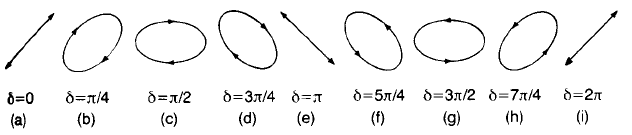
polarization is taken to be the sense of rotation of the E vector for oncoming
light. For example (b) is described as ‘right elliptically polarized light’, (f) as
‘left elliptically polarized light’, and (a) and (e) simply as ‘plane-polarized
light’. This seems to be the most commonly adopted convention, although the
opposite one might be encountered which is, in fact, more consistent with
the definitions regarding the polarization and angular momentum of a
photon.
There are materials, for example in the form of certain specially prepared
polymer films, which, for light incident normal to the film, absorb to an extent
dependent on the inclination of the plane of polarization to a unique axis in the
plane of the film. Devices made from such films are termed ‘polarizers’:
approximately 60% of the incident unpolarized light is absorbed, and that part
transmitted is plane polarized. The E vectors for the transmitted light are
perpendicular to the high-absorbance direction. If the incident light is plane
polarized, the intensity transmitted depends on the orientation of the polarizer
axis with respect to the plane of polarization of the light. A device used in this
mode is usually referred to as an ‘analyser’.
8.1.2 Double refraction
In the discussion of the piezoelectric effect in Chapter 6 the tensor character of
the permittivity of a dielectric was recognized although attention was focused on
the piezoelectric coefficients. Because the optical and electro-optical properties of
dielectrics are determined by their refractive indices or, equivalently, by their
permittivities (see Eq. (2.120)), it is now necessary to consider these parameters in
some detail.
In an isotropic dielectric such as a normal glass, the induced electrical
polarization is always parallel to the applied electric field and therefore the
susceptibility is a scalar. In general this is not the case in anisotropic dielectrics
when the polarization depends on both the direction and magnitude of the
applied field. The three components of the polarization are written
BACKGROUND OPTICS 437
Fig. 8.3 How elliptically polarized light depends on the phase difference d between plane-
polarized components.
P
x
¼ e
0
ðw
11
E
x
þ w
12
E
y
þ w
13
E
z
Þ
P
y
¼ e
0
ðw
21
E
x
þ w
22
E
y
þ w
23
E
z
Þ
P
z
¼ e
0
ðw
31
E
x
þ w
32
E
y
þ w
33
E
z
Þ
ð8:9Þ
or
D
x
¼ e
11
E
x
þ e
12
E
y
þ e
13
E
z
D
y
¼ e
21
E
x
þ e
22
E
y
þ e
23
E
z
D
z
¼ e
31
E
x
þ e
32
E
y
þ e
33
E
z
ð8:10Þ
which can be abbreviated to
D
i
¼ e
ij
E
j
ð8:11Þ
with summation over repeated indices implied.
In an anisotropic dielectric the phase velocity of an electromagnetic wave
generally depends on both its polarization and its direction of propagation. The
solutions to Maxwell’s electromagnetic wave equations for a plane wave show
that it is the vectors D and H which are perpendicular to the wave propagation
direction and that, in general, the direction of energy flow does not coincide with
this.
The classical example of an anisotropic crystal is calcite (CaCO
3
). This is the
crystal with which the first recorded observation of ‘double refraction’ was made
by Bartolinius in 1669. Because of the particular arrangement of atoms (and so
of electric charges) in calcite, light generally propagates at a speed depending on
the orientation of its plane of polarization relative to the crystal structure. For
one particular direction, the optic axis, the speed of propagation is independent
of the orientation of the plane of polarization. Because in calcite there is only one
such axis the crystal is termed uniaxial.
Crystals may have two optic axes, not necessarily perpendicular, in which case
they are termed biaxial. Orthorhombic, monoclinic and triclinic crystals are
biaxial; hexagonal, tetragonal and trigonal crystals are uniaxial; cubic crystals
are isotropic. In the following discussion attention is confined to uniaxial
crystals.
The situation can be analysed more closely by considering a source of
monochromatic light located at S in Fig. 8.4 from which two wavefronts
propagate, one with a spherical surface and the other with an ellipsoidal surface.
A wavefront is the locus of points of equal phase, i.e. the radii (e.g. SO and SE),
which are proportional to the ray speeds and inversely proportional to the
refractive indices. Figure 8.4 is a principal section of the wavefront surfaces
because it contains the optic axis SY.
Those rays, e.g. SO, for which the electric displacement component of the
wave vibrates at right angles to the principal section (indicated by the dots) travel
at a constant speed irrespective of direction; they are the ordinary or o rays.
438 ELECTRO-OPTIC CERAMICS
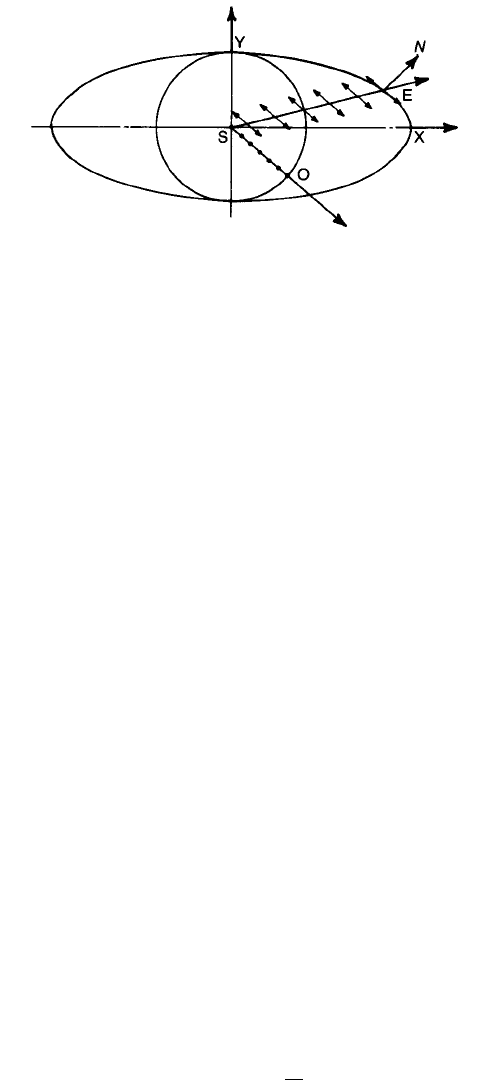
Those rays, e.g. SE, for which the electric displacement component lies in the
principal section travel at a speed which depends on direction; they are the
extraordinary or e rays. The refractive index n
e
for an e ray propagating along
SX is one of the two principal refractive indices of a uniaxial crystal; the other,
n
o
, refers to the o rays.
In Fig. 8.4 the velocity of the o ray is less than that of the e ray, except for
propagation along the optic axis. It follows that n
e
n
o
50, a situation defined as
negative birefringence. Cases of both positive and negative birefringence occur:
calcite and rutile (TiO
2
) have values of 70.18 and +0.29 respectively, and both
crystals are very birefringent. Values for the common ferroelectrics lie in the
range 70.01 to 70.1.
It is customary to develop the optical theory of crystals in terms of the relative
impermeability tensor B
ij
¼ðe
r
1
Þ
ij
, which is a second-rank tensor. It can be shown
that B
ij
is symmetrical, a property that requires B
ij
¼ B
ji
. It can also be shown that
because B
ij
is a symmetrical second-rank tensor it can be represented by
B
ij
x
i
x
j
¼ 1 ð8:12Þ
which, when expanded, is a second-degree equation representing a surface. The
notation in Eq. (8.12) implies summation over values of j ¼ 1, :::, 3 for each
value of i ¼ 1, :::, 3. The equation is called the ‘representation quadric’ and
possesses principal axes. The representation quadric for the relative imperme-
ability tensor B
ij
, with reference to its principal axes, reduces to
B
1
x
2
1
þ B
2
x
2
2
þ B
3
x
2
3
¼ 1 ð8:13Þ
in which B
1
etc. are the principal relative impermeabilities. Under the assumption
that the material is non-magnetic (m
r
¼ 1) (see Eq. 2.120)
B
1
¼ðe
1
r
Þ
1
¼
1
n
2
1
etc. ð8:14Þ
BACKGROUND OPTICS 439
Fig. 8.4 A principal section of the wavefront surfaces for a uniaxial crystal; the dots on SO
represent the E (and D) vectors which are normal to the plane of the paper.
where n
1
is the refractive index for light whose electric displacement is parallel to
x
1
. Eq. (8.13) can be written
x
2
1
n
2
1
þ
x
2
2
n
2
2
þ
x
2
3
n
2
3
¼ 1 ð8:15Þ
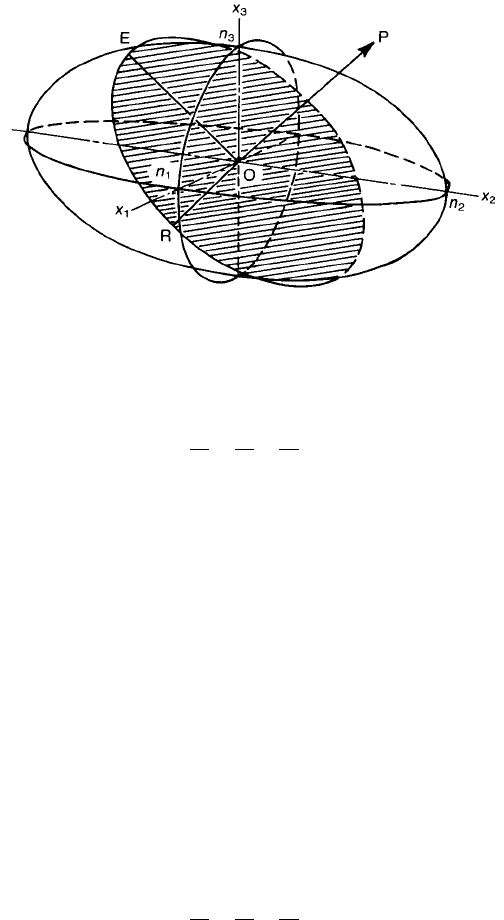
and is known as the optical indicatrix. This is an ellipsoidal surface, as shown in
Fig. 8.5, and n
1
, n
2
and n
3
are the principal refractive indices of the crystal. For
biaxial crystals n
1
6¼ n
2
6¼ n
3
.
If in Fig. 8.5 OP is an arbitrary direction, the semiminor and semimajor axes
OR and OE of the shaded elliptical section normal to OP are the refractive
indices of the two waves propagated with fronts normal to OP. For each of the
two waves associated with a given wave normal, the electric displacement D
vibrates parallel to the corresponding axis of the elliptical section.
In the special case when Ox
2
is the propagation direction the two waves have
refractive indices n
1
and n
3
; similarly, the two waves propagated along Ox
3
have
refractive indices n
1
and n
2
, and those propagated along Ox
1
have refractive
indices n
2
and n
3
.
For a uniaxial crystal the indicatrix is symmetrical about the principal
symmetry axis of the crystal – the optic axis.Ifx
3
is the optic axis, the central
section of the ellipsoid is a circle of radius n
o
and the equation becomes
x
2
1
n
2
o
þ
x
2
2
n
2
o
þ
x
2
3
n
2
e
¼ 1 ð8:16Þ
8.1.3 The electro-optic e¡ect
In the earlier discussion on dielectrics (see Section 2.7.1) a linear relationship
between P and E was assumed. The justification for this assumption rests on
440 ELECTRO-OPTIC CERAMICS
Fig. 8.5 The optical indicatrix.
experiment, and the underlying cause is that the largest field strengths commonly
encountered in practice (about 10
6
Vm
71
) are small compared with those that
bind electrons in atoms (about 10
11
Vm
71
).
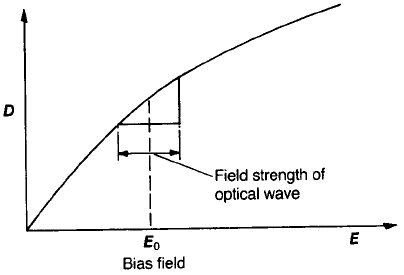
However, the linear response of a dielectric to an applied field is an
approximation; the actual response is non-linear and is of the form indicated in
Fig. 8.6. The electro-optic effect has its origins in this non-linearity, and the very
large electric fields associated with high-intensity laser light lead to the non-linear
optics technology discussed briefly in Section 8.1.4. Clearly the permittivity
measured for small increments in field depends on the biasing field E
0
, from
which it follows that the refractive index also depends on E
0
. The dependence can
be expressed by the following polynomial:
n ¼ n
0
þ aE
0
þ bE
2
0
ð8:17Þ
in which n
0
is the value measured under zero biasing field and a and b are
constants. This dependence of n on E
0
is the electro-optic effect.
It is evident that if the material has a centre of symmetry or a random
structure as in the case of a normal glass, reversal of E
0
will have no effect on n.
This requires a to be zero, so that there is only a quadratic dependence of n on E
0
(and, possibly, a dependence on higher even powers). If, however, the crystal is
non-centrosymmetric, reversal of E
0
may well affect n and so the linear term has
to be retained.
In 1875 John Kerr carried out experiments on glass and detected electric-field-
induced optical anisotropy. A quadratic dependence of n on E
0
is now known as
the Kerr effect. In 1883 both Wilhelm Ro
¨
ntgen and August Kundt independently
reported a linear electro-optic effect in quartz which was analysed by Pockels in
1893. The linear electro-optical effect is termed the Pockels effect.
The small changes in refractive index caused by the application of an electric
field can be described by small changes in the shape, size and orientation of the
BACKGROUND OPTICS 441
Fig. 8.6 Non-linearity in the D versus E relationship.