
Moulson A.J., Herbert J.M. Electroceramics: Materials, Properties, Applications
Подождите немного. Документ загружается.


optical indicatrix. These can be specified by changes in the coefficients of the
indicatrix DB
ij
which are assumed to depend on E (and P) as follows:
DB
ij
¼ r
ijk
E
k
þ R
ijkl
E
k
E
l
ð8:18Þ
or, in terms of polarization P,
DB
ij
¼ f
ijk
P
k
þ g
ijkl
P
k
P
l
ð8:19Þ
The constants r
ijk
and f
ijk
are the Pockels electro-optic coefficients, and R
ijkl
and
g
ijkl
the Kerr coefficients. They are related as follows:
f
ijk
¼
r
ijk
e
k
e
0
ð8:20Þ
and
g
ijkl
¼
R
ijkl
ðe
k
e
0
Þðe
l
e
0
Þ
ð8:21Þ
where e
k
and e
l
are the permittivity values measured with E directed along k or l.
The subscript on E
0
has now been dropped because the distinction between a bias
field and the electric field component of an electromagnetic wave should be
apparent from the context.
Whether or not the dependence is expressed in terms of E or P is a matter of
choice; it seems customary in the literature relating to single crystals to use the r
coefficient for the linear Pockels effect and g for the quadratic Kerr effect. In the
case of electro-optic ceramics r and R are most commonly used.
The r and f are third-rank tensors and the R and g are fourth-rank tensors,
and since they are both symmetrical the subscripts i and j can be interchanged,
as also can k and l. Under these circumstances it is helpful to use a ‘contracted’
or ‘reduced’ notation such that r
ijk
! r
mk
and R
ijkl
! R
mn
, where m and n run
from 1 to 6. The ij ¼ m and kl ¼ n contractions are as follows:
11 ! 1, 22 ! 2, 33 ! 3, 23 ! 4, 13 ! 5 and 12 ! 6.
A complete description of the electro-optic effect for single crystals necessitates
full account being taken of the tensorial character of the electro-optic
coefficients. The complexity is reduced with increasing symmetry of the crystal
structure when an increasing number of tensor components are zero and others
are simply interrelated. The main interest here is confined to polycrystalline
ceramics with a bias field applied, when the symmetry is high and equivalent to
1mm (6 mm) and so the number of tensor components is a minimum. However,
the approach to the description of their electro-optic properties is formally
identical with that for the more complex lower-symmetry crystals where up to a
maximum of 36 independent tensor components may be required to describe
their electro-optic properties fully. The methods are illustrated below with
reference to single-crystal BaTiO
3
and a polycrystalline electro-optic ceramic.
442 ELECTRO-OPTIC CERAMICS
TEAMFLY
Team-Fly
®

The Pockels electro-optic effect
Single-crystal BaTiO
3
(T5T
c
)
At temperatures below T
c
BaTiO
3
belongs to the tetragonal crystal class
(symmetry group 4mm); it is optically uniaxial, and the optic axis is the x
3
axis
(n
o
¼ 2.416, n
e
¼ 2.364). When an electric field is applied in an arbitrary
direction the representation quadric for the relative impermeability is perturbed
to
ðB
ij
þ DB
ij
Þx
i
x
j
¼ 1 ð8:22Þ
where DB
ij
¼ r
ijk
E
k
. Employing the contracted notation and referring to the
principal axes of the unperturbed ellipsoid (Eq. (8.12)) we can expand Eq. (8.22)
to
1
n
2
1
þ r
1k
E
k
!
x
2
1
þ
1
n
2
1
þ r
2k
E
k
!
x
2
2
þ
1
n
2
3
þ r
3k
E
k
!
x
2
3
þ 2x
2
x
3
r
4k
E
k
þ 2x
3
x
1
r
5k
E
k
þ 2x
1
x
2
r
6k
E
k
¼ 1
ð8:23Þ
in which k takes the values 1, :::, 3. From considerations of crystal symmetry it
can be shown that r
23
¼ r
13
and r
42
¼ r
51
, and that, except for r
33
, the remaining
13 tensor components are zero. Furthermore if we assume that the electric field E
is directed along the x
3
axis so that E
1
¼ E
2
¼ 0, Eq. (8.23) reduces to
1
n
2
o
þ r
13
E
!
x
2
1
þ
1
n
2
o
þ r
13
E
!
x
2
2
þ
1
n
2
o
þ r
33
E
!
x
2
3
¼ 1 ð8:24Þ
It follows that, in comparison with Eq. (8.22),
D
1
n
2
o
!
¼ r
13
E and D
1
n
2
e
!
¼ r
33
E
or, since Dn
o
n
o
and Dn
e
n
e
,
Dn
o
¼
1
2
n
3
o
r
13
E
Dn
e
¼
1
2
n
3
e
r
33
E
ð8:25Þ
The induced birefringence is Dn, where
Dn ¼ Dðn
e
n
o
Þ¼Dn
e
Dn
o
¼
1
2
n
3
e
r
33
n
3
o
n
3
e
r
13
!
E ð8:26Þ
or, simply,
Dn ¼
1
2
n
3
r
c
E
where
BACKGROUND OPTICS 443

r
c
¼ r
33
n
3
o
n
3
e
r
13
ð8:27Þ
r
c
r
33
r
13
if n n
o
n
e
.
Polycrystalline ceramic
The form of the electro-optic tensor for 6mm symmetry is identical with that
for the 4mm symmetry dealt with above. Therefore the induced birefringence for
a field directed along the x
3
axis is again
Dn ¼
1
2
n
3
r
c
E ð8:28Þ
where r
c
¼ r
33
r
13
.
A useful figure of merit for linear electro-optic materials is the half-wave
voltage V
p
which is the voltage that must be applied to opposite faces of a unit
cube of material to induce a phase difference of p between the extraordinary and
ordinary rays. It is discussed further in Section 8.2.2 (see Eq. (8.44)). Values for
V
p
are included in Table 8.1.
The Kerr quadratic electro-optic effect
Single-crystal BaTiO
3
(T4T
c
)
At temperatures above 130 8C BaTiO
3
is cubic (symmetry group m3m); it is
optically isotropic with n ¼ 2.42. When an electric field is applied in an arbitrary
direction the representation quadric is perturbed to
B
ij
þ DB
ij
¼ 1 ð8:29Þ
where DB
ij
¼ R
ijkl
E
k
E
l
.
444 ELECTRO-OPTIC CERAMICS
Table 8.1 Properties of some electro-optic materials
Material r
c
/pm V
71
V
p
/V R/nm
2
V
72
jg
11
g
12
j=m
4
C
2
Single crystals
BaTiO
3
(room temperature) 80 500 – –
BaTiO
3
(4130 8C) – – – 0.13
LiNbO
3
17.5 3030 – –
LiTaO
3
22 2800 – –
SrTiO
3
– – – 0.14
KTa
0.65
Nb
0.35
O
3
– – – 0.17
Ceramics
PLZT(8/65/35)
a
520 400 – –
PLZT(8/40/60) 100 200 – –
PLZT(9/65/35) – – 380 0.018
a
For explanation of the notation see Section 8.2.1.

Because the material is isotropic, the electric field can be directed along the x
3
axis without any loss in generality, and so E
1
¼ E
2
¼ 0. Symmetry requires
R
11
¼ R
22
¼ R
33
and R
12
¼ R
13
¼ R
23
¼ R
31
¼ R
32
, R
44
¼ R
55
¼ R
66
, and the
remaining components to be zero. Therefore the indicatrix can be written
x
2
1
1
n
2
þ R
12
E
2
þ x
2
2
1
n
2
þ R
12
E
2
þ x
2
3
1
n
2
þ R
11
E
2
¼ 1 ð8:30Þ
Now
n
1
¼ n þ Dn
1
¼ n
1
2
n
3
R
12
E
2
¼ n
2
and
n
3
¼ n þDn
3
¼ n
1
2
n
3
R
11
E
2
The induced birefringence is given by
Dn ¼ n
e
n
o
¼ n
3
n
1
¼
1
2
n
3
ðR
11
R
12
ÞE
2
ð8:31Þ
or, in terms of the polarization,
Dn ¼
n
3
2
ðR
11
R
12
ÞP
2
e
2
0
ðe
r
1Þ
2
¼
1
2
n
3
ðg
11
g
12
ÞP
2
ð8:32Þ
Polycrystalline ceramic
In the case of polycrystalline ceramic (6mm) the form of the electro-optic tensor
is the same as that for m3m symmetry except that R
66
¼
1
2
ðR
11
R
12
Þ. Therefore,
when a field is applied along the x
3
axis, the induced birefringence is again
Dn ¼
1
2
n
3
ðR
11
R
12
ÞE
2
ð8:33Þ
or, in terms of the polarization,
Dn ¼
1
2
n
3
ðg
11
g
12
ÞP
2
ð8:34Þ
The electro-optic properties of a few important materials are summarized in
Table 8.1.
8.1.4 Non-linear optics
Second harmonic generation (SHG)
In the previous section the effects of a d.c. bias field on optical properties were
discussed. The effects arise because the bias field is sufficiently strong (10
6
Vm
1
)
to significantly disturb the structure of an anisotropic crystal such as LiNbO
3
,a
BACKGROUND OPTICS 445
disturbance described by changes in the optical indicatrix. The strength of the
electric vector (10
2
Vm
1
) of the light used in such experiments acts on the bound
electrons in an essentially linear way. We now turn attention to laser light for which
the electric vector can have magnitudes in the range 10
8
–10
12
Vm
1
. Under such
intense fields the interaction with the electrons is non-linear.
Field strengths as high as this, if applied statically or at low frequency, are
strong enough to detach electrons from atoms or ions and cause breakdown. As
a component of light the peak fields persist for only very short times (10
15
s)
and so do not cause breakdown.
The non-linearity in the response can be expressed by
P ¼ e
0
ðw
1Þ
E þ w
2Þ
E
2
þ w
3Þ
E
3
þ :::Þ (8:35Þ
Because the susceptibilities are tensors, for the linear dependence we have
P
i
¼ e
0
w
1Þ
ij
E
j
(8:36Þ
and for the quadratic
P
i
¼ e
0
w
2Þ
ijk
E
j
E
k
(8:37Þ
In the literature relating to second harmonic generation d-coefficients are
sometimes used rather than ws when, employing a contracted notation
ðjk ¼ s ð1,2, :::,6ÞÞ
d
is
¼ w
2Þ
is
=2(8:38Þ
with ‘s’ running from 1 to 6, the values of the permutated ‘jk’.
If laser light of sufficient intensity is propagating through an optically non-
linear material, and the time dependence of the electric vector component of the
electromagnetic field is given by E ¼ E
0
sinðotÞ, then from Eq. (8.35), the
polarization is given by
P ¼ e
0
fw
1Þ
E
0
sinðotÞþw
2Þ
E
2
0
sin
2
ðotÞþw
3Þ
E
3
0
sin
3
ðotÞþ :::g
¼ e
0
w
1Þ
E
0
sinðotÞþ
1
2
w
2Þ
E
2
0
f1 cosð2otÞg
þ
1
4
w
3Þ
E
3
0
f3 sinðotÞsinð3otÞg ð8:39Þ
The term w
1Þ
E
0
sinðotÞ represents the response expected from a linear dielectric.
The second term contains the components
1
2
w
2Þ
E
2
0
and
1
2
w
2Þ
E
2
0
cosð2otÞ: the first
of these represents a constant polarization which would produce a voltage across
the material, that is rectification; the second corresponds to a variation in
polarization at twice the frequency of the primary wave. Thus the interaction of
laser light of a single frequency with a suitable non-linear material leads to both
frequency doubling (SHG) and rectification.
Whether or not second harmonics can be generated in a material depends
upon the symmetry of its structure. For example, in the case of isotropic
446 ELECTRO-OPTIC CERAMICS
materials such as cubic crystals (e.g. calcite) and normal glasses, reversal of E
simply reverses P; therefore there can be no even-power terms in Eq. (8.35) so
that w
2Þ
etc. are zero and SHG is not possible. Specially modified glasses can
generate second harmonics, as discussed in Section 8.4.
A difficulty arises in the production of second harmonic radiation because of
‘dispersion’, that is the dependence of wave velocity on frequency. We consider
the primary wave (angular frequency o) interacting with a bound electron and
producing a second harmonic (2o) wave. At this point the two waves are in
phase. As the ‘o-wave’ propagates it generates new second harmonic, ‘2o-waves’
and, because of dispersion, the ‘o-wave’ will, in general, travel with a different
phase velocity than that of the ‘2o-wave’. As a result a ‘new’ ‘2o-wave’ will
interfere with those generated earlier, and only constructively if they have the
required phase relationship.
For a plane wave travelling in a direction normal to the surfaces of a plate of
thickness L the following proportionality can be derived [9] for the intensity I of
the second harmonic wave leaving the plate:
I /fsin
2
2pðn
1
n
2
ÞL=l
0
g=ðn
1
n
2
Þ
2
(8:40Þ
where n
1
and n
2
are the refractive indices for angular frequencies o and 2o
respectively and l
0
(or 2pc/o), is the wavelength of the fundamental frequency
wave travelling in a vacuum.
From Eq. (8.40), because the intensity is inversely proportional to (n
1
n
2
)
2
, the
efficient production of SHG radiation in a crystal of appreciable thickness
requires the matching of n
1
and n
2
. In certain birefringent materials it is possible
to choose a direction of propagation such that the refractive indices of the
ordinary and extraordinary rays are equal. This is possible in, for example, the
crystal potassium dihydrogen phosphate (KDP).
Frequency mixing
It is also possible to ‘mix’ frequencies when light beams differing in frequency are
made to follow the same path through a non-linear medium. For example, if two
waves with electric field components E
1
sinðo
1
tÞ and E
2
sinðo
2
tÞ follow the same
path through a dielectric with the characteristic
P ¼ e
0
ðw
1Þ
E þ w
2Þ
E
2
Þð8:41Þ
then the second-order contribution is given by
e
0
w
2Þ
fE
2
1
sin
2
ðo
1
tÞþE
2
2
sin
2
ðo
2
tÞþ2E
1
E
2
sinðo
1
tÞsinðo
2
tÞg ð8:42Þ
The first two terms in braces describe SHG and the last term describes waves of
frequency o
1
þ o
2
and o
1
o
2
. The output of a wave of frequency o
1
þ o
2
is
known as ‘up-conversion’ and has been used in infrared imaging. For example,
BACKGROUND OPTICS 447
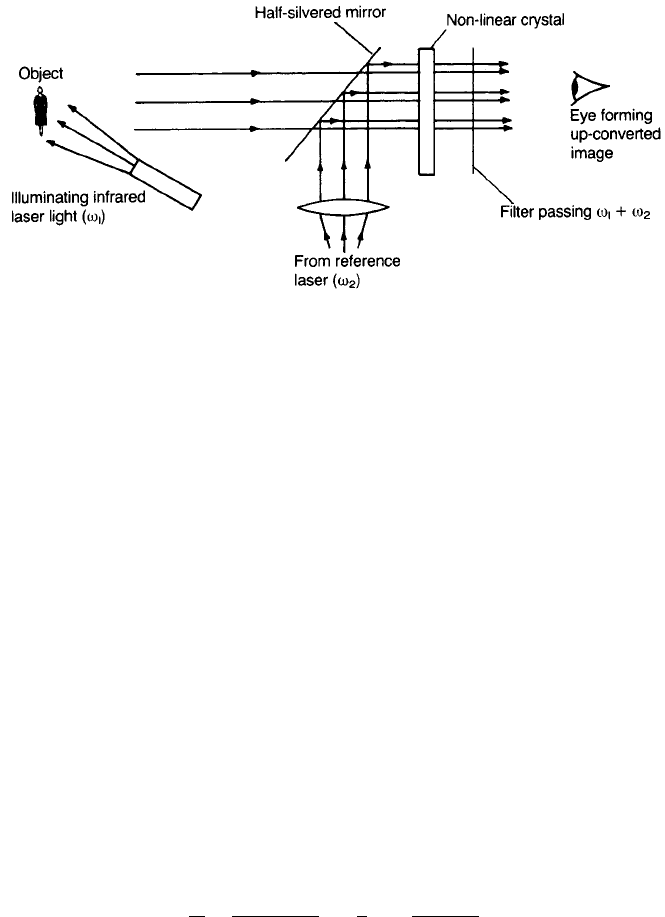
as shown in Fig. 8.7, infrared laser light reflected from an object can be mixed
with a suitably chosen infrared reference beam to yield an up-converted
frequency in the visible spectrum. Also, the possibility of obtaining outputs
corresponding to the sums and differences of the frequencies of two signals opens
up the possibility of processing optical signals in similar ways to electronic
signals. This is the subject of intensive research effort.
8.1.5 Transparent ceramics
For a ceramic to be useful as an electro-optic material it must, of course, be
transparent. Ceramic dielectrics are mostly white and opaque, though thin
sections are usually translucent. This is due to the scattering of incident light.
Scattering occurs because of discontinuities in refractive index which will usually
occur at phase boundaries (including porosity) and, if the major phase itself is
optically anisotropic, at grain boundaries. For transparency, therefore, a ceramic
should consist of a single-phase fully dense material which is cubic or
amorphous; glasses usually fulfil these requirements.
It is instructive to examine Rayleigh’s expression
I
y
I
0
/
1 þ cos
2
y
x
2
r
2
r
l
4
n
p
n
m
n
m
2
ð8:43Þ
for the intensity I
y
of light scattered through an angle y by a dispersion of
particles of radius r and refractive index n
p
in a matrix of refractive index n
m
,
where n
p
n
m
is small. The incident intensity is I
0
, I
y
is measured at a distance x
from the particles and l is the wavelength of the scattered light (r5l).
It should be noted that the scattering is proportional to (r/l)
4
and so, for
example, if r/l is reduced from 10
71
to 10
72
, the scattering decreases by a factor
448 ELECTRO-OPTIC CERAMICS
Fig. 8.7 Up-conversion of infrared to the visible frequency range.
of 10
4
. This suggests that pores much smaller than the wavelength of the light will
have only a minor scattering effect. Indeed, any change in refractive index that
only persists for a fraction of a wavelength can be expected to have little effect.
Thus dense ceramics composed of ultrafine particles of six 0.1 mm or less are
expected to be transparent to visible light (l(yellow)0.5mm) even if the particles
are optically anisotropic.
Because the scattering is proportional to (n
p
n
m)
2
/n
m
2
it is expected to fall off
rapidly as the refractive indices of the two phases become closer or as the
birefringence of a single phase becomes less. However, if birefringence is
introduced into an isotropic ceramic by the Kerr effect this may cause scattering
in an otherwise transparent material.
The position is complicated in ferroelectric materials by the presence of
domain walls which divide the crystals into small regions with differing refractive
indices because of birefringence. Poling reduces the concentration of domain
walls and may thereby reduce scattering in anisotropic ceramics. Crystal size
within a ceramic affects the birefringence. Small crystals (52 mm) are under
greater internal stress than larger crystals because they contain fewer domains
and are less able to adjust to the essentially isotropic cavities in which they are
embedded; consequently their optical anisotropies are reduced. The precise
contributions to scattering from crystal size and domain structure have yet to be
determined. However, it is found in practice that electrically controllable
birefringence can be obtained in ceramics consisting of crystals with sizes below
2 mm and low birefringence, whilst controlled scattering can be obtained in
ceramics with large crystals (45 mm).
8.2 Lanthanum-substituted Lead Zirconate
Titanate
8.2.1 Structure and fabrication
Transparent single-crystal ferroelectrics, such as potassium dihydrogen phos-
phate (KDP), BaTiO
3
and Gd(MoO
4
)
3
, have long been recognized as useful
electro-optic materials. However, the use of single crystals is limited by available
size, cost and, in the case of KDP, susceptibility to moisture attack. In contrast,
electro-optic ceramics do not suffer the same limitations, but prior to about 1960
transparent forms were not available. The 1960s saw the development of
processing routes for the production of highly transparent ceramics in the
PbZrO
3
–PbTiO
3
–La
2
O
3
(PLZT) system which, as mentioned earlier (see Section
6.3.2), have the facility for changing their polar state under an applied field and
have been exploited in a variety of successful electro-optic devices. The PLZT
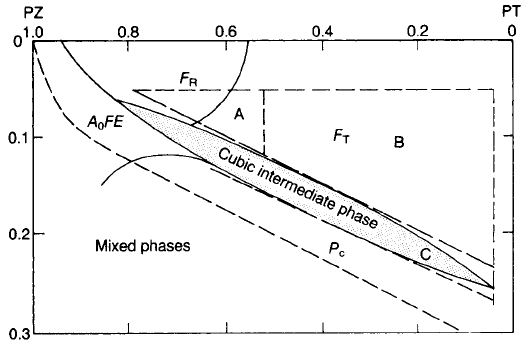
phase diagram is shown in Fig. 8.8; compositions are defined by y/z/(1z)in
which y is the percentage of Pb sites occupied by La and z/(1z) is the Zr/Ti
ratio.
LANTHANUM-SUBSTITUTED LEAD ZIRCONATE TITANATE 449
Optimum homogeneity is needed in electro-optic materials both to avoid
scattering due to local variations in composition and to ensure uniform electro-
optic properties. Adequate mixing of the more slowly diffusing ions such as Zr,
Ti and La is essential, and this calls for special chemical routes for the
preparation of starting powders. As an example, the starting materials can be
zirconium and titanium alkoxides mixed in predetermined ratios as liquids. An
aqueous solution of lanthanum acetate is added and the resulting hydrolysis
precipitates an intimate mixture of the three metal hydroxides. Lead oxide is
milled with the precipitated material and the mixture is calcined at 900 8C.
During the subsequent sintering stage the Pb
2+
ions diffuse from the liquid phase
and are distributed uniformly without difficulty. The slower-diffusing Ti
4+
,Zr
4+
and La
3+
ions are already intimately mixed and have short paths to their final
lattice sites.
Pore-free PLZT can be obtained by sintering under atmospheric pressure in
oxygen or by applying a vacuum during the early stages of sintering. It is more
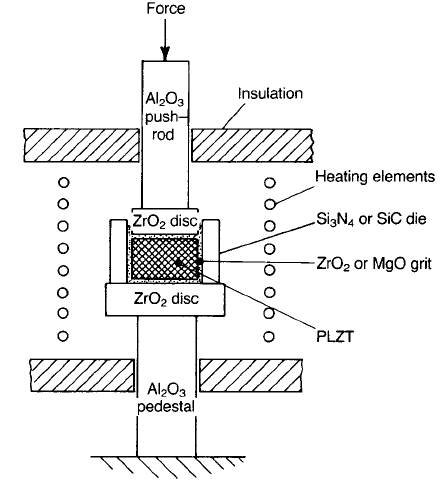
usual to prepare cylindrical blocks of material by hot-pressing in Si
3
N
4
or SiC
dies as shown in Fig. 8.9. In both the pressureless sintering and hot-pressing
routes the sample is surrounded by powders approximating in composition to
that of the sample; the correct design of the powder is particularly critical if good
quality material is to be made by the pressureless sintering route.
PLZT ceramic with a grain size less than 5 mm can be obtained by hot-pressing
at 1200 8C and 40 MPa and holding for about 6 h. The crystals can be increased
in size by a subsequent anneal in an atmosphere containing PbO vapour. Plates
of large area for wide aperture devices require very careful annealing in order to
eliminate variations in birefringence due to minor variations in density without
undue crystal growth. Plates of the required thickness are cut from the hot-
pressed pieces and the major surfaces are lapped and polished. If the plates are to
450 ELECTRO-OPTIC CERAMICS
y
Fig. 8.8 Phase diagram of Pb
13y/2
La
y
(Ti
1z
Zr
z
)O
3
: A, memory; B, linear; C, quadratic.
be used exploiting a longitudinal electro-optic effect, where the electric field and
light are parallel, transparent electrodes of indium tin oxide (ITO) can be applied
to the major surfaces by sputtering and coated with blooming layers to reduce
the loss of light by reflection. Where the field is to be at right angles to the
direction of light propagation, grooves can be formed in the major surfaces and
gold deposited in them to form an interdigitated electrode system. Blooming
layers are again essential because the refractive indices may be about 2.5, so that
approximately 40% of normally incident light would otherwise be reflected.
8.2.2 Measurement of electro-optic properties
In their ferroelectric state, the electro-optically useful PLZT compositions have
an almost cubic structure, with the polar c axis being typically only about 1%
longer than the a axes. Consequently the optical properties are almost isotropic
and this, in part, is why high transparency can be achieved in the ceramic form.
When an electric field is applied to the ceramic, domain alignment, or a field-
enforced transition to the ferroelectric state, leads to the development of
macroscopic polarization and so to uniaxial optical properties, i.e. the optic axis
LANTHANUM-SUBSTITUTED LEAD ZIRCONATE TITANATE 451
Fig. 8.9 Apparatus for hot-pressing PLZT.