
Moulson A.J., Herbert J.M. Electroceramics: Materials, Properties, Applications
Подождите немного. Документ загружается.

7.5 Measurement of the Pyroelectric
Coe⁄cient
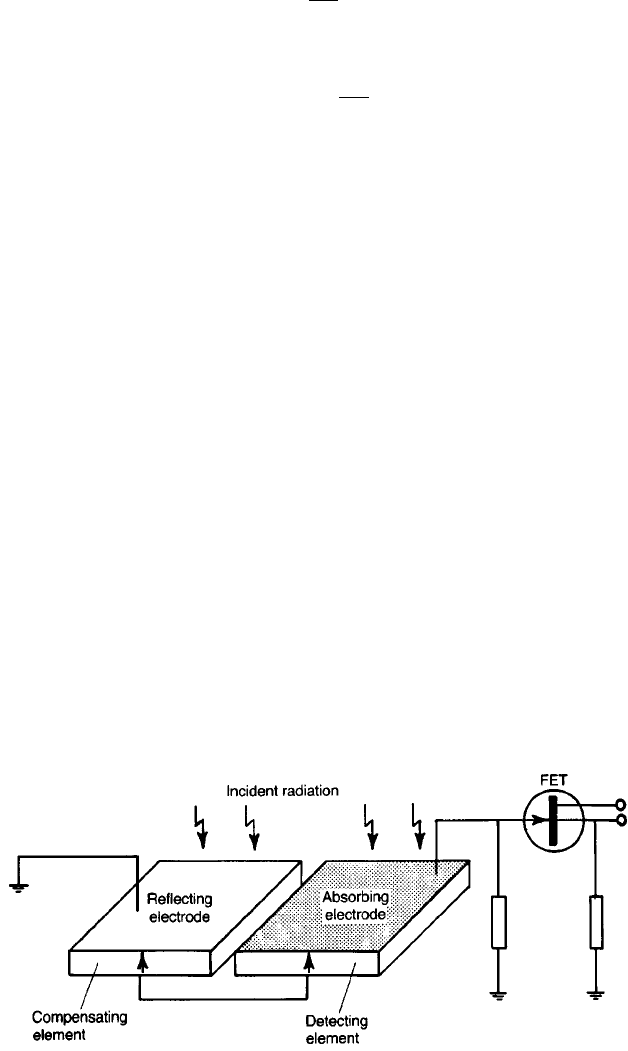
The pyroelectric coefficient can be measured in a variety of ways but a direct
method is illustrated in Fig. 7.6. From Eq. (7.12)
422 PYROELECTRIC MATERIALS
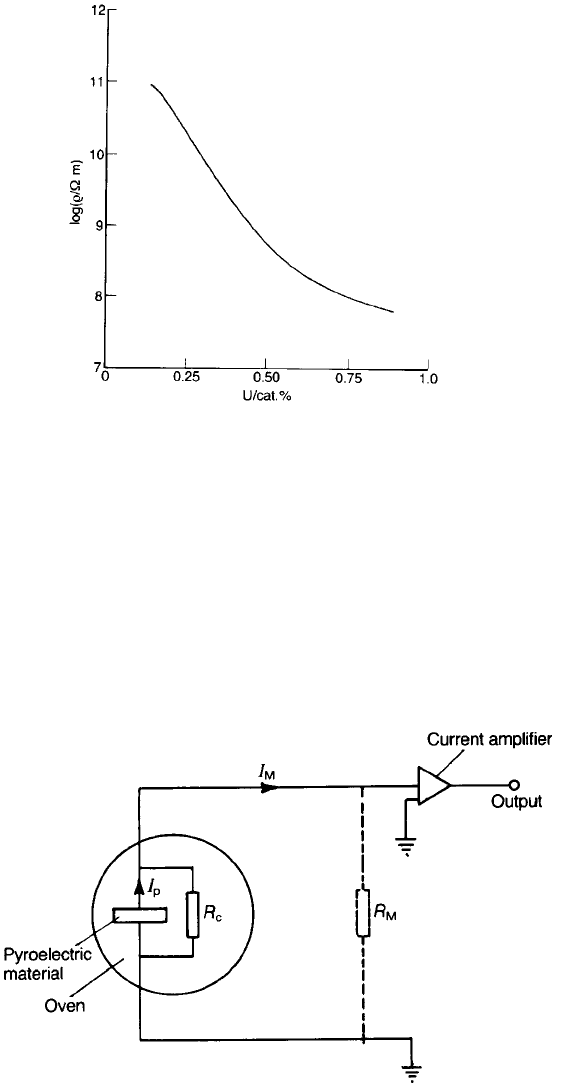
Fig. 7.5 Variation in the resistivity of PZFNTU with the uranium content.
Fig. 7.6 Circuit for the measurement of the pyroelectric coefficient.
TEAMFLY
Team-Fly
®
p ¼
I
p
A
_
TT
ð7:32Þ
where
I
p
¼ I
M
1 þ
R
M
R
c
in which I
M
is the measured current and R
M
and R
c
are the input resistance of the
amplifier and the leakage resistance of the crystal respectively. Provided that
R
M
R
c
, which is usually the case, then I
M
I
p
and p can be determined by
changing the temperature of the crystal at a known rate.
7.6 Applications
Pyroelectric materials respond to changes in the intensity of incident radiation
and not to a temporally uniform intensity. Thus humans or animals moving
across the field of view of a detector will produce a response as a result of the
movement of their warm bodies which emit infrared radiation (l 10 mmÞ.To
obtain a response from stationary objects requires the radiation from them to be
periodically interrupted. This is usually achieved by a sector disc rotating in front
of the detector and acting as a radiation chopper.
All pyroelectric materials are piezoelectric and therefore develop electric
charges in response to external stresses that may interfere with the response to
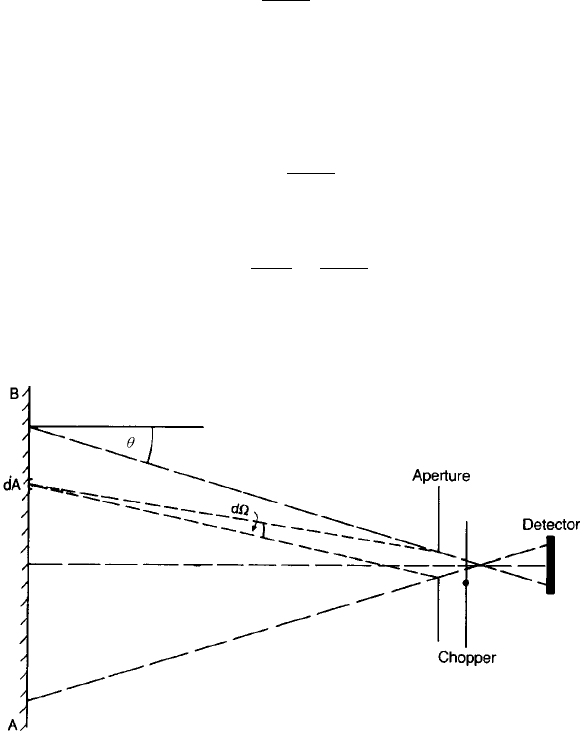
radiation. This can largely be compensated for by the provision of a duplicate of
the detecting element that is protected from the radiation by reflecting electrodes
or masking, but which is equally exposed to air and mounting vibrations. The
principle is illustrated in Fig. 7.7. The duplicate is connected in series with the
detector and with its polarity opposed so that the piezoelectric outputs cancel.
This results in a small reduction in sensitivity (53 dB) but compensation is an
APPLICATIONS 423
Fig. 7.7 ‘Dummy’ element to compensate for piezoelectrically induced currents.
essential feature in many cases. Using a compensating element of larger area than
that of the detecting element, e.g. larger by a factor of 3, does not affect the
piezoelectric voltage cancellation but results in a response and detectivity closer
to that of the detecting element alone. It may also be necessary to ensure that the
detector and compensator are so packaged as to reduce the transmission of
vibrations to them.
7.6.1 Radi ometry
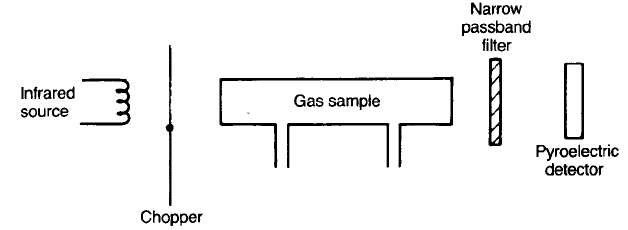
The radiant power dW emitted into a solid angle dO from a small area dA varies
with the angle y measured from the normal to dA and is given by
dW ¼
sZT
4
p
dA dO cos y ð7:33Þ
The situation is illustrated in Fig. 7.8 where dA is a small part of a uniformly
radiating surface AB of emissivity Z. Provided that y is small, which is also the
condition that r is approximately constant for all radiating elements, Eq. (7.33)
becomes
dW
ZsT
4
p
dAdO
or
W
AdO
ZsT
4
p
ð7:34Þ
If the radiometer is designed so that the imaged uniformly emitting surface
covers the detector surface, then both A ¼
Ð
dA and the solid angle dO subtended
424 PYROELECTRIC MATERIALS
Fig. 7.8 Radiometer optics.
by the aperture at a point on the emitting surface are known. Therefore if W is
measured and Z is known, T is determined.
The radiation has to be chopped, and so the detector receives pulses of
radiation from the source and the chopper alternately. Therefore the temperature
is measured relative to the temperature of the chopper surface. In practice,
radiometers are calibrated so that the temperature can be read directly from a
scale. A particular commercial model which operates over the temperature range
0–600 8C uses a LiTaO
3
single crystal as the pyroelectric detector.
7.6.2 Pollutant control
The amount of specific impurities in a gas can be monitored by passing radiation
from an infrared source through a tube containing a gas sample and then
through a narrow passband optical filter corresponding to a frequency at which
the pollutant absorbs radiation to a greater extent than any other constituent of
the gas. For example, CO
2
absorbs strongly at about 4.3 mm. The experimental
arrangement is illustrated in Fig. 7.9. The response from the infrared detector
can be compared with that obtained when using a different filter corresponding
to a wavelength to which the gas is transparent. A variety of pollutants can be
detected by changing filters.
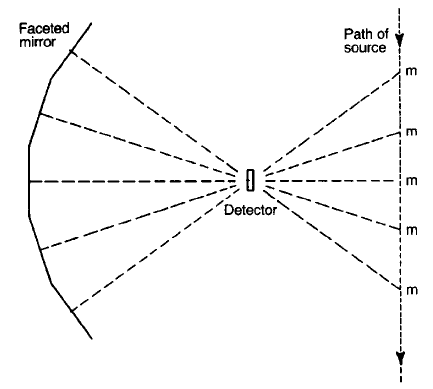
7.6.3 Intruder alarm
In a common type of intruder alarm the detector is positioned at the focus of an
encircling set of parabolic mirrors as shown in Fig. 7.10. A moving object causes
a succession of maxima and minima in the radiation from it reaching the
detector.
The wavelength l
m
of radiation emitted with maximum power from a black
body at temperature T is given by Wien’s displacement law:
APPLICATIONS 425
Fig. 7.9 Apparatus for the detection of gaseous pollutants.
l
m
T ¼ 2944 mmK (7:35Þ
For a black body at 300 K, l
m
¼ 9:8 m m. A filter is included which cuts out
radiation of wavelength shorter than about 5 mm and so prevents the device from
responding to changes in background lighting levels. Such a detector is capable
of responding to a moving person up to distances of 100 m.
7.6.4 Thermal imaging
In thermal imaging the infrared radiation emitted by surfaces at different
temperatures is focused onto a sensitive plate in an exactly analogous manner to
the formation of a photographic image using visible light. There are two
atmospheric ‘windows’ in the infrared extending from 3 to 5 mm and from 8 to
14 mm. As mentioned above, the power radiated from a black body at 300 K
peaks around 10 mm, and the power density in the 8–14 mm band is
approximately 25 times that radiated in the 3–5 mm band (about 150 W m
2
compared with about 6 W m
2
). For this reason infrared imaging using
pyroelectrics exploits energy in the 8–14 mm band.
The pyroelectric elements used in the devices described so far are commonly
square plates with sides about a millimetre long and thicknesses around 30 mm.
Because entire scenes are focused onto the plates in thermal imaging, they have
to be larger, typically squares of side about 1 cm; the thicknesses are the same as
for the simpler devices.
426 PYROELECTRIC MATERIALS
Fig. 7.10 Faceted mirror in an intruder alarm: m indicates the positions of the source giving
radiation maxima at the detector.
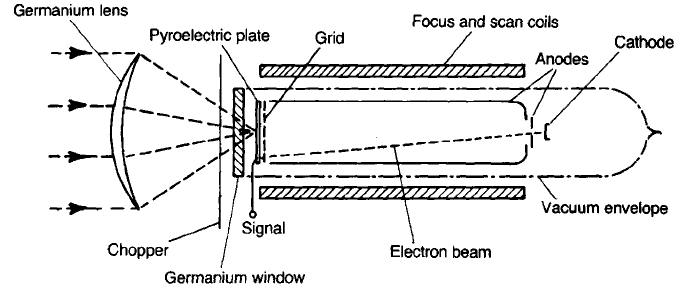
The effect of a spatially variable radiation flux falling on a pyroelectric plate is
to produce a corresponding charge distribution. In imaging devices this charge
distribution is detected by a process giving rise to a current which is amplified
and electronically processed to produce a television picture corresponding to the
infrared radiation from the original scene. A widely used device is the infrared
vidicon shown schematically in Fig. 7.11. It is used in many systems, both civil
and military. A UK-manufactured camera is used for locating survivors buried
in collapsed building rubble.
The radiation from the scene is chopped and focused, using germanium optics,
onto an infrared absorbing electrode carried on the front face of the pyroelectric
plate. The voltages developed across the plate are typically a few millivolts. The
metal grid, positioned close to the detector, collects most of the electrons as it is
scanned. Some electrons pass through the grid; the number depends on the local
potential at the surface of the plate. The charge deposited on the plate produces a
signal at the front electrode which is processed into the television picture.
In the particular mode of operation outlined, when the radiation is interrupted
by the chopper, the detector cools, giving negative signals and causing the local
surface potential to go negative with respect to the cathode. In order for the
detector to be properly addressed by the electron beam it is biased to a potential
of approximately þ300 mV. This is achieved by the deposition of charge from
gas molecules deliberately introduced into the tube and ionized by the electron
beam. Circuitry in synchronism with the chopper reverses the sense of the
negative output signal current when the chopper is closed and adds this to the
positive signal obtained when the chopper is open. This both removes any flicker
in the picture due to detector or bias non-uniformity and increases the sensitivity
for imaging moving objects.
The charge on the surface of the plate must be removed before the electron-
beam scan is repeated. This will occur automatically if the bias is high enough to
ensure that sufficient electrons can reach the plate to neutralise the pyroelectric
APPLICATIONS 427
Fig. 7.11 Pyroelectric vidicon.
charges. Sufficient ions must be created in the residual gas to provide the required
bias.
Lateral flow of heat in the pyroelectric detector plate tends to even out the
temperature differences, blurring the charge pattern and hence the final image.
This process will depend on the thickness h of the plate and the thermal
diffusivity L ¼ l=c
0
of the plate material. Vidicon performance improves as both
h and L are reduced in value, and a suitable figure of merit is
F
vid
¼
p
c
0
eLh
¼
p
leh
¼
F
V
Lh
ð7:36Þ
According to Eq. (7.36) PVDF is an attractive candidate for vidicon targets, and
it has been used, although it does not approach the performance obtained using
TGS and other members of that family.
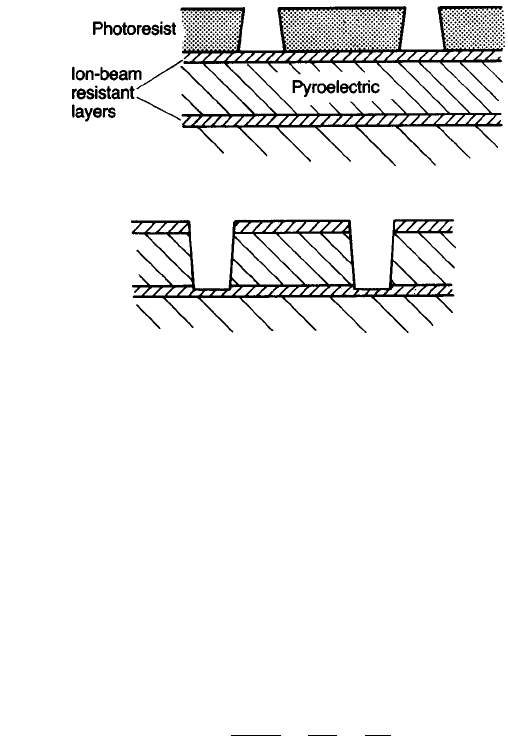
The effect of thermal diffusion can be countered by reticulating the target.
Reticulation involves the formation of grooves that cut through the thickness of
the target almost completely (or completely) and divide it into small square
regions which are nearly (or completely) separate, as illustrated in Fig. 7.12.
Suitable patterns for the grooves can be formed by depositing a metal, or some
other material resistant to ion-beam etching, on the target surface and then
partially removing it in the required pattern by photo-engraving. The target is
then exposed to an ion beam that etches away the bare pyroelectric material far
more rapidly than the metal or other protective layer. This method has been used
428 PYROELECTRIC MATERIALS
(a)
Fig. 7.12 Reticulation to improve thermal isolation: (a) before milling; (b) after milling.
(b)
to divide TGS crystals some 30 mm thick into islands 20 mm wide separated by
5 mm wide grooves.
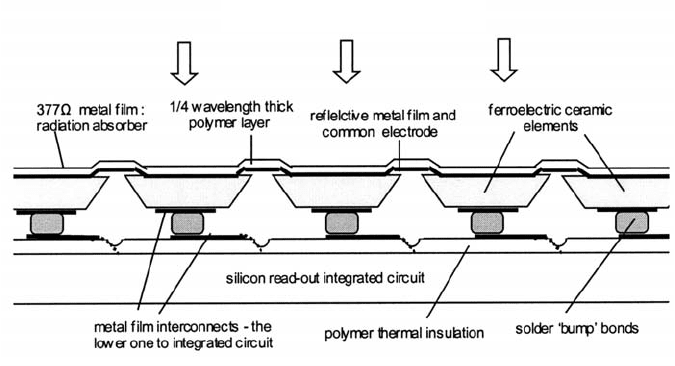
As an attractive alternative to the vidicon the array of elements can be
connected directly to individual voltage detectors on a silicon integrated circuit
(usually referred to as a ROIC: ‘read-out integrated circuit’) via solder ‘bumps’.
The resulting signals can then be electronically processed to yield a picture in the
standard way. Fig. 7.13 shows a section through part of such an imaging array.
Arrays can be fabricated in the following way. A wafer, 15 mm thick by
75 mm diameter is prepared from a hot-pressed ceramic block (e.g. ‘PST’ or
‘BST’) by diamond sawing, lapping and polishing. Both faces are coated with
metal films by sputtering after which a polymer film is ‘spun’ onto one face. The
coated wafer is then bonded to a glass support for the reticulation process carried
out by laser-assisted etching under potassium hydroxide. This gives an element
pitch of down to 40 mm with groove widths down to 10 mm. The structure is
then flip-chip bonded to the integrated circuit after which the glass support layer
is removed to expose the l/4 polymer/metal film radiation-absorbing structure.
To reduce expense, efforts are made to exploit integrated thin film
technologies. For example, arrays have been produced via thin film deposition
of the pyroelectric onto a sacrificial layer, e.g. a suitable metal or polysilicon,
which is then selectively etched away. Thermal isolation of the pyroelectric
element is achieved through engineering a gap between it and the ROIC silicon
wafer. Vias in the supporting layer permit electrical connections to be made
between the detector and the wafer via solder bonds. Imaging arrays have been
produced in this way incorporating sputtered PST and sol-gel formed PZT films.
APPLICATIONS 429
Fig. 7.13 Ferroelectric pyroelectric imaging array structure (after R.W. Whatmore and R.
Watton [2]).
incidence focused infrared radiation
The ideal route would be one in which the pyroelectric detector material is laid
down in thin film form by a route compatible with the production of the silicon
ROIC. There are obvious parallels with the development of FeRAMS (see
Section 5.7.5) and the substantial effort now devoted to their development will
have a positive impact on the manufacture of pyroelectric arrays. Challenges lie
in the requirement to process the deposited films at temperatures not too high for
the underlying integrated circuit, and the need to engineer the temperature
diffusion characteristics within the element and its surroundings so as to optimise
image definition.
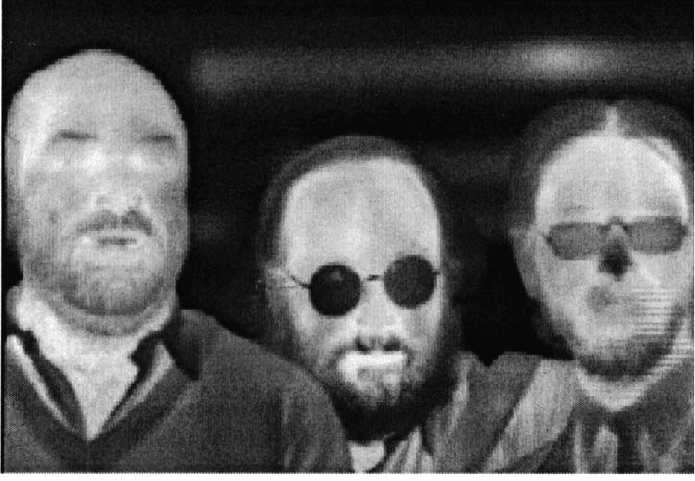
The type of infrared imager described is now widely exploited for both civilian
and military use and typical image quality currently achieved is illustrated in
Fig. 7.14.
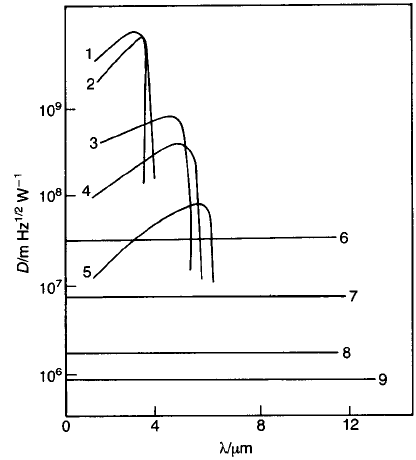
Pyroelectric infrared detectors are inferior in detectivity by one or two orders
of magnitude compared with photoconductors such as cadmium mercury
telluride, as shown in Fig. 7.15. However, such materials require temperatures of
200 K for efficient operation and generally respond to rather narrow bands at the
infrared wavelengths. Pyroelectric devices can discriminate temperature differ-
ences of 0.1 K but find many useful applications in which the discrimination is
limited to about 0.5 K. They have the great practical advantage of operating at
normal ambient temperatures.
430 PYROELECTRIC MATERIALS
Fig. 7.14 A thermal image produced by an infrared camera exploiting uncooled pyroelectric
ceramic detection technology. (Courtesy of QinetiQ Limited.)
The uncooled thermal imaging technology exploiting ferroelectric ceramics
is being challenged by other technologies, significantly by one based
upon ‘resistance bolometer’ materials such as vanadium oxide (VO
x
) and
amorphous silicon.
Problems
1. Explain why it is that the sun appears to the eye as a uniformly bright disc. Would it
appear equally bright were its distance from us doubled?
2. Check by integration that Eq. (7.33) is consistent with the expression W ¼ sT
4
for the
total power radiated from unit area of a black body.
3. Make an order of magnitude estimate of the time taken for a plate of pyroelectric
material 30 mm thick to achieve a uniform temperature if the face is suddenly
illuminated with infrared radiation (l 4.0 W m
71
K
71
; r ¼7.45 Mg m
73
;
c ¼0.33 kJ kg
71
K
71
). [Answer: 0:1 ms]
4. A TGS plate of uniform thickness (30 mm) receives a uniform radiation flux for 1 ms at
normal incidence. Using data given in Table 7.1, calculate the lower radiation intensity
PROBLEMS 431
Fig. 7.15 Detectivities D of some photoconductive and pyroelectric detector materials:
curve 1, PbS; curve 2, InAs; curve 3, HgCdTe; curve 4, PbSe; curve 5, InSb; curve 6,
L-alanine-
doped TGS; curve 7, LiTaO
3
; curve 8, PZ; curve 9, PVDF. (Curves 1–5 measured at 200 K;
curves 6–9 measured at 300 K.)