
Quinn J.J., Yi K.-S. Solid State Physics: Principles and Modern Applications
Подождите немного. Документ загружается.


Uncorrected Proof
BookID 160928 ChapID 08 Proof# 1 - 29/07/09
8.7 Clausius–Mossotti Relation 221
This term clearly depends on the crystal structure. If p
i
= p = pˆz, then the 110
field at the center of the Lorentz sphere is 111
E
3
=(0, 0,E
3
)=p
i∈L.S.
3z
2
i
− r
2
i
r
5
i
ˆz. (8.23)
For a crystal with cubic symmetry
112
i
x
2
i
r
5
i
=
i
y
2
i
r
5
i
=
i
z
2
i
r
5
i
=
1
3
i
r
2
i
r
5
i
.
Thus, for a cubic crystal, the two terms cancel and E
3
= 0. Hence, we find 113
the local field in a cubic crystal 114
E
LF
= E
0
+ E
1
4 56 7
+ E
2
4567
+ E
3
= E +
4π
3
P +0.
(8.24)
115
The last expression is the Lorentz relation . We note that, since E
1
= −
4π
3
P 116
for a spherical specimen, the local field at the center of a sphere of cubic 117
crystal is simply given by 118
E
sphere
LF
= E
0
−
4π
3
P +
4π
3
P +0=E
0
.
8.7 Clausius–Mossotti Relation 119
The induced dipole moment of an atom is given, in terms of the local field, 120
by p = αE
LF
.ThepolarizationP is given, for a cubic crystal, by 121
P = Np = NαE
LF
= Nα
E +
4π
3
P
, (8.25)
where N is the number of atoms per unit volume. Solving for P gives
122
P =
Nα
1 −
4πNα
3
E ≡ χE. (8.26)
Thus, the electrical susceptibility of the solid is
123
χ =
Nα
1 −
4πNα
3
. (8.27)
Since D = εE with ε =1+4πχ, we find that
124
ε =1+
4πNα
1 −
4πNα
3
. (8.28)

Uncorrected Proof
BookID 160928 ChapID 08 Proof# 1 - 29/07/09
222 8 Dielectric Properties of Solids
or 125
ε =
1+
8πNα
3
1 −
4πNα
3
. (8.29)
This relation between the macroscopic dielectric function ε and the atomic
126
polarizability α is called the Clausius–Mossotti relation. It can also be writ- 127
ten (solving for
4πNα
3
)by 128
ε − 1
ε +2
=
4πNα
3
. (8.30)
129
8.8 Polarizability and Dielectric Functions 130
of Some Simple Systems 131
The total polarizability of the atoms or ions within a unit cell can usually be 132
separated into three parts: 133
1. Electronic polarizability α
e
: the displacement of the electrons relative to 134
the nucleus. 135
2. Ionic polarizability α
i
: The displacement of an ion itself with respect to its 136
equilibrium position. 137
3. Dipolar polarizability α
dipole
: The orientation of any permanent dipoles by 138
the electric field in the presence of thermal disorder. 139
Atoms and homonuclear diatomic molecules have no dipole moments in their 140
ground states. Molecules like KCl, HCl, H
2
O,...do exhibit permanent dipole 141
moments. A typical dipole moment p = qd has q 4.8 × 10
−10
esu and 142
d 10
−8
cm, giving p 5 × 10
−18
stat-coulomb cm. 143
8.8.1 Evaluation of the Dipole Polarizability 144
In the absence of an electric field, the probability that a dipole p will be 145
oriented within the solid angle dΩ = sin θ dθ dφ is independent of θ and φ and 146
is given by
dΩ
4π
. In the presence of a field E, the probability is proportional to 147
dΩ e
−W/k
B
T
,whereW = −p · E is the energy of the dipole in the field E.If 148
we choose the z-direction parallel to E, then the average values of p
x
and p
y
149
vanish and we have 150
¯p
z
=
"
dΩ e
pE cos θ/k
B
T
p cos θ
"
dΩ e
pE cos θ/k
B
T
. (8.31)
Let
pE
k
B
T
= ξ,cosθ = x and rewrite ¯p
z
as 151
¯p
z
= p
"
1
−1
dxxe
ξx
"
1
−1
dx e
ξx
= p
d
dξ
ln
"
1
−1
dx e
ξx
= p
d
dξ
ln
2sinhξ
ξ
= p
coth ξ −
1
ξ
.
Uncorrected Proof
BookID 160928 ChapID 08 Proof# 1 - 29/07/09
8.8 Polarizability and Dielectric Functionsof Some Simple Systems 223
Thus, we can write ¯p
z
as 152
¯p
z
= pL(ξ). (8.32)
153
Here, L(ξ)istheLangevin function defined by L(ξ)=cothξ −
1
ξ
. The dipole 154
moment per unit volume is then given by 155
P = N ¯p
z
= NpL
pE
k
B
T
.
We note that for ξ →∞, L(ξ) → 1, while for ξ → 0, L(ξ)=
ξ
3
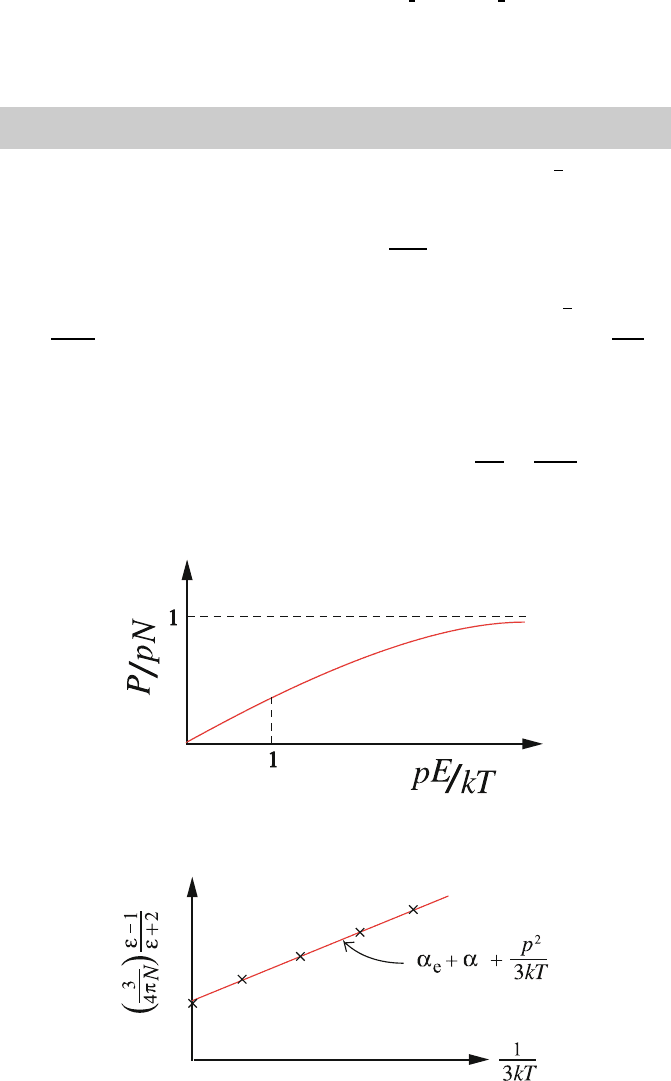
.Ifξ 1, 156
P =
Np
2
E
3k
B
T
. At room temperature the condition is satisfied if E
k
B
T
p
157
10
7
volts/cm. The standard unit of dipole moment is the Debye, defined by 1 158
Debye = 10
−18
esu. Figure 8.5 is a sketch of the temperature dependence of 159
an electrical polarization P . 160
The electronic polarizability α
e
and the ionic polarizability α
ion
are almost 161
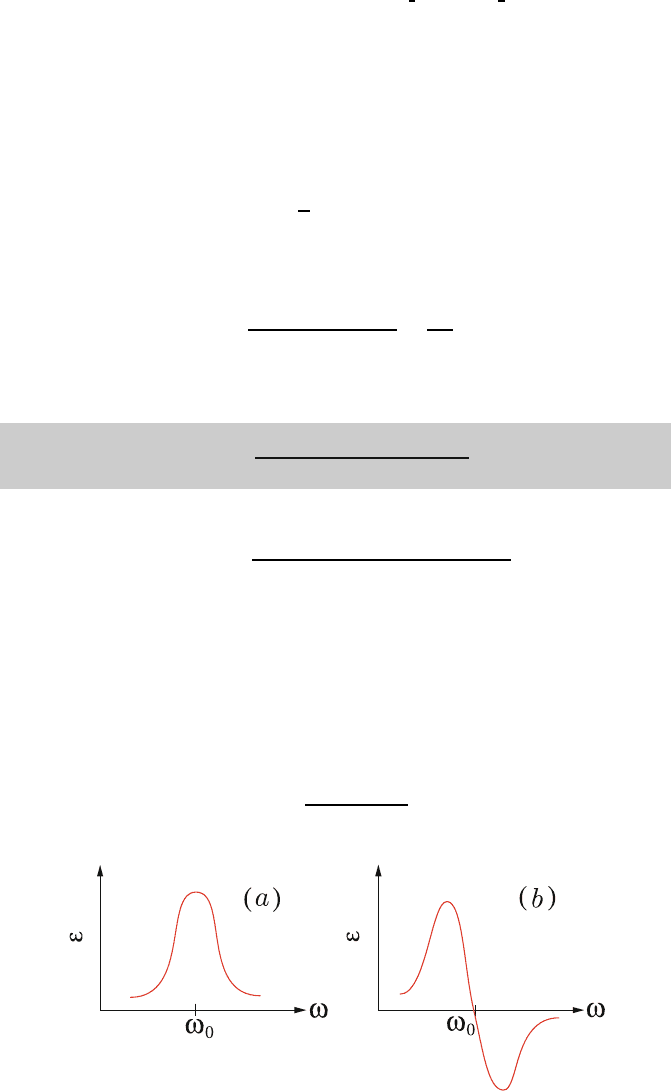
independent of temperature. Therefore, by measuring
ε−1
ε+2
≡
4πNα
3
as a func- 162
tion of temperature one can obtain the value of p
2
from the slope (see Fig. 8.6). 163
164
Fig. 8.5. Temperature dependence of an electrical polarization P
i
Fig. 8.6. An electrical polarizability α as a function of temperature
Uncorrected Proof
BookID 160928 ChapID 08 Proof# 1 - 29/07/09
224 8 Dielectric Properties of Solids
8.8.2 Polarizability of Bound Electrons 165
Assume that an electron (of charge q = −e) is bound harmonically to a par- 166
ticular location (e.g., the position of a particular ion). Its equation of motion 167
is written by 168
m
¨
r +
˙
r
τ
= −kr − eE, (8.33)
where −kr is the restoring force and E is the perturbing electric field. Assume
169
E ∝ e
iωt
and let k = mω
2
0
. Then we can solve for r ∝ e
iωt
to obtain 170
r =
−eE/m
−ω
2
+iω/τ + ω
2
0
≡
p
−e
. (8.34)
The dipole moment of the atom will be p = −er and the polarization
171
P = Np = −Ner ≡ Nα
el
E.Thisgivesforα
el
172
α
el
=
(e
2
/m)
ω
2
0
− ω
2
− iω/τ
(ω
2
0
− ω
2
)
2
+(ω/τ)
2
. (8.35)
173
The dielectric function ε =1+4πNα
el
is 174
ε(ω)=1+
4πNe
2
/m
ω
2
0
− ω
2
− iω/τ
(ω
2
0
− ω
2
)
2
+(ω/τ)
2
. (8.36)
It is clear that α
e
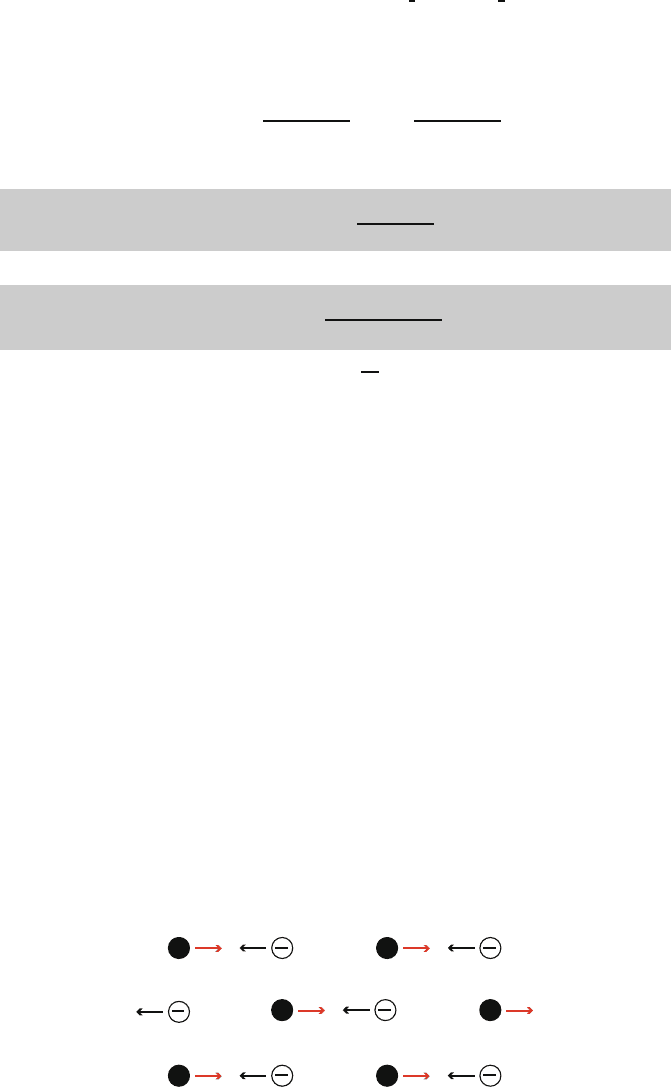
has a real and an imaginary part whose frequency 175
dependences are of the form sketched in Fig. 8.7. 176
8.8.3 Dielectric Function of a Metal 177
In a metal (e.g., Drude model) the electrons are free. This means that the 178
restoring force vanishes (i.e., k → 0) or ω
0
= 0. In that case, we obtain 179
α
e
=
e
2
/m
−ω
2
+iω/τ
, (8.37)
Re
el
Im
el
Fig. 8.7. The frequency dependence of the dielectric function ε of atoms with bound
electrons. (a)Realpartofε(ω), (b) imaginary part of ε(ω)
Uncorrected Proof
BookID 160928 ChapID 08 Proof# 1 - 29/07/09
8.8 Polarizability and Dielectric Functionsof Some Simple Systems 225
or 180
ε(ω)=1−
4πNe
2
/m
ω
2
− iω/τ
=1−
ω
2
p
ω
2
− iω/τ
. (8.38)
The real and imaginary parts of ε(ω)are
181
ε(ω)=1−
ω
2
p
τ
2
1+ω
2
τ
2
(8.39)
182
and 183
ε(ω)=−
ω
2
p
τ
2
ωτ(1 + ω
2
τ
2
)
. (8.40)
184
The fact that ε(ω) < 0forω
2
<ω
2
p
−
1
τ
2
leads to an imaginary refractive 185
index and is responsible for the fact that metals are good reflectors. 186
8.8.4 Dielectric Function of a Polar Crystal 187
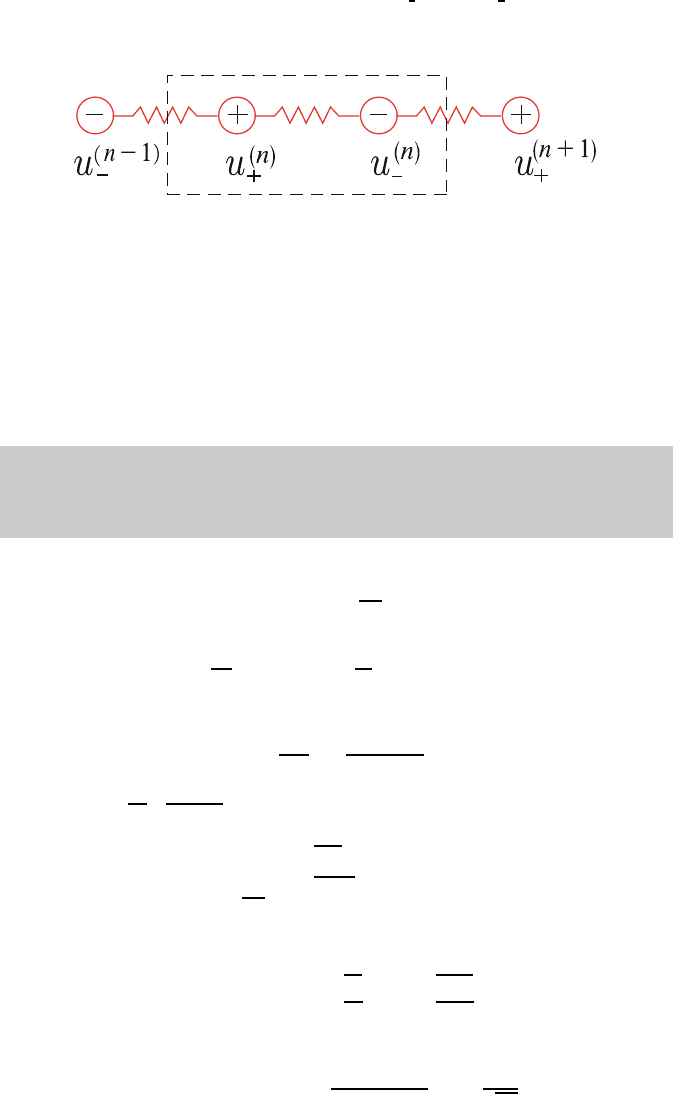
In an ionic crystal like NaCl, longitudinal optical phonons have associated 188
with them charge displacements, which result in a macroscopic polarization 189
field P
L
. Here the subscript L stands for the lattice polarization. (See, for 190
example, Fig. 8.8.) 191
The polarization field P
L
consists of two parts: (1) the displacements of 192
the charged individual ions from their equilibrium positions and (2) the polar- 193
ization of the ions themselves resulting from the displacement of the electrons 194
relative to the nucleus under the influence of the E field. In determining each 195
of these contributions to P
L
, we must use the local field E
LF
. We shall consider 196
the following model of a polar crystal: 197
1. The material is a cubic lattice with two atoms per unit cell; the volume of 198
the unit cell is V . 199
2. The charges, masses, and atomic polarizabilities of these ions are ±ze, M
±
, 200
and α
±
201
3. In addition to long range electrical forces, there is a short range restoring 202
force that is proportional to the relative displacement of the pair of atoms 203
in the same cell. 204
Fig. 8.8. Polarization field due to charge displacements in a polar crystal
Uncorrected Proof
BookID 160928 ChapID 08 Proof# 1 - 29/07/09
226 8 Dielectric Properties of Solids
Fig. 8.9. Ionic displacements in the n
th
unit cell and its nearest neighbor atoms
Note: Here we are considering only the q = 0 optical phonon, so that the 205
ionic displacements are identical in each cell. Therefore, the restoring force 206
can be written in such a way that: The force on M
(n)
+
depends on u
(n)
+
−u
(n)
−
207
and u
(n)
+
− u
(n−1)
−
, but u
(n)
−
= u
(n−1)
−
so the force is simply proportional to 208
u
(n)
+
− u
(n)
−
. (See Fig. 8.9.) 209
We can write the equations of motion of u
+
and u
−
as 210
M
+
¨
u
+
= −k(u
+
− u
−
)+zeE
LF
,
M
−
¨
u
−
= k(u
+
− u
−
) − zeE
LF
. (8.41)
211
The local field E
LF
is given, for cubic crystals, by (8.24): 212
E
LF
= E +
4π
3
P
L
, (8.42)
and
213
P
L
=
ze
V
(u
+
− u
−
)+
1
V
(α
+
+ α
−
) E
LF
. (8.43)
Substitute for E
LF
in terms of E and P
L
,andthensolveforP
L
.Thisgives 214
us 215
P
L
=
ze
Vβ
r +
α
+
+ α
−
Vβ
E. (8.44)
Here, β =1−
4π
3
α
+
+α
−
V
and r = u
+
− u
−
. Introduce 216
Ω
2
±
≡
k
M
±
,
Ω
2
p±
≡
4πe
2
VM
±
,
M
−1
≡ M
−1
+
+ M
−1
−
.
(8.45)
The equations of motion can be rewritten
217
−ω
2
u
+
= −Ω
2
+
r +
1
3β
Ω
2
p+
r +
ze
M
+
β
E,
−ω
2
u
−
=+Ω
2
−
r −
1
3β
Ω
2
p−
r −
ze
M
−
β
E.
(8.46)
If we subtract the second equation from the first we obtain
218
−ω
2
+
Ω
2
+
+Ω
2
−
−
Ω
2
p+
+Ω
2
p−
3β
r =
ze
βM
E. (8.47)

Uncorrected Proof
BookID 160928 ChapID 08 Proof# 1 - 29/07/09
8.8 Polarizability and Dielectric Functionsof Some Simple Systems 227
This can be rewritten 219
r = −
ze
βM
ω
2
+ b
11
−1
E, (8.48)
where
220
b
11
= −
Ω
2
+
+Ω
2
−
−
Ω
2
p+
+Ω
2
p−
3β
≡−ω
2
T
. (8.49)
−b
11
is a frequency squared and it is positive since Ω
2
p±
is always smaller than 221
Ω
±
. Let us call it +ω
2
T
. Since we know the expression for P
L
in terms of r 222
and E we can write 223
P
L
=
ze
Vβ
−
ze
βM
E
ω
2
− ω
2
T
+
α
+
+ α
−
βV
E. (8.50)
Let us define
224
b
22
=
α
+
+ α
−
βV
,
b
2
12
=
z
2
e
2
β
2
MV
.
(8.51)
Then, we can rewrite P
L
as 225
P
L
=
b
22
−
b
2
12
ω
2
− ω
2
T
E ≡ χE. (8.52)
Recall that the electrical susceptibility is defined by χ(ω)=
P
L
(ω)
E(ω)
,andthe 226
dielectric function by 227
ε(ω)=1+4πχ(ω). (8.53)
From (8.52) for P
L
we find 228
χ(ω)=b
22
−
b
2
12
ω
2
− ω
2
T
. (8.54)
The frequency ω
T
is in the infrared (∼10
13
/sec). If we look at frequencies 229
much larger than ω
T
we find 230
χ
∞
= b
22
. (8.55)
For ω → 0 we find that
231
χ
0
= b
22
+
b
2
12
ω
2
T
= χ
∞
+
b
2
12
ω
2
T
. (8.56)
Therefore we can write
232
b
2
12
= ω
2
T
(χ
0
− χ
∞
)=
ω
2
T
4π
(ε
0
− ε
∞
) . (8.57)
Uncorrected Proof
BookID 160928 ChapID 08 Proof# 1 - 29/07/09
228 8 Dielectric Properties of Solids
This, of course, is positive since ε
0
contains contributions from the displace- 233
ments of the ions as well as the electronic displacements within each ion. The 234
latter is very fast while the former is slow. The dielectric function ε(ω)can 235
be written 236
ε(ω)=ε
∞
−
ω
2
T
ω
2
−ω
2
T
(ε
0
− ε
∞
)
= ε
∞
1 −
ε
0
ε
∞
− 1
ω
2
T
ω
2
−ω
2
T
.
We define ω
2
L
= ω
2
T
ε
0
ε
∞
>ω
2
T
. Then, we can write 237
ε(ω)=ε
∞
ω
2
− ω
2
L
ω
2
− ω
2
T
. (8.58)
238
Here, ω
L
and ω
T
are the TO and LO phonon frequencies, respectively. We note 239
that ω
L
>ω
T
since ε
0
>ε
∞
in general. Values of ε
0
and ε
∞
for some polar 240
materials are listed in Table 8.2. Instead of discussing the lattice polarization 241
P
L
, we could have discussed the lattice current density 242
j
L
=
˙
P
L
=iωP
L
=iωχ(ω)E.
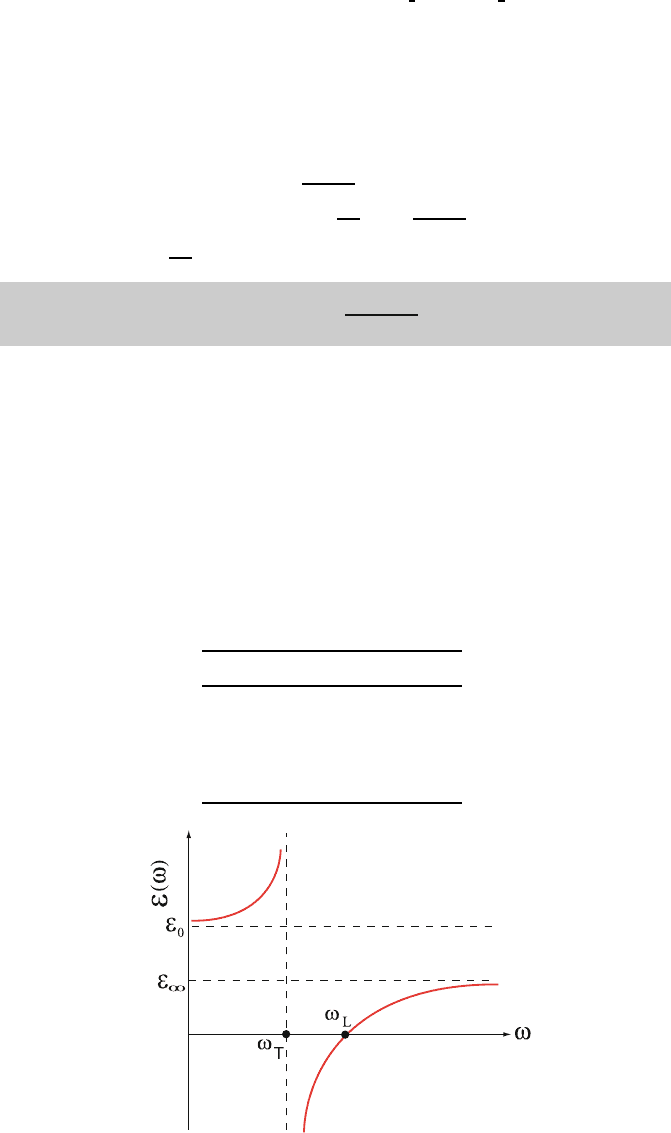
Aplotofε(ω)versusω is shown in Fig. 8.10. At ω =0ε has the static value
243
ε
0
,andasω →∞it approaches the high-frequency value ε
∞
. ε
0
is always 244
larger than ε
∞
. There is a resonance at ω = ω
T
. 245
t2.1 Tabl e 8. 2. Dielectric constants ε
0
and ε
∞
for polar materials
t2.2 Crystal ε
0
ε
∞
ε
0
/ε
∞
t2.3 LiF 8.7 1.93 4.5
t2.4 NaCl 5.62 2.25 2.50
t2.5 KBr 4.78 2.33 2.05
t2.6 Cu
2
O 8.75 4.0 2.2
t2.7 PbS 17.9 2.81 6.37
Fig. 8.10. Frequency dependence of the dielectric function ε(ω)ofapolarcrystal

Uncorrected Proof
BookID 160928 ChapID 08 Proof# 1 - 29/07/09
8.9 Optical Properties 229
8.9 Optical Properties 246
The dielectric and magnetic properties of a medium are characterized by the 247
dielectric function ε(ω) and the magnetic permeability μ(ω): 248
D = εE and B = μH. (8.59)
In terms of E and B, Maxwell’s equations can be written
249
∇·E =4πρ =4π(ρ
0
+ ρ
P
)
∇·B =0
∇×E = −
1
c
˙
B
∇×B =
1
c
˙
E +
4π
c
(j
0
+ j
P
)+4π∇×M.
(8.60)
250
The last equation involves the magnetization which is normally very small. 251
Here, we will neglect it; this is equivalent to taking μ =1orB = H.The 252
sources of E are all charges; external (ρ
0
) and induced polarization (ρ
P
)charge 253
densities. The sources of B are the rate of change of E and the total cur- 254
rent (external j
0
and induced j
P
current densities). Recall that j
P
=
˙
P and 255
∇·P = − ρ
P
. 256
Note: Sometimes the first Maxwell equation is replaced by ∇·D =4πρ
0
.
Here D = E +4πP and as we have seen ρ
P
= −∇ · P. The fourth
equation is sometimes replaced by ∇×H =
1
c
˙
D +
4π
c
j
0
,whichomits
all polarization currents.
257
In this chapter, we shall ignore all magnetic effects and take μ(ω) = 1. This is 258
an excellent approximation for most materials since the magnetic susceptibil- 259
ity is usually much smaller than unity. There are two extreme ways of writing 260
the equation for ∇×B: 261
∇×B =
ε
c
˙
E +
4π
c
j
0
or
∇×B =
1
c
˙
E +
4π
c
(j
0
+ σE) (8.61)
The first equation is just that for H in which we put μ =1andD = εE.The
262
second equation is that for ∇×B in which we have taken j
P
= σE where σ 263
is the conductivity. From this we see that
iω
c
ε(ω)=
iω
c
+
4π
c
σ(ω), or 264
ε(ω)=1−
4πi
ω
σ(ω) (8.62)
265
is a complex dielectric constant and simply related to the conductivity σ(ω). 266
We have assumed that E and B are proportional to e
iωt
. 267
8.9.1 Wave Equation 268
For the propagation of light in a material characterized by a complex dielectric 269
function ε(ω), the external sources j
0
and ρ
0
vanishes. Therefore, we have 270

Uncorrected Proof
BookID 160928 ChapID 08 Proof# 1 - 29/07/09
230 8 Dielectric Properties of Solids
∇×E = −
iω
c
B
∇×B =
iωε(ω)
c
E. (8.63)
Later, we will consider both bulk and surface waves. We will take the normal
271
to the surface as the z-direction and consider waves that propagate at some 272
angle to the interface. There is no loss of generality in assuming that the wave 273
vector q =(0,q
y
,q
z
), so that the E field is given by 274
E =(E
x
,E
y
,E
z
)e
i(ωt−q
y
y−q
z
z)
.
The operators ∇ and
∂
∂t
become −iq and iω, and the two Maxwell equations 275
for ∇×E and ∇×B can be combined to give 276
∇×(∇×E)=−
iω
c
∇×B = −
iω
c
iωε
c
E
= ∇(∇·E) −∇
2
E.
This can be rewritten
277
ω
2
c
2
ε(ω) − q
2
E + q (q ·E)=0. (8.64)
278
This vector equation can be expressed as a matrix equation 279
⎛
⎜
⎝
ω
2
c
2
ε(ω) − q
2
00
0
ω
2
c
2
ε(ω) − q
2
z
q
y
q
z
0 q
y
q
z
ω
2
c
2
ε(ω) − q
2
y
⎞
⎟
⎠
⎛
⎝
E
x
E
y
E
z
⎞
⎠
=0. (8.65)
8.10 Bulk Modes 280
For an infinite homogeneous medium of dielectric function ε(ω), the nontriv- 281
ial solutions are obtained by setting the determinant of the 3 × 3matrix 282
(multiplying the column vector E in (8.65)) equal to zero. This gives 283
ε(ω)
ω
2
c
2
ε(ω) − q
2
2
=0. (8.66)
There are two transverse modes satisfying
284
ω
2
=
c
2
q
2
ε(ω)
. (8.67)
285
One of these has q
y
E
y
+ q
z
E
z
≡ q · E =0; E
x
= 0. The other has E
x
=0 286
and E
y
= E
z
= 0. The other mode is longitudinal and has E
x
=0andq E 287
or
E
z
E
y
=
q
z
q
y
, and has the dispersion relation 288
ε(ω)=0. (8.68)
289
First, let us look at longitudinal modes. 290