
Quinn J.J., Yi K.-S. Solid State Physics: Principles and Modern Applications
Подождите немного. Документ загружается.

Uncorrected Proof
BookID 160928 ChapID 08 Proof# 1 - 29/07/09
8.10 Bulk Modes 231
8.10.1 Longitudinal Modes 291
Longitudinal modes, as we have seen, are given by the zeros of the dielectric 292
function ε(ω). For simplicity we will neglect collisions and set τ →∞in the 293
various dielectric functions we have studied. 294
Bound Electrons 295
We found that (for τ →∞) 296
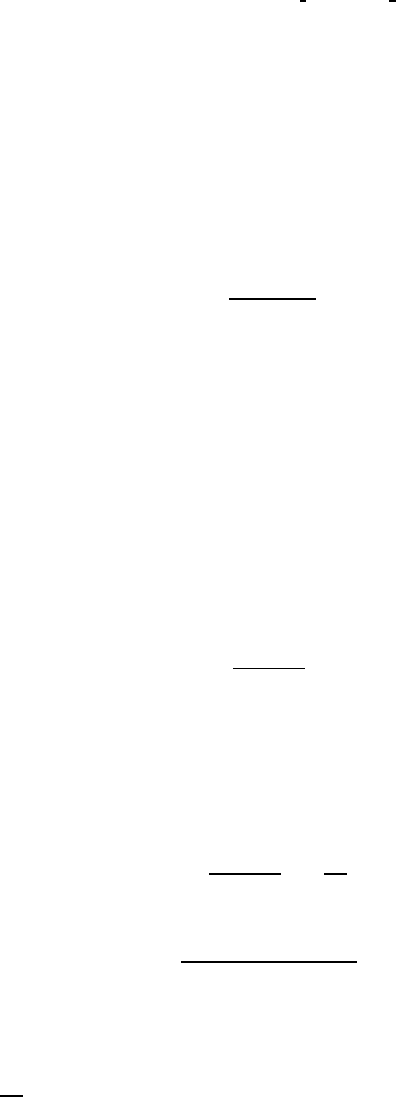
ε(ω)=1+
4πNe
2
/m
ω
2
0
− ω
2
. (8.69)
We have seen the quantity 4πNe
2
/m before. It is just the square of the plasma 297
frequency ω
p
of a system of N electrons per unit volume. The zero of ε(ω) 298
occurs at 299
ω
2
= ω
2
0
+ ω
2
p
≡ Ω
2
. (8.70)
Free Electrons
300
For free electrons ω
0
= 0. Therefore, the longitudinal mode (plasmon) 301
occurs at 302
ω
2
= ω
2
p
. (8.71)
Polar Crystal
303
For a polar dielectric, the dielectric function is given by 304
ε(ω)=ε
∞
ω
2
− ω
2
L
ω
2
− ω
2
T
. (8.72)
The longitudinal mode occurs at ω = ω
L
, the longitudinal optical phonon 305
frequency. 306
Degenerate Polar Semiconductor 307
For a polar semiconductor containing N free electrons per unit volume in the 308
conduction band 309
ε(ω)=ε
∞
ω
2
− ω
2
L
ω
2
− ω
2
T
−
ω
2
p
ω
2
. (8.73)
This can be written as
310
ε(ω)=ε
∞
(ω
2
− ω
2
+
)(ω
2
− ω
2
−
)
ω
2
(ω
2
− ω
2
T
)
. (8.74)
Here, ω
2
±
are two solutions of the quadratic equation 311
ω
4
− ω
2
(ω
2
L
+˜ω
2
p
)+ω
2
T
˜ω
2
p
=0, (8.75)
where ˜ω
2
p
=
ω
2
p
ε
∞
with background dielectric constant ε
∞
. The modes are cou- 312
pled plasmon–LO phonon modes. One can see where these two modes occur 313
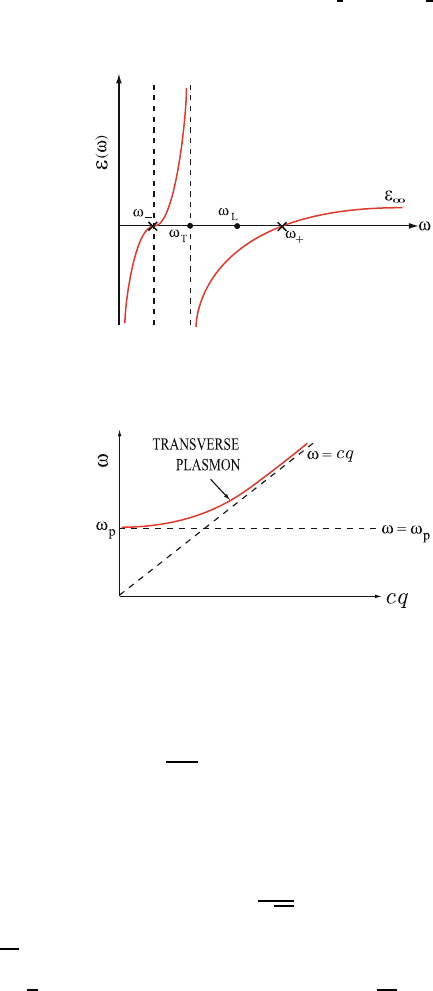
by plotting ε(ω)versusω (see Fig. 8.11). 314
Uncorrected Proof
BookID 160928 ChapID 08 Proof# 1 - 29/07/09
232 8 Dielectric Properties of Solids
Fig. 8.11. Frequency dependence of the dielectric function ε(ω) for a degenerate
polar semiconductor
Fig. 8.12. Dispersion relations of the transverse modes in a metal
8.10.2 Transverse Modes 315
For transverse waves ω
2
=
c
2
q
2
ε(ω)
. Again we will take the limit τ →∞. 316
Dielectric 317
For a dielectric ε(ω)isaconstantε
0
independent of frequency. Thus, we have 318
ω =
c
√
ε
0
q. (8.76)
Here,
√
ε
0
is called the refractive index n, and the velocity of light in the 319
medium is
c
n
. paragraphMetal For a metal ε =1−
ω
2
p
ω
2
, giving 320
ω
2
= ω
2
p
+ c
2
q
2
. (8.77)
No transverse waves propagate for ω<ω
p
since ε(ω) is negative there (see 321
Fig. 8.12). 322
Uncorrected Proof
BookID 160928 ChapID 08 Proof# 1 - 29/07/09
8.10 Bulk Modes 233
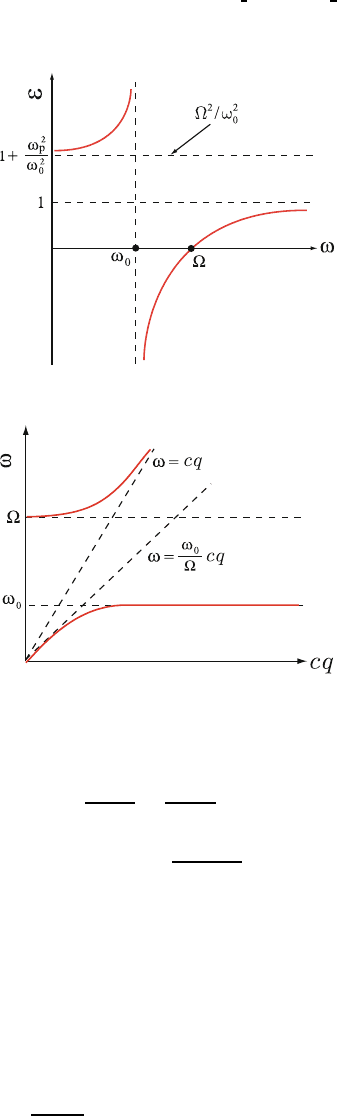
Fig. 8.13. Frequency dependence of the dielectric function ε(ω) for bound electrons
Fig. 8.14. Dispersion relation of the transverse modes for bound electrons
Bound Electrons 323
For bound electrons ε =1+
ω
2
p
ω
2
0
−ω
2
=
Ω
2
−ω
2
ω
2
0
−ω
2
giving for the transverse mode 324
c
2
q
2
= ω
2
Ω
2
− ω
2
ω
2
0
− ω
2
. (8.78)
It is worth sketching ε(ω)versusω (see Fig. 8.13).
325
The dielectric function is negative for ω
0
<ω<Ω. The dispersion relation 326
of the transverse mode for bound electrons given by (8.78) is sketched in 327
Fig. 8.14. 328
No transverse modes propagate where ε(ω) < 0sincec
2
q
2
= ω
2
ε gives 329
imaginary values of q in that region. 330
Polar Dielectric 331
In this case ε(ω)=ε
∞
ω
2
−ω
2
L
ω
2
−ω
2
T
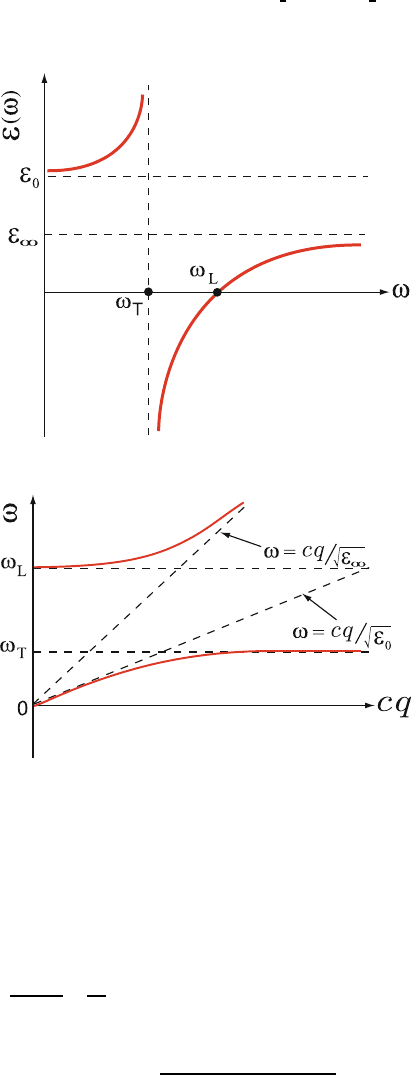
and again it is worth plotting ε(ω)versusω.It 332
is shown in Fig. 8.15. ε(ω) is negative in the region ω
T
<ω<ω
L
. Plotting 333
Uncorrected Proof
BookID 160928 ChapID 08 Proof# 1 - 29/07/09
234 8 Dielectric Properties of Solids
Fig. 8.15. Frequency dependence of the dielectric function ε(ω) in a polar dielectric
Fig. 8.16. Dispersion relation of the transverse modes in a polar dielectric
ω versus cq we have result shown in Fig. 8.16. There is a region between ω
T
334
and ω
L
where no light propagates the (reststrahlen region ). The propagating 335
modes are referred to as polariton modes. They are linear combinations of 336
transverse phonon and electromagnetic modes. 337
Degenerate Polar Semiconductor 338
Here ε(ω)=ε
∞
ω
2
−ω
2
L
ω
2
−ω
2
T
−
ω
2
p
ω
2
. We have already shown in (8.74) that this can be 339
written in terms of ω
+
and ω
−
. The equation for a transverse mode becomes 340
c
2
q
2
= ε
∞
(ω
2
− ω
2
+
)(ω
2
− ω
2
−
)
ω
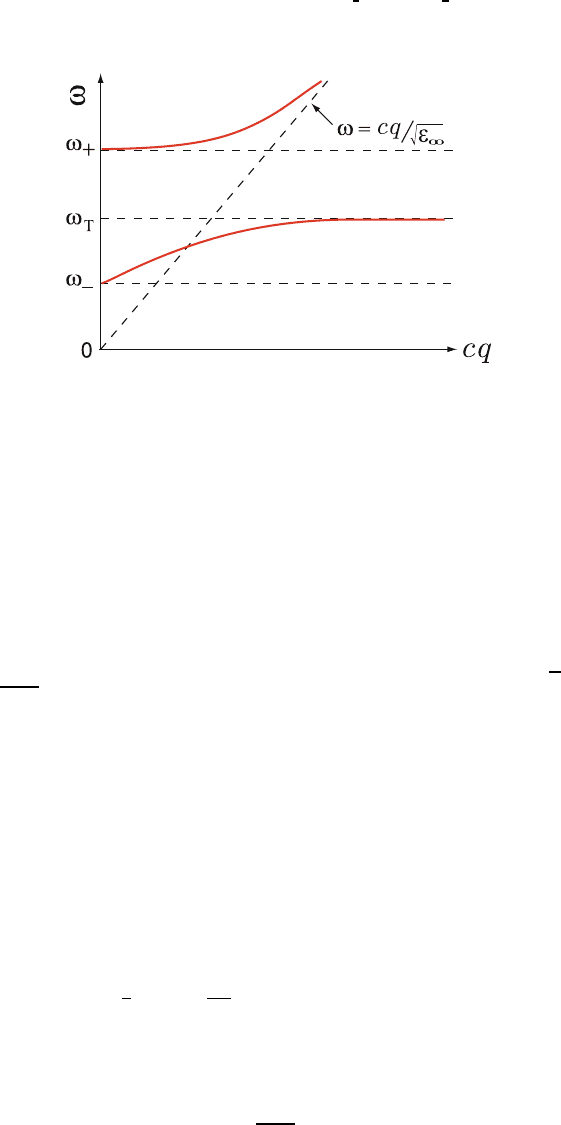
2
− ω
2
T
. (8.79)
In Fig. 8.11 the dielectric function ε(ω) was plotted as a function of ω in order
341
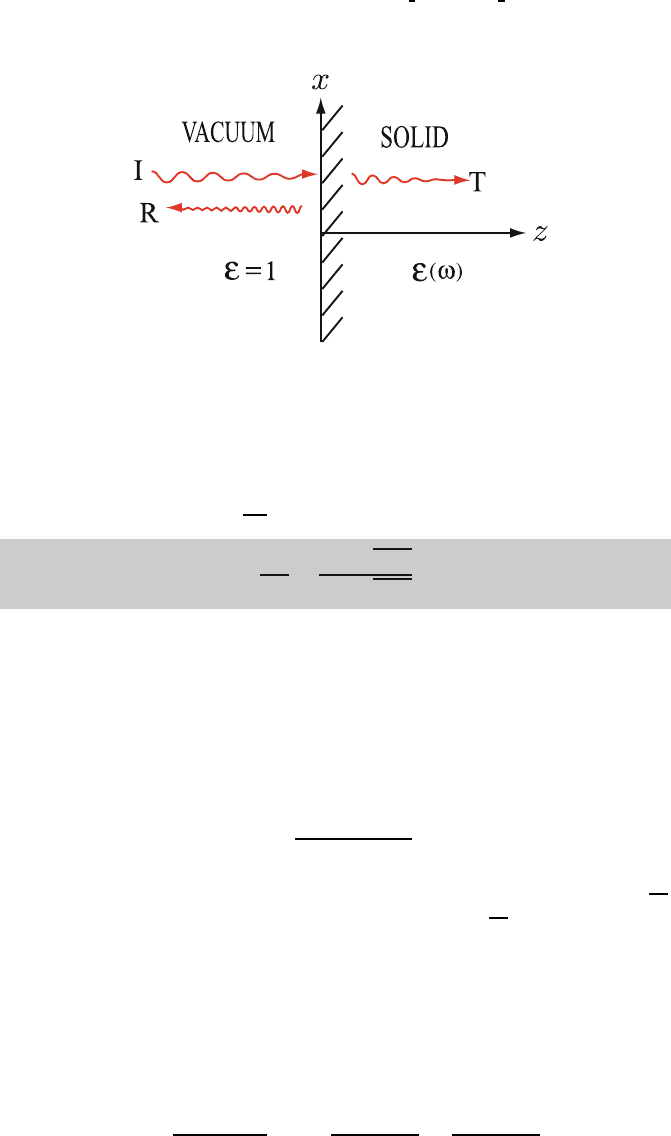
to study the longitudinal modes. There, we found that ε(ω) was negative if 342
Uncorrected Proof
BookID 160928 ChapID 08 Proof# 1 - 29/07/09
8.11 Reflectivity of a Solid 235
Fig. 8.17. Dispersion relation of the transverse modes in a polar semiconductor
ω<ω
−
or if ω
T
<ω<ω
+
. The dispersion curve for the transverse mode is 343
displayed in Fig. 8.17. 344
8.11 Reflectivity of a Solid 345
A vacuum–solid interface is located at z = 0. The solid (z>0) is described 346
by a dielectric function ε(ω) and vacuum (z<0) by ε = 1. An incident light 347
wave of frequency ω propagates in the z-direction as shown in Fig. 8.18. 348
Here we take the wave to be polarized in the ˆy-direction and q
0
=
ω
c
while 349
q =
ε(ω)q
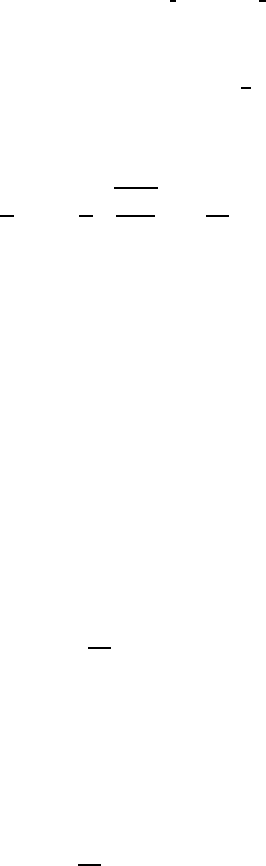
0
. There are three waves to consider: 350
1. The incident wave whose electric field is given by 351
E
I
=ˆyE
I
e
i(ωt−q
0
z)
.
2. The reflected wave whose electric field is given by
352
E
R
=ˆyE
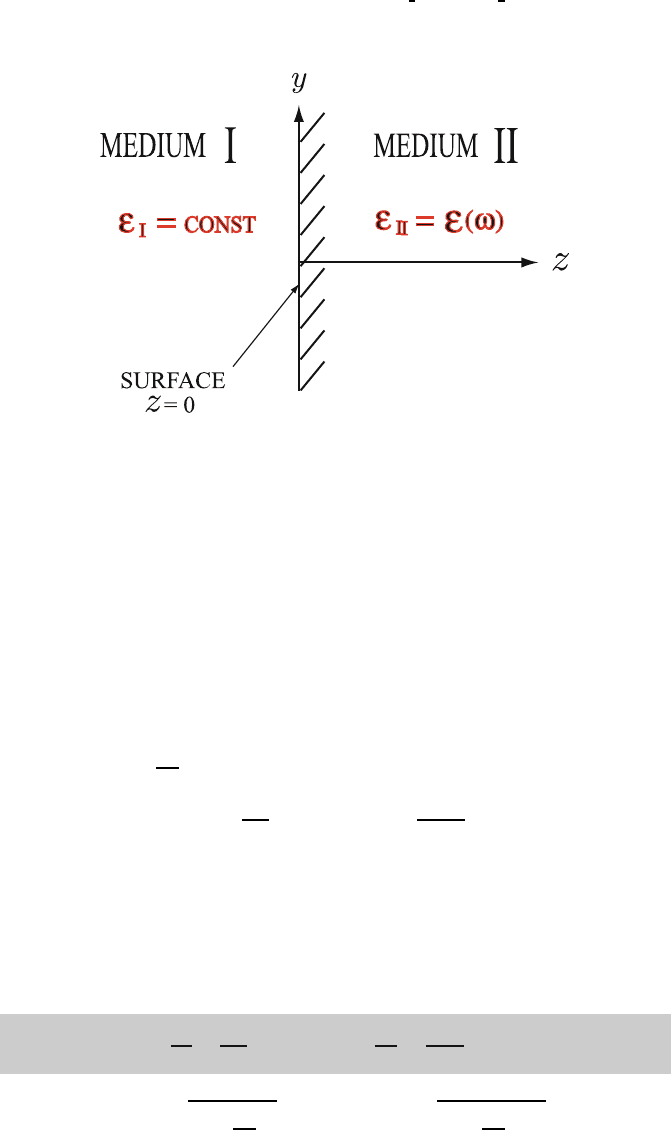
R
e
i(ωt+q
0
z)
. (8.80)
3. The transmitted wave whose electric field is given by
353
E
T
=ˆyE
T
e
i(ωt−qz)
.
Because ∇×E = −
1
c
˙
B, B =
cq
i
ω
× E,whereq
i
= q
0
for the wave in vacuum 354
and q
i
= q for the wave in the solid. We can easily see that 355
B
I
= −ˆxE
I
e
i(ωt−q
0
z)
,
B
R
=ˆxE
R
e
i(ωt+q
0
z)
,
B
T
= −ˆx
ε(ω)E
T
e
i(ωt−qz)
.
(8.81)
Uncorrected Proof
BookID 160928 ChapID 08 Proof# 1 - 29/07/09
236 8 Dielectric Properties of Solids
Fig. 8.18. Reflection of light wave at the interface of vacuum and solid of dielectric
function ε(ω)
The boundary conditions at z = 0 are continuity of E and B.Thisgives 356
E
I
+ E
R
= E
T
, −E
I
+ E
R
= −ε
1/2
E
T
. (8.82)
Solving these equations for
E
R
E
I
gives 357
E
R
E
I
=
1 −
ε(ω)
1+
ε(ω)
. (8.83)
358
8.11.1 Optical Constants 359
The refractive index n(ω) and extinction coefficient k(ω) are real functions of 360
frequency defined by 361
ε(ω)=(n +ik)
2
. (8.84)
Therefore, the reflection coefficient, defined by R = |E
R
/E
I
|
2
is given by 362
R =
(1 − n)
2
+ k
2
(1 + n)
2
+ k
2
. (8.85)
The power absorbed is given by P = (j · E). But j = σE and σ =
iω
4π
363
(ε −1). Therefore the power absorbed is proportional to
ω
4π
ε
2
(ω)|E|
2
.Butthe 364
imaginary part of ε(ω)isjust2nk,sothat 365
Power absorbed ∝ n(ω) k(ω). (8.86)
8.11.2 Skin Effect
366
We have seen that for a metal ε(ω)isgivenby 367
ε(ω)=1−
ω
2
p
ω(ω − i/τ)
=1−
ω
2
p
ω
2
+1/τ
2
− i
ω
2
p
/ωτ
ω
2
+1/τ
2
. (8.87)
Uncorrected Proof
BookID 160928 ChapID 08 Proof# 1 - 29/07/09
8.12 Surface Waves 237
At optical frequencies ω is usually large compared to
1
τ
. Therefore, the real 368
part of ε(ω) is large compared to the imaginary part; however, it is negative. 369
ε
1
(ω) −ω
2
p
/ω
2
,sinceω
p
is large compared to optical frequencies for most 370
metals. The wave vector of the transmitted wave is 371
q =
ω
c
ε
1/2
ω
c
8
−ω
2
p
ω
2
= ±i
ω
p
c
Thus, the wave
372
E
T
= E
T
ˆy e
i(ωt−qz)
decays with increasing z as e
−z/λ
where λ = c/ω
p
is called the skin depth.For 373
ω
p
10
16
sec
−1
, λ ≈ 30 nm. In a metal, light only penetrates this distance. 374
This analysis assumed that j(r)=σE(r), a local relationship between j and E. 375
If the mean free path l = v
F
τ is larger than λ, the skin depth, this assumption 376
is not valid. Then one must use a more sophisticated analysis; this is referred 377
to as the anomalous skin effect. 378
8.12 Surface Waves 379
In solving the equations describing the propagation of electromagnetic waves 380
in an infinite medium, we considered the wave vector q, which satisfied the 381
relation 382
q
2
=
ω
2
c
2
ε(ω) (8.88)
to have components q
y
and q
z
which were real. 383
At a surface (z = 0) separating two different dielectrics it is possible to 384
have solutions for which q
2
z
is negative in one or both of the media. If q
2
z
is 385
negative in both media, implying that q
z
itself is imaginary, such solutions 386
describe surface waves. 387
Let us look at the system shown in Fig. 8.19. The wave equation can be 388
written 389
q
2
zi
=
ω
2
c
2
ε
i
− q
2
y
, (8.89)
where i = I or II. We think of ω and q
y
as given and the same in each medium. 390
Then the wave equation tells us the value of q
2
z
in each medium. 391
Let us assume a p-polarized wave (the s-polarization in which E is parallel 392
to the surface does not usually give surface waves). We take 393
E =(0,E
y
,E
z
)e
i(ωt−q
y
y−q
z
z)
. (8.90)
Because there is no charge density except at the surface z =0,wehave
394
∇·E = q · E = 0 everywhere except at the surface. This implies that 395
q
y
E
y
+ q
z
E
z
=0, (8.91)
Uncorrected Proof
BookID 160928 ChapID 08 Proof# 1 - 29/07/09
238 8 Dielectric Properties of Solids
Fig. 8.19. The interface of two different media of dielectric functions ε
I
and ε
II
giving the value of E
z
in each medium in terms of q
y
, q
zi
,andE
y
.Wetake 396
E
I
=(0,E
yI
,E
zI
)e
iωt−iq
y
y+α
I
z
,α
2
I
= −q
2
zI
E
II
=(0,E
yII
,E
zII
)e
iωt−iq
y
y−α
II
z
,α
2
II
= −q
2
zII
. (8.92)
Since
397
e
−iq
zI
z
=e
α
I
z
,q
zI
=iα
I
e
−iq
zII
z
=e
−α
II
z
,q
zII
= −iα
II
.
Here α
I
and α
II
are positive and the form of E(z) has been chosen to vanish 398
as |z|→∞. 399
Since E
z
i
= −
q
y
q
z
i
E
y
,weobtain 400
E
zI
= −
q
y
iα
I
E
y
I
,E
zII
= −
q
y
−iα
II
E
y
II
(8.93)
The boundary conditions are 401
(i) E
yI
(0) = E
yII
(0) = E
y
(0)
(ii) ε
I
E
zI
(0) = ε
II
E
zII
(0)
(8.94)
These conditions give us the dispersion relation of the surface wave. Substi-
402
tuting fields given by (8.93) into the second expression of (8.94), we have 403
ε
I
α
I
+
ε
II
α
II
=0 or
ε
o
α
o
+
ε(ω)
α
=0. (8.95)
404
where 405
α
o
=
8
q
2
y
−
ω
2
c
2
ε
o
and α =
8
q
2
y
−
ω
2
c
2
ε(ω). (8.96)
Uncorrected Proof
BookID 160928 ChapID 08 Proof# 1 - 29/07/09
8.12 Surface Waves 239
Non-retarded Limit 406
This is the case where cq
y
ω or c may be taken as infinite. In this limit, we 407
have α
I
α
II
q
y
and the dispersion relation becomes 408
ε
o
+ ε(ω)=0. (8.97)
Surface Polaritons (with Retardation Effects)
409
We take the dispersion relation given by (8.95) and square both sides. This 410
gives 411
ε
2
o
α
2
= ε
2
(ω)α
2
0
,
or
412
ε
2
o
q
2
y
−
ω
2
c
2
ε(ω)
= ε
2
(ω)
q
2
y
−
ω
2
c
2
ε
o
.
This can be simplified to
413
[ε
o
+ ε(ω)] q
2
y
=
ω
2
c
2
ε
o
ε(ω)
or
414
c
2
q
2
y
=
ω
2
ε
o
ε(ω)
ε
o
+ ε(ω)
(8.98)
8.12.1 Plasmon
415
For a system containing n
0
free electrons of mass m 416
ε(ω)=ε
s
−
ω
2
p
ω
2
, (8.99)
where ε
s
is the background dielectric constant and ω
2
p
=
4πn
0
e
2
m
. In the non- 417
retarded limit we find 418
ε
o
+
9
ε
s
−
ω
2
p
ω
2
:
=0.
Solving for ω
2
gives the surface plasmon frequency 419
ω
SP
=
ω
p
√
ε
o
+ ε
s
. (8.100)
420
Recall the bulk plasmon is given by ε(ω)=0 421
ω
BP
=
ω
p
√
ε
s
>ω
SP
. (8.101)
422
Uncorrected Proof
BookID 160928 ChapID 08 Proof# 1 - 29/07/09
240 8 Dielectric Properties of Solids
-
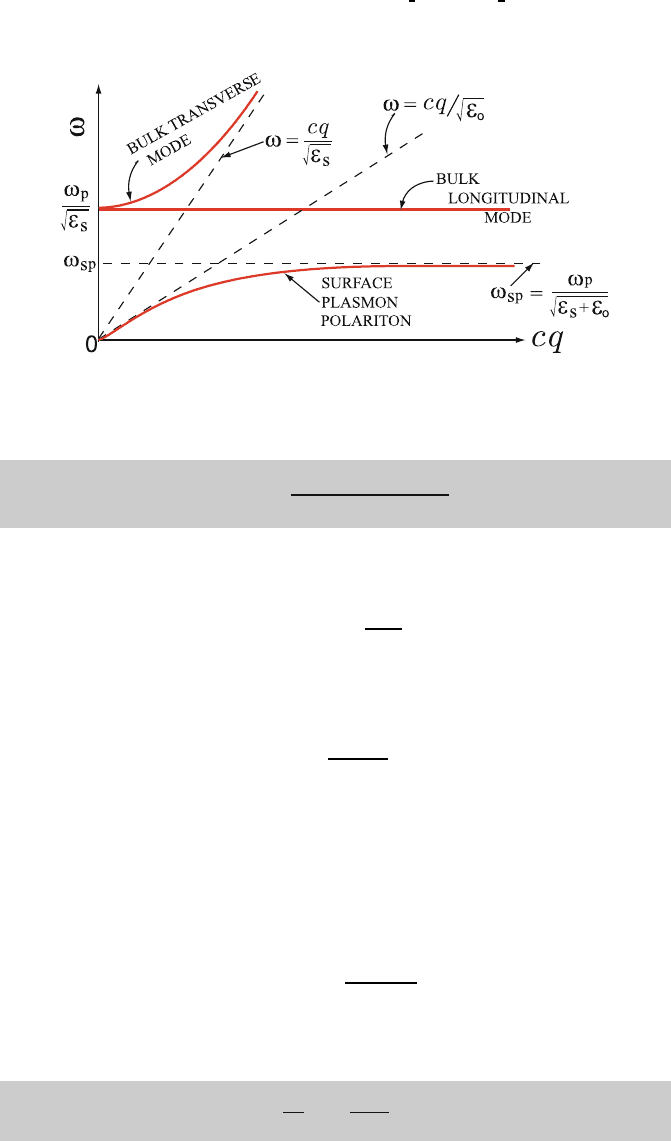
Fig. 8.20. Dispersion curves of the bulk and surface plasmon–polariton modes
So that we have ω
SP
<ω
BP
. For the surface plasmon–polariton we find 423
c
2
q
2
y
=
ω
2
ε
o
ε
s
− ω
2
p
/ω
2
ε
o
+ ε
s
− ω
2
p
/ω
2
(8.102)
424
It is easy to see that, for very small values of cq
y
, ω → 0 and we can neglect 425
ε
s
and (ε
o
+ ε
s
)comparedto−ω
2
p
/ω
2
on the right-hand side of (8.102). 426
lim
cq
y
→0
ω
2
c
2
q
2
y
ε
o
. (8.103)
For very large cq
y
, the only solution occurs when the denominator of the right 427
hand side approaches zero. 428
lim
cq
y
→∞
ω
2
ω
2
p
ε
o
+ ε
s
= ω
2
SP
. (8.104)
The dispersion curves of the bulk and surface plasmon–polariton modes are
429
shown in Fig. 8.20. 430
8.12.2 Surface Phonon–Polariton 431
Here we take the dielectric function of a polar crystal 432
ε(ω)=ε
∞
ω
2
− ω
2
L
ω
2
− ω
2
T
. (8.105)
At the interface of a dielectric ε
I
and a polar material described by (8.105) 433
the surface mode is given by (8.95) 434
ε
I
α
I
= −
ε(ω)
α
. (8.106)
435