
Quinn J.J., Yi K.-S. Solid State Physics: Principles and Modern Applications
Подождите немного. Документ загружается.

Uncorrected Proof
BookID 160928 ChapID 09 Proof# 1 - 29/07/09
9.6 Diamagnetism of Metals 261
We note that the eigenvalues E
n
(k
y
,k
z
) are independent of k
y
. The allowed 253
values of k
y
and k
z
are determined by imposing periodic boundary conditions. 254
If we require the particles to be in a cube of length L, then because the center 255
of each oscillator must be in the box, the range of possible k
y
values must be 256
Range of values of k
y
≤
mω
c
L
¯h
. (9.81)
The total number of allowed values of k
y
,foragivenk
z
,is 257
L
2π
× Range of values of k
y
=
mω
c
L
2
2π¯h
=
BL
2
hc/e
. (9.82)
Thus for each value of n, k
z
(and spin s)thereare
mω
c
L
2
2π¯h
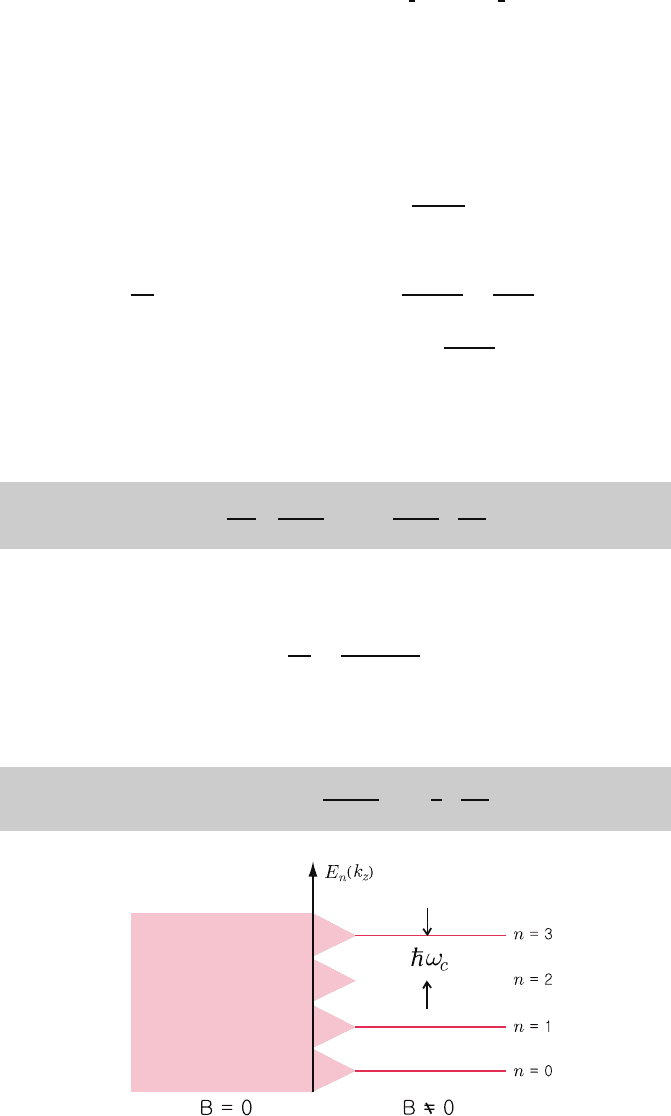
energy states. Con- 258
sider the following schematic plot of the energy levels for a given k
z
shown in 259
Fig. 9.4. In quantum mechanics, a dc magnetic field can alter the distribution 260
of energy levels. Thus, there can be a change in the energy of the system and 261
this can result in a diamagnetic current. The diamagnetic susceptibility turns 262
out to be 263
χ
L
= −
n
0
2ζ
0
e¯h
2m
∗
c
2
= −
n
0
μ
2
B
2ζ
0
m
m
∗
2
. (9.83)
264
Notice that we expect m
∗
(not m) to appear because the diamagnetism is asso- 265
ciated with the orbital motion of the electrons. This is justifiable only if the 266
cyclotron radius is much larger than the interatomic spacing. 267
r
c
=
v
F
ω
c
=
v
F
eB
0
/m
∗
c
. (9.84)
Typically, v
F
≈ 10
8
cm/sandω
c
≈ 1.76 × 10
7
B
0
.ThusforB
0
∼ 10
5
gauss, 268
r
c
≈ 10
−4
cm ∼ 10
4
˚
A lattice constant. The total magnetic susceptibility
269
of a metal is 270
χ
QM
= χ
P
+ χ
L
=
3n
0
μ
2
B
2ζ
0
1 −
1
3
m
m
∗
2
(9.85)
271
Fig. 9.4. Energy level splitting of the electron gas due to orbital quantizations in
the presence of the magnetic field B
Uncorrected Proof
BookID 160928 ChapID 09 Proof# 1 - 29/07/09
262 9 Magnetism in Solids
9.7 de Haas–van Alphen Effect 272
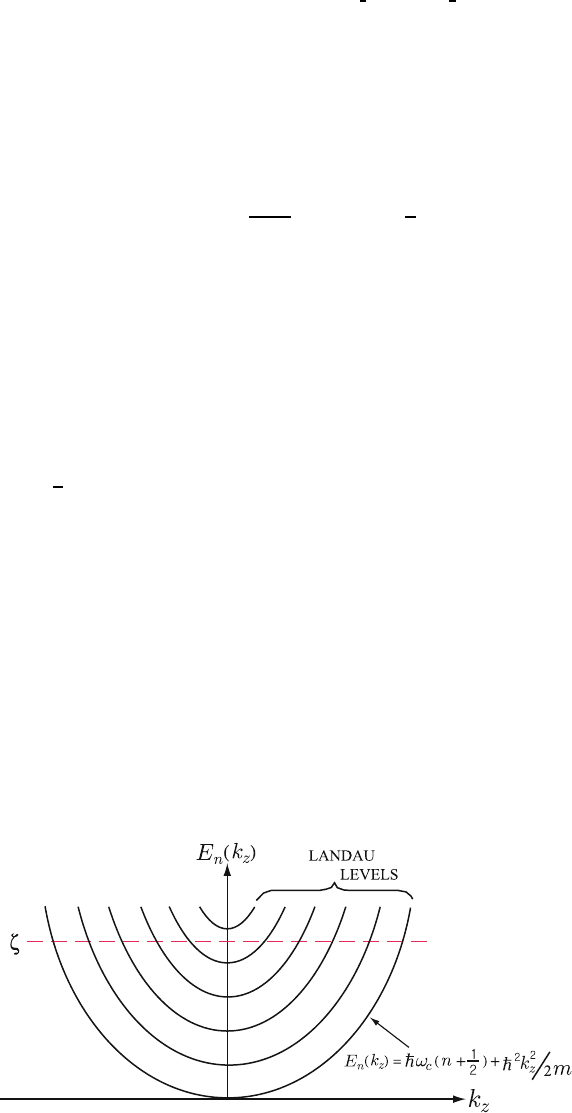
We have seen that the energy levels for an electron in a magnetic field look 273
like, as is shown in Fig. 9.5, 274
E
n
(k
y
,k
z
)=
¯h
2
k
2
z
2m
+¯hω
c
n +
1
2
.
The Fermi energy ζ is a slowly varying function of B.AsweincreaseB,the
275
distance between Landau levels increases, and at k
z
= 0 levels pass through 276
the Fermi energy. As the Landau level at k
z
= 0 passes through the Fermi 277
level, the internal energy abruptly decreases. 278
Let us consider a simple situation, where the Fermi energy ζ is between 279
two orbits. Let us assume that T = 0 so that we have a perfectly sharp Fermi 280
surface. As we increase the field, the states are raised in energy so that the 281
lowest occupied state approaches ζ in energy. Of course, all the energies in the 282
presence of the field will be higher than those in the absence of the field by 283
an amount
1
2
¯hω
c
. As the levels approach the Fermi energy, the free energy of 284
the electron gas approaches a maximum. As the highest occupied level passes 285
the Fermi surface, it begins to empty, thus decreasing the free energy of the 286
electron gas. When the Fermi level lies below the cyclotron level the energy of 287
the electron gas is again a minimum. Thus, we can see how the free energy is 288
a periodic function of the magnetic field. Now, since many physically observ- 289
able properties of the system are derived from the free energy (such as the 290
magnetization), we see that they, too, are periodic functions of the magnetic 291
field. The periodic oscillation of the diamagnetic susceptibility of a metal at 292
low temperatures is known as the de Haas–van Alphen effect. The de 293
Haas–van Alphen effect arises from the periodic variation of the total energy 294
of an electron gas as a function of a static magnetic field. The energy varia- 295
tion is easily observed in experiments as a periodic variation in the magnetic 296
moment of the metal. 297
Fig. 9.5. Schematics of energy levels for an electron in a magnetic field B
Uncorrected Proof
BookID 160928 ChapID 09 Proof# 1 - 29/07/09
9.7 de Haas–van Alphen Effect 263
Density of States 298
Look at G(E), the number of states per unit volume of energy less than E. 299
G(E)=
1
L
3
nk
y
k
z
E
nk
z
<E
1=
1
L
3
L
2π
2
2
n
E
nk
z
<E
dk
y
dk
z
1. (9.86)
We added a factor 2 to take account of spin. Since
"
dk
y
=
mω
c
L
¯h
,wehave 300
G(E)=
1
L
3
L
2π
2
2
mω
c
L
¯h
n
E
nk
z
<E
dk
z
,
where E
n
(k
y
,k
z
)=
¯h
2
k
2
z
2m
+¯hω
c
(n+
1
2
). Define κ
n
=
√
2m
¯h
E − ¯hω
c
(n +
1
2
)
1/2
. 301
For each value of n the k
z
integration goes from −κ
n
to κ
n
.Thisgives 302
G(E)=
mω
c
2π
2
¯h
n
Max
n=0
2
√
2m
¯h
E − ¯hω
c
n +
1
2
1/2
. (9.87)
The density of states g(E)is
dG
dE
. 303
g(E)=
mω
c
2π
2
¯h
√
2m
¯h
n
Max
n=0
E − ¯hω
c
n +
1
2
−1/2
. (9.88)
304
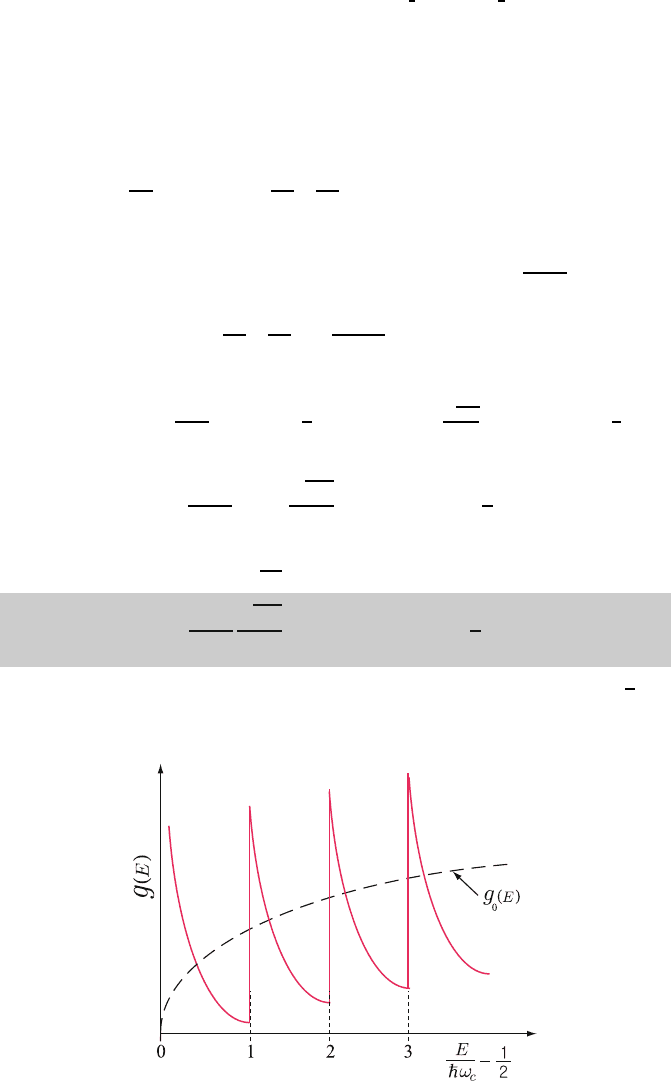
We note that the g(E) has square root singularities at E =¯hω
c
(n +
1
2
)as 305
illustrated in Fig. 9.6. 306
Fig. 9.6. Schematic plot of the density of states for an electron gas in a magnetic
field B
Uncorrected Proof
BookID 160928 ChapID 09 Proof# 1 - 29/07/09
264 9 Magnetism in Solids
Fig. 9.7. Schematic plot of the magnetic field dependence of the diamagnetic
susceptibility
In the limit as ¯hω
c
→ 0, the sum on n can be replaced by an integral 307
n
Max
n=0
−→
1
¯hω
c
E
0
dx,
where x = n¯hω
c
. In this case the g(E) reduces to the free particle density of 308
states for B = 0, i.e. g
0
(E)=
√
2m
3/2
π
2
¯h
3
E
1/2
. 309
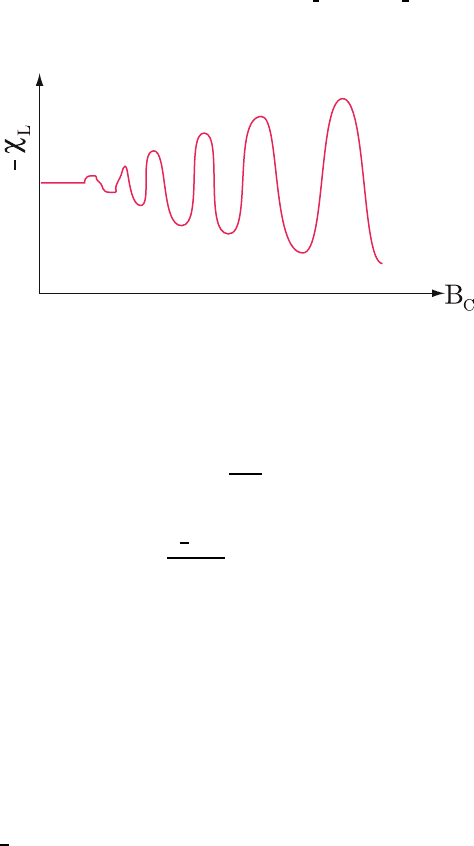
Because g(E) has square root singularities, the internal energy, the mag- 310
netic susceptibility, etc. show oscillations (see Fig. 9.7). As ¯hω
c
changes with 311
N fixed (or N changes with ¯hω
c
fixed), the Fermi level passes through the 312
bottoms of different Landau levels. Let ζ μ
B
B or ζ ¯hω
c
. Then the 313
electron gas occupies states in many different cyclotron levels. At low tem- 314
peratures all cyclotron levels are partially occupied up to a limiting energy 315
ζ, which might lie between the threshold energies of the n
th
and (n − 1)
th
316
cyclotron levels. As B-field increases, the energy and the number of states 317
in each subband increase, and hence the threshold energy likewise increases. 318
Since the total number of electrons is given, there is a continuous rearrange- 319
ment of the electrons with increasing the field. When the threshold energy 320
E
n
=(n +
1
2
)¯hω
c
grows from a value below ζ to a value above ζ, the electrons 321
in the nth band fall back into states in the (n−1)th band, decreasing the total 322
energy. As the field increases, it rises again until the next threshold energy 323
E
n−1
exceeds the ζ.Asaresultζ itself becomes (weakly) periodic. The sepa- 324
ration between the individual threshold energy is ¯hω
c
. Therefore, ¯hω
c
k
B
T 325
is an important condition; otherwise the electron distribution in the region of 326
ζ is so widely spread that oscillations are smoothed out. When the condition 327
ζ ¯hω
c
is no longer fulfilled, all the electrons are in the lowest subband and 328
the oscillations cease. This limit is called the quantum limit. 329
The oscillations in the magnetic susceptibility are observed in experiments 330
when ¯hω
c
k
B
T in high purity (low scattering) samples. Oscillations in elec- 331
trical conductivity are called the Shubnikov–de Haas oscillations.Both 332

Uncorrected Proof
BookID 160928 ChapID 09 Proof# 1 - 29/07/09
9.8 Cooling by Adiabatic Demagnetization of a Paramagnetic Salt 265
the de Haas–van Alphen oscillations and Shubnikov–de Haas oscillations are 333
useful in studying electronic properties of metals and semiconductor quantum 334
structures. 335
9.8 Cooling by Adiabatic Demagnetization 336
of a Paramagnetic Salt 337
The entropy of a paramagnetic salt is the sum of the entropy due to phonons 338
and the entropy due to the magnetic moments. 339
S = S
p
+ S
m
. (9.89)
If the paramagnetic ion has angular momentum J, then the ground state in
340
the absence of any applied magnetic field must be 2J +1 fold degenerate. This 341
is because m
J
can have any value between −J and +J with equal probabil- 342
ity. For a system containing N paramagnetic ions (noninteracting), the total 343
degeneracy is (2J +1)
N
, and the magnetic contribution to the entropy is 344
S
m
(B =0)=k
B
ln(2J +1)
N
= Nk
B
ln(2J +1). (9.90)
Introduce a magnetic field B (neglect local field corrections treating the ions
345
as noninteracting magnetic ions). Then the magnetic entropy must be given by 346
S
m
(B)=−Nk
B
J
m
J
=−J
p(m
J
)lnp(m
J
), (9.91)
where
347
p(m
J
)=Z
−1
e
−
g
L
μ
B
B
k
B
T
m
J
. (9.92)
Here, we have used the relation S(B, T )=k
B
∂
∂T
(T ln Z)wherethenormal- 348
ization constant Z is defined so that
m
J
p(m
J
) = 1, giving 349
Z =
m
J
e
−
g
L
μ
B
B
k
B
T
m
J
. (9.93)
Substitute the expression for p(m
J
)intoS
m
(B)tohave 350
S
m
(B)=Nk
B
ln Z + Nk
B
g
L
μ
B
B
k
B
T
m
J
. (9.94)
We note that the magnetization is given by M = −Ng
L
μ
B
m
J
so that 351
S
m
(B)=Nk
B
ln Z −
MB
T
. (9.95)
352
Uncorrected Proof
BookID 160928 ChapID 09 Proof# 1 - 29/07/09
266 9 Magnetism in Solids
Fig. 9.8. Schematic plot of the process of cooling by adiabatic demagnetization of
a paramagnetic salt
Notice that S
m
(B) depends only on the product βB =
B
k
B
T
.Thus,wehave 353
S
m
(B) − S
m
(0) = Nk
B
ln
Z
2J +1
−
MB
T
. (9.96)
354
It is easy to see that this quantity is always negative. This agrees with the 355
intuitive idea that the system is more disordered in the absence of the mag- 356
netic field. The phonon contribution to the entropy is essentially independent 357
of magnetic field. 358
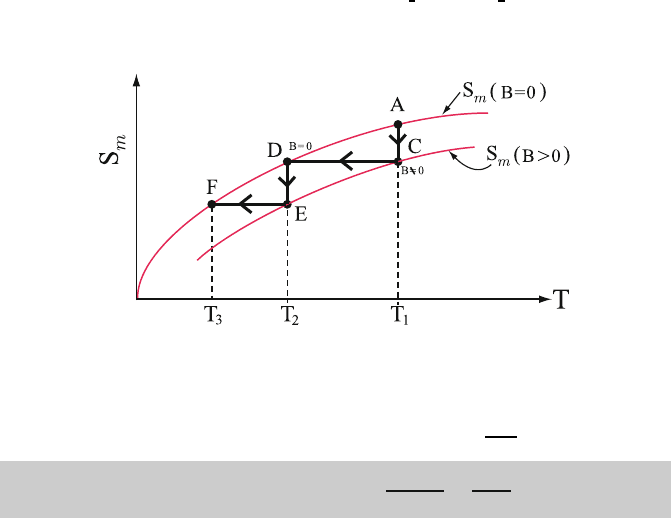
Now, consider the following process (see Fig. 9.8): 359
1. Apply a magnetic field B under isothermal conditions. This takes one from 360
point A to point C in the S
m
versus T plane. 361
2. Now, isolate the salt from the heat bath and adiabatically remove the 362
magnetic field to arrive at D. 363
This process has lowered the temperature from T
1
to T
2
. The process can be 364
repeated.InanidealsystemS
m
(B = 0) should approach zero as T approaches 365
zero. In practice there is a lower limit in T that can be reached; it is due to the 366
internal magnetic fields (i.e. coupling of magnetic moments to one another) 367
in the paramagnetic salt. 368
9.9 Ferromagnetism 369
Some materials possess a spontaneous magnetic moment; that is, even in 370
the absence of an applied magnetic field they have a magnetization M . 371
The value of the spontaneous magnetic moment per unit volume is called the 372
spontaneous magnetization, M
s
(T ). The temperature T
c
above which the 373
spontaneous magnetization vanishes is called the Curie temperature. 374
The simplest way to account for the spontaneous alignment is by postulat- 375
ing the existence of an internal field H
E
, called the Weiss field, which causes 376
Uncorrected Proof
BookID 160928 ChapID 09 Proof# 1 - 29/07/09
9.9 Ferromagnetism 267
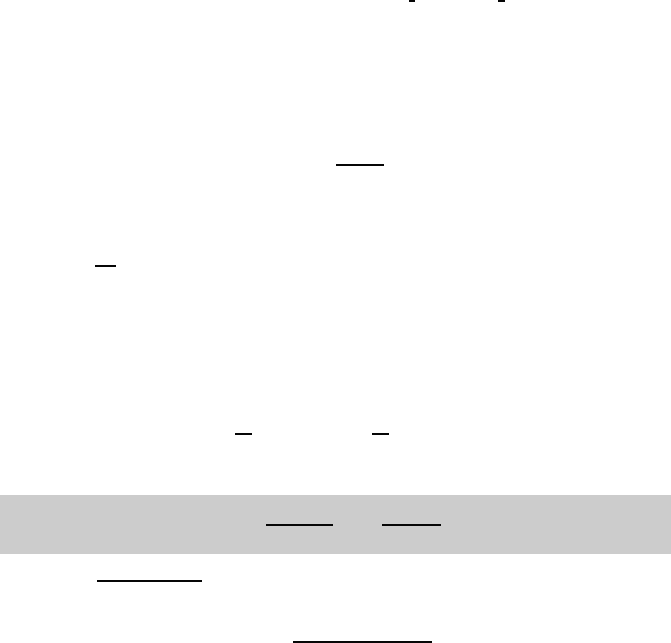
the magnetic moments of the atoms to line up. The value of H
E
is determined 377
from the Curie temperature T
c
by the relation gμ
B
JH
E
k
B
T
c
to be 378
H
E
=
k
B
T
c
gμ
B
J
. (9.97)
Typically, H
E
has a value of about 500 Tesla. We shall see that effective field 379
is not of magnetic origin. If we take μ
B
divided by the volume of a unit cell, 380
we obtain
μ
B
a
3
10
3
gauss H
E
. Weiss assumed that the effective field H
E
381
was proportional to the magnetization, i.e. 382
H
E
= λM. (9.98)
For T>T
c
, the magnetic susceptibility obeys Curie’s law, but now H + H
E
383
would replace H 384
M =
C
T
(H + H
E
)=
C
T
(H + λM)
Therefore, we have
385
M =
C
T − λC
H =
C
T − T
c
H (9.99)
386
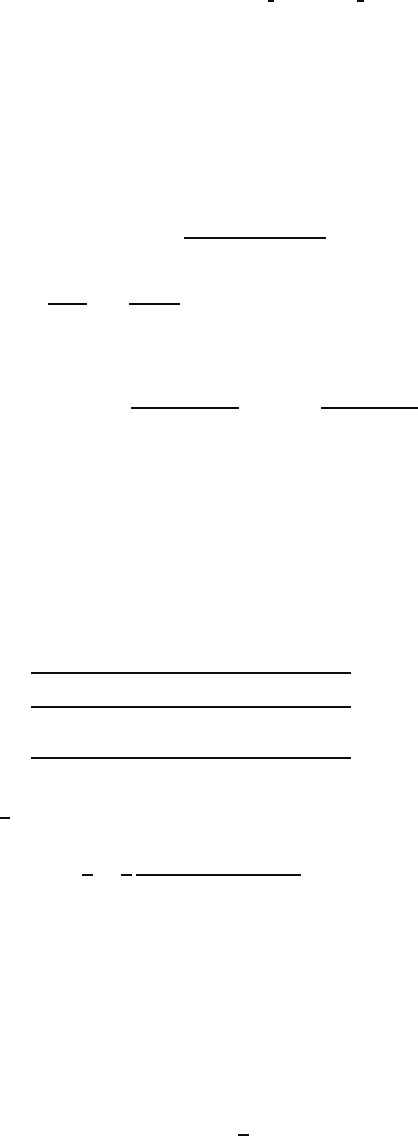
Since C =
Ng
2
L
μ
2
B
J(J+1)
3k
B
, the molecular field parameter can be written 387
λ
−1
=
Ng
2
L
μ
2
B
J(J +1)
3k
B
T
c
. (9.100)
For Fe, we have λ 5, 000.
388
Uncorrected Proof
BookID 160928 ChapID 09 Proof# 1 - 29/07/09
268 9 Magnetism in Solids
Problems 389
9.1. Consider a volume V bounded by a surface S filled with a magnetization 390
M(r
) that depends on the position r
. The vector potential A produced by 391
a magnetization M(r)isgivenby 392
A(r)=
d
3
r
M(r
) × (r − r
)
|r − r
|
3
.
(a) Show that ∇
1
r−r
|
=
r−r
|r−r
|
3
. 393
(b) Use this result together with the divergence theorem to show that A(r) 394
can be written as 395
A(r)=
V
d
3
r
∇
r
× M(r
)
|r − r
|
+
3
S
dS
M(r
) ×
ˆ
n
|r − r
|
,
where
ˆ
n is a unit vector outward normal to the surface S.Thevolume
396
integration is carried out over the volume V of the magnetized mate- 397
rial. The surface integral is carried out over the surface bounding the 398
magnetized object. 399
9.2. Demonstarate for yourself that Table 9.1 is correct by placing ↑ or ↓ 400
arrows according to Hund’s rules as shown below for Cr of atomic configura- 401
tion (3d)
5
(4s)
1
. 402
t1.2 l
z
210−1 −2
t1.3 3d-shell ↑↑↑ ↑ ↑
t1.4 4s-shell ↑
Clearly S =
1
2
× 6=3,L =0,J = L + S =3,and 403
g =
3
2
+
1
2
3(3 + 1) − 0(0 + 1)
3(3 + 1)
=2.
Therefore, the spectroscopic notation of Cr is
7
S
3
. 404
Use Hund’s rules (even though they might not be appropriate for every 405
case) to make a similar table for Y
39
,Nb
41
,Tc
43
,La
57
,Dy
66
,W
74
,andAm
95
. 406
9.3. AsystemofN electrons is confined to move on the x−y plane. A magnetic 407
field B = Bˆz is perpendicular to the plane. 408
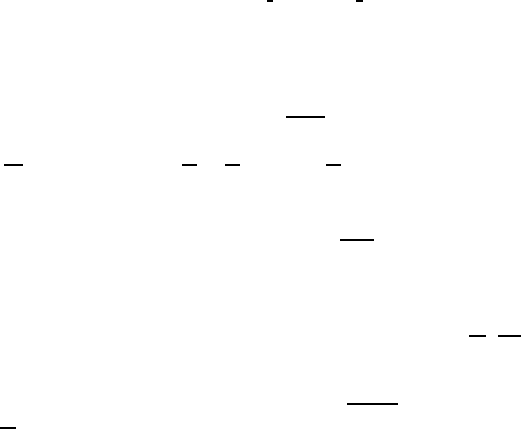
(a) Show that the eigenstates of an electron are written by 409
ε
nσ
(k)=¯hω
c
n +
1
2
− μ
B
Bσ
z
,
Uncorrected Proof
BookID 160928 ChapID 09 Proof# 1 - 29/07/09
9.9 Ferromagnetism 269
410
ψ
nσ
(k, x,y)=e
iky
u
n
(x +
¯hk
mω
c
)η
σ
.
Here, k =
2π
L
× j,wherej = −
N
2
, −
N
2
+1, ...,
N
2
− 1, and η
σ
is a spin 411
eigenfunction. 412
(b) Determine the density of states g
σ
(ε) for electrons of spin σ. Remember 413
that each cyclotron level can accomodate N
L
=
BL
2
hc/e
electrons of each 414
spin. 415
(c) Determine G
σ
(ε), the total number of states per unit area. 416
(d) Describe qualitatively how the chemical potential at T = 0 changes as 417
the magnetic field is increased from zero to a value larger than (
hc
e
)
N
L
L
2
. 418
9.4. Show that S
m
(B,T) <S
m
(0,T) by showing that dS(B, T )=∂
B
S|
T,V
+ 419
∂
T
S|
B,V
dT and that ∂
B
S(B, T)|
T,V
< 0 for all values of
g
L
μ
B
B
k
B
T
if J = 0. Here, 420
∂
T
S|
B,V
is just
c
v
T
. 421
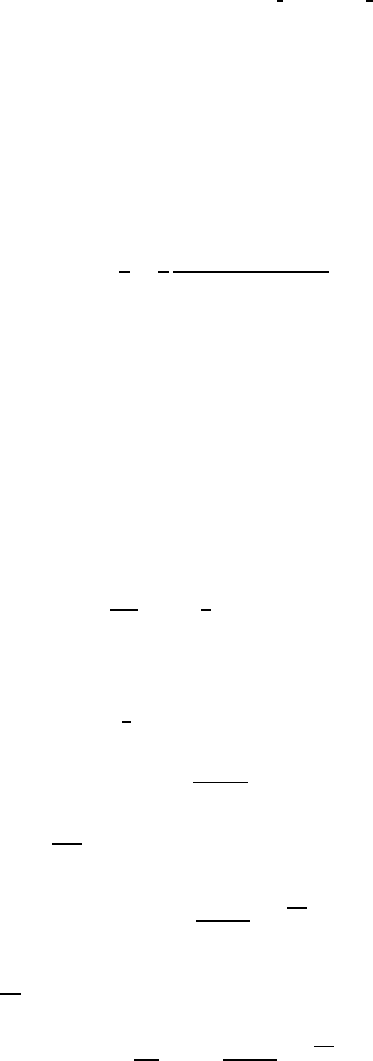
Uncorrected Proof
BookID 160928 ChapID 09 Proof# 1 - 29/07/09
270 9 Magnetism in Solids
Summary 422
The total angular momentum and magnetic moment of an atom are given by 423
J = L + S.; m = −μ
B
(L +2S)=−ˆgμ
B
J.
Here, the eigenvalue of the operator ˆg is the Land´eg-factor written as
424
g
L
=
3
2
+
1
2
s(s +1)− l(l +1)
j(j +1)
.
Thegroundstateofanatomorionwithan incomplete shell is determined
425
by Hund’s rules: 426
1. ThegroundstatehasthemaximumS consistent with the Pauli exclusion 427
principle. 428
2. It has the maximum L consistent with the maximum spin multiplicity 429
2S + 1 of Rule (i). 430
3. The J-value is given by L − S when a shell is less than half filled and by 431
L + S when more than half filled. 432
In the presence of a magnetic field B the Hamiltonian describing the 433
electrons in an atom is written as 434
H = H
0
+
i
1
2m
p
i
+
e
c
A(r
i
)
2
+2μ
B
B ·
i
s
i
,
where H
0
is the nonkinetic part of the atomic Hamiltonian and the sum is 435
over all electrons in an atom. For a homogeneous magnetic field B in the 436
z-direction, we have A = −
1
2
B
0
y
ˆ
i − x
ˆ
j
. In this gauge, the Hamiltonian
437
becomes 438
H = H−m
z
B
0
+
e
2
B
2
0
8m
e
c
2
i
x
2
i
+ y
2
i
,
where H = H
0
+
i
p
2
i
2m
e
and m
z
= μ
B
(L
z
+2S
z
). In the presence of B
0
,the 439
z-component of magnetic moment of the atom becomes 440
μ
z
= m
z
−
e
2
B
0
6m
e
c
2
i
r
2
i
.
The second term on the right-hand side is the origin of diamagnetism.If
441
J =0(sothatJ
z
= 0), the (Langevin) diamagnetic susceptibility is given by 442
χ
Dia
=
M
B
0
= −N
e
2
6m
e
c
2
i
r
2
i
.
The energy of an atom in a magnetic field B is E = g
L
μ
B
Bm
J
, where 443
m
J
= −J, −J +1,...,J − 1,J. The magnetization of a system containing N 444