
Quinn J.J., Yi K.-S. Solid State Physics: Principles and Modern Applications
Подождите немного. Документ загружается.


Uncorrected Proof
BookID 160928 ChapID 10 Proof# 1 - 29/07/09
284 10 Magnetic Ordering and Spin Waves
ion, rather than opposite to the moment as was given by (9.26). The exchange 140
integral J is defined as a half of the difference between the singlet and triplet 141
energies. Let us define the operators S
±
by 142
S
±
= S
x
± iS
y
. (10.31)
Remember that we can write S as
143
S =
1
2
σ, (10.32)
where σ
x
, σ
y
, σ
y
are the Pauli spin matrices given by 144
σ
x
=
01
10
,σ
y
=
0 −i
i 0
,σ
z
=
10
0 −1
. (10.33)
Let us choose units in which ¯h = 1. Then, S
x
, S
y
,andS
z
satisfy the 145
commutation relations 146
[S
x
,S
y
]
−
=iS
z
,
[S
y
,S
z
]
−
=iS
x
,
[S
z
,S
x
]
−
=iS
y
.
(10.34)
We will be using the symbols S and S
z
for quantum mechanical operators 147
and for numbers associated with eigenvalues. Where confusion might arise 148
we will write
ˆ
S and
ˆ
S
z
for the quantum mechanical operators. From quan- 149
tum mechanics we know that
ˆ
S
2
and
ˆ
S
z
can be diagonalized in the same 150
representation since they commute. We usually write 151
ˆ
S
2
|S, S
z
>= S(S +1)|S, S
z
,
ˆ
S
z
|S, S
z
= S
z
|S, S
z
.
(10.35)
Let us look at
ˆ
S
+
operating on the state |S, S
z
. We recall that 152
ˆ
S
2
,
ˆ
S
+
=0,
ˆ
S
z
,
ˆ
S
+
=
ˆ
S
+
.
(10.36)
We can write
153
ˆ
S
2
ˆ
S
+
|S, S
z
=
ˆ
S
+
ˆ
S
2
|S, S
z
+
ˆ
S
2
,
ˆ
S
+
|S, S
z
. (10.37)
The second term vanishes because the commutator is zero, and
ˆ
S
2
|S, S
z
= 154
S(S +1)|S, S
z
giving 155
ˆ
S
2
ˆ
S
+
|S, S
z
= S(S +1)
ˆ
S
+
|S, S
z
. (10.38)
Perform the same operation for
ˆ
S
z
operating on
ˆ
S
+
|S, S
z
to have 156
ˆ
S
z
ˆ
S
+
|S, S
z
=
ˆ
S
+
ˆ
S
z
|S, S
z
+
ˆ
S
z
,
ˆ
S
+
|S, S
z
. (10.39)

Uncorrected Proof
BookID 160928 ChapID 10 Proof# 1 - 29/07/09
10.4 Zero-Temperature Heisenberg Ferromagnet 285
Use the fact that
ˆ
S
z
,
ˆ
S
+
=
ˆ
S
+
and
ˆ
S
z
|S, S
z
= S
z
|S, S
z
.Thisgives 157
ˆ
S
z
ˆ
S
+
|S, S
z
=(S
z
+1)
ˆ
S
+
|S, S
z
. (10.40)
This means that
ˆ
S
+
|S, S
z
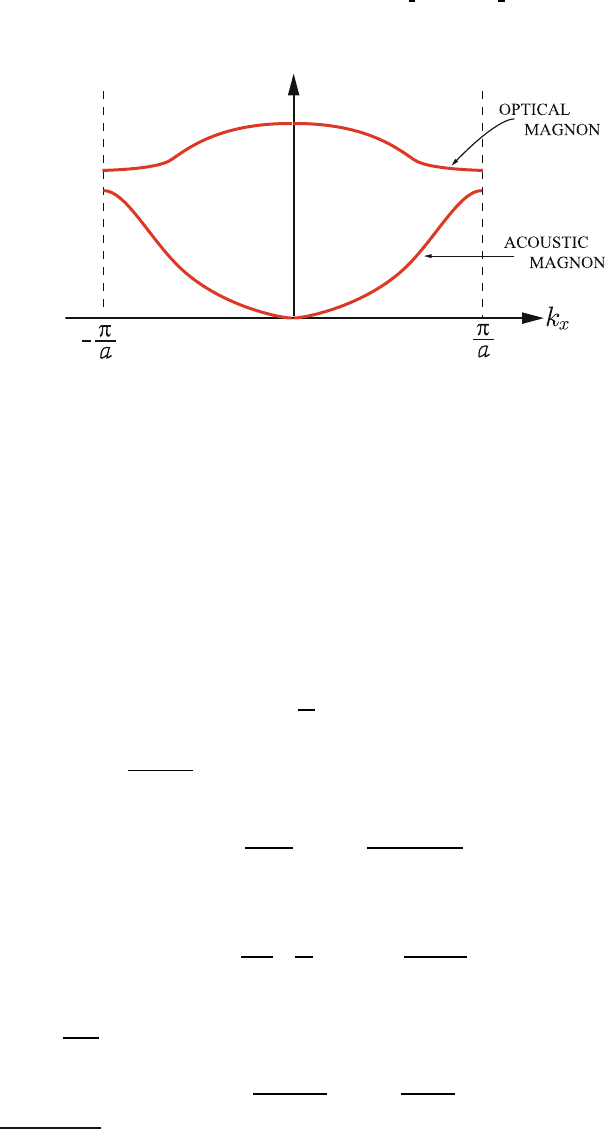
is proportional to |S, S
z
+1. To determine the 158
normalization constant we write 159
ˆ
S
+
|S, S
z
= N|S, S
z
+1,
and note that
160
{N|S, S
z
+1}
†
= N
∗
<S,S
z
+1|
and
161
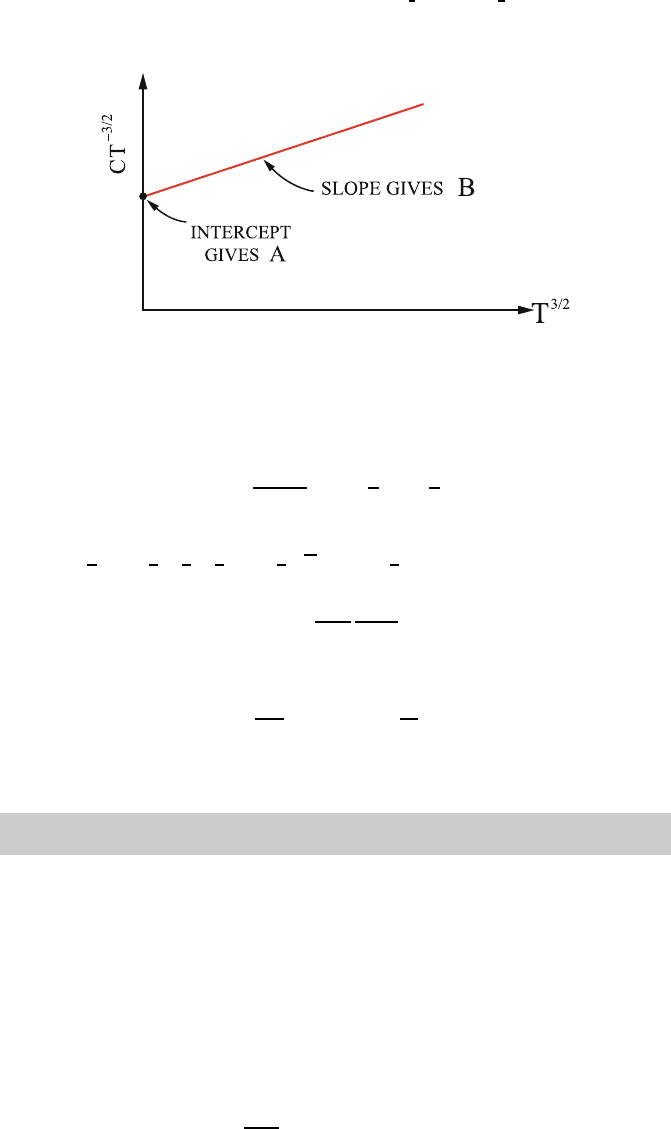
{
ˆ
S
z
|S, S
z
†
= S, S
z
|
ˆ
S
z
Thus, we have 162
|N|
2
S, S
z
+1|S, S
z
+1 = S, S
z
|
ˆ
S
−
ˆ
S
+
|S, S
z
= S, S
z
|(
ˆ
S
2
x
+
ˆ
S
2
y
−
ˆ
S
z
)|S, S
z
= S, S
z
|(
ˆ
S
2
−
ˆ
S
2
z
−
ˆ
S
z
)|S, S
z
giving for N
163
N =
S(S +1)− S
2
z
− S
z
1/2
.
We can then show that
164
ˆ
S
+
|S, S
z
=
(S − S
z
)(S +1+S
z
)|S, S
z
+1
ˆ
S
−
|S, S
z
=
(S + S
z
)(S +1−S
z
)|S, S
z
− 1
(10.41)
Now, note that
165
S
ix
S
jx
+ S
iy
S
jy
=
1
2
S
+
i
S
−
j
+ S
−
i
S
+
j
. (10.42)
These are all operators, but we omit the ˆ over the S. The Heisenberg Hamil-
166
tonian, (10.30), becomes 167
H = −
i,j
J
ij
S
iz
S
jz
−
1
2
i,j
J
ij
S
+
i
S
−
j
+ S
−
i
S
+
j
−gμ
B
B
0
i
S
iz
. (10.43)
168
It is rather clear that the ground state will be obtained when all the spins are 169
aligned parallel to one another and to the magnetic field B
0
. Let us define 170
this state as |GS > or |0 >.Wecanwrite 171
|0 >=
i
|S, S
i
. (10.44)
Here, |S, S
i
is the state of the ith spin in which
ˆ
S
iz
has the eigenvalue S
z
= S, 172
its maximum value. It is clear that
ˆ
S
+
i
operating on |0 gives zero for every 173
position i in the crystal. Therefore, H operating on |0 gives 174

Uncorrected Proof
BookID 160928 ChapID 10 Proof# 1 - 29/07/09
286 10 Magnetic Ordering and Spin Waves
H|0 = −
⎛
⎝
i,j
J
ij
ˆ
S
iz
ˆ
S
jz
+ gμ
B
B
0
i
ˆ
S
iz
⎞
⎠
|0 >. (10.45)
Equation (10.45) shows that the state, in which all the spins are parallel and
175
aligned along B
0
=(0, 0,B
0
), so that S
z
takes its maximum value S,hasthe 176
lowest energy. The ground state energy becomes 177
E
0
= −S
2
i,j
J
ij
− Ngμ
B
B
0
S. (10.46)
178
If J
ij
= J for nearest neighbor pairs and zero otherwise, then
i,j
1=Nz, 179
where z is the number of nearest neighbors. Then E
0
reduces to 180
E
0
= −S
2
NzJ−Ngμ
B
B
0
S
= −gμ
B
NS
B
0
+ z
JS
g
2
μ
2
B
.
(10.47)
10.5 Zero-Temperature Heisenberg Antiferromagnet 181
If J is replaced by −J so that the exchange interaction tends to align neigh- 182
boring spins in opposite directions, the ground state of the system is not 183
quite simple. In fact, it has been solved exactly only for the special case of 184
spin
1
2
atoms in a one-dimensional chain by Hans Bethe. Let us set the applied 185
magnetic field B
0
= 0. Then the Hamiltonian is given by 186
H =
i,j
J
ij
S
i
· S
j
. (10.48)
If we assume that each sublattice acts as the ground state of the ferromagnet,
187
but has S
z
oriented in opposite directions on sublattices A and B, we would 188
write a trial wave function 189
Φ
Trial
=
i ∈ A
j ∈ B
|S, S
i
|S, −S
j
. (10.49)
Remember that the Hamiltonian is
190
H =
i,j
J
ij
S
iz
S
jz
+
1
2
S
+
i
S
−
j
+
1
2
S
−
i
S
+
j
. (10.50)
The S
iz
S
jz
term would take its lowest possible value with this wave function, 191
but unfortunately S
−
i
S
+
j
operating on Φ
Trial
would give a new wave function 192
in which sublattice A has one atom with S
z
having the value S − 1and193
sublattice B has one with S
z
= −S +1.Thus,Φ
Trial
is not an eigenfunction 194
of H. 195

Uncorrected Proof
BookID 160928 ChapID 10 Proof# 1 - 29/07/09
10.6 Spin Waves in Ferromagnet 287
10.6 Spin Waves in Ferromagnet 196
The Heisenberg Hamiltonian for a system (with unit volume) consisting of N 197
spins with the nearest neighbor interaction can be written 198
H = −2J
i,j
ˆ
S
i
·
ˆ
S
j
− gμ
B
B
0
i
S
iz
, (10.51)
199
where the symbol i, j below the
implies a sum over all distinct pairs of 200
nearest neighbors. The constants of the motion are
ˆ
S
2
=
i
ˆ
S
i
·
j
ˆ
S
j
and 201
ˆ
S
z
=
j
ˆ
S
jz
,where
ˆ
S =
j
ˆ
S
j
. The eigenvalues of
ˆ
S
2
and
ˆ
S
z
are given by 202
ˆ
S
2
|0 = NS(NS +1)|0
ˆ
S
z
|0 = NS|0.
(10.52)
The ground state satisfies the equation
203
H|0 = −
gμ
B
B
0
NS + JNzS
2
|0 (10.53)
10.6.1 Holstein–Primakoff Transformation
204
If we write
ˆ
S
i
·
ˆ
S
j
in terms of x, y,andz components of the spin operators, 205
the Heisenberg Hamiltonian becomes 206
H = −2J
i,j
ˆ
S
ix
ˆ
S
jx
+
ˆ
S
iy
ˆ
S
jy
+
ˆ
S
iz
ˆ
S
jz
− gμ
B
B
0
i
ˆ
S
iz
. (10.54)
We can write
207
ˆ
S
ix
ˆ
S
jx
+
ˆ
S
iy
ˆ
S
jy
=
1
2
ˆ
S
+
i
ˆ
S
−
j
+
1
2
ˆ
S
−
i
ˆ
S
+
j
. (10.55)
Now, the Hamiltonian is rewritten
208
H = −2J
i,j
1
2
ˆ
S
+
i
ˆ
S
−
j
+
1
2
ˆ
S
−
i
ˆ
S
+
j
+
ˆ
S
iz
ˆ
S
jz
− gμ
B
B
0
i
ˆ
S
iz
. (10.56)
The spin state of each atom is characterized by the value of S
z
,whichcan 209
take on any value between −S and S separated by a step of unity. Because 210
we are interested in low lying states, we will consider excited states in which 211
the value of S
iz
does not differ too much from its ground state value S.Itis 212
convenient to introduce an operator ˆn
j
defined by 213
ˆn
j
= S
j
−
ˆ
S
jz
= S −
ˆ
S
jz
. (10.57)
214
ˆn
j
is called the spin deviation operator; it takes on the eigenvalues 0, 1, 2, 215
···, 2S telling us how much the value of S
z
on site j differs from its ground 216

Uncorrected Proof
BookID 160928 ChapID 10 Proof# 1 - 29/07/09
288 10 Magnetic Ordering and Spin Waves
state value S. We now define a
†
j
and its Hermitian conjugate a
j
by 217
ˆn
j
= a
†
j
a
j
. (10.58)
a
†
j
and a
j
are creation and annihilation operators for the j
th
atom. We will 218
require a
j
and a
†
j
to satisfy the commutation relation [a
j
,a
†
j
] = 1, since a spin 219
deviation looks like a boson. Notice that a
†
j
, which creates one spin deviation 220
on site j, acts like the lowering operator S
−
j
while a
j
acts, by destroying one 221
spin deviation on site j, like S
+
j
. Therefore, we expect a
†
j
to be proportional 222
to S
−
j
and a
j
to be proportional to S
+
j
. One can determine the coefficient by 223
noting that 224
[
ˆ
S
+
,
ˆ
S
−
]=2
ˆ
S
z
=2(S − ˆn). (10.59)
If we introduce the Holstein–Primakoff transformation to boson creation and
225
annihilation operators a
†
j
and a
j
226
ˆ
S
+
j
=(2S
j
− ˆn
j
)
1/2
a
j
and
ˆ
S
−
j
= a
†
j
(2S
j
− ˆn
j
)
1/2
(10.60)
and substitute into the expression for the commutator of
ˆ
S
+
with
ˆ
S
−
,we 227
obtain 228
[
ˆ
S
+
,
ˆ
S
−
]=2(S − ˆn) (10.61)
if [a, a
†
] = 1. The proof of (10.61) is given below. We want to show that 229
[
ˆ
S
+
,
ˆ
S
−
]=2(S − ˆn)if[a, a
†
] = 1. We start by defining
ˆ
G =(2S − ˆn)
1/2
. 230
Then, we can write 231
[
ˆ
S
+
,
ˆ
S
−
]=[
ˆ
Ga, a
†
ˆ
G]=
ˆ
G[a, a
†
ˆ
G]+[
ˆ
G, a
†
ˆ
G]a
=
ˆ
Ga
†
[a,
ˆ
G]+
ˆ
G
2
+[
ˆ
G, a
†
]
ˆ
Ga
=
ˆ
G
2
+ˆn
ˆ
G
2
− a
†
ˆ
G
2
a.
But, we note that
232
−a
†
ˆ
G
2
a = −a
†
(2S − ˆn)a = −a
†
{[2S − ˆn, a]+a(2S − ˆn)}
= −a
†
−[ˆn, a]+a
ˆ
G
2
= −a
†
−[a
†
a, a]+a
ˆ
G
2
= −a
†
−[a
†
,a]a + a
ˆ
G
2
= −ˆn − ˆn
ˆ
G
2
.
Therefore, we have 233
[
ˆ
S
+
,
ˆ
S
−
]=
ˆ
G
2
+ˆn
ˆ
G
2
− a
†
ˆ
G
2
a
=
ˆ
G
2
+ˆn
ˆ
G
2
− ˆn − ˆn
ˆ
G
2
=
ˆ
G
2
− ˆn =2(S − ˆn)=2
ˆ
S
z
.
To obtain this result we had to require [a
†
,a]=−1. If we substitute (10.59) 234
and (10.60) into the Hamiltonian, (10.56), we obtain 235

Uncorrected Proof
BookID 160928 ChapID 10 Proof# 1 - 29/07/09
10.6 Spin Waves in Ferromagnet 289
H = −2JS
i,j
(
8
1 −
ˆn
i
2S
a
i
a
†
j
8
1 −
ˆn
j
2S
+ a
†
i
8
1 −
ˆn
i
2S
8
1 −
ˆn
j
2S
a
j
+ S
1 −
ˆn
i
S
1 −
ˆn
j
S
$
− gμ
B
B
0
S
i
1 −
ˆn
i
S
. (10.62)
236
So far, we have made no approximation other than those inherent in the 237
Heisenberg model. Now, we will make the approximation that ˆn
i
2S for 238
all states of interest. Therefore, in an expansion of the operator
2
1 −
ˆn
i
2S
we 239
will keep only terms up to those linear in ˆn
i
, i.e. 240
8
1 −
ˆn
i
2S
1 −
ˆn
i
4S
+ ··· . (10.63)
We make this substitution into the Heisenberg Hamiltonian and write H as
241
H = E
0
+ H
0
+ H
1
. (10.64)
Here, E
0
is the ground state energy that we obtained by assuming that the 242
ground state wave function was |0 =
;
i
|S, S
z
= S
i
. 243
E
0
= −2S
2
i,j
J
ij
− Ngμ
B
B
0
= −zJNS
2
− gμ
B
B
0
NS.
(10.65)
H
0
is the part of the Hamiltonian that is quadratic in the spin deviation 244
creation and annihilation operators. 245
H
0
=(gμ
B
B
0
+2zJS)
i
ˆn
i
− 2JS
i,j
a
i
a
†
j
+ a
†
i
a
j
. (10.66)
H
1
includes all higher terms. To fourth order in a
†
’s and a’s the expression 246
for H
1
is given explicitly by 247
H
1
= −2J
i,j
ˆn
i
ˆn
j
−
1
4
ˆn
i
a
i
a
†
j
−
1
4
a
i
a
†
j
ˆn
j
−
1
4
ˆn
j
a
†
i
a
j
−
1
4
a
†
i
a
j
ˆn
i
+ higher order terms.
(10.67)
Let us concentrate on H
0
. It is apparent that a
†
i
a
j
transfers a spin deviation 248
from the j
th
atom to the ith atom. Thus, a state with a spin deviation on the 249
jth atom is not an eigenstate of H. This problem is similar to that which we 250
encountered in studying lattice vibrations. By this, we mean that spin devia- 251
tions on neighboring sites are coupled together in the same way that atomic 252
displacements of neighboring atoms are coupled in lattice dynamics. As we 253
did in studying phonons, we will introduce new variables that we call magnon 254

Uncorrected Proof
BookID 160928 ChapID 10 Proof# 1 - 29/07/09
290 10 Magnetic Ordering and Spin Waves
or spin wave variables defined as follows: 255
b
k
= N
−1/2
j
e
ik·x
j
a
j
and b
†
k
= N
−1/2
j
e
−ik·x
j
a
†
j
. (10.68)
256
As usual the inverse can be written 257
a
j
= N
−1/2
k
e
−ik·x
j
b
k
and a
†
j
= N
−1/2
k
e
ik·x
j
b
†
k
. (10.69)
It is straightforward (but left as an exercise) to show, because [a
j
,a
j
]=258
[a
†
j
,a
†
j
]=0and[a
j
,a
†
j
]=δ
jj
,that 259
[b
k
,b
k
]=
b
†
k
,b
†
k
=0 and
b
k
,b
†
k
= δ
kk
. (10.70)
Substitute into H
0
the expression for spin deviation operators in terms of the 260
magnon operators; this gives 261
H
0
=(gμ
B
B
0
+2zJS)
j
N
−1
kk
e
i(k−k
)·x
j
b
†
k
b
k
−2JSN
−1
j,l
kk
e
ik·x
l
−ik
·x
j
b
k
b
†
k
+e
ik
·x
j
−ik·x
l
b
†
k
b
k
.(10.71)
We introduce δ, one of the nearest neighbor vectors connecting neighboring
262
sites and write x
l
= x
j
+ δ in the summation
j,l
, so that it becomes 263
1
2
j
δ
=
1
2
zN. We also make use of the fact that 264
j
e
i(k−k
)·x
j
= δ
kk
N. (10.72)
Then, H
0
canbeexpressedas 265
H
0
=(gμ
B
B
0
+2zJS)
k
b
†
k
b
k
−JS
k
δ
e
ik·δ
b
k
b
†
k
+e
−ik·δ
b
†
k
b
k
.
(10.73)
We now define
266
γ
k
= z
−1
δ
e
ik·δ
. (10.74)
If there is a center of symmetry about each atom then γ
−k
= γ
k
.Further, 267
since
k
e
ik·R
= 0 unless R = 0, it is apparent that
k
γ
k
=0.Usingthese 268
results in our expression for H
0
gives 269
H
0
=
k
¯hω
k
b
†
k
b
k
, (10.75)
where
270
¯hω
k
=2zJS(1 − γ
k
)+gμ
B
B
0
. (10.76)

Uncorrected Proof
BookID 160928 ChapID 10 Proof# 1 - 29/07/09
10.6 Spin Waves in Ferromagnet 291
Thus, if we neglect H
1
, we have for the Hamiltonian of a state containing 271
magnons 272
H = −
gμ
B
B
0
NS + zJNS
2
+
k
¯hω
k
b
†
k
b
k
. (10.77)
273
This tells us that the elementary excitations are waves (remember b
†
k
= 274
N
−1/2
j
e
−ik·x
j
a
†
j
is a linear combination of spin deviations shared equally 275
in amplitude by all sites) of energy ¯hω
k
. Provided that we stay at low enough 276
temperature so that ˆn
j
S, this approximation is rather good. At higher 277
temperatures, where many spin waves are excited, the higher terms (spin 278
wave–spin wave interactions) become important. 279
10.6.2 Dispersion Relation for Magnons 280
For long wave lengths |k·δ|1. In this region, we can expand e
ik·δ
in powers 281
of k to get 282
γ
k
= z
−1
δ
1+ik · δ −
(k · δ)
2
2
+ ···
. (10.78)
Using
δ
1=z,and
δ
δ =0gives 283
γ
k
≈ 1 −
1
2z
δ
(k · δ)
2
. (10.79)
Thus, z(1 − γ
k
)
1
2
δ
(k · δ)
2
and in this limit we have 284
¯hω
k
= gμ
B
B
0
+ JS
δ
(k · δ)
2
. (10.80)
For a simple cubic lattice |δ| = a and
δ
(k · δ)
2
=2k
2
a
2
giving 285
¯hω
k
= gμ
B
B
0
+2JSa
2
k
2
. (10.81)
286
In a simple cubic lattice, the magnon energy is of the same form as the energy 287
of a free particle in a constant potential ε = V
0
+
¯h
2
k
2
2m
∗
where V
0
= gμ
B
B
0
and 288
1
m
∗
=
4JSa
2
¯h
2
. 289
The dispersion relation we have been considering is appropriate for a Bra- 290
vais lattice. In reciprocal space the k values will, as is usual in crystalline 291
materials, be restricted to the first Brillouin zone. For a lattice with more 292
than one spin per unit cell, optical magnons as well as acoustic magnons are 293
found, as is shown in Fig. 10.11. 294
10.6.3 Magnon–Magnon Interactions 295
The terms in H
1
that we have omitted involve more than two spin deviation 296
creation and annihilation operators. These terms are responsible for magnon– 297
magnon scattering just as cubic and quartic anharmonic terms are responsible 298
Uncorrected Proof
BookID 160928 ChapID 10 Proof# 1 - 29/07/09
292 10 Magnetic Ordering and Spin Waves
E
Fig. 10.11. Magnon dispersion curves
for phonon–phonon scattering. Freeman J. Dyson studied the leading terms 299
associated with magnon–magnon scattering.
1
Rigorous treatment of magnon– 300
magnon scattering is mathematically difficult. 301
10.6.4 Magnon Heat Capacity 302
If the external magnetic field is zero and if magnon–magnon interactions are 303
neglected, then we can write the magnon frequency as ω
k
= Dk
2
for small 304
values of k.HereD =2JSa
2
. The internal energy per unit volume associated 305
with these excitations is given by (we put ¯h = 1 for convenience) 306
U =
1
V
k
ω
k
n
k
(10.82)
where n
k
=
1
e
ω
k
/Θ
−1
is the Bose–Einstein distribution function since mag- 307
nons are Bosons. Converting the sum to an integral over k gives 308
U =
1
(2π)
3
BZ
d
3
k
Dk
2
e
Dk
2
/Θ
− 1
. (10.83)
Let Dk
2
=Θx
2
;thenU becomes 309
U =
D
2π
2
Θ
D
5/2
dx
x
4
e
x
2
− 1
. (10.84)
Here,wehaveusedd
3
k =4πk
2
dk.Letx
2
= y and set the upper limit at 310
y
M
=
Dk
M
Θ
2
. Then, we find 311
U =
Θ
5/2
4π
2
D
3/2
y
M
0
dy
y
3/2
e
y
− 1
. (10.85)
1
F.J. Dyson, Phys. Rev. 102, 1217 (1956).
Uncorrected Proof
BookID 160928 ChapID 10 Proof# 1 - 29/07/09
10.6 Spin Waves in Ferromagnet 293
Fig. 10.12. Specific heat of an insulating ferromagnet
For very low temperatures Θ ω
M
and no serious error is made by replacing 312
y
M
by ∞. Then, the integral becomes 313
∞
0
dy
y
3/2
e
y
− 1
=Γ
5
2
ζ
5
2
, 1
. (10.86)
Here, Γ(x)andζ(a, b) are the Γ function and Riemann zeta function, respec-
314
tively: Γ(
5
2
)=
3
2
·
1
2
Γ(
1
2
)=
3
4
√
π and ζ(
5
2
, 1) ≈ 1.341. Thus for U we 315
obtain 316
U
0.45
π
2
Θ
5/2
D
3/2
(10.87)
and for the specific heat due to magnons
317
C =
∂U
∂T
=0.113k
B
Θ
D
3/2
(10.88)
For an insulating ferromagnet the specific heat contains contributions due to
318
phonons and due to magnons. At low temperatures we have 319
C = AT
3/2
+ BT
3
(10.89)
320
Plotting CT
−3/2
as a function of T
3/2
at low temperature should give a 321
straight line. (See, for example, Fig. 10.12.) For the ideal Heisenberg ferro- 322
magnet YIG (yttrium iron garnet) D has a value approximately 0.8 erg · cm
2
323
implying an effective mass m
∗
6 m
e
. 324
10.6.5 Magnetization 325
The thermal average of the magnetization at a temperature T is referred to 326
as the spontaneous magnetization at temperature T .Itisgivenby 327
M
s
=
gμ
B
V
9
NS −
k
b
†
k
b
k
:
. (10.90)