
Quinn J.J., Yi K.-S. Solid State Physics: Principles and Modern Applications
Подождите немного. Документ загружается.

Uncorrected Proof
BookID 160928 ChapID 09 Proof# 1 - 29/07/09
9.9 Ferromagnetism 271
atoms per unit volume is written as M = Ng
L
μ
B
JB
J
(βg
L
μ
B
BJ), where the 445
function B
J
(x) is called the Brillouin function. If the magnetic field B is 446
small compared to 500 T at room temperature, M becomes 447
M
Ng
2
L
μ
2
B
J(J +1)
3k
B
T
B,
and we obtain the Curie’s law for the paramagnetic susceptibility:
448
χ
Para
=
M
B
=
N
m
2
3k
B
T
at high temperature, (g
L
μ
B
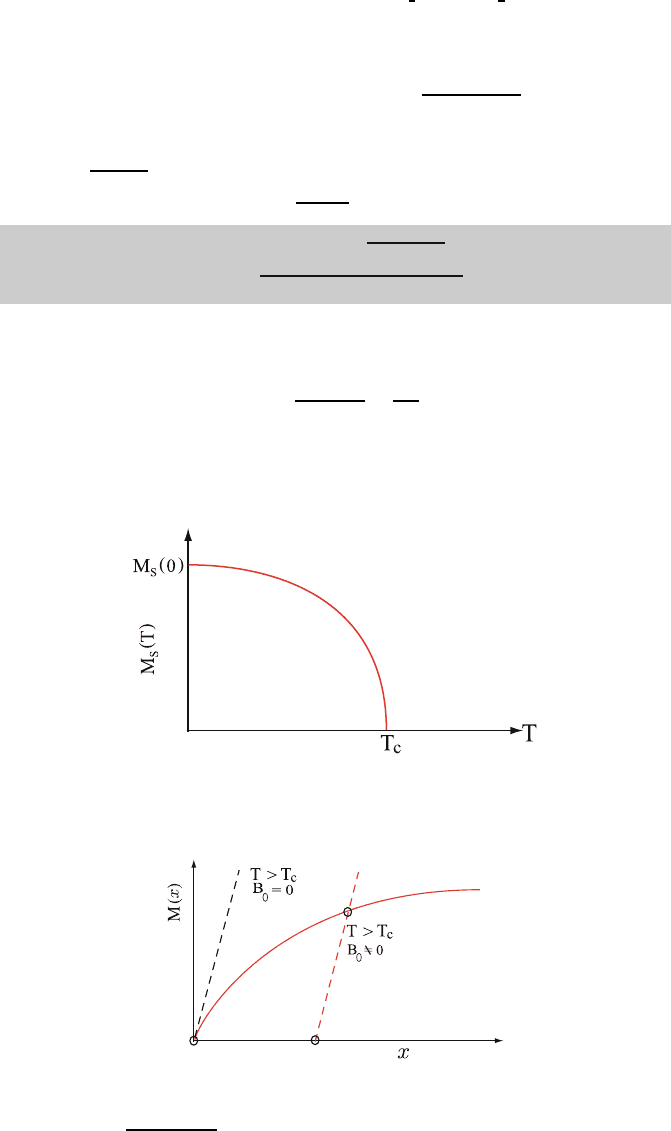
BJ k
B
T ). 449
In the presence of the magnetic field B, the number of electrons of spin 450
up (or down) per unit volume is 451
n
±
=
1
2
∞
0
dEf
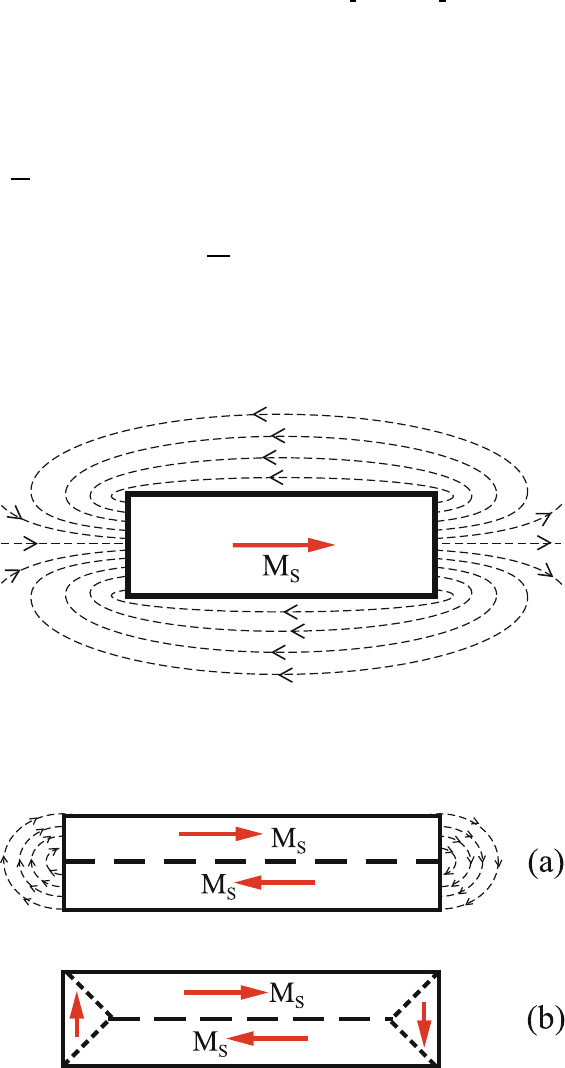
0
(E)g (E ∓ μ
B
B) .
For ζ μ
B
B and k
B
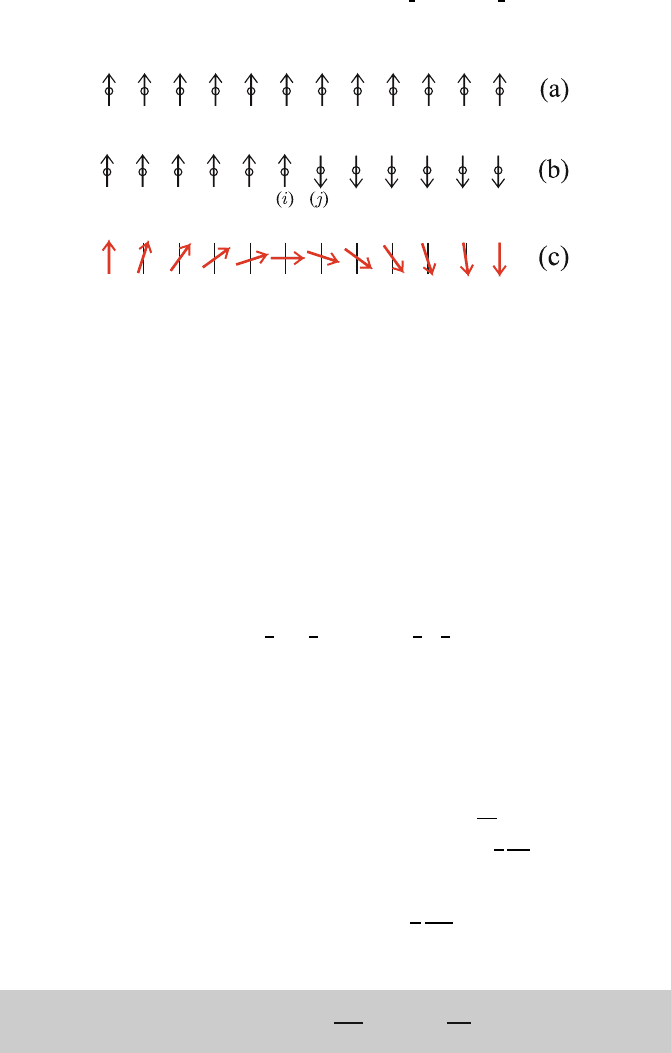
T ζ, the magnetization M(= μ
B
(n
−
− n
+
)) reduces 452
to 453
M μ
2
B
B
g(ζ)+
π
2
6
(k
B
T )
2
g
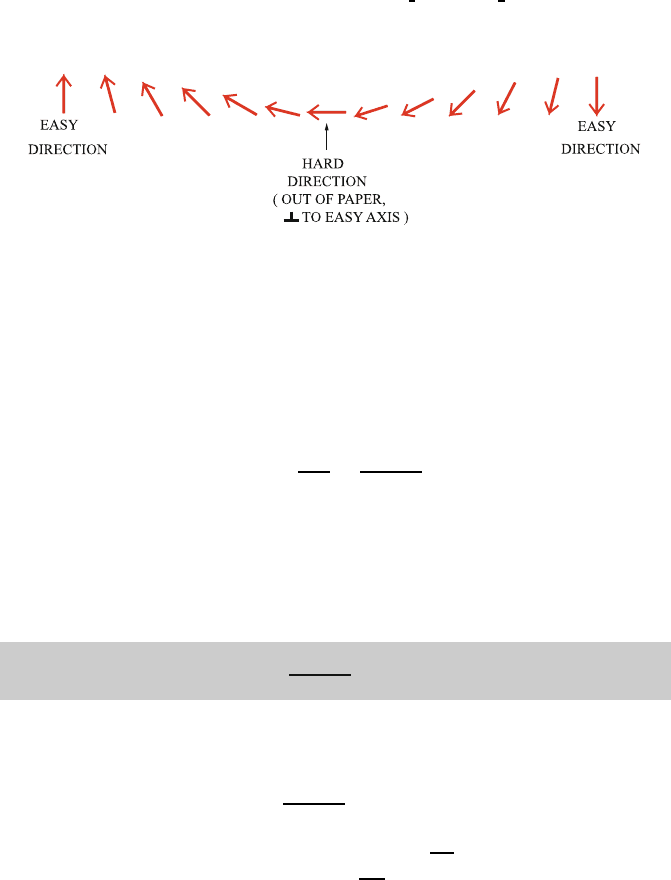
(ζ)
,
with ζ = ζ
0
−
π
2
6
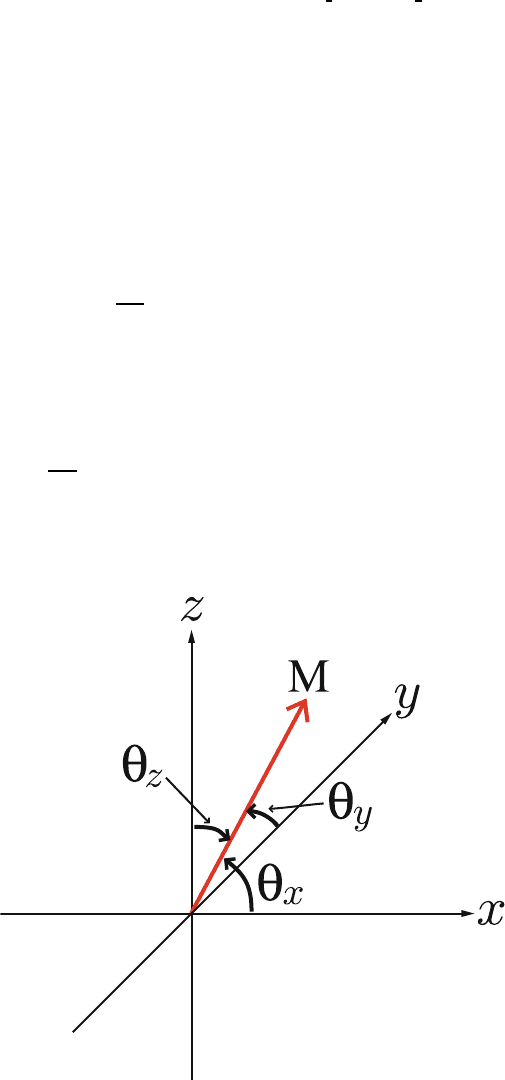
(k
B
T )
2
g
(ζ
0
)
g(ζ
0
)
. Since g(ζ)=
3
2
n
0
ζ
0
ε
ζ
0
1/2
, we obtain the 454
(quantum mechanical) expression 455
χ
QM
=
3n
0
μ
2
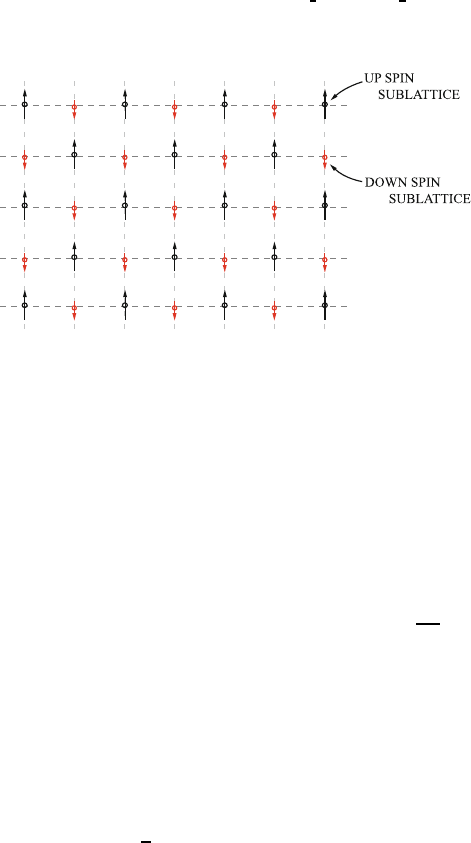
B
2ζ
0
1 −
π
2
12
k
B
T
ζ
0
2
+ ···
for the Pauli spin (paramagnetic) susceptibility of a metal.
456
In quantum mechanics, a dc magnetic field can alter the distribution of 457
the electronic energy levels and the orbital states of an electron are described 458
by the eigenfunctions and eigenvalues given by 459
|nk
y
k
z
= L
−1
e
ik
y
y+ik
z
z
φ
n
x +
¯hk
y
mω
c
; E
n
(k
y
,k
z
)=
¯h
2
k
2
z
2m
+¯hω
c
n +
1
2
.
The quantum mechanical (Landau) diamagnetic susceptibility of a metal
460
becomes 461
χ
L
= −
n
0
2ζ
0
e¯h
2m
∗
c
2
= −
n
0
μ
2
B
2ζ
0
m
m
∗
2
.
Appearance of m
∗
(not m) indicates that the diamagnetism is associated with 462
the orbital motion of the electrons. 463
In a metal, as we increase B, the Landau level at k
z
= 0 passes through the 464
Fermi energy ζ and the internal energy abruptly decreases. Many physically 465
observable properties of the system are periodic functions of the magnetic 466
field. The periodic oscillation of the diamagnetic susceptibility of a metal at 467
low temperatures is known as the de Haas–van Alphen effect. Oscillations 468
in electrical conductivity are called the Shubnikov–de Haas oscillations. 469
Uncorrected Proof
BookID 160928 ChapID 10 Proof# 1 - 29/07/09
10 3
Magnetic Ordering and Spin Waves 4
10.1 Ferromagnetism 5
10.1.1 Heisenberg Exchange Interaction 6
The origin of the Weiss effective field is found in the exchange field between 7
the interacting electrons on different atoms. For simplicity, assume that atoms 8
A and B are neighbors and that each atom has one electron. Let Ψ
A
and Ψ
B
9
be the wave functions of the electron on atoms A and B, respectively. The 10
Pauli principle requires that the wave function for the pair of electrons be 11
antisymmetric. If we label the two indistinguishable electrons 1 and 2, this 12
means 13
Ψ(1, 2) = −Ψ(2, 1). (10.1)
The wave function for an electron has a spatial part and a spin part. Let
14
η
i↑
and η
i↓
be the spin eigenfunctions for electron i in spin up and spin down 15
states, respectively. There are two possible ways of obtaining an antisymmetric 16
wave function for the pair (1,2). 17
Ψ
I
=Φ
S
(r
1
,r
2
)χ
A
(1, 2) (10.2)
Ψ
II
=Φ
A
(r
1
,r
2
)χ
S
(1, 2). (10.3)
The wave function Ψ
I
has a symmetric space part and an antisymmetric 18
spin part, and the wave function Ψ
II
has an antisymmetric space part and 19
a symmetric spin part. In (10.2) and (10.3), the space parts are 20
Φ
S
A
(r
1
,r
2
)=
1
√
2
[Ψ
a
(1)Ψ
b
(2) ± Ψ
a
(2)Ψ
b
(1)] , (10.4)
and χ
A
and χ
S
are the spin wave functions for the singlet (s = 0) spin state 21
(which is antisymmetric) and for the triplet (s = 1) spin state (which is 22
symmetric). 23
Uncorrected Proof
BookID 160928 ChapID 10 Proof# 1 - 29/07/09
276 10 Magnetic Ordering and Spin Waves
χ
A
(1, 2) =
1
√
2
[η
1↑
η
2↓
− η
1↓
η
2↑
]; S
z
=0 (10.5)
χ
S
(1, 2) =
⎧
⎨
⎩
η
1↑
η
2↑
S
z
=1
1
√
2
[η
1↑
η
2↓
+ η
1↓
η
2↑
] S
z
=0
η
1↓
η
2↓
S
z
= −1
(10.6)
If we consider the electron–electron interaction
24
V =
e
2
r
12
, (10.7)
we can evaluate the expectation value of V in state Ψ
I
or in state Ψ
II
.Since 25
V is independent of spin it is simple enough to see that 26
Ψ
I
|V |Ψ
I
= Φ
S
|V |Φ
S
(10.8)
= Ψ
a
(1)Ψ
b
(2) |V |Ψ
a
(1)Ψ
b
(2) + Ψ
a
(1)Ψ
b
(2) |V |Ψ
a
(2)Ψ
b
(1).
When we do the same for Ψ
II
,weobtain 27
Ψ
II
|V |Ψ
II
= Φ
A
|V |Φ
A
(10.9)
= Ψ
a
(1)Ψ
b
(2) |V |Ψ
a
(1)Ψ
b
(2)−Ψ
a
(1)Ψ
b
(2) |V |Ψ
a
(2)Ψ
b
(1).
The two terms are called the direct and exchange terms and labeled V
d
and J, 28
respectively. Thus, the expectation value of the Coulomb interaction between 29
electrons is given by 30
V =
#
V
d
+ J for the singlet state (S =0)
V
d
−J for the triplet state (S =1)
(10.10)
31
Now, S =
ˆ
s
1
+
ˆ
s
2
and S
2
=(
ˆ
s
1
+
ˆ
s
2
)
2
=
ˆ
s
2
1
+
ˆ
s
2
2
+2
ˆ
s
1
·
ˆ
s
2
. Therefore, 32
ˆ
s
1
·
ˆ
s
2
=
1
2
(
ˆ
s
1
+
ˆ
s
2
)
2
−
1
2
ˆ
s
2
1
−
1
2
ˆ
s
2
2
=
1
2
S(S +1)−
3
4
. Here, we have used 33
the fact that the operator S
2
has eigenvalues S(S +1) and
ˆ
s
2
1
and
ˆ
s
2
2
have 34
eigenvalues
1
2
(
1
2
+1)=
3
4
. Thus, one can write 35
ˆ
s
1
·
ˆ
s
2
=
(
−
3
4
if S =0
1
4
if S =1.
Then, we write
36
V = V
d
+ J
1 − S
2
= V
d
−
1
2
J−2J
ˆ
s
1
·
ˆ
s
2
. (10.11)
Here, −2J
ˆ
s
1
·
ˆ
s
2
denotes the contribution to the energy from a pair of atoms 37
(or ions) located at sites 1 and 2. For a large number of atoms we need only 38
sum over all pairs to get 39
E = constant −
1
2
i=j
2J
ij
ˆ
s
i
·
ˆ
s
j
(10.12)
Uncorrected Proof
BookID 160928 ChapID 10 Proof# 1 - 29/07/09
10.1 Ferromagnetism 277
Normally, one assumes that J
ij
is nonzero only for nearest neighbors and 40
perhaps next nearest neighbors. The factor
1
2
is introduced in order to avoid 41
double counting of the interaction. The introduction of the interaction term 42
−2J
ˆ
s
1
·
ˆ
s
2
is the source of the Weiss internal field which produces ferromag- 43
netism. If z is the number of nearest neighbors of each atom i, then for atom 44
i we have 45
E
ex
= −2JzS
2
= −g
L
μ
B
SH
E
(10.13)
46
10.1.2 Spontaneous Magnetization 47
From our study of paramagnetism we know that 48
M = Ng
L
μ
B
SB
S
(x), (10.14)
where x =
g
L
μ
B
SB
Local
k
B
T
. Here, B
Local
is B +λM , i.e. it includes the Weiss field. 49
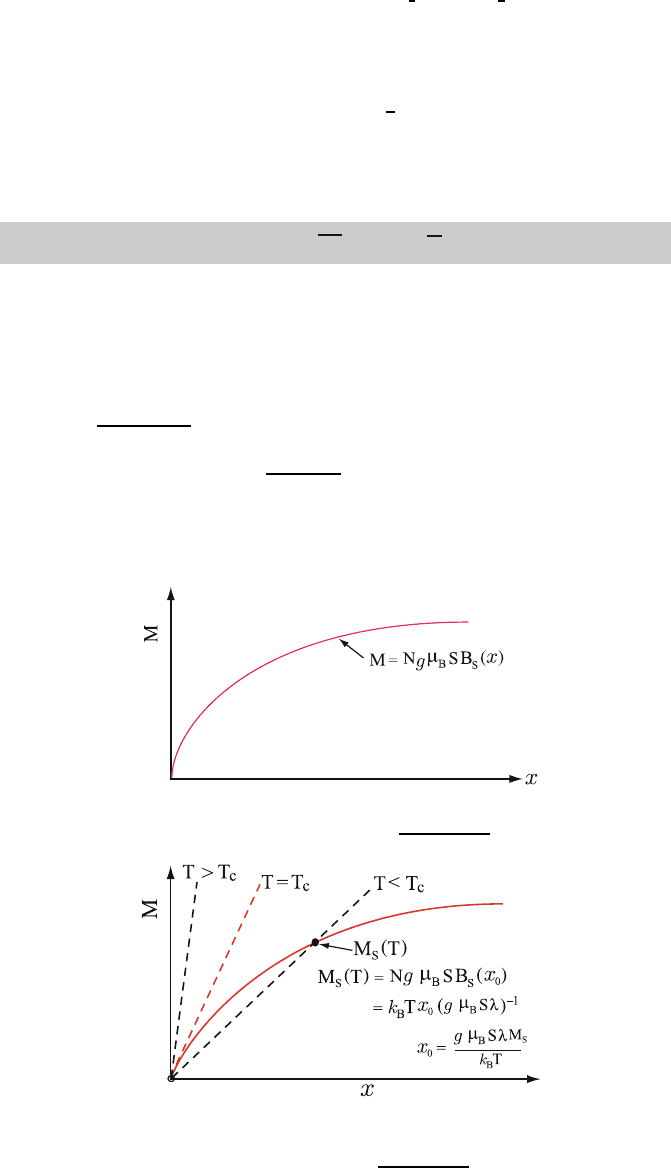
If we plot M vs. x, we get the behavior shown in Fig. 10.1. But for B =0, 50
B
Local
= λM. Therefore, x =
g
L
μ
B
SλM
k
B
T
. If we plot this straight line x vs. M 51
on the panel of Fig. 10.1 for different temperatures T we find the behavior 52
shown in Fig. 10.2. Solutions (intersections) occur only at (M =0,x =0)for 53
T>T
c
.ForT<T
c
there is a solution at some nonzero value of M, i.e. 54
Fig. 10.1. Schematic plot of the magnetization M of a paramagnet as a function
of the dimensionless parameter x defined by x =
g
L
μ
B
SB
Local
k
B
T
L
L
L
Fig. 10.2. Schematic plot of the magnetization M of a paramagnet for various
different temperatures, in the absence of an external magnetic field, as a function of
the dimensionless parameter x defined by x =
g
L
μ
B
SB
Local
k
B
T
Uncorrected Proof
BookID 160928 ChapID 10 Proof# 1 - 29/07/09
278 10 Magnetic Ordering and Spin Waves
M
S
(T )=Ng
L
μ
B
SB
S
(x
0
),x
0
=
g
L
μ
B
SλM
S
k
B
T
.
The Curie temperature T
C
is the temperature, at which the gradient of the 55
line M =
k
B
Tx
g
L
μ
B
Sλ
and the curve M = Ng
L
μ
B
SB
S
(x) are equal at the origin. 56
Recall that, for small x, B
S
(x)=
(S+1)x
3S
+ O(x
3
). Then the T
C
is given by 57
T
C
=
λN
g
L
μ
B
S(S +1)
2
3k
B
. (10.15)
58
It is not difficult to see that M
S
(T )vs.T looks like Fig. 10.3. 59
If a finite external magnetic field B
0
is applied, then we have 60
M =
k
B
Tx
g
L
μ
B
Sλ
−
B
0
λ
. (10.16)
Plotting this straight line on the M–x plane gives the behavior shown in
61
Fig. 10.4. 62
Fig. 10.3. Schematic plot of the spontaneous magnetization M
S
as a function of
temperature T
Fig. 10.4. Schematic plot of the magnetization M of a paramagnet, in the presence
of an external magnetic field B
0
, as a function of the dimensionless parameter x
defined by x =
g
L
μ
B
SB
Local
k
B
T
Uncorrected Proof
BookID 160928 ChapID 10 Proof# 1 - 29/07/09
10.1 Ferromagnetism 279
10.1.3 Domain Structure 63
If all the magnetic moments in a finite sample are lined up, then there will 64
be flux emerging from the sample as shown in Fig. 10.5. There is an energy 65
density
1
8π
H(r)·B(r) associated with this flux emerging from the sample, and 66
the total emergence energy is given by 67
U =
1
8π
d
3
r H(r) · B(r) (10.17)
The emergence energy can be lowered by introducing a domain structures
68
as shown in Fig. 10.6. To have more than a single domain, one must have a 69
domain wall, and the domain wall has a positive energy per unit area. 70
Fig. 10.5. Schematic plot of the magnetic flux around a sample with a single domain
of finite spontaneous magnetization
Fig. 10.6. Domain structures in a sample with finite spontaneous magnetization.
(a) Pair of domains, (b) domains of closure
Uncorrected Proof
BookID 160928 ChapID 10 Proof# 1 - 29/07/09
280 10 Magnetic Ordering and Spin Waves
Fig. 10.7. A chain of magnetic spins interacting via Heisenberg exchange interac-
tion. (a) Single domain, (b) a domain wall, (c) gradual spin flip
10.1.4 Domain Wall 71
Consider a chain of magnetic spins (Fig. 10.7a) interacting via Heisenberg 72
exchange interaction 73
H
ex
= −2J
i,j
s
i
·s
j
,
where the sum is over all pairs of nearest neighbors. Compare the energy
74
of this configuration with that having an abrupt domain wall as shown in 75
Fig. 10.7b. Only spins (i)and(j) have a misalignment so that 76
ΔE = H
ex
(i ↑,j ↓) − H
ex
(i ↑,j ↑)
= −2J(
1
2
)(−
1
2
) −
−2J(
1
2
)(
1
2
)
= J.
(10.18)
Energetically it is more favorable to have the spin flip gradually as shown
77
in Fig. 10.7c. If we assume the angle between each neighboring pair in the 78
domain wall is Φ, we can write 79
(E
ex
)
ij
= −2Js
i
·s
j
= −2Js
i
s
j
cos Φ. (10.19)
Now, if the spin turns through an angle Φ
0
(Φ
0
= π in the case shown in 80
Fig. 10.7b) in N steps, where N is large, then Φ
ij
Φ
0
N
within the domain 81
wall, and we can approximate cos Φ
ij
by cos Φ
ij
≈ 1 −
1
2
Φ
2
0
N
2
. Therefore, the 82
exchange energy for a neighboring spin pair will be 83
(E
ex
)
ij
= −2JS
2
1 −
1
2
Φ
2
0
N
2
(10.20)
The increase in exchange energy due to the domain wall will be
84
E
ex
= N
JS
2
Φ
2
0
N
2
= JS
2
Φ
2
0
N
. (10.21)
85
Clearly, the exchange energy is lower if the domain wall is very wide. In fact, 86
if no other energies were involved, the domain wall width Na (where a is the 87
atomic spacing) would be infinite. However, there is another energy involved, 88
the anisotropy energy. Let us consider it next. 89
Uncorrected Proof
BookID 160928 ChapID 10 Proof# 1 - 29/07/09
10.1 Ferromagnetism 281
10.1.5 Anisotropy Energy 90
We realize that crystals are not spherically symmetric, but have finite point 91
group symmetry. In real crystals, certain directions are easy to magnetize 92
and others are hard. For example, Co is a hexagonal crystal. It is easy to 93
magnetize Co along the hexagonal axis, but hard to magnetize it along any axis 94
perpendicular to the hexagonal axis. The excess energy needed to magnetize 95
the crystal in a direction that makes an angle θ with the hexagonal axis can 96
be written 97
E
A
V
= K
1
sin
2
θ + K
2
sin
4
θ>0. (10.22)
For Fe, a cubic crystal, the 100 directions are easy axes and the 111 direc-
98
tions are hard. The anisotropy energy must reflect the cubic symmetry of the 99
lattice. If we define α
i
=cosθ
i
as shown in Fig. 10.8, then an approximation 100
to the anisotropy energy can be written 101
E
A
V
≈ K
1
α
2
x
α
2
y
+ α
2
y
α
2
z
+ α
2
z
α
2
x
+ K
2
α
2
x
α
2
y
α
2
z
. (10.23)
The constants K
1
and K
2
in (10.22) and (10.23) are called anisotropy 102
constants. They are very roughly of the order of 10
5
erg/cm
3
. 103
Fig. 10.8. Orientation of the magnetization with respect to the crystal axes in a
cubic lattice
Uncorrected Proof
BookID 160928 ChapID 10 Proof# 1 - 29/07/09
282 10 Magnetic Ordering and Spin Waves
Fig. 10.9. Rotation of the magnetization in a domain wall
Clearly, if we make a domain wall, we must rotate the magnetization away 104
from one easy direction and into another easy direction (see, for example, Fig. 105
10.9). To get an order of magnitude estimate of the domain wall thickness 106
we can write the energy per unit surface area as the sum of the exchange 107
contribution σ
ex
and the anisotropy contribution σ
A
108
σ
ex
=
E
ex
a
2
=
JS
2
π
2
Na
2
, (10.24)
where a is the atomic spacing. The anisotropy energy will be proportional to
109
the anisotropy constant (energy per unit volume) times the number of spins 110
times a. 111
σ
A
≈ KNa 10
2
− 10
7
J/m
3
. (10.25)
Thus the total energy per unit area will be
112
σ =
π
2
JS
2
Na
2
+ KNa. (10.26)
113
The σ has a minimum as a function of N, since the exchange part wants N 114
to be very large and the anisotropy part wants it very small. At the minimum 115
we have 116
N
π
2
JS
2
Ka
3
1/2
≈ 300. (10.27)
The width of the domain wall is δ = Na πS(
J
Ka
)
1/2
, and the energy per 117
unit area of the domain wall is σ 2πS(
JK
a
)
1/2
. 118
10.2 Antiferromagnetism 119
For a Heisenberg ferromagnet we had an interaction Hamiltonian given by 120
H = −2J
i,j
s
i
· s
j
, (10.28)
and the exchange constant J was positive. This made s
i
and s
j
align parallel 121
to one another so that the energy was minimized. It is not uncommon to have 122
Uncorrected Proof
BookID 160928 ChapID 10 Proof# 1 - 29/07/09
10.4 Zero-Temperature Heisenberg Ferromagnet 283
Fig. 10.10. Sublattice structure of spins in a ferrimagnet
spin systems in which J is negative. Then the Hamiltonian 123
H =2|J|
i,j
s
i
·s
j
(10.29)
will attempt to align the neighboring spins antiparallel. Materials with J < 0
124
are called antiferromagnets. 125
For a antiferromagnet, the magnetic susceptibility increases as the tem- 126
perature increases up to the transition temperature T
N
=
|J|
k
B
,knownasthe 127
N´eel temperature.AboveT
N
, the antiferromagnetic crystal is in the standard 128
paramagnetic state. 129
10.3 Ferrimagnetism 130
In an antiferromagnet we can think of two different sublattices as shown in 131
Fig. 10.10. If the two sublattices happened to have a different spin on each 132
(e.g. up sublattice has s =
3
2
, down sublattice has s = 1), then instead of an 133
antiferromagnet for J<0, we have a ferrimagnet. 134
10.4 Zero-Temperature Heisenberg Ferromagnet 135
In the presence of an applied magnetic field B
0
oriented in the z-direction, 136
the Hamiltonian of a Heisenberg ferromagnet can be written 137
H = −
i,j
J(R
i
− R
j
)S
i
· S
j
− gμ
B
B
0
i
S
iz
. (10.30)
Here, we take the usual practice that the symbol S
i
represents the total angu- 138
lar momentum of the ith ion and is parallel to the magnetic moment of the 139