
Raven P.H., Johnson G.B., Mason K.A. Biology (Ninth Edition)
Подождите немного. Документ загружается.

Apago PDF Enhancer
0
3
2
1
0.2 0.4
Frequency (kHz)
Time (seconds)
b.
0
3
2
1
0.2 0.4
Frequency (kHz)
Time (seconds)
c.a.
Figure 55.30
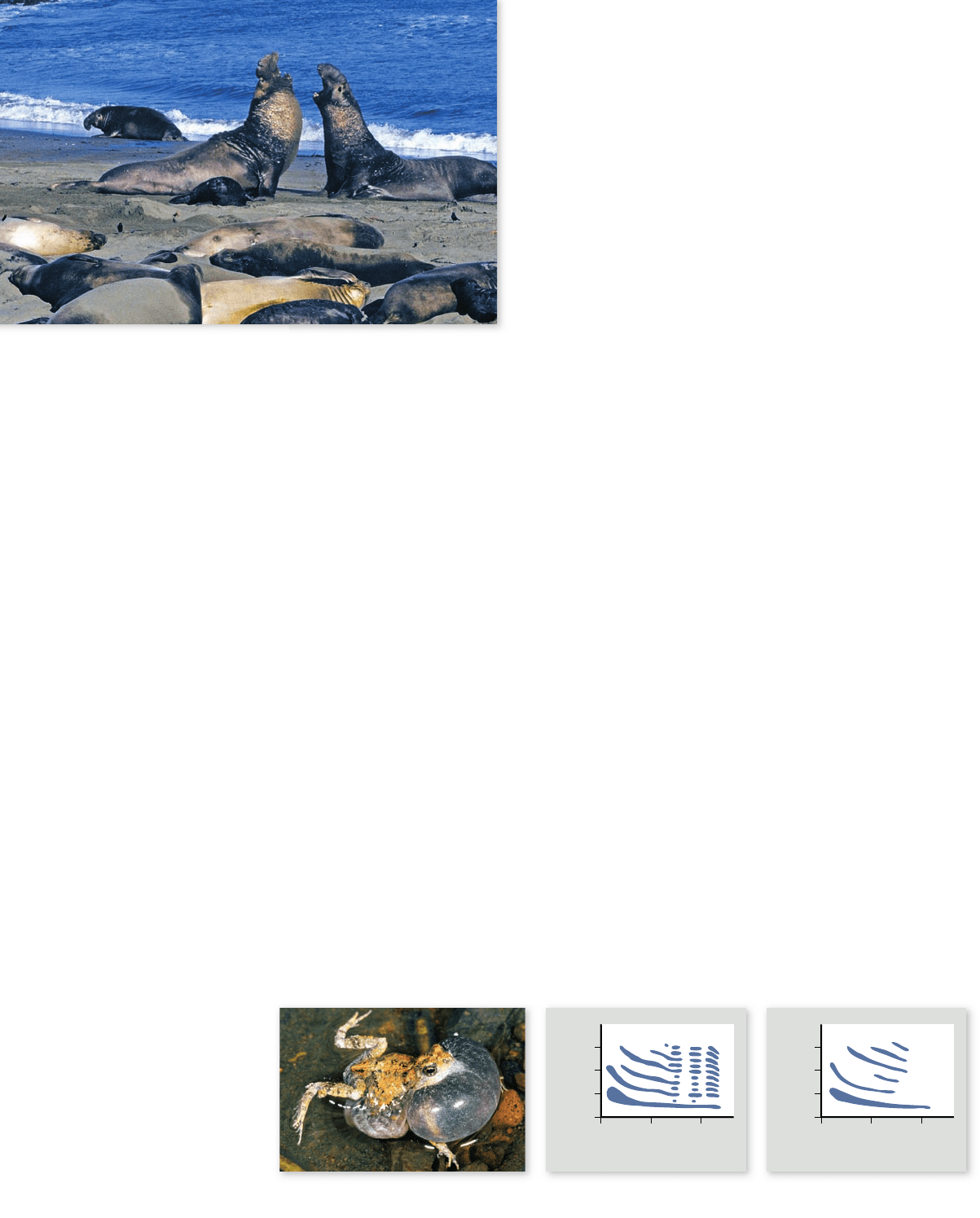
Female defense polygyny in northern
elephant seals (Mirounga angustirostris). Male elephant seals
ght with one another for possession of territories. Only the
largest males can hold territories, which contain many females.
Figure 55.31
M ale Túngara frog
(Physalaemus pustulosus)
calling. Female frogs of
several species in the genus
Physalaemus prefer males that
include a “chuck” in their call.
However, only males of the
Túngaru frog (a) produce such
calls (b); males of other species
do not (c).
sult of his genetic makeup, the female will be ensuring that her
offspring receive good genes from their father.
Several experimental studies in fish and moths have ex-
amined whether female mate choice leads to greater reproduc-
tive success. In these experiments, females in one group were
allowed to choose males, whereas males were randomly mated
to a different group of females. Offspring of females that chose
their mates were more vigorous and survived better than off-
spring from females given no choice, which suggests that fe-
males preferred males with a better genetic makeup.
A variant of this theory goes one step further. In some
cases, females prefer mates with traits that appear to be detri-
mental to survival (see figure 55.28c). The long tail of the pea-
cock is a hindrance in flying and makes males more vulnerable
to predators. Why should females prefer males with such traits?
The handicap hypothesis states that only genetically superior
mates can survive with such a handicap. By choosing a male
with the largest handicap, the female is ensuring that her off-
spring will receive these quality genes. Of course, the male off-
spring will also inherit the genes for the handicap. For this
reason, evolutionary biologists are still debating the merit of
this hypothesis.
Alternative theories about the evolution of mate choice.
Some courtship displays appear to have evolved from a predis-
position in the female’s sensory system to respond to certain
stimuli. For example, females may be better able to detect
particular colors or sounds at a certain frequency, and thus be
attracted to such signals. Sensory exploitation involves the
evolution in males of a signal that “exploits” these preexisting
biases. For example, if females are particularly adept at detect-
ing red objects, then red coloration may evolve in males as part
of a courtship display.
To understand the evolution of courtship calls, consider
the vocalizations of the Túngara frog (figure 55.31) . Unlike re-
lated species, males include a short burst of sound, termed a
“chuck,” at the end of their calls. Recent research suggests that
not only are females of this species particularly attracted to calls
of this sort, but so are females of related species, even though
males of these species do not produce “chucks.”
A great variety of other hypotheses have been proposed
to explain the evolution of mating preferences. Many of these
hypotheses may be correct in some circumstances, but none
seems capable of explaining all of the variation in mating be-
havior in the animal world. This is an area of vibrant research,
with new discoveries appearing regularly.
care—the better the parent, the more offspring she is likely to
rear. In other species, males provide no care, but maintain ter-
ritories that provide food, nesting sites, and predator refuges.
In red deer, males that hold territories with the highest quality
grasses mate with the most females. In this case, there is a di-
rect bene t of a female mating with such a territory owner:
She feeds with little disturbance on quality food.
Indirect benefits of mate choice.
In many species, how-
ever, males provide no direct benefits of any kind to females.
In such cases, it is not intuitively obvious what females have to
gain by being “choosy.” Moreover, what could be the possible
benefit of choosing a male with an extremely long tail or a
complex song?
A number of theories have been proposed to explain the
evolution of such preferences. One idea is that females choose
the male that is the healthiest or oldest. Large males, for ex-
ample, have probably been successful at living long, acquiring a
lot of food, and resisting parasites and disease. In other species,
features other than size may indicate a male’s condition. In gup-
pies and some birds, the brightness of a male’s color reflects the
quality of his diet and overall health. Females may gain two
benefits from mating with the healthiest males. First, healthy
males are less likely to be carrying diseases, which might be
transmitted to the female during mating. Second, to the extent
that the males’ success in living long and prospering is the re-
1152
part
VIII
Ecology and Behavior
rav32223_ch55_1132-1161.indd 1152rav32223_ch55_1132-1161.indd 1152 11/20/09 4:57:14 PM11/20/09 4:57:14 PM
Apago PDF Enhancer
4 6
D
E
F
G
a
b
8 10 20
kb
2
2
2
2
1
1
1
1
1
3
3
4
3
3/3
2/4
5/5
6/8
7/7
11/14
1/8
2/4
3/3
2/5
5/9
0/4
5/6
100 m
a. b.
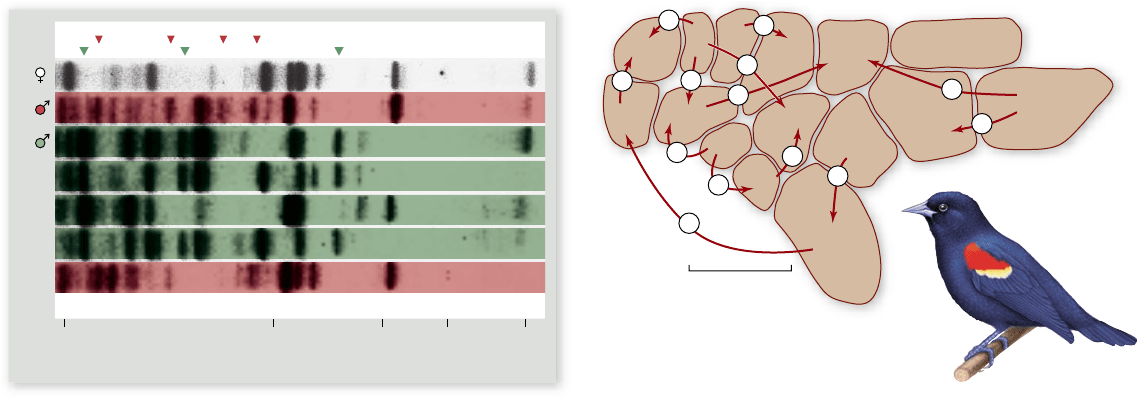
Figure 55.32
The study of paternity. a. A DNA ngerprinting gel from the dunnock (Prunella modularis). The bands represent
fragments of DNA of different lengths. The four nestlings (D–G) were in the nest of the female. By comparing the bands present in the two
males and the female, we can determine which male fathered which offspring. The triangles point to the bands that are diagnostic for one
male and not the other. In this case, the β-male fathered three (D, E, F, but not G) of the four offspring. b. Results of a DNA ngerprinting
study in red-winged blackbirds (Agelaius phoeniceus). Fractions indicate the proportion of offspring fathered by the male in whose territory the
nest occurred. Arrows indicate how many offspring were fathered by particular males outside of each territory. Nests on some territories were
not sampled.
Mating systems are strongly influenced by ecology. A
male may defend a territory that holds nest sites or food
sources sufficient for more than one female. If territories vary
in quality or quantity of resources, a female’s fitness is maxi-
mized if she mates with a male holding a high-quality terri-
tory, even if he has mated. Although a male may already have
a mate, it is still more advantageous for the female to breed
with a mated male holding a high-quality territory than with
an unmated male holding a low-quality territory. This favors
the evolution of polygyny.
Polyandry is relatively rare, but the evolution of mul-
tiple mating by females is becoming better understood. It is
best known in birds like spotted sandpipers and jacanas liv-
ing in highly productive environments such as marshes and
wetlands. Here, females take advantage of the increased re-
sources available to rear offspring by laying clutches of eggs
with more than one male. Males provide all incubation and
parenting, and females mate and leave eggs with two or
more males.
Females may also mate with several males to genetically
diversify their offspring, which in turn increases disease resis-
tance. This appears to be the case in honey bees, for example, in
which a queen may mate with many males.
Extra-pair copulations
The “monogamy” of many bird species has been re-evaluated as
DNA fingerprinting (see chapter 15) has become commonly
used to determine paternity and precisely quantify the repro-
ductive success of individual males (figure 55.32a). In red-
winged blackbirds (figure 55.32b), researchers established that
Mating systems reect the ability of parents to
care for o spring and are in uenced by ecology
The number of individuals with which an animal mates during
the breeding season varies among species. Mating systems in-
clude monogamy (one male mates with one female), polygyny
(one male mates with more than one female; see figure 55.30),
and polyandry (one female mates with more than one male).
Only monogamous mating includes a pair bond (like prairie
voles). Like mate choice, mating systems have evolved to allow
females and males to maximize fitness.
The option of having more than one mate may be con-
strained by the need for offspring care. If females and males are
able to care for young, then the presence of both parents may
be necessary for young to be reared successfully. Monogamy
may thus be favored. Generally this is the case for birds, in
which over 90% of all species appear to be monogamous. A
male may either remain with his mate and provide care for the
offspring or desert that mate to search for others; both strate-
gies may increase his fitness. The strategy that natural selection
will favor depends on the requirement for male assistance in
feeding or defending the offspring. In some species (like hu-
mans!), offspring are altricial—they require prolonged and ex-
tensive care. In these species, the need for care by two parents
reduces the tendency for the male to desert his mate and seek
other matings. In species in which the young are precocial (re-
quiring little parental care), males may be more likely to be
polygynous because the need for their parenting is lower. In
mammals, only females lactate, freeing males from feeding off-
spring. It follows that most mammals are polygynous.
chapter
55
Behavioral Biology
115 3www.ravenbiology.com
rav32223_ch55_1132-1161.indd 1153rav32223_ch55_1132-1161.indd 1153 11/20/09 4:57:17 PM11/20/09 4:57:17 PM

Apago PDF Enhancer
55.11
Altruism
Learning Outcomes
Explain altruism and its benefits.1.
Explain kin selection and inclusive fitness.2.
Discuss how haplodiploidy influences kin selection in 3.
eusocial insects.
Understanding the evolution of altruism has been a particular
challenge to evolutionary biologists, including Darwin himself.
Why should an individual decrease his or her own fitness to
help another? How could genes for altruism be favored by nat-
ural selection, given that the frequency of such genes should
decrease in populations through time?
In fact, there can be great benefits to being an altruist,
even if the altruism leads an individual to forego reproduction
or even sacrifice its own life. Let’s examine how this can work.
Altruism is behavior that benefits another individual at a
cost to the actor. Humans sacrificing themselves in times of war
or placing themselves in jeopardy to help their children are ex-
amples, but altruism also has been described in an extraordinary
variety of organisms. In many bird species, for example, there
are “helpers at the nest”—birds other than parents who assist in
raising their young. In both mammals and birds, individuals that
spy a predator may give an alarm call, alerting other members of
their group to allow them to escape, even though such an act
might call the predator’s attention to the caller. And in social
insects like ants, workers are sterile offspring that help their
mother, the colony’s queen, to reproduce.
A number of explanations have been put forward to ex-
plain the evolution of altruism. Once it was thought that altru-
ism evolved for the “good of the species.” Individuals that fail to
mate, for example, have been called “altruists” because their lack
of success in competition has been misinterpreted as a willing-
ness to forego reproduction so that the population or species
does not increase in size, exhaust its resources, and go extinct.
This group selection explanation (selection acting on a popula-
tion or species) is simply incorrect because individuals that fail
to secure mates and not breed will not leave any offspring.
Therefore, their “altruism” would not be favored by selection.
Current studies of altruism note that seemingly altruistic
acts are in fact selfish. For example, helpers at the nest are often
young birds that gain valuable parenting experience by assist-
ing established breeders; this may give them an advantage when
they breed. Moreover, they may have limited opportunities to
reproduce on their own, and by hanging around breeding pairs,
may inherit the territory when established breeders die.
Reciprocity theory explains altruism
between unrelated individuals
One explanation of altruism proposes that genetically unrelated
individuals may form “partnerships” in which mutual exchanges
of altruistic acts occur because they benefit both participants.
half of all nests contained at least one hatchling fertilized by a
male other than the territory owner; overall, 20% of the off-
spring were the result of such extra-pair copulations (EPCs).
What is the evolutionary advantage of EPCs? For
males, the answer is obvious: increased reproductive success.
Females, on the other hand, may mate with genetically supe-
rior individuals even if already paired with a male, thus en-
hancing the genes passed on to their offspring. The female
doesn’t produce more offspring, but offpring of better ge-
netic quality. In some birds and other animals, EPCs may
help females increase the amount of care they get from males
to raise their offspring. This is exactly what happens in a
common English bird, the dunnock. Females mate not only
with the territory owner, but also with subordinate males
that hang around the edge of the territory. If these subordi-
nates mate a sufficient number of times with a female, they
will help raise her young, presumably because they may have
fathered some of these young.
Alternative mating strategies
Natural selection has led to the evolution of many ways of
increasing reproductive success. For example, in many spe-
cies of fish, there are two genetic classes of males. One group
is large and defends territories to obtain matings. The other
group is small and adopts a completely different strategy.
These males do not maintain territories, but loiter at the
edge of the territories of large males. Just at the end of a
male’s courtship, when the female is laying her eggs and the
territorial male is depositing sperm, the smaller male darts
in and releases its own sperm into the water, thus fertilizing
some of the eggs. If this strategy is successful, natural selec-
tion will favor the evolution of these two different male re-
productive strategies.
Similar patterns are seen in other organisms. In some
dung beetles, territorial males have large horns that they use to
guard the chambers in which females reside, whereas geneti-
cally small males don’t have horns. Instead, the smaller males
dig side tunnels and attempt to intercept the female inside her
chamber. In Isopods, there are three genetic size classes. The
medium-sized males pass for females and enter a large male’s
territory in this way; the smallest class are so tiny, they are able
to sneak in completely undetected.
This is just a glimpse of the rich diversity in mating sys-
tems and mating tactics that have evolved. The bottom line is:
If there is a way of increasing reproductive success, natural se-
lection will favor its evolution.
Learning Outcomes Review 55.10
The sex that invests more in reproduction (parental investment) tends to
exhibit mate choice. Females or males can be selective, depending on the
energy and time they devote to parental care. Sexual selection governs
evolution of secondary sex characteristics in that mates are chosen on the
basis of phenotype and competitive success. Reproductive success infl uences
whether males and females mate monogamously or with multiple partners.
■ Pipefish males incubate young in a brood pouch. Which
sex would you expect to show mate choice? Why?
115 4
part
VIII
Ecology and Behavior
rav32223_ch55_1132-1161.indd 1154rav32223_ch55_1132-1161.indd 1154 11/20/09 4:57:18 PM11/20/09 4:57:18 PM
Apago PDF Enhancer
Average Genetic Relatedness
EA
SX
8 3
NM
DF
WT
3 7
KR
Fir
st Cousins
AC
XZ
1 3
JM
EE
SS
8 8
NQ
Unrelated
f
emale
KM
FF
TT
7 7
RH
AD
WY
1 3
Unrelated
f
emale
Brothers
Gene 1
Gene 2
Gene 3
Gene 4
Gene 1
Gene 2
Gene 3
Gene 4
AB
WX
1 2
JK
CD
YZ
3 4
LM
Parents
Parent-offspring
Full siblings
Half-siblings
1st cousins
=
=
=
=
1/2
1/2
1/4
1/8
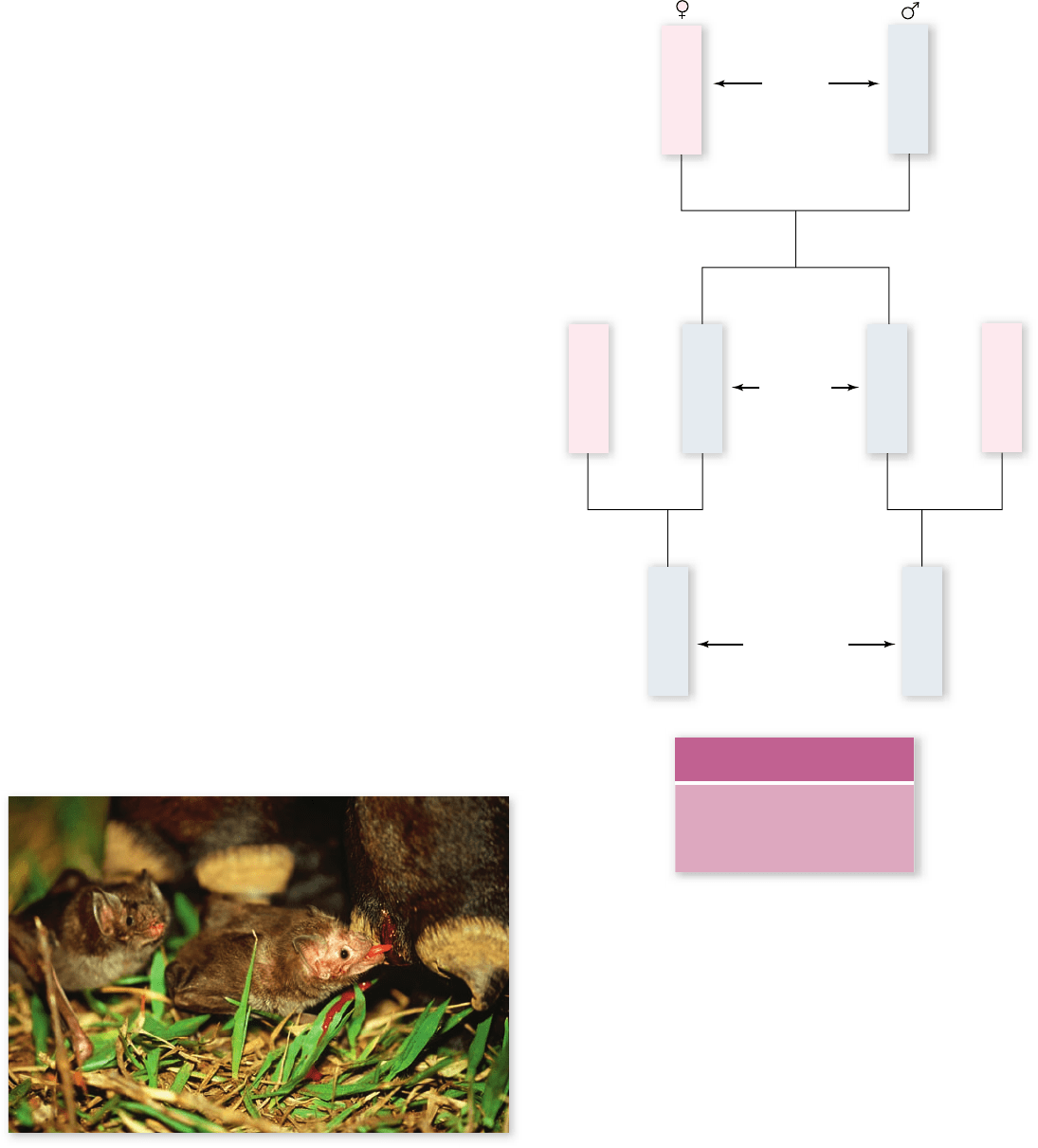
Figure 55.33
Truth is stranger than ction: Reciprocal
altruism in vampire bats (Desmodus rotundus). Vampire bats
do feed on the blood of large mammals, but they don’t transform
into people and sleep in cof ns. Vampires live in groups and share
blood meals. They remember which bats have provided them with
blood in the past and are more likely to share with those bats that
have shared with them previously. The bats here are feeding on
cattle in Brazil.
of alleles to the next generation as Haldane himself would.
Similarly, Haldane and a first cousin would share an eighth of
their alleles (see figure 55.34). Their parents, who are siblings,
would each share half their alleles, and each of their children
would receive half of these, of which half on the average would
be in common: 1/2 × 1/2 × 1/2 = 1/8. Eight first cousins would
therefore pass on as many of those alleles to the next generation
as Haldane himself would.
The most compelling explanation for the kin-related ori-
gin of altruism was presented by one of the most influential
evolutionary biologists of our time, William D. Hamilton, in
1964. Hamilton understood Haldane’s point: Natural selection
will favor any behavior, including the sacrifice of life, that in-
creases the propagation of an individual’s alleles.
Partners are willing to give aid at one time and delay “repay-
ment” for the good deed to a time in the future when they
themselves are in need. In reciprocal altruism, the partner-
ships are stable because “cheaters” (nonreciprocators) are dis-
criminated against and do not receive future aid. According to
this hypothesis, if the altruistic act is relatively inexpensive, the
small benefit a cheater receives by not reciprocating is far
outweighed by the potential cost of not receiving future aid.
Under these conditions, cheating behavior should be elimi-
nated by selection.
Vampire bats roost in hollow trees, caves, and mines in
groups of 8 to 12 individuals (figure 55.33) . Because bats have a
high metabolic rate, individuals that have not fed recently may
die. Bats that have found a host imbibe a great deal of blood, so
giving up a small amount to keep a roostmate from starvation
presents no great energy cost to the donor. Vampire bats tend
to share blood with past reciprocators that are not necessarily
relatives. If an individual fails to give blood to a bat from which
it received blood in the past, it will be excluded from future
bloodsharing. Reciprocity routinely occurs in many primates,
including humans (obviously!).
Kin selection theory proposes a direct
genetic advantage to altruism
The great population geneticist J. B. S. Haldane once passion-
ately said in a pub that he would willingly lay down his life for
two brothers or eight first cousins.
Evolutionarily speaking, this sacrifice makes sense, be-
cause for each allele Haldane received from his parents, his
brothers each had a 50% chance of receiving the same allele
(figure 55.34). Statistically, it is expected that two of his broth-
ers would pass on as many of Haldane’s particular combination
Figure 55.34
Hypothetical example of genetic
relationships. On average, full siblings share half of their alleles.
By contrast, cousins only share one-eighth of their alleles on
average. Each letter and number represents a different allele.
chapter
55
Behavioral Biology
115 5www.ravenbiology.com
rav32223_ch55_1132-1161.indd 1155rav32223_ch55_1132-1161.indd 1155 11/20/09 1:51:21 PM11/20/09 1:51:21 PM
Apago PDF Enhancer
her own, she would share only half of her alleles with her young
(the other half would come from their father). Thus, because of
this close genetic relatedness due to haplodiploidy, workers would
propagate more of their own alleles by giving up their own repro-
duction to assist their mother in rearing their sisters, some of
whom will be new queens, start new colonies, and reproduce.
In this way, the unusual haplodiploid system may have set
the “genetic stage” for the evolution of eusociality. Indeed, eu-
sociality has evolved at least 12 separate times in the Hy-
menoptera. One wrinkle in this theory, however, is that eusocial
systems have evolved in other insects (thrips, weevils, and ter-
mites), and mammals (naked mole rats). Although thrips are
also haplodiploid, termites and naked mole rats are not. Thus,
although haplodiploidy may have facilitated the evolution of
eusociality, other factors can influence social evolution.
Other examples of kin selection
Kin selection may explain altruism in other animals. Belding’s
ground squirrels give alarm calls when they spot a predator
such as a coyote or a badger. Such predators may attack a call-
ing squirrel, so giving the signal places the caller at risk. A
ground squirrel colony consists of a female and her daughters,
sisters, aunts, and nieces. When males mature, they disperse
long distances from where they are born, so adult males in the
colony are not genetically related to the females. By marking all
squirrels in a colony with an individual dye pattern on their fur
and by recording which individuals gave calls and the social
circumstances of their calling, researchers found that females
who have relatives living nearby are more likely to give alarm
calls than females with no kin nearby. Males tend to call much
less frequently, as would be expected because they are not re-
lated to most colony members.
Another example of kin selection is provided by the
white-fronted bee-eater, a bird which lives along river banks in
Africa in colonies of 100 to 200 individuals (figure 55.36) . In
contrast to ground squirrels, the male bee-eaters usually remain
in the colony in which they were born, and the females disperse
to join new colonies. Many bee-eaters do not raise their own
offspring, but instead help others. Most helpers are young birds,
Hamilton mathematically showed that by directing aid to-
ward close genetic relatives, an altruist may increase the repro-
ductive success of its relatives enough to not only compensate for
the reduction in its own fitness, but even increase its fitness be-
yond what would be possible without assisting relatives. Because
the altruist’s behavior increases the propagation of alleles in rela-
tives, it will be favored by natural selection. Selection that favors
altruism directed toward relatives is called kin selection. Al-
though the behaviors are altruistic, the genes are actually “behav-
ing selfishly,” because they encourage the organism to favor the
success of copies of themselves in relatives. In other words, if an
individual has a dominant allele that causes altruism, any action
that increases the frequency of this allele in future generations
will be favored, even if that action is detrimental to the actor.
Hamilton then defined reproductive success with a new
concept—inclusive fitness. Inclusive fitness considers gene prop-
agation through both direct (personal fitness) and indirect (the
fitness of relatives) reproduction. Hamilton’s kin selection model
predicts that altruism is likely to be directed toward close rela-
tives. The more closely related two individuals are, the greater
the potential genetic payoff, and the greater inclusive fitness.
This is described by Hamilton’s rule, which states that altruistic
acts are favored when rb > c. In this expression, b and c are the
benefits and costs of the altruistic act, respectively, and r is the
coefficient of relatedness, the proportion of alleles shared by two
individuals through common descent. For example, an individual
should be willing to have one less child (c = 1) if such actions al-
low a half-sibling, which shares one-quarter of its genes
(r = 0.25), to have five or more additional offspring (b = 5).
Haplodiploidy and altruism in ants, bees, and wasps
The relationship between genetic relatedness, kin selection,
and altruism can be best understood using social insects as an
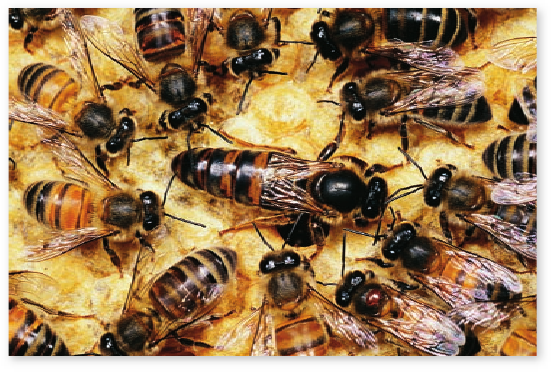
example. A hive of honeybees consists of a single queen, who is
the sole egg-layer, and tens of thousands of her offspring, fe-
male workers with nonfunctional ovaries (figure 55.35). Honey-
bees are eusocial (“truly” social): their societies are defined by
reproductive division of labor (only the queen reproduces), co-
operative care of the brood (workers nurse, clean, and forage),
and overlap of generations (the queen lives with several genera-
tions of her offspring).
Darwin was perplexed by eusociality. How could natural
selection favor the evolution of sterile workers that left no off-
spring? It remained for Hamilton to explain the origin of euso-
ciality in hymenopterans (bees, wasps, and ants) using his kin
selection model. In these insects, males are haploid (produced
from unfertilized eggs) and females are diploid. This system of
sex determination and parthenogenesis, called haplodiploidy,
leads to unusual genetic relatedness among colony members. If
the queen is fertilized by a single male, then all female offspring
will inherit exactly the same alleles from their father (because
he is haploid and has only one copy of each allele). Female off-
spring (workers and future queens) will also share among them-
selves, on average, half of the alleles they get from their mother,
the queen. Consequently, they will share, on average, 75% of
their alleles with each sister (to verify this, rework figure 55.34,
but allow the father to only have one allele for each gene).
Now recall Haldane’s statement of commitment to family
while you read this section. If a worker should have offspring of
Figure 55.35
Reproductive division of labor in
honeybees. The queen (center) is the sole egg-layer. Her
daughters are sterile workers.
115 6
part
VIII
Ecology and Behavior
rav32223_ch55_1132-1161.indd 1156rav32223_ch55_1132-1161.indd 1156 11/20/09 1:51:24 PM11/20/09 1:51:24 PM
Apago PDF Enhancer
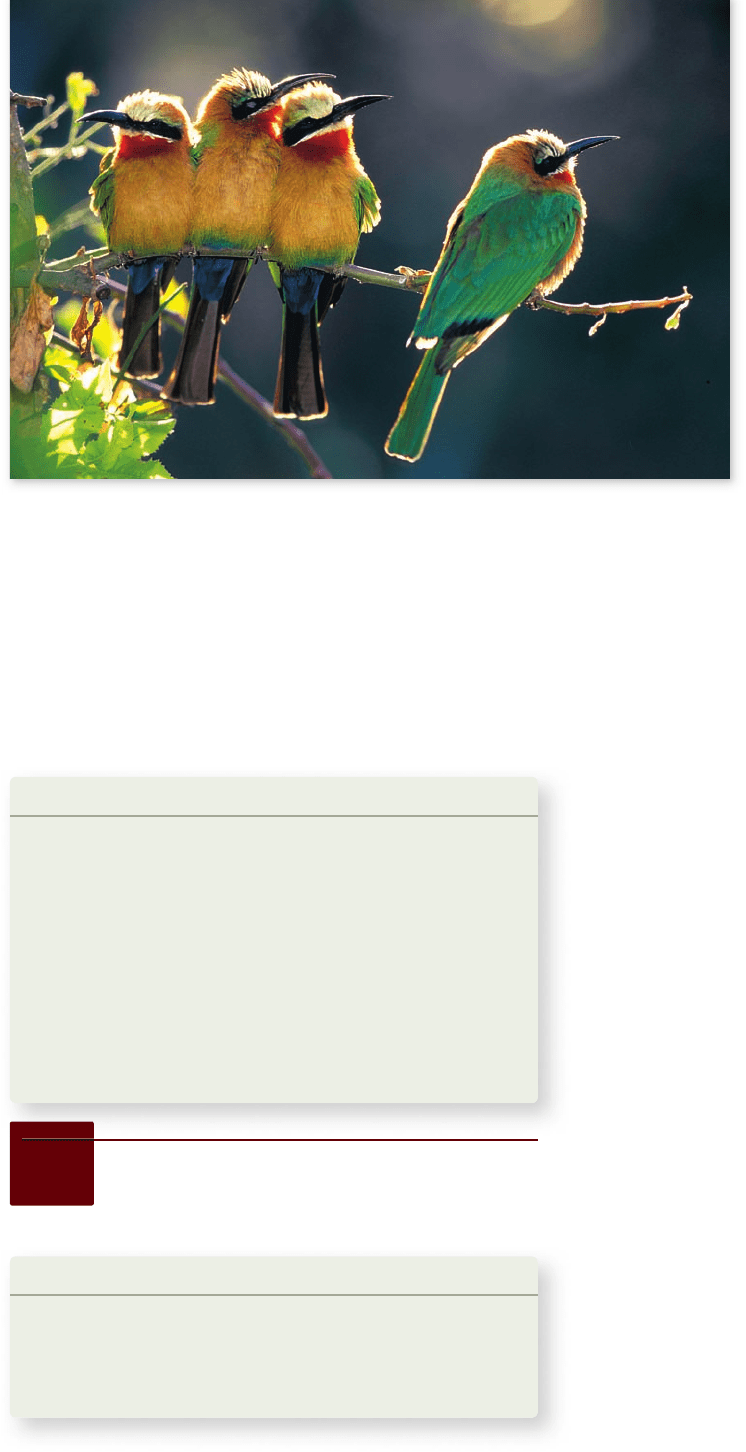
Figure 55.36
Kin selection in the
white-fronted bee-eater (Merops
bullockoides) . Bee-eaters are small
insectivorous birds that live in Africa in large
colonies. Bee-eaters often help others raise
their young; helpers usually choose to help
close relatives.
but older birds whose nesting attempts have failed may also be
helpers. The presence of a single helper, on average, doubles
the number of offspring that survive. Two lines of evidence sup-
port the idea that kin selection is important in determining
helping behavior in this species. First, helpers are normally
males, which are usually related to other birds in the colony,
and not females, which are not related. Second, when birds
have the choice of helping different parents, they almost invari-
ably choose the parents to which they are most closely related.
Learning Outcomes Review 55.11
Genetic and ecological factors have contributed to evolution of altruism, a
behavior that benefi ts another individual at a cost to the actor. Individuals
may benefi t directly if cooperative acts are reciprocated among unrelated
interactants. Kin selection explains how altruistic acts directed toward
relatives, which share alleles, increase an individual’s inclusive fi tness.
Haplodiploidy has resulted in eusociality among some insects by increasing
genetic relatedness; it is not found in vertebrates.
■ Imagine that you witness older group members rescuing
infants in a troupe of monkeys when a predator
appears. How would you test whether the altruistic act
you see is reciprocity or kin selection?
55.12
The Evolution of Group Living
and Animal Societies
Learning Outcomes
Explain the possible advantages of group living.1.
Contrast the nature of insect and vertebrate societies.2.
Discuss social organization in African weaver birds and 3.
how it is influenced by ecology.
Organisms from cnidarians and insects to fish, whales, chim-
panzees, and humans live in social groups. To encompass the
wide variety of social phenomena, we can broadly define a soci-
ety as a group of organisms of the same species that are orga-
nized in a cooperative manner.
Why have individuals in some species given up a solitary
existence to become members of a group? One hypothesis is
that individuals in groups benefit directly from social living.
For example, a bird in a flock may be better protected from
predators. As flock size increases, the risk of predation decreases
because there are more individuals to scan the environment for
predators (figure 55.37).
A member of a flock may also increase its feeding success
if it can acquire information from other flock members about
the location of new, rich food sources. In some predators, hunt-
ing in groups can increase success and allow the group to tackle
prey too large for any one individual.
Insect societies form e cient colonies
containing specialized castes
We’ve already discussed the origin of eusociality in the insect or-
der Hymenoptera (ants, bees, and wasps). Additionally, all termites
(order Isoptera) are also eusocial, and a few other insect and ar-
thropod species are eusocial. Social insect colonies are composed
of different castes, groups of individuals that differ in reproductive
ability (queens vs. workers), size, and morphology and perform
different tasks. Workers nurse, maintain the nest, and forage; sol-
diers are large and have powerful jaws specialized for defense.
The structure of an insect society is illustrated by leaf-
cutters, which form colonies of as many as several million indi-
viduals. These ants cut leaves and use it to grow crops of fungi
beneath the ground. Workers divide the tasks of leaf cutting,
defense, mulching the fungus garden, and implanting fungal
hyphae according to their body size (figure 55.38).
The structure of a vertebrate
society is related to ecology
In contrast to the highly structured and integrated insect societ-
ies and their remarkable forms of altruism, vertebrate social
chapter
55
Behavioral Biology
115 7www.ravenbiology.com
rav32223_ch55_1132-1161.indd 1157rav32223_ch55_1132-1161.indd 1157 11/20/09 1:51:29 PM11/20/09 1:51:29 PM
Apago PDF Enhancer
20
40
0
1 2–10 11–50 50+
60
80
100
20
40
0
60
80
100
Number of Pigeons in Flock
Percent Attack Success
Reaction Distance (m)
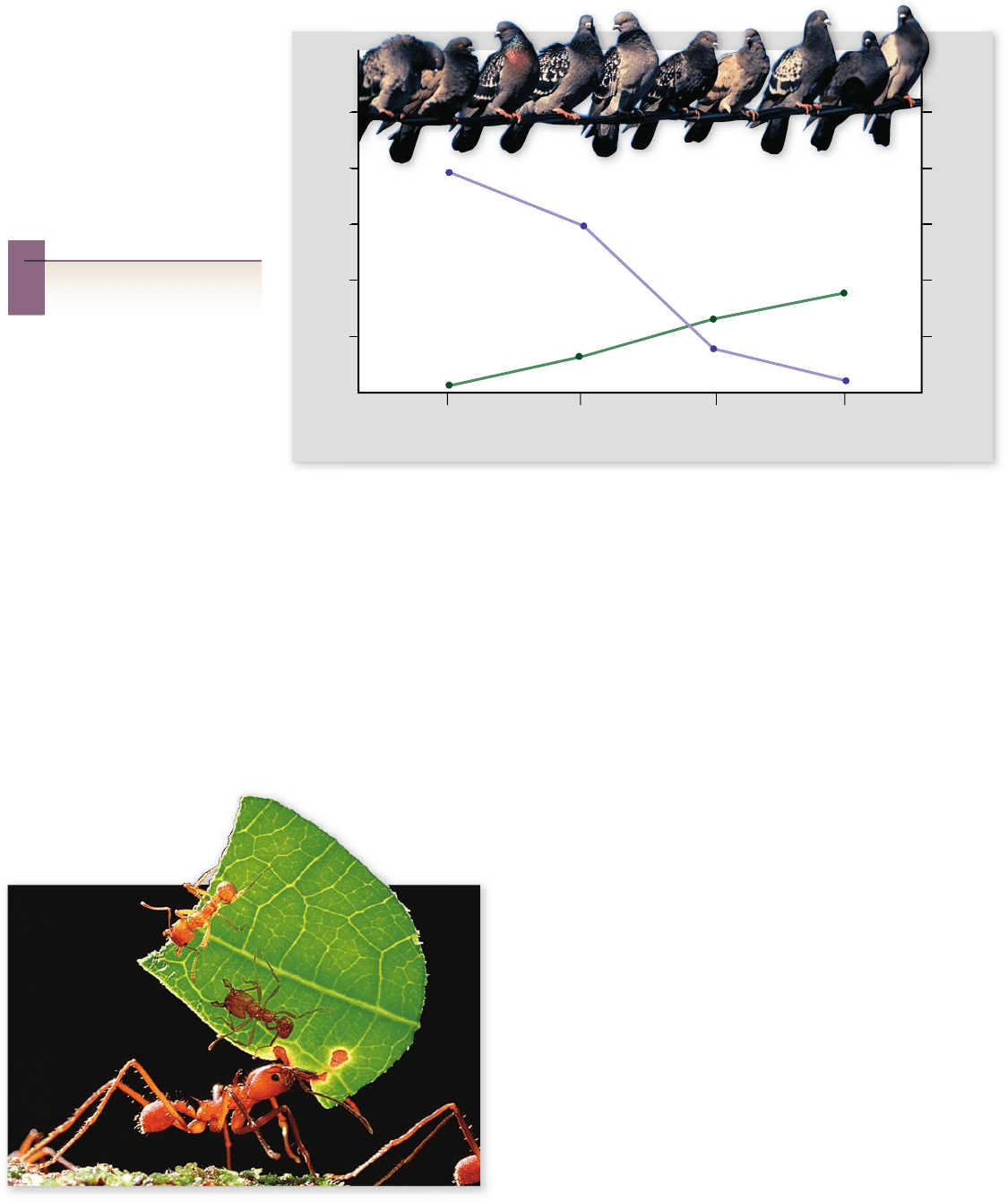
Figure 55.37
Flocking
behavior decreases predation.
When more pigeons are present in
the ock, they can detect hawks at
greater distances, thus allowing
more time for the pigeons to escape.
As a result, as the size of a pigeon
ock increases, hawks are less
successful at capturing pigeons.
Inquiry question
?
How would living in a
flock affect the time
available for foraging by
individual pigeons?
Figure 55.38
Castes of ants. These leaf-cutter ants are
members of different castes. The large ant is a worker carrying
leaves to the nest, whereas the smaller ants are protecting the
worker from attack.
groups are usually less rigidly organized and less cohesive. It
seems paradoxical that vertebrates, which have larger brains and
are capable of more complex behaviors, are generally less altru-
istic than insects (the exception, of course, is humans). Reciproc-
ity and kin-selected altruism are common in vertebrate societies,
although there is often more conflict and aggression among
group members. Conflicts generally center on access to food
and mates and occur because a vertebrate society is a made up of
individuals striving to improve their own fitness.
Social groups of vertebrates have a size, stability of mem-
bers, number of breeding males and females, and type of mat-
ing system characteristic of a given species. Diet and predation
are important factors in shaping social groups. For example,
meerkats take turns watching for predators while other group
members forage for food (figure 55.39).
African weaver birds, which construct nests from vegeta-
tion, provide an excellent example of the relationship between
ecology and social organization. Their roughly 90 species can
be divided according to the type of social group they form. One
group of species lives in the forest and builds camouflaged, soli-
tary nests. Males and females are monogamous; they forage for
insects to feed their young. The second group of species nests
in colonies in trees on the savanna. They are polygynous and
feed in flocks on seeds.
The feeding and nesting habits of these two groups of
species are correlated with their mating systems. In the forest,
insects are hard to find, and both parents must cooperate in
feeding the young. The camouflaged nests do not call the at-
tention of predators to their brood. On the open savanna, build-
ing a hidden nest is not an option. Rather, savanna-dwelling
weaver birds protect their young from predators by nesting in
trees, which are not very abundant. This shortage of safe nest
sites means that birds must nest together in colonies. Because
seeds occur abundantly, a female can acquire all the food need-
ed to rear young without a male’s help. The male, free from the
duties of parenting, spends his time courting many females—a
polygynous mating system.
One exception to the general rule that vertebrate societ-
ies are not organized like those of insects is the naked mole rat,
a small, hairless rodent that lives in and near East Africa. Unlike
other kinds of mole rats, which live alone or in small family
groups, naked mole rats form large underground colonies with
a far-ranging system of tunnels and a central nesting area. It is
not unusual for a colony to contain 80 individuals.
Naked mole rats feed on bulbs, roots, and tubers, which
they locate by constant tunneling. As in insect societies, there is
a division of labor among the colony members, with some indi-
viduals working as tunnelers while others perform different
1158
part
VIII
Ecology and Behavior
rav32223_ch55_1132-1161.indd 1158rav32223_ch55_1132-1161.indd 1158 11/20/09 1:51:32 PM11/20/09 1:51:32 PM
Apago PDF Enhancer
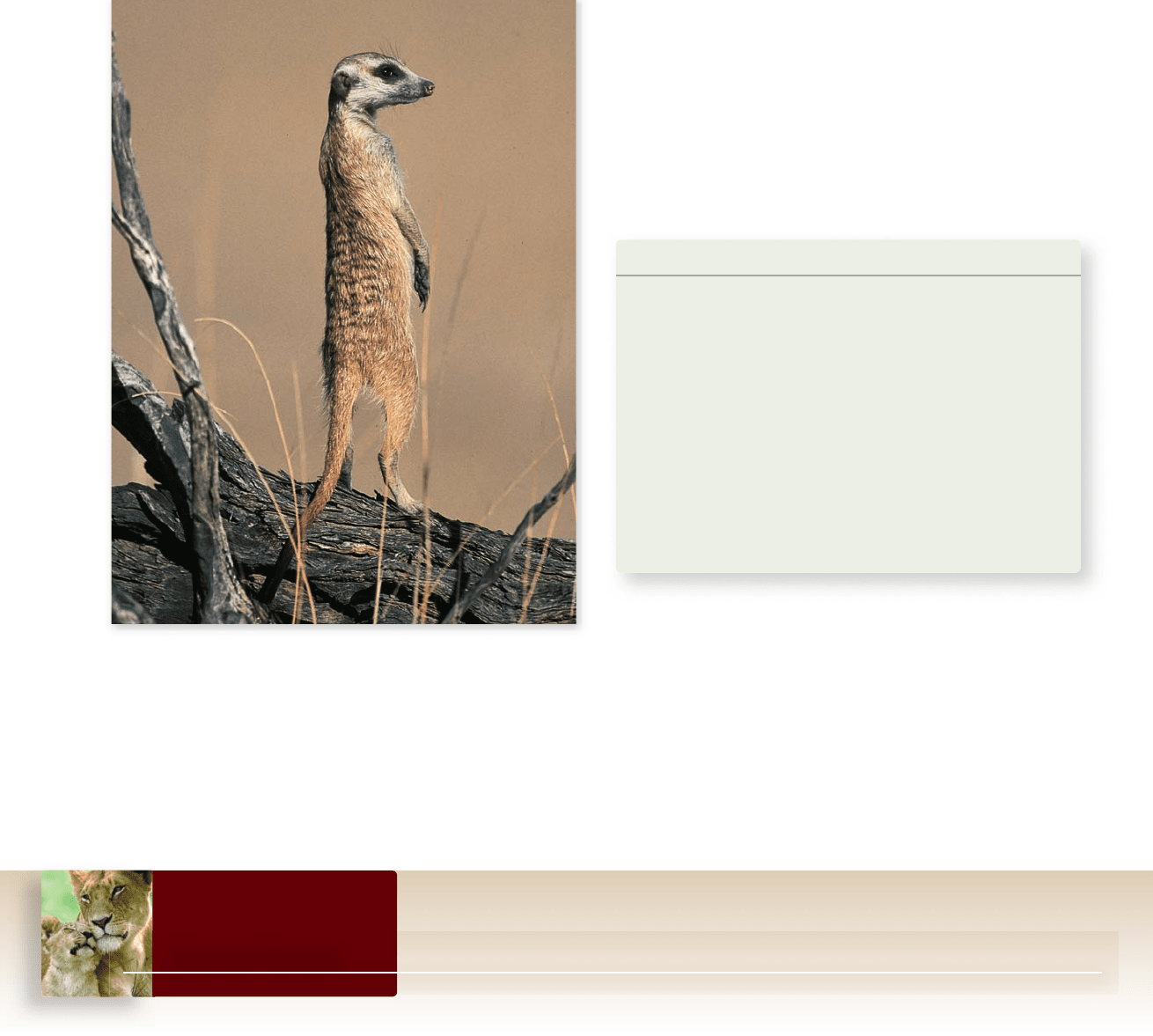
Figure 55.39
Foraging and predator avoidance. A
meerkat sentinel on duty. Meerkats (Suricata suricata) are a species
of highly social mongoose living in the semiarid sands of the
Kalahari Desert in southern Africa. This meerkat is taking its turn
to act as a lookout for predators. Under the security of its vigilance,
the other group members can focus their attention on foraging.
tasks, depending on the size of their bodies. Large mole rats
defend the colony and dig tunnels.
Naked mole rat colonies have a reproductive division of
labor similar to the one normally associated with the eusocial
insects. All of the breeding is done by a single female, or “queen,”
who has one or two male consorts. The workers, consisting of
both sexes, keep the tunnels clear and forage for food.
Learning Outcomes Review 55.12
Advantages of group living include protection from predators and increased
feeding success. Eusocial insects form complex, highly altruistic societies
that increase the fi tness of the colony. The members of vertebrate societies
exhibit more confl ict and competition, but also cooperate and behave
altruistically, especially toward kin. African weaver birds have developed
diff erent types of societies depending on the ecology of their habitat,
particularly the safety of nesting sites.
■ What are the benefits and costs associated with living in
social groups?
■ Why is altruism directed toward kin considered to be
selfish behavior?
■ Is a human army more like an insect society or a
vertebrate society? Explain your answer.
Chapter Review
55.1 The Natural History of Behavior
Behavior can be analyzed in terms of mechanisms (cause) and
evolutionary origin (adaptive nature).
Proximate causation refers to the mechanisms of behavior. Ultimate
causation examines a behavior’s evolutionary signi cance.
Ethology emphasizes the study of instinct and its origins.
Innate, or instinctive, behavior is a response to an environmental
stimulus or trigger that does not require learning (see gure 55.1).
55.2 Nerve Cells, Neurotransmitters, Hormones,
and Behavior
Instinctive behaviors are accomplished by neural circuits, which
develop under genetic control. Hormones and neurotransmitters can
act to regulate behavior.
55.3 Behavioral Genetics
Arti cial selection and hybrid studies link genes and behavior.
Breeding fast-learning and slow-learning rats among each other for
several generations produced two distinct behavioral populations (see
gure 55.3).
Some behaviors appear to be controlled by a single gene.
55.4 Learning
Learning mechanisms include habituation and association.
Habituation, a form of nonassociative learning, is a decrease in
response to repeated nonessential stimuli. Associative learning is a
change in behavior by association of two stimuli or of a behavior and
a response (conditioning).
chapter
55
Behavioral Biology
115 9www.ravenbiology.com
rav32223_ch55_1132-1161.indd 1159rav32223_ch55_1132-1161.indd 1159 11/20/09 1:51:34 PM11/20/09 1:51:34 PM

Apago PDF Enhancer
Classical (Pavlovian) conditioning occurs when two stimuli are
associated with each other. Operant conditioning occurs when an
animal associates a behavior with reward or punishment.
Instinct governs learning preparedness.
What an animal can learn is biologically in uenced—that is, learning
is possible only within the boundaries set by evolution.
55.5 The Development of Behavior
Parent–o spring interactions inuence how behavior develops.
In imprinting, a young animal forms an attachment to other
individuals or develops preferences that inuence later behavior.
Instinct and learning may interact as behavior develops.
Animals may have an innate genetic template that guides their
learning as behavior develops, such as song development in birds.
Studies on twins reveal a role for both genes and environment in
human behavior.
55.6 Animal Cognition
Some animals exhibit cognitive behavior and can respond to novel
situations using logic (see gures 55.12, 55.13).
55.7 Orientation and Migratory Behavior
Migration often involves populations moving large distances.
Migrating animals must be capable of orientation and navigation (see
gure 55.16).
Orientation is the mechanism by which animals move by tracking
environmental stimuli such as celestial clues or Earth’s magnetic eld.
Navigation is following a route based on orientation and some sort of
“map.” The nature of the map in animals is not known.
55.8 Animal Communication
Successful reproduction depends on appropriate signals and responses.
Courtship signals are usually species-specic and help to ensure
reproductive isolation (see gure 55.19).
Communication enables information exchange among group
members (see gures 55.20, 55.21).
55.9 Behavioral Ecology
Foraging behavior can directly inuence energy intake and
individual tness.
Natural selection favors optimal foraging strategies in which energy
acquisition (cost) is minimized and reproductive success (benet)
is maximized.
Territorial behavior evolves if the bene ts of holding a territory exceed
the costs.
55.10 Reproductive Strategies and Sexual Selection
The sexes often have di erent reproductive strategies.
One sex may be choosier than the other, and which one often
depends on the degree of parental investment.
Sexual selection occurs through mate competition and mate choice.
Intrasexual selection involves competition among members of the
same sex for the chance to mate. Intersexual selection is one sex
choosing a mate.
Mate choice may provide direct bene ts (increased resource availability
or parental care) or indirect bene ts (genetic quality of the mate).
Mating systems reect the ability of parents to care for o spring and
are in uenced by ecology.
Mating systems include monogamy, polygyny, and polyandry; they
are inuenced by ecology and constrained by needs of offspring.
55.11 Altruism
Reciprocity theory explains altruism between unrelated individuals.
Mutual exchanges bene t both participants; a participant that does
not reciprocate would not receive future aid.
Kin selection theory proposes a direct genetic advantage to altruism.
Kin selection increases the reproductive success of relatives and
increased frequency of alleles shared by kin, and thus increases an
individual’s inclusive tness.
Ants, bees, and wasps have haplodiploid reproduction, and therefore
high degree of gene sharing.
55.12 The Evolution of Group Living and Animal
Societies
A social system is a group organized in a cooperative manner.
Insect societies form e cient colonies containing specialized castes
(see gure 55.38).
Social insect societies are composed of different castes that are
specialized to reproduce or to perform certain colony maintenance tasks.
The structure of a vertebrate society is related to ecology.
Vertebrate social systems are less rigidly organized and cohesive and
are inuenced by food availability and predation.
Review Questions
UNDERSTAND
1. A key stimulus, innate releasing mechanism, and xed
action pattern
a. are mechanisms associated with behaviors that are learned.
b. are components of behaviors that are innate.
c. involve behaviors that cannot be explained in terms of
ultimate causation.
d. involve behaviors that are not subject to natural selection.
2. In operant conditioning
a. an animal learns that a particular behavior leads to a reward
or punishment.
b. an animal associates an unconditioned stimulus with a
conditioned response.
c. learning is unnecessary.
d. habituation is required for an appropriate response.
116 0
part
VIII
Ecology and Behavior
rav32223_ch55_1132-1161.indd 1160rav32223_ch55_1132-1161.indd 1160 11/20/09 1:51:37 PM11/20/09 1:51:37 PM

Apago PDF Enhancer
3. The study of song development in sparrows showed that
a. the acquisition of a species-specic song is innate.
b. there are two components to this behavior: a genetic
template and learning.
c. song acquisition is an example of associative learning.
d. All of these are correct.
4. The difference between following a set of driving directions
given to you by somebody on the street (for example “. . . take a
right at the next light, go four blocks and turn left . . .”) and
using a map to nd your destination is
a. the difference between navigation and orientation,
respectively.
b. the difference between learning and migration, respectively.
c. the difference between orientation and navigation,
respectively.
d. why birds are not capable of orientation.
5. In courtship communication
a. the signal itself is always species-specic.
b. the sign communicates species identity.
c. it involves a stimulus–response chain.
d. courtship signals are produced only by males.
6. Behavioral ecology assumes
a. that all behavioral traits are innate.
b. learning is the dominant determinant of behavior.
c. behavioral traits are subject to natural selection.
d. behavioral traits do not affect tness.
7. According to optimal foraging theory
a. individuals minimize energy intake per unit of time.
b. energy content of a food item is the only determinant of a
forager’s food choice.
c. time taken to capture a food item is the only determinant
of a forager’s food choice.
d. a higher energy item might be less valuable than a lower
energy item if it takes too much time to capture the
larger item.
8. The elaborate tail feathers of a male peacock evolved
because they
a. improve reproductive success of males and females.
b. improve male survival.
c. reduce survival.
d. None of the above.
9. From the perspective of females, extra-pair copulations (EPCs)
a. are always disadvantageous to females.
b. can be associated with receiving male aid.
c. are too rare to affect female tness.
d. can only be of bene t if the EPC male has elaborate
secondary sexual traits.
10. In the haplodiploidy system of sex determination, males are
a. haploid.
b. diploid.
c. sterile.
d. not present because bees exist as single-sex populations.
11. According to kin selection, saving the life of your _____ would
do the least for increasing your inclusive tness.
a. mother c. sister-in-law
b. brother d. niece
12. Altruism
a. is only possible through reciprocity.
b. is only possible through kin selection.
c. can only be explained by group selection.
d. will only occur when the tness benet of a given act is
greater than the tness cost.
APPLY
1. Refer to gure 55.25. Data on size of mussels eaten by shore
crabs suggest they eat sizes smaller than expected by an optimal
foraging model. Suggest a hypothesis for why and describe an
experiment to test your hypothesis.
2. Refer to gure 55.26. Six pairs of birds were removed but only
four pairs moved in. Where did the new pairs come from?
Additionally, it appears that many of the birds that were not
removed expanded their territories and that the new residents
ended up with smaller territories than the pairs they
replaced. Explain.
3. Refer to gure 55.28. Peahens prefer to mate with peacocks that
have more eyespots in their tail feathers (that is, longer tail
feathers). It has also been suggested that the longer the tail
feathers, the more impaired the ight of the males. One
possible hypothesis to explain such a preference by females is
that the males with the longest tail feathers experience the most
severe handicap, and if they can nevertheless survive, it reects
their “vigor.” Suggest some studies that would allow you to test
this idea. Your description should include the kinds of traits that
you would measure and why.
4. An altruistic act is dened as one that benets another
individual at a cost to the actor. There are two theories to
explain how such behavior evolves: reciprocity and kin selection.
How would you distinguish between the two in a eld study? In
the context of natural selection, is an altruistic act “costly” to an
individual who performs it?
SYNTHESIZE
1. Insects that sting or contain toxic chemicals often have black
and yellow coloration and consequentially are not eaten by
predators. How could you determine if a predator has an innate
avoidance of insects that are colored this way, or if the
avoidance is learned? If avoidance is learned, how would you
determine the learning mechanism involved? How would you
measure the adaptive signi cance of the black and yellow
coloration to the prey insect?
2. Behavioral genetics has made great advances from detailed
studies of a single animal such as the fruit y as a model system
to develop general principles of how genes regulate behavior.
What are advantages and disadvantages of this “model system”
approach? How would you determine how broadly applicable
the results of such studies are to other animals?
3. If a female bird chooses to live in the territory of a particular
male, why might she mate with a male other than the
territory owner?
ONLINE RESOURCE
www.ravenbiology.com
Understand, Apply, and Synthesize—enhance your study with
animations that bring concepts to life and practice tests to assess
your understanding. Your instructor may also recommend the
interactive eBook, individualized learning tools, and more.
chapter
55
Behavioral Biology
1161www.ravenbiology.com
rav32223_ch55_1132-1161.indd 1161rav32223_ch55_1132-1161.indd 1161 11/20/09 1:51:37 PM11/20/09 1:51:37 PM