
Raven P.H., Johnson G.B., Mason K.A. Biology (Ninth Edition)
Подождите немного. Документ загружается.


Apago PDF Enhancer
Chapter Review
56.1 The Environmental Challenges
Key environmental factors include temperature, water, sunlight, and
soil type. Individuals seek to maintain internal homeostasis.
Organisms are capable of responding to environmental changes that
occur during their lifetime.
Most individuals can cope with variations in their natural habitat,
such as short-term changes in temperature and water availability.
Natural selection leads to evolutionary adaptation to environmental
conditions.
Over evolutionary time, physiological, morphological, or behavioral
adaptations evolve that make organisms better suited to the
environment in which they live.
56.2 Populations: Groups of a Single Species
in One Place
A population’s geographic distribution is termed its range.
Ranges undergo expansion and contraction.
Most populations have limited geographic ranges that can expand or
contract through time as the environment changes.
Dispersal mechanisms may allow some species to cross a barrier and
expand their range. Human actions have led to range expansion of
some species, often with detrimental effects.
Individuals in populations exhibit di erent spacing patterns.
Within a population, individuals are distributed randomly, uniformly,
or are clumped . Nonrandom distributions may re ect resource
distributions or competition for resources.
A metapopulation comprises distinct populations that may
exchange members.
The degree of exchange between populations in a metapopulation is
highest when populations are large and more connected.
Metapopulations may act as a buffer against extinction by permitting
recolonization of vacant areas or marginal areas.
56.3 Population Demography and Dynamics
Sex ratio and generation time a ect population growth rates.
Abundant females, a short generation time, or both can be responsible
for more rapid population growth.
Age structure is determined by the numbers of individuals in di erent
age groups.
Every age cohort has a characteristic fecundity and death rate, and so
the age structure of a population affects growth.
Life tables show probability of survival and reproduction through a
cohort’s life span.
Survivorship curves demonstrate how survival probability changes
with age (see gures 56.11, 56.12).
In some populations, survivorship is high until old age, whereas in
others, survivorship is lowest among the youngest individuals.
56.4 Life History and the Cost of Reproduction
Because resources are limited, reproduction has a cost. Resources
allocated toward current reproduction cannot be used to enhance
survival and future reproduction (see gure 56.13).
A trade-o exists between number of o spring and investment
per o spring.
When reproductive cost is high, tness can be maximized by
deferring reproduction, or by producing a few large-sized young that
have a greater chance of survival.
Reproductive events per lifetime represent an additional trade-o .
Semelparity is reproduction once in a single large event. Iteroparity
is production of offspring several times over many seasons.
Age at rst reproduction correlates with life span.
Longer-lived species delay rst reproduction longer compared with
short-lived species, in which time is of the essence.
ecological footprint of an individual in the United States is more
than 10 times greater than that of someone in India.
Based on these measurements, researchers have calculated
that resource use by humans is now one-third greater than the
amount that nature can sustainably replace. Moreover, con-
sumption is increasing rapidly in parts of the developing world;
if all humans lived at the standard of living in the industrialized
world, two additional planet Earths would be needed.
Building a sustainable world is the most important task
facing humanity’s future. The quality of life available to our
children will depend to a large extent on our success in
limiting both population growth and the amount of per capita
resource consumption.
Learning Outcomes Review 56.7
For most of its history, the K-selected human population increased
gradually. In the last 400 years, with resource control, the human population
has grown exponentially; at the current rate, it would double in 58 years.
A population pyramid shows the number of individuals in diff erent age
categories. Pyramids with a wide base are undergoing faster growth
than those that are uniform from top to bottom. Growth rates overall are
declining, but consumption per capita in the developed world is still a
signifi cant drain on resources.
■ Which is more important, reducing global population
growth or reducing resource consumption levels in
developed countries?
118 2
part
VIII
Ecology and Behavior
rav32223_ch56_1162-1184.indd 1182rav32223_ch56_1162-1184.indd 1182 11/20/09 1:47:12 PM11/20/09 1:47:12 PM

Apago PDF Enhancer
Review Questions
UNDERSTAND
1. Source–sink metapopulations are distinct from other types
of metapopulations because
a. exchange of individuals only occurs in the former.
b. populations with negative growth rates are a part
of the former.
c. populations never go extinct in the former.
d. all populations eventually go extinct in the former.
2. The potential for social interactions among individuals should
be maximized when individuals
a. are randomly distributed in their environment.
b. are uniformly distributed in their environment.
c. have a clumped distribution in their environment.
d. None of the above
3. When ecologists talk about the cost of reproduction they mean
a. the reduction in future reproductive output
as a consequence of current reproduction.
b. the amount of calories it takes for all the activity used
in successful reproduction.
c. the amount of calories contained in eggs or offspring.
d. None of the above
4. A life history trade-off between clutch size and offspring size
a. means that as clutch size increases, offspring size increases.
b. means that as clutch size increases, offspring size decreases.
c. means that as clutch size increases, adult size increases.
d. means that as clutch size increases, adult size decreases.
5. The difference between exponential and logistic growth rates is
a. exponential growth depends on birth and death rates
and logistic does not.
b. in logistic growth, emigration and immigration
are unimportant.
c. that both are affected by density, but logistic growth
is slower.
d. that only logistic growth re ects density-dependent effects
on births or deaths.
6. The logistic population growth model, dN/dt = rN[(K – N)/K],
describes a population’s growth when an upper limit to growth
is assumed. As N approaches (numerically) the value of K
a. dN/dt increases rapidly.
b. dN/dt approaches 0.
c. dN/dt increases slowly.
d. the population becomes threatened by extinction.
56.5 Environmental Limits to Population Growth
The exponential growth model applies to populations with no
growth limits.
The rate of population increase, r, is de ned as the difference
between birth rate, b, and death rate, d.
Exponential growth occurs when a population is not limited by
resources or by other species (see gure 56.16).
The logistic model applies to populations that approach their
carrying capacity.
Logistic growth is observed as a population reaches its carrying
capacity. Usually, a population’s growth rate slows to a plateau. In
some cases the population overshoots and then drops back to the
carrying capacity.
56.6 Factors That Regulate Populations
Density-dependent e ects occur when reproduction and survival are
a ected by population size.
Density-dependent factors include increased competition and
disease. To stabilize a population size, birth rates must decline, death
rates must increase, or both.
Density-independent e ects include environmental disruptions
and catastrophes.
Density-independent factors are not related to population size and
include environmental events that result in mortality.
Population cycles may re ect complex interactions.
In some cases, population size is cyclic because of the interaction of
factors such as food supply and predation (see gure 56.23).
Resource availability a ects life history adaptations.
Populations at carrying capacity have adaptations to compete for
limited resources; populations well below carrying capacity exhibit a
high reproductive rate to use abundant resources.
56.7 Human Population Growth
Human populations have grown exponentially.
Technology and other innovations have simultaneously increased the
carrying capacity and decreased mortality in the past 300 years.
Population pyramids show birth and death trends.
Populations with many young individuals are likely to experience
high growth rates as these individuals reach reproductive age.
Humanity’s future growth is uncertain.
The human population is unevenly distributed. Rapid growth in
developing countries has resulted in poverty, whereas most resources
are utilized by the industrialized world.
The population growth rate has declined.
Even at lower growth rates, the number of individuals on the planet
is likely to plateau at 7 to 10 billion.
Consumption in the developed world further depletes resources.
Resource consumption rates in the developed world are very high; a
sustainable future requires limits both to population growth and to
per capita resource consumption.
chapter
56
Ecology of Individuals and Populations
118 3www.ravenbiology.com
rav32223_ch56_1162-1184.indd 1183rav32223_ch56_1162-1184.indd 1183 11/20/09 1:47:12 PM11/20/09 1:47:12 PM

Apago PDF Enhancer
7. Which of the following is an example of a density-dependent
effect on population growth?
a. An extremely cold winter
b. A tornado
c. An extremely hot summer in which cool burrow retreats
are fewer than number of individuals in the population
d. A drought
APPLY
1. If the size of a population is reduced due to a natural disaster
such as a ood
a. population growth rates may increase because the
population is no longer near its carrying capacity.
b. population growth rates may decrease because individuals
have trouble nding mates.
c. both effects a. and b. may occur and whether population
rates increase or decrease cannot be predicted.
d. All of the above
2. In populations subjected to high levels of predation
a. individuals should invest little in reproduction so as to
maximize their survival.
b. individuals should produce few offspring and invest little in
any of them.
c. individuals should invest greatly in reproduction because
their chance of surviving to another breeding season is low.
d. individuals should stop reproducing altogether.
3. In a population in which individuals are uniformly distributed
a. the population is probably well below its carrying capacity.
b. natural selection should favor traits that maximize the
ability to compete for resources.
c. immigration from other populations is probably keeping
the population from going extinct.
d. None of the above
4. The elimination of predators by humans
a. will cause its prey to experience exponential growth until
new predators arrive or evolve.
b. will lead to an increase in the carrying capacity of
the environment.
c. may increase the population size of a prey species if that
prey’s population was being regulated by predation from
the predator.
d. will lead to an Allee effect.
SYNTHESIZE
1. Refer to gure 56.8. What are the implications for evolutionary
divergence among populations that are part of a metapopulation
versus populations that are independent of other populations?
2. Refer to gure 56.13. Given a trade-off between current
reproductive effort and future reproductive success (the
so-called cost of reproduction), would you expect old
individuals to have the same “optimal” reproductive effort as
young individuals?
3. Refer to gure 56.14. Because the number of offspring that a
parent can produce is often a trade-off with the size of
individual offspring, many circumstances lead to an
intermediate number and size of offspring being favored. If the
size of an offspring was completely unrelated to the quality of
that offspring (its chances of surviving until it reaches
reproductive age), would you expect parents to fall on the left or
right side of the x-axis (clutch size)? Explain.
4. Refer to gure 56.26. Would increasing the mean generation
time have the same kind of effect on population growth rate as
reducing the number of children that an individual female has
over her lifetime? Which effect would have a bigger in uence
on population growth rate? Explain.
ONLINE RESOURCE
www.ravenbiology.com
Understand, Apply, and Synthesize—enhance your study with
animations that bring concepts to life and practice tests to assess
your understanding. Your instructor may also recommend the
interactive eBook, individualized learning tools, and more.
118 4
part
VIII
Ecology and Behavior
rav32223_ch56_1162-1184.indd 1184rav32223_ch56_1162-1184.indd 1184 11/20/09 1:47:13 PM11/20/09 1:47:13 PM
Apago PDF Enhancer
A
Chapter
57
Community Ecology
Introduction
All the organisms that live together in a place are members of a community. The myriad of species that inhabit a tropical rain
forest are a community. Indeed, every inhabited place on Earth supports its own particular array of organisms. Over time,
the different species that live together have made many complex adjustments to community living, evolving together and
forging relationships that give the community its character and stability. Both competition and cooperation have played key
roles; in this chapter, we look at these and other factors in community ecology.
Chapter Outline
57.1 Biological Communities: Species Living Together
57.2 The Ecological Niche Concept
57.3 Predator–Prey Relationships
57.4 The Many Types of Species Interactions
57.5 Ecological Succession, Disturbance,
and Species Richness
CHAPTER
rav32223_ch57_1185-1206.indd 1185rav32223_ch57_1185-1206.indd 1185 11/20/09 2:08:15 PM11/20/09 2:08:15 PM
Apago PDF Enhancer
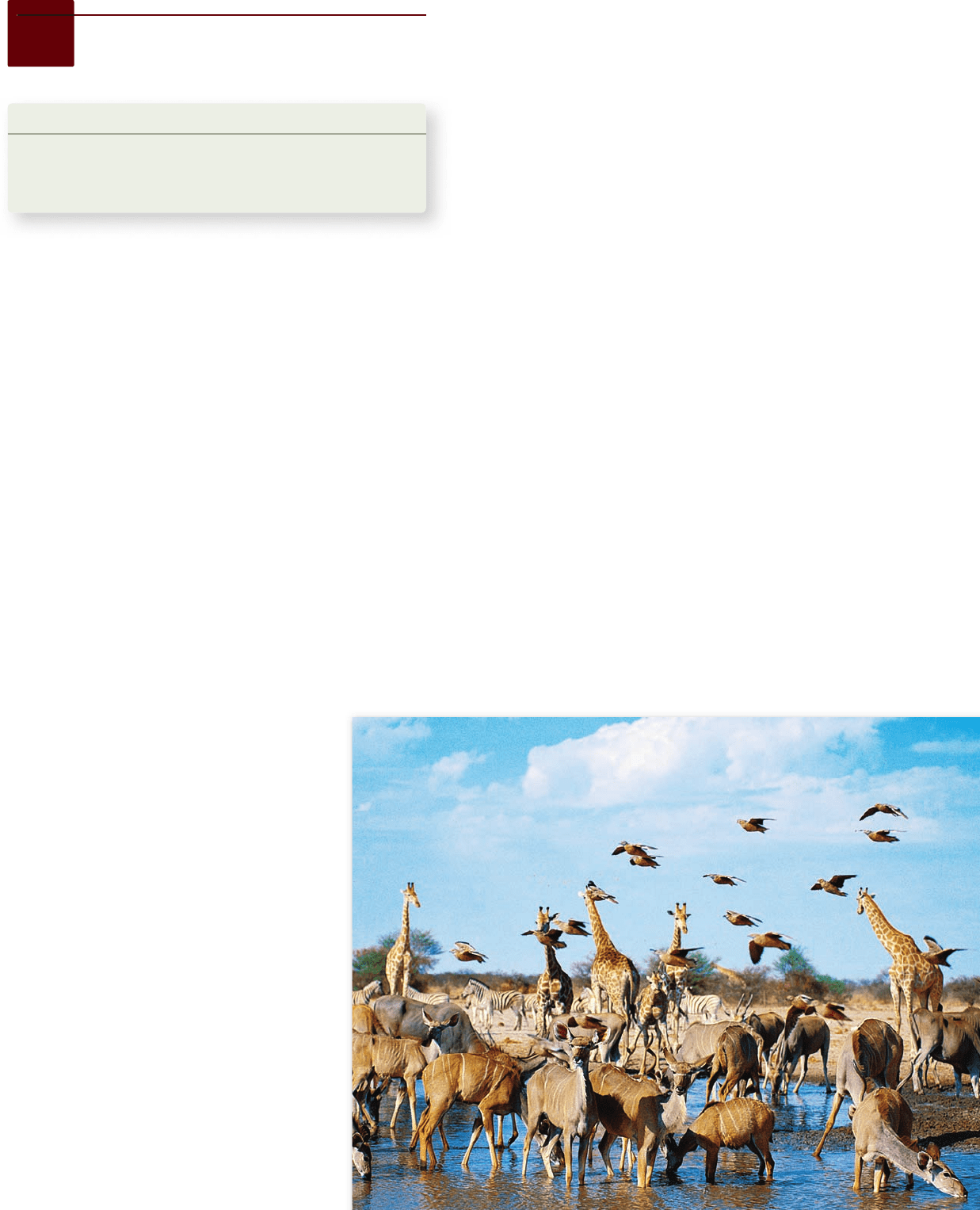
Figure 57.1
An African savanna
community. A community consists of all the
species—plants, animals, fungi, protists, and
prokaryotes—that occur at a locality, i n this case
Etosha National Park in Namibia.
interact with one another are studied. Although scientists some-
times refer to such subsets as communities (for example, the
“spider community”), the term assemblage is more appropri-
ate to connote that the species included are only a portion of
those present within the entire community.
Communities have been
viewed in di erent ways
Two views exist on the structure and functioning of communi-
ties. The individualistic concept of communities holds that a com-
munity is simply an aggregation of species that happen to occur
together at one place.
By contrast, the holistic concept of communities views
communities as an integrated unit. In this sense, the commu-
nity could be viewed as a superorganism whose constituent spe-
cies have coevolved to the extent that they function as part of a
greater whole, just as the kidneys, heart, and lungs all function
together within an animal’s body. In this view, then, a commu-
nity would amount to more than the sum of its parts.
These two views make differing predictions about the
integrity of communities across space and time. If, as the indi-
vidualistic view implies, communities are nothing more than a
combination of species that occur together, then moving geo-
graphically across the landscape or back through time, we
would not expect to see the same community. That is, species
should appear and disappear independently, as a function of
each species’ own unique ecological requirements. By contrast,
if a community is an integrated whole, then we would make
the opposite prediction: Communities should stay the same
through space or time, until being replaced by completely dif-
ferent communities when environmental differences are suffi-
ciently great.
57.1
Biological Communities:
Species Living Together
Learning Outcomes
Define community.1.
Describe how community composition may change 2.
across a geographic landscape.
Almost any place on Earth is occupied by species, sometimes by
many of them, as in the rain forests of the Amazon, and some-
times by only a few, as in the near-boiling waters of Yellow-
stone’s geysers (where a number of microbial species live). The
term community refers to the species that occur at any par-
ticular locality (figure 57.1) . Communities can be characterized
either by their constituent species or by their properties, such
as species richness (the number of species present) or primary
productivity (the amount of energy produced).
Interactions among community members govern many
ecological and evolutionary processes. These interactions,
such as predation and mutualism, affect the population biol-
ogy of particular species—whether a population increases
or decreases in abundance, for example—as well as the ways
in which energy and nutrients cycle through the ecosystem.
Moreover, the community context affects the patterns of
natural selection faced by a species, and thus the evolution-
ary course it takes.
Scientists study biological communities in many ways,
ranging from detailed observations to elaborate, large-scale ex-
periments. In some cases, studies focus on the entire community,
whereas in other cases only a subset of species that are likely to
118 6
part
VIII
Ecology and Behavior
rav32223_ch57_1185-1206.indd 1186rav32223_ch57_1185-1206.indd 1186 11/20/09 2:08:20 PM11/20/09 2:08:20 PM
Apago PDF Enhancer
Normal soil Ecotone Serpentine soil
Black oak
Poison oak
Iris
Douglas fir
Hawkweed
California fescue
Snakeroot
Canyon live oak
Collomia
Ragwort
Yarrow
Buck brush
Small fescue
Fireweed
Knotweed
5 10 15 20 25 30
Species of Plant
Distance Along Transect (m)
400
200
0
Moisture Gradient
Number of Trees per Hectare
Wet Dry
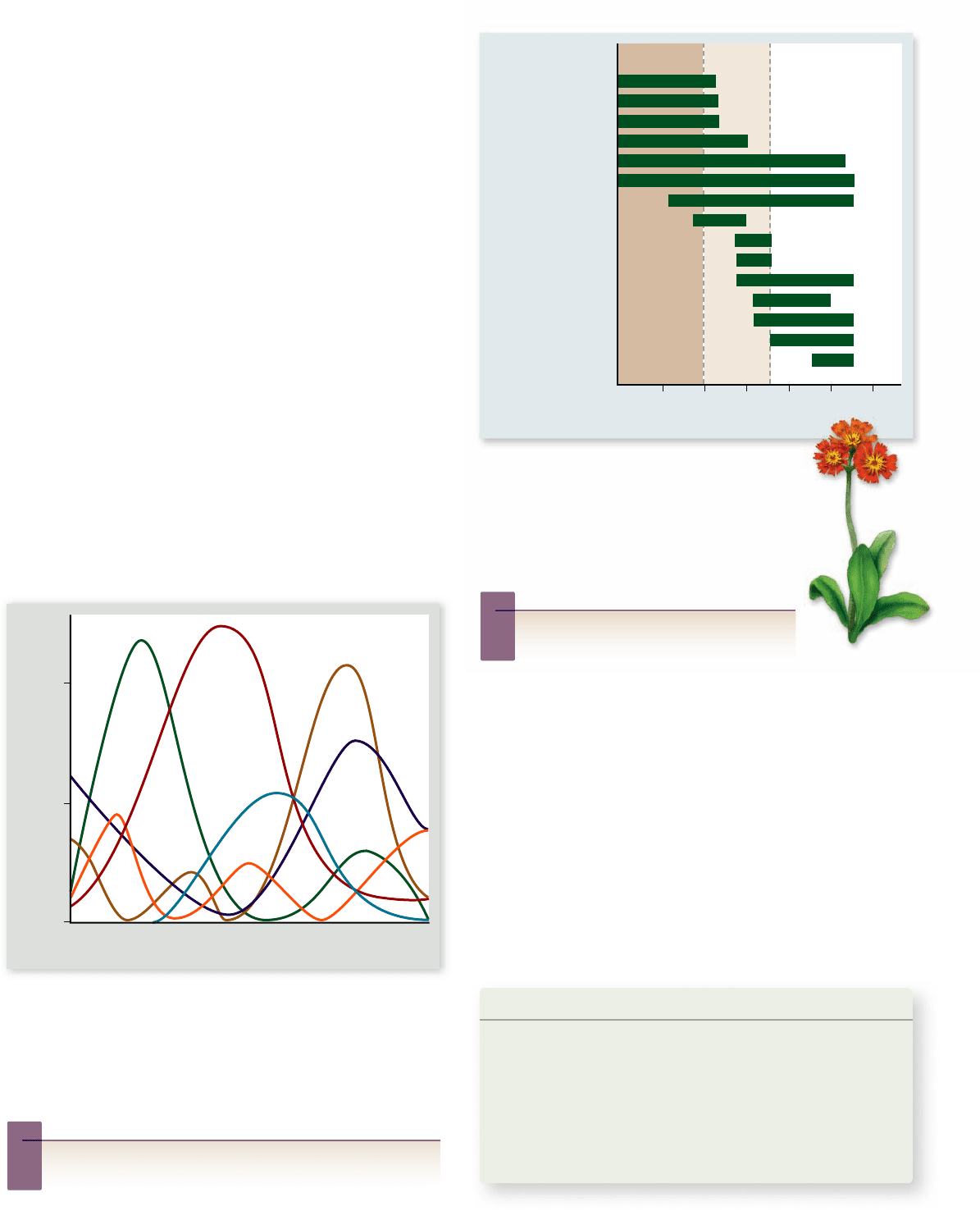
Figure 57.2
Abundance of tree species along a moisture
gradient in the Santa Catalina Mountains of southeastern
Arizona. Each line represents the abundance of a different tree
species. The species’ patterns of abundance are independent of one
another. Thus, community composition changes continually along
the gradient.
Inquiry question
?
Why do species exhibit different patterns of response to
change in moisture?
Figure 57.3
Change in community
composition across an ecotone. The plant
assemblages on normal and serpentine soils are
greatly different, and the transition from one
community to another occurs over a short
distance.
Inquiry question
?
Why is there a sharp transition between
the two community types?
Nonetheless, in some cases the abundance of species in a
community does change geographically in a synchronous pat-
tern. Often, this occurs at ecotones, places where the environ-
ment changes abruptly. For example, in the western United
States, certain patches of habitat have serpentine soils. This soil
differs from normal soil in many ways—for example, high con-
centrations of nickel, chromium, and iron; low concentrations
of copper and calcium. Comparison of the plant species that
occur on different soils shows that distinct communities exist
on each type, with an abrupt transition from one to the other
over a short distance (figure 57.3) . Similar transitions are seen
wherever greatly different habitats come into contact, such as at
the interface between terrestrial and aquatic habitats or where
grassland and forest meet.
Learning Outcomes Review 57.1
A community comprises all species that occur at one site. In most cases, the
abundance of community members appears to vary independently across
space and through time. Community composition also changes gradually
depending on environmental factors when moving from one location to
another, such as from a very dry area to a very moist area.
■ In a community, would you expect greater variation
over time in abundance of animal life or plant life? Why?
Communities change over space and time
Most ecologists today favor the individualistic concept. For the
most part, species seem to respond independently to changing
environmental conditions. As a result, community composition
changes gradually across landscapes as some species appear and
become more abundant, while others decrease in abundance
and eventually disappear.
A famous example of this pattern is the abundance of tree
species in the Santa Catalina Mountains of Arizona along a
geographic gradient running from very dry to very moist.
Figure 57.2 shows that species can change abundance in pat-
terns that are for the most part independent of one another. As
a result, tree communities at different localities in these moun-
tains fall on a continuum, one merging into the next, rather
than representing discretely different sets of species.
Similar patterns through time are seen in paleontological
studies. For example, a very good fossil record exists for the
trees and small mammals that occurred in North America over
the past 20,000 years. Examination of prehistoric communities
shows little similarity to those that occur today. Many species
that occur together today were never found together in the
past. Conversely, species that used to occur in the same com-
munities often do not overlap in their geographic ranges today.
These findings suggest that as climate has changed during the
waxing and waning of the Ice Ages, species have responded in-
dependently, rather than shifting their distributions together, as
would be expected if the community were an integrated unit.
chapter
57
Interspeci c Interactions and the Ecology of Communities
118 7www.ravenbiology.com
rav32223_ch57_1185-1206.indd 1187rav32223_ch57_1185-1206.indd 1187 11/20/09 2:08:22 PM11/20/09 2:08:22 PM
Apago PDF Enhancer
High tide
Low tide
S.balanoides and C.stellatus competing
Semibalanus
Semibalanus
realized niche
Semibalanus
fundamental
niche
Chthamalus
Chthamalus
realized niche
Chthamalus
fundamental
niche
C.stellatus fundamental and
realized niches are identical when
S.balanoides is removed.
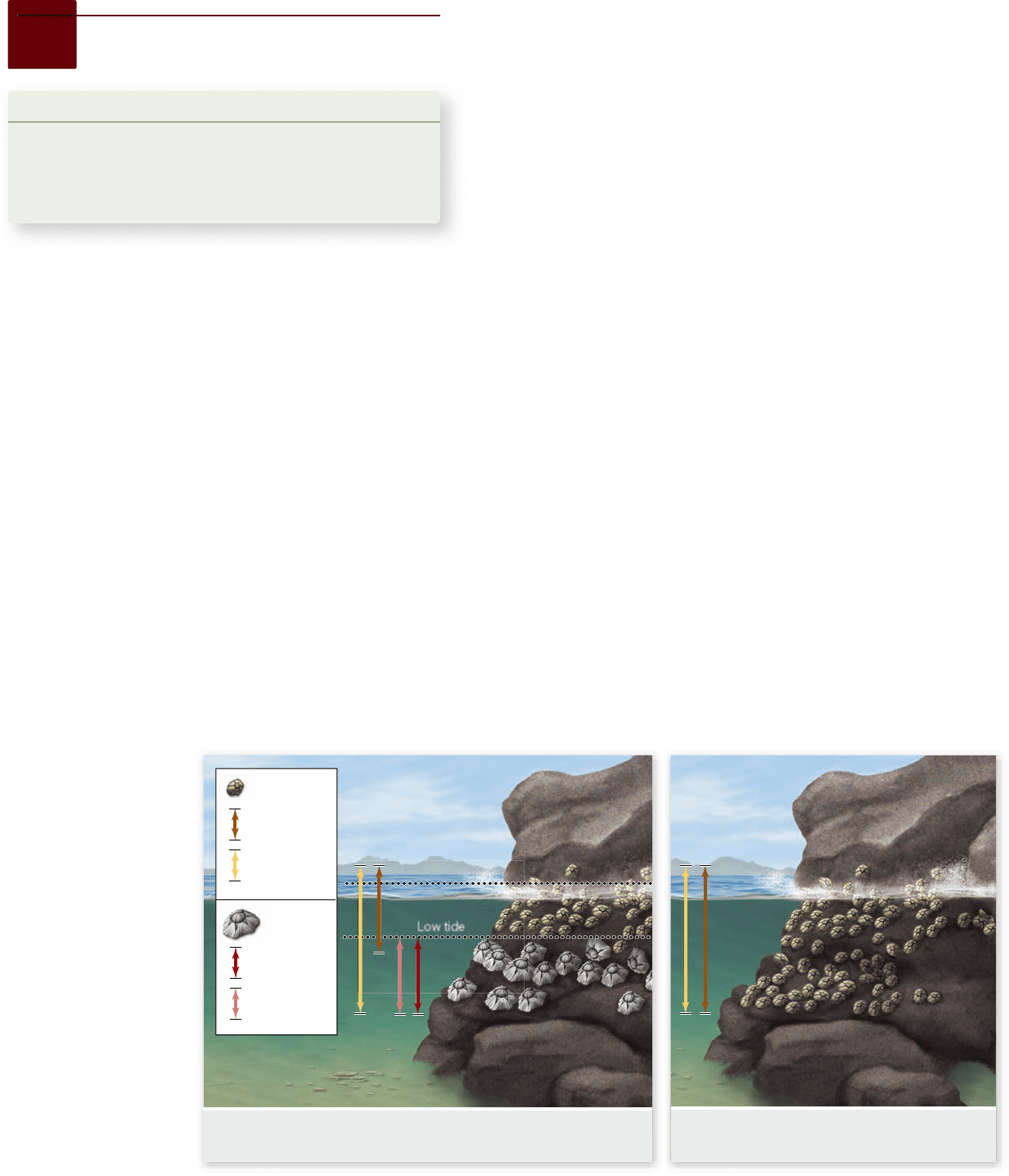
Figure 57.4
Competiti on among
two species of
barnacles. The
fundamental niche of
Chthamalus stellatus
includes both deep and
shallow zones, but
Semibalanus balanoides
forces C. stellatus out of the
part of its fundamental
niche that overlaps the
realized niche of
Semibalanus.
fundamental niche. The actual set of environmental conditions,
including the presence or absence of other species, in which the
species can establish a stable population is its realized niche.
Because of interspecific interactions, the realized niche of a spe-
cies may be considerably smaller than its fundamental niche.
Competition between species for niche occupancy
In a classic study, Joseph Connell of the University of Califor-
nia, Santa Barbara, investigated competitive interactions be-
tween two species of barnacles that grow together on rocks
along the coast of Scotland. Of the two species Connell studied,
Chthamalus stellatus lives in shallower water, where tidal action
often exposes it to air, and Semibalanus balanoides (called Balanus
balanoides prior to 1995) lives lower down, where it is rarely
exposed to the atmosphere (figure 57.4) . In these areas, space is
at a premium. In the deeper zone, S. balanoides could always
outcompete C. stellatus by crowding it off the rocks, undercut-
ting it, and replacing it even where it had begun to grow, an
example of interference competition.
When Connell removed S. balanoides from the area, how-
ever, C. stellatus was easily able to occupy the deeper zone, indi-
cating that no physiological or other general obstacles prevented
it from becoming established there. In contrast, S. balanoides
could not survive in the shallow-water habitats where C. stellatus
normally occurs; it does not have the physiological adaptations
to warmer temperatures that allow C. stellatus to occupy this
zone. Thus, the fundamental niche of C. stellatus includes both
shallow and deeper zones, but its realized niche is much nar-
rower because C. stellatus can be outcompeted by S. balanoides in
parts of its fundamental niche. By contrast, the realized and fun-
damental niches of S. balanoides appear to be identical.
Other causes of niche restriction
Processes other than competition can also restrict the realized
niche of a species. For example, the plant St. John’s wort (Hy-
pericum perforatum) was introduced and became widespread in
57.2
The Ecological Niche Concept
Learning Outcomes
Define niche and resource partitioning.1.
Differentiate between fundamental and realized niches.2.
Explain how the presence of other species can affect a 3.
species’ realized niche.
Each organism in a community confronts the challenge of sur-
vival in a different way. The niche an organism occupies is the
total of all the ways it uses the resources of its environment. A
niche may be described in terms of space utilization, food con-
sumption, temperature range, appropriate conditions for mat-
ing, requirements for moisture, and other factors.
Sometimes species are not able to occupy their entire
niche because of the presence or absence of other species. Spe-
cies can interact with one another in a number of ways, and
these interactions can either have positive or negative effects.
One type of interaction, interspecific competition, occurs
when two species attempt to use the same resource and there is
not enough of the resource to satisfy both. Physical interactions
over access to resources—such as fighting to defend a territory
or displacing an individual from a particular location—are re-
ferred to as interference competition; consuming the same
resources is called exploitative competition.
Fundamental niches are potential;
realized niches are actual
The entire niche that a species is capable of using, based on its
physiological tolerance limits and resource needs, is called the
118 8
part
VIII
Ecology and Behavior
rav32223_ch57_1185-1206.indd 1188rav32223_ch57_1185-1206.indd 1188 11/20/09 2:08:24 PM11/20/09 2:08:24 PM
Apago PDF Enhancer
0
50
100
150
200
Days
Population Density
(measured by volume)
4 0 8 12 16 20 24 4 0 8 12 16 20 24 4 0 8 12 16 20 24
Days Days
a.
b. c.
200
150
100
50
0
0
0
20 24 16 12 8 4
Days
Population Density
(measured by volume)
50
75
25
Days
4 0 8 12 16 20 24
Paramecium bursaria
Paramecium caudatum
Paramecium aurelia
Population Density
(measured by volume)
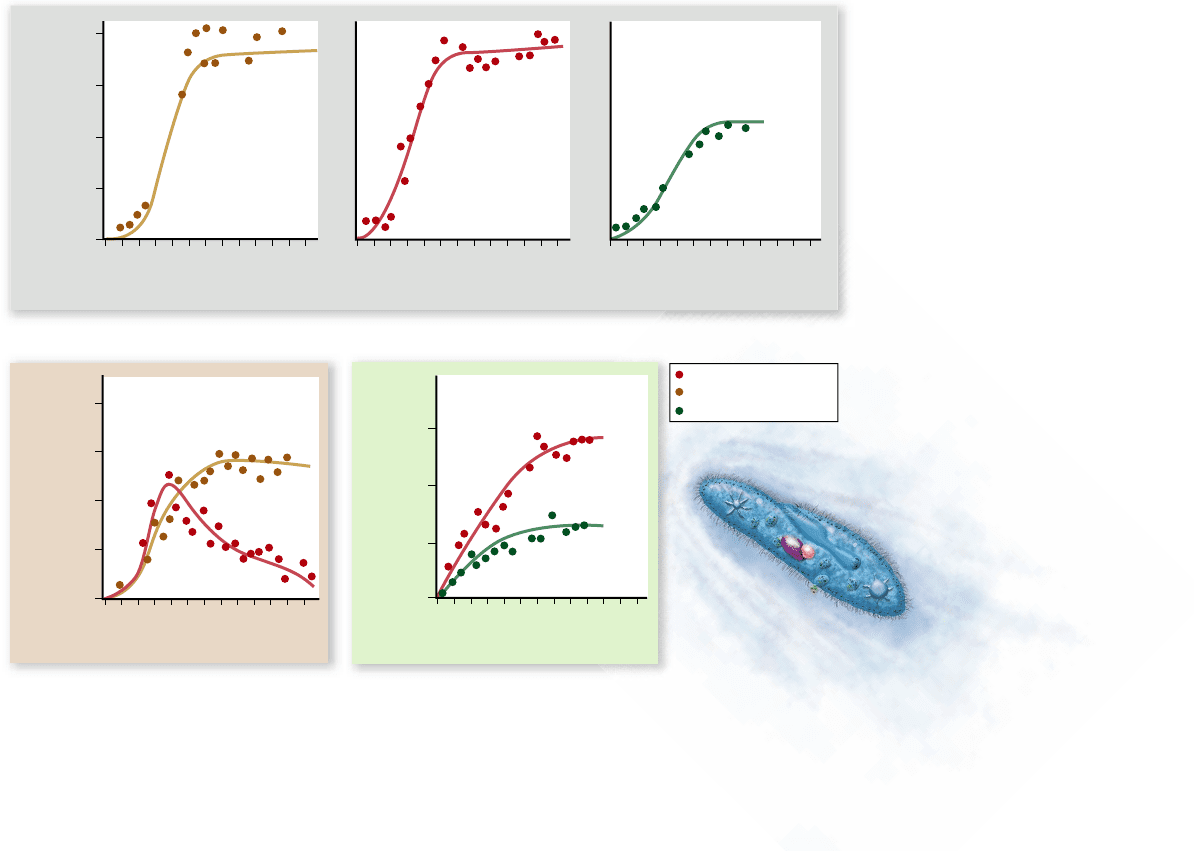
Figure 57.5
Competitive
exclusion among three
species of Paramecium.
In the microscopic world,
Paramecium is a ferocious
predator that preys on smaller
protists. a. In his experiments,
Gause found that three species
of Paramecium grew well alone
in culture tubes. b. However,
P. caudatum declined to
extinction when grown with
P. aurelia because they shared
the same realized niche, and
P. aurelia outcompeted
P. caudatum for food resources.
c. P. caudatum and P. bursaria
were able to coexist because the
two have different realized
niches and thus avoided
competition.
with P. caudatum in the same culture tube, the numbers of
P. caudatum always declined to extinction, leaving P. aurelia the
only survivor (figure 57.5b). Why did this happen? Gause found
that P. aurelia could grow six times faster than its competitor
P. caudatum because it was able to better utilize the limited
available resources, an example of exploitative competition.
From experiments such as this, Gause formulated what is
now called the principle of competitive exclusion. This prin-
ciple states that if two species are competing for a limited re-
source such as food or water, the species that uses the resource
more efficiently will eventually eliminate the other locally. In
other words, no two species with the same niche can coexist
when resources are limiting.
Niche overlap and coexistence
In a revealing experiment, Gause challenged Paramecium cauda-
tum—the defeated species in his earlier experiments—with a
third species, P. bursaria. Because he expected these two species
to also compete for the limited bacterial food supply, Gause
thought one would win out, as had happened in his previous
experiments. But that’s not what happened. Instead, both spe-
cies survived in the culture tubes, dividing the food resources.
The explanation for the species’ coexistence is simple. In
the upper part of the culture tubes, where the oxygen concen-
tration and bacterial density were high, P. caudatum dominated
because it was better able to feed on bacteria. In the lower part
open rangeland habitats in California until a specialized beetle
was introduced to control it. Population size of the plant quickly
decreased, and it is now only found in shady sites where the
beetle cannot thrive. In this case, the presence of a predator
limits the realized niche of a plant.
In some cases, the absence of another species leads to a
smaller realized niche. Many North American plants depend
on insects for pollination; indeed, the value of insect pollina-
tion for American agriculture has been estimated as more than
$2 billion per year. However, pollinator populations are cur-
rently declining for several reasons. Conservationists are con-
cerned that if these insects disappear from some habitats, the
realized niche of many plant species will decrease or even dis-
appear entirely. In this case, the absence—rather than the
presence—of another species will be the cause of a relatively
small realized niche.
Competitive exclusion can occur when
species compete for limited resources
In classic experiments carried out in 1934 and 1935, Russian
ecologist Georgii Gause studied competition among three spe-
cies of Paramecium, a tiny protist. Each of the three species grew
well in culture tubes by themselves, preying on bacteria and
yeasts that fed on oatmeal suspended in the culture fluid
(figure 57.5a). However, when Gause grew P. aurelia together
chapter
57
Interspeci c Interactions and the Ecology of Communities
118 9www.ravenbiology.com
rav32223_ch57_1185-1206.indd 1189rav32223_ch57_1185-1206.indd 1189 11/20/09 2:08:27 PM11/20/09 2:08:27 PM
Apago PDF Enhancer
a.
b.
c.
d.
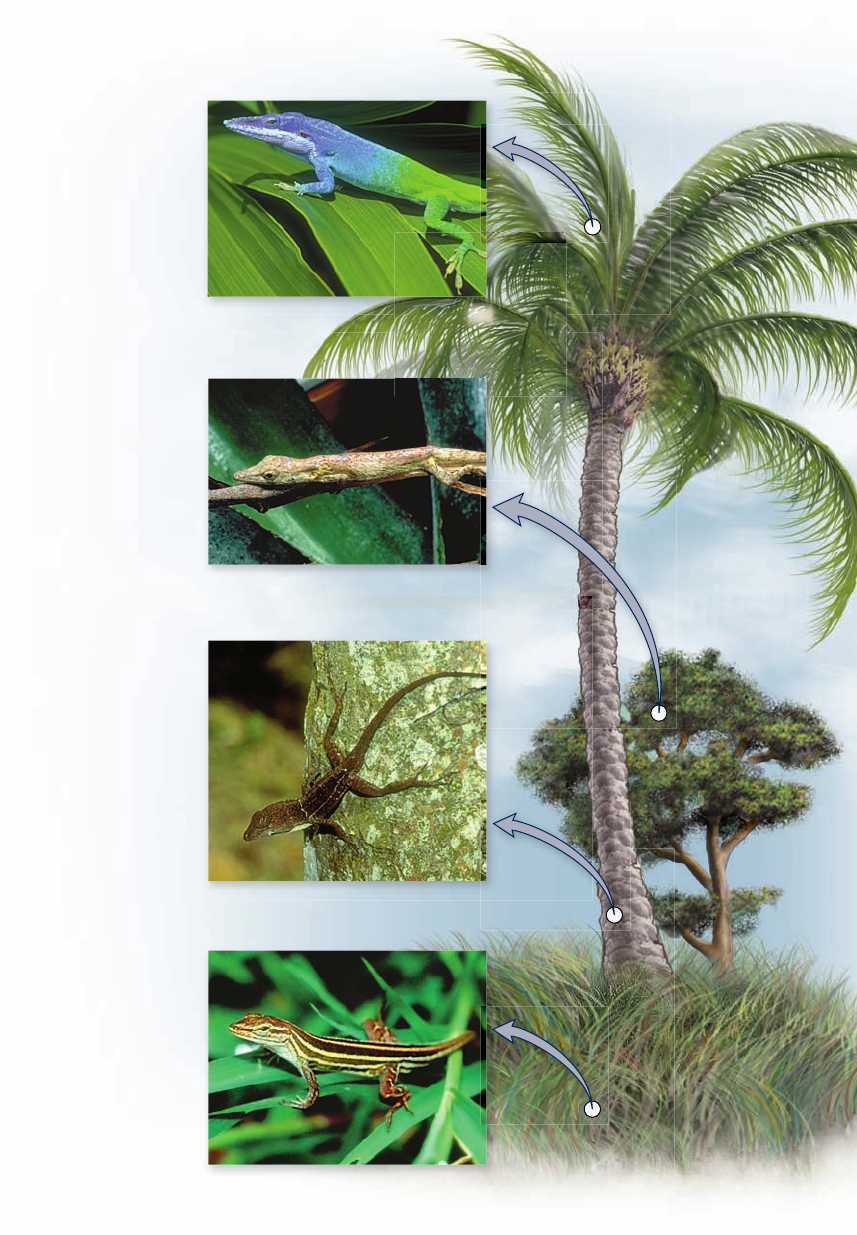
Figure 57.6
Resource partitioning among sympatric
lizard species. Species of Anolis lizards on Caribbean islands
partition their habitats in a variety of ways. a. Some species occupy
leaves and br anches in the canopy of trees, (b) others use twigs on
the periphery, and (c) still others are found at the base of the trunk.
In addition, (d) some use grassy areas in the open. When two
species occupy the same part of the tree, they either utilize
different-sized insects as food or partition the thermal microhabitat;
for example, one might only be found in the shade, whereas the
other would only bask in the sun.
of the tubes, however, the lower oxygen concentration favored
the growth of a different potential food, yeast, and P. bursaria
was better able to eat this food. The fundamental niche of each
species was the whole culture tube, but the realized niche of
each species was only a portion of the tube. Because the real-
ized niches of the two species did not overlap too much, both
species were able to survive. However, competition did have a
negative effect on the participants (figure 57.5c). When grown
without a competitor, both species reached densities three times
greater than when they were grown with a competitor.
Competitive exclusion refined
Gause’s principle of competitive exclusion can be restated as:
No two species can occupy the same niche indefinitely when
resources are limiting. Certainly species can and do coexist
while competing for some of the same resources. Nevertheless,
Gause’s hypothesis predicts that when two species coexist on a
long-term basis, either resources must not be limited or their
niches will always differ in one or more features; otherwise, one
species will outcompete the other, and the extinction of the sec-
ond species will inevitably result.
Competition may lead
to resource partitioning
Gause’s competitive exclusion principle has a very important
consequence: If competition for a limited resource is intense,
then either one species will drive the other to extinction, or
natural selection will reduce the competition between them.
When the ecologist Robert MacArthur studied five spe-
cies of warblers, small insect-eating forest songbirds, he dis-
covered that they appeared to be competing for the same
resources. But when he studied them more carefully, he found
that each species actually fed in a different part of spruce trees
and so ate different subsets of insects. One species fed on in-
sects near the tips of branches, a second within the dense foli-
age, a third on the lower branches, a fourth high on the trees,
and a fifth at the very apex of the trees. Thus, each species of
warbler had evolved so as to utilize a different portion of the
spruce tree resource. They had subdivided the niche to avoid
direct competition with one another. This niche subdivision is
termed resource partitioning.
Resource partitioning is often seen in similar species
that occupy the same geographic area. Such sympatric species
often avoid competition by living in different portions of
the habitat or by using different food or other resources
(figure 57.6) . This pattern of resource partitioning is thought
to result from the process of natural selection causing initially
similar species to diverge in resource use to reduce competi-
tive pressures.
Whether such evolutionary divergence occurs can be in-
vestigated by comparing species whose ranges only partially
overlap. Where the two species occur together, they often tend
to exhibit greater differences in morphology (the form and
structure of an organism) and resource use than do allopatric
populations of the same species that do not occur with the other
species. Called character displacement , the differences evident be-
tween sympatric species are thought to have been favored by
119 0
part
VIII
Ecology and Behavior
rav32223_ch57_1185-1206.indd 1190rav32223_ch57_1185-1206.indd 1190 11/20/09 2:08:28 PM11/20/09 2:08:28 PM
Apago PDF Enhancer
10
15
5
0
199019891988
Number of Captures
of Other Rodents
kangaroo rats removed
kangaroo rats present
Question: Does interspecific interaction occur between rodent species?
Hypothesis: The larger kangaroo rat will have a negative effect on
other species.
Experiment: Build large cages in desert areas. Remove kangaroo rats
from some cages, leaving them present in others.
Result: In the absence of kangaroo rats, the number of other rodents
increases quickly and remains higher than in the control cages
throughout the course of the experiment.
Interpretation: Why do you think population sizes rise and fall in
synchrony in the two cages?
SCIENTIFIC THINKING
50
25
0
50
25
0
50
25
0
7 9 11 13 15
Los Hermanos
Islets
Daphne Major
Island
San Cristobal and
Floreana Islands
Individuals in Each Size Class (%)
G. fuliginosa
Allopatric
G. fortis
Allopatric
G. fuliginosa
and G. fortis
Sympatric
Finch Beak Depth (mm)
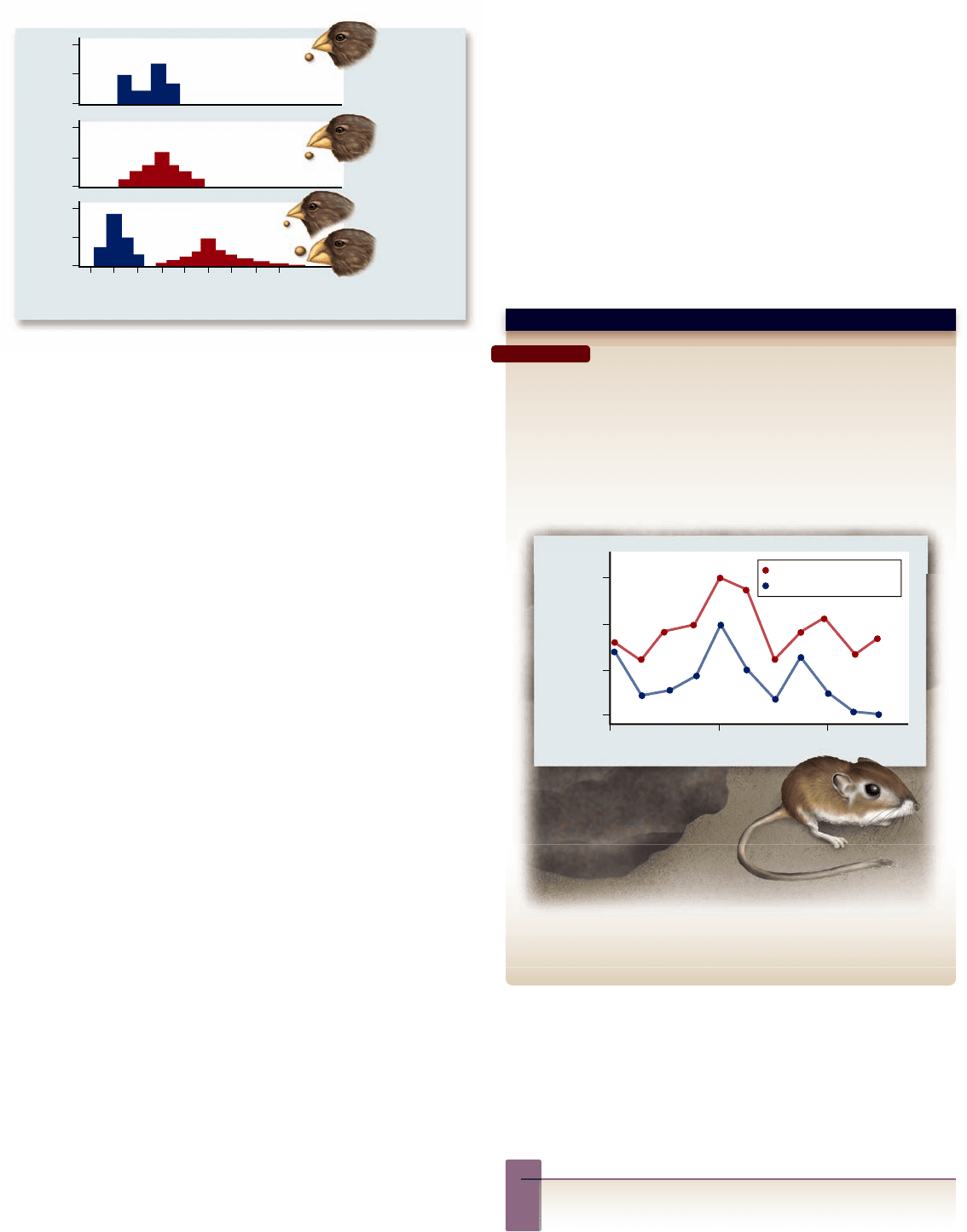
Figure 57.7
Character displacement in Darwin’s
nches. These two species of nches (genus Geospiza) have beaks
of similar size when allopatric, but different size when sympatric.
Figure 57.8
Detecting interspeci c competition.
This experiment tested how removal of kangaroo rats affected the
population size of other rodents. Immediately after kangaroo rats
were removed, the number of other rodents increased relative to the
enclosures that still contained kangaroo rats. Notice that population
sizes (a s estimated by number of captures) changed in synchrony in
the two treatments, probably re ecting changes in the weather.
Inquiry question
?
Why are there more individuals of other rodent species when
kangaroo rats are excluded?
rats had been removed, the holes were too small to allow the
kangaroo rats to reenter.
Over the course of the next 3 years, the researchers moni-
tored the number of the smaller rodents present in the plots. As
figure 57.8 illustrates, the number of other rodents was sub-
stantially higher in the absence of kangaroo rats, indicating that
kangaroo rats compete with the other rodents and limit their
population sizes.
A great number of similar experiments have indicated
that interspecific competition occurs between many species of
plants and animals. The effects of competition can be seen in
aspects of population biology other than population size, such
natural selection as a means of partitioning resources and thus
reducing competition.
As an example, the two Darwin’s finches in figure 57.7
have bills of similar size where the finches are allopatric (that is,
each living on an island where the other does not occur). On
islands where they are sympatric (that is, occur together), the
two species have evolved beaks of different sizes, one adapted to
larger seeds and the other to smaller ones. Character displace-
ment such as this may play an important role in adaptive radia-
tion, leading new species to adapt to different parts of the
environment, as discussed in chapter 22.
Detecting interspeci c competition
can be di cult
It is not simple to determine when two species are competing.
The fact that two species use the same resources need not im-
ply competition if that resource is not in limited supply. Even if
the population sizes of two species are negatively correlated,
such that where one species has a large population, the other
species has a small population and vice versa, the two species
may not be competing for the same limiting resource. Instead,
the two species might be independently responding to the same
feature of the environment—perhaps one species thrives best in
warm conditions and the other where it’s cool.
Experimental studies of competition
Some of the best evidence for the existence of competition
comes from experimental field studies. By setting up experi-
ments in which two species occur either alone or together, sci-
entists can determine whether the presence of one species has a
negative effect on a population of the second species.
For example, a variety of seed-eating rodents occur in
North American deserts. In 1988, researchers set up a series of
50-m × 50-m enclosures to investigate the effect of kangaroo
rats on smaller, seed-eating rodents. Kangaroo rats were re-
moved from half of the enclosures, but not from the others.
The walls of all of the enclosures had holes that allowed ro-
dents to come and go, but in the plots in which the kangaroo
chapter
57
Interspeci c Interactions and the Ecology of Communities
119 1www.ravenbiology.com
rav32223_ch57_1185-1206.indd 1191rav32223_ch57_1185-1206.indd 1191 11/20/09 2:08:33 PM11/20/09 2:08:33 PM