
Raven P.H., Johnson G.B., Mason K.A. Biology (Ninth Edition)
Подождите немного. Документ загружается.

Apago PDF Enhancer
Phosphates in
solution
Phosphates in
animal tissues
Excretion
Soluble
phosphates
in soil
Phosphates in
roc
ks and minerals
Weathering
Decomposition
Phosphates in
plant tissues
Food
c
hains
Loss in drainage
Precipitation
Phosphates in
plant tissues
Phosphates in
animal tissues
Excretion and
decomposition
Food
chains
Uptake
b
y roots
Phosphates in sediment
Uptake
by roots
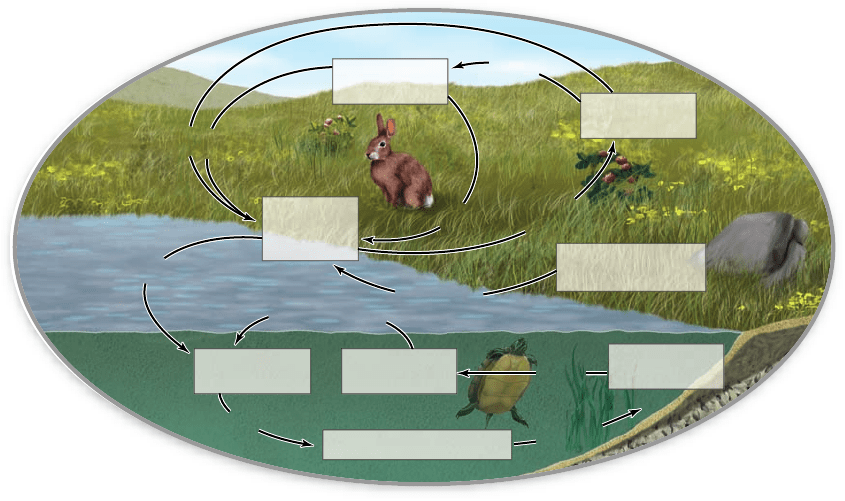
Figure 58.5
The phosphorus cycle. In contrast to
carbon, water, and nitrogen, phosphorus occurs
only in the liquid and solid states and thus does
not enter the atmosphere.
other potential culprit in adding PO
4
3 –
to ecosystems, but laws
now mandate low-phosphate detergents in much of the world.
Limiting nutrients in ecosystems are those
in short supply relative to need
A chain is only as strong as its weakest link. For the plants and
algae in an ecosystem to grow—and to thereby provide food for
animals—they need many different chemical elements. The
simplest theory is that in any particular ecosystem, one element
will be in shortest supply relative to the needs for it by the
plants and algae. That element is the limiting nutrient—the
weak link—in the ecosystem.
The cycle of a limiting nutrient is particularly important
because it determines the rate at which the nutrient is made
available for use. We gave the nitrogen and phosphorus cycles
close attention precisely because those elements are the limit-
ing nutrients in many ecosystems. Nitrogen is the limiting
nutrient in about two-thirds of the oceans and in many terres-
trial ecosystems.
Oceanographers have discovered in just the last 15 years that
iron is the limiting nutrient for algal populations (phytoplankton)
in about one-third of the world’s oceans. In these waters, wind-
borne soil dust seems often to be the chief source of iron. When
wind brings in iron-rich dust, algal populations proliferate, pro-
vided the iron is in a usable chemical form. In this way, sand storms
in the Sahara Desert, by increasing the dust in global winds, can
increase algal productivity in Pacific waters (figure 58.6).
Biogeochemical cycling in a forest ecosystem
has been studied experimentally
An ongoing series of studies at the Hubbard Brook Experimen-
tal Forest in New Hampshire has yielded much of the available
information about the cycling of nutrients in forest ecosystems.
Phosphorus cycles through
terrestrial and aquatic ecosystems,
but not the atmosphere
Phosphorus is required in substantial quantities by all organisms;
it occurs in nucleic acids, membrane phospholipids, and other
essential compounds, such as adenosine triphosphate (ATP).
Unlike carbon, water, and nitrogen, phosphorus has no
significant gaseous form and does not cycle through the atmo-
sphere (figure 58.5) . In this respect, the phosphorus cycle ex-
emplifies the sorts of cycles also exhibited by calcium, silicon,
and many other mineral elements. Another feature that greatly
simplifies the phosphorus cycle compared with the nitrogen
cycle is that phosphorus exists in ecosystems in just a single oxi-
dation state, phosphate (PO
4
3 –
).
Phosphate availability
Plants and algae use free inorganic PO
4
3 –
in the soil or water
for synthesizing their phosphorus-containing organic com-
pounds. Animals then tap the phosphorus in plant or algal tis-
sue compounds to build their own phosphorus compounds.
When organisms die, decay microbes—in a process called
phosphate re min er a liz a tion—break up the organic compounds
in their bodies, releasing phosphorus as inorganic PO
4
3 –
that
plants and algae again can use.
The phosphorus cycle includes critical abiotic chemical
and physical processes. Free PO
4
3 –
exists in soil in only low con-
centrations both because it combines with other soil constitu-
ents to form insoluble compounds and because it tends to be
washed away by streams and rivers. Weathering of many sorts of
rocks releases new PO
4
3 –
into terrestrial systems, but then rivers
carry the PO
4
3 –
into the ocean basins. There is a large one-way
flux of PO
4
3 –
from terrestrial rocks to deep-sea sediments.
Phosphates as fertilizers
Human activities have greatly modified the global phosphorus
cycle since the advent of crop fertilization. Fertilizers are typi-
cally designed to provide PO
4
3 –
because crops might otherwise
be short of it; the PO
4
3 –
in fertilizers is typically derived from
crushed phosphate-rich rocks and bones. Detergents are an-
1212
part
VIII
Ecology and Behavior
rav32223_ch58_1207-1229.indd 1212rav32223_ch58_1207-1229.indd 1212 11/20/09 2:22:17 PM11/20/09 2:22:17 PM
Apago PDF Enhancer
Dust
a. b.
Concentration of nitrate (mg/L)
80
40
4
2
0
1965 1966 1967 1968
Year
deforested
watershed
undisturbed
watershed
Deforestation
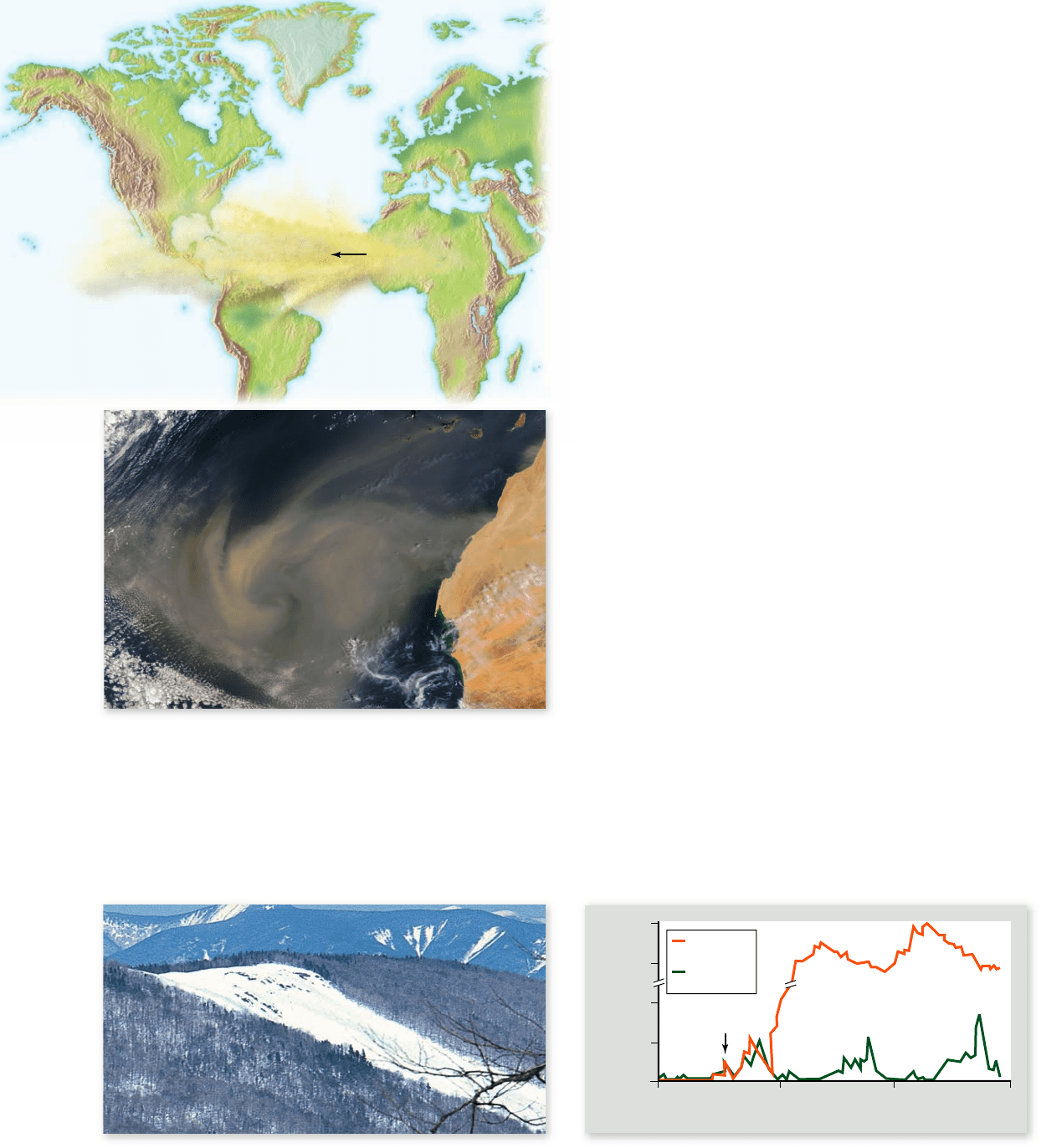
Figure 58.6
One world. Every year, millions of metric tons
of iron-rich dust is carried westward by the trade winds from the
Sahara Desert and neighboring Sahel area. A working hypothesis of
many oceanographers is that this dust fertilizes parts of the ocean,
including parts of the Paci c Ocean, where iron is the limiting
nutrient. Land use practices in Africa, which are increasing the size
of the north African desert, can thus affect ecosystems on the other
side of the globe.
Figure 58.7
The Hubbard Brook experiment. a. A 38-acre watershed was completely deforested, and the runoff monitored for
several years. b. Deforestation greatly increased the loss of nutrients in runoff water from the ecosystem. The orange curve shows the nitrate
concentration in the runoff water from the deforested watershed; the green curve shows the nitrate concentration in runoff water from an
undisturbed neighboring watershed.
Hubbard Brook is the central stream of a large watershed that
drains the hillsides of a mountain range covered with temperate
deciduous forest. Multiple tributary streams carry water off the
hillsides into Hubbard Brook.
Six tributary streams, each draining a particular valley,
were equipped with measurement devices when the study was
started. All of the water that flowed out of each valley had to
pass through the measurement system, where the flow of water
and concentrations of nutrients was quantified.
The undisturbed forests around Hubbard Brook are ef-
ficient at retaining nutrients. In a year, only small quantities of
nutrients enter a valley from outside, doing so mostly as a re-
sult of precipitation. The quantities carried out in stream wa-
ters are small also. When we say “small,” we mean the influxes
and outfluxes represent just minor fractions of the total
amounts of nutrients in the system—about 1% in the case of
calcium, for example.
In 1965 and 1966, the investigators felled all the trees and
cleared all shrubs in one of the six valleys and prevented regrowth
(figure 58.7a). The effects were dramatic. The amount of water
running out of that valley increased by 40%, indicating that wa-
ter previously taken up by vegetation and evaporated into the
atmosphere was now running off. The amounts of a number of
nutrients running out of the system also greatly increased. For
example, the rate of loss of calcium increased ninefold. Phospho-
rus, on the other hand, did not increase in the stream water; it
apparently was locked up in insoluble compounds in the soil.
The change in the status of nitrogen in the disturbed val-
ley was especially striking (figure 58.7b). The undisturbed for-
est in this valley had been accumulating NO
3
–
at a rate of about
5 kg per hectare per year, but the deforested ecosystem lost
NO
3
–
at a rate of about 53 kg per hectare per year. The NO
3
–
concentration in the stream water rapidly increased. The fertil-
ity of the valley decreased dramatically, while the run-off of
nitrate generated massive algal blooms downstream, and the
danger of downstream flooding greatly increased.
This experiment is particularly instructive at the start of
the 21st century because forested land continues to be cleared
worldwide (see chapter 59).
chapter
58
Dynamics of Ecosystems
1213www.ravenbiology.com
rav32223_ch58_1207-1229.indd 1213rav32223_ch58_1207-1229.indd 1213 11/20/09 2:22:24 PM11/20/09 2:22:24 PM

Apago PDF Enhancer
The second principle is that whenever organisms use
chemical-bond or light energy, some of it is converted to heat;
the Second Law of Thermodynamics states that a partial con-
version to heat is inevitable. Put another way, animals and plants
require chemical-bond energy and light to stay alive, but as
they use these forms of energy, they convert them to heat,
which they cannot use to stay alive and which they cannot cycle
back into the original forms.
Fortunately for organisms, the Earth functions as an open
system for energy. Light arrives every day from the Sun. Plants
and other photosynthetic organisms use the newly arrived light
to synthesize organic compounds and stay alive. Animals then
eat the photosynthetic organisms, making use of the chemical-
bond energy in their organic molecules to stay alive. Light and
chemical-bond energy are partially converted to heat at every
step. In fact, the light and chemical-bond energy are ultimately
converted completely to heat. The heat leaves the Earth by be-
ing radiated into outer space at invisible, infrared wavelengths
of the electromagnetic spectrum. For life to continue, new light
energy is always required.
The Earth’s incoming and outgoing flows of radiant en-
ergy must be equal for global temperature to stay constant. One
concern is that human activities are changing the composition
of the atmosphere in ways that impede the outgoing flow—the
so-called greenhouse effect, which is described in the following
chapter. Heat may be accumulating on Earth, causing global
warming (see chapter 59).
Energy ows through trophic
levels of ecosystems
In chapter 7, we introduced the concepts of autotrophs (“self-
feeders”) and heterotrophs (“fed by others”). Autotrophs syn-
thesize the organic compounds of their bodies from inorganic
precursors such as CO
2
, water, and NO
3
–
using energy from an
abiotic source. Some autotrophs use light as their source of en-
ergy and therefore are photoautotrophs; they are the photo-
synthetic organisms, including plants, algae, and cyanobacteria.
Other autotrophs are chemoautotrophs and obtain energy by
means of inorganic oxidation reactions, such as the microbes
that use hydrogen sulfide available at deep water vents (see
chapter 59). All chemoautotrophs are prokaryotic. The photo-
autotrophs are of greatest importance in most ecosystems, and
we focus on them in the remainder of this chapter.
Heterotrophs are organisms that cannot synthesize or-
ganic compounds from inorganic precursors, but instead live by
taking in organic compounds that other organisms have made.
They obtain the energy they need to live by breaking up some
of the organic compounds available to them, thereby liberating
chemical-bond energy for metabolic use (see chapter 7). Ani-
mals, fungi, and many microbes are heterotrophs.
When living in their native environments, species are of-
ten organized into chains that eat each other sequentially. For
example, a species of insect might eat plants, and then a species
of shrew might eat the insect, and a species of hawk might eat
the shrew. Food passes through the four species in the sequence:
plants
→
insect
→
shrew
→
hawk. A sequence of spe-
cies like this is termed a food chain.
58.2
The Flow of Energy
in Ecosystems
Learning Outcomes
Describe the different trophic levels.1.
Distinguish between energy and heat.2.
Explain how energy moves through trophic levels.3.
The dynamic nature of ecosystems includes the processing of
energy as well as that of matter. Energy, however, follows very
different principles than does matter. Energy is never recycled.
Instead, radiant energy from the Sun that reaches the Earth
makes a one-way pass through our planet’s ecosystems before
being converted to heat and radiated back into space, signifying
that the Earth is an open system for energy.
Energy can neither be created
nor destroyed, but changes form
Why is energy so different from matter? A key part of the an-
swer is that energy exists in several different forms, such as
light, chemical-bond energy, motion, and heat. Although en-
ergy is neither created nor destroyed in the biosphere (the
First Law of Thermodynamics), it frequently changes form.
A second key point is that organisms cannot convert heat to
any of the other forms of energy. Thus, if organisms convert some
chemical-bond or light energy to heat, the conversion is one-way;
they cannot cycle that energy back into its original form.
Living organisms can use many
forms of energy, but not heat
To understand why the Earth must function as an open system
with regard to energy, two additional principles need to be
recognized. The first is that organisms can use only certain
forms of energy. For animals to live, they must have energy
specifically as chemical-bond energy, which they acquire from
their foods. Plants must have energy as light. Neither animals
nor plants (nor any other organisms) can use heat as a source
of energy.
Learning Outcomes Review 58.1
An ecosystem consists of the living and nonliving components of a particular
place. Biogeochemical cycles describe how elements move between these
components. Carbon, nitrogen, and phosphorus cycle in known ways, as
does water, which is critical to ecosystems. Human populations disrupt these
cycles with artifi cial fertilization, deforestation, diversion of water, and
burning of fossil fuels.
■ Would fertilization with animal manure be less
disruptive than fertilization with purified chemicals?
Why or why not?
1214
part
VIII
Ecology and Behavior
rav32223_ch58_1207-1229.indd 1214rav32223_ch58_1207-1229.indd 1214 11/20/09 2:22:27 PM11/20/09 2:22:27 PM
Apago PDF Enhancer
Trophic Level 1
Primary producers
Trophic Level 2
Herbivores
Trophic Level 3
Primary carnivores
Trophic Level 4
Secondary carnivores
Detritivores
Sun
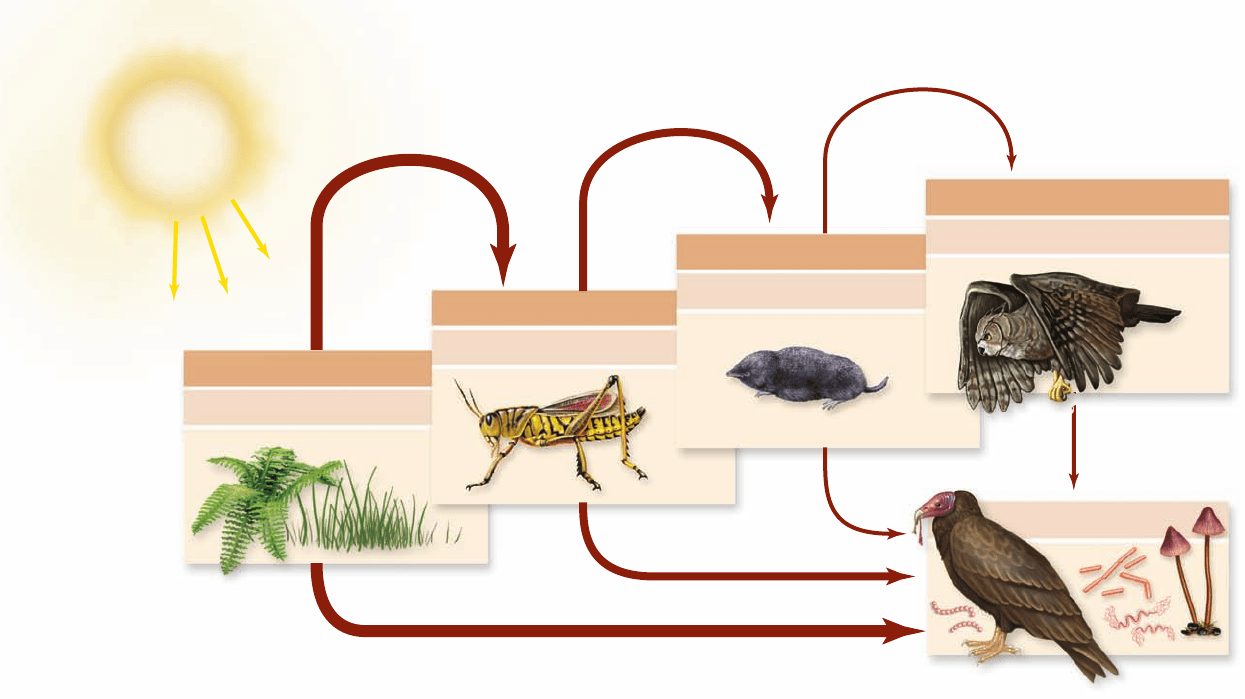
Figure 58.8
Trophic levels within an ecosystem. Primary producers such as plants obtain their energy directly from the Sun,
placing them in trophic level 1. Animals that eat plants, such as plant-eating insects, are herbivores and are in trophic level 2. Animals that eat
the herbivores, such as shrews, are primary carnivores and are in trophic level 3. Animals that eat the primary carnivores, such as owls, are
secondary carnivores in trophic level 4. Each trophic level, although illustrated here by a particular species, consists of all the species in the
ecosystem that function in a similar way in terms of what they eat. The organisms in the detritivore trophic level consume dead organic
matter they obtain from all the other trophic levels.
trophic levels in that they feed on the remains of already-dead
organisms; detritus is dead organic matter. A subcategory of
detritivores is the decomposers, which are mostly microbes
and other minute organisms that live on and break up dead
organic matter.
Concepts to describe trophic levels
Trophic levels consist of whole populations of organisms. For
example, the primary-producer trophic level consists of the
whole populations of all the autotrophic species in an ecosys-
tem. Ecologists have developed a special set of terms to refer to
the properties of populations and trophic levels.
The productivity of a trophic level is the rate at which
the organisms in the trophic level collectively synthesize new
organic matter (new tissue substance). Primary productivity is
the productivity of the primary producers. An important com-
plexity in analyzing the primary producers is that not only do
they synthesize new organic matter by photosynthesis, but they
also break down some of the organic matter to release energy
by means of aerobic cellular respiration (see chapter 7 ). The
respiration of the primary producers, in this context, is the rate
at which they break down organic compounds. Gross primary
productivity (GPP) is simply the raw rate at which the pri-
mary producers synthesize new organic matter; net primary
productivity (NPP) is the GPP minus the respiration of the
In a whole ecosystem, many species play similar roles; there
is typically not just a single species in each role. For example, the
animals that eat plants might include not just a single insect spe-
cies, but perhaps 30 species of insects, plus perhaps 10 species of
mammals. To organize this complexity, ecologists recognize a
limited number of feeding, or trophic, levels (figure 58.8).
Definitions of trophic levels
The first trophic level in an ecosystem, called the primary
producers, consists of all the autotrophs in the system.
The other trophic levels consist of the heterotrophs—the
consumers. All the heterotrophs that feed directly on the pri-
mary producers are placed together in a trophic level called
the herbivores. In turn, the heterotrophs that feed on the her-
bivores (eating them or being parasitic on them) are collec-
tively termed primary carnivores, and those that feed on the
primary carnivores are called secondary carnivores.
Advanced studies of ecosystems need to take into account
that organisms often do not line up in simple linear sequences
in terms of what they eat; some animals, for example, eat both
primary producers and other animals. A linear sequence of
trophic levels is a useful organizing principle for many pur-
poses, however.
An additional consumer level is the detritivore trophic
level. Detritivores differ from the organisms in the other
chapter
58
Dynamics of Ecosystems
1215www.ravenbiology.com
rav32223_ch58_1207-1229.indd 1215rav32223_ch58_1207-1229.indd 1215 11/20/09 2:22:29 PM11/20/09 2:22:29 PM
Apago PDF Enhancer
17% growth
33% cellular
respiration
50% feces
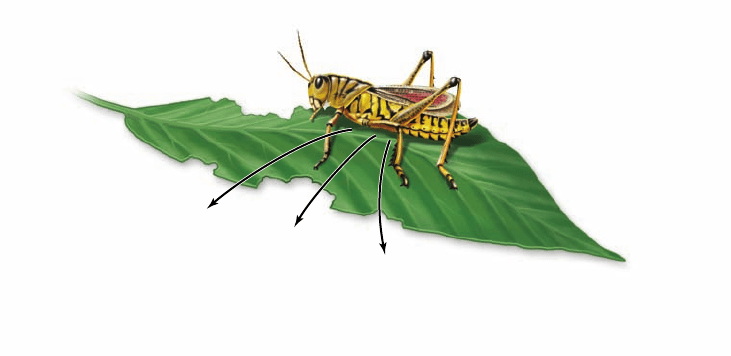
Figure 58.9
The fate of ingested chemical-bond energy:
Why all the energy ingested by a heterotroph is not
available to the next trophic level. A heterotroph such as this
herbivorous insect assimilates only a fraction of the chemical-bond
energy it ingests. In this example, 50% is not assimilated and is
eliminated in feces; this eliminated chemical-bond energy cannot
be used by the primary carnivores. A third (33%) of the ingested
energy is used to fuel cellular respiration and thus is converted to
heat, which cannot be used by the primary carnivores. Only 17% of
the ingested energy is converted into insect biomass through
growth and can serve as food for the next trophic level, but not even
that percentage is certain to be used in that way because some of the
insects die before they are eaten.
primary producers. The NPP represents the organic matter
available for herbivores to use as food.
The productivity of a heterotroph trophic level is termed
secondary productivity. For instance, the rate that new or-
ganic matter is made by means of individual growth and repro-
duction in all the herbivores in an ecosystem is the secondary
productivity of the herbivore trophic level. Each heterotroph
trophic level has its own secondary productivity.
How trophic levels process energy
The fraction of incoming solar radiant energy that the pri-
mary producers capture is small. Averaged over the course of
a year, something around 1% of the solar energy impinging
on forests or oceans is captured. Investigators sometimes ob-
serve far lower levels, but also see percentages as high as 5%
under some conditions. The solar energy not captured as
chemical-bond energy through photosynthesis is immediately
converted to heat.
The primary producers, as noted before, carry out respi-
ration in which they break down some of the organic com-
pounds in their bodies to release chemical-bond energy. They
use a portion of this chemical-bond energy to make ATP, which
they in turn use to power various energy-requiring processes.
Ultimately, the chemical-bond energy they release by respira-
tion turns to heat.
Remember that organisms cannot use heat to stay alive.
As a result, whenever energy changes form to become heat, it
loses much or all of its usefulness for organisms as a fuel source.
What we have seen so far is that about 99% of the solar energy
impinging on an ecosystem turns to heat because it fails to be
used by photosynthesis. Then some of the energy captured by
photosynthesis also becomes heat because of respiration by the
primary producers. All the heterotrophs in an ecosystem must
live on the chemical-bond energy that is left.
An example of energy loss between trophic levels
As chemical-bond energy is passed from one heterotroph trophic
level to the next, a great deal of the energy is diverted all along
the way. This principle has dramatic consequences. It means that,
over any particular period of time, the amount of chemical-bond
energy available to primary carnivores is far less than that avail-
able to herbivores, and the amount available to secondary carni-
vores is far less than that available to primary carnivores.
Why does the amount of chemical-bond energy decrease
as energy is passed from one trophic level to the next? Consider
the use of energy by the herbivore trophic level as an example
(figure 58.9). After an herbivore such as a leaf-eating insect in-
gests some food, it produces feces. The chemical-bond energy
in the compounds in the feces is not passed along to the pri-
mary carnivore trophic level. The chemical-bond energy of the
food that is assimilated by the herbivore is used for a number of
functions. Part of the assimilated energy is liberated by cellular
respiration to be used for tissue repair, body movements, and
other such functions. The energy used in these ways turns to
heat and is not passed along to the carnivore trophic level.
Some chemical-bond energy is built into the tissues of the her-
bivore and can serve as food for a carnivore. However, some
herbivore individuals die of disease or accident rather than be-
ing eaten by predators.
In the end, of course, some of the initial chemical-bond
energy acquired from the leaf is built into the tissues of herbi-
vore individuals that are eaten by primary carnivores. Much of
the initial chemical-bond energy, however, is diverted into heat,
feces, and the bodies of herbivore individuals that carnivores do
not get to eat. The same scenario is repeated at each step in a
series of trophic levels (figure 58.10).
Ecologists figure as a rule of thumb that the amount of
chemical-bond energy available to a trophic level over time is
about 10% of that available to the preceding level over the same
period of time. In some instances the percentage is higher, even
as high as 30%.
Heat as the final energy product
Essentially all of the chemical-bond energy captured by photo-
synthesis in an ecosystem eventually becomes heat as the
chemical-bond energy is used by various trophic levels. To see
this important point, recognize that when the detritivores in
the ecosystem metabolize all the dead bodies, feces, and other
materials made available to them, they produce heat just like
the other trophic levels do.
Productive ecosystems
Ecosystems vary considerably in their NPP. Wetlands and trop-
ical rain forests are examples of particularly productive ecosys-
tems (figure 58.11) ; in them, the NPP, measured as dry weight
of new organic matter produced, is often around 2000 g/m
2
/
year. By contrast, the corresponding figures for some other
types of ecosystems are 1200 to 1300 for temperate forests, 900
for savanna, and 90 for deserts. (These general ecosystem types,
termed biomes, are described in the following chapter.)
1216
part
VIII
Ecology and Behavior
rav32223_ch58_1207-1229.indd 1216rav32223_ch58_1207-1229.indd 1216 11/20/09 2:22:29 PM11/20/09 2:22:29 PM
Apago PDF Enhancer
Primary
producers
Detritivores
Herbivores
Primary
carnivores
Solar energy
Secondary
carnivores
Chemical-bond
energy in dead
bodies, feces,
and other non-
living organic
products useful
only to
detritivores.
Heat
1%
R
e
s
p
i
r
a
t
i
o
n
Feces and death Respiration
R
e
s
p
i
r
a
t
i
o
n
R
e
s
p
i
r
a
t
i
o
n
F
e
c
e
s
a
n
d
d
e
a
t
h
D
e
a
t
h
R
e
s
p
i
r
a
t
i
o
n
9
9
%
s
o
l
a
r
e
n
e
r
g
y
a
b
s
o
r
b
e
d
a
s
h
e
a
t
F
e
c
e
s
a
n
d
d
e
a
t
h
F
e
c
e
s
a
n
d
d
e
a
t
h
Algal beds and reefs
Tropical rain forest
Wetlands
Tropical seasonal forest
Estuaries
Temperate evergreen forest
Temperate deciduous forest
Savanna
Boreal forest
Woodland and shrubland
Cultivated land
Temperate grassland
Continental shelf
Lake and stream
Tundra and alpine
Open ocean
Desert and semidesert
Extreme desert
NPP per unit area (g dry matter/m
2
/yr) World NPP (10
12
kg dry matter/m
2
/yr)
0 500 1000 1500 2000 2500 0 20 30 40 5010
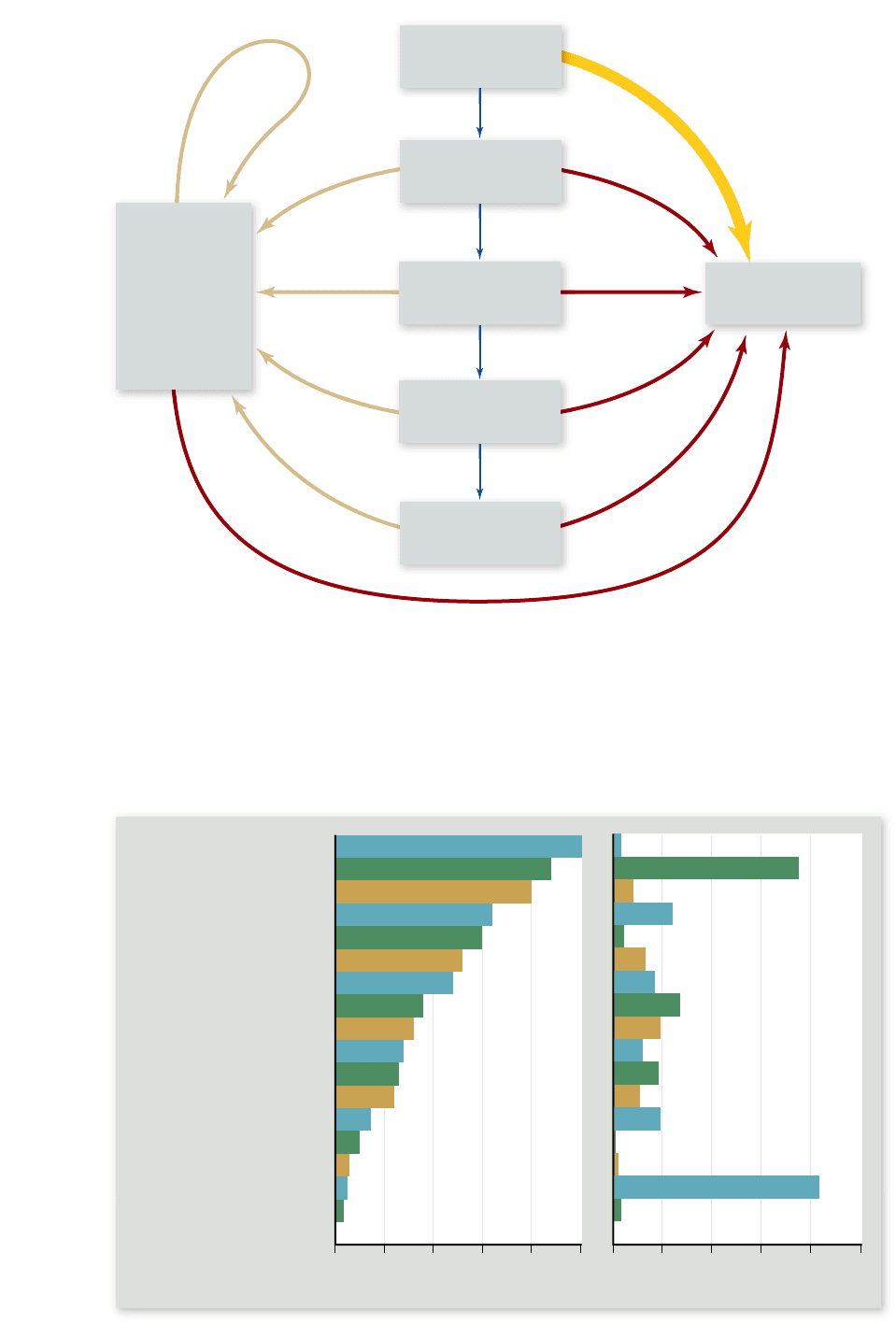
Figure 58.10
The ow of
energy through an ecosystem.
Blue arrows represent the ow of
energy that enters the ecosystem as
light and is then passed along as
chemical-bond energy to successive
trophic levels. At each step energy
is diverted, meaning that the
chemical-bond energy available to
each trophic level is less than that
available to the preceding trophic
level. Red arrows represent
diversions of energy into heat. Tan
arrows represent diversions of
energy into feces and other organic
materials useful only to the
detritivores. Detritivores may be
eaten by carnivores, so some of the
chemical-bond energy returns to
higher trophic levels.
Figure 58.11
Ecosystem
productivity per year. The
rst column of data shows the
average net primary productivity
(NPP) per square meter per year.
The second column of data
factors in the area covered by the
ecosystem type; it is the product
of the productivity per square
meter per year times the number
of square meters occupied by the
ecosystem type worldwide. Note
that an ecosystem type that is
very productive on a square-
meter basis may not contribute
much to global productivity if it
is an uncommon type, such as
wetlands. On the other hand, a
very widespread ecosystem type,
such as the open ocean, can
contribute greatly to global
productivity even if its
productivity per square meter
is low.
Source: Data in: Begon, M., J.L. Harper, and C. R. Townsend, Ecology 3/e, Blackwell Science, 1996, page 715. Original source: Whittaker, R. H. Communities and Ecosystems, 2/e, Macmillan,
London, 1975.
The number of trophic levels is
limited by energy availability
The rate at which chemical-bond energy is made available to
organisms in different trophic levels decreases exponentially as
energy makes its way from primary producers to herbivores and
then to various levels of carnivores. To envision this critical
point, assume for simplicity that the primary producers in an
ecosystem gain 1000 units of chemical-bond energy over a pe-
riod of time. If the energy input to each trophic level is 10% of
the input to the preceding level, then the input of chemical-
bond energy to the herbivore trophic level is 100 units, to the
chapter
58
Dynamics of Ecosystems
1217www.ravenbiology.com
rav32223_ch58_1207-1229.indd 1217rav32223_ch58_1207-1229.indd 1217 11/20/09 2:22:30 PM11/20/09 2:22:30 PM
Apago PDF Enhancer
Primary producers
(algae and cyanobacteria)
Herbivores
(animal plankton)
Smelt
Human
Trout
1.2 calories 6 calories
30 calories
150 calories
1000 calories
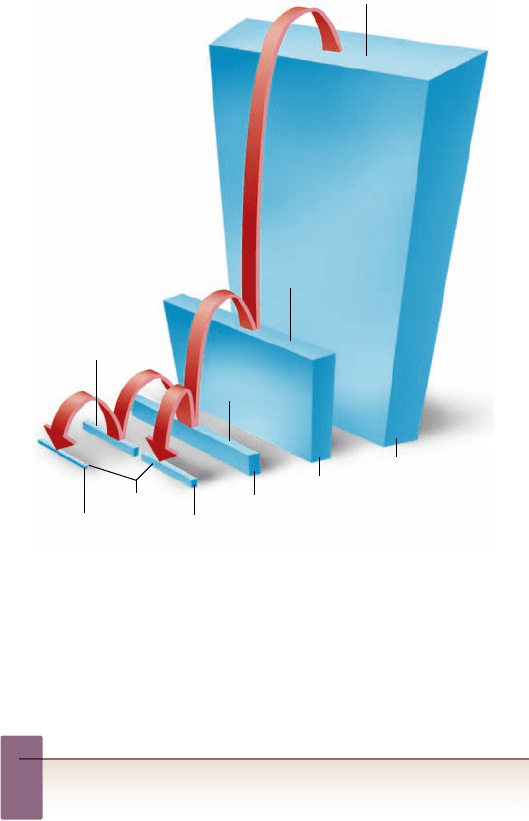
Figure 58.12
Flow of energy through the trophic levels
of Cayuga Lake. Autotrophic plankton (algae and cyanobacteria)
x the energy of the Sun, the herbivores (animal plankton) feed on
them, and both are consumed by smelt. The smelt are eaten by
trout. The amount of sh esh produced per unit time for human
consumption is at least ve times greater if people eat smelt rather
than trout, but people typically prefer to eat trout.
Inquiry question
?
Why does it take so many calories of algae to support so few
calories of humans?
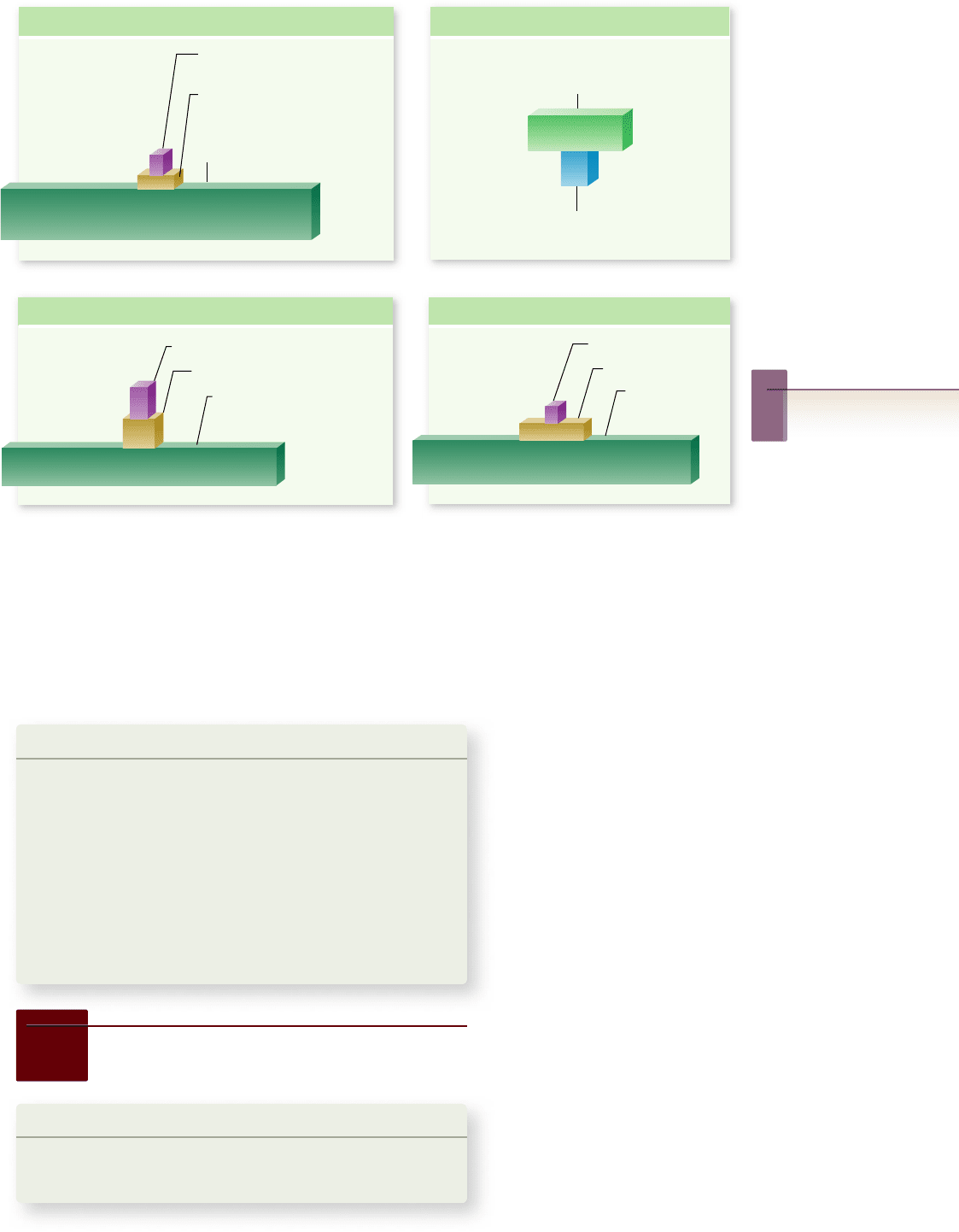
In a pyramid of biomass, the widths of the boxes are
drawn to be proportional to standing crop biomass. Usually,
trophic levels that have relatively low productivity also have
relatively little biomass present at a given time. Thus, pyramids
of biomass are usually upright, meaning each box is narrower
than the one below it (figure 58.13b). An upright pyramid of
biomass is not mandated by fundamental and inviolable rules
like an upright pyramid of productivity is, however. In some
ecosystems, the pyramid of biomass is inverted, meaning that
at least one trophic level has greater biomass than the one be-
low it (figure 58.13c).
How is it possible for the pyramid of biomass to be in-
verted? Consider a common sort of aquatic system in which the
primary producers are single-celled algae (phytoplankton), and
the herbivores are rice grain-sized animals (such as copepods)
that feed directly on the algal cells. In such a system, the turn-
over of the algal cells is often very rapid: The cells multiply
rapidly, but the animals consume them equally rapidly. In these
circumstances, the algal cells never develop a large population
size or large biomass. Nonetheless, because the algal cells
are very productive, the ecosystem can support a substantial
primary carnivores, 10 units, and to the secondary carnivores,
1 unit over the same period of time.
Limits on top carnivores
The exponential decline of chemical-bond energy in a trophic
chain limits the lengths of trophic chains and the numbers of
top carnivores an ecosystem can support. According to our
model calculations, if an ecosystem includes secondary carni-
vores, only about one-thousandth of the energy captured by
photosynthesis passes all the way through the series of trophic
levels to reach these animals as usable chemical-bond energy.
Tertiary carnivores would receive only one ten-thousandth. This
helps explain why no predators subsist solely on eagles or lions.
The decline of available chemical-bond energy also helps
explain why the numbers of individual top-level carnivores in an
ecosystem tend to be low. The whole trophic level of top carni-
vores receives relatively little energy, and yet such carnivores
tend to be big: They have relatively large individual body sizes
and great individual energy needs. Because of these two factors,
the population numbers of top predators tend to be small.
The longest trophic chains probably occur in the oceans.
Some tunas and other top-level ocean predators probably func-
tion as third- and fourth-level carnivores at times. The chal-
lenge of explaining such long trophic chains is obvious, but the
solutions are not well understood presently.
Humans as consumers: A case study
The flow of energy in Cayuga Lake in upstate New York
(figure 58.12) helps illustrate how the energetics of trophic levels
can affect the human food supply. Researchers calculated from the
actual properties of this ecosystem that about 150 of each 1000
calories of chemical-bond energy captured by primary producers
in the lake were transferred into the bodies of herbivores. Of these
calories, about 30 were transferred into the bodies of smelt, small
fish that were the principal primary carnivores in the system.
If humans ate the smelt, they gained about 6 of the 1000
calories that originally entered the system. If trout ate the smelt
and humans ate the trout, the humans gained only about
1.2 calories. For human populations in general, more energy is
available if plants or other primary producers are eaten than if
animals are eaten—and more energy is available if herbivores
rather than carnivores are consumed.
Ecological pyramids illustrate
the relationship of trophic levels
Imagine that the trophic levels of an ecosystem are repre-
sented as boxes stacked on top of each other. Imagine also that
the width of each box is proportional to the productivity of
the trophic level it represents. The stack of boxes will always
have the shape of a pyramid; each box is narrower than the
one under it because of the inviolable rules of energy flow. A
diagram of this sort is called a pyramid of energy flow or pyra-
mid of productivity (figure 58.13a). It is an example of an eco-
logical pyramid.
There are several types of ecological pyramids. Pyramid
diagrams can be used to represent standing crop biomass or
numbers of individuals, as well as productivity.
1218
part
VIII
Ecology and Behavior
rav32223_ch58_1207-1229.indd 1218rav32223_ch58_1207-1229.indd 1218 11/20/09 2:22:30 PM11/20/09 2:22:30 PM
Apago PDF Enhancer
b.
Photosynthetic plankton
(36,380 kcal/m
2
/year)
4,000,000,000
11
1
Carnivore
Herbivore
First-level carnivore
(48 kcal/m
2
/year)
Herbivore
(596 kcal/m
2
/year)
a.
Pyramid of Energy Flow (Productivity)
Pyramid of Biomass
Inverted Pyramid of Biomass
Pyramid of Numbers
Photosynthetic plankton
(807 g/m
2
)
Herbivore (37 g/m
2
)
First-level carnivore (11 g/m
2
)
Phytoplankton
(4 g/m
2
)
Herbivorous zooplankton and
bottom fauna (21 g/m
2
)
c.
d.
Photosynthetic
plankton
biomass of the animals, a biomass larger than that ever observed
in the algal population.
In a pyramid of numbers, the widths of the boxes are pro-
portional to the numbers of individuals present in the various
trophic levels (figure 58.13d). Such pyramids are usually, but
not always, upright.
Learning Outcomes Review 58.2
Trophic levels in an ecosystem include primary producers, herbivores,
primary carnivores, and secondary carnivores. Detritivores consume dead
or waste matter from all levels. As energy passes from one level to another,
some is inevitably lost as heat, which cannot be reclaimed. Photosynthetic
primary producers capture about 1% of solar energy as chemical-bond
energy. As this energy is passed through the other trophic levels, some is
diverted at each step into heat, feces, and dead matter; only about 10% is
available to the next level.
■ Describe the different ways that matter, such as carbon
atoms, and energy move through ecosystems?
Learning Outcomes
Explain the meaning of trophic cascade.1.
Distinguish between top-down and bottom-up effects.2.
58.3
Trophic-Level Interactions
Figure 58.13
Ecological
pyramids. In an ecological
pyramid, successive trophic
levels in an ecosystem are
represented as stacked boxes,
and the widths of the boxes
represent the magnitude of an
ecological property in the
various trophic levels.
Ecological pyramids can
represent several different
properties. a. Pyramid of
energy ow (productivity).
b. Pyramid of biomass of the
ordinary type. c. Inverted
pyramid of biomass.
d. Pyramid of numbers.
Inquiry question
?
How can the existence
of inverted pyramids of
biomass be explained?
The existence of food chains creates the possibility that species
in any one trophic level may have effects on more than one
trophic level. Primary carnivores, for example, may have effects
not only on the animals they eat, but also, indirectly, on the
plants or algae eaten by their prey. Conversely, increases in pri-
mary productivity may provide more food not just to herbi-
vores, but also, indirectly, to carnivores.
The process by which effects exerted at an upper trophic
level flow down to influence two or more lower levels is termed
a trophic cascade. The effects themselves are called top-down
effects. When an effect flows up through a trophic chain, such
as from primary producers to higher trophic levels, it is termed
a bottom-up effect.
Top-down e ects occur when changes in the
top trophic level a ect primary producers
The existence of top-down effects has been confirmed by
controlled experiments in some types of ecosystems, particu-
larly freshwater ones. For example, in one study, sections of a
stream were enclosed with a mesh that prevented fish from
entering. Brown trout—predators on invertebrates—were
added to some enclosures but not others. After 10 days, the
numbers of invertebrates in the enclosures with trout were
only two-thirds as great as the numbers in the no-fish enclo-
sures (figure 58.14). In turn, the biomass of algae, which the
invertebrates ate, was five times greater in the trout enclo-
sures than the no-fish ones.
The logic of the trophic cascade just described leads to
the expectation that if secondary carnivores are added to
chapter
58
Dynamics of Ecosystems
1219www.ravenbiology.com
rav32223_ch58_1207-1229.indd 1219rav32223_ch58_1207-1229.indd 1219 11/20/09 2:22:31 PM11/20/09 2:22:31 PM
Apago PDF Enhancer
No fish TroutNo fish Trout
Invertebrates (number/m
2
)
Algae (μg chlorophyll a/cm
2
)
5000
4000
3000
2000
1000
0
2.0
1.5
1.0
0.5
0
Herbivorous
insects
Algae
Carnivorous
damselfly
nymphs
Herbivorous
insects
Algae
Carnivorous
damselfly
nymphs
Population Size
High
Low
Population Size
High
Low
No Fish Fish
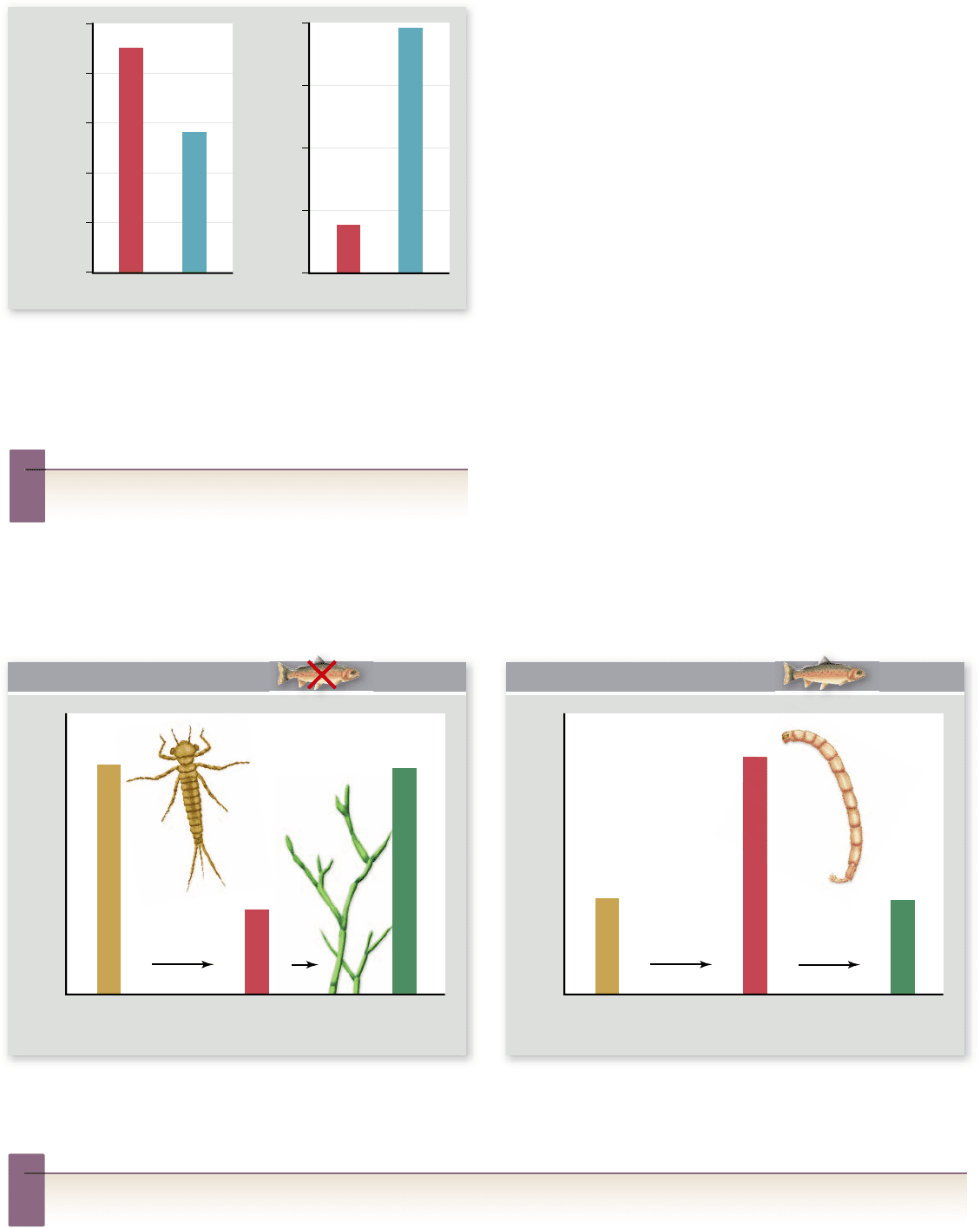
Figure 58.14
Top-down e ects demonstrated by
experiment in a simple trophic cascade. In a New Zealand
stream, enclosures with trout had fewer herbivorous invertebrates
(see the left-hand panel) and more algae (see the right-hand panel)
than ones without trout.
Inquiry question
?
Why do streams with trout have more algae?
Figure 58.15
Top-down e ects demonstrated by an experiment in a four-level trophic cascade. Stream enclosures with
large, carnivorous sh (on right) have fewer primary carnivores, such as damsel y nymphs, more herbivorous insects (exempli ed here by the
number of chironomids, a type of aquatic insect), and lower levels of algae.
Inquiry question
?
What might be the effect if snakes that prey on fish were added to the enclosures?
In an experiment similar to the one just described, enclo-
sures were created in free-flowing streams in northern Califor-
nia. In these streams, the principal primary carnivores were
damselfly larvae (termed nymphs). Fish that preyed on the
nymphs and on other primary carnivores were added to some
enclosures but not others. In the enclosures with fish, the num-
bers of damselfly nymphs were reduced, leading to higher
numbers of their prey, including herbivorous insects, which led
in turn to a decreased biomass of algae (figure 58.15).
Trophic cascades in large-scale ecosystems are not as easy
to verify by experiment as ones in stream enclosures, and the
workings of such cascades are not thoroughly known. None-
theless, certain cascades in large-scale ecosystems are recog-
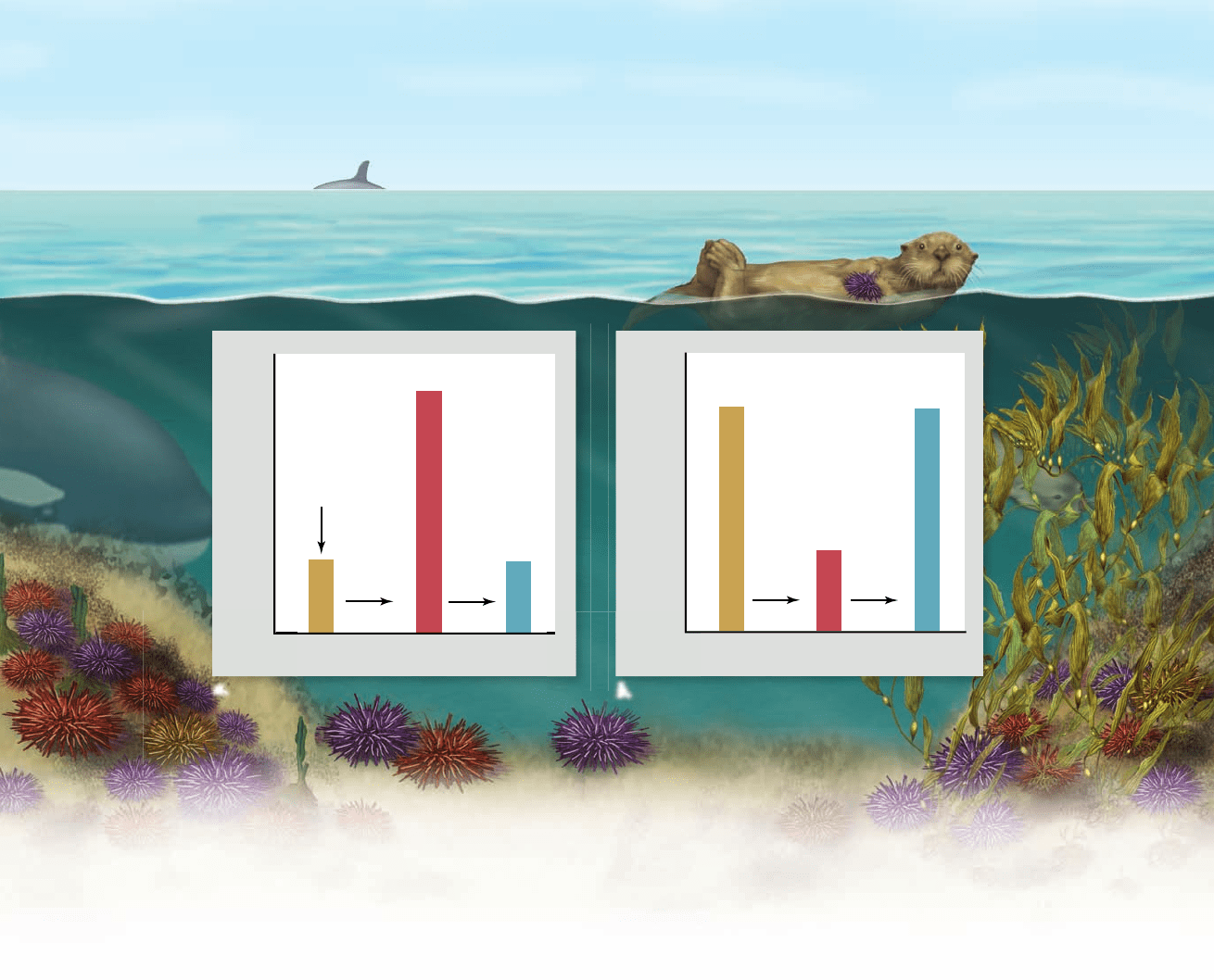
nized by most ecologists. One of the most dramatic involves sea
otters, sea urchins, and kelp forests along the West Coast of
North America (figure 58.16).
The otters eat the urchins, and the urchins eat young
kelps, inhibiting the development of kelp forests. When the ot-
ters are abundant, the kelp forests are well developed because
there are relatively few urchins in the system. But when the ot-
ters are sparse, the urchins are numerous and impair develop-
ment of the kelp forests. Orcas (killer whales) also enter the
picture because in recent years they have started to prey inten-
sively on the otters, driving otter populations down.
Human removal of carnivores
produces top-down e ects
Human activities are believed to have had top-down effects in a
number of ecosystems, usually by the removal of top-level
enclosures, they would also cause cascading effects. The sec-
ondary carnivores would be predicted to keep populations of
primary carnivores in check, which would lead to a profusion of
herbivores and a scarcity of primary producers.
1220
part
VIII
Ecology and Behavior
rav32223_ch58_1207-1229.indd 1220rav32223_ch58_1207-1229.indd 1220 11/20/09 2:22:32 PM11/20/09 2:22:32 PM
Apago PDF Enhancer
Population Size
High
Low
Sea Otters Sea Urchins Kelp
Orca
predation
drives
sea otter
population
down
a.
b.
Sea Otters Sea Urchins Kelp
Population Size
High
Low
Figure 58.16
A trophic cascade in a large-scale ecosystem. Along the West Coast of North America, the sea otter/sea urchin/kelp
system exists in two states: In the state shown in panel a, low populations of sea otters permit high populations of urchins, which suppress kelp
populations; in the state shown in panel b, high populations of otters keep urchins in check, permitting profuse kelp growth. According to a
recent hypothesis, a switch of orcas to preying on otters rather than other mammals is leading the ecosystem today to be mostly in the state
represented on the left.
carnivores. The great naturalist Aldo Leopold posited such ef-
fects long before the trophic cascade hypothesis had been sci-
entifically articulated when he wrote in Sand County Almanac:
“I have lived to see state after state extirpate its wolves. I
have watched the face of many a new wolfless mountain, and
seen the south-facing slopes wrinkle with a maze of new deer
trails. I have seen every edible bush and seedling browsed, first
to anemic desuetude, and then to death. I have seen every edible
tree defoliated to the height of a saddle horn.”
Many similar examples exist in which the removal of
predators has led to cascading effects on lower trophic levels.
Large predators such as jaguars and mountain lions are absent
on Barro Colorado Island, a hilltop turned into an island by the
construction of the Panama Canal at the beginning of the last
century. As a result, smaller predators whose populations are
normally held in check—including monkeys, peccaries (a rela-
tive of the pig), coatimundis, and armadillos—have become ex-
traordinarily abundant. These animals eat almost anything they
find. Ground-nesting birds are particularly vulnerable, and
many species have declined; at least 15 bird species have van-
ished from the island entirely.
Similarly, in the world’s oceans, large predatory fish such
as billfish and cod have been reduced by overfishing to an aver-
age of 10% of their previous numbers in virtually all parts of
the world’s oceans. In some regions, the prey of cod—such as
certain shrimp and crabs—have become many times more
abundant than they were before, and further cascading effects
are evident at still lower trophic levels.
Bottom-up e ects occur when changes to
primary producers a ect higher trophic levels
In predicting bottom-up effects, ecologists must take account
of the life histories of the organisms present. A model of
bottom-up effects thought to apply to a number of types of
ecosystems is diagrammed in figure 58.17.
chapter
58
Dynamics of Ecosystems
1221www.ravenbiology.com
rav32223_ch58_1207-1229.indd 1221rav32223_ch58_1207-1229.indd 1221 11/20/09 2:22:37 PM11/20/09 2:22:37 PM