
Raven P.H., Johnson G.B., Mason K.A. Biology (Ninth Edition)
Подождите немного. Документ загружается.

Apago PDF Enhancer
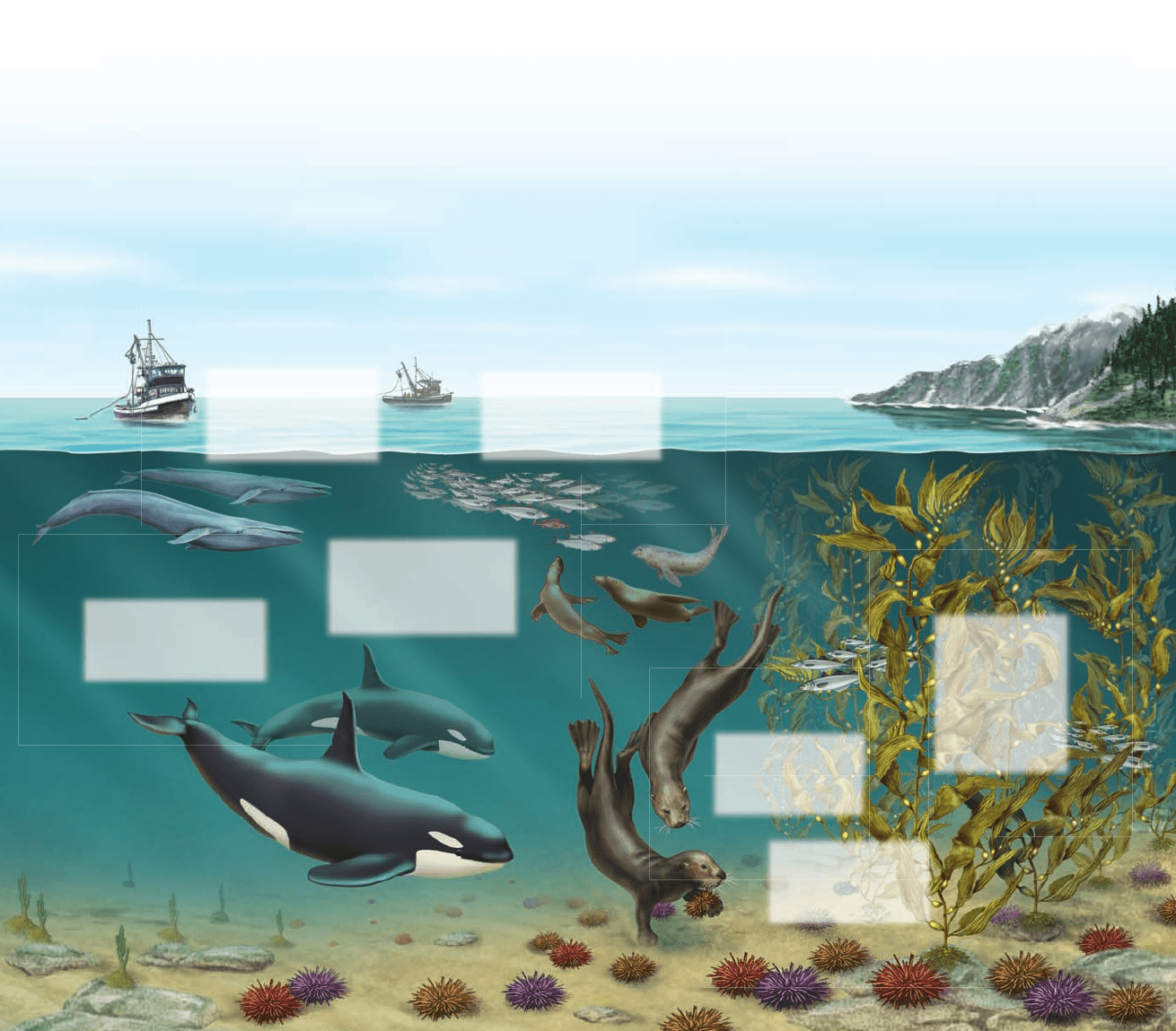
2. Nutritious fish
Populations of nutritious fish
like ocean perch and herring
declined, likely due to
competition with pollock.
3. Sea lions and harbor seals
Sea lion and harbor seal
populations drastically declined
in Alaska, probably because
the less-nutritious pollock could
not sustain them.
7. Kelp forests
Severely thinned by
the sea urchins, the
kelp beds no longer
support a diversity of
fish species, which
may lead to a decline
in populations of
eagles that feed on
the fish.
1. Whales
Overharvesting of
plankton-eating whales may
have caused an increase in
plankton-eating pollock
populations.
4. Killer whales
With the decline in their prey
populations of sea lions and
seals, killer whales turned to a
new source of food: sea otters.
5. Sea otters
Sea otter populations
declined so dramatically
that they disappeared in
some areas.
6. Sea urchins
Usually the preferred food
of sea otters, sea urchin
populations now exploded
and fed on kelp.
Figure 60.19
Disruption of the kelp forest ecosystem.
Overharvesting by commercial whalers altered the balance of sh in the
ocean ecosystem, inducing killer whales to feed on sea otters, a keystone species of the kelp forest ecosystem.
Loss of keystone species
As discussed in chapter 57, a keystone species is a species that
exerts a greater influence on the structure and functioning of
an ecosystem than might be expected solely on the basis of its
abundance. The sea otters of figure 60.19 are a keystone species
of the kelp forest ecosystem, and their removal can have disas-
trous consequences.
No hard-and-fast line allows us to clearly identify key-
stone species. Rather, it is a qualitative concept, a statement that
indicates a species plays a particularly important role in its com-
munity. Keystone species are usually characterized by the
strength of their effect on their community.
Case study: Flying foxes
The severe decline of many species of “flying foxes,” a type of
bat (figure 60.20) , in the Old World tropics is an example of
how the loss of a keystone species can dramatically affect the
other species living within an ecosystem, sometimes even lead-
ing to a cascade of further extinctions.
These bats have very close relationships with important
plant species on the islands of the Pacific and Indian Oceans. The
family Pteropodidae contains nearly 200 species, approximately
one-quarter of them in the genus Pteropus, and is widespread on
the islands of the South Pacific, where they are the most important—
and often the only—pollinators and seed dispersers.
described earlier in this chapter. Without whales to keep their
numbers in check, ocean zooplankton thrived, leading in turn
to proliferation of a species of fish called pollock that feeds on
the abundant zooplankton. Given this ample food supply, the
pollock proved to compete very successfully with other north-
ern Pacific fish, such as herring and ocean perch, so that levels
of these other fish fell steeply in the 1970s.
Then the falling chain of dominoes began to accelerate.
The decline in the nutritious forage fish led to an ensuing crash
in Alaskan populations of sea lions and harbor seals, for which
pollock did not provide sufficient nourishment. This decline
may also have been hastened by orcas (also called killer whales)
switching from feeding on the less-available whales to feeding
on seals and sea lions; the numbers of these pinniped species
have fallen precipitously since the 1970s.
When pinniped numbers crashed, some orcas, faced with
a food shortage, turned to the next best thing: sea otters. In one
bay where the entrance from the sea was too narrow and shal-
low for orcas to enter, only 12% of the sea otters have disap-
peared, while in a similar bay that orcas could enter easily,
two-thirds of the otters disappeared in a year’s time.
Without otters to eat them, the population of sea urchins
exploded, eating the kelp and thus “deforesting” the kelp for-
ests and denuding the ecosystem (figure 60.19) . As a result, fish
species that live in the kelp forest, such as sculpins and green-
lings, are declining.
rav32223_ch60_1256-1280.indd 1272rav32223_ch60_1256-1280.indd 1272 11/20/09 3:08:48 PM11/20/09 3:08:48 PM
Apago PDF Enhancer
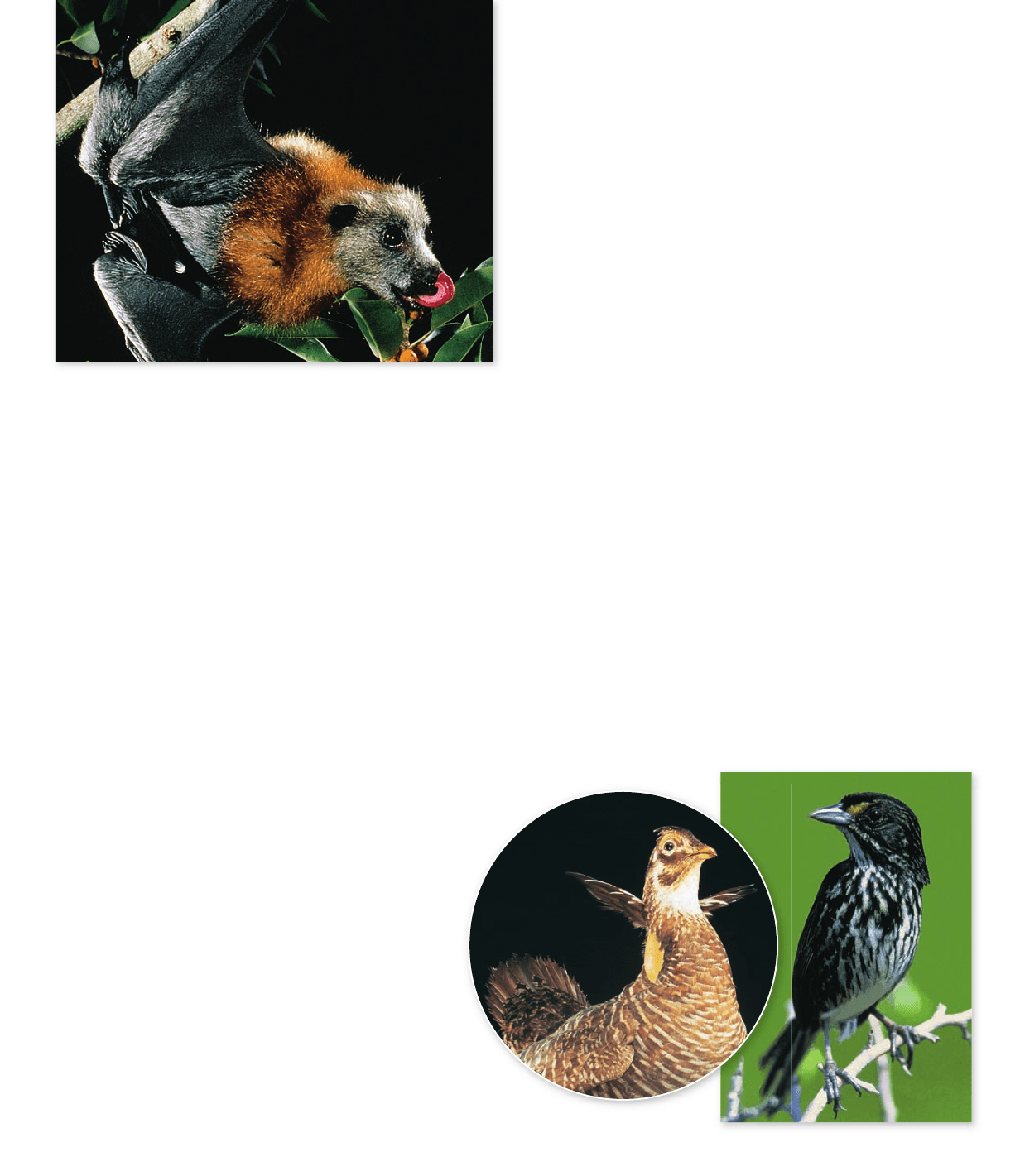
a.
b.
Figure 60.21
Alive no more.
a. A museum specimen of the
heath hen (Tympanuchus cupido cupido) which went extinct in 1932.
b. This male was one of the last dusky seaside sparrows
(Ammodramus maritimus nigrescens).
Figure 60.20
The importance of keystone species.
Flying foxes, a type of fruit-eating bat, are keystone species on
many Old World tropical islands. It pollinates many plants and is a
key disperser of seeds. Its elimination due to hunting and habitat
loss is having a devastating effect on the ecosystems of many South
Paci c Islands.
Small populations are particularly vulnerable
Because of the factors just discussed, populations of many spe-
cies are fragmented and reduced in size. Such populations are
particularly prone to extinction.
Demographic factors
Small populations are vulnerable to events that decrease survival
or reproduction. For example, by nature of their size, small pop-
ulations are ill-equipped to withstand catastrophes, such as a
flood, forest fire, or disease epidemic. One example is provided
by the history of the heath hen. Although the species was once
common throughout the eastern United States, hunting pres-
sure in the 18th and 19th centuries eventually eliminated all but
one population, on the island of Martha’s Vineyard near Cape
Cod, Massachusetts. Protected in a nature preserve, the popula-
tion was increasing in number until a fire destroyed most of the
preserve’s habitat. The small surviving population was then rav-
aged the next year by an unusual congregation of predatory
birds, followed shortly thereafter by a disease epidemic. The last
sighting of a heath hen, a male, was in 1932 (figure 60.21a) .
When populations become extremely small, bad luck
can spell the end. For example, the dusky seaside sparrow
(figure 60.21b), a now-extinct subspecies that was found on the
east coast of Florida, dwindled to a population of five individu-
als, all of which happened to be males. In a large population, the
probability that all individuals will be of one sex is infinitesimal.
But in small populations, just by the luck of the draw, it is pos-
sible that 5 or 10 or even 20 consecutive births will all be indi-
viduals of one sex, and that can be enough to send a species to
extinction. In addition, when populations are small, individuals
may have trouble finding each other (the Allee effect discussed
in chapter 56), thus leading the population into a downward
spiral toward extinction.
A study in Samoa found that 80% to 100% of the seeds
landing on the ground during the dry season were deposited by
flying foxes, which eat the fruits and defecate the seeds, often
moving them great distances in the process. Many species are en-
tirely dependent on these bats for pollination. Some have evolved
features such as night-blooming flowers that prevent any other
potential pollinators from taking over the role of the fruit bats.
In Guam, the two local species of flying fox have recently
been driven extinct or nearly so, with a substantial impact on
the ecosystem. Botanists have found that some plant species are
not fruiting or are doing so only marginally, producing fewer
fruits than normal. Fruits are not being dispersed away from
parent plants, so seedlings are forced to compete, usually un-
successfully, with adult trees.
Flying foxes are being driven to extinction by human
hunters who kill them for food and for sport, and by orchard
farmers who consider them pests. Flying foxes are particu-
larly vulnerable because they live in large and obvious
groups of up to a million individuals. Because they move
in regular and predictable patterns and can be easily
tracked to their home roost, hunters can easily kill thou-
sands at a time.
Programs aimed at preserving particular species of
flying foxes are only just beginning. One particularly suc-
cessful example is the program to save the Rodrigues fruit
bat, Pteropus rodricensis, which occurs only on Rodrigues Is-
land in the Indian Ocean near Madagascar. The population
dropped from about 1000 individuals in 1955 to fewer than 100
by 1974, largely due to the loss of the fruit bat’s forest habitat to
farming. Since 1974, the species has been legally protected, and
the forest area of the island is being increased through a tree-
planting program. Eleven captive-breeding colonies have been
established, and the bat population is now increasing rapidly.
The combination of legal protection, habitat restoration, and
captive breeding has in this instance produced a very effective
preservation program.
chapter
60
Conservation Biology
1273www.ravenbiology.com
rav32223_ch60_1256-1280.indd 1273rav32223_ch60_1256-1280.indd 1273 11/20/09 3:08:56 PM11/20/09 3:08:56 PM
Apago PDF Enhancer
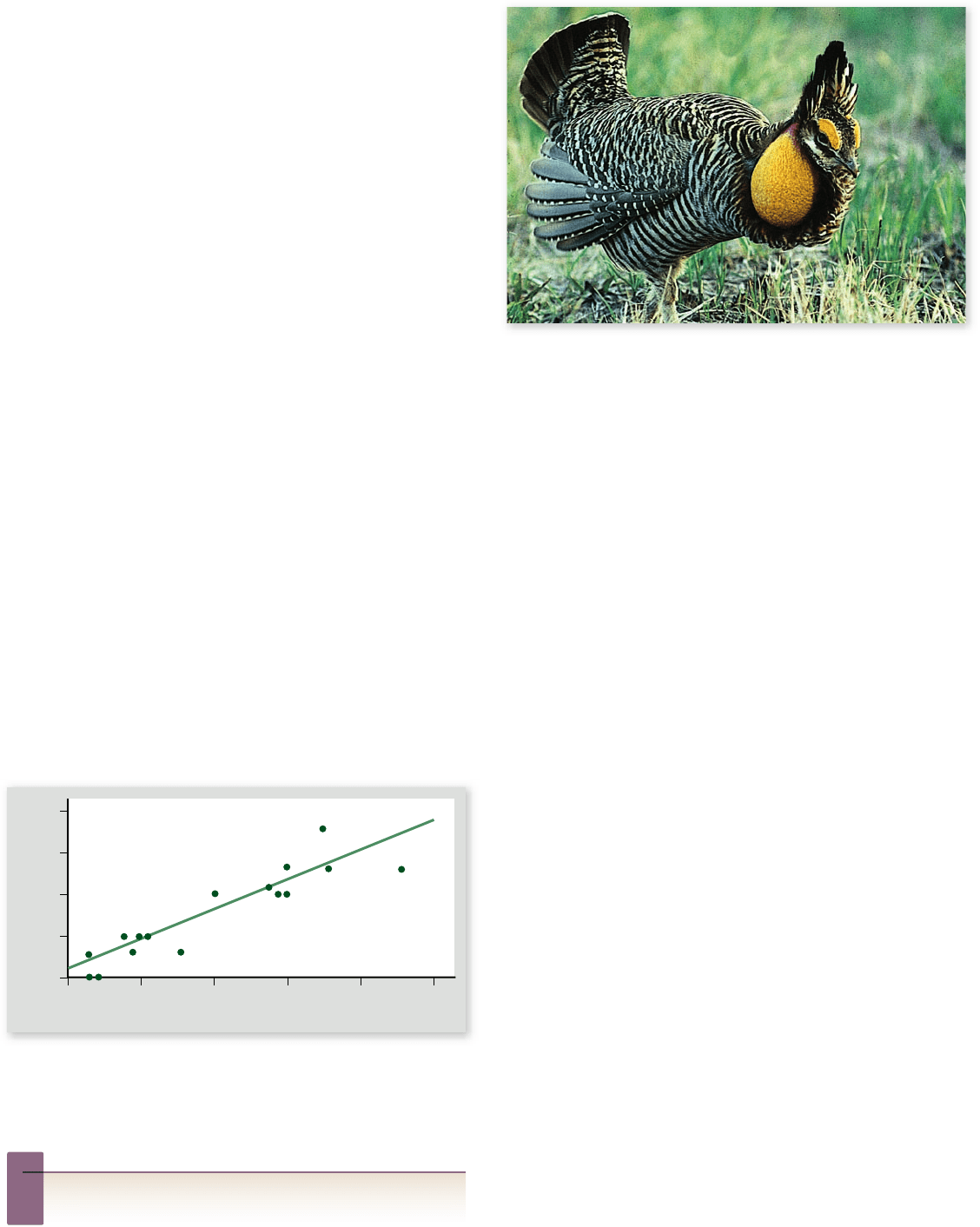
Polymorphism (%)
Population Size (log)
1 100 1,000 10,000 100,000 1,000,000
0
10
20
30
40
Figure 60.23
A mating ritual.
The male greater prairie
chicken (Tympanuchus cupido pinnatus) in ates bright orange air sacs,
part of his esophagus, into balloons on each side of his head. As air
is drawn into the sacs, it creates a three-syllable low frequency
“boom-boom-boom” that can be heard for kilometers.
Figure 60.22
Loss of genetic variability in small
populations.
The percentage of genes that are polymorphic in
isolated populations of the tree Halocarpus bidwillii in the mountains
of New Zealand is a sensitive function of population size.
Inquiry question
?
Why do small populations lose genetic variation?
Once, enormous numbers of birds occurred throughout the
state, but with the 1837 introduction of the steel plow, the first that
could slice through the deep, dense root systems of prairie grasses,
the Illinois prairie began to be replaced by farmland. By the turn
of the 20th century, the prairie had all but vanished, and by 1931,
the heath hen had become locally extinct in Illinois. The greater
prairie chicken fared little better, its numbers falling to 25,000
statewide in 1933 and then to 2000 by 1962. In surrounding states
with less intensive agriculture, it continued to prosper.
In 1962 and 1967, sanctuaries were established in Illinois to
attempt to preserve the greater prairie chicken. But privately owned
grasslands kept disappearing, along with their prairie chickens, and
by the 1980s the birds were extinct in Illinois except for two pre-
serves, and even there, their numbers kept falling. By 1990, the egg
hatching rate, which at one time had averaged between 91% and
100%, had dropped to an extremely low 38%. By the mid-1990s,
the count of males had dropped to as low as six in each sanctuary.
What was wrong with the sanctuary populations? One
suggestion was that because of very small population sizes and
a mating ritual whereby one male may dominate a flock, the
Illinois prairie chickens had lost so much genetic variability as
to create serious genetic problems. To test this idea, biologists
at the University of Illinois compared DNA from frozen tissue
samples of birds that had died in Illinois between 1974 and
1993, and found that in recent years Illinois birds had indeed
become genetically less diverse.
The researchers then extracted DNA from tissue in the
roots of feathers from stuffed birds collected in the 1930s from
the same population. They found that Illinois birds had lost
fully one-third of the genetic diversity of birds living in the
same place before the population collapse of the 1970s. By con-
trast, prairie chicken populations in other states still contained
much of the genetic variation that had disappeared from Illi-
nois populations.
Now the stage was set to halt the Illinois prairie chicken’s
race toward extinction in Illinois. Wildlife managers began to
Lack of genetic variability
Small populations face a second dilemma. Because of their low
numbers, such populations are prone to the loss of genetic variation
as a result of genetic drift (figure 60.22). Indeed, many small popu-
lations contain little or no genetic variability. The result of such
genetic homogeneity can be catastrophic. Genetic variation is ben-
eficial to a population both because of heterozygote advantage (see
chapter 20) and because genetically variable individuals tend not to
have two copies of deleterious recessive alleles. Populations lacking
variation are often composed of sickly, unfit, or sterile individuals.
Laboratory groups of rodents and fruit flies that are maintained at
small population sizes often perish after a few generations as each
generation becomes less robust and fertile than the preceding one.
Although it is difficult to demonstrate that a species has
gone extinct because of lack of genetic variation, studies of both
zoo and natural populations clearly reveal that more genetically
variable individuals have greater fitness. Furthermore, in the
longer term, populations with limited genetic variation have
diminished ability to adapt to changing environments.
Interaction of demographic and genetic factors
As populations decrease in size, demographic and genetic fac-
tors combine to cause what has been termed an “extinction vor-
tex.” That is, as a population gets smaller, it becomes more
vulnerable to demographic catastrophes. In turn, genetic varia-
tion starts to be lost, causing reproductive rates to decline and
population numbers to decline even further, and so on. Eventu-
ally, the population disappears entirely, but attributing its de-
mise to one particular factor would be misleading.
Case study: Prairie chickens
The greater prairie chicken, a close relative of the now-extinct
heath hen, is a showy, 2-lb bird renowned for its flamboyant
mating rituals (figure 60.23) . Abundant in many midwestern
states, the prairie chickens in Illinois have in the past six de-
cades undergone a population collapse.
1274
part
VIII
Ecology and Behavior
rav32223_ch60_1256-1280.indd 1274rav32223_ch60_1256-1280.indd 1274 11/20/09 3:09:04 PM11/20/09 3:09:04 PM
Apago PDF Enhancer
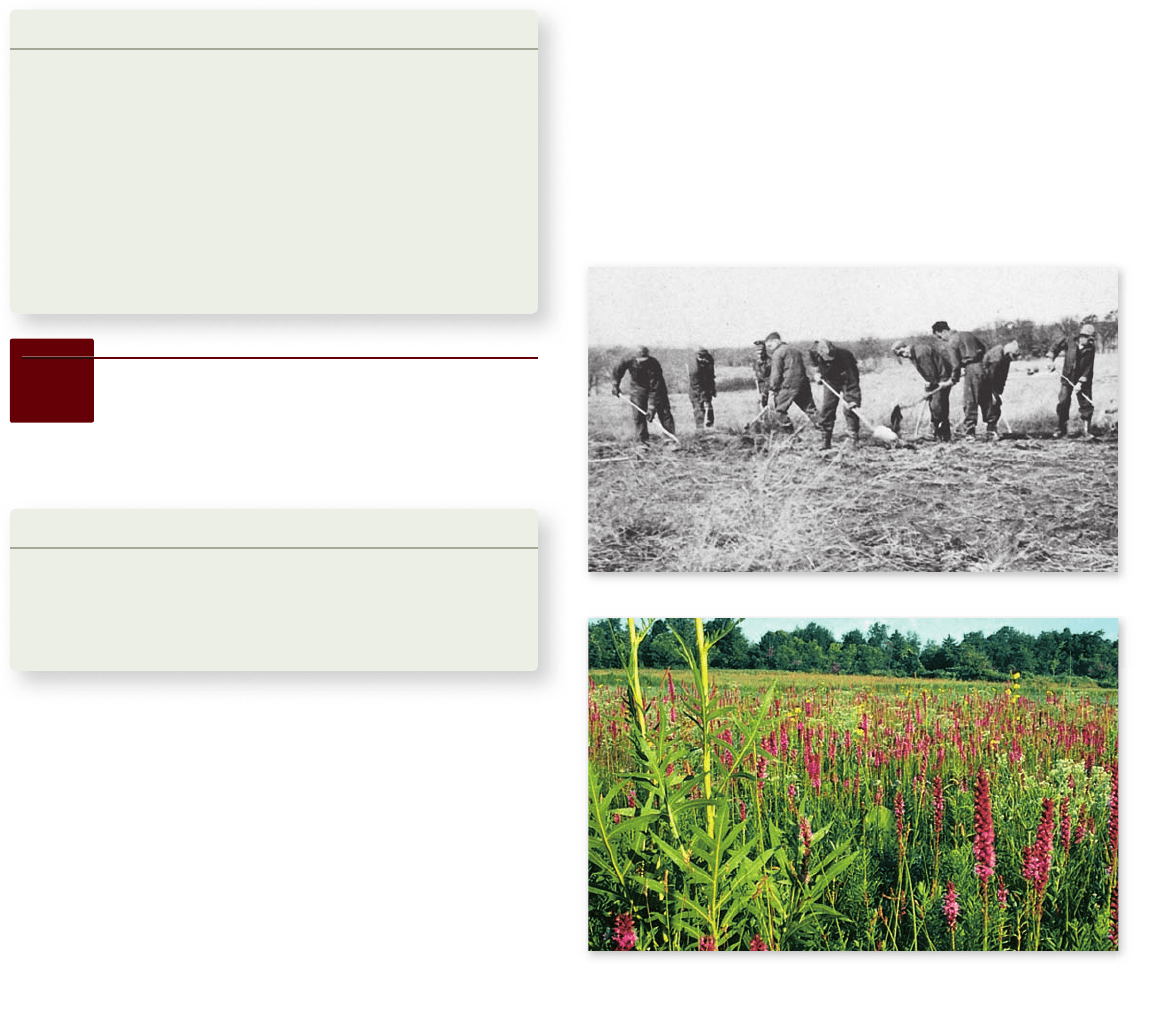
a.
b.
Figure 60.24
Habitat restoration. The University of
Wisconsin–Madison Arboretum has pioneered restoration ecology.
a. The restoration of the prairie was at an early stage in November
1935. b. The prairie as it looks today. This picture was taken at
approximately the same location as the 1935 photograph.
60.4
Approaches for Preserving
Endangered Species and
Ecosystems
Learning Outcomes
Distinguish between restoration of species and 1.
restoration of ecosystem functioning.
List the strategies for habitat restoration.2.
Explain the rationale for captive breeding programs.3.
Once the cause of a species’ endangerment is known, it be-
comes possible to design a recovery plan. If the cause is com-
mercial overharvesting, regulations can be issued to restrict
harvesting and protect the threatened species. If the cause is
habitat loss, plans can be instituted to restore the habitat. Loss
of genetic variability in isolated subpopulations can be coun-
tered by transplanting individuals from genetically different
populations. Populations in immediate danger of extinction can
be captured, introduced into a captive-breeding program, and
later reintroduced to other suitable habitat.
All of these solutions are extremely expensive. But as
Bruce Babbitt, Secretary of the Interior in the Clinton admin-
istration, noted, it is much more economical to prevent “envi-
ronmental trainwrecks” from occurring than to clean them up
afterward. Preserving ecosystems and monitoring species be-
fore they are threatened is the most effective means of protect-
ing the environment and preventing extinctions.
transplant birds from genetically diverse populations of Min-
nesota, Kansas, and Nebraska to Illinois. Between 1992 and
1996, a total of 518 out-of-state prairie chickens were brought
in to interbreed with the Illinois birds, and hatching rates were
back up to 94% by 1998. It looks as though the prairie chickens
have been saved from extinction in Illinois.
The key lesson here is the importance of not allowing things
to go too far—not to drop down to a single isolated population.
Without the outlying genetically different populations, the prairie
chickens in Illinois could not have been saved. When the last pop-
ulation of the dusky seaside sparrow lost its last female, there was
no other source of females, and the subspecies went extinct.
Learning Outcomes Review 60.3
Habitat factors responsible for extinction include habitat destruction,
pollution, disruption, and fragmentation. Overexploitation can reduce
populations to low levels or eliminate them entirely. Introduced species can
wreak havoc on native communities. Finally, small populations have less
ability to rebound from catastrophes and are vulnerable to loss of genetic
variation. Interaction of all these factors can hasten species’ decline
into extinction.
■ Does it make sense to take endangered species out of
the wild to preserve them if their habitat is allowed to
disappear? Explain.
Destroyed habitats can sometimes be restored
Conservation biology typically concerns itself with preserving
populations and species in danger of decline or extinction.
Conservation, however, requires that there be something left to
preserve; in many situations, conservation is no longer an op-
tion. Species, and in some cases whole communities, have dis-
appeared or been irretrievably modified. The clear-cutting of
the temperate forests of Washington State leaves little behind
to conserve, as does converting a piece of land into a wheat field
or an asphalt parking lot. Redeeming these situations requires
restoration rather than conservation.
Three quite different sorts of habitat restoration programs
might be undertaken, depending on the cause of the habitat loss.
Pristine restoration
In ecosystems where all species have been effectively removed,
conservationists might attempt to restore the plants and ani-
mals that are the natural inhabitants of the area, if these species
can be identified. When abandoned farmland is to be restored
to prairie, as in figure 60.24 , how would conservationists know
what to plant?
chapter
60
Conservation Biology
1275www.ravenbiology.com
rav32223_ch60_1256-1280.indd 1275rav32223_ch60_1256-1280.indd 1275 11/20/09 3:09:06 PM11/20/09 3:09:06 PM
Apago PDF Enhancer
1980
0
20
40
60
80
100
1982 1984
Year
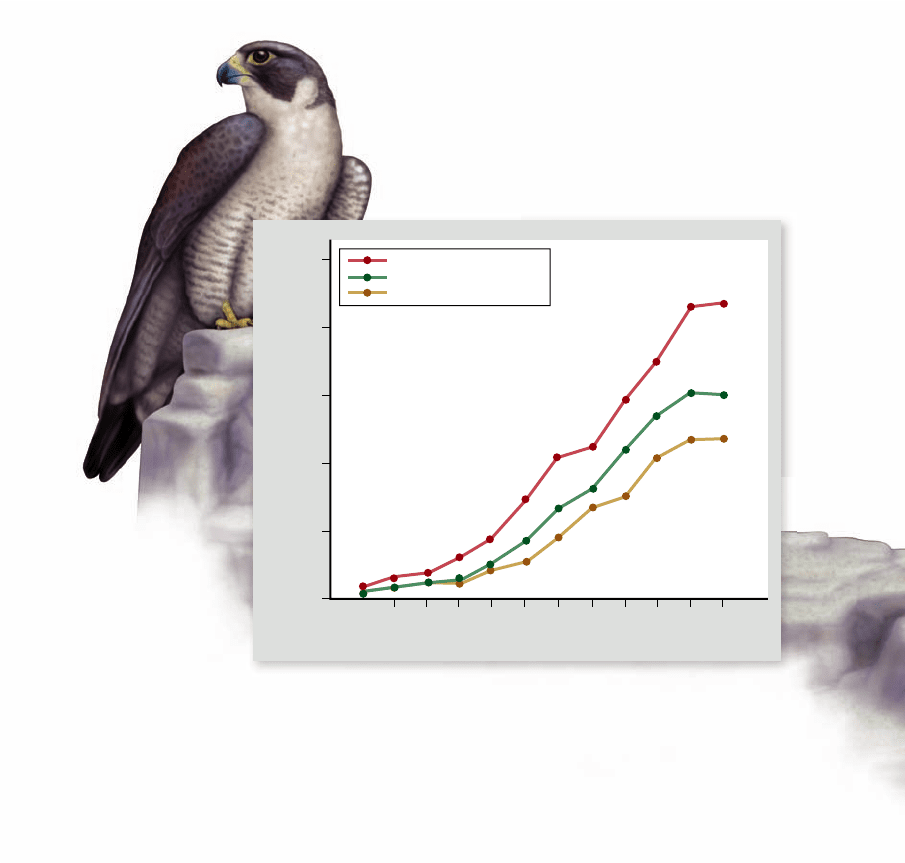
Number of Pairs of Peregrines
1986 1988 1990
pairs observed
pairs nesting
pairs producing offspring
Figure 60.25
Success of captive breeding.
The
peregrine falcon (Falco peregrinus) has been reestablished in the
eastern United States by releasing captive-bred birds over a period
of 10 years.
captive-breeding program at Cornell University in 1970,
with the intent of reestablishing the peregrine falcon in the
eastern United States by releasing offspring of these birds.
By the end of 1986, over 850 birds had been released in
13 eastern states, producing an astonishingly strong recov-
ery (figure 60.25).
Case study: The California condor
The number of California condors (Gymnogyps californianus), a
large, vulture-like bird with a wingspan of nearly 3 m, has been
declining gradually for the past 200 years. By 1985, condor
numbers had dropped so low that the bird was on the verge of
extinction. Six of the remaining 15 wild birds disappeared in
that year alone. The entire breeding population of the species
consisted of the birds remaining in the wild and an additional
21 birds in captivity.
In a last-ditch attempt to save the condor from extinction,
the remaining birds were captured and placed in a captive-
breeding population. The breeding program was set up in zoos,
with the goal of releasing offspring on a large, 5300-hectare
ranch in prime condor habitat. Birds were isolated from human
contact as much as possible, and closely related individuals were
prevented from breeding.
By early 2009, the captive population of California con-
dors had reached over 160 individuals. After extensive pre-
release training to avoid power poles and people, captive-reared
condors have been released successfully in California at two
sites in the mountains north of Los Angeles, as well
as at the Grand Canyon. Many of the released birds
are doing well, and the wild population now num-
bers nearly 200 birds. Biologists are particularly
Although it is in principle possible to reestablish each
of the original species in their original proportions, rebuild-
ing a community requires knowing the identities of all the
original inhabitants and the ecologies of each of the species.
We rarely have this much information, so no restoration is
ever truly pristine.
Increasingly, restoration biologists are working on restor-
ing the functioning of an ecosystem, rather than trying to rec-
reate the same community composition. This approach shifts
the focus from restoring species to reconstructing the processes
that operated in the natural habitat.
Removing introduced species
Sometimes the habitat has been destroyed by a single intro-
duced species. In such a case, habitat restoration involves re-
moving the introduced species. Restoration of the once-diverse
cichlid fishes to Lake Victoria will require more than breed-
ing and restocking the endangered species. The introduced
water hyacinth and Nile perch populations will have to be
brought under control or removed, and eutrophication will
have to be reversed.
It is important to act quickly if an introduced species is to
be removed. When aggressive African bees (the so-called “killer
bees”) were inadvertently released in Brazil, they remained
confined to the local area for only one season. Now they occupy
much of the western hemisphere.
Cleanup and rehabilitation
Habitats seriously degraded by chemical pollution cannot
be restored until the pollution is cleaned up. The success-
ful restoration of the Nashua River in New England is
one example of how a concerted effort can succeed in re-
storing a heavily polluted habitat to a relatively pris-
tine condition.
Once so heavily polluted by chemicals from dye
manufacturing plants that it was different colors in
different places, the river is now clean and used for
many recreational activities.
Captive breeding programs
have saved some species
Recovery programs, particularly those focused
on one or a few species, must sometimes in-
volve direct intervention in natural populations
to avoid an immediate threat of extinction.
Case study: The peregrine falcon
American populations of birds of prey, such as the peregrine
falcon, began an abrupt decline shortly after World War II. Of
the approximately 350 breeding pairs east of the Mississippi
River in 1942, all had disappeared by 1960. The culprit proved
to be the chemical pesticide DDT (Chapter 59).
The use of DDT was banned by federal law in 1972,
causing levels in the eastern United States to fall quickly.
However, no peregrine falcons were left in the eastern
United States to reestablish a natural population. Falcons
from other parts of the country were used to establish a
1276
part
VIII
Ecology and Behavior
rav32223_ch60_1256-1280.indd 1276rav32223_ch60_1256-1280.indd 1276 11/20/09 3:09:10 PM11/20/09 3:09:10 PM
Apago PDF Enhancer
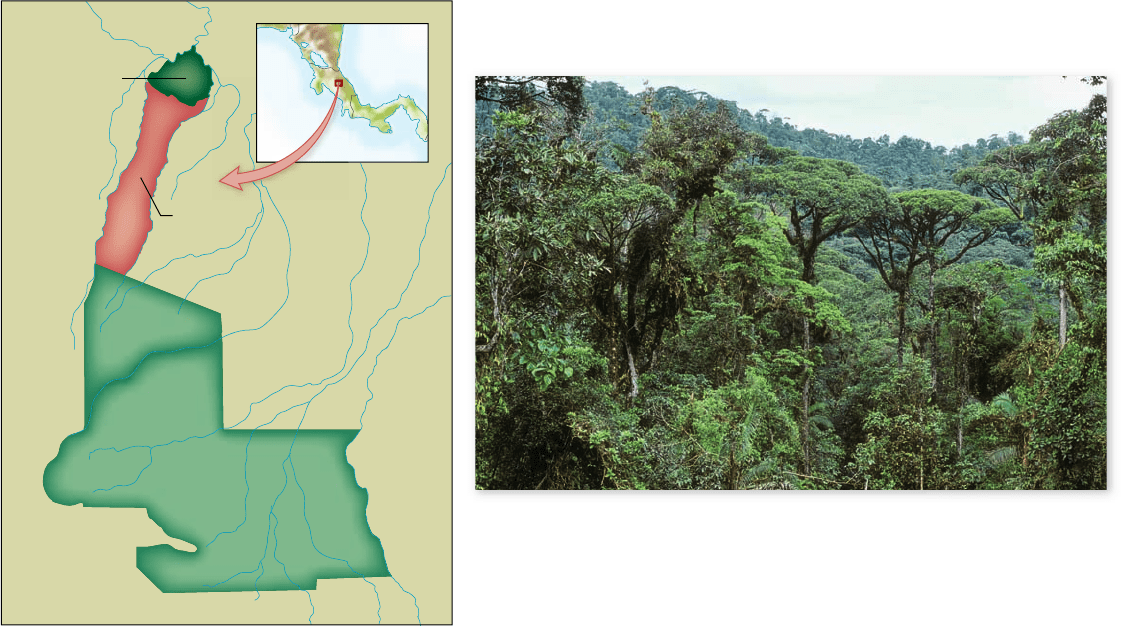
Braulio Carrillo
National Park
Forest
Reserve
La Selva
Biological Corridor
La Selva
Biological
Field Station
Costa
Rica
Figure 60.26
Corridor connecting two reserves.
a. The
Organization of Tropical Studies’ La Selva Biological Station in Costa Rica is
connected to Braulio Carrillo National Park. b. The corridor allows migration of
birds, mammals, butter ies, and other animals from La Selva at 35 m above sea
level to mountainous habitats up to 2900 m elevation.
excited by breeding activities that resulted in the first-ever
offspring produced in the wild by captive-reared parents in
both California and Arizona.
Case study: Yellowstone wolves
The ultimate goal of captive-breeding programs is not simply
to preserve interesting species, but rather to restore ecosystems
to a balanced, functional state. Yellowstone Park has been an
ecosystem out of balance, due in large part to the systematic
extermination of the gray wolf (Canis lupus) in the park early in
the 20th century. Without these predators to keep their num-
bers in check, herds of elk and deer expanded rapidly, damaging
vegetation so that the elk themselves starve in time of scarcity.
In an attempt to restore the park’s natural balance, two
complete wolf packs from Canada were released into the park
in 1995 and 1996. The wolves adapted well, breeding so suc-
cessfully that by 2002 the park contained 16 free-ranging packs
and more than 200 wolves.
Although ranchers near the park have been unhappy
about the return of the wolves, little damage to livestock has
been noted, and the ecological equilibrium of Yellowstone
Park seems well on the way to being regained. Elk are congre-
gating in larger herds and are avoiding areas near rivers where
they are vulnerable. As a result, riverside trees such as willows
are increasing in number, in turn providing food for beavers,
whose dams lead to the creation of ponds, a habitat type that
had become rare in Yellowstone. This newly restored habitat,
in turn, has led to increases in some species of birds such as
the redstart that had been in decline for decades or disap-
peared entirely.
Current conservation approaches
are multidimensional
Historically, conservationists strived to solve the problems of
habitat fragmentation by focusing solely on preserving as much
land as possible in a pristine state in national parks and reserves.
Increasingly, however, it has become apparent that the amount
of land that can be preserved in such a state is limited; more-
over, many areas that are not completely protected nonetheless
provide suitable habitat for many species.
As a result, conservation plans are becoming multidimen-
sional, including not only pristine areas, but also surrounding
areas in which some level of human disturbance is permitted.
As discussed previously, isolated patches of habitat lose species
far more rapidly than large preserves do. By including these
other, less pristine areas, the total amount of area available for
many species is increased.
The key to managing such large tracts of land successfully
over a long time is to operate them in a way compatible with
local land use. For example, although no economic activity is
allowed in the core pristine area, the remainder of the land may
be used for nondestructive harvesting of resources. Even areas
in which hunting of some species is allowed provide protection
for many other species.
Corridors of dispersal are also being provided that link the
pristine areas, thus effectively increasing population sizes and al-
lowing recolonization if a population disappears in one area due
to a catastrophe. Corridors can also provide protection to species
that move over great distances during the course of a year. Cor-
ridors in East Africa have protected the migration routes of ungu-
lates. In Costa Rica, a corridor linking the lowland rain forest at
the La Selva Biological Station to the montane rain forest in
Braulio Carrillo National Park permits the altitudinal migration
of many species of birds, mammals, and butterflies (figure 60.26).
chapter
60
Conservation Biology
1277www.ravenbiology.com
rav32223_ch60_1256-1280.indd 1277rav32223_ch60_1256-1280.indd 1277 11/20/09 3:09:11 PM11/20/09 3:09:11 PM

Apago PDF Enhancer
60.1 Overview of the Biodiversity Crisis
Prehistoric humans were responsible for local extinctions.
Shortly after humans arrived in North America after the last Ice Age,
at least 75% of large mammals became extinct. The same pattern has
been observed in other parts of the world.
Extinctions have continued in historical time.
The majority of historical extinctions have occurred within the last
150 years and on islands. The current mass extinction is the only
such event triggered by one species, Homo sapiens, and the only one
in which resources will not be widely available for evolutionary
recovery afterward.
Endemic species hotspots are especially threatened.
Endemic species are found in one restricted range and are thus
vulnerable to extinction. Hotspots are areas with many endemic
species; many hotspots are the site of large human population growth
and high rates of extinction.
60.2 The Value of Biodiversity
The direct economic value of biodiversity includes resources for
our survival.
Many products are obtained from different species and ecosystems,
including food, materials for clothing and shelter, and medicines.
Indirect economic value is derived from ecosystem services.
Intact ecosystems provide services such as maintaining water
quality, preserving soils and nutrients, moderating local climates,
and recycling nutrients. The value of intact ecosystems is often not
apparent until they are lost.
Ethical and aesthetic values are based on our conscience and
our consciousness.
Humans can and should make ethical decisions to protect the
esthetic, ecological, and economic values of ecosystems.
60.3 Factors Responsible for Extinction
Amphibians are on the decline: A case study.
Almost half of all amphibian species have experienced decreases in
population size. No single cause has been identi ed, which implies
that global environmental changes may be responsible.
Habitat loss devastates species richness.
Habitat may be destroyed, polluted, disrupted, or fragmented. As
habitats become more fragmented, the relative proportion of the
remaining habitat that occurs on the boundary or edge increases
rapidly, exposing species to parasites, nonnative invasive species, and
predators (see gure 60.11).
Overexploitation wipes out species quickly.
Hunting and harvesting of wild species pose a risk of extinction. The
collapse of the cod sheries of the North Atlantic and the decline of
whale species are only two of many examples.
Introduced species threaten native species and habitats.
Natural or accidental introductions of new species results in large
and often negative changes to a community because of lack of
checks and balances on introduced species’ growth in the form of
species interactions.
Disruption of ecosystems can cause an extinction cascade.
Extinction cascades may occur either top-down or bottom-up
through the trophic levels. Loss of a keystone species may increase
competition and greatly alter ecosystem structure and function.
Small populations are particularly vulnerable.
Catastrophes, lack of mates, and loss of genetic variability all make
reduced populations more likely to become extinct (see gure 60.22).
60.4 Approaches for Preserving Endangered
Species and Ecosystems
Destroyed habitats can sometimes be restored.
Restoration by removal of introduced species is very dif cult and is
most successful if done very soon after a new species is introduced.
Severely polluted or damaged habitats sometimes cannot be restored
to original conditions, but they may be restored to provide different
environmental services.
Captive breeding programs have saved some species.
Species may be bred in captivity and returned to the wild when
the factors that caused their endangerment are no longer a threat.
Preservation of habitat may be a key in successful reintroduction.
Current conservation approaches are multidimensional.
The best way to preserve biodiversity is to preserve intact ecosystems
rather than individual species. The key to management of large
tracts of land is to operate them in a way compatible with local
human needs.
Corridors of dispersal can link habitat fragments with one another
and with larger habitats, allowing for increased population size,
genetic exchange, and recolonization.
Chapter Review
In addition to this focus on maintaining large enough re-
serves, in recent years conservation biologists also have recog-
nized that the best way to preserve biodiversity is to focus on
preserving intact ecosystems, rather than particular species. For
this reason, attention in many cases is turning to identifying
those ecosystems most in need of preservation and devising the
means to protect not only the species within the ecosystem, but
the functioning of the ecosystem itself. This entails making
sure that reserves are not only large enough, but also that they
protect elements such as watersheds so that activities outside
the reserve won’t threaten the ecosystem within it.
Learning Outcomes Review 60.4
Restoration of species may prevent extinction, but only if restoration of
habitat or an entire ecosystem is also undertaken. Removal of introduced
species and cleanup of pollutants are primary strategies for habitat
restoration. In cases where extinction appears imminent, removal of
individuals from the wild and preservation in captive breeding programs
may be necessary while habitat is restored.
■ Can habitat restoration ever approach a pristine state?
Why or why not?
1278
part
VIII
Ecology and Behavior
rav32223_ch60_1256-1280.indd 1278rav32223_ch60_1256-1280.indd 1278 11/20/09 3:09:13 PM11/20/09 3:09:13 PM

Apago PDF Enhancer
UNDERSTAND
1. Conservation hotspots are best described as
a. areas with large numbers of endemic species, in many of
which species are disappearing rapidly.
b. areas where people are particularly active supporters
of biological diversity.
c. islands that are experiencing high rates of extinction.
d. areas where native species are being replaced with
introduced species.
2. The economic value of indirect ecosystem services
a. is unlikely to exceed the economic value derived from uses
after ecosystem conversion.
b. has never been carefully determined.
c. can greatly exceed the value derived after ecosystem
conversion.
d. is entirely aesthetic.
3. The amphibian decline is best described as
a. global disappearance of amphibian populations due
to the pervasiveness of local habitat destruction.
b. global shrinkage of amphibian populations due to global
climate change.
c. the unexplained disappearance of golden toads in Costa Rica.
d. None of the above
4. Habitat fragmentation can negatively affect populations by
a. restricting gene ow among areas that were
previously continuous.
b. increasing the relative amount of edge in suitable
habitat patches.
c. creating patches that are too small to support
a breeding population.
d. all of the above.
5. When populations are drastically reduced in size, genetic
diversity and heterozygosity
a. are likely to increase, enhancing the probability of extinction.
b. are likely to decrease, enhancing the probability of extinction.
c. are usually not factors that in uence the probability
of extinction.
d. automatically respond in a way that protects populations
from future changes.
6. A captive-breeding program followed by release to the wild
a. is very likely, all by itself, to save a species threatened
by extinction.
b. is only likely to succeed when genetic variation of wild
populations is very low.
c. may be successful when combined with proper regulations
and habitat restoration.
d. None of the above
APPLY
1. Historically, island species have tended to become extinct
faster than species living on a mainland. Which of the
following reasons can be used to explain this phenomenon?
a. Island species have often evolved in the absence
of predators and have no natural avoidance strategies.
b. Humans have introduced diseases and competitors
to islands, which negatively affect island populations.
c. Island populations are usually smaller than
mainland populations.
d. All of the above
2. Ninety-nine percent of all the species that ever existed have
gone extinct,
a. serving as evidence that current extinction rates are not
higher than normal.
b. but most of these losses have occurred in the last 400 years.
c. which argues that the world just had too many species.
d. None of the above
3. To effectively address the biodiversity crisis, the protection
of individual species
a. must be used in concert with a principle of ecosystem
management and restoration.
b. is a suf cient management approach that merely needs
to be expanded to more species.
c. has no role to play in addressing the biodiversity crisis.
d. usually con icts with the principle of ecosystem management.
4. The introduction of a non-native predator to an
ecosystem could cause extinction by
a. causing a top-down trophic cascade (see chapter 58).
b. outcompeting a native carnivore (see chapter 57).
c. transmitting parasites to which the native species are not
adapted.
d. all of the above.
SYNTHESIZE
1. If 99% of the species that ever existed are now extinct, why is there
such concern over the extinction rates over the last several centuries?
2. Ecosystem conversion always has a cost and a bene t. Usually
the bene t ows to a segment of society (a business or one
group of people, for instance), but the costs are borne by all of
society. That is what makes decisions about how and when to
convert ecosystems dif cult. However, is that a problem unique
to conversion of ecosystems in the way we understand it today
(for example, the conversion of the mangrove to a shrimp
farm)? Are there other examples we can look to for guidance in
how to make these decisions?
3. There is concern and evidence that amphibian populations are
declining worldwide as a consequence of factors acting globally.
Given that we know that species extinction is a natural process,
how do we determine if there is a global decline that is different
from normal species extinction?
4. Given what you learned in chapter 57 about interactions
between species and in chapter 58 about interactions among
trophic levels, how can the extinction of one species have far-
ranging effects on an ecosystem? Is it possible to predict which
species would be particularly likely to affect many other species
if they were to go extinct?
5. All populations become small before going extinct. Is small
population size really a cause of extinction, or just something
that happens as a result of other factors that cause extinction?
Review Questions
chapter
60
Conservation Biology
1279www.ravenbiology.com
rav32223_ch60_1256-1280.indd 1279rav32223_ch60_1256-1280.indd 1279 11/20/09 3:09:14 PM11/20/09 3:09:14 PM
Apago PDF Enhancer
This page intentionally left blank

Apago PDF Enhancer
Answer Key
CHAPTER 1
LEARNING OUTCOME QUESTIONS
1.1 No. The study of biology encompasses information/tools from chemistry,
physics, geology, literally all of the “natural sciences.”
1.2 A scienti c theory has been tested by experimentation. A(n) hypothesis is a
starting point to explain a body of observations. When predictions generated using
the hypothesis have been tested it gains the con dence associated with a theory.
A theory still cannot be “proved” however as new data can always force us to re-
evaluate a theory.
1.3 No. Natural selection explains the patterns of living organisms we see at
present, and allows us to work back in time, but it is not intended to explain how
life arose. This does not mean that we can never explain this, but merely that natu-
ral selection does not do this.
1.4 Viruses do not t well into our de nition of living systems. It is a matter of
controversy whether viruses should be considered “alive.” They lack the basic cel-
lular machinery, but they do have genetic information. Some theories for the origin
of cells view viruses as being a step from organic molecules to cell, but looking at
current organisms, they do not ful ll our de nition of life.
INQUIRY QUESTIONS
Page 10 Reducing the factor by which the geometric progression increases
(lowering the value of the exponent) reduces the difference between numbers of
people and amount of food production. It can be achieved by lowering family size
or delaying childbearing.
Page 11 A snake would fall somewhere near the bird, as birds and snakes are
closely related.
UNDERSTAND
1. b 2. c 3. a 4. b 5. d 6. b 7. c 8. c
APPLY
1. d 2. d 3. c 4. d 5. d 6. d 7. a
SYNTHESIZE
1. For something to be considered living it would demonstrate organization,
possibly including a cellular structure. The organism would gain and use
energy to maintain homeostasis, respond to its environment, and to grow and
reproduce. These latter properties would be dif cult to determine if the
evidence of life from other planets comes from fossils. Similarly, the ability of
an alien organism to evolve could be dif cult to establish.
2. a. The variables that were held the same between the two experiments
include the broth, the ask, and the sterilization step.
b. The shape of the ask in uences the experiment because any cells present
in the air can enter the ask with the broken neck, but they are trapped in
the neck of the other ask.
c. If cells can arise spontaneously, then cell growth will occur in both asks.
If cells can only arise from preexisting cells (cells in the air), then only the
ask with the broken neck will grow cells. Breaking the neck exposes the
broth to a source of cells.
d. If the sterilization step did not actually remove all cells, then growth would
have occurred in both asks. This result would seem to support the
hypothesis that life can arise spontaneously.
CHAPTER 2
LEARNING OUTCOME QUESTIONS
2.1 If the number of proton exceeds neutrons, there is no effect on charge; if the
number of protons exceeds electrons, then the charge is (+).
2.2 Atoms are reactive when their outer electron shell is not lled with electrons.
The noble gases have lled outer electrons shells, and are thus unreactive.
2.3 An ionic bond results when there is a transfer of electrons resulting in posi-
tive and negative ions that are attracted to each other. A covalent bond is the result
of two atoms sharing electrons. Polar covalent bonds involve unequal sharing of
electrons. This produces regions of partial charge, but not ions.
2.4 C and H have about the same electronegativity, and thus form nonpolar
covalent bonds. This would not result in a cohesive or adhesive uid.
2.5 Since ice oats, a lake will freeze from the top down, not the bottom up. This
means that water remains uid on the bottom of the lake allowing living things to
overwinter.
2.6 Since pH is a log scale, this would be a change of 100 fold in [H
+
].
INQUIRY QUESTION
Page 30 The buffer works over a broad range because it ionizes more completely
as pH increases; in essence, there is more acid to neutralize the greater amount of
base you are adding. At pH4 none of the buffer is ionized. Thus below that pH,
base raises the pH without the ameliorating effects of the ionization of the buffer.
UNDERSTAND
1. b 2. d 3. b 4. a 5. c 6. d 7. b
APPLY
1. c 2. b 3. a 4. c 5. d 6. Chemical reactions involve changes in the
electronic con guration of atoms. Radioactive decay involves the actual decay of
the nucleus producing another atom and emitting radiation.
SYNTHESIZE
1. A cation is an element that tends to lose an electron from its outer energy
level, leaving behind a net positive charge due to the presence of the protons
in the atomic nucleus. Electrons are only lost from the outer energy level if
that loss is energetically favorable, that is, if it makes the atom more stable by
virtue of obtaining a lled outer energy level (the octet rule). You can predict
which elements are likely to function as cations by calculating which of the
elements will possess one (or two) electrons in their outer energy level. Recall
that each orbital surrounding an atomic nucleus can only hold two electrons.
Energy level K is a single s orbital and can hold two electrons. Energy level L
consists of another s orbital plus three p orbitals—holding a total of eight
electrons. Use the atomic number of each element to predict the total
number of electrons present. Examples of other cations would include:
hydrogen (H), lithium (Li), magnesium (Mg), and beryllium (Be).
2. Silicon has an atomic number of 14. This means that there are four unpaired
electrons in its outer energy level (comparable to carbon). Based on this fact,
you can conclude that silicon, like carbon, could form four covalent bonds.
Silicon also falls within the group of elements with atomic masses less than 21,
a property of the elements known to participate in the formation of biologically
important molecules. Interestingly, silicon is much more prevalent than carbon
on Earth. Although silicon dioxide is found in the cell walls of plants and
single-celled organisms called diatoms, silicon-based life has not been identi ed
on this planet. Given the abundance of silicon on Earth you can conclude that
some other aspect of the chemistry of this atom makes it incompatible with the
formation of molecules that make up living organisms.
3. Water is considered to be a critical molecule for the evolution of life on
Earth. It is reasonable to assume that water on other planets could play a
similar role. The key properties of water that would support its role in the
evolution of life are:
• The ability of water to acts as a solvent. Molecules dissolved in water
could move and interact in ways that would allow for the formation of
larger, more complex molecules such as those found in living
organisms.
• The high speci c heat of water. Water can modulate and maintain its
temperature, thereby protecting the molecules or organisms within it
from temperature extremes—an important feature on other planets.
Appendix A
A-1
rav32223_appx_A1-A34.indd A-1rav32223_appx_A1-A34.indd A-1 11/30/09 6:35:58 PM11/30/09 6:35:58 PM