
Raven P.H., Johnson G.B., Mason K.A. Biology (Ninth Edition)
Подождите немного. Документ загружается.

Apago PDF Enhancer
CoA
CoA
CoA
CoA
CoA
CoA
Fatty acid
Fatty acid
2C shorter
Fatty acid
Fatty acid
Fatty acid
Fatty acid
Krebs
Cycle
AMP+PP
i
OH
O
H
H
JCJCJC
K
J
JJ
H
H
JJ
O H
H
JCJCJCJ
J J
H
H
J
K
J
OO
JCJCJCJ
K
H
H
J
K
J
OHO
H
JCJCJCJ
JJ
H
H
J
K
J
OH
JCKCJCJ
J
H
J
K
ATP
FAD
FADH
2
NADH
NAD
;
H
2
O
Acetyl-CoA
energy in many types of animals. If excess energy were stored
instead as carbohydrate, as it is in plants, animal bodies would
have to be much bulkier.
A small number of key intermediates
connect metabolic pathways
Oxidation pathways of food molecules are interrelated in that
a small number of key intermediates, such as pyruvate and
acetyl-CoA, link the breakdown from different starting points.
These key intermediates allow the interconversion of different types
of molecules, such as sugars and amino acids (see figure 7.20).
Cells can make glucose, amino acids, and fats, as well as get-
ting them from external sources. They use reactions similar to
those that break down these substances. In many cases, the reverse
pathways even share enzymes if the free-energy changes are small.
For example, gluconeogenesis, the process of making new glucose,
uses all but three enzymes of the glycolytic pathway. Thus, much
of glycolysis runs forward or backward, depending on the concen-
trations of the intermediates—with only three key steps having
different enzymes for forward and reverse directions.
Acetyl-CoA has many roles
Many different metabolic processes generate acetyl-CoA. Not
only does the oxidation of pyruvate produce it, but the meta-
bolic breakdown of proteins, fats, and other lipids also gener-
ates acetyl-CoA. Indeed, almost all molecules catabolized for
energy are converted into acetyl-CoA.
Acetyl-CoA has a role in anabolic metabolism as well.
Units of two carbons derived from acetyl-CoA are used to build
up the hydrocarbon chains in fatty acids. Acetyl-CoA produced
from a variety of sources can therefore be channeled into fatty
acid synthesis or into ATP production, depending on the or-
ganism’s energy requirements. Which of these two options is
taken depends on the level of ATP in the cell.
When ATP levels are high, the oxidative pathway is in-
hibited, and acetyl-CoA is channeled into fatty acid synthesis.
This explains why many animals (humans included) develop fat
reserves when they consume more food than their activities re-
quire. Alternatively, when ATP levels are low, the oxidative
pathway is stimulated, and acetyl-CoA flows into energy-
producing oxidative metabolism.
Learning Outcomes Review 7.9
Proteins can be broken into their constituent amino acids, which are then
deaminated and can enter metabolism at glycolysis or diff erent steps of
the Krebs cycle. Fats can be broken into units of acetyl-CoA by β oxidation
and then fed into the Krebs cycle. Many metabolic processes can be used
reversibly, to either build up (anabolism) or break down (catabolism) the
major biological macromolecules. Key intermediates, such as pyruvate and
acetyl-CoA, connect these processes.
■ Can fats be oxidized in the absence of O
2
?
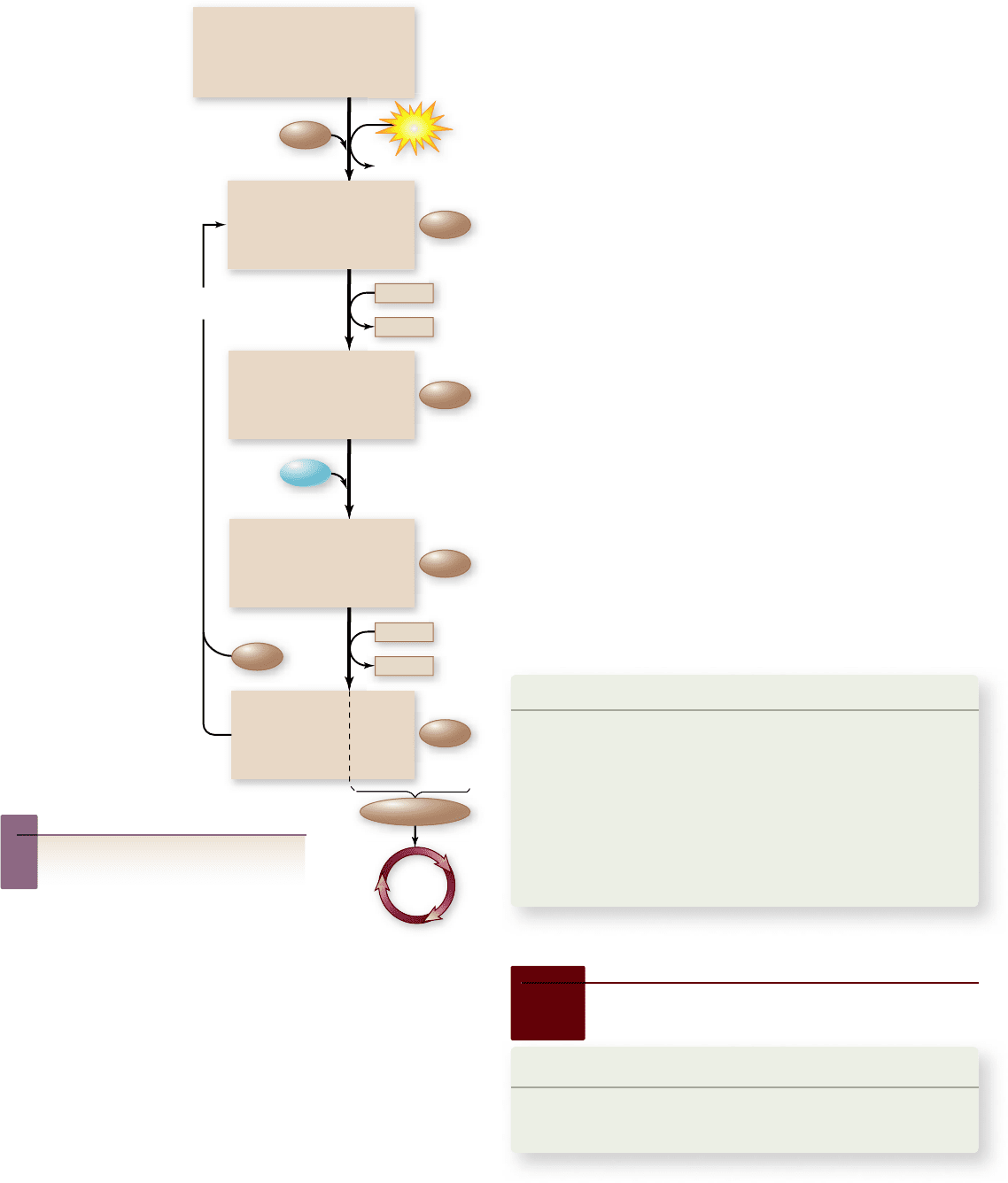
Figure 7.22
β oxidation. Through
a series of reactions
known as β oxidation,
the last two carbons in
a fatty acid combine
with coenzyme A to
form acetyl-CoA,
which enters the Krebs
cycle. The fatty acid,
now two carbons
shorter, enters the
pathway again and
keeps reentering until
all its carbons have
been used to form
acetyl-CoA molecules.
Each round of β
oxidation uses one
molecule of ATP and
generates one molecule
each of FADH
2
and NADH.
Inquiry question
?
Given what you have learned in this
chapter, how many ATP would be
produced by the oxidation of a fatty
acid that has 16 carbons?
7.1 0
Evolution of Metabolism
Learning Outcome
Describe one possible hypothesis for the evolution 1.
of metabolism.
We talk about cellular respiration as a continuous series of
stages, but it is important to note that these stages evolved over
time, and metabolism has changed a great deal in that time.
142
part
II
Biology of the Cell
rav32223_ch07_122-146.indd 142rav32223_ch07_122-146.indd 142 11/6/09 12:41:06 PM11/6/09 12:41:06 PM

Apago PDF Enhancer
Both anabolic processes and catabolic processes evolved in con-
cert with each other. We do not know the details of this bio-
chemical evolution, or the order of appearance of these
processes. Therefore the following timeline is based on the
available geochemical evidence and represents a hypothesis
rather than a strict timeline.
The earliest life forms degraded carbon-based
molecules present in the environment
The most primitive forms of life are thought to have obtained
chemical energy by degrading, or breaking down, organic mole-
cules that were abiotically produced, that is, carbon-containing
molecules formed by inorganic processes on the early Earth.
The first major event in the evolution of metabolism was the
origin of the ability to harness chemical bond energy. At an early
stage, organisms began to store this energy in the bonds of ATP.
The evolution of glycolysis also occurred early
The second major event in the evolution of metabolism was
glycolysis, the initial breakdown of glucose. As proteins evolved
diverse catalytic functions, it became possible to capture a
larger fraction of the chemical bond energy in organic mole-
cules by breaking chemical bonds in a series of steps.
Glycolysis undoubtedly evolved early in the history of life
on Earth, because this biochemical pathway has been retained
by all living organisms. It is a chemical process that does not
appear to have changed for more than 2 billion years.
Anoxygenic photosynthesis allowed
the capture of light energy
The third major event in the evolution of metabolism was anoxy-
genic photosynthesis. Early in the history of life, a different way of
generating ATP evolved in some organisms. Instead of obtaining
energy for ATP synthesis by reshuffling chemical bonds, as in gly-
colysis, these organisms developed the ability to use light to pump
protons out of their cells and to use the resulting proton gradient to
power the production of ATP through chemiosmosis.
Photosynthesis evolved in the absence of oxygen and works
well without it. Dissolved H
2
S, present in the oceans of the early
Earth beneath an atmosphere free of oxygen gas, served as a ready
source of hydrogen atoms for building organic molecules. Free sul-
fur was produced as a by-product of this reaction.
Oxygen-forming photosynthesis
used a di erent source of hydrogen
The substitution of H
2
O for H
2
S in photosynthesis was the
fourth major event in the history of metabolism. Oxygen- forming
photo syn thesis employs H
2
O rather than H
2
S as a source of hy-
drogen atoms and their associated electrons. Because it garners
its electrons from reduced oxygen rather than from reduced sul-
fur, it generates oxygen gas rather than free sulfur.
More than 2 bya, small cells capable of carrying out
this oxygen-forming photosynthesis, such as cyanobacteria,
became the dominant forms of life on Earth. Oxygen gas be-
gan to accumulate in the atmosphere. This was the begin-
ning of a great transition that changed conditions on Earth
permanently. Our atmosphere is now 20.9% oxygen, every
molecule of which is derived from an oxygen-forming pho-
tosynthetic reaction.
Nitrogen xation provided
new organic nitrogen
Nitrogen is available from dead organic matter, and from
chemical reactions that generated the original organic mole-
cules. For life to expand, a new source of nitrogen was needed.
Nitrogen fixation was the fifth major step in the evolution of
metabolism. Proteins and nucleic acids cannot be synthesized
from the products of photosynthesis because both of these bio-
logically critical molecules contain nitrogen. Obtaining nitro-
gen atoms from N
2
gas, a process called nitrogen fixation,
requires breaking an N
≡
N triple bond.
This important reaction evolved in the hydrogen-rich at-
mosphere of the early Earth, where no oxygen was present.
Oxygen acts as a poison to nitrogen fixation, which today oc-
curs only in oxygen-free environments or in oxygen-free com-
partments within certain prokaryotes.
Aerobic respiration utilized oxygen
Respiration is the sixth and final event in the history of metabo-
lism. Aerobic respiration employs the same kind of proton
pumps as photosynthesis and is thought to have evolved as a
modification of the basic photosynthetic machinery.
Biologists think that the ability to carry out photosynthe-
sis without H
2
S first evolved among purple nonsulfur bacteria,
which obtain their hydrogens from organic compounds instead.
It was perhaps inevitable that among the descendants of these
respiring photosynthetic bacteria, some would eventually do
without photosynthesis entirely, subsisting only on the energy
and electrons derived from the breakdown of organic mole-
cules. The mitochondria within all eukaryotic cells are thought
to be descendants of these bacteria.
The complex process of aerobic metabolism developed
over geological time, as natural selection favored organisms
with more efficient methods of obtaining energy from organic
molecules. The process of photosynthesis, as you have seen in
this concluding section, has also developed over time, and the
rise of photosynthesis changed life on Earth forever. The next
chapter explores photosynthesis in detail.
Learning Outcome Review 7.10
Major milestones in the evolution of metabolism include the evolution
of pathways to extract energy from organic compounds, the pathways of
photosynthesis, and those of nitrogen fi xation. Photosynthesis began as an
anoxygenic process that later evolved to produce free oxygen, thus allowing
the evolution of aerobic metabolism.
■ What evidence can you cite for this hypothesis of the
evolution of metabolism?
chapter
7
How Cells Harvest Energy
143www.ravenbiology.com
rav32223_ch07_122-146.indd 143rav32223_ch07_122-146.indd 143 11/6/09 12:41:10 PM11/6/09 12:41:10 PM

Apago PDF Enhancer
Glucose becomes CO
2
and potential energy .
As a glucose molecule is broken down to CO
2
, some of its energy is
preserved in 4 ATPs,10 NADH, and 2 FADH
2
.
Following the electrons in the reactions reveals the direction of transfer.
7.5 The Electron Transport Chain and
Chemiosmosis
(see gure 7.12 )
The electron transport chain produces a proton gradient.
In the inner mitochondrial membrane, NADH is oxidized to
NAD
+
by NADH dehydrogenase. Electrons move through
ubiquinone and the bc
1
complex to cytochrome oxidase, where
they join with H
+
and O
2
to form H
2
O. This results in three
protons being pumped into the intermembrane space. For
FADH
2
, electrons are passed directly to ubiquinone. Thus only
two protons are pumped into the intermembrane space.
The gradient forms as electrons move through electron carriers
Chemiosmosis utilizes the electrochemical gradient to produce ATP
ATP synthase is a molecular rotary motor.
Protons diffuse back into the mitochondrial matrix via the ATP
synthase channel. The enzyme uses this energy to synthesize ATP
(see gure 7.15).
7.6 Energy Yield of Aerobic Respiration
The theoretical yield for eukaryotes is 36 molecules of ATP per
glucose molecule .
The actual yield for eukaryotes is 30 molecules of ATP per glucose
molecule (see gure 7.16).
7.7 Regulation of Aerobic Respiration
Glucose catabolism is controlled by the concentration of ATP
molecules and intermediates in the Krebs cycle (see gure 7.17).
7.8 Oxidation Without O
2
(see gure 7.8)
In the absence of oxygen other
nal electron acceptors can be used
for respiration.
Methanogens use carbon dioxide.
Sulfur bacteria use sulfate.
Fermentation uses organic compounds as electron acceptors.
Fermentation is the regeneration of NAD
+
by oxidation of
NADH and reduction of an organic molecule. In yeast, pyruvate
is decarboxylated, then reduced to ethanol. In animals, pyruvate is
reduced directly to lactate.
7.9 Catabolism of Proteins and Fats
Catabolism of proteins removes amino groups (see gure 7.20).
Catabolism of fatty acids produces acetyl groups.
Fatty acids are converted to acetyl groups by successive rounds of
β-oxidation (see gure 7.22). These acetyl groups feed into the Krebs
cycle to be oxidized and generate NADH for electron transport.
A small number of key intermediates connect metabolic pathways.
7.1 Overview of Respiration
Cells oxidize organic compounds to drive metabolism.
Cellular respiration is the complete oxidation of glucose.
Aerobic respiration uses oxygen as the nal electron acceptor for
redox reactions. Anaerobic respiration utilizes inorganic molecules as
acceptors, and fermentation uses organic molecules.
Electron carriers play a critical role in energy metabolism.
Electron carriers can be reversibly oxidized and reduced. For
example, NAD
+
is reduced to NADH by acquiring two electrons;
NADH supplies these electrons to other molecules to reduce them.
Metabolism harvests energy in stages.
Mitochondria of eukaryotic cells move electrons in steps via the
electron transport chain to capture energy ef ciently.
ATP plays a central role in metabolism.
The ultimate goal of cellular respiration is synthesis of ATP, which is
used to power most of the cell’s activities.
Cells make ATP by two fundamentally di erent mechanisms.
Substrate-level phosphorylation transfers a phosphate directly to
ADP (see gure 7.4). Oxidative phosphorylation generates ATP via
the enzyme ATP synthase, powered by a proton gradient.
7.2 Glycolysis: Splitting Glucose (see gure 7.6)
Glycolysis converts glucose into two 3-carbon molecules of pyruvate.
Each molecule of glucose yields two net
ATP molecules.
Priming changes glucose into an easily cleaved form.
Priming reactions add two phosphates to glucose; this is cleaved into
two 3-carbon molecules of glyceraldehyde 3-phosphate (G3P).
ATP is synthesized by substrate-level phosphorylation.
Oxidation of G3P transfers electrons to NAD
+
, yielding NADH.
After four more reactions, the nal product is two molecules of
pyruvate. Glycolysis produces 2 net ATP, 2 NADH, and 2 pyruvate.
NADH must be recycled into NAD
+
to continue respiration.
In the presence of oxygen, NADH passes electrons to the electron
transport chain. In the absence of oxygen, NADH passes the
electrons to an organic molecule such as acetaldehyde (fermentation).
7.3 The Oxidation of Pyruvate
to Produce Acetyl-CoA
Pyruvate is oxidized to yield 1 CO
2
, 1 NADH, and 1 acetyl-CoA.
Acetyl-CoA enters the Krebs cycle as 2-carbon acetyl units.
7.4 The Krebs Cycle
The Krebs cycle extracts electrons and synthesizes one ATP.
The rst reaction is an irreversible condensation that produces citrate;
it is inhibited when ATP is plentiful. The second and third reactions
rearrange citrate to isocitrate. The fourth and fth reactions are
oxidations; in each reaction, one NAD
+
is reduced to NADH. The
sixth reaction is a substrate-level phosphorylation producing GTP, and
from that ATP. The seventh reaction is another oxidation that reduces
FAD to FADH
2
. Reactions eight and nine regenerate oxaloacetate,
including one nal oxidation that reduces NAD
+
to NADH.
Chapter Review
144
part
II
Biology of the Cell
rav32223_ch07_122-146.indd 144rav32223_ch07_122-146.indd 144 11/6/09 12:41:10 PM11/6/09 12:41:10 PM

Apago PDF Enhancer
APPLY
1. Which of the following is NOT a true statement regarding
cellular respiration?
a. Enzymes catalyze reactions that transfer electrons.
b. Electrons have a higher potential energy at the end
of the process.
c. Carbon dioxide gas is a by-product.
d. The process involves multiple redox reactions.
2. The direct source of energy for the ATP produced by ATP
synthase comes from
a. the electron transport chain.
b. the proton gradient.
c. substrate-level phosphorylation.
d. the oxidation reactions occurring during respiration.
3. Can cellular respiration occur in the absence of O
2
?
a. No, O
2
is necessary as the nal electron acceptor.
b. No, anaerobic organisms only need glycolysis and fermentation.
c. Yes, because oxygen can be generated by splitting H
2
O.
d. Yes, but it requires an alternative to O
2
as a nal
electron acceptor.
4. Why is fermentation an important metabolic function in cells?
a. It generates glucose for the cell in the absence of O
2
.
b. It oxidizes NADH to NAD
+
.
c. It oxidizes pyruvate.
d. It produces ATP.
5. Which of the following statements is NOT true about the
oxidation of pyruvate?
a. Pyruvate oxidation occurs in the cytoplasm.
b. Pyruvate oxidation only occurs if oxygen is present.
c. Pyruvate is converted into acetyl-CoA.
d. Pyruvate oxidation results in the production of NADH.
6. A chemical agent that makes holes in the inner membrane of
the mitochondria would
a. stop the movement of electrons down the electron
transport chain.
b. stop ATP synthesis.
c. stop the Krebs cycle.
d. all of the above.
UNDERSTAND
1. An autotroph is an organism that
a. extracts energy from organic sources.
b. converts energy from sunlight into chemical energy.
c. relies on the energy produced by other organisms
as an energy source.
d. does both a and b.
2. Which of the following processes is (are) required
for the complete oxidation of glucose?
a. The Krebs cycle
b. Glycolysis
c. Pyruvate oxidation
d. All of the above
3. Which of the following is NOT a product of glycolysis?
a. ATP c. CO
2
b. Pyruvate d. NADH
4. Glycolysis produces ATP by
a. phosphorylating organic molecules in the priming
reactions.
b. the production of glyceraldehyde 3-phosphate.
c. substrate-level phosphorylation.
d. the reduction of NAD
+
to NADH.
5. What is the role of NAD
+
in the process of cellular respiration?
a. It functions as an electron carrier.
b. It functions as an enzyme.
c. It is the nal electron acceptor for anaerobic respiration.
d. It is a nucleotide source for the synthesis of ATP.
6. The reactions of the Krebs cycle occur in the
a. inner membrane of the mitochondria.
b. intermembrane space of the mitochondria.
c. the cytoplasm.
d. matrix of the mitochondria.
7. The electrons carried by NADH and FADH
2
can be
a. pumped into the intermembrane space.
b. transferred to the ATP synthase.
c. moved between proteins in the inner membrane of
the mitochondrion.
d. transported into the matrix of the mitochondrion.
Review Questions
Acetyl-CoA has many roles.
With high ATP, acetyl-CoA is converted into fatty acids.
7.10 Evolution of Metabolism
Major milestones are recognized in the evolution of metabolism; the
order of events is hypothetical.
The earliest life forms degraded carbon-based molecules present in the
environment.
The evolution of glycolysis also occurred early.
Anoxygenic photosynthesis allowed the capture of light energy.
Oxygen-forming photosynthesis used a di erent source of hydrogen.
Nitrogen xation provided new organic nitrogen.
Aerobic respiration utilized oxygen.
chapter
7
How Cells Harvest Energy
145www.ravenbiology.com
rav32223_ch07_122-146.indd 145rav32223_ch07_122-146.indd 145 11/6/09 12:41:11 PM11/6/09 12:41:11 PM

Apago PDF Enhancer
7. Yeast cells that have mutations in genes that encode enzymes in
glycolysis can still grow on glycerol. They are able to utilize
glycerol because it
a. enters glycolysis after the step affected by the mutation.
b. can feed into the Krebs cycle and generate ATP via
electron transport and chemiosmosis.
c. can be utilized by fermentation.
d. can donate electrons directly to the electron transport chain.
SYNTHESIZE
1. Use the following table to outline the relationship between the
molecules and the metabolic reactions.
Molecules Glycolysis Cellular Respiration
Glucose
Pyruvate
Oxygen
ATP
CO
2
2. Human babies and hibernating or cold-adapted animals are able
to maintain body temperature (a process called thermogenesis)
due to the presence of brown fat. Brown fat is characterized by
a high concentration of mitochondria. These brown fat
mitochondria have a special protein located within their inner
membranes. Thermogenin is a protein that functions as a passive
proton transporter. Propose a likely explanation for the role of
brown fat in thermogenesis based on your knowledge of
metabolism, transport, and the structure and function
of mitochondria.
3. Recent data indicate a link between colder temperatures
and weight loss. If adults retain brown fat, how could this
be explained?
ONLINE RESOURCE
www.ravenbiology.com
Understand, Apply, and Synthesize—enhance your study with
animations that bring concepts to life and practice tests to assess
your understanding. Your instructor may also recommend the
interactive eBook, individualized learning tools, and more.
146
part
II
Biology of the Cell
rav32223_ch07_122-146.indd 146rav32223_ch07_122-146.indd 146 11/6/09 12:41:11 PM11/6/09 12:41:11 PM

Apago PDF Enhancer
T
Chapter
8
Photosynthesis
Introduction
The rich diversity of life that covers our Earth would be impossible without photosynthesis. Almost every oxygen atom in
the air we breathe was once part of a water molecule, liberated by photosynthesis. All the energy released by the burning of
coal, firewood, gasoline, and natural gas, and by our bodies’ burning of all the food we eat—directly or indirectly—has been
captured from sunlight by photosynthesis. It is vitally important, then, that we understand photosynthesis. Research may
enable us to improve crop yields and land use, important goals in an increasingly crowded world. In chapter 7, we described
how cells extract chemical energy from food molecules and use that energy to power their activities. In this chapter, we
examine photosynthesis, the process by which organisms such as the aptly named sunflowers in the picture capture energy
from sunlight and use it to build food molecules that are rich in chemical energy.
Chapter Outline
8.1 Overview of Photosynthesis
8.2 The Discovery of Photosynthetic Processes
8.3 Pigments
8.4 Photosystem Organization
8.5 The Light-Dependent Reactions
8.6 Carbon Fixation: The Calvin Cycle
8.7 Photorespiration
CHAPTER
8.1
Overview of Photosynthesis
Learning Outcomes
Explain the reaction for photosynthesis.1.
Describe the structure of the chloroplast.2.
Life is powered by sunshine. The energy used by most living
cells comes ultimately from the Sun and is captured by plants,
algae, and bacteria through the process of photosynthesis.
The diversity of life is only possible because our planet is
awash in energy streaming Earthward from the Sun. Each day,
the radiant energy that reaches Earth equals the power from
about 1 million Hiroshima-sized atomic bombs. Photosynthe-
sis captures about 1% of this huge supply of energy (an amount
equal to 10,000 Hiroshima bombs) and uses it to provide the
energy that drives all life.
rav32223_ch08_147-167.indd 147rav32223_ch08_147-167.indd 147 11/6/09 2:07:12 PM11/6/09 2:07:12 PM
Apago PDF Enhancer
Vascular bundle Stoma
Cuticle
Epidermis
Mesophyll
Chloroplast
Inner membrane
Outer membrane
Vacuole
Cell wall
1.58 µm
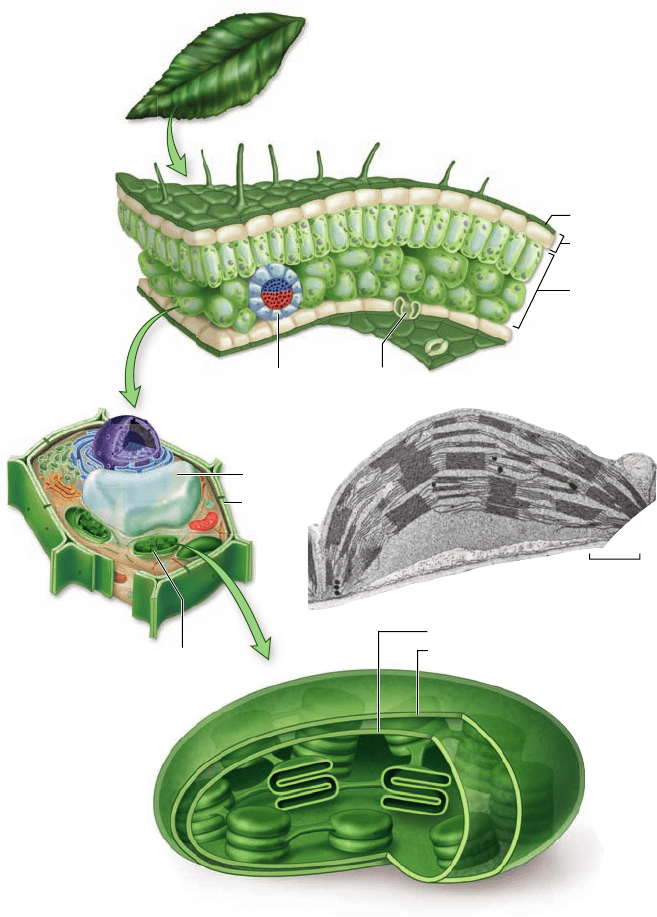
Figure 8.1
Journey into a leaf. A plant leaf possesses a thick
layer of cells (the mesophyll) rich in chloroplasts. The inner membrane
of the chloroplast is organized into attened structures called thylakoid
disks, which are stacked into columns called grana. The rest of the
interior is lled with a semi uid substance called stroma.
Photosynthesis combines CO
2
and H
2
O,
producing glucose and O
2
Photosynthesis occurs in a wide variety of organisms, and it
comes in different forms. These include a form of photosynthesis
that does not produce oxygen (anoxygenic) and a form that does
(oxygenic). Anoxygenic photosynthesis is found in four different
bacterial groups: purple bacteria, green sulfur bacteria, green
nonsulfur bacteria, and heliobacteria. Oxygenic photosynthesis is
found in cyanobacteria, seven groups of algae, and essentially all
land plants. These two types of photosynthesis share similarities
in the types of pigments they use to trap light energy, but they
differ in the arrangement and action of these pigments.
In the case of plants, photosynthesis takes place primarily in
the leaves. Figure 8.1 illustrates the levels of organization in a plant
leaf. As you learned in chapter 4 , the cells of plant leaves con-
tain organelles called chloroplasts, which carry out the
photosynthetic process. No other structure in a plant
cell is able to carry out photosynthesis (figure 8.2).
Photosynthesis takes place in three stages:
capturing energy from sunlight;1.
using the energy to make ATP and to reduce 2.
the compound NADP
+
, an electron carrier, to
NADPH; and
using the ATP and NADPH to power the 3.
synthesis of organic molecules from CO
2
in
the air.
The first two stages require light and are commonly
called the light-dependent reactions.
The third stage, the formation of organic molecules from
CO
2
, is called carbon fixation. This process takes place via a
cyclic series of reactions. As long as ATP and NADPH are
available, the carbon fixation reactions can occur either in the
presence or in the absence of light, and so these reactions are
also called the light-independent reactions.
The following simple equation summarizes the overall
process of photosynthesis:
6 CO
2
+ 12 H
2
O + light
→
C
6
H
12
O
6
+ 6 H
2
O + 6 O
2
carbon water glucose water oxygen
dioxide
You may notice that this equation is the reverse of the reac-
tion for respiration. In respiration, glucose is oxidized to CO
2
using O
2
as an electron acceptor. In photosynthesis, CO
2
is re-
duced to glucose using electrons gained from the oxidation of
water. The oxidation of H
2
O and the reduction of CO
2
requires
energy that is provided by light. Although this statement is an
oversimplification, it provides a useful “global perspective.”
In plants, photosynthesis
takes place in chloroplasts
In the preceding chapter, you saw that a mitochondrion’s complex
structure of internal and external membranes contribute to its
function. The same is true for the structure of the chloroplast.
The internal membrane of chloroplasts, called the thylakoid
membrane, is a continuous phospholipid bilayer organized into
flattened sacs that are found stacked on one another in columns
called grana (singular, granum). The thylakoid membrane con-
tains chlorophyll and other photosynthetic pigments for captur-
ing light energy along with the machinery to make ATP.
Connections between grana are termed stroma lamella.
Surrounding the thylakoid membrane system is a semiliquid
substance called stroma. The stroma houses the enzymes needed
to assemble organic molecules from CO
2
using energy from ATP
coupled with reduction via NADPH. In the thylakoid membrane,
photosynthetic pigments are clustered together to form photo-
systems, which show distinct organization within the thylakoid.
148
part
II
Biology of the Cell
rav32223_ch08_147-167.indd 148rav32223_ch08_147-167.indd 148 11/6/09 2:07:16 PM11/6/09 2:07:16 PM
Apago PDF Enhancer
H
2
O
O
2
NADPH
Organic
molecules
Stroma
Photosystem
Thylakoid
Light-Dependent
Reactions
NADP
;
NA
ATP
ADP+P
i
Calvin
Cycle
CO
2
Sunlight
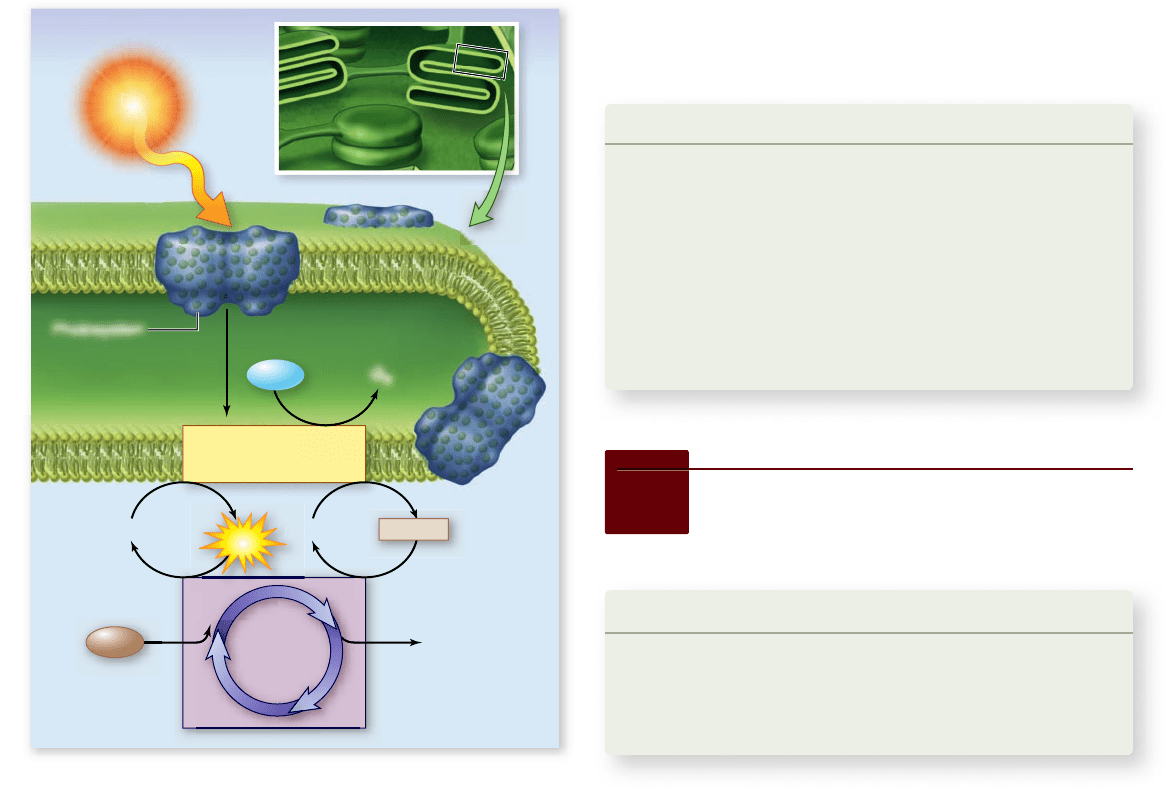
Figure 8.2
Overview of photosynthesis. In the light-
dependent reactions, photosystems in the thylakoid absorb
photons of light and use this energy to generate ATP and
NADPH. Electrons lost from the photosystems are replaced by
the oxidation of water, producing O
2
as a by-product. The ATP
and NADPH produced by the light reactions is used during
carbon xation via the Calvin cycle in the stroma.
Each pigment molecule within the photosystem is capable
of capturing photons, which are packets of energy. When light
of a proper wavelength strikes a pigment molecule in the photo-
system, the resulting excitation passes from one pigment mole-
cule to another.
The excited electron is not transferred physically—rather,
its energy passes from one molecule to another. The passage is
similar to the transfer of kinetic energy along a row of upright
dominoes. If you push the first one over, it falls against the next,
and that one against the next, and so on, until all of the domi-
noes have fallen down.
Eventually, the energy arrives at a key chlorophyll mole-
cule in contact with a membrane-bound protein that can accept
an electron. The energy is transferred as an excited electron to
that protein, which passes it on to a series of other membrane
proteins that put the energy to work making ATP and NADPH.
These compounds are then used to build organic molecules.
The photosystem thus acts as a large antenna, gathering the
light energy harvested by many individual pigment molecules.
Learning Outcomes Review 8.1
Photosynthesis consists of light-dependent reactions that require sunlight,
and others that convert CO
2
into organic molecules. The overall reaction
is essentially the reverse of respiration and produces O
2
as a by-product.
The chloroplast’s inner membrane, the thylakoid, is the site in which
photosynthetic pigments are clustered, allowing passage of energy from
one molecule to the next. The thylakoid membrane is organized into
fl attened sacs stacked in columns called grana.
■ How is the structure of the chloroplast similar to
the mitochondria?
8.2
The Discovery of
Photosynthetic Processes
Learning Outcomes
Describe experiments that support our understanding 1.
of photosynthesis.
Explain the difference between the light-dependent and 2.
light-independent reactions.
The story of how we learned about photosynthesis begins over
300 years ago, and it continues to this day. It starts with curios-
ity about how plants manage to grow, often increasing their
organic mass considerably.
Plants do not increase mass
from soil and water alone
From the time of the Greeks, plants were thought to obtain
their food from the soil, literally sucking it up with their roots.
A Belgian doctor, Jan Baptista van Helmont (1580–1644)
thought of a simple way to test this idea.
He planted a small willow tree in a pot of soil, after first
weighing the tree and the soil. The tree grew in the pot for
several years, during which time van Helmont added only wa-
ter. At the end of five years, the tree was much larger, its weight
having increased by 74.4 kg. However, the soil in the pot
weighed only 57 g less than it had five years earlier. With this
experiment, van Helmont demonstrated that the substance of
the plant was not produced only from the soil. He incorrectly
concluded, however, that the water he had been adding mainly
accounted for the plant’s increased biomass.
A hundred years passed before the story became clearer.
The key clue was provided by the English scientist Joseph
Priestly (1733–1804). On the 17th of August, 1771, Priestly put
chapter
8
Photosynthesis
149www.ravenbiology.com
rav32223_ch08_147-167.indd 149rav32223_ch08_147-167.indd 149 11/6/09 2:07:19 PM11/6/09 2:07:19 PM
Apago PDF Enhancer
Maximum rate
Excess CO
2
; 35````°C
Temperature limited
Excess
CO
2
; 20°C
CO
2
limited
Light Intensity (foot-candles)
Light limited
500 1000
1500 2000 2500
Insufficient
CO
2
(0.01%); 20°C
Increased Rate of Photosynthesis
0
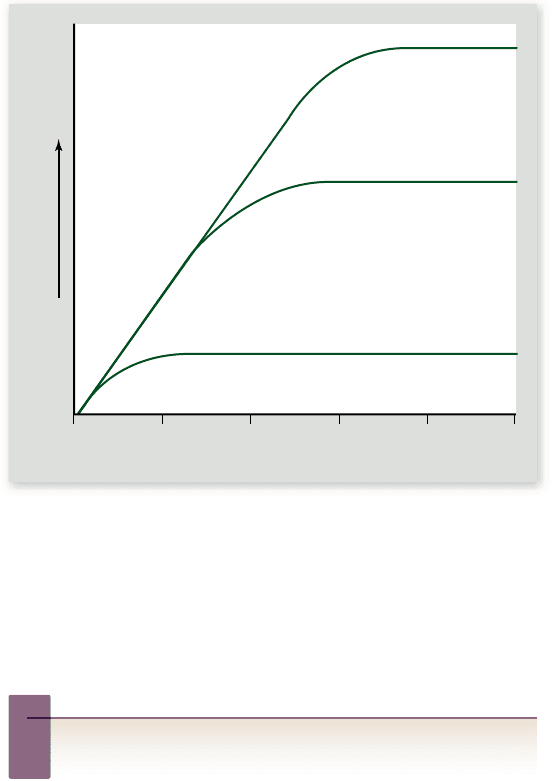
Figure 8.3
Discovery of the light-independent
reactions. Blackman measured photosynthesis rates under
differing light intensities, CO
2
concentrations, and temperatures.
As this graph shows, light is the limiting factor at low light
intensities, but temperature and CO
2
concentration are the limiting
factors at higher light intensities. This implies the existence of
reactions using CO
2
that involve enzymes.
Inquiry question
?
Blackman found that increasing light intensity above 2000
foot-candles did not lead to any further increase in the rate
of photosynthesis. Can you suggest a hypothesis that would
explain this?
a living sprig of mint into air in which a wax candle had burnt
out. On the 27th of the same month, Priestly found that an-
other candle could be burned in this same air. Somehow, the
vegetation seemed to have restored the air. Priestly found that
while a mouse could not breathe candle-exhausted air, air “re-
stored” by vegetation was not “at all inconvenient to a mouse.”
The key clue was that living vegetation adds something to the air.
How does vegetation “restore” air? Twenty-five years
later, the Dutch physician Jan Ingenhousz (1730–1799) solved
the puzzle. He demonstrated that air was restored only in the
presence of sunlight and only by a plant’s green leaves, not by
its roots. He proposed that the green parts of the plant carry
out a process that uses sunlight to split carbon dioxide into
carbon and oxygen. He suggested that the oxygen was released
as O
2
gas into the air, while the carbon atom combined with
water to form carbohydrates. Other research refined his con-
clusions, and by the end of the nineteenth century, the overall
reaction for photosynthesis could be written as:
CO
2
+ H
2
O + light energy
→
(CH
2
O) + O
2
It turns out, however, that there’s more to it than that. When re-
searchers began to examine the process in more detail in the twen-
tieth century, the role of light proved to be unexpectedly complex.
Photosynthesis includes both light-dependent
and light-independent reactions
At the beginning of the twentieth century, the English plant
physiologist F. F. Blackman (1866–1947) came to the startling
conclusion that photosynthesis is in fact a multistage process,
only one portion of which uses light directly.
Blackman measured the effects of different light intensities,
CO
2
concentrations, and temperatures on photosynthesis. As
long as light intensity was relatively low, he found photosynthesis
could be accelerated by increasing the amount of light, but not by
increasing the temperature or CO
2
concentration ( figure 8.3). At
high light intensities, however, an increase in temperature or
CO
2
concentration greatly accelerated photosynthesis.
Blackman concluded that photosynthesis consists of an initial
set of what he called “light” reactions, that are largely independent
of temperature but depend on light, and a second set of “dark” reac-
tions (more properly called light-independent reactions), that
seemed to be independent of light but limited by CO
2
.
Do not be confused by Blackman’s labels—the so-called
“dark” reactions occur in the light (in fact, they require the prod-
ucts of the light-dependent reactions); his use of the word dark sim-
ply indicates that light is not directly involved in those reactions.
Blackman found that increased temperature increased
the rate of the light-independent reactions, but only up to
about 35°C. Higher temperatures caused the rate to fall off
rapidly. Because many plant enzymes begin to be denatured at
35°C, Blackman concluded that enzymes must carry out the
light-independent reactions.
O
2
comes from water, not from CO
2
In the 1930s, C. B. van Niel (1897–1985) working at the Hopkins
Marine Station at Stanford, discovered that purple sulfur bacteria
do not release oxygen during photosynthesis; instead, they convert
hydrogen sulfide (H
2
S) into globules of pure elemental sulfur that
accumulate inside them. The process van Niel observed was:
CO
2
+ 2 H
2
S + light energy
→
(CH
2
O) + H
2
O + 2 S
The striking parallel between this equation and Ingen-
housz’s equation led van Niel to propose that the generalized
process of photosynthesis can be shown as:
CO
2
+ 2 H
2
A + light energy
→
(CH
2
O) + H
2
O + 2 A
In this equation, the substance H
2
A serves as an electron
donor. In photosynthesis performed by green plants, H
2
A is
water, whereas in purple sulfur bacteria, H
2
A is hydrogen sul-
fide. The product, A, comes from the splitting of H
2
A. There-
fore, the O
2
produced during green plant photosynthesis results
from splitting water, not carbon dioxide.
When isotopes came into common use in the early 1950s,
van Niel’s revolutionary proposal was tested. Investigators ex-
amined photosynthesis in green plants supplied with water
containing heavy oxygen (
18
O); they found that the
18
O label
ended up in oxygen gas rather than in carbohydrate, just as
van Niel had predicted:
CO
2
+ 2 H
2
18
O + light energy
→
(CH
2
O) + H
2
O +
18
O
2
150
part
II
Biology of the Cell
rav32223_ch08_147-167.indd 150rav32223_ch08_147-167.indd 150 11/6/09 2:07:21 PM11/6/09 2:07:21 PM

Apago PDF Enhancer
400 nm
Visible light
430 nm 500 nm 560 nm 600 nm 650 nm 740 nm
1 nm 0.001 nm 10 nm 1000 nm
Increasing wavelength
Increasing energy
0.01 cm 1 cm 1 m
Radio waves Infrared X-rays Gamma rays
UV
light
100 m
8.3
Pigments
Learning Outcomes
Explain how pigments are important to photosynthesis.1.
Relate the absorption spectrum of a pigment to its color.2.
For plants to make use of the energy of sunlight, some bio-
chemical structure must be present in chloroplasts and the thy-
lakoids that can absorb this energy. Molecules that absorb light
energy in the visible range are termed pigments. We are most
familiar with them as dyes that impart a certain color to cloth-
ing or other materials. The color that we see is the color that is
not absorbed—that is, it is reflected. To understand how plants
use pigments to capture light energy, we must first review cur-
rent knowledge about the nature of light.
Light is a form of energy
The wave nature of light produces an electromagnetic spec-
trum that differentiates light based on its wavelength ( figure 8.4).
We are most familiar with the visible range of this spectrum
because we can actually see it, but visible light is only a small
part of the entire spectrum. Visible light can be divided into its
separate colors by the use of a prism, which separates light
based on wavelength.
A particle of light, termed a photon, acts like a discrete
bundle of energy. We use the wave concept of light to under-
stand different colors of light and the particle nature of light to
understand the energy transfers that occur during photosyn-
thesis. Thus, we will refer both to wavelengths of light and to
photons of light throughout the chapter.
The energy in photons
The energy content of a photon is inversely proportional to
the wavelength of the light: Short-wavelength light contains
photons of higher energy than long-wavelength light (see
figure 8.4). X-rays, which contain a great deal of energy, have very
short wavelengths—much shorter than those of visible light.
In algae and green plants, the carbohydrate typically
produced by photosynthesis is glucose. The complete
balanced equation for photosynthesis in these organisms
thus becomes:
6 CO
2
+ 12 H
2
O + light energy
→
C
6
H
12
O
6
+ 6 H
2
O + 6 O
2
ATP and NADPH from light-dependent
reactions reduce CO
2
to make sugars
In his pioneering work on the light-dependent reactions,
van Niel proposed that the H
+
ions and electrons generated
by the splitting of water were used to convert CO
2
into or-
ganic matter in a process he called carbon fixation. In the 1950s,
Robin Hill (1899–1991) demonstrated that van Niel was right,
light energy could be harvested and used in a reduction reac-
tion. Chloroplasts isolated from leaf cells were able to reduce
a dye and release oxygen in response to light. Later experi-
ments showed that the electrons released from water were
transferred to NADP
+
and that illuminated chloroplasts de-
prived of CO
2
accumulate ATP. If CO
2
is introduced, neither
ATP nor NADPH accumulate, and the CO
2
is assimilated
into organic molecules.
These experiments are important for three reasons:
First, they firmly demonstrate that photosynthesis in plants
occurs within chloroplasts. Second, they show that the light-
dependent reactions use light energy to reduce NADP
+
and to
manufacture ATP. Third, they confirm that the ATP and
NADPH from this early stage of photosynthesis are then used
in the subsequent reactions to reduce carbon dioxide, forming
simple sugars.
Learning Outcomes Review 8.2
Early experiments indicated that plants “restore” air to usable form, that is,
produce oxygen—but only in the presence of sunlight. Further experiments
showed that there are both light-dependent and independent reactions.
The light-dependent reactions produce O
2
from H
2
O, and generate ATP and
NADPH. The light-independent reactions synthesize organic compounds
through carbon fi xation.
■ Where does the carbon in your body come from?
Figure 8.4
The
electromagnetic
spectrum. Light is a form of
electromagnetic energy
conveniently thought of as a
wave. The shorter the
wavelength of light, the greater
its energy. Visible light
represents only a small part of
the electromagnetic spectrum
between 400 and 740 nm.
chapter
8
Photosynthesis
151www.ravenbiology.com
rav32223_ch08_147-167.indd 151rav32223_ch08_147-167.indd 151 11/6/09 2:07:21 PM11/6/09 2:07:21 PM