
Raven P.H., Johnson G.B., Mason K.A. Biology (Ninth Edition)
Подождите немного. Документ загружается.

Apago PDF Enhancer
Wavelength (nm)
400
450 500
550 600 650
700
Light
Absorbtion
low
high
carotenoids
chlorophyll a
chlorophyll b
H
2
CK
CH
J
CH
2
CH
3
H
3
C
J
CH
3
J
H
H
H
J
J
J
CH
2
CH
2
C
O
CH
2
CH
CCH
3
CH
2
CH
2
CH
2
CHCH
3
CH
2
CH
2
CH
2
CHCH
3
CH
2
CH
2
CH
2
CHCH
3
CH
3
O
K
J
CO
2
CH
3
Porphyrin
head
O
NN
NN
Mg
JH
J
H
J
J
Chlorophyll a: =J
CH
3
Chlorophyll b: =J
CHO
R
R
Hydrocarbon
tail
R
H
3
C
J
H
J
J
K
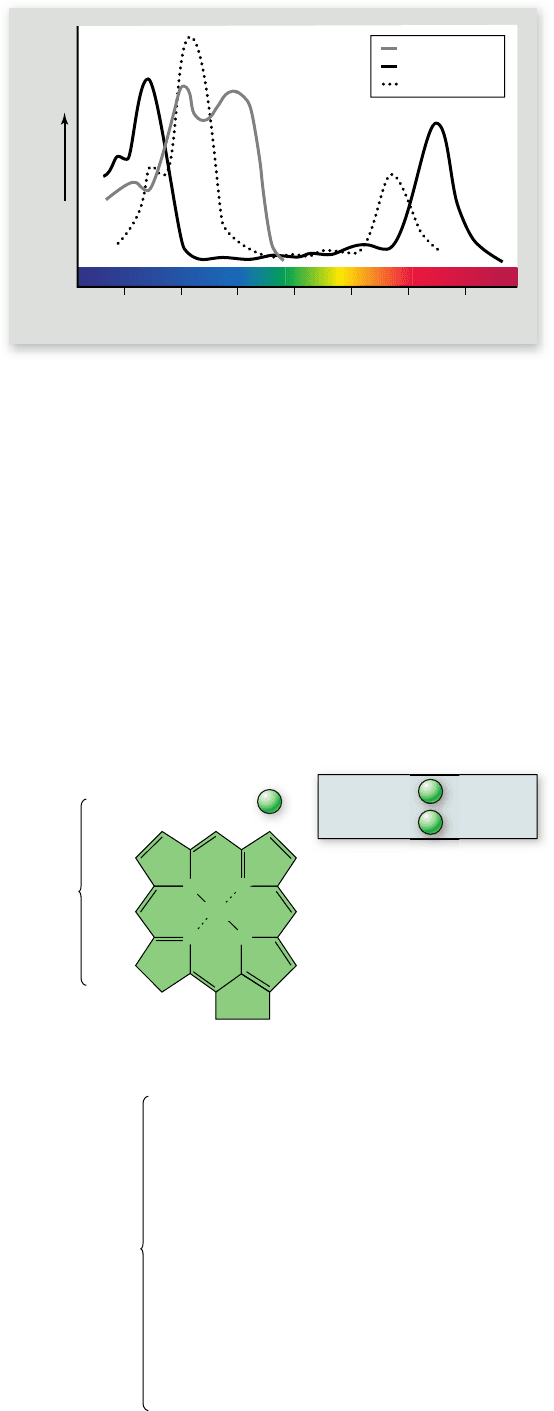
Figure 8.5
Absorption spectra for chlorophyll and
carotenoids. The peaks represent wavelengths of light of sunlight
absorbed by the two common forms of photosynthetic pigment,
chlorophylls a and b, and the carotenoids. Chlorophylls absorb
predominantly violet-blue and red light in two narrow bands of the
spectrum and re ect green light in the middle of the spectrum.
Carotenoids absorb mostly blue and green light and re ect orange
and yellow light.
Figure 8.6
Chlorophyll.
Chlorophyll molecules consist
of a porphyrin head and a
hydrocarbon tail that anchors
the pigment molecule to
hydrophobic regions of proteins
embedded within the thylakoid
membrane. The only difference
between the two chlorophyll
molecules is the substitution of
a
–
CHO (aldehyde) group in
chlorophyll b for a
–
CH
3
(methyl) group in chlorophyll a.
Structure of chlorophylls
Chlorophylls absorb photons by means of an excitation process
analogous to the photoelectric effect. These pigments contain a
complex ring structure, called a porphyrin ring, with alternating
single and double bonds. At the center of the ring is a magne-
sium atom (figure 8.6 ).
A beam of light is able to remove electrons from cer-
tain molecules, creating an electrical current. This phenom-
enon is called the photoelectric effect, and it occurs when
photons transfer energy to electrons. The strength of the
photoelectric effect depends on the wavelength of light;
that is, short wavelengths are much more effective than long
ones in producing the photoelectric effect because they
have more energy.
In photosynthesis, chloroplasts are acting as photoelec-
tric devices: They absorb sunlight and transfer the excited elec-
trons to a carrier. As we unravel the details of this process, it will
become clear how this process traps energy and uses it to syn-
thesize organic compounds.
Each pigment has a characteristic
absorption spectrum
When a photon strikes a molecule with the amount of energy
needed to excite an electron, then the molecule will absorb the
photon raising the electron to a higher energy level. Whether
the photon’s energy is absorbed depends on how much energy
it carries (defined by its wavelength), and also on the chemical
nature of the molecule it hits.
As described in chapter 2, electrons occupy discrete en-
ergy levels in their orbits around atomic nuclei. To boost an
electron into a different energy level requires just the right
amount of energy, just as reaching the next rung on a ladder
requires you to raise your foot just the right distance. A spe-
cific atom, therefore, can absorb only certain photons of
light—namely, those that correspond to the atom’s available
energy levels. As a result, each molecule has a characteristic
absorption spectrum, the range and efficiency of photons it
is capable of absorbing.
As mentioned earlier, pigments are good absorbers of
light in the visible range. Organisms have evolved a variety of
different pigments, but only two general types are used in green
plant photosynthesis: chlorophylls and carotenoids. In some
organisms, other molecules also absorb light energy.
Chlorophyll absorption spectra
Chlorophylls absorb photons within narrow energy ranges. Two
kinds of chlorophyll in plants, chlorophyll a and chlorophyll b,
preferentially absorb violet-blue and red light (figure 8.5). Neither
of these pigments absorbs photons with wavelengths between
about 500 and 600 nm; light of these wavelengths is reflected.
When these reflected photons are subsequently absorbed by the
retinal pigment in our eyes, we perceive them as green.
Chlorophyll a is the main photosynthetic pigment in plants
and cyanobacteria and the only pigment that can act directly to
convert light energy to chemical energy. Chlorophyll b, acting as
an accessory pigment, or secondary light-absorbing pigment,
complements and adds to the light absorption of chlorophyll a.
Chlorophyll b has an absorption spectrum shifted toward
the green wavelengths. Therefore, chlorophyll b can absorb
photons that chlorophyll a cannot, greatly increasing the pro-
portion of the photons in sunlight that plants can harvest. In
addition, a variety of different accessory pigments are found in
plants, bacteria, and algae.
152
part
II
Biology of the Cell
rav32223_ch08_147-167.indd 152rav32223_ch08_147-167.indd 152 11/6/09 2:07:22 PM11/6/09 2:07:22 PM
Apago PDF Enhancer
Light
Absorbtion
low
high
Oxygen-seeking bacteria
Filament of green algae
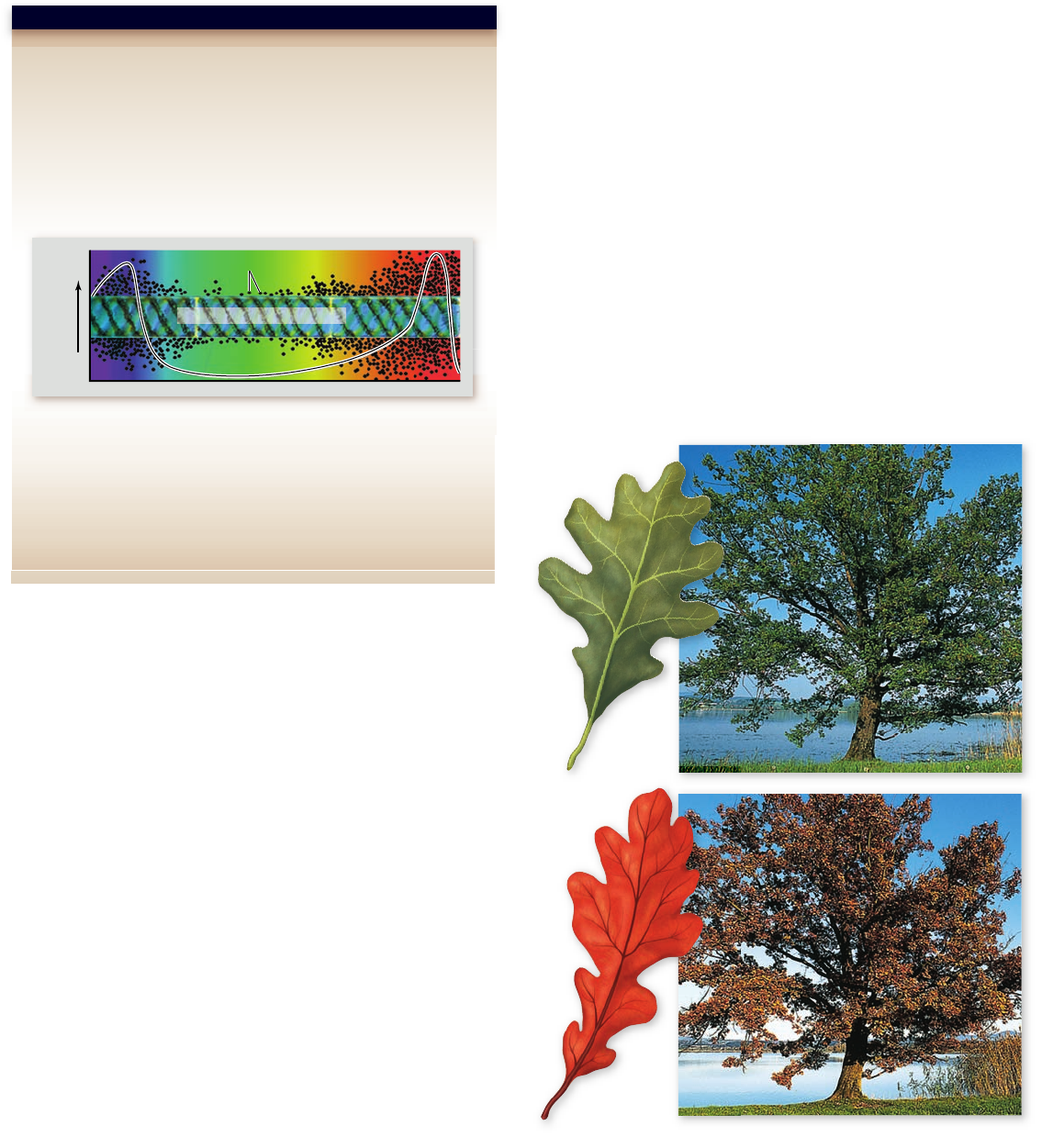
Hypothesis: All wavelengths of light are equally effective in
promoting photosynthesis.
Prediction: Illuminating plant cells with light broken into different
wavelengths by a prism will produce the same amount of O
2
for
all wavelengths.
Test: A filament of algae immobilized on a slide is illuminated by light
that has passed through a prism. Motile bacteria that require O
2
for
growth are added to the slide.
Result: The bacteria move to regions of high O
2
, or regions of most active
photosynthesis. This is in the purple/blue and red regions of the spectrum.
Conclusion: All wavelengths are not equally effective at promoting
photosynthesis. The most effective constitute the action spectrum
for photosynthesis.
Further Experiments: How does the action spectrum relate to the
various absorption spectra in figure 8.5?
SCIENTIFIC THINKING
Oak leaf
in summer
Oak leaf
in autumn
Photons excite electrons in the porphyrin ring, which are
then channeled away through the alternating carbon single-
and double-bond system. Different small side groups attached
to the outside of the ring alter the absorption properties of the
molecule in the different kinds of chlorophyll (see figure 8.6).
The precise absorption spectrum is also influenced by the local
microenvironment created by the association of chlorophyll
with different proteins.
The action spectrum of photosynthesis—that is, the
relative effectiveness of different wavelengths of light in pro-
moting photosynthesis—corresponds to the absorption spec-
trum for chlorophylls. This is demonstrated in the experiment
in figure 8.7. All plants, algae, and cyanobacteria use chloro-
phyll a as their primary pigments.
It is reasonable to ask why these photosynthetic organ-
isms do not use a pigment like retinal (the pigment in our eyes),
which has a broad absorption spectrum that covers the range of
500 to 600 nm. The most likely hypothesis involves photo-
efficiency. Although retinal absorbs a broad range of wavelengths,
it does so with relatively low efficiency. Chlorophyll, in con-
trast, absorbs in only two narrow bands, but does so with high
efficiency. Therefore, plants and most other photosynthetic or-
ganisms achieve far higher overall energy capture rates with
chlorophyll than with other pigments.
Carotenoids and other accessory pigments
Carotenoids consist of carbon rings linked to chains with al-
ternating single and double bonds. They can absorb photons
Figure 8.7
Determination of an action spectrum for
photosynthesis.
with a wide range of energies, although they are not always
highly efficient in transferring this energy. Carotenoids assist in
photosynthesis by capturing energy from light composed of
wavelengths that are not efficiently absorbed by chlorophylls
(figure 8.5; see also figure 8.8).
Carotenoids also perform a valuable role in scavenging
free radicals. The oxidation –reduction reactions that occur in
the chloroplast can generate destructive free radicals. Carote-
noids can act as general-purpose antioxidants to lessen damage.
Thus carotenoids have a protective role in addition to their role
as light-absorbing molecules. This protective role is not sur-
prising, because unlike the chlorophylls, carotenoids are found
in many different kinds of organisms, including members of all
three domains of life.
A typical carotenoid is β-carotene, which contains two
carbon rings connected by a chain of 18 carbon atoms with
alternating single and double bonds. Splitting a molecule of
β-carotene into equal halves produces two molecules of
vitamin A. Oxidation of vitamin A produces retinal, the
Figure 8.8
Fall colors are produced by carotenoids and
other accessory pigments. During the spring and summer,
chlorophyll in leaves masks the presence of carotenoids and other
accessory pigments. When cool fall temperatures cause leaves to
cease manufacturing chlorophyll, the chlorophyll is no longer
present to re ect green light, and the leaves re ect the orange and
yellow light that carotenoids and other pigments do not absorb.
chapter
8
Photosynthesis
153www.ravenbiology.com
rav32223_ch08_147-167.indd 153rav32223_ch08_147-167.indd 153 11/6/09 2:07:22 PM11/6/09 2:07:22 PM
Apago PDF Enhancer
Saturation when all
photosystems are in use
Intensity of Light Flashes
Output (O
2
yield per flash)
Saturation when all
chlorophyll molecules
are in use
expected
observed
low high
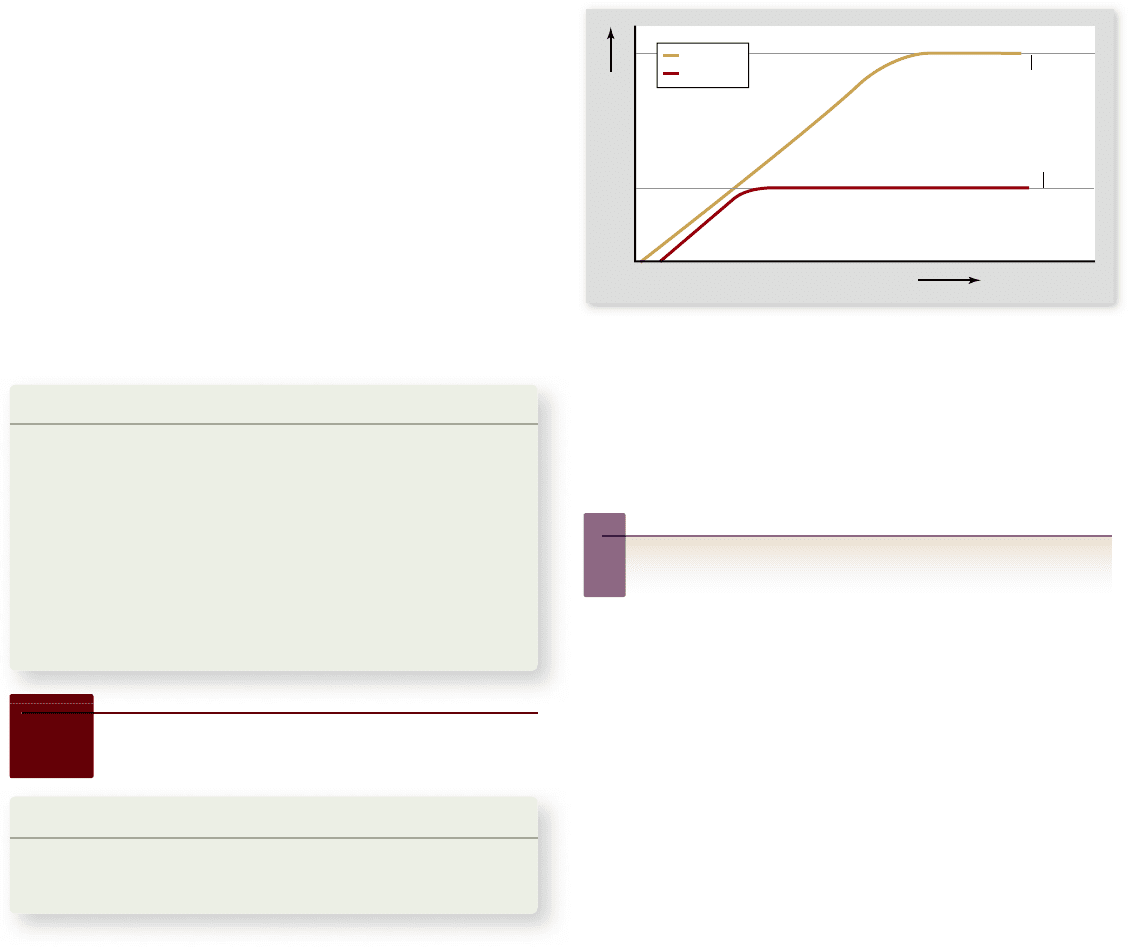
Figure 8.9
Saturation of photosynthesis. When
photosynthetic saturation is achieved, further increases in intensity
cause no increase in output. This saturation occurs far below the level
expected for the number of individual chlorophyll molecules present.
This led to the idea of organized photosystems, each containing many
chlorophyll molecules. These photosystems saturate at a lower O
2
yield
than that expected for the number of individual chlorophyll molecules.
Inquiry question
?
Under what experimental conditions would you expect the
saturation levels for a given number of chlorophyll molecules
to be higher?
pigment used in vertebrate vision. This connection explains
why eating carrots, which are rich in β-carotene, may en-
hance vision.
Phycobiloproteins are accessory pigments found in cy-
anobacteria and some algae. These pigments are composed of
proteins attached to a tetrapyrrole group. These pyrrole rings
contain a system of alternating double bonds similar to those
found in other pigments and molecules that transfer electrons.
Phycobiloproteins can be organized into complexes called phy-
cobilisomes to form another light-harvesting complex that can
absorb green light, which is typically reflected by chlorophyll.
These complexes are probably ecologically important to cy-
anobacteria, helping them to exist in low-light situations in
oceans. In this habitat, green light remains because red and blue
light has been absorbed by green algae closer to the surface.
Learning Outcomes Review 8.3
A pigment is a molecule that can absorb light energy; its absorption
spectrum shows the wavelengths at which it absorbs energy most
effi ciently. A pigment’s color results from the wavelengths it does not
absorb, which we then see. The main photosynthetic pigment is chlorophyll,
which exists in several forms with slightly diff erent absorption spectra.
Many photosynthetic organisms have accessory pigments with absorption
spectra diff erent from chlorophyll; these increase light capture.
■ What is the difference between an action spectrum
and an absorption spectrum?
Using the unicellular algae Chlorella, investigators could obtain these
values. Illuminating a Chlorella culture with pulses of light with in-
creasing intensity should increase the yield of O
2
per pulse until the
system becomes saturated. Then O
2
production can be compared
with the number of chlorophyll molecules present in the culture.
The observed level of O
2
per chlorophyll molecule at satura-
tion, however, turned out to be only one molecule of O
2
per 2500
chlorophyll molecules (figure 8.9). This result was very different
from what was expected, and it led to the idea that light is absorbed
not by independent pigment molecules, but rather by clusters of
chlorophyll and accessory pigment molecules (photosystems). Light
is absorbed by any one of hundreds of pigment molecules in a
photo system, and each pigment molecule transfers its excitation en-
ergy to a single molecule with a lower energy level than the others.
A generalized photosystem contains
an antenna complex and a reaction center
In chloroplasts and all but one class of photosynthetic prokaryotes,
light is captured by photosystems. Each photosystem is a network
of chlorophyll a molecules, accessory pigments, and associated
proteins held within a protein matrix on the surface of the photo-
synthetic membrane. Like a magnifying glass focusing light on a
precise point, a photosystem channels the excitation energy gath-
ered by any one of its pigment molecules to a specific molecule,
the reaction center chlorophyll. This molecule then passes the en-
ergy out of the photosystem as excited electrons that are put to
work driving the synthesis of ATP and organic molecules.
A photosystem thus consists of two closely linked compo-
nents: (1) an antenna complex of hundreds of pigment molecules
that gather photons and feed the captured light energy to the
8.4
Photosystem Organization
Learning Outcomes
Describe the nature of photosystems.1.
Understand what happens in the reaction center.2.
One way to study the role that pigments play in photosynthesis
is to measure the correlation between the output of photosyn-
thesis and the intensity of illumination—that is, how much
photosynthesis is produced by how much light. Experiments on
plants show that the output of photosynthesis increases linearly
at low light intensities, but finally becomes saturated (no fur-
ther increase) at high-intensity light. Saturation occurs because
all of the light-absorbing capacity of the plant is in use.
Production of one O
2
molecule requires
many chlorophyll molecules
Given the saturation observed with increasing light intensity,
the next question is how many chlorophyll molecules have ac-
tually absorbed a photon. The question can be phrased this
way: “Does saturation occur when all chlorophyll molecules
have absorbed photons?” Finding an answer required being
able to measure both photosynthetic output (on the basis of O
2
production) and the number of chlorophyll molecules present.
154
part
II
Biology of the Cell
rav32223_ch08_147-167.indd 154rav32223_ch08_147-167.indd 154 11/6/09 2:07:26 PM11/6/09 2:07:26 PM
Apago PDF Enhancer
e
:
e
:
Photon
Electron
donor
Chlorophyll
molecule
Electron
acceptor
Photosystem
Reaction center
chlorophyll
Thylakoid membrane
Electron
donor
Electron
acceptor
Acceptor
reduced
Chlorophyll
oxidized
Chlorophyll
reduced
Donor
oxidized
Excited
chlorophyll
molecule
Light
e
:
e
:
e
:
e
:
e
:
e
:
e
:
e
:
:
;
:
;
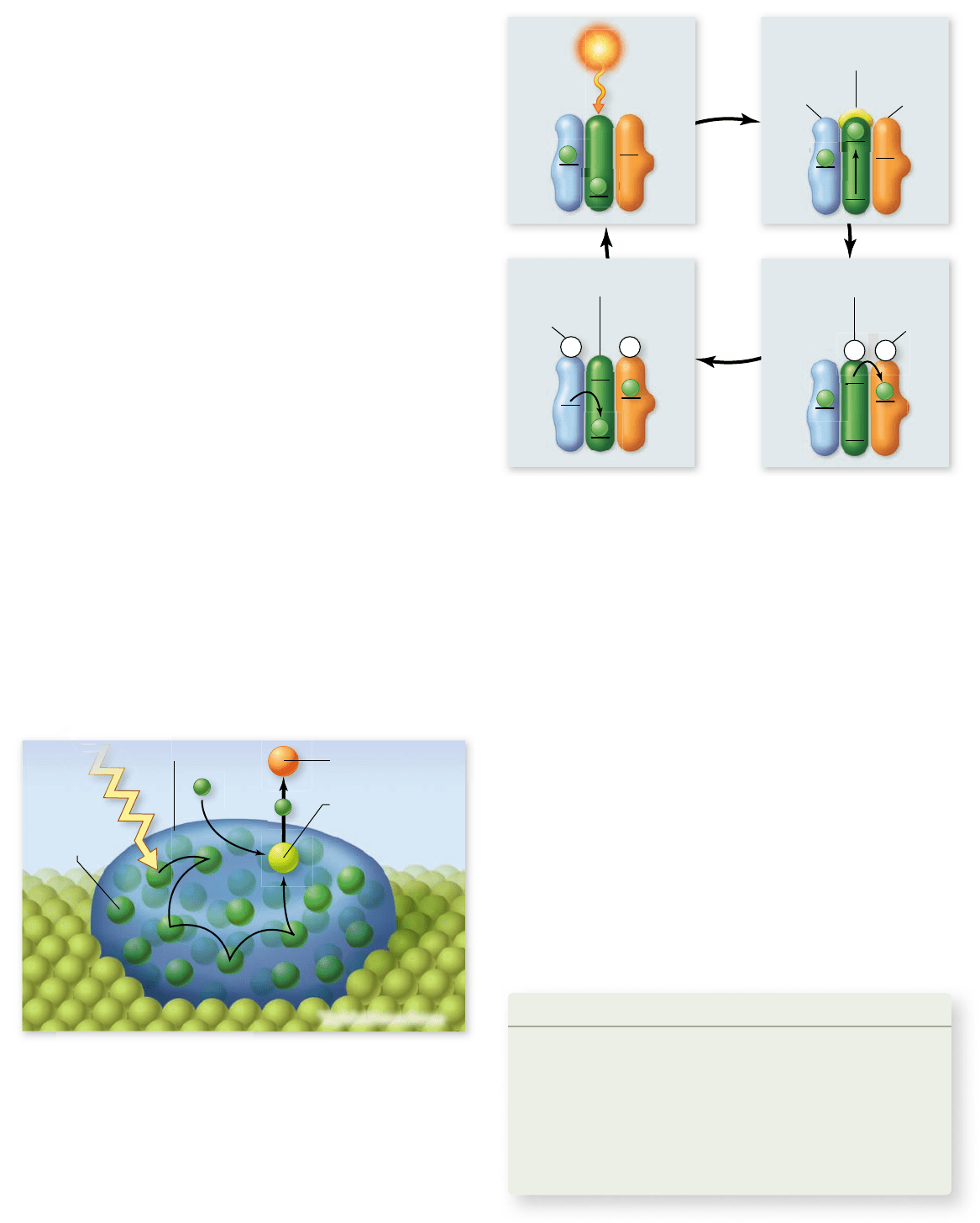
Figure 8.10
How the antenna complex works. When
light of the proper wavelength strikes any pigment molecule within
a photosystem, the light is absorbed by that pigment molecule. The
excitation energy is then transferred from one molecule to another
within the cluster of pigment molecules until it encounters the
reaction center chlorophyll a. When excitation energy reaches the
reaction center chlorophyll, electron transfer is initiated.
absorbed from photons to move away from the chlorophylls,
and it is the key conversion of light into chemical energy.
Figure 8.11 shows the transfer of excited electrons from
the reaction center to the primary electron acceptor. By ener-
gizing an electron of the reaction center chlorophyll, light cre-
ates a strong electron donor where none existed before. The
chlorophyll transfers the energized electron to the primary ac-
ceptor (a molecule of quinone), reducing the quinone and con-
verting it to a strong electron donor. A nearby weak electron
donor then passes a low-energy electron to the chlorophyll, re-
storing it to its original condition. The quinone transfers its
electrons to another acceptor, and the process is repeated.
In plant chloroplasts, water serves as this weak electron
donor. When water is oxidized in this way, oxygen is released
along with two protons (H
+
).
Learning Outcomes Review 8.4
Chlorophylls and accessory pigments are organized into photosystems
found in the thylakoid membrane. The photosystem can be subdivided into
an antenna complex, which is involved in light harvesting, and a reaction
center, where the photochemical reactions occur. In the reaction center, an
excited electron is passed to an acceptor; this transfers energy away from
the chlorophylls and is key to the conversion of light into chemical energy.
■ Why were photosystems an unexpected finding?
reaction center; and (2) a reaction center consisting of one or more
chlorophyll a molecules in a matrix of protein, that passes excited
electrons out of the photosystem.
The antenna complex
The antenna complex is also called a light-harvesting com-
plex, which accurately describes its role. This light-harvesting
complex captures photons from sunlight (figure 8.10) and chan-
nels them to the reaction center chlorophylls.
In chloroplasts, light-harvesting complexes consist of a
web of chlorophyll molecules linked together and held tightly
in the thylakoid membrane by a matrix of proteins. Varying
amounts of carotenoid accessory pigments may also be present.
The protein matrix holds individual pigment molecules in ori-
entations that are optimal for energy transfer.
The excitation energy resulting from the absorption of a
photon passes from one pigment molecule to an adjacent mol-
ecule on its way to the reaction center. After the transfer, the
excited electron in each molecule returns to the low-energy
level it had before the photon was absorbed. Consequently, it is
energy, not the excited electrons themselves, that passes from
one pigment molecule to the next. The antenna complex fun-
nels the energy from many electrons to the reaction center.
The reaction center
The reaction center is a transmembrane protein–pigment
complex. The reaction center of purple photosynthetic bacte-
ria is simpler than the one in chloroplasts but better under-
stood. A pair of bacteriochlorophyll a molecules acts as a trap
for photon energy, passing an excited electron to an acceptor
precisely positioned as its neighbor. Note that here in the re-
action center, the excited electron itself is transferred, and not
just the energy, as was the case in the pigment–pigment trans-
fers of the antenna complex. This difference allows the energy
Figure 8.11
Converting light to chemical energy. When a
chlorophyll in the reaction center absorbs a photon of light, an
electron is excited to a higher energy level. This light-energized
electron can be transferred to the primary electron acceptor,
reducing it. The oxidized chlorophyll then lls its electron “hole” by
oxidizing a donor molecule. The source of this donor varies with the
photosystem as discussed in the text.
chapter
8
Photosynthesis
155www.ravenbiology.com
rav32223_ch08_147-167.indd 155rav32223_ch08_147-167.indd 155 11/6/09 2:07:27 PM11/6/09 2:07:27 PM
Apago PDF Enhancer
ATP
Energy of electrons
High
Low
e
:
e
:
e
:
Photon
Photosystem
Electron
acceptor
Excited reaction center
Electron
acceptor
Reaction
center (P
870
)
b-c
1
complex
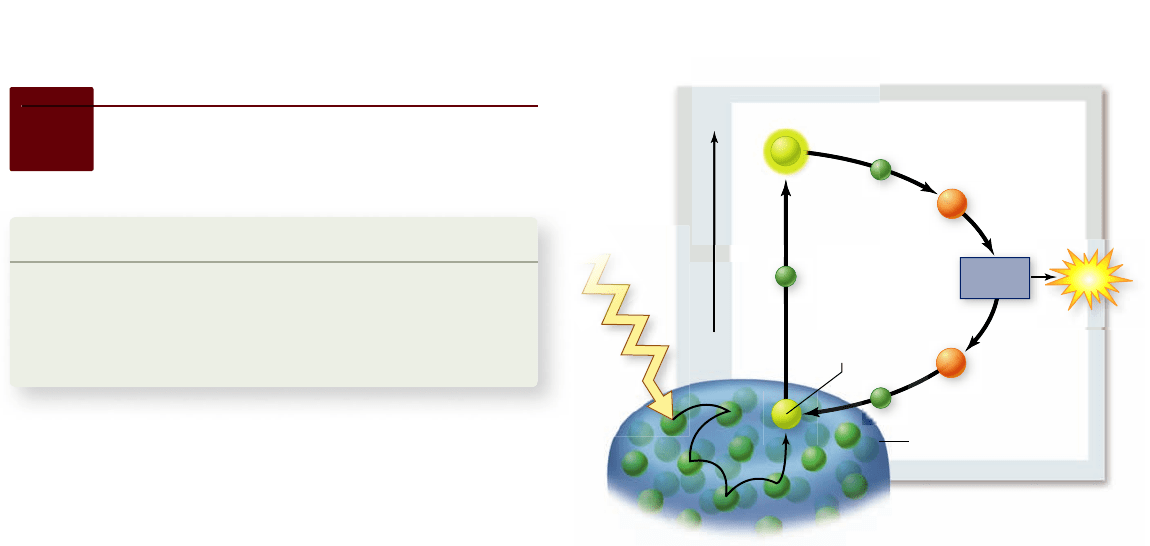
Figure 8.12
The path of an electron in purple nonsulfur
bacteria. When a light-energized electron is ejected from the
photosystem reaction center (P
870
) it returns to the photosystem via
a cyclic path that produces ATP but not NADPH.
8.5
The Light-Dependent
Reactions
Learning Outcomes
Compare the function of the two photosystems in 1.
green plants.
Explain how the light reactions generate ATP 2.
and NADPH.
As you have seen, the light-dependent reactions of photosyn-
thesis occur in membranes. In photosynthetic bacteria, the
plasma membrane itself is the photosynthetic membrane. In
many bacteria, the plasma membrane folds in on itself repeat-
edly to produce an increased surface area. In plants and algae,
photosynthesis is carried out by chloroplasts, which are thought
to be the evolutionary descendants of photosynthetic bacteria.
The internal thylakoid membrane is highly organized and
contains the structures involved in the light-dependent reactions.
For this reason, the reactions are also referred to as the thylakoid
reactions. The thylakoid reactions take place in four stages:
Primary photoevent.1. A photon of light is captured by a
pigment. This primary photoevent excites an electron
within the pigment.
Charge separation.2. This excitation energy is
transferred to the reaction center, which transfers an
energetic electron to an acceptor molecule, initiating
electron transport.
Electron transport.3. The excited electrons are shuttled
along a series of electron carrier molecules embedded
within the photosynthetic membrane. Several of them
react by transporting protons across the membrane,
generating a proton gradient. Eventually the electrons
are used to reduce a nal acceptor, NADPH.
Chemiosmosis.4. The protons that accumulate on one
side of the membrane now ow back across the
membrane through ATP synthase where chemiosmotic
synthesis of ATP takes place, just as it does in aerobic
respiration (see chapter 7 ).
These four processes make up the two stages of the light-
dependent reactions mentioned at the beginning of this chapter.
Steps 1 through 3 represent the stage of capturing energy from
light; step 4 is the stage of producing ATP (and, as you’ll see,
NADPH). In the rest of this section we discuss the evolution of
photosystems and the details of photosystem function in the
light-dependent reactions.
Some bacteria use a single photosystem
Photosynthetic pigment arrays are thought to have evolved more
than 2 bya in bacteria similar to the purple and green bacteria
alive today. In these bacteria, a single photosystem is used that
generates ATP via electron transport. This process then returns
the electrons to the reaction center. For this reason, it is called
cyclic photophosphorylation. These systems do not evolve oxy-
gen and are thus referred to as anoxygenic photosynthesis.
In the purple nonsulfur bacteria, peak absorption occurs at
a wavelength of 870 nm (near infrared, not visible to the human
eye), and thus the reaction center pigment is called P
870
. Absorp-
tion of a photon by chlorophyll P
870
does not raise an electron to
a high enough level to be passed to NADP, thus they must gener-
ate reducing power in a different way.
When the P
870
reaction center absorbs a photon, the ex-
cited electron is passed to an electron transport chain that
passes the electrons back to the reaction center, generating a
proton gradient for ATP synthesis (figure 8.12). The proteins
in the purple bacterial photosystem appear to be homologous
to the proteins in the modern photosystem II.
In the green sulfur bacteria, peak absorption occurs at a
wavelength of 840 nm (near infrared, not visible to the human
eye), and thus the reaction center pigment is called P
840
. Excited
electrons from this photosystem can be passed to NADPH , or
returned to the chlorophyll by an electron transport chain similar
to the purple bacteria. To replace electrons passed to NADPH,
hydrogen sulfide is used as an electron donor. The proteins in the
green sulfur bacterial photosystem appear to be homologous to
the proteins in the modern photosystem I.
Neither of these systems generate sufficient oxidizing
power to oxidize H
2
O. They are thus anoxygenic and take place
under anaerobic conditions. The linked photosystems of cy-
anobacteria and plant chloroplasts generate the oxidizing
power necessary to oxidize H
2
O, allowing it to serve as a source
of both electrons and protons.
Chloroplasts have two connected photosystems
In contrast to the sulfur bacteria, plants have two linked photo-
systems. This overcomes the limitations of cyclic photophos-
phorylation by providing an alternative source of electrons
156
part
II
Biology of the Cell
rav32223_ch08_147-167.indd 156rav32223_ch08_147-167.indd 156 11/6/09 2:07:30 PM11/6/09 2:07:30 PM
Apago PDF Enhancer
Rate of Photosynthesis
low
high
Far-red light on Both lights onRed light onOff Off
Time
Off
passed to photosystem I to drive the production of NADPH.
For every pair of electrons obtained from a molecule of water,
one molecule of NADPH and slightly more than one molecule
of ATP are produced.
Photosystem II
The reaction center of photosystem II closely resembles the
reaction center of purple bacteria. It consists of a core of 10
transmembrane protein subunits with electron transfer compo-
nents and two P
680
chlorophyll molecules arranged around this
core. The light-harvesting antenna complex consists of mole-
cules of chlorophyll a and accessory pigments bound to several
protein chains. The reaction center of photosystem II differs
from the reaction center of the purple bacteria in that it also
contains four manganese atoms. These manganese atoms are
essential for the oxidation of water.
Although the chemical details of the oxidation of water are
not entirely clear, the outline is emerging. Four manganese atoms
are bound in a cluster to reaction center proteins. Two water mol-
ecules are also bound to this cluster of manganese atoms. When
the reaction center of photosystem II absorbs a photon, an elec-
tron in a P
680
chlorophyll molecule is excited, which transfers this
electron to an acceptor. The oxidized P
680
then removes an elec-
tron from a manganese atom. The oxidized manganese atoms,
with the aid of reaction center proteins, remove electrons from
oxygen atoms in the two water molecules. This process requires
the reaction center to absorb four photons to complete the oxida-
tion of two water molecules, producing one O
2
in the process.
The role of the b
6
-f complex
The primary electron acceptor for the light-energized electrons
leaving photosystem II is a quinone molecule. The reduced
from the oxidation of water. The oxidation of water also gener-
ates O
2
, thus oxygenic photosynthesis. The noncyclic transfer
of electrons also produces NADPH, which can be used in the
biosynthesis of carbohydrates.
One photosystem, called photosystem I , has an absorption
peak of 700 nm, so its reaction center pigment is called P
700
. This
photosystem functions in a way analogous to the photosystem found
in the sulfur bacteria discussed earlier. The other photosystem,
called photosystem II, has an absorption peak of 680 nm, so its
reaction center pigment is called P
680
. This photosystem can gener-
ate an oxidation potential high enough to oxidize water. Working
together, the two photosystems carry out a noncyclic transfer of
electrons that is used to generate both ATP and NADPH.
The photosystems were named I and II in the order of
their discovery, and not in the order in which they operate in the
light-dependent reactions. In plants and algae, the two photo-
systems are specialized for different roles in the overall process of
oxygenic photosynthesis. Photosystem I transfers electrons ulti-
mately to NADP
+
, producing NADPH. The electrons lost from
photosystem I are replaced by electrons from photosystem II.
Photosystem II with its high oxidation potential can oxidize wa-
ter to replace the electrons transferred to photosystem I. Thus
there is an overall flow of electrons from water to NADPH.
These two photosystems are connected by a complex of
electron carriers called the cytochrome/b
6
-f complex (explained
shortly). This complex can use the energy from the passage of
electrons to move protons across the thylakoid membrane to gen-
erate the proton gradient used by an ATP synthase enzyme.
The two photosystems work together
in noncyclic photophosphorylation
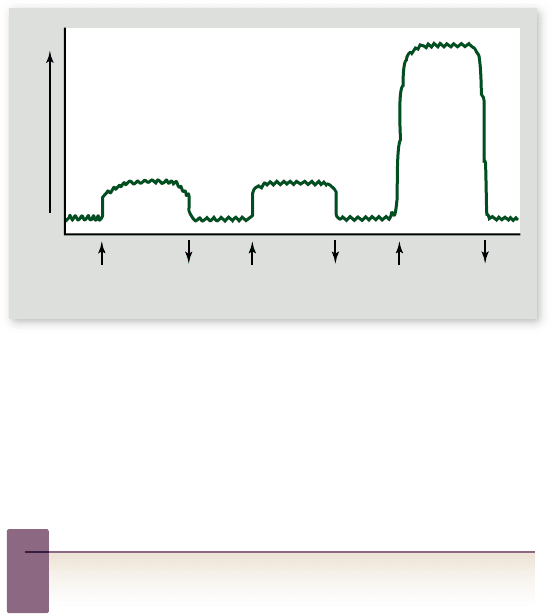
Evidence for the action of two photosystems came from experi-
ments that measured the rate of photosynthesis using two light
beams of different wavelengths: one red and the other far-red. Us-
ing both beams produced a rate greater than the sum of the rates
using individual beams of these wavelengths (figure 8.13). This
surprising result, called the enhancement effect, can be explained by
a mechanism involving two photosystems acting in series (that is,
one after the other), one photosystem absorbs preferentially in the
red, the other in the far-red.
Plants use photosystems II and I in series, first one and
then the other, to produce both ATP and NADPH. This two-
stage process is called noncyclic photophosphorylation be-
cause the path of the electrons is not a circle—the electrons
ejected from the photosystems do not return to them, but rather
end up in NADPH. The photosystems are replenished with
electrons obtained by splitting water.
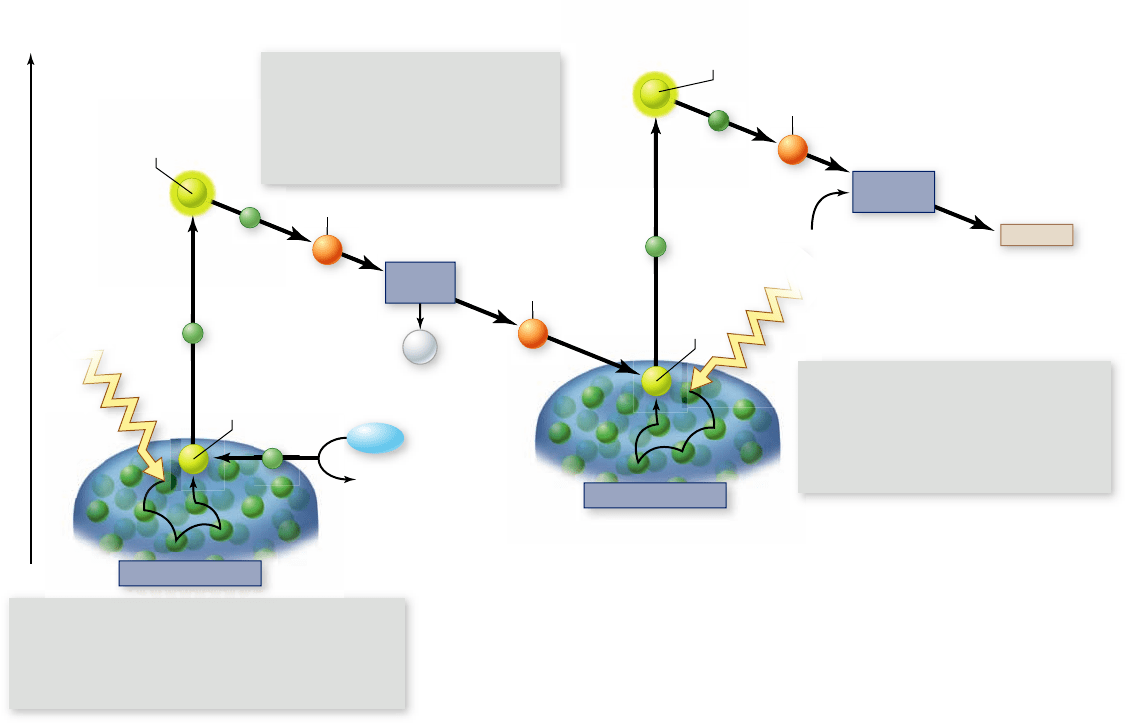
The scheme shown in figure 8.14, called a Z diagram, illus-
trates the two electron-energizing steps, one catalyzed by each
photosystem. The horizontal axis shows the progress of the light
reactions and the relative positions of the complexes, and the verti-
cal axis shows relative energy levels of electrons. The electrons
originate from water, which holds onto its electrons very tightly
(redox potential = +820 mV), and end up in NADPH, which holds
its electrons much more loosely (redox potential = –320 mV).
Photosystem II acts first. High-energy electrons gener-
ated by photosystem II are used to synthesize ATP and are then
Figure 8.13
The enhancement e ect. The rate of
photosynthesis when red and far-red light are provided together is
greater than the sum of the rates when each wavelength is provided
individually. This result baf ed researchers in the 1950s. Today, it
provides key evidence that photosynthesis is carried out by two
photochemical systems that act in series. One absorbs maximally in
the far red, the other in the red portion of the spectrum.
Inquiry question
?
What would you conclude if “both lights on” did not change
the relative rate of photosynthesis?
chapter
8
Photosynthesis
157www.ravenbiology.com
rav32223_ch08_147-167.indd 157rav32223_ch08_147-167.indd 157 11/6/09 2:07:31 PM11/6/09 2:07:31 PM
Apago PDF Enhancer
Energy of electrons
e
:
e
:
e
:
e
:
e
:
Photon
Reaction
center
Excited reaction center
Excited reaction center
Plastoquinone
Plastocyanin
Ferredoxin
Proton gradient formed
for ATP synthesis
Reaction
center
Photosystem II
Photosystem I
Photon
b
6
-f
complex
NADP
reductase
2. The electrons pass through the b
6
-f
complex, which uses the energy
released to pump protons across
the thylakoid membrane. The proton
gradient is used to produce ATP by
chemiosmosis.
3. A pair of chlorophylls in the reaction
center absorb two photons. This excites
two electrons that are passed to
NADP
;
, reducing it to NADPH.
Electron transport from photosystem II
replaces these electrons.
1. A pair of chlorophylls in the reaction center absorb
two photons of light. This excites two electrons that
are transferred to plastoquinone (PQ). Loss of
electrons from the reaction center produces an
oxidation potential capable of oxidizing water.
H
2
O
H
;
PQ
PC
Fd
2H
;
+
1
/
2
O
2
NADP
;
+H
;
NADPH
2
2
2
2
2
two molecules of reduced ferredoxin, are then donated to a mol-
ecule of NADP
+
to form NADPH. The reaction is catalyzed by
the membrane-bound enzyme NADP reductase.
Because the reaction occurs on the stromal side of the mem-
brane and involves the uptake of a proton in forming NADPH, it
contributes further to the proton gradient established during
photo synthetic electron transport. The function of the two photo-
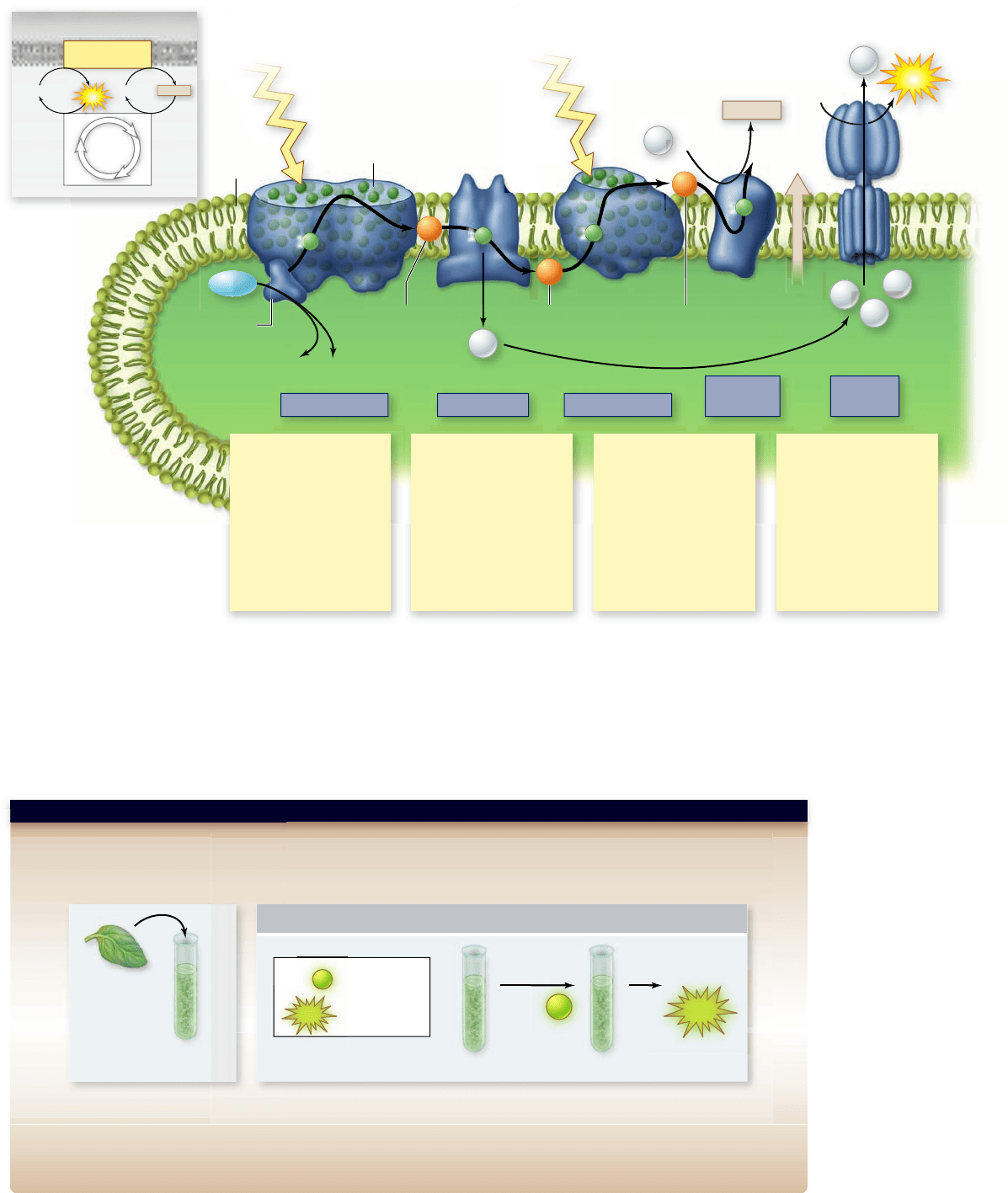
systems is summarized in figure 8.15.
ATP is generated by chemiosmosis
Protons are pumped from the stroma into the thylakoid com-
partment by the b
6
-f complex. The splitting of water also pro-
duces added protons that contribute to the gradient. The
thylakoid membrane is impermeable to protons, so this creates
an electrochemical gradient that can be used to synthesize ATP.
ATP synthase
The chloroplast has ATP synthase enzymes in the thylakoid
membrane that form a channel, allowing protons to cross back
out into the stroma. These channels protrude like knobs on the
external surface of the thylakoid membrane. As protons pass
out of the thylakoid through the ATP synthase channel, ADP is
phosphorylated to ATP and released into the stroma (see
figure 8.15). The stroma contains the enzymes that catalyze the
reactions of carbon fixation—the Calvin cycle reactions.
This mechanism is the same as that seen in the mitochon-
drial ATP synthase, and, in fact, the two enzymes are evolution-
arily related. This similarity in generating a proton gradient by
quinone that results from accepting a pair of electrons (plasto-
quinone ) is a strong electron donor; it passes the excited electron
pair to a proton pump called the b
6
-f complex embedded within
the thylakoid membrane (figure 8.15). This complex closely re-
sembles the bc
1
complex in the respiratory electron transport
chain of mitochondria, discussed in chapter 7 .
Arrival of the energetic electron pair causes the b
6
-f complex
to pump a proton into the thylakoid space. A small, copper -
containing protein called plastocyanin then carries the electron pair
to photosystem I.
Photosystem I
The reaction center of photosystem I consists of a core trans-
membrane complex consisting of 12 to 14 protein subunits with
two bound P
700
chlorophyll molecules. Energy is fed to it by an
antenna complex consisting of chlorophyll a and accessory pig-
ment molecules.
Photosystem I accepts an electron from plastocyanin into
the “hole” created by the exit of a light-energized electron. The
absorption of a photon by photosystem I boosts the electron
leaving the reaction center to a very high energy level. The elec-
trons are passed to an iron–sulfur protein called ferredoxin. Un-
like photosystem II and the bacterial photosystem, the plant
photosystem I does not rely on quinones as electron acceptors.
Making NADPH
Photosystem I passes electrons to ferredoxin on the stromal side
of the membrane (outside the thylakoid). The reduced ferredoxin
carries an electron with very high potential. Two of them, from
Figure 8.14
Z diagram of photosystems I and II. Two photosystems work
sequentially and have different roles. Photosystem II passes energetic electrons to
photosystem I via an electron transport chain. The electrons lost are replaced by
oxidizing water. Photosystem I uses energetic electrons to reduce NADP
+
to NADPH.
158
part
II
Biology of the Cell
rav32223_ch08_147-167.indd 158rav32223_ch08_147-167.indd 158 11/6/09 2:07:31 PM11/6/09 2:07:31 PM
Apago PDF Enhancer
Photosystem II Photosystem I b
6
-f complex
Stroma
Thylakoid
space
NADP
reductase
Plastoquinone
Water-splitting
enzyme
Proton
gradient
Plastocyanin Ferredoxin
ATP
synthase
4. ATP synthase uses
the proton gradient to
synthesize ATP from
ADP and P
i
.
The
enzyme acts as a
channel for protons to
diffuse back into the
stroma using this
energy to drive the
synthesis of ATP.
1. Photosystem II
absorbs photons,
exciting electrons that
are passed to
plastoquinone (PQ).
Electrons lost from
photosystem II are
replaced by the
oxidation of water,
producing O
2
.
2. The b
6
-f complex
receives electrons
from PQ and passes
them to plastocyanin
(PC). This provides
energy for the b
6
-f
complex to pump
protons into the
thylakoid.
3. Photosystem I
absorbs photons,
exciting electrons that
are passed through a
carrier to reduce
NADP
;
to NADPH.
These electrons are
replaced by electron
transport from
photosystem II.
H
;
H
;
H
;
H
;
1
/
2
O
2
2H
;
NADPH
ATP
H
;
Thylakoid
membrane
Antenna
complex
ADP
H
;
+NADP
;
NADPH
Light-Dependent
Reactions
NADP
ATP
ADP+P
i
Calvin
Cycle
Photon
Photon
H
2
O
e
:
e
:
e
:
e
:
Fd
PC
PQ
2
2
2
2
Hypothesis: Photophosphorylation is coupled to electron transport by a proton gradient.
Prediction: If a proton gradient can be formed artificially, then isolated chloroplasts will phosphorylate ADP in the dark.
Test: Isolated chloroplasts are incubated in acid medium, then transferred in the dark to a basic medium to create an artificial proton gradient.
Result: Isolated chloroplasts can phosphorylate ADP in the dark as assayed by the incorporation of radioactive PO
4
into ATP.
Conclusion: The energy from electron transport in the chloroplast is coupled to the phosphorylation of ADP by a proton gradient.
Further Experiments: If an agent that makes membranes permeable to protons were included in this experiment, what would be the
outcome? Would this argue for or against the hypothesis?
SCIENTIFIC THINKING
Spinach leaf
Dark conditions
Add
pH 4.0 pH 8.0
Assay for
Isolated
chloroplasts
radioactive P
i
radioactive
ATP
P
i
ATP
P
i
ATP
ADP+
phosphorylation was actually discovered earlier (figure 8.16)
and formed the background for experiments using the mito-
chondrial ATP synthase.
electron transport and ATP by chemiosmosis illustrates the
similarities in structure and function in mitochondria and chlo-
roplasts. Evidence for this chemiosmotic mechanism for photo-
Figure 8.15
The photosynthetic electron transport system and ATP synthase. The two photosystems are arranged in the
thylakoid membrane joined by an electron transport system that includes the b
6
-f complex. These function together to create a proton gradient
that is used by ATP synthase to synthesize ATP.
Figure 8.16
The Jagendorf
acid bath
experiment.
chapter
8
Photosynthesis
159www.ravenbiology.com
rav32223_ch08_147-167.indd 159rav32223_ch08_147-167.indd 159 11/6/09 2:07:32 PM11/6/09 2:07:32 PM
Apago PDF Enhancer
Photosystem II
Photosystem I
Cytochrome b
6
-f
ATP synthase
Grana Stoma lamella
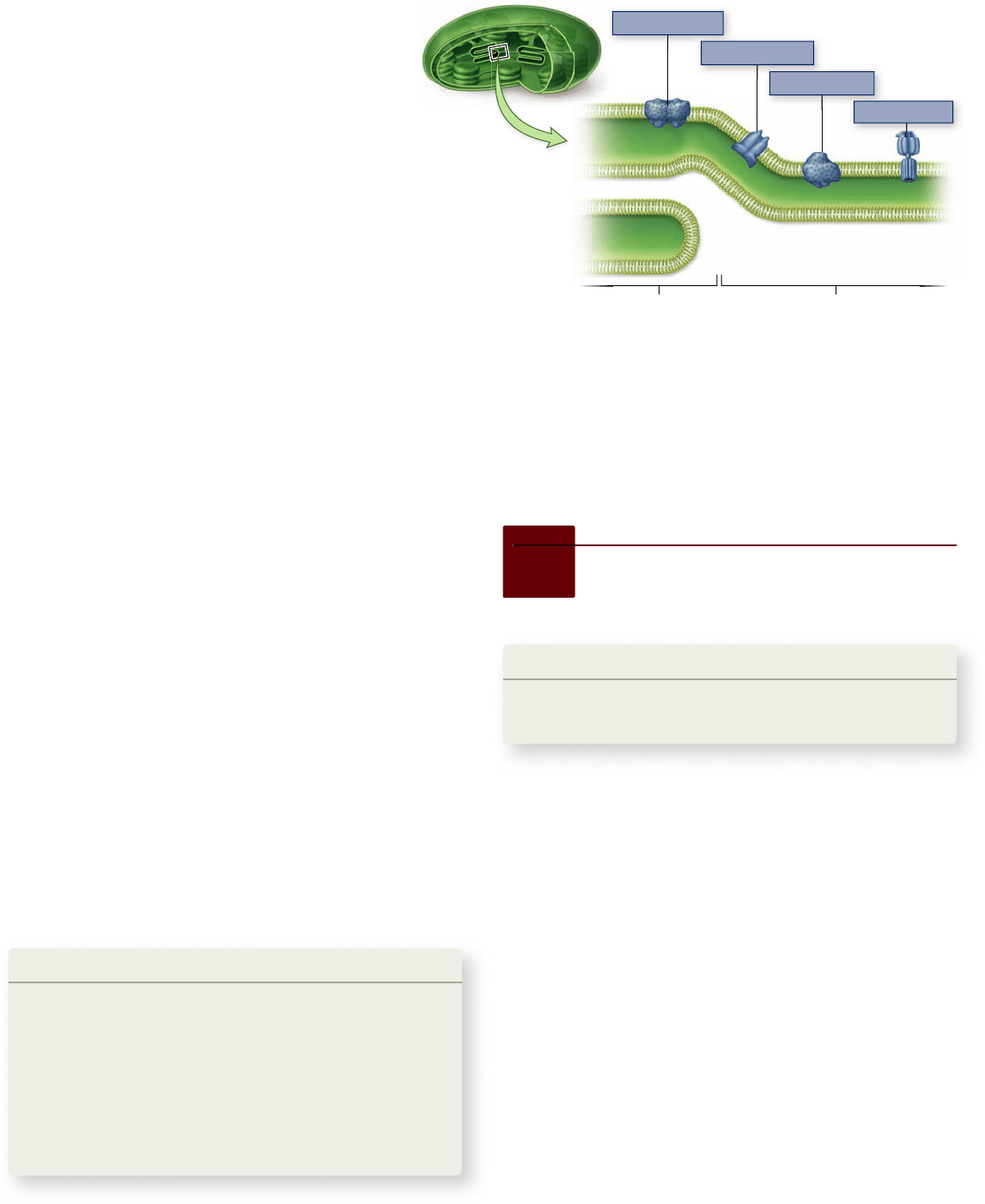
Figure 8.17
Model for the arrangement of complexes
within the thylakoid. The arrangement of the two kinds of
photosystems and the other complexes involved in photosynthesis is
not random. Photosystem II is concentrated within grana, especially
in stacked areas. Photosystem I and ATP synthase are concentrated
in stroma lamella and the edges of grana. The cytochrome b
6
-f
complex is in the margins between grana and stroma lamella. This is
one possible model for this arrangement.
8.6
Carbon Fixation:
The Calvin Cycle
Learning Outcomes
Describe carbon fixation.1.
Explain how the Calvin cycle produces glucose.2.
Carbohydrates contain many C
–
H bonds and are highly re-
duced compared with CO
2
. To build carbohydrates, cells use
energy and a source of electrons produced by the light-dependent
reactions of the thylakoids:
Energy.1. ATP (provided by cyclic and noncyclic
photophosphorylation) drives the endergonic reactions.
Reduction potential.2. NADPH (provided by
photosystem I) provides a source of protons and the
energetic electrons needed to bind them to carbon atoms.
Much of the light energy captured in photosynthesis ends
up invested in the energy-rich C
–
H bonds of sugars.
Calvin cycle reactions convert inorganic
carbon into organic molecules
Because early research showed temperature dependence, photo-
synthesis was predicted to involve enzyme-catalyzed reactions.
These reactions form a cycle of enzyme-catalyzed steps much
like the Krebs cycle of respiration. Unlike the Krebs cycle,
The production of additional ATP
The passage of an electron pair from water to
NADPH in noncyclic photophosphorylation gener-
ates one molecule of NADPH and slightly more than
one molecule of ATP. But as you will learn later in this
chapter, building organic molecules takes more energy
than that—it takes 1.5 ATP molecules per NADPH mole-
cule to fix carbon.
To produce the extra ATP, many plant species are
capable of short-circuiting photosystem I, switching photo-
synthesis into a cyclic photophosphorylation mode, so that the
light-excited electron leaving photosystem I is used to make
ATP instead of NADPH. The energetic electrons are simply
passed back to the b
6
-f complex, rather than passing on to
NADP
+
. The b
6
-f complex pumps protons into the thylakoid
space, adding to the proton gradient that drives the chemios-
motic synthesis of ATP. The relative proportions of cyclic and
noncyclic photophosphorylation in these plants determine
the relative amounts of ATP and NADPH available for build-
ing organic molecules.
Thylakoid structure reveals
components’ locations
The four complexes responsible for the light-dependent
reactions—namely photosystems I and II, cytochrome b
6
-f, and
ATP synthase—are not randomly arranged in the thylakoid.
Researchers are beginning to image these complexes with the
atomic force microscope, which can resolve nanometer scale
structures , and a picture is emerging in which photosystem II is
found primarily in the grana, whereas photosystem I and ATP
synthase are found primarily in the stroma lamella. Photo-
system I and ATP synthase may also be found in the edges of
the grana that are not stacked. The cytochrome b
6
-f complex is
found in the borders between grana and stroma lamella. One
possible model for the arrangement of the complexes is shown
in figure 8.17.
The thylakoid itself is no longer thought of only as stacked
disks. Some models of the thylakoid, based on electron micros-
copy and other imaging, depict the grana as folds of the inter-
connecting stroma lamella. This kind of arrangement is more
similar to the folds seen in bacterial photosynthesis, and it
would therefore allow for more flexibility in how the various
complexes are arranged relative to one another.
Learning Outcomes Review 8.5
The chloroplast has two photosystems located in the thylakoid membrane
that are connected by an electron transport chain. Photosystem I passes an
electron to NADPH. This electron is replaced by one from photosystem II.
Photosystem II can oxidize water to replace the electron it has lost. A proton
gradient is built up in the thylakoid space, and this gradient is used to
generate ATP as protons pass through the ATP synthase enzyme.
■ If the thylakoid membrane were leaky to protons,
would ATP still be produced? Would NADPH?
160
part
II
Biology of the Cell
rav32223_ch08_147-167.indd 160rav32223_ch08_147-167.indd 160 11/6/09 2:07:34 PM11/6/09 2:07:34 PM
Apago PDF Enhancer
P
H
A
S
E
2
P
H
A
S
E
1
P
H
A
S
E
3
Rubisco
6 ATP
12 ATP
6 molecules of
10 molecules of
Ribulose 1,5-bisphosphate (5C) (RuBP)
Glyceraldehyde 3-phosphate (3C)
6 ADP
4
P
i
12 molecules of
12 NADP
;
Glyceraldehyde 3-phosphate (3C) (G3P)
12
P
i
12 molecules of
12 ADP
1,3-bisphosphoglycerate (3C)
12 NADPH
12 molecules of
3-phosphoglycerate (3C) (PGA)
Stroma of chloroplast
6 molecules of
Carbon
dioxide (CO
2
)
2 molecules of
Glyceraldehyde 3-phosphate (3C) (G3P)
Glucose and
other sugars
NADPH
Light-Dependent
Reactions
NADP
;
ATP
ADP+P
i
Calvin
Cycle
Calvin Cycle
R
e
g
e
n
e
r
a
t
i
o
n
o
f
R
u
B
P
R
e
d
u
c
t
i
o
n
C
a
r
b
o
n
f
i
x
a
t
i
o
n
carbon 3-phosphoglycerate (PGA). This overall reaction is called
the carbon fixation reaction because inorganic carbon (CO
2
) has
been incorporated into an organic form: the acid PGA. The en-
zyme that carries out this reaction, ribulose bisphosphate
carboxylase/oxygenase (usually abbreviated rubisco) is a large,
16-subunit enzyme found in the chloroplast stroma.
Carbon is transferred through cycle
intermediates, eventually producing glucose
We will consider how the Calvin cycle can produce one molecule
of glucose, although this glucose is not produced directly by the
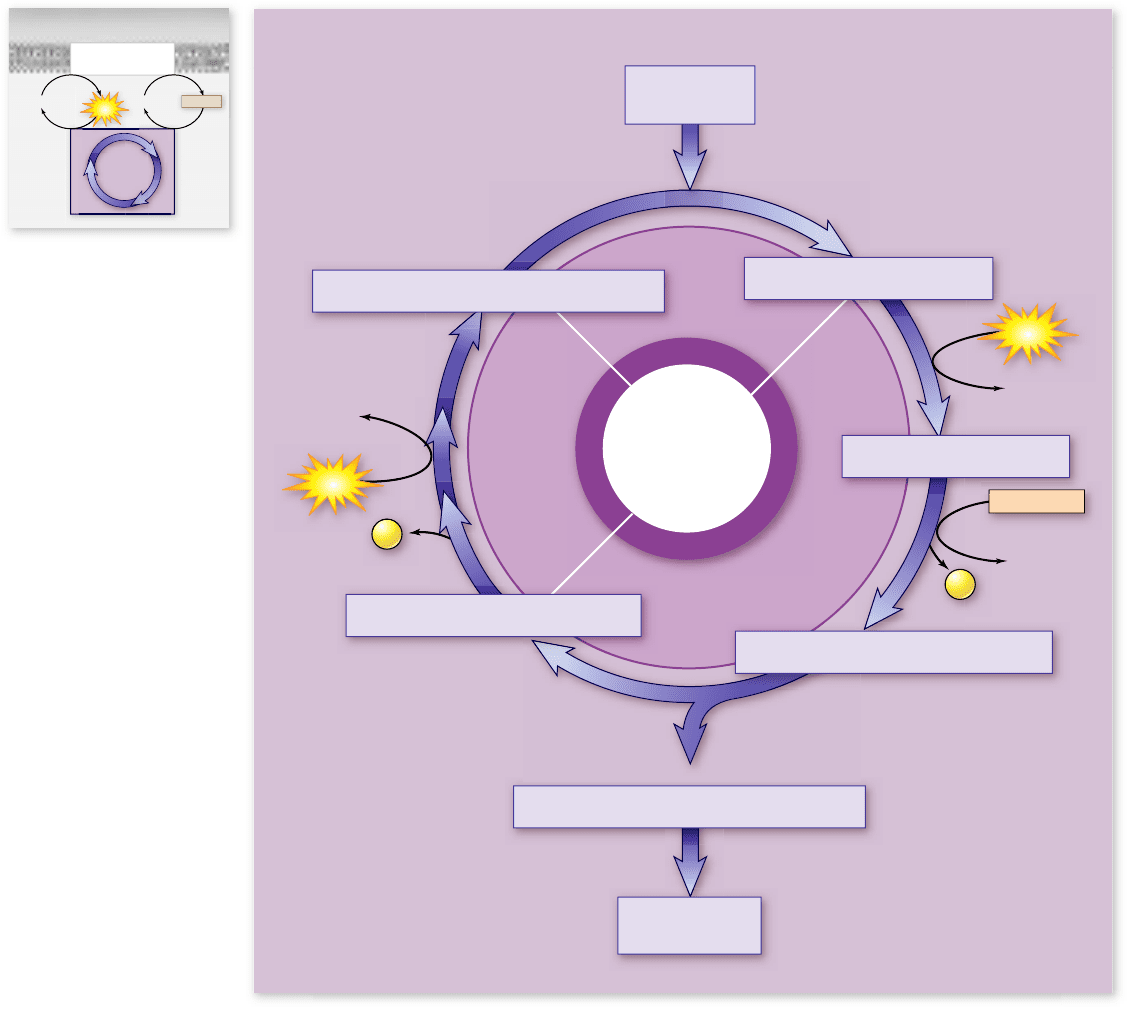
cycle (figure 8.18). In a series of reactions, six molecules of CO
2
are bound to six RuBP by rubisco to produce 12 molecules of
however, carbon fixation is geared toward producing new com-
pounds, so the nature of the cycles is quite different.
The cycle of reactions that allow carbon fixation is called the
Calvin cycle, after its discoverer, Melvin Calvin (1911–1997). Be-
cause the first intermediate of the cycle, phosphoglycerate, contains
three carbon atoms, this process is also called C
3
photosynthesis.
The key step in this process—the event that makes the
reduction of CO
2
possible—is the attachment of CO
2
to a
highly specialized organic molecule. Photosynthetic cells pro-
duce this molecule by reassembling the bonds of two interme-
diates in glycolysis—fructose 6-phosphate and glyceraldehyde
3-phosphate (G3P)—to form the energy-rich 5-carbon sugar
ribulose 1,5-bisphosphate (RuBP).
CO
2
reacts with RuBP to form a transient 6-carbon inter-
mediate that immediately splits into two molecules of the three-
Figure 8.18
The
Calvin cycle. The Calvin
cycle accomplishes carbon
xation: converting
inorganic carbon in the
form of CO
2
into organic
carbon in the form of
carbohydrates. The cycle
can be broken down into
three phases: (1) carbon
xation, (2) reduction, and
(3) regeneration of RuBP.
For every six CO
2
molecules xed by the
cycle, a molecule of glucose
can be synthesized from the
products of the reduction
reactions, G3P. The cycle
uses the ATP and
NADPH produced by
the light reactions.
chapter
8
Photosynthesis
161www.ravenbiology.com
rav32223_ch08_147-167.indd 161rav32223_ch08_147-167.indd 161 11/6/09 2:07:36 PM11/6/09 2:07:36 PM