
Raven P.H., Johnson G.B., Mason K.A. Biology (Ninth Edition)
Подождите немного. Документ загружается.

Apago PDF Enhancer
Phosphorylase
kinase
P
Cytoplasm
Adenylyl
cyclase
Adenylyl
cyclase
Glycogen
phosphorylase
Epinephrine
Glucagon
P P P
P P P P
Glycogen
P
CH
2
GDP
GDP
GTP
GTP
ATP
GPCR
PKA
cAMP
Glucose-6-phosphate
ATP
Ca
2;
Ca
2;
Ca
2;
Ca
2;
Ca
2;
Inactive
protein
Active
protein
Calmodulin
Calmodulin
a. b.
protein kinases, ion channels, receptor proteins, and cyclic
nucleotide phosphodiesterases. These many uses of Ca
2+
make
it one of the most versatile second messengers in cells.
Di erent receptors can produce the same
second messengers
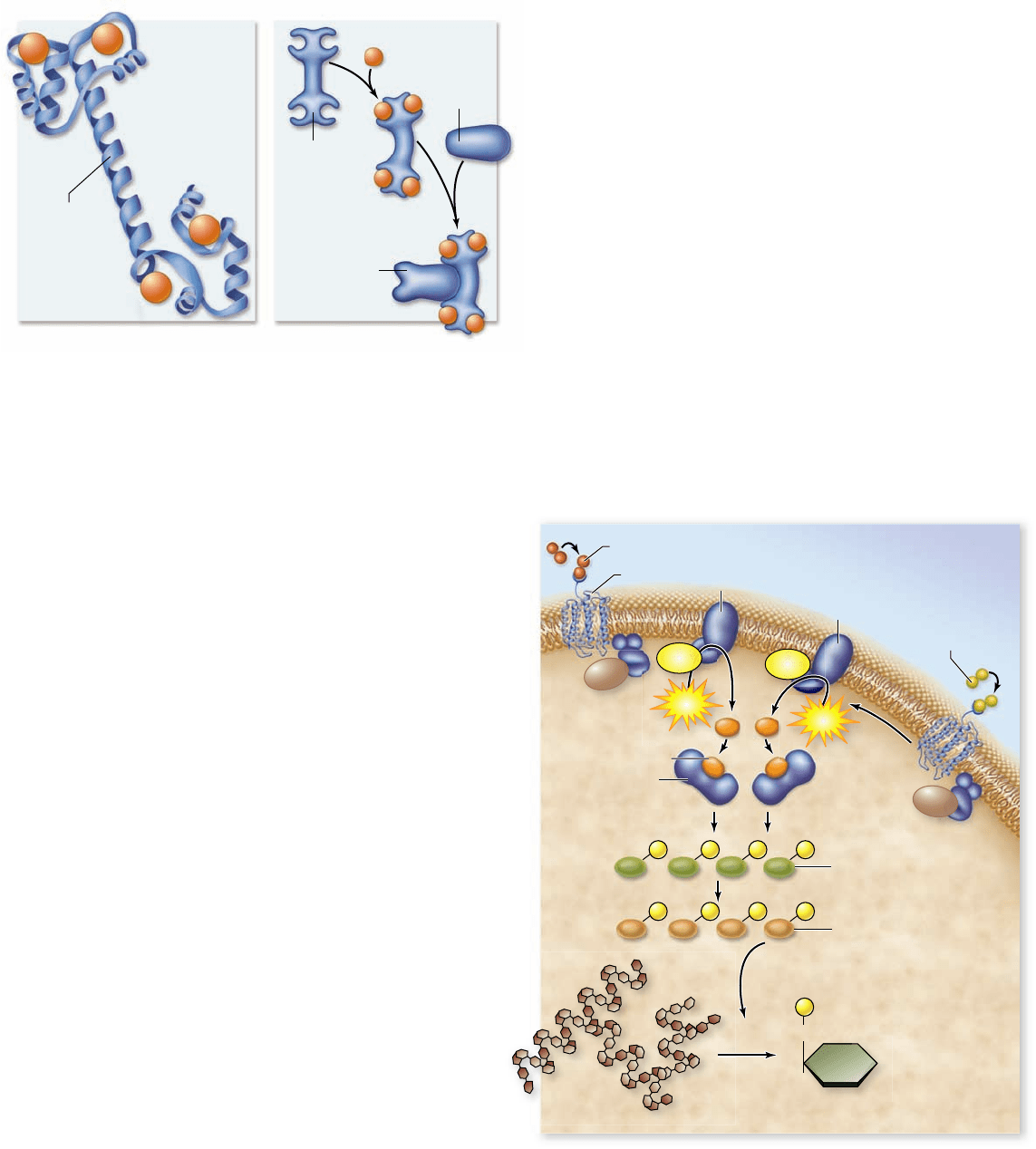
As mentioned previously, the two hormones glucagon and epi-
nephrine can both stimulate liver cells to mobilize glucose. The
reason that these different signals have the same effect is that
they both act by the same signal transduction pathway to stim-
ulate the breakdown and inhibit the synthesis of glycogen.
The binding of either hormone to its receptor activates a G
protein that simulates adenylyl cyclase. The production of cAMP
leads to the activation of PKA, which in turn activates another
protein kinase called phosphorylase kinase. Activated phosphory-
lase kinase then activates glycogen phosphorylase, which cleaves
off units of glucose-6-phosphate from the glycogen polymer
(figure 9.17). The action of multiple kinases again leads to amplifi-
cation such that a few signaling molecules result in a large number
of glucose molecules being released.
At the same time, PKA also phosphorylates the enzyme
glycogen synthase, but in this case it inhibits the enzyme, thus pre-
venting the synthesis of glycogen. In addition, PKA phosphory-
lates other proteins that activate the expression of genes encoding
the enzymes needed to synthesize glucose. This convergence of
signal transduction pathways from different receptors leads to the
same result—glucose is mobilized.
Receptor subtypes can lead to di erent
e ects in di erent cells
We also saw earlier how a single signaling molecule, epineph-
rine, can have different effects in different cells. One way this
happens is through the existence of multiple forms of the same
receptor. The receptor for epinephrine actually has nine differ-
ent subtypes, or isoforms. These are encoded by different genes
and are actually different receptor molecules. The sequences of
these proteins are very similar, especially in the ligand-binding
domain, which allows them to bind epinephrine. They differ
mainly in their cytoplasmic domains, which interact with G pro-
teins. This leads to different isoforms activating different G pro-
teins, thereby leading to different signal transduction pathways.
Thus, in the heart, muscle cells have one isoform of
the receptor that, when bound to epinephrine, activates a
G protein that activates adenylyl cyclase, leading to increased
cAMP. This increases the rate and force of contraction. In the
intestine, smooth muscle cells have a different isoform of the
receptor that, when bound to epinephrine, activates a different
G protein that inhibits adenylyl cyclase, which decreases cAMP.
This has the result of relaxing the muscle.
G protein-coupled receptors and receptor
tyrosine kinases can activate the same pathways
Different receptor types can affect the same signaling module. For
example, RTKs were shown to activate the MAP kinase cascade,
Figure 9.16
C a l m o d u l i n . a. Calmodulin is a protein
containing 148 amino acid residues that mediates Ca
2+
function.
b. When four Ca
2+
are bound to the calmodulin molecule, it
undergoes a conformational change that allows it to bind to other
cytoplasmic proteins and effect cellular responses.
F i g u r e 9 . 1 7
Di erent receptors can activate the same
signaling pathway. The hormones glucagon and epinephrine
both act through GPCRs. Each of these receptors acts via a
G protein that activates adenylyl cyclase, producing cAMP.
The activation of PKA begins a kinase cascade that leads to the
breakdown of glycogen.
182
part
II
Biology of the Cell
rav32223_ch09_168-185.indd 182rav32223_ch09_168-185.indd 182 11/6/09 2:33:21 PM11/6/09 2:33:21 PM

Apago PDF Enhancer
but GPCRs can also activate this same cascade. Similarly, the ac-
tivation of phospholipase C was mentioned previously in the con-
text of GPCR signaling, but it can also be activated by RTKs.
This cross-reactivity may appear to introduce complica-
tions into cell function, but in fact it provides the cell with an
incredible amount of flexibility. Cells have a large, but limited
number of intracellular signaling modules, which can be turned
on and off by different kinds of membrane receptors. This leads
to signaling networks that interconnect possible cellular effec-
tors with multiple incoming signals.
The Internet represents an example of a network in which
many different kinds of computers are connected globally. This
network can be broken down into subnetworks that are connected
to the overall network. Because of the nature of the connections,
when you send an e-mail message across the Internet, it can reach
its destination through many different pathways. Likewise, the cell
has interconnected networks of signaling pathways in which many
different signals, receptors, and response proteins are intercon-
nected. Specific pathways like the MAP kinase cascade, or signal-
ing through second messengers like cAMP and Ca
2+
, represent
subnetworks within the global signaling network. A specific signal
can activate different pathways in different cells, or different sig-
nals can activate the same pathway. We do not yet understand the
cell at this level, but the field of systems biology is moving toward
such global understanding of cell function.
Learning Outcomes Review 9.5
Signaling through GPCRs uses a three-part system—a receptor, a
G protein, and an eff ector protein. G proteins are active when bound to
GTP and inactive when bound to GDP. A ligand binding to the receptor
activates the G protein, which then activates the eff ector protein.
Eff ector proteins include adenylyl cyclase, which produces the second
messenger cAMP. Another eff ector protein, phospholipase C, cleaves the
inositol phosphates and results in the release of Ca
2+
from the ER.
■ There are far more GPCRs than any other receptor type.
What is a possible explanation for this?
Membrane receptors include three subclasses.
Channel-linked receptors are chemically gated ion channels that
allow speci c ions to pass through a central pore.
Enzymatic receptors are enzymes activated by binding a ligand; these
enzymes are usually protein kinases.
G protein-coupled receptors interact with G proteins that control
the function of effector proteins: enzymes or ion channels.
Membrane receptors can generate second messengers.
Some enzymatic and most G protein-coupled receptors produce
second messengers, to relay messages in the cytoplasm.
9.3 Intracellular Receptors ( gure 9.5)
Many cell signals are lipid-soluble and readily pass through the
plasma membrane and bind to receptors in the cytoplasm
or nucleus.
Steroid hormone rec
eptors a ect gene expression.
Steroid hormones bind cytoplasmic receptors then are transported to
the nucleus. Thus, they are called nuclear receptors. These can directly
affect gene expression, usually activating transcription of the genes
they control.
Nuclear receptors have three functional domains: hormone-binding,
DNA-binding, and transcription-activating domains.
Ligand binding changes receptor shape, releasing an inhibitor
occupying the DNA-binding site.
A cell’s response to a lipid-soluble signal depends on the hormone–
receptor complex and the other protein coactivators present.
Other intracellular receptors act as enzymes.
Chapter Review
9.1 Overview of Cell Communication ( gure 9.1)
Cell communication requires signal molecules, called ligands,
binding to speci
c receptor proteins producing a cellular response.
Signaling is de ned by the distance from source to receptor ( gure 9.2).
Direct contact—molecules on the plasma membrane of one cell
contact the receptor molecules on an adjacent cell.
Paracrine signaling—short-lived signal molecules are released into
the extracellular uid and in uence neighboring cells.
Endocrine signaling—long-lived hormones enter the circulatory
system and are carried to target cells some distance away.
Synaptic signaling—short-lived neurotransmitters are released by
neurons into the gap, called a synapse, between nerves and
target cells.
Signal transduction pathways lead to cellular responses.
Intracellular events initiated by a signaling event are called
signal transduction.
Phosphorylation is key in control of protein function.
Proteins can be controlled by phosphate added by kinase and
removed by phosphatase enzymes.
9.2 Receptor Types ( gure 9.4)
Receptors are de
ned by location.
Receptors are broadly de ned as intracellular or cell-surface
receptors (membrane receptors).
Membrane receptors are transmembrane proteins that transfer
information across the membrane, but not the signal molecule.
www.ravenbiology.com
chapter
9
Cell Communication
183
rav32223_ch09_168-185.indd 183rav32223_ch09_168-185.indd 183 11/6/09 2:33:23 PM11/6/09 2:33:23 PM

Apago PDF Enhancer
9.4 Signal Transduction Through
Receptor Kinases
Receptor kinases in plants and animals recognize hydrophilic ligands
and in uence the cell cycle, cell migration, cell metabolism, and
cell proliferation.
Because they are involved in growth control, alterations of receptor
kinases and their signaling pathways can lead to cancer.
RTKs are activated by autophosphorylation.
The activated receptor can also phosphorylate other
intracellular proteins.
Phosphotyrosine domains mediate protein–protein interactions.
Adapter proteins can bind to phosphotryrosine and act as links
between the receptors and downstream signaling events.
Protein kinase cascades can amplify a signal.
Sca old proteins organize kinase cascades.
Scaffold proteins and protein kinases form a single complex where
the enzymes act sequentially and are optimally functional.
Internalized receptors are degraded or recycled.
Ras proteins link receptors with kinase cascades.
RTKs are inactivated by internalization.
9.5 Signal Transduction Through
G Protein-Coupled Receptors
( gure 9.11)
G protein-coupled receptors function through activation of
G proteins.
G proteins link rec
eptors with e ector proteins.
G proteins are active bound to GTP and inactive bound to GDP.
Receptors promote exchange of GDP for GTP.
The activated G protein dissociates into two parts, G
α
and G
βγ
, each
of which can act on effector proteins.
G
α
also hydrolyzes GTP to GDP to inactivate the G protein.
E ector proteins produce multiple second messengers.
Two common effector proteins are adenylyl cyclase and
phospholipase C, which produce second messengers known as cAMP,
and DAG and IP
3
, respectively.
Ca
2+
is also a second messenger. Ca
2+
release is triggered by IP
3
binding to channel-linked receptors in the ER.
Ca
2+
can bind to a cytoplasmic protein calmodulin, which in turn
activates other proteins, producing a variety of responses.
Di erent receptors can produce the same second messengers.
Different GPCR receptors can converge to activate the same
effector enzyme and thus produce the same second messenger.
Receptor subtypes can lead to di erent e ects in di erent cells.
Epinephrine causes increased contraction in heart muscle but
relaxation in smooth muscle.
G protein-coupled receptors and receptor tyrosine kinases can activate
the same pathways.
Both RTKs and GPCRs can activate MAP kinase cascades.
4. Which of the following receptor types is not a membrane
receptor?
a. Channel-linked receptor
b. Enzymatic receptor
c. G protein-coupled receptor
d. Steroid hormone receptors
5. How does the function of an intracellular receptor differ from
that of a membrane receptor?
a. The intracellular receptor binds a ligand.
b. The intracellular receptor binds DNA.
c. The intracellular receptor activates a kinase.
d. The intracellular receptor functions as a
second messenger.
6. Signaling through receptor tyrosine kinases often
a. leads to the production of the second
messenger cAMP.
b. leads to the production of the second messenger IP
3
.
c. stimulates gene expression directly.
d. leads to the activation of a cascade of
kinase enzymes.
Review Questions
UNDERSTAND
1. Paracrine signaling is characterized by ligands that are
a. produced by the cell itself.
b. secreted by neighboring cells.
c. present on the plasma membrane of neighboring cells.
d. secreted by distant cells.
2. Signal transduction pathways
a. are necessary for signals to cross the membrane.
b. include the intracellular events stimulated by an
extracellular signal.
c. include the extracellular events stimulated by an
intracellular signal.
d. are only found in cases where the signal can cross
the membrane.
3. The function of a ________ is to add phosphates to proteins,
whereas a _________ functions to remove the phosphates.
a. tyrosine; serine
b. protein phosphatase; protein dephosphatase
c. protein kinase; protein phosphatase
d. receptor; ligand
184
part
II
Biology of the Cell
rav32223_ch09_168-185.indd 184rav32223_ch09_168-185.indd 184 11/6/09 2:33:24 PM11/6/09 2:33:24 PM

Apago PDF Enhancer
7. What is the function of Ras during tyrosine kinase cell signaling?
a. It activates the opening of channel-linked receptors.
b. It is an enzyme that synthesizes second messengers.
c. It links the receptor protein to the MAP kinase pathway.
d. It phosphorylates other enzymes as part of a pathway.
8. Which of the following best describes the immediate effect of
ligand binding to a G protein-coupled receptor?
a. The G protein trimer releases a GDP and binds a GTP.
b. The G protein trimer dissociates from the receptor.
c. The G protein trimer interacts with an effector protein.
d. The α subunit of the G protein becomes phosphorylated.
APPLY
1. The action of steroid hormone receptors
a. stimulates a cascade of phosphorylation reactions.
b. leads to a direct affect on gene expression.
c. stimulates a second messenger that activates.
gene expression.
d. activates a G protein that stimulates gene expression.
2. The ion Ca
++
can act as a second messenger because it is
a. produced by the enzyme calcium synthase.
b. normally at a high level in the cytoplasm.
c. normally at a low level in the cytoplasm.
d. stored in the cytoplasm.
3. The response to signaling through G protein-coupled receptors
can vary in different cells because
a. all receptors act through the same G protein.
b. different isoforms of a receptor bind the same ligand but
activate different effectors.
c. the amount of receptor in the membrane differs in
different cell types.
d. different receptors can activate the same effector.
4. Signaling through G proteins is self-limiting because G proteins
a. are degraded, shutting the pathway off.
b. only bind to GDP and not GTP.
c. are internalized, shutting the pathway off.
d. hydrolyze GTP to GDP inactivating themselves.
5. The same signal can have different effects in different cells
because there
a. are different receptor subtypes that initiate different signal
transduction pathways.
b. may be different coactivators in different cells.
c. may be different target proteins in different cells’ signal
transduction pathways.
d. all of the above.
6. The receptors for steroid hormones and peptide hormones are
fundamentally different because
a. of the great difference in size of the molecule.
b. peptides are one of the four major polymers and steroids
are simple ringed structures.
c. peptides are hydrophilic and steroids are hydrophobic.
d. peptides are hydrophobic and steroids are hydrophilic.
SYNTHESIZE
1. Describe the common features found in all examples of
cellular signaling discussed in this chapter. Provide examples to
illustrate your answer.
2. The sheet of cells that form the gut epithelium folds into peaks
called villi and valleys called crypts. The cells within the crypt
region secrete a protein, Netrin-1, that becomes concentrated
within the crypts. Netrin-1 is the ligand for a receptor protein
that is found on the surface of all gut epithelial cells. Netrin-1
binding triggers a signal pathway that promotes cell growth.
Gut epithelial cells undergo apoptosis (cell death) in the
absence of Netrin-1 ligand binding.
a. How would you characterize the type of signaling
(autocrine, paracrine, endocrine) found in this system?
b. Predict where the greatest amount of cell growth and cell
death would occur in the epithelium.
c. The loss of the Netrin-1 receptor is associated with some
types of colon cancer. Suggest an explanation for the link
between this signaling pathway and tumor formation.
ONLINE RESOURCE
www.ravenbiology.com
Understand, Apply, and Synthesize—enhance your study with
animations that bring concepts to life and practice tests to assess
your understanding. Your instructor may also recommend the
interactive eBook, individualized learning tools, and more.
www.ravenbiology.com
chapter
9
Cell Communication
185
rav32223_ch09_168-185.indd 185rav32223_ch09_168-185.indd 185 11/6/09 2:33:24 PM11/6/09 2:33:24 PM
Apago PDF Enhancer
2.5
μ
m
A
Chapter
10
How Cells Divide
Chapter Outline
10.1 Bacterial Cell Division
10.2 Eukaryotic Chromosomes
10.3 Overview of the Eukaryotic Cell Cycle
10.4 Interphase: Preparation for Mitosis
10.5 M Phase: Chromosome Segregation and
the Division of Cytoplasmic Contents
10.6 Control of the Cell Cycle
Introduction
All species of organisms—bacteria, alligators, the weeds in a lawn—grow and reproduce. From the smallest creature to the
largest, all species produce offspring like themselves and pass on the hereditary information that makes them what they
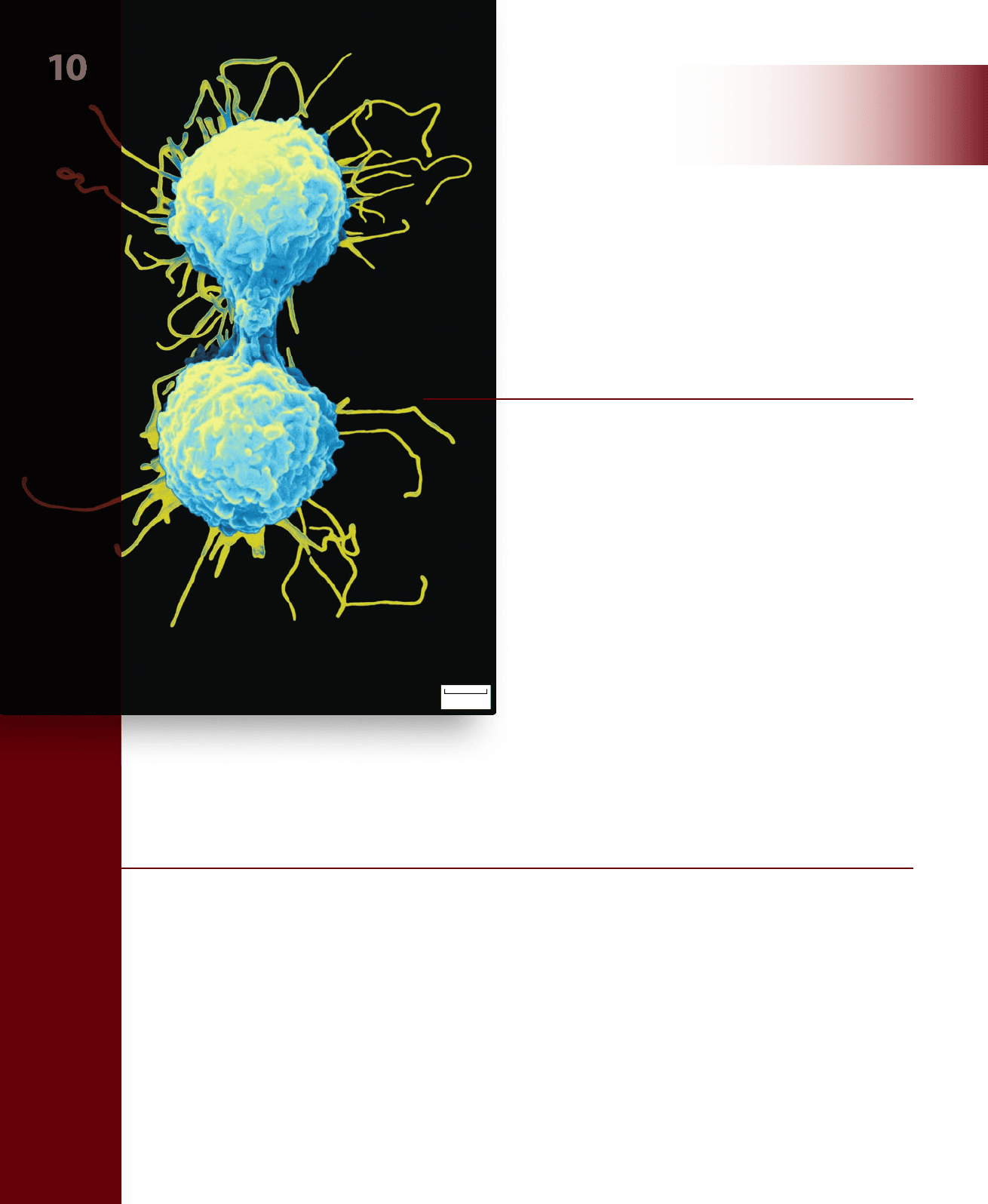
are. In this chapter, we examine how cells, like the white blood cell shown in the figure, divide and reproduce. Cell division
is necessary for the growth of organisms, for wound healing, and to replace cells that are lost regularly, such as those in
your skin and in the lining of your gut. The mechanism of cell reproduction and its biological consequences have changed
significantly during the evolution of life on Earth. The process is complex in eukaryotes, involving both the replication of
chromosomes and their separation into daughter cells. Much of what we are learning about the causes of cancer relates
to how cells control this process, and in particular their tendency to divide, a mechanism that in broad outline remains the
same in all eukaryotes.
CHAPTER
rav32223_ch10_186-206.indd 186rav32223_ch10_186-206.indd 186 11/6/09 2:14:28 PM11/6/09 2:14:28 PM
Apago PDF Enhancer
Bacterial cell
Origin of
replication
Bacterial chromosome:
Double-stranded DNA
Septum
Prior to cell division,
the bacterial DNA
molecule replicates.
The replication of the
double-stranded,
circular DNA mole-
cule that constitutes
the genome of a
bacterium begins at a
specific site, called
the origin of replica-
tion (green area).
The replication
enzymes move out
in both directions
from that site and
make copies of each
strand in the DNA
duplex. The
enzymes continue
until they meet at
another specific site,
the terminus of
replication (red
area).
3. As the DNA is
replicated, the cell
elongates, and the
DNA is partitioned in
the cell such that the
origins are at the 1/4
and 3/4 positions in
the cell and the
termini are oriented
toward the middle of
the cell.
Septation then begins, in which new membrane and cell wall material
begin to grow and form a septum at approximately the midpoint of the
cell. A protein molecule called FtsZ (orange dots) facilitates this process.
When the septum is complete, the cell pinches
in two, and two daughter cells are formed,
each containing a bacterial DNA molecule.
1.
2.
4.
5.
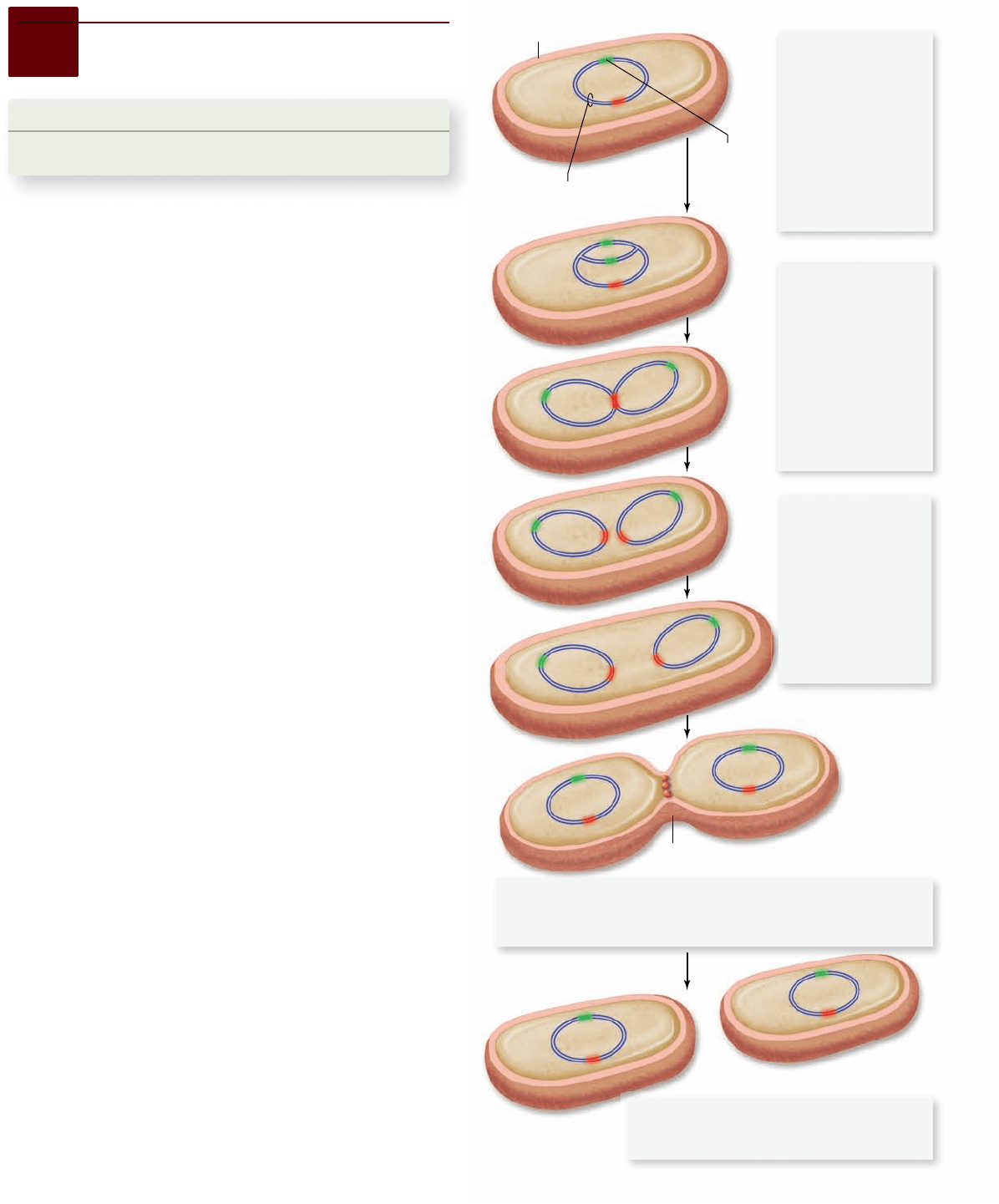
Figure 10.1
Binary ssion.
Learning Outcome
Describe the process of binary fission.1.
Bacteria divide as a way of reproducing themselves. Although
bacteria exchange DNA, they do not have a sexual cycle like
eukaryotes. Thus all growth in a bacterial population is due to
division to produce new cells. The reproduction of bacteria is
clonal—that is, each cell produced by cell division is an identi-
cal copy of the original cell.
Binary ssion is a simple form of cell division
Cell division in both bacterial and eukaryotic cells produces
two new cells with the same genetic information as the original.
Despite the differences in these cell types, the essentials of the
process are the same: duplication and segregation of genetic
information into daughter cells, and division of cellular con-
tents. We begin by looking at the simpler process, binary fis-
sion, which occurs in bacteria.
Most bacteria have a genome made up of a single, circular
DNA molecule. In spite of its apparent simplicity, the DNA
molecule of the bacterium Escherichia coli is actually on the order
of 500 times longer than the cell itself! Thus, this “simple” struc-
ture is actually packaged very tightly to fit into the cell. Although
not found in a nucleus, the DNA is located in a region called the
nucleoid that is distinct from the cytoplasm around it.
The compaction and organization of the nucleoid involves
a class of proteins called structural maintenance of chromosome,
or SMC, proteins. These are ancient proteins that have evolved
to perform a number of roles related to DNA compression and
cohesion. In eukaryotes the cohesin and condensin proteins dis-
cussed later in the chapter are SMC proteins.
During binary fission, the chromosome is replicated, and
the two products are partitioned to each end of the cell prior to
the actual division of the cell. One key feature of bacterial cell
division is that replication and partitioning of the chromosome
occur as a concerted process. In contrast, DNA replication in
eukaryotic cells occurs early in division, and chromosome sepa-
ration occurs much later.
Proteins control chromosome separation
and septum formation
Binary fission begins with the replication of the bacterial DNA
at a specific site—the origin of replication (see chapter 14 ) —
and proceeds both directions around the circular DNA to a
specific site of termination (figure 10.1). The cell grows by
elongation, and division occurs roughly at midcell. For many
years, it was thought that newly replicated E. coli DNA mole-
cules were passively segregated by attachment to and growth of
the membrane as the cell elongated. Experiments that follow
the movement of the origin of replication show that it is at
10.1
Bacterial Cell Division
chapter
10
How Cells Divide
187www.ravenbiology.com
rav32223_ch10_186-206.indd 187rav32223_ch10_186-206.indd 187 11/6/09 2:14:31 PM11/6/09 2:14:31 PM
Apago PDF Enhancer
No nucleus, usually
have single circular
chromosome. After DNA
is replicated, it is
partitioned in the cell.
After cell elongation,
FtsZ protein assembles
into a ring and facilitates
septation and cell
division.
Nucleus present and
nuclear envelope
remains intact during
cell division.
Chromosomes line up.
Microtubule fibers pass
through tunnels in the
nuclear membrane and
set up an axis for
separation of replicated
chromosomes, and cell
division.
A spindle of micro-
tubules forms between
two pairs of centrioles at
opposite ends of the
cell. The spindle passes
through one tunnel in
the intact nuclear
envelope. Kinetochore
microtubules form
between kinetochores
on the chromosomes
and the spindle poles
and pull the chromo-
somes to each pole.
Nuclear envelope
remains intact; spindle
microtubules form
inside the nucleus
between spindle pole
bodies. A single
kinetochore microtubule
attaches to each
chromosome and
pulls each to a pole.
Spindle microtubules
begin to form between
centrioles outside of
nucleus. Centrioles move
to the poles and the
nuclear envelope breaks
down. Kinetochore
microtubules attach
kinetochores of
chromosomes to spindle
poles. Polar microtubules
extend toward the center
of the cell and overlap.
Septum
FtsZ protein
Chromosome
Chromosome
Microtubule
Nucleus
Kinetochore microtubule
Centrioles Kinetochore
Central spindle
of microtubules
Polar microtubule
Spindle pole body
Kinetochore microtubule
Fragments
of nuclear
envelope
Centriole
Prokaryotes Some Protists Other Protists Yeasts
Animals
Kinetochore microtubule
Polar microtubule
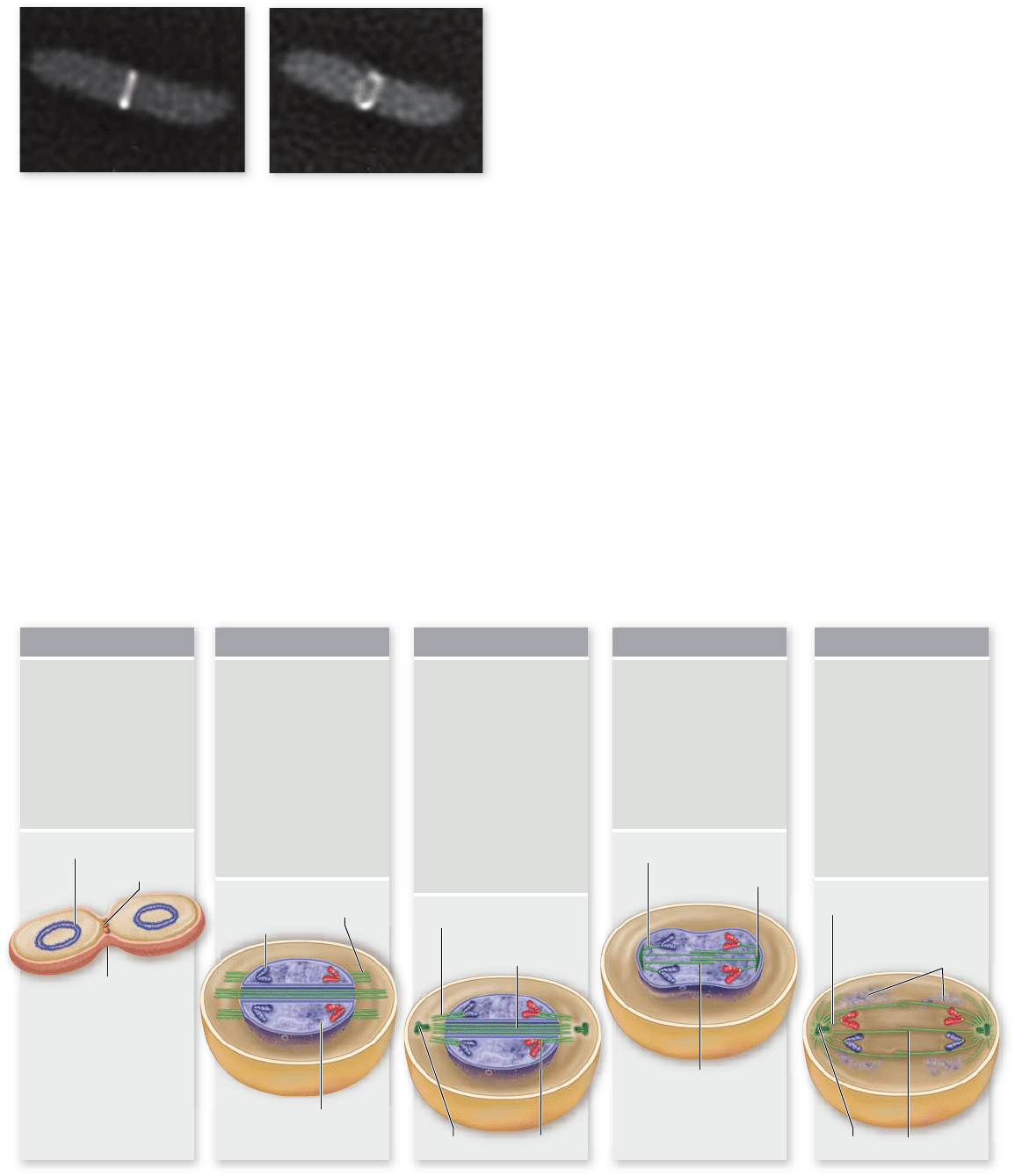
Figure 10.2
The FtsZ protein. In these dividing E. coli bacteria,
the FtsZ protein is labeled with uorescent dye to show its location
during binary ssion. The protein assembles into a ring at approximately
the midpoint of the cell, where it facilitates septation and cell division.
Bacteria carrying mutations in the FtsZ gene are unable to divide.
Figure 10.3
A comparison of protein assemblies during cell division among di erent organisms.
The prokaryotic protein FtsZ has a structure that is similar to that of the eukaryotic protein tubulin. Tubulin is the
protein component of microtubules, which are bers used to separate chromosomes in eukaryotic cell division.
nucleoids, and division occurs. The force behind chromosome
segregation has been attributed to DNA replication itself, tran-
scription, and the polymerization of actin-like molecules. At
this point, no single model appears to explain the process, and
it may involve more than one.
The cell’s other components are partitioned by the growth
of new membrane and production of the septum (see figure 10.1).
This process, termed septation, usually occurs at the midpoint
of the cell. It begins with the formation of a ring composed of
many copies of the protein FtsZ (figure 10.2 ) . Next, accumula-
tion of a number of other proteins occurs, including ones em-
bedded in the membrane. This structure contracts inward
radially until the cell pinches off into two new cells. The midcell
location of the FtsZ ring is caused by an oscillation between the
two poles of an inhibitor of FtsZ formation.
The FtsZ protein is found in most prokaryotes, including
archaea. It can form filaments and rings, and recent three-
dimensional crystals show a high degree of similarity to eukary-
otic tubulin. However, its role in bacterial division is quite
different from the role of tubulin in mitosis in eukaryotes.
The evolution of eukaryotic cells included much more
complex genomes composed of multiple linear chromosomes
housed in a membrane-bounded nucleus. These complex ge-
nomes may be possible due to the evolution of mechanisms that
delay chromosome separation after replication. Although it is
unclear how this ability to keep chromosomes together evolved,
it does seem more closely related to binary fission than we once
thought (figure 10.3).
midcell prior to replication, then the newly replicated origins
move toward opposite ends of the cell. This movement is faster
than the rate of elongation, showing that growth alone is not
enough. The origins appear to be captured at the one quarter
and three quarter positions relative to the length of the cell,
which will be midcell of the two daughter cells.
Although the actual mechanism of chromosome segrega-
tion is unclear, the order of events is not. During replication,
first the origin, then the rest of the newly replicated chromo-
somes are moved to opposite ends of the cell as two new nucle-
oids are assembled. The final event of replication is decatenation
(untangling) of the final replication products. After replication
and segregation, the midcell region is cleared of daughter
188
part
II
Biology of the Cell
rav32223_ch10_186-206.indd 188rav32223_ch10_186-206.indd 188 11/6/09 2:14:32 PM11/6/09 2:14:32 PM
Apago PDF Enhancer
10.5 µm
TABLE 10.1
Chromosome Number
in Selected Eukaryotes
Group Total Number of Chromosomes
FUNGI
Neurospora (haploid) 7
Saccharomyces (a yeast) 16
INSECTS
Mosquito 6
Drosophila 8
Honeybee diploid females 32, haploid males 16
Silkworm 56
PLANTS
Haplopappus gracilis 2
Garden pea 14
Corn 20
Bread wheat 42
Sugarcane 80
Horsetail 216
Adder’s tongue fern 1262
VERTEBRATES
Opossum 22
Frog 26
Mouse 40
Human 46
Chimpanzee 48
Horse 64
Chicken 78
Dog 78
Figure 10.4
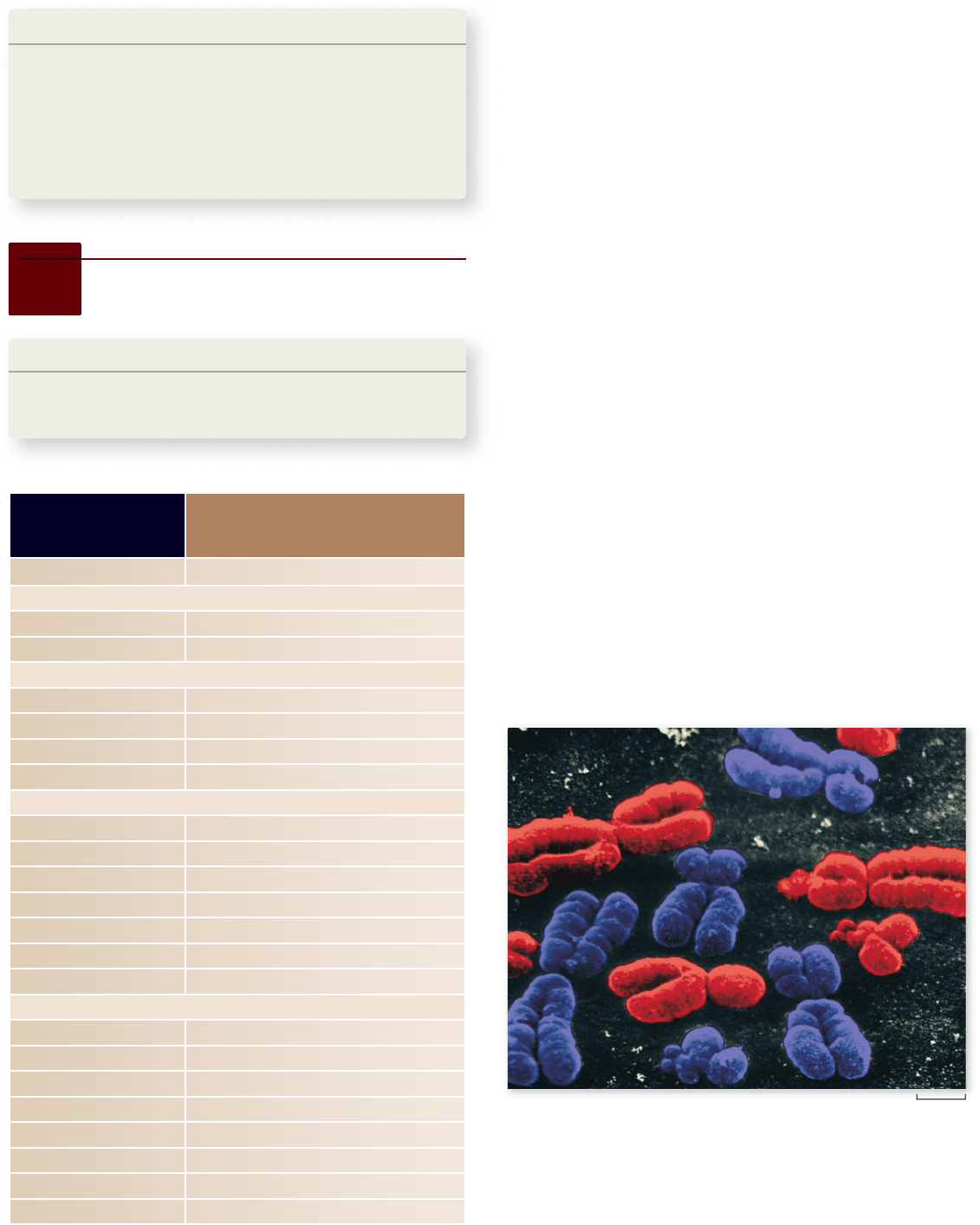
Human chromosomes. This scanning
electron micrograph shows human chromosomes as they appear
immediately before nuclear division. Each DNA molecule has
already replicated, forming identical copies held together at a visible
constriction called the centromere. False color has been added to
the chromosomes.
Learning Outcomes
Describe the structure of eukaryotic chromosomes.1.
Distinguish between homologues and sister chromatids.2.
10.2
Eukaryotic Chromosomes
Learning Outcome Review 10.1
Most bacteria divide by binary fi ssion, a form of cell division in which DNA
replication and segregation occur simultaneously. This process involves
active partitioning of the single bacterial chromosome and positioning of
the site of septation.
■ Would binary fission work as well if bacteria had many
chromosomes?
Chromosomes were first observed by the German embryolo-
gist Walther Flemming (1843–1905) in 1879, while he was ex-
amining the rapidly dividing cells of salamander larvae. When
Flemming looked at the cells through what would now be a
rather primitive light microscope, he saw minute threads within
their nuclei that appeared to be dividing lengthwise. Flemming
called their division mitosis, based on the Greek word mitos,
meaning “thread.”
Chromosome number varies among species
Since their initial discovery, chromosomes have been found in
the cells of all eukaryotes examined. Their number may vary
enormously from one species to another. A few kinds of organ-
isms have only a single pair of chromosomes, whereas some
ferns have more than 500 pairs ( table 10.1). Most eukaryotes
have between 10 and 50 chromosomes in their body cells.
Human cells each have 46 chromosomes, consisting of 23
nearly identical pairs (figure 10.4). Each of these 46 chromo-
somes contains hundreds or thousands of genes that play im-
portant roles in determining how a person’s body develops and
functions. Human embryos missing even one chromosome, a
condition called monosomy, do not survive in most cases. Having
an extra copy of any one chromosome, a condition called tri-
somy, is usually fatal except where the smallest chromosomes
are involved. (You’ll learn more about human chromosome ab-
normalities in chapter 13. )
Eukaryotic chromosomes exhibit
complex structure
Researchers have learned a great deal about chromosome struc-
ture and composition in the more than 125 years since their
chapter
10
How Cells Divide
189www.ravenbiology.com
rav32223_ch10_186-206.indd 189rav32223_ch10_186-206.indd 189 11/6/09 2:14:33 PM11/6/09 2:14:33 PM
Apago PDF Enhancer
Chromosome Rosettes of Chromatin Loops Chromatin Loop Solenoid
Nucleosome DNA Double Helix (duplex)
DNA Histone core
Scaffold
protein
Scaffold protein
Chromatin loop
Figure 10.5
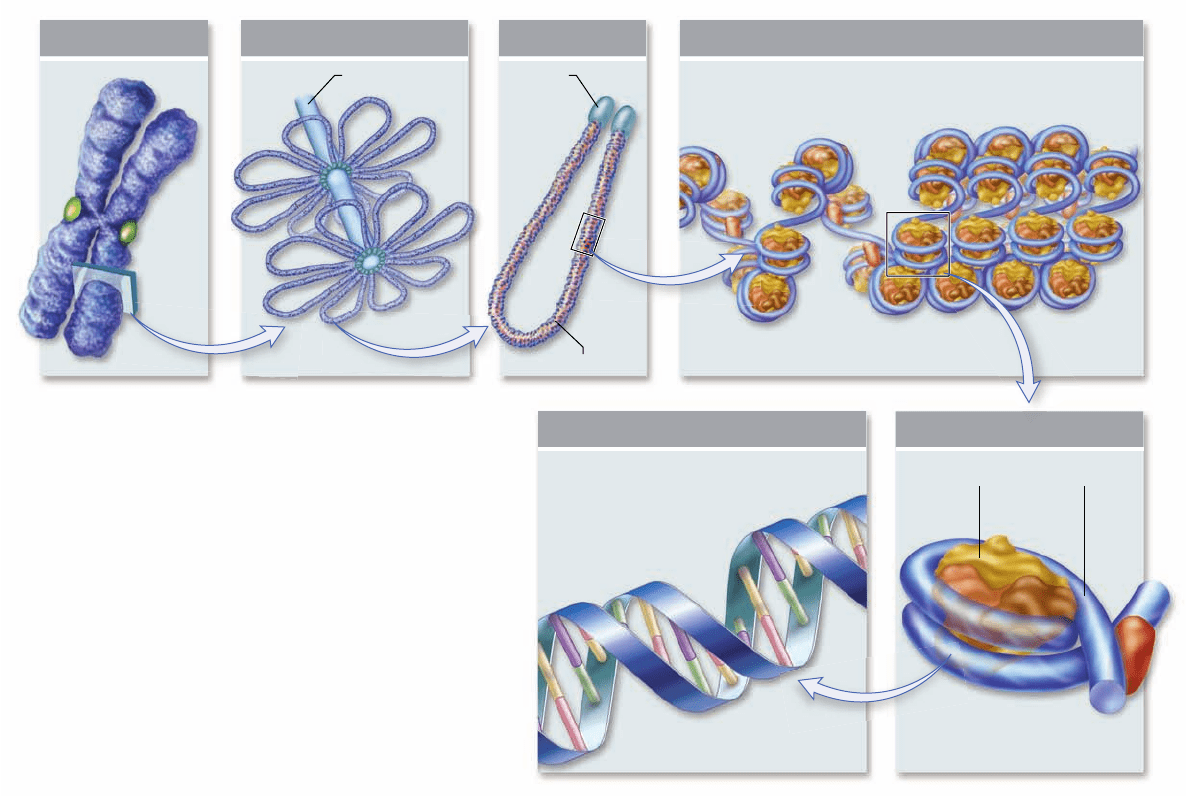
Levels of eukaryotic chromosomal
organization. Each chromosome consists of a long double-
stranded DNA molecule. These strands require further
packaging to t into the cell nucleus. The DNA duplex is
tightly bound to and wound around proteins called histones.
The DNA-wrapped histones are called nucleosomes. The
nucleosomes are further coiled into a solenoid. This solenoid
is then organized into looped domains. The nal
organization of the chromosome is unknown, but it appears
to involve further radial looping into rosettes around a
preexisting scaffolding of protein. The arrangement
illustrated here is one of many possibilities.
The organization of chromatin in the nondividing nucleus
is not well understood, but geneticists have recognized for years
that some domains of chromatin, called heterochromatin, are
not expressed, and other domains of chromatin, called euchro-
matin, are expressed. This genetically measurable state is also
related to the physical state of chromatin, although researchers
are just beginning to see the details.
Chromosome structure
If we gently disrupt a eukaryotic nucleus and examine the DNA
with an electron microscope, we find that it resembles a string
of beads (figure 10.5). Every 200 nucleotides (nt), the DNA du-
plex (double strand) is coiled around a core of eight histone
proteins. Unlike most proteins, which have an overall negative
charge, histones are positively charged because of an abundance
of the basic amino acids arginine and lysine. Thus, they are
strongly attracted to the negatively charged phosphate groups
of the DNA, and the histone cores act as “magnetic forms” that
promote and guide the coiling of the DNA. The complex of
DNA and histone proteins is termed a nucleosome.
Further coiling occurs when the string of nucleosomes is
wrapped into higher order coils called solenoids. The precise
path of this higher order folding of chromatin is still a subject
of some debate, but it leads to a fiber with a diameter of 30 nm
and thus is often called the 30-nm fiber. This 30-nm fiber is the
usual state of interphase (nondividing) chromatin.
discovery. But despite intense research, the exact structure of
eukaryotic chromosomes during the cell cycle remains unclear.
The structures described in this chapter represent the currently
accepted model.
Composition of chromatin
Chromosomes are composed of chromatin , a complex of DNA
and protein; most chromosomes are about 40% DNA and
60% protein. A significant amount of RNA is also associated
with chromosomes because chromosomes are the sites of
RNA synthesis.
The DNA of a single chromosome is one very long,
double-stranded fiber that extends unbroken through the
chromosome’s entire length. A typical human chromosome
contains about 140 million (1.4 × 10
8
) nucleotides in its
DNA. If we think of each nucleotide as a “word,” then the
amount of information an average chromosome contains
would fill about 280 printed books of 1000 pages each, with
500 “words” per page.
If we could lay out the strand of DNA from a single chro-
mosome in a straight line, it would be about 5 cm (2 in.) long.
Fitting such a strand into a cell nucleus is like cramming a string
the length of a football field into a baseball—and that’s only 1
of 46 chromosomes! In the cell, however, the DNA is coiled,
allowing it to fit into a much smaller space than would other-
wise be possible.
190
part
II
Biology of the Cell
rav32223_ch10_186-206.indd 190rav32223_ch10_186-206.indd 190 11/6/09 2:14:35 PM11/6/09 2:14:35 PM
Apago PDF Enhancer
9.2 µm
Homologous chromosomes Homologous chromosomes
Sister chromatids
Sister chromatids
Centromere
Replication
Kinetochore
Kinetochores
Cohesin
proteins
Figure 10.6
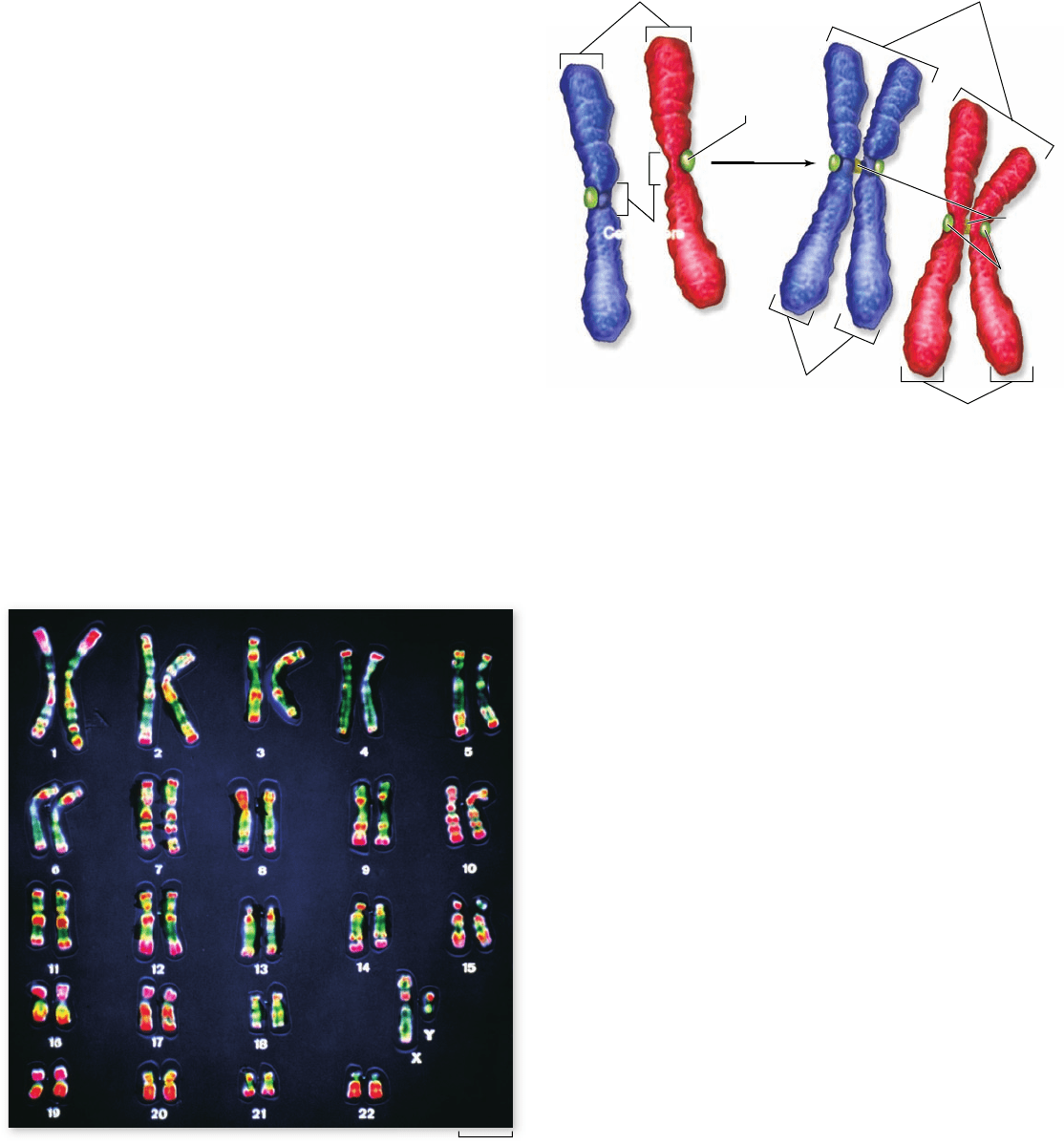
A human karyotype. The individual
chromosomes that make up the 23 pairs differ widely in size and in
centromere position. In this preparation of a male karyotype , the
chromosomes have been speci cally stained to indicate differences
in their composition and to distinguish them clearly from one
another. Notice that members of a chromosome pair are very
similar but not identical.
Figure 10.7
The di erence between homologous
chromosomes and sister chromatids. Homologous
chromosomes are the maternal and paternal copies of the same
chromosome—say, chromosome number 16. Sister chromatids are
the two replicas of a single chromosome held together at their
centromeres by cohesin proteins after DNA replication. The
kinetochore (described later in the chapter) is composed of proteins
found at the centromere that attach to microtubules during mitosis.
chromosomes reflect the equal genetic contribution that each
parent makes to offspring. We refer to the maternal and pater-
nal chromosomes as being homologous, and each one of the
pair is termed a homologue.
Chromosome replication
Chromosomes as seen in a karyotype are only present for a
brief period during cell division. Prior to replicating, each
chromosome is composed of a single DNA molecule that is
arranged into the 30-nm fiber described earlier. After replica-
tion, each chromosome is composed of two identical DNA
molecules held together by a complex of proteins called co-
hesins. As the chromosomes become more condensed and ar-
ranged about the protein scaffold, they become visible as two
strands that are held together. At this point, we still call this
one chromosome, but it is composed of two sister chromatids
(figure 10.7).
The fact that the products of replication are held to-
gether is critical to the division process. One problem that a
cell must solve is how to ensure that each new cell receives a
complete set of chromosomes. If we were designing a system,
we might use some kind of label to identify each chromosome,
much like most of us use when we duplicate files on a com-
puter. The cell has no mechanism to label chromosomes; in-
stead, it keeps the products of replication together until the
moment of chromosome segregation, ensuring that one copy
of each chromosome goes to each daughter cell. This separa-
tion of sister chromatids is the key event in the mitotic pro-
cess described in detail shortly.
During mitosis the chromatin in the solenoid is arranged
around a scaffold of protein assembled at this time to achieve
maximum compaction of the chromosomes. This process pre-
pares the chromosomes for the events of mitosis described
later. The exact nature of this compaction is unknown, but one
long-standing model involves radial looping of the solenoid
about the protein scaffold, aided by a complex of proteins
called condensin.
Chromosome karyotypes
Chromosomes vary in size, staining properties, the location of
the centromere (a constriction found on all chromosomes, de-
scribed shortly), the relative length of the two arms on either
side of the centromere, and the positions of constricted regions
along the arms. The particular array of chromosomes an indi-
vidual organism possesses is called its karyotype. The karyo-
type in figure 10.6 shows the set of chromosomes from a normal
human cell.
When defining the number of different chromosomes in
a species, geneticists count the haploid (n) number of chromo-
somes. This refers to one complete set of chromosomes neces-
sary to define an organism. For humans and many other species,
the total number of chromosomes in a cell is called the diploid
(2n) number, which is twice the haploid number. For humans,
the haploid number is 23 and the diploid number is 46. Diploid
chapter
10
How Cells Divide
191www.ravenbiology.com
rav32223_ch10_186-206.indd 191rav32223_ch10_186-206.indd 191 11/6/09 2:14:36 PM11/6/09 2:14:36 PM