
Raven P.H., Johnson G.B., Mason K.A. Biology (Ninth Edition)
Подождите немного. Документ загружается.

Apago PDF Enhancer
I
n
a
c
t
i
v
e
C
d
k
1
A
c
t
i
v
e
C
d
k
1
A
c
t
i
v
e
C
d
k
2
I
n
a
c
t
i
v
e
C
d
k
2
I
n
a
c
t
i
v
e
A
P
C
A
c
t
i
v
e
A
P
C
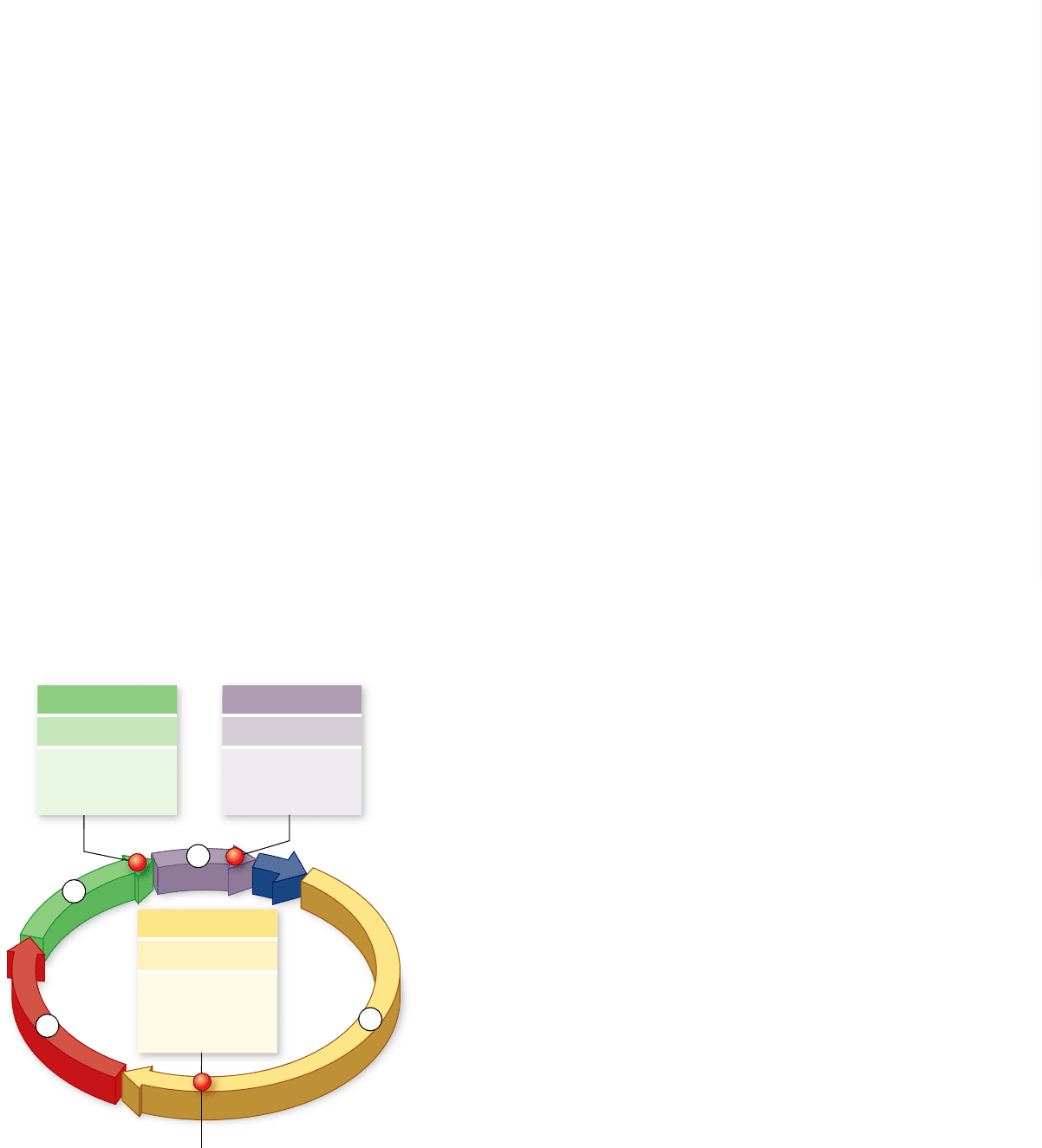
Spindle Checkpoint
APC
G
2
/M Checkpoint
Cdk1/Cyclin B
• Replication
completed
• DNA integrity
G
1
/S Checkpoint
Cdk2/Cyclin E
• Growth factors
• Nutritional state
of cell
• Size of cell
G
2
M
S
G
1
• Chromosomes
attached at
metaphase plate
cell cycle is shown in figure 10.21. These more complex con-
trols allow the integration of more input into control of the
cycle. With the evolution of more complex forms of organiza-
tion (tissues, organs, and organ systems), more complex forms
of cell cycle control evolved as well.
A multicellular body’s organization cannot be maintained
without severely limiting cell proliferation—so that only certain
cells divide, and only at appropriate times. The way cells inhibit
individual growth of other cells is apparent in mammalian cells
growing in tissue culture: A single layer of cells expands over a
culture plate until the growing border of cells comes into con-
tact with neighboring cells, and then the cells stop dividing. If a
sector of cells is cleared away, neighboring cells rapidly refill
that sector and then stop dividing again on cell contact.
How are cells able to sense the density of the cell culture
around them? When cells come in contact with one another,
receptor proteins in the plasma membrane activate a signal
transduction pathway that acts to inhibit Cdk action. This pre-
vents entry into the cell cycle.
Growth factors and the cell cycle
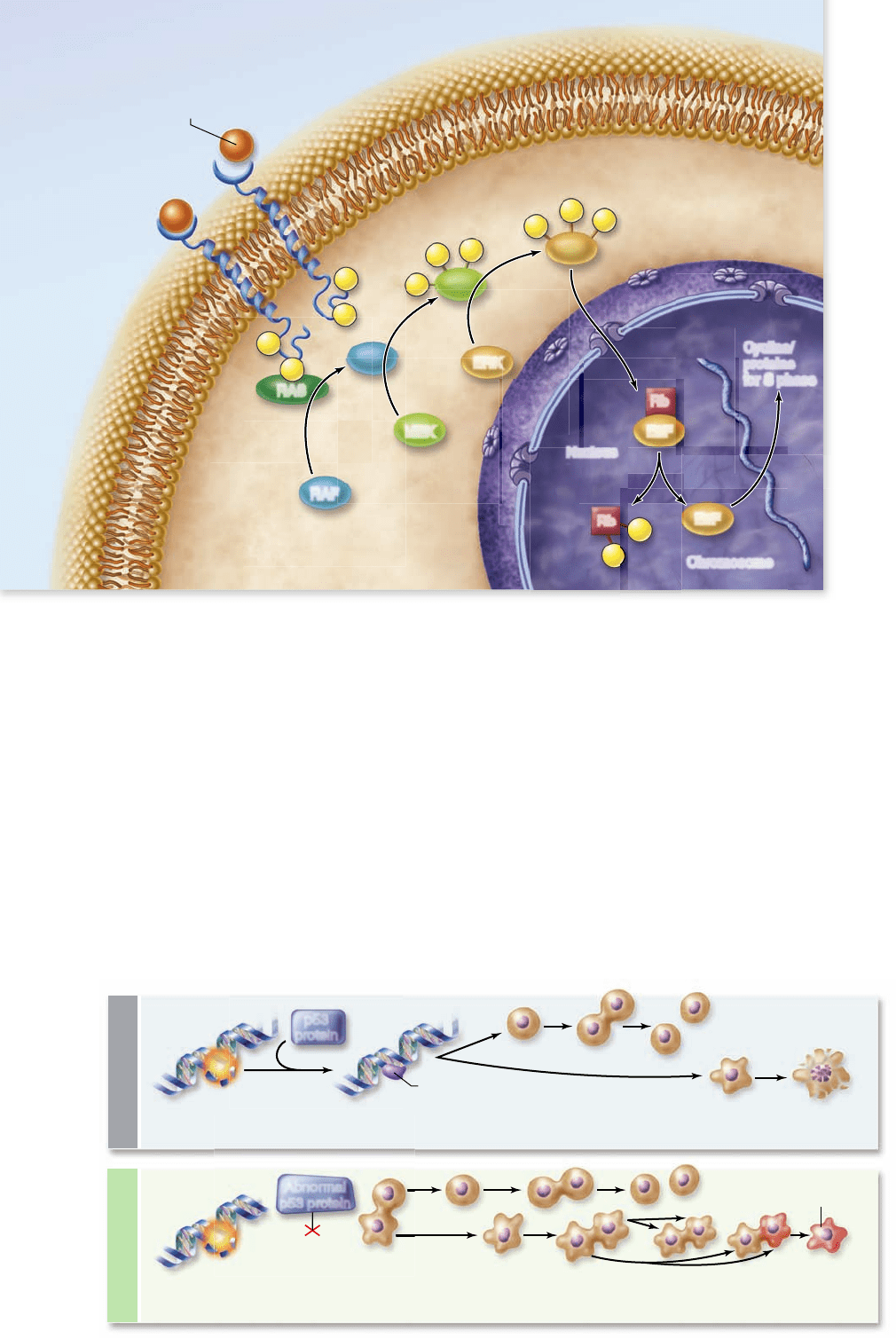
Growth factors act by triggering intracellular signaling systems.
Fibroblasts, for example, possess numerous receptors on their
plasma membranes for one of the first growth factors to be identi-
fied, platelet-derived growth factor (PDGF). The PDGF recep-
tor is a receptor tyrosine kinase (RTK) that initiates a MAP kinase
cascade to stimulate cell division (discussed in chapter 9).
PDGF was discovered when investigators found that fi-
broblasts would grow and divide in tissue culture only if the
growth medium contained blood serum. Serum is the liquid
that remains in blood after clotting; blood plasma, the liquid
from which cells have been removed without clotting, would
not work. The researchers hypothesized that platelets in the
blood clots were releasing into the serum one or more factors
required for fibroblast growth. Eventually, they isolated such a
factor and named it PDGF.
Growth factors such as PDGF can override cellular con-
trols that otherwise inhibit cell division. When a tissue is in-
jured, a blood clot forms, and the release of PDGF triggers
neighboring cells to divide, helping to heal the wound. Only a
tiny amount of PDGF (approximately 10
–10
M) is required to
stimulate cell division in cells with PDGF receptors.
Characteristics of growth factors
Over 50 different proteins that function as growth factors have
been isolated, and more undoubtedly exist. A specific cell sur-
face receptor recognizes each growth factor, its binding site fit-
ting that growth factor precisely. These growth factor receptors
often initiate MAP kinase cascades in which the final kinase
enters the nucleus and activates transcription factors by phos-
phorylation. These transcription factors stimulate the produc-
tion of G
1
cyclins and the proteins that are necessary for cell
cycle progression (figure 10.22).
The cellular selectivity of a particular growth factor de-
pends on which target cells bear its unique receptor. Some
growth factors, such as PDGF and epidermal growth factor
(EGF), affect a broad range of cell types, but others affect only
specific types. For example, nerve growth factor (NGF) pro-
motes the growth of certain classes of neurons, and erythropoi-
etin triggers cell division in red blood cell precursors. Most
animal cells need a combination of several different growth fac-
tors to overcome the various controls that inhibit cell division.
The G
0
phase
If cells are deprived of appropriate growth factors, they stop at
the G
1
checkpoint of the cell cycle. With their growth and divi-
sion arrested, they remain in this dormant G
0
phase.
The ability to enter G
0
accounts for the incredible diversity
seen in the length of the cell cycle in different tissues. Epithelial
cells lining the human gut divide more than twice a day, con-
stantly renewing this lining. By contrast, liver cells divide only
once every year or two, spending most of their time in the G
0
phase. Mature neurons and muscle cells usually never leave G
0
.
Cancer is a failure of cell cycle control
The unrestrained, uncontrolled growth of cells in humans leads
to the disease called cancer. Cancer is essentially a disease of
cell division—a failure of cell division control.
The p53 gene
Recent work has identified one of the culprits in cancer. Offi-
cially dubbed p53, this gene plays a key role in the G
1
check-
point of cell division.
Figure 10.21
Checkpoints of the mammalian cell cycle.
The more complex mammalian cell cycle is shown. This cycle is
still controlled through three main checkpoints. These integrate
internal and external signals to control progress through the cycle.
These inputs control the state of two different Cdk–cyclin complexes
and the anaphase-promoting complex (APC).
202
part
II
Biology of the Cell
rav32223_ch10_186-206.indd 202rav32223_ch10_186-206.indd 202 11/6/09 2:14:54 PM11/6/09 2:14:54 PM
Apago PDF Enhancer
Nucleus
Chromosome
RAS
RAF
MEK
ERK
E2F
E2F
Cyclins/
proteins
for S phase
Rb
Rb
P
P
P
P
P
P
P
P
P
P
P
P
Growth factor
p53
protein
1. DNA damage is caused by
heat, radiation, or chemicals.
2. Cell division stops, and p53 triggers
enzymes to repair damaged region.
3. p53 triggers the destruction of
cells damaged beyond repair.
1. DNA damage is caused by
heat, radiation, or chemicals.
2. The p53 protein fails to stop cell
division and repair DNA. Cell divides
without repair to damaged DNA.
3. Damaged cells continue to divide.
If other damage accumulates, the
cell can turn cancerous.
DNA repair enzyme
p53 allows cells with
repaired DNA to divide.
Cancer cell
Abnormal
p53 protein
Abnormal p53 Normal p53
Proto-oncogenes
The disease we call cancer is actually many different diseases,
depending on the tissue affected. The common theme in all cases
is the loss of control over the cell cycle. Research has identified
numerous so-called oncogenes, genes that can, when introduced
into a cell, cause it to become a cancer cell. This identification
then led to the discovery of proto-oncogenes, which are nor-
mal cellular genes that become oncogenes when mutated.
The action of proto-oncogenes is often related to signal-
ling by growth factors, and their mutation can lead to loss of
growth control in multiple ways. Some proto-oncogenes encode
receptors for growth factors, and others encode proteins in-
volved in signal transduction that act after growth factor recep-
tors. If a receptor for a growth factor becomes mutated such that
it is permanently “on,” the cell is no longer dependent on the
presence of the growth factor for cell division. This is analogous
The gene’s product, the p53 protein, monitors the integ-
rity of DNA, checking that it is undamaged. If the p53 protein
detects damaged DNA, it halts cell division and stimulates the
activity of special enzymes to repair the damage. Once the
DNA has been repaired, p53 allows cell division to continue. In
cases where the DNA damage is irreparable, p53 then directs
the cell to kill itself.
By halting division in damaged cells, the p53 gene pre-
vents the development of many mutated cells, and it is there-
fore considered a tumor-suppressor gene although its
activities are not limited to cancer prevention. Scientists have
found that p53 is entirely absent or damaged beyond use in the
majority of cancerous cells they have examined. It is precisely
because p53 is nonfunctional that cancer cells are able to re-
peatedly undergo cell division without being halted at the G
1
checkpoint (figure 10.23).
Figure 10.22
The cell
proliferation-signaling
pathway. Binding of a growth
factor sets in motion a MAP
kinase intracellular signaling
pathway (described in chapter 9),
which activates nuclear regulatory
proteins that trigger cell division.
In this example, when the nuclear
retinoblastoma protein (Rb) is
phosphorylated, another nuclear
protein (the transcription factor
E2F) is released and is then able to
stimulate the production of cyclin
and other proteins necessary for
S phase.
Figure 10.23
Cell division, cancer,
and p53 protein.
Normal p53 protein
monitors DNA,
destroying cells that have
irreparable damage to
their DNA. Abnormal p53
protein fails to stop cell
division and repair DNA.
As damaged cells
proliferate, cancer
develops.
chapter
10
How Cells Divide
203www.ravenbiology.com
rav32223_ch10_186-206.indd 203rav32223_ch10_186-206.indd 203 11/6/09 2:14:56 PM11/6/09 2:14:56 PM
Apago PDF Enhancer
Growth factor receptor:
more per cell in many
breast cancers.
Ras protein:
activated by mutations
in 20–30% of all cancers.
Src kinase:
activated by mutations
in 2–5% of all cancers.
Rb protein:
mutated in 40% of all cancers.
p53 protein:
mutated in 50% of all cancers.
Proto-oncogenes
Tumor-suppressor Genes
Cell cycle
checkpoints
Mammalian cell
Ras
protein
Rb
protein
Src
kinase
Cytoplasm
C
ell c
y
cle
che
ckp
oints
Rb
p
p
p
p
pro
tei
n
n
n
n
n
Nucleus
p53
protein
to a light switch that is stuck on: The light will always be on.
PDGF and EGF receptors both fall into the category of proto-
oncogenes. Only one copy of a proto-oncogene needs to un-
dergo this mutation for uncontrolled division to take place; thus,
this change acts like a dominant mutation.
The number of proto-oncogenes identified has grown to
more than 50 over the years. This line of research connects our
understanding of cancer with our understanding of the molec-
ular mechanisms governing cell cycle control.
Tumor-suppressor genes
After the discovery of proto-oncogenes, a second category of genes
related to cancer was identified: the tumor-suppressor genes. We
mentioned earlier that the p53 gene acts as a tumor-suppressor
gene, and a number of other such genes exist.
Both copies of a tumor-suppressor gene must lose function
for the cancerous phenotype to develop, in contrast to the muta-
tions in proto-oncogenes. Put another way, the proto-oncogenes
act in a dominant fashion, and tumor suppressors act in a reces-
sive fashion.
The first tumor-suppressor identified was the retino-
blastoma susceptibility gene (Rb), which predisposes individuals
for a rare form of cancer that affects the retina of the eye. Despite
the fact that a cell heterozygous for a mutant Rb allele is normal, it
is inherited as a dominant in families. The reason is that inheriting
a single mutant copy of Rb means the individual has only one “good”
copy left, and during the hundreds of thousands of divisions that
occur to produce the retina, any error that damages the remaining
good copy leads to a cancerous cell. A single cancerous cell in the
retina then leads to the formation of a retinoblastoma tumor.
The role of the Rb protein in the cell cycle is to integrate
signals from growth factors. The Rb protein is called a “pocket pro-
tein” because it has binding pockets for other proteins. Its role is
therefore to bind important regulatory proteins and prevent them
from stimulating the production of the necessary cell cycle proteins,
such as cyclins or Cdks (see figure 10.21) discussed previously.
The binding of Rb to other proteins is controlled by
phosphorylation: When it is dephosphorylated, it can bind a
variety of regulatory proteins, but loses this capacity when
phosphorylated. The action of growth factors results in the
phosphorylation of Rb protein by a Cdk. This then brings us
full circle, because the phosphorylation of Rb releases previ-
ously bound regulatory proteins, resulting in the production of
S phase cyclins that are necessary for the cell to pass the G
1
/S
boundary and begin chromosome replication.
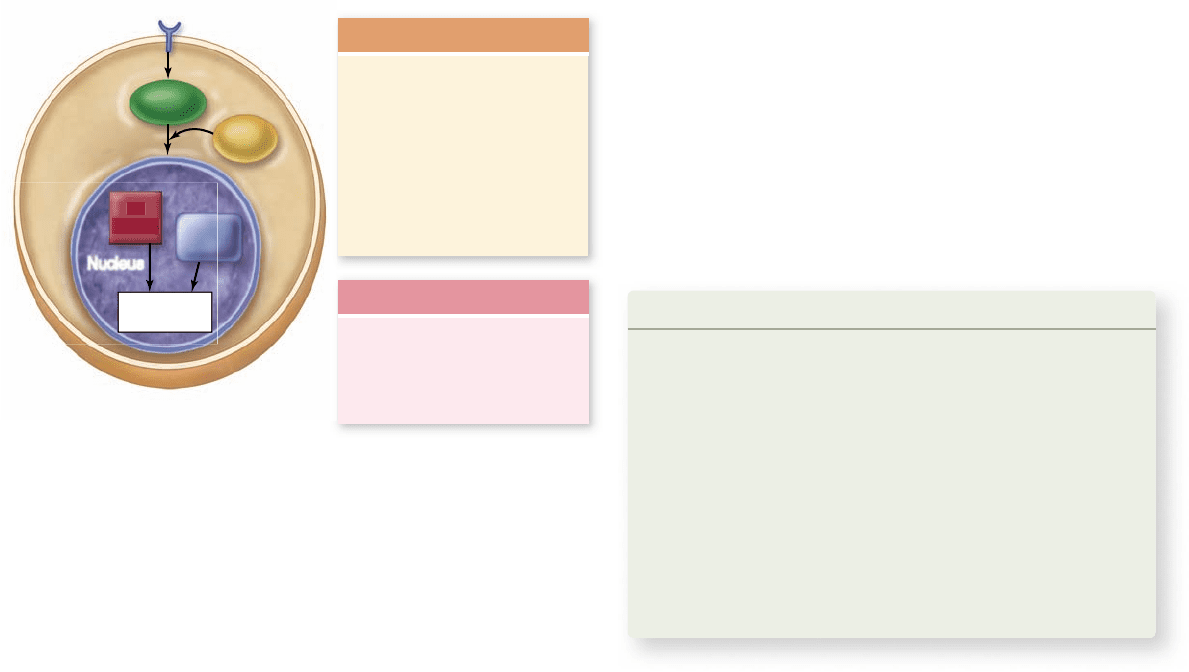
Figure 10.24 summarizes the types of genes that can cause
cancer when mutated.
Learning Outcomes Review 10.6
Cyclin proteins are produced in synchrony with the cell cycle. These proteins
complex with cyclin-dependent kinases to drive the cell cyle. Three
checkpoints exist in the cell cycle: the G
1
/S checkpoint, the G
2
/M checkpoint,
and the spindle checkpoint. The cell cycle can be halted at these checkpoints
if the process is not accurate. The anaphase-promoting complex/cyclosome
(APC/C) triggers anaphase by lifting inhibition on a protease that removes
cohesin holding chromatids together. The loss of cell cycle control leads to
cancer, which can occur by a combination of two basic mechanisms: proto-
oncogenes that gain function to become oncogenes, and tumor-suppressor
genes that lose function and allow cell proliferation.
■ How can you distinguish between a tumor suppressor
gene and a proto-oncogene?
Figure 10.24
Key proteins associated with human
cancers. Mutations in genes encoding key components of the cell
division-signaling pathway are responsible for many cancers.
Among them are proto-oncogenes encoding growth factor
receptors, protein relay switches such as Ras protein, and kinase
enzymes such as Src, which act after Ras and growth factor
receptors. Mutations that disrupt tumor-suppressor proteins, such
as Rb and p53, also foster cancer development.
204
part
II
Biology of the Cell
rav32223_ch10_186-206.indd 204rav32223_ch10_186-206.indd 204 11/6/09 2:14:58 PM11/6/09 2:14:58 PM

Apago PDF Enhancer
separate and migrate to opposite ends of the cell, establishing the axis
of nuclear division.
During prometaphase, chromosomes attach to the spindle.
In metaphase, chromosomes align at the equator.
Chromatids of each chromosome are connected to opposite poles by
kinetochore microtubules. They are held at the equator of the cell by
the tension of being pulled toward opposite poles.
At anaphase, the chromatids separate.
At this point, cohesin proteins holding sister chromatids together
at the centromeres are destroyed, and the chromatids are pulled
to opposite poles. This movement is called anaphase A, and the
movement of poles farther apart is called anaphase B.
During telophase, the nucleus re-forms.
Telophase reverses the events of prophase and prepares the cell
for cytokinesis.
In animals cells, a belt of actin pinches o the daughter cells.
A contractile ring of actin under the membrane contracts
during cytokinesis.
In plant cells, a cell plate divides the daughter cells.
Fusion of vesicles produces a new membrane in the middle of the cell
to produce the cell plate.
In fungi and some protists, daughter nuclei are separated
during cytokinesis.
10.6 Control of the Cell Cycle ( gure 10.18)
Research uncovered cell cycle control factors.
Experiments showed that there are positive regulators of mitosis,
and that there are proteins produced in synchrony with the cell
cycle (cyclins). The positive regulators are cyclin-dependent kinases
(Cdks). Cdks are complexes of a kinase and a regulatory molecule
called cyclin. They phosphorylate proteins to drive the cell cycle.
The cell cycle can be halted at three checkpoints.
Checkpoints are points at which the cell can assess the accuracy
of the process and stop if needed. The G
1
/S checkpoint is a
commitment to divide; the G
2
/M checkpoint ensures DNA integrity;
and the spindle checkpoint ensures that all chromosomes are
attached to spindle bers, with bipolar orientation.
Cyclin-dependent kinases drive the cell cycle.
The cycle progresses by the action of Cdks. Yeast have only one
CDK enzyme; vertebrates have more than four enzymes. During the
G
1
phase, G
1
cyclin combines with Cdc2 kinase to form the Cdk that
triggers entry into S phase.
The anaphase-promoting complex/cyclosome (APC/C) activates a
protease that removes cohesins holding the centromeres of sister
chromatids together; the result is to trigger anaphase, separating the
chromatids and drawing them to opposite poles. The APC/C also
triggers destruction of mitotic cyclins to exit mitosis.
In multicellular eukaryotes, many Cdks and external signals
act on the cell cycle.
Growth factors, like platelet-derived growth factor (PDGF),
stimulate cell division. This acts through a MAP kinase cascade
that results in the production of cyclins and activation of Cdks to
stimulate cell division in broblasts after tissue injury.
Cancer is a failure of cell cycle control.
Mutations in proto-oncogenes have dominant, gain-of-function
effects leading to cancer. Mutations in tumor-suppressor genes are
recessive; loss of function of both copies leads to cancer.
10.1 Bacterial Cell Division
Binary ssion is a simple form of cell division.
Prokaryotic cell division is clonal, resulting in two identical cells.
Bacterial DNA replication and partitioning of the chromosome are
concerted processes.
Proteins control chromosome separation and septum formation.
DNA replication begins at a speci c point, the origin, and proceeds
bidirectionally to a speci c termination site. Newly replicated
chromosomes are segregated to opposite poles at the same time
as they are replicated. New cells are separated by septation, which
involves insertion of new cell membrane and other cellular materials
at the midpoint of the cell. A ring of FtsZ and proteins embedded
in the cell membrane expands radially inward, pinching the cell into
two new cells.
10.2 Eukaryotic Chromosomes
Chromosome number varies among species.
The gain or loss of chromosomes is usually lethal.
Eukaryotic chromosomes exhibit complex structure.
Chromosomes are composed of chromatin, a complex of DNA,
and protein. Heterochromatin is not expressed and euchromatin is
expressed. The DNA of a single chromosome is a very long, double-
stranded ber. The DNA is wrapped around a core of eight histones
to form a nucleosome, which can be further coiled into a 30-nm
ber in interphase cells. During mitosis, chromosomes are further
condensed by arranging coiled 30-nm bers radially around a
protein scaffold.
Newly replicated chromosomes remain attached at a constricted area
called a centromere, consisting of repeated DNA sequences. After
replication, a chromosome consists of two sister chromatids held
together at the centromere by a complex of proteins called cohesins
( gure 10.7).
10.3 Overview of the Eukaryotic Cell Cycle ( gure 10.8)
The cell cycle is divided into v
e phases.
The phases of the cell cycle are gap 1 (G
1
), synthesis (S), gap 2 (G
2
),
mitosis, and cytokinesis (C). G
1
, S, and G
2
are collectively called
interphase, and mitosis and cytokinesis together are called M phase.
The duration of the cell cycle varies depending on cell type.
The length of a cell cycle varies with age, cell type, and species. Cells
can exit G
1
and enter a nondividing phase called G
0
; the G
0
phase
can be temporary or permanent.
10.4 Interphase: Preparation for Mitosis
G
1
, S, and G
2
, are the three subphases of interphase. G
1
is the
primary growth phase; during S phase, DNA synthesis occurs. G
2
phase occurs after S phase and before mitosis.
The centromere binds proteins assembled into a disklike structure
called a kinetochore where microtubules attach during mitosis.
The centromeric DNA is replicated, but the two DNA strands are
held together by cohesin proteins.
10.5 M Phase: Chromosome Segregation and the
Division of Cytoplasmic Contents
( gure 10.11)
During prophase, the mitotic apparatus forms.
In prophase,
chromosomes condense, the spindle is formed, and
the nuclear envelope disintegrates. In animals cells, centriole pairs
Chapter Review
chapter
10
How Cells Divide
205www.ravenbiology.com
rav32223_ch10_186-206.indd 205rav32223_ch10_186-206.indd 205 11/6/09 2:14:59 PM11/6/09 2:14:59 PM

Apago PDF Enhancer
4. Genetically, proto-oncogenes act in a dominant fashion.
This is because
a. there is only one copy of each proto-oncogene in the genome.
b. they act in a gain-of-function fashion to turn on the cell cycle.
c. they act in a loss-of-function fashion to turn off the cell cycle.
d. they require that both genomic copies are altered to affect
function.
5. The metaphase to anaphase transition involves
a. new force being generated to pull the chromatids apart.
b. an increase in force on sister chromatids to pull them apart.
c. completing DNA replication of centromeres allowing
chromosomes to be pulled apart.
d. loss of cohesion between sister chromatids.
6. The main difference between bacterial cell division and
eukaryotic cell division is that
a. since bacteria only have one chromosome, they can count
the number of copies in the cell.
b. eukaryotes mark their chromosomes to identify them and
bacteria do not.
c. bacterial DNA replication and chromosome segregation
are concerted processes but in eukaryotes they are
separated in time.
d. none of the above
7. In animal cells, cytokinesis is accomplished by a contractile ring
containing actin. The related process in bacteria is
a. chromosome segregation, which also appears to use an
actin-like protein.
b. septation via a ring of FtsZ protein, which is an actin-like
protein.
c. cytokinesis, which requires formation of a cell plate via
vesicular fusion.
d. septation via a ring of FtsZ protein, which is a tubulin-like
protein.
S Y N THES IZE
1. Regulation of the cell cycle is very complex and involves
multiple proteins. In yeast, a complex of cdc2 and a mitotic
cyclin is responsible for moving the cell past the G
2
/M
checkpoint. The activity of the cyclin-dependent kinase cdc2 is
inhibited when it is phosphorylated by the kinase, Wee-1. What
would you predict would be the phenotype of a Wee-1 mutant
yeast? What other genes could be altered in a Wee-1 de cient
mutant strain that would make the cells act normally?
2. Review your knowledge of signaling pathways (chapter 9). Create
an outline illustrating how a growth factor (ligand) can lead to
the production of a cyclin protein that would trigger S phase.
3. Compare and contrast how mutations in cellular proto-
oncogenes and in tumor suppressor genes can lead to cancer cells.
U N DERS TAN D
1. Binary ssion in prokaryotes does not require the
a. replication of DNA.
b. elongation of the cell.
c. separation of daughter cells by septum formation.
d. assembly of the nuclear envelope.
2. Chromatin is composed of
a. RNA and protein. c. sister chromatids.
b. DNA and protein. d. chromosomes.
3. What is a nucleosome?
a. A region in the cell’s nucleus that contains euchromatin
b. A region of DNA wound around histone proteins
c. A region of a chromosome made up of multiple loops
of chromatin
d. A 30-nm ber found in chromatin
4. What is the role of cohesin proteins in cell division?
a. They organize the DNA of the chromosomes into highly
condensed structures.
b. They hold the DNA of the sister chromatids together.
c. They help the cell divide into two daughter cells.
d. They connect microtubules and chromosomes.
5. The kinetochore is a structure that functions to
a. connect the centromere to microtubules.
b. connect centrioles to microtubules.
c. aid in chromosome condensation.
d. aid in chromosomes cohesion.
6. Separation of the sister chromatids occurs during
a. prophase. c. anaphase.
b. prometaphase. d. telophase.
7. Why is cytokinesis an important part of cell division?
a. It is responsible for the proper separation of genetic
information.
b. It is responsible for the proper separation of the
cytoplasmic contents.
c. It triggers the movement of a cell through the cell cycle.
d. It allows cells to halt at checkpoints.
APPLY
1. What steps in the cell cycle represent irreversible
commitments?
a. The S/G
2
checkpoint c. Anaphase
b. The G
1
/S checkpoint d. Both b and c
2. Cyclin-dependent kinases (Cdks) are regulated by
a. the periodic destruction of cyclins.
b. bipolar attachment of chromosomes to the spindle.
c. DNA synthesis.
d. both a and b.
3. The bacterial SMC proteins, eukaryotic cohesin proteins, and
condensin proteins share a similar structure. Functionally they all
a. interact with microtubules.
b. can act as kinase enzymes.
c. interact with DNA to compact or hold strands together.
d. connect chromosomes to cytoskeletal elements.
Review Questions
O N LIN E RES OURCE
www.ravenbiology.com
Understand, Apply, and Synthesize—enhance your study with
animations that bring concepts to life and practice tests to assess
your understanding. Your instructor may also recommend the
interactive eBook, individualized learning tools, and more.
206
part
II
Biology of the Cell
rav32223_ch10_186-206.indd 206rav32223_ch10_186-206.indd 206 11/6/09 2:14:59 PM11/6/09 2:14:59 PM
Apago PDF Enhancer
M
16.6
μ
m
Part
III
Genetic and Molecular Biology
Chapter
11
Sexual Reproduction
and Meiosis
Introduction
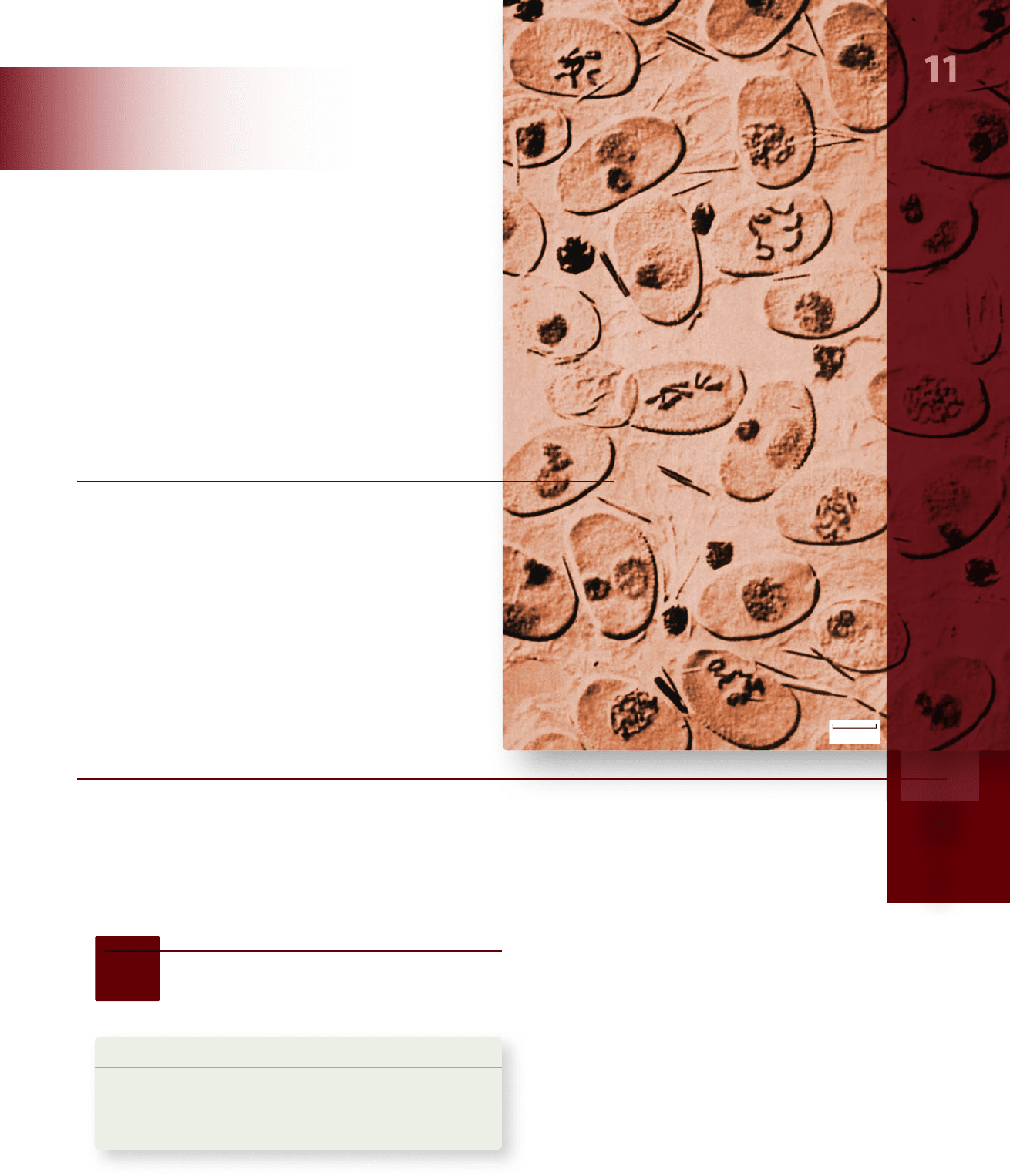
Most animals and plants reproduce sexually. Gametes of opposite sex unite to form a cell that, dividing repeatedly by mitosis,
eventually gives rise to an adult body with some 100 trillion cells. The gametes that form the initial cell are the products of
a special form of cell division called meiosis, visible in the photo above, and the subject of this chapter. Meiosis is far more
intricate than mitosis, and the details behind it are not as well understood. The basic process, however, is clear. Also clear are
the profound consequences of sexual reproduction: It plays a key role in generating the tremendous genetic diversity that is
the raw material of evolution.
Chapter Outline
11.1 Sexual Reproduction Requires Meiosis
11. 2 Features of Meiosis
11. 3 The Process of Meiosis
11. 4 Summing Up: Meiosis Versus Mitosis
CHAPTER
Learning Outcomes
1. Understand the function of meiosis in sexual
reproduction.
2. Distinguish between germ-line and somatic cells.
11.1
Sexual Reproduction
Requires Meiosis
The essence of sexual reproduction is the genetic contribution
of two cells. This mode of reproduction imposes difficulties for
sexually reproducing organisms that biologists recognized early
on. We are only recently making progress on the underlying
mechanism for the elaborate behavior of chromosomes during
meiosis. To begin, we briefly consider the history of meiosis and
its relationship to sexual reproduction.
Meiosis reduces the number of chromosomes
Only a few years after Walther Flemming’s discovery of chro-
mosomes in 1879, Belgian cytologist Edouard van Beneden was
rav32223_ch11_207-220.indd 207rav32223_ch11_207-220.indd 207 11/9/09 12:12:26 PM11/9/09 12:12:26 PM
Apago PDF Enhancer
Haploid sperm
Haploid egg
Diploid zygote
Maternal
homologue
Paternal
homologue
Fertilization
n
2n
Adult female
(diploid) 2n
Adult male
(diploid) 2n
Germ-line
cells
Germ-line
cells
Somatic
cells
Sperm
(haploid) n
Egg
(haploid) n
FERTILIZATION
MITOSIS
MITOSIS
MEIOSIS
MEIOSIS
Zygote
(diploid) 2n
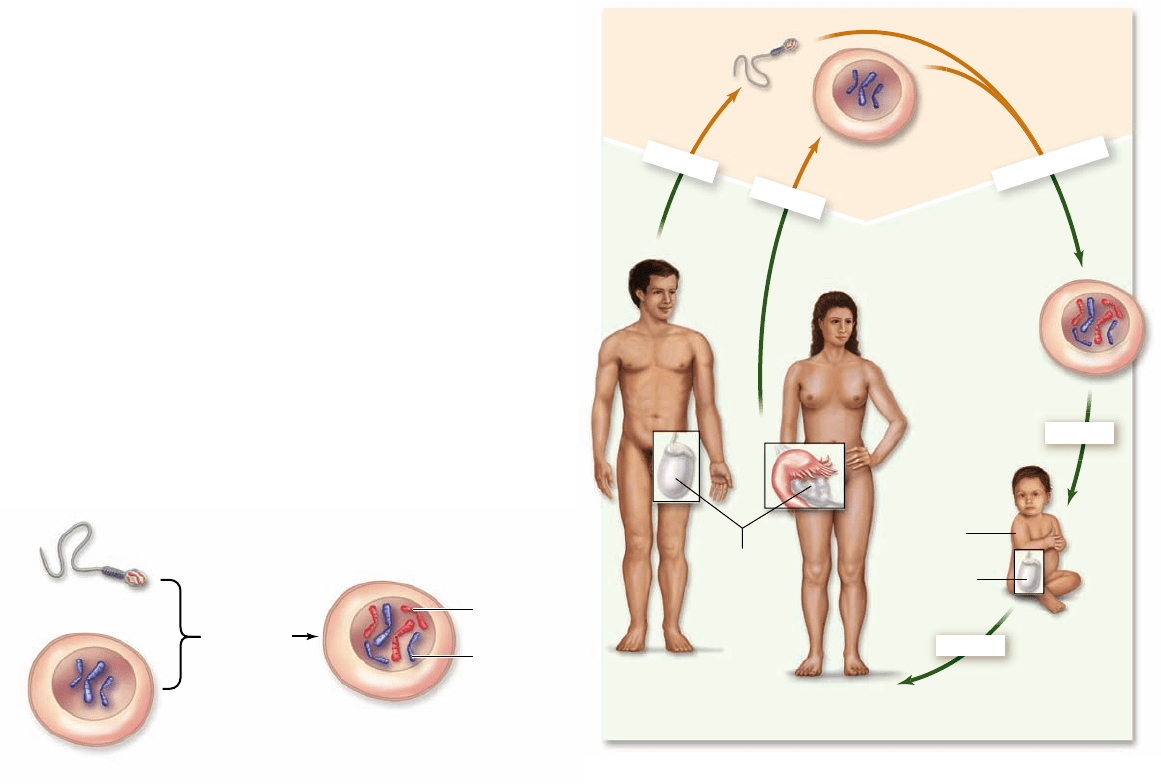
Figure 11.1
Diploid cells carry chromosomes from two
parents. A diploid cell contains two versions of each chromosome, a
maternal homologue contributed by the haploid egg of the mother, and
a paternal homologue contributed by the haploid sperm of the father.
F i g u r e 11 . 2
The sexual life cycle in animals. In animals,
the zygote undergoes mitotic divisions and gives rise to all the cells
of the adult body. Germ-line cells are set aside early in development
and undergo meiosis to form the haploid gametes (eggs or sperm).
The rest of the body cells are called somatic cells.
and some algae alternate between a multicellular haploid phase
and a multicellular diploid phase (specific examples can be
found in chapters 30 and 31 ). In most animals, the diploid state
dominates; the zygote first undergoes mitosis to produce dip-
loid cells. Then later in the life cycle, some of these diploid cells
undergo meiosis to produce haploid gametes (figure 11.2 ) .
Germ-line cells are set aside
early in animal development
In animals, the single diploid zygote undergoes mitosis to give
rise to all of the cells in the adult body. The cells that will even-
tually undergo meiosis to produce gametes are set aside from
somatic cells early in the course of development. These cells are
referred to as germ-line cells.
Both the somatic cells and the gamete-producing germ-
line cells are diploid, but whereas somatic cells undergo mitosis
to form genetically identical, diploid daughter cells, gamete-
producing germ-line cells undergo meiosis to produce haploid
gametes (see figure 11.2).
surprised to find different numbers of chromosomes in differ-
ent types of cells in the roundworm Ascaris. Specifically, he ob-
served that the gametes (eggs and sperm) each contained two
chromosomes, but all of the nonreproductive cells, or somatic
cells, of embryos and mature individuals each contained four.
From his observations, van Beneden proposed in 1883 that
an egg and a sperm, each containing half the complement of
chromosomes found in other cells, fuse to produce a single cell
called a zygote. The zygote, like all of the cells ultimately derived
from it, contains two copies of each chromosome. The fusion of
gametes to form a new cell is called fertilization, or syngamy.
It was clear even to early investigators that gamete forma-
tion must involve some mechanism that reduces the number of
chromosomes to half the number found in other cells. If it did
not, the chromosome number would double with each fertiliza-
tion, and after only a few generations, the number of chromo-
somes in each cell would become impossibly large. For example,
in just 10 generations, the 46 chromosomes present in human
cells would increase to over 47,000 (46 × 2
10
).
The number of chromosomes does not explode in this way
because of a special reduction division, meiosis . Meiosis occurs dur-
ing gamete formation, producing cells with half the normal number
of chromosomes. The subsequent fusion of two of these cells ensures
a consistent chromosome number from one generation to the next.
Sexual life cycles have both
haploid and diploid stages
Meiosis and fertilization together constitute a cycle of reproduc-
tion. Two sets of chromosomes are present in the somatic cells of
adult individuals, making them diploid cells, but only one set is
present in the gametes, which are thus haploid . Reproduction that
involves this alternation of meiosis and fertilization is called sexual
reproduction. Its outstanding characteristic is that offspring in-
herit chromosomes from two parents (figure 11.1). You, for exam-
ple, inherited 23 chromosomes from your mother (maternal
homologue), and 23 from your father (paternal homologue).
The life cycles of all sexually reproducing organisms fol-
low a pattern of alternation between diploid and haploid chro-
mosome numbers, but there is some variation in the life cycles.
Many types of algae, for example, spend the majority of their
life cycle in a haploid state. The zygote undergoing meiosis
produces haploid cells that then undergo mitosis. Some plants
208
part
III
Genetic and Molecular Biology
rav32223_ch11_207-220.indd 208rav32223_ch11_207-220.indd 208 11/9/09 12:12:34 PM11/9/09 12:12:34 PM
Apago PDF Enhancer
a
.
b. c.
Homologous
chromosomes
Synaptonemal
complex
138 nm
Synaptonemal
complex
Sister chromatids
Homologues
Kinetochore
Diploid cell
Chromosome duplication
Meiosis I
Meiosis II
Haploid cells
Centromere
Learning Outcomes Review 11.1
Sexual reproduction involves the genetic contribution of two cells, each
from a diff erent individual. Meiosis produces haploid cells with half the
number of chromosomes. Fertilization then unites these haploid cells to
restore the diploid state of the next generation. Only germ-line cells are
capable of meiosis. All other cells in the body, termed somatic cells, can
undergo only mitotic division.
■ Germ-line cells undergo meiosis, but how can the body
maintain a constant supply of these cells?
Learning Outcomes
1. Describe how homologous chromosomes pair
during meiosis.
2. Explain why meiosis I is called the reductive division.
The mechanism of meiotic cell division varies in important
details in different organisms. These variations are particu-
larly evident in the chromosomal separation mechanisms:
11. 2
Features of Meiosis
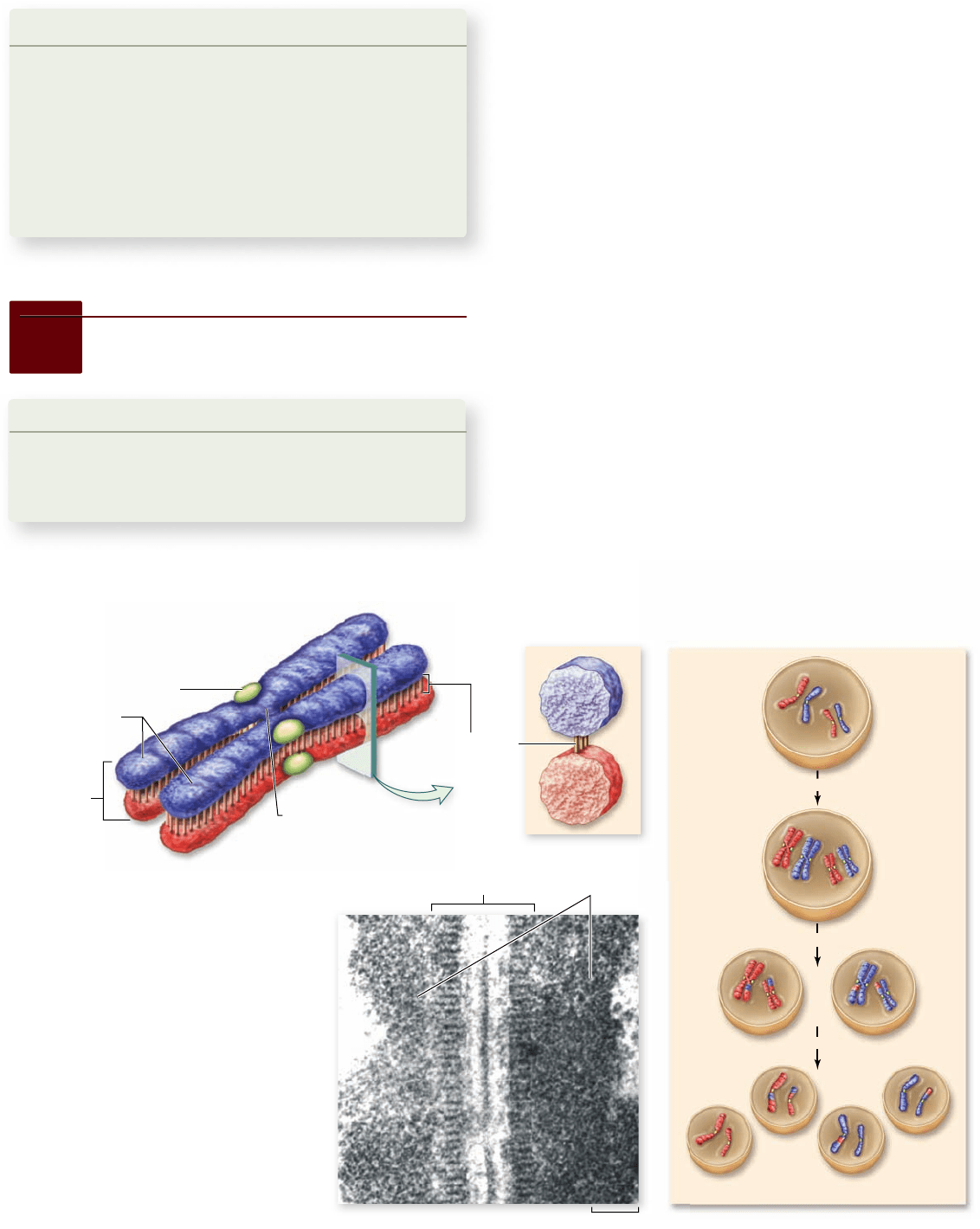
F i g u r e 11 . 3
Unique features of
meiosis. a. Homologous chromosomes
pair during prophase I of meiosis. This
process, called synapsis, produces
homologues connected by a structure
called the synaptonemal complex. The
paired homologues can physically
exchange parts, a process called crossing
over. b. The synaptonemal complex of
the ascomycete Neotiella rutilans, a cup
fungus. c. This pairing allows the
homologous pairs, and not sister
chromatids, to separate as a unit during
meiosis I. Because chromosomes are not
duplicated again before meiosis II,
disjunction of sister chromatids yields
the nal haploid products .
Those found in protists and fungi are very different from
those in plants and animals, which we describe here.
Meiosis in a diploid organism consists of two rounds of
division, called meiosis I and meiosis II, with each round con-
taining prophase, metaphase, anaphase, and telophase stages.
Before describing the details of this process, we first examine
the features of meiosis that distinguish it from mitosis.
Homologous chromosomes pair during meiosis
During early prophase I of meiosis, homologous chromosomes
find each other and become closely associated, a process called
pair ing, or synapsis (figure 11.3a). Despite a long history of
investigation, molecular details remain unclear. Biologists have
used electron microscopy, data from genetic crosses, and biochemi-
cal analysis to shed light on synapsis. Thus far the results of their
investigations have not been integrated into a complete picture .
The synaptonemal complex
It is clear that homologous chromosomes find their proper part-
ners and become intimately associated during prophase I. This
process includes the formation in many species of an elaborate
structure called the synaptonemal complex, consisting of the
homo logues paired closely along a lattice of proteins between
them (figure 11.3b). The components of the synaptonemal
complex include a meiosis-specific form of cohesin, a type of pro-
tein that joins sister chromatids during mitosis (described in
chapter 10). This form of cohesin helps to join homologues as well
as sister chromatids. The result is that all four chromatids of the
two homologues are closely associated during this phase of meio-
sis. This structure is also sometimes called a tetrad or bivalent.
chapter
11
Sexual Reproduction and Meiosis
209www.ravenbiology.com
rav32223_ch11_207-220.indd 209rav32223_ch11_207-220.indd 209 11/9/09 12:12:34 PM11/9/09 12:12:34 PM
Apago PDF Enhancer
Site of crossover
Learning Outcomes
1. Describe the behavior of chromosomes through both
meiotic divisions.
2. Explain the importance of monopolar attachment of
homologous pairs at metaphase I.
Differentiate between the events of anaphase I and 3.
anaphase II of meiosis.
To understand meiosis, it is necessary to carefully follow the be-
havior of chromosomes during each division. The events of meio-
sis depend on homologues exchanging chromosomal material by
crossing over. This allows sister chromatid cohesion around the
sites of exchange to hold homologues together. The loss of sister
chromatid cohesion is then different on the chromosome arms
and at the centromeres: it is lost at anaphase I on the chromosome
arms but is retained at the centromeres until anaphase II.
Prophase I sets the stage
for the reductive division
Meiotic cells have an interphase period that is similar to mitosis
with G
1
, S, and G
2
phases. After interphase, germ-line cells enter
meiosis I. In prophase I, the DNA coils tighter, and individual
chromosomes first become visible under the light microscope as
a matrix of fine threads. Because the DNA has already replicated
before the onset of meiosis, each of these threads actually consists
of two sister chromatids joined at their centromeres. In pro-
phase I, homologous chromosomes become closely associated in
synapsis, exchange segments by crossing over, and then separate.
Synapsis
During interphase in germ-line cells, the ends of the chroma-
tids seem to be attached to the nuclear envelope at specific sites.
The sites the homologues attach to are adjacent, so that during
prophase I the members of each homologous pair of chromo-
somes are brought close together. Homologous pairs then align
side by side, apparently guided by heterochromatin sequences,
in the process of synapsis.
This association joins homologues along their entire length.
The sister chromatids of each homologue are also joined by the
cohesin complex in a process called sister chromatid cohesion (simi-
lar to what happens during mitosis). This brings all four chroma-
tids for each set of paired homologues into close association.
11. 3
The Process of Meiosis
The exchange of genetic material between homologues
While homologues are paired during prophase I, another process
unique to meiosis occurs: genetic recombination, or crossing
over. This process literally allows the homologues to exchange
chromosomal material. The cytological observation of this phe-
nomenon is called crossing over, and its detection genetically is
called recombination—because alleles of genes that were formerly
on separate homologues can now be found on the same homo-
logue. (Genetic recombination is covered in detail in chapter 13.)
The sites of crossing over are called chiasmata (singular,
chiasma), and these sites of contact are maintained until ana-
phase I. The physical connection of homologues due to cross-
ing over and the continued connection of the sister chromatids
lock homologues together.
Homologue association and separation
The association between the homologues persists throughout
meiosis I and dictates the behavior of the chromosomes. Dur-
ing metaphase I, the paired homologues move to the metaphase
plate and become oriented with homologues of each pair at-
tached to opposite poles of the spindle. By contrast, in mitosis
homologues behave independently of one another.
Then, during anaphase I, homologues are pulled to op-
posite poles for each pair of chromosomes. This again is in con-
trast to mitosis, in which sister chromatids, not homologues,
are pulled to opposite poles.
You can now see why the first division is termed the “re-
duction division”—it results in daughter cells that contain one
homologue from each chromosome pair. The second meiotic di-
vision does not further reduce the number of chromosomes; it
will merely separate the sister chromatids for each homologue.
Meiosis features two divisions
with one round of DNA replication
The most obvious distinction between meiosis and mitosis is the
simple observation that meiosis involves two successive divisions
with no replication of genetic material between them. One way
to view this is that DNA replication must be suppressed between
the two meiotic divisions. Because of the behavior of chromo-
somes during meiosis I, the resulting cells contain one replicated
copy of each chromosome. A division that acts like mitosis, with-
out DNA replication, converts these cells into ones with a single
copy of each chromosome (figure 11.3c). This is the last key to
understanding meiosis: The second meiotic division is like mito-
sis with no chromosome duplication.
Learning Outcomes Review 11.2
Meiosis is characterized by the pairing of homologous chromosomes during
prophase I. In many species, an elaborate structure called the synaptonemal
complex forms between homologues. During this pairing, homologues
may exchange chromosomal material at sites called chiasmata. In meiosis
I, the homologues separate from each other, reducing the chromosome
number to the haploid state (thus the reductive division). It is followed by a
second division without replication, during which sister chromatids become
separated. The result of meiosis I and II is four haploid cells.
■ If sister chromatids separated at the first division, would
meiosis still work?
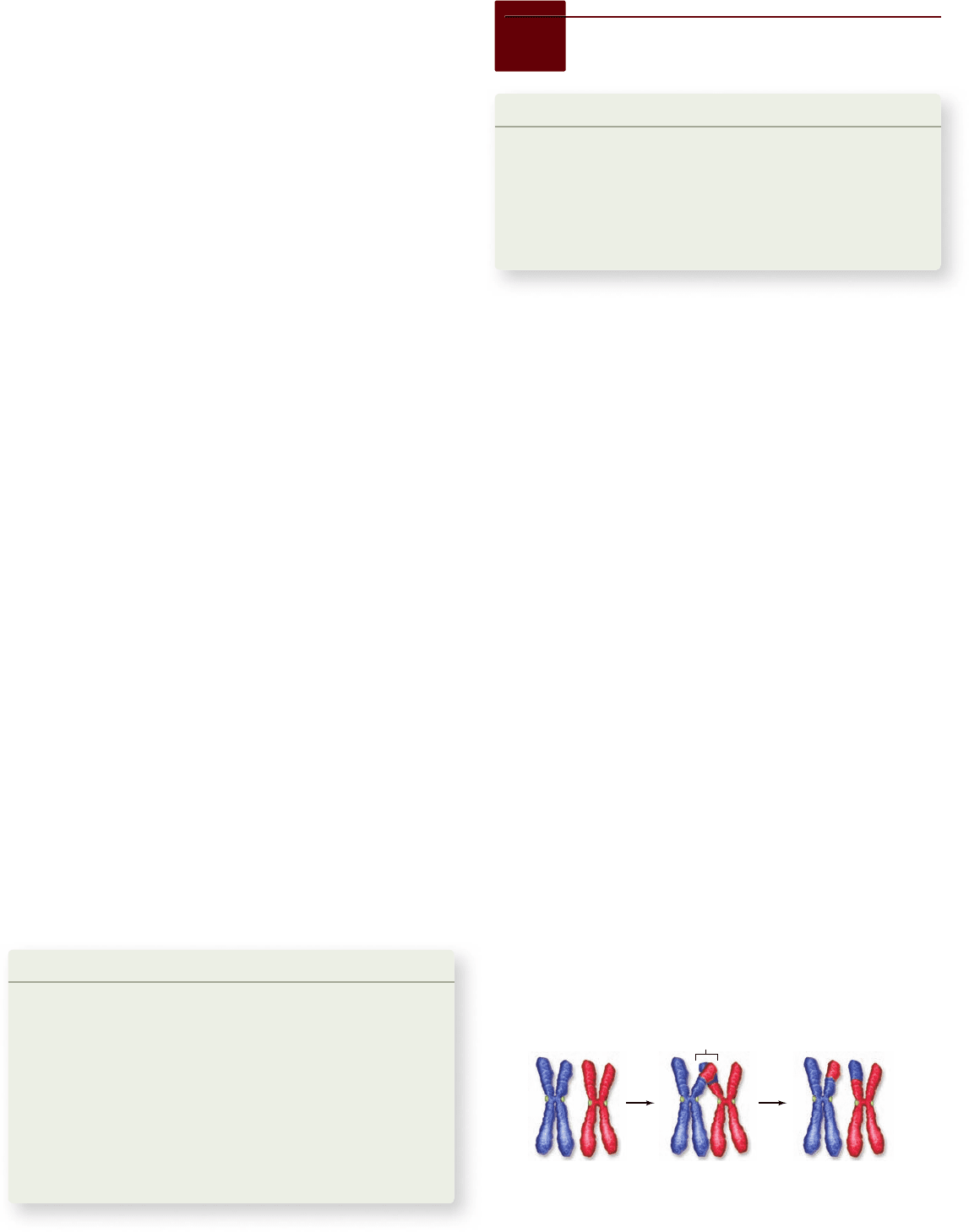
Figure 11.4
The results of crossing over. During crossing
over, homologous chromosomes may exchange segments.
210
part
III
Genetic and Molecular Biology
rav32223_ch11_207-220.indd 210rav32223_ch11_207-220.indd 210 11/9/09 12:12:37 PM11/9/09 12:12:37 PM
Apago PDF Enhancer
Meiosis I
Mitosis
Chiasmata hold
homologues
together. The
kinetochores of
sister chromatids
fuse and function as
one. Microtubules
can attach to only
one side of each
centromere.
Microtubules pull
the homologous
chromosomes
apart, but sister
chromatids are
held together.
Homologues do
not pair;
kinetochores of
sister chromatids
remain separate;
microtubules
attach to both
kinetochores on
opposite sides of
the centromere.
Microtubules
pull sister
chromatids
apart.
Metaphase I
Anaphase I
Metaphase
Anaphase
Crossing over
Along with the synaptonemal complex that forms during pro-
phase I (see figure 11.3), another kind of structure appears that
correlates in timing with the recombination process. These are
called recombination nodules, and they are thought to contain the
enzymatic machinery necessary to break and rejoin chromatids
of homologous chromosomes.
Crossing over involves a complex series of events in which
DNA segments are exchanged between nonsister chromatids
( figure 11.4). Crossing over between sister chromatids is suppressed
during meiosis. Reciprocal crossovers between nonsister chroma-
tids are controlled such that each chromosome arm usually has one
or a few crossovers per meiosis, no matter what the size of the
chromosome. Human chromosomes typically have two or three.
When crossing over is complete, the synaptonemal com-
plex breaks down, and the homologous chromosomes become
less tightly associated but remain attached by chiasmata. At this
point, there are four chromatids for each type of chromosome
(two homologous chromosomes, each of which consists of two
sister chromatids).
The four chromatids do not separate completely because
they are held together in two ways: (1) The two sister chromatids
of each homologue, recently created by DNA replication, are held
together by their common centromeres; and (2) the paired homo-
logues are held together at the points where crossing over occurred
by sister chromatid cohesion around the site of exchange. These
points are the chiasmata that can be observed microscopically.
Like small rings moving down two strands of rope, the chiasmata
move to the end of the chromosome arm before metaphase I.
While the elaborate behavior of chromosome pairing is
taking place, other events must occur during prophase I. The
nuclear envelope must be dispersed, along with the interphase
structure of microtubules. The microtubules are formed into a
spindle, just as in mitosis.
During metaphase I, paired homologues align
By metaphase I, the second stage of meiosis I, the chiasmata
have moved down the paired chromosomes to the ends. At this
point, they are called terminal chiasmata. Terminal chiasmata
hold the homologous chromosomes together in metaphase I so
that homologues can be aligned at the equator of the cell.
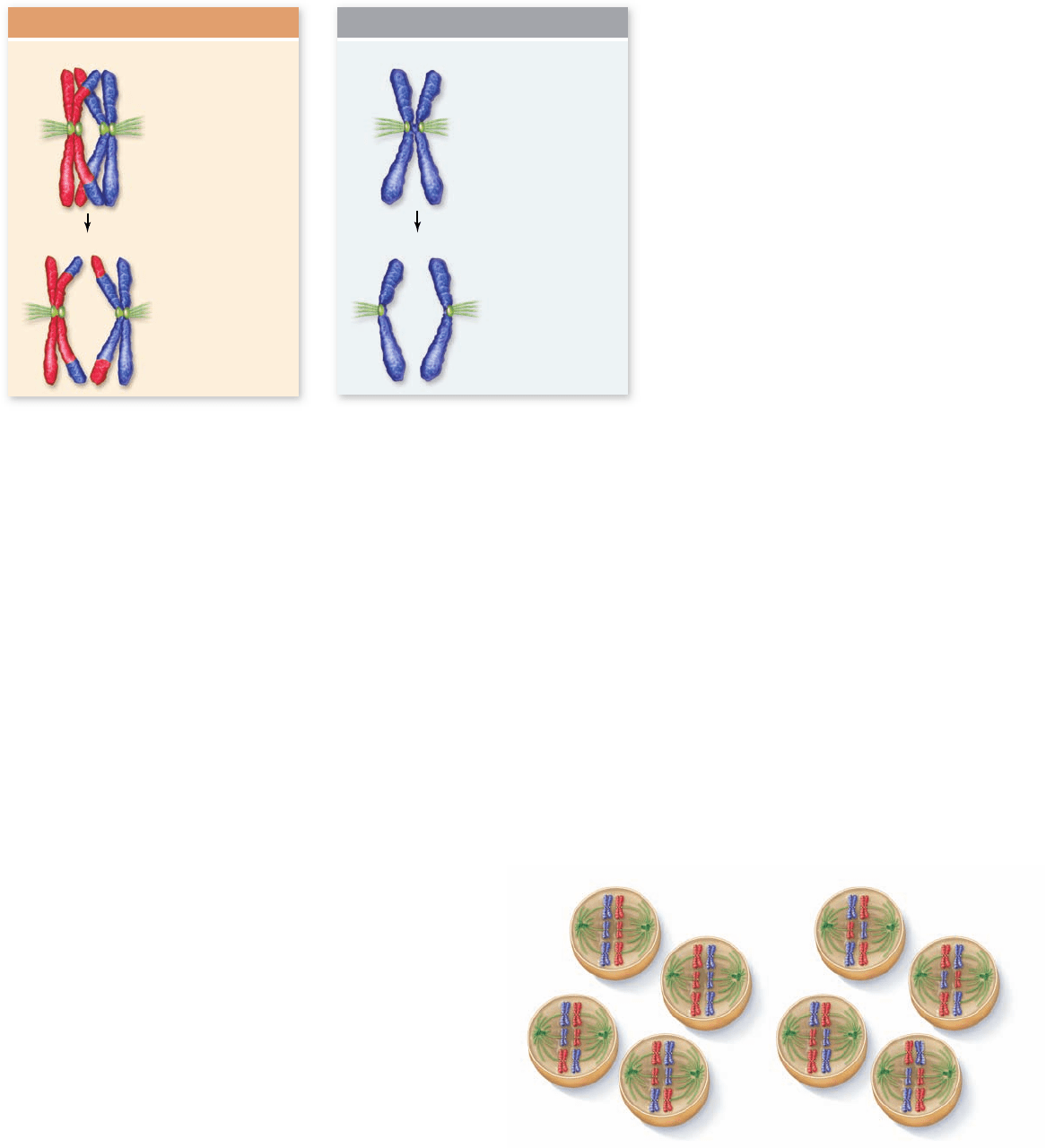
The capture of microtubules by kinetochores occurs such
that the kinetochores of sister chromatids act as a single unit.
This results in microtubules from opposite poles becoming at-
tached to the kinetochores of homologues, and not to those of
sister chromatids (figure 11.5).
The ability of sister centromeres to behave as a unit dur-
ing meiosis I is not understood. It has been suggested, based on
electron microscope data, that the centromere–kinetochore
complex of sister chromatids is compacted during meiosis I, al-
lowing them to function as a single unit.
The monopolar attachment of centromeres of sister chro-
matids would be disastrous in mitosis, but it is critical to meiosis I.
It produces tension on the homologues, which are joined by chias-
mata and sister chromatid cohesion, pulling paired homologues to
the equator of the cell. In this way, each joined pair of homologues
lines up on the metaphase plate (see figure 11.5).
The orientation of each pair on the spindle axis is ran-
dom; either the maternal or the paternal homologue may be
oriented toward a given pole (figure 11.6; see also figure 11.7).
Figure 11.5
Alignment of chromosomes
di ers between meiosis I and mitosis. In
metaphase I of meisosis I, the chiasmata and
connections between sister chromatids hold
homologous chromosomes together; paired
kinetochores for sister chromatids of each
homologue become attached to microtubules
from one pole. By the end of meiosis I,
connections between sister chromatid arms are
broken as microtubules shorten, pulling the
homologous chromosomes apart. The sister
chromatids remain joined by their centromeres.
In mitosis, microtubules from opposite poles
attach to the kinetochore of each sister
centromere; when the connections between sister
centromeres are broken microtubules shorten,
pulling the sister chromatids to opposite poles .
Figure 11.6
Random orientation of chromosomes on
the metaphase plate. The number of possible chromosome
orientations equals 2 raised to the power of the number of chromosome
pairs. In this hypothetical cell with three chromosome pairs, eight (2
3
)
possible orientations exist. Each orientation produces gametes with
different combinations of parental chromosomes.
chapter
11
Sexual Reproduction and Meiosis
211www.ravenbiology.com
rav32223_ch11_207-220.indd 211rav32223_ch11_207-220.indd 211 11/9/09 12:12:38 PM11/9/09 12:12:38 PM