
Raven P.H., Johnson G.B., Mason K.A. Biology (Ninth Edition)
Подождите немного. Документ загружается.

Apago PDF Enhancer
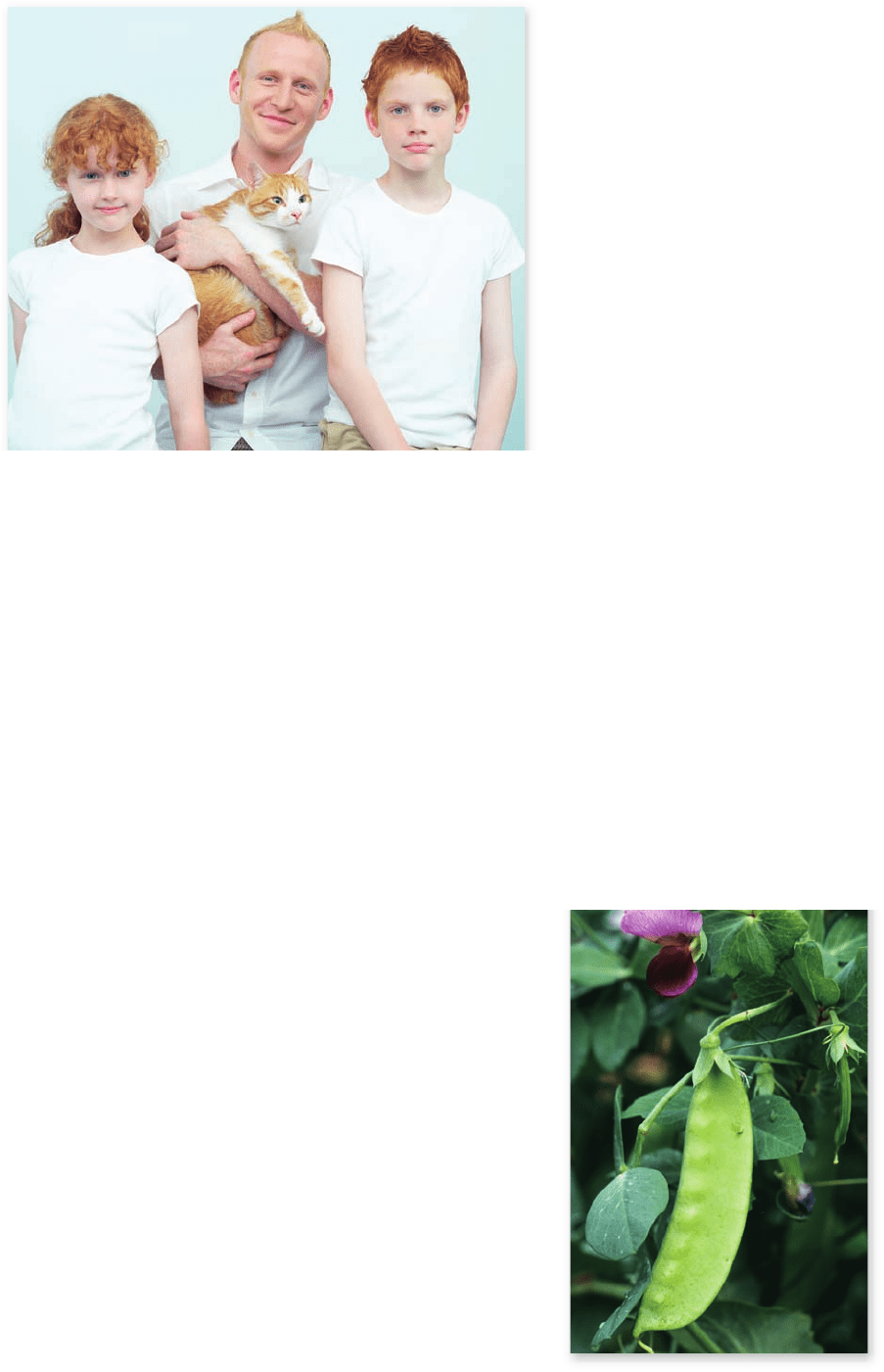
Figure 12.1
Heredity and family resemblance. Family
resemblances are often strong—a visual manifestation of the
mechanism of heredity.
Figure 12.2
The garden pea,
Pisum sativum. Easy
to cultivate and able to
produce many
distinctive varieties, the
garden pea was a popular
experimental subject in
investigations of
heredity as long as a
century before Gregor
Mendel’s experiments.
Inheritance itself was viewed as traits being borne through
fluid, usually identified as blood, that led to their blending in
offspring. This older idea persists today in the use of the term
“bloodlines” when referring to the breeding of domestic ani-
mals such as horses.
Taken together, however, these two classical assumptions
led to a paradox. If no variation enters a species from outside, and
if the variation within each species blends in every generation,
then all members of a species should soon have the same appear-
ance. It is clear that this does not happen—individuals within
most species differ from one another, and they differ in charac-
teristics that are transmitted from generation to generation.
Early plant biologists produced hybrids
and saw puzzling results
The first investigator to achieve and document successful ex-
perimental hybridizations was Josef Kölreuter, who in 1760
cross-fertilized (or crossed, for short) different strains of tobacco
and obtained fertile offspring. The hybrids differed in appear-
ance from both parent strains. When individuals within the hy-
brid generation were crossed, their offspring were highly
variable. Some of these offspring resembled plants of the hybrid
generation (their parents), but a few resembled the original
strains (their grandparents). The variation observed in second-
generation offspring contradicts the theory of direct transmis-
sion. This can be seen as the beginning of modern genetics.
Over the next hundred years, other investigators elaborated
on Kölreuter’s work. T. A. Knight, an English landholder, in 1823
crossed two varieties of the garden pea, Pisum sativum (figure 12.2).
One of these varieties had green seeds, and the other had yellow
seeds. Both varieties were true-breeding, meaning that the off-
spring produced from self-fertilization remained uniform from
one generation to the next. All of the progeny (offspring) of the
cross between the two varieties had yellow seeds. Among the off-
spring of these hybrids, however, some plants produced yellow
seeds and others, less common, produced green seeds.
Other investigators made observations similar to Knight’s,
namely that alternative forms of observed traits were being dis-
tributed among the offspring. A modern geneticist would say
the alternative forms of each trait were segregating among the
progeny of a mating, meaning that some offspring exhibited one
form of a trait (yellow seeds), and other offspring from the same
mating exhibited a different form (green seeds). This segrega-
tion of alternative forms of a trait provided the clue that led
Gregor Mendel to his understanding of the nature of heredity.
Within these deceptively simple results were the makings
of a scientific revolution. Nevertheless, another century passed
before the process of segregation was fully appreciated.
Mendel used mathematics
to analyze his crosses
Born in 1822 to peasant parents, Gregor Mendel (figure 12.3)
was educated in a monastery and went on to study science and
mathematics at the University of Vienna, where he failed his
examinations for a teaching certificate. He returned to the
monastery and spent the rest of his life there, eventually be-
coming abbot. In the garden of the monastery, Mendel initiated
his own series of experiments on plant hybridization. The re-
sults of these experiments would ultimately change our views of
heredity irrevocably.
Practical considerations for use of the garden pea
For his experiments, Mendel chose the garden pea, the same
plant Knight and others had studied. The choice was a good
one for several reasons. First, many earlier investigators had
produced hybrid peas by crossing different varieties, so Mendel
knew that he could expect to observe segregation of traits
among the offspring.
222
part
III
Genetic and Molecular Biology
rav32223_ch12_221-238.indd 222rav32223_ch12_221-238.indd 222 12/4/09 10:46:27 AM12/4/09 10:46:27 AM
Apago PDF Enhancer
1. The anthers are
cut away on the
purple flower.
Petals
Stigma
Style
Anthers (male)
Carpel (female)
2. Pollen is obtained
from the white
flower.
3. Pollen is
transferred to
the purple flower.
4. All progeny
result in purple
flowers.
Second, a large number of pure varieties of peas were avail-
able. Mendel initially examined 34 varieties. Then, for further
study, he selected lines that differed with respect to seven easily
distinguishable traits, such as round versus wrinkled seeds and yel-
low versus green seeds, the latter a trait that Knight had studied.
Third, pea plants are small and easy to grow, and they
have a relatively short generation time. A researcher can there-
fore conduct experiments involving numerous plants, grow
several generations in a single year, and obtain results rela-
tively quickly.
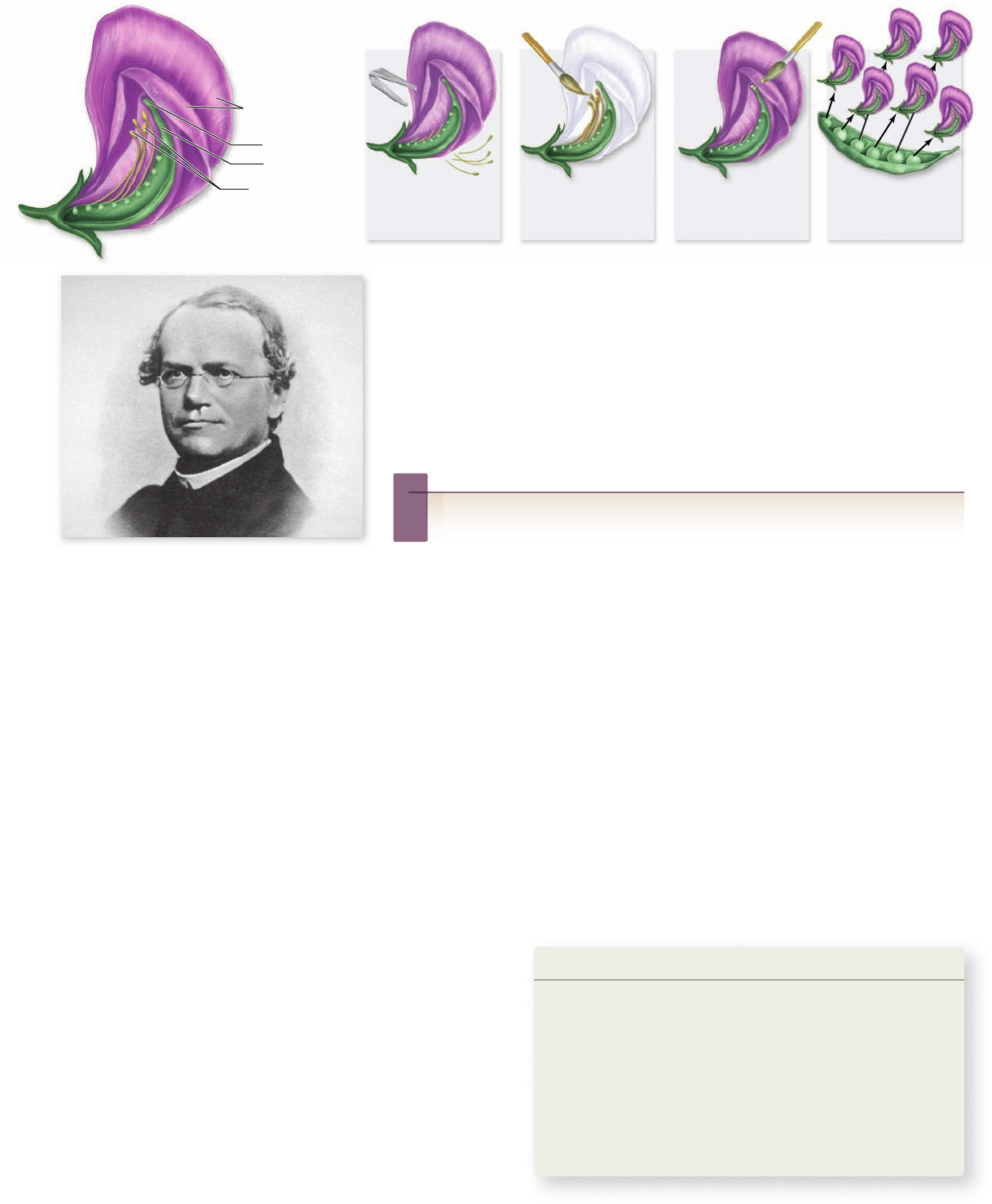
A fourth advantage of studying peas is that both the male
and female sexual organs are enclosed within each pea flower
(see figure 12.3), and gametes produced by the male and female
parts of the same flower can fuse to form viable offspring, a
process termed self-fertilization. This self-fertilization takes
place automatically within an individual flower if it is not dis-
turbed. It is also possible to prevent self-fertilization by remov-
ing a flower’s male parts before fertilization occurs, then
introduce pollen from a different strain, thus performing cross-
pollination that results in cross-fertilization (see figure 12.3).
Mendel’s experimental design
Mendel was careful to focus on only a few specific differences
between the plants he was using and to ignore the countless
other differences he must have seen. He also had the insight to
realize that the differences he selected must be comparable. For
example, he recognized that trying to study the inheritance of
round seeds versus tall height would be useless.
Mendel usually conducted his experiments in three stages:
1. Mendel allowed plants of a given variety to self-cross for
multiple generations to assure himself that the traits he
Figure 12.3
How Mendel conducted his experiments. In a pea plant ower,
petals enclose both the male anther (containing pollen grains, which give rise to haploid
sperm) and the female carpel (containing ovules, which give rise to haploid eggs). This
ensures self-fertilization will take place unless the ower is disturbed. Mendel collected
pollen from the anthers of a white ower, then placed that pollen onto the stigma of a
purple ower with anthers removed. This cross fertilization yields all hybrid seeds that
give rise to purple owers. Using pollen from a white ower to fertilize a purple ower
gives the same result.
Inquiry question
?
What confounding problems could have been seen if Mendel had chosen another
plant with exposed male and female structures?
was studying were indeed true-breeding, that is,
transmitted unchanged from generation to generation.
2. Mendel then performed crosses between true-breeding
varieties exhibiting alternative forms of traits. He also
performed reciprocal crosses: using pollen from a
white- owered plant to fertilize a purple- owered plant,
then using pollen from a purple- owered plant to fertilize
a white- owered plant.
3. Finally, Mendel permitted the hybrid offspring produced by
these crosses to self-fertilize for several generations, allowing
him to observe the inheritance of alternative forms of a trait.
Most important, he counted the numbers of offspring
exhibiting each trait in each succeeding generation.
This quantification of results is what distinguished Mendel’s re-
search from that of earlier investigators, who only noted differences
in a qualitative way. Mendel’s mathematical analysis of experimen-
tal results led to the inheritance model that we still use today.
Learning Outcomes Review 12.1
Prior to Mendel, concepts of inheritance did not form a consistent model.
The dominant view was of blending inheritance, in which traits of parents
were carried by fl uid and “blended” in off spring. Plant hybridizers before
Mendel, however, had already cast doubt on this model by observing
characteristics in hybrids that seemed to change in second-generation
off spring. Mendel’s experiments with plants involved quantifying types of
off spring and mathematically analyzing his observations.
■ Which was more important to Mendel’s success: his
approach, or his choice of experimental material?
chapter
12
Patterns of Inheritance
223www.ravenbiology.com
rav32223_ch12_221-238.indd 223rav32223_ch12_221-238.indd 223 11/6/09 2:44:57 PM11/6/09 2:44:57 PM
Apago PDF Enhancer
Purple White
Yellow Green
Round Wrinkled
Green Yellow
1. Flower Color
2. Seed Color
3. Seed Texture
4. Pod Color
Dominant Recessive F
2
Generation
705 Purple:
224 White
3.15:1
X
X
X
X
6022 Yellow:
2001 Green
3.01:1
5474 Round:
1850 Wrinkled
2.96:1
428 Green:
152 Yellow
2.82:1
Inflated Constricted
5. Pod Shape
X
882 Inflated:
299 Constricted
2.95:1
Axial Terminal
Tall Short
6. Flower Position
7. Plant Height
X
X
651 Axial:
207 Terminal
3.14:1
787 Tall:
277 Short
2.84:1
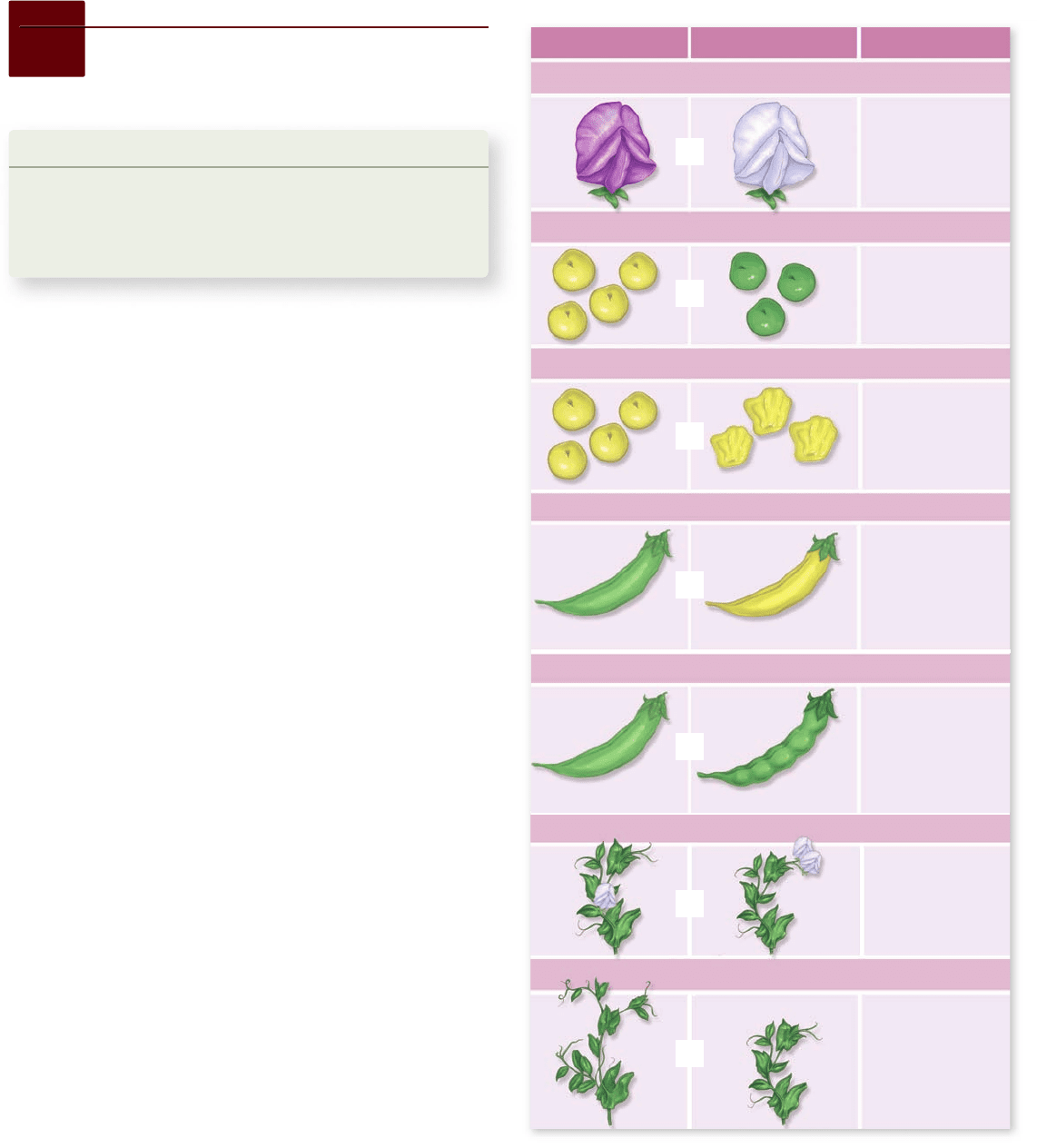
Figure 12.4
Mendel’s seven traits. Mendel studied how
differences among varieties of peas were inherited when the
varieties were crossed. Similar experiments had been done
before, but Mendel was the rst to quantify the results and
appreciate their signi cance. Results are shown for seven
different monohybrid crosses. The F
1
generation is not shown in
the table.
12.2
Monohybrid Crosses: The
Principle of Segregation
Learning Outcomes
Evaluate the outcome of a monohybrid cross.1.
Explain Mendel’s principle of segregation.2.
Compare the segregation of alleles with the behavior of 3.
homologues in meiosis.
A monohybrid cross is a cross that follows only two variations on
a single trait, such as white- and purple-colored flowers. This
deceptively simple kind of cross can lead to important conclu-
sions about the nature of inheritance.
The seven characteristics, or characters, Mendel studied
in his experiments possessed two variants that differed from
one another in ways that were easy to recognize and score
( figure 12.4). We examine in detail Mendel’s crosses with flower
color. His experiments with other characters were similar, and
they produced similar results.
The F
1
generation exhibits only one
of two traits, without blending
When Mendel crossed white-flowered and purple-flowered
plants, the hybrid offspring he obtained did not have flowers of
intermediate color, as the hypothesis of blending inheritance
would predict. Instead, in every case the flower color of the
offspring resembled that of one of their parents. These off-
spring are customarily referred to as the first filial generation,
or F
1
. In a cross of white-flowered and purple-flowered plants,
the F
1
offspring all had purple flowers, as other scientists had
reported before Mendel.
Mendel referred to the form of each trait expressed in the
F
1
plants as dominant, and to the alternative form that was not
expressed in the F
1
plants as recessive. For each of the seven
pairs of contrasting traits that Mendel examined, one of the
pair proved to be dominant and the other recessive.
The F
2
generation exhibits
both traits in a 3:1 ratio
After allowing individual F
1
plants to mature and self-fertilize,
Mendel collected and planted the seeds from each plant to see
what the offspring in the second filial generation, or F
2
,
would look like. He found that although most F
2
plants had
purple flowers, some exhibited white flowers, the recessive trait.
Although hidden in the F
1
generation, the recessive trait had
reappeared among some F
2
individuals.
Believing the proportions of the F
2
types would provide
some clue about the mechanism of heredity, Mendel counted
the numbers of each type among the F
2
progeny. In the cross
between the purple-flowered F
1
plants, he obtained a total of
929 F
2
individuals. Of these, 705 (75.9%) had purple flowers,
and 224 (24.1%) had white flowers (see figure 12.4) .
224
part
III
Genetic and Molecular Biology
rav32223_ch12_221-238.indd 224rav32223_ch12_221-238.indd 224 11/6/09 2:44:58 PM11/6/09 2:44:58 PM
Apago PDF Enhancer
F
1
generation
F
2
generation
(3:1 phenotypic
ratio)
F
3
generation
(1:2:1 genotypic
ratio)
Parent generation
True-
breeding
Non-true-
breeding
Non-true-
breeding
True-
breeding
Purple
Dominant
Purple
Dominant
Purple
Dominant
White
Recessive
Self-cross Self-cross Self-cross Self-cross
Cross-fertilize
Self-cross
True-
breeding
Purple
Parent
Purple
Offspring
True-
breeding
White
Parent
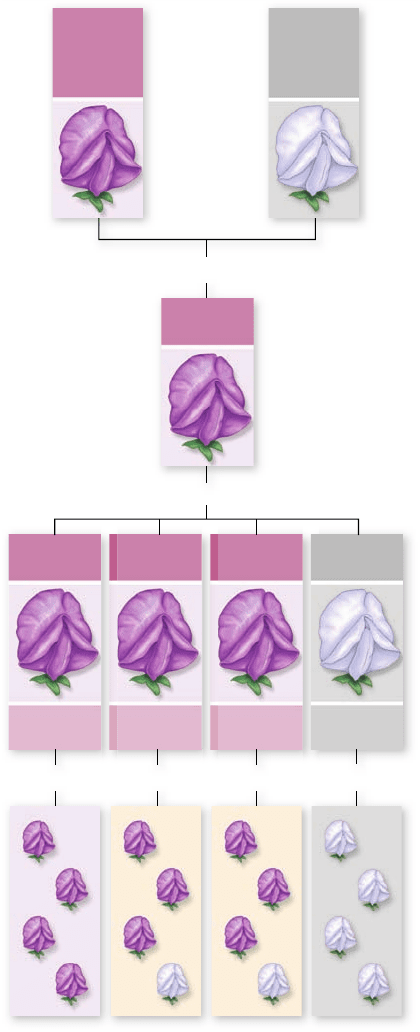
Figure 12.5
The F
2
generation is a disguised 1:2:1 ratio.
By allowing the F
2
generation to self-fertilize, Mendel found from the
offspring (F
3
) that the ratio of F
2
plants was 1 true-breeding dominant:
2 not-true-breeding dominant: and 1 true-breeding recessive.
Approximately ¼ of the F
2
individuals, therefore, exhibited
the recessive form of the character.
Mendel obtained the same numerical result with the oth-
er six characters he examined: Of the F
2
individuals, ¾ exhib-
ited the dominant trait, and ¼ displayed the recessive trait (see
figure 12.4). In other words, the dominant-to-recessive ratio
among the F
2
plants was always close to 3:1.
The 3:1 ratio is actually 1:2:1
Mendel went on to examine how the F
2
plants passed traits to
subsequent generations. He found that plants exhibiting the re-
cessive trait were always true-breeding. For example, the white-
flowered F
2
individuals reliably produced white-flowered
offspring when they were allowed to self-fertilize. By contrast,
only ⅓ of the dominant, purple-flowered F
2
individuals (¼ of
all F
2
offspring) proved true-breeding , but ⅔ were not. This
last class of plants produced dominant and recessive individuals
in the third filial generation (F
3
) in a 3:1 ratio.
This result suggested that, for the entire sample, the 3:1
ratio that Mendel observed in the F
2
generation was really a
disguised 1:2:1 ratio: ¼ true-breeding dominant individuals, ½
not-true-breeding dominant individuals, and ¼ true-breeding
recessive individuals (figure 12.5).
Mendel’s Principle of Segregation
explains monohybrid observations
From his experiments, Mendel was able to understand four
things about the nature of heredity:
■ The plants he crossed did not produce progeny of
intermediate appearance, as a hypothesis of blending
inheritance would have predicted. Instead, different
plants inherited each trait intact, as a discrete
characteristic.
■ For each pair of alternative forms of a trait, one
alternative was not expressed in the F
1
hybrids, although
it reappeared in some F
2
individuals. The trait that
“disappeared” must therefore be latent (present but not
expressed) in the F
1
individuals.
■ The pairs of alternative traits examined were segregated
among the progeny of a particular cross, some individuals
exhibiting one trait and some the other.
■ These alternative traits were expressed in the F
2
generation in the ratio of ¾ dominant to ¼ recessive.
This characteristic 3:1 segregation is referred to as the
Mendelian ratio for a monohybrid cross.
Mendel’s five-element model
To explain these results, Mendel proposed a simple model that
has become one of the most famous in the history of science,
containing simple assumptions and making clear predictions.
The model has five elements:
Parents do not transmit physiological traits directly to 1.
their offspring. Rather, they transmit discrete information
for the traits, what Mendel called “factors.” We now call
these factors genes .
Each individual receives one copy of each gene from each 2.
parent. We now know that genes are carried on
chromosomes, and each adult individual is diploid, with
one set of chromosomes from each parent.
Not all copies of a gene are identical. The alternative forms 3.
of a gene are called alleles. When two haploid gametes
containing the same allele fuse during fertilization, the
resulting offspring is said to be homozygous. When the
two haploid gametes contain different alleles, the resulting
offspring is said to be heterozygous.
chapter
12
Patterns of Inheritance
225www.ravenbiology.com
rav32223_ch12_221-238.indd 225rav32223_ch12_221-238.indd 225 11/6/09 2:44:59 PM11/6/09 2:44:59 PM
Apago PDF Enhancer
P
P
p
p pp
P
P
p
p pp
Pp
P
P
p
p pp pP
P
P
p
p pp
Pp
pP
Pp PP
a.
p
P
p
P
Pp
Pp
Pp
Pp
White parent pp
Purple
parent
PP
b.
P
P
p
p
pp
Pp
pP
PP
Purple
heterozygote Pp
Purple
heterozygote
Pp
1. p+p=pp. 2. P+p=Pp.
3. p+P=pP. 4. P+P=PP.
F
1
generation
F
2
generation 3 Purple:1 White
(1PP:2Pp:1pp)
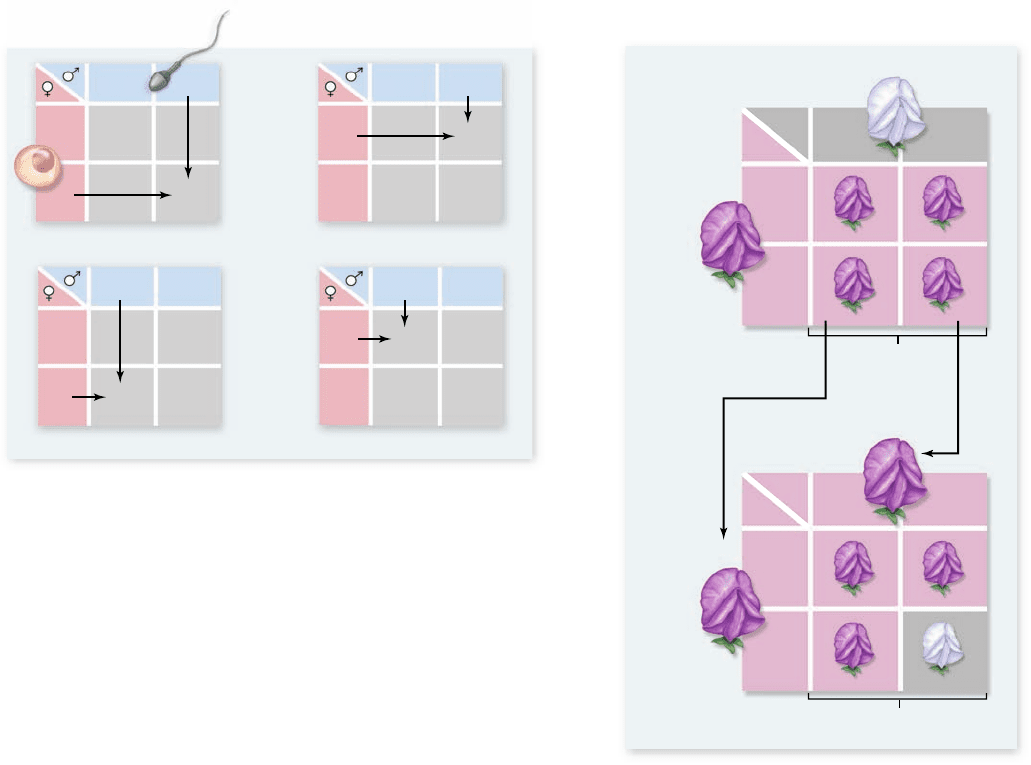
Figure 12.6
Using a Punnett square to analyze Mendel’s cross.
a. To make a Punnett square, place the different female gametes along the side of
a square and the different male gametes along the top. Each potential zygote is
represented as the intersection of a vertical line and a horizontal line. b. In
Mendel’s cross of purple by white owers, each parent makes only one type of
gamete. The F
1
are all purple, Pp, heterozygotes. These F
1
offspring make two
types of gametes that can be combined to produce three kinds of F
2
offspring: PP
homozygous dominant (purple); Pp heterozygous (also purple); and pp
homozygous recessive (white). The phenotypic ratio is 3 purple:1 white. The
genotypic ratio is 1 PP:2 Pp:1 pp.
and remain distinct—has since been verified in many other or-
ganisms. It is commonly referred to as Mendel’s first law of he-
redity, or the Principle of Segregation. It can be simply stated
as: The two alleles for a gene segregate during gamete formation and
are rejoined at random, one from each parent, during fertilization.
The physical basis for allele segregation is the behavior of
chromosomes during meiosis. As you saw in chapter 11,
homologues for each chromosome disjoin during anaphase I of
meiosis. The second meiotic division then produces ga metes
that contain only one homologue for each chromosome.
It is a tribute to Mendel’s intellect that his analysis arrived
at the correct scheme, even though he had no knowledge of the
cellular mechanisms of inheritance; neither chromosomes nor
meiosis had yet been described.
The Punnett square allows symbolic analysis
To test his model, Mendel first expressed it in terms of a simple
set of symbols. He then used the symbols to interpret his results.
Consider again Mendel’s cross of purple-flowered with
white-flowered plants. By convention, we assign the symbol P
(uppercase) to the dominant allele, associated with the produc-
tion of purple flowers, and the symbol p (lowercase) to the reces-
sive allele, associated with the production of white flowers.
In this system, the genotype of an individual that is true-
breeding for the recessive white-flowered trait would be desig nat-
ed pp. Similarly, the genotype of a true-breeding purple-flowered
The two alleles remain discrete—they neither blend with 4.
nor alter each other. Therefore, when the individual
matures and produces its own gametes, the alleles
segregate randomly into these gametes.
The presence of a particular allele does not ensure that the 5.
trait it encodes will be expressed. In heterozygous individuals,
only one allele is expressed (the dominant one), and the other
allele is present but unexpressed (the recessive one).
Geneticists now refer to the total set of alleles that an individual
contains as the individual’s genotype. The physical appearance
or other observable characteristics of that individual, which re-
sult from an allele’s expression, is termed the individual’s phe-
notype. In other words, the genotype is the blueprint, and the
phenotype is the visible outcome in an individual.
This also allows us to present Mendel’s ratios in more mod-
ern terms. The 3:1 ratio of dominant to recessive is the mono-
hybrid phenotypic ratio. The 1:2:1 ratio of homozygous dominant
to heterozygous to homozygous recessive is the monohybrid ge-
notypic ratio. The genotypic ratio “collapses” into the phenotypic
ratio due to the action of the dominant allele making the heterozy-
gote appear the same as homozygous dominant.
The principle of segregation
Mendel’s model accounts for the ratios he observed in a neat and
satisfying way. His main conclusion—that alternative alleles for
a character segregate from each other during gamete formation
226
part
III
Genetic and Molecular Biology
rav32223_ch12_221-238.indd 226rav32223_ch12_221-238.indd 226 11/6/09 2:44:59 PM11/6/09 2:44:59 PM
Apago PDF Enhancer
Dominant Pedigree
Key
unaffected male
unaffected female
affected male
affected female
Generation I
Generation II
2 1
2 3 4 5 1
2 3 1
Generation III
TABLE 12.1
Some Dominant and Recessive Traits in Humans
Recessive Traits Phenotypes Dominant Traits Phenotypes
Albinism Lack of melanin pigmentation Middigital hair Presence of hair on middle segment of ngers
Alkaptonuria Inability to metabolize homogentisic acid Brachydactyly Short ngers
Red-green color blindness Inability to distinguish red or green wavelengths of light Huntington disease Degeneration of nervous system, starting in middle age
Cystic brosis Abnormal gland secretion, leading to liver degeneration
and lung failure
Phenylthiocarbamide (PTC)
sensitivity
Ability to taste PTC as bitter
Duchenne muscular dystrophy Wasting away of muscles during childhood Camptodactyly Inability to straighten the little nger
Hemophilia Inability of blood to clot properly, some clots form but
the process is delayed
Hypercholesterolemia
(the most common human
Mendelian disorder)
Elevated levels of blood cholesterol and risk of heart attack
Sickle cell anemia Defective hemoglobin that causes red blood cells to
curve and stick together
Polydactyly Extra ngers and toes
individual would be designated PP. In contrast, a heterozygote
would be designated Pp (dominant allele first). Using these con-
ventions and denoting a cross between two strains with ×, we can
symbolize Mendel’s original purple × white cross as PP × pp.
Because a white-flowered parent (pp) can produce only p
gametes, and a true-breeding purple-flowered parent (PP, ho-
mozygous dominant) can produce only P gametes, the union of
these gametes can produce only heterozygous Pp offspring in
the F
1
generation. Because the P allele is dominant, all of these
F
1
individuals are expected to have purple flowers.
When F
1
individuals are allowed to self-fertilize, the P
and p alleles segregate during gamete formation to produce
both P gametes and p gametes. Their subsequent union at fer-
tilization to form F
2
individuals is random.
The F
2
possibilities may be visualized in a simple diagram
called a Punnett square, named after its originator, the English
geneticist R. C. Punnett (figure 12.6a ). Mendel’s model, ana-
lyzed in terms of a Punnett square, clearly predicts that the F
2
generation should consist of ¾ purple-flowered plants and ¼
white-flowered plants, a phenotypic ratio of 3:1 (figure 12.6b).
Some human traits exhibit
dominant/recessive inheritance
A number of human traits have been shown to display both
dominant and recessive inheritance (table 12.1 provides a sam-
ple of these). Researchers cannot perform controlled crosses in
humans the way Mendel did with pea plants, instead geneticists
study crosses that have already been performed—in other
words, family histories. The organized methodology we use is a
pedigree, a consistent graphical representation of matings and
offspring over multiple generations for a particular trait. The
information in the pedigree may allow geneticists to deduce a
model for the mode of inheritance of the trait. In analyzing
these pedigrees, it is important to realize that disease-causing
alleles are usually quite rare in the general population.
A dominant pedigree: Juvenile glaucoma
One of the most extensive pedigrees yet produced traced the
inheritance of a form of blindness caused by a dominant allele.
The disease allele causes a form of hereditary juvenile glauco-
ma. The disease causes degeneration of nerve fibers in the optic
nerve, leading to blindness.
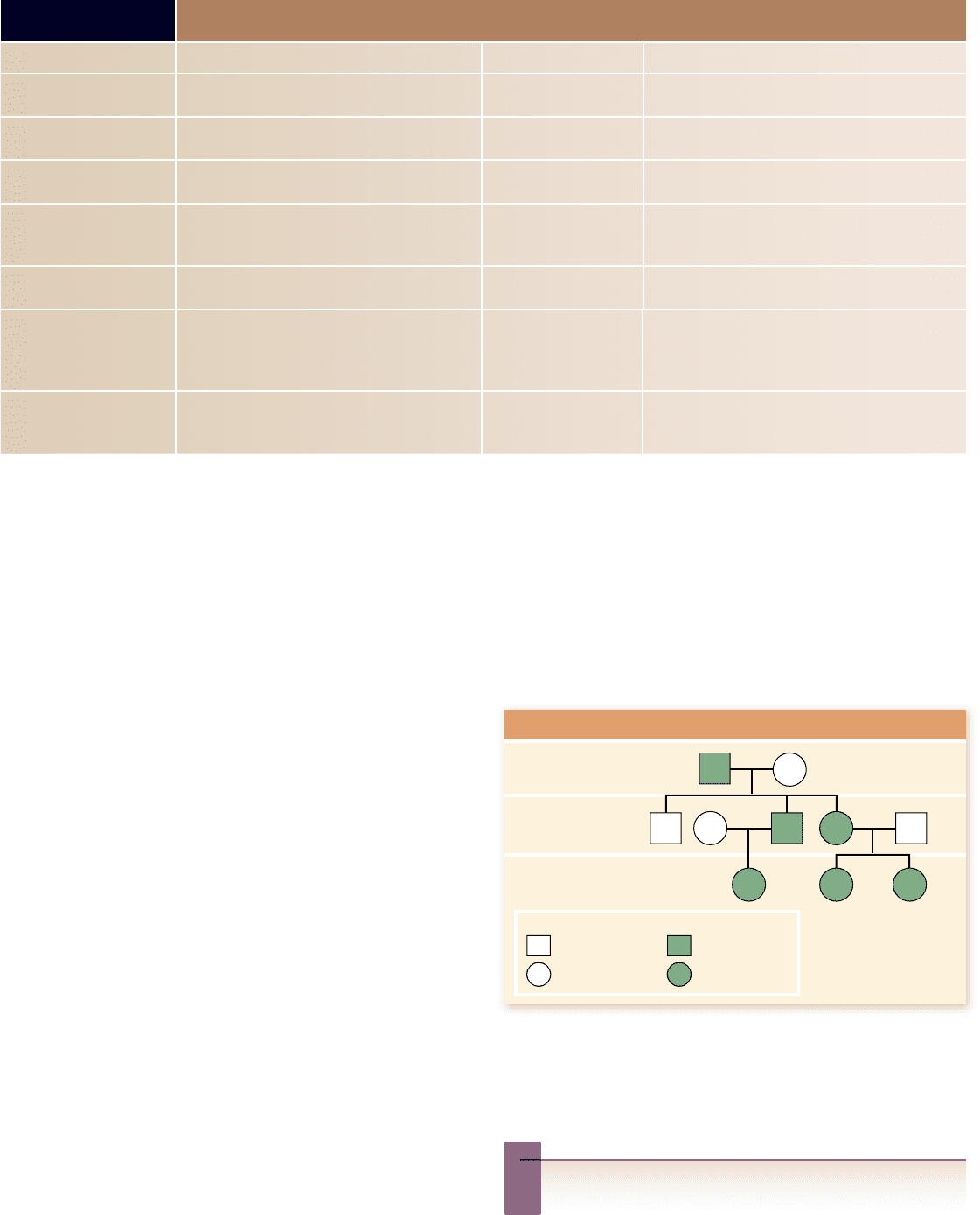
This pedigree followed inheritance over three centuries, fol-
lowing the origin back to a couple in a small town in northwestern
France who died in 1495. A small portion of this pedigree is shown
in figure 12.7 . The dominant nature of the trait is obvious from the
Figure 12.7
Dominant pedigree for hereditary juvenile
glaucoma. Males are shown as squares and females are shown as
circles. Affected individuals are shown shaded. The dominant
nature of this trait can be seen in the trait appearing in every
generation, a feature of dominant traits.
Inquiry question
?
If one of the affected females in the third generation married
an unaffected male, could she produce unaffected offspring?
If so, what are the chances of having unaffected offspring?
chapter
12
Patterns of Inheritance
227www.ravenbiology.com
rav32223_ch12_221-238.indd 227rav32223_ch12_221-238.indd 227 11/6/09 2:45:00 PM11/6/09 2:45:00 PM
Apago PDF Enhancer
Recessive Pedigree
Key
unaffected male
unaffected female
affected male
affected female
male carrier
female carrier
Generation I
1 2
1 2
1 2
3
3
1 2 3
4
4
5
5 6 7
Generation II
Generation III
One of these persons
is heterozygous
Heterozygous
Homozygous recessive
Mating between
first cousins
Generation IV
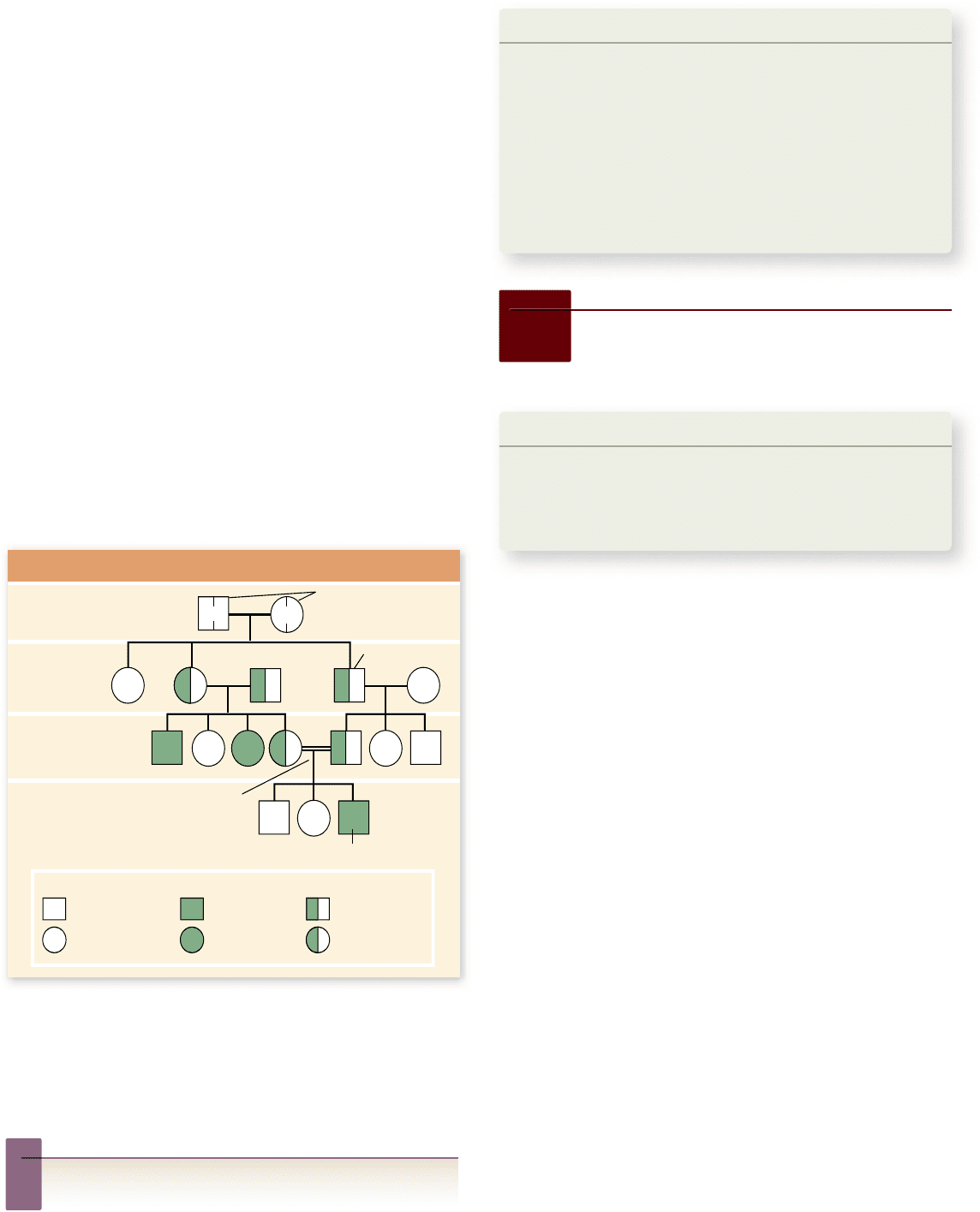
Figure 12.8
Recessive pedigree for albinism. One of the two
individuals in the rst generation must be heterozygous and individuals
II-2 and II-4 must be heterozygous. Notice that for each affected
individual, neither parent is affected, but both must be heterozygous
(carriers). The double line indicates a consanguineous mating (between
relatives) that, in this case, produced affected offspring.
Inquiry question
?
From a genetic disease standpoint, why is it never advisable
for close relatives to mate and have children?
12.3
Dihybrid Crosses: The Principle
of Independent Assortment
Learning Outcomes
Evaluate the outcome of a dihybrid cross.1.
Explain Mendel’s Principle of Independent Assortment.2.
Understand the physical basis of independent 3.
assortment.
The Principle of Segregation explains the behavior of alterna-
tive forms of a single trait in a monohybrid cross. The next step
is to extend this to follow the behavior of two different traits in
a single cross: a dihybrid cross.
With an understanding of the behavior of single traits, Men-
del went on to ask if different traits behaved independently in hy-
brids. He first established a series of true-breeding lines of peas
that differed in two of the seven characters he had studied. He then
crossed contrasting pairs of the true-breeding lines to create
heterozygotes. These heterozygotes are now doubly heterozygous,
or dihybrid. Finally, he self-crossed the dihybrid F
1
plants to pro-
duce an F
2
generation, and counted all progeny types.
Traits in a dihybrid cross behave independently
Consider a cross involving different seed shape alleles (round,
R, and wrinkled, r) and different seed color alleles (yellow, Y,
and green, y). Crossing round yellow (RR YY) with wrinkled
green (rr yy), produces heterozygous F
1
individuals having the
same phenotype (namely round and yellow) and the same ge-
notype (Rr Yy). Allowing these dihybrid F
1
individuals to self-
fertilize produces an F
2
generation.
The F
2
generation exhibits four types
of progeny in a 9:3:3:1 ratio
In analyzing these results, we first consider the number of pos-
sible phenotypes. We expect to see the two parental pheno-
types: round yellow and wrinkled green. If the traits behave
independently, then we can also expect one trait from each par-
ent to produce plants with round green seeds and others with
wrinkled yellow seeds.
Learning Outcomes Review 12.2
Mendel’s monohybrid crosses refute the idea of blending. One trait disappears in
the fi rst generation (F
1
), then reappears in a predictable ratio in the next (F
2
). The
trait observable in the F
1
is called dominant, and the other recessive. In the F
2
,
the ratio of observed dominant off spring to recessive is 3:1, and this represents a
ratio of 1 homozygous dominant to 2 heterozygous to 1 homozygous recessive.
The Principle of Segregation states that alleles segregate into diff erent gametes,
which randomly combine at fertilization. The physical basis for segregation is
the separation of homologues during anaphase I of meiosis.
■ What fraction of tall F
2
plants are true-breeding?
fact that every generation shows the trait. This is extremely un-
likely for a recessive trait as it would require large numbers of un-
related individuals to be carrying the disease allele.
A recessive pedigree: Albinism
An example of inheritance of a recessive human trait is albi-
nism, a condition in which the pigment melanin is not pro-
duced. Long thought to be due to a single gene, multiple genes
are now known that lead to albinism; the common feature is the
loss of pigment from hair, skin, and eyes. The loss of pigment
makes albinistic individuals sensitive to the sun. The tanning
effect we are all familiar with from exposure to the sun is due to
increased numbers of pigment-producing cells, and increased
production of pigment. This is lacking in albinistic individuals
due to the lack of any pigment to begin with.
The pedigree in figure 12.8 is for a form of albinism due
to a nonfunctional allele of the enzyme tyrosinase, which is re-
quired for the formation of melanin pigment. The genetic
characteristics of this form of albinism are: females and males
are affected equally, most affected individuals have unaffected
parents, a single affected parent usually does not have affected
offspring, and affected offspring are more frequent when par-
ents are related. Each of these features can be see in figure 12.8,
and all of this fits a recessive mode of inheritance.
228
part
III
Genetic and Molecular Biology
rav32223_ch12_221-238.indd 228rav32223_ch12_221-238.indd 228 11/6/09 2:45:00 PM11/6/09 2:45:00 PM
Apago PDF Enhancer
RY Ry rY ry
RR YY RR Yy Rr YY Rr Yy
RR Yy RR yy Rr Yy Rr yy
Rr YY Rr Yy rr YY rr Yy
Rr Yy Rr yy rr Yy rr yy
9/16
3/16
3/16
1/16
round, yellow
round, green
wrinkled, yellow
wrinkled, green
F
2
generation
Cross-Fertilization
Meiosis
(chromosomes assort independently
into four types of gametes)
RY
Ry
rY
ry
RY Ry rY ry
F
1
X F
1
(RrYy X RrYy)
Meiosis Meiosis
RR YY rr yy
F
1
generation
Parent generation
Rr Yy
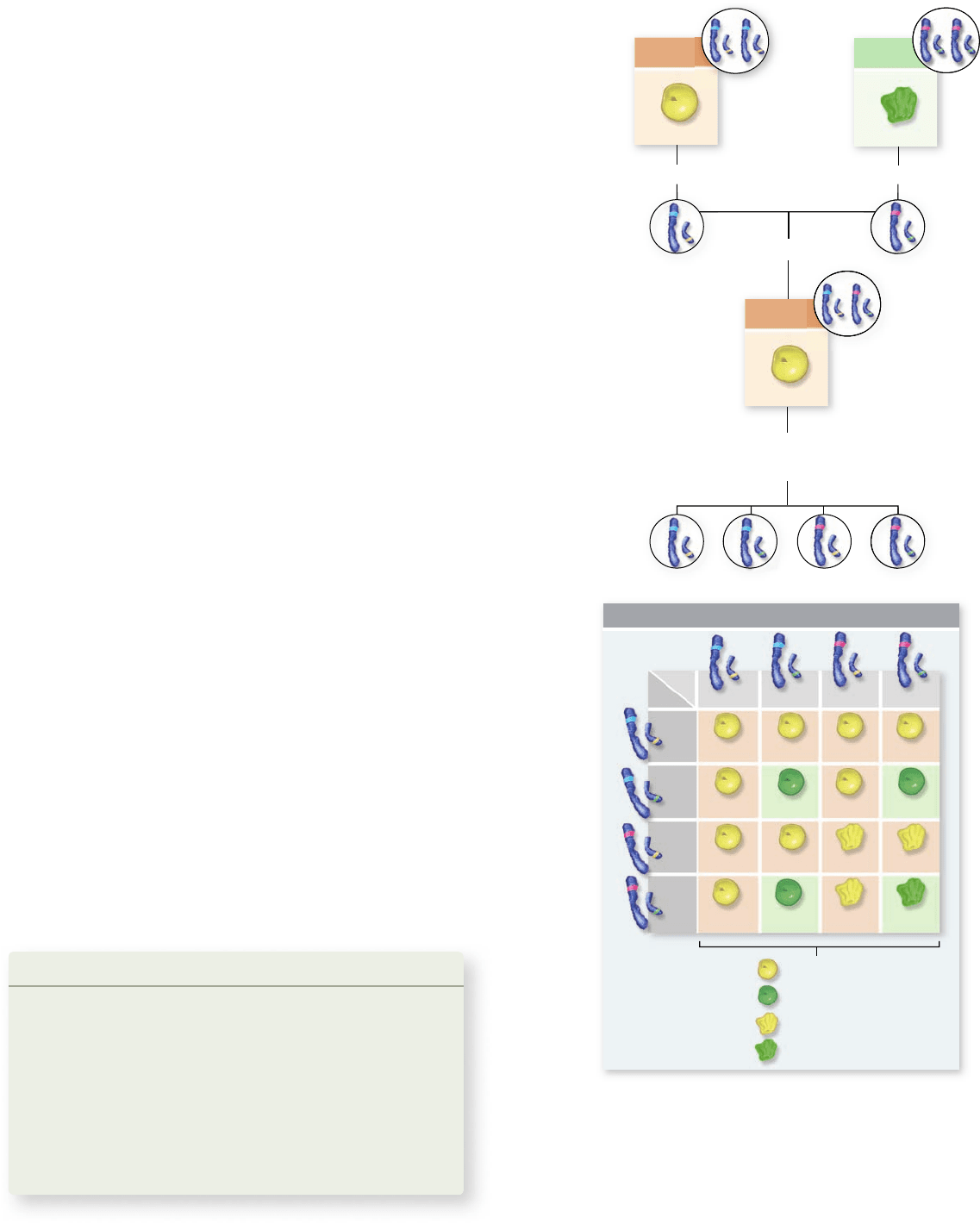
Figure 12.9
Analyzing a dihybrid cross. This Punnett
square shows the results of Mendel’s dihybrid cross between plants
with round yellow seeds and plants with wrinkled green seeds. The
ratio of the four possible combinations of phenotypes is predicted to
be 9:3:3:1, the ratio that Mendel found.
Next consider what types of gametes the F
1
individuals
can produce. Again, we expect the two types of gametes found
in the parents: RY and ry. If the traits behave independently,
then we can also expect the gametes Ry and rY. Using modern
language, two genes each with two alleles can be combined four
ways to produce these gametes: RY, ry, Ry, and rY.
A dihybrid Punnett square
We can then construct a Punnett square with these gametes to
generate all possible progeny. This is a 4 × 4 square with 16
possible outcomes. Filling in the Punnett square produces all
possible offspring (figure 12.9). From this we can see that there
are 9 round yellow, 3 wrinkled yellow, 3 round green, and 1
wrinkled green. This predicts a phenotypic ratio of 9:3:3:1 for
traits that behave independently.
Mendel’s Principle of Independent
Assortment explains dihybrid results
What did Mendel actually observe? From a total of 556 seeds from
self-fertilized dihybrid plants, he observed the following results:
■ 315 round yellow (signified R__ Y__, where the
underscore indicates the presence of either allele),
■ 108 round green (R__ yy),
■ 101 wrinkled yellow (rr Y__ ), and
■ 32 wrinkled green (rr yy).
These results are very close to a 9:3:3:1 ratio. (The expected
9:3:3:1 ratio from this many offspring would be 313:104:104:35.)
The alleles of two genes appeared to behave indepen-
dently of each other. Mendel referred to this phenomenon as
the traits assorting independently. Note that this independent
assortment of different genes in no way alters the segregation of
individual pairs of alleles for each gene. Round versus wrinkled
seeds occur in a ratio of approximately 3:1 (423:133); so do yel-
low versus green seeds (416:140). Mendel obtained similar re-
sults for other pairs of traits.
We call this Mendel’s second law of heredity, or the Prin-
ciple of Independent Assortment. This can also be stated
simply: In a dihybrid cross, the alleles of each gene assort indepen-
dently. A more precise statement would be: the segregation of dif-
ferent allele pairs is independent. This statement more closely ties
independent assortment to the behavior of chromosomes dur-
ing meiosis (see chapter 11). The independent alignment of dif-
ferent homologous chromosome pairs during metaphase I leads
to the independent segregation of the different allele pairs.
Learning Outcomes Review 12.3
Mendel’s analysis of dihybrid crosses revealed that the segregation of allele
pairs for diff erent traits is independent; this fi nding is known as Mendel’s
Principle of Independent Assortment. When individuals that diff er in two
traits are crossed, and their progeny are intercrossed, the result is four
diff erent types that occur in a ratio of 9:3:3:1, Mendel’s dihybrid ratio. This
occurs because of the independent behavior of diff erent homologous pairs
of chromosomes during meiosis I.
■ Which is more important in terms of explaining
Mendel’s laws, meiosis I or meiosis II?
chapter
12
Patterns of Inheritance
229www.ravenbiology.com
rav32223_ch12_221-238.indd 229rav32223_ch12_221-238.indd 229 11/6/09 2:45:00 PM11/6/09 2:45:00 PM

Apago PDF Enhancer
12.4
Probability: Predicting
the Results of Crosses
Learning Outcomes
Understand the rule of addition and the rule of 1.
multiplication.
Apply the rules of probability to genetic crosses.2.
Probability allows us to predict the likelihood of the outcome
of random events. Because the behavior of different chromo-
somes during meiosis is independent, we can use probability to
predict the outcome of crosses. The probability of an event that
is certain to happen is equal to 1. In contrast, an event that can
never happen has a probability of 0. Therefore, probabilities for
all other events have fractional values, between 0 and 1. For
instance, when you flip a coin, two outcomes are possible; there
is only one way to get the event “heads” so the probability of
heads is one divided by two, or ½. In the case of genetics, con-
sider a pea plant heterozygous for the flower color alleles P and
p. This individual can produce two types of gametes in equal
numbers, again due to the behavior of chromosomes during
meiosis. There is one way to get a P gamete, so the probability
of any particular gamete carrying a P allele is 1 divided by 2 or
½, just like the coin toss.
Two probability rules help predict
monohybrid cross results
We can use probability to make predictions about the outcome
of genetic crosses using only two simple rules. Before we de-
scribe these rules and their uses, we need another definition. We
say that two events are mutually exclusive if both cannot happen
at the same time. The heads and tails of a coin flip are examples
of mutually exclusive events. Notice that this is different from
two consecutive coin flips where you can get two heads or two
tails. In this case, each coin flip represents an independent event.
It is the distinction between independent and mutually exclusive
events that forms the basis for our two rules.
The rule of addition
Consider a six-sided die instead of a coin: for any roll of the die,
only one outcome is possible, and each of the possible outcomes
are mutually exclusive. The probability of any particular num-
ber coming up is . The probability of either of two different
numbers is the sum of the individual probabilities, or restated
as the rule of addition:
For two mutually exclusive events, the probability of either
event occurring is the sum of the individual probabilities.
Probability of rolling either a 2 or a 6
is =
1
/
6
+
1
/
6
=
2
/
6
=
1
/
3
To apply this to our cross of heterozygous purple F
1
, four mu-
tually exclusive outcomes are possible: PP, Pp, pP, and pp. The
probability of being heterozygous is the same as the probability
of being either Pp or pP, or ¼ plus ¼, or ½.
Probability of F
2
heterozygote = ¼Pp + ¼pP = ½
In the previous example, of 379 total offspring, we would ex-
pect about 190 to be heterozygotes. (The actual number is 189.5.)
The rule of multiplication
The second rule, and by far the most useful for genetics, deals
with the outcome of independent events. This is called the
product rule, or rule of multiplication, and it states that
the probability of two independent events both occurring is
the product of their individual probabilities.
We can apply this to a monohybrid cross in which off-
spring are formed by gametes from each of two parents. For
any particular outcome then, this is due to two independent
events: the formation of two different gametes. Consider the
purple F
1
parents from earlier. They are all Pp (heterozygotes),
so the probability that a particular F
2
individual will be pp (ho-
mozygous recessive) is the probability of receiving a p gamete
from the male (½) times the probability of receiving a p gamete
from the female (½), or ¼:
Probability of pp homozygote = ½p (male parent) × ½p
(female parent) = ¼pp
This is actually the basis for the Punnett square that we
used before. Each cell in the square was the product of the
probabilities of the gametes that contribute to the cell. We then
use the addition rule to sum the probabilities of the mutually
exclusive events that make up each cell.
We can use the result of a probability calculation to pre-
dict the number of homozygous recessive offspring in a cross
between heterozygotes. For example, out of 379 total offspring,
we would expect about 95 to exhibit the homozygous recessive
phenotype. (The actual calculated number is 94.75.)
Dihybrid cross probabilities are based
on monohybrid cross probabilities
Probability analysis can be extended to the dihybrid case. For
our purple F
1
by F
1
cross, there are four possible outcomes,
three of which show the dominant phenotype. Thus the prob-
ability of any offspring showing the dominant phenotype is ¾,
and the probability of any offspring showing the recessive phe-
notype is ¼. Now we can use this and the product rule to pre-
dict the outcome of a dihybrid cross. We will use our example
of seed shape and color from earlier, but now examine it using
probability.
If the alleles affecting seed shape and seed color segregate
independently, then the probability that a particular pair of al-
leles for seed shape would occur together with a particular pair of
alleles for seed color is the product of the individual probabilities
for each pair. For example, the probability that an individual with
wrinkled green seeds (rr yy) would appear in the F
2
generation
would be equal to the probability of obtaining wrinkled seeds
(¼) times the probability of obtaining green seeds (¼), or
16
.
Probability of rr yy = ¼ rr × ¼ yy =
16
rr yy
230
part
III
Genetic and Molecular Biology
rav32223_ch12_221-238.indd 230rav32223_ch12_221-238.indd 230 11/6/09 2:45:01 PM11/6/09 2:45:01 PM
Apago PDF Enhancer
Dominant
Phenotype
(unknown
genotype)
p
P
p
P
PP or Pp?
Pp
Pp
Pp
Pp
Homozygous
recessive
Homozygous
dominant
If Pp If PP
then then
Alternative 1:
All offspring are purple
and the unknown flower
is homozygous dominant
p
P
p
p
pp
Pp
pp
Pp
Homozygous
recessive
Heterozygous
dominant
Alternative 2:
Half of the offspring are
white and the unknown flower
is heterozygous dominant
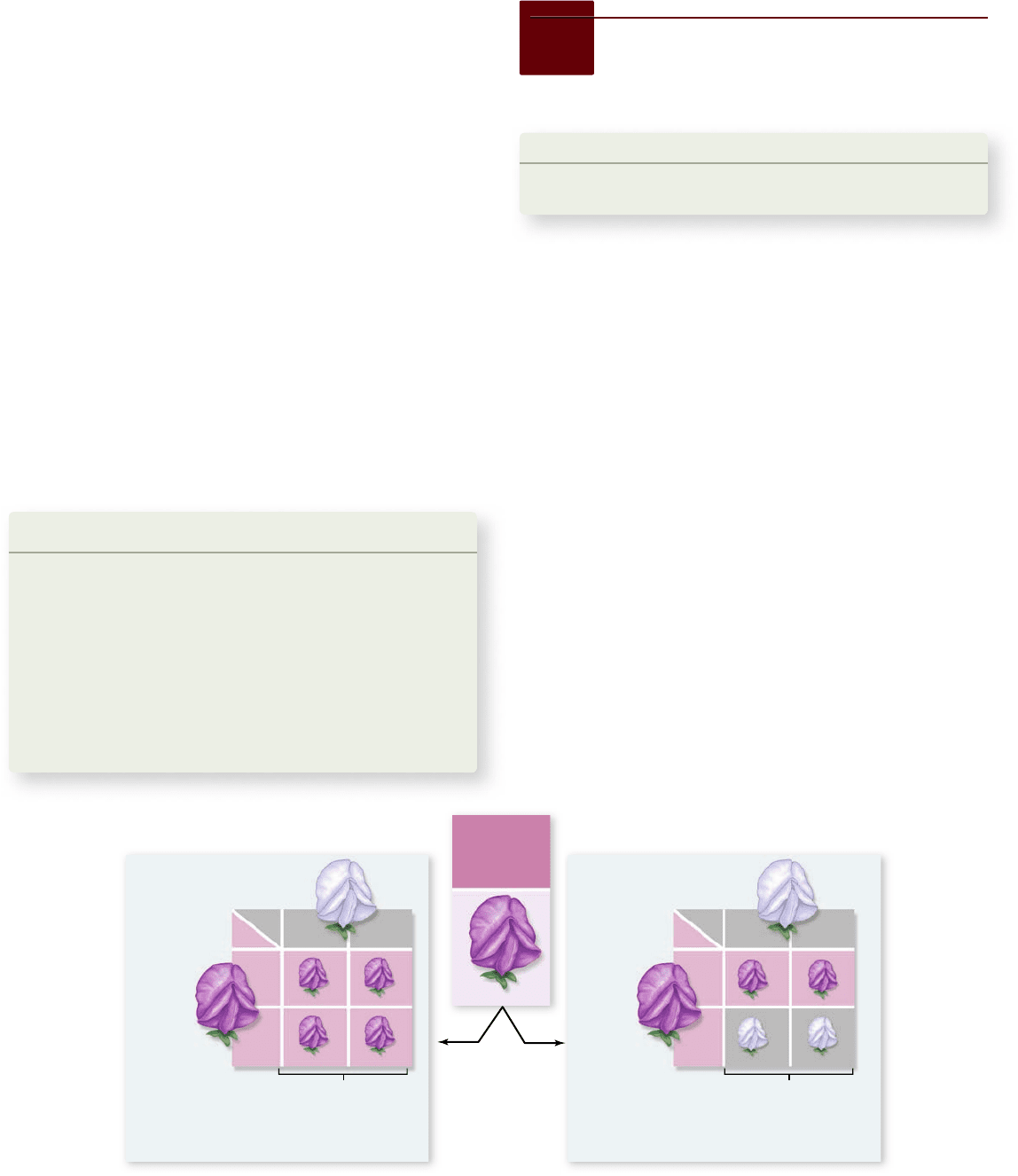
Figure 12.10
A testcross. To determine whether an individual exhibiting a dominant phenotype, such as purple owers, is homozygous
or heterozygous for the dominant allele, Mendel crossed the individual in question with a plant that he knew to be homozygous recessive—in
this case, a plant with white owers.
Because of independent assortment, we can think of the
dihybrid cross of consisting of two independent monohybrid
crosses; since these are independent events, the product rule
applies. So, we can calculate the probabilities for each dihy-
brid phenotype:
Probability of round yellow (R__ Y__) =
¾ R__ × ¾ Y__ =
9
/
16
Probability of round green (R__ yy) =
¾ R__ × ¼ yy =
3
/
16
Probability of wrinkled yellow (rr Y__) =
¼ rr × ¾ Y__ =
3
/
16
Probability of wrinkled green (rr yy) =
¼ rr ×¼ yy =
1
/
16
The hypothesis that color and shape genes are indepen-
dently sorted thus predicts that the F
2
generation will display a
9:3:3:1 phenotypic ratio. These ratios can be applied to an ob-
served total offspring to predict the expected number in each
phenotypic group. The underlying logic and the results are the
same as obtained using the Punnett square.
Learning Outcomes Review 12.4
The rule of addition states that the probability of either of two events
occurring is the sum of their individual probabilities. The rule of
multiplication states that the probability of two independent events
both occurring is the product of their individual probabilities. These
rules can be applied to genetic crosses to determine the probability of
particular genotypes and phenotypes. Results can then be compared
against these predictions.
■ How would you calculate the probability of all
dominant phenotype F
2
progeny in a trihybrid cross?
12.5
The Testcross: Revealing
Unknown Genotypes
Learning Outcome
Interpret data from test crosses to infer genotypes.1.
To test his model further, Mendel devised a simple and power-
ful procedure called the testcross. In a testcross, an individual
with unknown genotype is crossed with the homozygous reces-
sive genotype—that is, the recessive parental variety. The con-
tribution of the homozygous recessive parent can be ignored,
because this parent can contribute only recessive alleles.
Consider a purple-flowered pea plant. It is impossible to
tell whether such a plant is homozygous or heterozygous simply
by looking at it. To learn its genotype, you can perform a test-
cross to a white-flowered plant. In this cross, the two possible test
plant genotypes will give different results (figure 12.10) :
Alternative 1: Unknown individual is homozygous dominant
(PP ) PP × pp: All offspring have purple owers (Pp).
Alternative 2: Unknown individual is heterozygous (Pp)
Pp × pp: ½ of offspring have white owers (pp), and
½ have purple owers (Pp).
Put simply, the appearance of the recessive phenotype in
the offspring of a testcross indicates that the test individual’s
genotype is heterozygous.
For each pair of alleles Mendel investigated, he ob-
served phenotypic F
2
ratios of 3:1 (see figure 12.4) and test-
cross ratios of 1:1, just as his model had predicted.
Testcrosses can also be used to determine the genotype of
an individual when two genes are involved. Mendel often
chapter
12
Patterns of Inheritance
231www.ravenbiology.com
rav32223_ch12_221-238.indd 231rav32223_ch12_221-238.indd 231 11/6/09 2:45:01 PM11/6/09 2:45:01 PM