
Raven P.H., Johnson G.B., Mason K.A. Biology (Ninth Edition)
Подождите немного. Документ загружается.

Apago PDF Enhancer
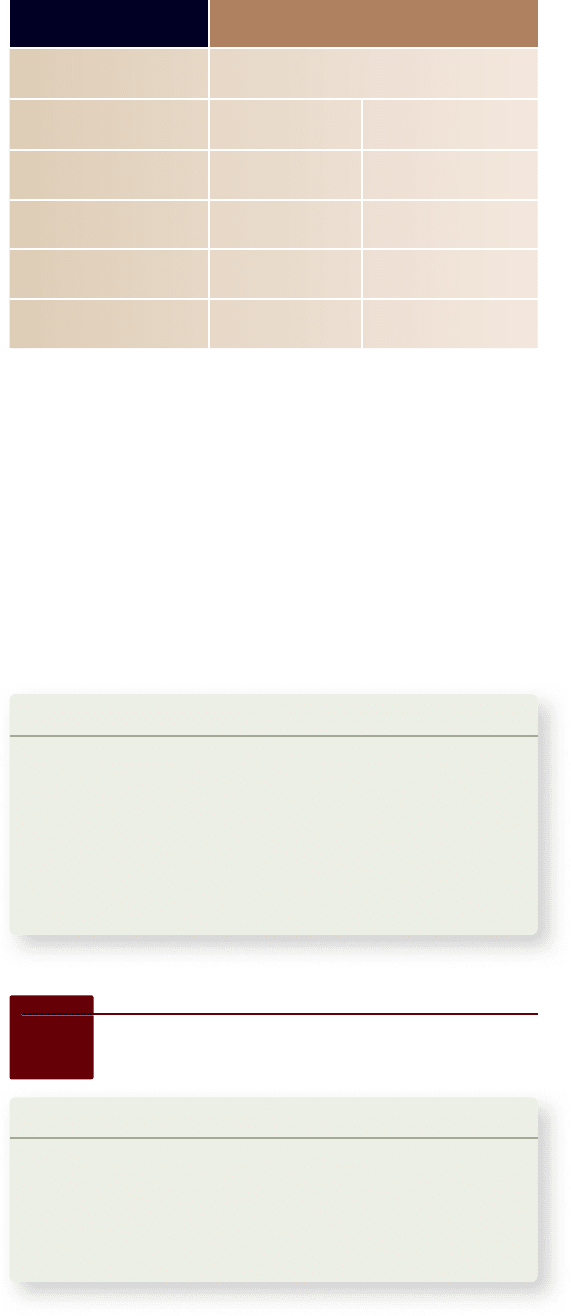
TABLE 12.2
Dihybrid Testcross
Actual Genotype Results of Testcross
Trait A Trait B
AABB Trait A breeds true Trait B breeds true
AaBB ——— Trait B breeds true
AABb Trait A breeds true ———
AaBb ——— ———
12.6
Extensions to Mendel
Learning Outcomes
Describe how assumptions in Mendel’s model result in 1.
oversimplification.
Discuss a genetic explanation for continuous variation.2.
Explain the genetic basis for observed alterations to 3.
Mendel’s ratios.
Although Mendel’s results did not receive much notice during
his lifetime, three different investigators independently redis-
covered his pioneering paper in 1900, 16 years after his death.
They came across it while searching the literature in prepara-
performed test crosses to verify the genotypes of dominant-
appearing F
2
individuals.
An F
2
individual exhibiting both dominant traits (A__ B__ )
might have any of the following genotypes: AABB, AaBB,
AABb, or AaBb. By crossing dominant-appearing F
2
individuals
with homozygous recessive individuals (that is, A__ B__ ×
aabb), Mendel was able to determine whether either or both of
the traits bred true among the progeny, and so to determine the
genotype of the F
2
parent (table 12.2).
Testcrossing is a powerful tool that simplifies genetic
analysis. We will use this method of analysis in the next chapter,
when we explore genetic mapping.
Learning Outcome Review 12.5
Individuals showing the dominant phenotype can be either homozygous
dominant or heterozygous. Unknown genotypes can be revealed using
a testcross, which is a cross to a homozygous recessive individual.
Heterozygotes produce both dominant and recessive phenotypes in equal
numbers as a result of the testcross.
■ In a dihybrid testcross of a doubly heterozygous
individual, what would be the expected phenotypic ratio?
tion for publishing their own findings, which closely resembled
those Mendel had presented more than 30 years earlier.
In the decades following the rediscovery of Mendel’s
ideas, many investigators set out to test them. However, scien-
tists attempting to confirm Mendel’s theory often had trouble
obtaining the same simple ratios he had reported.
The reason that Mendel’s simple ratios were not obtained had
to do with the traits that others examined. A number of assumptions
are built into Mendel’s model that are oversimplifications. These
assumptions include that each trait is specified by a single gene with
two alternative alleles; that there are no environmental effects; and
that gene products act independently. The idea of dominance also
hides a wealth of biochemical complexity. In the following sections,
you’ll see how Mendel’s simple ideas can be extended to provide a
more complete view of genetics (table 12.3).
In polygenic inheritance, more than
one gene can a ect a single trait
Often, the relationship between genotype and phenotype is
more complicated than a single allele producing a single trait.
Most phenotypes also do not reflect simple two-state cases like
purple or white flowers.
Consider Mendel’s crosses between tall and short pea
plants. In reality, the “tall” plants actually have normal height,
and the “short” plants are dwarfed by an allele at a single gene.
But in most species, including humans, height varies over a
continuous range, rather than having discrete values. This con-
tinuous distribution of a phenotype has a simple genetic expla-
nation: more than one gene is at work. The mode of inheritance
operating in this case is often called polygenic inheritance.
In reality, few phenotypes result from the action of only
one gene. Instead, most characters reflect multiple additive con-
tributions to the phenotype by several genes. When multiple
genes act jointly to influence a character, such as height or
weight, the character often shows a range of small differences.
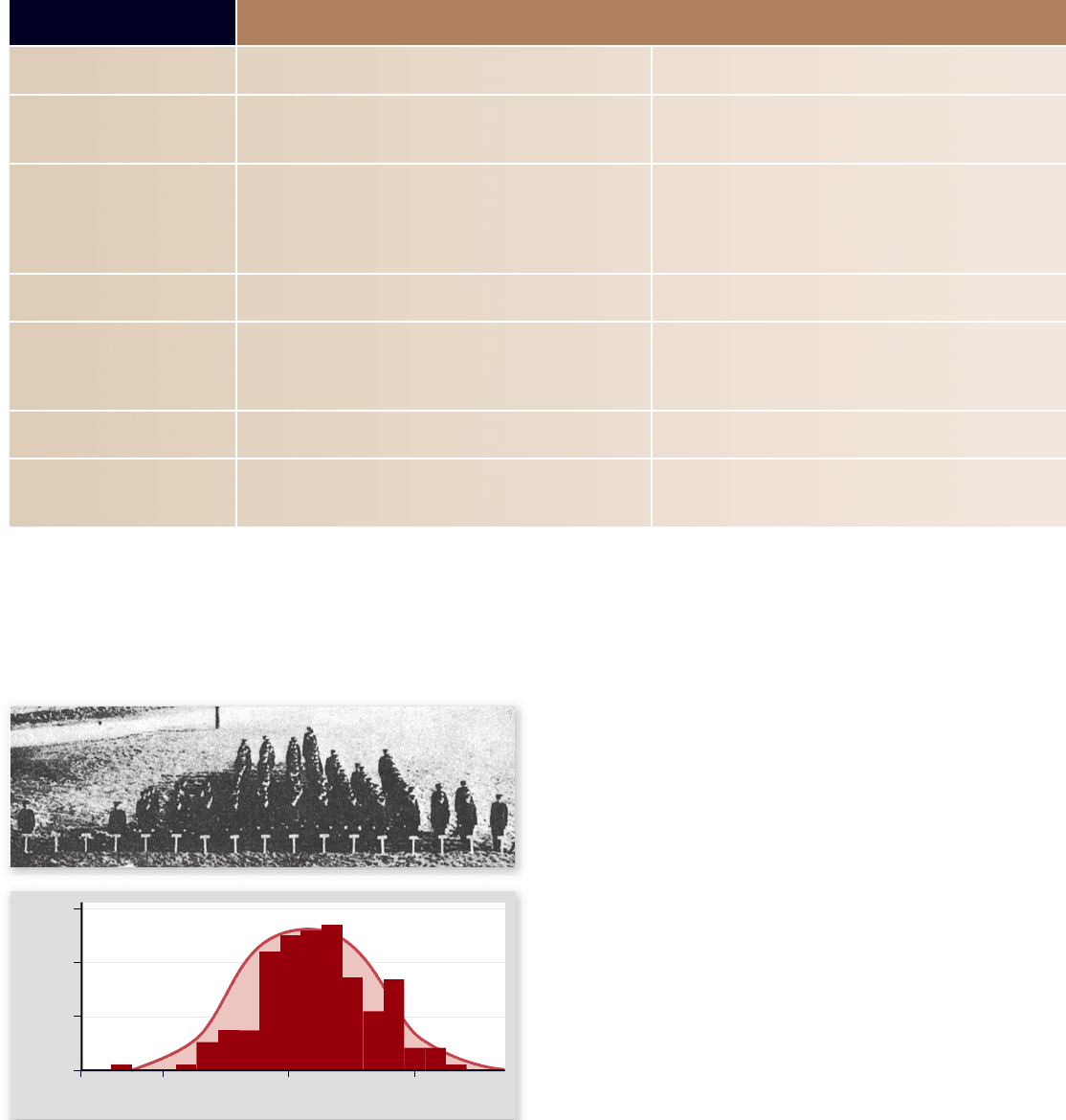
When these genes segregate independently, a gradation in the
degree of difference can be observed when a group consisting of
many individuals is examined (figure 12.11) . We call this grada-
tion continuous variation, and we call such traits quantitative
traits. The greater the number of genes influencing a character,
the more continuous the expected distribution of the versions of
that character.
This continuous variation in traits is similar to blending
different colors of paint: Combining one part red with seven
parts white, for example, produces a much lighter shade of pink
than does combining five parts red with three parts white. Dif-
ferent ratios of red to white result in a continuum of shades,
ranging from pure red to pure white.
Often, variations can be grouped into categories, such as
different height ranges. Plotting the numbers in each height
category produces a curve called a histogram, such as that shown
in figure 12.11. The bell-shaped histogram approximates an
idealized normal distribution, in which the central tendency is
characterized by the mean, and the spread of the curve indi-
cates the amount of variation.
Even simple-appearing traits can have this kind of poly-
genic basis. For example, human eye colors are often described in
232
part
III
Genetic and Molecular Biology
rav32223_ch12_221-238.indd 232rav32223_ch12_221-238.indd 232 11/6/09 2:45:02 PM11/6/09 2:45:02 PM
Apago PDF Enhancer
Number of Individuals
30
20
10
0
0 5'0'' 5'6''
Height
6'0''
Figure 12.11
Height is a continuously varying trait. The
photo and accompanying graph show variation in height among
students of the 1914 class at the Connecticut Agricultural College.
Because many genes contribute to height and tend to segregate
independently of one another, the cumulative contribution of
different combinations of alleles to height forms a continuous
distribution of possible heights, in which the extremes are much
rarer than the intermediate values. Variation can also arise due to
environmental factors such as nutrition.
TABLE 12.3
When Mendel’s Laws/Results May Not Be Observed
Genetic Occurrence Defi nition Examples
Polygenic inheritance More than one gene can a ect a single trait. • Four genes are involved in determining eye color.
• Human height
Pleiotropy A single gene can a ect more than one trait. • A pleiotropic allele dominant for yellow fur in mice is recessive for a
lethal developmental defect.
• Cystic brosis
• Sickle cell anemia
Multiple alleles for one gene Genes may have more than two alleles. ABO blood types in humans
Dominance is not always complete • In incomplete dominance the heterozygote is intermediate.
• In codominance no single allele is dominant, and the heterozygote
shows some aspect of both homozygotes.
• Japanese four o’clocks
• Human blood groups
Environmental factors Genes may be a ected by the environment. Siamese cats
Gene interaction Products of genes can interact to alter genetic ratios. • The production of a purple pigment in corn
• Coat color in mammals
In pleiotropy, a single gene can a ect
more than one trait
Not only can more than one gene affect a single trait, but a single
gene can affect more than one trait. Considering the complexity
of biochemical pathways and the interdependent nature of organ
systems in multicellular organisms, this should be no surprise.
An allele that has more than one effect on phenotype is said to
be pleiotropic. The pioneering French geneticist Lucien Cuenot
studied yellow fur in mice, a dominant trait, and found he was un-
able to obtain a pure-breeding yellow strain by crossing individual
yellow mice with each other. Individuals homozygous for the yellow
allele died, because the yellow allele was pleiotropic: One effect was
yellow coat color, but another was a lethal developmental defect.
A pleiotropic allele may be dominant with respect to one
phenotypic consequence (yellow fur) and recessive with respect
to another (lethal developmental defect). Pleiotropic effects are
difficult to predict, because a gene that affects one trait often
performs other, unknown functions.
Pleiotropic effects are characteristic of many inherited
disorders in humans, including cystic fibrosis and sickle cell
anemia (discussed in chapter 13). In these disorders, multiple
symptoms (phenotypes) can be traced back to a single gene
defect. Cystic fibrosis patients exhibit clogged blood vessels,
overly sticky mucus, salty sweat, liver and pancreas failure, and
several other symptoms. It is often difficult to deduce the na-
ture of the primary defect from the range of a gene’s pleiotropic
effects. As it turns out, all these symptoms of cystic fibrosis are
pleiotropic effects of a single defect, a mutation in a gene that
encodes a chloride ion transmembrane channel.
Genes may have more than two alleles
Mendel always looked at genes with two alternative alleles. Al-
though any diploid individual can carry only two alleles for a
simple terms with brown dominant to blue, but this is actually
incorrect. Extensive analysis indicates that at least four genes are
involved in determining eye color. This leads to more complex
inheritance patterns than initially reported. For example, blue-
eyed parents can have brown-eyed offspring, although it is rare.
chapter
12
Patterns of Inheritance
233www.ravenbiology.com
rav32223_ch12_221-238.indd 233rav32223_ch12_221-238.indd 233 11/6/09 2:45:03 PM11/6/09 2:45:03 PM
Apago PDF Enhancer
F
1
generation
F
2
generation
Parent generation
1 : 2 : 1
C
R
C
R
:C
R
C
W
:C
W
C
W
C
R
C
W
C
R
C
W
C
R
C
R
C
R
C
W
C
W
C
W
C
R
C
W
Cross-fertilization
C
R
C
W
C
W
C
W
C
R
C
R
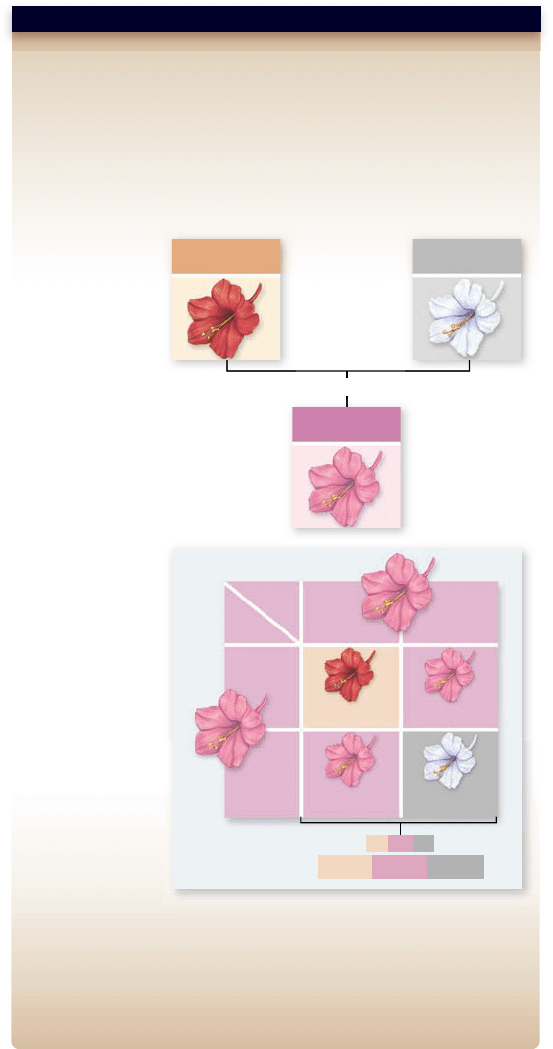
Hypothesis: The pink F
1
observed in a cross of red and white Japanese
four o’clock owers is due to failure of dominance and is not an example
of blending inheritance.
Prediction: If pink F
1
are self-crossed, they will yield progeny the
same as the Mendelian monohybrid genotypic ratio. This would be
1 red: 2 pink: 1 white.
Test: Perform the cross and count progeny.
Result: When this cross is performed, the expected outcome is observed.
Conclusion: Flower color in Japanese four o’clock plants exhibits
incomplete dominance.
Further Experiments: How many ospring would you need to count to
be condent in the observed ratio?
SCI ENTI FIC THINKING
Figure 12.12
Incomplete dominance. In a cross between a
red- owered (genotype C
R
C
R
) Japanese four o’clock and a white-
owered one (C
W
C
W
), neither allele is dominant. The heterozygous
progeny have pink owers and the genotype C
R
C
W
. If two of these
heterozygotes are crossed, the phenotypes of their progeny occur in
a ratio of 1:2:1 (red:pink:white).
blood cells. These sugars act as recognition markers for the im-
mune system (see chapter 52 ) . The gene that encodes the en-
zyme, designated I, has three common alleles: I
A
, whose product
adds galactosamine; I
B
, whose product adds galactose; and i,
which codes for a protein that does not add a sugar.
The three alleles of the I gene can be combined to produce
six different genotypes. An individual heterozygous for the I
A
and
gene, there may be more than two alleles in a population. The
example of ABO blood types in humans, described later on, in-
volves an allelic series with three alleles.
If you think of a gene as a sequence of nucleotides in a DNA
molecule, then the number of possible alleles is huge because
even a single nucleotide change could produce a new allele. In
reality, the number of alleles possible for any gene is constrained,
but usually more than two alleles exist for any gene in an out-
breeding population. The dominance relationships of these al-
leles cannot be predicted, but can be determined by observing the
phenotypes for the various heterozygous combinations.
Dominance is not always complete
Mendel’s idea of dominant and recessive traits can seem hard to
explain in terms of modern biochemistry. For example, if a re-
cessive trait is caused by the loss of function of an enzyme en-
coded by the recessive allele, then why should a heterozygote,
with only half the activity of this enzyme, have the same ap-
pearance as a homozygous dominant individual?
The answer is that enzymes usually act in pathways and
not alone. These pathways, as you have seen in earlier chapters,
can be highly complex in terms of inputs and outputs, and they
can sometimes tolerate large reductions in activity of single en-
zymes in the pathway without reductions in the level of the
end-product. When this is the case, complete dominance will
be observed; however, not all genes act in this way.
Incomplete dominance
In incomplete dominance, the heterozygote is intermediate in
appearance between the two homozygotes. For example, in a
cross between red- and white-flowering Japanese four o’clocks,
described in figure 12.12, all the F
1
offspring have pink flowers—
indicating that neither red nor white flower color was dominant.
Looking only at the F
1
, we might conclude that this is a case of
blending inheritance. But when two of the F
1
pink flowers are
crossed, they produce red-, pink-, and white-flowered plants in a
1:2:1 ratio. In this case the phenotypic ratio is the same as the
genotypic ratio because all three genotypes can be distinguished.
Codominance
Most genes in a population possess several different alleles, and
often no single allele is dominant; instead, each allele has its own
effect, and the heterozygote shows some aspect of the phenotype
of both homozygotes. The alleles are said to be codominant.
Codominance can be distinguished from incomplete dominance
by the appearance of the heterozygote. In incomplete domi-
nance, the heterozygote is intermediate between the two ho-
mozygotes, whereas in codominance, some aspect of both alleles
is seen in the heterozygote. One of the clearest human examples
is found in the human blood groups.
The different phenotypes of human blood groups are
based on the response of the immune system to proteins on the
surface of red blood cells. In homozygotes a single type of pro-
tein is found on the surface of cells, and in heterozygotes, two
kinds of protein are found, leading to codominance.
The human ABO blood group system
The gene that determines ABO blood types encodes an enzyme
that adds sugar molecules to proteins on the surface of red
234
part
III
Genetic and Molecular Biology
rav32223_ch12_221-238.indd 234rav32223_ch12_221-238.indd 234 11/6/09 2:45:03 PM11/6/09 2:45:03 PM
Apago PDF Enhancer
Temperature above
33°C, tyrosinase
inactive, no pigment
Temperature below
33°C, tyrosinase
active, dark pigment
Sugars
Exhibited
Blood
Type
Alleles
Donates and
Receives
Both galactose and
galactosamine
AB
Universal receiver
Donates to AB
None O
Receiv
es O
Universal donor
I
A
I
B
(codominant)
Galactosamine A
Receives A and O
Donates to A and AB
I
A
I
A
,
I
A
i
(I
A
dominant to i)
Galactose B
Receives B and O
Donates to B and AB
I
B
I
B
, I
B
i
(I
B
dominant to i)
ii
(i is recessive)
Figure 12.13
ABO blood groups illustrate both
codominance and multiple alleles. There are three alleles of
the I gene: I
A
, I
B
, and i. I
A
and I
B
are both dominant to i (see types A
and B), but codominant to each other (see type AB). The genotypes
that give rise to each blood type are shown with the associated
phenotypes in terms of sugars added to surface proteins and the
body’s reaction after a blood transfusion .
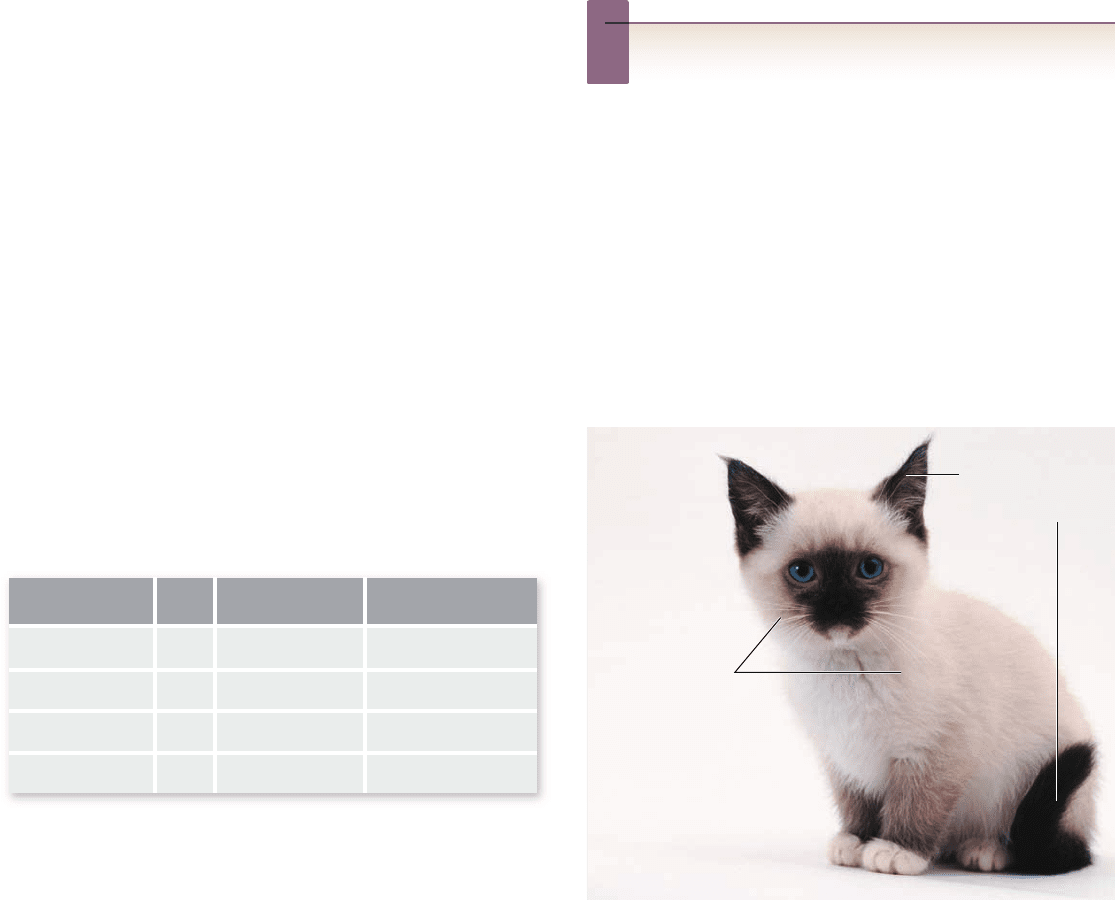
Figure 12.14
Siamese cat. The pattern of coat color is due
to an allele that encodes a temperature-sensitive form of the enzyme
tyrosinase.
and phenotype. For example, the soil in the abbey yard where
Mendel performed his experiments was probably not uniform,
and yet its possible effect on the expression of traits was ig-
nored. But in reality, although the expression of genotype pro-
duces phenotype, the environment can affect this relationship.
Environmental effects are not limited to the external envi-
ronment. For example, the alleles of some genes encode heat-
sensitive products, that are affected by differences in internal body
temperature. The ch allele in Himalayan rabbits and Siamese cats
encodes a heat-sensitive version of the enzyme tyrosinase, which as
you may recall is involved in albinism (figure 12.14) . The Ch version
of the enzyme is inactivated at temperatures above about 33°C. At
the surface of the torso and head of these animals, the temperature
is above 33°C and tyrosinase is inactive, producing a whitish coat. At
the extremities, such as the tips of the ears and tail, the temperature
is usually below 33°C and the enzyme is active, allowing production
of melanin that turns the coat in these areas a dark color.
Inquiry question
?
Many studies of identical twins separated at birth have
revealed phenotypic differences in their development
(height, weight, etc.). If these are identical twins, can you
propose an explanation for these differences?
In epistasis, interactions of genes
alter genetic ratios
The last simplistic assumption in Mendel’s model is that the
products of genes do not interact. But the products of genes
may not act independently of one another, and the intercon-
nected behavior of gene products can change the ratio expected
by independent assortment, even if the genes are on different
chromosomes that do exhibit independent assortment.
I
B
alleles produces both forms of the enzyme and exhibits both
galactose and galactosamine on red blood cells. Because both al-
leles are expressed simultaneously in heterozygotes, the I
A
and I
B
alleles are codominant. Both I
A
and I
B
are dominant over the i
allele, because both I
A
and I
B
alleles lead to sugar addition, where-
as the i allele does not. The different combinations of the three
alleles produce four different phenotypes (figure 12.13) :
Type A individuals add only galactosamine. They are 1.
either I
A
I
A
homozygotes or I
A
i heterozygotes (two
genotypes).
Type B individuals add only galactose. They are either 2.
I
B
I
B
homozygotes or I
B
i heterozygotes (two genotypes).
Type AB individuals add both sugars and are 3. I
A
I
B
heterozygotes (one genotype).
Type O individuals add neither sugar and are 4. ii
homozygotes (one genotype).
These four different cell-surface phenotypes are called
the ABO blood groups.
A person’s immune system can distinguish among these
four phenotypes. If a type A individual receives a transfusion of
type B blood, the recipient’s immune system recognizes the
“foreign” antigen (galactose) and attacks the donated blood
cells, causing them to clump, or agglutinate. The same thing
would happen if the donated blood is type AB. However, if the
donated blood is type O, no immune attack occurs, because
there are no galactose antigens.
In general, any individual’s immune system can tolerate a
transfusion of type O blood, and so type O is termed the “uni-
versal donor.” Because neither galactose nor galactosamine is
foreign to type AB individuals (whose red blood cells have both
sugars), those individuals may receive any type of blood, and
type AB is termed the “universal recipient.” Nevertheless,
matching blood is preferable for any transfusion.
Phenotypes may be a ected
by the environment
Another assumption, implicit in Mendel’s work, is that the en-
vironment does not affect the relationship between genotype
chapter
12
Patterns of Inheritance
235www.ravenbiology.com
rav32223_ch12_221-238.indd 235rav32223_ch12_221-238.indd 235 11/6/09 2:45:03 PM11/6/09 2:45:03 PM
Apago PDF Enhancer
AB Ab aB ab
AABB AABb AaBB AaBb
AABb AAbb AaBb Aabb
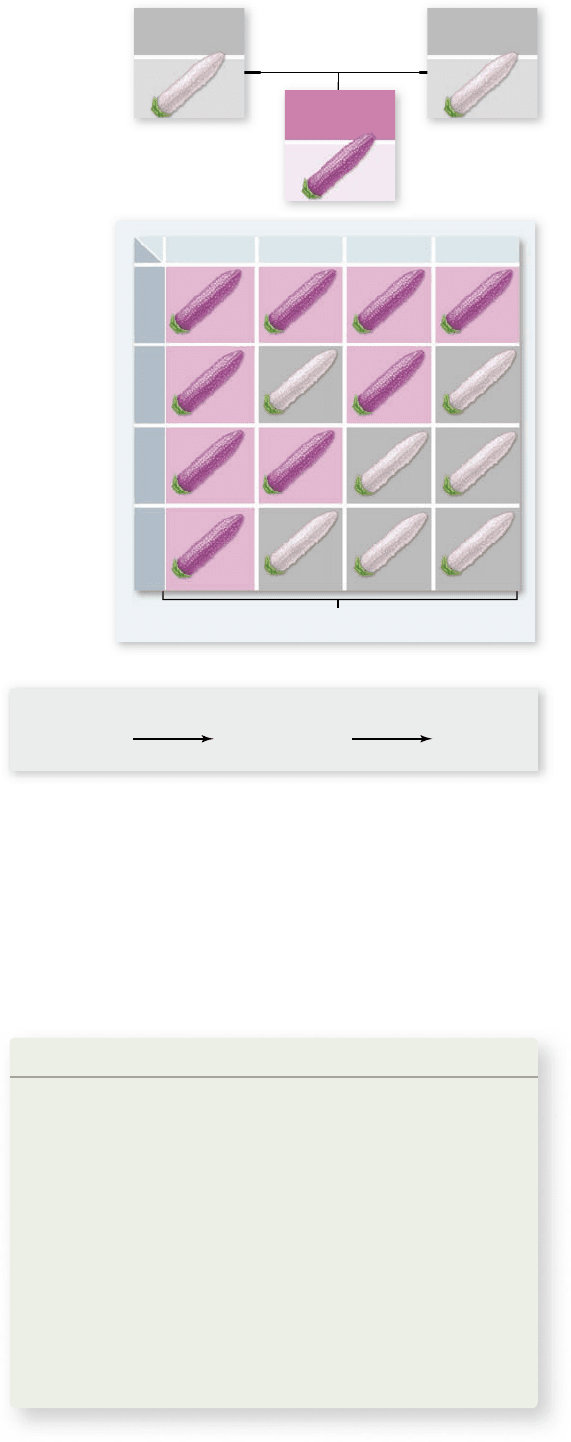
White
(AAbb)
AaBB AaBb aaBB aaBb
AaBb Aabb aaBb aabb
9/16 Purple: 7/16 White
F
2
generation
F
1
generation
Parental
generation
Precursor
(colorless)
White
(aaBB)
AB
Ab
aB
ab
Cross-fertilization
All Purple
(AaBb)
Enzyme
A
Intermediate
(colorless)
Pigment
(purple)
Enzyme
B
a.
b.
Figure 12.15
How epistasis a ects grain color.
a. Crossing some white varieties of corn yields an all purple F
1
.
Self-crossing the F
1
yields 9 purple:7 white. This can be explained
by the presence of two genes, each encoding an enzyme necessary
for the production of purple pigment. Unless both enzymes are
active (genotype is A_B_), no pigment is expressed. b. The
biochemical pathway for pigment production with enzymes encoded
by A and B genes.
Learning Outcomes Review 12.6
Mendel’s model assumes that each trait is specifi ed by one gene with only
two alleles, no environmental eff ects alter a trait, and gene products act
independently. All of these prove to be oversimplifi cations. Traits produced
by the action of multiple genes (polygenic inheritance) have continuous
variation. One gene can aff ect more than one trait (pleiotropy). Genes may
have more than two alleles, and these may not show simple dominance. In
incomplete dominance, the heterozygote is intermediate between the two
homozygotes, and in codominance the heterozygote shows aspects of both
homozygotes, both of which alter the monohybrid ratio. The action of genes
is not always independent, which can result in modifi ed dihybrid ratios.
■ In the cross in figure 12.15, what proportion of F
2
will be
white because they are homozygous recessive for one of
the two genes?
Given the interconnected nature of metabolism, it should
not come as a surprise that many gene products are not inde-
pendent. Genes that act in the same metabolic pathway, for ex-
ample, should show some form of dependence at the level of
function. In such cases, the ratio Mendel would predict is not
readily observed, but it is still there in an altered form.
In the tests of Mendel’s ideas that followed the rediscovery
of his work, scientists had trouble obtaining Mendel’s simple ra-
tios, particularly with dihybrid crosses. Sometimes, it was not pos-
sible to identify successfully each of the four phenotypic classes
expected, because two or more of the classes looked alike.
An example of this comes from the analysis of particular
varieties of corn, Zea mays. Some commercial varieties exhibit
a purple pigment called anthocyanin in their seed coats,
whereas others do not. In 1918, geneticist R. A. Emerson
crossed two true-breeding corn varieties, each lacking antho-
cyanin pigment. Surprisingly, all of the F
1
plants produced
purple seeds.
When two of these pigment-producing F
1
plants were
crossed to produce an F
2
generation, 56% were pigment pro-
ducers and 44% were not. This is clearly not what Mendel’s
ideas would lead us to expect. Emerson correctly deduced that
two genes were involved in producing pigment, and that the
second cross had thus been a dihybrid cross. According to Men-
del’s theory, gametes in a dihybrid cross could combine in 16
equally possible ways—so the puzzle was to figure out how
these 16 combinations could occur in the two phenotypic
groups of progeny. Emerson multiplied the fraction that were
pigment producers (0.56) by 16 to obtain 9, and multiplied the
fraction that lacked pigment (0.44) by 16 to obtain 7. Emerson
therefore had a modified ratio of 9:7 instead of the usual 9:3:3:1
ratio (figure 12.15) .
This modified ratio is easily rationalized by consider-
ing the function of the products encoded by these genes.
When gene products act sequentially, as in a biochemical
pathway, an allele expressed as a defective enzyme early in
the pathway blocks the flow of material through the rest of
the pathway. In this case, it is impossible to judge whether
the later steps of the pathway are functioning properly. This
type of gene interaction, in which one gene can interfere
with the expression of another, is the basis of the phenome-
non called epistasis.
The pigment anthocyanin is the product of a two-step
biochemical pathway:
enzyme 1 enzyme 2
starting molecule
→
intermediate
→
anthocyanin
(colorless) (colorless) (purple)
To produce pigment, a plant must possess at least one func-
tional copy of each enzyme’s gene. The dominant alleles encode
functional enzymes, and the recessive alleles encode nonfunc-
tional enzymes. Of the 16 genotypes predicted by random as-
sortment, 9 contain at least one dominant allele of both genes;
they therefore produce purple progeny. The remaining 7 geno-
types lack dominant alleles at either or both loci (3 + 3 + 1 = 7) and
so produce colorless progeny, giving the phenotypic ratio of 9:7
that Emerson observed (see figure 12.15).
You can see that although this ratio is not the expected
dihybrid ratio, it is a modification of the expected ratio.
236
part
III
Genetic and Molecular Biology
rav32223_ch12_221-238.indd 236rav32223_ch12_221-238.indd 236 11/6/09 2:45:04 PM11/6/09 2:45:04 PM

Apago PDF Enhancer
Mendel’s Principle of Independent Assortment explains
dihybrid results.
The Principle of Independent Assortment states that different
traits segregate independently of one another. The physical basis
of independent assortment is the independent behavior of different
pairs of homologous chromosomes during meiosis I.
12.4 Probability: Predicting
the Results of Crosses
Two probability rules help predict monohybrid cross results.
The rule of addition states that the probability of two independent
events occurring is the sum of their individual probabilities. The rule
of multiplication, or product rule, states that the probability of two
independent events both occurring is the product of their individual
probabilities.
Dihybrid cross probabilities are based on monohybrid
cross probabilities.
A dihybrid cross is essentially two independent monohybrid
crosses. The product rule applies and can be used to predict the
cross’s outcome.
12.5 The Testcross: Revealing Unknown
Genotypes
(see gure 12.10)
In a testcross, an unknown genotype is crossed with a homozygous
recessive genotype.
The F
1
offspring will all be the same if the
unknown genetoype is homozygous dominant. The F
1
offspring will
exhibit a 1:1 dominant:recessive ratio if the unknown genotype
is heterozygous.
12.6 Extensions to Mendel
In polygenic inheritance, more than one gene can a ect a single trait.
Many traits, such as human height, are due to multiple additive
contributions by many genes, resulting in continuous variation.
In pleiotropy, a single gene can a ect more than one trait.
A pleiotropic effect occurs when an allele affects more than one trait.
These effects are dif cult to predict.
Genes may have more than two alleles.
There may be more than two alleles of a gene in a population. Given
the possible number of DNA sequences, this is not surprising.
Dominance is not always complete.
In incomplete dominance the heterozygote exhibits an intermediate
phenotype; the monohybrid genotypic and phenotypic ratios are the
same (see gure 12.12). Codominant alleles each contribute to the
phenotype of a heterozygote.
Phenotypes may be a ected by the environment.
Genotype determines phenotype, but the environment will have
an effect on this relationship. Environment means both external
and internal factors. For example, in Siamese cats, a temperature-
sensitive enzyme produces more pigment in the colder peripheral
areas of the body.
In epistasis, interactions of genes alter genetic ratios.
Genes encoding enzymes that act in a single biochemical pathway are
not independent. In corn, anthocyanin pigment production requires
the action of two enzymes. Doubly heterozygous individuals for these
enzymes yield a 9:7 ratio when self-crossed (see gure 12.15).
12.1 The Mystery of Heredity
Early plant biologists produced hybrids and saw puzzling results.
Plant breeders noticed that some forms of a trait can disappear in one
generation only to reappear later, that is, they segregate rather
than blend.
Mendel used mathematics to analyze his crosses.
Mendel’s experiments involved reciprocal crosses between true-
breeding pea varieties followed by one or more generations of self-
fertilization. His mathematical analysis of experimental results led to
the present model of inheritance.
12.2 Monohybrid Crosses: The Principle
of Segregation
(see gure 12.5)
The F
1
generation exhibits only one of two traits, without blending.
Mendel called the trait visible in the F
1
the dominant trait; the other
he termed recessive.
The F
2
generation exhibits both traits in a 3:1 ratio.
When F
1
plants are self-fertilized, the F
2
shows a consistent ratio
of 3 dominant:1 recessive. We call this 3:1 ratio the Mendelian
monohybrid ratio.
The 3:1 ratio is actually 1:2:1.
Mendel then examined the F
2
and found the recessive F
2
plants
always bred true, but only one out of three dominant F
2
bred true.
This means the 3:1 ratio is actually 1 true-breeding dominant:2 non-
true-breeding dominant:1 recessive.
Mendel’s Principle of Segregation explains monohybrid observations.
Traits are determined by discrete factors we now call genes. These
exist in alternative forms we call alleles. Individuals carrying two
identical alleles for a gene are said to be homozygous, and individuals
carrying different alleles are said to be heterozygous. The genotype
is the entire set of alleles of all genes possessed by an individual. The
phenotype is the individual’s appearance due to these alleles.
The Principle of Segregation states that during gamete formation,
the two alleles of a gene separate (segregate). Parental alleles then
randomly come together to form the diploid zygote. The physical
basis of segregation is the separation of homologues during anaphase
of meiosis I.
The Punnett square allows symbolic analysis.
Punnett squares are formed by placing the gametes from one parent
along the top of the square with the gametes from the other parent
along the side. Zygotes formed from gamete combinations form the
blocks of the square (see gure 12.6).
Some human traits exhibit dominant/recessive inheritance.
Certain human traits have been found to have a Mendelian basis (see
table 12.1). Inheritance patterns in human families can be analyzed
and inferred using a pedigree diagram of earlier generations.
12.3 Dihybrid Crosses: The Principle
of Independent Assortment
(see gure 12.9)
Traits in a dihybrid cross behave independently.
If parents differing in two traits are crossed,
the F
1
will be all
dominant. Each F
1
parent can produce four different gametes that
can be combined to produce 16 possible outcomes in the F
2
. This
yields a phenotypic ratio of 9:3:3:1 of the four possible phenotypes.
Chapter Review
chapter
12
Patterns of Inheritance
237www.ravenbiology.com
rav32223_ch12_221-238.indd 237rav32223_ch12_221-238.indd 237 11/6/09 2:45:05 PM11/6/09 2:45:05 PM

Apago PDF Enhancer
4. What is the probability of obtaining an individual with the
genotype CC from a cross between two individuals with the
genotypes CC and Cc?
a. ½ c.
b. ¼ d.
16
5. You discover a new variety of plant with color varieties of
purple and white. When you intercross these, the F
1
is a lighter
purple. You consider that this may be an example of blending
and self-cross the F
1
. If Mendel is correct, what would you
predict for the F
2
?
a. 1 purple:2 white:1 light purple
b. 1 white:2 purple:1 light purple
c. 1 purple:2 light purple:1 white
d. 1 light purple:2 purple:1 white
6. Mendel’s model assumes that each trait is determined by a
single factor with alternate forms. We now know that this is too
simplistic and that
a. a single gene may affect more than one trait.
b. a single trait may be affected by more than one gene.
c. a single gene always affects only one trait, but traits may be
affected by more than one gene.
d. a single gene can affect more than one trait, and traits may
be affected by more than one gene.
S Y N THES IZE
1. Create a Punnett square for the following crosses and use this
to predict phenotypic ratio for dominant and recessive traits.
Dominant alleles are indicated by uppercase letters and
recessive are indicated by lowercase letters. For parts b and c,
predict ratios using probability and the product rule.
a. A monohybrid cross between individuals with the genotype
Aa and Aa
b. A dihybrid cross between two individuals
with the genotype AaBb
c. A dihybrid cross between individuals with the genotype
AaBb and aabb
2. Explain how the events of meiosis can explain both segregation
and independent assortment.
3. In mice, there is a yellow strain that when crossed yields
2 yellow:1 black. How could you explain this observation?
How could you test this with crosses?
4. In mammals, a variety of genes affect coat color. One of these is
a gene with mutant alleles that results in the complete loss of
pigment, or albinism. Another controls the type of dark pigment
with alleles that lead to black or brown colors. The albinistic
trait is recessive, and black is dominant to brown. Two black
mice are crossed and yield 9 black:4 albino:3 brown. How
would you explain these results?
U N DERS TAN D
1. What property distinguished Mendel’s investigation
from previous studies?
a. Mendel used true-breeding pea plants.
b. Mendel quanti ed his results.
c. Mendel examined many different traits.
d. Mendel examined the segregation of traits.
2. The F
1
generation of the monohybrid cross purple (PP) × white
(pp) ower pea plants should
a. all have white owers.
b. all have a light purple or blended appearance.
c. all have purple owers.
d. have (¾) purple owers, and ¼ white owers.
3. The F
1
plants from the previous question are allowed to self-
fertilize. The phenotypic ratio for the F
2
should be
a. all purple. c. 3 purple:1 white.
b. 1 purple:1 white. d. 3 white:1 purple.
4. Which of the following is not a part of Mendel’s ve-element model?
a. Traits have alternative forms (what we now call alleles).
b. Parents transmit discrete traits to their offspring.
c. If an allele is present it will be expressed.
d. Traits do not blend.
5. An organism’s ___________ is/are determined by its
_____________.
a. genotype; phenotype c. alleles; phenotype
b. phenotype; genotype d. genes; alleles
6. Phenotypes like height in humans, which show a continuous
distribution, are usually the result of
a. an alteration of dominance for multiple alleles of a single gene.
b. the presence of multiple alleles for a single gene.
c. the action of one gene on multiple phenotypes.
d. the action of multiple genes on a single phenotype.
APPLY
1. A dihybrid cross between a plant with long smooth leaves and a
plant with short hairy leaves produces a long smooth F
1
. If this
F
1
is allowed to self-cross to produce an F
2
, what would you
predict for the ratio of F
2
phenotypes?
a. 9 long smooth:3 long hairy:3 short hairy:1 short smooth
b. 9 long smooth:3 long hairy:3 short smooth:1 short hairy
c. 9 short hairy:3 long hairy:3 short smooth:1 long smooth
d. 1 long smooth:1 long hairy:1 short smooth:1 short hairy
2. Consider a long smooth F
2
plant from the previous question.
This plant’s genotype
a. must be homozygous for both long alleles and hairy alleles.
b. must be heterozygous at both the leaf length gene, and the
leaf hair gene.
c. can only be inferred by another cross.
d. cannot be determined by any means.
3. What is the probability of obtaining an individual with the
genotype bb from a cross between two individuals with the
genotype Bb?
a. ½ c.
b. ¼ d. 0
Review Questions
O N LIN E RES OURCE
www.ravenbiology.com
Understand, Apply, and Synthesize—enhance your study with
animations that bring concepts to life and practice tests to assess
your understanding. Your instructor may also recommend the
interactive eBook, individualized learning tools, and more.
238
part
III
Genetic and Molecular Biology
rav32223_ch12_221-238.indd 238rav32223_ch12_221-238.indd 238 11/6/09 2:45:05 PM11/6/09 2:45:05 PM
Apago PDF Enhancer
M
4
μ
m
Chapter
13
Chromosomes,
Mapping, and the
Meiosis–Inheritance
Connection
Chapter Outline
13.1 Sex Linkage and the Chromosomal Theory
of Inheritance
13.2 Sex Chromosomes and Sex Determination
13.3 Exceptions to the Chromosomal Theory
of Inheritance
13.4 Genetic Mapping
13.5 Selected Human Genetic Disorders
Introduction
Mendel’s experiments opened the door to understanding inheritance, but many questions remained. In the early part of the
20th century, we did not know the nature of the factors whose behavior Mendel had described. The next step, which involved
many researchers in the early part of the century, was uniting information about the behavior of chromosomes, seen in the
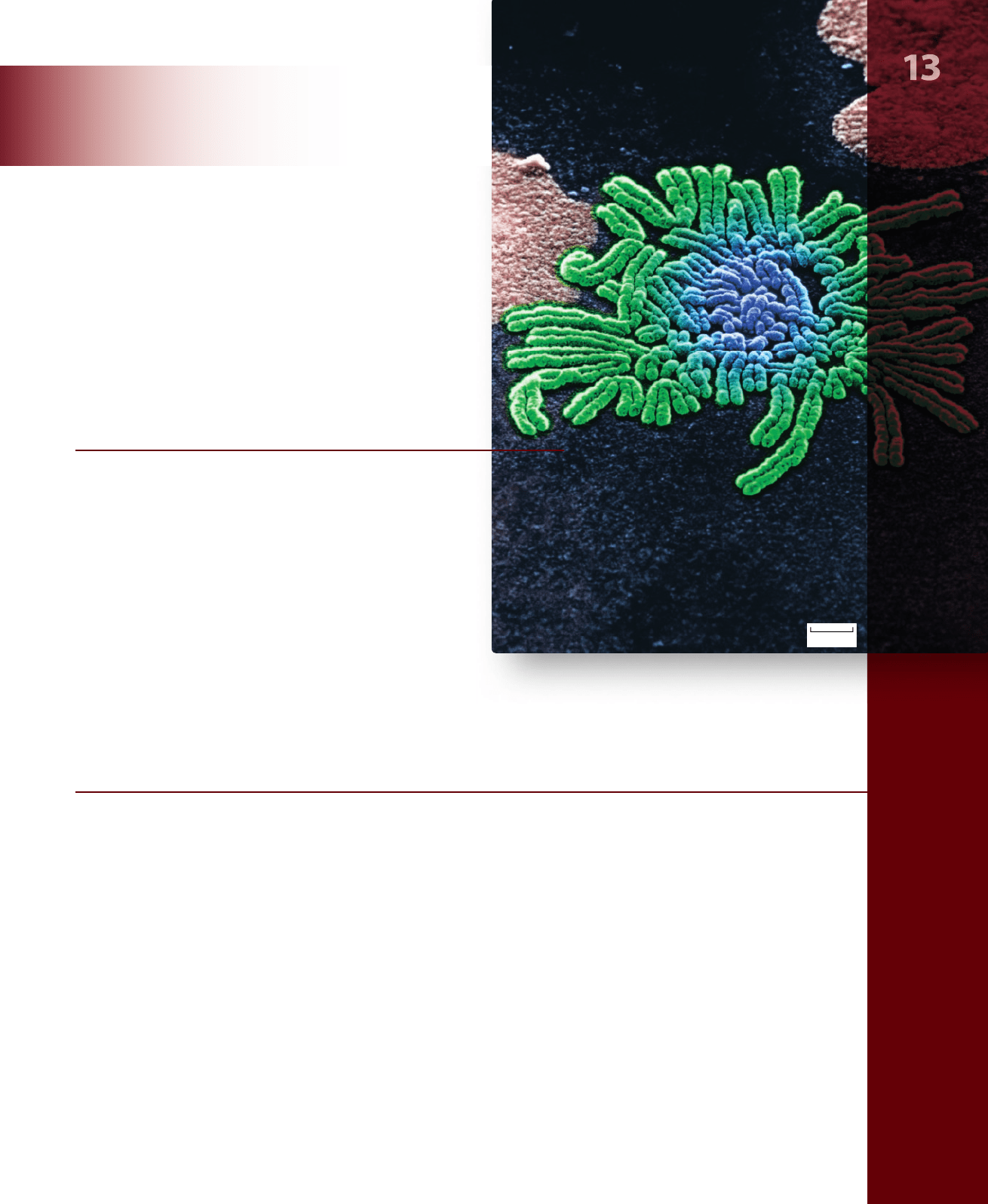
picture, and the inheritance of traits. The basis for Mendel’s principles of segregation and independent assortment lie in
events that occur during meiosis.
The behavior of chromosomes during meiosis not only explains Mendel’s principles, but leads to new and di erent
approaches to the study of heredity. The ability to construct genetic maps is one of the most powerful tools of classical genetic
analysis. The tools of genetic mapping developed in ies and other organisms in combination with information from the Human
Genome Project now allow us to determine the location of genes and isolate those that are involved in genetic diseases.
CHAPTER
rav32223_ch13_239-255.indd 239rav32223_ch13_239-255.indd 239 11/6/09 3:28:18 PM11/6/09 3:28:18 PM
Apago PDF Enhancer
Mutant TypeNormal / Wild Type
Parental generation
male
Parental
generation
female
Parental generation
male
Testcross
F
1
progeny all had red eyes
F
1
generation
male
F
1
generation
female
F
2
female progeny had red eyes, only males had white eyes
F
1
generation
female
The testcross revealed that white-eyed females
are viable. Therefore eye color is linked to the
X chromosome and absent from the Y chromosome
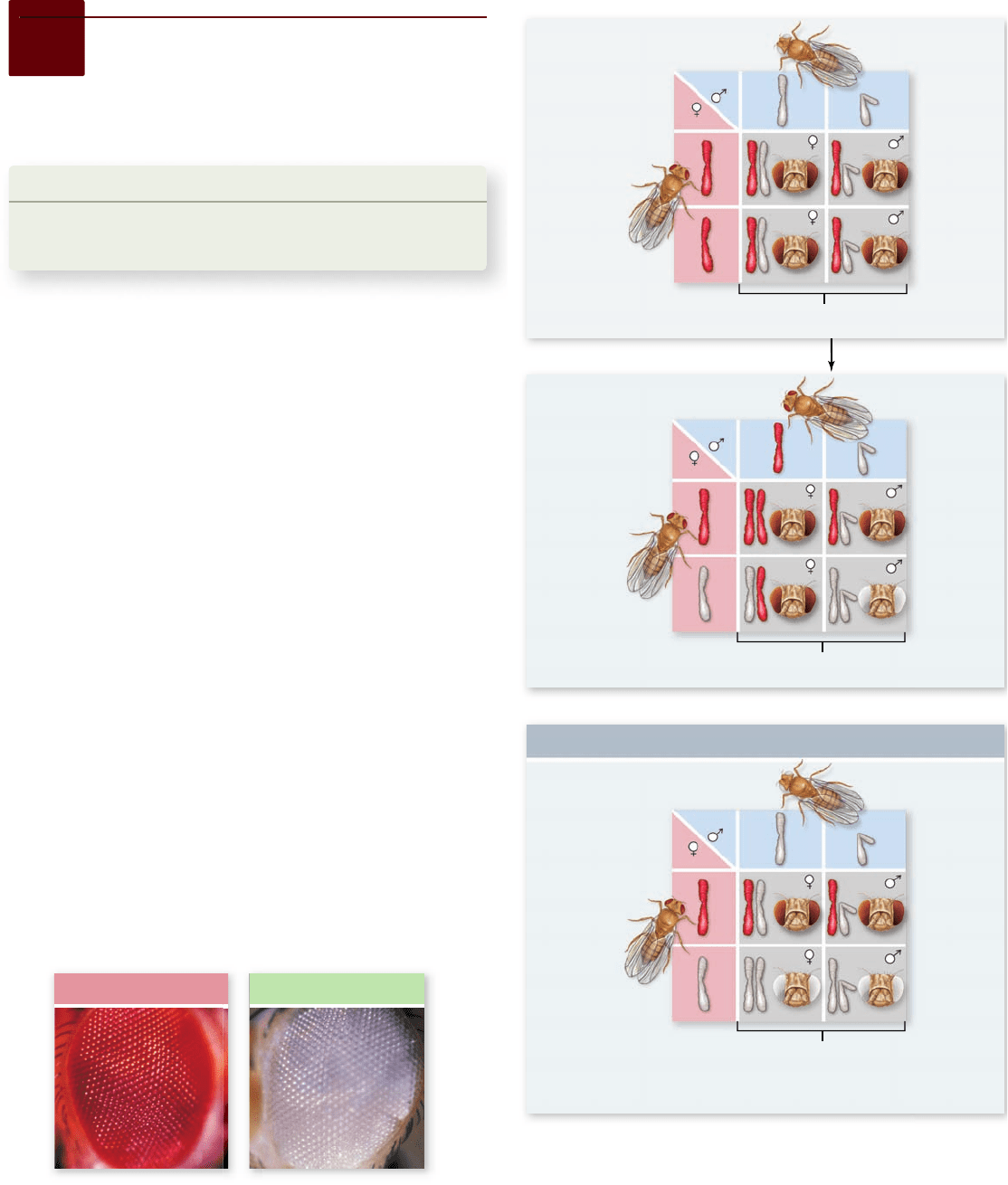
Figure 13.1
Red-eyed (wild type) and white-eyed
(mutant) Drosophila. Mutations are heritable alterations in
genetic material. By studying the inheritance pattern of white and
red alleles (located on the X chromosome), Morgan rst
demonstrated that genes are on chromosomes.
Figure 13.2
The chromosomal basis of sex linkage.
White-eyed male ies are crossed to red-eyed females. The F
1
ies all have red eyes, as expected for a recessive white-eye allele.
In the F
2
, all of the white-eyed ies are male because the Y
chromosome lacks the white-eye (white) gene. Inheritance of the
sex chromosomes correlates with eye color, showing the white gene
is on the X chromosome.
13.1
Sex Linkage and
the Chromosomal
Theory of Inheritance
Learning Outcomes
Describe sex-linked inheritance in fruit flies.1.
Explain the evidence for genes being on chromosomes.2.
A central role for chromosomes in heredity was first suggested in
1900 by the German geneticist Carl Correns, in one of the papers
announcing the rediscovery of Mendel’s work. Soon after, obser-
vations that similar chromosomes paired with one another during
meiosis led directly to the chromosomal theory of inheritance,
first formulated by the American Walter Sutton in 1902.
Morgan correlated the inheritance
of a trait with sex chromosomes
In 1910, Thomas Hunt Morgan, studying the fruit fly Droso-
phila melanogaster, discovered a mutant male fly with white eyes
instead of red (figure 13.1).
Morgan immediately set out to determine whether this
new trait would be inherited in a Mendelian fashion. He first
crossed the mutant male to a normal red-eyed female to see
whether the red-eyed or white-eyed trait was dominant. All of
the F
1
progeny had red eyes, so Morgan concluded that red eye
color was dominant over white.
The F
1
cross
Following the experimental procedure that Mendel had estab-
lished long ago, Morgan then crossed the red-eyed flies from
the F
1
generation with each other. Of the 4252 F
2
progeny
Morgan examined, 782 (18%) had white eyes. Although the ra-
tio of red eyes to white eyes in the F
2
progeny was greater than
3:1, the results of the cross nevertheless provided clear evidence
that eye color segregates. However, something about the out-
come was strange and totally unpredicted by Mendel’s theory—
all of the white-eyed F
2
flies were males! (Figure 13.2)
240
part
III
Genetic and Molecular Biology
rav32223_ch13_239-255.indd 240rav32223_ch13_239-255.indd 240 11/6/09 3:28:23 PM11/6/09 3:28:23 PM
Apago PDF Enhancer
X chromosome
Y chromosome
2.8 µm
TABLE 13.1
Sex Determination
in Some Organisms
Female Male
Humans, Drosophila XX XY
Birds ZW ZZ
Grasshoppers XX XO
Honeybees Diploid Haploid
13.2
Sex Chromosomes
and Sex Determination
Learning Outcomes
Describe the relationship between sex chromosomes and 1.
sex determination.
Explain dosage compensation in mammals and its 2.
genetic consequences.
The structure and number of sex chromosomes vary in different
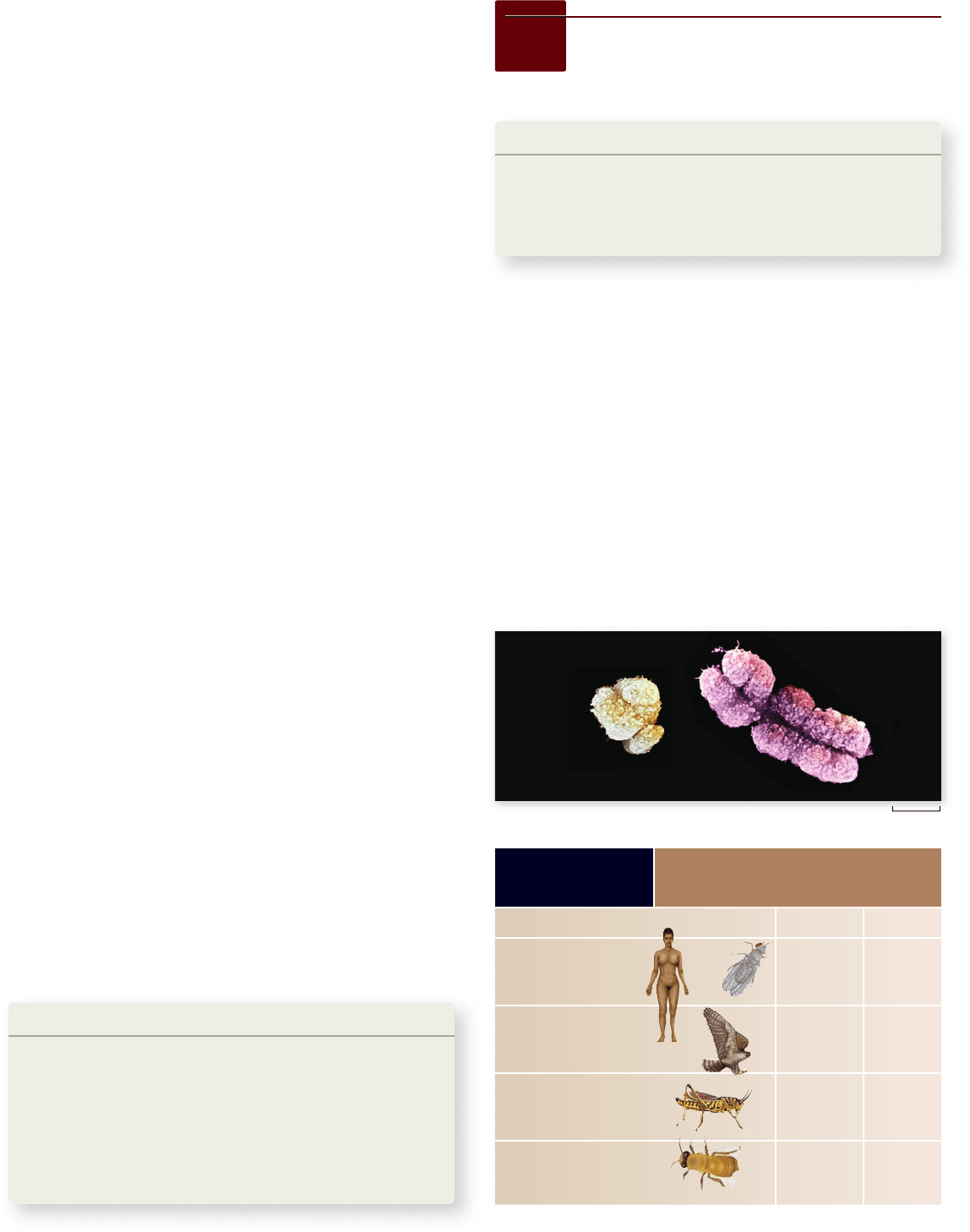
species (table 13.1). In the fruit fly, Drosophila, females are XX and
males XY, which is also the case for humans and other mammals.
However, in birds, the male has two Z chromosomes, and the fe-
male has a Z and a W chromosome. Some insects, such as grass-
hoppers, have no Y chromosome—females are XX and males are
characterized as XO (O indicates the absence of a chromosome).
In humans, the Y chromosome generally
determines maleness
In chapter 10 , you learned that humans have 46 chromosomes (23
pairs). Twenty-two of these pairs are perfectly matched in both
males and females and are called autosomes. The remaining pair
are the sex chromosomes: XX in females, and XY in males.
The testcross
Morgan sought an explanation for this result. One possibility
was simply that white-eyed female flies don’t exist; such indi-
viduals might not be viable for some unknown reason. To test
this idea, Morgan testcrossed the female F
1
progeny with the
original white-eyed male. He obtained white-eyed and red-
eyed flies of both sexes in a 1:1:1:1 ratio, just as Mendel’s theory
had predicted (figure 13.2). Therefore, white-eyed female flies
are viable. Given that white-eyed females can exist, Morgan
turned to the nature of the chromosomes in males and females
for an explanation.
The gene for eye color lies
on the X chromosome
In Drosophila, the sex of an individual is determined by the
number of copies it has of a particular chromosome, the X
chromosome. Observations of Drosophila chromosomes re-
vealed that female flies have two X chromosomes, but male flies
have only one. In males, the single X chromosome pairs in mei-
osis with a dissimilar partner called the Y chromosome. These
two chromosomes are termed sex chromosomes because of
their association with sex.
During meiosis, a female produces only X-bearing gam-
etes, but a male produces both X-bearing and Y- bearing gam-
etes. When fertilization involves an X sperm, the result is an
XX zygote, which develops into a female; when fertilization in-
volves a Y sperm, the result is an XY zygote, which develops
into a male.
The solution to Morgan’s puzzle is that the gene
causing the white-eye trait in Drosophila resides only on
the X chromosome—it is absent from the Y chromosome.
(We now know that the Y chromosome in flies carries al-
most no functional genes.) A trait determined by a gene on
the X chromosome is said to be sex-linked, or X-linked,
because it is associated with the sex of the individual.
Knowing the white-eye trait is recessive to the red-eye
trait, we can now see that Morgan’s result was a natural
consequence of the Mendelian segregation of chromo-
somes (see figure 13.2).
Morgan’s experiment was one of the most important in
the history of genetics because it presented the first clear evi-
dence that the genes determining Mendelian traits do indeed
reside on the chromosomes, as Sutton had proposed. Mende-
lian traits segregate in genetic crosses because homologues
separate during gamete formation.
Learning Outcomes Review 13.1
Morgan showed that the trait for white eyes in Drosophila segregated with
the sex of off spring. X and Y chromosomes also segregate with sex, this
correlates the behavior of a trait with the behavior of chromosomes. This
fi nding supported the chromosomal theory of inheritance, which states that
traits are carried on chromosomes.
■ What are the expectations for a cross of white-eyed
females to red-eyed males?
chapter
13
Chromosomes, Mapping, and the Meiosis–Inheritance Connection
241www.ravenbiology.com
rav32223_ch13_239-255.indd 241rav32223_ch13_239-255.indd 241 11/6/09 3:28:25 PM11/6/09 3:28:25 PM