
Raven P.H., Johnson G.B., Mason K.A. Biology (Ninth Edition)
Подождите немного. Документ загружается.

Apago PDF Enhancer
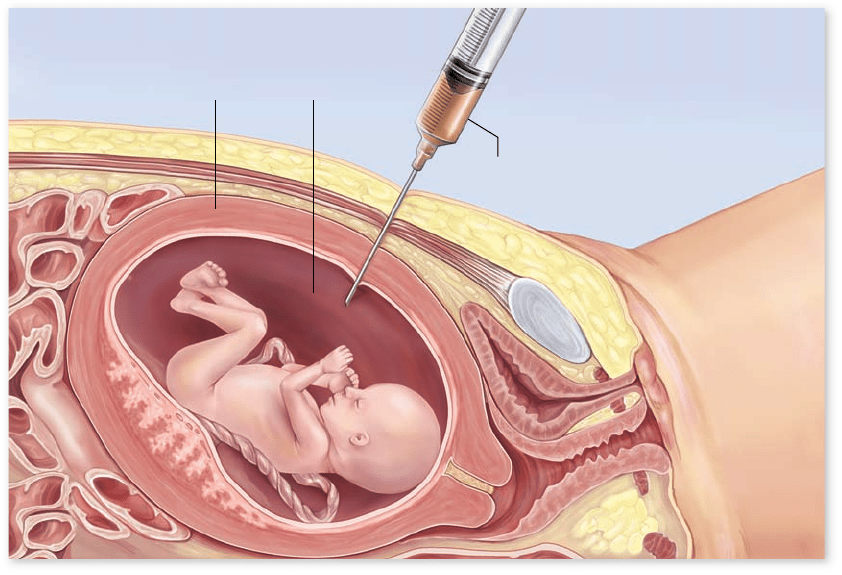
Amniotic fluid
Hypodermic syringe
Uterus
are inactivated in the maternal germ line, such that deletion or
other functional loss of paternally derived alleles produces the
syndrome. The opposite is true for AS syndrome: Genes are
inactivated in the paternal germ line, such that loss of mater-
nally derived alleles leads to the syndrome.
Molecular basis of genomic imprinting
Although genomic imprinting is not well understood, at least
one aspect seems clear: The basis for inactivating genes ap-
pears to be linked to modifications of the DNA itself. DNA
can be modified by the addition of methyl groups, termed
methylation. This modification is correlated with inactivity of
genes. The proteins that are associated with chromosomes can
also be modified, leading to effects on gene expression. The
control of gene expression is discussed in more detail in the
following chapters.
Some genetic defects can be
detected early in pregnancy
Although most genetic disorders cannot yet be cured, we are
learning a great deal about them, and progress toward suc-
cessful therapy is being made in many cases. In the absence of
a cure, however, the only recourse is to try to avoid produc-
ing children with these conditions. The process of identify-
ing parents at risk for having children with genetic defects
and of assessing the genetic state of early embryos is called
genetic counseling.
Pedigree analysis
One way of assessing risks is through pedigree analysis, often
employed as an aid in genetic counseling. By analyzing a per-
son’s pedigree, it is sometimes possible to estimate the likeli-
hood that the person is a carrier for certain disorders. For
example, if a counseling client’s family history reveals that a
relative has been afflicted with a recessive genetic disorder, such
as cystic fibrosis, it is possible that the client is a heterozygous
carrier of the recessive allele for that disorder.
When a couple is expecting a child, and pedigree analysis
indicates that both of them have a significant chance of being
heterozygous carriers of a deleterious recessive allele, the preg-
nancy is said to be high-risk. In such cases, a significant proba-
bility exists that their child will exhibit the clinical disorder.
Another class of high-risk pregnancy is that in which the
mothers are older than 35. As discussed earlier, the frequency of
Down syndrome increases dramatically in the pregnancies of
older women (see figure 13.13).
Amniocentesis
When a pregnancy is diagnosed as high-risk, many women
elect to undergo amniocentesis, a procedure that permits
the prenatal diagnosis of many genetic disorders. In the
fourth month of pregnancy, a sterile hypodermic needle is
inserted into the expanded uterus of the mother, removing a
small sample of the amniotic fluid that bathes the fetus
( figure 13.15). Within the fluid are free-floating cells derived
from the fetus; once removed, these cells can be grown in
cultures in the laboratory.
During amniocentesis, the position of the needle and that
of the fetus are usually observed by means of ultrasound. The
sound waves used in ultrasound are not harmful to mother or
fetus, and they permit the person withdrawing the amniotic
fluid to do so without damaging the fetus. In addition, ultra-
sound can be used to examine the fetus for signs of major ab-
normalities. However, about 1 out of 200 amniocentesis
procedures may result in fetal death and miscarriage.
Figure 13.15
Amniocentesis. A needle is
inserted into the amniotic
cavity, and a sample of amniotic
uid, containing some free cells
derived from the fetus, is
withdrawn into a syringe. The
fetal cells are then grown in
culture, and their karyotype and
many of their metabolic
functions are examined.
252
part
III
Genetic and Molecular Biology
rav32223_ch13_239-255.indd 252rav32223_ch13_239-255.indd 252 11/6/09 3:28:35 PM11/6/09 3:28:35 PM
Apago PDF Enhancer
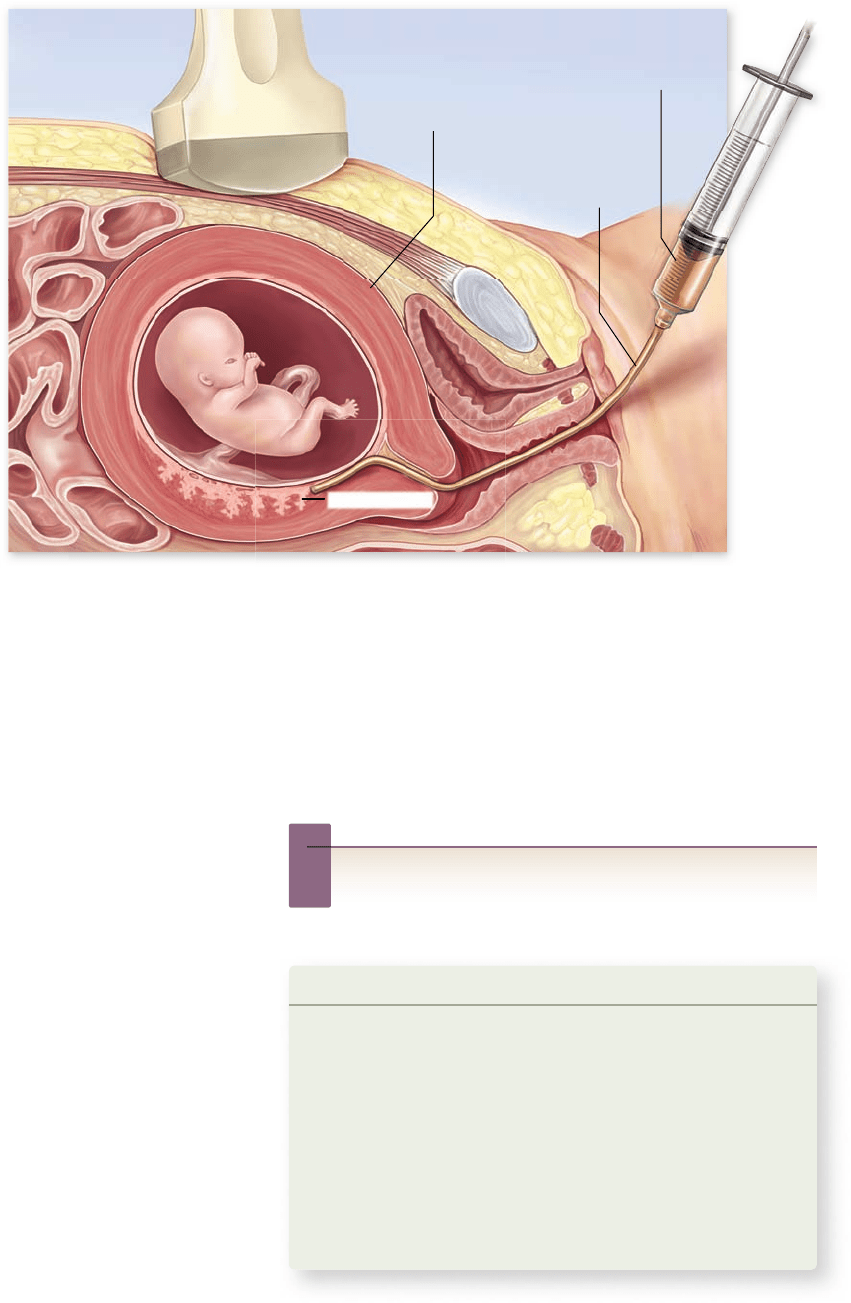
Cells from the chorion
Suction tube
Uterus
Ultrasound device
Chorionic villi
design tests for many more diseases. Difficulties still exist in
discerning the number and frequency of disease-causing alleles,
but these problems are not insurmountable. At present, tests for
at least 13 genes with alleles that lead to clinical syndromes are
available. This number is bound to rise and to be expanded to
include alleles that do not directly lead to disease states but that
predispose a person for a particular disease.
Inquiry question
?
Based on what you read in this chapter, what reasons could
a mother have to undergo CVS, considering its small but
potential risks?
Learning Outcomes Review 13.5
Mutations in DNA that result in altered proteins can cause hereditary
diseases. Pedigree studies and genetic testing may clarify the risk of disease.
At the chromosome level, nondisjunction during meiosis can result in
gametes with too few or too many chromosomes, most of which produce
inviable off spring. Imprinting refers to inactivation of alleles depending on
which parent the alleles come from; off spring in whom imprinting occurs
appear haploid for the aff ected gene even though they are diploid.
■ During spermatogenesis, is there any difference
in outcome between first and second division
nondisjunction?
Chorionic villi sampling
In recent years, physicians have increasingly turned to a new,
less invasive procedure for genetic screening called chorionic
villi sampling. Using this method, the physician removes cells
from the chorion, a membranous part of the placenta that nour-
ishes the fetus (figure 13.16). This procedure can be used ear-
lier in pregnancy (by the eighth week) and yields results much
more rapidly than does amniocentesis. Risks from chorionic
villi sampling are comparable to those for amniocentesis.
To test for certain genetic disorders, genetic counselors
look for three characteristics in the cultures of cells obtained
from amniocentesis or chorionic villi sampling. First, analysis
of the karyotype can reveal aneuploidy (extra or missing chro-
mosomes) and gross chromosomal alterations. Second, in many
cases it is possible to test directly for the proper functioning of
enzymes involved in genetic disorders. The lack of normal en-
zymatic activity signals the presence of the disorder. As exam-
ples, the lack of the enzyme responsible for breaking down
phenylalanine indicates phenylketonuria (PKU); the absence of
the enzyme responsible for the breakdown of gangliosides indi-
cates Tay–Sachs disease; and so forth. Additionally, with infor-
mation from the Human Genome Project, more disease alleles
for genetic disorders are known. If there are a small number of
alleles for a specific disease in the population, these can be
identified as well.
With the changes in human genetics brought about by
the Human Genome Project (see chapter 18), it is possible to
Figure 13.16
Chorionic
villi sampling. Cells can be
taken from the chorionic villi
as early as the eighth to tenth
week of pregnancy. Cells are
removed by suction with a tube
inserted through the cervix.
These cells can then be grown
in culture and examined for
karyotypes and tested
biochemically for defects.
chapter
13
Chromosomes, Mapping, and the Meiosis–Inheritance Connection
253www.ravenbiology.com
rav32223_ch13_239-255.indd 253rav32223_ch13_239-255.indd 253 11/6/09 3:28:38 PM11/6/09 3:28:38 PM

Apago PDF Enhancer
chromosomes as shown by crosses in which chromosomes carry both
visible and genetic markers (see gure 13.6).
Recombination is the basis for genetic maps.
Genes close together on a single chromosome are said to be linked.
The further apart two linked genes are, the greater the frequency
of recombination. This allows genetic maps to be constructed
based on recombination frequency. A map unit is expressed as the
percentage of recombinant progeny.
Multiple crossovers can yield independent assortment results.
The probability of multiple crossovers increases with distance
between two genes and results in an underestimate of recombination
frequency. The maximum recombination frequency is 50%, the same
value as for independent assortment.
Three-point crosses can be used to put genes in order (see gure 13.9).
If three genes are used instead of two, data from multiple crossovers
can be used to order genes. Longer map distances fail to re ect the
effect of multiple crossovers and thus underestimate true distance.
By evaluating intervening genes with less separation, more accurate
distances can be obtained.
Genetic maps can be constructed for the human genome.
Human genetic mapping was dif cult because it required multiple
disease-causing alleles segregating in a family. The process has
been made easier by the use of anonymous markers, identi able
molecular markers that do not cause a phenotype. Single-nucleotide
polymorphisms (SNPs) can be used to detect differences between
individuals for identi cation.
13.5 Selected Human Genetic Disorders
Sickle cell anemia is due to altered hemoglobin.
The phenotypes in sickle cell anemia can all be traced to alterations
in the structure of hemoglobin that affect the shape of red blood
cells. Over 700 variants of hemoglobin structure have been
characterized, some of which also cause disorders.
Nondisjunction of chromosomes changes chromosome number.
Nondisjunction is the failure of homologues or sister chromatids
to separate during meiosis. The result is aneuploidy: monosomy or
trisomy of a chromosome in the zygote. Most aneuploidies are lethal,
but some, such as trisomy 21 in humans (Down syndrome), can result
in viable offspring. X-chromosome nondisjunction occurs when
X chromosomes fail to separate during meiosis. The resulting gamete
carries either XX or O (zero sex chromosomes) (see gure 13.14 ) .
Y-chromosome nondisjunction results in YY gametes.
Genomic imprinting depends on the parental origin of alleles.
In genomic imprinting, the expression of a gene depends
on whether it passes through the maternal or paternal germ line.
Imprinted genes appear to be inactivated by methylation. Imprinting
produces a haploid phenotype.
Some genetic defects can be detected early in pregnancy.
Genetic defects in humans can be determined by pedigree analysis,
amniocentesis, or chorionic villi sampling.
13.1 Sex Linkage and the Chromosomal Theory
of Inheritance
Morgan correlated the inheritance of a trait with sex chromosomes
(see gure 13.2).
Morgan crossed red-eyed and white-eyed ies and found differences in
inheritance based on the sex of offspring. All white-eyed offspring were
males, but testcrosses showed that white-eyed females were possible,
supporting the idea that the white-eye gene was on the X chromsome.
The gene for eye color lies on the X chromosome.
The inheritance of eye color in Drosophila segregates with the
X chromosome, a phenomenon termed sex-linked inheritance.
13.2 Sex Chromosomes and Sex Determination
Sex determination in animals is usually associated with a chromosomal
difference. In some animals, females have two similar sex chromosomes
and males have sex chromosomes that differ. In other species, females
have sex chromosomes that differ (see table 13.1).
In humans the Y chromosome generally determines maleness.
The Y chromosome is highly condensed and does not have
active counterparts to most genes on the X chromosome. The SRY
gene on the Y chromosome is responsible for the masculinization
of genitalia and secondary sex organs. An XY individual can develop
into a sterile female due to mutations in the SRY gene or the failure
of the embryo to respond to androgens.
Some human genetic disorders display sex linkage (see gure 13.3).
Human genetic disorders show sex linkage when the relevant gene is
on the X chromosome; hemophilia is an example.
Dosage compensation prevents doubling of sex-linked gene products.
In fruit ies, males double the gene expression from their single
X chromosome. In mammals, one of the X chromosomes in a female
is randomly inactivated during development.
X-chromosome inactivation can lead to genetic mosaics.
In a mammalian female that is heterozygous for X-chromosome
alleles, X inactivation produces a mosaic pattern, as shown in the coat
color of calico cats (see gure 13.4).
13.3 Exceptions to the Chromosomal Theory
of Inheritance
Mitochondrial genes are inherited from the female parent.
Mitochondria have their own genomes and divide independently;
they are passed to offspring in the cytoplasm of the egg cell.
Chloroplast genes may also be passed on uniparentally.
Chloroplasts also reside in the cytoplasm, have their own genomes,
and divide independently. They are usually inherited maternally.
13.4 Genetic Mapping
Mendel’s independent assortment is too simplistic. Genes on the
same chromosome may or may not segregate independently.
Genetic recombination exchanges alleles on homologues.
Homologous chromosomes may exchange alleles by crossing
over (see gure 13.5). This occurs by breakage and rejoining of
Chapter Review
254
part
III
Genetic and Molecular Biology
rav32223_ch13_239-255.indd 254rav32223_ch13_239-255.indd 254 11/6/09 3:28:40 PM11/6/09 3:28:40 PM

Apago PDF Enhancer
3. Down syndrome is the result of trisomy for chromosome 21. Why is
this trisomy viable and trisomy for most other chromosomes is not?
a. Chromosome 21 is a large chromosome and excess genetic
material is less harmful.
b. Chromosome 21 behaves differently in meiosis I than the
other chromosomes.
c. Chromosome 21 is a small chromosome with few genes so
this does less to disrupt the genome.
d. Chromosome 21 is less prone to nondisjunction than other
chromosomes.
4. Genes that are on the same chromosome can show independent
assortment
a. when they are far enough apart for two crossovers to occur.
b. when they are far enough apart that odd numbers of
crossovers is about equal to even.
c. only if recombination is low for that chromosome.
d. only if the genes show genomic imprinting.
5. We use three-point crosses to order genes because this allows us to
a. control for dosage compensation.
b. control for genomic imprinting.
c. detect multiple recombination events, and these infrequent
events give us the order.
d. detect multiple recombination events, and these frequent
events give us the order.
6. During the process of spermatogenesis, a nondisjunction event
that occurs during the second division would be
a. worse than the rst division because all four meiotic
products would be aneuploid.
b. better than the rst division because only two of the four
meiotic products would be aneuploid.
c. the same outcome as the rst division with all four
products aneuploid.
d. the same outcome as the rst division as only two products
would be aneuploid.
SYNTHESIZE
1. Color blindness is caused by a sex-linked, recessive gene. If a
woman, whose father was color blind, marries a man with normal
color vision, what percentage of their children will be color
blind? What percentage of male children? Of female children?
2. Assume that the genes for seed color and seed shape are located
on the same chromosome. A plant heterozygous for both genes
is testcrossed wrinkled green with the following results:
green, wrinkled 645
green, round 36
yellow, wrinkled 29
yellow, round 590
What were the genotypes of the parents, and how far apart are
these genes?
3. Is it possible to have a calico cat that is male? Why or why not?
UNDERSTAND
1. Why is the white-eye phenotype always observed in males
carrying the white-eye allele?
a. Because the trait is dominant
b. Because the trait is recessive
c. Because the allele is located on the X chromosome
and males only have one X
d. Because the allele is located on the Y chromosome
and only males have Y chromosomes
2. In an organism’s genome, autosomes are
a. the chromosomes that differ between the sexes.
b. chromosomes that are involved in sex determination.
c. only inherited from the mother (maternal inheritance).
d. all of the chromosomes other than sex chromosomes.
3. What cellular process is responsible for genetic recombination?
a. The independent alignment of homologous pairs during
meiosis I
b. Separation of the homologues in meiosis I
c. Separation of the chromatids during meiosis II
d. Crossing over between homologues
4. The map distance between two genes is determined by the
a. recombination frequency.
b. frequency of parental types.
c. ratio of genes to length of a chromosome.
d. ratio of parental to recombinant progeny.
5. How many map units separate two alleles if the recombination
frequency is 0.07?
a. 700 cM b. 70 cM c. 7 cM d. 0.7 cM
6. How does maternal inheritance of mitochondrial genes differ
from sex linkage?
a. Mitochondrial genes do not contribute to the phenotype
of an individual.
b. Because mitochondria are inherited from the mother,
only females are affected.
c. Since mitochondria are inherited from the mother, females
and males are equally affected.
d. Mitochondrial genes must be dominant. Sex-linked traits
are typically recessive.
7. Which of the following genotypes due to nondisjunction of sex
chromosomes is lethal?
a. XXX b. XXY c. OY d. XO
APPLY
1. Dosage compensation is needed to
a. balance expression from autosomes relative to sex
chromosomes.
b. balance expression from two autosomes in a diploid cell.
c. balance expression of sex chromosomes in both sexes.
d. inactivate female-speci c autosomal chromosomes.
2. As real genetic distances increases, the distance calculated by
recombination frequency becomes an
a. overestimate due to multiple crossovers that cannot be scored.
b. underestimate due to multiple crossovers that cannot be scored.
c. underestimate due to multiple crossovers adding to
recombination frequency.
d. overestimate due to multiple crossovers adding to
recombination frequency.
Review Questions
ONLINE RESOURCE
www.ravenbiology.com0
Understand, Apply, and Synthesize—enhance your study with
animations that bring concepts to life and practice tests to assess
your understanding. Your instructor may also recommend the
interactive eBook, individualized learning tools, and more.
chapter
13
Chromosomes, Mapping, and the Meiosis–Inheritance Connection
255www.ravenbiology.com
rav32223_ch13_239-255.indd 255rav32223_ch13_239-255.indd 255 11/6/09 3:28:40 PM11/6/09 3:28:40 PM
Apago PDF Enhancer
T
Chapter
14
DNA: The Genetic
Material
Chapter Outline
14.1 The Nature of the Genetic Material
14.2 DNA Structure
14.3 Basic Characteristics of DNA Replication
14.4 Prokaryotic Replication
14.5 Eukaryotic Replication
14.6 DNA Repair
Introduction
The realization that patterns of heredity can be explained by the segregation of chromosomes in meiosis raised a question
that occupied biologists for over 50 years: What is the exact nature of the connection between hereditary traits and
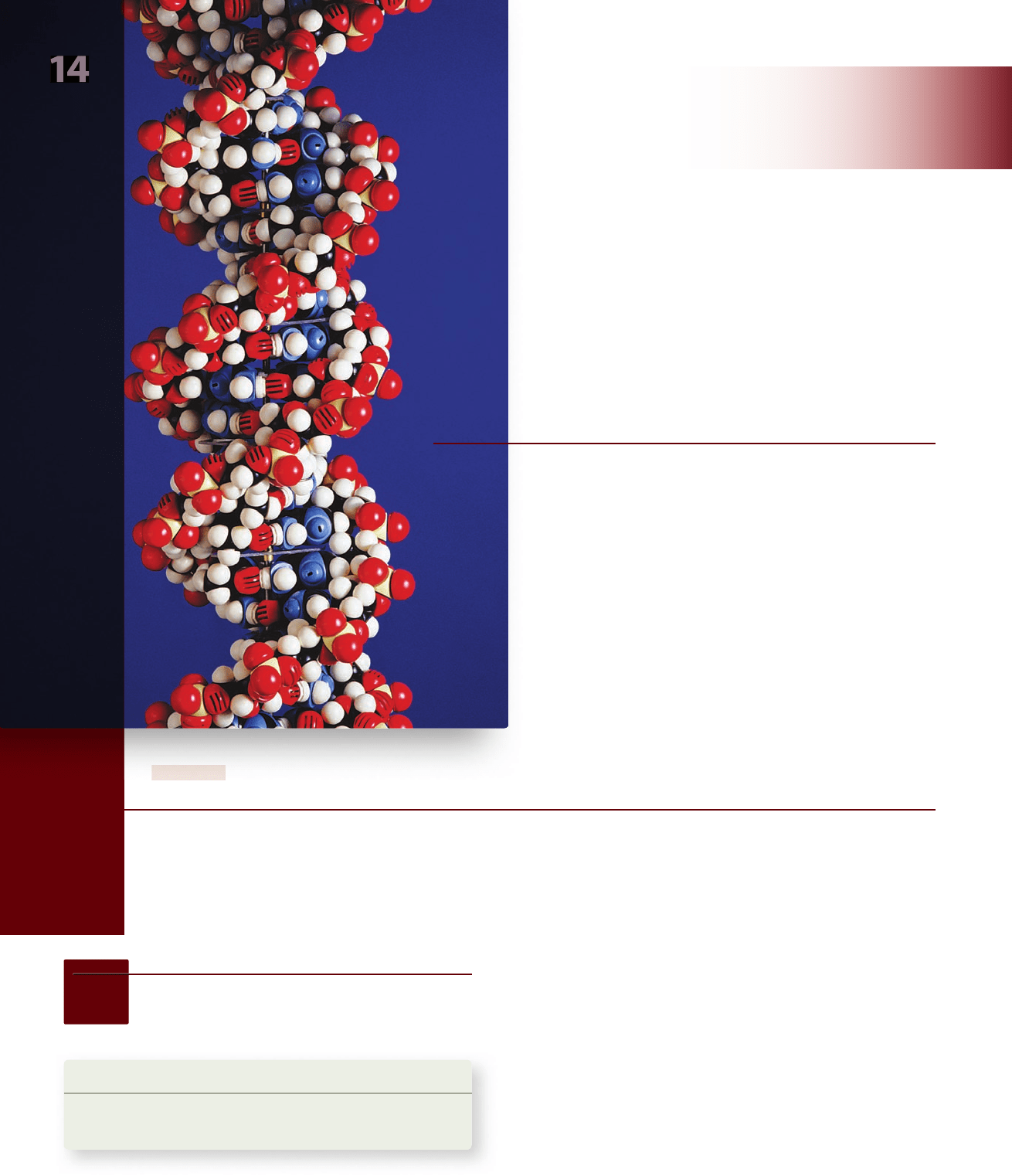
chromosomes? This chapter describes the chain of experiments that led to our current understanding of DNA, modeled in
the picture, and of the molecular mechanisms of heredity. These experiments are among the most elegant in science. And,
just as in a good detective story, each discovery has led to new questions. But however erratic and lurching the course of the
experimental journey may appear, our picture of heredity has become progressively clearer, the image more sharply defined.
CHAPTER
In the previous two chapters, you learned about the nature of in-
heritance and how genes, which contain the information to specify
traits, are located on chromosomes. This finding led to the ques-
tion of what part of the chromosome actually contains the genetic
information. Specifically, biologists wondered about the chemical
identity of the genetic information. They knew that chromosomes
are composed primarily of both protein and DNA. Which of these
organic molecules actually makes up the genes?
Starting in the late 1920s and continuing for about
30 years, a series of investigations addressed this question. DNA
14.1
The Nature of the Genetic
Material
Learning Outcomes
Describe the phenomenon of transformation.1.
Evaluate the evidence for DNA as genetic material.2.
rav32223_ch14_256-277.indd 256rav32223_ch14_256-277.indd 256 11/6/09 4:34:32 PM11/6/09 4:34:32 PM
Apago PDF Enhancer
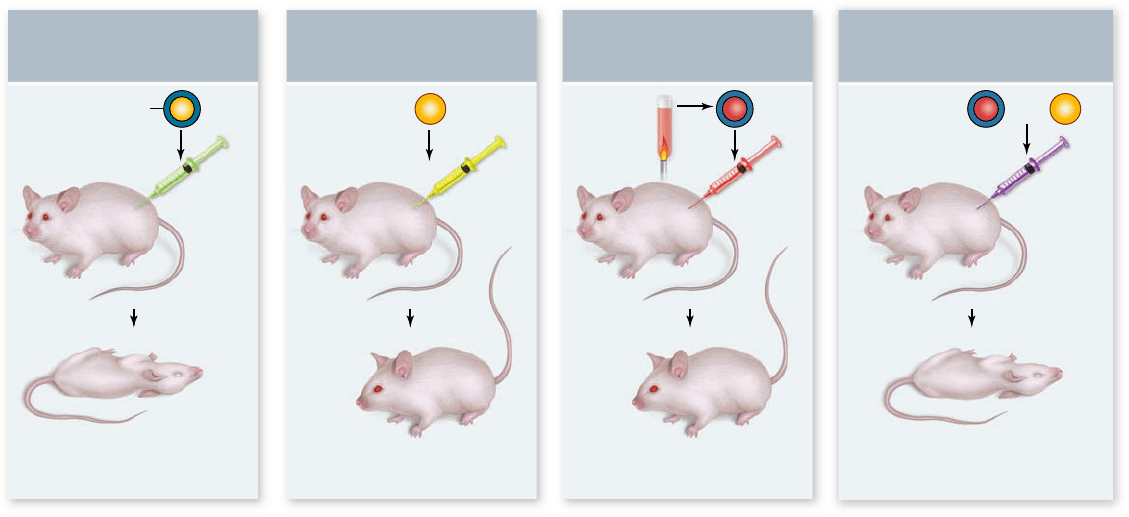
Live Virulent
Strain of S. pneumoniae
Live Nonvirulent
Strain of
S. pneumoniae
Mice live
Mice die
Their lungs contain live
pathogenic strain of S. pneumoniae
Mixture of Heat-Killed Virulent
and Live Nonvirulent
Strains of S. pneumoniae
+
Heat-killed Virulent
Strain of S. pneumoniae
Mice live
Polysaccharide
coat
Mice die
a. b. c. d.
Figure 14.1
Gri th’s experiment. Grif th was trying to make a vaccine against pneumonia and instead discovered transformation.
a. Injecting live virulent bacteria into mice produces pneumonia. Injection of nonvirulent bacteria (b) or heat-killed virulent bacteria (c)
had no effect. d. However, a mixture of heat-killed virulent and live nonvirulent bacteria produced pneumonia in the mice. This indicates
the genetic information for virulence was transferred from dead, virulent cells to live, nonvirulent cells, transforming them from
nonvirulent to virulent.
consists of four chemically similar nucleotides. In contrast, pro-
tein contains 20 different amino acids that are much more
chemically diverse than nucleotides. These characteristics
seemed initially to indicate greater informational capacity in
protein than in DNA.
However, experiments began to reveal evidence in fa-
vor of DNA. We describe three of those major findings in
this section.
Gri th nds that bacterial cells
can be transformed
The first clue came in 1928 with the work of the British micro-
biologist Frederick Griffith. Griffith was trying to make a vac-
cine that would protect against influenza, which was thought at
the time to be caused by the bacteria Streptococcus pneumoniae.
There are two forms of this bacteria: The normal virulent form
that causes pneumonia, and a mutant, nonvirulent form that
does not. The normal virulent form of this bacterium is re-
ferred to as the S form because it forms smooth colonies on a
culture dish. The mutant, nonvirulent form, which lacks an en-
zyme needed to manufacture the polysaccharide coat, is called
the R form because it forms rough colonies.
Griffith performed a series of simple experiments in
which mice were infected with these bacteria, then monitored
for disease symptoms (figure 14.1). Mice infected with the viru-
lent S form died from pneumonia, whereas infection with the
nonvirulent R form had no effect. This result shows that the
polysaccharide coat is necessary for virulence. If the virulent
S form is first heat-killed, infection does not harm the mice,
showing that the coat itself is not sufficient to cause disease.
Lastly, infecting mice with a mixture of heat-killed S form with
live R form caused pneumonia and death in the mice. This was
unexpected as neither treatment alone caused disease. Further-
more, high levels of live S form bacteria were found in the lungs
of the dead mice.
Somehow, the information specifying the polysaccharide
coat had passed from the dead, virulent S bacteria to the live,
coatless R bacteria in the mixture, permanently altering the
coatless R bacteria into the virulent S variety. Griffith called this
transfer of virulence from one cell to another, transformation.
Our modern interpretation is that genetic material was actually
transferred between the cells.
Avery, MacLeod, and McCarty identify
the transforming principle
The agent responsible for transforming Streptococcus went un-
discovered until 1944. In a classic series of experiments, Oswald
Avery and his coworkers Colin MacLeod and Maclyn McCarty
identified the substance responsible for transformation in
Griffith’s experiment.
They first prepared the mixture of dead S Streptococcus
and live R Streptococcus that Griffith had used. Then they re-
moved as much of the protein as they could from their prepara-
tion, eventually achieving 99.98% purity. They found that
despite the removal of nearly all protein, the transforming ac-
tivity was not reduced.
chapter
14
DNA: The Genetic Material
257www.ravenbiology.com
rav32223_ch14_256-277.indd 257rav32223_ch14_256-277.indd 257 11/6/09 4:34:36 PM11/6/09 4:34:36 PM
Apago PDF Enhancer
Phage grown in radioactive
35
S,
which is incorporated into phage coat
Virus infect
bacteria
Blender separates
phage coat from bacteria
Centrifuge forms
bacterial pellet
35
S
in supernatant
35
S-Labeled Bacteriophages
+
Phage grown in radioactive
32
P,
which is incorporated into phage DNA
32
P-Labeled Bacteriophages
Virus infect
bacteria
Blender separates
phage coat from bacteria
Centrifuge forms
bacterial pellet
32
P
in bacteria pellet
+
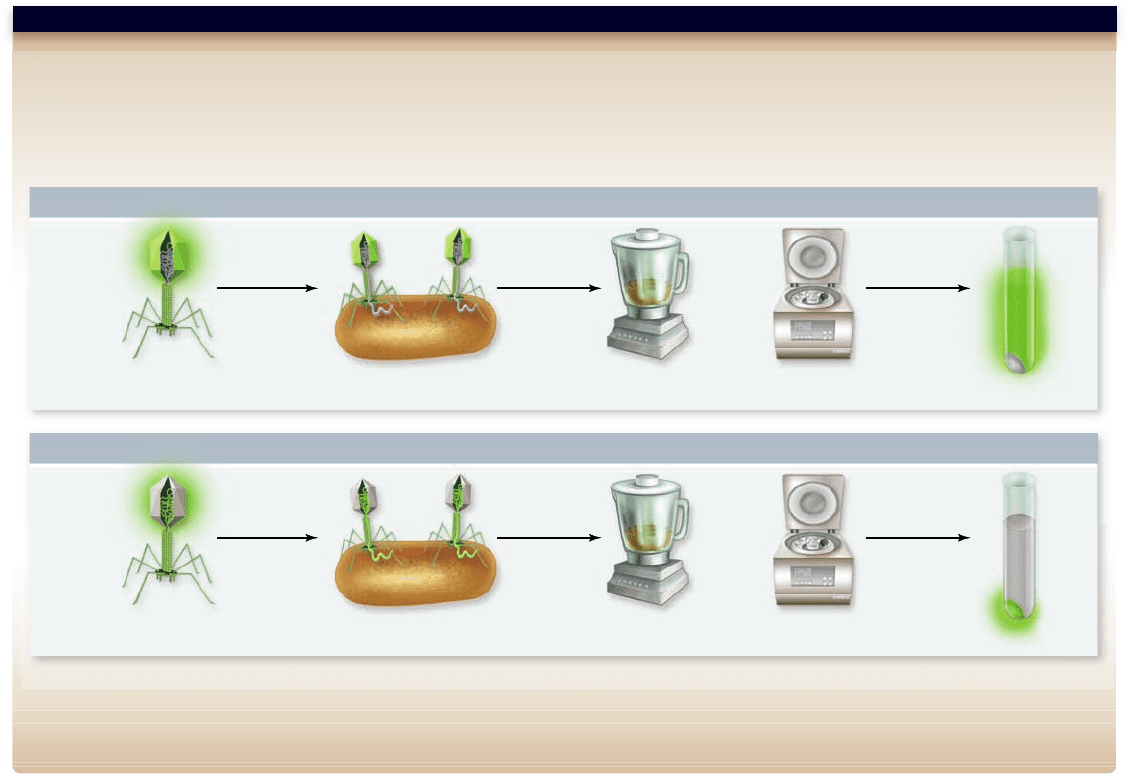
Hypothesis: DNA is the genetic material in bacteriophage.
Prediction: The phage life cycle requires reprogramming the cell to make phage proteins. The information for this must be introduced into the cell during infection.
Test: DNA can be specifically labeled using radioactive phosphate (
32
P), and protein can be specifically labeled using radioactive sulfur (
35
S) . Phage are grown on either
35
S or
32
P, then used to infect cells in two experiments. The phage heads remain attached to the outside of the cell and can be removed by brief agitation in a blender. The
cell suspension can be collected by centrifugation, leaving the phage heads in the supernatant.
Result: When the experiment is done, only
32
P makes it into the cell in any significant quantity.
Conclusion: Thus, DNA must be the molecule that is used to reprogram the cell.
Further Experiments: How does this experiment complement or extend the work of Avery on the identity of the transforming principle?
SCIENTIFIC THINKING
Figure 14.2
Hershey–Chase experiment showed DNA is genetic material for phage.
tory of hereditary information. But additional evidence sup-
porting Avery’s conclusion was provided in 1952 by Alfred
Hershey and Martha Chase, who experimented with viruses
that infect bacteria. These viruses are called bacteriophages,
or more simply, phages.
Viruses, described in more detail in chapter 27, are much
simpler than cells; they generally consist of genetic material
(DNA or RNA) surrounded by a protein coat. The phage used
in these experiments is called a lytic phage because infection
causes the cell to burst, or lyse. When such a phage infects a
bacterial cell, it first binds to the cell’s outer surface and then
injects its genetic information into the cell. There, the viral
genetic information is expressed by the bacterial cell’s machin-
ery, leading to production of thousands of new viruses. The
buildup of viruses eventually causes the cell to lyse, releasing
progeny phage.
The phage used by Hershey and Chase contains only
DNA and protein, and therefore it provides the simplest
possible system to differentiate the roles of DNA and pro-
tein. Hershey and Chase set out to identify the molecule that
the phage injects into the bacterial cells. To do this, they
needed a method to label both DNA and protein in unique
ways that would allow them to be distinguished. Nucleotides
Moreover, the properties of this substance resembled
those of DNA in several ways:
The elemental composition agreed closely with that 1.
of DNA.
When spun at high speeds in an ultracentrifuge, it 2.
migrated to the same level (density) as DNA.
Extracting lipids and proteins did not reduce 3.
transforming activity.
Protein-digesting enzymes did not affect transforming 4.
activity, nor did RNA-digesting enzymes.
DNA-digesting enzymes destroyed all transforming 5.
activity.
These experiments supported the identity of DNA as the
substance transferred between cells by transformation and indicated
that the genetic material, at least in this bacterial species, is DNA.
Hershey and Chase demonstrate that
phage genetic material is DNA
Avery’s results were not widely accepted at first because many
biologists continued to believe that proteins were the reposi-
258
part
III
Genetic and Molecular Biology
rav32223_ch14_256-277.indd 258rav32223_ch14_256-277.indd 258 11/6/09 4:34:36 PM11/6/09 4:34:36 PM
Apago PDF Enhancer
Cytosine
(both DNA and RNA)
Thymine
(DNA only)
Uracil
(RNA only)
PurinesPyrimidines
Adenine
Guanine
NH
2
C
C
N
N
N
C
H
N
C
CH
O
H
H
OC
NC
H
N
C
NH
2
H
C
H
O
O
C
N
C
H
N
C
H
3
C
C
H
H
O
O
C
N
C
H
N
C
H
C
H
NH
2
C
C
N
N
N
C
H
N
C
CH
H
Nitrogenous Base
4„
5„
1„
3„ 2„
2
8
76
39
4
5
1
NH
2
O
J
J
P
J
O
-
-
O
J
O
J
CH
2
J
Phosphate group
Sugar
Nitrogenous base
OH
OH in RNA
H in DNA
NN
N
O
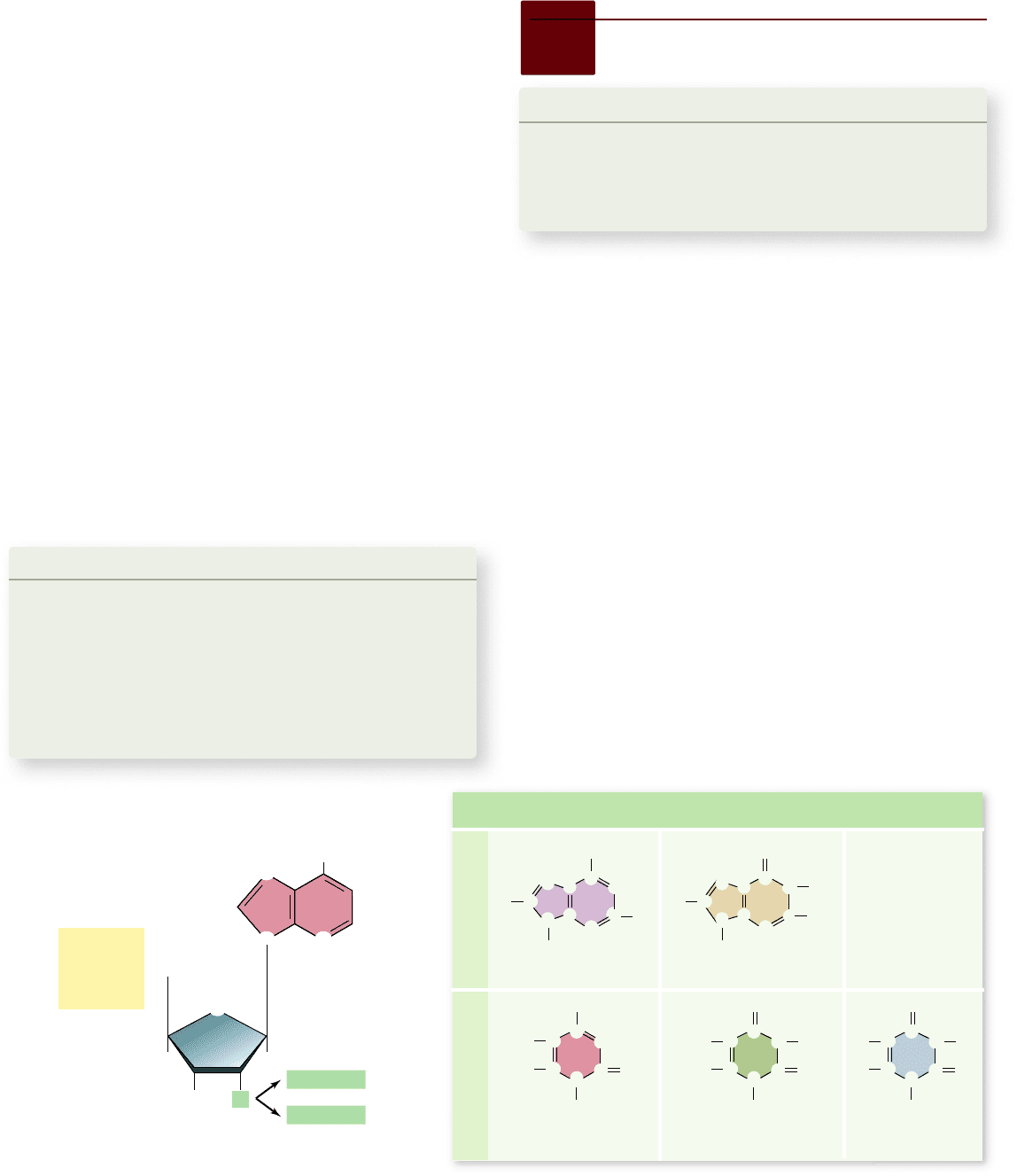
Figure 14.3
Nucleotide subunits of DNA and RNA. The nucleotide subunits of DNA and RNA are composed of three
components: a five-carbon sugar (deoxyribose in DNA and ribose in RNA); a phosphate group; and a nitrogenous base (either a purine
or a pyrimidine).
14.2
DNA Structure
Learning Outcomes
Describe the data available to Watson and Crick.1.
Explain the details of the Watson and Crick structure.2.
Explain the importance of complementarity for DNA 3.
structure and function.
A Swiss chemist, Friedrich Miescher, discovered DNA in
1869, only four years after Mendel’s work was published—
although it is unlikely that Miescher knew of Mendel’s
experiments.
Miescher extracted a white substance from the nuclei of
human cells and fish sperm. The proportion of nitrogen and
phosphorus in the substance was different from that found in
any other known constituent of cells, which convinced Mie-
scher that he had discovered a new biological substance. He
called this substance “nuclein” because it seemed to be specifi-
cally associated with the nucleus. Because Miescher’s nuclein
was slightly acidic, it came to be called nucleic acid .
DNA’s components were known,
but its three-dimensional structure
was a mystery
Although the three-dimensional structure of the DNA mole-
cule was not elucidated until Watson and Crick, it was known
that it contained three main components (figure 14.3) :
a ve-carbon sugar1.
a phosphate (PO2.
4
) group
contain phosphorus, but proteins do not, and some amino
acids contain sulfur, but DNA does not. Thus, the radio-
active
32
P isotope can be used to label DNA specifically, and
the isotope
35
S can be used to label proteins specifically. The
two isotopes are easily distinguished based on the particles
they emit when they decay.
Two experiments were performed (figure 14.2). In one,
viruses were grown on a medium containing
32
P, which was in-
corporated into DNA; in the other, viruses were grown on me-
dium containing
35
S, which was incorporated into coat proteins.
Each group of labeled viruses was then allowed to infect sepa-
rate bacterial cultures.
After infection, the bacterial cell suspension was agitated
in a blender to remove the infecting viral particles from the
surfaces of the bacteria. This step ensured that only the part of
the virus that had been injected into the bacterial cells—that is,
the genetic material—would be detected.
Each bacterial suspension was then centrifuged to pro-
duce a pellet of cells for analysis. In the
32
P experiment, a large
amount of radioactive phosphorus was found in the cell pellet,
but in the
35
S experiment, very little radioactive sulfur was
found in the pellet (see figure 14.2). Hershey and Chase de-
duced that DNA, and not protein, constituted the genetic in-
formation that viruses inject into bacteria.
Learning Outcomes Review 14.1
Experiments with pneumonia-causing bacteria showed that virulence could
be passed from one cell to another, a phenomenon termed transformation.
When the factor responsible for transformation was purifi ed, it was shown
to be DNA. Labeling experiments with phage also indicated that the genetic
material was DNA and not protein.
■ Why was protein an attractive candidate for the
genetic material?
chapter
14
DNA: The Genetic Material
259www.ravenbiology.com
rav32223_ch14_256-277.indd 259rav32223_ch14_256-277.indd 259 11/6/09 4:34:36 PM11/6/09 4:34:36 PM
Apago PDF Enhancer
a. b.
Base
Phosphodiester
bond
J
CH
2
O
5„
3„
O
J
P
J
O
J
OH
J
CH
2
-
O
J
O
J
J
J
C
Base
O
PO
4
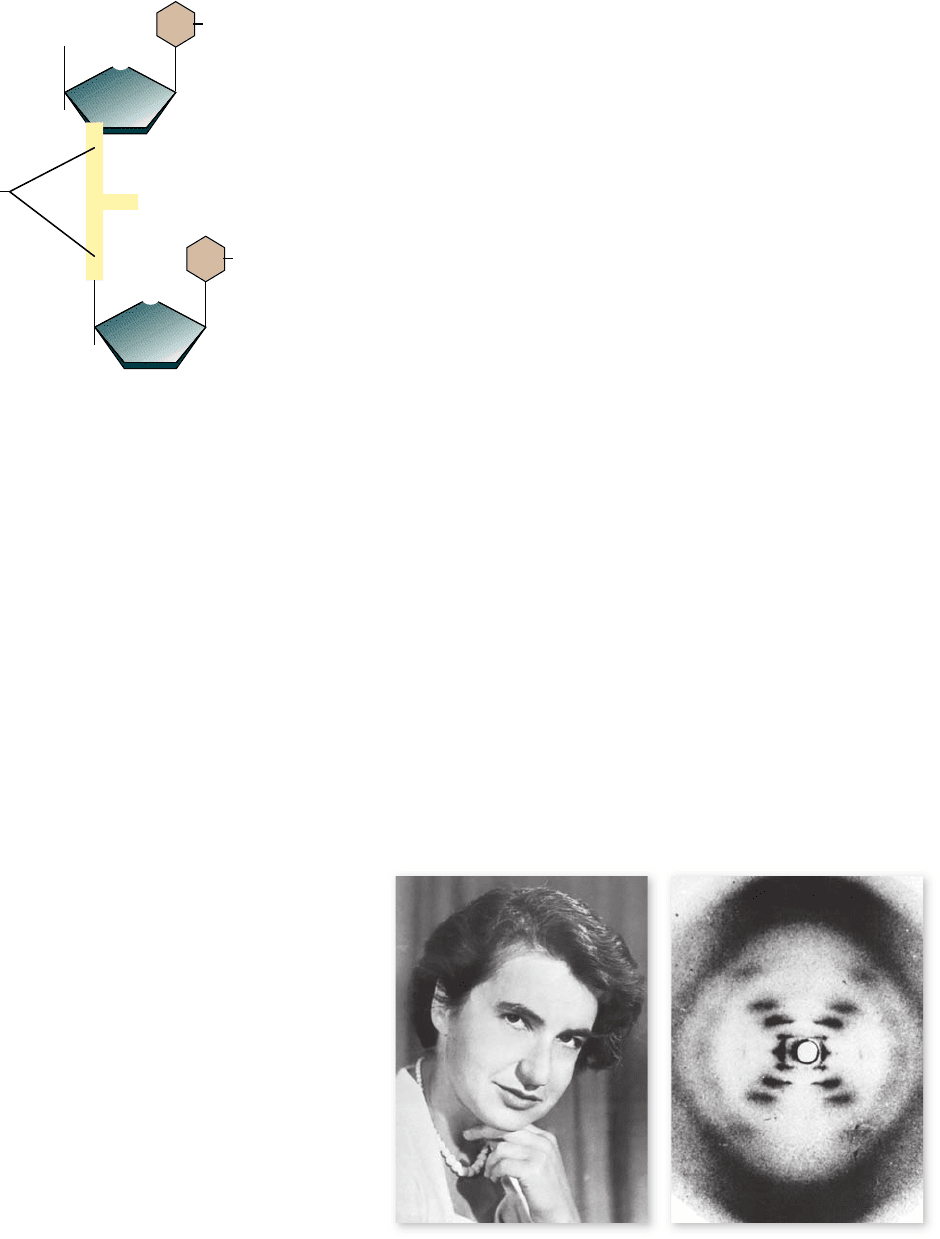
Figure 14.5
Rosalind Franklin’s X-ray di raction
patterns. a. Rosalind Franklin. b. This X-ray diffraction
photograph of DNA bers, made in 1953 by Rosalind Franklin was
interpreted to show the helical structure of DNA.
Charga , Franklin, and Wilkins obtained
some structural evidence
To understand the model that Watson and Crick proposed, we
need to review the evidence that they had available to construct
their model.
Chargaff’s rules
A careful study carried out by Erwin Chargaff showed that the
nucleotide composition of DNA molecules varied in complex
ways, depending on the source of the DNA. This strongly sug-
gested that DNA was not a simple repeating polymer and that
it might have the information-encoding properties genetic ma-
terial requires. Despite DNA’s complexity, however, Chargaff
observed an important underlying regularity in the ratios of the
bases found in native DNA: The amount of adenine present in
DNA always equals the amount of thymine, and the amount of gua-
nine always equals the amount of cytosine. These findings are com-
monly referred to as Chargaff’s rules:
The proportion of A always equals that of T, and the1.
proportion of G always equals that of C, or: A = T, and G = C.
It follows that there is always an equal proportion of 2.
purines (A and G) and pyrimidines (C and T).
As mounting evidence indicated that DNA stored the heredi-
tary information, investigators began to puzzle over how such a
seemingly simple molecule could carry out such a complex cod-
ing function.
Franklin: X-ray diffraction patterns of DNA
Another line of evidence provided more direct information
about the possible structure of DNA. The British chemist
Rosalind Franklin (figure 14.5a) used the technique of X-ray
diffraction to analyze DNA. In X-ray diffraction, a molecule is
bombarded with a beam of X-rays. The rays are bent, or
a nitrogen-containing (nitrogenous) base. The base may 3.
be a purine (adenine, A, or guanine, G), a two-ringed
structure; or a pyrimidine (thymine, T, or cytosine, C), a
single-ringed structure. RNA contains the pyrimidine
uracil (U) in place of thymine.
The convention in organic chemistry is to number the
carbon atoms of a molecule and then to use these numbers to
refer to any functional group attached to a carbon atom (see
chapter 3). In the ribose sugars found in nucleic acids, four of
the carbon atoms together with an oxygen atom form a five-
membered ring. As illustrated in figure 14.3, the carbon atoms
are numbered 1' to 5', proceeding clockwise from the oxygen
atom; the prime symbol (') indicates that the number refers to a
carbon in a sugar rather than to the atoms in the bases attached
to the sugars.
Under this numbering scheme, the phosphate group is
attached to the 5' carbon atom of the sugar, and the base is
attached to the 1' carbon atom. In addition, a free hydroxyl
(
—
OH) group is attached to the 3' carbon atom.
The 5' phosphate and 3' hydroxyl groups allow DNA
and RNA to form long chains of nucleotides by the process
of dehydration synthesis (see chapter 3). The linkage is
called a phosphodiester bond because the phosphate
group is now linked to the two sugars by means of a pair of
ester bonds (figure 14.4) . Many thousands of nucleotides
can join together via these linkages to form long nucleic
acid polymers.
Linear strands of DNA or RNA, no matter how long,
almost always have a free 5' phosphate group at one end and
a free 3' hydroxyl group at the other. Therefore, every DNA
and RNA molecule has an intrinsic polarity, and we can
refer unambiguously to each end of the molecule. By con-
vention, the sequence of bases is usually written in the
5'-to-3' direction.
Figure 14.4
A phosphodiester bond.
260
part
III
Genetic and Molecular Biology
rav32223_ch14_256-277.indd 260rav32223_ch14_256-277.indd 260 11/6/09 4:34:37 PM11/6/09 4:34:37 PM
Apago PDF Enhancer
5
3
P
P
P
P
OH
5-carbon sugar
Nitrogenous base
Phosphate group
Phosphodiester bond
O
O
O
O
4„
5„
1„
3„
2„
4„
5„
1„
3„
2„
4„
5„
1„
3„
2„
4„
5„
1„
3„
2„
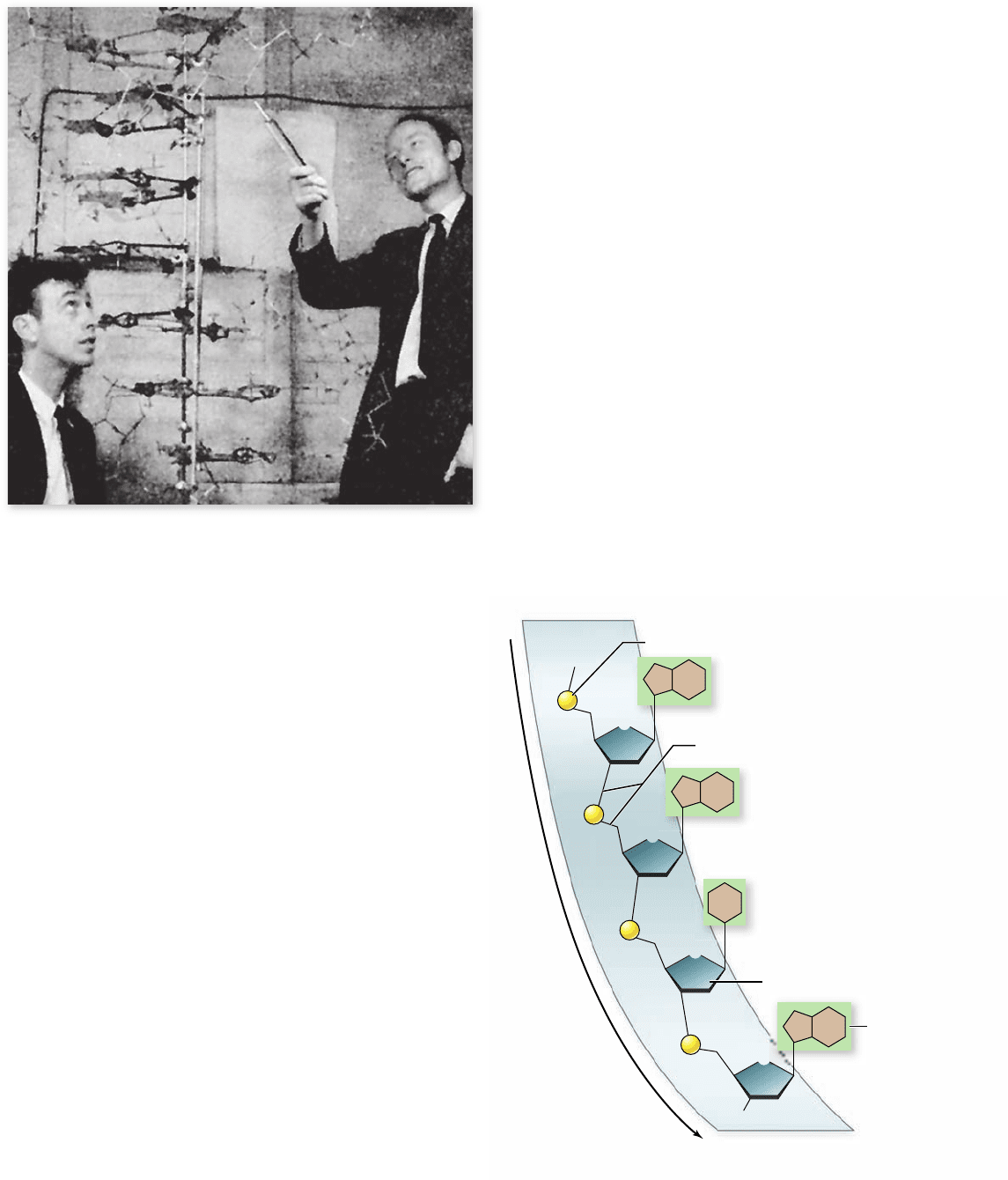
Figure 14.6
The DNA double helix. James Watson (left) and
Francis Crick (right) deduced the structure of DNA in 1953 from
Chargaff’s rules, knowing the proper tautomeric forms of the bases
and using Franklin’s diffraction studies.
Figure 14.7
Structure of a single strand of DNA. The
phosphodiester backbone is composed of alternating sugar and
phosphate groups. The bases are attached to each sugar.
The importance of this distinction is that the two forms
exhibit very different hydrogen-bonding possibilities. The pre-
dominant forms of the bases contain the keto and amino groups
(see figure 14.3), but a prominent biochemistry text of the time
actually contained the opposite, and incorrect, information.
Legend has it that Watson learned the correct forms while hav-
ing lunch with a biochemist friend.
The Watson–Crick model ts
the available evidence
Learning informally of Franklin’s results before they were pub-
lished in 1953, James Watson and Francis Crick, two young
investigators at Cambridge University, quickly worked out a
likely structure for the DNA molecule (figure 14.6), which we
now know was substantially correct. Watson and Crick did not
perform a single experiment themselves related to DNA struc-
ture; rather, they built detailed molecular models based on the
information available.
The key to the model was their understanding that each
DNA molecule is actually made up of two chains of nucleotides
that are intertwined—the double helix.
The phosphodiester backbone
The two strands of the double helix are made up of long polymers
of nucleotides, and as described earlier, each strand is made up of
repeating sugar and phosphate units joined by phosphodiester
bonds (figure 14.7). We call this the phosphodiester backbone of the
diffracted, by the molecules they encounter, and the diffraction
pattern is recorded on photographic film. The patterns resem-
ble the ripples created by tossing a rock into a smooth lake
(figure 14.5b). When analyzed mathematically, the diffraction
pattern can yield information about the three-dimensional
structure of a molecule.
X-ray diffraction works best on substances that can be
prepared as perfectly regular crystalline arrays. At the time
Franklin conducted her analysis, it was impossible to obtain
true crystals of natural DNA, so she had to use DNA in the
form of fibers. Maurice Wilkins, another researcher working in
the same laboratory, had been able to prepare more uniformly
oriented DNA fibers than anyone else at the time. Using these
fibers, Franklin succeeded in obtaining crude diffraction infor-
mation on natural DNA. The diffraction patterns she obtained
suggested that the DNA molecule had the shape of a helix, or
corkscrew, with a consistent diameter of about 2 nm and a com-
plete helical turn every 3.4 nm.
Tautomeric forms of bases
One piece of evidence important to Watson and Crick was the
form of the bases themselves. Because of the alternating double
and single bonds in the bases, they actually exist in equilibrium
between two different forms when in solution. The different
forms have to do with keto (C
=
O) versus enol (C
–
OH) groups
and amino (
–
NH
2
) versus imino (
=
NH) groups that are at-
tached to the bases. These structural forms are called tautomers.
chapter
14
DNA: The Genetic Material
261www.ravenbiology.com
rav32223_ch14_256-277.indd 261rav32223_ch14_256-277.indd 261 11/6/09 4:34:37 PM11/6/09 4:34:37 PM