
Raven P.H., Johnson G.B., Mason K.A. Biology (Ninth Edition)
Подождите немного. Документ загружается.

Apago PDF Enhancer
3
3 5
2 nm
Minor
groove
Major
groove
Minor
groove
Major
groove
3.4 nm
0.34 nm
5
C
C
C
G
G
G
G
G
T
T
T
T
A
A
A
A
H
Sugar
Sugar
Sugar
Sugar
Hydrogen
bond
T
G
C
N
H
N
O
H
CH
3
H
HN
J
O
N
NH
J
N
N
N
H
H
H
N
OH
H
H
J
N
O
N
J
H
N
N
H
N
J
N
Hydrogen
bond
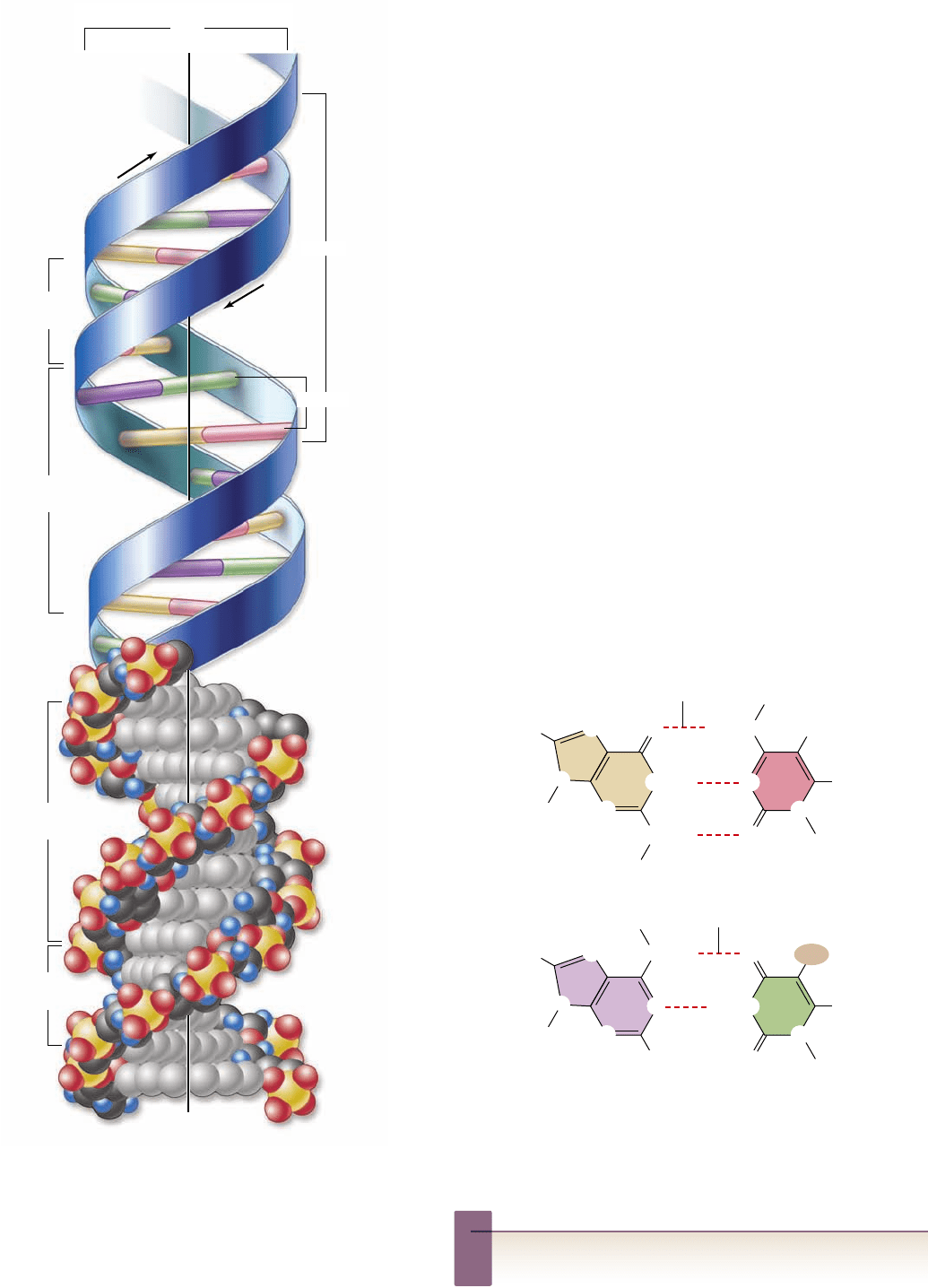
Figure 14.8
The double helix. Shown with the
phosphodiester backbone as a ribbon on top and a space-filling
model on the bottom. The bases protrude into the interior of
the helix where they hold it together by base-pairing. The
backbone forms two grooves, the larger major groove and the
smaller minor groove.
Inquiry question
?
Does the Watson–Crick model account for all of the data
discussed in the text?
Figure 14.9
Base-pairing holds strands together. The
hydrogen bonds that form between A and T and between G and C
are shown with dashed lines. These produce AT and GC base-pairs
that hold the two strands together. This always pairs a purine with a
pyrimidine, keeping the diameter of the double helix constant.
molecule. The two strands of the backbone are then wrapped
about a common axis forming a double helix (figure 14.8). The
helix is often compared to a spiral staircase, in which the two
strands of the double helix are the handrails on the staircase.
Complementarity of bases
Watson and Crick proposed that the two strands were held to-
gether by formation of hydrogen bonds between bases on oppo-
site strands. These bonds would result in specific base-pairs:
Adenine (A) can form two hydrogen bonds with thymine (T) to
form an A–T base-pair, and guanine (G) can form three hydrogen
bonds with cytosine (C) to form a G–C base-pair (figure 14.9).
Note that this configuration also pairs a two-ringed pu-
rine with a single-ringed pyrimidine in each case, so that the
diameter of each base-pair is the same. This consistent diame-
ter is indicated by the X-ray diffraction data.
We refer to this pattern of base-pairing as complementary ,
which means that although the strands are not identical, they each
can be used to specify the other by base-pairing. If the sequence
of one strand is ATGC, then the complementary strand sequence
must be TACG. This characteristic becomes critical for DNA
replication and expression, as you will see later in this chapter.
The Watson–Crick model also explained Chargaff’s results:
In a double helix, adenine forms two hydrogen bonds with thy-
mine, but it will not form hydrogen bonds properly with cytosine.
Similarly, guanine forms three hydrogen bonds with cytosine, but
it will not form hydrogen bonds properly with thymine. Because
of this base-pairing, adenine and thymine always occur in the same
proportions in any DNA molecule, as do guanine and cytosine.
262
part
III
Genetic and Molecular Biology
rav32223_ch14_256-277.indd 262rav32223_ch14_256-277.indd 262 11/6/09 4:34:38 PM11/6/09 4:34:38 PM
Apago PDF Enhancer
Conservative Semiconservative Dispersive
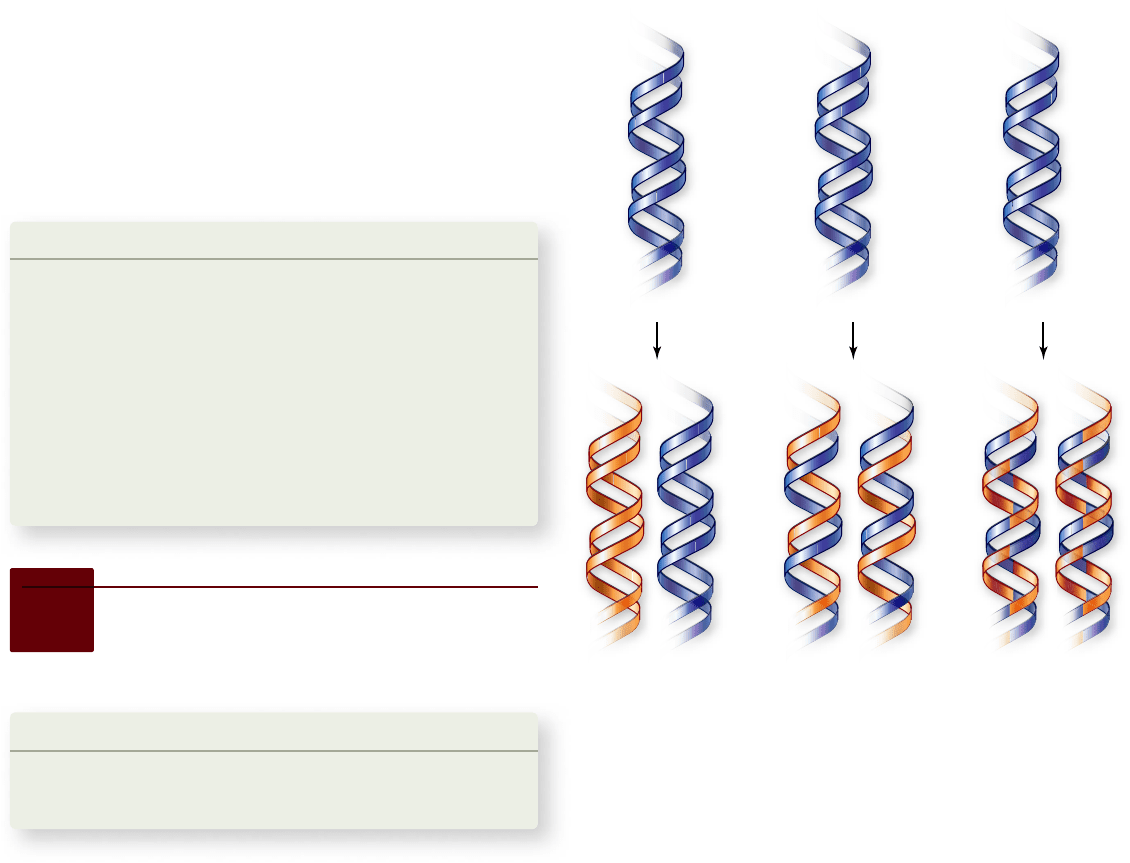
Figure 14.10
Three possible models for DNA
replication. The conservative model produces one entirely new
molecule and conserves the old. The semiconservative model
produces two hybrid molecules of old and new strands. The
dispersive model produces hybrid molecules with each strand a
mixture of old and new.
Antiparallel configuration
As stated earlier, a single phosphodiester strand has an inher-
ent polarity, meaning that one end terminates in a 3' OH and
the other end terminates in a 5' PO
4
. Strands are thus referred
to as having either a 5'-to-3' or a 3'-to-5' polarity. Two strands
could be put together in two ways: with the polarity the same
in each (parallel) or with the polarity opposite (antiparallel).
Native double-stranded DNA always has the antiparallel con-
figuration, with one strand running 5' to 3' and the other run-
ning 3' to 5' (see figure 14.8). In addition to its complementarity,
this antiparallel nature also has important implications for
DNA replication.
The Watson–Crick DNA molecule
In the Watson and Crick model, each DNA molecule is com-
posed of two complementary phosphodiester strands that each
form a helix with a common axis. These strands are antiparallel,
with the bases extending into the interior of the helix. The bases
from opposite strands form base-pairs with each other to join
the two complementary strands (see figures 14.8 and 14.9).
Although the hydrogen bonds between each individual
base-pair are low-energy bonds, the sum of bonds between the
many base-pairs of the polymer has enough energy that the en-
tire molecule is stable. To return to our spiral staircase analogy—
the backbone is the handrails, the base-pairs are the steps.
Although the Watson–Crick model provided a rational
structural for DNA, researchers had to answer further questions
about how DNA could be replicated, a crucial step in cell divi-
sion, and also about how cells could repair damaged or otherwise
altered DNA. We explore these questions in the rest of this chap-
ter. (In the following chapter, we continue with the genetic code
and the connection between the code and protein synthesis.)
Learning Outcomes Review 14.2
Chargaff showed that in DNA, the amount of adenine was equal to the
amount of thymine, and the amount of guanosine was equal to that of
cytosine. X-ray diff raction studies by Franklin and Wilkins indicated that DNA
formed a helix. Watson and Crick built a model consisting of two antiparallel
strands wrapped in a helix about a common axis. The two strands are held
together by hydrogen bonds between the bases: adenine pairs with thymine
and guanine pairs with cytosine. The two strands are thus complementary
to each other.
■ Why was information about the proper tautomeric form
of the bases critical?
14.3
Basic Characteristics
of DNA Replication
Learning Outcomes
Explain the basic mechanism of DNA replication.1.
Describe the requirements for DNA replication.2.
The accurate replication of DNA prior to cell division is a basic and
crucial function. Research has revealed that this complex process
requires the participation of a large number of cellular proteins.
Before geneticists could look for these details, however, they needed
to perform some groundwork on the general mechanisms.
Meselson and Stahl demonstrate
the semiconservative mechanism
The Watson–Crick model immediately suggested that the basis
for copying the genetic information is complementarity. One
chain of the DNA molecule may have any conceivable base se-
quence, but this sequence completely determines the sequence
of its partner in the duplex.
In replication, the sequence of parental strands must be
duplicated in daughter strands. That is, one parental helix with
two strands must yield two daughter helices with four strands.
The two daughter molecules are then separated during the
course of cell division.
Three models of DNA replication are possible (figure 14.10):
In a 1. conservative model, both strands of the parental duplex
would remain intact (conserved), and new DNA copies
would consist of all-new molecules. Both daughter
strands would contain all-new molecules.
chapter
14
DNA: The Genetic Material
263www.ravenbiology.com
rav32223_ch14_256-277.indd 263rav32223_ch14_256-277.indd 263 11/6/09 4:34:39 PM11/6/09 4:34:39 PM
Apago PDF Enhancer
14
N medium
15
N medium
Samples taken at
three time points
and suspended in
cesium chloride
solution
Samples are centrifuged
0 min
0 rounds
20 min
1 round
40 min
2 rounds
E. coli
E. coli cells grown
in
15
N medium
Cells shifted to
14
N medium and
allowed to grow
DNA
Rounds of
replication
Top
0
1
2
0 rounds 1 round 2 rounds
Bottom
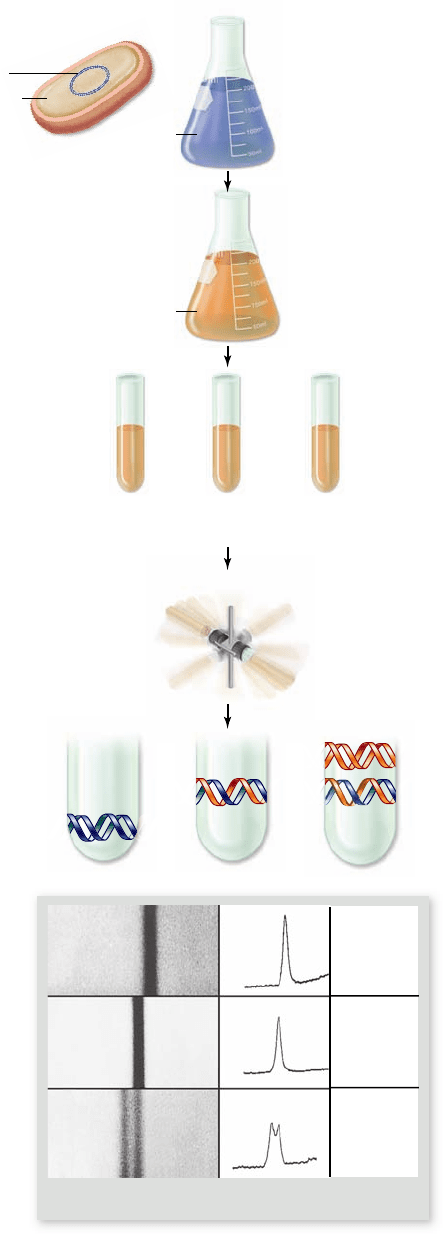
Figure 14.11
The Meselson–Stahl experiment. Bacteria
grown in heavy
15
N medium are shifted to light
14
N medium and
grown for two rounds of replication. Samples are taken at time
points corresponding to zero, one, and two rounds of replication
and centrifuged in cesium chloride to form a gradient. The actual
data are shown at the bottom with the interpretation of
semiconservative replication shown schematically.
In a 2. semiconservative model, one strand of the
parental duplex remains intact in daughter strands
(semiconserved); a new complementary strand is built
for each parental strand consisting of new molecules.
Daughter strands would consist of one parental strand
and one newly synthesized strand.
In a 3. dispersive model, copies of DNA would consist of
mixtures of parental and newly synthesized strands; that
is, the new DNA would be dispersed throughout each
strand of both daughter molecules after replication.
Notice that these three models suggest general mechanisms of rep-
lication, without specifying any molecular details of the process.
The Meselson–Stahl experiment
The three models for DNA replication were evaluated in 1958
by Matthew Meselson and Franklin Stahl. To distinguish be-
tween these models, they labeled DNA and then followed the
labeled DNA through two rounds of replication (figure 14.11) .
The label Meselson and Stahl used was a heavy isotope of
nitrogen (
15
N), not a radioactive label. Molecules containing
15
N have a greater density than those containing the common
14
N isotope. Ultracentrifugation can be used to separate mole-
cules that have different densities.
Bacteria were grown in a medium containing
15
N, which
became incorporated into the bases of the bacterial DNA. After
several generations, the DNA of these bacteria was denser than
that of bacteria grown in a medium containing the normally
available
14
N. Meselson and Stahl then transferred the bacteria
from the
15
N medium to
14
N medium and collected the DNA
at various time intervals.
The DNA for each interval was dissolved in a solution
containing a heavy salt, cesium chloride. This solution was spun
at very high speeds in an ultracentrifuge. The enormous cen-
trifugal forces caused cesium ions to migrate toward the bot-
tom of the centrifuge tube, creating a gradient of cesium
concentration, and thus of density. Each DNA strand floated or
sank in the gradient until it reached the point at which its den-
sity exactly matched the density of the cesium at that location.
Because
15
N strands are denser than
14
N strands, they migrated
farther down the tube.
The DNA collected immediately after the transfer of
bacteria to new
14
N medium was all of one density equal to that
of
15
N DNA alone. However, after the bacteria completed a
first round of DNA replication, the density of their DNA had
decreased to a value intermediate between
14
N DNA alone and
15
N DNA. After the second round of replication, two density
classes of DNA were observed: one intermediate and one equal
to that of
14
N DNA (see figure 14.11).
Interpretation of the Meselson–Stahl findings
Meselson and Stahl compared their experimental data with the
results that would be predicted on the basis of the three models.
The conservative model was not consistent with the data 1.
because after one round of replication, two densities should
have been observed: DNA strands would either be all-heavy
(parental) or all-light (daughter). This model is rejected.
The semiconservative model is consistent with all 2.
observations: After one round of replication, a single
264
part
III
Genetic and Molecular Biology
rav32223_ch14_256-277.indd 264rav32223_ch14_256-277.indd 264 11/6/09 4:34:40 PM11/6/09 4:34:40 PM
Apago PDF Enhancer
P
P
P
P
P
P
P
P
P
P
P
Pyrophosphate
3
3
5
5
Sugar–
phosphate
backbone
New Strand Template Strand
DNA polymerase III
O
HO
OH
O
O
O
O
O
O
O
O
O
O
C
C
T
T
T
A
A
A
G
G
A
P
P
P
P
P
P
P P P
P P
P
P
P
P
3
3
5
5
New Strand Template Strand
O
HO
OH
OH
O
O
O
O
O
O
O
O
O
O
C
C
T
T
T
A
A
A
G
G
A
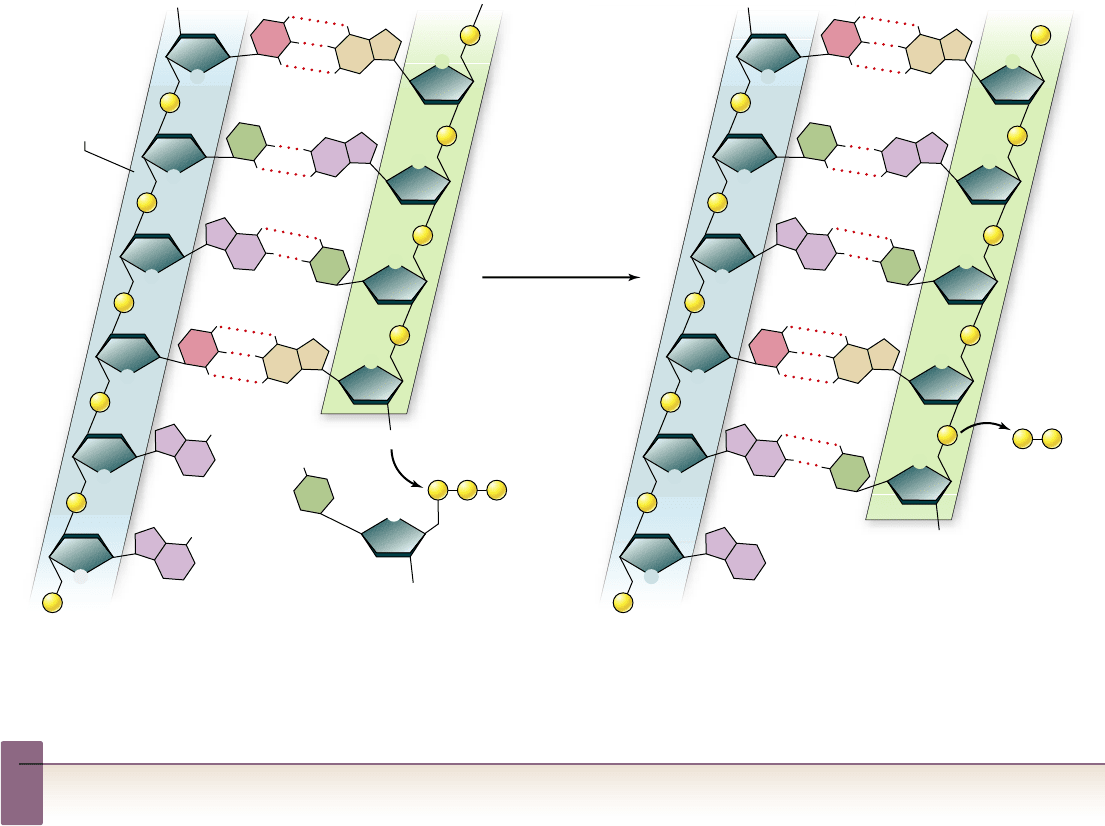
Figure 14.12
Action of DNA polymerase. DNA polymerases add nucleotides to the 3' end of a growing chain. The nucleotide added
depends on the base that is in the template strand. Each new base must be complementary to the base in the template strand. With the
addition of each new nucleoside triphosphate, two of its phosphates are cleaved off as pyrophosphate.
Inquiry question
?
Why do you think it is important that the sugar–phosphate backbone of DNA is held together by covalent bonds, and the cross-bridges
between the two strands are held together by hydrogen bonds?
density would be predicted because all DNA molecules
would have a light strand and a heavy strand. After two
rounds of replication, half of the molecules would have
two light strands, and half would have a light strand and a
heavy strand—and so two densities would be observed.
Therefore, the results support the semiconservative model.
The dispersive model was consistent with the data from 3.
the rst round of replication, because in this model,
every DNA helix would consist of strands that are
mixtures of ½ light (new) and ½ heavy (old) molecules.
But after two rounds of replication, the dispersive model
would still yield only a single density; DNA strands
would be composed of ¾ light and ¼ heavy molecules.
Instead, two densities were observed. Therefore, this
model is also rejected.
The basic mechanism of DNA replication is semiconser-
vative. At the simplest level, then, DNA is replicated by open-
ing up a DNA helix and making copies of both strands to
produce two daughter helices, each consisting of one old strand
and one new strand.
DNA replication requires a template,
nucleotides, and a polymerase enzyme
Replication requires three things: something to copy, some-
thing to do the copying, and the building blocks to make the
copy. The parental DNA molecules serve as a template, en-
zymes perform the actions of copying the template, and the
building blocks are nucleoside triphosphates.
The process of replication can be thought of as having a
beginning where the process starts; a middle where the ma-
jority of building blocks are added; and an end where the pro-
cess is finished. We use the terms initiation, elongation, and
termination to describe a biochemical process. Although this
may seem overly simplistic, in fact, discrete functions are usu-
ally required for initiation and termination that are not neces-
sary for elongation.
A number of enzymes work together to accomplish the
task of assembling a new strand, but the enzyme that actually
matches the existing DNA bases with complementary nucleo-
tides and then links the nucleotides together to make the
new strand is DNA polymerase (figure 14.12) . All DNA
chapter
14
DNA: The Genetic Material
265www.ravenbiology.com
rav32223_ch14_256-277.indd 265rav32223_ch14_256-277.indd 265 11/6/09 4:34:42 PM11/6/09 4:34:42 PM
Apago PDF Enhancer
5„
3„
5„
5„
5„
3„
3„
RNA polymerase makes primer DNA polymerase extends primer
Replisome
Replisome
Origin
Origin
Origin Origin
Origin
Termination
Termination
Termination Termination
Termination Termination
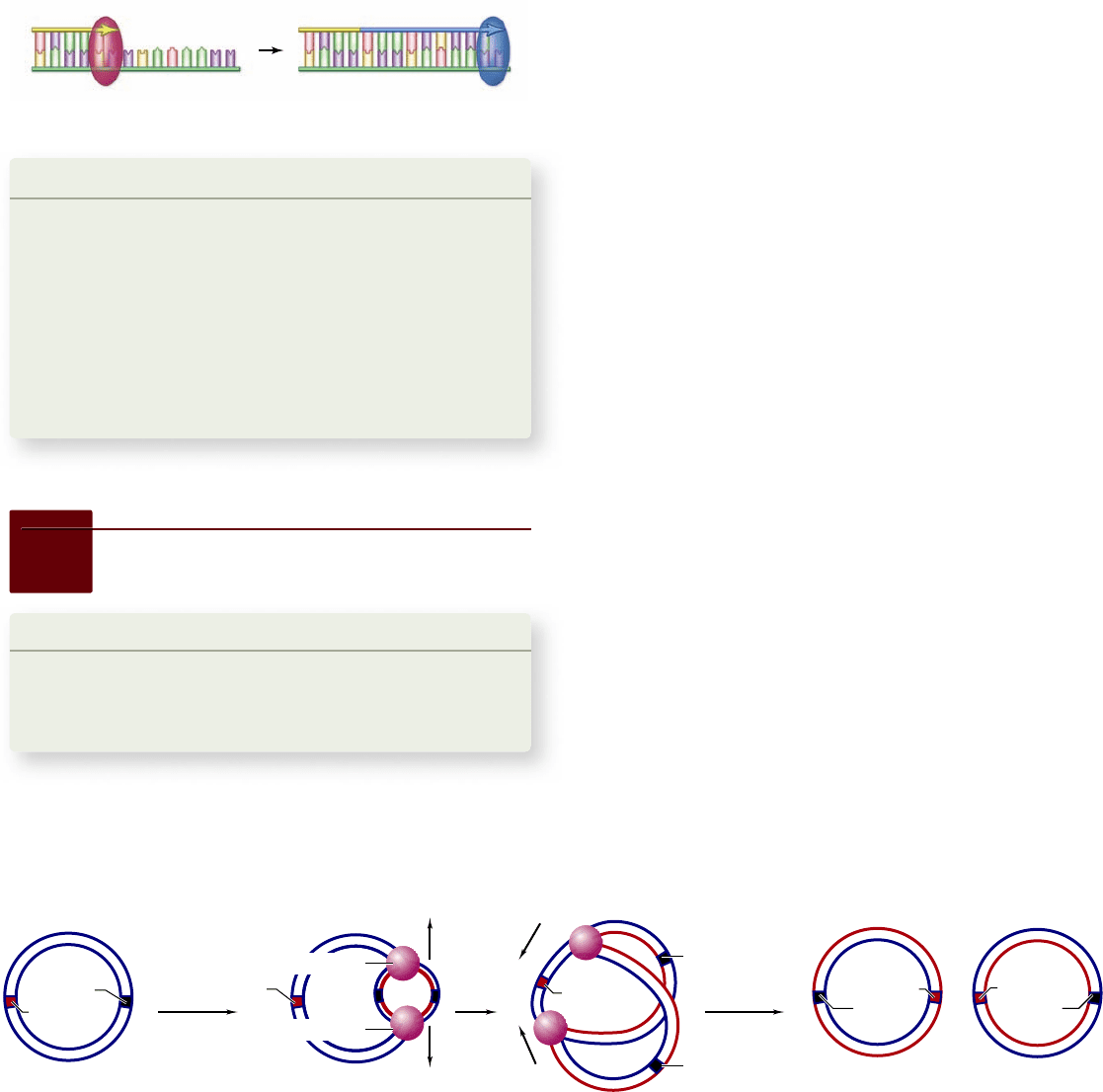
Figure 14.13
Replication is bidirectional from a unique origin. Replication initiates from a unique origin. Two separate
replisomes are loaded onto the origin and initiate synthesis in the opposite directions on the chromosome. These two replisomes continue in
opposite directions until they come to a unique termination site.
14.4
Prokaryotic Replication
Learning Outcomes
Describe the functions of E. coli DNA polymerases.1.
Explain why replication is discontinuous on one strand.2.
Diagram the functions found at the replication fork.3.
To build up a more detailed picture of replication, we first con-
centrate on prokaryotic replication using E. coli as a model. We
can then look at eukaryotic replication primarily in how it dif-
fers from the prokaryotic system.
Learning Outcomes Review 14.3
Meselson and Stahl showed that the basic mechanism of replication is
semiconservative: Each new DNA helix is composed of one old strand and
one new strand. The process of replication requires a template to copy,
nucleoside triphosphate building blocks, and the enzyme DNA polymerase.
DNA polymerases synthesize DNA in a 5'-to-3' direction from a primer,
usually RNA.
■ In the Meselson–Stahl experiment, what would the
results be if the DNA was denatured prior to separation
by ultracentrifugation?
polymerases that have been examined have several common
features. They all add new bases to the 3' end of existing
strands. That is, they synthesize in a 5'-to-3' direction by ex-
tending a strand base-paired to the template. All DNA poly-
merases also require a primer to begin synthesis; they cannot
begin without a strand of RNA or DNA base-paired to the
template. RNA polymerases do not have this requirement, so
they usually synthesize the primers.
Prokaryotic replication starts at a single origin
Replication in E. coli initiates at a specific site, the origin (called
oriC), and ends at a specific site, the terminus. The sequence of oriC
consists of repeated nucleotides that bind an initiator protein and
an AT-rich sequence that can be opened easily during initiation of
replication. (A–T base-pairs have only two hydrogen bonds, com-
pared with the three hydrogen bonds in G–C base-pairs.)
After initiation, replication proceeds bidirectionally from
this unique origin to the unique terminus (figure 14.13). We
call the DNA controlled by an origin a replicon. In this case,
the chromosome plus the origin forms a single replicon .
E. coli has at least three di erent
DNA polymerases
As mentioned earlier, DNA polymerase refers to a group of en-
zymes responsible for the building of a new DNA strand from
the template. The first DNA polymerase isolated in E. coli was
given the name DNA polymerase I (Pol I). At first, investiga-
tors assumed this polymerase was responsible for the bulk syn-
thesis of DNA during replication. A mutant was isolated, however,
that had no Pol I activity, but could still replicate its chromo-
some. Two additional polymerases were isolated from this strain
of E. coli and were named DNA polymerase II (Pol II) and
DNA polymerase III (Pol III). As with all other known poly-
merases, all three of these enzymes synthesize polynucleotide
strands only in the 5'-to-3' direction and require a primer.
Many DNA polymerases have additional enzymatic activ-
ity that aids their function. This activity is a nuclease activity, or
the ability to break phosphodiester bonds between nucleotides.
Nucleases are classified as either endonucleases (which cut
DNA internally) or exonucleases (which chew away at an end
of DNA). DNA Pol I, Pol II, and Pol III have 3'-to-5' exonu-
clease activity, which serves as a proofreading function because
it allows the enzyme to remove a mispaired base. In addition,
the DNA Pol I enzyme also has a 5'-to-3' exonuclease activity,
the importance of which will become clear shortly.
The three different polymerases have different roles in
the replication process. DNA Pol III is the main replication
enzyme; it is responsible for the bulk of DNA synthesis. DNA
Pol I acts on the lagging strand to remove primers and replace
them with DNA. The Pol II enzyme does not appear to play a
role in replication but is involved in DNA repair processes.
For many years, these three polymerases were thought to
be the only DNA polymerases in E. coli, but recently several
266
part
III
Genetic and Molecular Biology
rav32223_ch14_256-277.indd 266rav32223_ch14_256-277.indd 266 11/6/09 4:34:42 PM11/6/09 4:34:42 PM
Apago PDF Enhancer
Supercoiling
Replisomes
DNA gyrase
No Supercoiling
Replisomes
First RNA primer
Open helix and
replicate further
3„
5„
5„
3„
5„
3„
3„
3„
5„
3„
5„
5„
3„
5„
Leading strand
(continuous)
Lagging strand
(discontinuous)
RNA primer
RNA primer
Second RNA primer
Open helix
and replicate
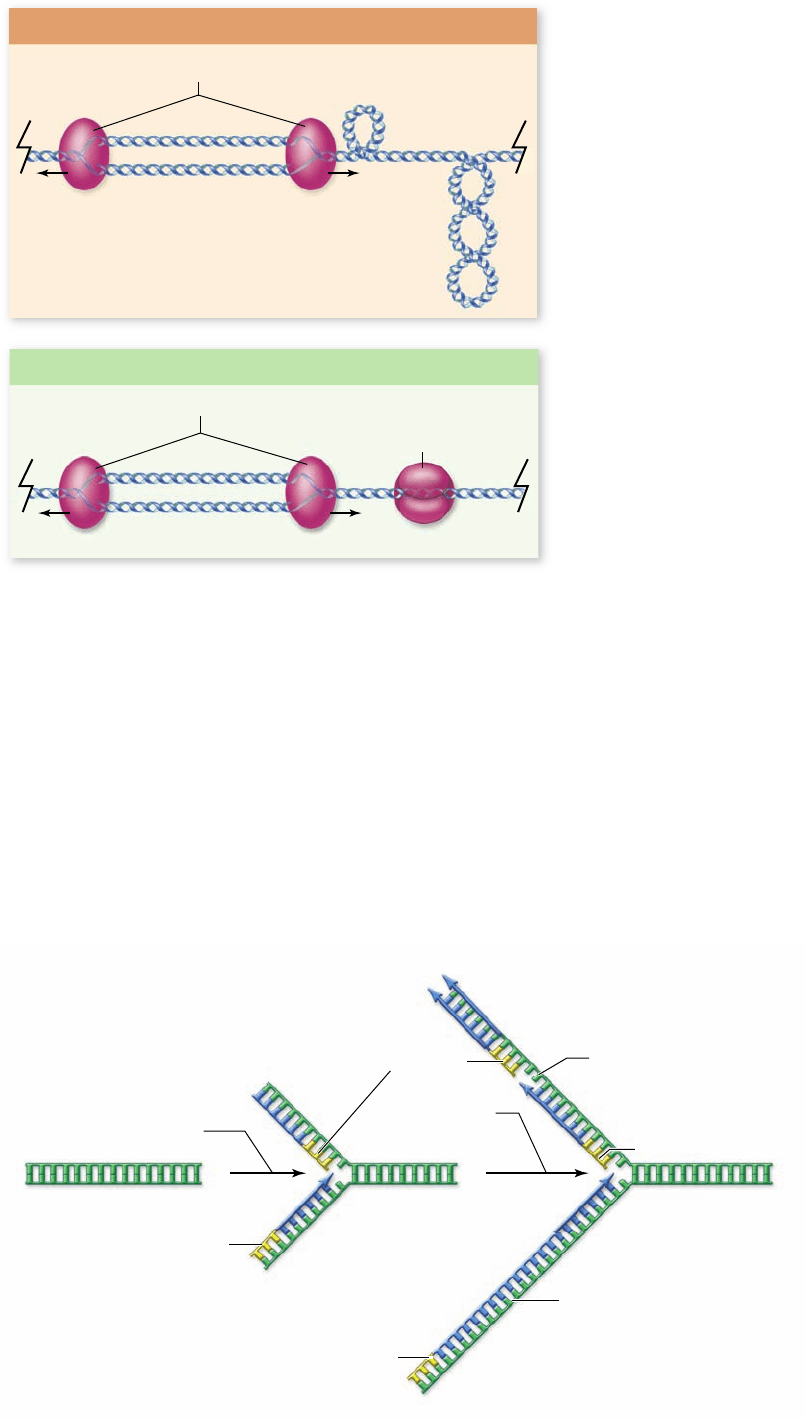
Figure 14.14
Unwinding the helix causes torsional
strain. If the ends of a linear DNA molecule are constrained, as
they are in the cell, unwinding the helix produces torsional strain.
This can cause the double helix to further coil in space
(supercoiling). The enzyme DNA gyrase can relieve supercoiling.
new ones have been identified. There are now five known poly-
merases, although not all are active in DNA replication.
Unwinding DNA requires energy
and causes torsional strain
Although some DNA polymerases can unwind DNA as they
synthesize new DNA, another class of enzymes has the single
function of unwinding DNA strands to make this process more
efficient. Enzymes that use energy from ATP to unwind the
DNA template are called helicases.
The single strands of DNA produced by helicase action
are unstable because the process exposes the hydrophobic
bases to water. Cells solve this problem by using a protein,
called single-strand-binding protein (SSB), to coat exposed
single strands.
The unwinding of the two strands introduces torsional
strain in the DNA molecule. Imagine two rubber bands twisted
together. If you now unwind the rubber bands, what happens?
The rubber bands, already twisted about each other, will fur-
ther coil in space. When this happens with a DNA molecule it
is called supercoiling (figure 14.14) . The branch of mathemat-
ics that studies how forms twist and coil in space is called topol-
ogy, and therefore we describe this coiling of the double helix as
the topological state of DNA. This state describes how the double
helix itself coils in space. You have already seen an example of
this coiling with DNA wrapped about histone proteins in the
nucleosomes of eukaryotic chromosomes (see chapter 10).
Enzymes that can alter the topological state of DNA are
called topoisomerases. Topoisomerase enzymes act to relieve
the torsional strain caused by unwinding and to prevent this
supercoiling from happening. DNA gyrase is the topoisomerase
involved in DNA replication (see figure 14.14).
Replication is semidiscontinuous
Earlier, DNA was described as being antiparallel—meaning
that one strand runs in the 3'-to-5' direction, and its comple-
mentary strand runs in the 5'-to-3' direction. The antiparallel
nature of DNA combined with the nature of the polymerase
enzymes puts constraints on the replication process. Because
polymerases can synthesize DNA in only one direction, and the
two DNA strands run in opposite directions, polymerases on
the two strands must be synthesizing DNA in opposite direc-
tions (figure 14.15).
The requirement of DNA polymerases for a primer
means that on one strand primers need to be added as the helix
Figure 14.15
Replication is
semidiscontinuous. The 5'-to-3'
synthesis of the polymerase and the
antiparallel nature of DNA mean
that only one strand, the leading
strand, can be synthesized
continuously. The other strand, the
lagging strand, must be made in
pieces, each with its own primer.
chapter
14
DNA: The Genetic Material
267www.ravenbiology.com
rav32223_ch14_256-277.indd 267rav32223_ch14_256-277.indd 267 11/6/09 4:34:43 PM11/6/09 4:34:43 PM
Apago PDF Enhancer
a.
b.
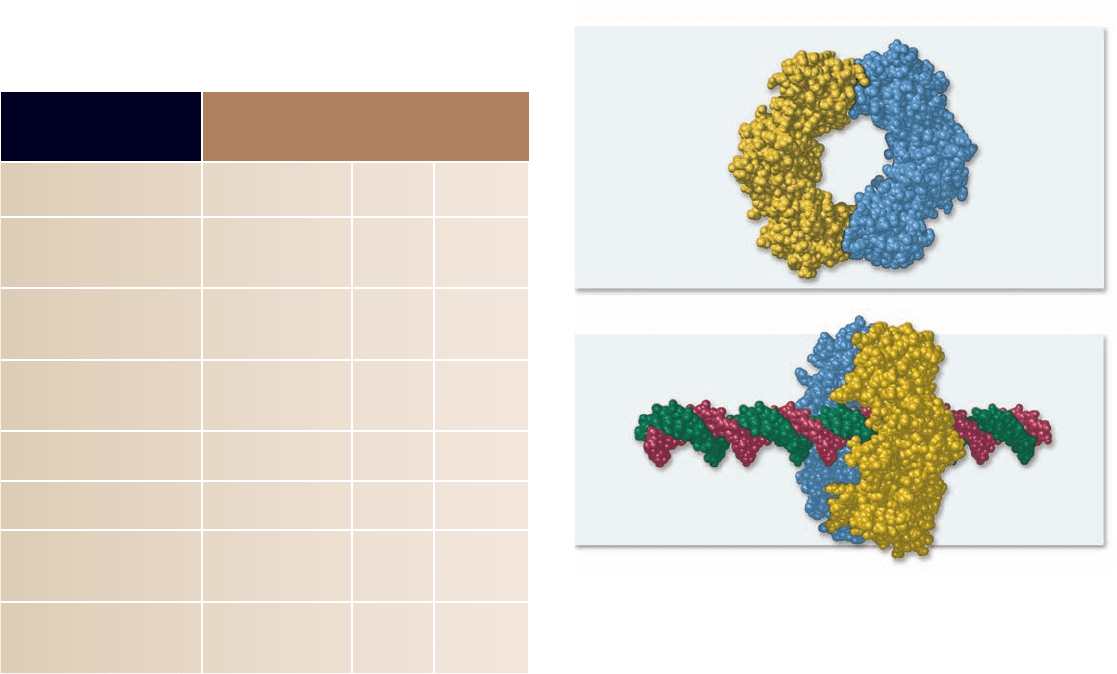
TABLE 14.1
DNA Replication
Enzymes of E. coli
Protein Role
Size
(kDa)
Molecules
per Cell
Helicase Unwinds the double
helix
300 20
Primase Synthesizes RNA
primers
60 50
Single-strand binding protein Stabilizes single-
stranded regions
74 300
DNA gyrase Relieves torque 400 250
DNA polymerase III Synthesizes DNA ≈900 20
DNA polymerase I Erases primer and
l l s g a p s
103 300
DNA ligase Joins the ends of DNA
segments; DNA repair
74 300
Figure 14.16
The DNA polymerase sliding clamp. a. The
β subunit forms a ring that can encircle DNA. b. The β subunit is
shown attached to the DNA. This forms the “sliding clamp” that
keeps the polymerase attached to the template.
mains attached to the template, it can synthesize around the
entire circular E. coli chromosome.
The ability of a polymerase to remain attached to the tem-
plate is called processivity. The Pol III enzyme is a large multi-
subunit enzyme that has high processivity due to the action of
one subunit of the enzyme, called the β subunit (figure 14.16a) .
The β subunit is made up of two identical protein chains
that come together to form a circle. This circle can be loaded
onto the template like a clamp to hold the Pol II enzyme to the
DNA (figure 14.16b). This structure is therefore referred to as
the “sliding clamp,” and a similar structure is found in eukary-
otic polymerases as well. For the clamp to function, it must be
opened and then closed around the DNA. A multisubunit pro-
tein called the clamp loader accomplishes this task. This func-
tion is also found in eukaryotes.
Lagging-strand synthesis
The discontinuous nature of synthesis on the lagging strand
requires the cell to do much more work than on the leading
strand (see figure 14.15). Primase is needed to synthesize prim-
ers for each Okazaki fragment, and then all these RNA primers
need to be removed and replaced with DNA. Finally, the frag-
ments need to be stitched together.
DNA Pol II accomplishes the synthesis of Okazaki frag-
ments. The removal and replacement of primer segments, how-
ever, is accomplished by DNA Pol I. Using its 5'-to-3'
exonuclease activity, it can remove primers in front and then
replace them by using its usual 5'-to-3' polymerase activity. The
synthesis is primed by the previous Okazaki fragment, which is
composed of DNA and has a free 3' OH that can be extended.
is opened up (see figure 14.15). This means that one strand can
be synthesized in a continuous fashion from an initial primer,
but the other strand must be synthesized in a discontinuous
fashion with multiple priming events and short sections of
DNA being assembled. The strand that is continuous is called
the leading strand, and the strand that is discontinuous is the
lagging strand. DNA fragments synthesized on the lagging
strand are named Okazaki fragments in honor of the man who
first experimentally demonstrated discontinuous synthesis.
They introduce a need for even more enzymatic activity on the
lagging strand, as is described next.
Synthesis occurs at the replication fork
The partial opening of a DNA helix to form two single strands
has a forked appearance, and is thus called the replication fork.
All of the enzymatic activities that we have discussed plus a few
more are found at the replication fork (table 14.1). Synthesis on
the leading strand and on the lagging strand proceed in differ-
ent ways, however.
Priming
The primers required by DNA polymerases during replication
are synthesized by the enzyme DNA primase. This enzyme is an
RNA polymerase that synthesizes short stretches of RNA 10–
20 bp (base-pairs) long that function as primers for DNA poly-
merase. Later on, the RNA primer is removed and replaced
with DNA.
Leading-strand synthesis
Synthesis on the leading strand is relatively simple. A single
priming event is required, and then the strand can be extended
indefinitely by the action of DNA Pol III. If the enzyme re-
268
part
III
Genetic and Molecular Biology
rav32223_ch14_256-277.indd 268rav32223_ch14_256-277.indd 268 11/6/09 4:34:44 PM11/6/09 4:34:44 PM
Apago PDF Enhancer
5„
3„
Leading strand
(continuous)
Lagging strand
(discontinuous)
RNA primer
Okazaki fragment
made by DNA
polymerase III
DNA polymerase I
Primase
DNA ligase
5„
3„
3„
5„
3„
5„
Leading strand
Lagging str
and
Okazaki fragment
RNA primer
Open b clamp
b clamp (sliding clamp)
New bases
New bases
Clamp loader
DNA
polymerase III
Primase
Parent
DNA
Helicase
Single-strand binding
proteins (SSB)
DNA
polymerase I
DNA gyrase
DNA ligase
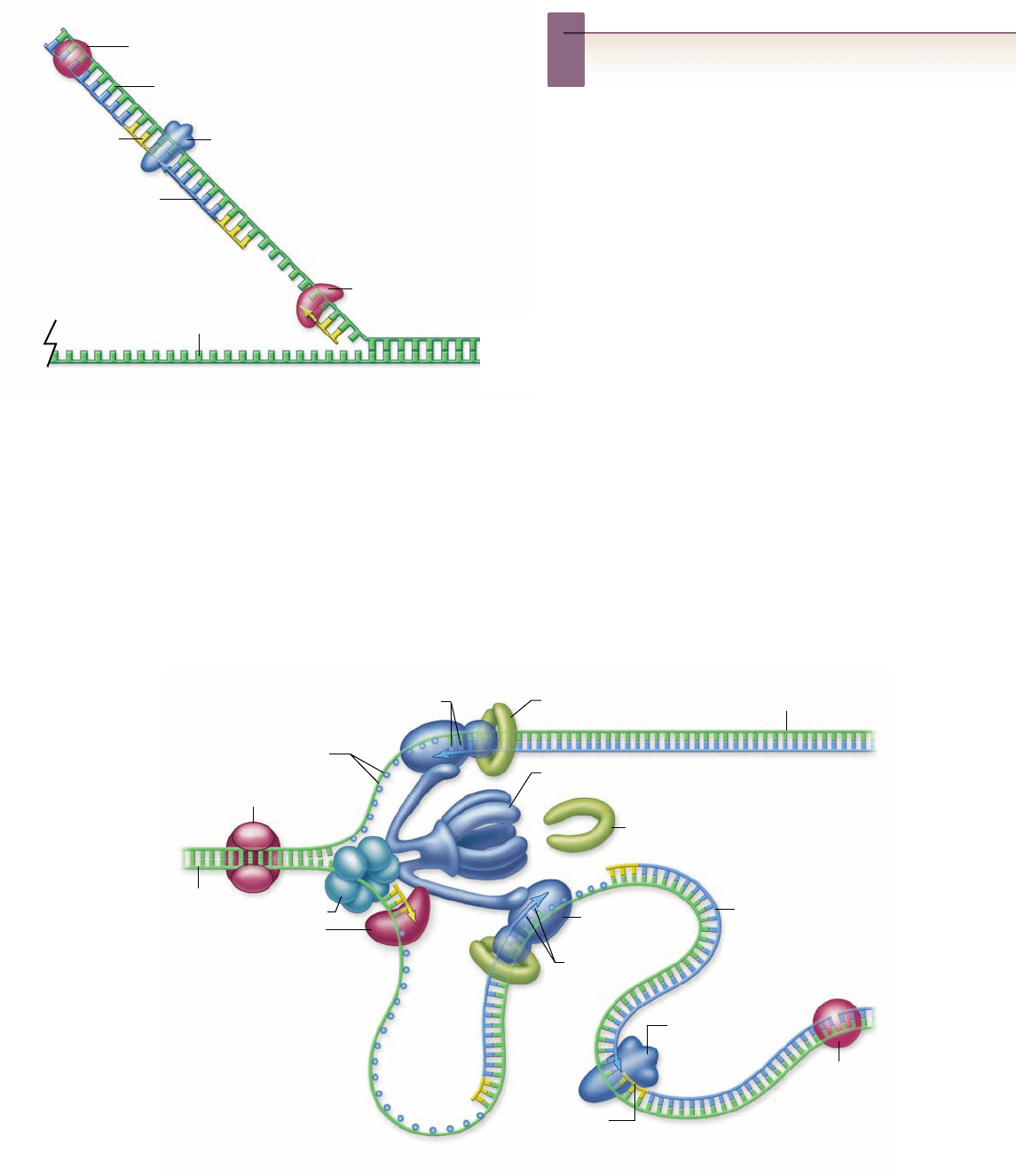
Figure 14.17
Lagging-strand synthesis. The action of
primase synthesizes the primers needed by DNA polymerase III
(not shown). These primers are removed by DNA polymerase I
using its 5'-to-3' exonuclease activity, then extending the previous
Okazaki fragment to replace the RNA. The nick between Okazaki
fragments after primer removal is sealed by DNA ligase.
Figure 14.18
The replication fork. A model for the structure of the replication fork with two polymerase III enzymes held together by a
large complex of accessory proteins. These include the “clamp loader,” which loads the β subunit sliding clamp periodically on the lagging strand.
The polymerase III on the lagging strand periodically releases its template and reassociates along with the β clamp. The loop in the lagging-strand
template allows both polymerases to move in the same direction despite DNA being antiparallel. Primase, which makes primers for the lagging-
strand fragments, and helicase are also associated with the central complex. Polymerase I removes primers and ligase joins the fragments together.
This leaves only the last phosphodiester bond to be
formed where synthesis by Pol I ends. This is done by DNA
ligase, which seals this “nick,” eventually joining the Okazaki
fragments into complete strands. All of this activity on the lag-
ging strand is summarized in figure 14.17 .
Inquiry question
?
What is the role of DNA ligase? What would happen to DNA
replication in a cell where this enzyme is not functional?
Termination
Termination occurs at a specific site located roughly opposite oriC
on the circular chromosome. The last stages of replication produce
two daughter molecules that are intertwined like two rings in a chain.
These intertwined molecules are unlinked by the same enzyme that
relieves torsional strain at the replication fork—DNA gyrase.
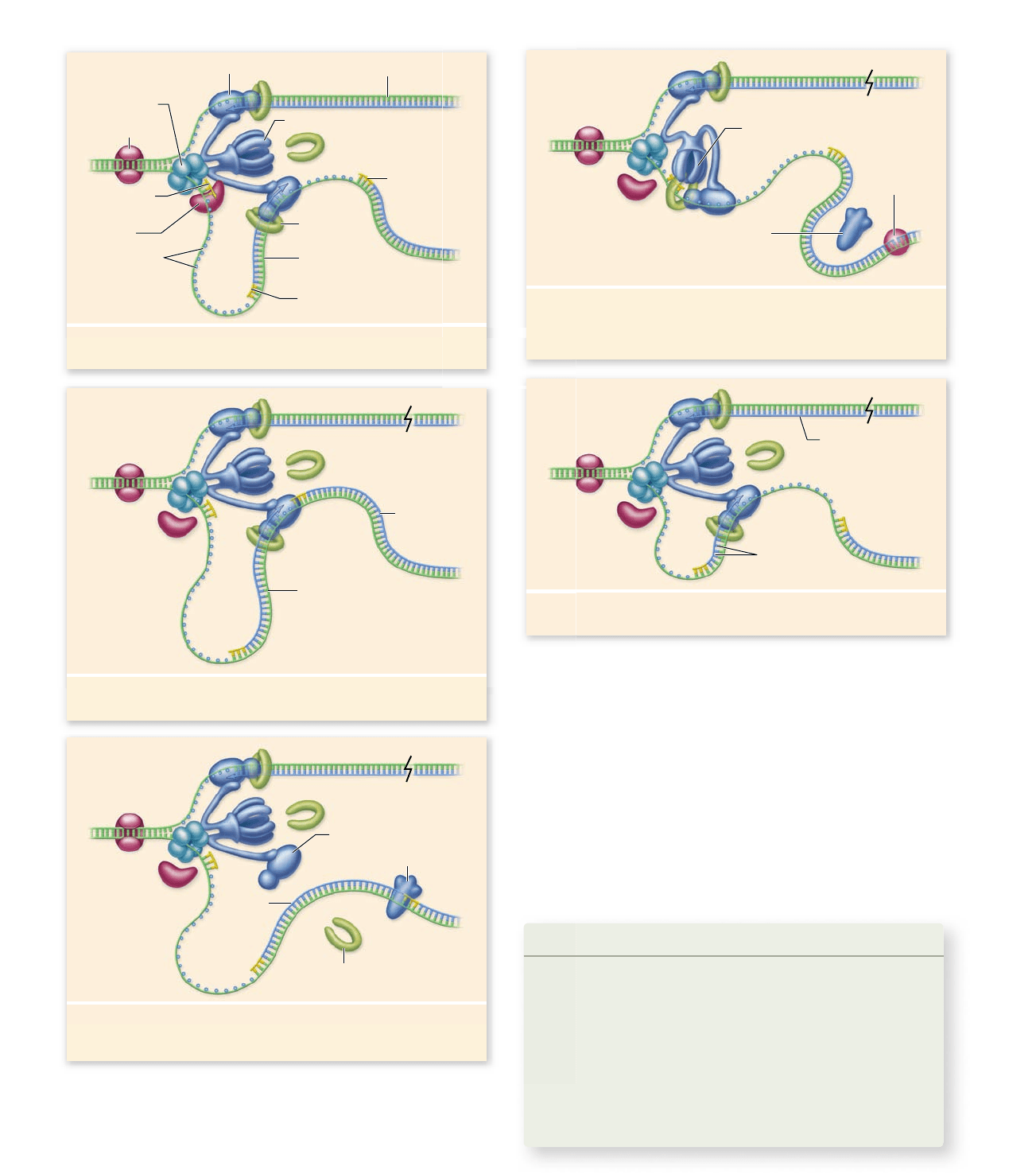
The replisome contains all the necessary
enzymes for replication
The enzymes involved in DNA replication form a macromolecular
assembly called the replisome. This assembly can be thought of as
the “replication organelle,” just as the ribosome is the organelle that
synthesizes protein. The replisome has two main subcomponents:
the primosome, and a complex of two DNA Pol III enzymes, one for
each strand. The primosome is composed of primase and helicase,
along with a number of accessory proteins. The need for constant
priming on the lagging strand explains the need for the primosome
complex as part of the replisome.
The two Pol III complexes include two synthetic core
subunits, each with its own β subunit. The entire replisome
complex is held together by a number of proteins that includes
the clamp loader. The clamp loader is required to periodically
load a β subunit on the lagging strand and to transfer the Pol
III to this new β subunit (figure 14.18) .
chapter
14
DNA: The Genetic Material
269www.ravenbiology.com
rav32223_ch14_256-277.indd 269rav32223_ch14_256-277.indd 269 11/6/09 4:34:45 PM11/6/09 4:34:45 PM
Apago PDF Enhancer
Leading strand
Lagging strand
First Okazaki
fragment
RNA primer
RNA primer
RNA primer
Primase
b clamp
Clamp loader
DNA polymerase III
Helicase
Single-strand
binding proteins
(SSB)
DNA gyrase
1. A DNA polymerase III enzyme is active on each strand. Primase
synthesizes new primers for the lagging strand.
5„
3„
3„
5„
3„
5„
Leading strand
replicates
continuously
b clamp
releases
New bases
DNA polymerase I
DNA polymerase III
Loop
grows
2. The “loop” in the lagging-strand template allows replication to
occur 5„-to-3„ on both strands, with the complex moving to the left.
3. When the polymerase III on the lagging strand hits the previously
synthesized fragment, it releases the b clamp and the template
strand. DNA polymerase I attaches to remove the primer.
5. After the b clamp is loaded, the DNA polymerase III on the lagging
strand adds bases to the next Okazaki fragment.
Clamp loader
DNA polymerase I
detaches after
removing RNA primer
DNA ligase
patches “nick”
4. The clamp loader attaches the b clamp and transfers this to
polymerase III, creating a new loop in the lagging-strand template.
DNA ligase joins the fragments after DNA polymerase I removes
the primers.
5„
3„
3„
5„
3„
5„
Second Okazaki
fragment nears
completion
Loop
grows
5„
3„
3„
5„
3„
5„
5„
3„
3„
5„
3„
5„
Lagging
strand
releases
5„
3„
3„
5„
3„
5„
Figure 14.19
DNA synthesis by the replisome. The
semidiscontinuous synthesis of DNA is illustrated in stages using
the model from gure 14.18.
Even given the difficulties with lagging-strand synthesis,
the two Pol III enzymes in the replisome are active on both lead-
ing and lagging strands simultaneously. How can the two strands
be synthesized in the same direction when the strands are antipar-
allel? The model first proposed, still with us in some form, in-
volves a loop formed in the lagging strand, so that the polymerases
can move in the same direction (see figure 14.18). Current evi-
dence also indicates that this replication complex is probably sta-
tionary, with the DNA strand moving through it like thread in a
sewing machine, rather than the complex moving along the DNA
strands. This stationary complex also pushes the newly synthe-
sized DNA outward, which may aid in chromosome segregation.
This process is summarized in figure 14.19.
Learning Outcomes Review 14.4
E. coli has three DNA polymerases: DNA Pol I, II, and III. Synthesis on one
strand is discontinuous because DNA is antiparallel, and polymerases only
synthesize in the 5
'-to-3' direction. Replication occurs at the replication fork,
where the two strands are separated. Assembled here is a massive complex,
the replisome, containing DNA polymerase III, primase, helicase, and other
proteins. The lagging strand requires DNA polymerase I to remove the
primers and replace them with DNA, and ligase to join Okazaki fragments.
■ How are the nuclease functions of the different
polymerases used during replication?
270
part
III
Genetic and Molecular Biology
rav32223_ch14_256-277.indd 270rav32223_ch14_256-277.indd 270 11/6/09 4:34:46 PM11/6/09 4:34:46 PM
Apago PDF Enhancer
9.09 µm
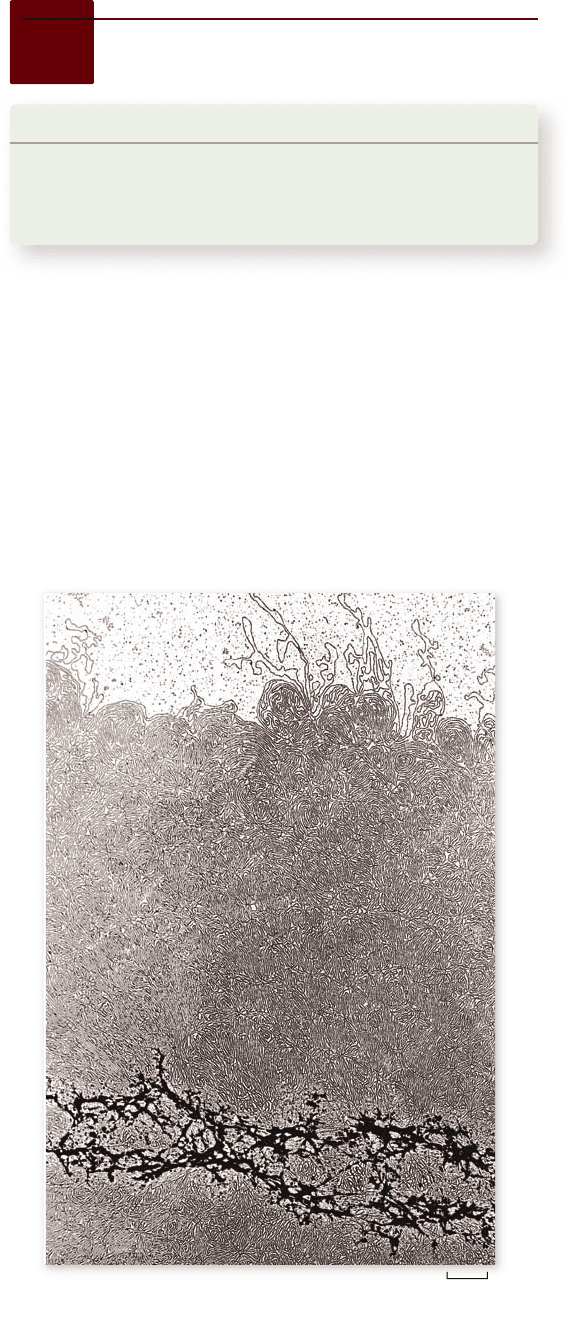
Figure 14.20
DNA of a single human chromosome. This
chromosome has been relieved of most of its packaging proteins,
leaving the DNA in its native form. The residual protein scaffolding
appears as the dark material in the lower part of the micrograph.
14.5
Eukaryotic Replication
Learning Outcomes
Compare eukaryotic replication with prokaryotic.1.
Explain the function of telomeres.2.
Identify the link between telomerase and cell division.3.
Eukaryotic replication is complicated by two main factors: the
larger amount of DNA organized into multiple chromosomes,
and the linear structure of the chromosomes. This process re-
quires new enzymatic activities only for dealing with the ends
of chromosomes; otherwise the basic enzymology is the same.
Eukaryotic replication requires
multiple origins
The sheer amount of DNA and how it is packaged constitute a
problem for eukaryotes (figure 14.20). Eukaryotes usually have
multiple chromosomes that are each larger than the E. coli
chromosome. If only a single unique origin existed for each
chromosome, the length of time necessary for replication would
be prohibitive. This problem is solved by the use of multiple
origins of replication for each chromosome, resulting in mul-
tiple replicons.
The origins are not as sequence-specific as oriC, and their
recognition seems to depend on chromatin structure as well as
on sequence. The number of origins used can also be adjusted
during the course of development, so that early on, when cell
divisions need to be rapid, more origins are activated. Each ori-
gin must be used only once per cell cycle.
The enzymology of eukaryotic
replication is more complex
The replication machinery of eukaryotes is similar to that found
in bacteria , but it is larger and more complex. The initiation
phase of replication requires more factors to assemble both
helicase and primase complexes onto the template, then load
the polymerase with its sliding clamp unit.
The eukaryotic primase is interesting in that it is a com-
plex of both an RNA polymerase and a DNA polymerase. It
first makes short RNA primers, then extends these with DNA
to produce the final primer. The reason for this added complex-
ity is unclear.
The main replication polymerase itself is also a complex
of two different enzymes that work together. One is called DNA
polymerase epsilon (pol ε) and the other DNA polymerase delta (pol
δ). The sliding clamp subunit that allows the enzyme complex
to stay attached to the template is called PCNA (for proliferat-
ing cell nuclear antigen). This unusual name reflects the fact
that PCNA was first identified as an antibody-inducing protein
in proliferating (dividing) cells. The PCNA sliding clamp forms
a trimer, but this structure is similar to the β subunit sliding
clamp. The clamp loader is also similar to the bacterial struc-
ture. Despite the additional complexity, the action of the repli-
some is similar to that described earlier for E. coli, and the
replication fork has essentially the same components.
Archaeal replication proteins are similar
to eukaryotic proteins
Despite their lack of a membrane-bounded nucleus, Archaeal
replication proteins are more similar to eukaryotes than to bacte-
rial. The main replication polymerase is most similar to eukary-
otic pol δ, and the sliding clamp is similar to the PCNA protein.
The clamp loading complex is also more similar to eukaryotic
than bacterial. The most interesting conclusion from all of these
data are that all three domains of life have similar functions in-
volved in replicating chromosomes. All three domains assemble
similar protein complexes with clamp loader, sliding clamp, two
polymerases, helicase, and primase at the replication fork.
Linear chromosomes have specialized ends
The specialized structures found on the ends of eukaryotic
chromosomes are called telomeres. These structures protect
chapter
14
DNA: The Genetic Material
271www.ravenbiology.com
rav32223_ch14_256-277.indd 271rav32223_ch14_256-277.indd 271 11/6/09 4:34:48 PM11/6/09 4:34:48 PM