
Raven P.H., Johnson G.B., Mason K.A. Biology (Ninth Edition)
Подождите немного. Документ загружается.

Apago PDF Enhancer
Leading strand (no problem)
Lagging strand (problem at the end)
Last primer
Replication first round
Shortened template
Removed primer
cannot be replaced
Primer removal
Replication second round
3„
5„
3„
5„
3„
5„
5„
3„
3„
5„
5„
3„
5„
3„
3„
5„
5„
3„
Lagging
strand
Leading
strand
Origin
5„
3„
Telomerase
Telomere
extended
by telomerase
Template RNA is
part of enzyme
3„
Synthesis by telomerase
Telomerase moves and
continues to extend telomere
Now ready
to synthesize
next repeat
G
GGGGG
TT
TTTT
G
T
T
G
G
GGG
T
TT
T
CCCCCAAAA
CCCCCAAAA
5„
3„
5„
3„
5„
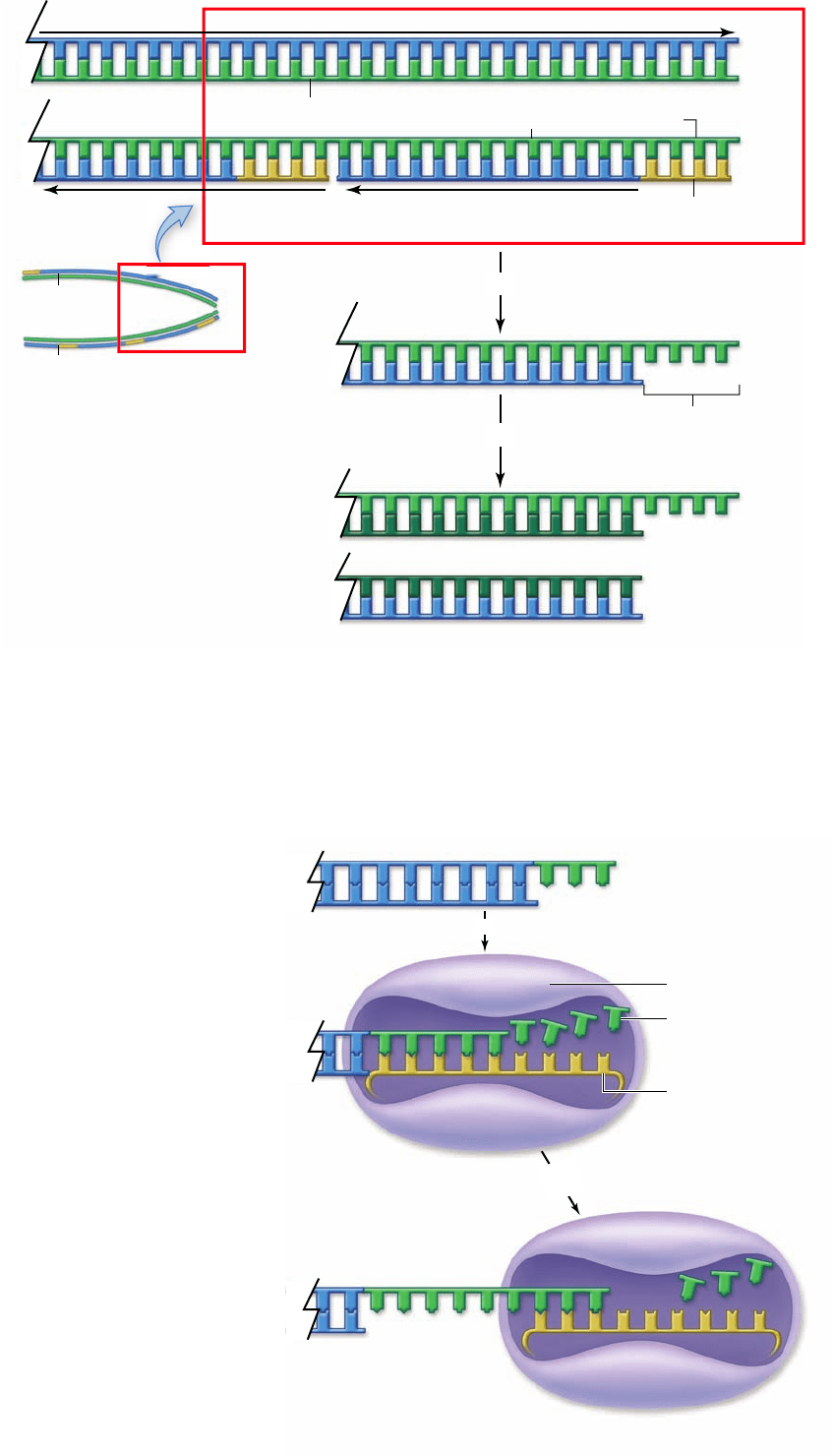
Figure 14.21
Replication of the end of linear DNA. Only
one end is shown for simplicity; the problem exists at both ends.
The leading strand can be completely replicated, but the lagging
strand cannot be nished. When the last primer is removed, it
cannot be replaced. During the next round of replication, when this
shortened template is replicated, it will produce a shorter
chromosome.
the ends of chromosomes from nucleases and maintain the in-
tegrity of linear chromosomes. These telomeres are composed
of specific DNA sequences, but they are not made by the repli-
cation complex.
Replicating ends
The very structure of a linear chromosome causes a cell
problems in replicating the ends. The directionality of poly-
merases, combined with their requirement for a primer, cre-
ate this problem.
Consider a simple linear molecule like the one in
figure 14.21. Replication of one end of each template strand is
simple, namely the 5' end of the leading-strand template. When
the polymerase reaches this end, synthesizing in the 5'-to-3' di-
rection, it eventually runs out of template and is finished.
But on the other strand’s end, the 3' end of the lagging
strand, removal of the last primer on this end leaves a gap. This
gap cannot be primed, meaning that the polymerase complex
cannot finish this end properly. The result would be a gradual
shortening of chromosomes with each round of cell division
(see figure 14.21).
The action of telomerase
When the sequence of telomeres was determined, they were
found to be composed of short repeated sequences of DNA.
This repeating nature is easily explained by their synthesis. They
are made by an enzyme called telomerase, which uses an inter-
nal RNA as a template and not the DNA itself (figure 14.22).
Figure 14.22
Action of telomerase. Telomerase contains
an internal RNA that the enzyme uses as a template to extend the
DNA of the chromosome end. Multiple rounds of synthesis by
telomerase produce repeated sequences. This single strand is
completed by normal synthesis using it as a template (not shown).
272
part
III
Genetic and Molecular Biology
rav32223_ch14_256-277.indd 272rav32223_ch14_256-277.indd 272 11/6/09 4:34:51 PM11/6/09 4:34:51 PM
Apago PDF Enhancer
The use of the internal RNA template allows short
stretches of DNA to be synthesized, composed of repeated
nucleotide sequences complementary to the RNA of the en-
zyme. The other strand of these repeated units is synthesized
by the usual action of the replication machinery copying the
strand made by telomerase.
Telomerase, aging, and cancer
A gradual shortening of the ends of chromosomes occurs in
the absence of telomerase activity. During embryonic and
childhood development in humans, telomerase activity is high,
but it is low in most somatic cells of the adult. The exceptions
are cells that must divide as part of their function, such as
lymphocytes. The activity of telomerase in somatic cells is
kept low by preventing the expression of the gene encoding
this enzyme.
Evidence for the shortening of chromosomes in the ab-
sence of telomerase was obtained by producing mice with no
telomerase activity. These mice appear to be normal for up to
six generations, but they show steadily decreasing telomere
length that eventually leads to nonviable offspring.
This finding indicates a relationship between cell senes-
cence (aging) and telomere length. Normal cells undergo only
a specified number of divisions when grown in culture. This
limit is at least partially based on telomere length.
Support for the relationship between senescence and
telomere length comes from experiments in which telomerase
was introduced into fibroblasts in culture. These cells have
their lifespan increased relative to controls that have no added
telo merase. Interestingly, these cells do not show the hallmarks
of malignant cells, indicating that activation of telomerase alone
does not make cells malignant.
A relationship has been found, however, between tel o me-
rase and cancer. Cancer cells do continue to divide indefinitely,
and this would not be possible if their chromosomes were being
continually shortened. Cancer cells generally show activation
of telomerase, which allows them to maintain telomere length;
but this is clearly only one aspect of conditions that allow them
to escape normal growth controls.
Inquiry question
?
How does the structure of eukaryotic genomes affect
replication? Does this introduce problems that are not faced
by prokaryotes?
Learning Outcomes Review 14.5
Eukarotic replication is complicated by a large amount of DNA organized into
chromosomes, and by the linear nature of chromosomes. Eukaryotes replicate
a large amount of DNA in a short time by using multiple origins of replication.
Linear chromosomes end in telomeres, and the length of telomeres is correlated
with the ability of cells to divide. The enzyme telomerase synthesizes the
telomeres. Cancer cells show activation of telomerase, which extends the ability
of the cells to divide.
■ What might be the result of abnormal shortening of
telomeres or a lack of telomerase activity?
14.6
DNA Repair
Learning Outcomes
Explain why DNA repair is critical for cells.1.
Describe the different forms of DNA repair.2.
As you learned earlier, many DNA polymerases have
3'-to- 5'exonuclease activity that allows “proofreading” of added
bases. This action increases the accuracy of replication, but er-
rors still occur. Without error correction mechanisms, cells
would accumulate errors at an unacceptable rate, leading to
high levels of deleterious or lethal mutations. A balance must
exist between the introduction of new variation by mutation,
and the effects of deleterious mutations on the individual.
Cells are constantly exposed
to DNA-damaging agents
In addition to errors in DNA replication, cells are constantly
exposed to agents that can damage DNA. These agents include
radiation, such as UV light and X-rays, and chemicals in the
environment. Agents that damage DNA can lead to mutations,
and any agent that increases the number of mutations above
background levels is called a mutagen.
The number of potentially mutagenic agents that organ-
isms encounter is huge. Sunlight itself includes radiation in the
UV range and is thus mutagenic. Ozone normally screens out
much of the harmful UV radiation in sunlight, but some remains.
The relationship between sunlight and mutations is shown
clearly by the increase in skin cancer in regions of the southern
hemisphere that are underneath a seasonal “ozone hole.”
Organisms also may encounter mutagens in their diet in
the form of either contaminants in food or natural plant products
that can damage DNA. When a simple test was designed to de-
tect mutagens, screening of possible sources indicated an amaz-
ing diversity of mutagens in the environment and in natural
sources. As a result, consumer products are now screened to re-
duce the load of mutagens we are exposed to, but we cannot es-
cape natural sources.
DNA repair restores damaged DNA
Cells cannot escape exposure to mutagens, but systems have
evolved that enable cells to repair some damage. These DNA
repair systems are vital to continued existence, whether a cell is
a free-living, single-celled organism or part of a complex multi-
cellular organism.
The importance of DNA repair is indicated by the multiplic-
ity of repair systems that have been discovered and characterized.
All cells that have been examined show multiple pathways for re-
pairing damaged DNA and for reversing errors that occur during
replication. These systems are not perfect, but they do reduce the
mutational load on organisms to an acceptable level. In the rest of
this section, we illustrate the action of DNA repair by concentrat-
ing on two examples drawn from these multiple repair pathways.
chapter
14
DNA: The Genetic Material
273www.ravenbiology.com
rav32223_ch14_256-277.indd 273rav32223_ch14_256-277.indd 273 11/6/09 4:34:51 PM11/6/09 4:34:51 PM
Apago PDF Enhancer
DNA with adjacent thymines
Thymine dimer
Thymine dimer
cleaved
Helix distorted by
thymine dimer
Photolyase
UV light
Photolyase binds
to damaged DNA
Visible light
T
A
T
A
AA
AA
T
A
T
A
T
T
T
T
Damaged or incorrect base
UvrABC complex
binds damaged DNA
Excision repair enzymes recognize damaged DNA
Excision of damaged strand
Resynthesis by DNA polymerase
DNA polymerase
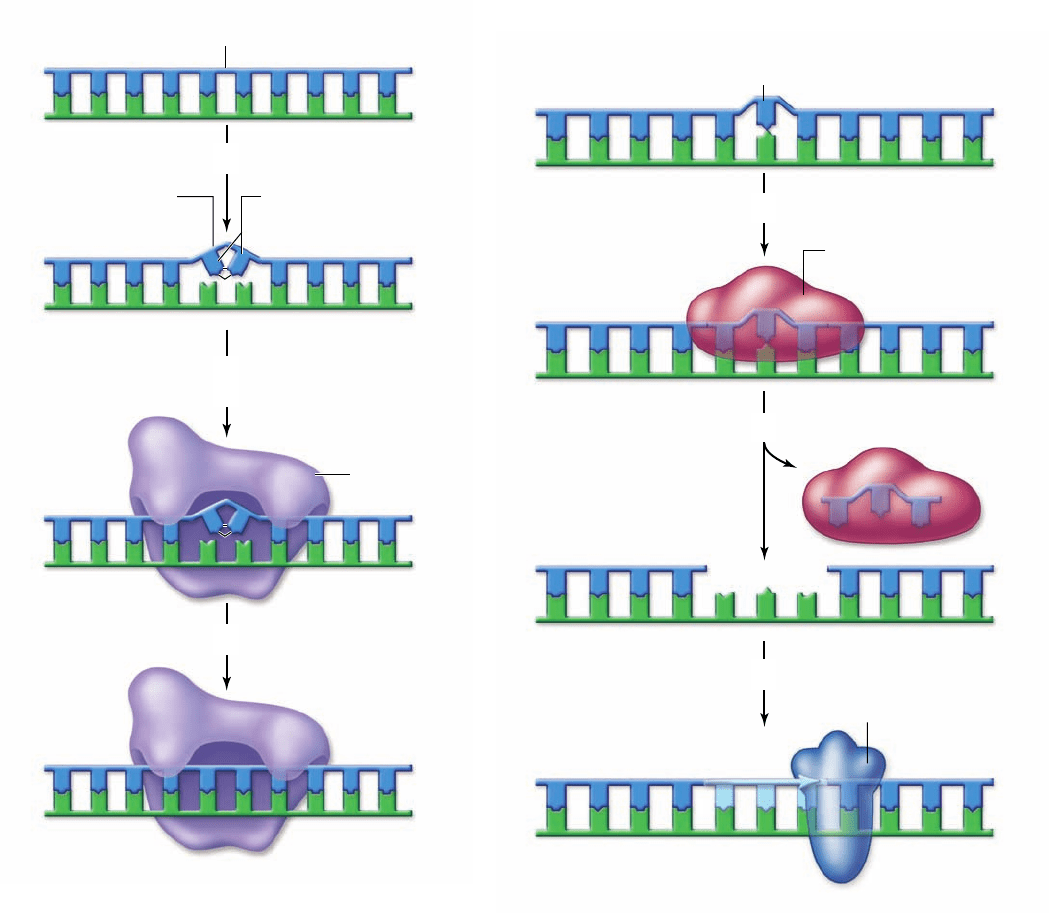
Figure 14.23
Repair of thymine dimer by photorepair.
UV light can catalyze a photochemical reaction to form a covalent
bond between two adjacent thymines, thereby creating a thymine
dimer. A photolyase enzyme recognizes the damage and binds to
the thymine dimer. The enzyme absorbs visible light and uses the
energy to cleave the thymine dimer.
Repair can be either speci c or nonspeci c
DNA repair falls into two general categories: specific and nonspe-
cific. Specific repair systems target a single kind of lesion in DNA
and repair only that damage. Nonspecific forms of repair use a
single mechanism to repair multiple kinds of lesions in DNA.
Photorepair: A specific repair mechanism
Photorepair is specific for one particular form of damage caused
by UV light, namely the thymine dimer. Thymine dimers are
formed by a photochemical reaction of UV light and adjacent
thymine bases in DNA. The UV radiation causes the thymines
to react, covalently linking them together: a thymine dimer
(figure 14.23) .
Repair of these thymine dimers can be accomplished by
multiple pathways, including photorepair. In photorepair, an en-
Figure 14.24
Repair of damaged DNA by excision
repair. Damaged DNA is recognized by the uvr complex, which
binds to the damaged region and removes it. Synthesis by DNA
polymerase replaces the damaged region. DNA ligase nishes the
process (not shown).
zyme called a photolyase absorbs light in the visible range and uses
this energy to cleave the thymine dimer. This action restores the
two thymines to their original state (see figure 14.23 ) . It is inter-
esting that sunlight in the UV range can cause this damage, and
sunlight in the visible range can be used to repair the damage.
Photorepair does not occur in cells deprived of visible light.
The photolyase enzyme has been found in many different
species, ranging from bacteria, to single-celled eukaryotes, to
humans. The ubiquitous nature of this enzyme illustrates the
importance of this form of repair. For as long as cells have ex-
isted on Earth, they have been exposed to UV light and its po-
tential to damage DNA.
Excision repair: A nonspecific repair mechanism
A common form of nonspecific repair is excision repair. In
this pathway, a damaged region is removed, or excised, and is
then replaced by DNA synthesis (figure 14.24) . In E. coli, this
action is accomplished by proteins encoded by the uvr A, B, and
274
part
III
Genetic and Molecular Biology
rav32223_ch14_256-277.indd 274rav32223_ch14_256-277.indd 274 11/6/09 4:34:52 PM11/6/09 4:34:52 PM
Apago PDF Enhancer
C genes. Although these genes were identified based on muta-
tions that increased sensitivity of the cell to UV light (hence the
“uvr” in their names), their proteins can act on damage due to
other mutagens.
Excision repair follows three steps: (1) recognition of
damage, (2) removal of the damaged region, and (3) resynthesis
using the information on the undamaged strand as a template
(see figure 14.24). Recognition and excision are accomplished
by the UvrABC complex. The UvrABC complex binds to dam-
aged DNA and then cleaves a single strand on either side of the
damage, removing it. In the synthesis stage, DNA pol I or
pol II replaces the damaged DNA. This restores the original
information in the damaged strand by using the information in
the complementary strand.
Other repair pathways
Cells have other forms of nonspecific repair, and these fall into
two categories: error-free and error-prone. It may seem strange
to have an error-prone pathway, but it can be thought of as a
last-ditch effort to save a cell that has been exposed to such
massive damage that it has overwhelmed the error-free sys-
tems. In fact, this system in E. coli is part of what is called the
“SOS response.”
Cells can also repair damage that produces breaks in
DNA. These systems use enzymes related to those that are in-
volved in recombination during meiosis (see chapter 11). It is
thought that recombination uses enzymes that originally
evolved for DNA repair.
The number of different systems and the wide spectrum of
damage that can be repaired illustrate the importance of maintain-
ing the integrity of the genome. Accurate replication of the ge-
nome is useless if a cell cannot reverse errors that can occur during
this process or repair damage due to environmental causes.
Inquiry question
?
Cells are constantly exposed to DNA-damaging agents,
ranging from UV light to by-products of oxidative
metabolism. How does the cell deal with this, and what would
happen if the cell had no way of dealing with this?
Learning Outcomes Review 14.6
The ability to repair DNA is critical because of replication errors and the
constant presence of damaging agents that can cause mutation. Cells have
multiple repair pathways; some of these systems are specifi c for a single
type of damage, such as photorepair that reverses thymine dimers caused by
UV light. Other systems are nonspecifi c, such as excision repair that removes
and replaces damaged regions.
■ Could a cell survive with no form of DNA repair?
studies by Franklin and Wilkins indicated that DNA had a helical
structure.
The Watson-Crick model ts the available evidence (see gures 14.8
and 14.9 ) .
DNA consists of two antiparallel polynucleotide strands wrapped
about a common helical axis. These strands are held together by
hydrogen bonds forming speci c base pairs (A/T and G/C). The two
strands are complementary; one strand can specify the other.
14.3 Basic Characteristics of DNA Replication
Meselson and Stahl demonstrate the semiconservative mechanism
(see gure 14.11) .
Semiconservative replication uses each strand of a DNA molecule to
specify the synthesis of a new strand. Meselson and Stahl showed this
by using a heavy isotope of nitrogen and separating the replication
products. Replication produces two new molecules each composed of
one new strand and one old strand.
DNA replication requires a template, nucleotides, and a
polymerase enzyme.
All new DNA molecules are produced by DNA polymerase copying
a template. All known polymerases synthesize new DNA in the
5'-to-3' direction. These enzymes also require a primer. The building
blocks used in replication are deoxynucleotide triphosphates with
high-energy bonds; they do not require any additional energy.
14.1 The Nature of the Genetic Material
Gri th nds that bacterial cells can be transformed.
Nonvirulent S. pneumoniae could take up an unknown substance from
a virulent strain and become virulent.
Avery, MacLeod, and McCarty identify the transforming principle.
The transforming substance could be inactivated by DNA-digesting
enzymes, but not by protein-digesting enzymes.
Hershey and Chase demonstrate that phage genetic material is DNA.
Radioactive labeling showed that the infectious agent of phage is its
DNA, and not its protein.
14.2 DNA Structure
DNA’s components were known, but its three-dimensional structure
was a mystery.
The nucleotide building blocks for DNA contain deoxyribose and
the bases adenine (A), guanine (G), cytosine (C), and thymine (T).
Phosphodiester bonds are formed between the 5' phosphate of one
nucleotide and the 3' hydroxyl of another nucleotide (see gure 14.4 ).
Charga , Franklin, and Wilkins obtained some structural evidence.
Chargaff found equal amounts of adenine and thymine, and of
cytosine and guanine, in DNA. The bases exist primarily in keto
and enol forms that exhibit hydrogen bonding. X-ray diffraction
Chapter Review
chapter
14
DNA: The Genetic Material
275www.ravenbiology.com
rav32223_ch14_256-277.indd 275rav32223_ch14_256-277.indd 275 11/6/09 4:34:53 PM11/6/09 4:34:53 PM

Apago PDF Enhancer
3. Chargaff studied the composition of DNA from different
sources and found that
a. the number of phosphate groups always equals the number
of ve-carbon sugars.
b. the proportions of A equal that of C and G equals T.
c. the proportions of A equal that of T and G equals C.
d. purines bind to pyrimidines.
4. The bonds that hold two complementary strands of DNA
together are
a. hydrogen bonds. c. ionic bonds.
b. peptide bonds. d. phosphodiester bonds.
UNDERSTAND
1. What was the key nding from Grif th’s experiments using live
and heat-killed pathogenic bacteria?
a. Bacteria with a smooth coat could kill mice.
b. Bacteria with a rough coat are not lethal.
c. DNA is the genetic material.
d. Genetic material can be transferred from dead to live bacteria.
2. Which of the following is not a component of DNA?
a. The pyrimidine uracil c. The purine adenine
b. Five-carbon sugars d. Phosphate groups
Review Questions
14.4 Prokaryotic Replication
Prokaryotic replication starts at a single origin.
The E. coli origin has AT-rich sequences that are easily opened. The
chromosome and its origin form a replicon.
E. coli has at least three di erent DNA polymerases.
Some DNA polymerases can also degrade DNA from one end, called
exonuclease activity. Pol I, II, and III all have 3'-to-5' exonuclease
activity that can remove mispaired bases. Pol I can remove bases in
the 5'-to-3' direction, important to removing RNA primers.
Unwinding DNA requires energy and causes torsional strain.
DNA helicase uses energy from ATP to unwind DNA. The torsional
strain introduced is removed by the enzyme DNA gyrase.
Replication is semidiscontinuous.
Replication is discontinuous on one strand (see gure 14.15 ). The
continuous strand is called the leading strand, and the discontinuous
strand is called the lagging strand.
Synthesis occurs at the replication fork.
The partial opening of a DNA strand forms two single-stranded
regions called the replication fork. At the fork, synthesis on the leading
strand requires a single primer, and the polymerase stays attached to
the template because of the β subunit that acts as a sliding clamp. On
the lagging strand, DNA primase adds primers periodically, and DNA
Pol III synthesizes the Okazaki fragments. DNA Pol I removes primer
segments, and DNA ligase joins the fragments.
The replisome contains all the necessary enzymes for replication.
The replisome consists of two copies of Pol III, DNA primase,
DNA helicase, and a number of accessory proteins. It moves in
one direction by creating a loop in the lagging strand, allowing the
antiparallel template strands to be copied in the same direction (see
gures 14.18 and 14.19 ) .
14.5 Eukaryotic Replication
Eukaryotic replication requires multiple origins.
The sheer size and organization of eukaryotic chromosomes requires
multiple origins of replication to be able to replicate DNA in the
time available in S phase.
The enzymology of eukaryotic replication is more complex.
The eukaryotic primase synthesizes a short stretch of RNA and
then switches to making DNA. This primer is extended by the main
replication polymerase, which is a complex of two enzymes. The
sliding clamp subunit was originally identi ed as protein produced by
proliferating cells and is called PCNA.
Archaeal replication proteins are similar to eukaryotic proteins.
The replication proteins of archaea, including the sliding clamp,
clamp loader, and DNA polymerases, are more similar to those of
eukaryotes than to prokaryotes.
Linear chromosomes have specialized ends.
The ends of linear chromosomes are called telomeres. They are made
by telomerase, not by the replication complex. Telomerase contains
an internal RNA that acts as a template to extend the DNA of the
chromosome end. Adult cells lack telomerase activity, and telomere
shortening correlates with senescence.
14.6 DNA Repair
Cells are constantly exposed to DNA-damaging agents.
Errors from replication and damage induced by agents such as UV
light and chemical mutagens can lead to mutations.
DNA repair restores damaged DNA.
Without repair mechanisms, cells would accumulate mutations until
inviability occurred.
Repair can be either speci c or nonspeci c.
The enzyme photolyase uses energy from visible light to cleave
thymine dimers caused by UV light. Excision repair is nonspeci c. In
prokaryotes, the uvr system can remove a damaged region of DNA.
276
part
III
Genetic and Molecular Biology
rav32223_ch14_256-277.indd 276rav32223_ch14_256-277.indd 276 11/6/09 4:34:54 PM11/6/09 4:34:54 PM

Apago PDF Enhancer
5. The basic mechanism of DNA replication is semiconservative
with two new molecules,
a. each with new strands.
b. one with all new strands and one with all old strands.
c. each with one new and one old strand.
d. each with a mixture of old and new strands.
6. One common feature of all DNA polymerases is that they
a. synthesize DNA in the 3'-to-5' direction.
b. synthesize DNA in the 5'-to-3' direction.
c. synthesize DNA in both directions by switching strands.
d. do not require a primer.
7. Which of the following is not part of the Watson–Crick model
of the structure of DNA?
a. DNA is composed of two strands.
b. The two DNA strands are oriented in parallel (5'-to-3').
c. Purines bind to pyrimidines.
d. DNA forms a double helix.
APPLY
1. If one strand of a DNA is: 5' ATCGTTAAGCGAGTCA 3',
then the complementary strand would be:
a. 5' TAGCAATTCGCTCAGT 3'.
b. 5' ACTGAGCGAATTGCTA 3'.
c. 5' TGACTCGCTTAACGAT 3'.
d. 5' ATCGTTAAGCGAGTCA 3'.
2. Hershey and Chase used radioactive phosphorus and sulfur to
a. label DNA and protein with the same molecule.
b. differentially label DNA and protein.
c. identify the transforming principle.
d. Both (b) and (c) are correct.
3. The Meselson and Stahl experiment used a density label to be
able to
a. determine the directionality of DNA replication.
b. differentially label DNA and protein.
c. distinguish between newly replicated and old strands.
d. distinguish between replicated DNA and RNA primers.
4. The difference in leading- versus lagging-strand synthesis is a
consequence of
a. only the physical structure of DNA.
b. only the activity of DNA polymerase enzymes.
c. both the physical structure of DNA and the action of
polymerase enzyme.
d. the larger size of the lagging strand.
5. If the activity of DNA ligase was removed from replication, this
would have a greater affect on
a. synthesis on the lagging strand versus the leading strand.
b. synthesis on the leading strand versus the lagging strand.
c. priming of DNA synthesis versus actual DNA synthesis.
d. photorepair of DNA versus DNA replication.
6. Successful DNA synthesis requires all of the following except
a. helicase. b. endonuclease.
c. DNA primase. d. DNA ligase.
7. The synthesis of telomeres
a. uses DNA polymerase, but without the sliding clamp.
b. uses enzymes involved in DNA repair.
c. requires telomerase, which does not need a template.
d. requires telomerase, which uses an internal RNA as a
template.
8. Which type of enzyme is involved in excision repair?
a. Photolyase c. Endonuclease
b. DNA polymerase III d. Telomerase
SYNTHESIZE
1. The work by Grif th provided the rst indication that DNA
was the genetic material. Review the four experiments outlined
in gure 14.1. Predict the likely outcome for the following
variations on this classic research.
a. Heat-killed pathogenic and heat-killed nonpathogenic
b. Heat-killed pathogenic and live nonpathogenic in the
presence of an enzyme that digests proteins (proteases)
c. Heat-killed pathogenic and live nonpathogenic in the
presence of an enzyme that digests DNA (endonuclease)
2. In the Meseleson–Stahl experiment, a control experiment was
done to show that the hybrid bands after one round of
replication were in fact two complete strands, one heavy and
one light. Using the same experimental setup as detailed in the
text, how can this be addressed?
3. Enzyme function is critically important for the proper
replication of DNA. Predict the consequence of a loss of
function for each of the following enzymes.
a. DNA gyrase c. DNA ligase
b. DNA polymerase III d. DNA polymerase I
ONLINE RESOURCE
www.ravenbiology.com
Understand, Apply, and Synthesize—enhance your study with
animations that bring concepts to life and practice tests to assess
your understanding. Your instructor may also recommend the
interactive eBook, individualized learning tools, and more.
chapter
14
DNA: The Genetic Material
277www.ravenbiology.com
rav32223_ch14_256-277.indd 277rav32223_ch14_256-277.indd 277 11/6/09 4:34:54 PM11/6/09 4:34:54 PM

Apago PDF Enhancer
Y
0.75
μ
m
Chapter
15
Genes and How
They Work
Chapter Outline
15.1 The Nature of Genes
15.2 The Genetic Code
15.3 Prokaryotic Transcription
15.4 Eukaryotic Transcription
15.5 Eukaryotic pre-mRNA Splicing
15.6 The Structure of tRNA and Ribosomes
15.7 The Process of Translation
15.8 Summarizing Gene Expression
15.9 Mutation: Altered Genes
Introduction
You’ve seen how genes specify traits and how those traits can be followed in genetic crosses. You’ve also seen that the
information in genes resides in the DNA molecule; the picture above shows all the DNA within the entire E. coli chromosome .
Information in DNA is replicated by the cell and then partitioned equally during the process of cell division. The information
in DNA is much like a blueprint for a building. The construction of the building uses the information in the blueprint, but
requires building materials and carpenters and other skilled laborers using a variety of tools working together to actually
construct the building. Similarly, the information in DNA requires nucleotide and amino acid building blocks, multiple forms
of RNA, and many proteins acting in a coordinated fashion to make up the structure of a cell.
We now turn to the nature of the genes themselves and how cells extract the information in DNA in the process of
gene expression. Gene expression can be thought of as the conversion of genotype into the phenotype.
CHAPTER
15.1
The Nature of Genes
Learning Outcomes
Describe the evidence for the one-gene/one-polypeptide 1.
hypothesis.
Distinguish between transcription and translation.2.
List the roles played by RNA in gene expression. 3.
We know that DNA encodes proteins, but this knowledge alone
tells us little about how the information in DNA can control
cellular functions. Researchers had evidence that genetic muta-
tions affected proteins, and in particular enzymes, long before
the structure and code of DNA was known. In this section we
review the evidence of the link between genes and enzymes.
Garrod concluded that inherited disorders
can involve speci c enzymes
In 1902, the British physician Archibald Garrod noted that cer-
tain diseases among his patients seemed to be more prevalent in
rav32223_ch15_278-303.indd 278rav32223_ch15_278-303.indd 278 11/11/09 2:44:39 PM11/11/09 2:44:39 PM
Apago PDF Enhancer
Wild-type
Neurospora
crassa
Mutagenize
with X-rays
Grow on
rich medium
No growth
on minimal
medium
Growth on
minimal
medium
plus arginine
Arginine
arg E
arg
genes
arg F arg G
arg H
arg mutants
ArginosuccinateCitrulineGlutamate
Enzymes
encoded
by arg
genes
Ornithine
EFGH
Experimental Procedure
Results
Conclusion
Mutation
in Enzyme
E
F
G
H
Plus
Arginine
Plus
Arginosuccinate
Plus
Citruline
Plus
Ornithine
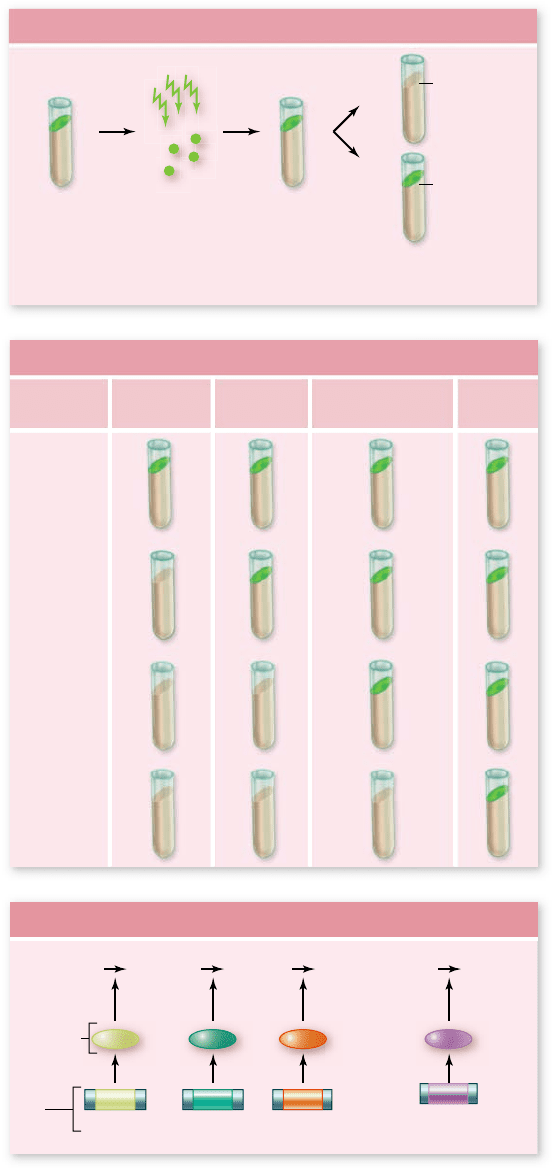
Figure 15.1
The Beadle and Tatum experiment.
Wild-type Neurospora were mutagenized with X-rays to produce
mutants de cient in the synthesis of arginine (top panel). The
speci c defect in each mutant was identi ed by growing on
medium supplemented with intermediates in the biosynthetic
pathway for arginine (middle panel). A mutant will grow only on
media supplemented with an intermediate produced after the
defective enzyme in the pathway for each mutant. The enzymes
in the pathway can then be correlated with genes on
chromosomes (bottom panel).
particular families. By examining several generations of these
families, he found that some of the diseases behaved as though
they were the product of simple recessive alleles. Garrod con-
cluded that these disorders were Mendelian traits, and that they
had resulted from changes in the hereditary information in an
ancestor of the affected families.
Garrod investigated several of these disorders in de-
tail. In alkaptonuria, patients produced urine that contained
homogentisic acid (alkapton). This substance oxidized rap-
idly when exposed to air, turning the urine black. In normal
individuals, homogentisic acid is broken down into simpler
substances. With considerable insight, Garrod concluded
that patients suffering from alkaptonuria lack the enzyme
necessary to catalyze this breakdown. He speculated
that many other inherited diseases might also reflect en-
zyme deficiencies.
Beadle and Tatum showed
that genes specify enzymes
From Garrod’s finding, it took but a short leap of intuition to
surmise that the information encoded within the DNA of chro-
mosomes acts to specify particular enzymes. This point was not
actually established, however, until 1941, when a series of ex-
periments by George Beadle and Edward Tatum at Stanford
University provided definitive evidence. Beadle and Tatum de-
liberately set out to create mutations in chromosomes and veri-
fied that they behaved in a Mendelian fashion in crosses. These
alterations to single genes were analyzed for their effects on the
organism (figure 15.1) .
Neurospora crassa, the bread mold
One of the reasons Beadle and Tatum’s experiments produced
clear-cut results was their choice of experimental organism, the
bread mold Neurospora crassa. This fungus can be grown readily
in the laboratory on a defined medium consisting of only a car-
bon source (glucose), a vitamin (biotin), and inorganic salts.
This type of medium is called “minimal” because it represents
the minimal requirements to support growth. Any cells that can
grow on minimal medium must be able to synthesize all neces-
sary biological molecules.
Beadle and Tatum exposed Neurospora spores to X-rays,
expecting that the DNA in some of the spores would experi-
ence damage in regions encoding the ability to make com-
pounds needed for normal growth (see figure 15.1). Such a
mutation would cause cells to be unable to grow on minimal
medium. Such mutations are called nutritional mutations be-
cause cells carrying them grow only if the medium is supple-
mented with additional nutrients.
Nutritional mutants
To identify mutations causing metabolic deficiencies, Beadle
and Tatum placed subcultures of individual fungal cells grown
on a rich medium onto minimal medium. Any cells that had
lost the ability to make compounds necessary for growth would
not grow on minimal medium. Using this approach, Beadle
and Tatum succeeded in isolating and identifying many nutri-
tional mutants.
chapter
15
Genes and How They Work
279www.ravenbiology.com
rav32223_ch15_278-303.indd 279rav32223_ch15_278-303.indd 279 11/9/09 2:42:35 PM11/9/09 2:42:35 PM
Apago PDF Enhancer
3„
3„
5„
5„
G
C
C
A
T
T
T
C
G
G
U
A
A
A
DNA
template
strand
Transcription
Protein
mRNA
Eukaryotes
Prokaryotes
Translation
Replication
DNA
Transcription Reverse transcription
ProteinRNA
Translation
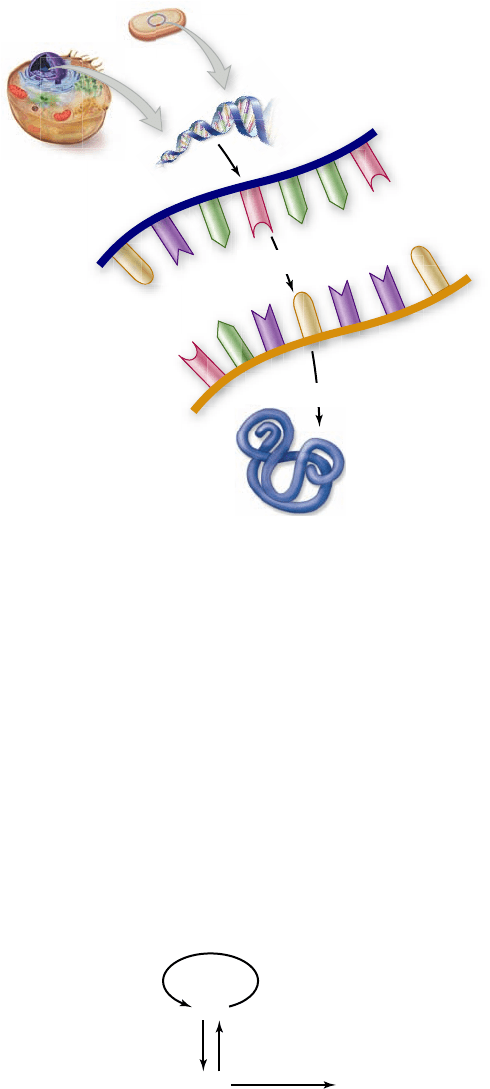
Figure 15.2
The central dogma of molecular biology.
DNA is transcribed to make mRNA, which is translated to make
a protein.
DNA-to-RNA step transcription because it produces an exact
copy of the DNA, much as a legal transcription contains the
exact words of a court proceeding. The RNA-to-protein step is
termed translation because it requires translating from the
nucleic acid to the protein “languages.”
Since the original formulation of the central dogma, a
class of viruses called retroviruses was discovered that can
convert their RNA genome into a DNA copy, using the viral
enzyme reverse transcriptase. This conversion violates the
direction of information flow of the central dogma, and the dis-
covery forced an updating of the possible flow of information
to include this “reverse” flow from RNA to DNA.
Next, the researchers supplemented the minimal medium
with different compounds known to be intermediates in this
biochemical pathway to identify the deficiency in each mutant.
This step allowed them to pinpoint the nature of the strain’s
biochemical deficiency. They concentrated in particular on
mutants that would grow only in the presence of the amino acid
arginine, dubbed arg mutants. These were shown to define four
genes they named argE, argF, argG, and argH. When their
chromosomal positions were located, the arg mutations were
found to cluster in three areas.
One gene/one polypeptide
The next step was to determine where each mutation was blocked
in the biochemical pathway for arginine biosynthesis. To do this,
they supplemented the medium with each intermediate in the
pathway to see which intermediate would support a mutant’s
growth. If the mutation affects an enzyme in the pathway that
acts prior to the intermediate used as a supplement, then growth
should be supported—but not if the mutation affects a step after
the intermediate used (see figure 15.1). For each enzyme in the
arginine biosynthetic pathway, Beadle and Tatum were able to
isolate a mutant strain with a defective form of that enzyme. The
mutation was always located at one of a few specific chromo-
somal sites, and each mutation had a unique location. Thus, each
of the mutants they examined had a defect in a single enzyme,
caused by a mutation at a single site on a chromosome.
Beadle and Tatum concluded that genes specify the struc-
ture of enzymes, and that each gene encodes the structure of
one enzyme (see figure 15.1). They called this relationship the
one-gene/one-enzyme hypothesis. Today, because many enzymes
contain multiple polypeptide subunits, each encoded by a sepa-
rate gene, the relationship is more commonly referred to as
the one-gene/one-polypeptide hypothesis. This hypothesis
clearly states the molecular relationship between genotype
and phenotype.
As you learn more about genomes and gene expression,
you’ll find that this clear relationship is overly simple. As de-
scribed later in this chapter, eukaryotic genes are more complex
than those of prokaryotes . In addition, some enzymes are
composed, at least in part, of RNA, itself an intermediate in
the production of proteins. Nevertheless, this one-gene/one-
polypeptide concept is a useful starting point for thinking about
gene expression.
The central dogma describes information
ow in cells as DNA to RNA to protein
The conversion of genotype to phenotype requires information
stored in DNA to be converted to protein. The nature of infor-
mation flow in cells was first described by Francis Crick as the
central dogma of molecular biology. Information passes in
one direction from the gene (DNA) to an RNA copy of the
gene, and the RNA copy directs the sequential assembly of a
chain of amino acids into a protein (figure 15.2). Stated briefly,
DNA
→
RNA
→
protein
The central dogma provides an intellectual framework that de-
scribes information flow in biological systems. We call the
Transcription makes an RNA copy of DNA
The process of transcription produces an RNA copy of the in-
formation in DNA. That is, transcription is the DNA-directed
synthesis of RNA by the enzyme RNA polymerase (figure 15.3).
This process uses the principle of complementarity, described
in chapter 14, to use DNA as a template to make RNA .
Because DNA is double-stranded and RNA is single-
stranded, only one of the two DNA strands needs to be copied.
We call the strand that is copied the template strand. The
RNA transcript’s sequence is complementary to the template
strand. The strand of DNA not used as a template is called the
coding strand. It has the same sequence as the RNA transcript,
280
part
III
Genetic and Molecular Biology
rav32223_ch15_278-303.indd 280rav32223_ch15_278-303.indd 280 11/9/09 2:42:36 PM11/9/09 2:42:36 PM
Apago PDF Enhancer
0.05mm
5„ 3„
Coding (sense)
3„ 5„
Template (antisense)
DNA
–TCAGCCGTCAGCT–
5„ 3„
Coding –UCAGCCGUCAGCU–
–AGTCGGCAGTCGA–
mRNA
Transcription
Translation takes place on the ribosome, the cellular
protein-synthesis machinery, and it requires the participation
of multiple kinds of RNA and many proteins. Here we provide
an outline of the processes; all are described in detail in the sec-
tions that follow.
RNA has multiple roles in gene expression
All RNAs are synthesized from a DNA template by transcription.
Gene expression requires the participation of multiple kinds of
RNA, each with different roles in the overall process. Here is a brief
summary of these roles, which are described in detail later.
Messenger RNA. Even before the details of gene expression
were unraveled, geneticists recognized that there must
be an intermediate form of the information in DNA that
can be transported out of the eukaryotic nucleus to the
cytoplasm for ribosomal processing. This hypothesis was
called the “messenger hypothesis,” and we retain this
language in the name messenger RNA (mRNA).
Ribosomal RNA. The class of RNA found in ribosomes is
called ribosomal RNA (rRNA). There are multiple
forms of rRNA, and rRNA is found in both ribosomal
subunits. This rRNA is critical to the function of
the ribosome.
Transfer RNA. The intermediary adapter molecule between
mRNA and amino acids, as mentioned earlier, is transfer
RNA (tRNA). Transfer RNA molecules have amino acids
covalently attached to one end and an anticodon that can
base-pair with an mRNA codon at the other. The tRNAs
act to interpret information in mRNA and to help
position the amino acids on the ribosome.
Small nuclear RNA. Small nuclear RNAs (snRNAs) are part
of the machinery that is involved in nuclear processing of
eukaryotic “pre-mRNA.” We discuss this splicing reaction
later in the chapter.
SRP RNA. In eukaryotes, where some proteins are
synthesized by ribosomes on the rough endoplasmic
reticulum (RER), this process is mediated by the signal
recognition particle, or SRP, described later in the
chapter. The SRP contains both RNA and proteins.
Micro-RNA. This class of RNA was discovered relatively
recently. These very short RNAs, called micro-RNAs,
or miRNA, have gone from unknown to a major class of
regulatory molecules in a very short period of time.
Learning Outcomes Review 15.1
Garrod showed that altered enzymes can cause metabolic disorders. Beadle
and Tatum demonstrated that each gene encodes a unique enzyme. Genetic
information fl ows from DNA (genes) to protein (enzymes) using messenger
RNA as an intermediate. Transcription converts information in DNA into an
RNA transcript, and translation converts this information into protein. RNA
comes in several varieties having diff erent functions; these include mRNA
(the transcript), tRNA (the intermediary), and rRNA (in ribosomes), as well as
snRNA, SNP RNA, and micro-RNA.
■ Why do cells need an adapter molecule like tRNA
between RNA and protein?
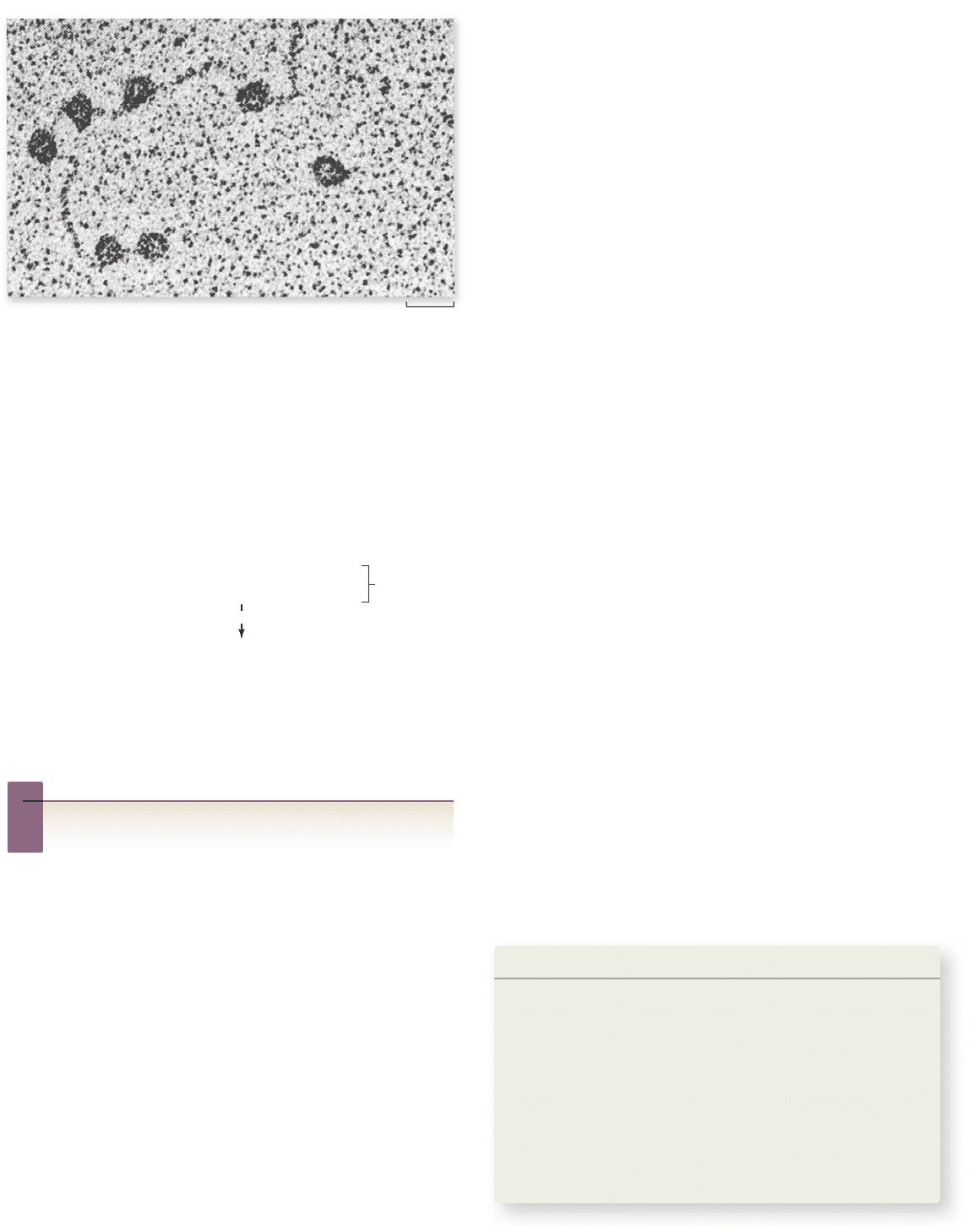
Figure 15.3
RNA polymerase.
In this electron micrograph,
the dark circles are RNA polymerase molecules synthesizing RNA
from a DNA template.
The RNA transcript used to direct the synthesis of poly-
peptides is termed messenger RNA (mRNA). Its name reflects its
use by the cell to carry the DNA message to the ribosome
for processing.
Inquiry question
?
It is widely accepted that RNA polymerase has no
proofreading capacity. Would you expect high or low levels of
error in transcription compared with DNA replication? Why do
you think it is more important for DNA polymerase than for
RNA polymerase to proofread?
Translation uses information
in RNA to synthesize proteins
The process of translation is by necessity much more complex
than transcription. In this case, RNA cannot be used as a direct
template for a protein because there is no complementarity—
that is, a sequence of amino acids cannot be aligned to an RNA
template based on any kind of “chemical fit.” Molecular geneti-
cists suggested that some kind of adapter molecule must exist
that can interact with both RNA and amino acids, and transfer
RNA (tRNA) was found to fill this role. This need for an inter-
mediary adds a level of complexity to the process that is not
seen in either DNA replication or transcription of RNA.
except that U (uracil) in the RNA is T (thymine) in the DNA-
coding strand. Another naming convention for the two strands
of the DNA is to call the coding strand the sense strand, as it
has the same “sense” as the RNA. The template strand would
then be the antisense strand.
chapter
15
Genes and How They Work
281www.ravenbiology.com
rav32223_ch15_278-303.indd 281rav32223_ch15_278-303.indd 281 11/9/09 2:42:38 PM11/9/09 2:42:38 PM