
Raven P.H., Johnson G.B., Mason K.A. Biology (Ninth Edition)
Подождите немного. Документ загружается.

Apago PDF Enhancer
Aminoacyl-tRNA
synthetase
Amino
acid site
tRNA
site
Carboxyl
group
Amino
group
Anticodon
specific to tryptophan
Accepting
site
tRNA
Charged
tRNA
dissociates
Charged tRNA travels to ribosome
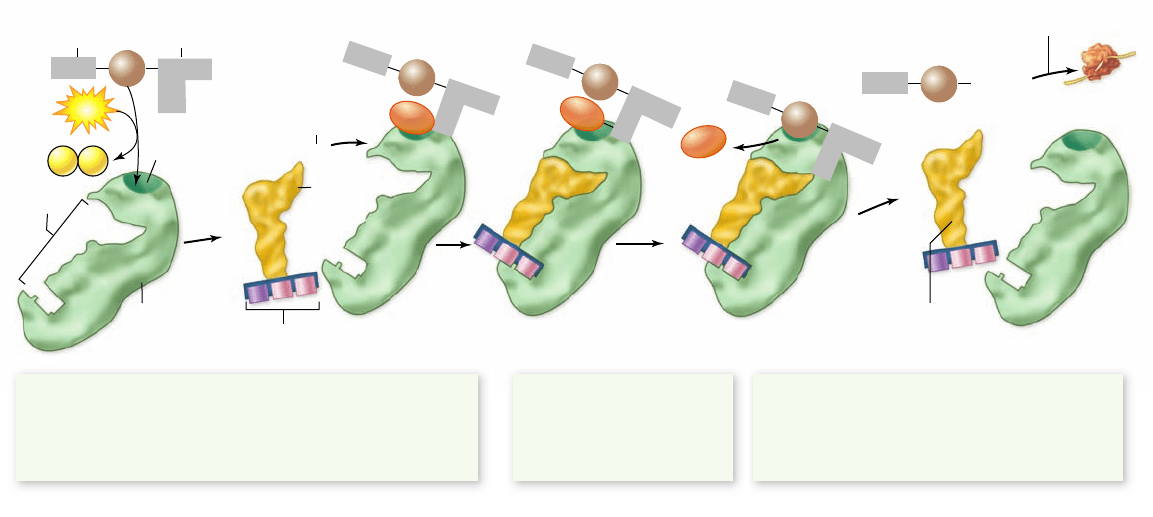
1. In the first step of the reaction, the amino acid is activated.
The amino acid reacts with ATP to produce an intermediate
with the carboxyl end of the amino acid attached to AMP.
The two terminal phosphates (pyrophosphates) are cleaved
from ATP in this reaction.
2. The amino acid-AMP
complex remains bound
to the enzyme. The tRNA
next binds to the enzyme.
3. The second step of the reaction transfers
the amino acid from AMP to the tRNA,
producing a charged tRNA and AMP. The
charged tRNA consists of a specific amino acid
attached to the 3„ acceptor stem of its RNA.
P
i
P
i
Trp
NH
3
+
NH
3
+
NH
3
+
NH
3
+
O
-
C
K
O
J
ATP
OH
Trp
O
C
K
O
J
AMP
Trp
O
OH
C
K
O
J
AMP
AMP
Trp
O
C
K
O
J
Trp
NH
3
+
O
C
K
O
J
The acceptor stem is the 3' end of the molecule, which al-
ways ends in 5' CCA 3'. The amino acid is attached to this end of
the molecule. The anticodon loop is the bottom loop of the clo-
verleaf, and it can base-pair with codons in mRNA.
The charging reaction
The aminoacyl-tRNA synthetases must be able to recognize
specific tRNA molecules as well as their corresponding amino
acids. Although 61 codons code for amino acids, there are actu-
ally not 61 tRNAs in cells, although the number varies from
species to species. Therefore, some aminoacyl-tRNA syn-
thetases must be able to recognize more than one tRNA—but
each recognizes only a single amino acid.
The reaction catalyzed by the enzymes is called the tRNA
charging reaction, and the product is an amino acid joined to
a tRNA, now called a charged tRNA. An ATP molecule provides
energy for this endergonic reaction. The charged tRNA pro-
duced by the reaction is an activated intermediate that can un-
dergo the peptide bond-forming reaction without an additional
input of energy.
The charging reaction joins the acceptor stem to the car-
boxyl terminus of an amino acid (figure 15.15) . Keeping this
directionality in mind is critical to understanding the function
of the ribosome, because each peptide bond will be formed be-
tween the amino group of one amino acid and the carboxyl
group of another amino acid.
The correct attachment of amino acids to tRNAs is im-
portant because the ribosome does not verify this attachment.
Ribosomes can only ensure that the codon–anticodon pairing is
correct. In an elegant experiment, cysteine was converted chem-
ically to alanine after the charging reaction, when the amino
acid was already attached to tRNA. When this charged tRNA
was used in an in vitro protein synthesis system, alanine was in-
Figure 15.15
tRNA charging reaction.
There are 20 different aminoacyl-tRNA synthetase enzymes each speci c for one amino acid,
such as tryptophan (Trp). The enzyme must also recognize and bind to the tRNA molecules with anticodons specifying that amino acid, ACC for
tryptophan. The reaction uses ATP and produces an activated intermediate that will not require further energy for peptide bond formation.
corporated in the place of cysteine, showing that the ribosome
cannot “proofread” the amino acids attached to tRNA.
In a very real sense, therefore, the charging reaction is the
real translation step; amino acids are incorporated into a pep-
tide based solely on the tRNA anticodon and its interaction
with the mRNA.
The ribosome has multiple
tRNA-binding sites
The synthesis of any biopolymer can be broken down into ini-
tiation, elongation, and termination—you have seen this divi-
sion for DNA replication as well as for transcription. In the
case of translation, or protein synthesis, all three of these steps
take place on the ribosome, a large macromolecular assembly
consisting of rRNA and proteins. Details of the process by
which the two ribosome subunits are assembled during initia-
tion are described shortly.
For the ribosome to function it must be able to bind to at
least two charged tRNAs at once so that a peptide bond can be
formed between their amino acids, as described in the previous
overview. The bacterial ribosome contains three binding sites,
summarized in figure 15.16 :
■ The P site (peptidyl) binds to the tRNA attached to the
growing peptide chain.
■ The A site (aminoacyl) binds to the tRNA carrying the
next amino acid to be added.
■ The E site (exit) binds the tRNA that carried the
previous amino acid added (see figure 15.16).
Transfer RNAs move through these sites successively
during the process of elongation. Relative to the mRNA, the
sites are arranged 5' to 3' in the order E, P, and A. The incoming
292
part
III
Genetic and Molecular Biology
rav32223_ch15_278-303.indd 292rav32223_ch15_278-303.indd 292 11/9/09 2:42:46 PM11/9/09 2:42:46 PM
Apago PDF Enhancer
Small
subunit
Large
subunit
Small
subunit
Large
subunit
Small
subunit
Large
subunit
E
P
A
mRNA
90°
0°
3„
5„
charged tRNAs enter the ribosome at the A site, transit through
the P site, and then leave via the E site.
The ribosome has both decoding
and enzymatic functions
The two functions of the ribosome involve decoding the tran-
scribed message and forming peptide bonds. The decoding
function resides primarily in the small subunit of the ribosome.
The formation of peptide bonds requires the enzyme peptidyl
transferase, which resides in the large subunit.
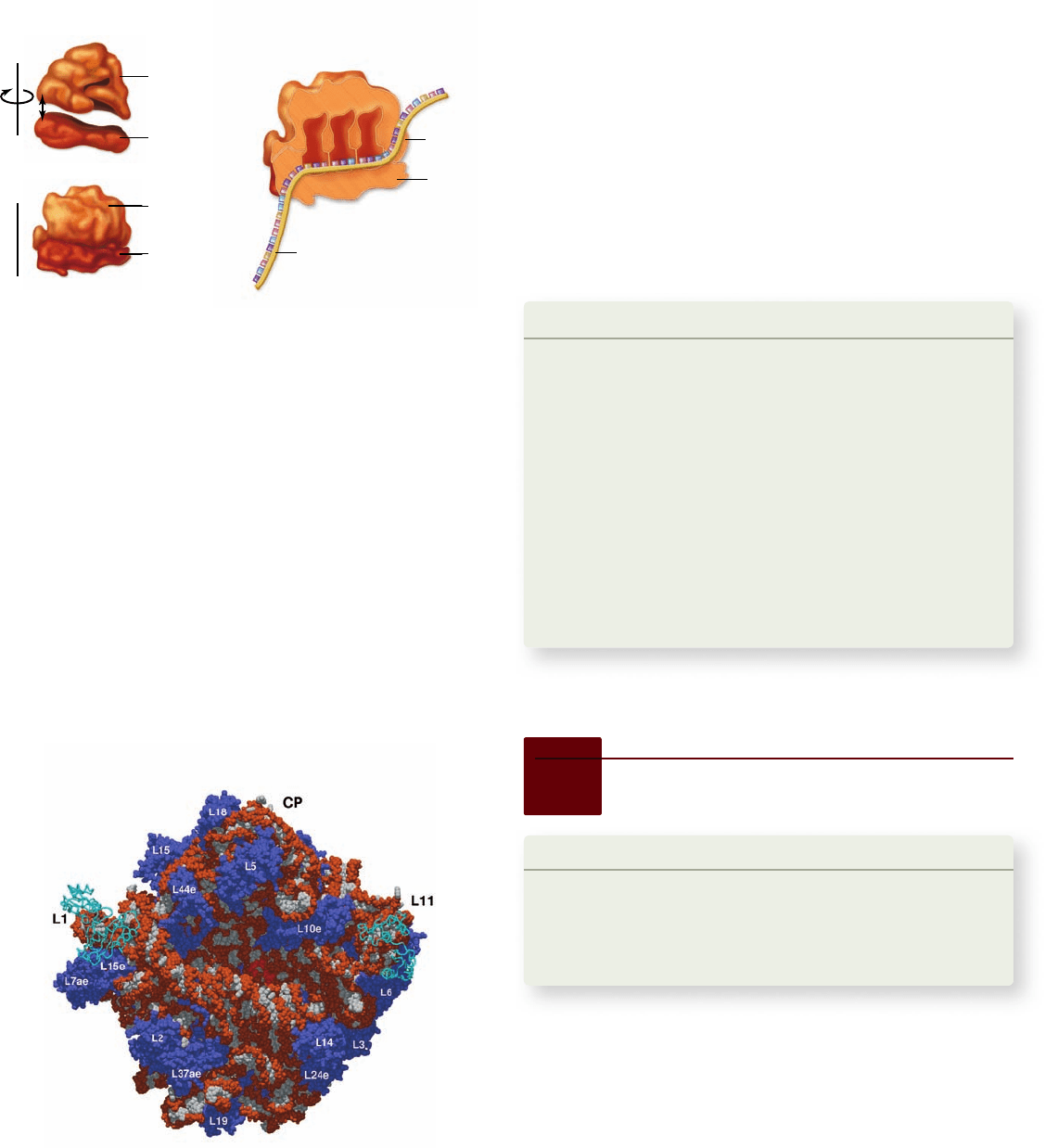
Figure 15.16
Ribosomes have two subunits.
Ribosome subunits come together and apart as part of a ribosome
cycle. The smaller subunit ts into a depression on the surface of
the larger one. Ribosomes have three tRNA-binding sites:
aminoacyl site (A), peptidyl site (P), and empty site (E).
Figure 15.17
3-D structure of prokaryotic
ribosome.
The complete atomic structure of a prokaryotic large
ribosomal subunit has been determined at 2.4-Å resolution. Bases of
RNA are white, the polynucleotide backbone is red, and proteins
are blue. The faces of each ribosomal subunit are lined with rRNA
such that their interaction with tRNAs, amino acids, and mRNA all
involve rRNA. Proteins are absent from the active site but abundant
everywhere on the surface. The proteins stabilize the structure by
interacting with adjacent RNA strands.
Our view of the ribosome has changed dramatically over
time. Initially, molecular biologists assumed that the proteins
in the ribosome carried out its function and that the rRNA
was a structural scaffold necessary to hold the proteins in the
correct position. Now this view has mostly been reversed; the
ribosome is seen instead as rRNAs that are held in place by
proteins. The faces of the two subunits that interact with each
other are lined with rRNA, and the parts of both subunits that
interact with mRNA, tRNA, and amino acids are also primar-
ily rRNA (figure 15.17). It is now thought that the peptidyl
transferase activity resides in an rRNA in the large subunit.
Learning Outcomes Review 15.6
Transfer RNA has two functional regions, one that bonds with an amino acid,
and the other that can base-pair with mRNA. The tRNA charging reaction
joins the carboxyl end of an amino acid to the 3
' acceptor stem of its tRNA;
without charged tRNAs, translation cannot take place. This reaction is
catalyzed by 20 diff erent aminoacyl-tRNA synthetases, one for each amino
acid. The ribosome has three diff erent binding sites for tRNA, one for the
tRNA adding to the growing peptide chain (P site), one for the next charged
tRNA (A site), and one for the previous tRNA, which is now without an amino
acid (E site). The ribosome can be thought of as having both a decoding
function and an enzymatic function.
■ What would be the effect on translation of a mutant
tRNA that has an anticodon complementary to a
STOP codon?
15.7
The Process of Translation
Learning Outcomes
Distinguish between translation initiation and 1.
elongation.
Explain the elongation cycle.2.
Compare translation on the RER and in the cytoplasm.3.
The process of translation is one of the most complex and energy-
expensive tasks that cells perform. An overview of the process, as
you saw earlier, is perhaps deceptively simple: The mRNA is
threaded through the ribosome, while tRNAs carrying amino
acids bind to the ribosome, where they interact with mRNA by
base-pairing with the mRNA’s codons. The ribosome and tRNAs
position the amino acids such that peptide bonds can be formed
between each new amino acid and the growing polypeptide.
Initiation requires accessory factors
As mentioned earlier, the start codon is AUG, which also en-
codes the amino acid methionine. The ribosome usually uses
the first AUG it encounters in an mRNA strand to signal the
start of translation.
chapter
15
Genes and How They Work
293www.ravenbiology.com
rav32223_ch15_278-303.indd 293rav32223_ch15_278-303.indd 293 11/9/09 2:42:46 PM11/9/09 2:42:46 PM
Apago PDF Enhancer
3„
3„
5„
5„
mRNA
AUG
UCA
U
C
A
A
G
U
fMet
GTP GDP
Large
subunit
Small
subunit
A site E site
tRNA in
P site
3„
3„
5„
5„
Initiation
factor
Initiation
factor
Initiation complex Complete ribosome
+
P
i
NH
3
+
NH
3
+
NH
3
+
3„
5„
“Empty”
tRNA
Amino
acid 1
Amino
acid 2
Amino
acid 2
Amino
acid 1
Amino
group
Amino
acid 1
Amino
acid 2
Amino
acid 3
Amino
acid 4
Amino
acid 5
Amino
acid 6
Amino
acid 7
Amino end
(N terminus)
Carboxyl end
(C terminus)
Peptide
bond
formation
Peptide
bond
Polypeptide
chain
P site
A site
OH
O
O
K
C
J J J J
O
K
C
J J J
O
C
K
O
J J J J
N
O
C
K
O
J J J J
J J J J J J
J
NH
2
J J
COO
-
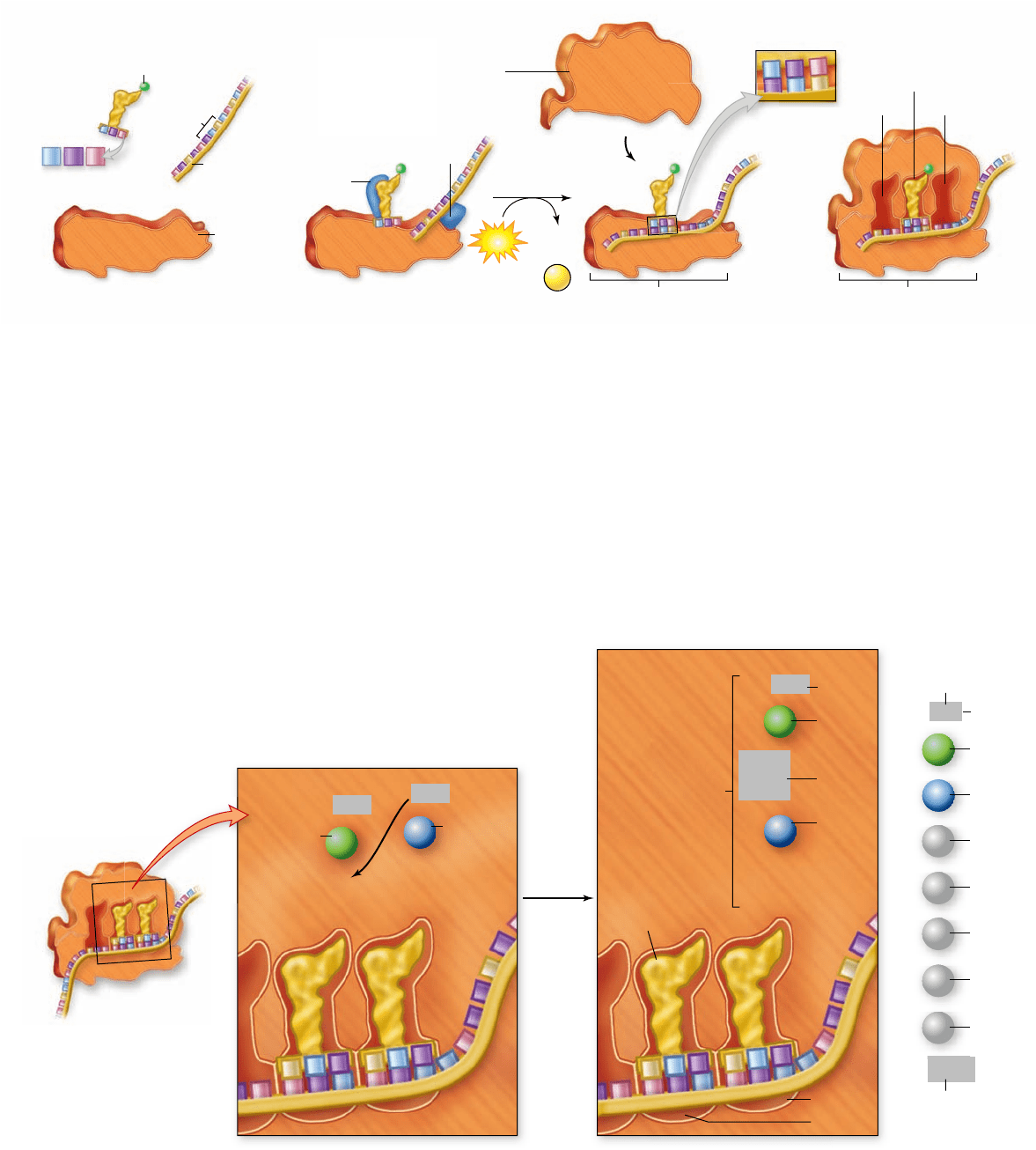
Figure 15.18
Initiation of translation.
In prokaryotes, initiation factors play key roles in positioning the small ribosomal subunit,
the initiator tRNA
fMet
, and the mRNA. When the tRNA
fMet
is positioned over the rst AUG codon of the mRNA, the large ribosomal subunit
binds, forming the E, P, and A sites where successive tRNA molecules bind to the ribosomes, and polypeptide synthesis begins. Ribosomal
subunits are shown as a cutaway sectioned through the middle.
Prokaryotic initiation
In prokaryotes, the initiation complex includes a special ini-
tiator tRNA molecule charged with a chemically modified me-
thionine, N-formylmethionine. The initiator tRNA is shown as
tRNA
fMet
. The initiation complex also includes the small
ribosomal subunit and the mRNA strand (figure 15.18) . The
small subunit is positioned correctly on the mRNA due to a
conserved sequence in the 5' end of the mRNA called the
ribosome-binding sequence (RBS) that is complementary to
the 3' end of a small subunit rRNA.
A number of initiation factors mediate this interaction of
the ribosome, mRNA, and tRNA
fMet
to form the initiation
complex. These factors are involved in initiation only and are
not part of the ribosome.
Once the complex of mRNA, initiator tRNA, and small
ribosomal subunit is formed, the large subunit is added, and
Figure 15.19
Peptide bond formation.
Peptide bonds are formed between a “new” charged tRNA in the A site and the growing
chain attached to the tRNA in the P site. The bond forms between the amino group of the new amino acid and the carboxyl group of the
growing chain. This breaks the bond between the growing chain and its tRNA, transfering it to the A site as the new amino acid remains
attached to its tRNA.
294
part
III
Genetic and Molecular Biology
rav32223_ch15_278-303.indd 294rav32223_ch15_278-303.indd 294 11/9/09 2:42:47 PM11/9/09 2:42:47 PM
Apago PDF Enhancer
GTP
Elongation
factor
Elongation
factor
Elongation
factor
Elongation
factor
Growing
polypeptide
3„
3„
3„
3„
3„
5„
5„
5„
5„
5„
“Ejected” tRNA
E
P
A
E
P
A
E
P
A
E
P
A
E
P
A
Sectioned ribosome
P
i
GTP
GTP
GDP
+
Next round
1
.
M
a
t
c
h
i
n
g
t
R
N
A
a
n
t
i
c
o
d
o
n
w
i
t
h
m
R
N
A
c
o
d
o
n
2
.
P
e
p
t
i
d
e
b
o
n
d
f
o
r
m
a
t
i
o
n
3
.
T
r
a
n
s
l
o
c
a
t
i
o
n
o
f
t
h
e
r
i
b
o
s
o
m
e
P
i
GDP
+
translation can begin. With the formation of the complete ri-
bosome, the initiator tRNA is bound to the P site with the A
site empty.
Eukaryotic initiation
Initiation in eukaryotes is similar, although it differs in two im-
portant ways. First, in eukaryotes, the initiating amino acid is
methionine rather than N-formylmethionine. Second, the ini-
tiation complex is far more complicated than in prokaryotes,
containing nine or more protein factors, many consisting of
several subunits. Eukaryotic mRNAs also lack an RBS. The
small subunit binds to the mRNA initially by binding to the 5'
cap of the mRNA.
Elongation adds successive amino acids
When the entire ribosome is assembled around the initiator
tRNA and mRNA, the second charged tRNA can be brought to
the ribosome and bind to the empty A site. This requires an
elongation factor called EF-Tu, which binds to the charged
tRNA and to GTP.
A peptide bond can then form between the amino acid of
the initiator tRNA and the newly arrived charged tRNA in the
A site. The geometry of this bond relative to the two charged
tRNAs is critical to understanding the process. Remember that
an amino acid is attached to a tRNA by its carboxyl terminus.
The peptide bond is formed between the amino end of the in-
coming amino acid (in the A site) and the carboxyl end of the
growing chain (in the P site) (figure 15.19).
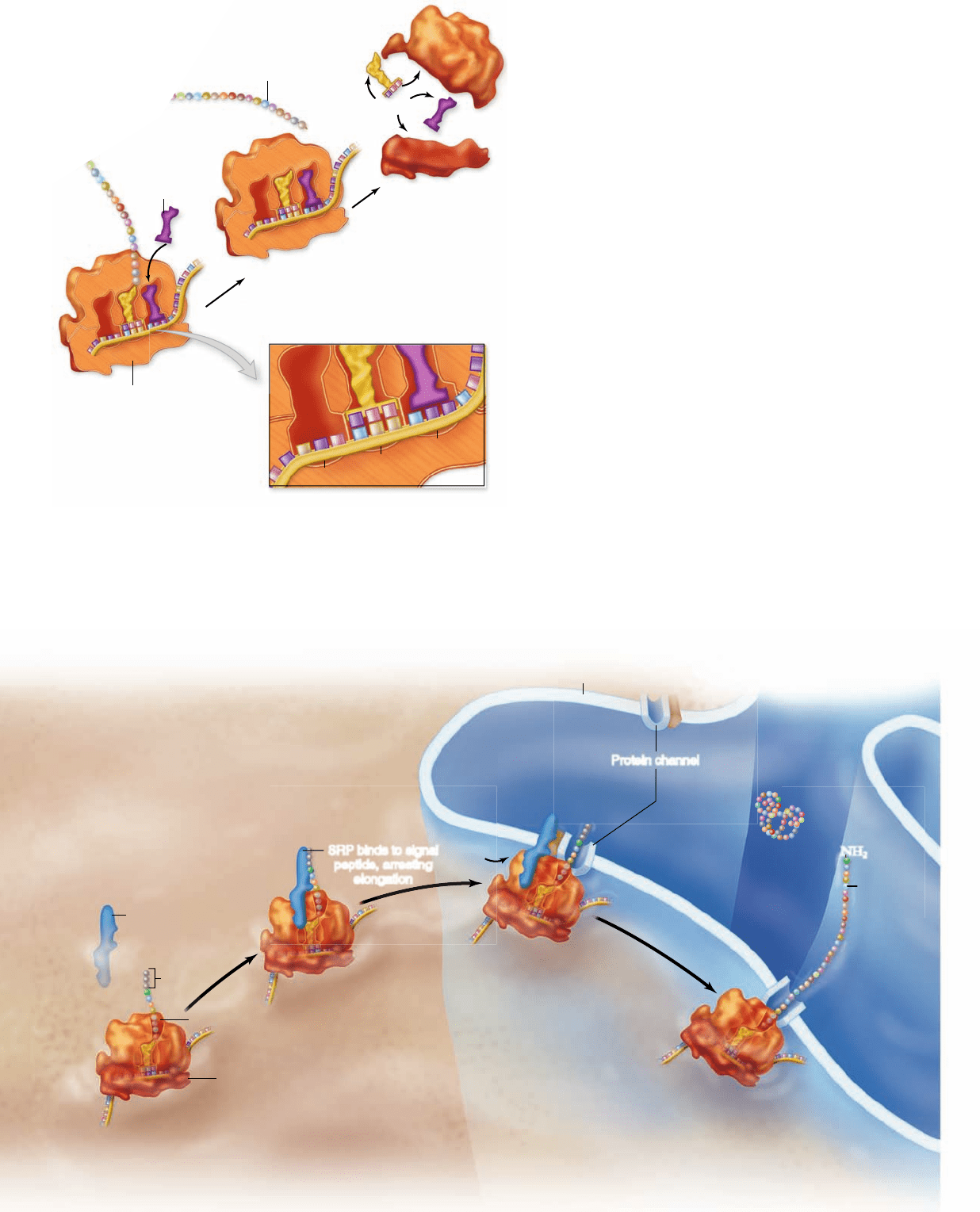
The addition of successive amino acids is a series of events
that occur in a cyclic fashion. Figure 15.20 shows the details of
the elongation cycle.
Matching tRNA anticodon with mRNA codon.1. Each
new charged tRNA comes to the ribosome bound to
EF-Tu and GTP. The charged tRNA binds to the A site if
its anticodon is complementary to the mRNA codon in
the A site.
After binding, GTP is hydrolyzed, and EF-Tu–
GDP dissociates from the ribosome where it is recycled
by another factor. This two-step binding and hydrolysis of
GTP is thought to increase the accuracy of translation.
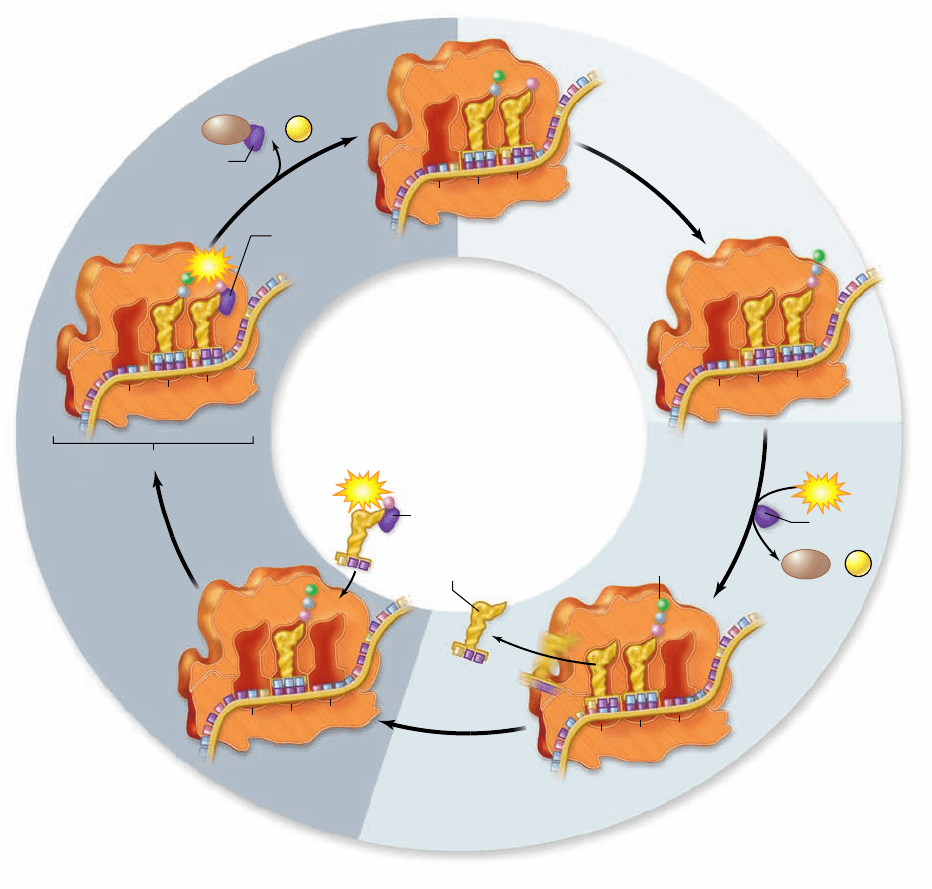
Figure 15.20
Elongation cycle.
Numbering of the cycle corresponds to
the numbering in the text. The cycle
begins when a new charged tRNA
with anticodon matching the codon
of the mRNA in the A site arrives
with EF-Tu. The EF-Tu
hydrolyzes GTP and
dissociates from the ribosome.
A peptide bond is formed
between the amino acid in
the A site and the growing
chain in the P site,
transferring the growing
chain to the A site, and
leaving the tRNA in the
P site empty. Ribosome
translocation requires
another elongation factor and
GTP hydrolysis. This moves
the tRNA in the A site into the
P site, the next codon in the
mRNA into the A site, and the
empty tRNA into the E site.
chapter
15
Genes and How They Work
295www.ravenbiology.com
rav32223_ch15_278-303.indd 295rav32223_ch15_278-303.indd 295 11/9/09 2:42:48 PM11/9/09 2:42:48 PM
Apago PDF Enhancer
3„
5„
3„
5„
Sectioned
ribosome
Polypeptide
chain releases
Release
factor
E
P
A
Dissociation
G
C
G
C
U
A
A
U
A
NH
2
Protein channel
Signal recognition
particle (SRP)
SRP binds to signal
peptide, arresting
elongation
Docking
Signal
Exit tunnel
Rough endoplasmic
reticulum (RER)
Lumen of the RERCytoplasm
Ribosome
synthesizing
peptide
Polypeptide
elongation
continues
Peptide bond formation.2. Peptidyl transferase, located in
the large subunit, catalyzes the formation of a peptide
bond between the amino group of the amino acid in the
A site and the carboxyl group of the growing chain. This
also breaks the bond between the growing chain and the
tRNA in the P site leaving it empty (no longer charged).
The overall result of this is to transfer the growing chain
to the tRNA in the A site.
Translocation of the ribosome.3. After the peptide bond
has been formed, the ribosome moves relative to the
mRNA and the tRNAs. The next codon in the mRNA
shifts into the A site, and the tRNA with the growing chain
moves to the P site. The uncharged tRNA formerly in the
P site is now in the E site, and it will be ejected in the next
cycle. This translocation step requires the accessory factor
EF-G and the hydrolysis of another GTP.
This elongation cycle continues with each new
amino acid added. The ribosome moves down the
mRNA in a 5'-to-3' direction, reading successive
codons. The tRNAs move through the ribosome in the
opposite direction, from the A site to the P site and
nally the E site, before they are ejected as empty
tRNAs, which can be charged with another amino acid
and then used again.
Wobble pairing
As mentioned, there are fewer tRNAs than codons. This situ-
ation is easily rationalized because the pairing between the 3'
base of the codon and the 5' base of the anticodon is less strin-
gent than normal. In some tRNAs, the presence of modified
bases with less accurate pairing in the 5' position of the anti-
codon enhances this flexibility. This effect is referred to as
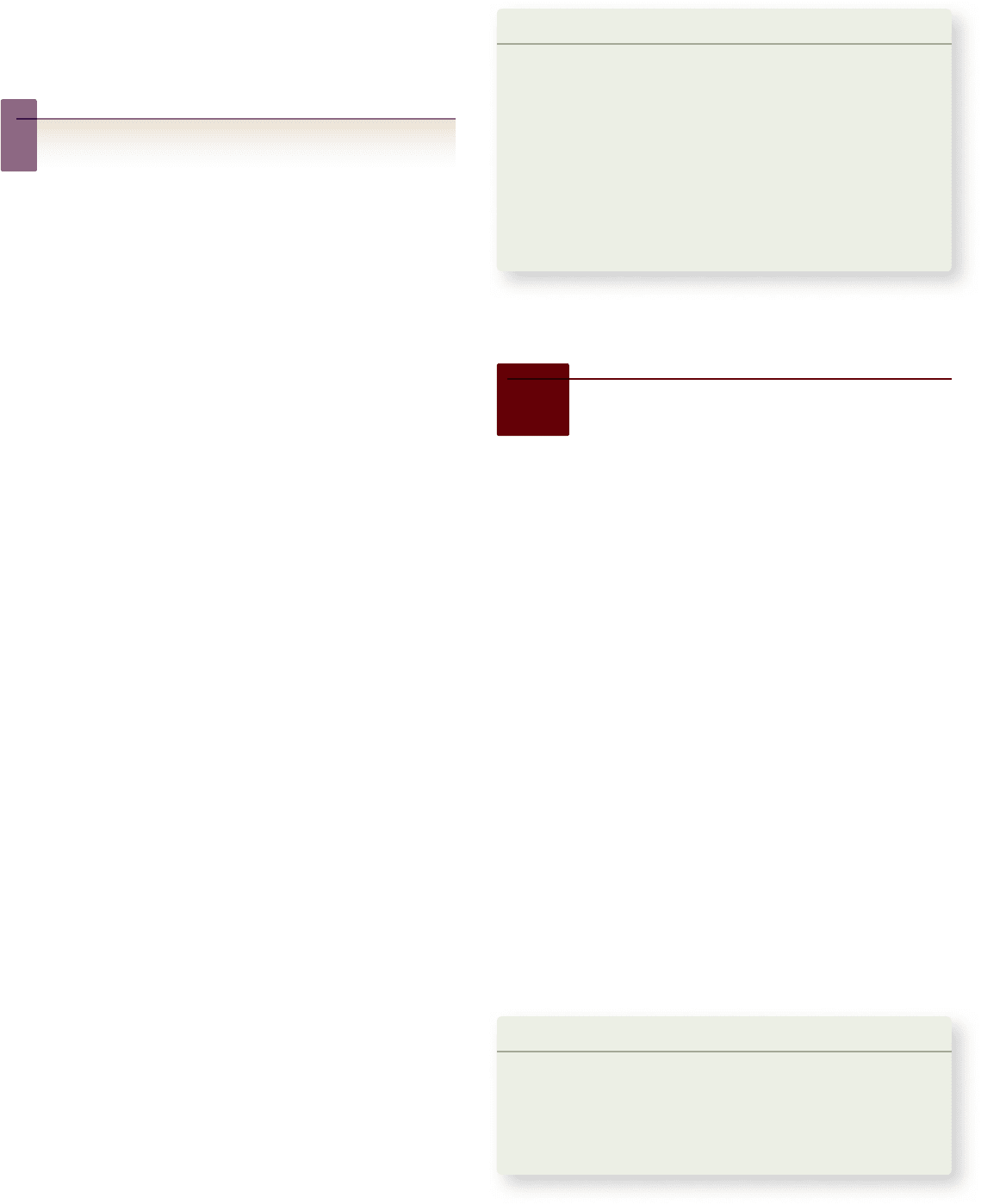
Figure 15.21
Termination of protein synthesis.
There is
no tRNA with an anticodon complementary to any of the three
termination signal codons. When a ribosome encounters a
termination codon, it stops translocating. A speci c protein release
factor facilitates the release of the polypeptide chain by breaking the
covalent bond that links the polypeptide to the P site tRNA.
Figure 15.22
Synthesis of proteins on RER.
Proteins that are synthesized on RER arrive at the ER
because of sequences in the peptide itself. A signal
sequence in the amino terminus of the polypeptide
is recognized by the signal recognition particle
(SRP). This complex docks with a receptor
associated with a channel in the ER. The peptide
passes through the channel into the lumen of the ER
as it is synthesized.
296
part
III
Genetic and Molecular Biology
rav32223_ch15_278-303.indd 296rav32223_ch15_278-303.indd 296 11/9/09 2:42:49 PM11/9/09 2:42:49 PM
Apago PDF Enhancer
wobble pairing because these tRNAs can “wobble” a bit on
the mRNA, so that a single tRNA can “read” more than one
codon in the mRNA.
Inquiry question
?
How is the wobble phenomenon related to the number of
tRNAs and the degeneracy of the genetic code?
Termination requires accessory factors
Elongation continues in this fashion until a chain-terminating
stop codon is reached (for example, UAA in figure 15.21). These
stop codons do not bind to tRNA; instead, they are recognized
by release factors, proteins that release the newly made poly-
peptide from the ribosome.
Proteins may be
targeted to the ER
In eukaryotes, translation can occur either in the cytoplasm
or on the RER. Proteins that are translated on the RER are
targeted there based on their own initial amino acid se-
quence. The ribosomes found on the RER are actively trans-
lating and are not permanently bound to the ER.
A polypeptide that starts with a short series of amino
acids called a signal sequence is specifically recognized
and bound by a cytoplasmic complex of proteins called the
signal recognition particle (SRP). The complex of signal se-
quence and SRP is in turn recognized by a receptor protein
in the ER membrane. The binding of the ER receptor to the
signal sequence/SRP complex holds the ribosome engaged
in translation of the protein on the ER membrane, a process
called docking (figure 15.22) .
As the protein is assembled, it passes through a channel
formed by the docking complex and into the interior ER com-
partment, the cisternal space. This is the basis for the docking
metaphor—the ribosome is not actually bound to the ER itself,
but with the newly synthesized protein entering the ER, the
ribosome is like a boat tied to a dock with a rope.
The basic mechanism of protein translocation across
membranes by the SRP and its receptor and channel complex
has been conserved across all three cell types: eukaryotes, bac-
teria, and archaea. Given that only eukaryotic cells have an en-
domembrane system, this universality may seem curious;
however, bacteria and archaea both export proteins through
their plasma membrane, and the mechanism used is similar to
the way in which eukaryotes move proteins into the cisternal
space of the ER.
Once within the ER cisternal space, or lumen, the newly
synthesized protein can be modified by the addition of sugars
(glycosylation) and transported by vesicles to the Golgi appara-
tus (see chapter 4) . This is the beginning of the protein-
trafficking pathway that can lead to other intracellular targets,
to incorporation into the plasma membrane, or to release out-
side of the cell itself.
15.8
Summarizing Gene Expression
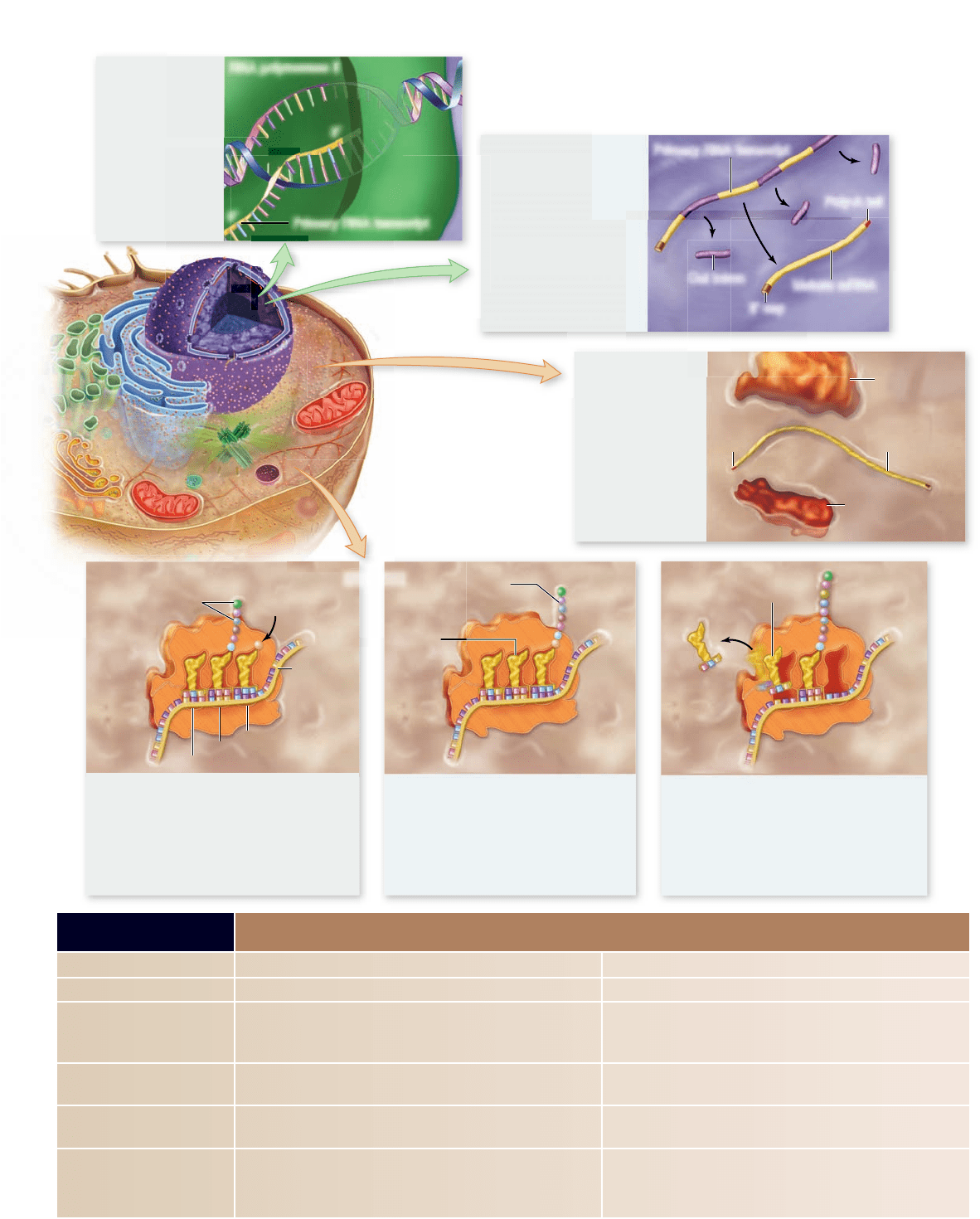
Because of the complexity of the process of gene expression, it
is worth stepping back to summarize some key points:
■ The process of gene expression converts information in
the genotype into the phenotype.
■ A copy of the gene in the form of mRNA is produced by
transcription, and the mRNA is used to direct the
synthesis of a protein by translation.
■ Both transcription and translation can be broken down
into initiation, elongation, and termination cycles that
produce their respective polymers. (The same is true for
DNA replication.)
■ Eukaryotic gene expression is much more complex than
that of prokaryotes.
The nature of eukaryotic genes with their intron and exon
components greatly complicates the process of gene expression
by requiring additional steps between transcription and trans-
lation. The production and processing of eukaryotic mRNAs
also takes place in the nucleus, whereas translation takes place
in the cytoplasm. This necessitates the transport of the mRNA
through the nuclear pores to the cytoplasm before translation
can take place. The entire eukaryotic process is summarized in
figure 15.23 .
A number of differences can be highlighted between gene
expression in prokaryotes and in eukaryotes. Table 15.2 (on
p. 298) summarizes these main points.
Learning Outcome Review 15.8
The greater complexity of eukaryotic gene expression is related to the
functional organization of the cell, with DNA in the nucleus and ribosomes
in the cytoplasm. The diff erences in gene expression between prokaryotes
and eukaryotes is mainly in detail, but some diff erences have functional
signifi cance.
Learning Outcomes Review 15.7
Translation initiation involves the interaction of the small ribosomal
subunit with mRNA and a charged initiator tRNA. The elongation cycle
involves bringing in new charged tRNAs to the ribosome’s A site, forming
peptide bonds between amino acids, and translocating the ribosome
along the mRNA chain. The tRNAs transit through the ribosome from A to
P to E sites during the process. In eukaryotes, signal sequences of a newly
forming polypeptide may target it and its ribosome to be moved to the RER.
Polypeptides formed on the RER enter the cisternal space rather than being
released into the cytoplasm.
■ What stages of translation require energy?
chapter
15
Genes and How They Work
297www.ravenbiology.com
rav32223_ch15_278-303.indd 297rav32223_ch15_278-303.indd 297 11/9/09 2:42:50 PM11/9/09 2:42:50 PM
Apago PDF Enhancer
RNA polymerase
II in the nucleus
copies one
strand
of the DNA to
produce the
primary
transcript.
The primary transcript
is processed by
addition of a 5„
methyl-G cap,
cleavage and
polyadenylation of the
3„ end, and removal of
introns. The mature
mRNA is then
exported through
nuclear pores to the
cytoplasm.
The 5„ cap of the
mRNA
associates with
the small subunit
of the ribosome.
The initiator
tRNA and large
subunit are
added to form
an initiation
complex.
The ribosome cycle begins with the
growing peptide attached to the tRNA
in the P site. The next charged tRNA
binds to the A site with its anticodon
complementary to the codon in the
mRNA in this site.
Peptide bonds form between the
amino terminus of the next amino
acid and the carboxyl terminus of
the growing peptide. This transfers
the growing peptide to the tRNA in
the A site, leaving the tRNA in the
P site empty.
Ribosome translocation moves the
ribosome relative to the mRNA and
its bound tRNAs. This moves the
growing chain into the P site, leaving
the empty tRNA in the E site and the
A site ready to bind the next
charged tRNA.
5. 6. 4.
Primary RNA transcript
Primary RNA transcript
Mature mRNA
Empty
tRNA
Empty tRNA moves into
E site and is ejected
mRNA
tRNA arrives
in A site
Amino acids
Large
subunit
Small
subunit
RNA polymerase II
mRNA
Lengthening
polypeptide chain
3„
3„
3„
5„
5„
5„ cap
5„ cap
Poly-A tail
5„
Cytoplasm
Cytoplasm
E site
A site
P site
Cut intron
3„
5„
3.
2.
1.
3„
5„
TABLE 15.2
Di erences Between Prokaryotic and Eukaryotic Gene Expression
Characteristic Prokaryotes Eukaryotes
Introns No introns, although some archaeal genes possess them. Most genes contain introns.
Number of genes in mRNA Several genes may be transcribed into a single mRNA molecule.
Often these have related functions and form an operon, which helps
coordinate regulation of biochemical pathways.
Only one gene per mRNA molecule; regulation of pathways
accomplished in other ways.
Site of transcription
and translation
No membrane-bounded nucleus, transcription and translation
are coupled.
Transcription in nucleus; mRNA is transported to the cytoplasm
for translation.
Initiation of translation Begins at AUG codon preceded by special sequence that binds
the ribosome.
Begins at AUG codon preceded by the 5' cap (methylated GTP) that binds
the ribosome.
Modi cation of mRNA
after transcription
None; translation begins before transcription is completed. Transcription
and translation are coupled.
A number of modi cations while the mRNA is in the nucleus: Introns are
removed and exons are spliced together; a 5' cap is added; a poly-A tail
is added.
Figure 15.23
An overview of gene expression
in eukaryotes.
298
part
III
Genetic and Molecular Biology
rav32223_ch15_278-303.indd 298rav32223_ch15_278-303.indd 298 11/9/09 2:42:51 PM11/9/09 2:42:51 PM
Apago PDF Enhancer
Polar
Normal HBB Sequence
Abormal HBB Sequence
Nonpolar (hydrophobic)
Amino acids
Nucleotides
Amino acids
Nucleotides
Leu
CCCCGTTTAGGA GAA
Thr Pro Glu Glu
CTTGAA
Lys
Ser
Leu
CCCCGTTTA GGGAA
Thr Pro Val Glu
CTTTGAA
Lys Ser
Hemoglobin
tetramer
Normal
Deoxygenated
Tetramer
a
1
b
1
a
2
b
2
b
2
a
1
b
1
a
2
"Sticky" non-
polar sites
Tetramers form long chains
when deoxygenated. This
distorts the normal red blood
cell shape into a sickle shape.
Abnormal
Deoxygenated
Tetramer
15.9
Mutation: Altered Genes
Learning Outcomes
Describe the effects of different point mutations.1.
Explain the nature of triplet repeat expansion.2.
List the different chromosomal mutations and their effects.3.
One way to analyze the function of genes is to find or to induce
mutations in a gene to see how this affects its function. In terms
of the organism, however, inducing mutations is usually negative;
most mutations have deleterious effects on the phenotype of the
organism. In chapter 13, you saw how a number of genetic dis-
eases, such as sickle cell anemia, are due to single base changes.
We now consider mutations from the perspective of how the
DNA itself is altered. Mutational changes range from the altera-
tion of a single base to the loss of genetic material (deletion) to
the loss of an entire chromosome. The change of a single base
can result in changing a single amino acid in a protein, and this
in turn can lead to a debilitating clinical phenotype. This is il-
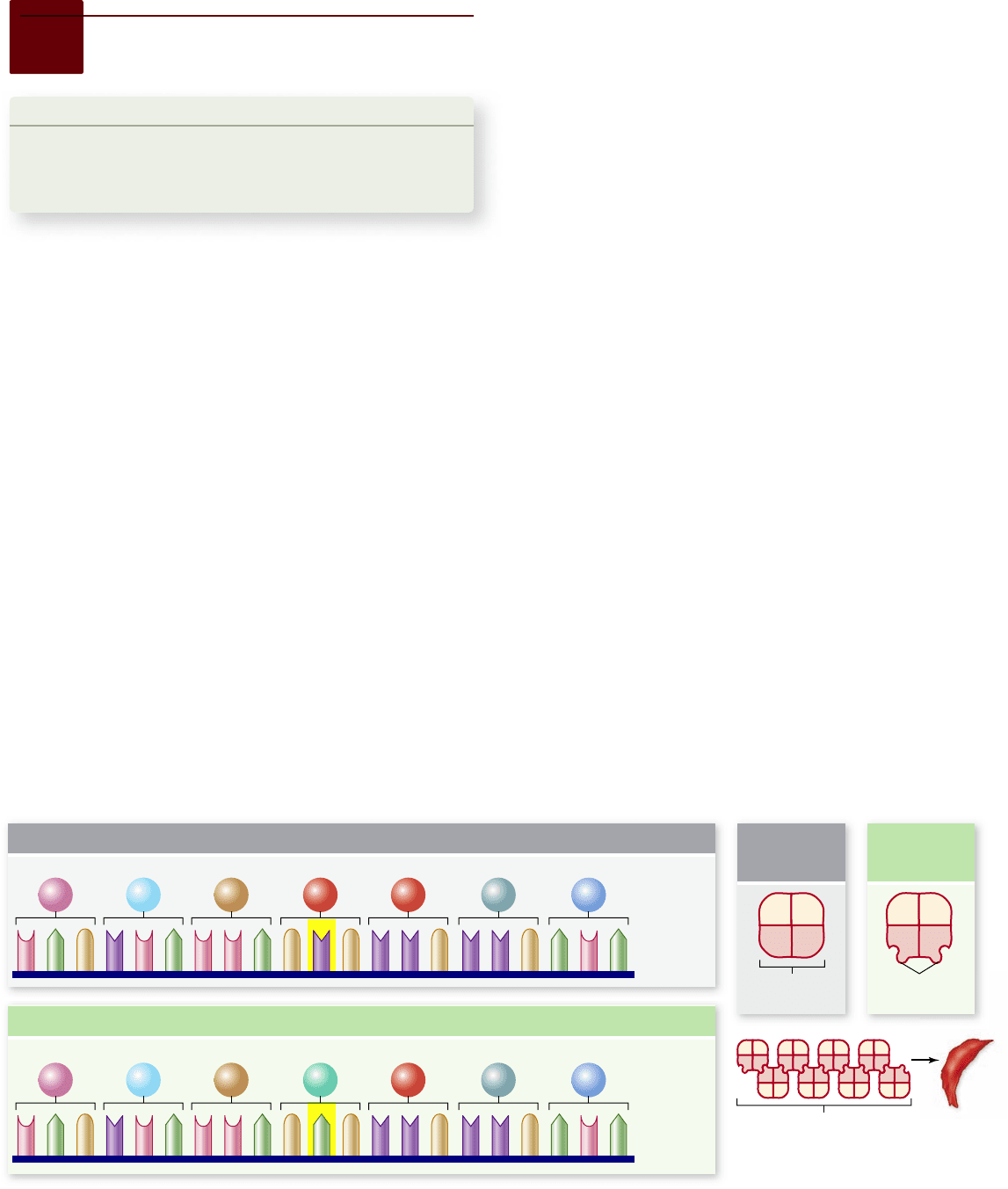
lustrated for the case of sickle cell anemia in figure 15.24. In the
sickle cell allele, a single A is changed to a T resulting in a glu-
tamic acid being replaced with a valine. The substitution of non-
polar valine causes the beta chains to aggregate into polymers,
and this alters the shape of the cells, leading to the disease state.
Point mutations a ect a single site in the DNA
A mutation that alters a single base is termed a point mutation.
The mutation can be either the substitution of one base for an-
other, or the deletion or addition of a single base (or a small
number of bases).
Base substitution
The substitution of one base pair for another in DNA is called a
base substitution mutation. Because of the degenerate nature
of the genetic code, base substitution may or may not alter the
amino acid encoded. If the new codon from the base substitu-
tion still encodes the same amino acid, we say the mutation is
silent (figure 15.25b). When base substitution changes an amino
acid in a protein, it is also called a missense mutation as the
“sense” of the codon produced after transcription of the mutant
gene will be altered (figure 15.25c). These fall into two classes,
transitions and transversions. A transition does not change the
type of bases in the base pair, that is, a pyrimidine is substituted
for a pyrimidine, or purine for purine. In contrast, a transversion
does change the type of bases in a base pair, that is, pyrimidine
to purine or the reverse. A variety of human genetic diseases,
including sickle cell anemia, are caused by base substitutions.
Nonsense mutations
A special category of base substitution arises when a base is
changed such that the transcribed codon is converted to a stop
codon (see figure 15.25d) . We call these nonsense mutations
because the mutation does not make “sense” to the translation
apparatus. The stop codon results in premature termination of
translation and leads to a truncated protein. How short the re-
sulting protein is depends on where a stop codon has been in-
troduced in the gene.
Frameshift mutations
The addition or deletion of a single base has much more pro-
found consequences than does the substitution of one base for
another. These mutations are called frameshift mutations be-
cause they alter the reading frame in the mRNA downstream of
the mutation. This class of mutations was used by Crick and
Brenner, as described earlier in the chapter, to infer the nature
of the genetic code.
Changing the reading frame early in a gene, and thus in
its mRNA transcript, means that the majority of the protein
will be altered. Frameshifts also can cause premature termina-
tion of translation because 3 in 64 codons are stop codons,
which represents a high probability in the sequence that has
been randomized by the frameshift.
Figure 15.24
Sickle cell anemia is caused by an altered protein.
Hemoglobin is composed of a tetramer of two α-globin and two
β-globin chains. The sickle cell allele of the β-globin gene contains a single base change resulting in the substitution of Val for Glu. This creates a
hydrophobic region on the surface of the protein that is “sticky” leading to their association into long chains that distort the shape of the red blood cells.
chapter
15
Genes and How They Work
299www.ravenbiology.com
rav32223_ch15_278-303.indd 299rav32223_ch15_278-303.indd 299 11/9/09 2:42:53 PM11/9/09 2:42:53 PM
Apago PDF Enhancer
Stop
5„–AUGCCUUAUCGCUGA–3„
mRNA
Protein
Coding
C
G
A
T
A
T
Template
5„–ATGCCTTATCGCTGA–3„
3„–TACGGAATAGCGACT–5„
Stop
5„–AUGCCCUAUCGCUGA–3„
mRNA
Protein
Coding
C
G
Template
5„–ATGCCCTATCGCTGA–3„
3„–TACGGGATAGCGACT–5„
Stop
5„–AUGCCCUAUCACUGA–3„
mRNA
Protein
Coding
A
T
Template
5„–ATGCCCTATCACTGA–3„
3„–TACGGGATAGTGACT–5„
Stop
5„–AUGCCCUAACGCUGA–3„
mRNA
Protein
Coding
A
T
Template
5„–ATGCCCTAA CGCTGA–3„
3„–TACGGGATTGCGACT–5„
Pr
o Thr Arg Met
a.
Pro Thr Arg Met
b.
Silent Mutation
Pro Thr His Met
c.
Missense Mutation
Pro Met
d.
Nonsense Mutation
Triplet repeat expansion mutations
Given the long history of molecular genetics, and the relatively
short time that molecular analysis has been possible on humans,
it is surprising that a new kind of mutation was discovered in
humans. However, one of the first genes isolated that was associ-
ated with human disease, the gene for Huntington disease, pro-
vided a new kind of mutation. The gene for Huntington contains
a triplet sequence of DNA that is repeated, and this repeat unit is
expanded in the disease allele relative to the normal allele. Since
this initial discovery, at least 20 other human genetic diseases ap-
pear to be due to this mechanism. The prevalence of this kind of
mutation is unknown, but at present humans and mice are the
only organisms in which they have been observed, implying that
they may be limited to vertebrates, or even mammals. No such
mutation has ever been found in Drosophila for example.
The expansion of the triplet can occur in the coding re-
gion or in noncoding transcribed DNA. In the case of Hun-
tington disease, the repeat unit is actually in the coding region
of the gene where the triplet encodes glutamine, and expansion
results in a polyglutamine region in the protein. A number of
other neurodegenerative disorders also show this kind of muta-
tion. In the case of fragile-X syndrome, an inherited form of
mental retardation, the repeat is in noncoding DNA.
Chromosomal mutations change
the structure of chromosomes
Point mutations affect a single site in a chromosome, but more
extensive changes can alter the structure of the chromosome itself,
resulting in chromosomal mutations. Many human cancers are
associated with chromosomal abnormalities, so these are of great
clinical relevance. We briefly consider possible alterations to chro-
mosomal structure, all of which are summarized in figure 15.26.
Deletions
A deletion is the loss of a portion of a chromosome. Frameshifts
can be caused by one or more small deletions, but much larger
regions of a chromosome may also be lost. If too much informa-
tion is lost, the deletion is usually fatal to the organism.
One human syndrome that is due to a deletion is cri-du-chat,
which is French for “cry of the cat” after the noise made by children
with this syndrome. Cri-du-chat syndrome is caused by a large de-
letion from the short arm of chromosome 5. It usually results in
early death, although many affected individuals show a normal
lifespan. It has a variety of effects, including respiratory problems.
Duplications
The duplication of a region of a chromosome may or may not
lead to phenotypic consequences. Effects depend upon the lo-
cation of the “breakpoints” where the duplication occurred. If
the duplicated region does not lie within a gene, there may be
no effect. If the duplication occurs next to the original region,
it is termed a tandem duplication. These tandem duplications are
important in the evolution of families of related genes, such as
the globin family that encode the protein hemoglobin.
Inversions
An inversion results when a segment of a chromosome is bro-
ken in two places, reversed, and put back together. An inversion
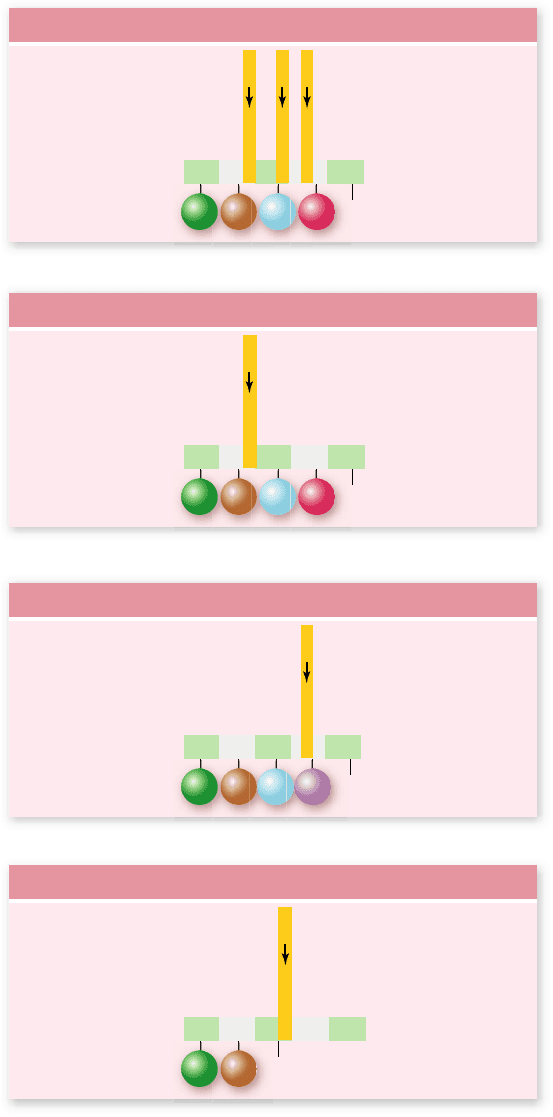
Figure 15.25
Types of mutations.
a. A hypothetical gene
is shown with encoded mRNA and protein. Arrows above the gene
indicate sites of mutations described in the rest of the gure.
b. Silent mutation. A change in the third position of a codon is often
silent due to degeneracy in the genetic code. In this case T/A to
C/G mutation does not change the amino acid encoded (proline).
c. Missesense mutation. The G/C to A/T mutation changes the
amino acid encoded from arginine to histidine. d. Nonsense
mutation. The T/A to A/T mutation produces a UAA stop codon in
the mRNA.
300
part
III
Genetic and Molecular Biology
rav32223_ch15_278-303.indd 300rav32223_ch15_278-303.indd 300 11/9/09 2:42:53 PM11/9/09 2:42:53 PM
Apago PDF Enhancer
A
A B C D E F G H A E F G H I I J J
B C D E F G H I J A B C D B C D E F G H I J
A B C D E F G H I J
A B C D E F G H I J
K L M N O P Q R
K L M D E F G H I J
A B C N O P Q R
A D C B E F G H I J
Duplication
Deletion
Inversion
Reciprocal Translocation
Deleted
Duplicated
Inverted
a.
b.
c.
d.
may not have an effect on phenotype if the sites where the in-
version occurs do not break within a gene. In fact, although
humans all have the “same” genome, the order of genes in all
individuals in a population is not precisely the same due to in-
versions that occur in different lineages.
Translocations
If a piece of one chromosome is broken off and joined to
another chromosome, we call this a translocation. Transloca-
tions are complex because they can cause problems during
meiosis, particularly when two different chromosomes try to
pair with each other during meiosis I.
Translocations can also move genes from one chromo-
somal region to another in a manner that changes the expres-
sion of genes in the region involved. Two forms of leukemia
have been shown to be associated with translocations that move
oncogenes into regions of a chromosome where they are ex-
pressed inappropriately in blood cells.
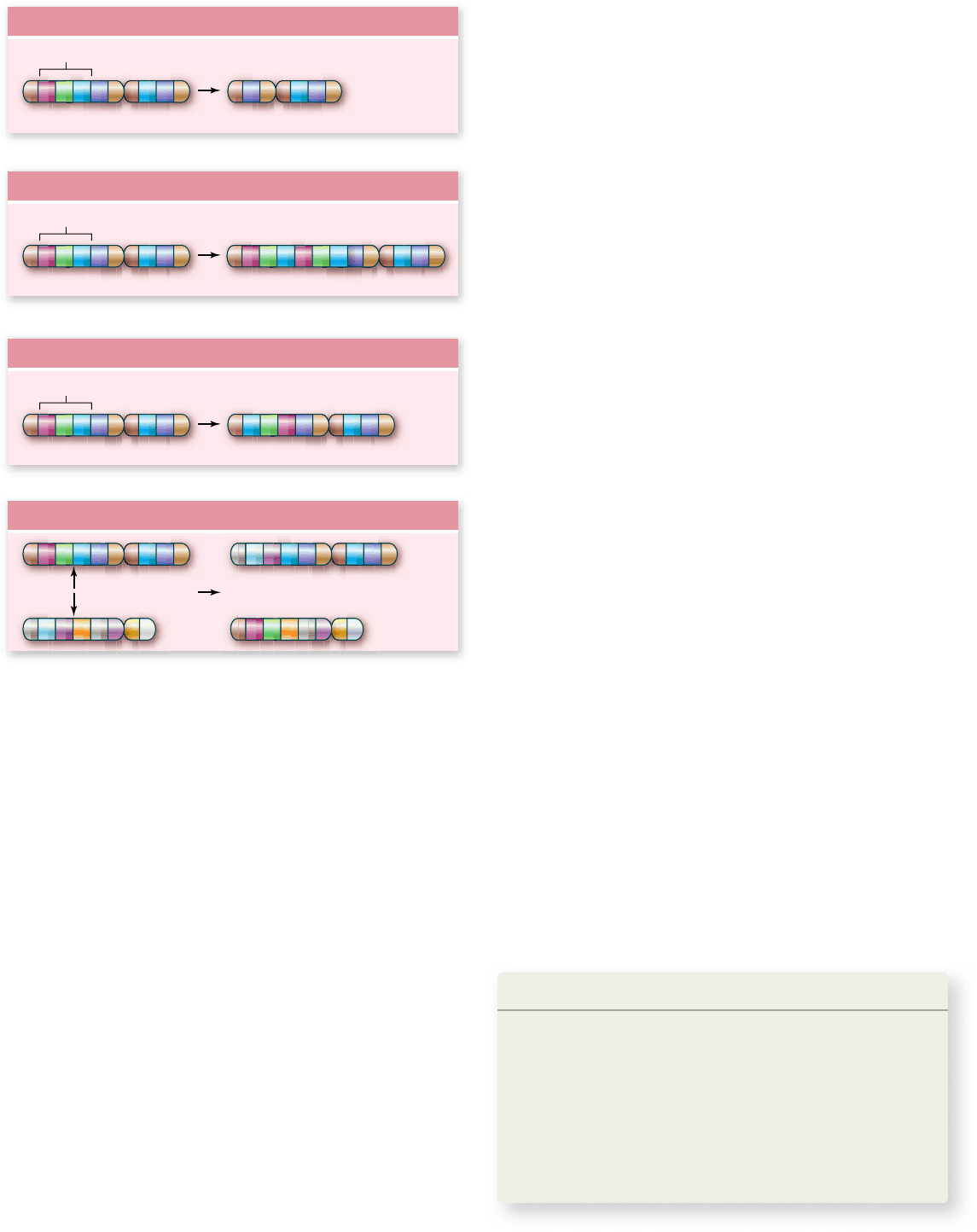
Figure 15.26
Chromosomal mutations.
Larger-scale
changes in chromosomes are also possible. Material can be deleted
(a), duplicated (b), and inverted (c). Translocations occur when one
chromosome is broken and becomes part of another chromosome.
This often occurs where both chromosomes are broken and
exchange material, an event called a reciprocal translocation (d).
Mutations are the starting point of evolution
If no changes occurred in genomes over time, then there could
be no evolution. Too much change, however, is harmful to the
individual with a greatly altered genome. Thus a delicate bal-
ance must exist between the amount of new variation that arises
in a species and the health of individuals in the species. This
topic is explored in more detail later in the book when we con-
sider evolution and population genetics (chapter 20).
The larger scale alteration of chromosomes has also been
important in evolution, although its role is poorly understood. It
is clear that gene families arise by the duplication of an ancestral
gene, followed by the functional divergence of the duplicated
copies. It is also clear that even among closely related species,
the number and arrangements of genes on chromosomes can
differ. Large-scale rearrangements may have occurred.
Our view of the nature of genes
has changed with new information
In this and the preceding chapters, we have seen multiple views
of genes. Mendel used crosses to follow traits determined by
what we now call genes. The behavior of these genes can be
predicted based on the behavior of chromosomes during meio-
sis. Morgan and others learned to map the location of genes on
chromosomes. These findings led to the view of genes as ab-
stract entities that could be followed through generations and
mapped to chromosomal locations like “beads on a string,” with
the beads being genes and the string the chromosome.
The original molecular analysis of genes led to the simple
one-gene/one-polypeptide paradigm. This oversimplification
was changed when geneticists observed the alternative splicing
of eukaryotic genes, which can lead to multiple protein prod-
ucts from the same genetic information. Furthermore, some
genes do not encode proteins at all, but only RNA, which can
either be a part of the gene expression machinery (rRNA,
tRNA, and other forms) or can itself act as an enzyme. Other
stretches of DNA are important for regulating genes but are
not expressed. All of these findings make a simple definition of
genes difficult.
We are left with the rich complexity of the nature of genes,
which defies simple definition. To truly understand the nature of
genes we must consider both their molecular nature as well as
their phenotypic expression. This brings us full circle, back to
the relationship between genotype and phenotype, with a much
greater appreciation for the complexity of this relationship.
Learning Outcomes Review 15.9
Point mutations (single-base changes, additions, or deletions) include missense
mutations that cause substitution of one amino acid for another, nonsense
mutations that halt transcription, and frameshift mutations that throw off the
correct reading of codons. Triplet repeat expansion is the abnormal duplication
of a codon with each round of cell division. Mutations aff ecting chromosomes
include deletions, duplications, inversions, and translocations.
■ Would an inversion or duplication always be expected
to have a phenotype?
chapter
15
Genes and How They Work
301www.ravenbiology.com
rav32223_ch15_278-303.indd 301rav32223_ch15_278-303.indd 301 11/9/09 2:42:53 PM11/9/09 2:42:53 PM