
Raven P.H., Johnson G.B., Mason K.A. Biology (Ninth Edition)
Подождите немного. Документ загружается.

Apago PDF Enhancer
DNA
3„
5„
5„
mRNA
RNA polymerase II
3„
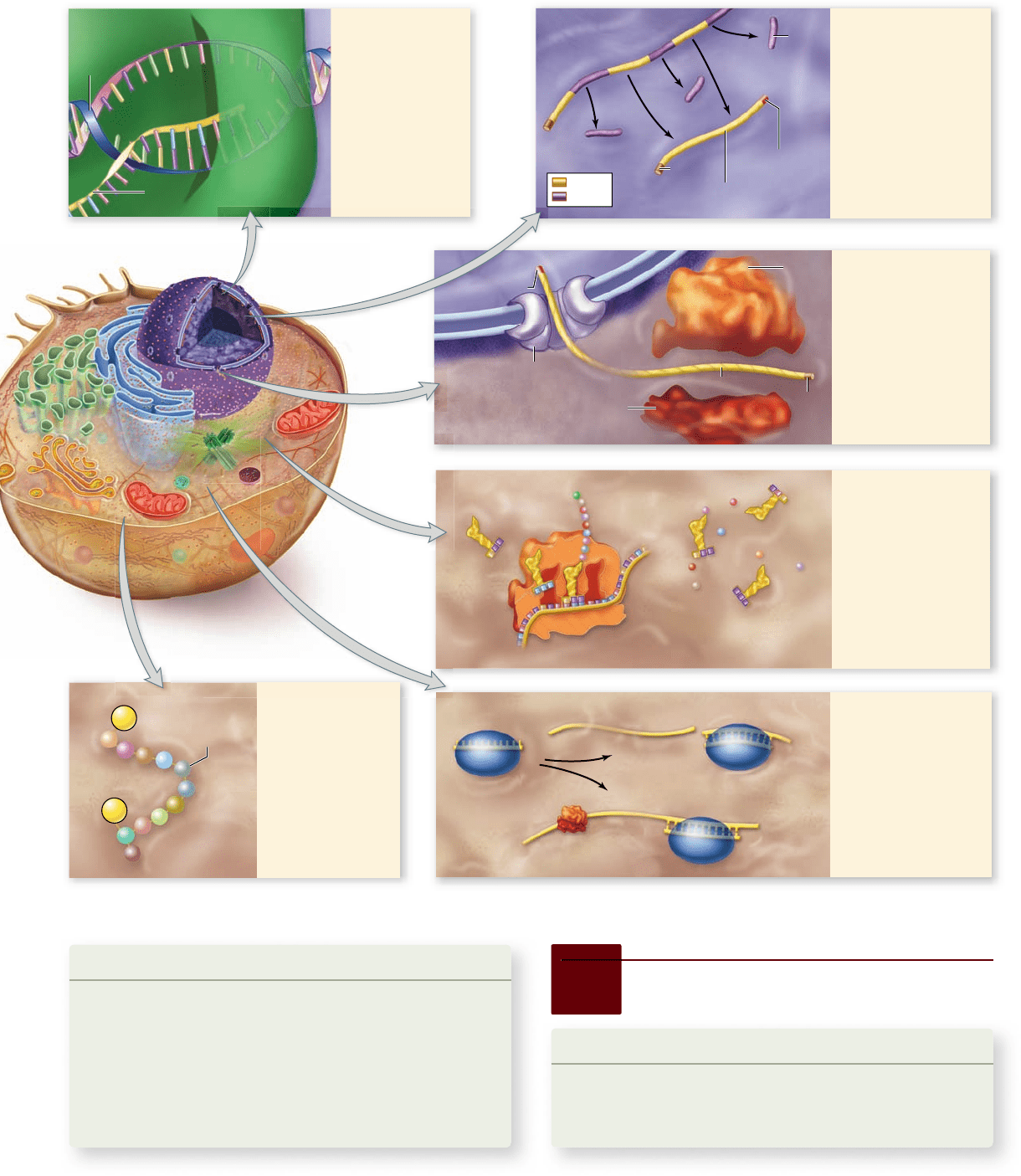
1. Initiation of
transcription
Most control of
gene expression
is achieved
by regulating
the frequency
of transcription
initiation.
2. RNA splicing
Gene expression
can be controlled
by altering the
rate of splicing in
eukaryotes.
Alternative splicing
can produce
multiple mRNAs
from one gene.
3. Passage through
the nuclear
membrane
Gene expression
can be regulated by
controlling access
to or efficiency of
transport channels.
5. RNA interference
Gene expression is
regulated by small
RNAs. Protein
complexes
containing siRNA
and miRNA target
specific mRNAs for
destruction or inhibit
their translation.
4. Protein synthesis
Many proteins
take part in the
translation process,
and regulation of
the availability of
any of them alters
the rate of gene
expression by
speeding or slowing
protein synthesis.
6. Posttranslational
modification
Phosphorylation or
other chemical
modifications can
alter the activity of
a protein after it is
produced.
Primary RNA transcript
Mature RNA transcript
3„ poly-A tail
3„ poly-A tail
Nuclear
pore
Large
subunit
Small
subunit
Cut
intron
5„ cap
5„ cap
Completed
polypeptide
chain
P
P
Exons
Introns
RISC
Learning Outcomes Review 16.6
Small RNAs control gene expression by either selective degradation of
mRNA, inhibition of translation, or alteration of chromatin structure.
Multiple mRNAs can be formed from a single gene via alternative splicing,
which can be tissue- and developmentally specifi c. The sequence of an mRNA
transcript can also be altered by RNA editing.
■ How could the phenomenon of RNA interference be
used in drug design?
16.7
Protein Degradation
Learning Outcomes
Describe the role of ubiquitin in the degradation 1.
of proteins.
Explain the function of the proteasome.2.
Figure 16.20
Mechanisms for control of gene expression in eukaryotes.
322
part
III
Genetic and Molecular Biology
rav32223_ch16_304-326.indd 322rav32223_ch16_304-326.indd 322 11/9/09 3:39:05 PM11/9/09 3:39:05 PM
Apago PDF Enhancer
P
i
ATP
ADP+
Ubiquitin
Protein to be
destroyed
Destroyed by proteolysis
15 nm
The proteasome degrades
polyubiquitinated proteins
The cellular organelle that degrades proteins marked with
ubiquitin is the proteasome, a large cylindrical complex that
proteins enter at one end and exit the other as amino acids or
peptide fragments (figure 16.22) .
The proteasome complex contains a central region that
has protease activity and regulatory components at each end.
Although not membrane-bounded, this organelle can be thought
of as a form of compartmentalization on a very small scale. By
using a two-step process, first to mark proteins for destruction,
then to process them through a large complex, proteins to be
degraded are isolated from the rest of the cytoplasm.
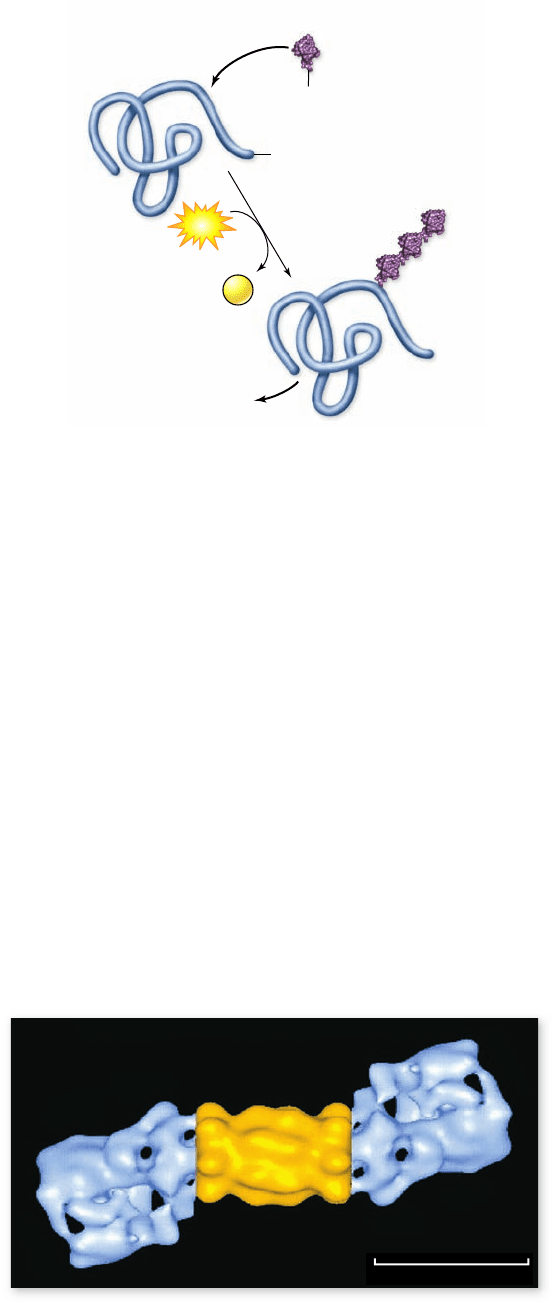
Figure 16.21
Ubiquitination of proteins. Proteins that
are to be degraded are marked with ubiquitin. The enzyme
ubiquitin ligase uses ATP to add ubiquitin to a protein. When a
series of these have been added, the polyubiquitinated protein
is destroyed.
Figure 16.22
The Drosophila proteasome. The central
complex contains the proteolytic activity, and the anking regions
act as regulators. Proteins enter one end of the cylinder and are
cleaved to peptide fragments that exit the other end.
If all of the proteins produced by a cell during its lifetime re-
mained in the cell, serious problems would arise. Protein label-
ing studies in the 1970s indicated that eukaryotic cells turn over
proteins in a controlled manner. That is, proteins are continu-
ally being synthesized and degraded. Although this protein
turnover is not as rapid as in prokaryotes, it indicates that a
system regulating protein turnover is important.
Proteins can become altered chemically, rendering them
nonfunctional; in addition, the need for any particular protein
may be transient. Proteins also do not always fold correctly, or
they may become improperly folded over time. These changes
can lead to loss of function or other chemical behaviors, such as
aggregating into insoluble complexes. In fact, a number of neu-
rodegenerative diseases, such as Alzheimer dementia, Parkin-
son disease, and mad cow disease, are related to proteins that
aggregate, forming characteristic plaques in brain cells. Thus,
in addition to normal turnover of proteins, cells need a mecha-
nism to get rid of old, unused, and incorrectly folded proteins.
Enzymes called proteases can degrade proteins by break-
ing peptide bonds, converting a protein into its constituent
amino acids. Although there is an obvious need for these en-
zymes, they clearly cannot be floating around in the cytoplasm
active at all times.
One way that eukaryotic cells handle such problems is to
confine destructive enzymes to a specific cellular compartment.
You may recall from chapter 4 that lysosomes are vesicles that
contain digestive enzymes, including proteases. Lysosomes are
used to remove proteins and old or nonfunctional organelles,
but this system is not specific for particular proteins. Cells need
another regulated pathway to remove proteins that are old or
unused, but leave the rest of cellular proteins intact.
Addition of ubiquitin marks
proteins for destruction
Eukaryotic cells solve this problem by marking proteins for de-
struction, then selectively degrading them. The mark that cells
use is the attachment of a ubiquitin molecule. Ubiquitin, so
named because it is found in essentially all eukaryotic cells (that
is, it is ubiquitous), is a 76–amino-acid protein that can exist as
an isolated molecule or in longer chains that are attached to
other proteins.
The longer chains are added to proteins in a stepwise
fashion by an enzyme called ubiquitin ligase (figure 16.21). This
reaction requires ATP and other proteins, and it takes place in
a multistep, regulated process. Proteins that have a ubiquitin
chain attached are called polyubiquitinated, and this state is a sig-
nal to the cell to destroy this protein.
Two basic categories of proteins become ubiquitinated:
those that need to be removed because they are improperly
folded or nonfunctional, and those that are produced and de-
graded in a controlled fashion by the cell. An example of the
latter are the cyclin proteins that help to drive the cell cycle
(chapter 10). When these proteins have fulfilled their role in
active division of the cell, they become polyubiquitinated and
are removed. In this way, a cell can control entry into cell divi-
sion or maintain a nondividing state.
chapter
16
Control of Gene Expression
323www.ravenbiology.com
rav32223_ch16_304-326.indd 323rav32223_ch16_304-326.indd 323 11/11/09 2:52:00 PM11/11/09 2:52:00 PM
Apago PDF Enhancer
ADP
Ubiquitin
Ubiquitin ligase
Targeted
protein
Degradation
Proteasome
P
i
ADP+
P
i
ADP+
Ubiquitination
Polypeptide
fragments
ATP
ATP
ATP
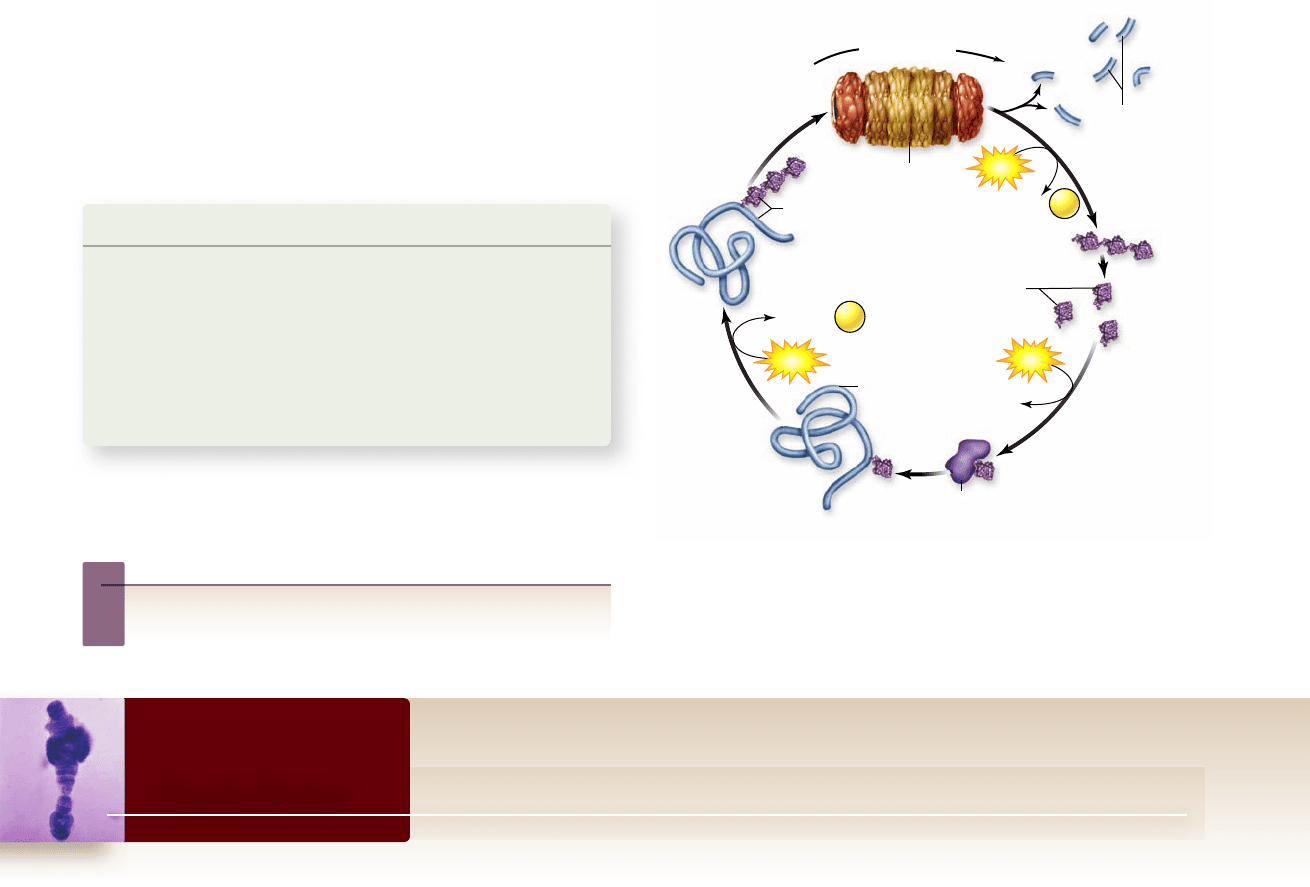
The process of ubiquitination followed by degradation by
the proteasome is called the ubiquitin–proteasome pathway. It can
be thought of as a cycle in that the ubiquitin added to proteins
is not itself destroyed in the proteasome. As the proteins are
degraded, the ubiquitin chain itself is simply cleaved back into
ubiquitin units that can then be reused (figure 16.23).
Learning Outcomes Review 16.7
Control of protein degradation in eukaryotes involves addition of the
protein ubiquitin, which marks the protein for destruction. The proteasome,
a cylindrical complex with protease activity in its center, recognizes
ubiquitinated proteins and breaks them down, much like a shredder
destroys documents. Ubiquitin is recycled unchanged.
■ If the ubiquitination process was not tightly controlled,
what effect would this have on a cell?
16.3 Prokaryotic Regulation
Control of transcription can be either positive or negative.
Negative control is mediated by proteins called repressors that
interfere with transcription. Positive control is mediated by a class of
regulatory proteins called activators that stimulate transcription.
Prokaryotes adjust gene expression in response to environmental
conditions.
The lac operon is induced in the presence of lactose; that is, the
enzymes to utilize lactose are only produced when lactose is present.
The trp operon is repressed; that is, the enzymes needed to produce
tryptophan are turned off when tryptophan is present.
The lac operon is negatively regulated by the lac repressor.
The lac operon is induced when the effector (allolactose) binds to the
repressor, altering its conformation such that it no longer binds DNA
(see gure 16.4).
The presence of glucose prevents induction of the lac operon
Maximal expression of the lac operon requires positive control by
catabolite activator protein (CAP) complexed with cAMP. When
glucose is low, cAMP is high. Glucose repression involves both
inducer exclusion, in which lactose is prevented from entering the
cell, and the control of CAP function by the level of glucose.
The trp operon is controlled by the trp repressor.
The trp operon is repressed when tryptophan, acting as a corepressor,
binds to the repressor, altering its conformation such that it can bind
to DNA and turn off the operon. This prevents expression in the
presence of excess trp.
16.1 Control of Gene Expression
Control usually occurs at the level of transcription initiation.
Transcription is controlled by regulatory proteins that modulate
the ability of RNA polymerase to bind to the promoter. These may
either block transcription or stimulate it.
Control strategies in prokaryotes are geared to adjust to
environmental changes.
Control strategies in eukaryotes are aimed at maintaining
homeostasis.
16.2 Regulatory Proteins
Proteins can interact with DNA through the major groove.
A DNA double helix exhibits a major groove and a minor groove;
bases in the major groove are accessible to regulatory proteins.
DNA-binding domains interact with speci c DNA sequences.
A region of the regulatory protein that can bind to the DNA is
termed a DNA-binding motif (see gure 16.2).
Several common DNA-binding motifs are shared by
many proteins.
Common motifs include the helix-turn-helix motif, the
homeodomain motif, the zinc finger motif, and the
leucine zipper.
Chapter Review
Figure 16.23
Degradation by the ubiquitin–
proteasome pathway. Proteins are rst ubiquitinated, then
enter the proteasome to be degraded. In the proteasome, the
polyubiquitin is removed and then is later “deubiquitinated”
to produce single ubiquitin molecules that can be reused.
Inquiry question
?
What are two reasons a cell would polyubiquitinate a
polypeptide?
324
part
III
Genetic and Molecular Biology
rav32223_ch16_304-326.indd 324rav32223_ch16_304-326.indd 324 11/9/09 3:39:07 PM11/9/09 3:39:07 PM

Apago PDF Enhancer
16.4 Eukaryotic Regulation
Transcription factors can be either general or speci c.
General transcription factors are needed to assemble the
transcription apparatus and recruit RNA polymerase II at the
promoter. Speci c factors act in a tissue- or time-dependent manner
to stimulate higher rates of transcription.
Promoters and enhancers are binding sites for transcription factors.
General factors bind to the promoter to recruit RNA polymerase.
Speci c factors bind to enhancers, which may be distant from the
promoter but can be brought closer by DNA looping.
Coactivators and mediators link transcription factors to RNA
polymerase II (see gure 16.12).
Some, but not all, transcription factors require a mediator. The
number of coactivators is small because a single coactivator can be
used with multiple transcription factors.
The transcription complex brings things together.
16.5 Eukaryotic Chromatin Structure
In eukaryotes, DNA is wrapped around proteins called histones,
forming nucleosomes. These may block binding of transcription
factors to promoters and enhancers.
Both DNA and histone proteins can be modi ed.
Methylation of DNA bases, primarily cytosine, correlates with genes
that have been “turned off.” Methylation is associated with inactive
regions of chromatin.
Some transcription activators alter chromatin structure.
Acetylation of histones results in active regions of chromatin.
Chromatin-remodeling complexes also change
chromatin structure.
Chromatin-remodeling complexes contain enzymes that move,
reposition, and transfer nucleosomes.
16.6 Eukaryotic Posttranscriptional Regulation
Small RNAs act after transcription to control gene expression.
RNA interference is mediated by siRNAs formed by cleavage of
double-stranded RNA by the Dicer nuclease. The siRNA is bound to
a protein, Argonaute, in an RNA Induced Silencing Complex (RISC).
The RISC can cleave mRNA or inhibit translation. Another class
of small RNA, miRNA, is formed by the action of two nucleases,
Drosha and Dicer, on RNA stem-and-loop structures. These also
form a RISC that can either degrade mRNA or stop translation.
Small RNAs can mediate heterochromatin formation.
In ssion yeast, Drosophila, and plants, RNA interference pathways
lead to the formation of heterochromatin.
Alternative splicing can produce multiple proteins from one gene.
In response to tissue-speci c factors, alternative splicing of pre-
mRNA from one gene can result in multiple proteins.
RNA editing alters mRNA after transcription.
mRNA must be transported out of the nucleus for translation.
Initiation of translation can be controlled.
Translation factors may be modi ed to control initiation; translation
repressor proteins can bind to the beginning of a transcript so that it
cannot attach to the ribosome.
The degradation of mRNA is controlled.
An mRNA transcript is relatively stable, but it may carry targets for
enzymes that degrade it more quickly as needed by the cell.
16.7 Protein Degradation
Addition of ubiquitin marks proteins for destruction.
In eukaryotes, proteins targeted for destruction have ubiquitin added
to them as a marker.
The proteasome degrades polyubiquitinated proteins.
A cell organelle—the cylindrical proteasome—degrades ubiquitinated
proteins that pass through it.
4. The lac operon is controlled by two main proteins. These proteins
a. both act in a negative fashion.
b. both act in a positive fashion.
c. act in the opposite fashion, one negative and one positive.
d. act at the level of translation.
5. In eukaryotes, binding of RNA polymerase to a promoter
requires the action of
a. speci c transcription factors.
b. general transcription factors.
c. repressor proteins.
d. inducer proteins.
6. In eukaryotes, the regulation of gene expression occurs
a. only at the level of transcription.
b. only at the level of translation.
c. at the level of transcription initiation, or
posttranscriptionally.
d. only posttranscriptionally.
UNDERSTAND
1. In prokaryotes, control of gene expression usually occurs at the
a. splicing of pre-mRNA into mature mRNA.
b. initiation of translation.
c. initiation of transcription.
d. all of the above
2. Regulatory proteins interact with DNA by
a. unwinding the helix and changing the pattern of base-pairing.
b. binding to the sugar–phosphate backbone of the
double helix.
c. unwinding the helix and disrupting base-pairing.
d. binding to the major groove of the double helix and
interacting with base-pairs.
3. In E. coli, induction in the lac operon and repression in the trp
operon are both examples of
a. negative control by a repressor.
b. positive control by a repressor.
c. negative control by an activator.
d. positive control by a repressor.
Review Questions
chapter
16
Control of Gene Expression
325www.ravenbiology.com
rav32223_ch16_304-326.indd 325rav32223_ch16_304-326.indd 325 11/9/09 3:39:08 PM11/9/09 3:39:08 PM

Apago PDF Enhancer
7. In the trp operon, the repressor binds to DNA
a. in the absence of trp.
b. in the presence of trp.
c. in either the presence or absence of trp.
d. only when trp is needed in the cell.
APPLY
1. The lac repressor, the trp repressor and CAP are all
a. negative regulators of transcription.
b. positive regulators of transcription.
c. allosteric proteins that bind to DNA and an effector.
d. proteins that can bind DNA or other proteins.
2. Speci c transcription factors in eukaryotes interact with
enhancers, which may be a long distance from the promoter.
These transcription factors then
a. alter the structure of the DNA between enhancer and promoter.
b. do not interact with the transcription apparatus.
c. can interact with the transcription apparatus via DNA looping.
d. can interact with the transcription apparatus by removing
the intervening DNA.
3. Repression in the trp operon and induction in the lac operon are
both mechanisms that
a. would only be possible with positive regulation.
b. allow the cell to control the level of enzymes to t
environmental conditions.
c. would only be possible with negative regulation.
d. cause the cell to make the enzymes from these two operons
all the time.
4. Regulation by small RNAs and alternative splicing are similar in
that both
a. act after transcription.
b. act via RNA/protein complexes.
c. regulate the transcription machinery.
d. both a and b
5. Eukaryotic mRNAs differ from prokaryotic mRNAs in that they
a. usually contain more than one gene.
b. are colinear with the genes that encode them.
c. are not colinear with the genes that encode them.
d. both a and c
6. In the cell cycle, cyclin proteins are produced in concert with
the cycle. This likely involves
a. control of initiation of transcription of cyclin genes, and
ubiquitination of cyclin proteins.
b. alternative splicing of cyclin genes to produce different
cyclin proteins.
c. RNA editing to produce the different cyclin proteins.
d. transcription/translation coupling.
7. A mechanism of control in E. coli not discussed in this chapter
involves pausing of ribosomes allowing a transcription
terminator to form in the mRNA. In eukaryotic ssion yeast,
this mechanism should
a. be common since they are unicellular.
b. not be common since they are unicellular.
c. not occur as transcription occurs in the nucleus and
translation in the cytoplasm.
d. not occur due to possibility of alternative splicing.
SYNTHESIZE
1. You have isolated a series of mutants affecting regulation of the
lac operon. All of these are constitutive, that is, they express the
lac operon all the time. You also have both mutant and wild-type
alleles for each mutant in all combinations, and on F ' plasmids,
which can be introduced into cells to make the cell diploid for
the relevant genes. How would you use these tools to determine
which mutants affect DNA binding sites on DNA, and which
affect proteins that bind to DNA?
2. Examples of positive and negative control of transcription can
be found in the regulation of expression of the bacterial operons
lac and trp. Use these two operon systems to describe the
difference between positive and negative regulation.
3. What forms of eukaryotic control of gene expression are unique
to eukaryotes? Could prokaryotes use the mechanisms, or are
they due to differences in these cell types?
4. The number and type of proteins found in a cell can be
in uenced by genetic mutation and regulation of gene
expression. Discuss how these two processes differ.
ONLINE RESOURCE
www.ravenbiology.com
Understand, Apply, and Synthesize—enhance your study with
animations that bring concepts to life and practice tests to assess
your understanding. Your instructor may also recommend the
interactive eBook, individualized learning tools, and more.
326
part
III
Genetic and Molecular Biology
rav32223_ch16_304-326.indd 326rav32223_ch16_304-326.indd 326 11/9/09 3:39:08 PM11/9/09 3:39:08 PM
Apago PDF Enhancer
O
0.3
μ
m
C h a p t e r
17
Bi otechn olo gy
Chapter Outline
1 7. 1 DNA Manipulation
17.2 Molecular Cloning
17.3 DNA Analysis
17.4 Genetic Engineering
17.5 Medical Applications
17.6 Agricultural Applications
Introduction
Over the past decades, the development of new and powerful techniques for studying and manipulating DNA has
revolutionized biology. The knowledge gained in the last 25 years is greater than that accrued during the history of biology.
Biotechnology also affects more aspects of everyday life than any other area of biology. From the food on your table to the
future of medicine, biotechnology touches your life.
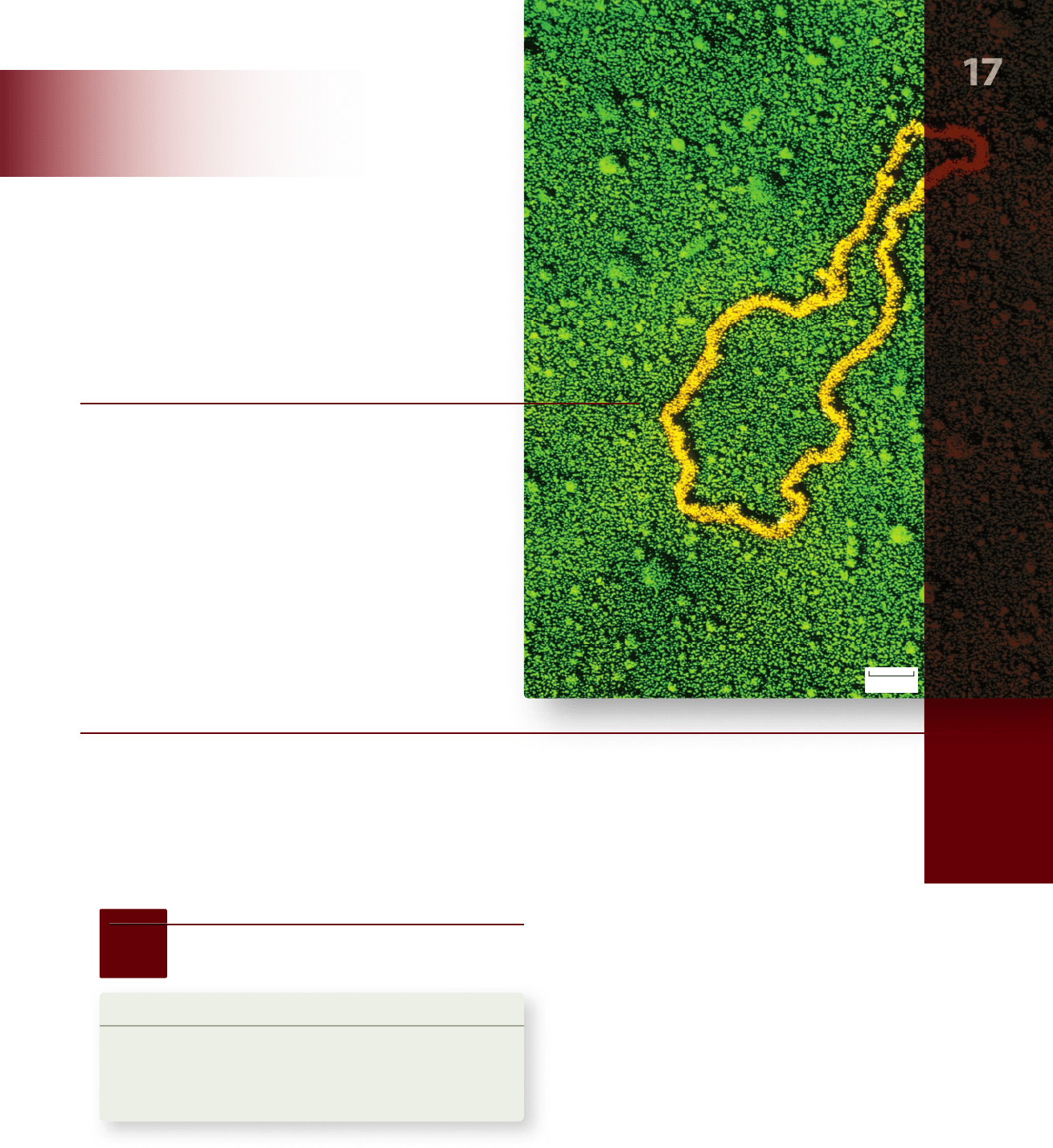
Biotechnology is the application of molecular biology principles to numerous aspects of life. The ability to isolate
specific DNA sequences arose from the study and use of small DNA molecules found in bacteria, like the plasmid pictured
here. In this chapter, we explore these technologies and consider how they apply to specific problems of practical importance.
CHAPTER
17.1
DNA Manipulation
Learning Outcomes
Relate endogenous roles of enzymes to their recombinant 1.
DNA applications.
Explain why DNA fragments can be separated with gel 2.
electrophoresis.
The ability to directly isolate and manipulate genetic material
was one of the most profound changes in the field of biology in
the late 20th century. The construction of recombinant DNA
molecules, that is, a single DNA molecule made from two dif-
ferent sources, began in the mid-1970s. The development of
this technology, which has led to the entire field of biotechnol-
ogy, is based on enzymes that can be used to manipulate DNA.
Restriction enzymes cleave DNA at speci c sites
Enzymes called restriction endonucleases revolutionalized
molecular biology because of their ability to cleave DNA at
specific sites. As described in chapter 14, nucleases are enzymes
that degrade DNA, and many were known prior to the isolation
of the first restriction enzyme (HindII) in 1970 . If a DNA se-
quence were a rope, then restriction enzymes would be a knife
that always cut that rope into specific pieces.
rav32223_ch17_327-351.indd 327rav32223_ch17_327-351.indd 327 11/10/09 2:43:09 PM11/10/09 2:43:09 PM
Apago PDF Enhancer
C
C G
G T
A
T
A
A
T
A
T
C
C G
G T
A
T
A
A
T
A
T
C
G
A A T T
C
G
A A T T
C
G
T T A A
C
G
T T A A
C
G
A A T T
DNA ligase
joins the strands.
DNA
duplex
C
G
A A
T T
C
G
A A T T
Sticky ends
Restriction sites
EcoRI
Recombinant DNA molecule
Restriction endonuclease
cleaves the DNA
EcoRI
EcoRI
EcoRI
DNA from another source cut with the
same restriction endonuclease is added.
Restriction endonuclease
cleaves the DNA
Sticky ends
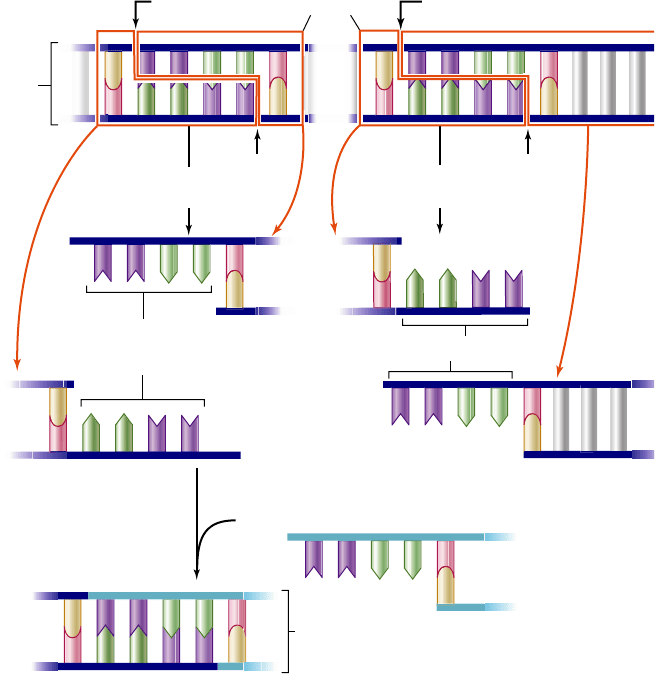
Figure 17.1
Many restriction endonucleases produce
DNA fragments with “sticky ends.”
The restriction
endonuclease EcoRI always cleaves the sequence 5'GAATTC3'
between G and A. Because the same sequence occurs on both
strands, both are cut. However, the two sequences run in opposite
directions on the two strands. As a result, single-stranded tails
called “sticky ends” are produced that are complementary to each
other. These complementary ends can then be joined to a fragment
from another DNA that is cut with the same enzyme. These two
molecules can then be joined by DNA ligase to produce a
recombinant molecule.
Discovery and significance of restriction endonucleases
This site-specific cleavage activity, long sought by molecular
biologists, was discovered from basic research into why bacte-
rial viruses can infect some cells but not others. This phenom-
enon was termed host restriction. The bacteria produce enzymes
that can cleave the invading viral DNA at specific sequences.
The host cells protect their own DNA from cleavage by modi-
fying it at the cleavage sites; the restriction enzymes do not
cleave that modified DNA. Since the initial discovery of these
restriction endonucleases, hundreds more have been isolated
that recognize and cleave different restriction sites.
The ability to cut DNA at specific places is significant in
two ways: First, it allows physical maps to be constructed based
on the positioning of cleavage sites for restriction enzymes.
These restriction maps provide crucial data for identifying and
working with DNA molecules.
Second, restriction endonuclease cleavage allows the cre-
ation of recombinant molecules. The ability to construct re-
combinant molecules is critical to research, because many steps
in the process of cloning and manipulating DNA require the
ability to combine molecules from different sources.
How restriction enzymes work
There are three types of restriction enzymes, but only type II
cleaves at precise locations. Types I and III cleave with less preci-
sion and are not often used in cloning and manipulating DNA.
Type II enzymes allow creation of recombinant mole-
cules; these enzymes recognize a specific DNA sequence, rang-
ing from 4 bases to 12 bases, and cleave the DNA at a specific
base within this sequence (figure 17.1).
The recognition sites for most type II enzymes are palin-
dromes. A linguistic palindrome is a word or phrase that reads
the same forward and in reverse, such as the sentence: “Madam
I’m Adam.” The palindromic DNA sequence reads the same
from 5' to 3' on one strand as it does on the complementary
strand (see figure 17.1).
Given this kind of sequence, cutting the DNA at the same
base on either strand can lead to staggered cuts that produce
“sticky ends.” These short, unpaired sequences are the same for
any DNA that is cut by this enzyme. Thus, these sticky ends
allow DNAs from different sources to be easily joined together
(see figure 17.1). While less common, some type II restriction
enzymes, including PvuII, can cut both strands in the same po-
sition, producing blunt, not sticky, ends. Blunt cut ends can be
joined with other blunt cut ends.
DNA ligase allows construction
of recombinant molecules
Because the two ends of a DNA molecule cut by a type II re-
striction enzyme have complementary sequences, the pair can
form a duplex. An enzyme is needed, however, to join the two
fragments together to create a stable DNA molecule. The en-
zyme DNA ligase accomplishes this by catalyzing the forma-
tion of a phosphodiester bond between adjacent phosphate and
hydroxyl groups of DNA nucleotides. The action of ligase is to
seal nicks in one or both strands (see figure 17.1). This is the
same enzyme that joins Okazaki fragments on the lagging
strand during DNA replication (see chapter 14 ) .
Gel electrophoresis separates DNA fragments
The fragments produced by restriction enzymes would not be
of much use if we could not also easily separate them for analy-
sis. The most common separation technique used is gel electro-
phoresis. This technique takes advantage of the negative charge
on DNA molecules by using an electrical field to provide the
force necessary to separate DNA molecules based on size.
The gel, which is made of either agarose or polyacrylamide
and spread thinly on supporting material, provides a three-
dimensional matrix that separates molecules based on size
( figure 17.2). The gel is submerged in a buffer solution containing
ions that can carry current and is subjected to an electrical field.
328
part
III
Genetic and Molecular Biology
rav32223_ch17_327-351.indd 328rav32223_ch17_327-351.indd 328 11/10/09 2:43:14 PM11/10/09 2:43:14 PM
Apago PDF Enhancer
Restriction endonuclease
1 cut site
Restriction endonuclease
2 cut site
Reaction
1
Reaction
2
Reaction
3
Restriction
endonuclease 3
Short segment Long segment
Medium segment Medium segment
Mixture of DNA
fragments of
different sizes in
solution placed at
the top of “lanes” in
the gel
Gel
Buffer
Lane
Anode
+
Cathode
-
Power
source
Short segment Long segment
Reaction 2
Reaction 1
Reaction 3
Shorter
fragments
Longer
fragments
Visualizing Stained Gel
Gel is stained with a dye to allow
the fragments to be visualized.
DNA samples are cut with restriction enzymes in three
different reactions producing different patterns of fragments.
Samples from the restriction enzyme digests are introduced into the gel.
Electric current is applied causing fragments to migrate through the gel.
Electrophoresis in the Laboratory
Restriction Enzyme Digestion
Gel Electrophoresis
a. b.
c.
d.
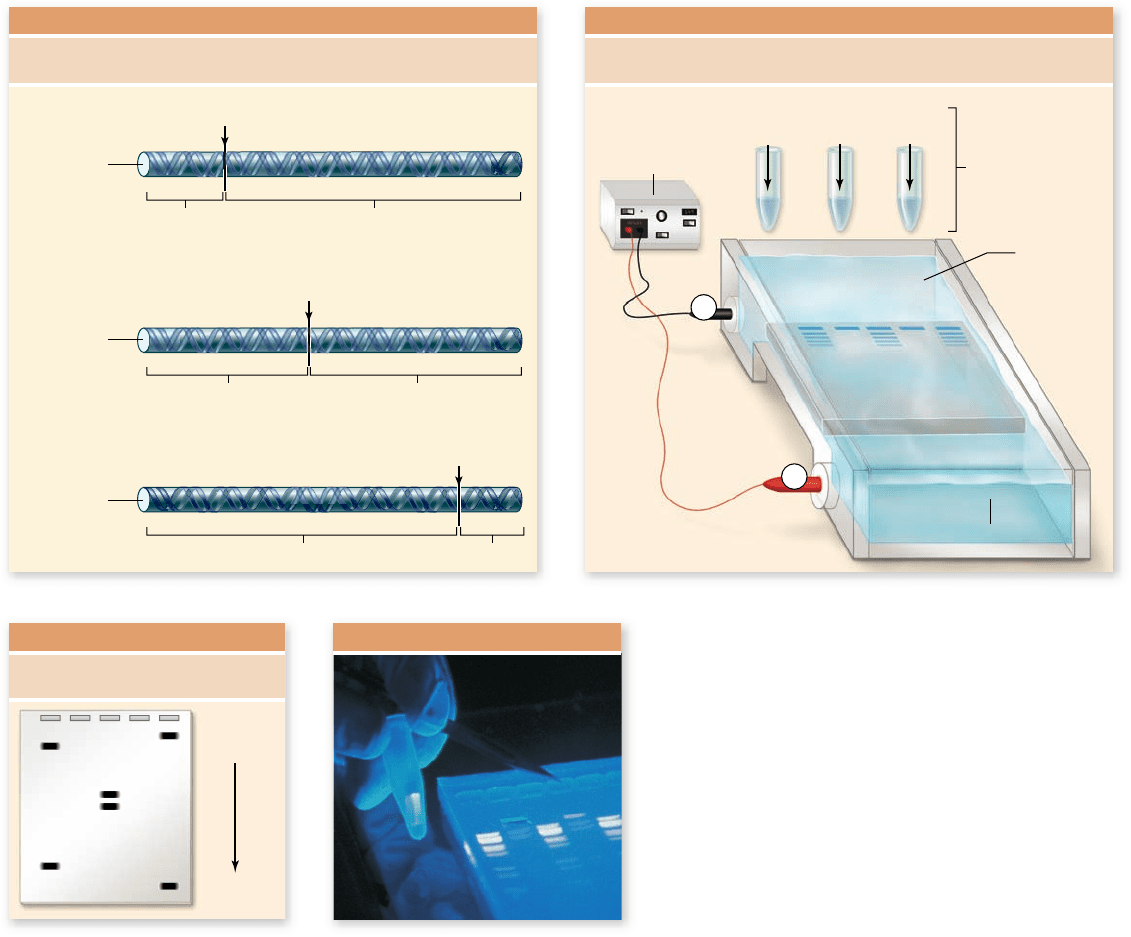
Figure 17.2
Gel electrophoresis.
a. Three
restriction enzymes are used to cut DNA into speci c
pieces depending on each enzyme’s recognition sequence.
b. The fragments are loaded into a gel (agarose or
polyacrylamide), and an electrical current is applied. The
DNA fragments migrate through the gel based on size,
with larger ones moving more slowly. c. This results in a
pattern of fragments separated based on size, with the
smaller fragments migrating farther than larger ones.
d. The fragments can be visualized by staining with the dye
ethidium bromide. When the gel is exposed to UV light,
the DNA with bound dye uoresces, appearing as pink
bands in the gel. In the photograph, one band of DNA has
been excised from the gel for further analysis and can be
seen glowing in the tube the technician holds.
reintroduce these molecules into cells. In chapter 14 you
learned that Frederick Griffith demonstrated that genetic ma-
terial could be transferred between bacterial cells. This pro-
cess, called transformation, is a natural process in the cells that
Griffith was studying.
The bacterium E. coli, used routinely in molecular biology
laboratories, does not undergo natural transformation; but arti-
ficial transformation techniques have been developed to allow
introduction of foreign DNA into E. coli. Through temperature
shifts or an electical charge, the E. coli membrane becomes
transiently permeable to the foreign DNA. In this way, recom-
binant molecules can be propagated in a cell that will make
many copies of the constructed molecules.
In general, the introduction of DNA from an outside
source into a cell is referred to as transformation. This pro-
cess is important in E. coli for molecular cloning and the
propagation of cloned DNA. Researchers also want to be able
The strong negative charges from the phosphate groups in
the DNA backbone cause it to migrate toward the positive pole
(figure 17.2b). The gel acts as a sieve to separate DNA molecules
based on size: The larger the molecule, the slower it will move
through the gel matrix. Over a given period, smaller molecules
migrate farther than larger ones. The DNA in gels can be visual-
ized using a fluorescent dye that binds to DNA (figure 17.2c, d).
Electrophoresis is one of the most important methods in
the toolbox of modern molecular biology, with uses ranging
from DNA fingerprinting to DNA sequencing, both of which
are described later on.
Transformation allows introduction
of foreign DNA into E. coli
The construction of recombinant molecules is the first step
toward genetic engineering. It is also necessary to be able to
chapter
17
Biotechnology
329www.ravenbiology.com
rav32223_ch17_327-351.indd 329rav32223_ch17_327-351.indd 329 11/10/09 2:43:14 PM11/10/09 2:43:14 PM

Apago PDF Enhancer
17.2
Molecular Cloning
Learning Outcomes
Explain the role of a vector in molecular cloning. 1.
Describe how a DNA library is constructed.2.
The term clone refers to a genetically identical copy. The tech-
nique of propagating plants by growing a new plant from a cut-
ting of a donor plant is an early method of cloning widely used
in agriculture and horticulture. The topic of cloning entire or-
ganisms is discussed in chapter 19 . For now, we explore the idea
of molecular cloning.
Molecular cloning involves the isolation of a specific se-
quence of DNA, usually one that encodes a particular protein
product. This is sometimes called gene cloning, but the term
molecular cloning is more accurate.
Host–vector systems allow propagation
of foreign DNA in bacteria
Although short sequences of DNA can be synthesized in vitro
(in a test tube), the cloning of large unknown sequences re-
quires propagation of recombinant DNA molecules in vivo (in
a cell). The enzymes and methods described earlier allow biolo-
gists to produce, separate, and then introduce foreign DNA
into cells.
The ability to propagate DNA in a host cell requires
a vector (something to carry the recombinant DNA
molecule) that can replicate in the host when it has been
introduced. Such host–vector systems are crucial to mo-
lecular biology.
to reintroduce DNA into the original cells from which it was
isolated. A transformed cell that can also be used to form all
or part of an organism, is called a transgenic organism. Later
in this chapter we explore the construction and uses of trans-
genic plants and animals.
Learning Outcomes Review 17.1
Restriction endonucleases are part of bacterial cells’ strategies to fi ght viral
infection. Type II endonucleases cleave DNA at specifi c sites. DNA ligase
can be used to link together fragments following action of restriction
endonucleases. Gel electrophoresis employs electrical charge to separate
DNA fragments according to size. Foreign DNA can be introduced into E.
coli through artifi cial transformation, and then propagation can produce
cloned DNA.
■ Compare and contrast the endogenous roles of EcoRI
and ligase in E. coli with their use in a molecular
biology lab.
The most flexible and common host used for molecular
cloning is the bacterium E. coli, but many other hosts are now
possible. Investigators routinely reintroduce cloned eukaryotic
DNA, using mammalian tissue culture cells, yeast cells, and
insect cells as host systems. Each kind of host–vector system
allows particular uses of the cloned DNA.
The two most commonly used vectors are plasmids and
artificial chromosomes . Plasmids are small, circular extrachro-
mosomal DNAs that are dispensable to the bacterial cell. Bac-
terial and eukaryotic artificial chromosomes are used to clone
larger pieces of DNA.
Plasmid vectors
Plasmid vectors (small, circular chromosomes) are typically used
to clone relatively small pieces of DNA, up to a maximum of about
10 kilobases (kb). A plasmid vector must have three components:
An 1. origin of replication to allow it to be replicated in E. coli
independently of the host chromosome,
A 2. selectable marker, usually antibiotic resistance, and
3. One or more unique restriction sites where foreign DNA can
be added.
The selectable marker allows the presence of the plasmid to be
easily identified through genetic selection. For example, cells
that contain a plasmid with an antibiotic resistance gene con-
tinue to live when plated on antibiotic-containing growth me-
dia, whereas cells that lack the plasmid will die (they are killed
by the antibiotic).
A fragment of DNA is inserted by the techniques de-
scribed into a region of the plasmid with restriction sites
called the multiple-cloning site (MCS). This region contains
a number of unique restriction sites such that when the plas-
mid is cut with the relevant restriction enzymes, a linear plas-
mid results. When DNA of interest is cut with the same
restriction enzyme, it can then be ligated into this site. The
plasmid is then introduced into cells by transformation (see
figure 17.3).
This region of the vector often has been engineered to
contain another gene that becomes inactivated, so-called inser-
tional inactivation, because it is now interrupted by the inserted
DNA. One of the first cloning vectors, pBR322, used another
antibiotic resistance gene for insertional activation; resistance
to one antibiotic and sensitivity to the other indicated the pres-
ence of inserted DNA.
More recent vectors use the gene for β-galactosidase, an
enzyme that cleaves galactoside sugars such as lactose. When the
enzyme cleaves the artificial substrate X-gal, a blue color is pro-
duced. In these plasmids, insertion of foreign DNA interrupts
the β-galactosidase gene, preventing a functional enzyme from
being produced. When transformed cells are plated on medium
containing both antibiotic (to select for plasmid-containing cells)
and X-gal, they remain white, whereas transformed cells with no
inserted DNA are blue (see figure 17.3).
Artificial Chromosomes
The size of DNA molecules that can be cloned in plasmid vec-
tors has limited the large-scale analysis of genomes. To deal
330
part
III
Genetic and Molecular Biology
rav32223_ch17_327-351.indd 330rav32223_ch17_327-351.indd 330 11/10/09 2:43:15 PM11/10/09 2:43:15 PM
Apago PDF Enhancer
Ampicillin
resistance
gene
lacZ gene
Restriction enzymes
cuts within
the lacZ gene
Foreign DNA
and DNA ligase
are added
Foreign
DNA
DNA
inserted
No DNA
inserted
Medium contains
ampicillin and X-gal
Transform
Transform
Active lacZ
gene produces
blue colonies
Inactive lacZ
gene produces
white colonies
Restriction
endonuclease
A Plasmid Vector
Each cell contains a
single fragment. All cells
together are the library.
DNA fragments
from source DNA
Transformation
DNA inserted
into plasmid vector
Plasmid Library
with this, geneticists decided to follow the strategy of cells and
construct chromosomes, leading to the development of yeast
artificial chromosomes (YACs) and bacterial artificial chromo-
somes (BACs). Progress has also been made on creating mam-
malian artificial chromosomes. Use of artificial chromosomes is
described in the next chapter.
Inquiry question
?
An investigator wishes to clone a 32-kb recombinant
molecule. What do you think is the best vector to use?
DNA libraries contain the entire
genome of an organism
The idea of molecular cloning depends on the ability to con-
struct a representation of very complex mixtures in DNA, such
as an entire genome, in a form that is easier to work with than
the enormous chromosomes within a cell. If the huge DNA
molecules in chromosomes can be converted into random frag-
ments, and inserted into a vector such as plasmids, then when
they are propagated in a host they will together represent the
whole genome. This aggregate is termed a DNA library, a col-
lection of DNAs in a vector that taken together represent the
complex mixture of DNA (figure 17.4).
Conceptually the simplest possible kind of DNA library
is a genomic library—a representation of the entire genome in
a vector. This genome is randomly fragmented by partially di-
gesting it with a restriction enzyme that cuts frequently. By not
cutting the DNA to completion, not all sites are cleaved, and
which sites are cleaved is random. The random fragments are
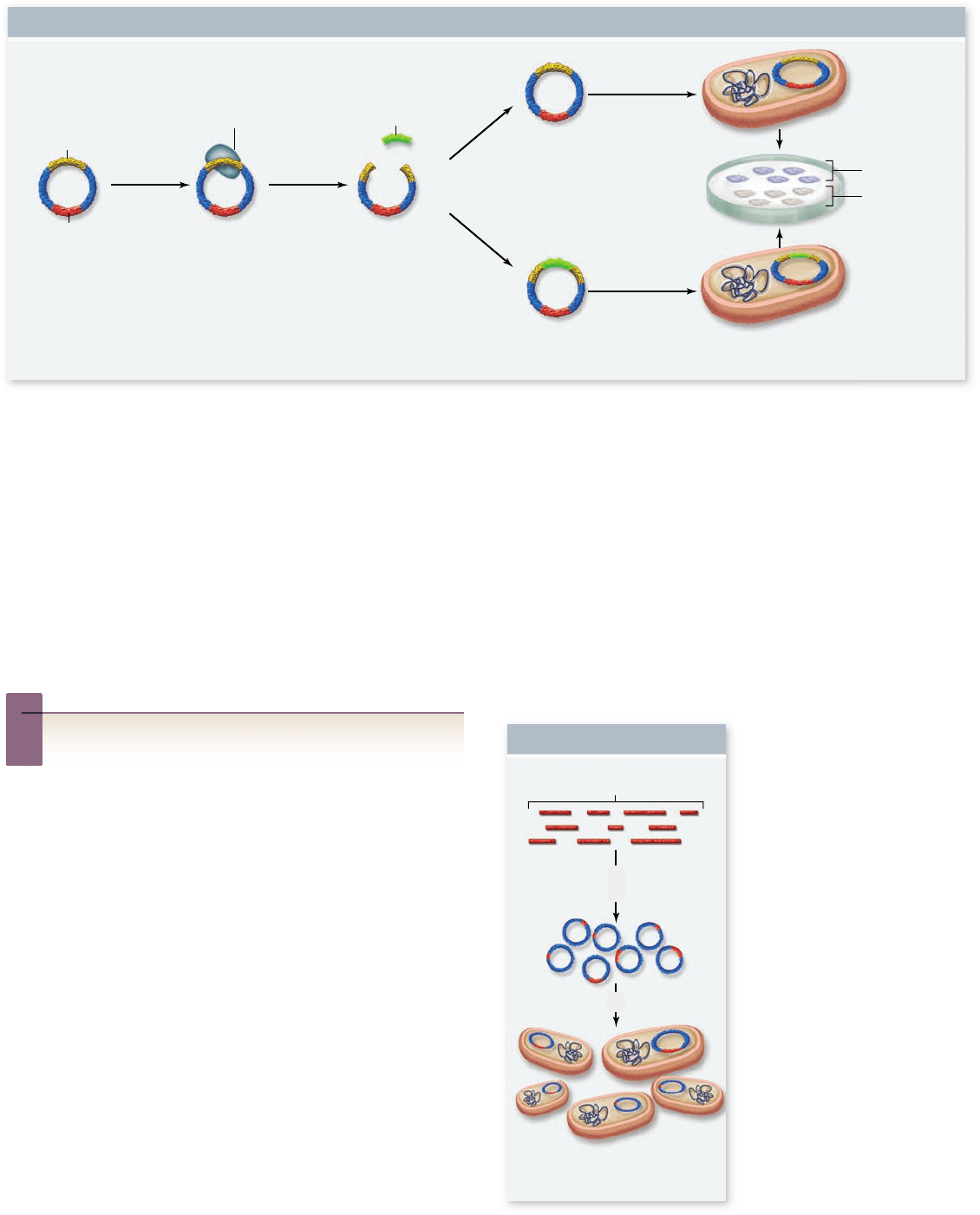
Figure 17.3
Molecular cloning with vectors.
Plasmids are cut within the β-galactosidase gene (lacZ), and foreign DNA and
DNA ligase are added. Foreign DNA inserted into lacZ interrupts the coding sequence, thus inactivating the gene. Plating cells on
medium containing the antibiotic ampicillin selects for plasmid-containing cells. The medium also contains X-gal, and when lacZ is intact
(top), the expressed enzyme cleaves the X-gal, producing blue colonies. When lacZ is inactivated (bottom), X-gal is not cleaved, and
colonies remain white.
Figure 17.4
Creating
DNA libraries.
then inserted into a vector and introduced into host cells. Ge-
nomic libraries are usually constructed in bacterial artificial
chromosomes (BACs).
A variety of different kinds of libraries can be made de-
pending on the source DNA used. Any particular clone in the
library contains only a single DNA, and all of them together
make up the library. Keep in mind that unlike a library full of
chapter
17
Biotechnology
331www.ravenbiology.com
rav32223_ch17_327-351.indd 331rav32223_ch17_327-351.indd 331 11/10/09 2:43:15 PM11/10/09 2:43:15 PM