
Raven P.H., Johnson G.B., Mason K.A. Biology (Ninth Edition)
Подождите немного. Документ загружается.

Apago PDF Enhancer
5.5
μ
m
R
Chapter
19
Cellular Mechanisms
of Development
Chapter Outline
19.1 The Process of Development
19.2 Cell Division
19.3 Cell Differentiation
19.4 Nuclear Reprogramming
19.5 Pattern Formation
19.6 Morphogenesis
Introduction
Recent work with different kinds of stem cells, like those pictured , have captured the hopes and imagination of the public.
For thousands of years, humans have wondered how organisms arise, grow, change, and mature. We are now in an era when
long-standing questions may be answered, and new possibilities for regenerative medicine seem on the horizon.
We have explored gene expression from the perspective of individual cells, examining the diverse mechanisms
cells employ to control the transcription of particular genes. Now we broaden our perspective and look at the unique
challenge posed by the development of a single cell, the fertilized egg, into a multicellular organism. In the course of this
developmental journey, a pattern of decisions about gene expression takes place that causes particular lines of cells to
proceed along different paths, spinning an incredibly complex web of cause and effect. Yet, for all its complexity, this
developmental program works with impressive precision. In this chapter, we explore the mechanisms of development at the
cellular and molecular level.
CHAPTER
Development can be defined as the process of systematic, gene-
directed changes through which an organism forms the succes-
sive stages of its life cycle. Development is a continuum, and
explorations of development can be focused on any point along
this continuum. The study of development plays a central role
in unifying the understanding of both the similarities and di-
versity of life on Earth.
19.1
The Process of Development
We can divide the overall process of development into
four subprocesses:
■ Cell Division. A developing plant or animal begins as a
fertilized egg, or zygote, that must undergo cell division to
produce the new individual. In all cases early development
involves extensive cell division, but in many cases it does
not include much growth as the egg cell itself is quite large.
■ Differentiation. As cells divide, orchestrated changes in
gene expression result in differences between cells that
ultimately result in cell specialization. In differentiated
rav32223_ch19_372-395.indd 372rav32223_ch19_372-395.indd 372 11/10/09 4:28:20 PM11/10/09 4:28:20 PM
Apago PDF Enhancer
a.
b. c.
0.8 mm 0.8 mm 0.8 mm
Figure 19.1
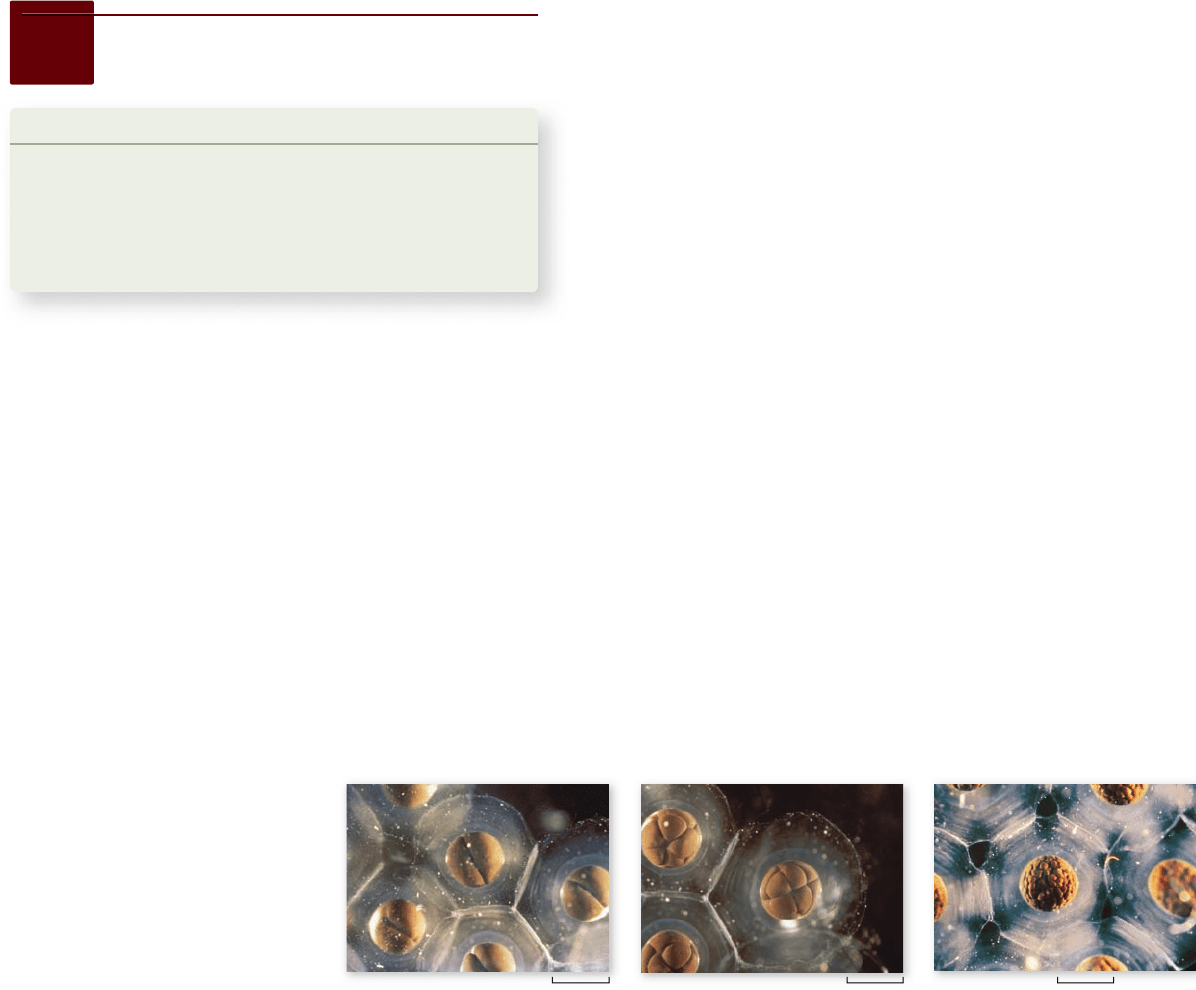
Cleavage divisions in a frog embryo. a. The
rst cleavage division divides the egg into two large blastomeres.
b. After two more divisions, four small blastomeres sit on top of
four large blastomeres, each of which continues to divide to produce
(c) a compact mass of cells.
19.2
Cell Division
Learning Outcomes
Explain the importance of cell division to early 1.
development.
Describe the use of 2. C. elegans to track cell lineages.
Distinguish differences in cell division between animals 3.
and plants.
When a frog tadpole hatches out of its protective coats, it is
roughly the same overall mass as the fertilized egg from which it
came. Instead of being made up of just one cell, however, the
tadpole consists of about a million cells, which are organized into
tissues and organs with different functions. Thus, the very first
process that must occur during embryogenesis is cell division.
Immediately following fertilization, the diploid zygote un-
dergoes a period of rapid mitotic divisions that ultimately result
in an early embryo comprised of dozens to thousands of diploid
cells. In animal embryos, the timing and number of these divi-
sions are species-specific and are controlled by a set of molecules
that we examined in chapter 10 : the cyclins and cyclin-dependent
kinases (Cdks). These molecules exert control over checkpoints in
the cycle of mitosis.
Development begins with cell division
In animal embryos, the period of rapid cell division following
fertilization is called cleavage. During cleavage, the enormous
mass of the zygote is subdivided into
a larger and larger number of smaller
and smaller cells, called blastomeres
(figure 19.1). Hence, cleavage is not
accompanied by any increase in the
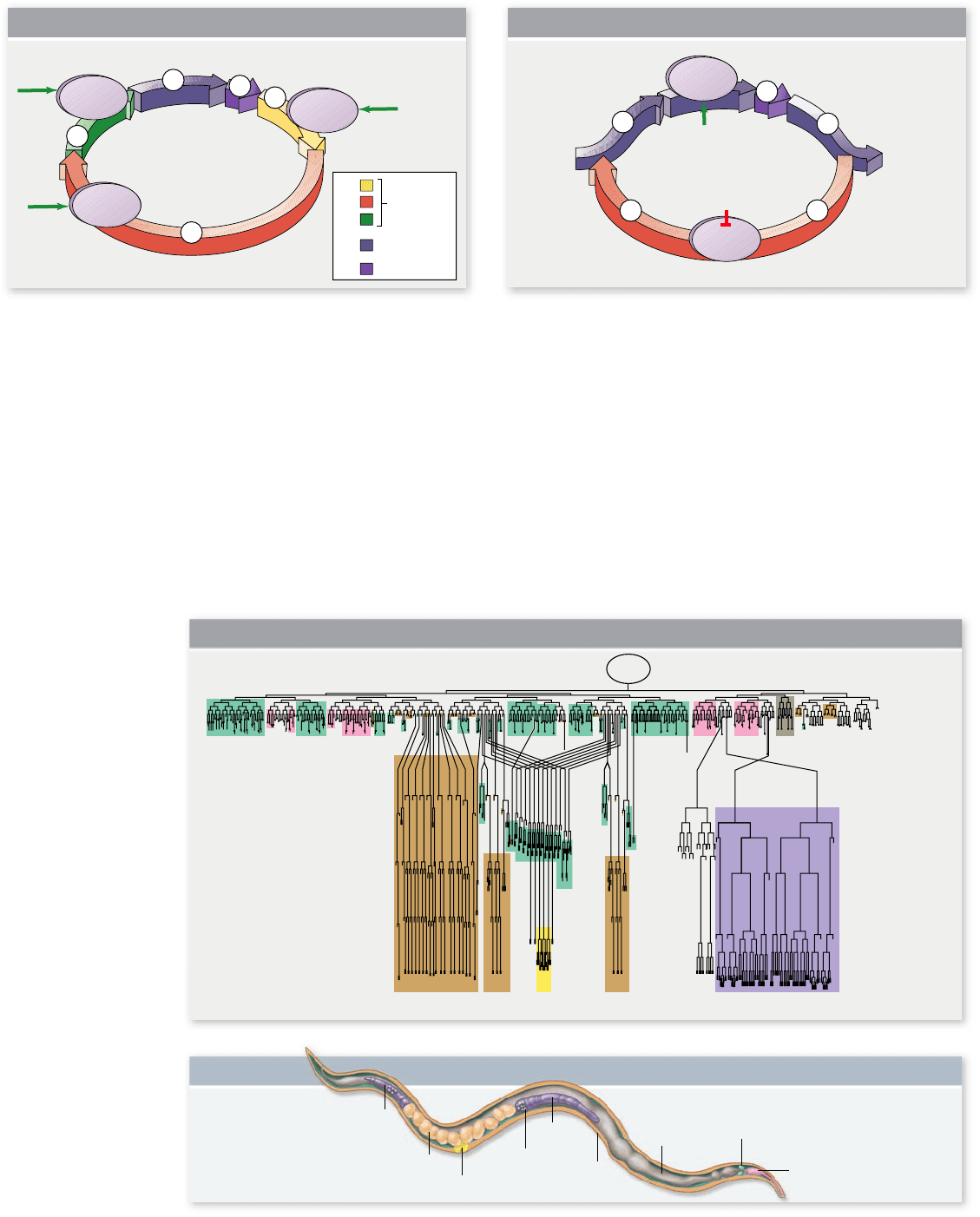
overall size of the embryo. The G
1
and G
2
phases of the cell cycle, dur-
ing which a cell increases its mass and
size, are extremely shortened or elim-
inated during cleavage (figure 19.2).
cells, certain genes are expressed at particular times, but
other genes may not be expressed at all.
■ Pattern Formation. Cells in a developing embryo must
become oriented to the body plan of the organism the
embryo will become. Pattern formation involves cells’ abilities
to detect positional information that guides their ultimate fate.
■ Morphogenesis. As development proceeds, the form of
the body—its organs and anatomical features—is
generated. Morphogenesis may involve cell death as well
as cell division and differentiation.
Despite the overt differences between groups of plants
and animals, most multicellular organisms develop according
to molecular mechanisms that are fundamentally very similar.
This observation suggests that these mechanisms evolved very
early in the history of multicellular life.
Because of the absence of the two gap/growth phases, the
rapid rate of mitotic divisions during cleavage is never again
approached in the lifetime of any animal. For example, zebrafish
blastomeres divide once every several minutes during cleavage,
to create an embryo with a thousand cells in just under 3 hr! In
contrast, cycling adult human intestinal epithelial cells divide
on average only once every 19 hr. A comparison of the different
patterns of cleavage can be found in chapter 54.
When external sources of nutrients become available—
for example, during larval feeding stages or after implantation
of mammalian embryos—daughter cells can increase in size
following cytokinesis, and an overall increase in the size of the
organism occurs as more cells are produced.
Every cell division is known
in the development of C. elegans
One of the most completely described models of development
is the tiny nematode Caenorhabditis elegans. Only about 1 mm
long, the adult worm consists of 959 somatic cells.
Because C. elegans is transparent, individual cells can be fol-
lowed as they divide. By observing them, researchers have learned
how each of the cells that make up the adult worm is derived from
the fertilized egg. As shown on the lineage map in figure 19.3a,
the egg divides into two cells, and these daughter cells continue
to divide. Each horizontal line on the map represents one round
of cell division. The length of each vertical line represents the
time between cell divisions, and the end of each vertical line rep-
resents one fully differentiated cell. In figure 19.3b, the major
organs of the worm are color-coded to match the colors of the
corresponding groups of cells on the lineage map.
Some of these differentiated cells, such as some cells that
generate the worm’s external cuticle, are “born” after only
8 rounds of cell division; other cuticle cells require as many as
14 rounds. The cells that make up the worm’s pharynx, or feed-
ing organ, are born after 9 to 11 rounds of division, whereas
cells in the gonads require up to 17 divisions.
Exactly 302 nerve cells are destined for the worm’s ner-
vous system. Exactly 131 cells are programmed to die, mostly
within minutes of their “birth.” The fate of each cell is the same
in every C. elegans individual, except for the cells that will be-
come eggs and sperm.
chapter
19
Cellular Mechanisms of Development
373www.ravenbiology.com
rav32223_ch19_372-395.indd 373rav32223_ch19_372-395.indd 373 11/10/09 4:28:27 PM11/10/09 4:28:27 PM
Apago PDF Enhancer
Nematode Lineage Map
a.
b.
Egg and
sperm line
Egg
Pharynx
Cuticle-making cells Vulva
Egg
Sperm
Adult Nematode
Vulva
Gonad
Gonad
Gonad
Nervous system
Pharynx
Intestine
Cuticle
Intestine
Nervous
system
C
M
G
2
interphase
mitosis
cytokinesis
G
2
S
G
1
M
C
Mitosis
DNA Synthesis
Adult Cell Cycle
S
G
1
Cdk / G1
cyclin
Cdk /
S cyclin
Mitosis
DNA Synthesis
Active
Cell Cycle of Early Frog Blastomere
Active
Active
Cyclin
Synthesis
Active
Cdk / G2
cyclin
C
M
S S
M
Cyclin
Degradation
Cdk /
cyclin
Cdk
Inactive
a. b.
Figure 19.3
Studying
embryonic cell
division and
development in
the nematode.
Development in
C. elegans has been
mapped out such that
the fate of each cell
from the single egg cell
has been determined.
a. The lineage map
shows the number of
cell divisions from the
egg, and the color
coding links their
placement in (b) the
adult organism.
M. E. Challinor
illustration. From
Howard Hughes Medical
Institute © as published
in From Egg to Adult,
1992. Reprinted by
permission.
sate for this restriction by allowing development to accommo-
date local circumstances.
Instead of creating a body in which every part is specified to
have a fixed size and location, a plant assembles its body throughout
its life span from a few types of modules, such as leaves, roots,
branch nodes, and flowers. Each module has a rigidly controlled
structure and organization, but how the modules are utilized is
quite flexible—they can be adjusted to environmental conditions.
Plant growth occurs in speci c
areas called meristems
A major difference between animals and plants is that most ani-
mals are mobile, at least in some phase of their life cycles, and
therefore they can move away from unfavorable circumstances.
Plants, in contrast, are anchored in position and must simply
endure whatever environment they experience. Plants compen-
Figure 19.2
Cell cycle of adult cell and embryonic cell. In contrast to the cell cycle of adult somatic cells (a), the dividing cells of
early frog embryos lack G
1
and G
2
stages (b), enabling the cleavage stage nuclei to rapidly cycle between DNA synthesis and mitosis. Large
stores of cyclin mRNA are present in the unfertilized egg. Periodic degradation of cyclin proteins correlates with exiting from mitosis. Cyclin
degradation and Cdk inactivation allow the cell to complete mitosis and initiate the next round of DNA synthesis.
374
part
III
Genetic and Molecular Biology
rav32223_ch19_372-395.indd 374rav32223_ch19_372-395.indd 374 11/10/09 4:28:30 PM11/10/09 4:28:30 PM
Apago PDF Enhancer
Donor
No donor
Recipient
Before Overt
Differentiation
Recipient
After Overt
Differentiation
Normal
Not Determined
(early development)
Determined
(later development)
Tail cells are
tr
ansplanted
to head
Tail cells develop
into head cells in head
Tail cells develop
into tail cells in head
Tail cells are
transplanted
to head
Tail Head
Plants develop by building their bodies outward, creating new
parts from groups of stem cells that are contained in structures called
meristems. As meristematic stem cells continually divide, they pro-
duce cells that can differentiate into the tissues of the plant.
This simple scheme indicates a need to control the pro-
cess of cell division. We know that cell-cycle control genes are
present in both yeast (fungi) and animal cells, implying that
these are a eukaryotic innovation—and in fact, the plant cell
cycle is regulated by the same mechanisms, namely through cy-
clins and cyclin-dependent kinases. In one experiment, over-
expression of a Cdk inhibitor in transgenic Arabidopsis thaliana
plants resulted in strong inhibition of cell division in leaf mer-
istems, leading to significant changes in leaf size and shape.
Learning Outcomes Review 19.2
In animal embryos, a series of rapid cell divisions that skip the G
1
and G
2
phases convert the fertilized egg into many cells with no change in size. In the
nematode C. elegans, every cell division leading to the adult form is known,
and this pattern is invariant, allowing biologists to trace development in
a cell-by-cell fashion. In plants, growth is restricted to specifi c areas called
meristems, where undiff erentiated stem cells are retained.
■ How are early cell divisions in an embryo different from
in an adult organism?
19.3
Cell Di erentiation
Learning Outcomes
Describe the progressive nature of determination.1.
List the ways in which cells become committed to 2.
developmental pathways on the molecular level.
Differentiate between the different types of stem cells.3.
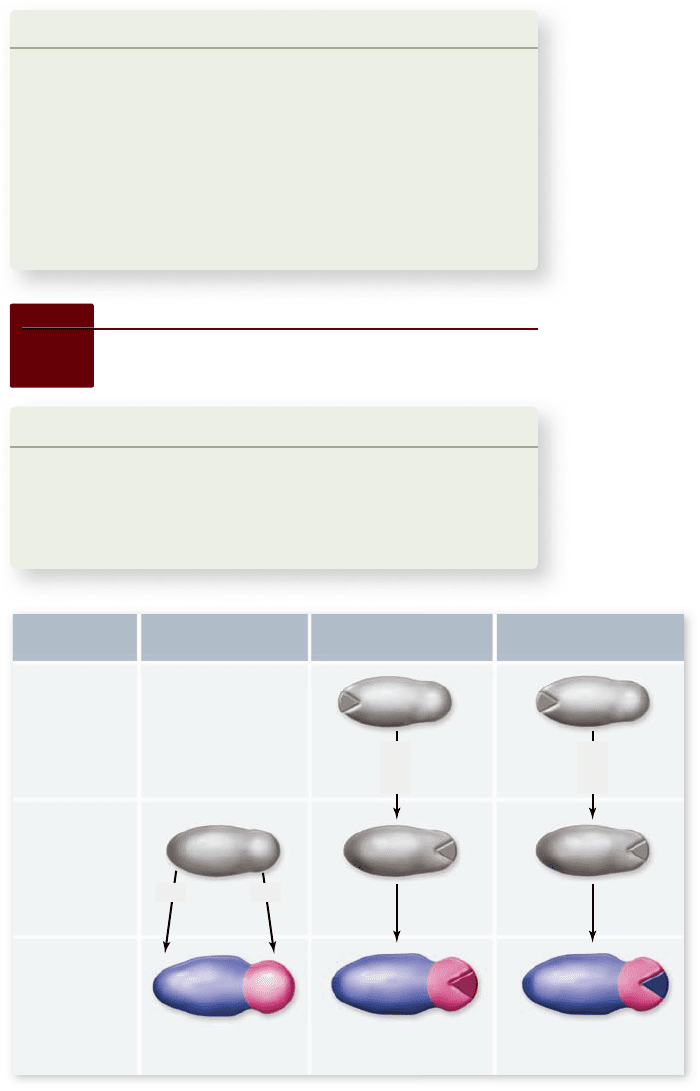
Figure 19.4
The standard test for
determination. The gray ovals represent
embryos at early stages of development. The cells
to the right normally develop into head structures,
whereas the cells to the left usually form tail
structures. If prospective tail cells from an early
embryo are transplanted to the opposite end
of a host embryo, they develop according
to their new position into head structures. These
cells are not determined. At later stages of
development, the tail cells are determined since
they now develop into tail structures after
transplantation into the opposite end
of a host embryo!
In chapter 16, we examined the mechanisms that control
eukaryotic gene expression. These processes are critical for
the development of multicellular organisms, in which life
functions are carried out by different tissues and organs. In
the course of development, cells become different from one
another because of the differential expression of subsets of
genes—not only at different times, but in different loca-
tions of the growing embryo. We now explore some of the
mechanisms that lead to differential gene expression dur-
ing development.
Cells become determined prior
to di erentiation
A human body contains more than 210 major types of differen-
tiated cells. These differentiated cells are distinguishable from
one another by the particular proteins that they synthesize,
their morphologies, and their specific functions. A molecular
decision to become a particular type of differentiated cell oc-
curs prior to any overt changes in the cell. This molecular
decision-making process is called cell determination, and it
commits a cell to a particular developmental pathway.
Tracking determination
Determination is often not visible in the cell and can only be
“seen” by experiment. The standard experiment to test whether
a cell or group of cells is determined is to move the donor cell(s)
to a different location in a host (recipient) embryo. If the cells
of the transplant develop into the same type of cell as they
would have if left undisturbed, then they are judged to be al-
ready determined (figure 19.4).
Determination has a time course; it depends on a series of
intrinsic or extrinsic events, or both. For example, a cell in the
prospective brain region of an amphibian embryo at the early
gastrula stage (see chapter 54) has not yet been determined; if
transplanted elsewhere in the embryo, it will develop according
to the site of transplant. By the late gastrula stage, however,
chapter
19
Cellular Mechanisms of Development
375www.ravenbiology.com
rav32223_ch19_372-395.indd 375rav32223_ch19_372-395.indd 375 11/10/09 4:28:31 PM11/10/09 4:28:31 PM
Apago PDF Enhancer
M
E
T
A
M
O
R
P
H
O
S
I
S
MEIOSIS
FERTILIZATION
a.
n
2n
Embryo
(diploid) 2n
Larva
(diploid) 2n
Sperm
(haploid) n
Egg
(haploid) n
Pigment
granules
Adult tunicate
(diploid) 2n
b.
50 µ
µ
m
50
µ
m
50
µ
m
50
µ
m
50
µ
m
forcement makes the developmental switch deterministic,
initiating a chain of events that leads down a particular devel-
opmental pathway.
Cells in which a set of regulatory genes have been acti-
vated may not actually undergo differentiation until some time
later, when other factors interact with the regulatory protein
and cause it to activate still other genes. Nevertheless, once the
initial “switch” is thrown, the cell is fully committed to its fu-
ture developmental path.
Cells become committed to follow a particular develop-
mental pathway in one of two ways:
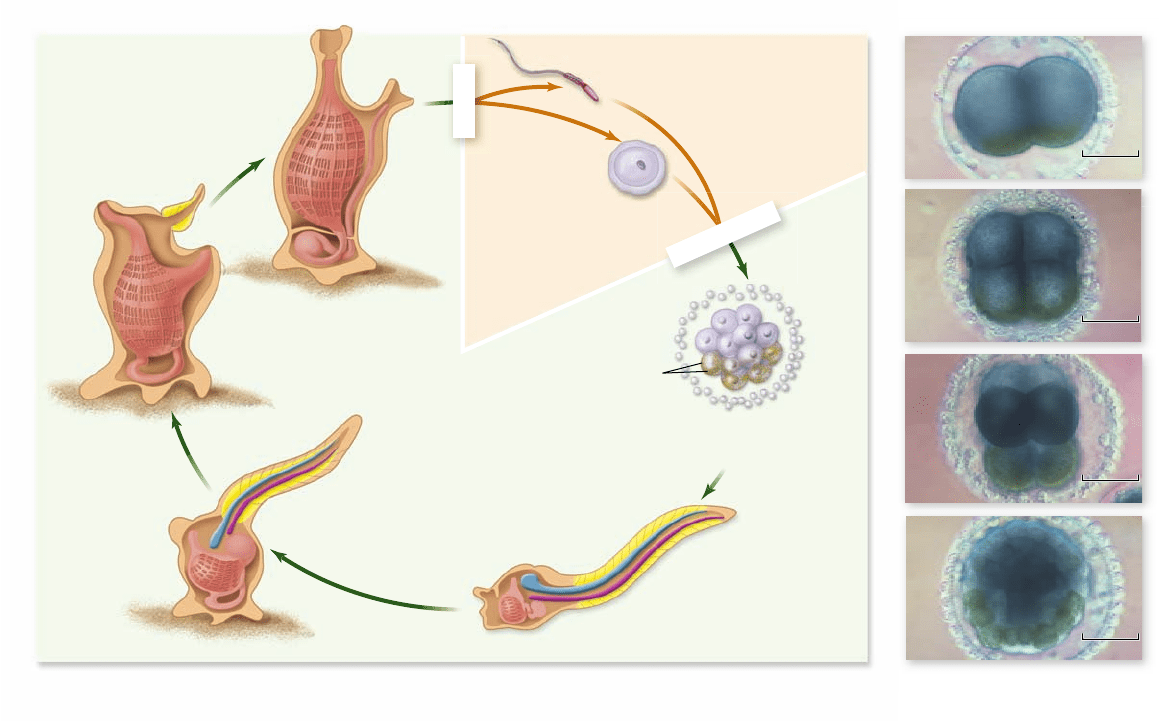
via the differential inheritance of cytoplasmic 1.
determinants, which are maternally produced and
deposited into the egg during oogenesis; or
via cell–cell interactions.2.
The first situation can be likened to a person’s social sta-
tus being determined by who his or her parents are and what he
or she has inherited. In the second situation, the person’s social
standing is determined by interactions with his or her neigh-
bors. Clearly both can be powerful factors in the development
and maturation of that individual.
Figure 19.5
Muscle determinants in tunicates. a. The life cycle of a solitary tunicate. Muscle cells that move the tail of the
swimming tadpole are arranged on either side of the notochord and nerve cord. The tail is lost during metamorphosis into the sedentary adult.
b. The egg of the tunicate Styela contains bright yellow pigment granules. These become asymmetrically localized in the egg following
fertilization, and cells that inherit the yellow granules during cleavage will become the larval muscle cells. Embryos at the 2-cell, 4-cell,
8-cell, and 64-cell stages are shown. The tadpole tail will grow out from the lower region of the embryo in the bottom panel.
additional cell interactions have occurred, determination has
taken place, and the cell will develop as neural tissue no matter
where it is transplanted.
Determination often takes place in stages, with a cell first
becoming partially committed, acquiring positional labels that
reflect its location in the embryo. These labels can have a great
influence on how the pattern of the body subsequently devel-
ops. In a chicken embryo, tissue at the base of the leg bud nor-
mally gives rise to the thigh. If this tissue is transplanted to the
tip of the identical-looking wing bud, which would normally
give rise to the wing tip, the transplanted tissue will develop
into a toe rather than a thigh. The tissue has already been de-
termined as leg, but it is not yet committed to being a particular
part of the leg. Therefore, it can be influenced by the positional
signaling at the tip of the wing bud to form a tip (but in this
case, a tip of leg).
The molecular basis of determination
Cells initiate developmental changes by using transcription
factors to change patterns of gene expression. When genes
encoding these transcription factors are activated, one of
their effects is to reinforce their own activation. This rein-
376
part
III
Genetic and Molecular Biology
rav32223_ch19_372-395.indd 376rav32223_ch19_372-395.indd 376 11/11/09 3:55:31 PM11/11/09 3:55:31 PM
Apago PDF Enhancer
2
1
Notochord (Not) Ventral endoderm (En)
Anterior
Posterior
Anterior Posterior
a.
b. c.
2 1
FGF signaling
Sagittal section Longitudinal section
Longitudinal section
Dorsal nerve cord (NC)
Mesenchymal cells (Mes)
Tail muscle cells (Mus)
32-Cell Stage 64-Cell Stage
Anterior
Posterior
Determination can be due
to cytoplasmic determinants
Many invertebrate embryos provide good visual examples of
cell determination through the differential inheritance of cyto-
plasmic determinants. Tunicates are marine invertebrates (see
chapter 35), and most adults have simple, saclike bodies that are
attached to the underlying substratum. Tunicates are placed in
the phylum Chordata, however, due to the characteristics of
their swimming, tadpolelike larval stage, which has a dorsal
nerve cord and notochord (figure 19.5a). The muscles that
move the tail develop on either side of the notochord.
In many tunicate species, colored pigment granules be-
come asymmetrically localized in the egg following fertilization
and subsequently segregate to the tail muscle cell progenitors
during cleavage (figure 19.5b). When these pigment granules are
shifted experimentally into other cells that normally do not de-
velop into muscle, their fate is changed and they become muscle
cells. Thus, the molecules that flip the switch for muscle devel-
opment appear to be associated with the pigment granules.
The next step is to determine the identity of the mole-
cules involved. Experiments indicate that the female parent
provides the egg with mRNA encoded by the macho-1 gene.
The elimination of macho-1 function leads to a loss of tail mus-
cle in the tadpole, and the misexpression of macho-1 mRNA
leads to the formation of additional (ectopic) muscle cells from
nonmuscle lineage cells. The macho-1 gene product has been
shown to be a transcription factor that can activate the expres-
sion of several muscle-specific genes.
Induction can lead to cell di erentiation
In chapter 9, we examined a variety of ways by which cells
communicate with one another. We can demonstrate the im-
portance of cell–cell interactions in development by separat-
ing the cells of an early frog embryo and allowing them to
develop independently.
Under these conditions, blastomeres from one pole of
the embryo (the “animal pole”) develop features of ectoderm,
and blastomeres from the opposite pole of the embryo (the
“vegetal pole”) develop features of endoderm. None of the two
separated groups of cells ever develop features characteristic of
mesoderm, the third main cell type. If animal-pole cells and
vegetal-pole cells are placed next to each other, however, some
of the animal-pole cells develop as mesoderm. The interaction
between the two cell types triggers a switch in the develop-
mental path of these cells. This change in cell fate due to inter-
action with an adjacent cell is called induction. Signaling
molecules act to alter gene expression in the target cells, in this
case, some of the animal-pole cells.
Another example of inductive cell interactions is the forma-
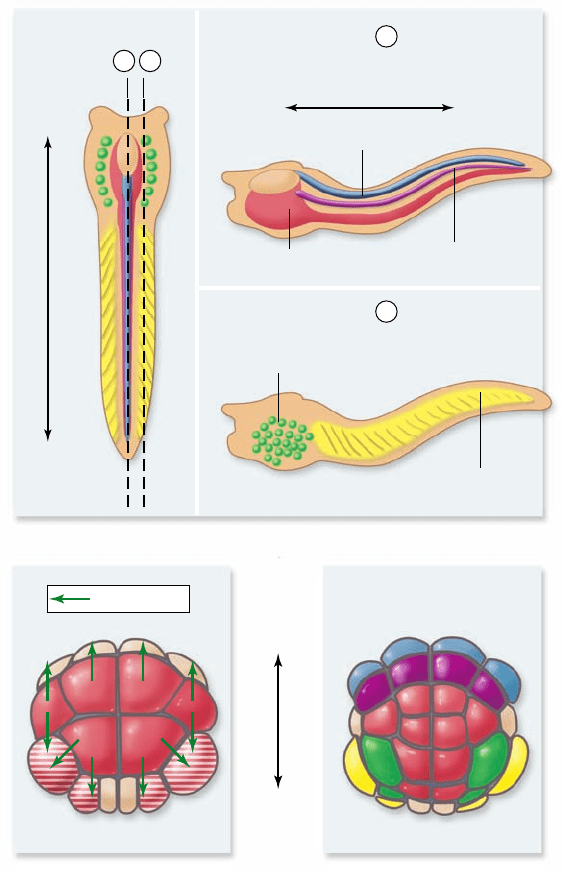
tion of the notochord and mesenchyme, a specific tissue, in tuni-
cate embryos. Muscle, notochord, and mesenchyme all arise from
mesodermal cells that form at the vegetal margin of the 32-cell
stage embryo. These prospective mesodermal cells receive signals
from the underlying endodermal precursor cells that lead to the
formation of notochord and mesenchyme (figure 19.6).
Figure 19.6
Inductive interactions contribute to cell
fate speci cation in tunicate embryos. a. Internal structures
of a tunicate larva. To the left is a sagittal section through the
larva with dotted lines indicating two longitudinal sections.
Section 1, through the midline of a tadpole, shows the dorsal
nerve cord (NC), the underlying notochord (Not) and the ventral
endoderm cells (En). Section 2, a more lateral section, shows the
mesenchymal cells (Mes) and the tail muscle cells (Mus). b. View
of the 32-cell stage looking up at the endoderm precursor cells.
FGF secreted by these cells is indicated with light-green arrows.
Only the surfaces of the marginal cells that directly border the
endoderm precursor cells bind FGF signal molecules. Note that
the posterior vegetal blastomeres also contain the macho-1
determinants (red and white stripes). c. Cell fates have been xed
by the 64-cell stage. Colors are as in (a). Cells on the anterior
margin of the endoderm precursor cells become notochord and
nerve cord, respectively, whereas cells that border the posterior
margin of the endoderm cells become mesenchyme and muscle
cells, respectively.
chapter
19
Cellular Mechanisms of Development
377www.ravenbiology.com
rav32223_ch19_372-395.indd 377rav32223_ch19_372-395.indd 377 11/10/09 4:28:37 PM11/10/09 4:28:37 PM
Apago PDF Enhancer
Nerve cord
Precursor Cells
Notochord
Precursor Cells
Muscle
Precursor Cells
a.
FGF Signal received?
Mesenchyme
Muscle
Notochord
FGF Signal
received?
Macho-1 inherited?
Nerve cord
First Step Cell TypesSecond Step
Ye s
Ye s
No
No
Ye s
No
Mesenchyme
Precursor Cells
FGF
FGF Receptor
Ras/MAPK
Pathway
T-Ets
Macho-1
Cell
membrane
P
Suppression of muscle
genes and activation
of mesenchyme genes
b.
No
FGF
FGF Receptor
Ras/MAPK
Pathway
T-Ets
Macho-1
Transcription
of muscle genes
Cell
membrane
FGF
FGF Receptor
Ras/MAPK
Pathway
T-Ets
No
Macho-1
Transcription
of notochord genes
P
Cell
membrane
No
FGF
FGF Receptor
Ras/MAPK
Pathway
T-Ets
No
Macho-1
Suppression of notochord
genes and activation
of nerve cord genes
Cell
membrane
Figure 19.7
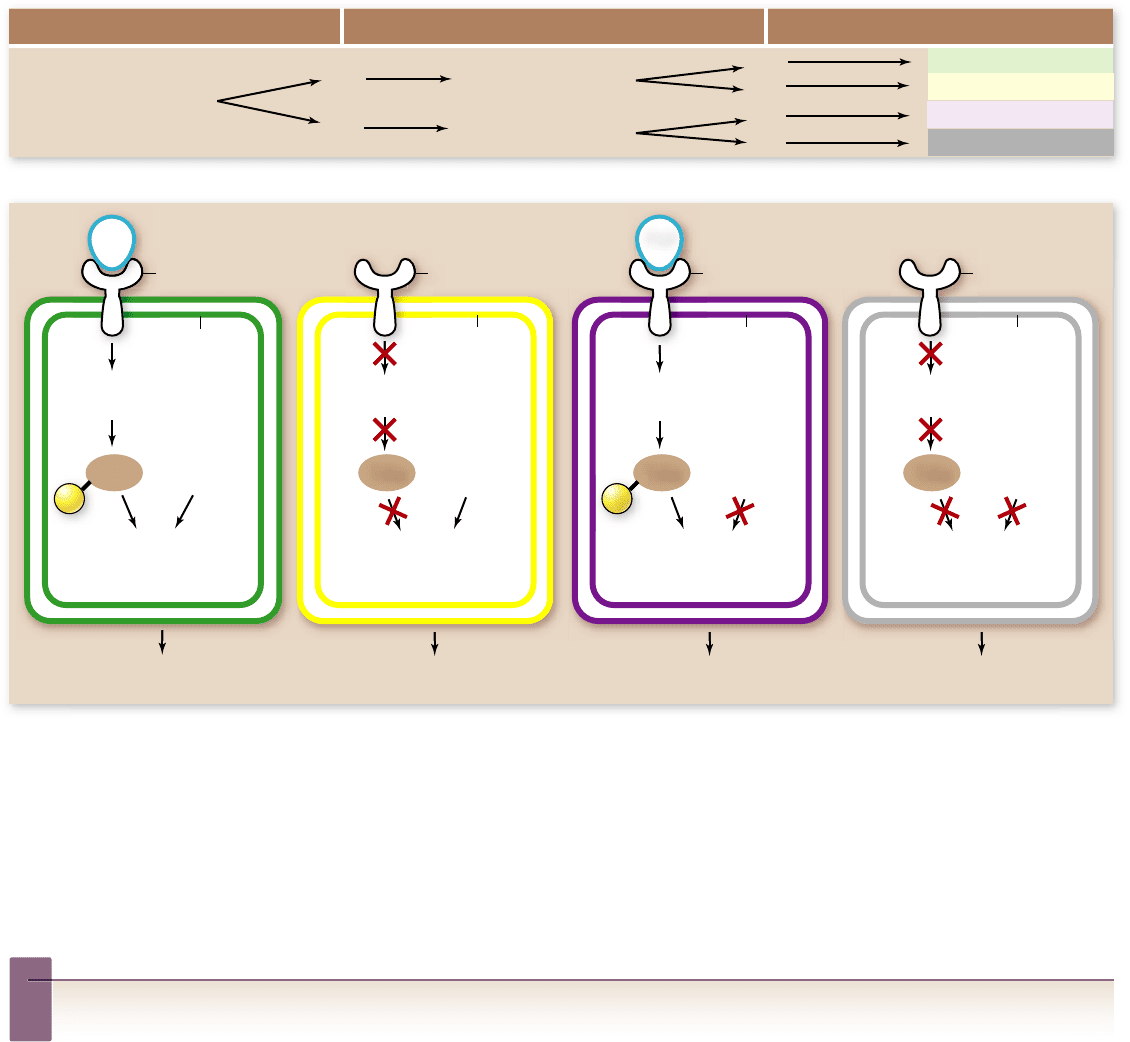
Model for cell fate speci cation by Macho-1 muscle determinant and FGF signaling. a. Two-step model of cell
fate speci cation in vegetal marginal cells of the tunicate embryo. The rst step is inheritance (or not) of muscle macho-1 mRNA. The second
step is FGF signaling from the underlying endoderm precursor cells. b. Posterior vegetal margin cells inherit macho-1 mRNA. Signaling by
FGF activates a Ras/MAP kinase pathway that produces the transcription factor T-Ets. Macho-1 protein and T-Ets suppress muscle-speci c
genes and turn on mesenchyme speci c genes (green cells). In cells with Macho-1 that do not receive the FGF signal, Macho-1 alone turns on
muscle-speci c cells (yellow cells). Anterior vegetal margin cells do not inherit macho-1 mRNA. If these cells receive the FGF signal, T-Ets
turns on notochord-speci c genes (purple cells). In cells that lack Macho-1 and FGF, notochord-speci c genes are suppressed and nerve
cord-speci c genes are activated (gray cells).
Inquiry question
?
What dictates whether Macho-1 acts as a transcriptional repressor or a transcriptional activator?
The chemical signal is a member of the fibroblast growth
factor (FGF) family of signaling molecules. It induces the over-
lying marginal zone cells to differentiate into either notochord
(anterior) or mesenchyme (posterior). The FGF receptor on
the marginal zone cells is a receptor tyrosine kinase that sig-
nals through a MAP kinase cascade to activate a transcription
factor that turns on gene expression resulting in differentia-
tion (figure 19.7).
This example is also a case of two cells responding differ-
ently to the same signal. The presence or absence of the macho-1
muscle determinant discussed earlier controls this difference in
cell fate. In the presence of macho-1, cells differentiate into
mesenchyme; in its absence, cells differentiate into notochord.
Thus, the combination of macho-1 and FGF signaling leads to
four different cell types (see figure 19.7)
Stem cells can divide and produce
cells that di erentiate
It is important, both during development, and even in the
adult animal, to have cells set aside that can divide but are not
determined for only a single cell fate. We call cells that are
capable of continued division but that can also give rise to dif-
ferentiated cells, stem cells . These cells can be characterized
based on the degree to which they have become determined.
378
part
III
Genetic and Molecular Biology
rav32223_ch19_372-395.indd 378rav32223_ch19_372-395.indd 378 11/10/09 4:28:37 PM11/10/09 4:28:37 PM
Apago PDF Enhancer
500
µ
m
a. b.
Egg
Sperm Blastocyst Embryo
Embryonic stem cell
culture
Inner cell
mass
Once sperm cell and egg cell have joined, cell
cleavage produces a blastocyst. The inner cell mass
of the blastocyst develops into the human embryo.
Embryonic stem cells (ES cells) are
isolated from the inner cell mass
At one extreme, we call a cell that can give rise to any tissue in
an organism totipotent . In mammals, the only cells that can
give rise to both the embryo and the extraembryonic mem-
branes are the zygote and early blastomeres from the first few
cell divisions. Cells that can give rise to all of the cells in the
organism’s body are called pluripotent . A stem cell that can
give rise to a limited number of cell types, such as the cells
that give rise to the different blood cell types, are called
multipotent . Then at the other extreme, unipotent stem
cells give rise to only a single cell type, such as the cells that
give rise to sperm cells in males.
Embryonic stem cells are pluripotent
cells derived from embryos
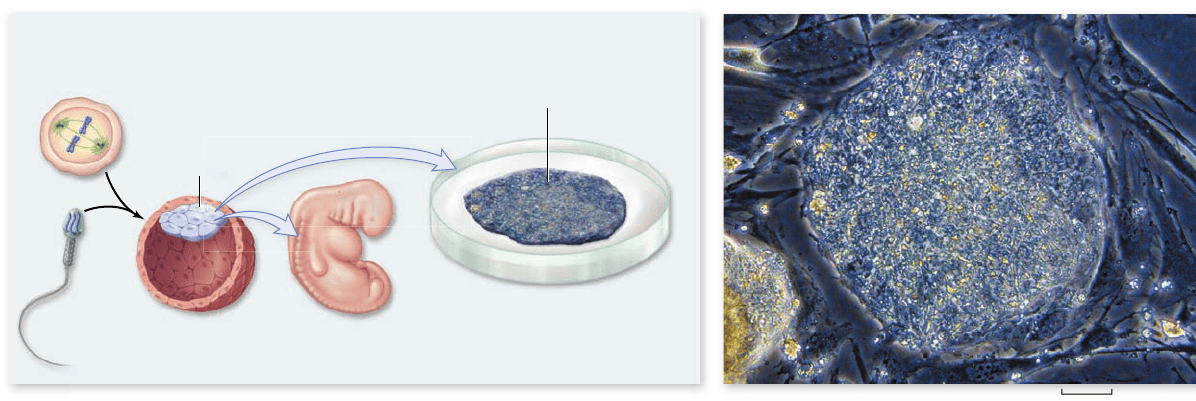
A form of pluripotent stem cells that has been derived in the
laboratory are called embryonic stem cells (ES cells). These
cells are made from mammalian embryos that have undergone
the cleavage stage of development to produce a ball of cells
called a blastocyst. The blastocyst consists of an outer ball of
cells, the trophectoderm, which will become the placenta, and
the inner cell mass that will go on to form the embryo (see
chapter 54 for details). Embryonic stem cells can be isolated
from the inner cell mass and grown in culture (figure 19.8). In
mice, these cells have been studied extensively and have been
shown to be able to develop into any type of cell in the tissues
of the adult. However, these cells cannot give rise to the extra-
embryonic tissues that arise during development, so they are
pluripotent, but not totipotent.
Once these cells were found in mice, it was only a matter
of time before human ES cells were derived as well. In 1998,
the first human ES cells (hES cells) were isolated and grown
in culture. While there are differences between human and
mouse ES cells, there are also substantial similarities. These
embryonic stem cells hold great promise for regenerative
medicine based on their potential to produce any cell type as
described below. These cells have also been the source of
much controversy and ethical discussion due to their embry-
onic origin.
Differentiation in culture
In addition to their possible therapeutic uses, ES cells offer a
way to study the differentiation process in culture. The ma-
nipulation of these cells by additions to the culture media will
allow us to tease out the factors involved in differentiation at
the level of the actual cell undergoing the process. Early at-
tempts at assessing differentiation in culture was plagued by the
culture conditions. The medium in early experiments contained
fetal calf serum (common in tissue culture), which is ill-defined,
and varies lot-to-lot. More recently, more defined culture con-
ditions have been found that allow greater reproducibility in
controlling differentiation in culture.
Using more defined media, ES cells have been used to reca-
pitulate in culture the early events in mouse development. Thus
mouse ES cells can be used to first give rise to ectoderm, endo-
derm, and mesoderm, then these three cell types will give rise to
the different cells each germ layer is determined to become. This
work is in early stages but is tremendously exciting as it offers the
promise of understanding the molecular cues that are involved in
the stepwise determination of different cell types.
In humans, ES cells have been used to give rise to a va-
riety of cell types in culture. For example, human ES cells
have been shown to give rise to different kinds of blood cells
in culture. Work is underway to produce hematopoeitic stem
cells in culture, which could be used to replace such cells in
patients with diseases that affect blood cells. Human ES cells
have also been used to produce cardiomyocytes in culture.
These cells could be used to replace damaged heart tissue af-
ter heart attacks.
Figure 19.8
Isolation of embryonic stem cells. a. Early cell divisions lead to the blastocyst stage that consists of an outer layer and
an inner cell mass, which will go on to form the embryo. Embryonic stem cells (ES cells) can be isolated from this stage by disrupting the
embryo and plating the cells. Stem cells removed from a six-day blastocyst can be established in culture and maintained inde nitely in an
undifferentiated state. b. Human embryonic stem cells. This mass in the photograph is a colony of undifferentiated human embryonic stem
cells being studied in the developmental biologist James Thomson’s research lab at the University of Wisconsin–Madison.
chapter
19
Cellular Mechanisms of Development
379www.ravenbiology.com
rav32223_ch19_372-395.indd 379rav32223_ch19_372-395.indd 379 11/10/09 4:28:38 PM11/10/09 4:28:38 PM
Apago PDF Enhancer
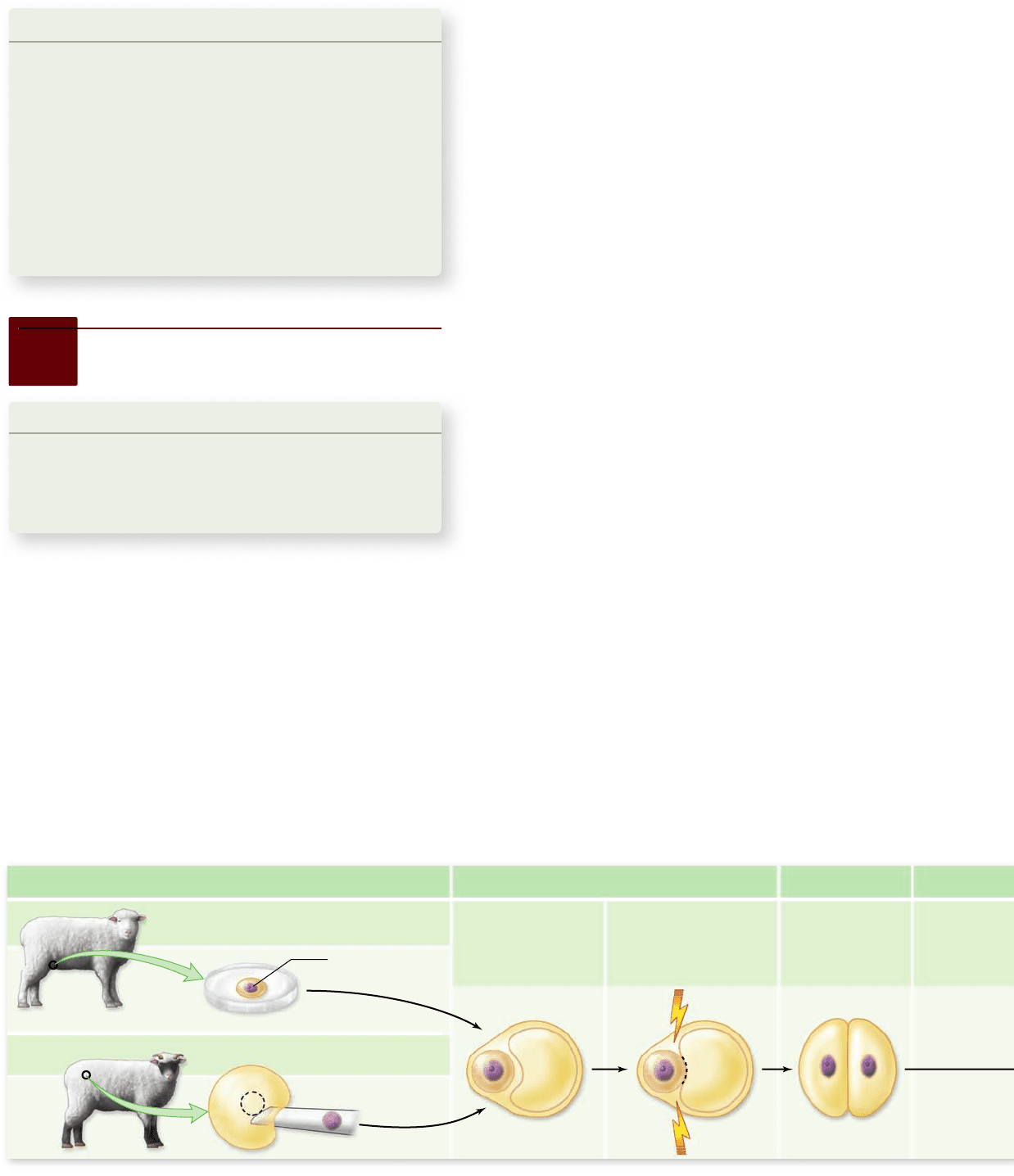
Mammary cell is extracted and grown in
nutrient-deficient solution that arrests the cell cycle.
Egg cell is extracted.
Nucleus is removed from
egg cell with a micropipette.
Nucleus containing
source DNA
Mammary cell is
inserted inside
covering of egg cell.
Electric shock fuses cell
membranes and triggers
cell division.
Preparation Cell Fusion Cell Division
Learning Outcomes Review 19.3
Cell diff erentiation is preceded by determination, where the cell becomes
committed to a developmental pathway, but has not yet diff erentiated.
Diff erential inheritance of cytoplasmic factors can cause determination and
diff erentiation, as can interactions between neighboring cells (induction).
Inductive changes are mediated by signaling molecules that trigger
transduction pathways. Stem cells are able to divide indefi nitely, and they
can give rise to diff erentiated cells. Embryonic stem cells are pluripotent
cells that can give rise to all adult structures.
■ How could you distinguish whether a cell becomes
determined by induction or because of cytoplasmic
factors?
19.4
Nuclear Reprogramming
Learning Outcomes
Define nuclear reprogramming and describe ways in 1.
which it has been accomplished.
Differentiate between reproductive and therapeutic 2.
cloning.
The study of the process of determination and differentiation
leads quite naturally to questions about whether this process
can be reversed. This is of interest both in terms of the experi-
mental possibilities to understand the basic process, and the
prospect of creating patient-specific populations of specific cell
types to replace cells lost to disease or trauma. This has led to a
fascinating path with many twists and turns that has accelerated
in the recent past. We will briefly consider the history of this
topic, then look at the most recent results available.
Reversal of determination has allowed cloning
Experiments carried out in the 1950s showed that single cells
from fully differentiated tissue of an adult plant could develop
into entire, mature plants. The cells of an early cleavage stage
mammalian embryo are also totipotent. When mammalian em-
bryos naturally split in two, identical twins result. If individual
blastomeres are separated from one another, any one of them
can produce a completely normal individual. In fact, this type of
procedure has been used to produce sets of four or eight identi-
cal offspring in the commercial breeding of particularly valu-
able lines of cattle.
Early research in amphibians
An early question in developmental biology was whether the
production of differentiated cells during development involved
irreversible changes to cells. Experiments carried out in the
1950s by Briggs and King, and by John Gurdon in the 1960s
and 1970s showed nuclei could be transplanted between cells.
Using very fine pipettes (hollow glass tubes), these researchers
sucked the nucleus out of a frog or toad egg and replaced the
egg nucleus with a nucleus sucked out of a body cell taken from
another individual.
The conclusions from these experiments are somewhat
contradictory. On the one hand, cells do not appear to undergo
any truly irreversible changes, such as loss of genes. On the
other hand, the more differentiated the cell type, the less suc-
cessful the nucleus in directing development when transplanted.
This led to the concept of nuclear reprogramming , that is, a nu-
cleus from a differentiated cell undergoes epigenetic changes
that must be reversed to allow the nucleus to direct develop-
ment. Epigenetic changes do not change a cell’s DNA but are
stable through cell divisions. The early work on amphibians
showed that tadpoles’ intestinal cell nuclei could be repro-
grammed to produce viable adult frogs. These animals not only
can be considered clones, but they show that tadpole nuclei can
be completely reprogrammed. However, nuclei from adult dif-
ferentiated cells could only be reprogrammed to produce tad-
poles, but not viable, fertile adults. Thus this work showed that
adult nuclei have remarkable developmental potential, but can-
not be reprogrammed to be totipotent.
Early research in mammals
Given the work done in amphibians, much effort was put into
nuclear transfer in mammals, primarily mice and cattle. Not
only did this not result in reproducible production of cloned
380
part
III
Genetic and Molecular Biology
rav32223_ch19_372-395.indd 380rav32223_ch19_372-395.indd 380 11/10/09 4:28:40 PM11/10/09 4:28:40 PM
Apago PDF Enhancer
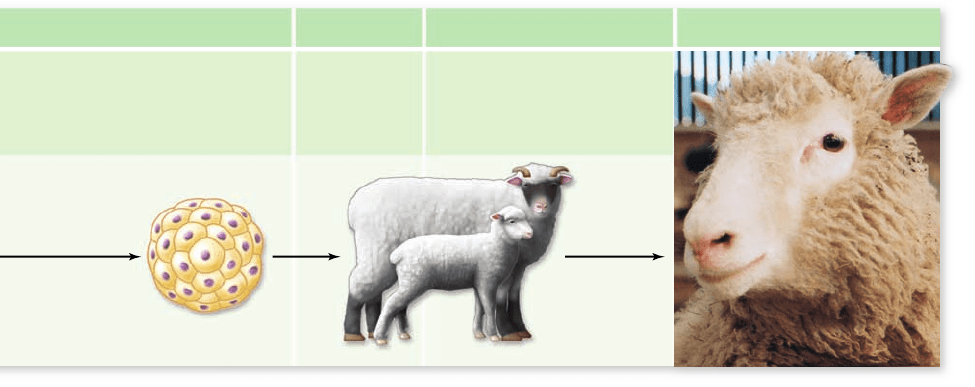
Embryo begins to
develop in vitro.
Embryo is
implanted into
surrogate
mother.
After a five-month pregnancy, a
lamb genetically identical to the
sheep from which the mammary
cell was extracted is born.
Embryo
Development Implantation Birth of Clone Growth to Adulthood
Figure 19.9
Proof that
determination in animals
is reversible. Scientists
combined a nucleus from an
adult mammary cell with an
enucleated egg cell to
successfully clone a sheep,
named Dolly, who grew to be a
normal adult and bore healthy
offspring. This experiment,
the rst successful cloning of
an adult animal, shows that a
differentiated adult cell can be
used to drive all of
development.
animals, but this work led to the discovery of imprinting
through the production of embryos with only maternal or pa-
ternal input (see chapter 13 for more information on imprint-
ing). These embryos never developed, and showed different
kinds of defects depending on whether the maternal or paternal
genome was the sole contributor.
Successful nuclear transplant in mammals
These results stood until a sheep was cloned using the nucleus
from a cell of an early embryo in 1984. The key to this success
was in picking a donor cell very early in development. This ex-
citing result was soon replicated by others in a host of other
organisms, including pigs and monkeys. Only early embryo
cells seemed to work, however.
Geneticists at the Roslin Institute in Scotland reasoned
that the egg and donated nucleus would need to be at the same
stage of the cell cycle for successful development. To test this
idea, they performed the following procedure (figure 19.9):
They removed differentiated mammary cells from the 1.
udder of a six-year-old sheep. The cells were grown in
tissue culture, and then the concentration of serum
nutrients was substantially reduced for ve days, causing
them to pause at the beginning of the cell cycle.
In parallel preparation, eggs obtained from a ewe were 2.
enucleated.
Mammary cells and egg cells were surgically combined in 3.
a process called somatic cell nuclear transfer (SCNT)
in January of 1996. Mammary cells and eggs were fused to
introduce the mammary nucleus into egg.
Twenty-nine of 277 fused couplets developed into 4.
embryos, which were then placed into the reproductive
tracts of surrogate mothers.
A little over ve months later, on July 5, 1996, one sheep 5.
gave birth to a lamb named Dolly, the rst clone
generated from a fully differentiated animal cell.
Dolly matured into an adult ewe, and she was able to re-
produce the old-fashioned way, producing six lambs. Thus, Dolly
established beyond all dispute that determination in animals is
reversible—that with the right techniques, the nucleus of a fully
differentiated cell can be reprogrammed to be totipotent.
Reproductive cloning has inherent problems
The term reproductive cloning refers to the process just de-
scribed, in which scientists use SCNT to create an animal that
is genetically identical to another animal. Since Dolly’s birth in
1997, scientists have successfully cloned one or more cats, rab-
bits, rats, mice, cattle, goats, pigs, and mules. All of these proce-
dures used some form of adult cell.
Low success rate and age-associated diseases
The efficiency in all reproductive cloning is quite low—only
3–5% of adult nuclei transferred to donor eggs result in live
births. In addition, many clones that are born usually die
soon thereafter of liver failure or infections. Many become
oversized, a condition known as large offspring syndrome
(LOS). In 2003, three of four cloned piglets developed to
adulthood, but all three suddenly died of heart failure at less
than 6 months of age.
Dolly herself was euthanized at the relatively young age
of six. Although she was put down because of virally induced
lung cancer, she had been diagnosed with advanced-stage ar-
thritis a year earlier. Thus, one difficulty in using genetic engi-
neering and cloning to improve livestock is production of
enough healthy animals.
Lack of imprinting
The reason for these problems lies in a phenomenon discussed
in chapter 13: genomic imprinting. Imprinted genes are expressed
differently depending on parental origin—that is, they are
turned off in either egg or sperm, and this “setting” continues
through development into the adult. Normal mammalian de-
velopment depends on precise genomic imprinting.
The chemical reprogramming of the DNA, which occurs
in adult reproductive tissue, takes months for sperm and years
for eggs. During cloning, by contrast, the reprogramming of
the donor DNA must occur within a few hours. The organiza-
tion of the chromatin in a somatic cell is also quite different
from that in a newly fertilized egg. Significant chromatin re-
modeling of the transferred donor nucleus must also occur if
the cloned embryo is to survive. Cloning fails because there is
likely not enough time in these few hours to get the remodeling
and reprogramming jobs done properly.
chapter
19
Cellular Mechanisms of Development
381www.ravenbiology.com
rav32223_ch19_372-395.indd 381rav32223_ch19_372-395.indd 381 11/10/09 4:28:42 PM11/10/09 4:28:42 PM