
Raven P.H., Johnson G.B., Mason K.A. Biology (Ninth Edition)
Подождите немного. Документ загружается.

Apago PDF Enhancer
Collared
flycatcher
Collared
flycatcher
Pied
flycatcher
Pied
flycatcher
then the two populations will interbreed freely, and whatever
other differences have evolved between them should disappear
over the course of time, as genetic exchange homogenizes the
populations. Conversely, if the populations are completely re-
productively isolated, then no genetic exchange will occur, and
the two populations will remain different species.
How reinforcement can complete the speciation process
The intermediate state, in which reproductive isolation has
partially evolved but is not complete, is perhaps the most inter-
esting situation. If the hybrids are partly sterile, or not as well
adapted to the existing habitats as their parents, they will be at
a disadvantage. Selection would favor any alleles in the parental
populations that prevented hybridization, because individuals
that did not engage in hybridization would produce more suc-
cessful offspring.
The result would be the continual improvement of prezy-
gotic isolating mechanisms until the two populations were
completely reproductively isolated. This process is termed
reinforcement because initially incomplete isolating mecha-
nisms are reinforced by natural selection until they are com-
pletely effective.
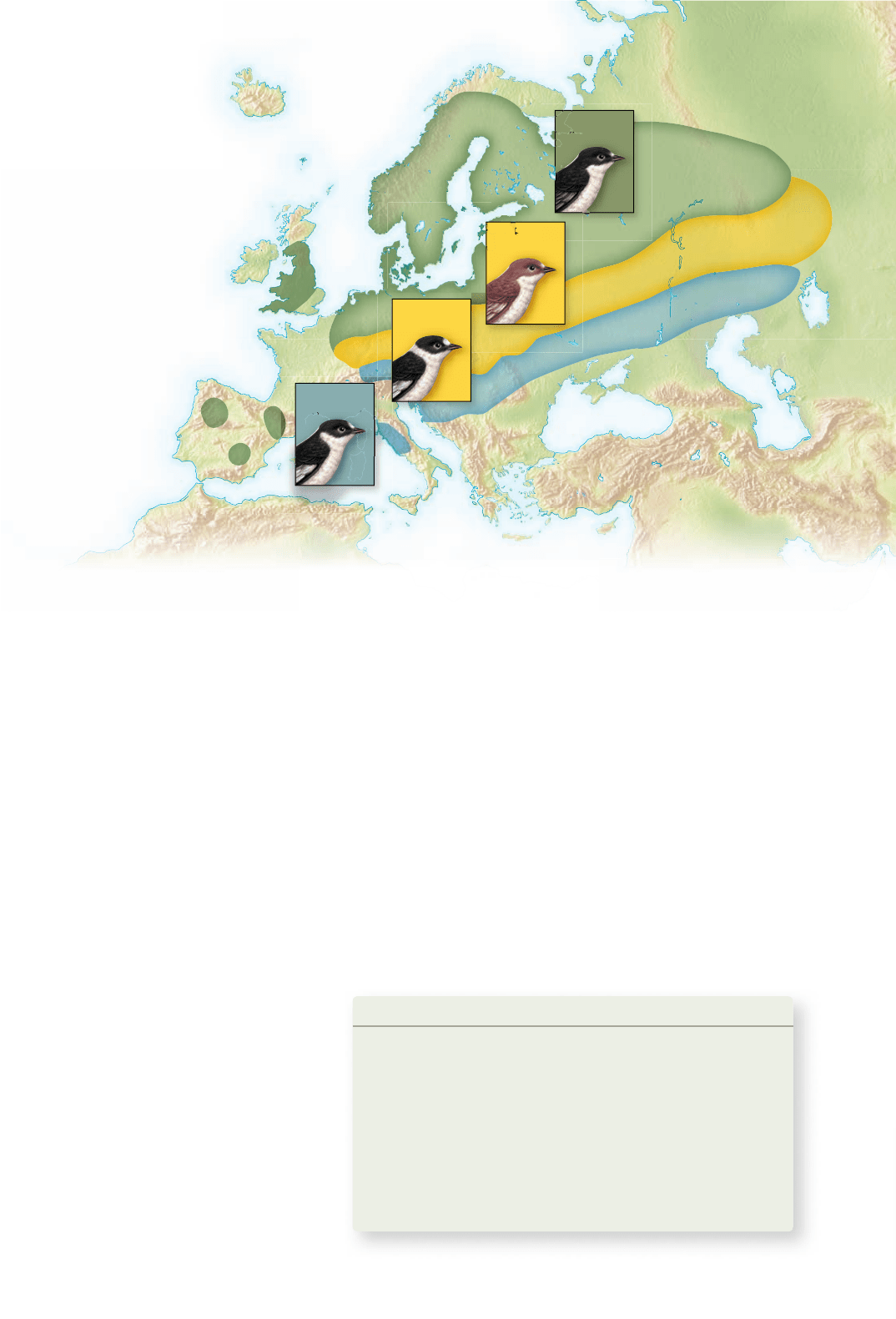
An example of reinforcement is provided by pied and col-
lared flycatchers. Throughout much of eastern and central Eu-
rope, these two bird species are geographically separated
(allopatric) and are very similar in color (figure 22.6). How-
ever, in the Czech Republic and Slovakia, the two species occur
together and occasionally hybridize, producing offspring that
usually have very low fertility. At those sites, the species have
evolved to look very different from each other, and birds prefer
to mate with individuals with their own species’ coloration. In
contrast, birds from the allopatric populations prefer the allo-
patric color pattern. As a consequence of the color differences
Figure 22.6
Reinforcement in
European ycatchers. The pied ycatcher
(Ficedula hypoleuca) and the collared ycatcher
(F. albicollis) appear very similar when they occur
alone. However, in places where the two species
occur sympatrically (indicated by the yellow
color on the map), they have evolved differences
in color and pattern, which allow individuals to
choose mates from their own species and thus
avoid hybridizing.
where the species are sympatric the rate of hybridization is ex-
tremely low. These results indicate that when populations of
the two species came into contact, natural selection led to the
evolution of differences in color patterns, resulting in the evo-
lution of behavioral, prezygotic isolation.
How gene flow may counter speciation
Reinforcement is not inevitable, however. When incompletely
isolated populations come together, gene flow immediately be-
gins to occur between them. Although hybrids may be inferior,
they are not completely inviable or infertile—if they were, the
species would already be completely reproductively isolated.
When these surviving hybrids reproduce with members of
either population, they will serve as a conduit of genetic ex-
change from one population to the other, and the two popula-
tions will tend to lose their genetic distinctiveness. Thus, a race
ensues: Can complete reproductive isolation evolve before gene
flow erases the differences between the populations? Experts
disagree on the likely outcome, but many consider reinforce-
ment to be the much less common outcome.
Learning Outcomes Review 22.2
Natural selection may favor the evolution of increased prezygotic
reproductive isolation between sympatric populations. This phenomenon is
termed reinforcement, and it may lead to populations becoming completely
reproductively isolated. In contrast, however, genetic exchange between
populations may decrease genetic diff erences among populations, thus
preventing speciation from occurring.
■ How might the initial degree of reproductive isolation
affect the probability that reinforcement will occur
when two populations come into sympatry?
442
part
IV
Evolution
rav32223_ch22_436-455.indd 442rav32223_ch22_436-455.indd 442 11/12/09 11:31:47 AM11/12/09 11:31:47 AM

Apago PDF Enhancer
22.3
The Role of Genetic Drift and
Natural Selection in Speciation
Learning Outcomes
Describe the effects of genetic drift on a population.1.
Explain how genetic drift and natural selection can lead 2.
to speciation.
What role does natural selection play in the speciation process?
Certainly, the process of reinforcement is driven by natural se-
lection, favoring the evolution of complete reproductive isola-
tion. But reinforcement may not be common. In situations
other than reinforcement, does natural selection play a role in
the evolution of reproductive isolating mechanisms?
Random changes may cause
reproductive isolation
As mentioned in chapter 20 , populations may diverge for purely
random reasons. Genetic drift in small populations, founder ef-
fects, and population bottlenecks all may lead to changes in
traits that cause reproductive isolation.
For example, in the Hawaiian Islands, closely related spe-
cies of Drosophila often differ greatly in their courtship behavior.
Colonization of new islands by these fruit flies probably involved
a founder effect, in which one or a few flies—perhaps only a single
pregnant female—was blown by strong winds to the new island.
Changes in courtship behavior between ancestor and descendant
populations may be the result of such founder events.
Given enough time, any two isolated populations will di-
verge because of genetic drift (remember that even large popula-
tions experience drift, but at a lower rate than in small populations).
In some cases, this random divergence may affect traits respon-
sible for reproductive isolation, and speciation may occur.
Adaptation can lead to speciation
Although random processes may sometimes be responsible, in
many cases natural selection probably plays a role in the specia-
tion process. As populations of a species adapt to different circum-
stances, they likely accumulate many differences that may lead to
reproductive isolation. For example, if one population of flies
adapts to wet conditions and another to dry ones, then natural
Figure 22.7
Dewlaps of di erent species of Caribbean Anolis lizards. Males use their dewlaps in both territorial and courtship
displays. Coexist ing species almost always differ in their dewlaps, which are used in species recognition. Darker-colored dewlaps, such as those
of the two species on the left, are easier to see in open habitats, whereas lighter-colored dewlaps, like those of the two species on the right, are
more visible in shaded environments.
selection will favor a variety of corresponding differences in phys-
iological and sensory traits. These differences may promote eco-
logical and behavioral isolation and may cause any hybrids the
two populations produce to be poorly adapted to either habitat.
Selection might also act directly on mating behavior. Male
Anolis lizards, for example, court females by extending a colorful
flap of skin, called a dewlap, located under their throats
( figure 22.7). The ability of one lizard to see the dewlap of an-
other lizard depends not only on the color of the dewlap, but on
the environment in which the lizards occur. A light-colored
dewlap, for example, is most effective in reflecting light in a dim
forest, whereas dark colors are more apparent in the bright glare
of open habitats. As a result, when these lizards occupy new
habitats, natural selection favors evolutionary change in dewlap
color because males whose dewlaps cannot be seen will attract
few mates. But the lizards also distinguish members of their own
species from other species by the color of the dewlap. Adaptive
change in mating signals in new environments could therefore
have the incidental consequence of producing reproductive iso-
lation from populations in the ancestral environment.
Laboratory scientists have conducted experiments on fruit
flies and other fast-reproducing organisms in which they isolate
populations in different laboratory chambers and measure how
much reproductive isolation evolves. These experiments indi-
cate that genetic drift by itself can lead to some degree of repro-
ductive isolation, but in general, reproductive isolation evolves
more rapidly when the populations are forced to adapt to differ-
ent laboratory environments (such as temperature or food type).
Although natural selection in the experiment does not directly
favor traits because they lead to reproductive isolation, the inci-
dental effect of adaptive divergence is that populations in differ-
ent environments become reproductively isolated. For this
reason, some biologists believe that the term isolating mechanisms
is misguided, because it implies that the traits evolved specifi-
cally for the purpose of genetically isolating a species, which in
most cases—except reinforcement—is probably incorrect.
Learning Outcomes Review 22.3
Genetic drift refers to randomly generated changes in a population’s genetic
makeup. Isolated populations will eventually diverge because of genetic
drift. Adaptation to diff erent environments may also lead to populations
becoming reproductively isolated from each other.
■ How is the evolution of reproductive isolation in
populations adapting to different environments
different from the process of reinforcement?
rav32223_ch22_436-455.indd 443rav32223_ch22_436-455.indd 443 11/12/09 11:32:16 AM11/12/09 11:32:16 AM
Apago PDF Enhancer
a. b. c.
PACIFIC
OCEAN
NEW
GUINEA
Isolated island
population
of kingfishers
Isolated island
population
of kingfishers
Mainland
population
of kingfishers
Mainland
population
of kingfishers
Isolated island
population
of kingfishers
ent from one another and from the mainland population
(figure 22.9). Thus, geographic isolation seems to have been
an important prerequisite for the evolution of differences
between populations.
Many other examples indicate that speciation can occur
under allopatric conditions. Because we would expect isolated
populations to diverge over time, by either drift or selection,
22.4
The Geography of Speciation
Learning Outcomes
Compare and contrast sympatric and allopatric 1.
speciation.
Explain the conditions required for sympatric speciation 2.
to occur .
Speciation is a two-part process. First, initially identical popu-
lations must diverge, and second, reproductive isolation must
evolve to maintain these differences. The difficulty with this
process, as we have seen, is that the homogenizing effect of
gene flow between populations is constantly acting to erase any
differences that may arise, either by genetic drift or natural se-
lection. Gene flow only occurs between populations that are in
contact, however, and populations can become geographically
isolated for a variety of reasons (figure 22.8) . Consequently,
evolutionary biologists have long recognized that speciation is
much more likely in geographically isolated populations.
Allopatric speciation takes place when
populations are geographically isolated
Ernst Mayr was the first biologist to demonstrate that geo-
graphically separated, or allopatric, populations appear much
more likely to have evolved substantial differences leading to
speciation. Marshalling data from a wide variety of organisms
and localities, Mayr made a strong case for allopatric speciation
as the primary means of speciation.
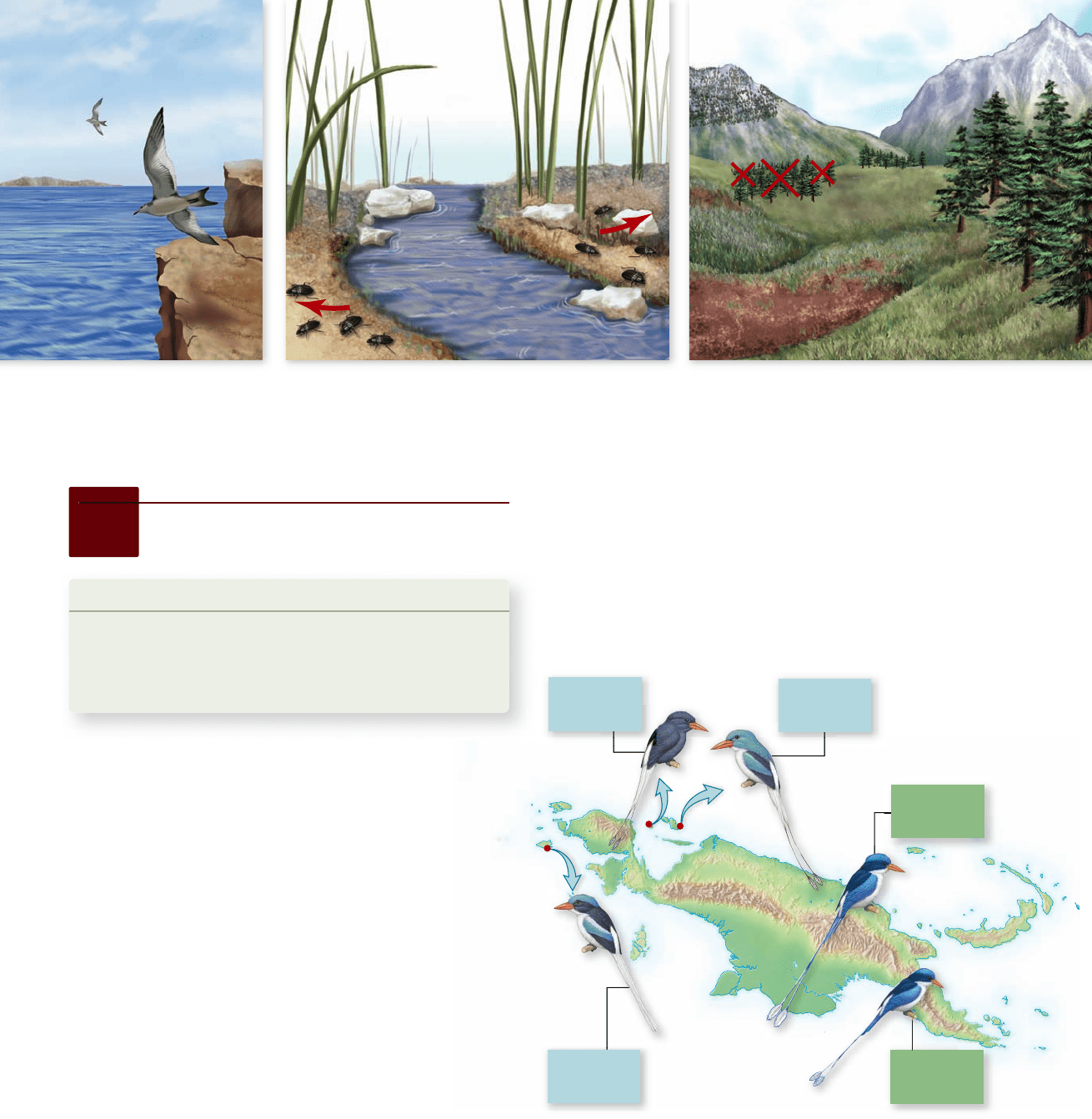
For example, the little paradise kingfisher varies little
throughout its wide range in New Guinea, despite the great
variation in the island’s topography and climate. By contrast,
isolated populations on nearby islands are strikingly differ-
Figure 22.9
Phenotypic di erentiation in the little
paradise king sher Tanysiptera hydro charis in New Guinea.
Isolated island populations (left) are quite distinctive, showing
variation in tail feather structure and length, plumage coloration,
and bill size, whereas king shers on the mainland (right) show
little variation.
Figure 22.8
Populations can become geographically isolated for a variety of reasons. a. Colonization of remote areas by one
or a few i ndividuals can establish populations in a distant place. b. Barriers to movement can split an ancestral population into two isolated
populations. c. Extinction of intermediate populations can leave the remaining populations isolated from one another.
444
part
IV
Evolution
rav32223_ch22_436-455.indd 444rav32223_ch22_436-455.indd 444 11/12/09 11:32:23 AM11/12/09 11:32:23 AM
Apago PDF Enhancer
Parent
Generation
Gametes
Species 1Species 2
2n=6
2n=4
n=3
n=2
2
n
=10
F1 Generation: Hybrid Offspring
No doubling of
chromosome number
Chromosomes either
cannot pair or go
through erratic meiosis
No gametes, or sterile
gametes – no sexual
reproduction possible
Pairing now possible during meiosis
n=5
Viable gametes – sexual reproduction
possible with other tetraploid
Doubling of
chromosome number
this result is not surprising. Rather, the more intriguing ques-
tion becomes: Is geographic isolation required for speciation
to occur?
Sympatric speciation occurs without
geographic separation
For decades, biologists have debated whether one species can
split into two at a single locality, without the two new species
ever having been geographically separated. Investigators have
suggested that this sympatric speciation could occur either in-
stantaneously or over the course of multiple generations. Al-
though most of the hypotheses suggested so far are highly
controversial, one type of instantaneous sympatric speciation is
known to occur commonly, as the result of polyploidy.
Instantaneous speciation through polyploidy
Instantaneous sympatric speciation occurs when an individ-
ual is born that is reproductively isolated from all other
members of its species. In most cases, a mutation that would
cause an individual to be greatly different from others of its
species would have many adverse pleiotropic side effects,
and the individual would not survive. One exception often
seen in plants, however, occurs through the process of poly-
ploidy, which produces individuals that have more than two
sets of chromosomes.
Polyploid individuals can arise in two ways. In autopoly-
ploidy, all of the chromosomes may arise from a single species.
This might happen, for example, due to an error in cell division
that causes a doubling of chromosomes. Such individuals,
termed tetraploids because they have four sets of chromosomes,
can self fertilize or mate with other tetraploids, but cannot mate
and produce fertile offspring with normal diploids. The reason
is that the tetraploid species produce “diploid” gametes that
produce triploid offspring (having three sets of chromosomes)
when combined with haploid gametes from normal diploids.
Triploids are sterile because the odd number of chromosomes
prevent proper pairing during meiosis.
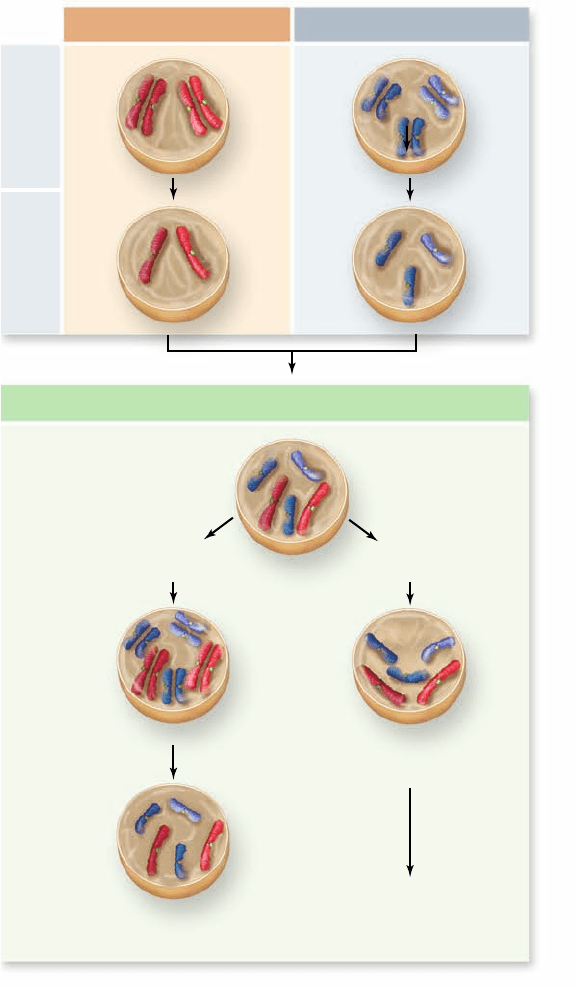
A more common type of polyploid speciation is
allopolyploidy, which may happen when two species hybrid-
ize (figure 22.10). The resulting offspring, having one copy of
the chromosomes of each species, is usually infertile because
the chromosomes do not pair correctly in meiosis. However,
such individuals are often otherwise healthy, can reproduce
asexually, and can even become fertile through a variety of
events. For example, if the chromosomes of such an individual
were to spontaneously double, as just described, the resulting
tetraploid would have two copies of each set of chromosomes.
Consequently, pairing would no longer be a problem in meio-
sis. As a result, such tetraploids would be able to interbreed,
and a new species would have been created.
It is estimated that about half of the approximately
260,000 species of plants have a polyploid episode in their his-
tory, including many of great commercial importance, such as
bread wheat, cotton, tobacco, sugarcane, bananas, and potatoes.
Speciation by polyploidy is also known to occur in a variety of
animals, including insects, fish, and salamanders, although
much more rarely than in plants.
Figure 22.10
Allopolyploid speciation. Hybrid offspring
from parents with different numbers of chromosomes often cannot
reproduce sexually. Sometimes, the number of chromosomes in
such hybrids doubles to produce a tetraploid individual that can
undergo meiosis and reproduce with similar tetraploid individuals.
Sympatric speciation by disruptive selection
Some investigators believe that sympatric speciation can occur
over the course of multiple generations through the process of
disruptive selection. As noted in chapter 20, disruptive selection
can cause a population to contain individuals exhibiting two
different phenotypes.
One might think that if selection is strong enough, these
two phenotypes would evolve over a number of generations
into different species. But before the two phenotypes could be-
come different species, they would have to evolve reproductive
isolating mechanisms. Initially, the two phenotypes would not
chapter
22
The Origin of Species
445www.ravenbiology.com
rav32223_ch22_436-455.indd 445rav32223_ch22_436-455.indd 445 11/12/09 4:26:39 PM11/12/09 4:26:39 PM
Apago PDF Enhancer
1. An ancestral
species flies
from mainland
to colonize
one island.
2. The ancestral
species spreads
to different
islands.
3. Populations on
different islands
evolve to become
different species.
4. Species evolve different
adaptations in allopatry.
4. Colonization of islands.
5. Colonization of islands. 5. Species evolve different adap-
tations to minimize competition
with other species (character
displacement).
or
a. b.
be reproductively isolated at all, and genetic exchange between
individuals of the two phenotypes would tend to prevent ge-
netic divergence in mating preferences or other isolating mech-
anisms. As a result, the two phenotypes would be retained as
polymorphisms within a single population. For this reason,
most biologists consider sympatric speciation of this type to be
a rare event.
In recent years, however, a number of cases have appeared
that are difficult to interpret in any way other than as sympatric
speciation. For example, Lake Barombi Mbo in Cameroon is an
extremely small and ecologically homogeneous lake, with no
opportunity for within-lake isolation. Nonetheless, 11 species
of closely related cichlid fish occur in the lake; all of the species
are more closely related evolutionarily to one another than to
any species outside of the lake. The most reasonable explana-
tion is that an ancestral species colonized the lake and subse-
quently underwent sympatric speciation multiple times.
Learning Outcomes Review 22.4
Sympatric speciation occurs without geographic separation, whereas
allopatric speciation occurs in geographically isolated populations.
Polyploidy and disruptive selection are two ways by which a single species
may undergo sympatric speciation.
■ How do polyploidy and disruptive selection differ as
ways in which sympatric speciation can occur?
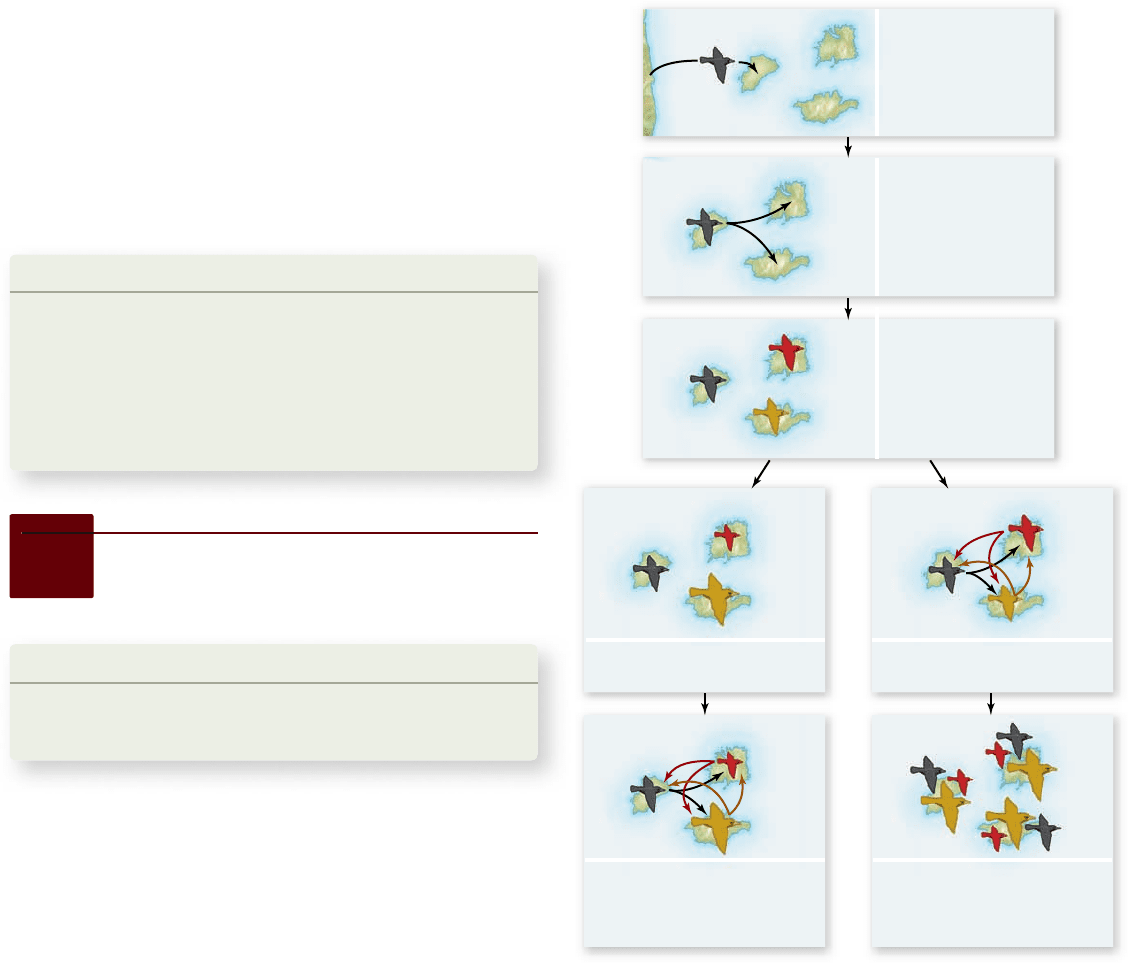
Figure 22.11
Classic model of adaptive radiation on
island archipelagoes. (1 ) An ancestral species col onizes an
island in an archipelago. Subsequently, the population colonizes
other islands (2), after which the populations on the different
islands speciate in allopatry (3). Then some of these new species
colonize other islands, leading to local communities of two or more
species. Adaptive differences can either evolve when species are in
allopatry in response to different environmental conditions (a) or as
the result of ecological interactions between species (b) by the
process of character displacement.
Learning Outcomes
Describe adaptive radiation.1.
List conditions that may lead to adaptive radiation. 2.
One of the most visible manifestations of evolution is the exis-
tence of groups of closely related species that have recently
evolved from a common ancestor by adapting to different parts
of the environment. These adaptive radiations are particularly
common in situations in which a species occurs in an environ-
ment with few other species and many available resources. One
example is the creation of new islands through volcanic activity,
such as the Hawaiian and Galápagos Islands. Another example
is a catastrophic event leading to the extinction of most other
species, a situation we will discuss soon in greater detail.
Adaptive radiation can also result when a new trait, called
a key innovation, evolves within a species allowing it to use
resources or other aspects of the environment that were previ-
ously inaccessible. Classic examples of key innovation leading
to adaptive radiation are the evolution of lungs in fish and of
wings in birds and insects, both of which allowed descendant
species to diversify and adapt to many newly available parts of
the environment.
22.5
Adaptive Radiation and
Biological Diversity
Adaptive radiation requires both speciation and adapta-
tion to different habitats. A classic model postulates that a spe-
cies colonizes multiple islands in an archipelago. Speciation
subsequentl y occurs allopatrically, and then the newly arisen
species colonize other islands, producing multiple species per
island (figure 22.11).
446
part
IV
Evolution
rav32223_ch22_436-455.indd 446rav32223_ch22_436-455.indd 446 11/12/09 11:32:37 AM11/12/09 11:32:37 AM
Apago PDF Enhancer
Question: Does competition for resources cause character displacement?
Hypothesis: Competition with similar species will cause natural
selection to promote evolutionary divergence.
Experiment: Place a species of fish in a pond with another, similar
fish species and measure the form of selection. As a control, place a
population of the same species in a pond without the second species. Note
that the size of food that these fish eat is related to the size of the fish.
Result: In the pond with two species, directional selection favors those
individuals which have phenotypes most dissimilar from the other
species, and thus are most different in resource use. Directional selection
does not occur in the control population.
Interpretation: Would you expect character displacement to occur if
resources were unlimited?
SCIENTIFIC THINKING
a. b.
Frequency
species 2
species 1
Body size
Frequency
Body size
Displacement
b.a.
Adaptation to new habitats can occur either during the
allopatric phase, as the species respond to different environ-
ments on the different islands, or after two species become
sympatric. In the latter case, this adaptation may be driven by
the need to minimize competition for available resources with
other species. Populations on different islands evolve to be-
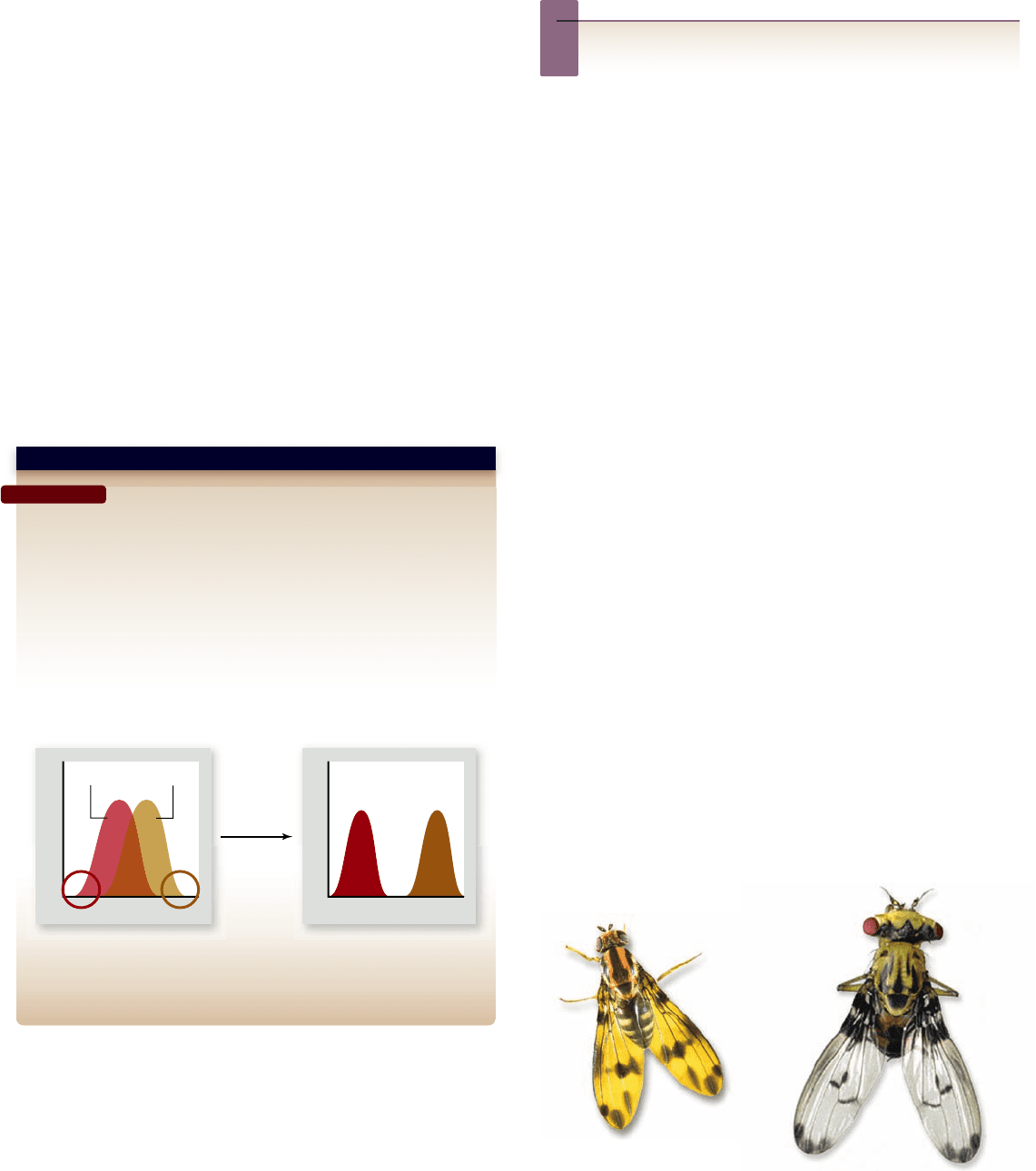
come different species. In this process, termed character
displacement, natural selection in each species favors those
individuals that use resources not used by the other species.
Because those individuals will have greater fitness, whatever
traits cause the differences in resource use will increase in fre-
quency (assuming that a genetic basis exists for these differ-
ences), and, over time, the species will diverge (figure 22.12).
An alternative possibility is that adaptive radiation occurs
through repeated instances of sympatric speciation, producing
a suite of species adapted to different habitats. As discussed ear-
lier such scenarios are hotly debated.
In the following sections we discuss four exemplary cases
of adaptive radiation.
Inquiry question
?
How would the scenario for adaptive radiation differ
depending on whether speciation is allopatric? What is the
relationship between character displacement and sympatric
speciation?
Hawaiian Drosophila exploited
a rich, diverse habitat
More than 1000 species in the fly genus Drosophila occur on the
Hawaiian Islands. New species of Drosophila are still being dis-
covered in Hawaii, although the rapid destruction of the native
vegetation is making the search more difficult.
Aside from their sheer number, Hawaiian Drosophila
species are unusual because of their incredible diversity of
morphological and behavioral traits (figure 22.13). Evidently,
when their ancestors first reached these islands, they encoun-
tered many “empty” habitats that other kinds of insects and
other animals occupied elsewhere. As a result, the species have
adapted to all manners of fruit fly life and include predators,
parasites, and herbivores, as well as species specialized for eat-
ing the detritus in leaf litter and the nectar of flowers. The lar-
vae of various species live in rotting stems, fruits, bark, leaves,
or roots, or feed on sap. No comparable diversity of Drosophila
species is found anywhere else in the world.
The great diversity of Hawaiian species is a result of the
geological history of these islands. New islands have continu-
ally arisen from the sea in this region. As they have done so,
they appear to have been invaded successively by the various
Drosophila groups present on the older islands. New species
thus have evolved as new islands have been colonized.
In addition, the Hawaiian Islands are among the most
volcanically active islands in the world. Periodic lava flows of-
ten have created patches of habitat within an island surrounded
by a “sea” of barren rock. These land islands are termed kipukas.
Drosophila populations isolated in these kipukas often undergo
speciation. In these ways, rampant speciation combined with
ecological opportunity has led to an unparalleled diversity of
insect life.
Figure 22.12
Character displacement. a. Two species are
initially similar and thus overla p greatly in resource use, as might
happen if the two species were similar in size (in many species, body
size and food size are closely related). Individuals in each species that
are most different from the other species (circled) will be favored by
natural selection, because they will not have to compete with the
other species. For example, the smallest individuals of one species and
the largest of the other would not compete with the other species for
food and thus would be favored. b. As a result, the species will diverge
in resource use and minimize competition between the species.
Figure 22.13
Hawaiian Drosophila. The hundreds of
species that have evolved on the Hawaiian Islands are extreme ly
variable in appearance, although genetically almost identical.
a. Drosophila heteroneura. b. Drosophila digressa.
chapter
22
The Origin of Species
447www.ravenbiology.com
rav32223_ch22_436-455.indd 447rav32223_ch22_436-455.indd 447 11/12/09 11:32:38 AM11/12/09 11:32:38 AM
Apago PDF Enhancer
Geospiza
fuliginosa
Geospiza
conirostris
Geospiza
difficilis
Camarhynchus
parvulus
Camarhynchus
psittacula
Camarhynchus
pauper
Cactospiza
heliobates
Cactospiza
pallida
Platyspiza
crassirostris
Ground and Cactus Finches Tree Finches
Vegetarian
Tree Finch
Warbler
Finches
Geospiza
fortis
Geospiza
magnirostris
Geospiza
scandens
Certhidea
fusca
Certhidea
olivacea
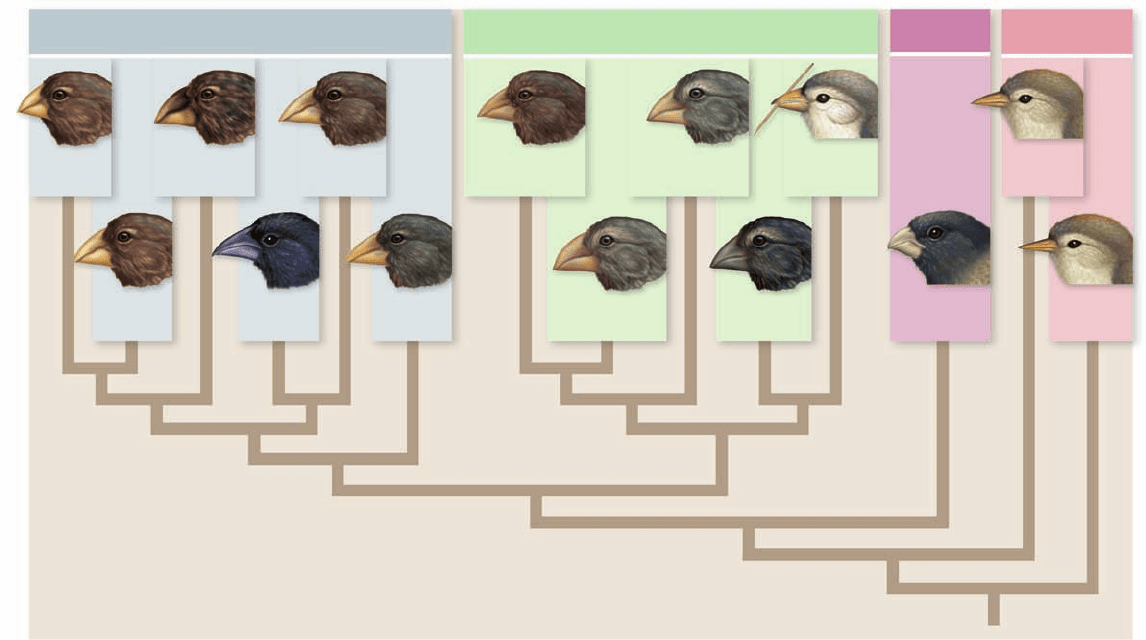
Tree nches.2. There are ve species of insect-eating tree
nches. Four species have bills suitable for feeding on
insects. The woodpecker nch has a chisel-like beak. This
unusual bird carries around a twig or a cactus spine, which
it uses to probe for insects in deep crevices.
Vegetarian nch.3. The very heavy bill of this species is
used to wrench buds from branches.
Warbler nches.4. These unusual birds play the same
ecological role in the Galápagos woods that warblers
play on the mainland, searching continuously over the
leaves and branches for insects. They have slender,
warblerlike beaks.
Recently, scientists have examined the DNA of Darwin’s
finches to study their evolutionary history. These studies suggest
that the deepest branches in the finch evolutionary tree lead to
warbler finches, which implies that warbler finches were among
the first types to evolve after colonization of the islands. All of
the ground species are closely related to one another, as are all
of the tree finches. Nonetheless, within each group, species differ
in beak size and other attributes, as well as in resource use.
Field studies, conducted in conjunction with those dis-
cussed in chapter 21, demonstrate that ground species compete
for resources; the differences between species likely resulted
from character displacement as initially similar species diverged
to minimize competitive pressures.
Darwin’s nch species adapted
to use di erent food types
The diversity of Darwin’s finches on the Galápagos Islands was
first mentioned in chapter 21. Presumably, the ancestor of Dar-
win’s finches reached these islands before other land birds, and
many of the types of habitats that other types of birds use on
the mainland were unoccupied.
As the new arrivals moved into these vacant ecological
niches and adopted new lifestyles, they were subjected to many
different sets of selective pressures. Under these circumstances,
and aided by the geographic isolation afforded by the many
islands of the Galápagos archipelago, the ancestral finches rap-
idly split into a series of diverse populations, some of which
evolved into separate species. These species now occupy many
different habitats on the Galápagos Islands, which are compa-
rable to the habitats several distinct groups of birds occupy on
the mainland. As illustrated in figure 22.14 , the 14 species fall
into four groups:
Ground nches.1. There are six species of Geospiza ground
nches. Most of the ground nches feed on seeds. The
size of their bills is related to the size of the seeds they eat.
Some of the ground nches feed primarily on cactus
owers and fruits, and they have a longer, larger, and
more pointed bill than the others.
Figure 22.14
An evolutionary tree of Darwin’s nches. This evolutionary tree, derived from examination of DNA sequences,
suggests that warbler nches are an early offshoot. Ground and tree nches subsequently diverged, and then species within each group
specialized to use different resources. Recent studies have shown, surprisingly, that the two warbler nches are not each other’s closest
relatives. Rather, Certhidea fusca is more closely related to the remaining Darwin’s nches than it is to C. olivacea.
448
part
IV
Evolution
rav32223_ch22_436-455.indd 448rav32223_ch22_436-455.indd 448 11/12/09 11:32:41 AM11/12/09 11:32:41 AM
Apago PDF Enhancer
Fish eater
Snail eater
Algae scraper
Zooplankton eater
Leaf eater
Insect eater
Second
set of ja
ws
Scale scraper
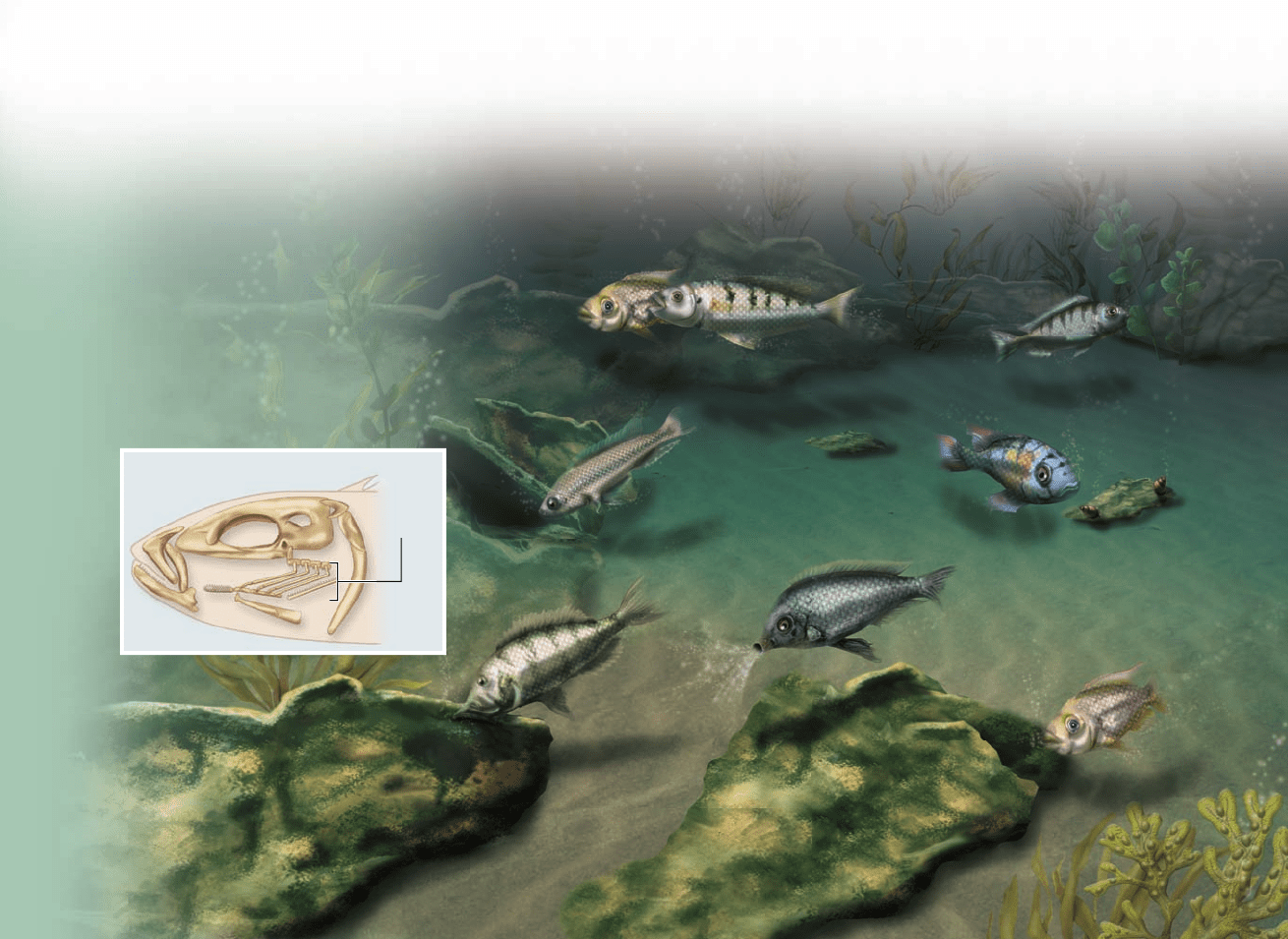
Figure 22.15
Cichlid shes of Lake Victoria. These shes have evolved adaptations to use a variety of different habitats. The
enlarged second set of jaws located in the throat of these sh has provided evolutionary exibility, allowing oral jaws to be modi ed in
many ways.
Lake Victoria cichlid shes
diversi ed very rapidly
Lake Victoria is an immense, shallow, freshwater sea about the
size of Switzerland in the heart of equatorial East Africa. Until
recently, the lake was home to an incredibly diverse collection
of over 450 species of cichlid fishes.
Geologically recent radiation
The cluster of cichlid species appears to have evolved recently
and quite rapidly. By sequencing the cytochrome b gene in
many of the lake’s fish, scientists have been able to estimate that
the first cichlids entered Lake Victoria only 200,000 years ago .
Dramatic changes in water level encouraged species for-
mation. As the lake rose, it flooded new areas and opened up
new habitats. Many of the species may have originated after the
lake dried down 14,000 years ago, isolating local populations in
small lakes until the water level rose again.
Cichlid diversity
Cichlids are small, perchlike fishes ranging from 5 to 25 centi-
meters (cm) in length, and the males come in endless varieties
of colors. The ecological and morphological diversity of these
fish is remarkable, particularly given the short span of time over
which they have evolved.
We can gain some sense of the vast range of types by look-
ing at how different species eat. There are mud biters, algae
scrapers, leaf chewers, snail crushers, zooplankton eaters, insect
eaters, prawn eaters, and fish eaters. Snail shellers pounce on
slow-crawling snails and spear their soft parts with long, curved
teeth before the snail can retreat into its shell. Scale scrapers rasp
slices of scales off other fish. There are even cichlid species that
are “pedophages,” eating the young of other cichlids.
Cichlid fish have a remarkable key innovation that may
have been instrumental in their evolutionary radiation: They
carry a second set of functioning jaws (figure 22.15). This trait
occurs in many other fish, but in cichlids it is greatly enlarged.
The ability of these second jaws to manipulate and process food
has freed the oral jaws to evolve for other purposes, and the
result has been the incredible diversity of ecological roles filled
by these fish.
Abrupt extinction in the last several decades
Recently, much of the cichlid diversity has disappeared. In
the 1950s, the Nile perch, a large commercial fish with a
voracious appetite, was introduced to Lake Victoria. Since
rav32223_ch22_436-455.indd 449rav32223_ch22_436-455.indd 449 11/12/09 11:33:02 AM11/12/09 11:33:02 AM
Apago PDF Enhancer
a.
b.
Glaciers link alpine zones into one
continuous range.
Mountain populations become isolated,
permitting divergence and speciation.
Alpine zones are reconnected. Separately
evolved species come back into contact.
Glaciation
snowfield snowline fringe stony debris sheltered boggy
Glaciers
recede
then, it has spread through the lake, eating its way through
the cichlids.
By 1990, many of the open-water cichlid species had be-
come extinct, as well as others living in rocky shallow regions.
Over 70% of all the named Lake Victoria cichlid species had
disappeared, as well as untold numbers of species that had yet
to be described. We will revisit the story of Lake Victoria when
we discuss conservation biology in chapter 59.
New Zealand alpine buttercups underwent
speciation in glacial habitats
Adaptive radiations such as those we have described in Hawaiian
Drosophila, Galápagos finches, and cichlid fishes seem to have
been favored by periodic isolation. A clear example of the role
periodic isolation plays in species formation can be seen in the
alpine buttercups that grow among the glaciers of New Zealand
(figure 22.16).
More species of alpine buttercups grow on the two main
islands of New Zealand than in all of North and South America
combined. The evolutionary mechanism responsible for this diver-
sity is recurrent isolation associated with the recession of glaciers.
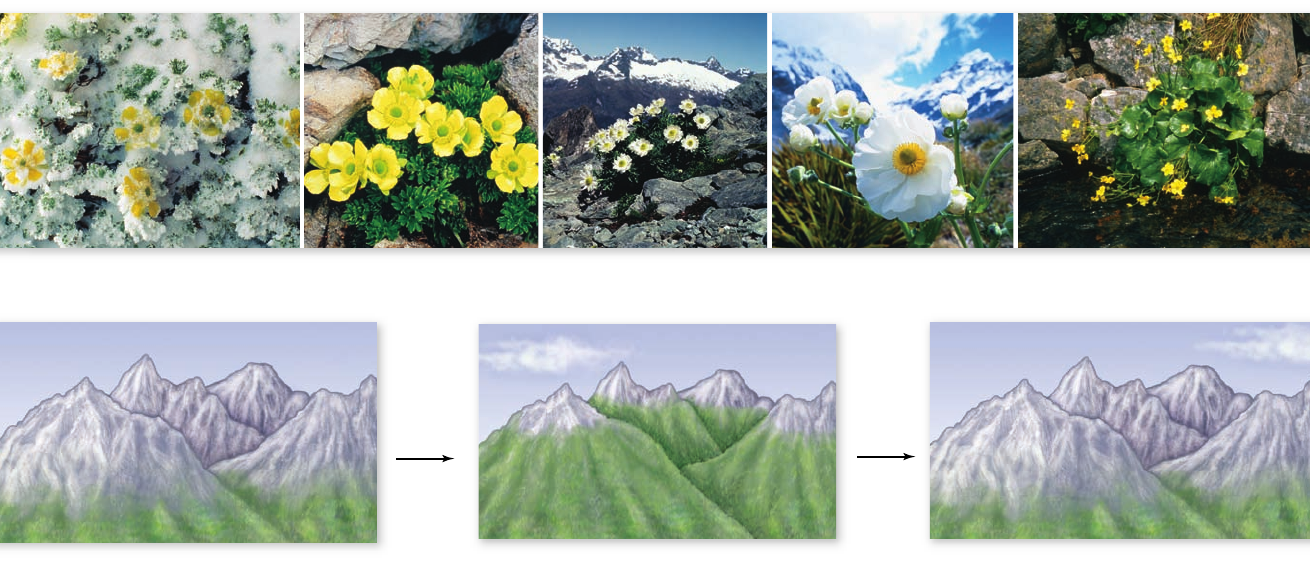
The 14 species of alpine buttercups occupy five distinc-
tive habitats within glacial areas:
■ snowfields—rocky crevices among outcrops in permanent
snowfields at 2130- to 2740-m elevation;
■ snowline fringe—rocks at lower margin of snowfields
between 1220 and 2130 m;
■ stony debris—slopes of exposed loose rocks at 610 to
1830 m;
■ sheltered situations—shaded by rock or shrubs at 305 to
1830 m; and
■ boggy habitats—sheltered slopes and hollows, poorly
drained tussocks at elevations between 760 and 1525 m.
Buttercup speciation and diversification have been
promoted by repeated cycles of glacial advance and retreat. As
the glaciers retreat up the mountains, populations become
isolated on mountain peaks, permitting speciation (see
figure 22.16). In the next glacial advances, these new species
can expand throughout the mountain range, coming into
contact with their close relatives. In this way, one initial spe-
cies could give rise to many descendants. Moreover, on iso-
lated mountaintops during glacial retreats, species have
Figure 22.16
New Zealand alpine buttercups (genus Ranunculus). Periodic glaciation encouraged species formation among
alpine buttercups in New Zealand. a. Fourteen species of alpine Ranunculus grow among the glaciers and mountains of New Zealand. b. The
formation of extensive glaciers during the Pleistocene epoch linked the alpi ne zones (white) of many mountains together. When the glaciers
receded, these alpine zones were isolated from one another, only to become reconnected with the advent of the next glacial period. During
periods of isolation, populations of alpine buttercups diverged in the isolated habitats.
450
part
IV
Evolution
rav32223_ch22_436-455.indd 450rav32223_ch22_436-455.indd 450 11/12/09 11:33:06 AM11/12/09 11:33:06 AM
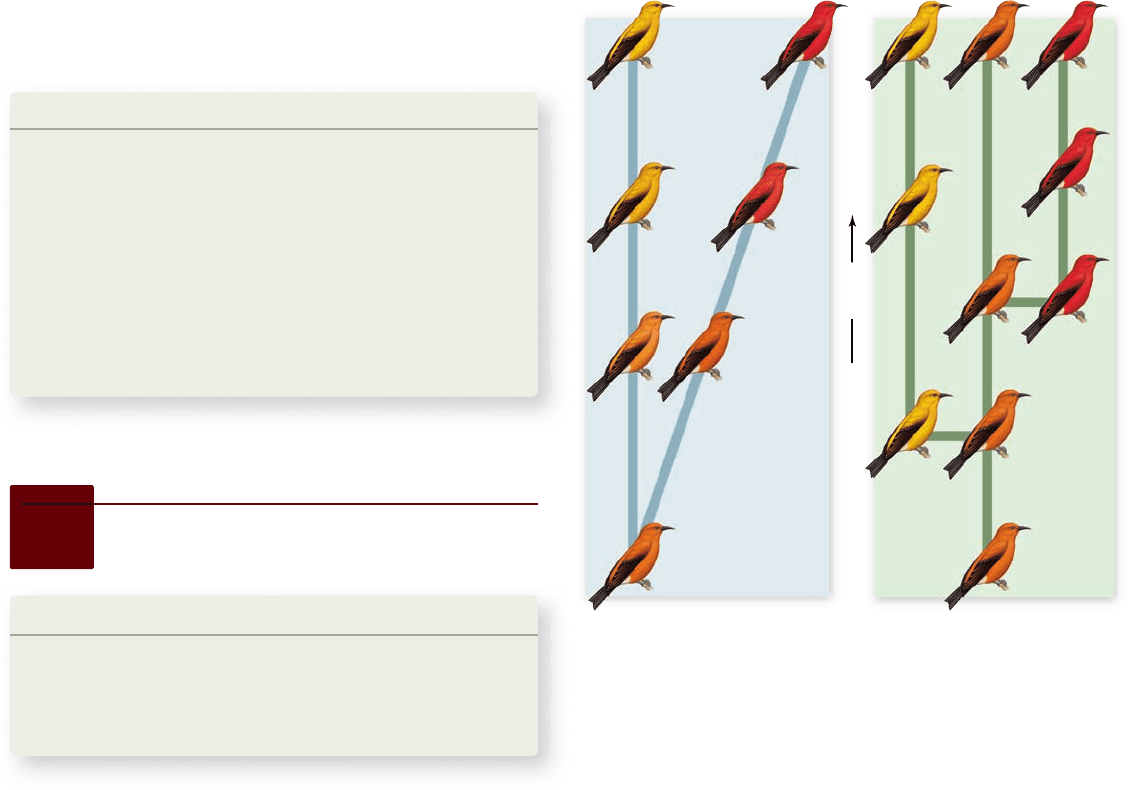
Apago PDF Enhancer
a. Gradualism b. Punctuated e
q
uilibrium
Time
of evolutionary change occurring over geologically short
time intervals. They called this phenomenon punctuated
equilibrium ( figure 22.17b) and argued that these periods of
rapid change occurred only during the speciation process.
Initial criticism of the punctuated equilibrium hypothesis
focused on whether rapid change could occur over short peri-
ods of time. As we have seen in the last two chapters, however,
when natural selection is strong, rapid and substantial evolu-
tionary change can occur. A more difficult question involves the
long periods of stasis: Why would species exist for thousands,
or even millions, of years without changing?
Although a number of possible reasons have been sug-
gested, most researchers now believe that a combination of
stabilizing and oscillating selection is responsible for stasis. If
the environment does not change over long periods of time,
or if environmental changes oscillate back and forth, then sta-
sis may occur for long periods. One factor that may enhance
this stasis is the ability of species to shift their ranges; for ex-
ample, during the ice ages, when the global climate cooled,
the geographic ranges of many species shifted southward, so
that the species continued to experience similar environmen-
tal conditions.
Learning Outcomes
Define stasis and compare it to gradual evolutionary 1.
change.
Explain the components of the punctuated equilibrium 2.
hypothesis.
We have discussed the manner in which speciation may occur,
but we haven’t yet considered the relationship between specia-
tion and the evolutionary change that occurs within a species.
Two hypotheses, gradualism and punctuated equilibrium, have
been advanced to explain the relationship.
Gradualism is the accumulation
of small changes
For more than a century after the publication of On the Origin
of Species, the standard view was that evolution occurred very
slowly. Such change would be nearly imperceptible from gen-
eration to generation, but would accumulate such that, over the
course of thousands and millions of years, major changes could
occur. This view is termed gradualism (figure 22.17a) .
Punctuated equilibrium is long periods of stasis
followed by relatively rapid change
Gradualism was challenged in 1972 by paleontologists Niles
Eldredge of the American Museum of Natural History in
New York and Stephen Jay Gould of Harvard University,
who argued that species experience long periods of little or
no evolutionary change (termed stasis), punctuated by bursts
22.6
The Pace of Evolution
convergently evolved to occupy similar habitats; these dis-
tantly related but ecologically similar species have then been
brought back into contact in subsequent glacial advances.
Learning Outcomes Review 22.5
Adaptive radiation occurs when a species diversifi es, producing descendant
species that are adapted to use many diff erent parts of the environment.
Adaptive radiation may occur under conditions of recurrent isolation,
which increases the rate at which speciation occurs, and by occupation of
areas with few competitors and many types of available resources, such
as on volcanic islands. The evolution of a key innovation may also allow
adaptation to parts of the environment that previously couldn’t be utilized.
■ In contrast to the archipelago model, how might an
adaptive radiation proceed in a case of sympatric
speciation by disruptive selection?
Figure 22.17
Two views of the pace of macroevolution.
a. Gradualism suggests that evolutionary change occ urs slowly
through time and is not linked to speciation, whereas
(b) punctuated equilibrium surmises that phenotypic change
occurs in bursts associated with speciation, separated by long
periods of little or no change.
chapter
22
The Origin of Species
451www.ravenbiology.com
rav32223_ch22_436-455.indd 451rav32223_ch22_436-455.indd 451 11/12/09 11:33:18 AM11/12/09 11:33:18 AM