
Raven P.H., Johnson G.B., Mason K.A. Biology (Ninth Edition)
Подождите немного. Документ загружается.

Apago PDF Enhancer
Ordovician
Devonian
Permian
Triassic
Cretaceous
Millions of years ago
Number of families
600
800 1000 600 400 200 0
0
100
200
300
400
500
Inquiry question
?
Why would changes in geographic ranges promote
evolutionary stasis?
Evolution may include both types of change
Eldredge and Gould’s proposal prompted a great deal of re-
search. Some well-documented groups, such as African mam-
mals, clearly have evolved gradually, not in spurts. Other groups,
such as marine bryozoa, seem to show the irregular pattern of
evolutionary change predicted by the punctuated equilibrium
model. It appears, in fact, that gradualism and punctuated equi-
librium are two ends of a continuum. Although some groups
appear to have evolved solely in a gradual manner and others
only in a punctuated mode, many other groups show evidence
of both gradual and punctuated episodes at different times in
their evolutionary history.
The idea that speciation is necessarily linked to pheno-
typic change has not been supported, however. On one hand, it
is now clear that speciation can occur without substantial phe-
notypic change. For example, many closely-related salamander
species are nearly indistinguishable. On the other, it is also clear
that phenotypic change can occur within species in the absence
of speciation.
Learning Outcomes Review 22.6
Gradualism is the accumulation of almost imperceptible changes that
eventually results in major diff erences. Punctuated equilibrium proposes that
long periods of stasis are interrupted (punctuated) by periods of rapid change.
Evidence for both gradualism and punctuated equilibrium has been found
in diff erent groups. Stasis refers to a period in which little or no evolutionary
change occurs. Stasis may result from stabilizing or oscillating selection.
■ Could evolutionary change be punctuated in time (that
is, rapid and episodic), but not linked to speciation?
Nonetheless, speciation has not always outpaced extinc-
tion. In particular, interspersed in the long-term increase in
species diversity have been a number of sharp declines, termed
mass extinctions.
Five mass extinctions have occurred
in the distant past
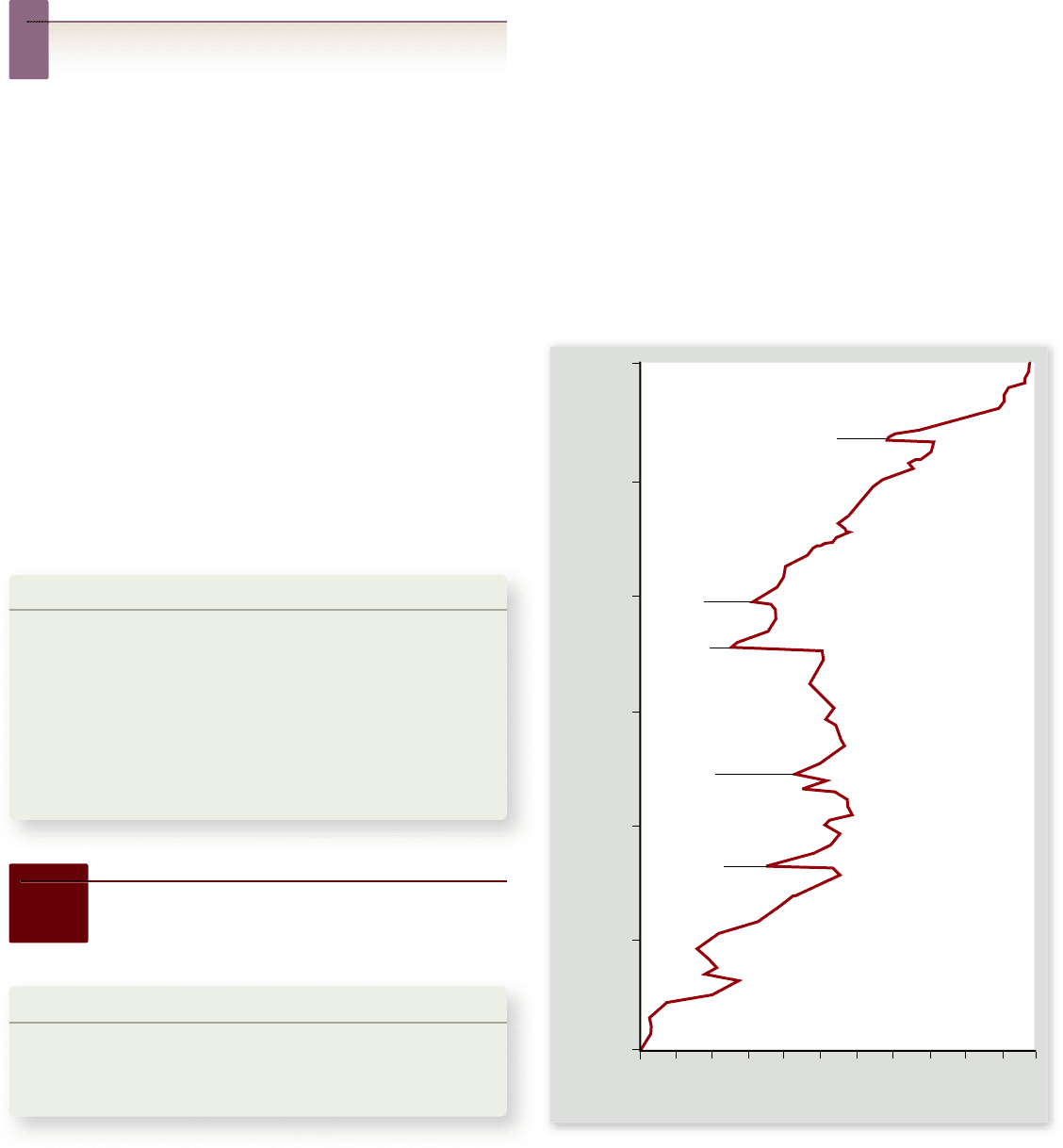
Five major mass extinctions have been identified, the most se-
vere one occurring at the end of the Permian period, approxi-
mately 250 million years ago (figure 22.18). At that time, more
than half of all plant and animal families and as much as 96% of
all species may have perished.
Learning Outcomes
Describe the pattern of species diversity through time.1.
Define mass extinction and identify when major mass 2.
extinctions have occurred.
Biological diversity has increased vastly since the Cambrian
period, but the trend has been far from consistent. After a
rapid rise, diversity reached a plateau for about 200 million
years, but since then has risen steadily. Because changes in the
number of species reflect the rate of origin of new species
relative to the rate at which existing species disappear, this
long-term trend reveals that speciation has, in general, sur-
passed extinction.
22.7
Speciation and Extinction
Through Time
Figure 22.18
Biodiversity through time. The taxonomic
diversity of families of marine animals has increased since the
Cambrian period, although occasional dips have occurred. The fossil
record is most complete for marine organisms because they are more
readily fossilized than terrestrial species. Families are shown, rather
than species, because many species are known from only one
specimen, thus introducing error into estimates of the time of
extinction. Arrows indicate the ve major mass extinction events.
452
part
IV
Evolution
rav32223_ch22_436-455.indd 452rav32223_ch22_436-455.indd 452 11/12/09 11:33:23 AM11/12/09 11:33:23 AM

Apago PDF Enhancer
The most famous and well-studied extinction, although
not as drastic, occurred at the end of the Cretaceous period (65
million years ago), at which time the dinosaurs and a variety of
other organisms went extinct. Recent findings have supported
the hypothesis that this extinction event was triggered when a
large asteroid slammed into Earth, perhaps causing global for-
est fires and obscuring the Sun for months by throwing parti-
cles into the air. The cause of other mass extinction events is
less certain. Some scientists suggest that asteroids may have
played a role in at least some of the other mass extinction
events; other hypotheses implicate global climate change and
other causes.
One important result of mass extinctions is that not all
groups of organisms are affected equally. For example, in the
extinction at the end of the Cretaceous, not only dinosaurs, but
also marine and flying reptiles, and ammonites (a type of mol-
lusk) went extinct. Marsupials, flowering plants, birds, and some
forms of plankton were greatly reduced in diversity. In contrast,
turtles, crocodilians, and amphibians seemed to have been un-
scathed. Why some groups were harder hit than others is not
clear, but one hypothesis suggests that survivors were those ani-
mals that could shelter underground or in water, and that could
either scavenge or required little food in the cool temperatures
that resulted from the blockage of sunlight.
A consequence of mass extinctions is that previously dom-
inant groups may perish, thus changing the course of evolution.
This is certainly true of the Cretaceous extinction. During the
Cretaceous period, placental mammals were a minor group
composed of species that were mostly no larger than a house cat.
When the dinosaurs, which had dominated the world for more
than 100 million years, disappeared at the end of this period, the
placental mammals underwent a significant adaptive radiation.
It is humbling to think that humans might never have arisen had
that asteroid not struck Earth 65 million years ago.
As the world around us illustrates today, species diversity
does rebound after mass extinctions, but this recovery is not
rapid. Examination of the fossil record indicates that rates of
speciation do not immediately increase after an extinction
pulse, but rather take about 10 million years to reach their max-
imum. The cause of this delay is not clear, but it may result
because it takes time for ecosystems to recover and for the pro-
cesses of speciation and adaptive diversification to begin. Con-
sequently, species diversity may require 10 million years, or
even much longer, to attain its previous level.
A sixth extinction is underway
The number of species in the world in recent times is greater
than it has ever been. Unfortunately, that number is decreasing
at an alarming rate due to human activities (see chapter 59).
Some estimate that as much as one-fourth of all species
will become extinct in the near future, a rate of extinction not
seen on Earth since the Cretaceous mass extinction. More-
over, the rebound in species diversity may be even slower
than following previous mass extinction events because, in-
stead of the ecologically impoverished, but energy-rich envi-
ronment that existed after previous mass extinction events,
a large proportion of the world’s resources will be taken up
already by human activities, leaving few resources available
for adaptive radiation.
Learning Outcomes Review 22.7
The number of species has increased through time, although not at a
constant rate. Five major extinction events have substantially, though
briefl y, reduced the number of species. Diversity rebounds, but the recovery
is not rapid, and the groups making up that diversity are not the same as
those that existed before the extinction event. Unfortunately, humans are
currently causing a sixth mass extinction event.
■ In what ways are the current mass extinction event
different from those that have occurred in the past?
Prezygotic isolating mechanisms prevent the formation of a zygote.
Prezygotic isolating mechanisms prevent a viable zygote from being
created. These mechanisms include ecological, behavioral, temporal,
and mechanical isolation.
Postzygotic isolating mechanisms prevent normal development into
reproducing adults.
Postzygotic isolating mechanisms prevent a zygote from developing
into a viable and fertile individual.
The biological species concept does not explain all observations.
The ecological species concept, one alternative explanation, focuses
on the role of natural selection and differences among species in their
ecological requirements.
In reality, no one species concept can explain all the diversity of life.
22.1 The Nature of Species and the Biological
Species Concept
Sympatric species inhabit the same locale but remain distinct.
Most sympatric species are readily distinguishable phenotypically and
ecologically. Others can usually be identi ed by careful study.
Populations of a species exhibit geographic variation.
Populations that differ greatly in phenotype or ecologically are
usually connected by geographically intermediate populations.
The biological species concept focuses on the ability to exchange genes.
Biological species are generally defined as populations that
interbreed, or have the potential to do so, and produce fertile
offspring. Reproductive isolating mechanisms prevent genetic
exchange between species.
Chapter Review
chapter
22
The Origin of Species
453www.ravenbiology.com
rav32223_ch22_436-455.indd 453rav32223_ch22_436-455.indd 453 11/12/09 11:33:23 AM11/12/09 11:33:23 AM

Apago PDF Enhancer
3. Problems with the biological species concept include the fact that
a. many species reproduce asexually.
b. postzygotic isolating mechanisms decrease hybrid viability.
c. prezygotic isolating mechanisms are extremely rare.
d. all of these.
4. Allopatric speciation
a. is less common than sympatric speciation.
b. involves geographic isolation of some kind.
c. is the only kind of speciation that occurs in plants.
d. requires polyploidy.
UNDERSTAND
1. Prezygotic isolating mechanisms include all of the following except
a. hybrid sterility. c. habitat separation.
b. courtship rituals. d. seasonal reproduction.
2. Reproductive isolation is
a. a result of individuals not mating with each other.
b. a speci c type of postzygotic isolating mechanism.
c. required by the biological species concept.
d. none of the above.
Review Questions
22.2 Natural Selection and Reproductive Isolation
Selection may reinforce isolating mechanisms.
Populations may evolve complete reproductive isolation in
allopatry. If populations that have evolved only partial reproductive
isolation come into contact, natural selection can lead to increased
reproductive isolation, a process termed “reinforcement.”
Alternatively, genetic exchange between the populations can lead to
homogenization and thus prevent speciation from occurring.
22.3 The Role of Genetic Drift and Natural
Selection in Speciation
Random changes may cause reproductive isolation.
In small populations, genetic drift may cause populations to diverge;
the differences that evolve may cause the populations to become
reproductively isolated.
Adaptation can lead to speciation.
Adaptation to different situations or environments may incidentally
lead to reproductive isolation. In contrast to reinforcement, these
differences are not directly favored by natural selection because they
prevent hybridization.
Natural selection can directly select for traits that increase
reproductive isolation.
22.4 The Geography of Speciation (see gure 22.9)
Allopatric speciation takes place when populations are geographically
isolated
.
Allopatric, or geographically isolated, populations are much more
likely to evolve into separate species because no gene ow occurs
between them. Most speciation probably occurs in allopatry.
Sympatric speciation occurs without geographic separation.
Sympatric speciation can occur in two ways. One is polyploidy, which
instantly creates a new species. Disruptive selection also can cause one
species to divide into two, but scientists debate how commonly it occurs.
22.5 Adaptive Radiation and Biological Diversity
Adaptive radiation occurs when a species nds itself in a new or
suddenly changed environment with many resources and few
competing species (see gure 22.11).
The evolution of a new trait that allows individuals to use previously
inaccessible parts of the environment, termed a “key innovation,”
may also trigger an adaptive radiation.
Hawaiian Drosophila exploited a rich, diverse habitat.
At least 1000 species of Hawaiian Drosophila have been identi ed.
Darwin’s nch species adapted to use di erent food types.
Fourteen species in four genera have evolved to exploit four different
habitats based on type of food.
Lake Victoria cichlid shes diversi ed very rapidly.
Cichlids underwent rapid radiation to form 300 species, although
today more than 70% of these species are now extinct.
New Zealand alpine buttercups underwent speciation in glacial habitats.
Periodic isolation by glaciers has led to 14 species in distinct habitats.
22.6 The Pace of Evolution
Gradualism is the accumulation of small changes.
Historically, scientists took the view that speciation occurred
gradually through very small cumulative changes.
Punctuated equilibrium is long periods of stasis followed by relatively
rapid change.
The punctuated equilibrium hypothesis contends that not only is
change rapid and episodic, but that it is only associated with the
speciation process.
Evolution may include both types of change.
Scientists generally agree that evolutionary change occurs on a
continuum, with gradualism and punctuated change being the extremes.
22.7 Speciation and Extinction Through Time
In general, the number of species have increased through time
(see gure 22.18).
Five mass extinctions have occurred in the distant past.
Mass extinctions have led to dramatic decreases in species diversity,
which takes millions of years to recover. Five such mass extinctions
have occurred in the distant past due to asteroids hitting the Earth
and global climate change, among other events.
A sixth mass extinction is underway.
Humans are currently causing a sixth mass extinction.
454
part
IV
Evolution
rav32223_ch22_436-455.indd 454rav32223_ch22_436-455.indd 454 11/12/09 11:33:24 AM11/12/09 11:33:24 AM

Apago PDF Enhancer
5. Gradualism and punctuated equilibrium are
a. two ends of the continuum of the rate of evolutionary
change over time.
b. mutually exclusive views about how all evolutionary change
takes place.
c. mechanisms of reproductive isolation.
d. none of the above.
6. During the history of life on Earth
a. there have been major extinction events.
b. species diversity has steadily increased.
c. species diversity has stayed relatively constant.
d. extinction rates have been completely offset
by speciation rates.
7. Speciation by allopolyploidy
a. takes a long time.
b. is common in birds.
c. leads to reduced numbers of chromosomes.
d. occurs after hybridization between two species.
8. Adaptive radiation
a. is the result of enriched uranium used in power plants.
b. is the evolution of closely related species adapted to use
different parts of the environment.
c. results from genetic drift.
d. is the outcome of stabilizing selection favoring the
maintenance of adaptive traits.
APPLY
1. Leopard frogs from different geographic populations
of the Rana pipiens complex
a. are members of a single species because they look very
similar to one another.
b. are different species shown to have pre- and postzygotic
isolating mechanisms.
c. frequently interbreed to produce viable hybrids.
d. are genetically identical due to effective reproductive
isolation.
2. If reinforcement is weak and hybrids are not completely infertile,
a. genetic divergence between populations may be overcome
by gene ow.
b. speciation will occur 100% of the time.
c. gene ow between populations will be impossible.
d. the speciation will be more likely than if hybrids were
completely infertile.
3. Natural selection can
a. enhance the probability of speciation.
b. enhance reproductive isolation.
c. act against hybrid survival and reproduction.
d. do all of these.
4. Character displacement
a. arises through competition and natural selection, favoring
divergence in resource use.
b. arises through competition and natural selection, favoring
convergence in resource use.
c. does not promote speciation.
d. reduced speciation rates in Galápagos nches.
5. Hybridization between incompletely isolated populations
a. always leads to reinforcement due to the inferiority of hybrids.
b. can serve as a mechanism for preserving gene ow
between populations, thus preventing speciation.
c. only occurs in plants.
d. never affects rates of speciation.
6. Natural selection can lead to speciation
a. by causing small populations to diverge more than large
populations.
b. because the evolutionary changes that two populations
acquire while adapting to different habitats may have the
effect of making them reproductively isolated.
c. by favoring the same evolutionary change in multiple
populations.
d. by favoring intermediate phenotypes.
SYNTHESIZE
1. Natural selection can lead to the evolution of prezygotic
isolating mechanisms, but not postzygotic isolating
mechanisms? Explain.
2. If there is no universally accepted de nition of a species, what
good is the term? Will the idea of and need for a “species
concept” be eliminated in the future?
3. Refer to gure 22.6. In Europe, pied and collared ycatchers are
dissimilar in sympatry, but very similar in allopatry, consistent
with character divergence in coloration. In this case, there is no
competition for ecological resources as in other cases of character
divergence discussed. How might this example work?
4. Refer to gure 22.14. Geospiza fuliginosa and Geospiza fortis are
found in sympatry on at least one island in the Galápagos and in
allopatry on several islands in the same archipelago. Compare
your expectations about degree of morphological similarity of the
two species in these two contexts, given the hypothesis that
competition for food played a large role in the adaptive radiation
of this group. Would your expectations be the same for a pair of
nch species that are not as closely related? Explain.
ONLINE RESOURCE
www.ravenbiology.com
Understand, Apply, and Synthesize—enhance your study with
animations that bring concepts to life and practice tests to assess
your understanding. Your instructor may also recommend the
interactive eBook, individualized learning tools, and more.
chapter
22
The Origin of Species
455www.ravenbiology.com
rav32223_ch22_436-455.indd 455rav32223_ch22_436-455.indd 455 12/4/09 10:52:02 AM12/4/09 10:52:02 AM
Apago PDF Enhancer
A
Chapter
23
Systematics
and the Phylogenetic
Revolution
Chapter Outline
23.1 Systematics
23.2 Cladistics
23.3 Systematics and Classi cation
23.4 Phylogenetics and Comparative Biology
23.5 Phylogenetics and Disease Evolution
Introduction
All organisms share many biological characteristics. They are composed of one or more cells, carry out metabolism and
transfer energy with ATP, and encode hereditary information in DNA. Yet, there is also a tremendous diversity of life, ranging
from bacteria and amoebas to blue whales and sequoia trees. For generations, biologists have tried to group organisms
based on shared characteristics. The most meaningful groupings are based on the study of evolutionary relationships among
organisms. New methods for constructing evolutionary trees and a sea of molecular sequence data are leading to improved
evolutionary hypotheses to explain life’s diversification.
CHAPTER
23.1
Systematics
Learning Outcomes
Understand what a phylogeny represents.1.
Explain why phenotypic similarity does not necessarily 2.
indicate close evolutionary relationship.
One of the great challenges of modern science is to under-
stand the history of ancestor–descendant relationships that
unites all forms of life on Earth, from the earliest single-
celled organisms to the complex organisms we see around
us today. If the fossil record were perfect, we could trace
the evolutionary history of species and examine how each
arose and proliferated; however, as discussed in chapter 21 ,
the fossil record is far from complete. Although it answers
many questions about life’s diversification, it leaves many
others unsettled.
rav32223_ch23_456-473.indd 456rav32223_ch23_456-473.indd 456 11/12/09 1:21:04 PM11/12/09 1:21:04 PM
Apago PDF Enhancer
a. b.
Variations of a Cladogram
1
3
2
Gibbon Human Chimp Gorilla Orangutan
1
2
Gibbon
Human
Chimp
Gorilla
Orangutan
Gibbon Human ChimpGorillaOrangutan
1
2
Version 1
Version 2
Version 3
3
3
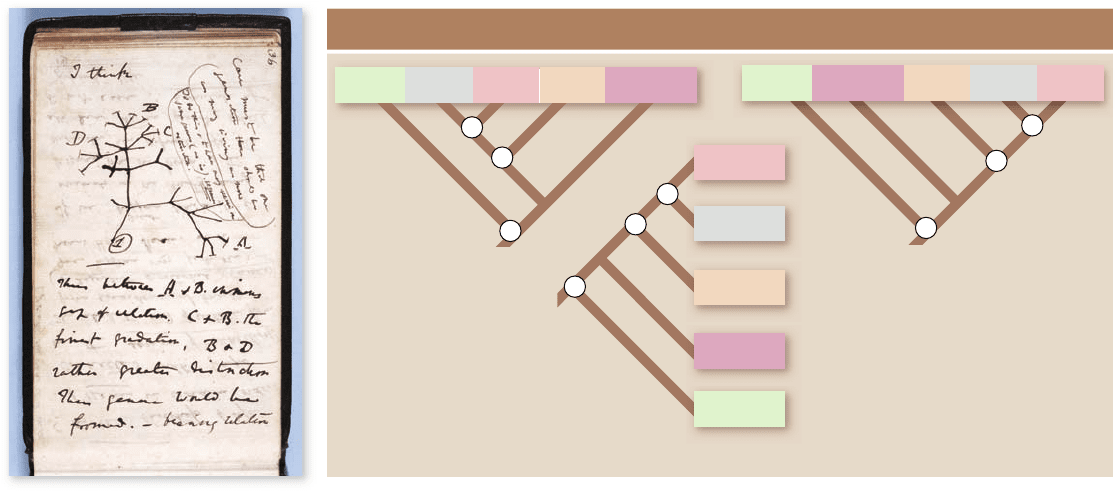
Figure 23.1
Phylogenies depict evolutionary relationships. a. A drawing from one of Darwin’s notebooks, written in 1837 as he
developed his ideas that led to On the Origin of Species. Dar win viewed life as a branching process akin to a tree, with species on the twigs, and
evolutionary change represented by the branching pattern displayed by a tree as it grows. b. An example of a phylogeny. Humans and
chimpanzees are more closely related to each other than they are to any other living species. This is apparent because they share a common
ancestor (the node labeled 1) that was not an ancestor of other species. Similarly, humans, chimpanzees, and gorillas are more closely related to
one another than any of them is to orangutans because they share a common ancestor (node 2) that was not ancestral to orangutans. Node 3
represents the common ancestor of all apes. Note that these three versions convey the same information despite the differences in
arrangement of species and orientation.
Consequently, scientists must rely on other types of evi-
dence to establish the best hypothesis of evolutionary relation-
ships. Bear in mind that the outcomes of such studies are
hypotheses, and as such, they require further testing. All hy-
potheses may be disproved by new data, leading to the forma-
tion of better, more accurate scientific ideas.
The reconstruction and study of evolutionary relation-
ships is called systematics. By looking at the similarities and
differences between species, systematists can construct an evo-
lutionary tree, or phylogeny, which represents a hypothesis
about patterns of relationship among species.
Branching diagrams depict
evolutionary relationships
Darwin envisioned that all species were descended from a sin-
gle common ancestor, and that the history of life could be de-
picted as a branching tree (figure 23.1). In Darwin’s view, the
twigs of the tree represent existing species. As one works down
the tree, the joining of twigs and branches reflects the pattern
of common ancestry back in time to the single common ances-
tor of all life. The process of descent with modification from
common ancestry results in all species being related in this
branching, hierarchical fashion, and their evolutionary history
can be depicted using branching diagrams or phylogenetic
trees. Figure 23.1b shows how evolutionary relationships are
depicted with a branching diagram. Humans and chimpanzees
are descended from a common ancestor and are each other’s
closest living relative (the position of this common ancestor is
indicated by the node labeled 1). Humans, chimps, and gorillas
share an older common ancestor (node 2), and all great apes
share a more distant common ancestor (node 3).
One key to interpreting a phylogeny is to look at how
recently species share a common ancestor, rather than looking
at the arrangement of species across the top of the tree. If you
compare the three versions of the phylogeny of figure 23.1b,
you can see that the relationships are the same: Regardless of
where they are positioned, chimpanzees and humans are still
more closely related to each other than to any other species.
Moreover, even though humans are placed next to gib-
bons in version 1 of figure 23.1b, the pattern of relationships
still indicates that humans are more closely related (that is,
share a more recent common ancestor) with gorillas and orang-
utans than with gibbons. Phylogenies are also sometimes dis-
played on their side, rather than upright figure 23.1b (version 3),
but this arrangement also does not affect its interpretation.
Similarity may not accurately predict
evolutionary relationships
We might expect that the greater the time since two species
diverged from a common ancestor, the more different they
would be. Early systematists relied on this reasoning and con-
structed phylogenies based on overall similarity. If, in fact,
chapter
23
Systematics and the Phylogenetic Revolution
457www.ravenbiology.com
rav32223_ch23_456-473.indd 457rav32223_ch23_456-473.indd 457 11/12/09 1:21:07 PM11/12/09 1:21:07 PM

Apago PDF Enhancer
23.2
Cladistics
Learning Outcomes
Describe the difference between ancestral and 1.
derived similarities.
Explain why only shared, derived characters indicate 2.
close evolutionary relationship.
Demonstrate how a cladogram is constructed.3.
Because phenotypic similarity may be misleading, most system-
atists no longer construct their phylogenetic hypotheses solely
on this basis. Rather, they distinguish similarity among species
that is inherited from the most recent common ancestor of an
entire group, which is called derived, from similarity that arose
prior to the common ancestor of the group, which is termed
ancestral. In this approach, termed cladistics, only shared
species evolved at a constant rate, then the amount of diver-
gence between two species would be a function of how long
they had been diverging, and thus phylogenies based on degree
of similarity would be accurate. As a result, we might think that
chimps and gorillas are more closely related to each other than
either is to humans.
But as chapter 22 revealed, evolution can occur very rap-
idly at some times and very slowly at others. In addition, evolu-
tion is not unidirectional—sometimes species’ traits evolve in
one direction, and then back the other way (a result of oscillat-
ing selection; see chapter 20 ). Species invading new habitats are
likely to experience new selective pressures and may change
greatly; those staying in the same habitats as their ancestors
may change only a little. For this reason, similarity is not neces-
sarily a good predictor of how long it has been since two species
shared a common ancestor.
A second fundamental problem exists as well: Evolution
is not always divergent. In chapter 21 , we discussed convergent
evolution, in which two species independently evolve the same
features. Often, species evolve convergently because they use
similar habitats, in which similar adaptations are favored. As a
result, two species that are not closely related may end up more
similar to each other than they are to their close relatives. Evo-
lutionary reversal, the process in which a species re-evolves the
characteristics of an ancestral species, also has this effect.
Learning Outcomes Review 23.1
Systematics is the study of evolutionary relationships. Phylogenies, or
phylogenetic trees, are graphic representations of relationships among
species. Similarity of organisms alone does not necessarily correlate with
their relatedness because evolutionary change is not constant in rate
and direction.
■ Why might a species be most phenotypically similar to a
species that is not its closest evolutionary relative?
derived characters are considered informative in determining
evolutionary relationships.
The cladistic method requires that character
variation be identi ed as ancestral or derived
To employ the method of cladistics, systematists first gather
data on a number of characters for all the species in the analysis.
Characters can be any aspect of the phenotype, including mor-
phology, physiology, behavior, and DNA. As chapters 18 and 24
show, the revolution in genomics should soon provide a vast
body of data that may revolutionize our ability to identify and
study character variation.
To be useful, the characters should exist in recognizable
character states. For example, consider the character “teeth”
in amniote vertebrates (namely birds, reptiles, and mammals;
see chapter 35). This character has two states: presence in most
mammals and reptiles and absence in birds and a few other
groups such as turtles.
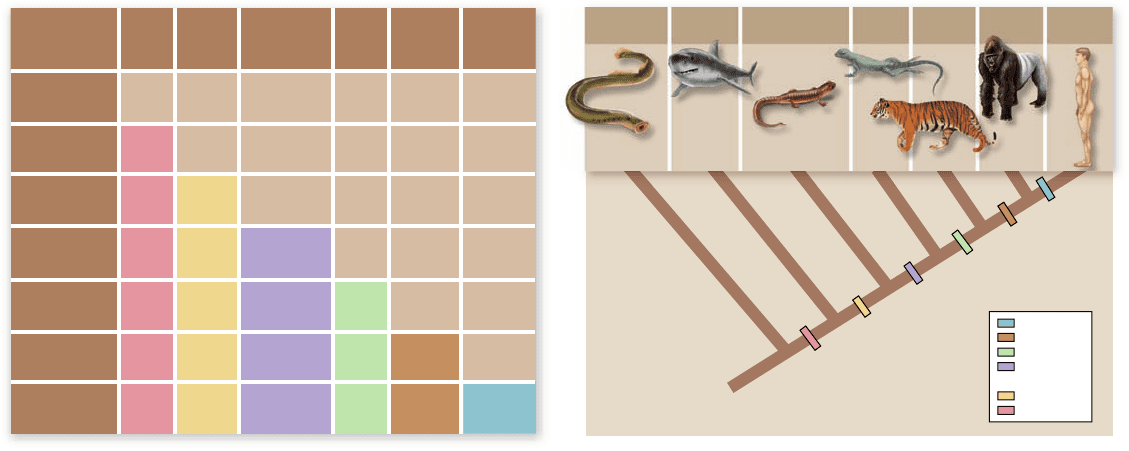
Examples of ancestral versus derived characters
The presence of hair is a shared derived feature of mammals
(figure 23.2) ; in contrast, the presence of lungs in mammals is
an ancestral feature because it is also present in amphibians and
reptiles (represented by a salamander and a lizard) and there-
fore presumably evolved prior to the common ancestor of
mammals (see figure 23.2). The presence of lungs, therefore,
does not tell us that mammal species are all more closely related
to one another than to reptiles or amphibians, but the shared,
derived feature of hair suggests that all mammal species share a
common ancestor that existed more recently than the common
ancestor of mammals, amphibians, and reptiles.
To return to the question concerning the relationships of
humans, chimps, and gorillas, a number of morphological and
DNA characters exist that are derived and shared by chimps
and humans, but not by gorillas or other great apes. These
characters suggest that chimps and humans diverged from a
common ancestor (see figure 23.1b, node 1) that existed more
recently than the common ancestor of gorillas, chimps, and hu-
mans (node 2).
Determination of ancestral versus derived
Once the data are assembled, the first step in a manual cladistic
analysis is to polarize the characters—that is, to determine
whether particular character states are ancestral or derived. To
polarize the character “teeth,” for example, systematists must
determine which state—presence or absence—was exhibited by
the most recent common ancestor of this group.
Usually, the fossils available do not represent the most
recent common ancestor—or we cannot be confident that they
do. As a result, the method of outgroup comparison is used to as-
sign character polarity. To use this method, a species or group
of species that is closely related to, but not a member of, the
group under study is designated as the outgroup. When the
group under study exhibits multiple character states, and one of
those states is exhibited by the outgroup, then that state is con-
sidered to be ancestral and other states are considered to be
derived. However, outgroup species also evolve from their
458
part
IV
Evolution
rav32223_ch23_456-473.indd 458rav32223_ch23_456-473.indd 458 11/12/09 1:21:10 PM11/12/09 1:21:10 PM
Apago PDF Enhancer
Traits:
Organism
Jaws Lungs Amniotic
Membrane
Hair No Tail Bipedal
Lamprey
Shark
Salamander
Lizard
Tiger
Gorilla
Human
0 0 0 0 0 0
1 0 0 0 0 0
1 1 0 0 0 0
1 1 1 0 0 0
1 1 1 1 0 0
1 1 1 1 1 0
1 1 1 1 1 1
Tail loss
Bipedal
Hair
Lungs
Jaws
Amniotic
membrane
Lamprey
Tiger
Gorilla Human
Lizard
Salamander
Shark
a. b.
Figure 23.2
A cladogram. a. Morphological data for a group of seven vertebrates are tab ulated. A “1” indicates possession of the
derived character state, and a “0” indicates possession of the ancestral character state (note that the derived state for character “no tail” is the
absence of a tail; for all other traits, absence of the trait is the ancestral character state). b. A tree, or cladogram, diagrams the relationships
among the organisms based on the presence of derived characters. The derived characters between the cladogram branch points are shared by
all organisms above the branch points and are not present in any below them. The outgroup (in this case, the lamprey) does not possess any of
the derived characters.
ancestors, so the outgroup species will not always exhibit the
ancestral condition.
Polarity assignments are most reliable when the same
character state is exhibited by several different outgroups.
In the preceding example, teeth are generally present in the
nearest outgroups of amniotes—amphibians and fish—
as well as in many species of amniotes themselves. Conse-
quently, the presence of teeth in mammals and reptiles is
considered ancestral, and their absence in birds and turtles is
considered derived.
Construction of a cladogram
Once all characters have been polarized, systematists use this
information to construct a cladogram, which depicts a hypoth-
esis of evolutionary relationships. Species that share a common
ancestor, as indicated by the possession of shared derived char-
acters, are said to belong to a clade. Clades are thus evolution-
ary units and refer to a common ancestor and all of its
descendants. A derived character shared by clade members is
called a synapomorphy of that clade. Figure 23.2b illustrates
that a simple cladogram is a nested set of clades, each character-
ized by its own synapomorphies. For example, amniotes are a
clade for which the evolution of an amniotic membrane is a
synapomorphy. Within that clade, mammals are a clade, with
hair as a synapomorphy, and so on.
Ancestral states are also called plesiomorphies, and
shared ancestral states are called symplesiomorphies. In con-
trast to synapomorphies, symplesiomorphies are not informa-
tive about phylogenetic relationships.
Consider, for example, the character state “presence of a
tail,” which is exhibited by lampreys, sharks, salamanders, lizards,
and tigers. Does this mean that tigers are more closely related
to—and shared a more recent common ancestor with—lizards
and sharks than to apes and humans, their fellow mammals? The
answer, of course, is no: Because symplesiomorphies reflect char-
acter states inherited from a distant ancestor, they do not imply
that species exhibiting that state are closely related.
Homoplasy complicates cladistic analysis
In real-world cases, phylogenetic studies are rarely as simple as
the examples we have shown so far. The reason is that in some
cases, the same character has evolved independently in several
species. These characters would be categorized as shared de-
rived characters, but they would be false signals of a close evo-
lutionary relationship. In addition, derived characters may
sometimes be lost as species within a clade re-evolve to the an-
cestral state.
Homoplasy refers to a shared character state that has
not been inherited from a common ancestor exhibiting that
character state. Homoplasy can result from convergent evolu-
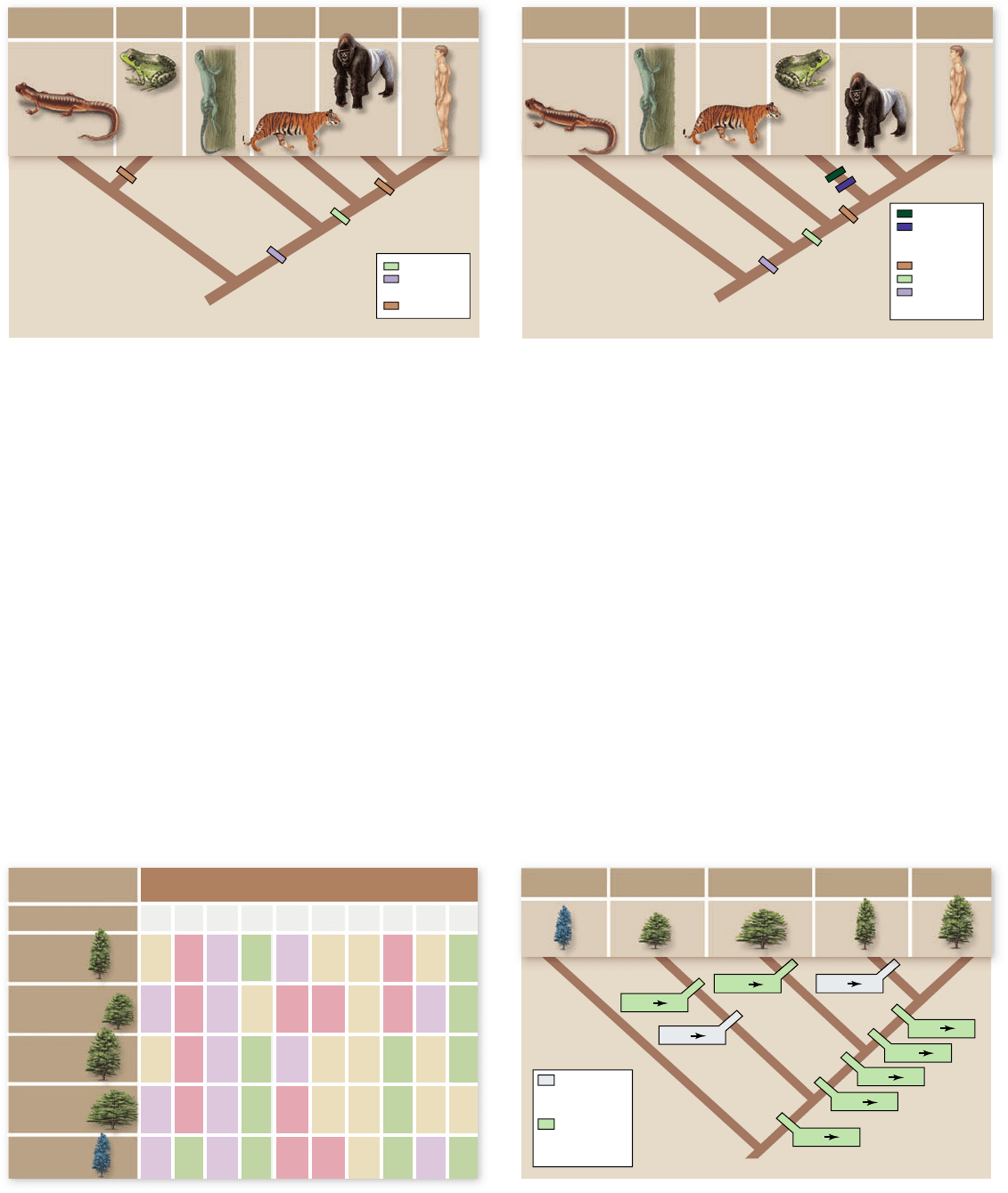
tion or from evolutionary reversal. For example, adult frogs
do not have a tail. Thus, absence of a tail is a synapomorphy
that unites not only gorillas and humans, but also frogs. How-
ever, frogs have neither an amniotic membrane nor hair, both
of which are synapomorphies for clades that contain gorillas
and humans.
In cases such as this, when there are conflicts among the
characters, systematists rely on the principle of parsimony,
which favors the hypothesis that requires the fewest assump-
tions. As a result, the phylogeny that requires the fewest evolu-
tionary events is considered the best hypothesis of phylogenetic
chapter
23
Systematics and the Phylogenetic Revolution
459www.ravenbiology.com
rav32223_ch23_456-473.indd 459rav32223_ch23_456-473.indd 459 11/12/09 1:21:11 PM11/12/09 1:21:11 PM
Apago PDF Enhancer
a. b.
Salamander Frog Lizard Tiger Gorilla Human Salamander Frog Lizard Tiger Gorilla Human
Hair
Tail loss
Amniotic
membrane
Amniotic
membrane
loss
Hair loss
Tail loss
Hair
Amniotic
membrane
8:T C
DNA Sequence
Species A
Site 1
G
G
A
A
A
C A
A
A
A
A
T
G
T
T
T
A
C
A
C
C
G
C
G
G
C
G
G
G
G
G
C
C
T
T
T
G
A
G
G
A
T
T
T
G
T
C
C
C
T
2 3 4 5 6 7 8 9 10
Outgroup
Species B
Species C
Species D
Outgroup Species A Species C Species D Species B
Homoplastic
evolutionary
changes
Homologous
evolutionary
changes
2:T C
9:A G
6:C G
1:A G
5:C A
4:T G
10:T G
8:T C
Figure 23.3
Parsimony and homoplasy. a. The placement of frogs as closely related to salamanders requires that tail loss evolved
twice, an example of homoplasy. b. If frogs are closely related to gorillas and humans, then tail loss only had to evolve once. However, this
arrangement would require two additional evolutionary changes: Frogs would have had to have lost the amniotic membrane and hair
(alternatively, hair could have evolved independently in tigers and the clade of humans and gorillas; this interpretation would require two
evolutionary changes in the hair character, just like the interpretation shown in the gure, in which hair evolved only once, but then was
lost in frogs). Based on the principle of parsimony, the cladogram that requires the fewest number of evolutionary changes is favored; in
this case the cladogram in (a) requires four changes, whereas that in (b) requires ve, so (a) is considered the preferred hypothesis of
evolutionary relationships.
Figure 23.4
Cladistic analysis of DNA sequence data. Sequence data are analyzed just like any other data. The most parsimonious
interpretation of the DNA sequence data requires nine evolutionary changes. Each of these changes is indicated on the phylogeny. Change in
site 8 is homoplastic: Species A and B independently evolved from thymine to cytosine at that site.
other type of data: Character states are polarized by reference
to the sequence of an outgroup, and a cladogram is constructed
that minimizes the amount of character evolution required
(figure 23.4).
Other phylogenetic methods work better
than cladistics in some situations
If characters evolve from one state to another at a slow rate
compared with the frequency of speciation events, then
the principle of parsimony works well in reconstructing
relationships (figure 23.3). In the example just stated, therefore,
grouping frogs with salamanders is favored because it requires
only one instance of homoplasy (the multiple origins of tailless-
ness), whereas a phylogeny in which frogs were most closely
related to humans and gorillas would require two homoplastic
evolutionary events (the loss of both amniotic membranes and
hair in frogs).
The examples presented so far have all involved morpho-
logical characters, but systematists increasingly use DNA se-
quence data to construct phylogenies because of the large
number of characters that can be obtained through sequencing.
Cladistics analyzes sequence data in the same manner as any
460
part
IV
Evolution
rav32223_ch23_456-473.indd 460rav32223_ch23_456-473.indd 460 11/12/09 1:21:11 PM11/12/09 1:21:11 PM

Apago PDF Enhancer
Alternatively, the timing of separation of two clades may be es-
timated from geological events that likely led to their diver-
gence, such as the rise of a mountain that now separates the two
clades. With this information, the amount of DNA divergence
separating two clades can be divided by the length of time sepa-
rating the two clades, which produces an estimate of the rate of
DNA divergence per unit of time (usually, per million years).
Assuming a molecular clock, this rate can then be used to date
other divergence events in a cladogram.
Although the molecular clock appears to hold true in
some cases, in many others the data indicate that rates of evolu-
tion have not been constant through time across all branches in
an evolutionary tree. For this reason, evolutionary dates derived
from molecular data must be treated cautiously. Recently, meth-
ods have been developed to date evolutionary events without
assuming that molecular evolution has been clocklike. These
methods hold great promise for providing more reliable esti-
mates of evolutionary timing.
Learning Outcomes Review 23.2
In cladistics, derived character states are distinguished from ancestral
character states, species are grouped based on shared derived character
states. Derived characters are determined from comparison to a group
known to be closely related, termed an outgroup. A clade contains
all descendants of a common ancestor. A cladogram is a hypothetical
representation of evolutionary relationships based on derived character
states. Homoplasies may give a false picture of relationships.
■ Why is cladistics more successful at inferring
phylogenetic relationships in some cases than in others?
evolutionary relationships. In this situation, the principle’s
underlying assumption—that shared derived similarity is in-
dicative of recent common ancestry—is usually correct. In
recent years, however, systematists have realized that some
characters evolve so rapidly that the principle of parsimony
may be misleading.
Rapid rates of evolutionary change and homoplasy
Of particular interest is the rate at which some parts of the
genome evolve. As discussed in chapter 18, some stretches of
DNA do not appear to have any function. As a result, muta-
tions that occur in these parts of the DNA are not eliminated
by natural selection, and thus the rate of evolution of new
character states can be quite high in these regions as a result of
genetic drift.
Moreover, because only four character states are possible
for any nucleotide base (A, C, G, or T), there is a high probabil-
ity that two species will independently evolve the same derived
character state at any particular base position. If such homoplasy
dominates the character data set, then the assumptions of the
principle of parsimony are violated, and as a result, phylogenies
inferred using this method are likely to be inaccurate.
Inquiry question
?
Why do high rates of evolutionary change and a
limited number of character states cause problems for
parsimony analyses?
Statistical approaches
Because evolution can sometimes proceed rapidly, systematists
in recent years have been exploring other methods based on
statistical approaches, such as maximum likelihood, to infer
phylogenies. These methods start with an assumption about
the rate at which characters evolve and then fit the data to these
models to derive the phylogeny that best accords (i.e., “maxi-
mally likely”) with these assumptions.
One advantage of these methods is that different assump-
tions of rate of evolution can be used for different characters. If
some DNA characters evolve more slowly than others—for ex-
ample, because they are constrained by natural selection—then
the methods can employ different models of evolution for the
different characters. This approach is more effective than par-
simony in dealing with homoplasy when rates of evolutionary
changes are high.
The molecular clock
In general, cladograms such as the one in figure 23.2 only indi-
cate the order of evolutionary branching events; they do not
contain information about the timing of these events. In some
cases, however, branching events can be timed, either by refer-
ence to fossils, or by making assumptions about the rate at
which characters change. One widely used but controversial
method is the molecular clock, which states that the rate of
evolution of a molecule is constant through time. In this model,
divergence in DNA can be used to calculate the times at which
branching events have occurred. To make such estimates, the
timing of one or more divergence events must be confidently
estimated. For example, the fossil record may indicate that two
clades diverged from a common ancestor at a particular time.
23.3
Systematics and Classi cation
Learning Outcomes
Differentiate among monophyletic, paraphyletic, and 1.
polyphyletic groups.
Explain the meaning of the phylogenetic species concept 2.
and why it is controversial.
Whereas systematics is the reconstruction and study of evolution-
ary relationships, classification refers to how we place species and
higher groups—genus, family, class, and so forth—into the taxo-
nomic hierarchy (a topic we discuss in greater detail in chapter 26).
Current classi cation sometimes does not
re ect evolutionary relationships
Systematics and traditional classification are not always congruent;
to understand why, we need to consider how species may be grouped
based on their phylogenetic relationships. A monophyletic group
includes the most recent common ancestor of the group and all of
chapter
23
Systematics and the Phylogenetic Revolution
461www.ravenbiology.com
rav32223_ch23_456-473.indd 461rav32223_ch23_456-473.indd 461 11/12/09 1:21:12 PM11/12/09 1:21:12 PM