
Raven P.H., Johnson G.B., Mason K.A. Biology (Ninth Edition)
Подождите немного. Документ загружается.


Apago PDF Enhancer
Bear
Europe North America
Corn
Australia North America
512
part
V
Diversity of Life on Earth
name (or scientific name) and are written in italics—for example,
Homo sapiens. Once a genus has been used in the body of a text,
it is often abbreviated in later uses. For example, the dinosaur
Tyrannosaurus rex becomes T. rex.
Taxonomic hierarchies have limitations
Named species are organized into larger groups based on
shared characteristics. As discussed in chapter 23 , sound evo-
lutionary hypotheses can be constructed when organisms are
grouped based on derived characters, not ancestral characters.
Early taxonomists were not aware that the distinction between
derived and ancestral characters could make a difference; as
a result, many hierarchies are now being re-examined. As the
phylogenetic and systematic revolution continues, other limita-
tions of the original levels of taxonomic organization, called the
Linnaean taxonomy, are being revealed.
The Linnaean hierarchy
In the decades following Linnaeus, taxonomists began to
group organisms into larger, more inclusive categories. Gen-
era with similar characters were grouped into a cluster called
a family, and similar families were placed into the same order
(figure 26.6). Orders with common properties were placed
into the same class, and classes with similar characteristics
into the same phylum (plural, phyla). Finally, the phyla were
assigned to one of several great groups, the kingdoms. These
kingdoms include two kinds of prokaryotes (Archaea and
Bacteria), a largely unicellular group of eukaryotes (Protista),
and three multicellular groups (Fungi, Plantae, and Anima-
lia). As you will see later in this chapter, the protists are not
26.2
Classi cation of Organisms
Learning Outcomes
Explain how taxonomists name and group organisms.1.
Evaluate the usefulness of taxonomic hierarchies in 2.
answering evolutionary questions.
People have known from the earliest times that differences
exist between organisms. Early humans learned that some
plants could be eaten, but others were poisonous. Some ani-
mals could be hunted or domesticated; others were danger-
ous hunters themselves. In this section, we review formal
scientific classification.
Taxonomy is a quest for
identity and relationships
More than 2000 years ago, the Greek philosopher Aristotle for-
mally categorized living things as either plants or animals. The
Greeks and Romans expanded this simple system and grouped
animals and plants into basic units such as cats, horses, and oaks.
Eventually, these units began to be called genera (singular, ge-
nus), the Latin word for “groups.” Starting in the Middle Ages,
these names began to be systematically written down in Latin,
the language used by scholars at that time. Thus, cats were as-
signed to the genus Felis, horses to Equus, and oaks to Quercus.
Linnaeus instituted the use
of binomial names
Until the mid-1700s, whenever biologists wanted to refer to a
particular kind of organism, which they called a species, they
added a series of descriptive terms to the name of the genus;
this was a polynomial, or “many names” system.
A much simpler system of naming organisms stemmed
from the work of the Swedish biologist Carolus Linnaeus
(1707–1778). In the 1750s, Linnaeus used the polynomial
names Apis pubescens, thorace subgriseo, abdomine fusco, pedibus
posticis glabris utrinque margine ciliates to denote the European
honeybee. But as a kind of shorthand, he also included a two-
part name for the honeybee; he designated it Apis mellifera.
These two-part names, or binomials, have become our stan-
dard way of designating species. You have already encountered
many binomial names in earlier chapters.
Taxonomy is the science of classifying living things. A
group of organisms at a particular level in a classification sys-
tem is called a taxon (plural, taxa). By agreement among tax-
onomists throughout the world, no two organisms can have
the same scientific name. The scientific name of an organism
is the same anywhere in the world and avoids the confusion
caused by common names (figure 26.5).
Also by agreement, the first word of the binomial name is
the genus to which the organism belongs. This word is always
capitalized. The second word refers to the particular species and
is not capitalized. The two words together are called the species
Figure 26.5
Common names make poor labels. In
North America, the common names “bear” and “corn” bring clear
images to our minds, but the images are very different for someone
living in Europe or Australia.
rav32223_ch26_507-527.indd 512rav32223_ch26_507-527.indd 512 11/12/09 3:51:56 PM11/12/09 3:51:56 PM
Apago PDF Enhancer
Genus
Sciurus
Species
Sciurus
carolinensis
Domain
Eukarya
Kingdom
Animalia
Phylum
Chordata
Subphylum
Vertebrata
Class
Mammalia
Order
Rodentia
Family
Sciuridae
Sciurus
carolinensis
www.ravenbiology.com
chapter
26
The Tree of Life
513
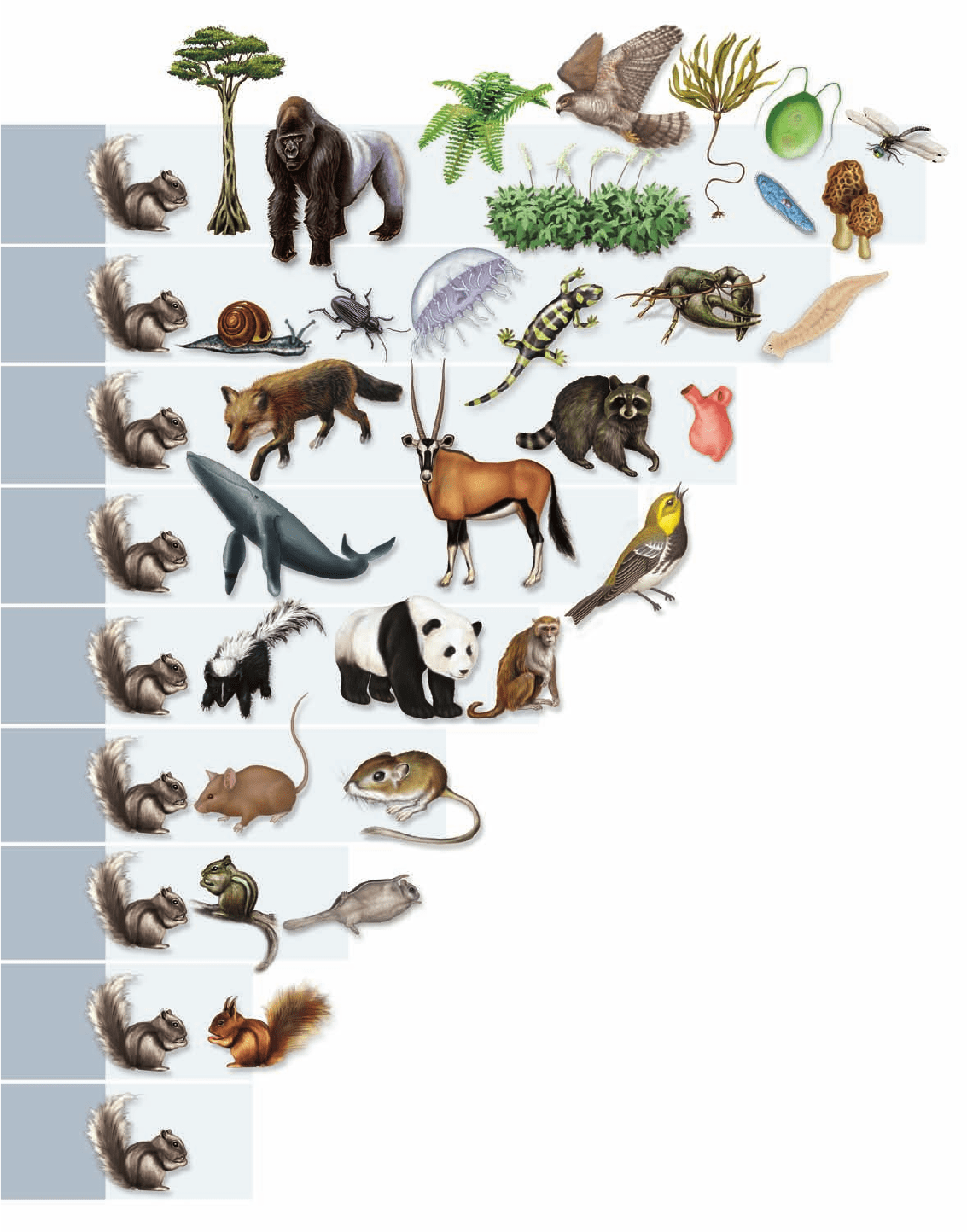
Figure 26.6
The
hierarchical system
used in classifying
an organism. The
organism, in this case the
eastern gray squirrel, is rst
recognized as a eukaryote
(domain Eukarya). Within
this domain, it is an animal
(kingdom Animalia). Among
the different phyla of animals, it
is a vertebrate (phylum Chordata,
subphylum Vertebrata). The organism’s
fur characterizes it as a mammal
(class Mammalia). Within this class, it
is distinguished by its gnawing teeth (order
Rodentia). Next, because it has four front toes and
ve back toes, it is a squirrel (family Sciuridae). Within
this family, it is a tree squirrel (genus Sciurus), with gray fur
and white-tipped hairs on the tail (species Sciurus carolinensis, the
eastern gray squirrel).
a monophyletic group, and the term kingdom is a bit of a
misnomer for protists.
In addition, an eighth level of classification, called a domain,
is frequently used. Biologists recognize three domains, which will
be discussed in section 26.3. The names of the taxonomic units
from the genus level and higher are capitalized.
The categories at the different levels may include many,
a few, or only one taxon. For example, there is only one living
genus of the family Hominidae (namely Homo), but several liv-
ing genera of Fagaceae (the birch family). To someone familiar
with classification or having access to the appropriate reference
books, each taxon implies both a set of characteristics and a
group of organisms belonging to the taxon.
To return to the example of the European honeybee, we
can analyze the bee’s taxonomic classification as follows:
1. Species level: Apis mellifera, meaning honey-bearing bee.
2. Genus level: Apis, a genus of bees.
3. Family level: Apidae, a bee family. All members of this
rav32223_ch26_507-527.indd 513rav32223_ch26_507-527.indd 513 11/12/09 3:51:58 PM11/12/09 3:51:58 PM

Apago PDF Enhancer
514
part
V
Diversity of Life on Earth
26.3
Grouping Organisms
Learning Outcomes
List examples showing that the three domains of life are 1.
monophyletic, but the six kingdoms are not.
Distinguish among the characteristics of Eukarya, Archaea, 2.
and Bacteria.
Explain why biologists do not include viruses in the tree 3.
of life.
In this section, we examine the largest groupings of organ-
isms: kingdoms and domains. The earliest classification sys-
tems recognized only two kingdoms of living things: animals
and plants. But as biologists discovered microorganisms and
learned more about other multicellular organisms, they added
kingdoms in recognition of certain fundamental differences.
The six-kingdom system was first proposed by Carl Woese of
the University of Illinois (figure 26.7b) .
The six kingdoms are not
necessarily monophyletic
In the six-kingdom system, four of the kingdoms consist of eu-
karyotic organisms. The two most familiar kingdoms, Animalia
and Plantae, contain only organisms that are multicellular during
most of their life cycle. The kingdom Fungi contains multicel-
lular forms and single-celled yeasts.
Fundamental differences divide these three kingdoms.
Plants are mainly stationary, but some have motile sperm; most
fungi lack motile cells; animals are mainly motile or mobile.
Animals ingest their food, plants manufacture it, and fungi di-
gest and absorb it by means of secreted extracellular enzymes.
The large number of eukaryotes that do not fit in any of
the three eukaryotic kingdoms are arbitrarily grouped into a
single kingdom called Protista (see chapter 29) . Most protists
are unicellular or, in the case of some algae, have a unicellular
phase in their life cycle. This kingdom reflects the current con-
troversy between taxonomic and phylogenetic approaches. The
protists are a paraphyletic group, containing several nonmono-
phyletic adaptive lineages with distinct evolutionary origins.
The remaining two kingdoms, Archaea and Bacteria,
consist of prokaryotic organisms, which are vastly differ-
ent from all other living things (see chapter 28 ). Archaea
are a diverse group that includes the methanogens and ex-
treme thermophiles, and its members differ from the other
prokaryotes—Bacteria.
The three domains probably
are monophyletic
As biologists have learned more about the Archaea, it has be-
come increasingly clear that this group is very different from
all other organisms. When the full genomic DNA sequences
of an archaean and a bacterium were first compared in 1996,
family are bees—some solitary, some living in colonies as
A. mellifera does.
4. Order level: Hymenoptera, a grouping that includes
bees, wasps, ants, and saw ies—all of which have wings
with membranes.
5. Class level: Insecta, a very large class that comprises
animals with three major body segments, three pairs of
legs attached to the middle segment, and wings.
6. Phylum level: Arthropoda. Animals in this phylum have a
hard exoskeleton made of chitin and jointed appendages.
7. Kingdom level: Animalia. The animals are multicellular
heterotrophs with cells that lack cell walls.
Limitations of the hierarchy
In chapter 23 , we discussed the modern phylogenetic approach,
which distinguishes relationships between different species based
on evolutionary history. Emerging phylogenies, frequently based
on molecular data, reveal that the Linnaean hierarchy is inad-
equate for recognizing the hierarchical relationships among taxa
that result naturally from a history of common ancestory and
descent. New evolutionary hypotheses are developing.
One problem with the Linnaean system is that many higher
taxonomic ranks are not monophyletic (for example, Reptilia) and
therefore do not represent natural groups. A common ancestor and
all of its descendants is a natural group that results from descent
from a common ancestor, but any other type of group (para phy-
let ic or polyphyletic) is an artificial group created by taxonomists.
In addition, Linnaean ranks, as currently recognized, are
not equivalent in any meaningful way. For example, two fami-
lies may not represent clades that originated at the same time.
One family may have diverged 70 million years before another
family, and therefore these families have had vastly different
amounts of time to diverge and develop evolutionary adapta-
tions. Two groups that diverged from a common ancestor at the
same time may be given different ranks. Thus, comparisons us-
ing Linnaean categories may be misleading. It is much better to
use hypotheses of phylogenetic relationships in such instances.
One result of all these differences is that families dem-
onstrate different degrees of biological diversity. Here’s one
example. It is difficult to say that the legume family with
16,000 species represents the same level of taxonomic organi-
zation as the cat family with only 36 species. The differences
across a single rank, whether it is class, order, or family, limit
the usefulness of taxonomic hierarchies in making evolution-
ary predictions.
Learning Outcomes Review 26.2
By convention, a species is given a binomial name. The fi rst part of the
name identifi es the genus, and the second part the individual species.
The Linnaean taxonomic hierarchy groups species into genera, then
families, orders, classes, phyla, and kingdoms. Traditional classifi cation
systems are based on similar traits, but because they include a mix of
derived and ancestral traits, they do not necessarily take into account
evolutionary relationships.
What can you infer about evolutionary relationships by ■
comparing a taxonomic hierarchy for a squirrel and a fox
(refer to figure 26.6)? What questions remain unanswered?
rav32223_ch26_507-527.indd 514rav32223_ch26_507-527.indd 514 11/12/09 3:51:59 PM11/12/09 3:51:59 PM
Apago PDF Enhancer
Purple bacteria
Cyanobacteria
Flavobacteria
Thermotoga
Pyrodictium
Thermoproteus
Methanobacterium
Methano-
pyrus
Thermo-
plasma
Methano-
coccus
Thermo-
coccus
Halobacterium
Aquifex
Gram-positive
bacteria
Animals
Fungi
Green plants
Rhodophyta
Alveolates
Stramenopiles
a. b.
c.
Animalia
Plantae
(Viridiplantae)
Fungi Protista
Archae-
bacteria
Bacteria
Common Ancestor
Domain
Bacteria
(Bacteria)
Domain
Archaea
(Archaebacteria)
Common Ancestor
Domain
Eukarya
(Eukaryotes)
Bacteria
Common Ancestor
Archaea
Eukarya
www.ravenbiology.com
chapter
26
The Tree of Life
515
oldest divergences represent the deepest rooted branches in the
tree. The archaea and eukaryotes are more closely related to each
other than to bacteria and are on a separate evolutionary branch
of the tree.
Bacteria are more numerous
than any other organism
The bacteria are the most abundant organisms on Earth. There
are more living bacteria in your mouth than there are mammals
living on Earth.
Although too tiny to see with the unaided eye, bacte-
ria play critical roles throughout the biosphere. Some extract
from the air all the nitrogen used by organisms, and they play
key roles in cycling carbon and sulfur. Much of the world’s
the differences proved striking. Archaea are as different from
bacteria as bacteria are from eukaryotes.
Recognizing this, biologists are increasingly adopt-
ing a classification of living organisms that recognizes three
domains, a taxonomic level higher than kingdom (figure 26.7a).
Archaea are in one domain (Domain Archaea), bacteria in a sec-
ond (Domain Bacteria), and eukaryotes in the third (Domain
Eukarya). Phylogenetically each of these domains form a clade.
Inquiry question
?
Why would the Archaea be considered a clade?
In the remainder of this section, we preview the major
characteristics of the three domains and viruses. Our current un-
derstanding of the “tree of life” is presented in figure 26.7c. The
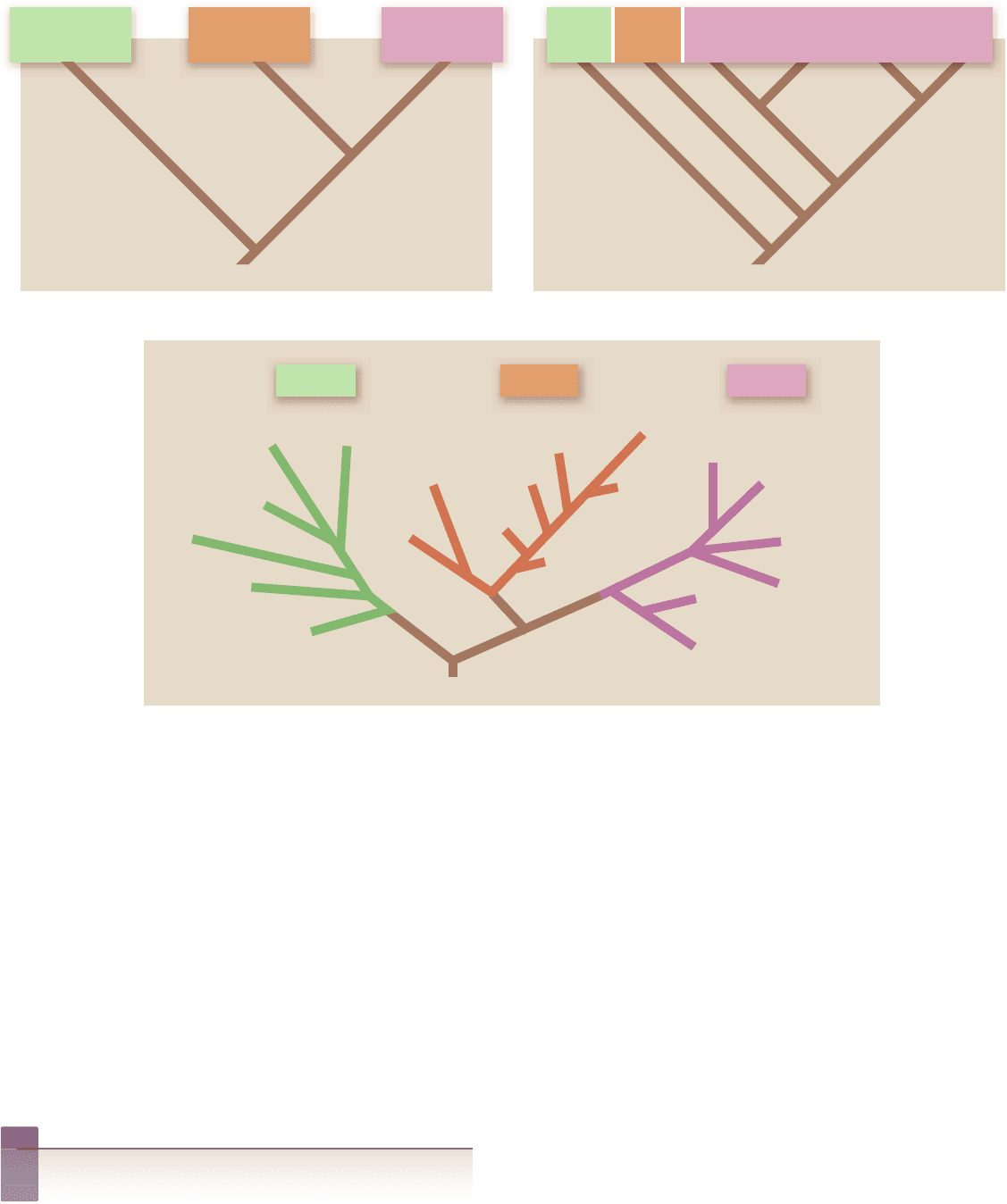
Figure 26.7
Di erent approaches to classifying living organisms. a. Bacteria and Archaea are so distinct that they have been
assigned to separate domains distinct from the Eukarya. Members of the domain Bacteria are thought to have diverged early from the
evolutionary line that gave rise to the archaea and eukaryotes. b. Eukarya are grouped into four kingdoms, but these, especially the protists, are
not necessarily monophyletic groups. c.
This phylogeny is prepared from rRNA analyses. The base of the tree was determined by examining
genes that are duplicated in all three domains, the duplication presumably having occurred in the common ancestor. Archaea and eukaryotes
diverged later than bacteria and are more closely related to each other than either is to bacteria. Bases of trees constructed with other traits are
often less clear because of horizontal gene transfer (see chapter 24 ).
rav32223_ch26_507-527.indd 515rav32223_ch26_507-527.indd 515 11/12/09 3:52:00 PM11/12/09 3:52:00 PM

Apago PDF Enhancer
516
part
V
Diversity of Life on Earth
Extremophiles are able to grow under conditions that
seem extreme to us. There are several types of extremophiles:
• Thermophiles, which live in temperatures ranging from
60° to 80°C. Many of these are autotrophs with a sulfur-
based metabolism.
• Cold-adapted, which live in glacier ice and alpine lakes.
• Halophiles, which live in very salty environments
including the Great Salt Lake and the Dead Sea. These
organisms require water with a salinity of 15 to 20%.
• pH-tolerant archaea, growing in highly acidic (pH = 0.7)
or highly basic (pH = 11) environments.
• Pressure-tolerant archaea found in the ocean depths.
These archaeans require at least 300 atmospheres
(atm) of pressure to survive and tolerate up to 800 atm.
To experience a pressure of 300 atm (300 times the
pressure of our atmosphere) you would need to dive
3000 m below the surface of the ocean (not a good idea
unless you were in a deep-sea submersible). The deepest
recorded skin dive is 127 m and a 145-m record is
reported for SCUBA diving.
Nonextreme archaea grow in the same environments
bacteria do. As the genomes of archaea have become better
known, microbiologists have been able to identify signature se-
quences of DNA present only in archaea. The newly discovered
microbe Nanoarchaeum equitens was identified as an archaean
based on a signature sequence. This odd Icelandic microbe may
have the smallest known genome, only 500 bp.
photosynthesis is carried out by bacteria. In contrast, certain
bacteria are also responsible for many forms of disease. Under-
standing bacterial metabolism and genetics is a critical part of
modern medicine.
Bacteria are highly diverse, and the evolutionary links
among species are not well understood. Although taxonomists
disagree about the details of bacterial classification, most rec-
ognize 12 to 15 major groups of bacteria. Comparisons of the
nucleotide sequences of ribosomal RNA (rRNA) molecules are
beginning to reveal how these groups are related to one an-
other and to the other two domains.
Archaea may live in extreme environments
The archaea seem to have diverged very early from the bacte-
ria and are more closely related to eukaryotes than to bacteria
(figure 26.7c). This conclusion comes largely from comparisons
of genes that encode ribosomal RNAs.
Horizontal gene transfer in microorganisms
Comparing whole-genome sequences from microorganisms
has led evolutionary biologists to a variety of phylogenetic
trees, some of which contradict each other. It appears that
during their early evolution, microorganisms swapped ge-
netic information via horizontal gene transfer (HGT), as
you learned in chapter 24 . The potential for gene transfer
makes constructing phylogenetic trees for microorganisms
very difficult.
Consider the archaean Thermotoga, a thermophile found
on Vulcano Island off the coast of Italy. The sequence of one
of its RNAs places it squarely within the bacteria near an an-
cient microbe called Aquifex. Recent DNA sequencing, how-
ever, fails to support any consistent relationship between the
two microbes.
Over the next few years, we can expect to see consider-
able change in accepted viewpoints as more and more data are
brought to bear.
Archaean characteristics
Although they are a diverse group, all archae share certain key
characteristics (table 26.1). Their cell walls lack peptidoglycan
(an important component of the cell walls of bacteria); the lip-
ids in the cell membranes of archae have a different structure
from those in all other organisms; and archae have distinctive
ribosomal RNA sequences. Some of their genes possess introns,
unlike those of bacteria. Both archae and eukaryotes lack the
peptidoglycan cell wall found in bacteria.
The archae are grouped into three general categories—
methanogens, extremophiles, and nonextreme archae—based
primarily on the environments in which they live or on their
specialized metabolic pathways. The word extreme refers to our
current environment. When archae first appeared on the scene
their now extreme habitats may have been typical.
Methanogens obtain their energy by using hydrogen gas
(H
2
) to reduce carbon dioxide (CO
2
) to methane gas (CH
4
).
They are strict anaerobes, poisoned by even traces of oxygen.
They live in swamps, marshes, and the intestines of mammals.
Methanogens release about 2 billion tons of methane gas into
the atmosphere each year.
TABLE 26.1
Features of the Domains
of Life
DOMAIN
Feature Archaea Bacteria Eukarya
Amino acid that initiates
protein synthesis
Methionine Formyl-
methionine
Methionine
Introns Present in
some genes
Absent Present
Membrane-bounded
organelles
Absent Absent Present
Membrane lipid structure Branched Unbranched Unbranched
Nuclear envelope Absent Absent Present
Number of diff erent RNA
polymerases
Several One Several
Peptidoglycan in cell wall Absent Present Absent
Response to the antibiotics
streptomycin and
chloramphenicol
Growth not
inhibited
Growth
inhibited
Growth not
inhibited
rav32223_ch26_507-527.indd 516rav32223_ch26_507-527.indd 516 11/12/09 3:52:00 PM11/12/09 3:52:00 PM
Apago PDF Enhancer
Cyanobacteria
Green alga Red alga
Eukaryotic cell
engulfs red alga
Brown alga
Eukaryotic cell with mitochondria
engulfs cyanobacteria
Ancestral
eukaryotic cell
Mitochondria
Chloroplasts
Photosynthetic
bacteria
Nonphotosynthetic
protists
Purple
bacteria
Other
bacteria
Methanogens
Thermophiles
Halophiles
Photosynthetic
protists
Red
algae
Green
algae
Brown
algae
Animalia Fungi Protista Plantae Bacteria Archaebacteria
www.ravenbiology.com
chapter
26
The Tree of Life
517
Eukaryotes have compartmentalized cells
For at least 1 billion years, prokaryotes ruled the Earth. No
other types of organisms existed to eat them or compete with
them, and their tiny cells formed the world’s oldest fossils.
Members of the third great domain of life, the eukaryotes, ap-
pear in the fossil record much later, only about 2.5 bya. But
despite the metabolic similarity of eukaryotic cells to prokary-
otic cells, their structure and function enabled these cells to be
larger, and eventually, allowed multicellular life to evolve.
Endosymbiosis and the origin of eukaryotes
The hallmark of eukaryotes is complex cellular organiza-
tion, highlighted by an extensive endomembrane system that
subdivides the eukaryotic cell into functional compartments
(chapter 4) . Not all cellular compartments, however, are de-
rived from the endomembrane system.
With few exceptions, modern eukaryotic cells possess
the energy-producing organelles termed mitochondria, and
photosynthetic eukaryotic cells possess chloroplasts, the energy-
harvesting organelles. Mitochondria and chloroplasts are both
believed to have entered early eukaryotic cells by a process called
endosymbiosis, which is discussed in more detail in chapter 29
(figure 26.8) .
Mitochondria are the descendants of relatives of purple
sulfur bacteria and the parasitic Rickettsia that were incorpo-
rated into eukaryotic cells early in the history of the group.
Chloroplasts are derived from cyanobacteria (figure 26.9).
As shown in figures 26.8 and 26.9, the red and green algae
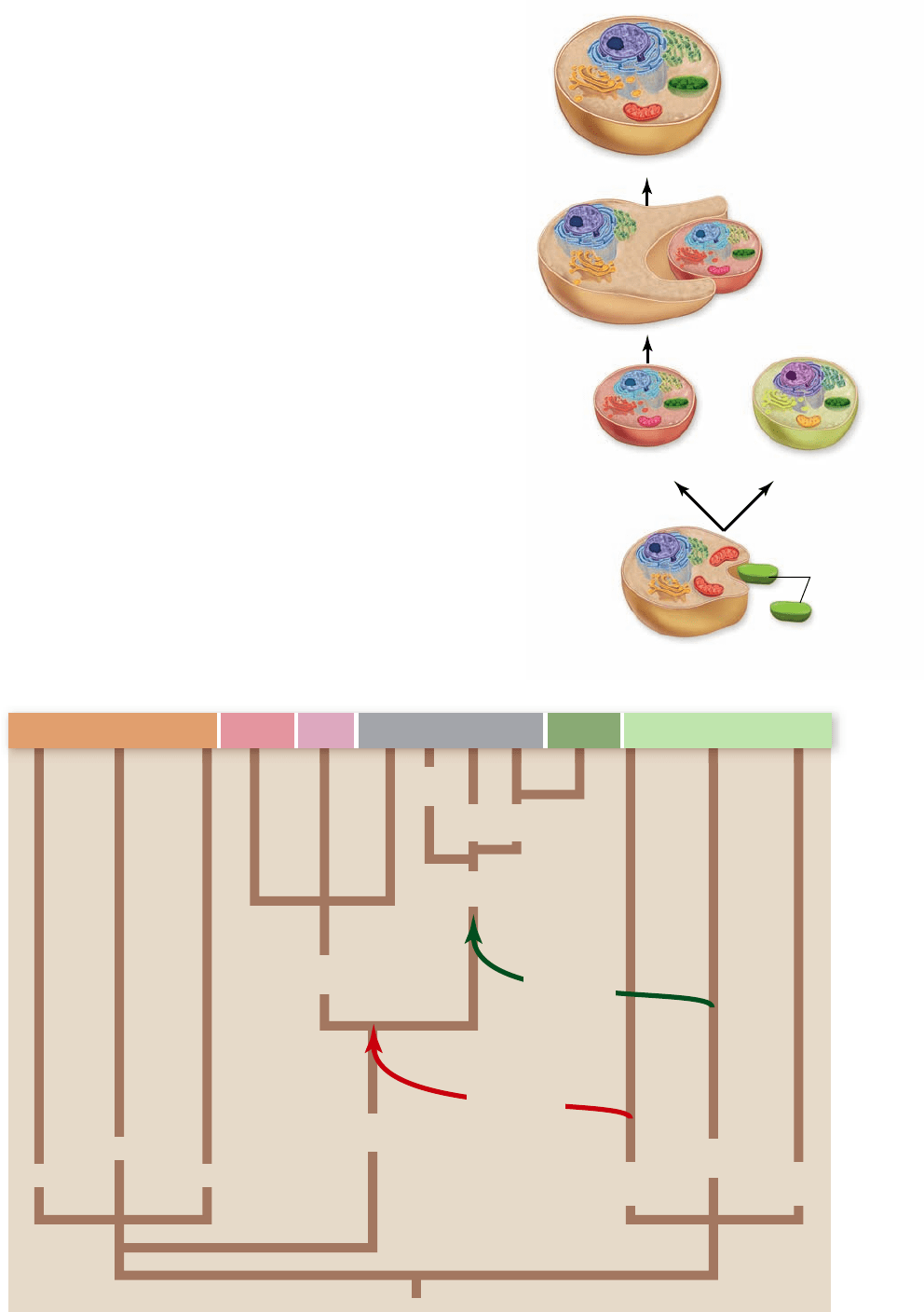
Figure 26.8
All chloroplasts
are monophyletic. The same
cyanobacteria were engulfed by
multiple hosts that were ancestral
to the red and green algae. Brown
algae share the same ancestral
chloroplast DNA, but most likely
gained it by engul ng red algae.
Figure 26.9
Hypothesis for
evolutionary
relationships
among the six
kingdoms of
organisms.
The colored lines
indicate symbiotic
events.
rav32223_ch26_507-527.indd 517rav32223_ch26_507-527.indd 517 11/12/09 3:52:00 PM11/12/09 3:52:00 PM
Apago PDF Enhancer
518
part
V
Diversity of Life on Earth
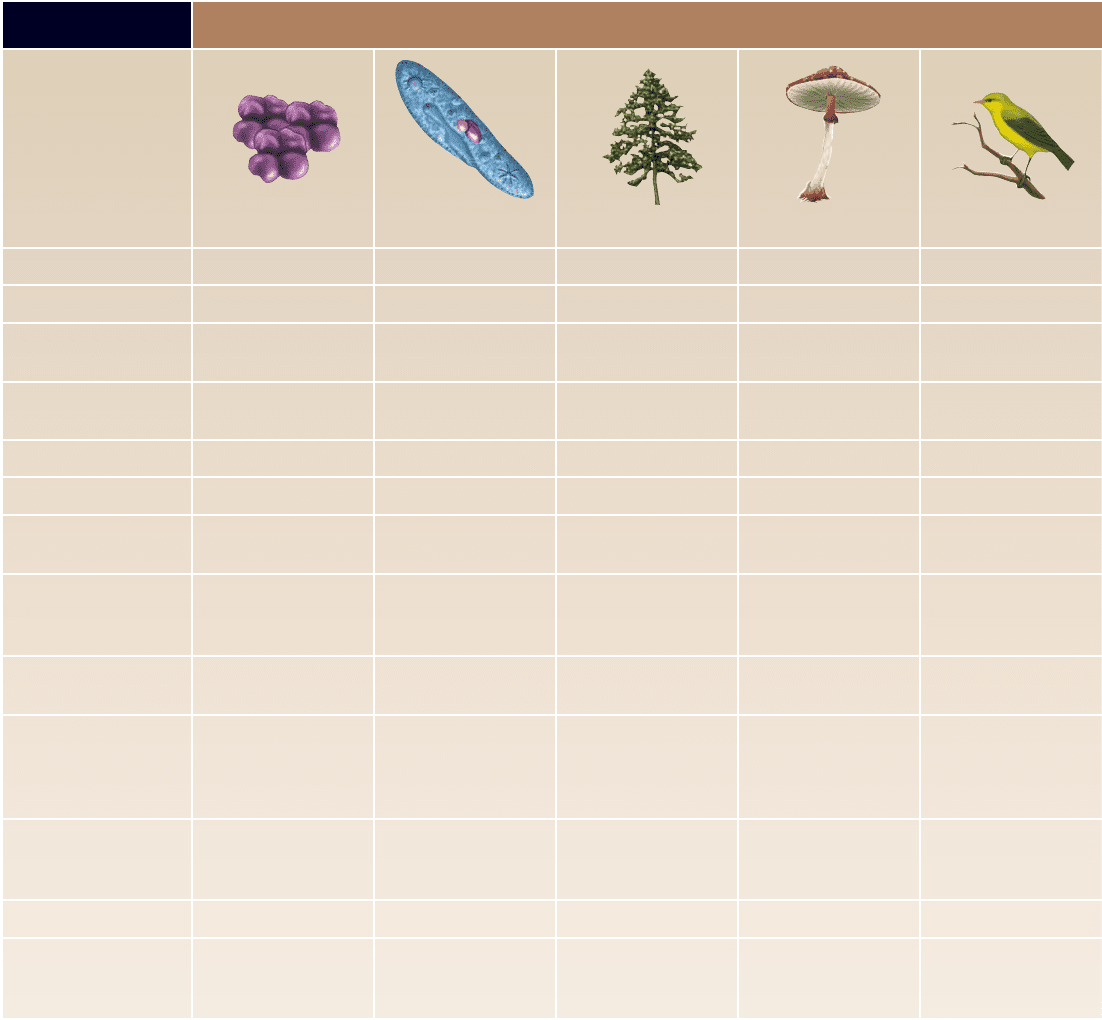
TABLE 26.2
Characteristics of the Six Kingdoms and Three Domains
Archaea
and Bacteria Protista Plantae Fungi Animalia
Cell Type Prokaryotic Eukaryotic Eukaryotic Eukaryotic Eukaryotic
Nuclear Envelope Absent Present Present Present Present
Transcription and
Translation
Occur in same compartment Occur in di erent
compartments
Occur in di erent
compartments
Occur in di erent
compartments
Occur in di erent
compartments
Histone Proteins
Associated with DNA
Absent Present Present Present Present
Cytoskeleton Absent Present Present Present Present
Mitochondria Absent Present (or absent) Present Present Present
Chloroplasts None (photosynthetic
membranes in some types)
Present (some forms) Present Absent Absent
Cell Wall Noncellulose
(polysaccharide plus
amino acids)
Present in some forms,
various types
Cellulose and other
polysaccharides
Chitin and other
noncellulose
polysaccharides
Absent
Means of Genetic
Recombination, if Present
Conjugation, transduction,
transformation
Fertilization and meiosis Fertilization and meiosis Fertilization and meiosis Fertilization and meiosis
Mode of Nutrition Autotrophic
(chemosynthetic,
photosynthetic) or
heterotrophic
Photosynthetic or
heterotrophic, or
combination of both
Photosynthetic,
chlorophylls a and b
Absorption Ingestion
Motility Bacterial agella, gliding
or nonmotile
9 + 2 cilia and agella;
amoeboid, contractile brils
None in most forms;
9 + 2 cilia and agella in
gametes of some forms
Both motile and nonmotile 9 + 2 cilia and agella,
contractile brils
Multicellularity Absent Absent in most forms Present in all forms Present in most forms Present in all forms
Nervous System None Primitive mechanisms for
conducting stimuli in
some forms
A few have primitive
mechanisms for
conducting stimuli
None Present (except sponges),
often complex
we recognize them as kingdoms distinct from Protista, even
though the amount of diversity among the protists is much greater
than that within or between the fungi, plants, and animals.
Key characteristics of the eukaryotes
The characteristics of the six kingdoms are outlined in
table 26.2 ; note that the archaea and bacteria are grouped in
the same column. Although eukaryotic organisms are extraor-
dinarily diverse, they share three characteristics that distinguish
them from prokaryotes: compartmentalization; multicellularity
in many, but not all, eukaryotes; and sexual reproduction.
Compartmentalization. Discrete compartments provide
evolutionary opportunities for increased specialization
acquired their chloroplasts by directly engulfing a cyanobac-
terium. The brown algae most likely engulfed red algae to
obtain chloroplasts.
The four kingdoms of eukaryotes
The first eukaryotes were unicellular organisms. A wide variety of
unicellular eukaryotes exist today, grouped together in the king-
dom Protista (along with some multicellular descendants) on the
basis that they do not fit into any of the other three kingdoms of
eukaryotes. Fungi, plants, and animals are largely multicellular
kingdoms, each a distinct evolutionary line from a single-celled
ancestor that would be classified in the kingdom Protista.
Because of the size and ecological dominance of plants, ani-
mals, and fungi, and because they are predominantly multi cellular,
rav32223_ch26_507-527.indd 518rav32223_ch26_507-527.indd 518 11/12/09 3:52:01 PM11/12/09 3:52:01 PM
Apago PDF Enhancer
Vaccinia virus
(cowpox)
Influenza
virus
T4 bacteriophage
HIV-1
(AIDS)
Tobacco mosaic
virus (TMV)
Herpes simplex
virus
Rhinovirus
(common
cold)
Adenovirus
(respiratory
virus)
Poliovirus
(polio)
Ebola virus
100 nm
www.ravenbiology.com
chapter
26
The Tree of Life
519
within the cell, as we see with chloroplasts and
mitochondria. The evolution of a nuclear membrane,
not found in prokaryotes, also accounts for increased
complexity in eukaryotes. In eukaryotes, RNA
transcripts from nuclear DNA are processed and
transported across the nuclear membrane into the
cytosol, where translation occurs. The physical
separation of transcription and translation in eukaryotes
adds additional levels of control to the process of
gene expression.
Multicellularity. The unicellular body plan has been
tremendously successful, with unicellular prokaryotes
and eukaryotes constituting about half of the biomass
on Earth. But a single cell has limits. The evolution of
multicellularity allowed organisms to deal with their
environments in novel ways through differentiation of
cell types into tissues and organs.
True multicellularity, in which the activities of
individual cells are coordinated and the cells themselves
are in contact, occurs only in eukaryotes and is one of
their major characteristics. Bacteria and many protists
form colonial aggregates of many cells, but the cells in
the aggregates have little differentiation or integration
of function.
Other protists—the red, brown, and green algae, for
example—have independently attained multicellularity.
One lineage of multicellular green algae was the
ancestor of the plants (see chapters 29 and 30 ), and most
taxonomists now place its members in the green plant
kingdom, the Viridiplantae.
The multiple origins of multicellularity are also
seen in the fungi and the animals, which arose
from unicellular protist ancestors with different
characteristics. As you will see in subsequent chapters,
the groups that seem to have given rise to each of these
kingdoms are still in existence.
Sexual Reproduction. Another major characteristic of
eukaryotic species as a group is sexual reproduction.
Although some interchange of genetic material occurs
in bacteria, it is certainly not a regular, predictable
mechanism in the same sense that sex is in eukaryotes.
Sexual reproduction allows greater genetic diversity
through the processes of meiosis and crossing over, as
you learned in chapter 13 .
In many of the unicellular phyla of protists, sexual
reproduction occurs only occasionally. The rst
eukaryotes were probably haploid; diploids seem to have
arisen on a number of separate occasions by the fusion
of haploid cells, which then eventually divided
by mitosis.
Viruses are a special case
Viruses possess only a portion of the properties of organisms.
Viruses are literally “parasitic” macromolecules, segments of
DNA or RNA wrapped in a protein coat. They cannot repro-
duce on their own, and for this reason they are not considered
alive by biologists. They can, however, reproduce within cells,
often with disastrous results to the host.
Viruses are currently viewed as detached fragments of the
genomes of organisms because of the high degree of similarity
found in some viral and eukaryotic genes. Viruses thus present a
special classification problem. Because they are not organisms,
we cannot logically place them in any of the kingdoms.
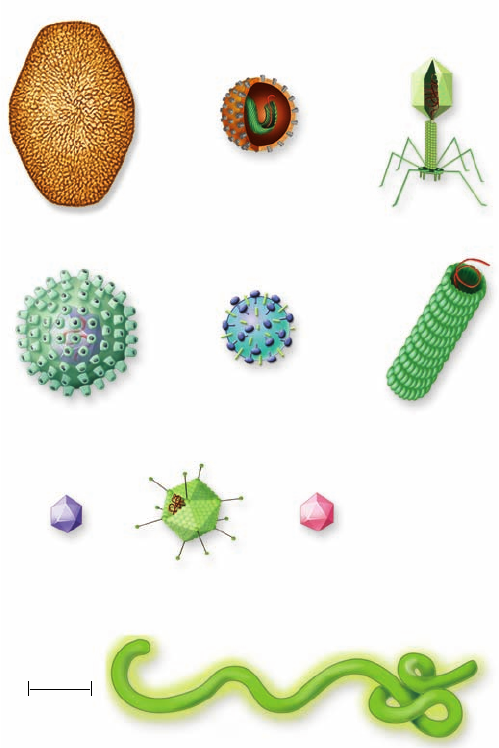
Viruses vary greatly in appearance and size. The smallest
are only about 17 nanometers (nm) in diameter, and the largest
are up to 1000 nm (1 micrometer; μm) in their greatest dimen-
sion, barely visible with a light microscope (figure 26.10). Viral
morphology is best revealed using the electron microscope.
Biologists first began to suspect the existence of viruses
near the end of the 19th century. European scientists were at-
tempting to isolate the infectious agent responsible for hoof-
and-mouth disease in cattle, and they concluded that it was
smaller than a bacterium. The true nature of viruses was dis-
covered in 1933, when biologist Wendell Stanley prepared an
extract of the tobacco mosaic virus (TMV) and attempted to
purify it. To his great surprise, the purified TMV preparation
precipitated in the form of crystals—the virus was acting like
a chemical off the shelf rather than like an organism. Stanley
Figure 26.10
Viral diversity. Viruses exhibit extensive
diversity in shape and size. At the scale these sample viruses are
shown, a human hair would be nearly 8 m thick.
rav32223_ch26_507-527.indd 519rav32223_ch26_507-527.indd 519 11/12/09 3:52:02 PM11/12/09 3:52:02 PM

Apago PDF Enhancer
Ancestral Eukaryote
Plants
Fungi
Animals
“Protists”
Choanoflagellates
Green algae
520
part
V
Diversity of Life on Earth
monophyletic groups, one of which gave rise to land plants.
Many systematists are calling for a new kingdom called Virid-
iplantae, or the green plant kingdom, which would include all
the green algae (not red or brown algae) and the land plants.
Thus, the definition of a plant has been expanded beyond those
species that made it onto land. Although the kingdom Protista
is in ruins, our understanding of the evolutionary relationships
among these early eukaryotes is growing exponentially.
Learning Outcome Review 26.4
Relationships among organisms in Kingdom Protista, a paraphyletic
group, are being clarifi ed by modern methods. Choanofl agellates are
most closely related to animals, and green algae may belong in a new
kingdom that would include plants. Systematics and cladistics continue
to add to our knowledge of these relationships.
How might life have evolved if photosynthesis had not ■
produced atmospheric oxygen?
concluded that TMV is best regarded as just that—chemical
matter rather than a living organism.
Within a few years, scientists disassembled the TMV
virus and found that Stanley was right. TMV was not cel-
lular but chemical. Each particle of TMV virus is in fact a
mixture of two chemicals: RNA and protein. The TMV virus
consists of a tube made of protein with an RNA core. If these
two components are separated and then reassembled, the re-
constructed TMV particles are fully able to infect healthy
tobacco plants.
Because eukaryote diversity is so vast, we next take a brief
look at the three kingdoms of the eukaryote domain.
Learning Outcomes Review 26.3
The six kingdoms are not necessarily based on common lineage;
Kingdom Protista, for example, is not a monophyletic group. The
three domains, however, do appear to be monophyletic. Bacteria
and archaea are tiny but numerous unicellular organisms that
lack internal compartmentalization. Eukaryotic cells are highly
compartmentalized, and they have acquired mitochondria and
chloroplasts by endosymbiosis. Viruses are not organisms classified
in the kingdoms of life, but instead are chemical assemblies that can
infect cells and replicate within them.
What would be the outcome if a virus infected a cell and ■
became a permanent resident in the cell’s genome?
Figure 26.11
The fall of kingdom Protista. Systematists
have shown that protists as a group are not monophyletic. Note
how some lineages are actually more closely related to plants or
animals than they are to other protists.
26.4
Making Sense of the Protists
Learning Outcome
Describe the relationships among groups of protists.1.
In reading this chapter and chapter 23 , you may have sensed
some tension between traditional classification systems and sys-
tems based on evolutionary relationships, such as cladistics and
phylogenetic analysis. The kingdom Protista illustrates well the
source of this tension. This kingdom is the weakest area of the
six-kingdom classification system shown in figure 26.7.
Eukaryotes diverged rapidly in a world that was shift-
ing from anaerobic to aerobic conditions. We may never be
able to completely sort out the relationships among different
lineages during this major evolutionary transition. Molecu-
lar systematics, however, clearly shows that the protists are
a para phyletic group (figure 26.11). Although biologists con-
tinue to use the term protist as a catchall for any eukaryote that
is not a plant, fungus, or animal, this grouping is not based on
evolutionary relationships.
The six main branchings of protists, shown at the base of
figure 26.11, represent a current working hypothesis, although
at least 60 protists do not seem to fit in any of the six groups.
Choanoflagellates are most closely related to sponges, and
indeed, to all animals. The green algae can be split into two
26.5
Origin of Plants
Learning Outcomes
Describe the evolutionary relationship between algae 1.
and plants.
Explain how moss genes have come to be found in the 2.
genome of a flowering plant.
The origin of land plants from a green algal ancestor has long been
recognized as a major evolutionary event. Molecular phylogenetics
reveals that land plants arose from an ancestral green alga, and that
the evolution of land plants occurred only once, an indication of
the incredible challenges involved in the move onto land.
rav32223_ch26_507-527.indd 520rav32223_ch26_507-527.indd 520 11/12/09 3:52:02 PM11/12/09 3:52:02 PM
Apago PDF Enhancer
Red algae
Chlorophyta
Mesostigmatales
Chlorokybales
Klebsormidiales
Zygnematales
Coleochaetales
Charales
Land plants
Viridiplantae
Streptophyta
www.ravenbiology.com
chapter
26
The Tree of Life
521
Which of the Streptophyta clades contains the closest
living relative of land plants? The two contenders have been
the Charales, with about 300 species, and the Coleochaetales,
with about 30 species. Both lineages are freshwater algae, but
the Charales are huge compared with the microscopic Coleo-
chaetales. At the moment, the Charales appear to be the sister
clade to land plants, with the Coleochaetales the next closest
relatives. Charales fossils dating back 420 mya indicate that the
common ancestor of land plants was a relatively complex fresh-
water alga.
Horizontal gene transfer
occurred in land plants
The shrub Amborella trichopoda is the closest living relative to
the earliest flowering plants (angiosperms). Its clade is a sister
clade to all other flowering plants, yet at least one copy of 20
out of 31 of its known mitochondrial protein genes hopped
into the mitochondrial genome from other land plants through
horizontal gene transfer (HGT). In addition, three different
moss species contributed to the mix (figure 26.13).
Molecular phylogenetics has identi ed
the closest living relatives of land plants
The phylogenetic relationships among the algae and the first
land plants have been fuzzy and subject to long debate. Cell
biology, biochemistry, and molecular systematics have provided
surprising new evolutionary hypotheses.
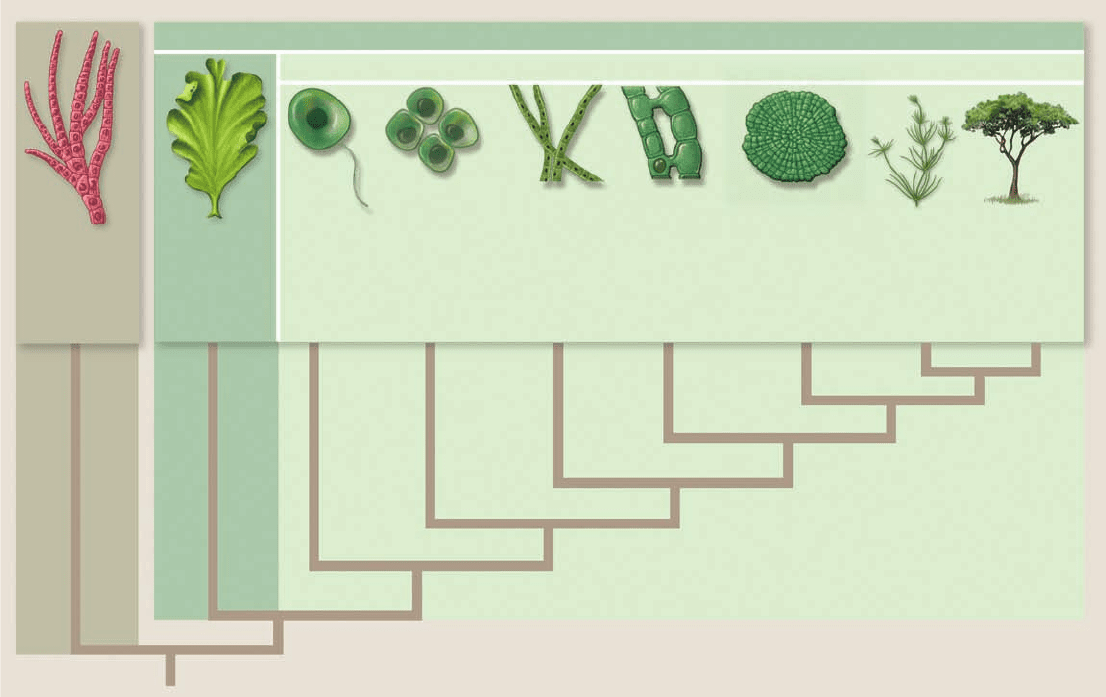
The green algae consist of two monophyletic groups, the
Chlorophyta and the Streptophyta (chapter 30 ). Land plants are
actually members of the Streptophyta, not a separate kingdom.
This new phylogenetic information demoted the land plants
from constituting a kingdom to being a branch within the al-
gal group Streptophyta. The Streptophyta along with the sister
green algal clade, Chlorophyta, are now considered by most to
make up the kingdom Viridiplantae. The current phylogeny is
shown in figure 26.12.
What was the earliest streptophyte? Conflicting answers
have been obtained with different phylogenetic analyses, but
growing evidence supports the hypothesis that the scaly, uni-
cellular flagellate Mesostigma (order Mesostigmatales) rep-
resents the earliest streptophyte branch.
Figure 26.12
A new hypothesis for land plant evolution. Kingdom Plantae (land plants) has been reduced to a clade within the
green algal branch Streptophyta, and a new kingdom, Viridiplantae, which includes the green algal branches Chlorophyta and Streptophyta,
has been proposed. Within the Streptophyta, the relatively complex Charales are believed to be the sister clade to the land plants. Contrast
this phylogeny with the one predicted by the six-kingdom system in gure 26.7b.
rav32223_ch26_507-527.indd 521rav32223_ch26_507-527.indd 521 11/12/09 3:52:03 PM11/12/09 3:52:03 PM