
Raven P.H., Johnson G.B., Mason K.A. Biology (Ninth Edition)
Подождите немного. Документ загружается.

Apago PDF Enhancer
Mitochondrial
Genes A–C
a.
b.
Pines
Flowering
plants
Ferns
Mosses
Charales
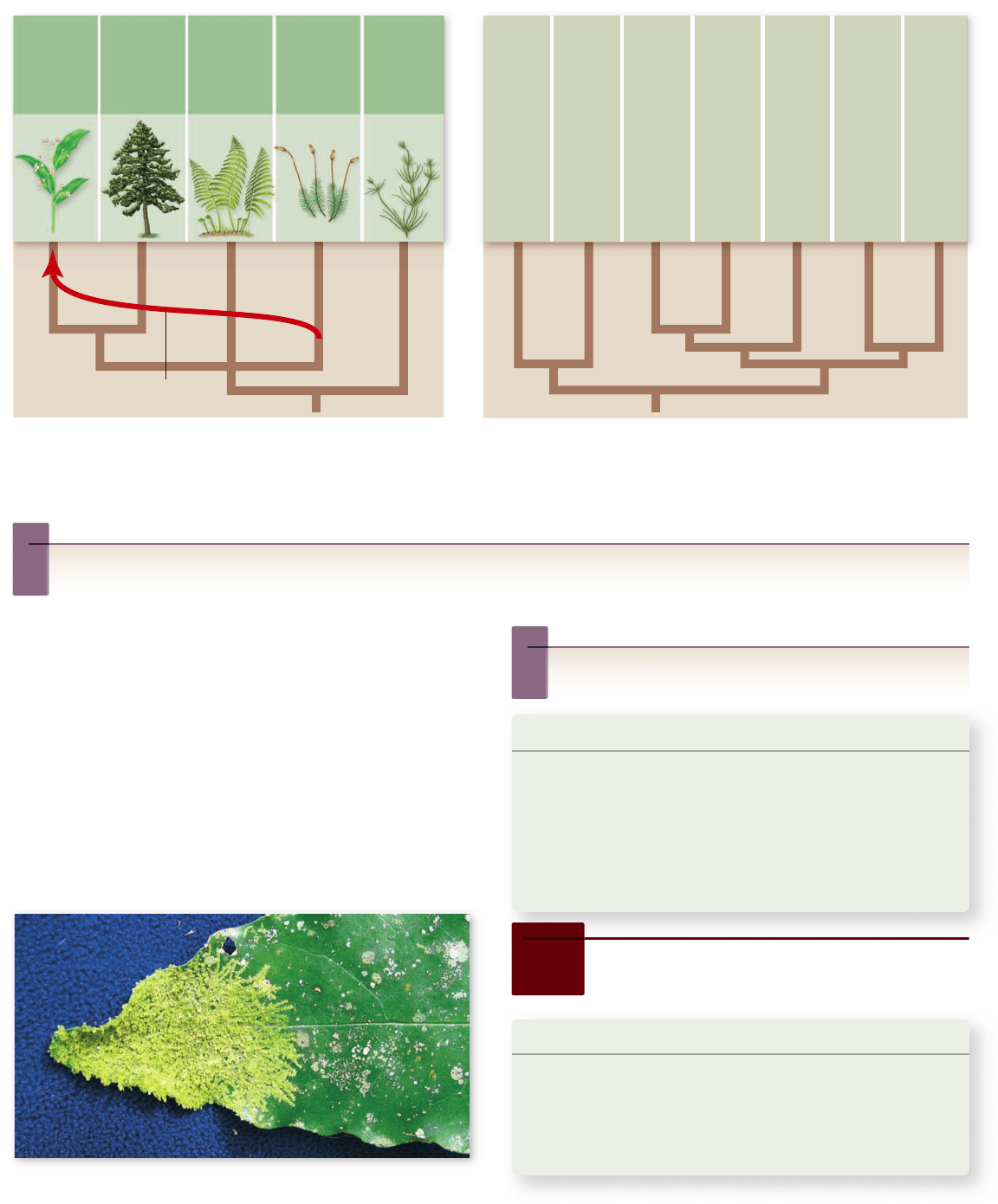
Amborella gene A (HGT)
Amborella - gene B (HGT)
Amborella - gene C (HGT)
Moss species 1 - gene A
Moss species 2 - gene B
Moss species 3 - gene B
Moss species 4 - gene C
522
part
V
Diversity of Life on Earth
Figure 26.14
Close contact between species can lead
to HGT. Here moss are growing on the base of an Amborella leaf
with lichens scattered on the rest of the leaf.
Inquiry question
?
How would you determine if a moss gene in Amborella had a
function? (Hint: Refer to chapter 25. )
Learning Outcomes Review 26.5
Land plants are now thought to be most closely related to the Streptophyta
group of green algae. The Charales appear to be the sister clade to land
plants. Not all plant evolution is vertical, however; horizontal gene transfer
has apparently mixed genes from distantly related species.
How could genes from moss be transported into a ■
flowering plant, other than via parasitic plants?
Amborella is not typical of most extant flowering plants. It
is the only existing member of its genus and is native only to the
tropical rain forests of New Caledonia, an island group east of
Australia that has been isolated for some 70 million years and
contains many ancient endemic species. Here parasitic plants
called epiphytes (plants that derive nutrients from other plants)
are common. Close contact with parasitic plants could increase
the probability of HGT (figure 26.14).
An open question is whether the moss genes in Amborella
have functions. About half the genes are intact and could be
transcribed and translated into a protein. The protein would
be similar to an existing protein in the plant, but its function, if
any, remains to be determined.
Figure 26.13
The owering plant Amborella acquired three moss genes through horizontal gene transfer. a. Phylogenetic
relationship of Amborella to other land plants. As shown by the arrow connecting moss and the owering plants, HGT is the only plausible
explanation for the presence of moss mitochondrial genes in Amborella. b. Phylogenetic relationships among the horizontally transferred gene.
Inquiry question
?
Explain why a phylogenetic tree based on comparisons of a single gene could result in an inaccurate evolutionary hypothesis.
26.6
Sorting Out the Animals
Learning Outcomes
Describe current ideas regarding the origin of 1.
segmentation in animals.
Explain why insects are termed “flying crustaceans.”2.
State the evidence for a common ancestor between whales 3.
and hippos.
Molecular systematics is leading to a revision of our under-
standing of evolutionary history in all kingdoms, including the
rav32223_ch26_507-527.indd 522rav32223_ch26_507-527.indd 522 11/12/09 3:52:05 PM11/12/09 3:52:05 PM
Apago PDF Enhancer
Increase in
Hox genes
Increase in
Hox genes
2 new Hox genes3 new Hox genes
Segmentation
Not segmented
ChordatesEchinodermsArthropodsNematodesAnnelidsMollusksFlatwormsLophophorates
Lophotrochozoans Ecdysozoans Deuterostomes
Duplicated Hox gene
Primers
5„ 3„
3„ 5„
3„5„
GGGCCTTTAA
2. Sequence the PCR products and group them based on sequence similarity.1. Using primers for the Hox gene of interest and polymerase chain
reaction (PCR), amplify the Hox gene of interest. Duplicated genes have
nearly identical sequences and will be amplied with the same primer sets.
3. Map the gene duplication ndings on a phylogeny based on ribosomal RNA.
Hypothesis:
Origins of segmentation can be explained by the duplication of a Hox gene that regulates segmentation.
Prediction: Duplication
of Hox genes will correlate with changes in segmentation patterns.
Test:
Result: Four
independent Hox gene duplication events were identied.
Conclusion: Three independent Hox gene duplication events correspond with the origins of segmentation.
Further Research: Explore where the duplicated Hox genes are expressed using in situ hybridization (refer to gure 19.13).
SCI ENTI FIC THINKING
www.ravenbiology.com
chapter
26
The Tree of Life
523
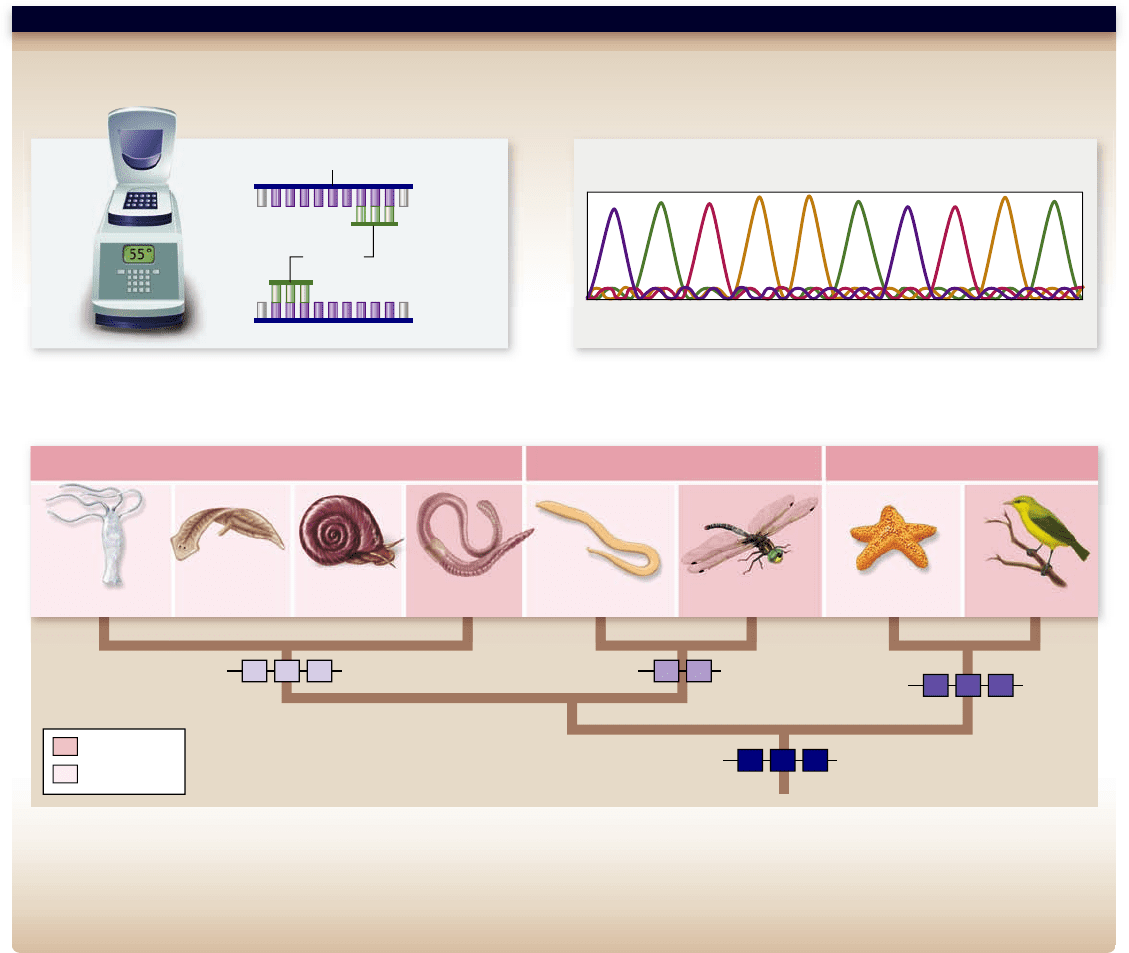
Figure 26.15
Multiple origins of segmentation.
rRNA sequences are raising questions about their relationship.
As rRNA sequences are obtained, it is becoming increasingly
clear that annelids and arthropods are more distantly related
than taxonomists previously believed.
Evolutionary occurrences of segmentation
Distinctions can be made among eukaryote animals on the basis of
timing of embryonic development of the mouth and anus. Anne-
lids and arthropods belong to the protostome group, in which the
mouth develops before the anus. Chordates, including humans,
fall into the deuterostome group, in which the anus forms first.
(You will learn more about these divisions in chapter 33. )
With the addition of newly available molecular traits,
annelids and arthropods fell into two distinct protostome
branches (figure 26.15) : lophotrochozoans and ecdysozoans.
animals. Some phylogenies are changing, and others, including
mammalian phylogenies, are actually being written for the first
time. In this section, we explore three examples: the relation-
ship between annelids and arthropods, relationships within the
arthropods, and the discovery of phylogenetic relationships
among mammals.
The origins of segmentation are puzzling
The arthropod phylum is a group of over one million described
invertebrates that includes the insects and crustaceans; the an-
nelid phylum, another invertebrate group, contains the seg-
mented worms such as the earthworm. Morphological traits
such as segmentation have been used in the past to group
arthropods and annelids close together, but comparisons of
rav32223_ch26_507-527.indd 523rav32223_ch26_507-527.indd 523 11/12/09 3:52:07 PM11/12/09 3:52:07 PM
Apago PDF Enhancer
Crayfish maxilliped
(biramous)
Misleading Morphology
Insect appendage
(uniramous)
524
part
V
Diversity of Life on Earth
A change in taxonomic relationship?
In recent years, a mass of accumulating morphological and
molecular data has led many taxonomists to suggest new ar-
thropod phylogenies. Hexapods (insects) with their six legs and
terrestrial habitat are the closest relatives of crustaceans, not
the myriopods. Hexapods and crustaceans form a clade called
pancrustacea. But, hexapods likely are not monophyletic, in-
dicating that crustacean ancestors moved onto land multiple
times. The relationships among the pancrustacea suggest that
hexapods are “flying crustaceans.”
These conclusions engender lively discussion since they
are in conflict with 150 years of morphology-based phyloge-
netic inference.
The mammalian family tree is emerging
In the preceding arthropod examples, our interpretation of evo-
lutionary history has been rewritten. In mammals, however, parts
of the phylogeny are just emerging, based on molecular data.
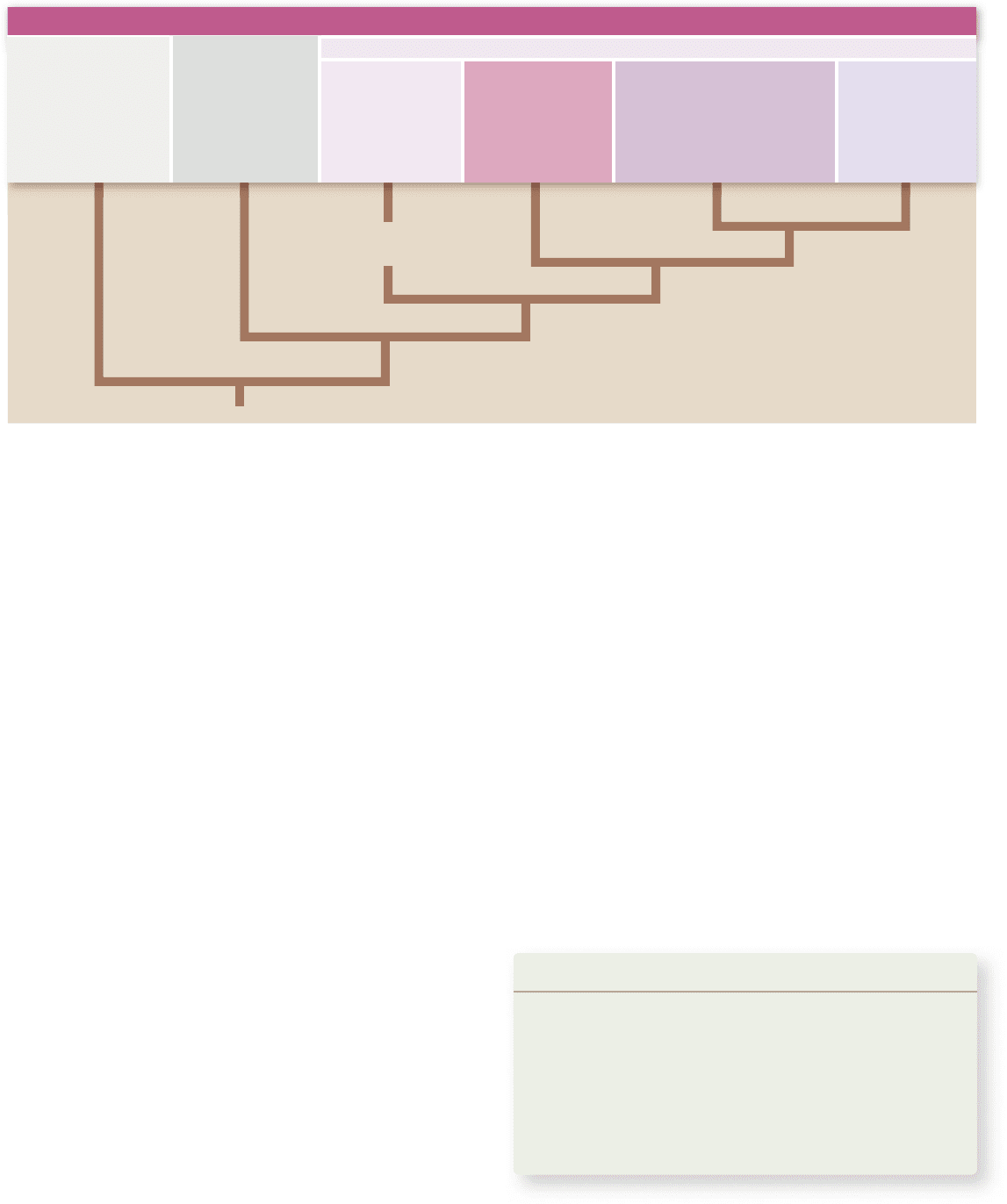
The four groups of placental mammals
Among the vertebrate classes, mammals are unique because
they have mammary glands to feed their young. The major-
ity of mammals—over 90%—are eutherians, or placental
mammals (see chapter 36 ). There are at least 18 extant orders
of eutherians, which are now divided into four major groups
(figure 26.17 ).
These two branches have been evolving independently since
ancient times. Lophotrochozoans include flatworms, mollusks,
and annelids. Two ecdysozoan phyla have been particularly suc-
cessful: roundworms (nematodes) and arthropods.
In the new protostome phylogeny, annelids and arthro-
pods do not constitute a monophyletic group, as they had in
the past. The implication is that segmentation arose twice,
not once, in the protostomes, as had been believed originally.
Segmentation then arose independently once again in the deu-
terostomes, specifically in the chordates.
Molecular details of segmentation
The most likely explanation for the independent appearance
of segmentation is that members of the same family of genes
were co-opted at least three times. Segmentation is regu-
lated by the Hox gene family that contains a homeo domain
region (see chapter 19 ). The Hox ancestral genes predate
the ecdysozoans and lophotrochozoans. The ancient an-
cestor of the lophotrochozoans, ecdysozoans, and deutero-
stomes most likely already had seven Hox genes. Some of
these genes appear to have evolved a role in segmentation
(see figure 26.15).
Insects and crustaceans are sister groups
Arthropods are the most diverse of all the animal phyla, com-
posed of 80% of all described animal species. Within the ar-
thropods, insects have traditionally been set apart from the
crustaceans (such as shrimp, crabs, and lobsters), and grouped
instead with the myriapods (centipedes and millipedes).
This phylogeny, still widely employed, dates back to
benchmark work by Robert Snodgrass in the 1930s. He pointed
out that insects, centipedes, and millipedes are united by several
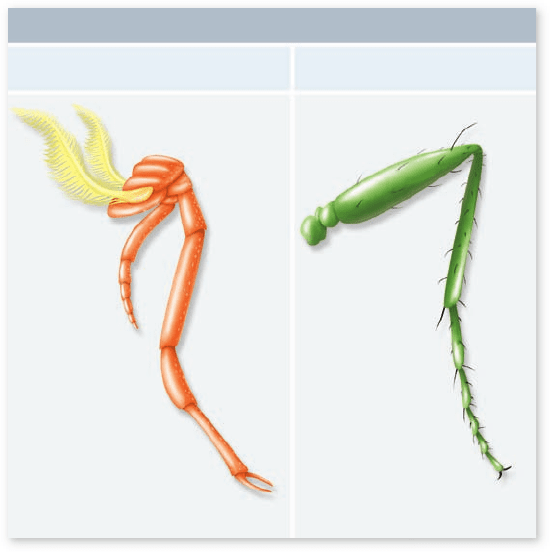
seemingly powerful attributes, including uniramous (single-
branched) appendages. All crustacean appendages, by contrast,
are basically biramous, or “two-branched” (figure 26.16), al-
though some of these appendages have become single-branched
by reduction in the course of their evolution.
Taxonomists have traditionally assumed a character such
as two-branched appendages to be a fundamental one, con-
served over the course of evolution, and thus suitable for mak-
ing taxonomic distinctions. As molecular methods have been
developed, however, this assumption has become questionable.
Hox genes and appendages
The patterning of appendages among arthropods is orches-
trated by Hox genes. A single one of these Hox genes, called
Distal-less, has been shown to initiate development of un-
branched limbs in insects and branched limbs in crustaceans.
The same Distal-less gene is found in many animal phyla, in-
cluding the vertebrates.
Distal-less appears to be necessary to initiate limb devel-
opment, and it turns on genes that are more directly involved in
the development of the limb itself. Evolutionary changes in the
genes that Distal-less acts on most likely account for differences
in limb morphology.
Figure 26.16
Branched and single appendages.
Development of a biramous leg in a crustacean (cray sh) and a
uniramous leg in an insect are both initiated by the Distal-less gene
even though their adult morphologies are distinct.
rav32223_ch26_507-527.indd 524rav32223_ch26_507-527.indd 524 11/12/09 3:52:08 PM11/12/09 3:52:08 PM
Apago PDF Enhancer
Eutherians (placental mammals)
Mammals
Elephants
Aardvarks
Anteaters
Armadillos
Hippopotamuses
Whales
Carnivores
Bats
Cattle
Deer
Horses
Primates
Rodents
Rabbits
African
clade
Monotremes
Marsupials
www.ravenbiology.com
chapter
26
The Tree of Life
525
The first major split occurred between the African
clade and the other placental mammals when South Amer-
ica and Africa separated about 100 mya. Aardvarks and ele-
phants are part of this African lineage, called the Afrotheria,
a clade we did not even recognize a decade ago. In South
America, anteaters and armadillos soon appeared. Then
two other branches arose—one includes ungulates with an
even number of toes (camels, llamas, and other artiodac-
tyls), odd-toed ungulates (perissodactyls such as horses and
rhinoceros), and carnivores, and the other, primates and ro-
dents. Sorting out the relationships within these branches is
an ongoing challenge.
Whales and hippos
The origin and relationships of whales has been debated for
over 200 years. Whales were initially thought to be relatives
of pigs based on morphological information from fossils and
extant animals, primarily the bones of the skull and shape of
the teeth.
DNA sequence data, however, revealed a particularly
close relationship between whales and hippopotamuses, sug-
gesting that whales were derived from within the group Ar-
tiodactyla. Whales and hippopotamuses appear to be much
more closely related than, for example, hippopotamuses and
cows. With this new phylogenetic information, the possi-
bility arises that some adaptations to aquatic environments
in both species had a common origin. Recent finds of fos-
sil whales with hind limbs have confirmed the artiodactyl
origin of whales. Prior to these recent discoveries, no fossil
whales with hind limbs had been found, so the key character
Figure 26.17
Major groups of mammals.
uniting whales and artiodactyls, the shape of a bone in the
ankle, was not known. A careful analysis of 80 traits in fossil
whales and hippos indicated a common, water-loving ances-
tor existed 50 to 60 mya belonging to the anthracotheres.
The anthracotheres split into two groups. One moved back
to an aquatic environment. The other gave rise to at least
37 genera that left a single descendent, the hippopotamus.
In this case, molecular data provided insight into whale ori-
gins that was later confirmed by fossil evidence.
Understanding evolutionary relationships among or-
ganisms does more than provide biologists with a sense of
order and a logical way to name organisms. A phylogeneti-
cally based taxonomy allows researchers to ask important
questions about physiology, behavior, and development
using information already known about a related species.
This information not only enriches our understanding of
how biological complexity evolved, but also provides novel
insights that lead to progress in our understanding of the
history and origins of important features and functions.
Learning Outcomes Review 26.6
Molecular systematics has provided new insight into evolutionary
relationships of animals. Segmentation likely arose more than once;
hexapods are more closely related to crustaceans than to myriapods; and
relationships among mammalian groups are still being revised based on
molecular data and new fossil fi nds.
Why might the most closely related living organisms have ■
very different appearances?
rav32223_ch26_507-527.indd 525rav32223_ch26_507-527.indd 525 11/12/09 3:52:08 PM11/12/09 3:52:08 PM

Apago PDF Enhancer
526
part
V
Diversity of Life on Earth
Chapter Review
26.1 Origins of Life
All organisms share fundamental properties of life.
Common properties of living things include cellular organization,
sensitivity, growth and development, reproduction, regulation and
homeostasis, and heredity.
Life may have had extraterrestrial origins.
The panspermia hypothesis proposes that the organic molecules of
life came to Earth inside meteorites.
Life may have originated on early Earth.
Conditions on the early Earth were very different, with a reducing
atmosphere that may have led to formation of carbon-rich,
organic molecules.
Cells evolved from the functional assembly of organic molecules.
Complex molecules may have coalesced inside a space surrounded
by a lipid or protein “bubble,” a precursor of a cell membrane. Here,
reactions could proceed more rapidly.
26.2 Classi cation of Organisms
Taxonomy is a quest for identity and relationships.
Taxonomy is the science of assigning organisms to a particular level
of classi cation called a taxon. Taxonomic hierarchies are organized
by domain, kingdom, phylum, class, order, family, genus, and species
(see gure 26.6).
Linnaeus instituted the use of binomial names.
Carolus Linnaeus devised a system of giving individual species
unique names, beginning with the capitalized genus, followed by a
species name. These are italicized.
Taxonomic hierarchies have limitations.
Traditional classi cations are limited because they are based on similar
traits and do not take into account evolutionary relationships.
26.3 Grouping Organisms
The six kingdoms are not necessarily monophyletic.
The six kingdoms proposed by Woese are not necessarily
monophyletic. In particular, Protista is paraphyletic (see
gures 26.7 and 26.9).
The three domains probably are monophyletic.
Domain Eukarya contains the kingdoms Protista, Plantae, Fungi, and
Animalia; the other two domains, Bacteria and Archaea, each contain
only prokaryotes.
Bacteria are more numerous than any other organism.
Bacteria are the most abundant and diverse organisms on Earth;
they consist of 12 to 15 major groups but their evolutionary links
are unclear.
Archaea may live in extreme environments.
Archaea are prokaryotes that are more closely related to eukaryotes
than to bacteria. They are grouped into methanogens, extremophiles,
and nonextreme archaea.
Eukaryotes have compartmentalized cells.
Eukaryote cells have compartmentalized organelles and other
structures. Eukaryotes acquired mitochondria and chloroplasts by
endosymbiosis (see gure 26.8). Many eukaryotes are multicellular,
and most undergo sexual reproduction.
Viruses are a special case.
Viruses are diverse chemical assemblies that cannot reproduce on
their own (see gure 26.10).
26.4 Making Sense of the Protists
Protists are divided into six groups, but at least 60 known protists do
not t into any of these groups (see gure 26.11).
A new kingdom, Viridiplantae, has been suggested to include green
algae and all aquatic and land plants.
26.5 Origin of Plants
Molecular phylogenetics has identi ed the closest living relatives of
land plants (see gure 26.12).
Green algae consist of two monophyletic groups: Chlorophyta and
Streptophyta. The latter group gave rise to land plants.
Horizontal gene transfer occurred in land plants.
Some land plants show evidence of horizontal gene transfer, such as
between the owering plant Amborella and mosses
(see gure 26.13).
26.6 Sorting Out the Animals
The origins of segmentation are puzzling.
Phylogeny based on rRNA shows that segmentation in arthropods,
annelids, and chordates arose independently at least three times.
Evidence points to duplications in Hox genes that regulate
segmentation as the cause (see gure 26.15).
Insects and crustaceans are sister groups.
Although previously based on appendages, classi cation of
arthropods has now placed hexapods (insects) as close relatives of
crustaceans based on molecular and genetic data.
The mammalian family tree is emerging.
Mammalian phylogeny continues to be re ned as molecular data
becomes available. Whales, for example, are most closely related to
hippopotamuses, sharing a water-loving common ancestor.
rav32223_ch26_507-527.indd 526rav32223_ch26_507-527.indd 526 11/12/09 3:52:08 PM11/12/09 3:52:08 PM

Apago PDF Enhancer
www.ravenbiology.com
chapter
26
The Tree of Life
527
c. Horizontal gene transfer
d. Changes in cell wall composition
4. You are given access to a database of Hox gene sequences from
a very large number of animals. Choose which topic you could
explore with your sequences from an evolutionary perspective.
a. Multicellularity
b. Sexual reproduction
c. Cellular compartmentalization
d. Segmentation
5. Molecular evidence and morphological evidence do not always
produce the same evolutionary hypotheses. Consider the
morphological evidence for arthropod evolution and evaluate
how it aligns with the conclusions drawn from the molecular
evidence. Choose the aspect of morphological evidence for
arthropod evolution that has been refuted by molecular evidence.
a. Protostome and deuterostome classi cation
b. Limb morphology and development
c. Metamorphosis
d. Development of eyes
6. Choose the most compelling evidence supporting the claim that
the whale is the closest relative of the hippopotamus.
a. Morphological information from fossils
b. Morphological information from hippopotamuses
c. Morphological evidence from carnivores
d. DNA sequence data
S Y N THES IZE
1. The conditions on Mars, Jupiter’s moon Europa, and Saturn’s moon
Titan mimic those that are believed to have occurred on the early
Earth. Yet, these places are also different from our early planet.
For example, both Europa and Titan are located far from the Sun.
Suppose that someday in the future scientists discover bacteria on
these moons that are very similar biochemically to the early bacteria
on Earth. Explain how this information would support the theory
of panspermia. What if the life was biochemically different?
2. Construct a phylogeny that includes arthropods, hexapods,
crustaceans, echinoderms, nematodes, mollusks, and annelids
based on evidence in this chapter.
3. You are part of a research team that has recently discovered
evidence of a single-celled prokaryotic organism on Mars. As you
begin your study of the organism, you wish to use a species from
Earth as a comparison. Propose which domain of life you should
obtain your reference species from and defend your choice.
4. In the past, classi cation has relied primarily on the evolution
of morphological characteristics. Modern approaches are
relying more heavily on molecular analysis. Defend the claim
that molecular approaches are very important in developing
evolutionary hypotheses.
U N DERS TAN D
1. The Miller–Urey experiment demonstrated that
a. life originated on Earth.
b. organic molecules could have originated in the
early atmosphere.
c. the early genetic material on the planet was DNA.
d. the early atmosphere contained large amounts of oxygen.
2. Which of the following properties of life would have to be
signi cantly different for an organism that evolved on a planet
located far from its sun?
a. Homeostasis c. Growth
b. Reproduction d. Sensitivity
3. Analyze a key limitation of the Linnaean system of classi cation.
4. Identify which of the following would not belong to the
domain Eukarya.
a. Photosynthetic plants c. Thermophilic archaea
b. Multicellular fungi d. Multicellular animals
5. Explain which of the kingdoms presented the greatest challenge
to the acceptance of a six-kingdom system.
6. Identify which of the following statements is false and correct
the statement.
a. Brown and red algae are not closely related
phylogenetically.
b. Chloroplasts in brown and red algae are monophyletic.
c. Brown algae gained chloroplasts by engul ng green algae
(endosymbiosis).
d. None of the above statements are false.
7. Which of the following events occurred rst in eukaryotic
evolution?
a. Endosymbiosis and mitochondria evolution
b. Endosymbiosis and chloroplast evolution
c. Compartmentalization and formation of the nucleus
d. Formation of multicellular organisms
8. Given your understanding of phylogenetics, where would you
place viruses in the tree of life?
a. Archaea c. Bacteria
b. Fungi d. None of the above
APPLY
1. As a researcher you discover a new species that is eukaryotic,
motile, possesses a cell wall made of chitin, but lacks any
evidence of a nervous system. Choose the kingdom of life that
best aligns with this new species.
2. Kingdom Plantae is being replaced by a new kingdom named
Viridiplantae. Choose the evidence that justi es this change.
a. Molecular phylogenetics
b. Newly discovered fossils
c. Biochemical differences
d. All of the above
3. Based on information in this chapter, choose which areas of
research in plant biology have the greatest potential to increase
our understanding of land plant evolution.
a. Photosynthetic pigments
b. Chloroplast endosymbiosis
Review Questions
O N LIN E RES OURCE
www.ravenbiology.com
Understand, Apply, and Synthesize—enhance your study with
animations that bring concepts to life and practice tests to assess
your understanding. Your instructor may also recommend the
interactive eBook, individualized learning tools, and more.
rav32223_ch26_507-527.indd 527rav32223_ch26_507-527.indd 527 11/12/09 3:52:09 PM11/12/09 3:52:09 PM

Apago PDF Enhancer
0.036
μ
m
W
CHAPTER
Introduction
We begin our exploration of the diversity of life with viruses. Viruses are genetic elements enclosed in protein; they are not
considered organisms since they lack many of the features associated with life, including cellular structure, and independent
metabolism or replication. For this reason viral particles are not called viral cells, but virions, and they are generally not described
as living or dead but as active or inactive. Because of their disease-producing potential, however, viruses are important biological
entities. The virus particles pictured here are responsible for causing in uenza— u for short. In the u season of 1918 to 1919, an
in uenza pandemic killed approximately 20 to 50 million people worldwide, twice as many as were killed in combat during World
War I. Other viruses cause such diseases as AIDS, SARS, and hemorrhagic fever, and some cause certain forms of cancer.
For more than four decades, viral studies have been thoroughly intertwined with those of genetics and molecular
biology. Classic studies using viruses that infect bacteria (known as bacteriophage ) have led to the discovery of restriction
enzymes and the identification of nucleic acid, not protein, as the hereditary material. Currently, viruses are one of the
principal tools used to experimentally carry genes from one organism to another. Applications of this technology could
include treating genetic illnesses and fighting cancer.
Chapter
27
Viruses
Chapter Outline
27.1 The Nature of Viruses
27.2 Bacteriophage: Bacterial Viruses
27.3 Human Immunode ciency Virus (HIV)
27.4 Other Viral Diseases
27.5 Prions and Viroids: Subviral Particles
rav32223_ch27_528-544.indd 528rav32223_ch27_528-544.indd 528 11/12/09 4:18:17 PM11/12/09 4:18:17 PM

Apago PDF Enhancer
a. b. c. d.
Viral shape
Bacterial virus
Icosahedral head: helical tail
Plant virus (TMV)
Helical capsid
Animal virus (Adenovirus)
Icosahedral capsid
Animal virus (Influenza)
Helical capsid within envelope
RNA
RNA
DNA
DNA
Capsid
Capsid
Capsid
Capsid Envelope
Antigen
Tail
Structure
Virus
27.1
The Nature of Viruses
Learning Outcomes
Describe the different structures found in viruses.1.
Understand the basic mechanism of viral replication.2.
All viruses have the same basic structure—a core of nucleic acid
surrounded by protein. This structure lacks cytoplasm, and it is
not a cell. Individual viruses contain only a single type of nucleic
acid, either DNA or RNA. The DNA or RNA genome may be
linear or circular; single-stranded or double-stranded.
RNA viruses may be segmented, with multiple RNA mol-
ecules within a virion, or nonsegmented, with a single RNA
molecule. Viruses are classified, in part, by the nature of their
genomes: RNA viruses, DNA viruses, or retroviruses.
Viruses are strands of nucleic acids
encased in a protein coat
Nearly all viruses form a protein sheath, or capsid, around
their nucleic acid core (figure 27.1) . The capsid is composed of
one to a few different protein molecules repeated many times.
The repeating units are called capsomeres.
In several viruses, specialized enzymes are stored with the
nucleic acid, inside the capsid. One example is reverse tran-
scriptase, which is required for retroviruses to complete their
cycle and is not found in the host. This enzyme is needed early
in the infection process and is carried within each virion.
Many animal viruses have an envelope around the capsid that
is rich in proteins, lipids, and glycoprotein molecules. The lipids
Figure 27.1
Structure of virions. Viruses are characterized as helical, icosahedral, binal, or polymorphic, depending on their
symmetry. a. The capsid may have helical symmetry such as the tobacco mosaic virus (TMV). TMV infects plants and consists of 2130
identical protein molecules (green) that form a cylindrical coat around the single strand of RNA (red). b. The capsid of icosahedral viruses has
20 facets made of equilateral triangles. These viruses can come in many different sizes all based on the same basic shape. c. Bacteriophage
come in a variety of shapes, but binal symmetry is exclusively seen in phages such as the T4 phage of E. coli. This form of symmetry is
characterized by an icosahedral head, which contains the viral genome, and a helical tail. d. Viruses can also have an envelope surrounding the
capsid such as the in uenza virus. This gives the virus a polymorphic shape. This virus has eight RNA segments, each within a helical capsid.
found in the envelope are derived from the host cell; however, the
proteins found in a viral envelope are generally virally encoded.
Viral hosts include virtually
every kind of organism
Viruses occur as obligate intracellular parasites in every kind of
organism that has been investigated for their presence. Viruses
infect fungal cells, bacterial cells, and protists as well as cells of
plants and animals; however, each type of virus can replicate in
only a very limited number of cell types. A virus that infects
bacteria would be ill-equipped to infect a human or plant cell.
The suitable cells for a particular virus are collectively
referred to as its host range. Once inside a multicellular host,
many viruses also exhibit tissue tropism, targeting only a spe-
cific set of cells. For example, rabies virus grows within neu-
rons, and hepatitis virus replicates within liver cells. Once inside
a host cell, some viruses, such as the highly dangerous Ebola
virus, wreak havoc on the cells they infect; others produce little
or no damage. Still other viruses remain dormant until a spe-
cific signal or event triggers their expression.
As one example, a person can get chicken pox as a child,
recover, and develop the disease shingles decades later. Both
chicken pox and shingles are caused by the same virus, varicella
zoster. This virus can remain dormant, or latent, for years.
Stresses to the immune system may trigger an outbreak of shin-
gles in people who have had chicken pox in the past. This is
caused by the same virus, but the infection may be called herpes
zoster because the virus is actually a herpes virus.
Any given organism may often be susceptible to more
than one kind of virus. This observation suggests that many
more kinds of viruses may exist than there are kinds of
organisms—perhaps trillions of different viruses. Only a few
thousand viruses have been described at this point.
chapter
27
Viruses
529www.ravenbiology.com
rav32223_ch27_528-544.indd 529rav32223_ch27_528-544.indd 529 11/12/09 4:18:22 PM11/12/09 4:18:22 PM
Apago PDF Enhancer
Head
DNA
Capsid
(protein sheath)
Collar
Whiskers
Tail
Tail fiber Base plate
a. b.
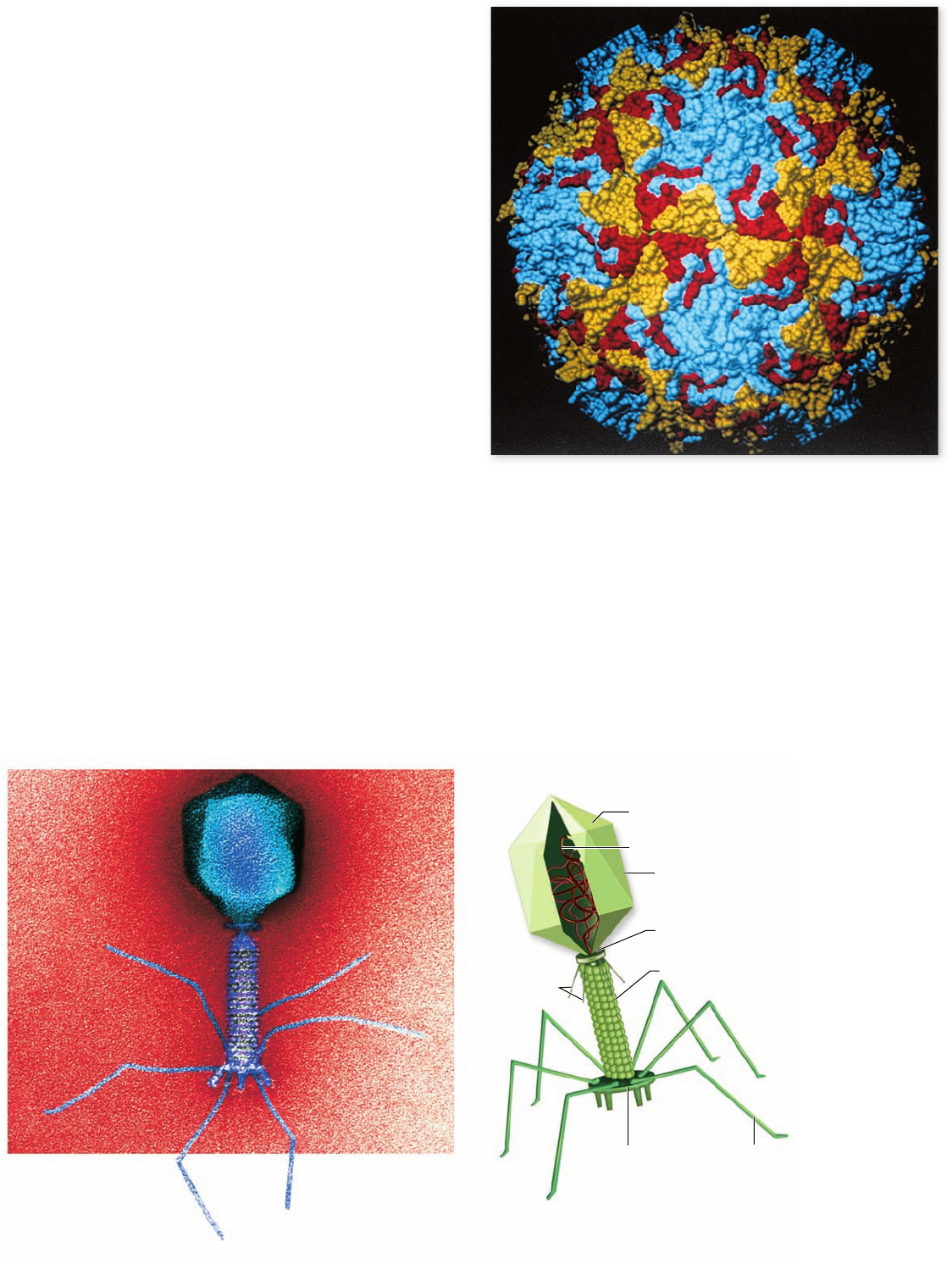
Figure 27.2
Icosahedral virion. The poliovirus has
icosahedral symmetry. The capsid is formed from multiple copies of
four different proteins shown in different colors. (One protein is
internal and cannot be seen.)
Figure 27.3
A bacterial virus.
Bacteriophage exhibit a
complex structure.
a. Electron micrograph
and (b) diagram of the
structure of a T4
bacteriophage (some
facets removed to reveal
the interior).
ture (figure 27.1b). The icosahedron is the basic design of the
geodesic dome, and it is the most efficient symmetrical arrange-
ment that subunits can take to form a shell with maximum in-
ternal capacity (figure 27.2).
Some viruses, such as the T-even bacteriophage shown
in figure 27.3, are complex. Complex viruses have a binal, or
Viruses replicate by taking over
host machinery
An infecting virus can be thought of as a set of instructions, not
unlike a computer program. A cell is normally directed by chro-
mosomal DNA-encoded instructions, just as a computer’s op-
eration is controlled by the instructions in its operating system.
A virus is simply a set of instructions, the viral genome, that can
trick the cell’s replication and metabolic enzymes into making
copies of the virus. Computer viruses get their name because
they perform similar actions, taking over a computer and di-
recting its activities. Like a computer with a virus, a cell with a
virus is often damaged by infection.
Viruses can reproduce only when they enter cells. When
they are outside of a cell, viral particles are called virions and are
metabolically inert. Viruses lack ribosomes and the enzymes
necessary for protein synthesis and most, if not all of the enzymes
for nucleic acid replication. Inside cells, the virus hijacks the
transcription and translation systems to produce viral proteins
from early genes, which are the genes in the viral genome ex-
pressed first. This is followed by the expression of middle genes
and eventually late genes. This cascade of gene expression leads
to replication of viral nucleic acid and production of viral capsid
proteins. The late genes generally code for proteins important
in assembly and release of viral particles from a host cell.
Most viruses come in two simple shapes
Most viruses have an overall structure that is either helical or
icosahedral. Helical viruses, such as the tobacco mosaic virus in
figure 27.1a, have a rodlike or threadlike appearance. Icosahe-
dral viruses have a soccer ball shape, the geometry of which is
revealed only under the highest magnification with an electron
microscope.
The icosahedron is a structure with 20 equilateral trian-
gular facets. Most animal viruses are icosahedral in basic struc-
530
part
V
Diversity of Life on Earth
rav32223_ch27_528-544.indd 530rav32223_ch27_528-544.indd 530 11/12/09 4:18:23 PM11/12/09 4:18:23 PM
Apago PDF Enhancer
EUKARYOTE
Yeast cell
7 mm long
EUKARYOTE
Yeast cell
7 mm long
Poxvirus
250 nm
VIRUS
15 nm
Hemoglobin
PROTEIN
Streptococcus
1 mm
2 mm long
E. coli
BACTERIUM
BACTERIUM
Herpes simplex
150 nm
VIRUS
Rabies
125 nm
VIRUS
HIV
110 nm
VIRUS
Influenza
100 nm
VIRUS
Adenovirus
75 nm
VIRUS
Poliovirus
30 nm
VIRUS
Flavivirus
(causes
yellow
fever)
22 nm
VIRUS
65 nm
T2 bacteriophage
VIRUS
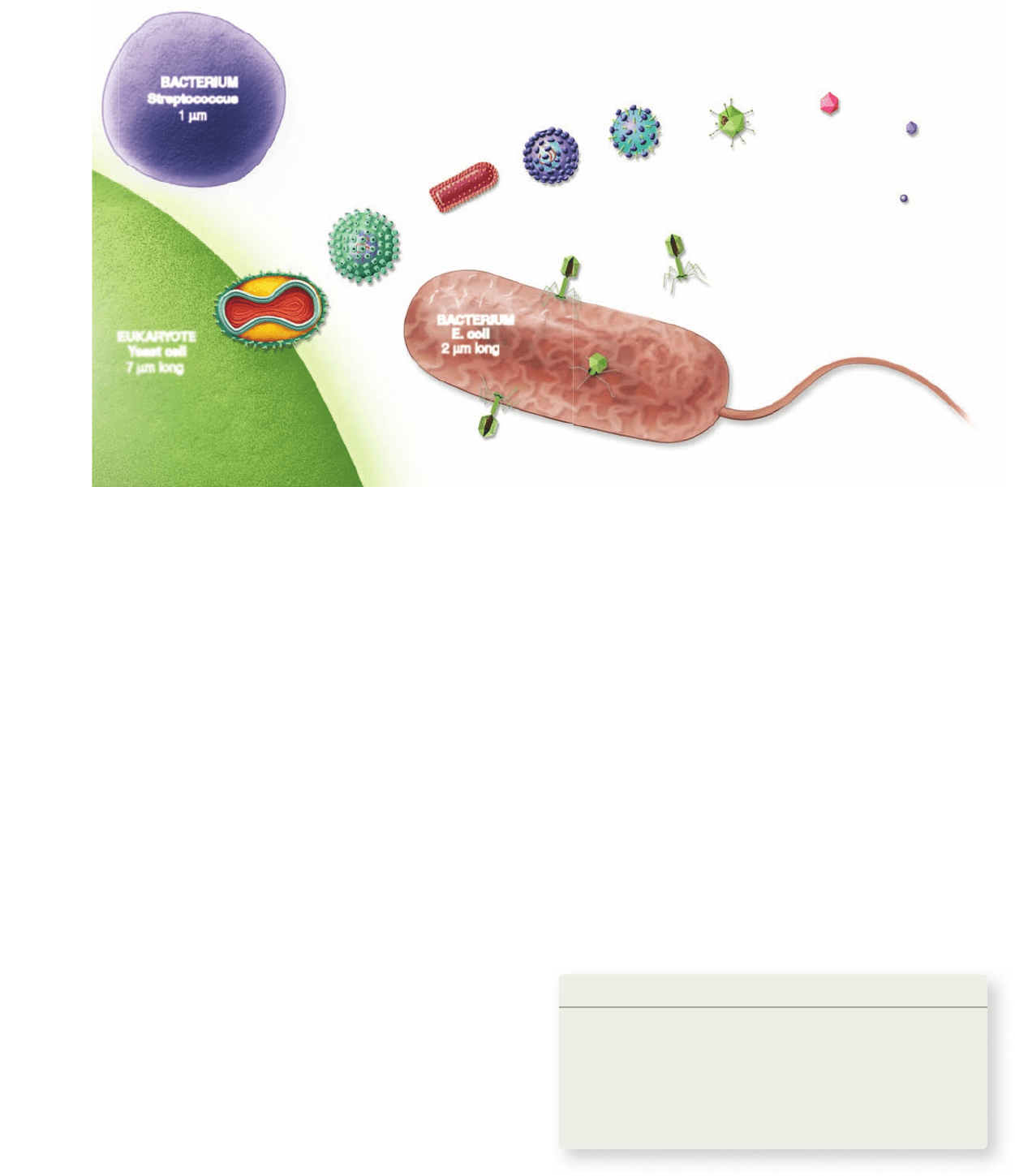
Figure 27.4
Viruses vary in size and shape. Note the dramatic differences in the size of a eukaryotic yeast cell, prokaryotic bacterial
cells, and the many different viruses.
In single-stranded RNA viruses, if the genome has the
same base sequence as the mRNA used to produce viral pro-
teins, then the genomic RNA can serve as the mRNA. Such
viruses are called positive-strand viruses. In contrast, if the ge-
nome is complementary to the viral mRNA, then the virus is
called a negative-strand virus.
A special class of RNA viruses, called retroviruses , have
an RNA genome that is reverse-transcribed into DNA by
the enzyme reverse transcriptase . The DNA fragments pro-
duced by reverse transcription are often integrated into a
host’s chromosomal DNA. Human immunodeficiency virus
(HIV), the agent that causes acquired immune deficiency syn-
drome (AIDS), is a retrovirus. (We describe HIV in detail
later on.)
Other viruses, such as the viruses causing smallpox and
herpes, have DNA genomes. Most DNA viruses are double-
stranded, and their DNA is replicated in the nucleus of eukary-
otic host cells.
Learning Outcomes Review 27.1
Viruses have a very simple structure that includes a nucleic acid genome
encased in a protein coat. Viruses replicate by taking over a host’s cell
systems and are thus obligate intracellular parasites. Viruses show diverse
genomes that are composed of DNA or RNA, which may be single- or double-
stranded; most DNA viruses are double-stranded.
■ Why can’t viruses replicate outside of a cell?
two-fold, symmetry that is not either purely icosahedral or
helical. The T-even phage shown has a head structure that
is an elongated icosahedron. A collar connects the head to a
hollow tube with helical symmetry that ends in a complex
baseplate with tail fibers. Although animal viruses do not
have this binal symmetry, some, such as the poxviruses, do
have a complex multilayered capsid structure. Some envel-
oped viruses, such as influenza, are polymorphic, having no
distinctive symmetry.
Viruses also vary greatly in size. As shown in figure 27.4,
the very smallest viruses, such as the poliovirus, have actually
been synthesized in a lab using nothing more than sequence
data and a machine capable of synthesizing nucleic acids from
nucleotides. The larger viruses, such as the poxviruses, gener-
ally carry more genes, have more complex structures, and tend
to have a very short cycle time between entry of viral particles
and release of newly formed virions.
Viral genomes exhibit great variation
Viral genomes vary greatly in both type of nucleic acid and
number of strands (table 27.1). Some viruses, including those
that cause flu, measles, and AIDS, possess RNA genomes. Most
RNA viruses are single-stranded and are replicated and assem-
bled in the cytosol of infected eukaryotic cells. RNA virus rep-
lication is error-prone, leading to high rates of mutation. This
makes them difficult targets for the host immune system, vac-
cines, and antiviral drugs.
chapter
27
Viruses
531www.ravenbiology.com
rav32223_ch27_528-544.indd 531rav32223_ch27_528-544.indd 531 11/12/09 4:18:26 PM11/12/09 4:18:26 PM