
Raven P.H., Johnson G.B., Mason K.A. Biology (Ninth Edition)
Подождите немного. Документ загружается.


Apago PDF Enhancer
TABLE 30.1
The Seven Phyla of Extant Vascular Plants, continued
Phylum Examples Key Characteristics
Approximate Number
of Living Species
SEED PLANTS
Coniferophyta Conifers
(including pines,
spruces, rs,
yews, redwoods,
and others)
Heterosporous seed plants. Sperm not motile; conducted to
egg by a pollen tube. Leaves mostly needlelike or scalelike.
Trees, shrubs. About 50 genera. Many produce seeds in cones.
601
Cycadophyta Cycads
Heterosporous. Sperm agellated and motile but con ned
within a pollen tube that grows to the vicinity of the egg.
Palmlike plants with pinnate leaves. Secondary growth slow
compared with that of the conifers. Ten genera. Seeds in cones.
206
Gnetophyta Gnetophytes
Heterosporous. Sperm not motile; conducted to egg by a
pollen tube. The only gymnosperms with vessels. Trees,
shrubs, vines. Three very diverse genera (Ephedra, Gnetum,
Welwitschia).
65
Ginkgophyta Ginkgo
Heterosporous. Sperm agellated and motile but conducted
to the vicinity of the egg by a pollen tube. Deciduous tree
with fan-shaped leaves that have evenly forking veins. Seeds
resemble a small plum with eshy, foul-smelling outer
covering. One genus.
1
Anthophyta Flowering plants
(angiosperms)
Heterosporous. Sperm not motile; conducted to egg by a
pollen tube. Seeds enclosed within a fruit. Leaves greatly
varied in size and form. Herbs, vines, shrubs, trees. About
14,000 genera.
250,000
30.7
The Evolution of Seed Plants
Learning Outcomes
List the evolutionary advantages of seeds.1.
Distinguish between pollen and sperm in seed plants.2.
The history of the land plants is replete with evolutionary innova-
tions allowing the ancestors of aquatic algae to colonize the harsh
and varied terrestrial terrains. Early innovations made survival on
land possible, later followed by an explosion of plant life that con-
tinues to change the land and atmosphere, and support terrestrial
animal life. Seed-producing plants have come to dominate the
terrestrial landscape over the last several hundred million years.
Much of the remarkable success of seed plants, both gymno-
sperms and angiosperms, can be attributed to the evolution of
the seed, an innovation that protects and provides food for deli-
cate embryos. Seeds allow embryos to “stop the clock” and ger-
minate after a harsh winter or extremely dry season has passed.
Fruits, a later innovation, enhanced the dispersal of embryos
across a broader landscape.
Seed plants, which have additional embryo protection, first
appeared about 305 to 465 mya and were the ancestors of gymno-
sperms and angiosperms. Seed plants appear to have evolved from
spore-bearing plants known as progymnosperms. Progymno-
sperms shared several features with modern gymnosperms, in-
cluding secondary vascular tissues (which allow for an increase in
girth later in development). Some progymnosperms had leaves.
Their reproduction was very simple, and it is not certain which
particular group of progymnosperms gave rise to seed plants.
The seed protects the embryo
From an evolutionary and ecological perspective, the seed rep-
resents an important advance. The embryo is protected by an
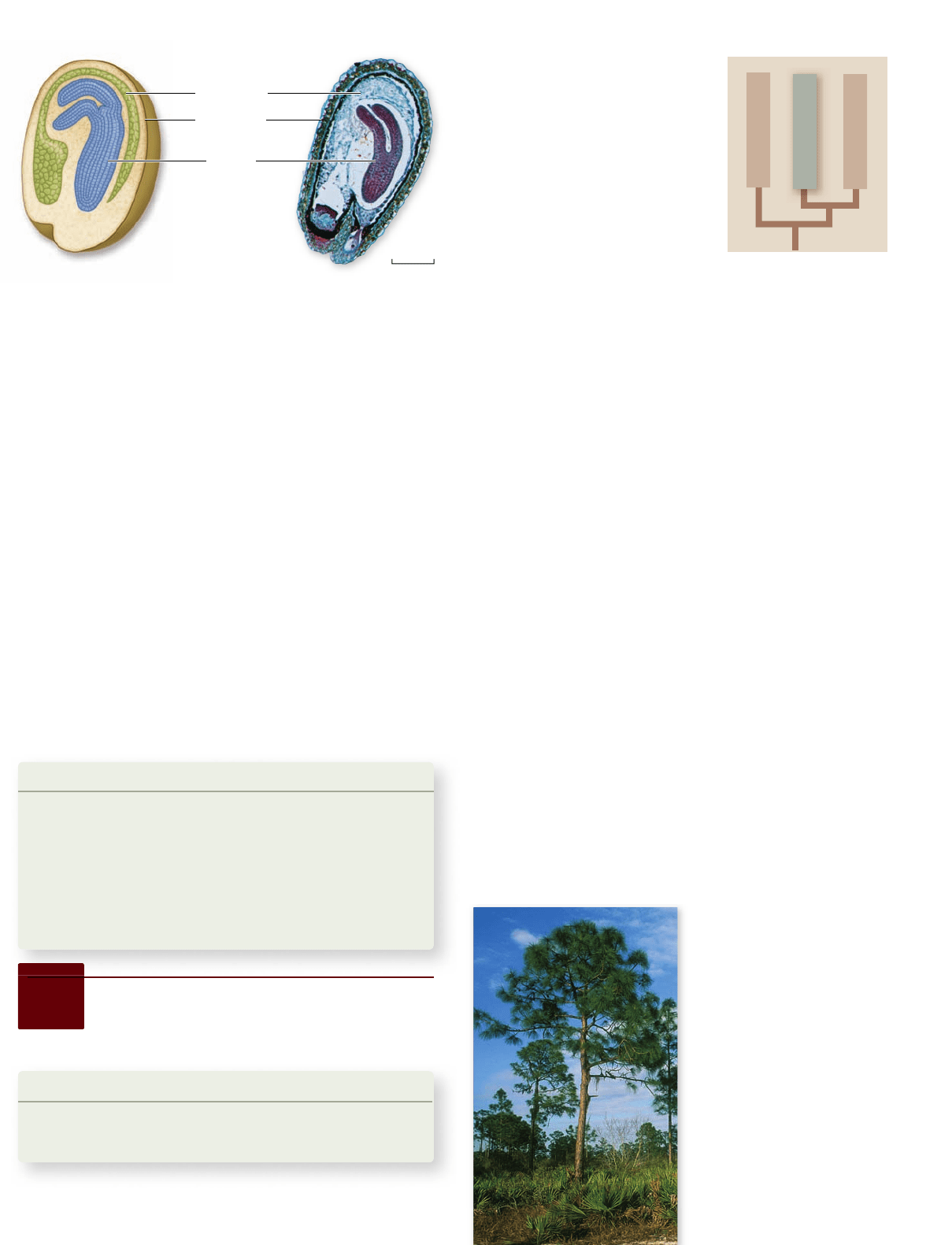
extra layer or two of sporophyte tissue called the integument,
creating the ovule (figure 30.21). Within the ovule, the mega-
sporangium divides meiotically, producing a haploid mega-
spore. The megaspore produces the egg that combines with the
sperm, resulting in the zygote. Seeds also contain a food supply
for the developing embryo.
602
part
V
Diversity of Life on Earth
rav32223_ch30_588-613.indd 602rav32223_ch30_588-613.indd 602 11/13/09 12:06:40 PM11/13/09 12:06:40 PM
Apago PDF Enhancer
312 µm
Stored food
Integument
(seed coat)
Embryo
Angiosperms
Gymnosperms
Ferns and Allies
During development, the integuments harden to produce
the seed coat. In addition to protecting the embryo from
drought, the seed can be easily dispersed. Perhaps even more
significantly, the presence of seeds introduces into the life cycle
a dormant phase that allows the embryo to survive until envi-
ronmental conditions are favorable for further growth.
A pollen grain is the male gametophyte
Seed plants produce two kinds of gametophytes—male and
female—each of which consists of just a few cells. Pollen grains,
multicellular male gametophytes, are conveyed to the egg in
the female gametophyte by wind or by a pollinator. In some
seed plants, the sperm moves toward the egg through a grow-
ing pollen tube. This eliminates the need for external water. In
contrast to the seedless plants, the whole male gametophyte,
rather than just the sperm, moves to the female gametophyte.
A female gametophyte forms within the protection of the
integuments, collectively forming the ovule. In angiosperms,
the ovules are completely enclosed within additional diploid
sporophyte tissue. The ovule and the surrounding, protective
tissue are called the ovary. The ovary develops into the fruit.
Learning Outcomes Review 30.7
A common ancestor that had seeds gave rise to the gymnosperms and the
angiosperms. Seeds protect the embryo, aid in dispersal, and can allow for
an extended pause in the life cycle. Seed plants produce male and female
gametophytes; the male gametophyte is a pollen grain, which is carried to
the female gametophyte by wind or other means. The sperm is within the
pollen grain.
■ Why is water not essential for fertilization in seed plants?
Seeds distinguish the gymnosperms
from the pterophytes. There are four
groups of living gymnosperms,
namely coniferophytes, cycadophytes,
gnetophytes, and ginkgophytes, all of
which lack the flowers and fruits of
angiosperms. In all of them, the ovule,
which becomes a seed, rests exposed
on a scale (a modified shoot or leaf)
and is not completely enclosed by
sporophyte tissues at the time of pol-
lination. The name gymnosperm literally means “naked seed.” Al-
though the ovules are naked at the time of pollination, the seeds
of gymnosperms are sometimes enclosed by other sporophyte
tissues by the time they are mature.
Details of reproduction vary somewhat in gymnosperms,
and their forms vary greatly. For example, cycads and Ginkgo
have motile sperm, whereas conifers and gnetophytes have
sperm with no flagella. All sperm are carried within a pollen
tube. The female cones range from tiny, woody structures
weighing less than 25 g and having a diameter of a few millime-
ters, to massive structures produced in some cycads, weighing
more than 45 kg and growing to lengths of more than a meter.
Conifers are the largest gymnosperm phylum
The most familiar gymnosperms are conifers (phylum Conif-
erophyta), which include pines (figure 30.22) , spruces, firs, ce-
dars, hemlocks, yews, larches, cypresses, and others. The coastal
redwood (Sequoia sempervirens), a conifer native to northwest-
ern California and southwestern Oregon, is the tallest living
vascular plant; it may attain a height of nearly 100 m (300 ft).
Another conifer, the bristlecone pine (Pinus longaeva) of the
White Mountains of California, is the oldest living tree; one
specimen is 4900 years of age.
Conifers are found in the colder temperate and some-
times drier regions of the world. Various species are sources of
timber, paper, resin, taxol (used to treat cancer), and other eco-
nomically important products.
Pines are an exemplary conifer genus
More than 100 species of pines exist today, all native to the north-
ern hemisphere, although the range of one species does extend a
Figure 30.21
Cross-section of an ovule.
Figure 30.22
Conifers.
Longleaf pines, Pinus palustris,
in Florida are representative of
the Coniferophyta, the largest
phylum of gymnosperms.
30.8
Gymnosperms: Plants
with “Naked Seeds”
Learning Outcomes
Describe the distinguishing features of a gymnosperm. 1.
List the four groups of living gymnosperms. 2.
chapter
30
Green Plants
603www.ravenbiology.com
rav32223_ch30_588-613.indd 603rav32223_ch30_588-613.indd 603 11/13/09 12:06:43 PM11/13/09 12:06:43 PM
Apago PDF Enhancer
n
2n
Section of seed (second year),
showing embryo embedded
in megagametophyte
(15 months
after pollination)
Ovulate
(seed-bearing)
cone
Megaspore
mother cell
Microspore
mother cell
Microspores
Pollen
Air bladder
Pollen-
bearing
cone
Pollen tube
Pollen tube
Sperm
Pollination
Sporophyte
Seedling
Pine
seed
Scale
Zygote
MEIOSIS
MITOSIS
FERTILIZATION
MITOSISMITOSIS
Megaspore
little south of the equator. Pines and spruces, which belong to the
same family, are members of the vast coniferous forests that lie
between the arctic tundra and the temperate deciduous forests
and prairies to their south. During the past century, pines have
been extensively planted in the southern hemisphere.
Pine morphology
Pines have tough, needlelike leaves produced mostly in clusters
of two to five. Among the conifers, only pines have clustered
leaves. The leaves, which have a thick cuticle and recessed sto-
mata, represent an evolutionary adaptation for retarding water
loss. This strategy is important because many of the trees grow
in areas where the topsoil is frozen for part of the year, making
it difficult for the roots to obtain water.
The leaves and other parts of the sporophyte have canals
into which surrounding cells secrete resin. The resin deters in-
sect and fungal attacks. The resin of certain pines is harvested
commercially for its volatile liquid portion, called turpentine, and
for the solid rosin, which is used on bowed stringed instruments.
The wood of pines lacks some of the more rigid cell types found
in other trees, and it is considered a “soft” rather than a “hard”
wood. The thick bark of pines is an adaptation for surviving fires
and subzero temperatures. Some cones actually depend on fire to
open them, releasing seeds to reforest burned areas.
Reproductive structures
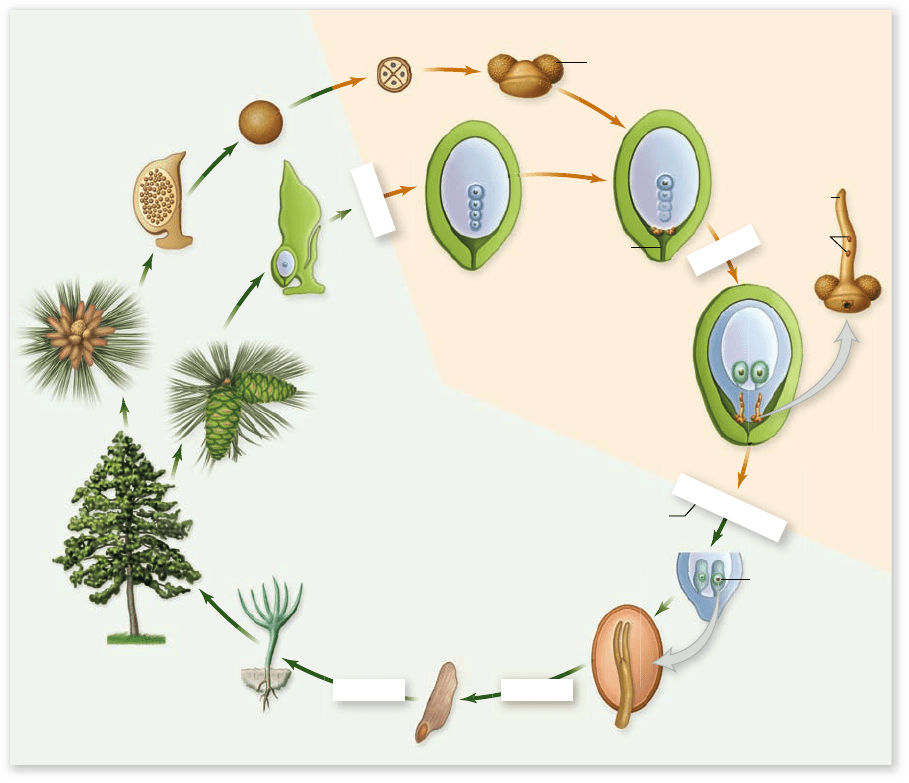
All seed plants produce two types of spores that give rise to two
types of gametophytes (figure 30.23 ). The male gametophytes
(pollen grains) of pines develop from microspores, which are
produced in male cones that develop in clusters of 30 to 70,
typically at the tips of the lower branches; there may be hun-
dreds of such clusters on any single tree.
The male pine cones generally are 1 to 4 cm long and
consist of small, papery scales arranged in a spiral or in whorls.
A pair of microsporangia form as sacs within each scale. Nu-
merous microspore mother cells in the microsporangia under-
go meiosis, each becoming four microspores. The microspores
develop into four-celled pollen grains with a pair of air sacs that
give them added buoyancy when released into the air. A single
cluster of male pine cones may produce more than a million
pollen grains.
Female pine cones typically are produced on the upper
branches of the same tree that produces male cones. Female cones
are larger than male cones, and their scales become woody.
Two ovules develop toward the base of each scale. Each
ovule contains a megasporangium called the nucellus. The nu-
cellus itself is completely surrounded by a thick layer of cells
called the integument that has a small opening (the micropyle)
toward one end. One of the layers of the integument later
Figure 30.23
Life cycle of a typical
pine. The male and
female gametophytes are
dramatically reduced in
size in these plants. Wind
generally disperses the
male gametophyte
(pollen), which produces
sperm. Pollen tube
growth delivers the sperm
to the egg on the female
cone. Additional
protection for the embryo
is provided by the
integument, which
develops into the
seed coat.
604
part
V
Diversity of Life on Earth
rav32223_ch30_588-613.indd 604rav32223_ch30_588-613.indd 604 11/13/09 12:06:53 PM11/13/09 12:06:53 PM
Apago PDF Enhancer
a
. b. c.
becomes the seed coat. A single megaspore mother cell within
each megasporangium undergoes meiosis, becoming a row of
four megaspores. Three of the megaspores break down, but the
remaining one, over the better part of a year, slowly develops
into a female gametophyte. The female gametophyte at matu-
rity may consist of thousands of cells, with two to six archego-
nia formed at the micropylar end. Each archegonium contains
an egg so large it can be seen without a microscope.
Fertilization and seed formation
Female cones usually take two or more seasons to mature. At
first they may be reddish or purplish in color, but they soon
turn green, and during the first spring, the scales spread apart.
While the scales are open, pollen grains carried by the wind
drift down between them, some catching in sticky fluid oozing
out of the micropyle. The pollen grains within the sticky fluid
are slowly drawn down through the micropyle to the top of the
nucellus, and the scales close shortly thereafter.
The archegonia and the rest of the female gametophyte
are not mature until about a year later. While the female game-
tophyte is developing, a pollen tube emerges from a pollen
grain at the bottom of the micropyle and slowly digests its way
through the nucellus to the archegonia. During growth of the
pollen tube, one of the pollen grain’s four cells, the generative
cell, divides by mitosis, with one of the resulting two cells divid-
ing once more. These last two cells function as sperm. The ger-
minated pollen grain with its two sperm is the mature male
gametophyte, a very limited haploid phase compared with
fern gametophytes.
About 15 months after pollination, the pollen tube reaches
an archegonium and discharges its contents into it. One sperm
unites with the egg, forming a zygote. The other sperm and cells
of the pollen grain degenerate. The zygote develops into an em-
bryo within the seed. After dispersal and germination of the
seed, the young sporophyte of the next generation develops into
a tree.
Cycads resemble palms, but
are not owering plants
Cycads (phylum Cycadophyta) are slow-growing gymnosperms
of tropical and subtropical regions. The sporophytes of most of
the 100 known species resemble palm trees (figure 30.24a) with
trunks that can attain heights of 15 m or more. Unlike palm trees,
which are flowering plants, cycads produce cones and have a life
cycle similar to that of pines.
The female cones, which develop upright among the leaf
bases, are huge in some species and can weigh up to 45 kg. The
sperm of cycads, although formed within a pollen tube, are re-
leased within the ovule to swim to an archegonium. These
sperm are the largest sperm cells among all living organisms.
Several species of cycads are facing extinction in the wild and
soon may exist only in botanical gardens.
Gnetophytes have xylem vessels
There are three genera and about 65 living species of gneto-
phytes (phylum Gnetophyta). They are the only gymnosperms
with vessels in their xylem. Vessels are a particularly efficient
conducting cell type that is a common feature in angiosperms.
The members of the three genera differ greatly from one
another in form. One of the most bizarre of all plants is Wel-
witschia, which occurs in the Namib and Mossamedes deserts of
southwestern Africa (figure 30.24b). The stem is shaped like a
large, shallow cup that tapers into a taproot below the surface.
It has two strap-shaped, leathery leaves that grow continuously
from their base, splitting as they flap in the wind. The repro-
ductive structures of Welwitschia are conelike, appear toward
the bases of the leaves around the rims of the stems, and are
produced on separate male and female plants.
More than half of the gnetophyte species are in the genus
Ephedra, which is common in arid regions of the western United
States and Mexico. Species are found on every continent except
Australia. The plants are shrubby, with stems that superficially
resemble those of horsetails, being jointed and having tiny, scale-
like leaves at each node. Male and female reproductive structures
may be produced on the same or different plants.
The drug ephedrine, widely used in the treatment of re-
spiratory problems, was in the past extracted from Chinese spe-
cies of Ephedra, but it has now been largely replaced with
synthetic preparations (pseudoephedrine). Because ephedrine
found in herbal remedies for weight loss was linked to strokes
and heart attacks, it was withdrawn from the market in April of
2004. Sales restrictions were placed on pseudoephedrine-
containing products in 2006 because it can be used to manufac-
ture the illegal drug methamphetamine.
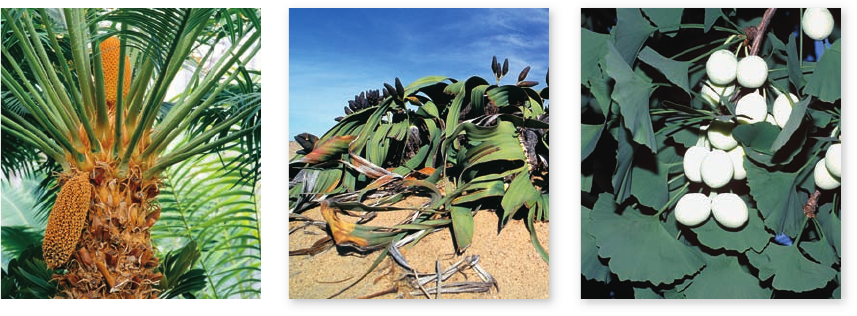
Figure 30.24
Three
phyla of gymnosperms.
a. A cycad, Cycas circinalis.
b. Welwitschia mirabilis
represents one of the three
genera of gnetophytes.
c. Maidenhair tree, Ginkgo
biloba, the only living
representative of the
phylum Ginkgophyta.
chapter
30
Green Plants
605www.ravenbiology.com
rav32223_ch30_588-613.indd 605rav32223_ch30_588-613.indd 605 11/13/09 12:06:54 PM11/13/09 12:06:54 PM
Apago PDF Enhancer
Angiosperms
Gymnosperms
Ferns and Allies
Ovules
Ovules
(seeds)
Carpel
(fruit)
Modified leaf
with ovules
Cross section
Folding of leaf
protects ovules
Fusion of
leaf margins
The best known species of the third genus, Gnetum, is a
tropical tree, but most species are vinelike. All species have
broad leaves similar to those of angiosperms. One Gnetum spe-
cies is cultivated in Java for its tender shoots, which are cooked
as a vegetable.
Only one species of the ginkgophytes
remains extant
The fossil record indicates that members of the ginkgophytes
(phylum Ginkgophyta) were once widely distributed, particu-
larly in the northern hemisphere; today, only one living spe-
cies, Ginkgo biloba, remains (figure 30.24c). This tree, which
sheds its leaves in the fall, was first encountered by Europeans
in cultivation in Japan and China; it apparently no longer ex-
ists in the wild.
Like the sperm of cycads, those of Ginkgo have flagella.
The ginkgo is dioecious—that is, the male and female repro-
ductive structures are produced on separate trees. The fleshy
outer coverings of the seeds of female ginkgo plants exude the
foul smell of rancid butter, caused by the presence of butyric
and isobutyric acids. As a result, male plants vegetatively propa-
gated from shoots are preferred for cultivation. Because of its
beauty and resistance to air pollution, Ginkgo is commonly
planted along city streets.
Learning Outcomes Review 30.8
Gymnosperms are mostly cone-bearing seed plants. In gymnosperms, the
ovules are not completely enclosed by sporophyte tissue at pollination, and
thus have “naked seeds.” The four groups of gymnosperms are conifers,
cycads, gnetophytes, and ginkgophytes.
■ What adaptation do conifers exhibit to capture wind-
borne pollen?
30.9
Angiosperms:
The Flowering Plants
Learning Outcomes
List the defining features of angiosperms.1.
Describe the roles of some animals in the angiosperm 2.
life cycle.
Explain double fertilization and its outcome. 3.
The 270,000 known species of flow-
ering plants are called angiosperms
because their ovules, unlike those of
gymnosperms, are enclosed within
diploid tissues at the time of pollina-
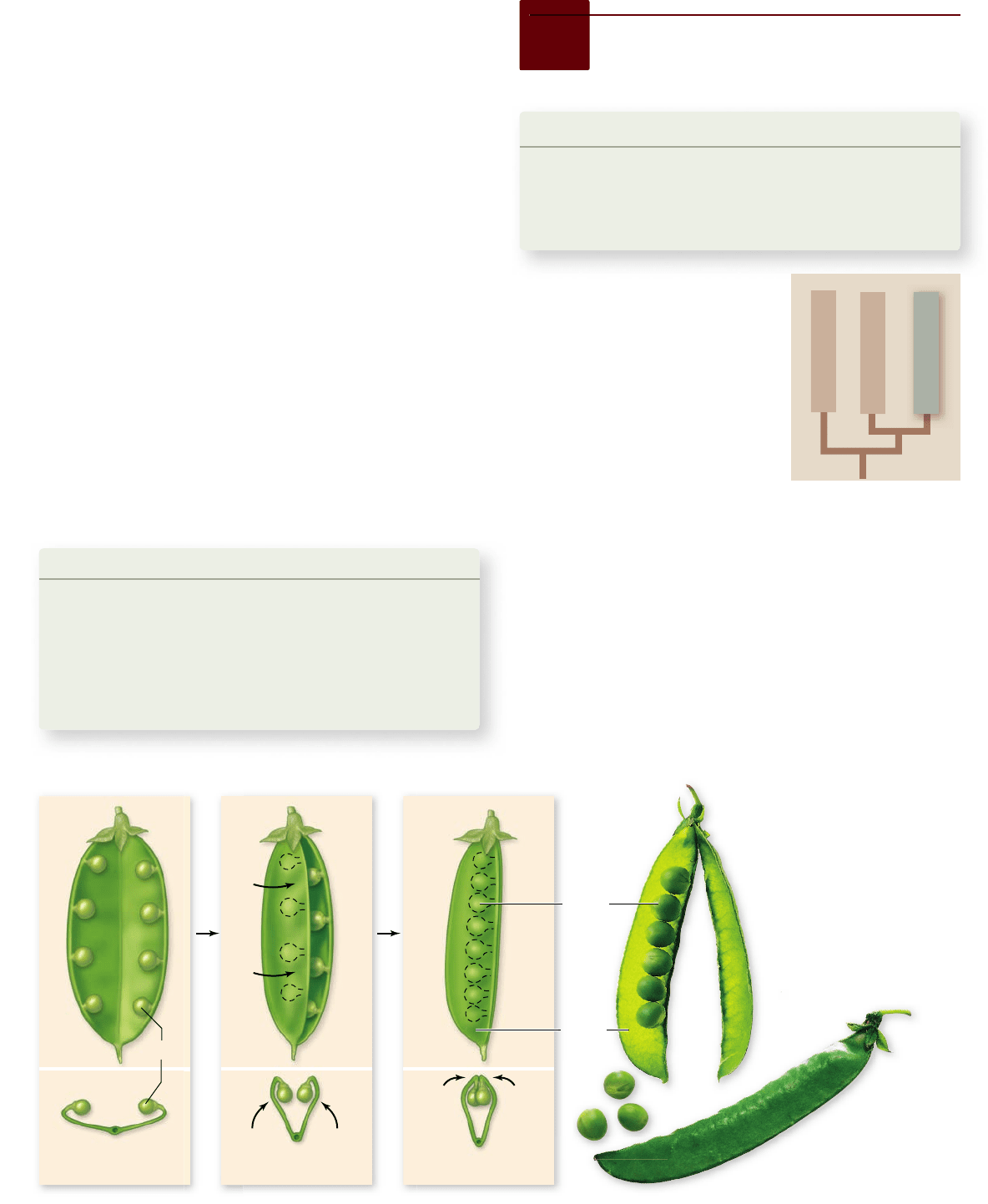
tion. The carpel, a modified leaf that
encapsulates seeds, develops into the
fruit, a unique angiosperm feature
(figure 30.25). Although some gym-
nosperms, including the yew (Taxus
spp.), have fleshlike tissue around
their seeds, it is of a different origin and not a true fruit.
Angiosperm origins are a mystery
The origins of the angiosperms puzzled even Darwin (he re-
ferred to their origin as an “abominable mystery”). Recent fos-
sil pollen and plants accompanied by molecular sequence data
have provided exciting clues about basal angiosperms, indicat-
ing origins as early as 145 to 208 mya.
In the remote Liaoning province of China, a complete
angiosperm fossil that is at least 125 million years old has been
found (figure 30.26) . The fossil may represent a new, basal, and
Figure 30.25
Evolution of fruit. Unlike
gymnosperms, the ovule of
angiosperms is surrounded
by diploid tissue derived
from leaves. This tissue is
called the carpel and
develops into the fruit. The
leaf origins of carpels are
still visible in the pea pod.
606
part
V
Diversity of Life on Earth
rav32223_ch30_588-613.indd 606rav32223_ch30_588-613.indd 606 11/13/09 12:06:59 PM11/13/09 12:06:59 PM
Apago PDF Enhancer
Fruits
Paired
stamens
carpel
petal
sepal
Archaefructus
(extinct)
Amborella Waterlillies Star anis Magnoliids Monocots
Angiosperms
Eudicots Ginkgo Conifers Gnetophytes Cycads
Gymnosperms
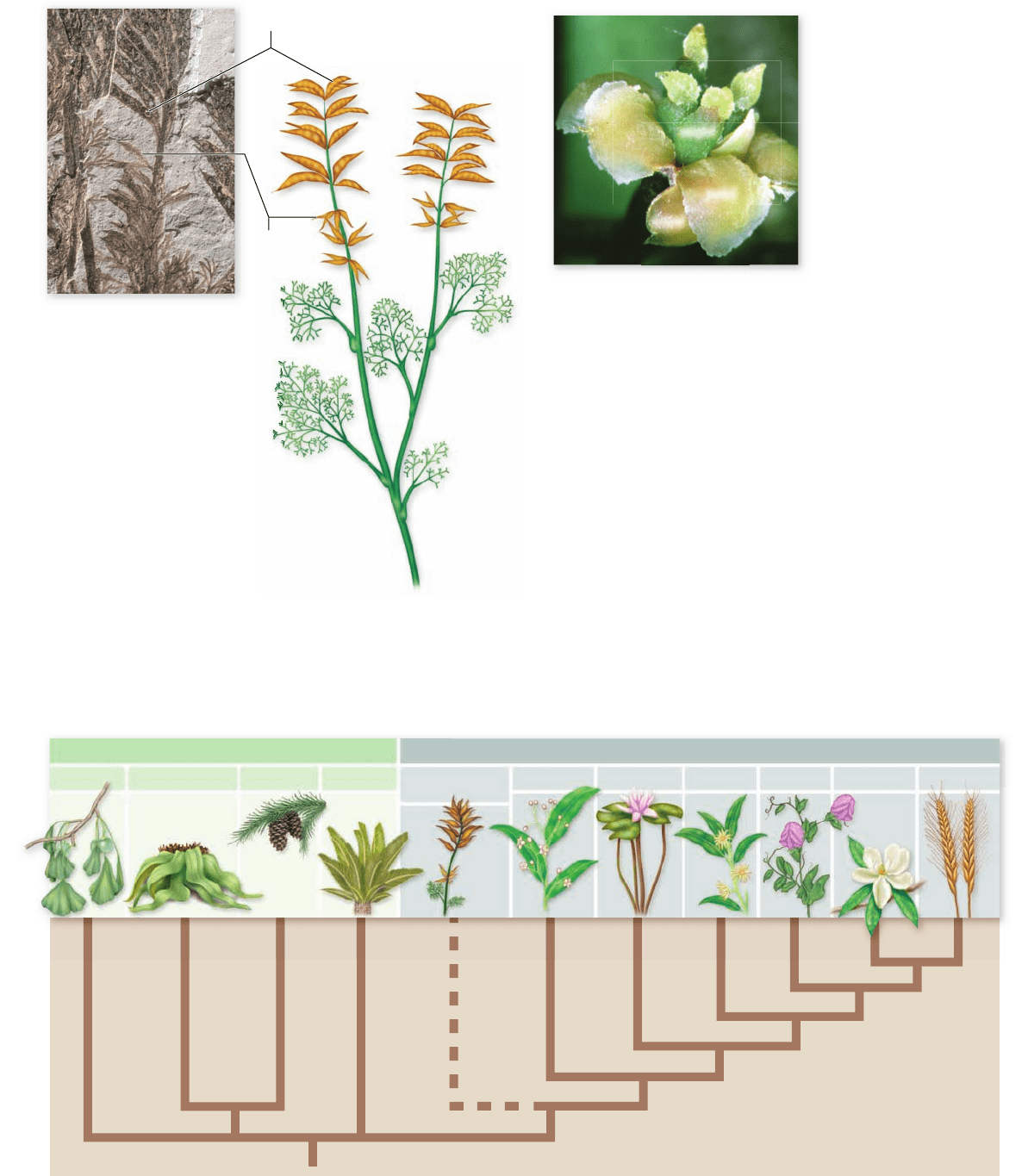
extinct angiosperm family, Archaefructaceae, with two species:
Archaefructus liaoningensis and A. sinensis. Archaefructus was an
herbaceous, aquatic plant. This family is proposed to be the
sister clade to all other angiosperms, but there is a lively debate
about the validity of this claim.
Archaefructus fossils have both male and female reproduc-
tive structures; however, they lack the sepals and petals that
evolved in later angiosperms to attract pollinators. The fossils
were so well preserved that fossil pollen could be examined us-
ing scanning electron microscopy. Although Archaefructus is
ancient, it is unlikely to be the very first angiosperm. Still, the
incredibly well-preserved fossils provide valuable detail on an-
giosperms in the Upper Jurassic to Lower Cretaceous period,
when dinosaurs roamed the Earth.
Consensus has also been growing on the most basal living
angiosperm—Amborella trichopoda (figure 30.27) . Amborella, with
small, cream-colored flowers, is even more primitive than water
lilies. This small shrub, found only on the island of New Caledo-
nia in the South Pacific, is the last remaining species of the earli-
est extant lineage of the angiosperms that arose about 135 mya.
Although Amborella is not the original angiosperm, it is
sufficiently close that studying its reproductive biology may
help us understand the early radiation of the angiosperms. The
angiosperm phylogeny reflects an evolutionary hypothesis that
is driving new research on angiosperm origins (figure 30.28).
Figure 30.26
Fossil
of basal angiosperm.
Archaefructus fossil with
multiseeded carpels (fruits)
and stamens. This is the
oldest known angiosperm in
the fossil record, estimated
to be between 122 and
145 million years.
Figure 30.27
An ancient living
angiosperm, Amborella
trichopoda. This plant is
believed to be the closest
living relative to the
original angiosperm.
Figure 30.28
Archaefructus may be the sister clade to all other angiosperms. All members of the Archaefructus lineage are
extinct, leaving Amborella as the most basal, living angiosperm. Gymnosperms species labels are shaded green.
chapter
30
Green Plants
607www.ravenbiology.com
rav32223_ch30_588-613.indd 607rav32223_ch30_588-613.indd 607 11/13/09 12:07:01 PM11/13/09 12:07:01 PM
Apago PDF Enhancer
Ovary wall
Petal
Sepal
Receptacle
Ovary
Pedicel
Megaspore
mother cell
Nucellus
Integuments
Micropyle
Stalk of ovule (funiculus)
Anther
Filament
Stamen
Stigma
Style
Ovule
Carpel
a. b.
Flowers house the gametophyte
generation of angiosperms
Flowers are considered to be modified stems bearing modified
leaves. Regardless of their size and shape, they all share certain
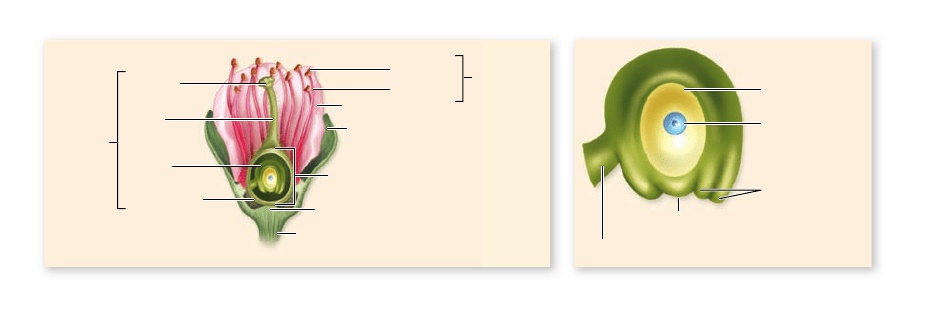
features (figure 30.29) . Each flower originates as a primordium
that develops into a bud at the end of a stalk called a pedicel.
The pedicel expands slightly at the tip to form the receptacle,
to which the remaining flower parts are attached.
Flower morphology
The other flower parts typically are attached in circles called
whorls. The outermost whorl is composed of sepals. Most flowers
have three to five sepals, which are green and somewhat leaflike.
The next whorl consists of petals that are often colored, attracting
pollinators such as insects, birds, and some small mammals . The
petals, which also commonly number three to five, may be separate,
fused together, or missing altogether in wind-pollinated flowers.
The third whorl consists of stamens and is collectively
called the androecium . This whorl is where the male gameto-
phytes, pollen, are produced. Each stamen consists of a pollen-
bearing anther and a stalk called a filament, which may be
missing in some flowers.
At the center of the flower is the fourth whorl, the
gynoecium, where the small female gametophytes are housed;
the gynoecium consists of one or more carpels. The first carpel
is believed to have been formed from a leaflike structure with
ovules along its margins. Primitive flowers can have several to
many separate carpels, but in most flowers, two to several car-
pels are fused together. Such fusion can be seen in an orange
sliced in half; each segment represents one carpel.
Structure of the carpel
A carpel has three major regions (see figure 30.29a). The ovary
is the swollen base, which contains from one to hundreds of
ovules; the ovary later develops into a fruit. The tip of the car-
pel is called a stigma. Most stigmas are sticky or feathery, caus-
ing pollen grains that land on them to adhere. Typically, a neck
or stalk called a style connects the stigma and the ovary; in
some flowers, the style may be very short or even missing.
Many flowers have nectar-secreting glands called nec tar-
ies, often located toward the base of the ovary. Nectar is a fluid
containing sugars, amino acids, and other molecules that at-
tracts insects, birds, and other animals to flowers.
Most species use owers to attract
pollinators and reproduce
Eudicots (about 175,000 species) include the great majority
of familiar angiosperms—almost all kinds of trees and shrubs,
snapdragons, mints, peas, sunflowers, and other plants.
Monocots (about 65,000 species) include the lilies, grasses,
cattails, palms, agaves, yuccas, orchids, and irises and share a
common ancestor with the eudicots ( see figure 30.28) . Some
of the monocots, including maize, rely on wind rather than
pollinators to reproduce.
The angiosperm life cycle
includes double fertilization
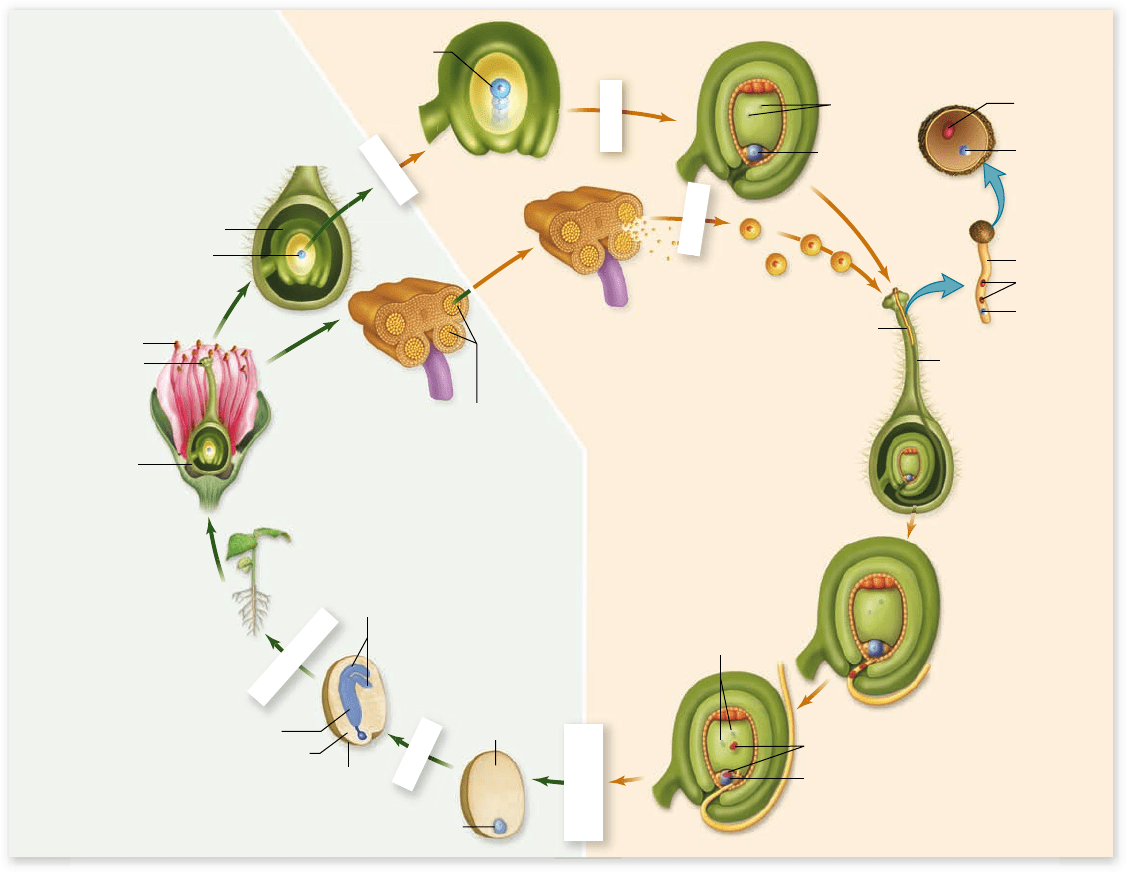
During development of a flower bud, a single megaspore
mother cell in the ovule undergoes meiosis, producing four
mega spores (figure 30.30 ). In most flowering plants, three of
the megaspores soon disappear; the nucleus of the remaining
mega spore divides mitotically, and the cell slowly expands un-
til it becomes many times its original size.
The female gametophyte
While the expansion of the megaspore is occurring, each of the
daughter nuclei divides twice, resulting in eight haploid nuclei
arranged in two groups of four. At the same time, two layers of
the ovule, the integuments, differentiate and become the seed
coat of a seed. The integuments, as they develop, form the
micropyle, a small gap or pore at one end that was described
earlier (see figure 30.29b).
One nucleus from each group of four migrates toward the
center, where they function as polar nuclei. Polar nuclei may
fuse together, forming a single diploid nucleus, or they may
form a single cell with two haploid nuclei. Cell walls also form
around the remaining nuclei. In the group closest to the micro-
pyle, one cell functions as the egg; the other two nuclei are
called synergids. At the other end, the three cells are now called
antipodals; they have no apparent function and eventually break
down and disappear.
The large sac with eight nuclei in seven cells is called an
embryo sac; it constitutes the female gametophyte. Although
it is completely dependent on the sporophyte for nutrition, it is
a multicellular, haploid individual.
Figure 30.29
Diagram
of an angiosperm ower.
a. The main structures of the
ower are labeled. b. Details
of an ovule. The ovary as it
matures will become a fruit;
as the ovule’s outer layers
(integuments) mature, they
will become a seed coat.
608
part
V
Diversity of Life on Earth
rav32223_ch30_588-613.indd 608rav32223_ch30_588-613.indd 608 11/13/09 12:07:04 PM11/13/09 12:07:04 PM
Apago PDF Enhancer
DOUBLE
FERTILIZATION
GERMINATION
Generative
cell
Formation of
pollen tube (n)
Tube
nucleus
Tube
nucleus
Sperm
Style
Sperm
Egg
Polar
nuclei
Polar
nuclei
Seed
coat
Zygote
Embryo (2n)
Cotyledons
Seed (2n)
Endosperm (3n)
Endosperm
Young
sporophyte (2n)
Adult sporophyte
with flower (2n)
Anther
Ovary
Stigma
Anther (2n)
Microspore
mother cells (2n)
Pollen (n)
Megaspore (n)
Pollen tube
Megaspore
mother cell (2n)
Ovule
Egg
MITOSIS
MITOSIS
MITOSIS
MEIOSIS
n
2n
Pollen production
While the female gametophyte is developing, a similar but less
complex process takes place in the anthers (see figure 30.30) . Most
anthers have patches of tissue (usually four) that eventually become
chambers lined with nutritive cells. The tissue in each patch is com-
posed of many diploid microspore mother cells that undergo meio-
sis more or less simultaneously, each producing four microspores.
The four microspores at first remain together as a quartet, or
tetrad, and the nucleus of each microspore divides once; in most spe-
cies, the microspores of each quartet then separate. At the same
time, a two-layered wall develops around each microspore. As the
microspore-containing anther continues to mature, the wall between
adjacent pairs of chambers breaks down, leaving two larger sacs. At
this point, the binucleate microspores have become pollen grains.
The outer pollen grain wall layer often becomes beautifully
sculptured, and it contains chemicals that may react with others in
a stigma to signal whether development of the male gametophyte
should proceed to completion. The pollen grain has areas called
apertures, through which a pollen tube may later emerge.
Pollination and the male gametophyte
Pollination is simply the mechanical transfer of pollen from its
source (an anther) to a receptive area (the stigma of a flowering
plant). Most pollination takes place between flowers of different
plants and is brought about by insects, wind, water, gravity, bats, and
other animals. In as many as one-quarter of all angiosperms, how-
ever, a pollen grain may be deposited directly on the stigma of its
own flower, and self-pollination occurs. Pollination may or may not
be followed by fertilization, depending on the genetic compatibility
of the pollen grain and the flower on whose stigma it has landed.
If the stigma is receptive, the pollen grain’s dense cyto-
plasm absorbs substances from the stigma and bulges through
an aperture. The bulge develops into a pollen tube that re-
sponds to chemical and mechanical stimuli that guide it to the
embryo sac. It follows a diffusion gradient of the chemicals and
grows down through the style and into the micropyle. The pol-
len tube usually takes several hours to two days to reach the
micropyle, but in a few instances, the journey may take up to a
year. Pollen tube growth is more rapid in angiosperms than
Figure 30.30
Life cycle of a typical angiosperm. As in pines, external water is no longer required for fertilization. In most species of
angiosperms, animals carry pollen to the carpel. The outer wall of the carpel forms the fruit, which often entices animals to disperse the seed.
chapter
30
Green Plants
609www.ravenbiology.com
rav32223_ch30_588-613.indd 609rav32223_ch30_588-613.indd 609 11/13/09 12:07:05 PM11/13/09 12:07:05 PM
Apago PDF Enhancer
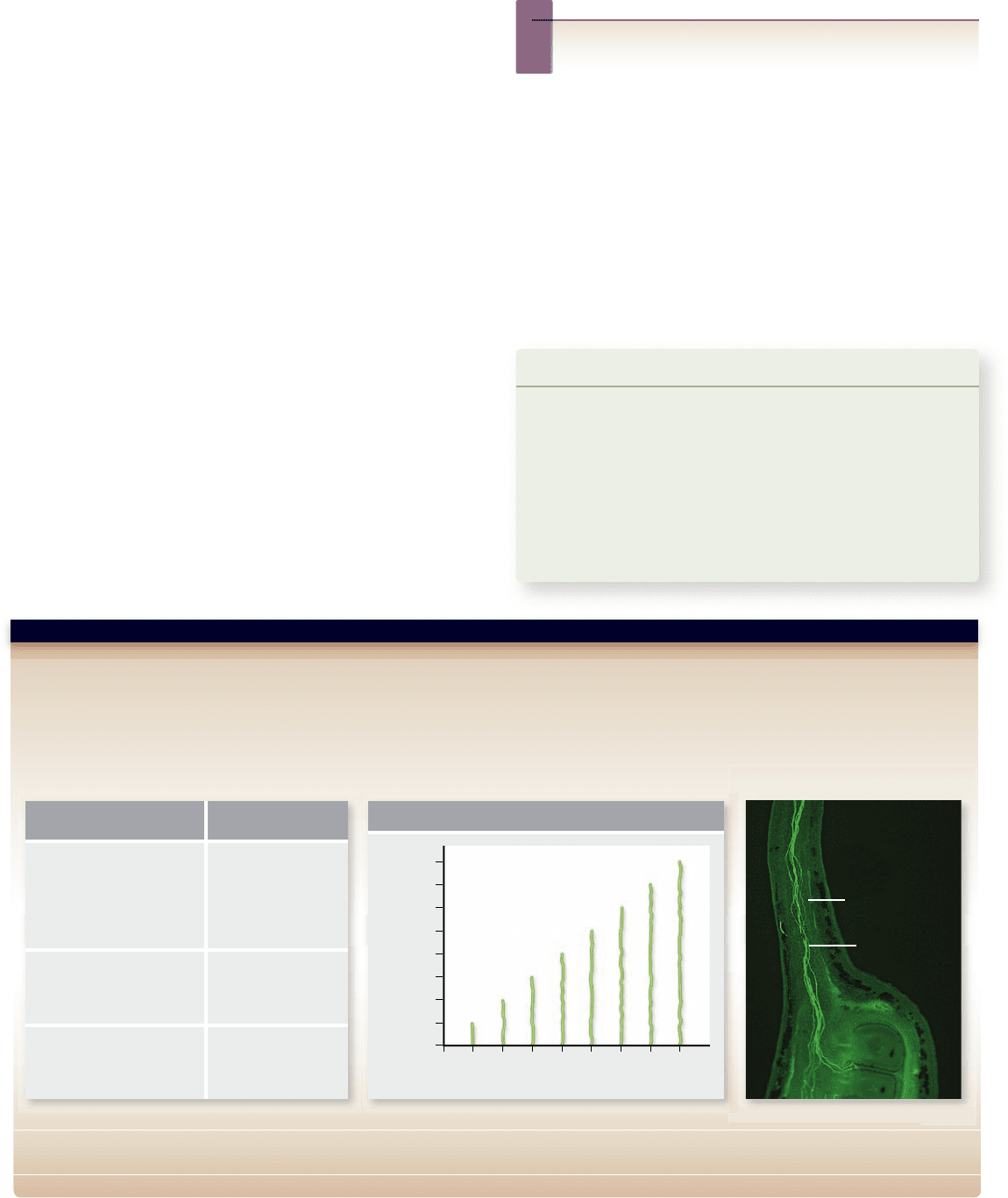
Hypothesis: An increase in pollen tube growth accompanied angiosperm origins.
Prediction: The time from pollination to fertilization will be greater in gymnosperms than angiosperms that are sister to the ancestral angiosperm and also
more derived angiosperms.
Test: Pollinate three angiosperm species, including Amborella, that are most closely related to the rst angiosperm. At dierent time intervals, cut sections of
the carpel and observe pollen tube position under a uorescent microscope. Calculate and compare the rate of pollen tube growth with results published for
gymnosperms and more derived angiosperms.
Conclusion: An increase in pollen tube growth rate is found in angiosperms most closely related to the ancestral angiosperm, supporting the hypothesis.
Further Experiments: Develop a hypothesis to explain the dierence in pollen tube growth rates among the tested angiosperms. Is there a correlation
between the distance a pollen tube must travel to fertilize an egg and the rate of growth? How could you test your hypothesis?
SCI ENTI FIC THINKING
Species
Pollen Tube Growth
Rate (mm/hour)
Close relatives of
ancestral angiosperm
Derived angiosperms
Gymnosperms
Amborella tr
ichopoda 80
589
271
900
10,000
6
0.31
Nuphar polysepala
Austrobaileya scandens
Gnetum gnemon
Ginkgo biloba
Petunia inflata
Zea mays (maize)
ti th h th i
Hours after pollination
0
0
1
80
160
240
320
400
480
560
640
2345678
Length of pollen tube (µm)
Pollen Tube Growth Rate of Amborella trichopoda
Style
Ovule
Pollen tubes
gymnosperms. Rapid pollen tube growth rate is an innovation
that is believed to have preceded fruit development and been
essential in the origins of angiosperms (see figure 30.31 )
One of the pollen grain’s two cells, the generative cell, lags
behind. Its nucleus divides in the pollen grain or in the pollen
tube, producing two sperm cells. Unlike sperm in mosses, ferns,
and some gymnosperms, the sperm of flowering plants have no
flagella. At this point, the pollen grain with its tube and sperm
has become a mature male gametophyte.
Double fertilization and seed production
As the pollen tube enters the embryo sac, it destroys a synergid in
the process and then discharges its contents. Both sperm are func-
tional, and an event called double fertilization follows. One sperm
unites with the egg and forms a zygote, which develops into an
embryo sporophyte plant. The other sperm and the two polar nu-
clei unite, forming a triploid primary endosperm nucleus.
The primary endosperm nucleus begins dividing rapidly and
repeatedly, becoming triploid endosperm tissue that may soon con-
sist of thousands of cells. Endosperm tissue can become an exten-
sive part of the seed in grasses such as corn, and it provides nutrients
for the embryo in most flowering plants (see figure 37.11) .
Until recently, the nutritional, triploid endosperm was be-
lieved to be the ancestral state in angiosperms. A recent analysis
of extant, basal angiosperms revealed that diploid endosperms
were also common. The female gametophyte in these species has
four, not eight nuclei. At the moment, it is unclear whether dip-
loid or triploid endosperms are the most primitive.
Inquiry question
?
If the endosperm failed to develop in a seed, how do you
think the fitness of that seed’s embryo would be affected?
Explain your answer.
Germination and growth of the sporophyte
As mentioned earlier, a seed may remain dormant for many
years, depending on the species. When environmental condi-
tions become favorable, the seed undergoes germination, and
the young sporophyte plant emerges. Again depending on the
species, the sporophyte may grow and develop for many years
before becoming capable of reproduction, or it may quickly
grow and produce flowers in a single growing season.
We present a more detailed description of reproduction
in plants in chapter 42 .
Learning Outcomes Review 30.9
Angiosperms are characterized by ovules that at pollination are enclosed
within an ovary at the base of a carpel, a structure unique to the phylum;
a fruit develops from the ovary. Evolutionary innovations of angiosperms
include fl owers to attract pollinators, fruits to protect embryos and aid in
their dispersal, and double fertilization, which provides endosperm to help
nourish the embryo.
■ What advantage does an angiosperm gain by
producing a fruit that animals eat?
Figure 30.31
Rapid pollen tube growth accompanied the origin of angiosperms.
610
part
V
Diversity of Life on Earth
rav32223_ch30_588-613.indd 610rav32223_ch30_588-613.indd 610 11/13/09 12:07:06 PM11/13/09 12:07:06 PM

Apago PDF Enhancer
30.4 Tracheophyte Plants: Roots, Stems,
and Leaves
(see table 30.1)
Vascular tissue allows for distribution of nutrients.
The evolution of tracheids allowed more ef
cient vascular systems to
develop. This vascular tissue develops in the sporophyte.
Vascular plants have a much reduced gametophyte.
Tracheophytes include seven extant phyla grouped in three clades.
The vascular plants found today exist in three clades: lycophytes,
pterophytes, and seed plants.
Stems evolved prior to roots.
Roots provide structural support and transport capability.
Leaves evolved more than once.
Lycophytes have small leaves called lycophylls that lack
vascularization.
True leaves (euphylls) are found only in ferns and seed plants and
have origins different from lycophylls.
Seeds are another innovation in some phyla.
Seeds are resistant structures that protect the embryo from desication
and to some extent from predators.
30.5 Lycophytes: Dominant Sporophyte
Generation and Vascular Tissue
Lycophyte ancestors were the earliest vascular plants and were
among the rst plants to have a dominant sporophyte generation.
30.6 Pterophytes: Ferns and Their Relatives
(see gure 30.17)
Ancestors of the pterophytes gave rise to two clades: one line of ferns
and horsetails,
and a second line of ferns and whisk ferns.
Pterophytes require water for fertilization and are seedless.
Whisk ferns lost their roots and leaves secondarily.
The sporophyte of a whisk fern consists of evenly forking green
stems without roots.
Horsetails have jointed stems with brushlike leaves.
Scalelike leaves of horsetail sporophytes emerge in a whorl. The
stems have silica deposits in epidermal cells of their ribs.
Ferns have fronds that bear sori.
The leaves of ferns, called fronds, develop as tightly rolled coils that
unwind to expand. Sporangia called sori develop on the underside
of the fronds. The gametophyte is often heart shaped and can live
independently.
30.7 The Evolution of Seed Plants
The seed protects the embryo.
An extra layer of sporophyte tissue surrounds the embryo, creating
the ovule, which later hardens. The seed protects the embryo, helps it
resist drying out, and allows a dormant stage that pauses the life cycle
until environmental conditions are favorable.
A pollen grain is the male gametophyte.
The gametophytes of seed plants consist of only a few cells. Pollen
grains are male gametophytes; each pollen grain contains sperm
cells. Water is not required for fertilization.The female gametophyte
develops within an ovule that forms the seed.
30.1 De ning Plants
Land plants evolved from freshwater algae.
All green plants arose from a single freshwater green algal species (see
gure 30.1). The charophytes are the sister clade of the land plants.
Green algae and the land plants are placed in the kingdom Viridiplantae.
Land plants have adapted to terrestrial life.
Land plants have two major characteristics: protected embryos and
multicellular haploid and diploid phases. A waxy cuticle, stomata, and
specialized cells for transport of water and minerals enhance survival.
Most multicellular Viridiplantae have haplodiplontic life cycles.
Plants have a haplodiplontic life cycle with multicellular diploid
sporophytes and haploid gametophytes (see gure 30.2).
The haplodiplontic cycle produces alternation of generations.
The relative sizes of haploid and diploid generations vary.
As some plants became more complex, the sporophyte stage became
the dominant phase.
30.2 Chlorophytes and Charophytes: Green Algae
(see gure 30.5)
The chlorophytes gave rise to aquatic algae; the streptophytes
include the group that gave rise to land plants.
Chloroph
ytes can be unicellular.
Unicellular chlorophytes include Chlamydomonas, which has two
agella, and Chlorella, which has no agella and reproduces asexually.
Colonial chlorophytes have some cell specialization.
Volvox is an example of a colonial green alga; some cells specialize for
producing gametes or for asexual reproduction.
Multicellular chlorophytes can have haplodiplontic life cycles.
Ulva has sporophyte and gametophyte generations; however, the
chlorophytes did not give rise to land plants.
Charophytes are the closest relatives to land plants.
Both candidate Streptophyta clades—Charales and Coleochaetales—
exhibit plasmodesmata, cytoplasmic links between cells. They also
undergo mitosis and cytokinesis like terrestrial plants.
30.3 Bryophytes: Dominant
Gametophyte Generation
Bryophytes are unspecialized but successful in many environments.
Bryophytes consist of three distinct clades: liverworts, mosses, and
hornworts. Bryophytes do not have true roots or tracheids, but do
have conducting cells for movement of water and nutrients.
In liverworts and mosses, the nonphotosynthetic sporophyte is
nutritionally dependent on the gametophyte.
Liverworts are an ancient phylum.
The gametophyte of some liverworts is attened and has lobes that
resemble those of the liver. They produce upright structures that
contain the gametangia.
Mosses have rhizoids and water-conducting tissue.
Mosses exhibit alternation of generations and have widespread
distribution. Many are able to withstand droughts.
Hornworts developed stomata.
Stomata in the sporophyte can open and close to regulate gas
exchange. The sporophyte is also photosynthetic.
Chapter Review
chapter
30
Green Plants
611www.ravenbiology.com
rav32223_ch30_588-613.indd 611rav32223_ch30_588-613.indd 611 11/13/09 12:07:12 PM11/13/09 12:07:12 PM