
Raven P.H., Johnson G.B., Mason K.A. Biology (Ninth Edition)
Подождите немного. Документ загружается.

Apago PDF Enhancer
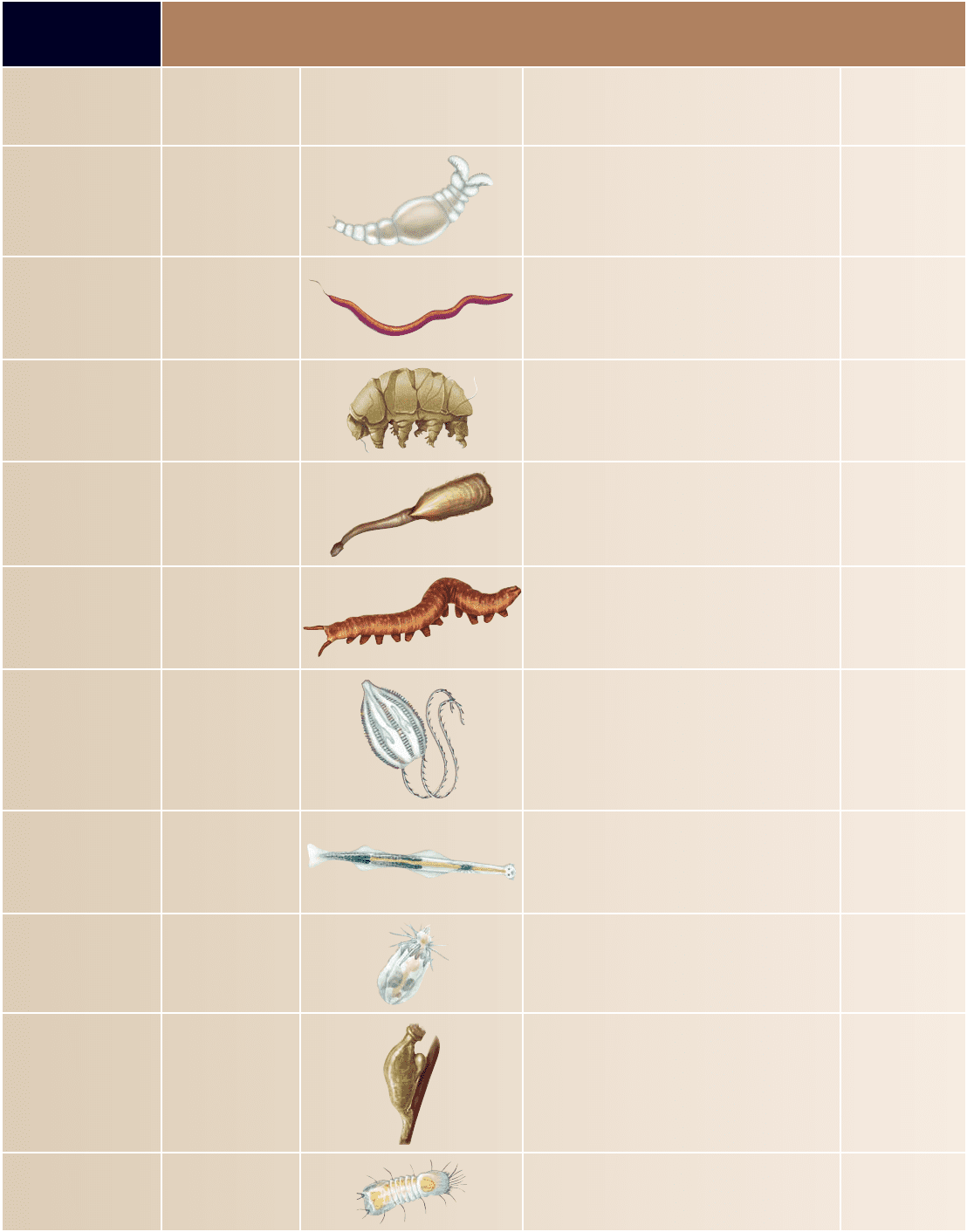
TABLE 32.3
Some Important Animal Phyla with Fewer Species—and Three Recently
Discovered Ones
Phylum Typical Examples Key Characteristics
Approximate
Number of
Named Species
Rotifera (wheel animals) Rotifers Small pseudocoelomates with a complete digestive tract
including a set of complex jaws. Cilia at the anterior end beat
so they resemble a revolving wheel. Some are very important
in marine and freshwater habitats as food for predators such
as shes.
2000
Nemertea (ribbon worms)
(also called Rhynchocoela)
Lineus
Protostome worms notable for their fragility—when
disturbed, they fragment in pieces. Long, extensible
proboscis occupies a coelomic space; that of some tipped by
a spearlike stylet. Most marine, but some live in fresh water,
and a few are terrestrial.
900
Tardigrada (water bears) Hypsibius
Microscopic protostomes with ve body segments and four
pairs of clawed legs. An individual lives a week or less but
can enter a state of suspended animation (“cryptobiosis”)
in which it can survive for many decades. Occupy marine,
freshwater, and terrestrial habitats.
800
Brachiopoda
(lamp shells)
Lingula
Protostomous animals encased in two shells that are
oriented with respect to the body di erently than in bivalved
mollusks. A ring of ciliated tentacles (lophophore) surrounds
the mouth. More than 30,000 fossil species are known.
300
Onychophora
(velvet worms)
Peripatus
Segmented protostomous worms resembling tardigrades;
with a chitinous soft exoskeleton and unsegmented
appendages. Related to arthropods. The only exclusively
terrestrial phylum, but what are interpreted as their
Cambrian ancestors were marine.
110
Ctenophora
(sea walnuts)
Comb jellies, sea
walnuts
Gelatinous, almost transparent, often bioluminescent marine
animals; eight bands of cilia; largest animals that use cilia for
locomotion; complete digestive tract with anal pore.
100
Chaetognatha
(arrow worms)
Sagitta
Small, bilaterally symmetrical, transparent marine worms
with a n along each side, powerful bristly jaws, and lateral
nerve cords. Some inject toxin into prey and some have large
eyes. It is uncertain if they are coelomates, and, if so, whether
protostomes or deuterostomes.
100
Loricifera
(loriciferans)
Nanaloricus mysticus
Tiny marine pseudocoelomates that live in spaces between
grains of sand. The mouth is borne on the tip of a exible
tube. Discovered in 1983.
10
Cycliophora (cycliophorans) Symbion
Microscopic animals that live on mouthparts of claw lobsters.
Discovered in 1995.
3
Micrognathozoa
(micrognathozoans)
Limnognathia
Microscopic animals with complicated jaws. Discovered in
2000 in Greenland.
1
642
part
V
Diversity of Life on Earth
rav32223_ch32_633-648.indd 642rav32223_ch32_633-648.indd 642 11/13/09 1:35:33 PM11/13/09 1:35:33 PM
Apago PDF Enhancer
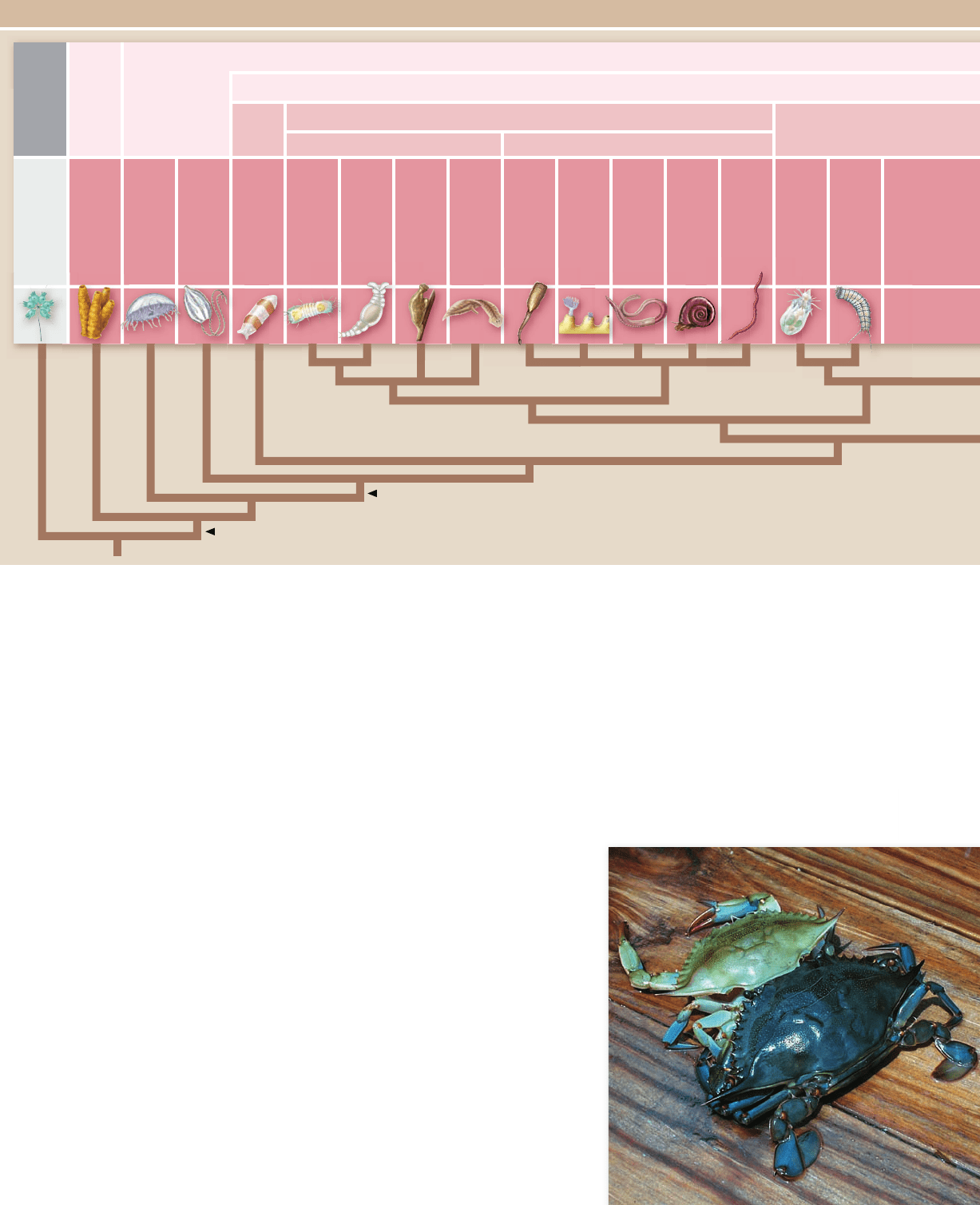
Morphology- and molecule-based phylogenies
agree on many major groupings
Although they differ from one another in some respects, phy-
logenies incorporating molecular data or based entirely on
them share some deep structure with the traditional animal
tree of life. Figure 32.4 is a summary of animal phylogeny
developed from morphological, molecular, life-history, and
other types of relevant data. Some aspects of this view have
been contradicted by studies based on particular characters or
using particular analytical methods. It is an exciting time to be
a systematist, but shifts in understanding of relationships
among groups of animals can be frustrating to some! Like any
scientific idea, a phylogeny is a hypothesis, open to challenge
and to being revised in light of additional data.
One consistent result is that Porifera (sponges) consti-
tutes a monophyletic group that shares a common ancestor
with other animals. Some systematists had considered sponges
to comprise two (or three) groups that are not particularly
closely related, but molecular data support what had been the
majority view, that phylum Porifera is monophyletic. And, as
mentioned earlier, all animals are found to be monophyletic.
Among eumetazoans, molecular data are in accord with
the traditional view that cnidarians (hydras, sea jellies, and cor-
als) branch off the tree before the origin of animals with bilat-
eral symmetry. Our understanding of the phylogeny of the
deuterostome branch of Bilateria (discussed in chapter 34 ) has
not changed much, but our understanding of the phylogeny of
protostomes has been altered by molecular data.
Most revolutionary is that annelids and arthropods, which
had been considered closely related based on the occurrence of
segmentation in both, belong to separate clades. Now arthro-
pods are grouped with protostomes that molt their cuticles at
least once during their life. These are termed ecdysozoans,
which means “molting animals” (see chapter 34) . Molecular se-
quence data can help test our ideas of which morphological fea-
tures reveal evolutionary relationships best; in this case,
molecular data allowed us to see that, contrary to our hypoth-
esis, segmentation seems to have evolved convergently, but
molting did not.
But not all features are easy to diagnose, and molecular
data do not resolve all uncertainties. The enigmatic phylum
Ctenophora (comb jellies)—pronounced with a silent C—has
been considered both diploblastic and triploblastic and has
been thought to have both a complete gut and a blind gut.
Likewise the enigmatic phylum Chaetognatha (arrow worms)
has been considered both coelomate and pseudocoelomate, and
if coelomate, both protostome and deuterostome (as reflected
in figure 32.4). Their placement in phylogenies varies, seeming
to depend on the features and methods used to construct the
tree. Further research is needed to resolve these uncertainties.
Molecular data are contributing to our understanding of
relationships among animal phyla. Animals are monophyletic,
as are sponges—relationships that were uncertain using only
morphological data. Molecular data confirm that cnidarians
branched off from the rest of animals before bilaterial symme-
try evolved. Although the position of ctenophores has not been
resolved, molecular data have significantly altered some ideas
of protostome evolution.
Morphology-based phylogeny
focused on the state of the coelom
In the morphology-based animal family tree, bilaterally sym-
metrical animals comprised three major branches. If the body
has no cavity (other than the gut), the animal is said to be acoe-
lomate; members of phylum Platyhelminthes are acoelomates.
A body cavity not lined with tissue derived from meso-
derm is a pseudocoelom; members of the phylum Nematoda
are pseudocoelomate. A body cavity lined with tissue derived
from mesoderm is a coelom; we and members of the phylum
Annelida are coelomate. All acoelomates and pseudocoelomates
are protostomes; some coelomates are protostomes and some
are deuterostomes.
Protostomes consist of
spiralians and ecdysozoans
Two major clades of protostomes are recognized as having
evolved independently since ancient times: the spiralians and
the ecdysozoans (see figure 32.4).
Spiralia
Spiralian animals grow by gradual addition of mass to the body.
Most live in water, and propel themselves through it using cilia
or contractions of the body musculature. Spiralians undergo
spiral cleavage (see figure 32.3).
There are two main groups of spiralians: Lophotrochozoa
and Platyzoa. Lophotrochozoa includes most coelomate pro-
tostome phyla; those animals move by muscular contractions.
Most platyzoans are acoelomates; these animals are tiny or flat,
and move by ciliary action. Some platyzoans (such as rotifers,
gnathostomulids, and the recently discovered phylum Micro-
gnathozoa have a set of complicated jaws. The most prominent
group is phylum Platyhelminthes; a flatworm has a simple body
with no circulatory or respiratory system but a complex repro-
ductive system. This group includes marine and freshwater pla-
narians as well as the parasitic flukes and tapeworms.
Lophotrochozoa consists of two major phyla and several
smaller ones. Many of the animals have a type of free-living
larva known as a trochophore, and some have a feeding struc-
ture termed a lophophore, a horseshoe-shaped crown of cili-
ated tentacles around the mouth used in filter-feeding. The
phyla characterized by a lophophore are Bryozoa and Brachio-
poda. Lophophorate animals are sessile (anchored in place).
Among the lophotrochozoans with a trochophore are
phyla Mollusca and Annelida. Mollusks are unsegmented, and
their coelom is reduced to a hemocoel (open circulatory space)
and some other small body spaces. This phylum includes ani-
mals as diverse as octopuses, snails, and clams. Annelids are
segmented coelomate worms, the most familiar of which is
the earthworm, but also includes leeches and the largely ma-
rine polychaetes.
chapter
32
Overview of Animal Diversity
643www.ravenbiology.com
rav32223_ch32_633-648.indd 643rav32223_ch32_633-648.indd 643 11/13/09 1:35:34 PM11/13/09 1:35:34 PM
Apago PDF Enhancer
Modern Phylogeny
Platyzoa
Parazoa
Lophotrochozoa
Spiralia
Eumetazoa
Nemertea
Loricifera
Kinorhyncha
Mollusca
Brachiopoda
Bryozoa
(Ectoprocta)
Annelida
Micrognathozoa
Rotifera
Cycliophora
Platyhelminthes
Acoelo-
morpha
Porifera
Choanoflagellates Protista
Metazoa
Ctenophora
Cnidaria
Acoela
Bilateria
Figure 32.5
Blue crab
undergoing
ecdysis (molting).
Members of
Ecdysozoa grow
step-wise because
their external
skeleton is rigid.
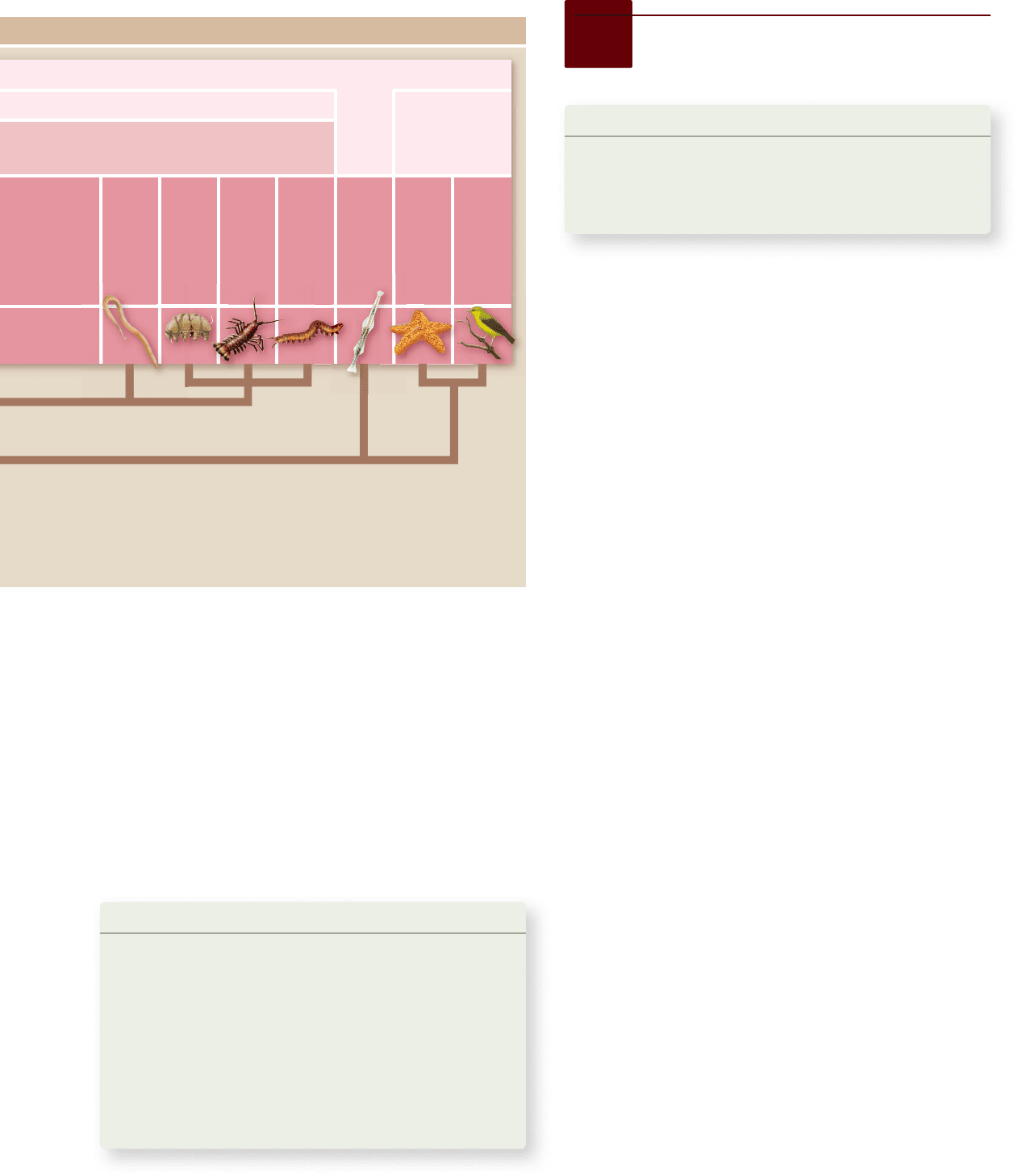
Figure 32.4
Proposed revision of the animal tree of life. A phylogeny of many of the 35–40 phyla re ects the consensus as of 2005
based on interpretation of anatomical and developmental data as well as results derived from molecular phylogenetic studies. Whether
Chaetognatha is a protostome or a deuterostome is unclear.
Ecdysozoa
The other major clade of protosomes is the Ecdysozoa. Ecdyso-
zoans are animals that molt, a phenomenon that seems to have
evolved only once in the animal kingdom. When an animal
grows large enough that it completely fills its hard external
skeleton, it must lose that skeleton (by molting, a process also
called ecdysis). While the animal grows, it forms a new exoskel-
eton underneath the existing one. The first step in molting is
for the body to swell until the existing exoskeleton cracks open
and is shed (figure 32.5) . Upon molting that skeleton, the ani-
mal inflates the soft, new one, expanding it using body fluids
(and, in many insects and spiders, air as well). When the new
one hardens, it is larger than the molted one had been and has
room for growth. Thus, rather than being continuous, as in
other animals, the growth of ecdysozoans is step-wise.
Of the numerous phyla of protostomes assigned to the
Ecdysozoa, Arthropoda contains the largest number of de-
scribed species of any phylum. Each phylum contains one of
the model organisms used in laboratory studies that have in-
formed much of our current understanding of genetics and de-
velopment: the fruit fly Drosophila melanogaster and the
roundworm Caenorhabditis elegans.
Arthropods are coelomate animals with jointed append-
ages and segmented external skeletons composed of chitin. Ar-
thropods include insects, spiders, crustaceans, and centipedes,
among many others. Arthropods have colonized almost all hab-
itats, being found from the ocean floor to the air and in all ter-
restrial and freshwater environments.
Roundworms are pseudocoelomate worms that lack cir-
culatory or gas exchange structures, and their bodies have only
longitudinal muscles. Nematodes inhabit marine, freshwater,
and terrestrial environments, and many species are parasitic in
644
part
V
Diversity of Life on Earth
rav32223_ch32_633-648.indd 644rav32223_ch32_633-648.indd 644 11/13/09 1:35:34 PM11/13/09 1:35:34 PM
Apago PDF Enhancer
Nematoda
Tardigrada
Chordata
Echinodermata
Chaetognatha
Onychophora
Arthropoda
Ecdysozoa
Deuterostomes
32.4
The Roots of the Animal
Tree of Life
Learning Outcomes
Explain the colonial flagellate hypothesis of metazoan 1.
origin and why it is now favored.
Describe the possible role of 2. Hox genes in the Cambrian
explosion.
Some of the most exciting contributions of molecular sys-
tematics are being made to our understanding of the base of
the animal family tree—the origins of the major clades
of animals.
Metazoans appear to have
evolved from colonial protists
The ancestor to all animals was presumably a protist (see
chapter 29), but it is not clear from which line of protists animals
evolved. Evidence is available to support two major hypotheses.
■ The multinucleate hypothesis is that metazoans arose
from a multinuclear protist similar to today’s ciliates.
Each nucleus became compartmentalized into a cell,
resulting in the multicellular condition.
■ The colonial flagellate hypothesis, first proposed by
Ernst Haeckel in 1874, is that metazoans descended from
colonial protists. Each colony is a hollow sphere composed
of flagellated cells. Some of the cells of sponges are
strikingly like those of choanoflagellate protists.
Molecular data based on ribosomal RNA sequences favor the
colonial flagellate hypothesis, and reject the multinucleate cili-
ate hypothesis based on evidence that metazoans are more
closely related to eukaryotic algae than to ciliates.
Molecular analysis may explain
the Cambrian explosion
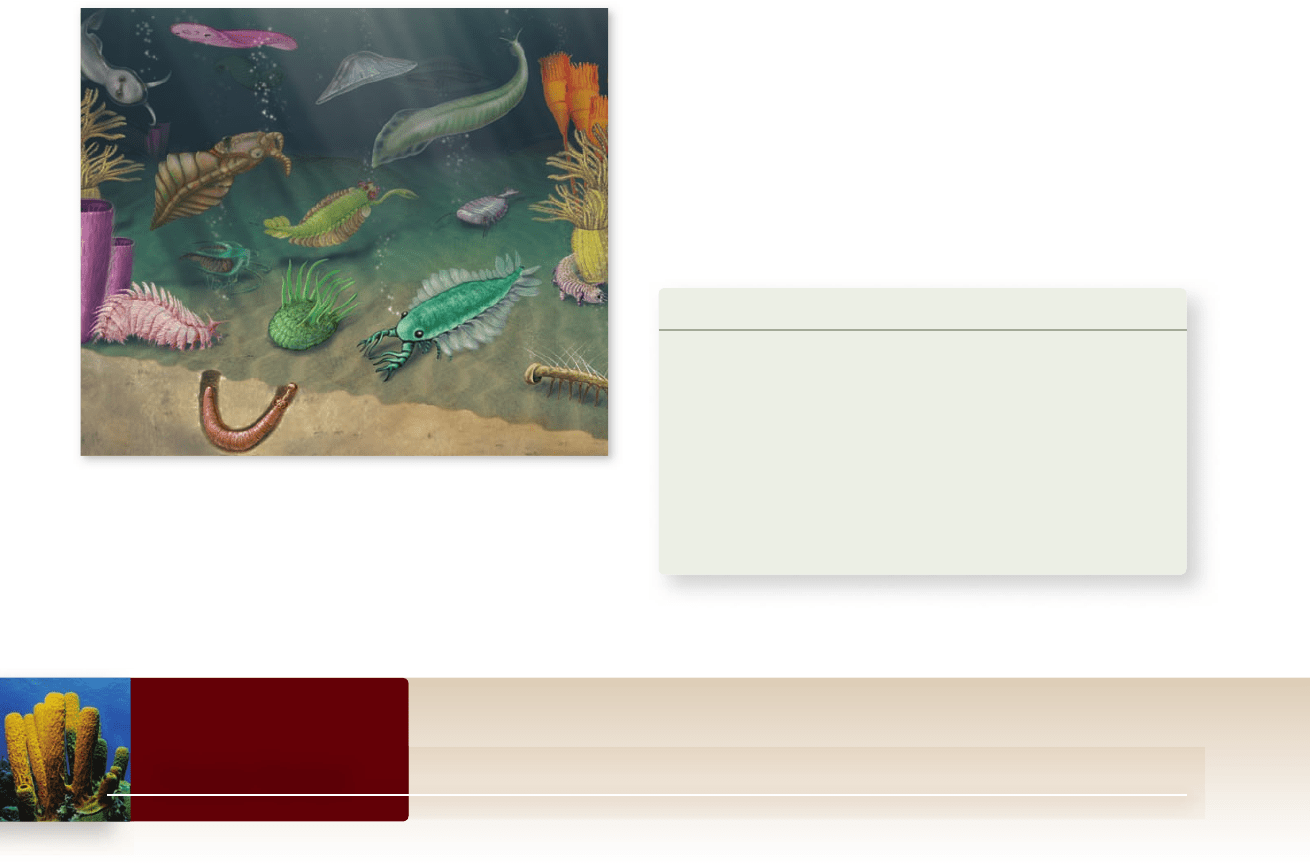
Most major animal body plans can be seen in fossils of Cam-
brian age, dating from 543 to 525 mya. Although fossil cnidar-
ians are found in rocks from the Ediacaran period, as old as
565 million years, along with what appear to be fossil mollusks
and the burrows of worms, the great diversity of animals evolved
quite rapidly in geological terms around the beginning of
the Cambrian period—an event known as the Cambrian
explosion. Biologists have long debated what caused this enor-
mous expansion of animal diversity (figure 32.6) . Many have
argued that the emergence of new body plans was biological—
the consequence of the evolution of predation, which encour-
aged an arms race between defenses, such as armor, and
innovations that improved mobility and hunting success. Oth-
ers have attributed the rapid diversification in body plans to
physical factors—such as the build-up of dissolved oxygen and
minerals in the oceans.
plants or animals. It is said that if everything in the world ex-
cept nematodes were to disappear, an outline of what had been
there would be visible in the remaining nematodes!
Deuterostomes include chordates
and echinoderms
Deuterostomes consist of fewer phyla and species than proto-
stomes, and are more uniform in many ways, despite great dif-
ferences in appearance. Echinoderms such as sea stars, and
chordates such as humans, share a mode of development that is
evidence of their evolution from a common ancestor, and sepa-
rates them clearly from other animals.
Learning Outcomes Review 32.3
Scientists have defi ned phyla based on tissues, symmetry, characteristics
such as presence or absence of a coelom or pseudocoelom, protostome
versus deuterostome development, growth pattern and larval stages, and
molecular data. Among protostomes, spiralian organisms have a growth
pattern in which their body size simply increases; ecdysozoans must molt in
order to grow larger. Among the deuterostome phyla are Echinodermata and
Chordata, which includes humans.
■ Why do systematists attempt to characterize each
group of animals by one or more features that have
evolved only once?
chapter
32
Overview of Animal Diversity
645www.ravenbiology.com
rav32223_ch32_633-648.indd 645rav32223_ch32_633-648.indd 645 11/13/09 1:35:38 PM11/13/09 1:35:38 PM
Apago PDF Enhancer
2
3
6
5
1
4
7
8
9
10
11
12
13
14
15
16
17
A circulatory system is an example of a specialized organ system that
assists with distribution of nutrients and removal of wastes.
Bilaterians have two main types of development.
In a protostome, the mouth develops from or near the blastopore.
A protostome has determinate development, and many have spiral
cleavage.
In a deuterostome, the anus develops from the blastopore. A
deuterostome has indeterminate development and radial cleavage.
Segmentation allowed for redundant systems and improved
locomotion.
Segmentation, which evolved multiple times, allows for ef cient
and exible movement because each segment can move somewhat
independently. Another advantage to segmentation is redundant
organ systems.
32.3 The Classication of Animals
Animals are classi ed into 35 to 40 phyla based on shared
characteristics. Systematists attempt to use features assumed to have
evolved only once.
Tissues and symmetry separate the Parazoa and Eumetazoa.
With the exception of sponges, animals exhibit embryonic germ
layers and differentiated cells that form tissues. These characteristics
lead to most animals being termed collectively the Eumetazoa; other
animals, including the sponges, are Parazoa.
32.1 Some General Features of Animals
Features common to all animals are multicelluarity, heterotrophic
lifestyle, and lack of a cell wall. Other features include specialized
tissues, ability to move, and sexual reproduction.
32.2 Evolution of the Animal Body Plan
Most animals exhibit radial or bilateral symmetry.
Most sponges are asymmetrical, but other animals are bilaterally or
radially symmetrical at some time during their life. The body parts of
radially symmetrical animals are arranged around a central axis. The
body of a bilaterally symmetrical animal has left and right halves.
Most bilaterally symmetrical organisms are cephalized and can
move directionally.
The evolution of tissues allowed for specialized structures
and functions.
Each tissue consists of differentiated cells that have characteristic
forms and functions.
A body cavity made possible the development of advanced
organ systems.
Most bilaterian animals possess a body cavity other than the gut.
A coelom is a cavity that lies within tissues derived from mesoderm.
A pseudocoelom lies between tissues derived from mesoderm and the
gut (which develops from endoderm). The acoelomate condition and
the pseudocoelom appear to have evolved more than once, but the
coelom evolved only once.
Chapter Review
Whether these causes or others are at the heart of the
Cambrian explosion, molecular studies in the field of evolu-
tionary developmental biology may provide a mechanism for
the emergence of so many body plans. Much of the variation in
animal body plans is associated with changes in the location or
time of expression of homeobox genes (Hox genes) in embryos
(see chapters 19 and 25 ). Hox genes specify the identity of de-
veloping body parts, such as the legs, thorax, and antennae. Per-
haps the Cambrian explosion reflects the evolution of the Hox
developmental gene complex, which provides a mechanism for
producing rapid changes in body plan.
Learning Outcomes Review 32.4
The hypothesis of evolution of metazoans from colonial fl agellates is
favored because of the similarity between fl agellate colonies and metazoan
sponges, and because of molecular data based on ribosomal RNA sequences.
Animal fossils become highly abundant in the Cambrian period in what is
known as the Cambrian explosion. Hox genes, which control development of
body shape and parts, may be responsible for the diversity found in
this period.
■ What alternative interpretations are there for the fossils
that have led to the idea of the Cambrian explosion?
Figure 32.6
Diversity of animals that evolved during
the Cambrian explosion. The Cambrian saw an astonishing
variety of body plans, many of which gave rise to the animals
we nd today. The natural history of these species is open
to speculation.
646
part
V
Diversity of Life on Earth
rav32223_ch32_633-648.indd 646rav32223_ch32_633-648.indd 646 11/13/09 1:35:42 PM11/13/09 1:35:42 PM

Apago PDF Enhancer
c. Segmentation enhances locomotion.
d. Segmentation represents an example of convergent
evolution.
7. Which of the following characteristics is used to distinguish
between a parazoan and a eumetazoan?
a. Presence of a true coelom
b. Segmentation
c. Cephalization
d. Tissues
8. With regard to classication in the animals, the study of which
of the following is changing our understanding of the
organization of the kingdom?
a. Molecular systematics
b. Origin of tissues
c. Patterns of segmentation
d. Evolution of morphological characteristics
9. The _______ contain the greatest number of known species.
a. Chordata c. Porifera
b. Arthropoda d. Mollusca
10. The evolution of which of the following occurred after the
Cambrian explosion?
a. Cephalization c. Segmentation
b. Coelom d. None of the above
11. A coelomate organism may have which of the following
characteristics?
a. Circulatory system
b. Internal skeleton
c. Larger size than a pseudocoelomate
d. All of the above
UNDERSTAND
1. Which of the following characteristics is unique to all members
of the animal kingdom?
a. Sexual reproduction c. Lack of cell walls
b. Multicellularity d. Heterotrophy
2. Animals are unique in the fact that they possess _______ for
movement and _______ for conducting signals between cells.
a. brains; muscles
b. muscle tissue; nervous tissue
c. limbs; spinal cords
d. agella; nerves
3. In animal sexual reproduction the gametes are formed by the
process of
a. meiosis. c. fusion.
b. mitosis. d. binary ssion.
4. The evolution of bilateral symmetry was a necessary precursor
for the evolution of
a. tissues. c. a body cavity.
b. segmentation. d. cephalization.
5. A uid-lled cavity that develops completely within mesodermal
tissue is a characteristic of a
a. coelomate. c. acoelomate.
b. pseudocoelomate. d. all of the above
6. Which of the following statements is not true regarding
segmentation?
a. Segmentation allows the evolution of redundant systems.
b. Segmentation is a requirement for a closed circulatory
system.
Review Questions
Molecular data help reveal evolutionary relationships.
By incorporating molecular data into phylogenetic analyses, major
alterations have been made to the traditional view of how members
of these phyla are related.
Morphology- and molecule-based phylogenies agree on many
major groupings.
Porifera (sponges) constitutes a monophyletic group that shares a
common ancestor with other animals. Cnidarians (hydras, sea jellies, and
corals) evolved before the origin of bilaterally symmetrical animals.
Annelids and arthropods had been considered closely related based
on segmentation, but now arthropods are grouped with protostomes
that molt their cuticles at least once during their life.
Morphology-based phylogeny focused on the state
of the coelom.
The two groups of bilaterally symmetrical animals (the Bilateria)—
protostomes and deuterostomes—differ in embryology. All
acoelomates and pseudocoelomates are protostomes; some
coelomates are protostomes and some are deuterostomes.
Protostomes consist of spiralians and ecdysozoans.
Spiralia comprises the clades Lophotrochozoa and Platyzoa.
Spiralian animals grow by gradual addition of mass to the body
and undergo spiral cleavage. Examples of Lophotrochozoa include
annelids and mollusks. Examples of Platyzoa are rotifers and
platyhelminthine worms.
Ecdysozoans grow by molting the external skeleton; Ecdysozoa
includes many varied species, ranging from the pseudocoelomate,
unsegmented Nematoda to the coelomate, segmented Arthropoda.
Deuterostomes include chordates and echinoderms.
The major groups of deuterostomes are the echinoderms, which
include animals such as sea stars and sea urchins, and the chordates,
which include vertebrates.
Deuterostome development indicates that echinoderms and
chordates evolved from a common ancestor, distinguishing them
clearly from other animals.
32.4 The Roots of the Animal Tree of Life
Metazoans appear to have evolved from colonial protists.
Systematics based on ribosomal RNA supports the hypothesis that
the Eumetazoa are monophyletic and arose from colonial agellates.
Molecular analysis may explain the Cambrian explosion.
Molecular analysis suggests that the rapid diversication during the
Cambrian explosion may have been due to evolution of the Hox genes.
chapter
32
Overview of Animal Diversity
647www.ravenbiology.com
rav32223_ch32_633-648.indd 647rav32223_ch32_633-648.indd 647 11/13/09 1:35:44 PM11/13/09 1:35:44 PM
Apago PDF Enhancer
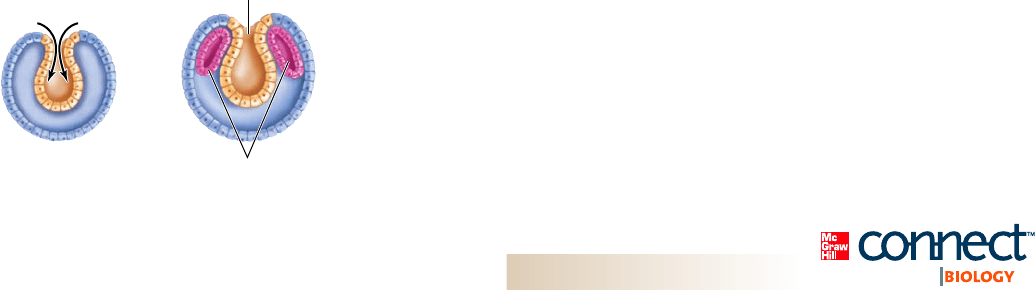
Blastopore
becomes mouth
Archenteron
Mesoderm
APPLY
1. The following diagram is of the blastopore stage of embryonic
development. Based on the information in the diagram, which
of the following statements is correct?
a. It is a diagram of a protostome.
b. It would have formed by radial cleavage.
c. It would exhibit determinate development.
d. All of the above are correct.
2. Which of the following characteristics would not apply to a
species in the Ecdysozoa?
a. Bilateral
b. Indeterminate cleavage
c. Molt at least once in their life cycle
d. Metazoan
3. In the rain forest you discover a new species that is terrestrial,
has determinate development, molts during its lifetime, and
possesses jointed appendages. To which phylum of animals
should it be assigned?
SYNTHESIZE
1. Worm evolution represents an excellent means of understanding
the evolution of a body cavity. Using the phyla of worms
Nematoda, Annelida, Platyhelminthes, and Nemetera, construct
a phylogenetic tree based only on the form of body cavity (refer
to gure 32.2 and table 32.2 for assistance). How does this
relate to the material in gure 32.4 ? Should body cavity be used
as the sole characteristic for classifying a worm?
2. Most students nd it hard to believe that Echinodermata and
Chordata are closely related phyla. If it were not for how their
members form a body cavity, where would you place
Echinodermata in the animal kingdom? Defend your answer.
ONLINE RESOURCE
www.ravenbiology.com
Understand, Apply, and Synthesize—enhance your study with
animations that bring concepts to life and practice tests to assess
your understanding. Your instructor may also recommend the
interactive eBook, individualized learning tools, and more.
648
part
V
Diversity of Life on Earth
rav32223_ch32_633-648.indd 648rav32223_ch32_633-648.indd 648 11/13/09 1:35:45 PM11/13/09 1:35:45 PM
Apago PDF Enhancer
O
Chapter
33
Noncoelomate
Invertebrates
Chapter Outline
33.1 Parazoa: Animals That Lack
Specialized Tissues
33.2 Eumetazoa: Animals with True Tissues
33.3 The Bilaterian Acoelomates
33.4 The Pseudocoelomates
Introduction
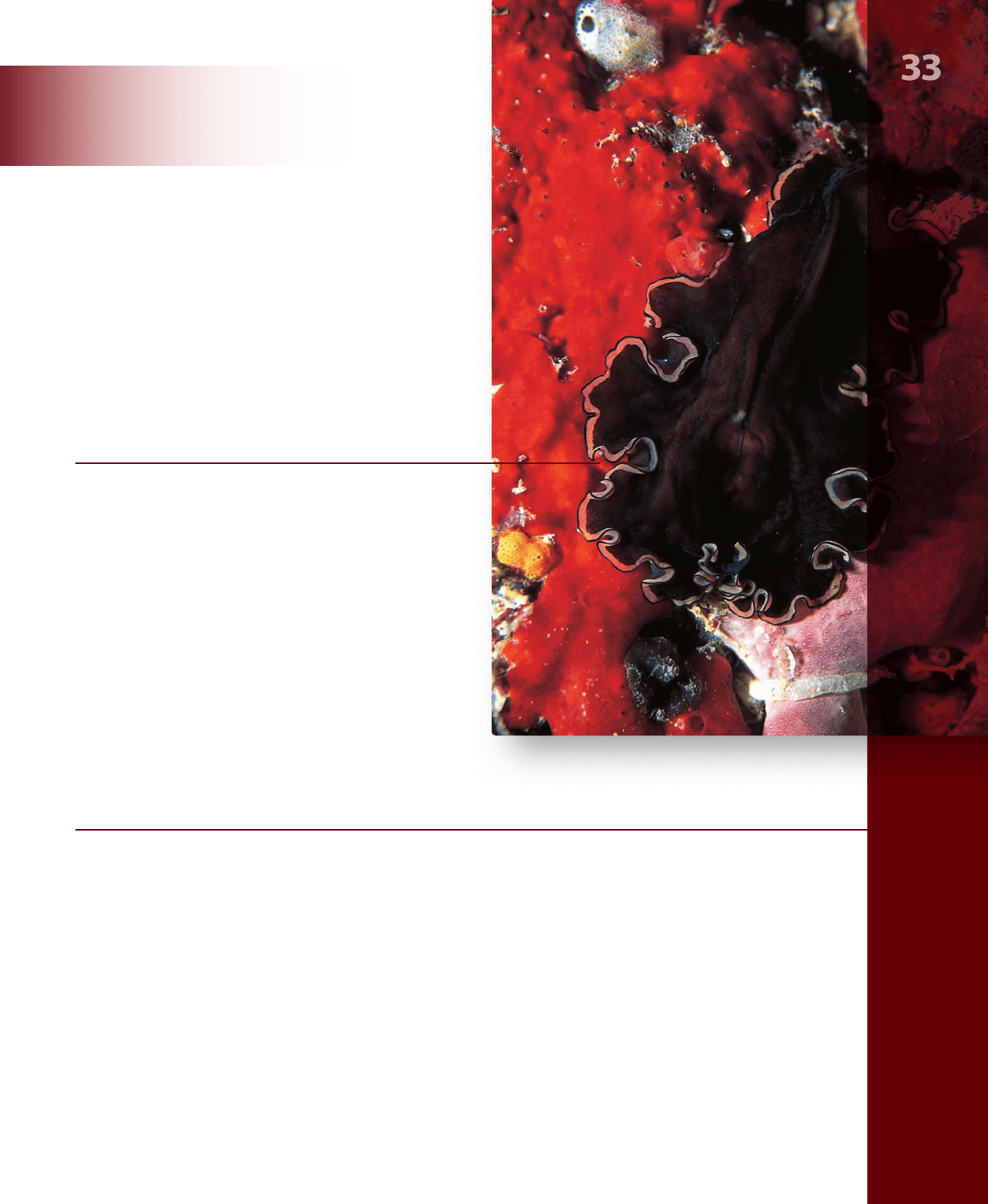
Our exploration of the great diversity of animals starts with the morphologically simplest members of the animal
kingdom—sponges, jellyfish, and some of the worms (fully a third of animal phyla are based on a “wormy” body plan!).
Despite their simplicity, these animals can carry out all the essential functions of life, just as do more morphologically
complex animals—eating, respiring, reproducing, and protecting themselves. These animals lack a coelom, so we refer to
them as noncoelomates, but many have a body space called a pseudocoelom. The major organization of the animal body
first evolved in these animals, the basic body plan from which that of all the rest of animals evolved. In chapter 34, we
consider the invertebrate animals that have a coelom, and in chapter 35 the vertebrates. You will see that all animals, despite
their great variation, have much in common.
CHAPTER
rav32223_ch33_649-665.indd 649rav32223_ch33_649-665.indd 649 11/13/09 3:23:01 PM11/13/09 3:23:01 PM
Apago PDF Enhancer
Porifera
Ctenophora
Cnidaria
Brachiopoda
Cycliophora
Platyhelminthes
Acoela
Bryozoa (Ectoprocta)
Micrognathozoa
Rotifera
Osculum
Collar
Flagellum
Nucleus
Amoebocyte
Pore
Spicule
Spongin
fiber
Choanocyte
Choanocyte
Epithelial
wall
Water
Ostium
b.
a.
Figure 33.1
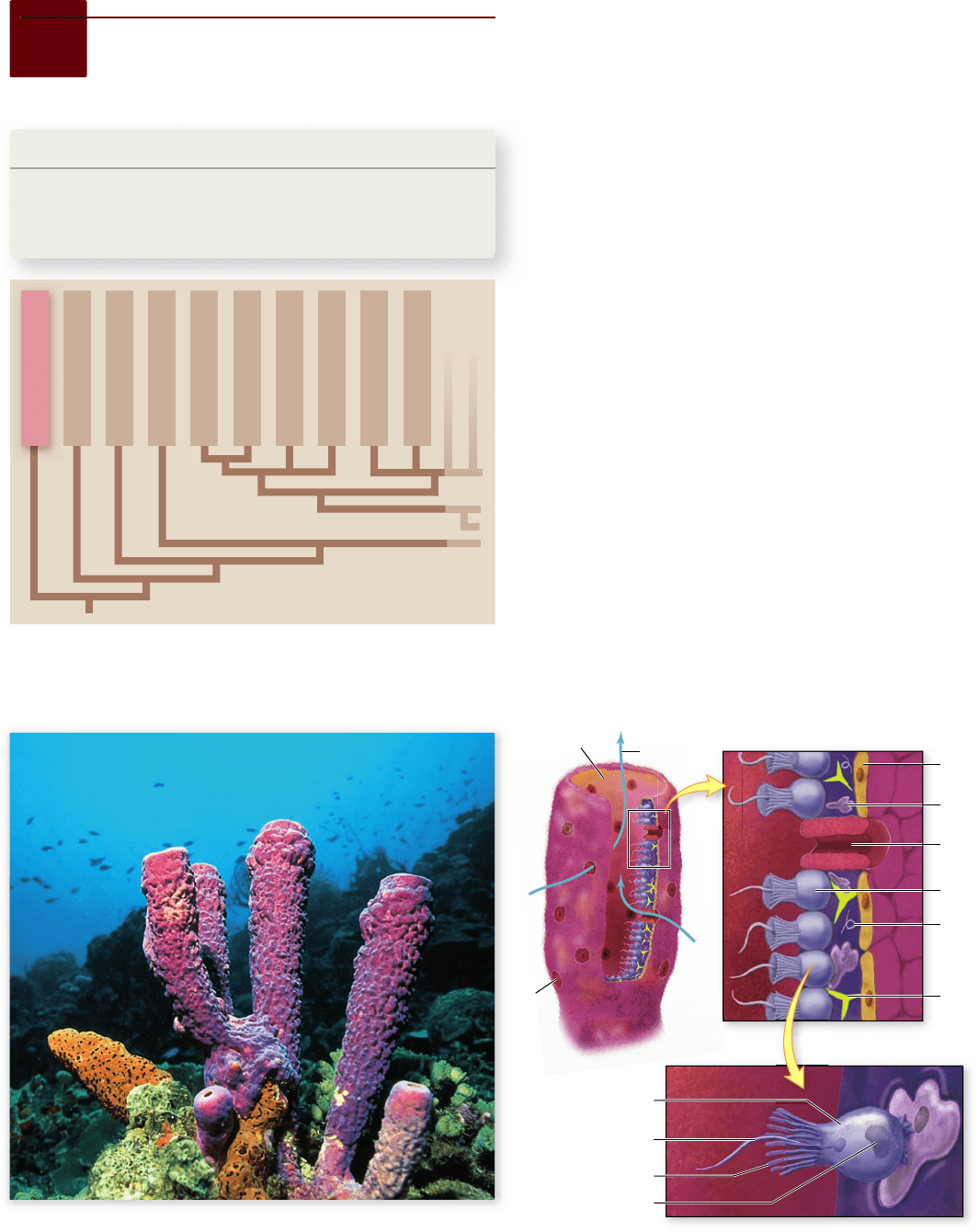
Phylum Porifera: Sponges.
a. Aplysina longissima. This beautiful, bright orange and purple elongated sponge is found on
deep coral reefs. b. Diagrammatic drawing of the simplest type of sponge. Sponges are composed of several distinct cell types, the activities of
which are coordinated. The sponge body has no organized tissues, and most are not symmetrical.
Parazoans are animals lacking tissues (and therefore organs)
and a definite symmetry. The major group of parazoans is phy-
lum Porifera, the sponges. Despite their morphological sim-
plicity, like all animals, sponges are truly multicellular.
The sponges, phylum Porifera,
have a loose body organization
Nearly 7000 species of sponges live in the sea, and perhaps
150 species live in fresh water. Marine sponges occur at all
depths, and may be among the most abundant animals in the
deepest part of the oceans. Although some sponges are small
(no more than a few millimeters across), some may reach 2 m
or more in diameter.
A few small sponges are radially symmetrical, but most
members of this phylum lack symmetry. Some have a low
and encrusting form and grow covering various sorts of sur-
faces; others are erect and lobed, some in complex patterns
(figure 33.1a) .
As is true of many marine invertebrate animals, larval
sponges are free-swimming. After a sponge larva attaches to an
appropriate surface, it metamorphoses into an adult and re-
mains attached to that surface for the rest of its life. Thus adult
sponges are sessile; that is, they are anchored, immobile, on
rocks or other submerged objects. Sponges defend themselves
by producing chemicals that repel potential predators and or-
ganisms that might overgrow them.
33.1
Parazoa: Animals That Lack
Specialized Tissues
Learning Outcomes
Describe the different types of cells in the 1.
sponge body.
Explain the function of choanocytes.2.
650
part
V
Diversity of Life on Earth
rav32223_ch33_649-665.indd 650rav32223_ch33_649-665.indd 650 11/13/09 3:23:07 PM11/13/09 3:23:07 PM

Apago PDF Enhancer
adapted to contain large amounts of water. The three classes of
sponges—Hexactinellida, Demospongiae, and Calcarea—are
distinguished in part by the mineral form of their spicules.
Choanocytes help circulate
water through the sponge
Each choanocyte resembles a protist with a single flagellum
(plural, flagella) (see figure 33.1b), a similarity that may reflect
its evolutionary derivation. The pressure created by the beating
flagella in the cavity contributes to circulating the water that
brings in food and oxygen and carries out wastes. In large
sponges, the inner wall of the body interior is convoluted, in-
creasing the surface area and, therefore, the number of flagella.
In such a sponge, 1 cm
3
of sponge can propel more than 20 L of
water per day. Choanocytes also capture food particles from the
passing water, engulfing and digesting them. Obviously, this ar-
rangement restricts a sponge to feeding on particles consider-
ably smaller than choanocytes—largely bacteria.
Sponges reproduce both
asexually and sexually
Some sponges can reproduce asexually simply by breaking into
fragments. Each fragment is able to continue growing as a new
individual. Whether a sponge should be considered colonial is an
illustration of the limitations of human language. A colony of
invertebrate animals, such as coral, is generally defined as a group
of individuals that are physically connected (and may be physio-
logically connected as well), all having been produced by asexual
reproduction (such as budding or dividing) from a single pro-
genitor that arose by sexual reproduction. Nearly all sponges
grow by multiplying the number of flagellated chambers con-
nected to a single osculum, but whether these units can be con-
sidered “individuals” is debatable.
Sponge sperm are created by the transformation of cho-
anocytes, which are then released into the water where they may
be carried into another sponge of the same species. When a
sperm is captured by a choanocyte, it is carried to an egg cell,
which is in the mesohyl (and in some sponges is also a trans-
formed choanocyte). In many sponges, development of the ex-
ternally ciliated larva occurs within the mother. In sponges of
other species, the fertilized egg is released into the water, where
development occurs. Whether a fertilized egg or a ciliated larva
is released, after a short planktonic (drifting) stage, the larva
settles on a suitable substrate where it transforms into an adult.
Learning Outcomes Review 33.1
Sponges possess multicellularity but have neither tissue-level development
nor body symmetry. Cells that compose a sponge include a layer of
choanocytes, a layer of epithelial cells, and amoeboid cells in the mesohyl
between the two layers. Choanocytes have fl agella that beat to circulate
water through the sponge body.
■ What features of a sponge make it seem to be a
colony, and what features make it seem to be
a single organism?
As a result, pharmaceutical companies are interested in
possibly using these chemicals for human applications.
The sponge body is composed
of several cell types
Lacking head or appendages, mouth or anus, and the organized
internal structure characteristic of all other animals, at first sight
a sponge seems to be little more than a mass of cells embedded
in a gelatinous matrix. In fact, a sponge contains several cell types
(figure 33.1b), each with specialized functions. If a sponge is put
through a fine sieve or coarse cloth so that the cells are separated,
they will seek one another out and reassemble the entire sponge—
a phenomenon that does not occur in any other animal .
As mentioned in chapter 32, a unique feature of sponge
cells is their ability to differentiate from one type to another,
and to dedifferentiate from a specialized state to an unspecial-
ized one. Activities of the cells are loosely coordinated to per-
form functions such as synchronizing reproduction and building
the complex skeletal meshwork. This distinguishes sponges as
truly multicellular, by contrast with colonial protists, which
may form aggregates of cells, but all are functionally identical
(except for the reproductive cells).
A small, anatomically simple sponge has a vaselike shape.
The walls of the “vase” have three functional layers. Facing the
internal cavity are flagellated cells called choanocytes, or col-
lar cells (see figure 33.1b). A larger and more complex sponge
has many small chambers connected by channels rather than a
single chamber. Once water has passed through a flagellated
chamber, it travels through channels that converge at a large
opening called an osculum (plural, oscula), through which wa-
ter is expelled from the sponge.
The body of a sponge is bounded by an outer epithelium
consisting of flattened cells somewhat like those that make up
the outer layers of animals in other phyla. Pores on the sponge
allow water to enter the channels that course through its body,
leading to and from the flagellated chambers. The name of the
phylum, Porifera, refers to these pores, the ostia (singular, os-
tium); a large sponge has multiple oscula, but they are far, far
fewer than the number of ostia.
Some epithelial cells are specialized to surround the ostia;
they can contract when touched or exposed to appropriate stimuli,
causing the ostia to close and thereby protecting the delicate inner
cells from the entry of potentially harmful substances such as sand
and noxious chemicals. Cells surrounding individual ostia operate
independently of one another; because a sponge has no nervous
system, actions cannot be coordinated across large distances.
Between the outer and inner layers of cells, sponges con-
sist mainly of a gelatinous, protein-rich matrix called the
mesohyl, which contains various types of amoeboid cells (and
eggs). In many kinds of sponges, some of these cells secrete nee-
dles of calcium carbonate or silica known as spicules, or fibers
of a tough protein called spongin. Spicules and spongin form
the skeleton of the sponge, strengthening its body. The siliceous
spicules of some deep-sea sponges can reach a meter in length!
A genuine bath sponge is the spongin skeleton of a marine
sponge; artificial sponges made of cellulose or plastic are mod-
eled on the body design of this animal, with a porous body
chapter
33
Noncoelomate Invertebrates
651www.ravenbiology.com
rav32223_ch33_649-665.indd 651rav32223_ch33_649-665.indd 651 11/13/09 3:23:10 PM11/13/09 3:23:10 PM