
Raven P.H., Johnson G.B., Mason K.A. Biology (Ninth Edition)
Подождите немного. Документ загружается.

Apago PDF Enhancer
Learning Outcomes Review 34.1
Mollusks are coelomates with a coelom surrounding the heart. Most have
effi cient excretory systems, ctenidia for respiration, and a rasping structure,
the radula, for gathering food. The mantle of mollusks not only secretes
their protective shell but also forms structures essential to body functions.
Chitons, gastropods, bivalves, and cephalopods are the four best-known
groups. Cephalopods lack cilia on their ctenidia and have a closed
circulatory system.
■ Why might a closed circulatory system be necessary in
a cephalopod?
among classes of objects and are capable of leaving one tank to
seize prey in another, then returning to their original one.
Cephalopod eyes are much like those of vertebrates, although
they evolved independently (see chapter 45).
Aside from the chambered nautiluses, living cephalo-
pods lack an external shell. Shelled cephalopods were for-
merly far more diverse, as evidenced by the many fossil
cephalopods such as ammonites and belemnites. These ceph-
alopods were extraordinarily successful because they could
move in open water instead of on the sea bottom like other
mollusks. However, once the more maneuverable fishes
evolved,shelled mollusks declined, some dying out, others ex-
periencing evolutionary reduction and eventual loss of their
heavy shells. The cuttlebone of cuttlefish and the pen of
squids are internal shells that support these animals and give
them some buoyancy. Even the internal shell has disappeared
in the lineage that gave rise to octopuses.
As in other mollusks, water passes through the mantle
cavity. In a cephalopod, it is pumped in by muscles and exits
through a siphon, which allows the animal to move by jet pro-
pulsion, and which can be directed to steer. The ink sac of
cephalopods, which typically contains a purplish fluid, can
eject its contents through the siphon as a cloud that may hide
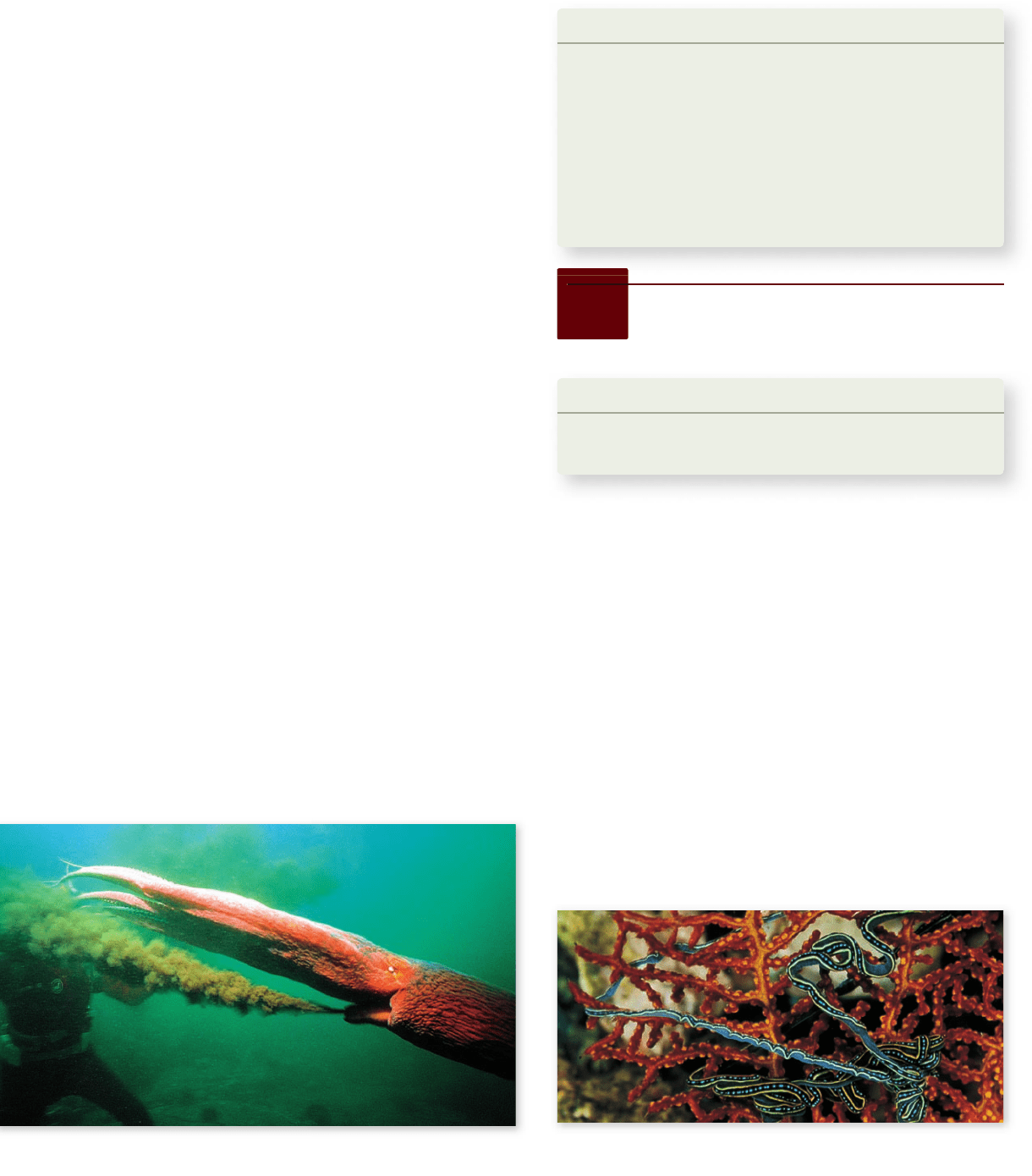
the cephalopod and confuse predators (figure 34.11) .
Most octopuses and squids are capable of changing skin
color and texture to match their background or to communi-
cate with one another. They do so using chromatophores, epi-
thelial cells that contain pigments. Some deep-sea squids
harbor symbiotic luminescent bacteria. These may be emitted
with the ink to produce a glimmering cloud (ink would not be
seen at depths where sunlight cannot penetrate) or they may
inhabit cells like chromatophores so they can light up the sur-
face of the animal.
Another difference with many other mollusks is that ceph-
alopods have direct development, that is, they lack a larval stage,
hatching as miniature adults.
Figure 34.11
Ink defense by a giant Paci c octopus
(Octopus do eini). When threatened, octopuses and squids expel
a dark cloudy liquid.
34.2
Phylum Nemertea:
The Ribbon Worms
Learning Outcome
Describe the two characteristics that place nemerteans 1.
with mollusks in the lophotrochozoa.
Nemerteans (phylum Nemertea) consist of about 900 species
of cylindrical to flattened very long worms (figure 34.12) . Most
nemerteans are marine; a few species live in fresh water and
humid terrestrial habitats. An individual may reach 10 to 20 cm
in length, although the animals are difficult to measure because
they can stretch, and many species break into pieces when dis-
turbed or handled. The species Lineus longissimus has been re-
ported to measure 60 m in length—the longest animal known!
The nemertean body plan resembles that of a flatworm
(see chapter 33), with networks of fine tubules constituting the
excretory system, and with internal organs not lying in a body
cavity. A bit of cephalization is present, with two lateral nerve
cords extending posteriorly from an anterior ganglion; some
animals have eyespots on the head. But, by contrast with a
platyhelminth, a nemertean has a complete gut, with both
mouth and anus, connected by a straight tube. Nemerteans also
possess a fluid-filled cavity called a rhynchocoel. This sac serves
Figure 34.12
Phylum Nemertea: A ribbon worm of the
genus Lineus. Some nemerteans can stretch to several meters
in length.
672
part
V
Diversity of Life on Earth
rav32223_ch34_666-692.indd 672rav32223_ch34_666-692.indd 672 11/13/09 4:21:27 PM11/13/09 4:21:27 PM
Apago PDF Enhancer
Nemertea
Loricifera
Kinorhyncha
Nematoda
Mollusca
Brachiopoda
Bryozoa (Ectoprocta)
Annelida
Rotifera
Cycliophora
Platyhelminthes
Tardigrada
Chordata
Echinodermata
Chaetognatha
Onychophora
Arthropoda
Segments
Setae
Clitellum
Mouth
Brain
Pharynx
Hearts
Esophagus
Dorsal blood
vessel
Ventral blood
vessel
Intestine
Septa
Male gonads
Female gonads
Nerve cord
Nephridium
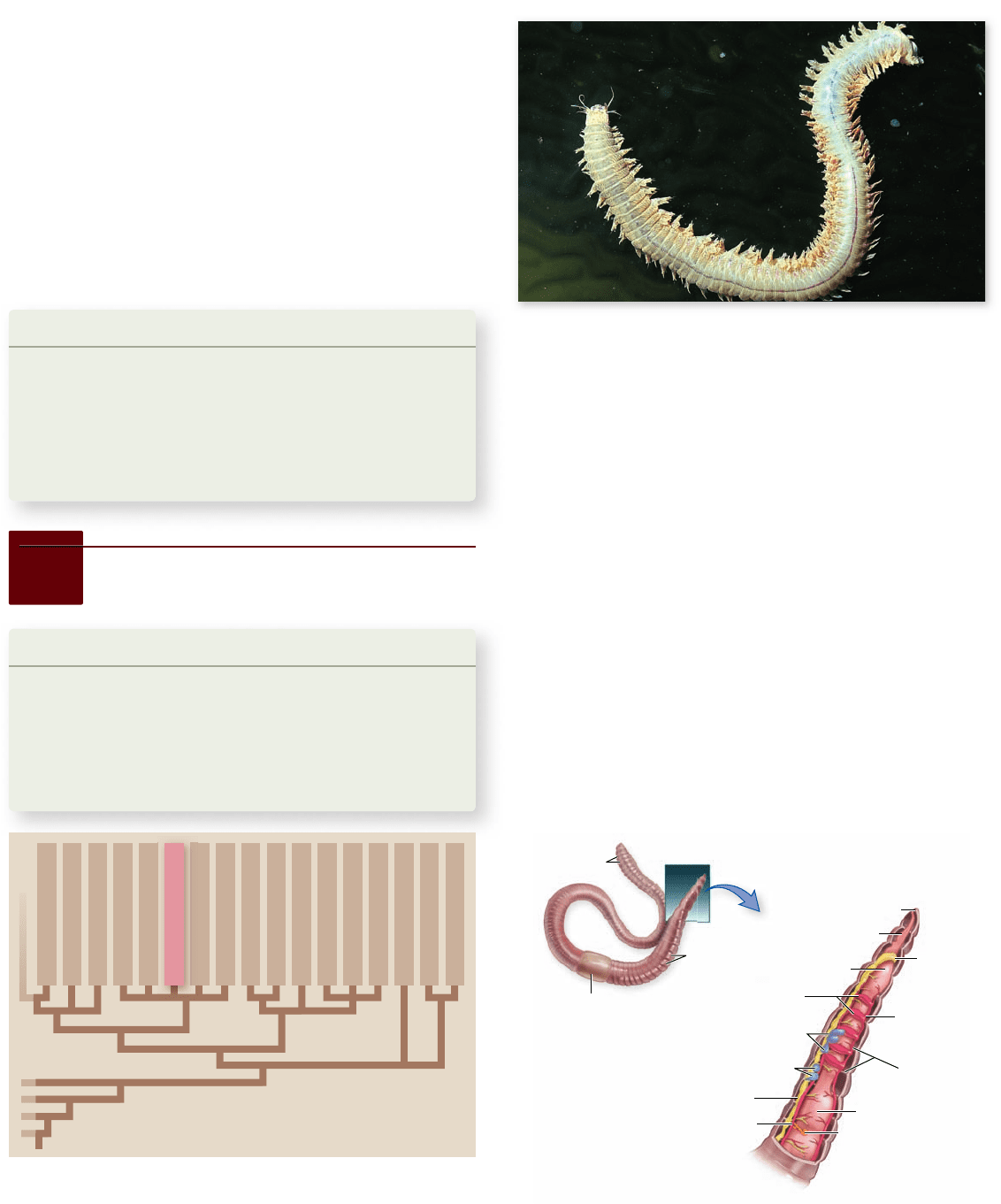
Figure 34.13
A polychaete annelid.
Nereis virens is a
wide-ranging, predatory, marine polychaete worm equipped with
feathery parapodia for movement and respiration, as well as jaws for
hunting. You may have purchased Nereis as shing bait!
as a hydraulic power source for the proboscis, a long muscular
tube that can be thrust out quickly from a sheath to capture ani-
mal prey.
Nemerteans are gonochoric, and all reproduce sexually.
Some are capable of asexual reproduction by fragmentation.
However, in most species, most fragments resulting from dis-
turbance die, so nemertean regenerative powers may not be as
great as is sometimes stated.
Blood of nemerteans flows entirely in vessels that are de-
rived from the coelom. That and the rhynchocoel are good evi-
dence that nemerteans are not related to flatworms, which they
resemble superficially, but belong to the Lophotrochozoa,
along with mollusks.
Learning Outcome Review 34.2
Nemerteans are very long worms that have a coelomic cavity and blood
vessels derived from the coelom. They capture prey with a muscular
proboscis. Unlike the acoelomate fl atworms, nemerteans have a complete
gut with mouth and anus.
■ What would be some advantages of a flow-through
digestive tract?
34.3
Phylum Annelida: The Annelids
Learning Outcomes
Explain how circular and longitudinal muscles in a 1.
segmented body facilitate movement.
Distinguish between the classes Polychaeta and 2.
Clitellata.
Describe adaptations in leeches for feeding on the blood 3.
of animals.
An important innovation in the animal body plan was segmen-
tation, the building of a body from a series of repeated units
(see chapter 32), which has evolved multiple times. Worms of
the phylum Annelida (figure 34.13) are segmented. One advan-
tage of a segmented body is that the development and function
of individual segments or groups of segments can differ. For
example, some segments may be specialized for reproduction,
whereas others are adapted for locomotion or excretion.
All animals that have been regarded as annelids are seg-
mented, so the animals were considered to constitute a natural
group, but the monophyly of Annelida is being reconsidered be-
cause some unsegmented worms may belong to this clade.
The annelid body is composed
of ringlike segments
The head, which contains a well-developed cerebral ganglion,
or brain, and sensory organs occurs at the anterior end (front)
of a series of ringlike segments that resemble a stack of coins
(figure 34.14) . Many species have eyes, which in some species
have lenses and retinas. Technically the head is not a segment,
Figure 34.14
Phylum Annelida: An oligochaete. The
earthworm body plan is based on repeated body segments.
Segments are separated internally from each other by septa.
chapter
34
Coelomate Invertebrates
673www.ravenbiology.com
rav32223_ch34_666-692.indd 673rav32223_ch34_666-692.indd 673 11/13/09 4:21:30 PM11/13/09 4:21:30 PM
Apago PDF Enhancer
enlarged and heavily muscular, serving as hearts that pump the
blood. An earthworm has five pulsating blood vessels on each
side that help to move blood from the main dorsal vessel, the
major pumping structure, to the ventral vessel.
The excretory system of annelids consists of ciliated,
funnel-shaped nephridia like those of mollusks. Each segment has
a pair of nephridia that collect wastes and transport them out of
the body by way of excretory tubes. Some polychaetes have proto-
nephridia like the flame cells of planarians.
Annelida comprises two—or three—classes
The roughly 12,000 described species of annelids occur in
many habitats. They range in length from as little as 0.5 mm to
giant Australian earthworms more than 3 m long. Although
traditionally annelids have been classified into classes Poly-
chaeta (mostly marine worms), Oligochaeta (mostly terrestrial
worms, including earthworms), and Hirudinea (leeches), the
monophyly of polychaetes is not well established. The classifi-
cation of annelids may change in the near future, but we adopt
the current two-class system of Polychaeta and Clitellata
(which combines Oligochaeta and Hirudinea).
Class Polychaeta: Polychaetes
Polychaetes include clamworms, scaleworms, lugworms, sea
mice, tubeworms, and many others. Polychaetes are a crucial
part of many marine food chains, and are extremely abundant
in particular habitats. Some of these worms are beautiful, with
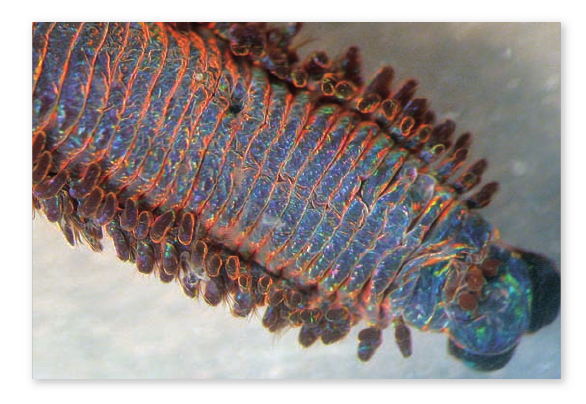
unusual forms and iridescent colors (figure 34.15) .
On most segments, a polychaete has paired, fleshy, paddle-
like lateral projections called parapodia (see figures 34.13,
34.15). The parapodia bear chaetae; the word polychaeta means
“many chaetae.” Parapodia are used in swimming, burrowing,
or crawling, and those of polychaetes that live in burrows or
tubes may have chaetae with hooks that help anchor the worm.
Parapodia can also play an important role in gas exchange be-
cause they greatly increase the surface area of the body, and in
some species they bear or are even transformed into gill-
like structures.
nor is the posterior end of the worm, the pygidium. In embry-
onic development, the head and tail form first, and then seg-
ments form between them; if a worm is cut in pieces, generally
only those parts containing either head or tail can regenerate
the missing parts and the middle bits just die.
Internally, the segments are divided from one another by
partitions called septa, just as bulkheads separate the compart-
ments of a submarine. Each segment has a pair of excretory
organs, a ganglion, and locomotory structure; in most marine
annelids, each also has a set of reproductive organs.
Although septa separate the segments, materials and bi-
ological signals do pass between segments. A closed circula-
tory system carries blood the length of the animal, anteriorly
in the dorsal vessel and posteriorly in the ventral one. Con-
nections from ventral to dorsal vessel in each segment bring
the blood near enough to each cell so oxygen and food mole-
cules diffuse from the blood into the cells of the body wall,
and carbon dioxide and other wastes diffuse from the cells
into the blood. A ventral nerve cord connects the ganglia in
each segment with one another and with the brain. These
neural connections allow the worm to function as a unified
and coordinated organism.
Annelids move by contracting their segments
The basic annelid body plan is a tube within a tube, the diges-
tive tract—extending from mouth to anus—passing through
the septa, and suspended within the spacious coelom, which is
surrounded by the body wall. Each portion of the digestive
tract—pharynx, esophagus, crop, gizzard, and intestine—is spe-
cialized for a different function.
The coelomic fluid creates a hydrostatic skeleton that
gives each segment rigidity, like an inflated balloon (see
chapter 47). Annelid locomotion is effected by contraction of
the circular and longitudinal muscles against the hydrostatic
skeleton. When circular muscles are contracted around a seg-
ment, the segment decreases in diameter, so the coelomic fluid
causes the segment to elongate. When longitudinal muscles are
contracted, the segment shortens, so the coelomic fluid causes
the segment to increase in diameter. Alternating these contrac-
tions and confining them to only some segments allows the
worms to move in complex ways.
In most annelid groups, each segment possesses bristles
of chitin called chaetae (or setae—singular, seta or chaeta). By
extending the chaetae in some segments so that they protrude
into the substrate and retracting them in other segments, the
worm can extend its body, but not slip (see figure 47.1).
Annelids have a common, closed circulatory
system but a segmented excretory system
Unlike arthropods and mollusks, except for cephalopods, an-
nelids have a closed circulatory system. Annelids exchange oxy-
gen and carbon dioxide with the environment through their
body surfaces, although some nonterrestrial ones have gills
along the sides of the body or at the anterior end. Gases (and
food molecules) are distributed throughout the body in blood
vessels. Some of the vessels at the anterior end of the body are
Figure 34.15
A polychaete. The shiny bristleworm Oenone
fulgida. Notice chaete extending from the iridescent parapodia.
674
part
V
Diversity of Life on Earth
rav32223_ch34_666-692.indd 674rav32223_ch34_666-692.indd 674 11/13/09 4:21:33 PM11/13/09 4:21:33 PM
Apago PDF Enhancer
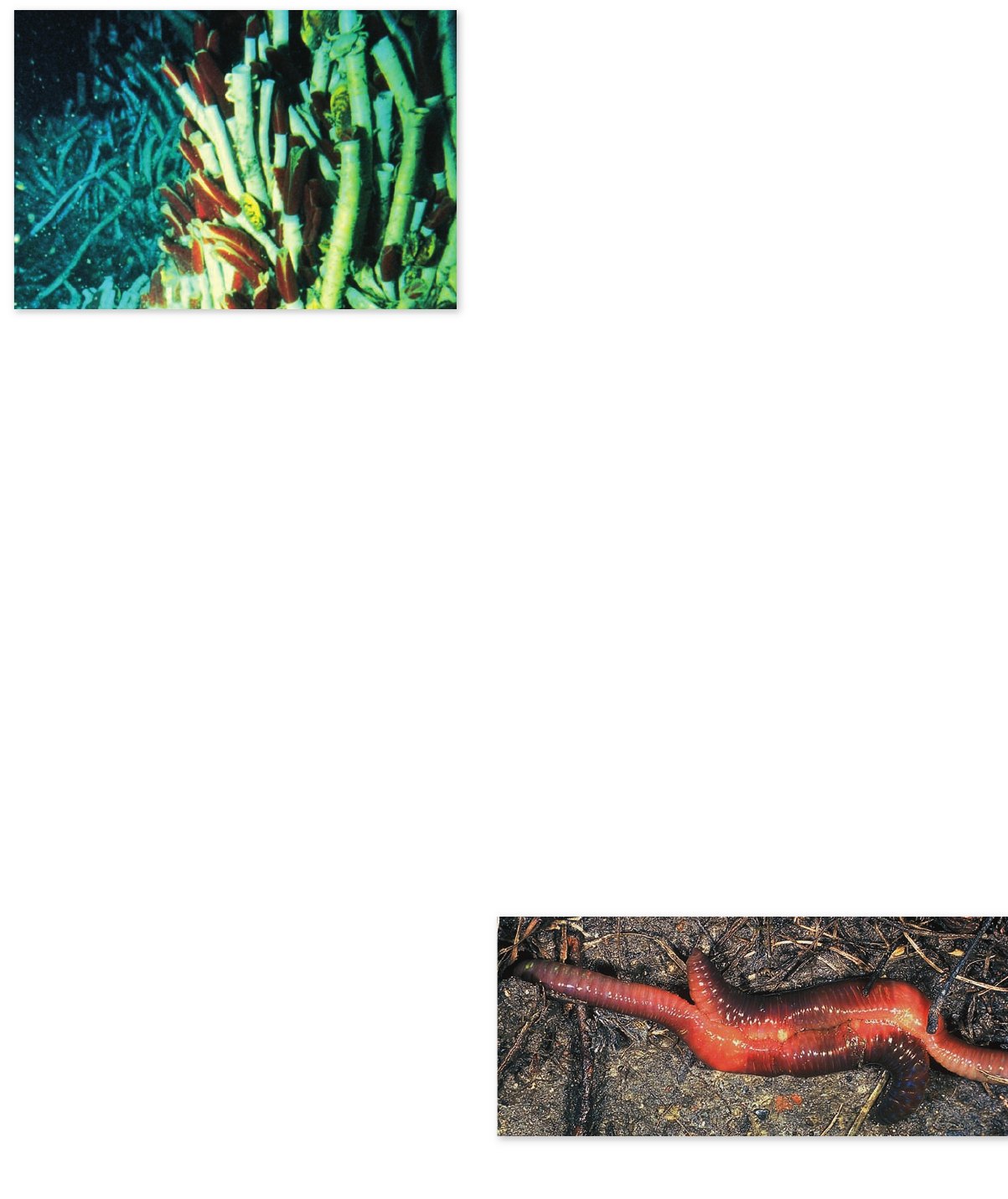
Figure 34.16
Giant tubeworms (Riftia pachyptila) living
in deep-sea hydrothermal vents near the Galápagos. These
tubeworms and associated animals (notice the small white crab) are
an example of a community dependent on hydrogen sul de, rather
than the Sun, as an energy source.
Earthworms.
The body of a typical earthworm consists of
100 to 175 similar segments. The head is not well differenti-
ated. An earthworm has no parapodia, and its chaetae (which
are fewer than in polychaetes—the word oligochaeta means
“few chaetae”) project directly from the body wall.
Earthworms eat their way through the soil, ingesting it by
muscular action of their strong pharynx; organic material is
ground in the gizzard. What passes through an earthworm is de-
posited outside the opening of its burrow as castings that form
irregular mounds. In this way, earthworms contribute to loosen-
ing, aeration, and enrichment of the soil. In view of their under-
ground lifestyle, it is not surprising that earthworms have no
eyes. But they do have light-, chemo-, and touch-sensitive cells,
most concentrated in segments near each end of the body—those
regions most likely to encounter light or other stimuli.
Earthworms are hermaphroditic, another way in which they
differ from most polychaetes, but they cross-fertilize through mat-
ing (figure 34.17). The clitellum secretes mucus that holds the
worms together during copulation, their anterior ends pointing in
opposite directions, their ventral surfaces touching. Sperm cells
are released from pores in specialized segments of one partner into
the sperm receptacles of the other, the process going in both direc-
tions simultaneously. Several days after the worms separate, the
clitellum of each worm secretes a mucus cocoon, surrounded by a
protective layer of chitin. As the worm moves, this sheath passes
over the female pores of the body, receiving eggs and incorporat-
ing the deposited sperm so that fertilization takes place within the
cocoon. When the cocoon passes over the end of the worm, its
edges pinch together. Within the cocoon, the fertilized eggs de-
velop directly into young worms similar to adults.
Leeches.
Most leeches live in fresh water, although a few are
marine and some tropical leeches occupy terrestrial habitats.
Dorsoventrally attened, most leeches are 2 to 6 cm long, but
one tropical species reaches 30 cm. Like earthworms, leeches
are hermaphroditic, but the clitellum develops only during the
breeding season. Leeches also cross-fertilize.
Unlike that of earthworms and polychaetes, the coelom
of a leech is reduced and not divided into segments. The suck-
ers at one or both ends of a leech’s body are used for locomo-
tion and to attach to prey. A leech with suckers at both ends
moves by attaching first one and then the other end to the sub-
strate, looping along. Many species are also capable of swim-
ming. Except for one species, leeches have no chaetae.
Polychaetes can swim or crawl, and some are active
predators with powerful jaws. Other polychaetes live in tubes
or burrows of hardened mud, sand, mucuslike secretions, or
calcium carbonate. Sedentary polychaetes may project feath-
ery tentacles that sweep the water for food, filter feeding; the
tentacles may also serve as gills, exchanging gas. Some deep-
sea tubeworms such as Riftia (figure 34.16) are gutless as adults.
Projections from the body of these worms house sulfur-oxidiz-
ing bacteria that synthesize organic compounds used by the
worm. These worms aggregate near hydrothermal vents
where sulfur is plentiful and can grow to more than a meter
in length.
Most polychaetes are gonochoric. Gametes typically are
released into the water, where fertilization occurs externally.
Many polychaetes have gonads in most segments, but in some
groups, gonads are confined to certain segments. In palolo
worms and their relatives, these segments are at the end of the
body; spawning involves the end of the worm breaking off and
swimming to the surface of the sea, where it ruptures, releasing
the gametes. The gamete-filled terminal parts of palolo worms
are considered delicacies by some people in the South Pacific.
Fertilization results in spiral cleavage followed by the
production of ciliated, mobile trochophore larvae similar to
that of mollusks. Metamorphosis of a trochophore involves dif-
ferentiation of a head and tail end, with development of seg-
ments in between, from a posterior growth zone.
Class Clitellata: Earthworms and leeches
Some authorities still consider earthworms to belong to class Oli-
gochaeta and leeches to class Hirudinea, but most now put earth-
worms and leeches into a single class, although, confusingly, it
sometimes may be called Oligochaeta. More often it is called Cli-
tellata, because of the feature that unites these seemingly quite
different animals, the clitellum—a thickened band on the body,
which is the familiar “saddle” of an earthworm (see figure 34.14).
Figure 34.17
Earthworms mating. The anterior ends are
pointing in opposite directions.
chapter
34
Coelomate Invertebrates
675www.ravenbiology.com
rav32223_ch34_666-692.indd 675rav32223_ch34_666-692.indd 675 11/13/09 4:21:35 PM11/13/09 4:21:35 PM
Apago PDF Enhancer
Nemertea
Loricifera
Kinorhyncha
Nematoda
Mollusca
Brachiopoda
Bryozoa (Ectoprocta)
Annelida
Rotifera
Cycliophora
Platyhelminthes
Tardigrada
Chordata
Echinodermata
Chaetognatha
Onychophora
Arthropoda
Figure 34.18
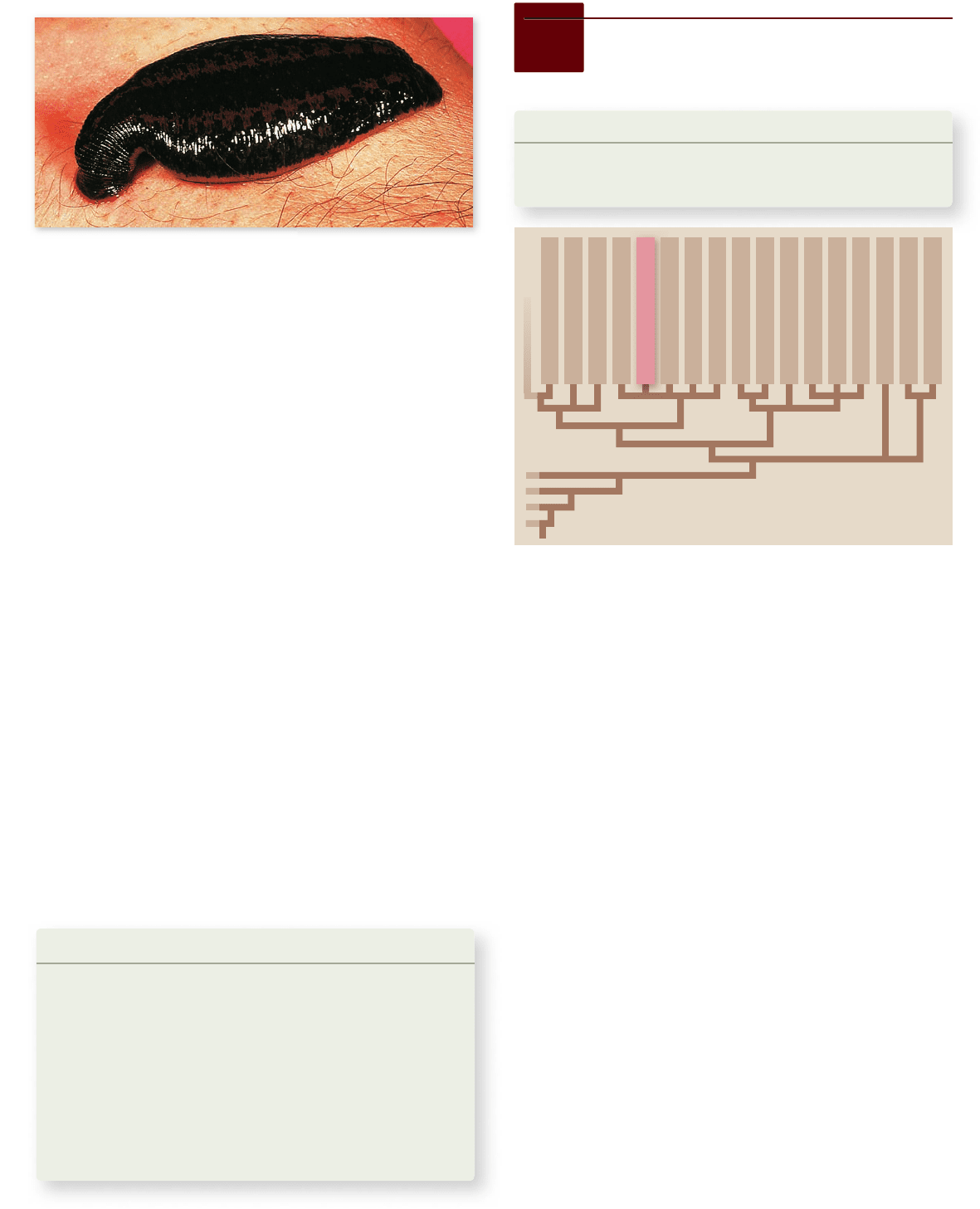
A leech. Hirudo medicinalis, the medicinal
leech, feeding on a human arm. Leeches use chitinous, bladelike
jaws to make an incision to access blood; they secrete an
anticoagulant to keep the blood from clotting. Both the
anticoagulant and the leech itself have made important
contributions to modern medicine.
About half the known species of leeches eat detritus or de-
vour small animals. The others suck blood or other fluids from
their hosts (figure 34.18). Such a leech secretes an anticoagulant
into the wound to prevent the blood from clotting, and vasodila-
tors to keep the blood flowing; the leech’s powerful pharynx pumps
the blood out quickly once a hole has been opened. Anesthetics
injected into the prey prevent the leech from being noticed while
piercing the skin; they are usually detected only after detaching,
when blood starts to flow from the wound. Freshwater parasitic
leeches may remain on their hosts for long periods, sucking the
host’s blood from time to time. Leeches detect prey by sensing
gradients of carbon dioxide in the environment. In some tropical
forests, a few seconds after you stop on a trail, you can see dozens
of leeches approaching you from all directions!
One of the best-known species, the medicinal leech Hirudo
medicinalis (see figure 34.18), reaches 10 to 12 cm long, and has
bladelike, chitinous jaws that can rasp through an animal’s skin.
Leeches were used in medicine for hundreds of years to treat
patients whose diseases were mistakenly believed to be caused by
an excess of blood. Today, leeches are used to remove excess
blood after surgery or to keep blood from coagulating in severed
appendages that have been reattached. Accumulations of blood
can cause the tissue to die; when leeches remove such blood, new
capillaries form in about a week, and the tissues remain healthy.
The anticoagulant and anesthetic properties of the leech are also
being investigated by pharmaceutical companies.
Learning Outcomes Review 34.3
Annelids generally exhibit segmentation. Each segment has its own
excretory and locomotor elements; circular and longitudinal muscles in
segments cause the body to extend and contract, respectively. Worms
of class Polychaeta, which are mostly marine, have parapodia on their
segments. Leeches and earthworms were formerly in separate classes, but a
major morphological similarity, the clitellum, has been used to group them
into a single class, Clitellata.
■ What would be the advantages of having nervous and
circulatory systems that serve the entire body instead of
segmented systems?
Learning Outcomes
Describe the lophophore and its function.1.
Distinguish between bryozoans and brachiopods. 2.
Two phyla of mostly marine animals—Bryozoa and
Brachiopoda —are characterized by a lophophore , a circular or
U -shaped ridge around the mouth bearing one or two rows of
ciliated tentacles into which the coelom extends. The loph-
ophore functions as a surface for gas exchange, and the cilia of
the loph o phore serve to guide organic detritus and plankton on
which the animal feeds to the mouth. Because of the lophophore,
bryozoans and brachiopods have been considered related to
one another, but some recent data indicate that the structures
may have evolved convergently.
Brachiopods share some features with protostomes and
others with deuterostomes. Cleavage in both brachiopods and
bryozoans is mostly radial, as in deuterostomes. The formation
of the coelom varies. In phoronids (once considered a phylum
on their own but now considered part of Brachiopoda), the
mouth forms from the blastopore (a feature of protostomes),
whereas in the rest of brachiopods and in the bryozoans, it
forms from the end of the embryo opposite the blastopore (a
feature of deuterostomes). Molecular evidence allies lophophor-
ates with protostomes. Because of the discrepancies between
anatomical and developmental characters and molecular char-
acters, the phylogeny of these animals continues to be a fasci-
nating puzzle.
The bryozoans, phylum Bryozoa, are the only
exclusively colonial animals
Bryozoans (phylum Bryozoa or Ectoprocta) are small—usually
less than 0.5 mm long—and live in colonies that look like patches
of moss on the surfaces of submerged objects (figure 34.19).
34.4
The Lophophorates: Bryozoa
and Brachiopoda
676
part
V
Diversity of Life on Earth
rav32223_ch34_666-692.indd 676rav32223_ch34_666-692.indd 676 11/13/09 4:21:41 PM11/13/09 4:21:41 PM
Apago PDF Enhancer
Anus
Intestine
Mouth
Stomach
Lophophore
Retracted lophophore
Retractor muscle
Zoecium
a.
b.
Pedicle
Digestive
gland
Stomach
Nephridium
Intestine
Adductor muscle
Coelom
Mouth
Spiral portion of lophophore
Lateral arm
of lophophore
Mantle
Ventral
(pedicle)
valve
Dorsal
(brachial)
valve
Gonad
a.
b.
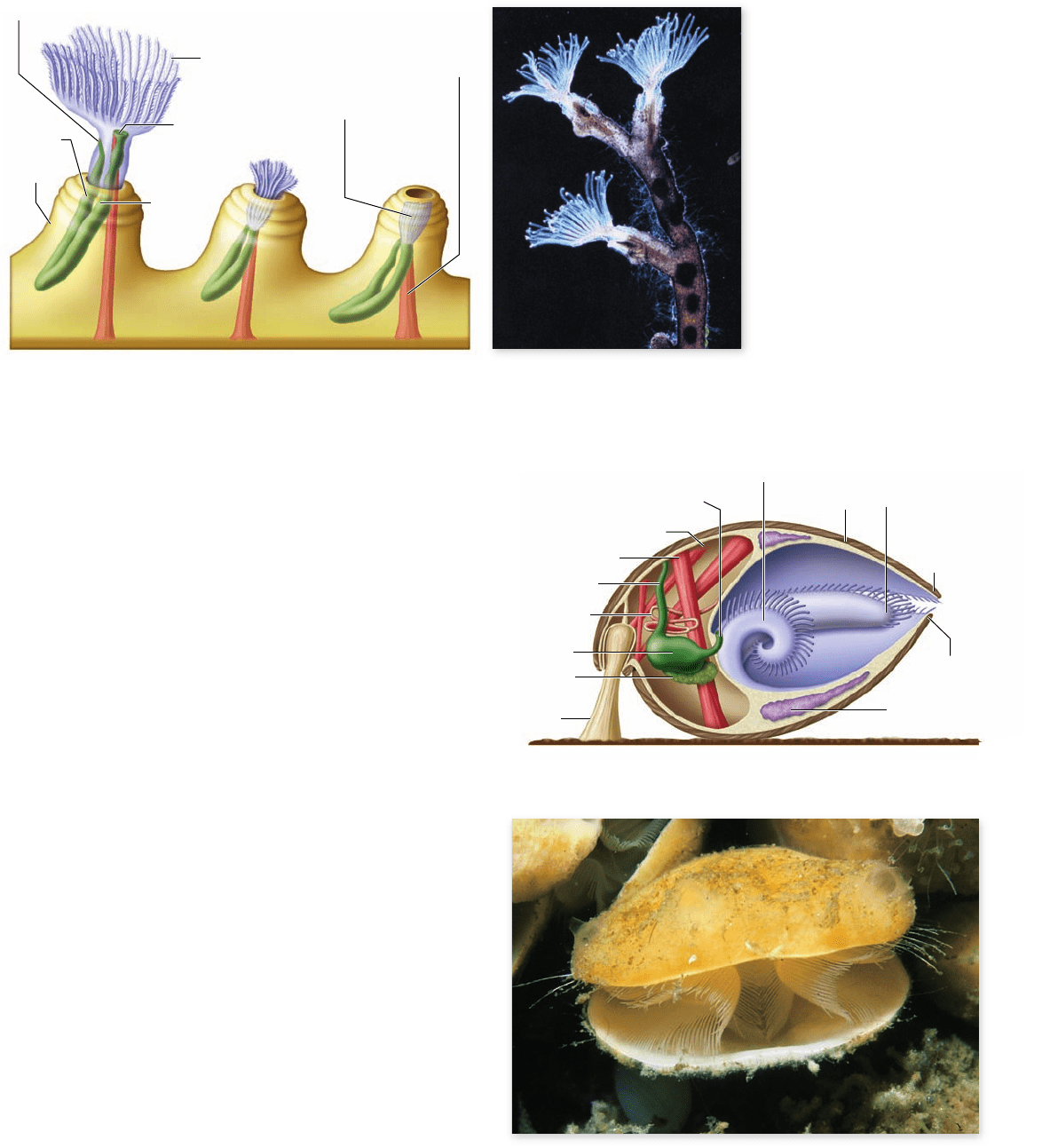
Figure 34.19
Bryozoans
(phylum Bryozoa). a. This
drawing depicts a small portion
of a colony of the freshwater
bryozoan genus Plumatella,
which grows on rocks. The
individual at the left has a fully
extended lophophore. The tiny
individuals disappear into the
zoecium when disturbed.
b. Plumatella repens, another
freshwater bryozoan.
Their common name, “moss-animals,” is a direct translation of
the Latin word bryozoa. The digestive system is U -shaped, with
the anus opening near the mouth, as in many sessile animals. The
alternative name Ectoprocta refers to the location of the anus
(proct) outside the ring of the lophophore.
The 4000 species of bryozoans include both marine and
freshwater forms. Each individual bryozoan—a zooid—secretes
a tiny chitinous chamber called a zoecium (plural, zoecia) that is
attached to rocks or other substrates such as the leaves of marine
plants and algae. Calcium carbonate is deposited in the wall of a
zoecium in many marine bryozoans, and in early geological
times, bryzoans formed reefs just as corals do today. A zooid can
divide or bud to create asexually another zooid beside the exist-
ing one so one wall of the new zooid’s zoecium is shared with that
of the existing one; this expanding group of zoecia constitutes a
colony. Individuals in the colony communicate chemically
through pores between the zoecia. Not all zoecia of a colony may
be identical; some are specialized for functions such as feeding,
reproduction, or defense.
The brachiopods and phoronids, phylum
Brachiopoda, are solitary lophophorates
Brachiopods, or lamp shells, superficially resemble clams be-
cause they have two calcified valves (figure 34.20). Recall that
the shells of bivalves are lateral, but in brachiopods, the valves
are dorsal and ventral. Many species attach to rocks or sand by
the pedicle (a stalk) that protrudes through an opening in one
shell, whereas in others one valve is cemented to the substrate
and the animal lacks a pedicle. The lophophore lies on the body,
between the shells. The gut in some brachiopods is U -shaped,
as in bryozoans, whereas in others there is no anus at all.
Slightly more than 300 species of brachiopods exist today,
but more than 30,000 fossil species are known. Because bra-
chiopods were common in the Earth’s oceans for millions of
years and because their shells fossilize readily, many are used as
index fossils, defining a particular geological period or sedi-
ment type.
Figure 34.20
Brachiopods (phylum Brachiopoda). a. All
the body structures except the pedicle lay within two calci ed
shells, or valves. b. The brachiopod Terebratulina septentrionalis is
slightly opened so the lophophore is visible.
chapter
34
Coelomate Invertebrates
677www.ravenbiology.com
rav32223_ch34_666-692.indd 677rav32223_ch34_666-692.indd 677 11/13/09 4:21:43 PM11/13/09 4:21:43 PM
Apago PDF Enhancer
Lophophore
Tentacles of
lophophore
Anus
Mouth
Nephridium
Body
wall
Intestine
Gonad
Nemertea
Loricifera
Kinorhyncha
Nematoda
Mollusca
Brachiopoda
Bryozoa (Ectoprocta)
Annelida
Rotifera
Cycliophora
Platyhelminthes
Tardigrada
Chordata
Echinodermata
Chaetognatha
Onychophora
Arthropoda
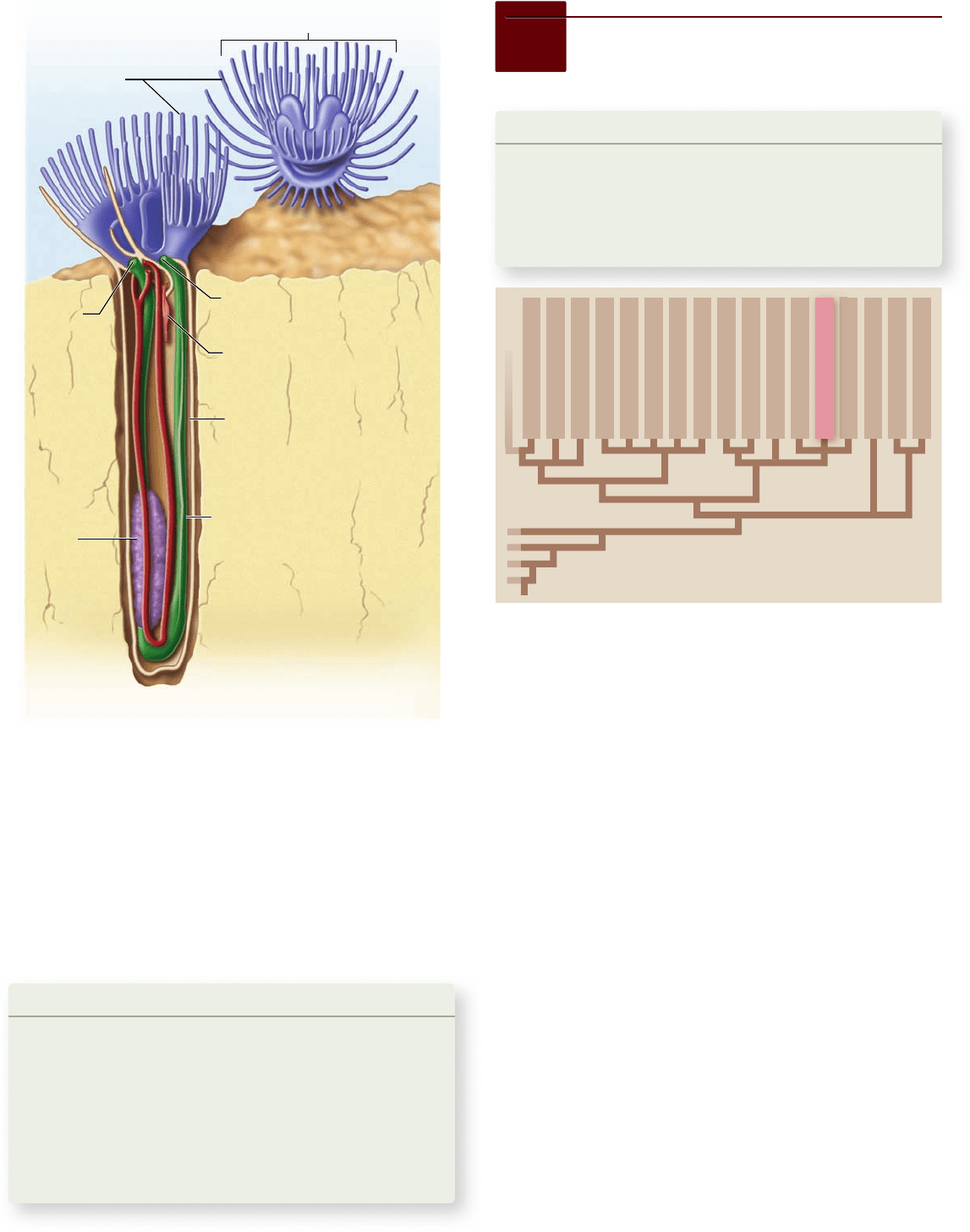
Figure 34.21
Phoronids. A phoronid lives in a chitinous
tube that the animal secretes. The lophophore consists of two
horseshoe-shaped ridges of tentacles and can be withdrawn into the
tube when the animal is disturbed.
Each phoronid (figure 34.21) secretes a chitinous tube
around itself from which it can extend its lophophore to feed.
The animal quickly withdraws into the tube when disturbed, as
some polychaete worms do. Only about 10 phoronid species are
known, ranging in length from a few millimeters to 30 cm. Indi-
viduals of some species lie buried in sand; others are attached to
rocks, either singly or in groups, forming loose colonies.
Learning Outcomes Review 34.4
The two phyla of lophophorates probably share a common ancestor, and
they show a mixture of protostome and deuterostome characteristics. The
lophophore is a characteristic feeding and exchange structure with ciliated
tentacles. Bryozoans are exclusively colonial, whereas brachiopods and
phoronids are solitary. Brachiopods have two shells with dorsal and ventral
valves, not lateral.
■ How is a U -shaped digestive tract an advantage to
bryozoans and brachipods?
34.5
Phylum Arthropoda:
The Arthropods
Learning Outcomes
Name the key features of arthropods.1.
List the four extant classes of arthropods and a 2.
characteristic that distinguishes them from one another.
Describe the advantages and drawbacks of 3.
an exoskeleton.
Arthropods are by far the most successful of all animals
(table 34.1) . Well over 1,000,000 species—about two-thirds
of all the named species on Earth— are members of the phy-
lum Arthropoda (figure 34.22) . One scientist recently esti-
mated that insects alone may comprise as many as 30 million
species. About 200 million individual insects are alive at any
time for each human! Insects (see figure 34.22) and other ar-
thropods abound in every habitat on the planet, but there are
few marine insects. Members of the phylum are small, gener-
ally a few millimeters in length, but adults range in size from
about 80 μm long (some parasitic mites) to 3 m across (Japa-
nese spider crabs).
Arthropods are of enormous economic importance, af-
fecting all aspects of human life. They pollinate crops and are
valuable as food for humans and other animals, but they also
compete with humans for food and damage crops. Diseases
spread by insects and ticks strike every kind of plant and animal,
including human beings. Insects are by far the most important
herbivores in terrestrial ecosystems: virtually every kind of
plant is eaten by one or more species.
Although our understanding of the phylogenetic rela-
tionships among the groups of arthropods and their relation-
ships to other animals may shift with new findings, taxonomists
currently recognize four extant classes (a fifth, the trilobites, is
extinct): chelicerates, crustaceans, hexapods, and myriapods.
Mouthparts of chelicerates are chelicerae (pincers), whereas
those of the other three classes are mandibles (biting jaws).
Mandibles are inferred to have arisen (probably from a pair of
limbs) in the common ancestor of crustaceans, hexapods, and
678
part
V
Diversity of Life on Earth
rav32223_ch34_666-692.indd 678rav32223_ch34_666-692.indd 678 11/13/09 4:21:48 PM11/13/09 4:21:48 PM
Apago PDF Enhancer
12.1%
Flies
12.1%
Butterflies,
moths
10.3%
Bees, wasps,
ants
8.6%
Other
insects
3.4% Crustaceans
5.2% Arachnids
12.1%
Other
arthropods
36.2%
Beetles
Antenna
Compound eye
Head
Thorax
Air sac
Malpighian
tubules
Abdomen
Rectum
Poison
sac
Sting
Midgut
Spiracles
Mouthparts
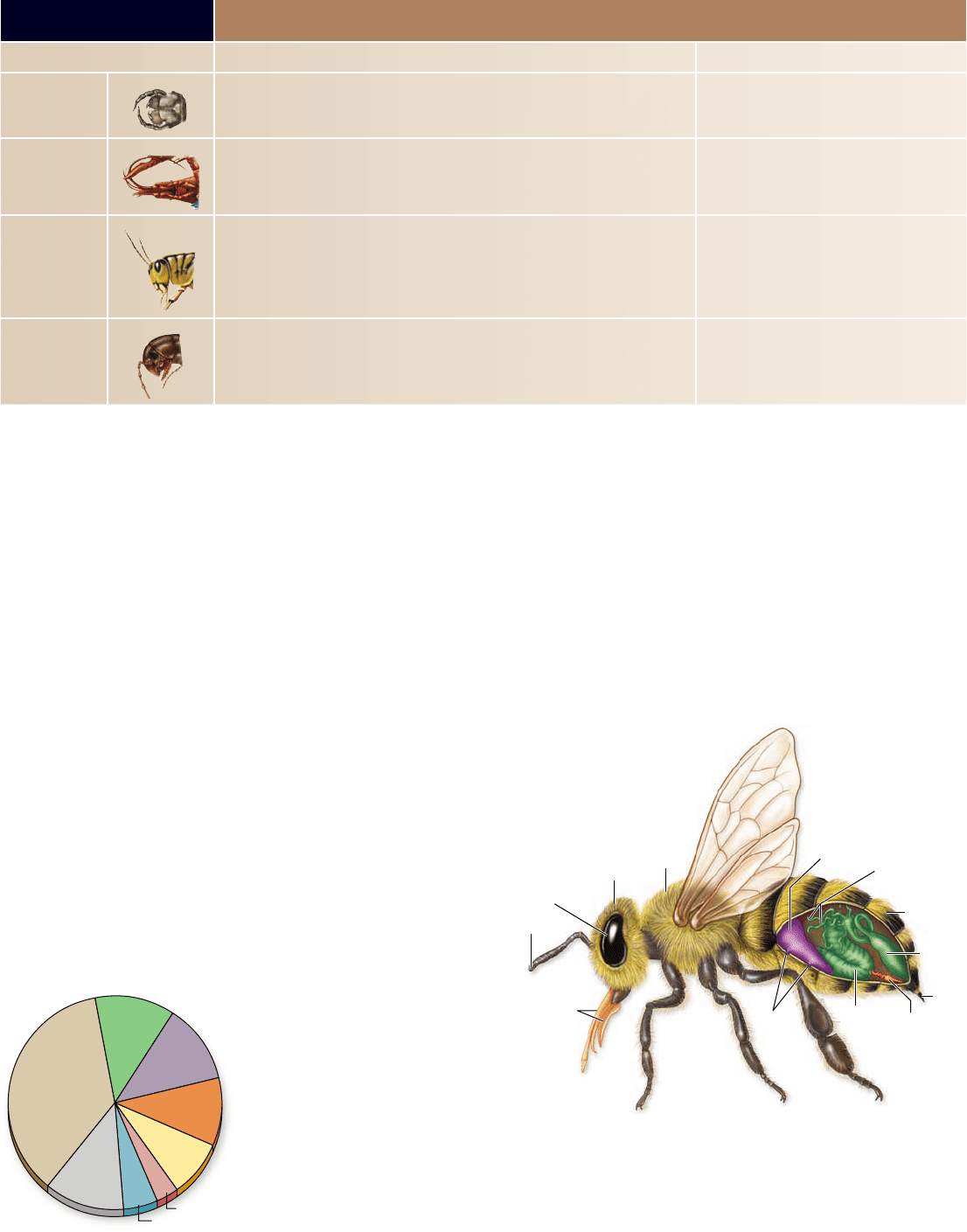
Figure 34.22
Arthropods are a
successful group. About
two-thirds of all named species
are arthropods. About 80% of
all arthropods are insects, and
about half of the named species
of insects are beetles.
myriapods, which means that these groups are more closely
related to one another than any of them is to chelicerates.
Arthropods exhibit key features
and organ systems
Part of arthropod success is explained by the modularity of the
segmented body, the exoskeleton, and the jointed appendages.
The advantages of segmentation were discussed in the section
on annelids. A hard exoskeleton confers protection against
predators, but it acts something like a straight-jacket, restrict-
ing motion. Joints in the appendages maintain protection while
providing some flexibility. With this system, arthropods have
developed many efficient modes of locomotion, both in the
oceans, where they originated, and on land, which they colo-
nized early in the Devonian period.
Segmentation
In members of some classes of arthropods, many body segments
look alike. In others, the segments are specialized into func-
tional groups, or tagmata (singular, tagma), such as the head,
thorax, and abdomen of an insect (figure 34.23). The fusion of
segments, known as tagmatization, is of central importance in
TABLE 34.1
Major Groups of the Phylum Arthropoda
Class Characteristics Members
Chelicerata Mouthparts are chelicerae (pincers or fangs). Spiders, mites, ticks, scorpions, daddy long-legs,
horseshoe crabs
Crustacea
Mouthparts are mandibles; appendages are biramous (“two-branched”); the head has two
pairs of antennae.
Lobsters, crabs, shrimps, isopods, barnacles
Hexapoda
Mouthparts are mandibles; the body consists of three regions: a head with one pair of
antennae, a thorax, and an abdomen; appendages are uniramous (“single-branched”).
Insects (beetles, bees, ies, eas, true bugs,
grasshoppers, butteries, termites), springtails
Myriapoda
Mouthparts are mandibles; the body consists of a head with one pair of antennae, and
numerous segments, each bearing paired uniramous appendages.
Centipedes, millipedes
Figure 34.23
Phylum Arthropoda. This bee, like all
insects and other arthropods, has a segmented body and jointed
appendages. An insect body is composed of three tagmata: head,
thorax, and abdomen. All arthropods have an exoskeleton made of
chitin. Some insects evolved wings that permit them to y.
the evolution of arthropods. Typically, the segments can be dis-
tinguished during larval development, but fusion in develop-
ment obliterates them. All arthropods have a distinct head; in
many crustaceans and chelicerates, head and thorax fuse to
form the cephalothorax, or prosoma.
An exoskeleton
The rigid external skeleton, or exoskeleton, is made of chitin
and protein. In any animal, the skeleton provides antagonism
for muscles (and in many animals, a surface for muscle attach-
ment), support for the body, and protection against physical
forces. The arthropod exoskeleton protects against water loss,
chapter
34
Coelomate Invertebrates
679www.ravenbiology.com
rav32223_ch34_666-692.indd 679rav32223_ch34_666-692.indd 679 11/13/09 4:21:54 PM11/13/09 4:21:54 PM
Apago PDF Enhancer
Head Thorax Abdomen
Antennae
Compound
eye
Spiracles
Tympanum
Aorta
Crop
Malpighian
tubules
Ovary
Rectum
Heart
Brain
Mouth
Gastric
ceca
Stomach
Nerve
ganglia
Ocellus
a.
b.
point, or inhibitor, for various actions, rather than a stimulator,
as it is in vertebrates.
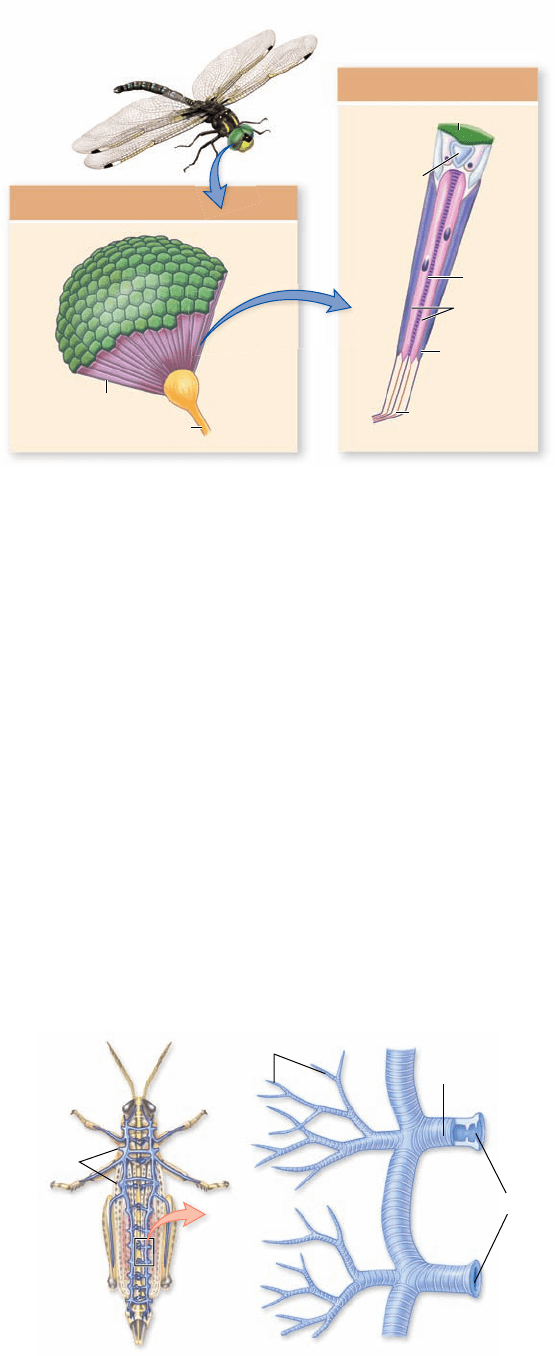
Compound eyes (figure 34.25) occur in many insects,
crustaceans, centipedes, and the extinct trilobites. They are
composed of hundreds or more independent visual units called
ommatidia (singular, ommatidium), each covered with a lens
and including a complex of eight retinular cells and a light-
sensitive central core, the rhabdom. Simple eyes, or ocelli (sin-
gular, ocellus) with single lenses, occur in some arthropods
including those with compound eyes. Ocelli distinguish light
from darkness. The ocelli of locusts and dragonflies function as
horizon detectors to help the insect visually stabilize flight.
Respiratory system
Marine arthropods such as crustaceans have gills, and marine
chelicerates (such as horseshoe crabs) have book gills, flaps un-
der the prosoma that appear to have evolved from legs. Some
tiny arthropods lack any structures for exchanging oxygen, and
their outer epithelium or gut have a respiratory function.
The respiratory system of most terrestrial arthropods
consists of small, branched, cuticle-lined ducts called
tracheae (singular, trachea) (figure 34.26) (the lining of which
is shed at ecdysis). Tracheae ultimately branch into very small
tracheoles, which are in direct contact with individual cells,
which was a powerful advantage in insects colonizing land. As
you learned in chapter 3, chitin is chemically similar to cellu-
lose, the dominant structural component of plants, and shares
with it properties of toughness and flexibility. The chitin and
protein of an arthropod exoskeleton provide a covering that is
very strong while being capable of flexing in response to the
contraction of muscles attached to it.
An exoskeleton has inherent limitations. As arthropods
increase in size, their exoskeletons must get disproportion-
ately thick to bear the pull of the muscles. If beetles were as
large as eagles, or crabs the size of cows, the exoskeleton
would be so thick that the animal would be unable to move its
great weight. Few terrestrial arthropods weigh more than a
few grams, but aquatic ones can be heavier because water, be-
ing denser than air, provides more support. Another limita-
tion is that, because the body is encased in a rigid skeleton,
arthropods periodically must undergo ecdysis, or molting.
Controlled by ecdysteroid hormones (chapter 46), molting
was explained in chapter 32. The anterior and posterior re-
gions of the digestive tract as well as the compound eyes are
covered with cuticle and therefore are also shed at ecdysis.
The animal is especially vulnerable during molting while the
exoskeleton is soft, and it may hide from predators until the
new exoskeleton hardens.
Jointed appendages
The name arthropod means “jointed feet”; all arthropods have
jointed appendages. Appendages may be modified into anten-
nae, mouthparts of various kinds, or legs.
One advantage of jointed appendages is that they can be
extended and retracted by bending. Imagine how difficult life
would be if your arms and legs could not bend! In addition,
joints serve as a fulcrum, or stable point, for appendage move-
ment, so leverage is possible. A small muscle force on a lever
can produce a large movement; for example, extending your
lower arm takes advantage of the fulcrum of the elbow. A small
contraction distance in your muscles moves your hand through
a large arc.
Circulatory system
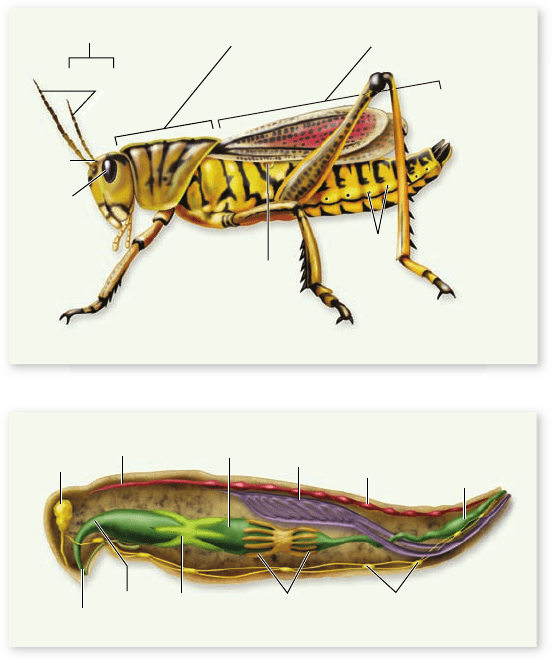
The circulatory system of arthropods is open. The principal
component of an insect’s circulatory system is a longitudinal
muscular vessel called the heart, which is near the dorsal sur-
face of the thorax and abdomen (figure 34.24) . When the
heart contracts, blood is pumped anteriorly. From there it
gradually flows through the spaces between the tissues toward
the posterior end. When the heart relaxes, blood returns to it
from those spaces through one-way valves in the posterior re-
gion of the heart.
Nervous system
The central feature of the arthropod nervous system is a double
chain of segmented ganglia along the animal’s ventral surface
(see figure 34.24). At the anterior end of the animal are three
fused pairs of dorsal ganglia, which constitute the brain; how-
ever, ventral ganglia (generally a pair per segment) control
much of the animal’s activities. Therefore, an arthropod can
carry out functions such as eating, moving, and copulating even
if the brain has been removed. The brain seems to be a control
Figure 34.24
A Grasshopper (order Orthoptera). This
grasshopper illustrates the major structural features of the insects,
the arthropod group with the greatest number of species.
a. External anatomy. b. Internal anatomy.
680
part
V
Diversity of Life on Earth
rav32223_ch34_666-692.indd 680rav32223_ch34_666-692.indd 680 11/13/09 4:21:56 PM11/13/09 4:21:56 PM
Apago PDF Enhancer
Corneal lens
Crystalline
cone
Rhabdom
Retinular
cells
Nerve fiber
Ommatidium
Compound Eye
Optic nerve
Ommatidium
Pigment
cell
Spiracles
Tracheoles
Spiracles
Trachea
Figure 34.25
The compound eye. The compound eyes in
insects are complex structures composed of many independent
visual units called ommatidia.
Excretory system
Various kinds of excretory systems occur in arthropods. In
aquatic arthropods, much of the waste may diffuse from the
blood in the gills.
Malpighian tubules, which occur in terrestrial insects,
myriapods, and chelicerates, are slender projections from the
digestive tract attached at the junction of the midgut and
hindgut (see figures 34.23, 34.24 ). Fluid passes through the
walls of the Malpighian tubules to and from the blood in which
the tubules are bathed. Nitrogenous wastes are precipitated as
concentrated uric acid or guanine, emptied into the hindgut,
and eliminated. Most of the water and salts in the fluid are re-
absorbed by the hindgut and rectum to be returned to the ar-
thropod’s body. This efficient conservation of water by
Malpighian tubules was another key adaptation facilitating in-
vasion of the land by arthropods.
Class Chelicerata includes spiders,
mites, ticks, and horseshoe crabs
In the class Chelicerata, with some 57,000 species, the most
anterior appendages, called chelicerae (singular, chelicera), may
function as fangs or pincers. The body of a chelicerate is di-
vided into two tagmata: the anterior prosoma, which bears all
the appendages, and the posterior opisthosoma, which con-
tains the reproductive organs. Chelicerates include familiar
largely terrestrial arthropods such as spiders, ticks, mites, scor-
pions, and daddy long-legs. However, 4000 known species of
mites and one species of spider live in freshwater habitats, and
a few mites live in the sea. Exclusively marine groups of chelic-
erates are horseshoe crabs and sea spiders.
In addition to a pair of chelicerae, a chelicerate has a pair
of pedipalps, and four pairs of walking legs on its prosoma.
The pedipalps (often simply called palps) resemble legs but
have one fewer segment and are not used for locomotion. In
male spiders, the pedipalps are copulatory organs; in scorpions,
they are large pincers; and in most other chelicerates, they are
sensorial, acting like the antennae of other arthropods.
Most chelicerates are carnivorous, but mites are largely
herbivorous. Aside from the daddy long-legs, which can ingest
small particles, most cannot consume solid food. They subsist on
liquids, including solid food that they liquefy by injecting with
digestive enzymes and then suck up with the muscular pharynx.
Horseshoe crabs comprise four species that live off the
North American Atlantic coast and in Southeast Asia. Sea spi-
ders are such strange marine animals that some authorities ex-
clude them from the Chelicerata. Most are small, but some can
reach 150 mm or so across; many live in association with other
marine animals, such as hydroids.
Order Araneae: Spiders
The 35,000 named species of spiders (order Araneae) play a ma-
jor role in virtually all terrestrial ecosystems. They are particu-
larly important as predators of insects and other small animals.
Spiders hunt their prey or catch it in silk webs of remarkable
diversity. Silk is formed from a fluid protein that is forced out of
spinnerets on the posterior portion of the spider’s abdomen.
Trap-door spiders construct silk-lined burrows with lids, seizing
allowing oxygen and carbon dioxide to diffuse across the plas-
ma membranes. Because insects depend on the respiratory
system rather than the circulatory system to carry oxygen to
their tissues, all parts of the body must be near a respiratory
passage. Along with the weight of the exoskeleton, this places
severe limitations on arthropod size.
Air passes into the tracheae through openings in the exo-
skeleton called spiracles (see figures 34.23, 34.24, and 34.26),
which, in most insects, can be opened and closed by valves. The
ability to prevent water loss by closing the spiracles was a key
adaptation that facilitated the arthropod invasion of land.
Many spiders have book lungs instead of or in addition to
tracheae. A book lung is a series of leaflike plates within a
chamber into which air is drawn and from which it is expelled
by muscular contraction.
Figure 34.26
Tracheae and tracheoles. Tracheae and
tracheoles are connected to the exterior by openings called spiracles
and carry oxygen to all parts of a terrestrial insect’s body.
chapter
34
Coelomate Invertebrates
681www.ravenbiology.com
rav32223_ch34_666-692.indd 681rav32223_ch34_666-692.indd 681 11/13/09 4:21:57 PM11/13/09 4:21:57 PM