
Raven P.H., Johnson G.B., Mason K.A. Biology (Ninth Edition)
Подождите немного. Документ загружается.

Apago PDF Enhancer
Porifera
Ctenophora
Cnidaria
Brachiopoda
Cycliophora
Platyhelminthes
Acoela
Bryozoa (Ectoprocta)
Micrognathozoa
Rotifera
Nematocyte
with nematocyst
Hydra
Trigger
Discharged
nematocyst
Undischarged
nematocyst
Tubu le
Nematocyte
Gastrodermis Epidermis
Tentacles
Mouth
Sensory
cell
Mesoglea
3.3 mm
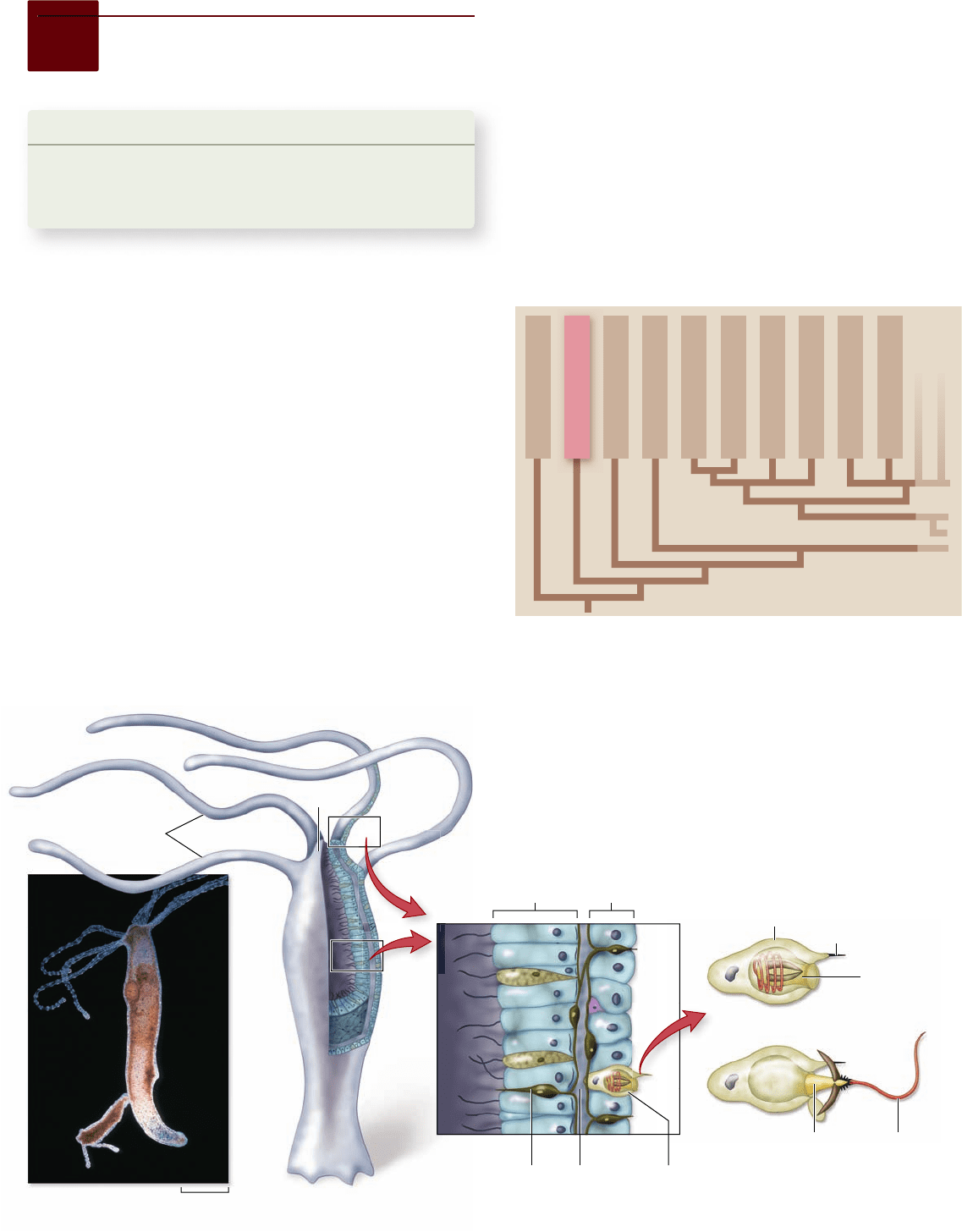
Figure 33.2
Phylum Cnidaria: Cnidarians.
The cells of a
cnidarian such as this Hydra are organized into specialized tissues. The
interior gut cavity is specialized for extracellular digestion—that is,
digestion begins within the gut cavity rather than within a cell. The
epidermis contains nematocysts for defense and for capturing prey. This
Hydra is undergoing asexual reproduction—budding off a new individual.
All cnidarians, phylum Cnidaria, are carnivores
Most of the 10,000 species of cnidarians are marine; a very few
live in fresh water. The bodies of these fascinating and simply
constructed diploblastic animals are made of distinct tissues, al-
though they do not have organs. Despite having no reproductive,
circulatory, digestive, or excretory systems, cnidarians reproduce,
exchange gas, capture and digest prey, and distribute the resulting
organic molecules to all their cells. A cnidarian has no concentra-
tion of nervous tissue that could be considered a brain or even a
ganglion. Rather, its nervous system is a latticework, the cells hav-
ing junctions like those of bilaterians. All cnidarians have nervous
receptors sensitive to touch, and some have gravity and light re-
ceptors, which include, in a few species, image-forming eyes.
Cnidarians capture their prey (which includes fishes,
crustaceans, and many other kinds of animals) with nemato-
cysts (figure 33.2) , microscopic intracellular structures unique
33.2
Eumetazoa: Animals
with True Tissues
Learning Outcomes
Explain the defining feature of cnidarians.1.
Differentiate between cnidarians and ctenophores.2.
Discuss the question of symmetry of ctenophores.3.
The Eumetazoa contains animals that evolved the first key
transition in the animal body plan: distinct tissues. The em-
bryonic cell layers differentiate into the tissues of the adult
body, giving rise to the body plan characteristic of each group
of animals.
Recall that the outer covering of the body (the epidermis)
and the nervous system develop from the embryonic ectoderm,
and the digestive tissue (called the gastrodermis) develops
from the embryonic endoderm. In the Bilateria, the embryonic
mesoderm, which lies between endoderm and ectoderm, forms
the muscles.
Eumetazoans also evolved body symmetry. Metazoans
living sessile on the ocean floor or free-living in the water may
be radially symmetrical. One phylum consisting of penta-
radially symmetrical animals (those with fivefold symmetry),
the Echinodermata, are dealt with in chapter 34. Some animals
of the phylum Cnidaria, comprising hydroids, jellyfish, sea
anemones, and corals, are clearly radially symmetrical and
some are biradially symmetrical (see chapter 32). Members of
the phylum Ctenophora, the comb jellies, are considered by
some people to be radially symmetrical but by others to be
bilaterally symmetrical.
652
part
V
Diversity of Life on Earth
rav32223_ch33_649-665.indd 652rav32223_ch33_649-665.indd 652 11/13/09 3:23:11 PM11/13/09 3:23:11 PM
Apago PDF Enhancer
Gastrovascular cavity
Mesoglea
Gastrodermis
Tentacles
Polyp
Medusa
Epidermis
Mesoglea
Gastrodermis
Gastrovascular cavity
Mouth
Mouth
Epidermis
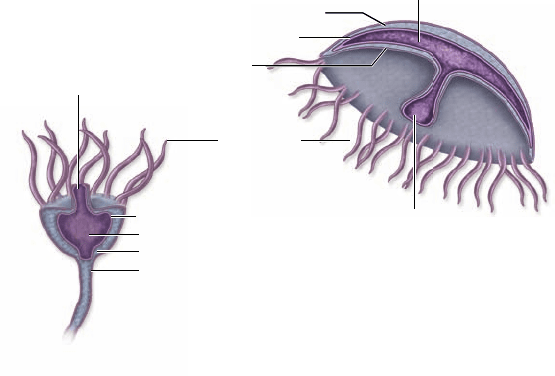
Figure 33.3
Two body forms of cnidarians:
The polyp and the medusa.
In addition to the hydrostatic skeleton of all polyps, those
of many species build an exoskeleton of chitin or calcium car-
bonate around themselves; in many colonial species, the skele-
ton links the members of the colony. The polyps of a smaller
number of species secrete internal skeletal elements. Polyps of
some groups of cnidarians, such as sea anemones, have no skel-
eton at all. All medusae are solitary (that is, they do not form
colonies) and form no skeleton.
The cnidarian life cycle
Some cnidarians occur only as polyps, and others exist only as
medusae, but many alternate between these two phases (see
figure 33.3); both phases consist of diploid individuals. In gen-
eral, in species having both polyp and medusa in the life cycle,
the medusa forms gametes. The sexes are separate; this condi-
tion, known as gonochorism , means an individual is either male
or female. An egg and a sperm unite to form a zygote, which
develops into a planktonic ciliated planula larva that metamor-
phoses into a polyp. The polyp produces medusae asexually.
Dispersal occurs in both medusa and larvae . In most species
with such a life cycle, a polyp may also produce other polyps
asexually; if they remain attached to one other, the resulting
group is referred to as a colony.
In a small number of species, the planula produced by
medusae may develop directly or indirectly into another me-
dusa without passing through the polyp stage. More commonly,
there is a polyp but no medusa in the life cycle. In such cnidar-
ians, the polyp can form gametes, and the resulting planula will
develop into another polyp. In some, but by no means all, of
these species, the polyp can also produce other polyps asexually,
by dividing, budding, or breaking off bits of itself that regener-
ate (grow the missing parts).
Digestion
A major evolutionary innovation in cnidarians is extracellular
digestion of food inside the animal. Recall that in a sponge, di-
gestion occurs within choanocytes, so food particles must be
small enough to be engulfed by a choanocyte. In a cnidarian,
digestion takes place partly in the gastrovascular cavity. Diges-
tive enzymes, released from cells lining the cavity, partially
break down food. Other cells lining the space engulf those food
fragments by phagocytosis. This allows a cnidarian to feed on
prey larger than a sponge can handle.
Nematocysts
Cnidarians capture food with the aid of nematocysts, micro-
scopic stinging capsules unique to the phylum (see figure 33.2).
Although often referred to as “stinging cells,” they are capsules,
each secreted within a cell called a nematocyte. Cnidarians may
be morphologically simple, but nematocysts are the most com-
plex structures secreted by single animal cells. When appropri-
ately stimulated, the closure at the end of the capsule springs
open, and a tubule is emitted. Nematocyst discharge is one of
the fastest cellular processes in nature. The mechanism of dis-
charge of a nematocyst is unknown—several hypotheses for it
have been proposed. Although the action of a nematocyst is
often described as harpoon-like, the tubule actually everts
(turns inside-out). It may penetrate or wrap around an object;
the tubules of some nematocysts are barbed and some carry
to the phylum. Food captured by a cnidarian is brought to the
mouth by the tentacles that ring the mouth.
Basic body plans
A cnidarian exhibits one of two body forms: the polyp and the
medusa (figure 33.3) . A polyp is cylindrical, with a mouth sur-
rounded by tentacles at the end of the cylinder opposite where it
is attached. Attachment in most solitary polyps is to a firm sub-
stratum, but in those that are part of a colony, it is to the mass of
common colonial tissue. A medusa is discoidal or umbrella-
shaped, with a mouth surrounded by tentacles on one side; most
live free in the water . These two seemingly quite different body
forms share the same morphology—the mouth opens into a sac-
like gastrovascular cavity and is surrounded by tentacles.
The cnidarian body plan has a single opening leading to
the gastrovascular space, which is the site of digestion, most gas
exchange, waste discharge, and, in many cnidarians, formation
of gametes. The body wall is composed of two layers: the epi-
dermis, which covers the surfaces in contact with the outside
environment, and the gastrodermis, which covers the gastrovas-
cular cavity. Between these two layers is the mesoglea, which
varies from acellular, being no more than a glue holding gastro-
dermis to epidermis in Hydra , to thick and rubbery with many
cells in large medusae called jellyfish (see figures 33.2, 33.3).
The gastrovascular space also serves as a hydrostatic skel-
eton (see chapter 47). A hydrostatic skeleton serves two of the
roles that a skeleton made of bone or shells does: it provides a
rigid structure against which muscles can operate, and it gives
the animal shape. For muscles to operate against it, the fluid-
filled space must be closed sufficiently tightly so the fluid is
under pressure and does not escape when muscles contract
around the space. Think of the gastrovascular space of a cnidar-
ian full of water like an inflated, elongated, air-filled balloon.
Because it is firm, muscles that shorten it cause it to broaden,
and muscles that decrease its diameter lengthen it. However, if
you inflate the balloon with air, but then do not hold the open-
ing closed, the air will escape and the balloon will become flac-
cid. Similarly, when a cnidarian contracts greatly, it must open
its mouth so water can escape. However, the mouth can close
sufficiently tightly to retain water in the gastrovascular cavity,
so the animal is turgid and can bend and extend its tentacles.
chapter
33
Noncoelomate Invertebrates
653www.ravenbiology.com
rav32223_ch33_649-665.indd 653rav32223_ch33_649-665.indd 653 11/13/09 3:23:13 PM11/13/09 3:23:13 PM
Apago PDF Enhancer
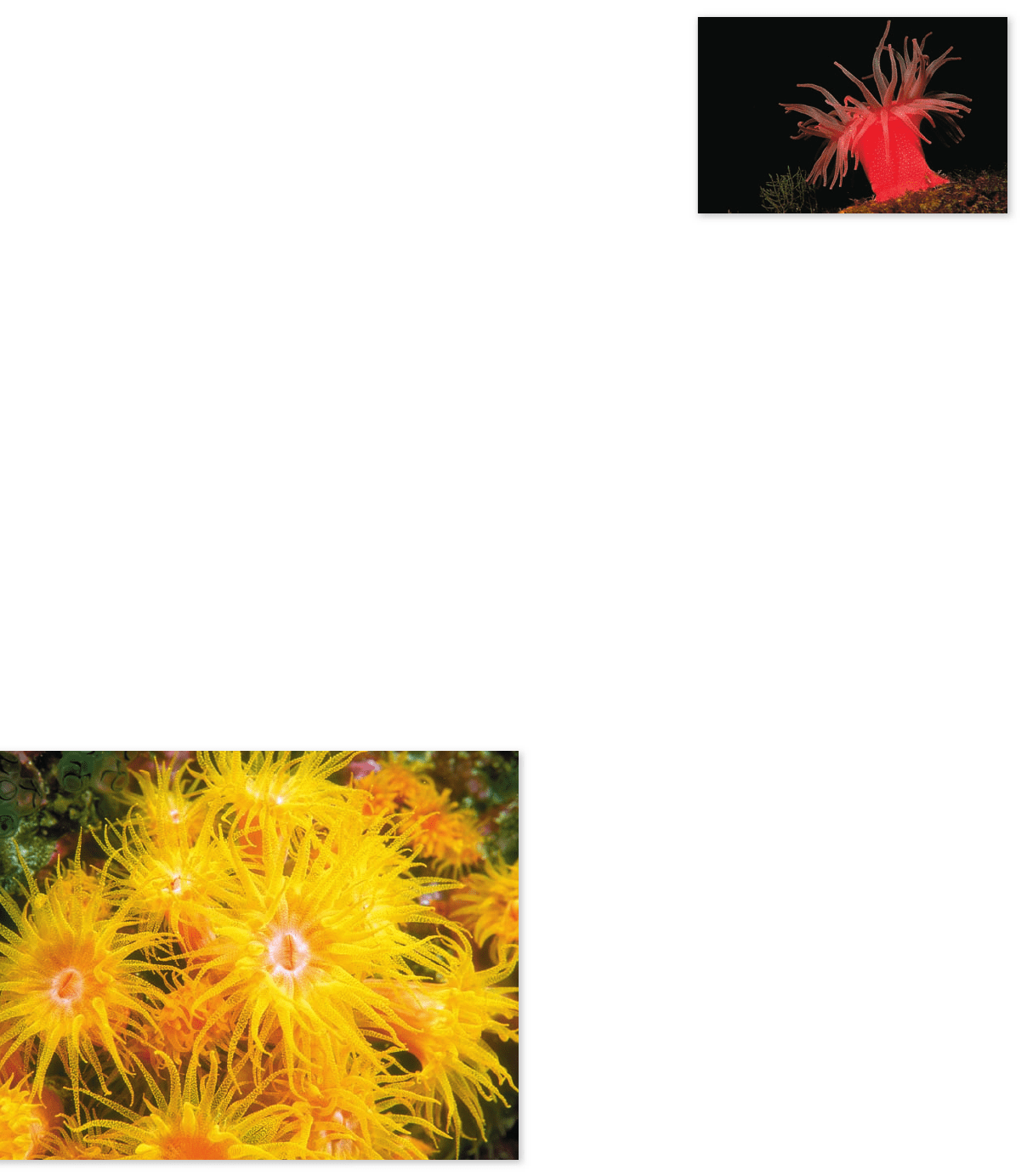
Figure 33.5
Class Anthozoa.
Crimson anemone,
Cribrinopsis
fernaldi.
An anthozoan polyp differs from a polyp of the other class-
es in its gastrovascular cavity being compartmentalized by radi-
ally arrayed, longitudinal sheets of tissue called mesenteries. The
way they are arranged imparts the biradial symmetry to these
animals mentioned in chapter 32. The gametes of an anthozoan
develop in the mesenteries. The tentacles of an anthozoan are
hollow, whereas those of many other cnidarians are solid.
Sea anemones (see figure 33.5) constitute a group of just
over 1000 species of highly muscular and relatively complex
soft-bodied anthozoans. Living in waters of all depths through-
out the world, they range from a few millimeters to over a me-
ter in diameter, and many are equally long.
Most corals are anthozoans, and most hard corals (about
1400 species, see figure 33.4 ) are closely related to sea anemones.
The polyp of a coral secretes an exoskeleton of calcium carbon-
ate around and under itself (this is the same material of which
chalk is composed); as the individual or colony grows upward,
dead skeleton accumulates below it. In shallow water of the trop-
ics, these accumulations form coral reefs. Most waters in which
coral reefs develop are nutrient-poor, but the corals are able to
grow well because they contain within their cells symbiotic dino-
flagellates (zooxanthellae) that photosynthesize and provide en-
ergy for the animals . Obviously coral reefs are restricted to water
sufficiently shallow for sunlight to reach the living animals (typi-
cally no more than 100 m), but corals that do not form reefs can
grow deeper—to about 5000 m. Only about half the species of
hard corals participate in forming reefs.
Coral reefs are economically important, serving as refuges
for the young of many species of crustaceans and fishes that are
eaten by humans, as well as protecting coasts of many tropical
islands. But they are threatened by global climate change . Water
warmer than usual can cause the symbiosis with zooxanthellae to
break down, a phenomenon known as “coral bleaching” because
the underlying white skeleton of the animal becomes visible
through its body in the absence of the symbionts. Bleaching does
not always kill a coral, but it is stressful. As carbon dioxide in the
atmosphere rises, it dissolves in water, forming carbonic acid,
which lowers the pH of the water. This makes calcium carbonate
less available; some species of calcifying marine plants and ani-
mals, including corals, have been shown to form less robust skel-
etons, and to form them more slowly, as pH drops.
Some “soft corals” secrete needles of calcium carbonate
much like sponge spicules; these sclerites form a case around the
polyp or are embedded in their tissues, presumably providing
protection against predation. Some of these animals also secrete
a horny rod that provides flexible support to the members of the
colony growing around it (sea fans are such colonies).
venom. In a very few species, the venoms are strong enough to
kill a human.
Many thousand nematocytes typically are part of the
epidermis of each tentacle. Each one can be used only once. In
some types of cnidarians, nematocysts occur in parts of the
body other than the tentacles, including in the gastrovascular
cavity, where they may aid in digestion. In addition to
being used offensively, nematocysts are the only defense of
cnidarians—they are the reason jellyfish and fire coral sting.
Some cnidarians have stinging capsules of types other than
nematocysts, which are termed cnidae—hence the name of
the phylum, Cnidaria.
Cnidarians are grouped into
four—or ve—classes
Traditionally, three classes of Cnidaria were recognized: An-
thozoa (sea anemones, corals, sea fans), Hydrozoa (hydroids,
Hydra, Portuguese man-of-war), and Scyphozoa (jellyfish).
Now nearly all biologists accept that some scyphozoans are suf-
ficiently distinct in life cycle and morphology that they consti-
tute their own class, Cubozoa (box jellies), some of which have
a sting sufficiently toxic to kill humans. Less widely accepted is
the separation of some other scyphozoans into their own class,
Staurozoa (star jellies).
Class Anthozoa: Sea anemones and corals
The largest class of Cnidaria is Anthozoa, consisting of ap-
proximately 6200 species of solitary and colonial polyps. They
include stony corals (figure 33.4) , soft-bodied sea anemones
(figure 33.5), and other groups known by such fanciful names as
sea pens, sea pansies, sea fans, and sea whips. Many of these
names reflect the plantlike appearance of the individual polyps
or colonies.
Figure 33.4
Stony corals.
Tubastraea aurea, a non-reef
building species from Malaysia.
654
part
V
Diversity of Life on Earth
rav32223_ch33_649-665.indd 654rav32223_ch33_649-665.indd 654 11/13/09 3:23:14 PM11/13/09 3:23:14 PM
Apago PDF Enhancer
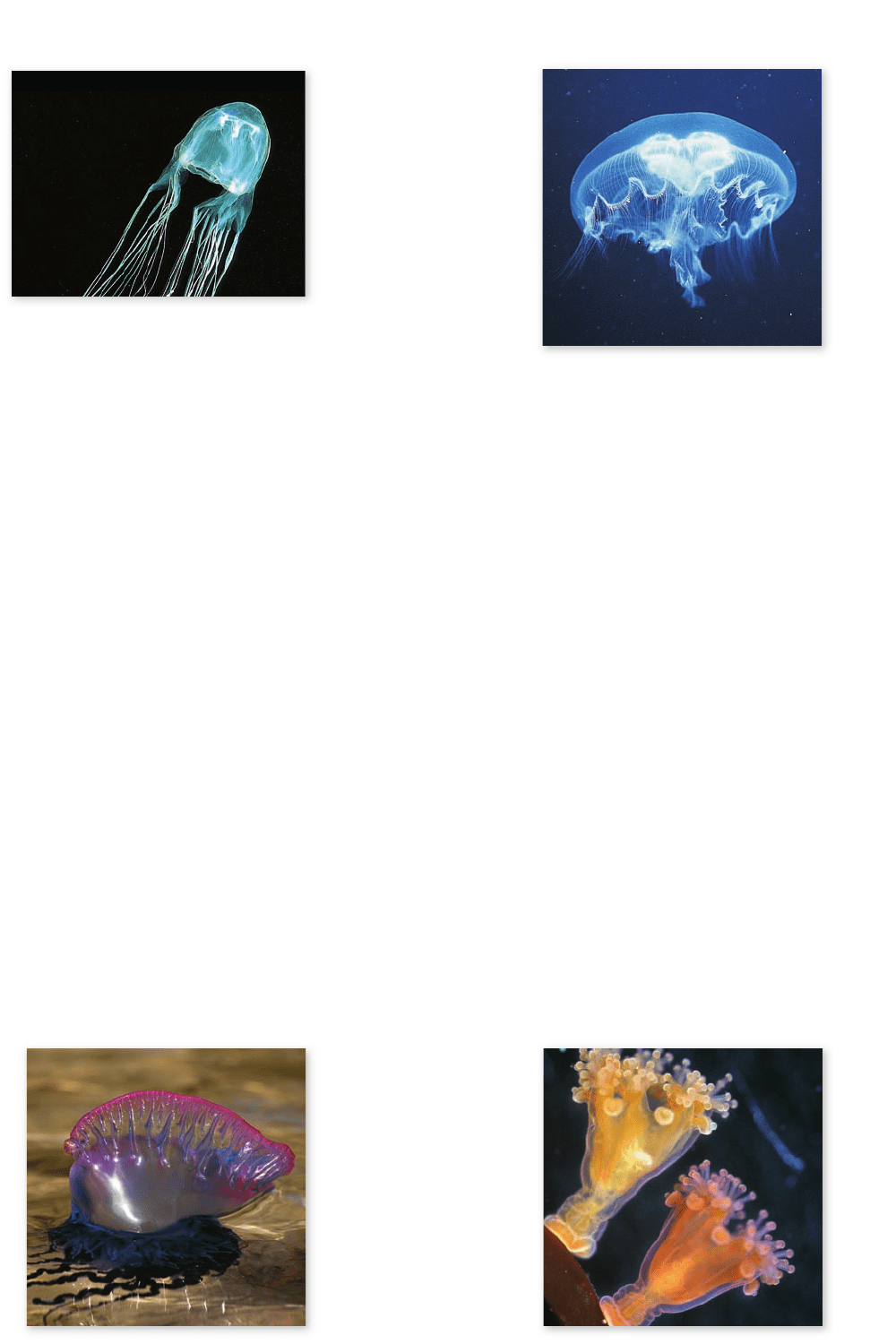
Figure 33.8
Class Scyphozoa.
Aurelia aurita, a
jelly sh.
Figure 33.6
Class Cubozoa.
Chironex eckeri,
a box jelly.
secretions. It can also somersault—by bending over and at-
taching to the substrate by its tentacles, then looping over to a
new location. If the polyp detaches from the substrate, it can
float to the surface.
Class Scyphozoa: The jellyfish
In the approximately 200 species of class Scyphozoa, the medusa
is much more conspicuous and complex than the polyp. Although
many scyphomedusae are essentially colorless (figure 33.8) , some
are a striking orange, blue, or pink. The polyp is small, incon-
spicuous, simple in structure, and typically white in color, but is
entirely lacking in a few scyphozoans that live in the open ocean.
The epithelium around the margin of a jellyfish contains
a ring of muscle cells that can contract rhythmically to propel
the animal through the water by jetting water from the gastro-
vascular cavity or space beneath it; by contracting those on just
one side, the animal can steer. A scyphomedusa (Cyanea capilata)
was the killer in the Sherlock Holmes tale “The Lion’s Mane,”
but, although some can inflict pain on humans, they are un-
likely to be capable of killing.
Class Staurozoa: The star jellies
Among the reasons the 50 species of this group were separated
from the Scyphozoa and placed in their own class (Staurozoa) is
that the animal resembles a medusa in most ways but is attached
to the substratum by a sort of stalk that emerges from the side
opposite the mouth (figure 33.9). In addition, in all staurozoans
known, the planula larva creeps rather than swims or drifts.
Class Cubozoa: The box jellies
As their name implies, medusae of class Cubozoa are box-
shaped, with a tentacle or group of tentacles hanging from each
corner of the box (figure 33.6) . Most of the 40 or so species are
only a few centimeters in height, although some reach 25 cm.
Box jellies are strong swimmers and voracious predators of fish
in tropical and subtropical waters; both of these facts are related
to some cubozoans having image-forming eyes! The stings of
some species can be fatal to humans. The polyp stage is incon-
spicuous and in many cases unknown.
Class Hydrozoa: The hydroids
Most of the approximately 2700 species of class Hydrozoa have
both polyp and medusa stages in their life cycle (see figure 33.3).
The polyp stage of most species is colonial. The polyps of a
colony may not be identical in structure or function: some may
be specialized to feed but be unable to reproduce, whereas the
opposite may be true of others (they are nourished by material
transported from feeding polyps through the gastrovascular
space connecting members of the colony). The Portuguese
man-of-war (figure 33.7 ) is not a jellyfish, but is a floating col-
ony of highly integrated polypoid and medusoid individuals!
Some marine hydroids and medusae are bioluminescent.
Hydrozoa is the only class of Cnidaria with freshwater
members. A well-known hydroid is the freshwater Hydra ,
which is exceptional not only in its habitat, but in having no
medusa stage and being solitary (see figure 33.2). Each polyp
attaches by a basal disk, on which it can glide, aided by mucous
Figure 33.9
Star jelly.
Stalked
jelly sh (Haliclystus
auricula).
Figure 33.7
Portuguese
man-of-war
( Physalia
physalis).
This
species has a very
painful sting.
chapter
33
Noncoelomate Invertebrates
655www.ravenbiology.com 655
rav32223_ch33_649-665.indd 655rav32223_ch33_649-665.indd 655 11/13/09 3:23:17 PM11/13/09 3:23:17 PM
Apago PDF Enhancer
Porifera
Ctenophora
Cnidaria
Brachiopoda
Cycliophora
Platyhelminthes
Acoela
Bryozoa (Ectoprocta)
Micrognathozoa
Rotifera
Porifera
Ctenophora
Cnidaria
Brachiopoda
Cycliophora
Platyhelminthes
Acoela
Bryozoa (Ectoprocta)
Micrognathozoa
Rotifera
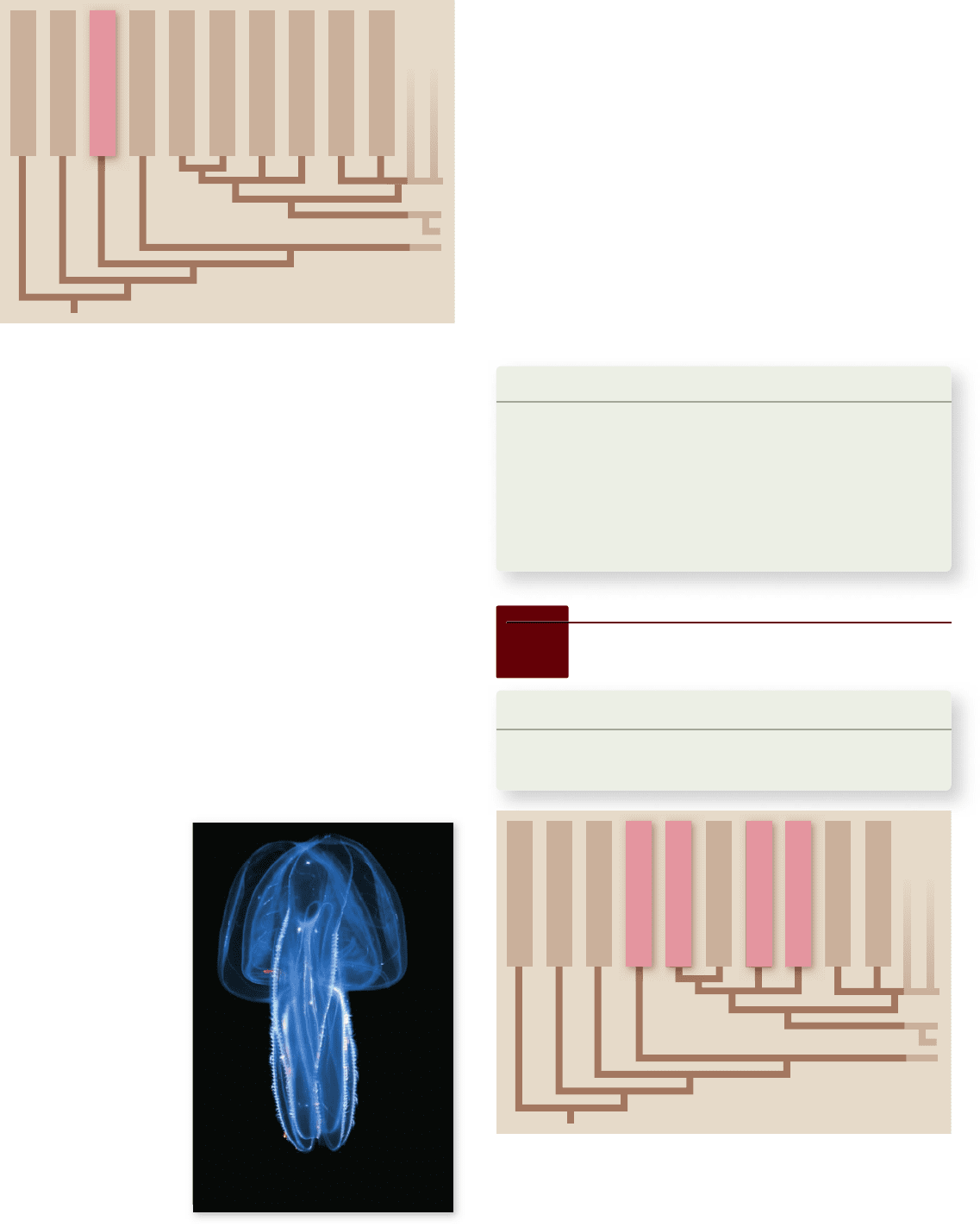
The comb jellies, phylum Ctenophora,
use cilia for movement
Pelagic members of the small marine phylum Ctenophora
range from spherical to ribbon-like and are known as comb
jellies, sea walnuts, or sea gooseberries. Abundant in the
open ocean, most of these animals are transparent and only
a few centimeters long, but rare ones are deeply pigmented
and reach 1 m in length. They propel themselves through
the water with eight rows of comblike plates of fused cilia
that beat in a coordinated fashion, scattering light so they
appear like rainbows (figure 33.10) . Ctenophores are the
largest animals that use cilia for locomotion. Many cteno-
phores are bioluminescent, giving off bright flashes of light
that are particularly evident in the deep sea or on the surface
of the ocean at night. Most ctenophores have two long, re-
tractable tentacles used in prey capture. The epithelium of
the tentacles contains colloblasts, a type of cell that bursts
to discharge a strong adhesive material on contact with ani-
mal prey.
The phylogenetic position of Ctenophora is unclear. It
was formerly considered closely related to Cnidaria because of
the gelatinous, medusa-like form of most species. However,
ctenophores lack nematocysts and are structurally more com-
plex than cnidarians. They have anal pores through which wa-
ter and other substances can exit the body. Although ctenophores
have been considered diploblasts with radial symmetry, recent
developmental studies have demonstrated them to have muscle
cells derived from mesoderm, which means they should be con-
sidered triploblasts, like bilaterians. The two tentacles placed
on opposite sides of a ctenophore’s body impart some bilateral-
ity to them, but whether their symmetry should be considered
biradial, like that of sea anemones, is unclear. A recent molecu-
lar phylogeny places ctenophores at the base of the animal tree
of life, as the sister group to all other metazoans. If this is borne
out, it implies that the ancestral animal was triploblastic and
bilaterally symmetrical.
Learning Outcomes Review 33.2
Members of phylum Cnidaria have nematocysts, capsules used in defense
and prey capture, and are radially symmetrical. Members of phylum
Ctenophora lack nematocysts; they propel themselves by means of eight
rows of comblike plates of fused cilia. Ctenophores have cells called
colloblasts that assist in prey capture. The symmetry of ctenophores is a
subject of debate.
■ Why would triploblasty be important to phylogeny?
33.3
The Bilaterian Acoelomates
Learning Outcomes
List the distinguishing features of bilaterian flatworms. 1.
Explain why the scolex of a tapeworm is not a head.2.
The Bilateria is characterized by a key transition in the animal
body plan—bilateral symmetry—which allowed animals to
achieve high levels of specialization within parts of their bodies,
Figure 33.10
A comb jelly (phylum
Ctenophora).
Note
the iridescent rows of
comblike plates of
fused cilia.
656
part
V
Diversity of Life on Earth
rav32223_ch33_649-665.indd 656rav32223_ch33_649-665.indd 656 11/13/09 3:23:29 PM11/13/09 3:23:29 PM
Apago PDF Enhancer
10 mm
Reproductive
System
Nervous
System
Excretory
System
Mouth
Protruding pharynx
Testi s
Testi s
Ovary
Epidermis
Parenchymal
muscle
Circular
muscles
Intestine
Longitudinal
muscles
Oviduct
Nerve cord
Sperm
duct
Eyespot
Intestine
Anterior
cerebral
ganglion
Nerve
cord
such as the concentration of sensory structures at the anterior.
(Even if ctenophores are truly bilateral as just mentioned, they
lack these other specializations.)
As discussed in chapter 32, bilaterians are traditionally
divided into acoelomates, pseudocoelomates, and coelo-
mates. The acoelomate and pseudocoelomate conditions
appear to have evolved multiple times; thus these conditions
are convergent and not homologous and do not necessarily
indicate close evolutionary relationship among the animals
sharing that anatomy. Nonetheless, the state of the internal
part of the animal’s body does provide information about
how the animals are constructed and how they live. In this
chapter, we cover acoelomates and pseudocoelomates; in
the next chapter we cover coelomates, which are probably
monophyletic.
Structurally, the simplest bilaterians are the acoelomates,
which lack an internal cavity other than the digestive tract. The
largest phylum of the group is the Platyhelminthes.
The atworms, phylum Platyhelminthes,
have an incomplete gut
The phylum Platyhelminthes consists of some 20,000 species.
These ciliated, soft-bodied animals are flattened dorsoventrally,
the anatomy that gives them the name flatworms. Flatworm
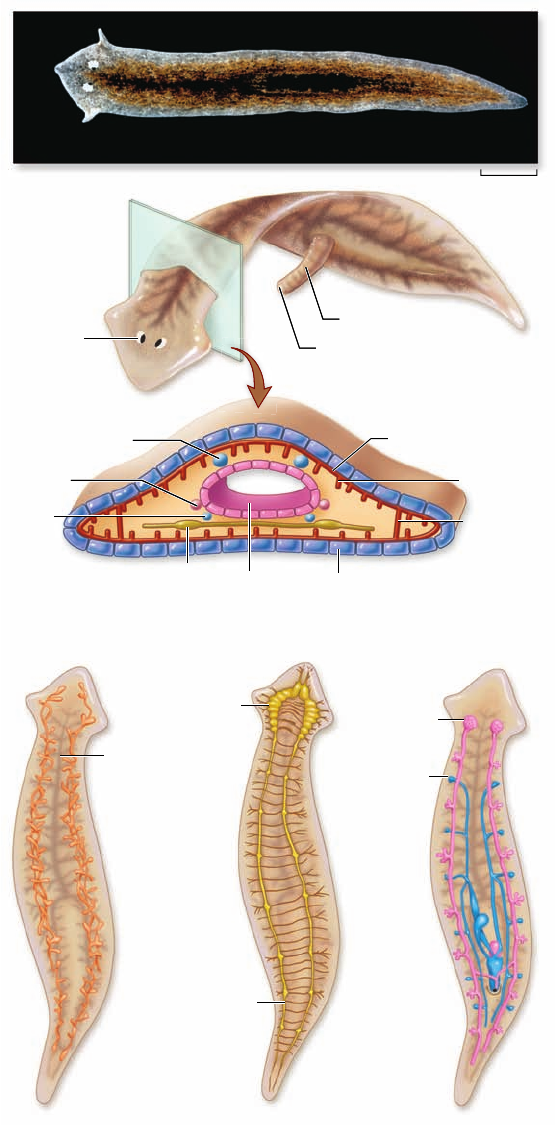
bodies are solid aside from an incomplete digestive cavity
(figure 33.11) . Although among the morphologically simplest
of bilaterally symmetrical animals, they have some complex
structures, like their reproductive apparatus, and they have the
most complex life cycles among animals.
Free-living flatworms occur in a wide variety of marine,
freshwater, and even moist terrestrial habitats. They are carni-
vores and scavengers, eating small animals and bits of organic
debris. They move around by means of ciliated epithelial cells,
which are particularly concentrated on their ventral surfaces,
but they also have well-developed musculature. By contrast,
many species of flatworms are parasitic, living inside the bodies
of other animals. Flatworms range in length from 1 mm or less
to many meters (some tapeworms).
Digestion in flatworms
Most flatworms have only a single opening for their digestive
cavity, a mouth located on the bottom side of the animal at
midbody. A flatworm ingests its food and tears it into small bits
using muscular contractions in the upper end of the gut,
the pharynx.
Like sponges, cnidarians, and ctenophores, a flatworm
lacks a circulatory system for the transport of oxygen and food
molecules. The thin body of a flatworm allows gas to diffuse
between its cells and the air (oxygen diffuses in and carbon di-
oxide diffuses out). Branches of the gut extend throughout the
body, so the gut functions in both digestion and distribution of
food. Cells that line the gut engulf most of the food particles by
phagocytosis and digest them; but, as in cnidarians and most
bilaterians, some particles are partly digested extracellularly.
Tapeworms, which are parasitic, have a mouth at the front of
their body and no digestive cavity at all; they absorb food di-
rectly through the body wall.
Figure 33.11
Architecture of a atworm.
A photo and an
idealized diagram of the genus Dugesia, the familiar freshwater
planarian of ponds and rivers. Upper schematic shows a whole
animal and a transverse section through the anterior part of the
body. Schematics below show the digestive, central nervous, and
reproductive systems.
Excretion and osmoregulation
Unlike cnidarians and ctenophores, flatworms have an excre-
tory system, which consists of a network of fine tubules that
run throughout the body. Bulblike flame cells, so named
chapter
33
Noncoelomate Invertebrates
657www.ravenbiology.com
rav32223_ch33_649-665.indd 657rav32223_ch33_649-665.indd 657 11/13/09 3:23:30 PM11/13/09 3:23:30 PM
Apago PDF Enhancer
outer surface. All neodermatans live as ectoparasites or endo-
parasites on or in the bodies of other animals for some period of
their lives. The neodermis is resistant to the digestive enzymes
and immune defenses produced by the animals parasitized by
these flatworms. These animals also lack other features of free-
living flatworms such as eyespots, which are of no adaptive value
to an organism living inside the body of another animal. Neo-
dermata contains two subgroups: Trematoda, the flukes, and
Cercomeromorpha, the tapeworms and their relatives.
Trematoda: The flukes
There are more than 10,000 named species of flukes, ranging in
length from less than 1 mm to more than 8 cm. Flukes attach
themselves within the bodies of their hosts by means of suckers,
anchors, or hooks. A fluke takes in food (cells or fluids of the
host) through its mouth, like its free-living relatives. The life
cycle of some species involves only one host, usually a fish, but
the life cycle of most flukes involves two or more hosts. The first
intermediate host is almost always a snail, and the final host (in
which the adult fluke lives and reproduces sexually) is almost al-
ways a vertebrate; in between there may be other intermediate
hosts. Although the life of a parasite is secure within a host, which
provides food and shelter, getting from one host to another is
extremely risky, and most individuals die in the transition.
Flukes that cause disease in humans
The oriental liver fluke, Clonorchis sinensis, is an example of a
flatworm that parasitizes humans, living in the bile duct of the
liver (as well as that of cats, dogs, and pigs) (figure 33.12) . It is
especially common in Asia. Each worm is 1 to 2 cm long and,
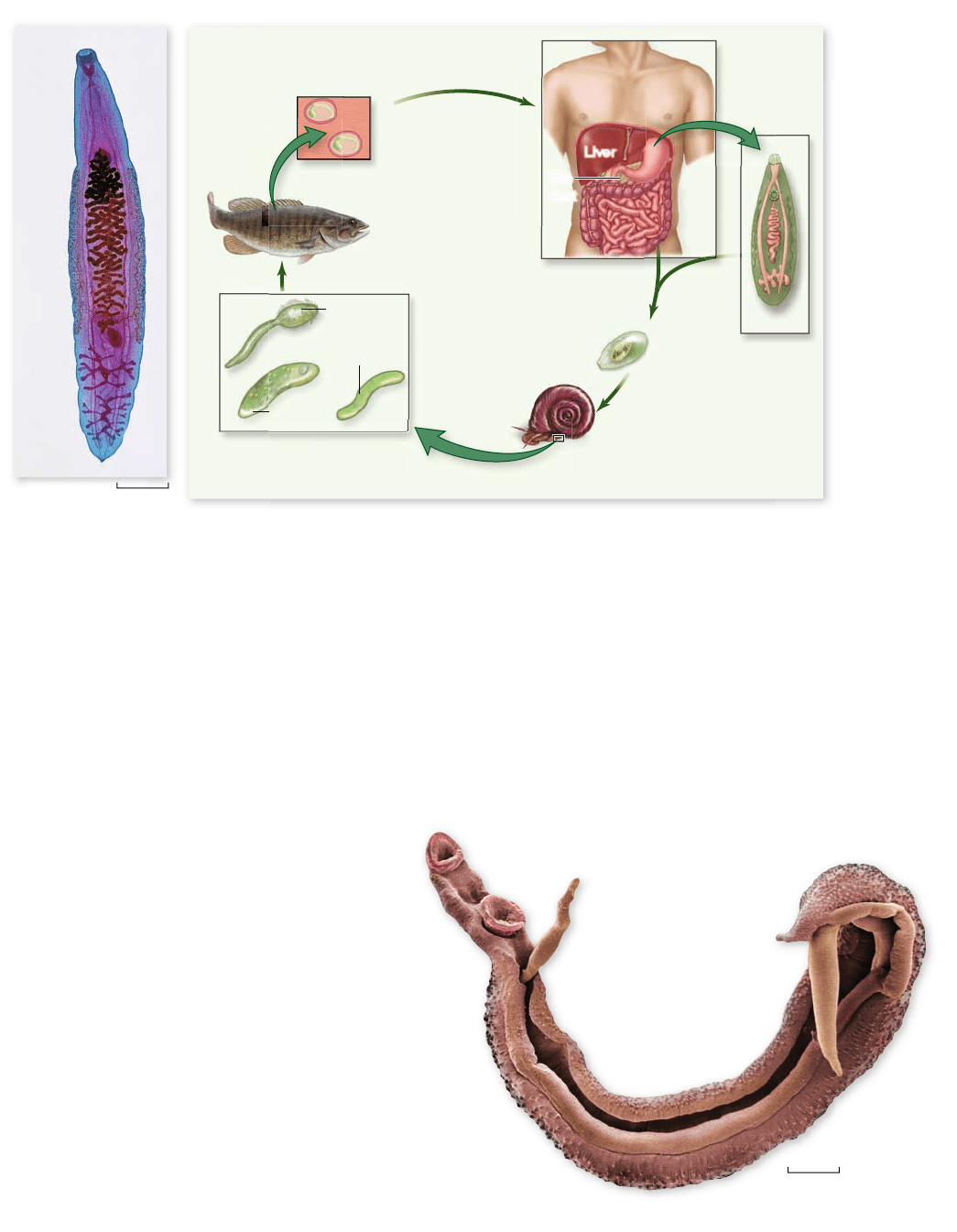
like all flukes, has a complex life cycle. A fertilized egg contain-
ing a ciliated first-stage larva, the miracidium, is passed in the
feces. If the larva reaches water, it may be ingested by an aquatic
snail (but most do not reach water and most that do are not
ingested. The prodigious number of eggs a parasitic flatworm
produces is an adaptation to this life-cycle full of risks). Within
the snail, the ciliated larva transforms into a sporocyst, a bag-
like structure containing embryonic germ cells, each of which
develops into a redia (plural, rediae), an elongated, nonciliated
larva. Each of these larvae grows within the snail, then gives rise
to several individuals of the next larval stage, the tadpole-like
cercaria (plural, cercariae).
Cercariae escape into the water, where they swim about
freely. When one encounters a fish of the family Cyprinidae—
the family that includes carp and goldfish—it bores into the
muscles, loses its tail, and encysts, transforming into a metacer-
caria. If a human or other mammal eats raw fish containing
metacercariae, the cyst dissolves in the intestine, and the young
fluke migrates to the bile duct, where it matures, thereby com-
pleting the cycle. Even if infected fish is cooked, the parasite
can be transmitted if metacercariae stuck to cutting boards or
the hands of a person handling the raw fish flesh are ingested.
An individual fluke may live for 15 to 30 years in the liver; a
heavy infection of liver flukes may cause cirrhosis of the liver
and death in humans.
Perhaps the most important trematodes to human health
are blood flukes of the genus Schistosoma. They afflict about 5%
because of the flickering movements of the flagella beating
inside them, are located on the side branches of the tubules.
Flagella in the flame cells move water and excretory sub-
stances into the tubules and then to pores located between
the epidermal cells through which the liquid is expelled.
Flame cells primarily regulate water balance of the organism;
the excretory function appears to be secondary, and much of
the metabolic waste of a flatworm diffuses into the gut and is
eliminated through the mouth.
Nervous system and sensory organs
The flatworm nervous system comprises an anterior cerebral
ganglion and nerve cords that run down the body, with cross-
connections that give it a ladder-like shape (see figure 33.11).
Free-living flatworms are poorly cephalized, with eyespots on
their heads (see figure 33.11). These inverted, pigmented cups,
which contain light-sensitive cells connected to the nervous
system, enable a worm to distinguish light from dark: most flat-
worms tend to move away from strong light.
Flatworm reproduction
The reproductive systems of flatworms are complex. Most are
hermaphroditic, each individual containing both male and fe-
male sexual structures (see figure 33.11). In many of members
of Platyhelminthes, copulation is required between two indi-
viduals, and fertilization is internal, each partner depositing
sperm in the copulatory sac of the other. The sperm travel
along special tubes to reach the eggs.
In most freshwater flatworms, fertilized eggs are laid in
cocoons strung in ribbons and hatch into miniature adults. In
contrast, some marine species develop indirectly, the fertilized
egg undergoing spiral cleavage, and the embryo giving rise to a
larva that swims or drifts until metamorphosing, when it settles
in an appropriate habitat.
Flatworms are known for their regenerative capacity:
when a single individual of some species is divided into two or
more parts, an entirely new flatworm can regrow what is miss-
ing from each bit.
Flatworms comprise two major groups
Most flatworms are parasitic; those that are not are referred to
as free-living. There is strong morphological and molecular
evidence that the parasitic lifestyle evolved only once in platy-
helminths, from free-living ancestors.
Turbellaria: Free-living flatworms
Flatworm phylogeny is in a state of flux. The group of free-
living flatworms, Turbellaria, has been considered a class, but
recent studies show it is not monophyletic so it is likely to be
divided into several classes. One of the most familiar members
of this group are freshwater members of the genus Dugesia, the
common planarian used in biology laboratories.
Neodermata: Parasitic flatworms
All parasitic flatworms are placed in the subphylum Neoder-
mata. That name means “new skin” and refers to the animal’s
658
part
V
Diversity of Life on Earth
rav32223_ch33_649-665.indd 658rav32223_ch33_649-665.indd 658 11/13/09 3:23:31 PM11/13/09 3:23:31 PM
Apago PDF Enhancer
Bile
duct
Liver
Miracidium hatches after
being eaten by snail
Sporocyst
Metacercarial
cysts in fish
muscle
Metacercariae are
consumed by humans
or other mammals
Adult fluke
Egg containing
miracidium in feces
(into water)
Cercaria
Redia
57.1 µm
125 µm
Figure 33.12
Life cycle of the oriental liver uke, Clonorchis sinensis.
worm occur in the intestines of vertebrates; about a dozen of
them regularly occur in humans.
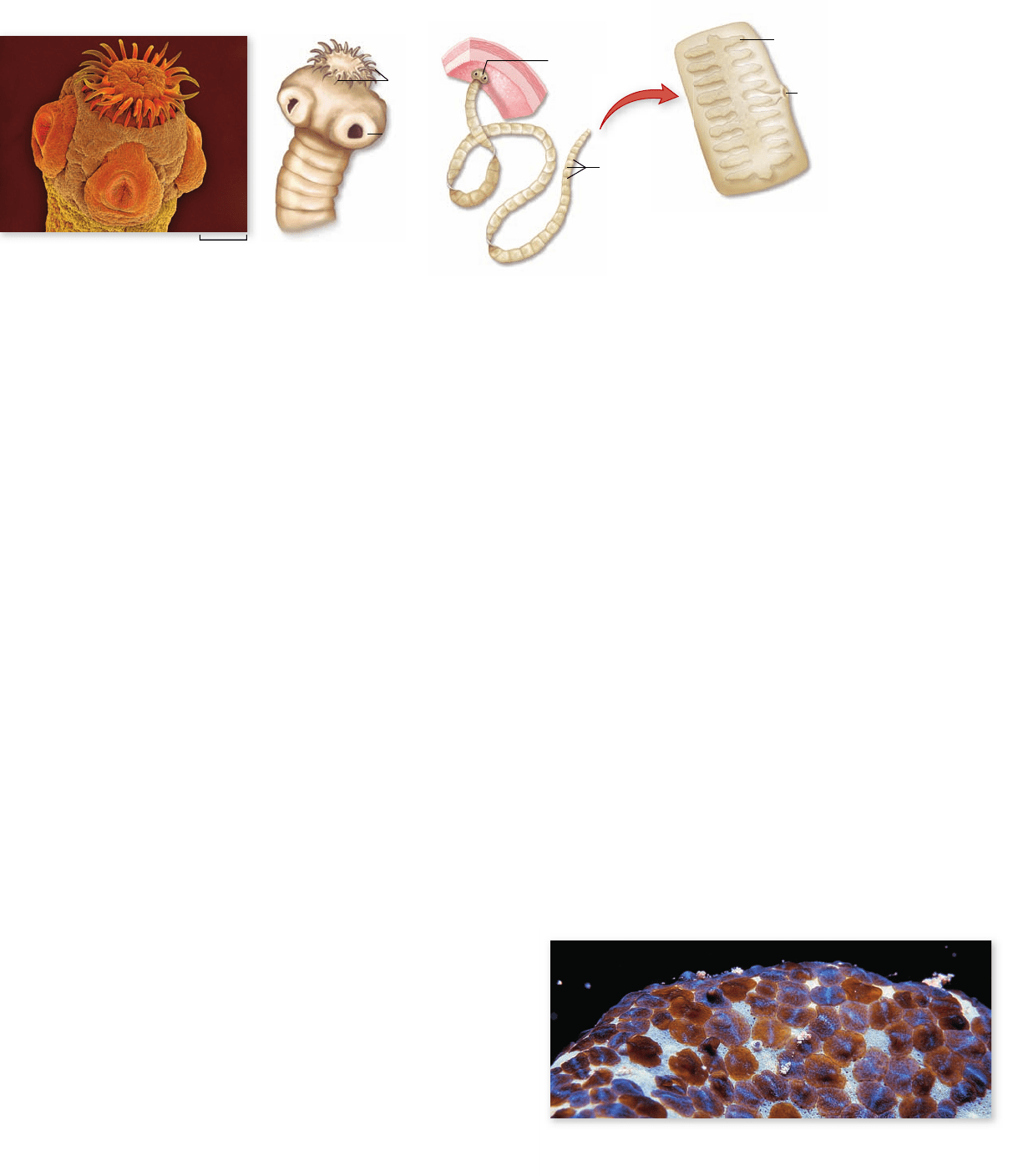
The long, flat body of a tapeworm is divided into three
zones: the scolex, or attachment structure; the neck; and a
series of repetitive sections, the proglottids (figure 33.14) .
The scolex of many species bears four suckers and may also
have hooks. The scolex is not a head: it has neither concen-
trated nervous tissue nor a mouth. Each proglottid is a com-
plete hermaphroditic unit, containing both male and female
of the world’s population, or more than 200 million people, in
tropical Asia, Africa, Latin America, and the Middle East. About
800,000 people die each year from the disease called schisto-
somiasis, or bilharzia.
Schistosomes live in blood vessels associated with the
intestine or the urinary bladder, depending on the species
(figure 33.13) . Thus if the worm is killed, it cannot be washed
out of the host, unlike parasites that live in the gut or associ-
ated organs such as the liver. Nor do its fertilized eggs have
that easy route out of the body. Instead, a fertilized egg must
break through the wall of the blood vessel to get into either
the intestine or the urinary bladder (depending on the spe-
cies). The damage done to the blood vessels and gut or blad-
der wall is considerable, especially considering that an
individual worm may release 300 to 3000 eggs per day and live
for many years.
Great effort is being made to control schistosomiasis.
The worms protect themselves from the body’s immune system
in part by coating themselves with some of the host’s own anti-
gens that effectively render the worm immunologically invisi-
ble (see chapter 52 ). The search is on for a vaccine that would
cause the host to develop antibodies to one of the antigens of
young worms before they can protect themselves.
Cercomeromorpha: The tapeworms
and their relatives
An adult tapeworm hangs onto the inner wall of its host’s intes-
tine by means of a terminal attachment structure. It lacks a di-
gestive cavity as well as digestive enzymes, absorbing food from
the host’s gut through its outer surface. Most species of tape-
Figure 33.13
Schistosomes.
The male lies within the
groove on the female’s ventral side, with its front and hind
ends protruding.
chapter
33
Noncoelomate Invertebrates
659www.ravenbiology.com
rav32223_ch33_649-665.indd 659rav32223_ch33_649-665.indd 659 11/13/09 3:23:32 PM11/13/09 3:23:32 PM
Apago PDF Enhancer
Scolex attached
to intestinal wall
Proglottids
Uterus
Proglottid
Hooks
Sucker
Scolex
Genital
pore
500 μm
Figure 33.14
Tapeworms.
Flatworms such as
this beef
tapeworm, Taenia
saginata, live
parasitically in the
intestine of
mammals.
Figure 33.15
Phylum Acoela.
An acoel atworm of the
genus Waminoa. These atworms, long thought to be relatives of
the Platyhelminthes, have a primitive nervous system and lack a
permanent digestive cavity.
includes another group of simple bilaterians once considered to
be flatworms. Their precise position in the phylogenetic tree
differs depending on the features used to construct it; one hy-
pothesis is they evolved before the phylogenetic split between
protostomes and deuterostomes.
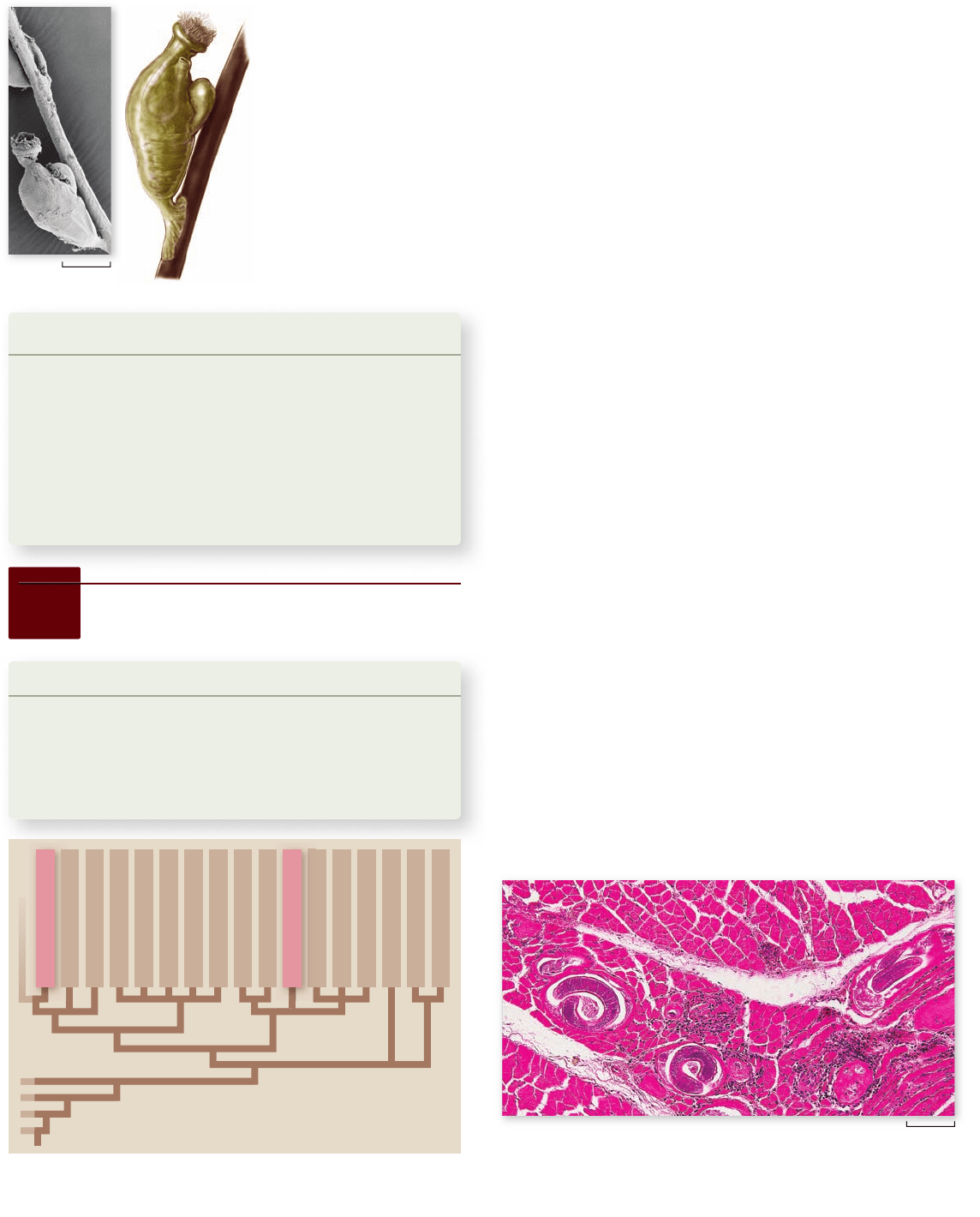
Phylum Cycliophora was discovered
relatively recently
In December 1995, Danish biologists Peter Funch and Rein-
hardt Kristensen reported the discovery of a strange new kind
of acoelomate creature about the size of a period on a printed
page. The tiny organism has a striking circular mouth sur-
rounded by a ring of cilia, and its anatomy and life cycle are so
unusual that their discoverers assigned it to an entirely new
phylum, Cycliophora (figure 33.16) .
The newest phylum to be named before Cycliophora, the
Loricifera, was discovered also by Reinhardt Kristensen in
1983, and he and Peter Funch discovered yet another new phy-
lum in 2000, the Micrognathozoa.
Cycliophorans live on the mouthparts of claw lobsters on
both sides of the North Atlantic. When the lobster to which
they are attached starts to molt, the tiny cycliophoran under-
goes sexual reproduction. Each male, which consists of nothing
but brains and reproductive organs, seeks out a female on the
molting lobster and fertilizes her eggs, generating free-
swimming larvae that can seek out another lobster and continue
the life cycle.
reproductive organs. Proglottids are formed continuously in a
growth zone at the base of the neck, with maturing ones being
pushed posteriorly as new ones are formed. The gonads in the
proglottids progressively mature away from the neck, fertiliza-
tion occurs, and the embryos form, the proglottids nearer the
end of the body being more mature. The most terminal pro-
glottid, filled with embryonated eggs, breaks off; either it rup-
tures and the embryos, each surrounded by a shell, are carried
out with the host’s feces, or the entire proglottid is carried out,
where the embryos emerge from it through a pore or the rup-
tured body wall. Embryos are scattered in the environment, on
leaves, in water, or in other places where they may be picked
up by another animal.
The beef tapeworm, Taenia saginata, occurs as a juvenile
in the intermuscular tissue of cattle; as an adult, it inhabits the
intestines of human beings, where a mature worm may reach a
length of 10 m or more. A worm attaches itself to the intestinal
wall of the host by a scolex with four suckers. Shed proglottids
pass from the human in the feces and may crawl onto vegeta-
tion, a favorable place to be picked up by cattle; they may re-
main viable for up to five months. If one is ingested by cattle,
the larva burrows through the wall of the intestine and ulti-
mately reaches muscle tissues through the blood or lymph ves-
sels. About 1% of cattle in the United States are infected, and
because some 20% of the beef consumed is not federally in-
spected, when humans eat infected beef that is cooked “rare,”
infection by these tapeworms can occur. As a result, the beef
tapeworm is a frequent parasite of humans.
Acoel atworms appear to be distinct
from Platyhelminthes: A case study
An acoel flatworm (figure 33.15) has a nervous system that con-
sists of a simple network of nerves with a minor concentration
of neurons in the anterior body end. It lacks a permanent diges-
tive cavity, so the mouth leads to a solid digestive syncytium (a
mass of cells that have no cell membranes separating them).
These characteristics had been used to place the acoels at
the base of phylum Platyhelminthes and that phylum at the
base of the Bilateria. However, based on molecular evidence,
scientists have concluded that acoels are not closely related to
members of phylum Platyhelminthes—similarities between the
two groups are convergent. They belong in their own phylum,
Acoela, or are members of the phylum Acoelomorpha, which
660
part
V
Diversity of Life on Earth
rav32223_ch33_649-665.indd 660rav32223_ch33_649-665.indd 660 11/13/09 3:23:34 PM11/13/09 3:23:34 PM
Apago PDF Enhancer
Nemertea
Loricifera
Kinorhyncha
Nematoda
Mollusca
Brachiopoda
Bryozoa (Ectoprocta)
Annelida
Rotifera
Cycliophora
Platyhelminthes
Tardigrada
Chordata
Echinodermata
Chaetognatha
Onychophora
Arthropoda
100 µm
50 µm
5
0
µ
m
Figure 33.16
Phylum Cycliophora.
About the size of the
period at the end of this
sentence, these acoelomates
live on the mouthparts of
claw lobsters. One feeding
stage (and part of a second
one) of Symbion pandora are
shown attached to the
mouthpart of a lobster.
33.4
The Pseudocoelomates
Learning Outcomes
Describe the distinguishing features of 1.
pseudocoelomates.
Describe the musculature of a nematode that allows it to 2.
wriggle in a highly characteristic manner.
Explain why rotifers are referred to as “wheel animals.”3.
All bilaterians except acoelomates possess an internal body
cavity. One type of cavity is a pseudocoelom, which, you will
Learning Outcomes Review 33.3
The acoelomates, typifi ed by fl atworms, are compact, bilaterally symmetrical
animals. Most have a blind digestive cavity with only one opening; they also
have an excretory system consisting of fl ame cells within tubules that run
throughout the body. Many are free-living, but some cause human diseases.
The scolex of a tapeworm is not a head, but simply an anchoring device to
hold the animal in the intestine where it acts as a parasite.
■ How does the anatomy of a tapeworm relate to its
way of life?
recall, lies between tissues derived from the mesoderm and
those derived from the endoderm (chapter 32; see figure 32.2).
The pseudocoelomic fluid performs the functions carried
out by a circulatory system in most coelomate animals.
The pseudocoelom also serves as a hydrostatic skeleton. The
hydrostatic skeleton of both pseudocoelomates and coelomates
is an improvement on the one supporting cnidarian polyps and
medusae because, not being the digestive cavity, it is entirely
isolated from the environment. The movement of these ani-
mals with a hydrostatic skeleton is more efficient than that of
the solid acoelomates.
Recall that pseudocoelomates are not monophyletic.
Most belong to the Ecdysozoa, which includes phyla Nema-
toda, Kinorhyncha, and Loricifera. Other pseudocoelomates,
such as the rotifers, belong to the Platyzoa. In this section, we
focus on two significant pseudocoelomate phyla.
The roundworms, phylum Nematoda,
are ecdysozoans comprising many species
Vinegar eels, eelworms, and other roundworms constitute a
large phylum, Nematoda, with some 20,000 recognized spe-
cies; scientists estimate that the actual number might ap-
proach 100 times that many. Nematodes are abundant and
diverse in marine and freshwater habitats, and many mem-
bers of this phylum are parasites of animals (figure 33.17) and
plants. Many nematodes are microscopic and live in soil.
A spadeful of fertile soil may contain, on the average, a mil-
lion nematodes.
Nematode structure
Nematodes are bilaterally symmetrical, unsegmented worms
covered by a flexible, thick cuticle that is molted as they grow—
parasitic nematodes molt four times. Lacking specialized respi-
ratory organs, nematodes exchange oxygen and carbon dioxide
through their cuticles. Muscles beneath the epidermis, which
underlies the cuticle, extend longitudinally, from anterior to
posterior. Nematodes are unusual among worms in that they
lack circular musculature, so they can shorten but not change
Figure 33.17
Trichinella nematode encysted in pork.
The serious disease trichinosis can result from eating undercooked
pork or bear meat containing such cysts.
chapter
33
Noncoelomate Invertebrates
661www.ravenbiology.com
rav32223_ch33_649-665.indd 661rav32223_ch33_649-665.indd 661 11/13/09 3:23:39 PM11/13/09 3:23:39 PM