
Raven P.H., Johnson G.B., Mason K.A. Biology (Ninth Edition)
Подождите немного. Документ загружается.

Apago PDF Enhancer
a. b.
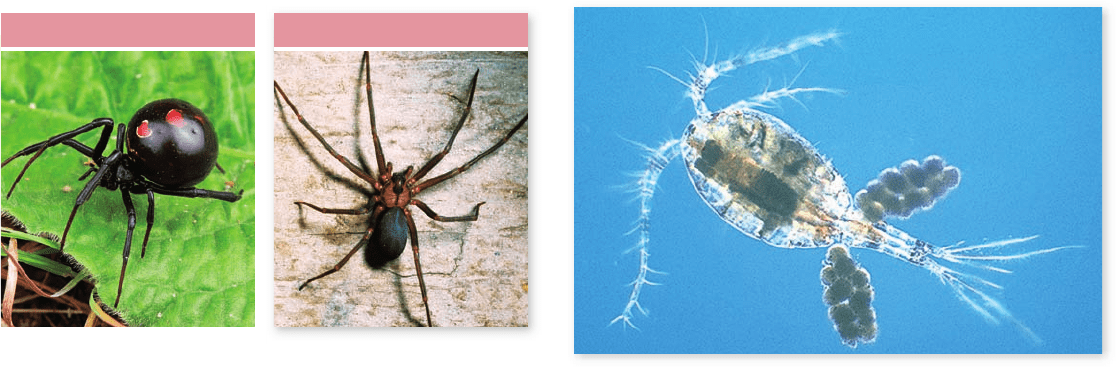
Black Widow Brown Recluse
pepoda; figure 34.28) are among the most abundant multicel-
lular organisms on Earth . A small number are terrestrial,
including about half the estimated 4500 species of order Iso-
poda, the pillbugs; and some sand fleas or beach fleas (order
Amphipoda) are semiterrestrial.
Some crustaceans (such as lobsters and crayfish) are val-
ued as food for humans; planktonic crustaceans (such as krill)
and larval crustaceans, which are abundant in the plankton,
are the primary food of baleen whales and many smaller ma-
rine animals.
Crustacean body plans
A typical crustacean has three tagmata; the anteriormost
two—the cephalon and thorax—may fuse to form the cepha-
lothorax (figure 34.29) . Most crustaceans have two pairs of
antennae, three pairs of appendages for chewing and manipu-
lating food, and various pairs of legs. Crustacean appendages,
with the possible exception of the first pair of antennae, are
biramous (“two-branched”). Crustaceans differ from hexa-
pods, but resemble myriopods, in having appendages on their
abdomen as well as their thorax. They are the only arthropods
with two pairs of antennae.
Large crustaceans have feathery gills for respiration near
the bases of their legs (see figure 34.29). Oxygen extracted
from the gills is distributed through the circulatory system. In
smaller crustaceans, gas exchange takes place directly through
the thinner areas of the cuticle or the entire body.
Crustacean reproduction
Nearly all crustaceans except barnacles are gonochoric. Many kinds
of copulation occur, and the members of some groups carry their
eggs, either singly or in egg pouches, until they hatch. Crustaceans
develop through a nauplius (plural, nauplii) stage (figure 34.30) .
The nauplius hatches with three pairs of appendages and under-
goes metamorphosis through several stages before reaching ma-
turity. In many groups, this nauplius stage is passed in the egg,
and the hatchling resembles a miniature adult.
their prey as it passes by. Spiders such as the familiar wolf spi-
ders and tarantulas hunt rather than spin webs.
All spiders have poison glands with channels through their
chelicerae, which are pointed and are used to bite and paralyze
prey. The bites of some, such as the western black widow
(Latrodectus hesperus) and brown recluse (Loxosceles reclusa)
(figure 34.27) , can be fatal to humans and other large mammals.
Order Acari: Mites and ticks
The order Acari is the most diverse of the chelicerates. About
30,000 species of mites and ticks have been named, but scien-
tists estimate that more than a million members of this order
may exist. Acarines are found in virtually every habitat; they
feed on a variety of organisms as predators and parasites.
Most mites are less than 1 mm long, but adults range
from 100 nm to 2 cm. In most mites, the cephalothorax and
abdomen are fused into an unsegmented, ovoid body. Respira-
tion is by means of tracheae or directly through the body sur-
face. Many mites pass through several stages during their life
cycle. In most, an inactive eight-legged prelarva gives rise to an
active six-legged larva, which, in turn, produces a succession of
three eight-legged stages, and, finally, the adult.
Ticks are parasites that attach to the surface of humans
and other animals, causing discomfort by sucking blood. Ticks,
which are larger than most other members of the order, can
carry disease-causing agents. For example, Rocky Mountain
spotted fever is caused by bacteria; Lyme disease is caused by
spirochaetes; and red-water fever, or Texas fever, is an important
tick-borne protozoan disease of cattle, horses, sheep, and dogs.
Class Crustacea includes crabs,
shrimps, lobsters, and pill bugs
The crustaceans (class Crustacea) comprise some 35,000 spe-
cies of largely marine organisms, such as crabs, shrimps, lob-
sters, and barnacles. However, some groups, such as crayfish,
occur in freshwater, and some crabs and copepods (order Co-
Figure 34.27
Two common poisonous spiders. a. The
southern black widow, Latrodectus mactans. b. The brown recluse
spider, Loxosceles reclusa. Both species are common throughout
temperate and subtropical North America.
Figure 34.28
Freshwater crustacean. A copepod with
attached eggs. Members of the marine and freshwater order
Copepoda are important components of the plankton. Most are a
few millimeters long.
682
part
V
Diversity of Life on Earth
rav32223_ch34_666-692.indd 682rav32223_ch34_666-692.indd 682 11/13/09 4:21:59 PM11/13/09 4:21:59 PM
Apago PDF Enhancer
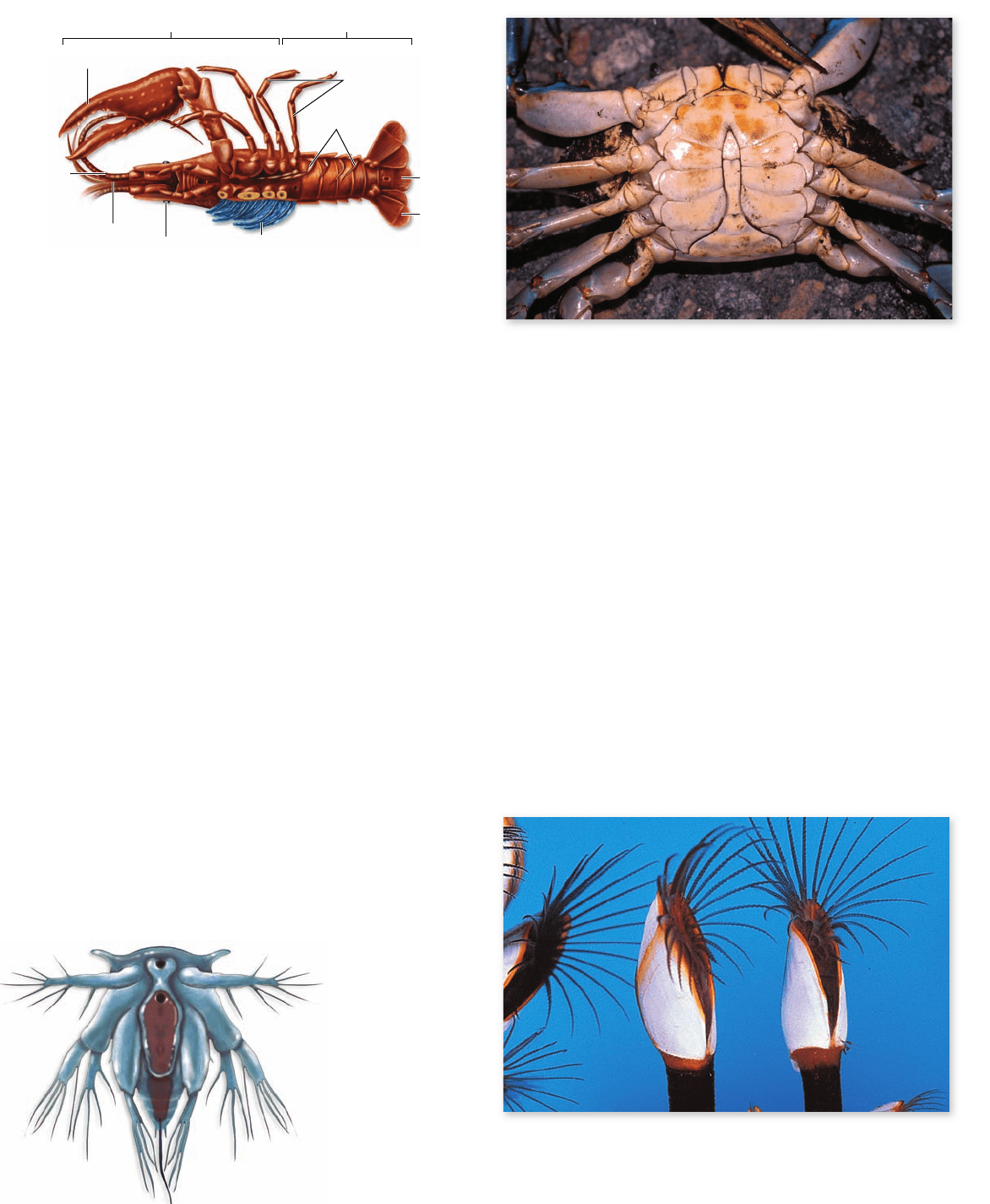
Cheliped
Eye
Cephalothorax
Abdomen
Swimmerets
Telson
Uropod
Antenna
Antennule
Walking legs
Gills
figure 34.29). When a lobster or crayfish contracts its abdomi-
nal muscle, the uropods and telson push water anteriorly, pro-
pelling the animal posteriorly through the water rapidly and
forcefully. It is this very large muscle that constitutes the “lob-
ster tail” so valued by human diners!
One difference between crabs and lobsters is that the crab
carapace is relatively much broader and the abdomen is just a
small vestige tucked under the cephalothorax. The abdomen of
a male crab is much narrower than that of a female of the same
species and size (figure 34.31) : the female carries her eggs at-
tached to appendages of the abdomen between it and the tho-
rax. A female with eggs is said to be “in berry.”
Sessile crustaceans: Barnacles
Barnacles (order Cirripedia; figure 34.32) are sessile as adults.
At the end of its larval life, a barnacle nauplius attaches by its
The nauplius larva is characteristic of Crustacea, provid-
ing evidence that all members of this diverse group descended
from a common ancestor that had a nauplius in its life cycle. The
sessile barnacles, with their shell-like exoskeleton, had been
thought to be related to mollusks until they were discovered to
have a nauplius larva. More recently, the wormy pentastomids,
which parasitize the respiratory tracts of vertebrates, were de-
termined to be crustaceans in part through their nauplii (recall
from chapter 32 that parasites may become morphologically
simplified and so can be difficult to place phylogenetically).
Decapod crustaceans: Shrimps,
lobsters, crabs, and crayfish
Large, primarily marine crustaceans such as shrimps, lobsters, and
crabs, along with their freshwater relatives, the crayfish, belong to
order Decapoda (see figure 34.29), which means “ten-footed” be-
cause of their five pairs of thoracic appendages. The exoskeleton
of most is reinforced with calcium carbonate. The cephalothorax
is covered by a dorsal shield, or carapace, which arises from the
head. The pincers of many decapod crustaceans are used in ob-
taining food—for example, by crushing mollusk shells.
In lobsters and crayfish, appendages called swimmerets
that occur along the ventral surface of the abdomen are used in
reproduction and swimming. At the posterior end of the abdo-
men, paired flattened appendages known as uropods form a
kind of paddle between which is a telson, a tail spine (see
Figure 34.30
The nauplius larva.
The nauplius of a
crustacean is an
important unifying
feature found in
members of this group.
Figure 34.29
Decapod crustacean. Ventral view of
a lobster, Homarus americanus, with some of its principal
features labeled.
Figure 34.32
Gooseneck barnacles, Lepas
anatifera. These barnacles are lter feeding, which they do by
sweeping their jointed legs through the water, gathering small
particles of food. These are stalked barnacles; others lack a stalk.
Figure 34.31
Cephalothorax. The cephalothorax of a
Chesapeake Bay blue crab (Callinectes sapidus).
chapter
34
Coelomate Invertebrates
683www.ravenbiology.com
rav32223_ch34_666-692.indd 683rav32223_ch34_666-692.indd 683 11/16/09 3:53:47 PM11/16/09 3:53:47 PM
Apago PDF Enhancer
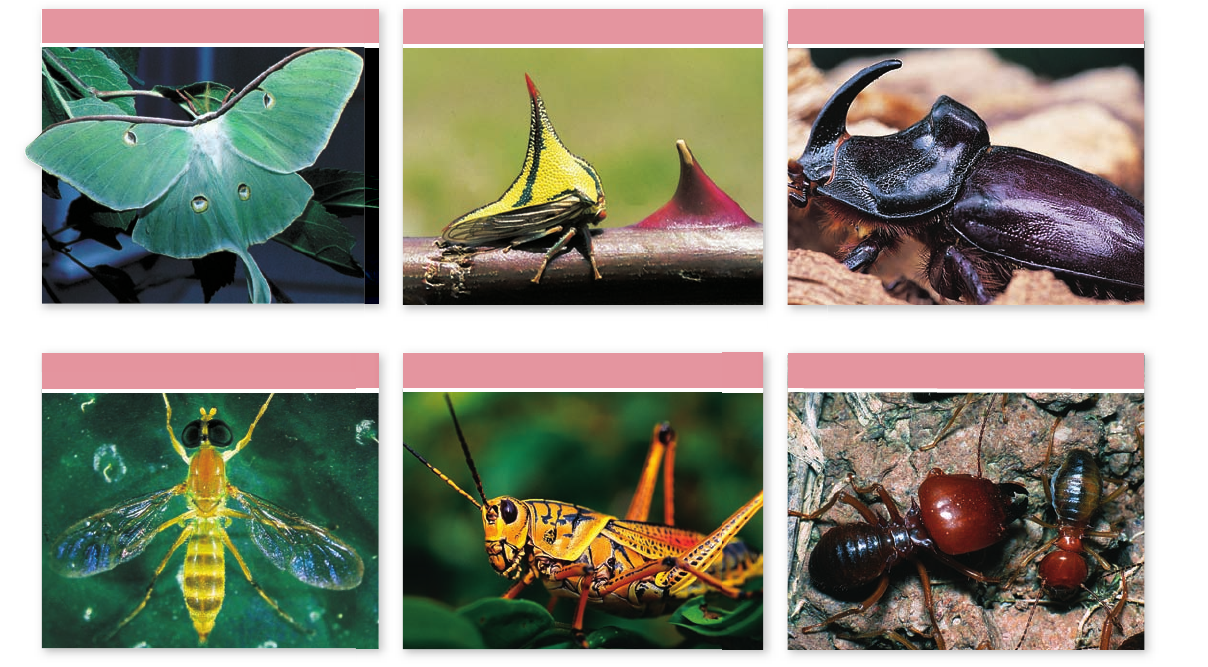
Order: Diptera
e.
Order: Orthoptera
f.
Order: Isoptera
d.
Order: Lepidoptera Order: Homoptera
a. b. c.
Order: Coleoptera
individual insects are alive at any one time. A glimpse into the
enormous diversity of insects is presented in figure 34.33 and
table 34.2.
External features
Insects are primarily terrestrial, and aquatic insects probably
had terrestrial ancestors. Most are small, ranging from 0.1 mm
to about 30 cm in length or wingspan. Insect mouthparts all
have the same basic structure; modifications reflect feeding
habits (figure 34.34) . Most insects have compound eyes, and
many also have ocelli.
An insect body has three regions: the head, thorax, and
abdomen (see figures 34.23, 34.24). The thorax consists of three
segments, each with a pair of legs, which accounts for the name
of the group, hexa (six) and poda (legs). Legs are absent in the
larvae of certain groups—for example, most flies (order Dip-
tera) and mosquitoes (figure 34.35) . In addition, an insect may
have one or two pairs of wings, which are not homologous to
the other appendages, and which attach to the middle and pos-
terior segments of the thorax (see figure 34.23). The wings,
which consist of chitin and protein, arise as saclike outgrowths
of the body wall; wings of moths and butterflies are covered
with detachable scales that provide most of their bright colors
head to a piling, rock, or other submerged object, metamor-
phoses, grows calcareous plates around it, and spends the rest of
its life capturing food with its jointed, feathery legs. The her-
maphroditic state of barnacles is thought to be related to their
sessility. Barnacles have the longest penis in the animal king-
dom, relative to their size, which enables these sessile animals
to cross-fertilize.
Class Hexapoda comprises the insects
The insects, members of class Hexapoda, are by far the largest
group of animals on Earth, in terms of number of species and
number of individuals. Insects live in every habitat on land and
in fresh water, but very few have invaded the sea. More than
half of named animal species are insects, and the actual propor-
tion may be higher because millions of forms await detection,
classification, and naming.
Approximately 90,000 described species occur in the
United States and Canada; the actual number probably ap-
proaches 125,000. A hectare of lowland tropical forest is esti-
mated to be inhabited by as many as 41,000 species of insects,
and many suburban gardens may have 1500 or more species. It
has been estimated that approximately a billion billion (10
18
)
Figure 34.33
Insect diversity. a. Luna moth, Actias luna. Luna moths and their relatives are among the most spectacular insects
(order Lepidoptera). b. A thorn-shaped treehopper, Umbonia crassicornis (order Homoptera). c. Boll weevil, Anthonomus grandis. Weevils are one
of the largest groups of beetles (order Coleoptera). d. Soldier y, Ptecticus trivittatus (order Diptera). e. Lubber grasshopper, Romalea guttata
(order Orthoptera). f. Termites, like ants, have several castes with individuals specialized for different tasks. The individual on the left is a
soldier; its large jaws aid in defending the colony.
684
part
V
Diversity of Life on Earth
rav32223_ch34_666-692.indd 684rav32223_ch34_666-692.indd 684 11/13/09 4:22:15 PM11/13/09 4:22:15 PM
Apago PDF Enhancer
a. b. c.
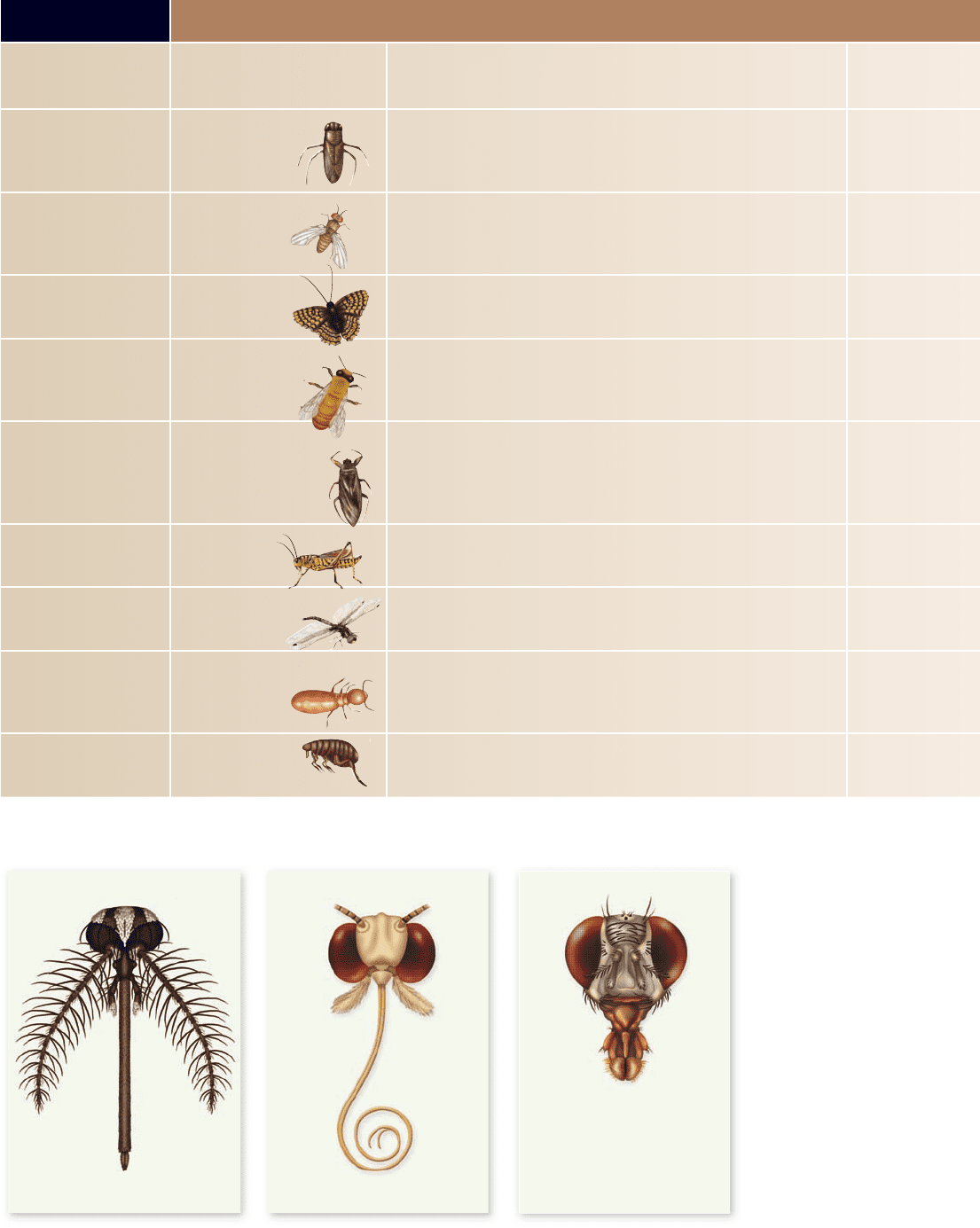
TABLE 34.2
Major Orders of Insects
Order Typical Examples Key Characteristics
Approximate
Number
of Named Species
Coleoptera Beetles Two pairs of wings, the front one hard, protecting the rear one; heavily armored
exoskeleton; biting and chewing mouthparts. Complete metamorphosis. The most
diverse animal order.
350,000
Diptera Flies Front ying wings transparent; hindwings reduced to knobby balancing organs
called halteres. Sucking, piercing, or lapping mouthparts; some bite people and other
mammals. Complete metamorphosis.
120,000
Lepidoptera Butter ies, moths Two pairs of broad, scaly, ying wings, often brightly colored. Hairy body; tubelike,
sucking mouthparts. Complete metamorphosis.
120,000
Hymenoptera Bees, wasps, ants Two pairs of transparent ying wings; mobile head and well-developed compound
eyes; often possess stingers; chewing and sucking mouthparts. Many social. Complete
metamorphosis.
100,000
Hemiptera and Homoptera True bugs,
bedbugs,
leafhoppers,
aphids, cicadas
Wingless or with two pairs of wings; piercing, sucking mouthparts, with which some
draw blood, some feed on plants. Simple metamorphosis.
60,000
Orthoptera Grasshoppers,
crickets
Wingless or with two pairs of wings; among the largest insects; biting and chewing
mouthparts in adults. Third pair of legs modied for jumping. Simple metamorphosis.
20,000
Odonata Dragon ies Two pairs of transparent ying wings that cannot fold back; large, long, and slender
body; chewing mouthparts. Simple metamorphosis.
5000
Isoptera Termites Two pairs of wings, but some stages wingless; chewing mouthparts; simple
metamorphosis. Social organization: labor divided among several body types. Some
are among the few types of animals able to digest wood. Complete metamorphosis.
2000
Siphonaptera Fleas Wingless; attened body with jumping legs; piercing and sucking mouthparts. Small;
known for irritating bites. Complete metamorphosis.
1200
Figure 34.34
Mouthparts in three kinds
of insects. Mouthparts are
modi ed for (a) piercing in this
mosquito of the genus Culex;
(b) sucking nectar from owers
in the alfalfa butter y of the
genus Colias; and (c) sopping up
liquids in the house y, Musca
domestica.
chapter
34
Coelomate Invertebrates
685www.ravenbiology.com
rav32223_ch34_666-692.indd 685rav32223_ch34_666-692.indd 685 11/13/09 4:22:31 PM11/13/09 4:22:31 PM
Apago PDF Enhancer
In many winged insects, tracheae are dilated in various
parts of the body, forming air sacs, which are surrounded by
muscles to form a kind of bellows system that forces air deep
into the body. The spiracles through which air enters the tra-
cheal system are located on or between the segments along
the sides of the thorax and abdomen. In most insects, the spir-
acles can be opened by muscular action. In some parasitic and
aquatic groups of insects, the spiracles are permanently closed.
In these groups, the tracheae are just below the surface of the
insect, and gas exchange takes place by diffusion.
Sensory receptors
In addition to eyes, insects have several characteristic kinds of
sense receptors. Sensory setae are hairlike structures that are
widely distributed over the body. They are sensitive to mechan-
ical and chemical stimulation and are linked to nerve cells. They
are particularly abundant on the antennae and legs, the parts of
the insect most likely to come into contact with other objects.
Sound, which may be of vital importance to insects such
as grasshoppers, crickets, cicadas, and some moths, is detected
by a thin membrane, each called a tympanum (see figure 34.24),
associated with the tracheal air sacs. In other groups of insects,
sound waves are detected by sensory hairs. Male mosquitoes
use thousands of sensory hairs on their antennae to detect
sounds made by the vibrating wings of female mosquitoes.
In addition to sound, nearly all insects communicate by
means of chemicals known as pheromones . These extremely
diverse compounds are sent forth into the environment, where
they convey a variety of messages, including mating signals and
trail markers.
Insect life histories
During the course of their development, many insects undergo
metamorphosis. For those such as grasshoppers, in which im-
mature individuals are quite similar to adults, a series of molts
results in an individual gradually getting bigger and more de-
veloped; this is termed simple metamorphosis. Those such as
moths and butterflies have a life history involving a wormlike
larval stage, a resting stage called a pupa or chrysalis, during
which metamorphosis occurs, and then a final molt into the
adult form or imago; this is termed complete metamorphosis.
Myriapoda includes centipedes and millipedes
The body of a centipede (subclass Chilopoda) and millipede (sub-
class Diplopoda) consists of a head region posterior to which are
numerous, more or less similar segments. Nearly all segments of a
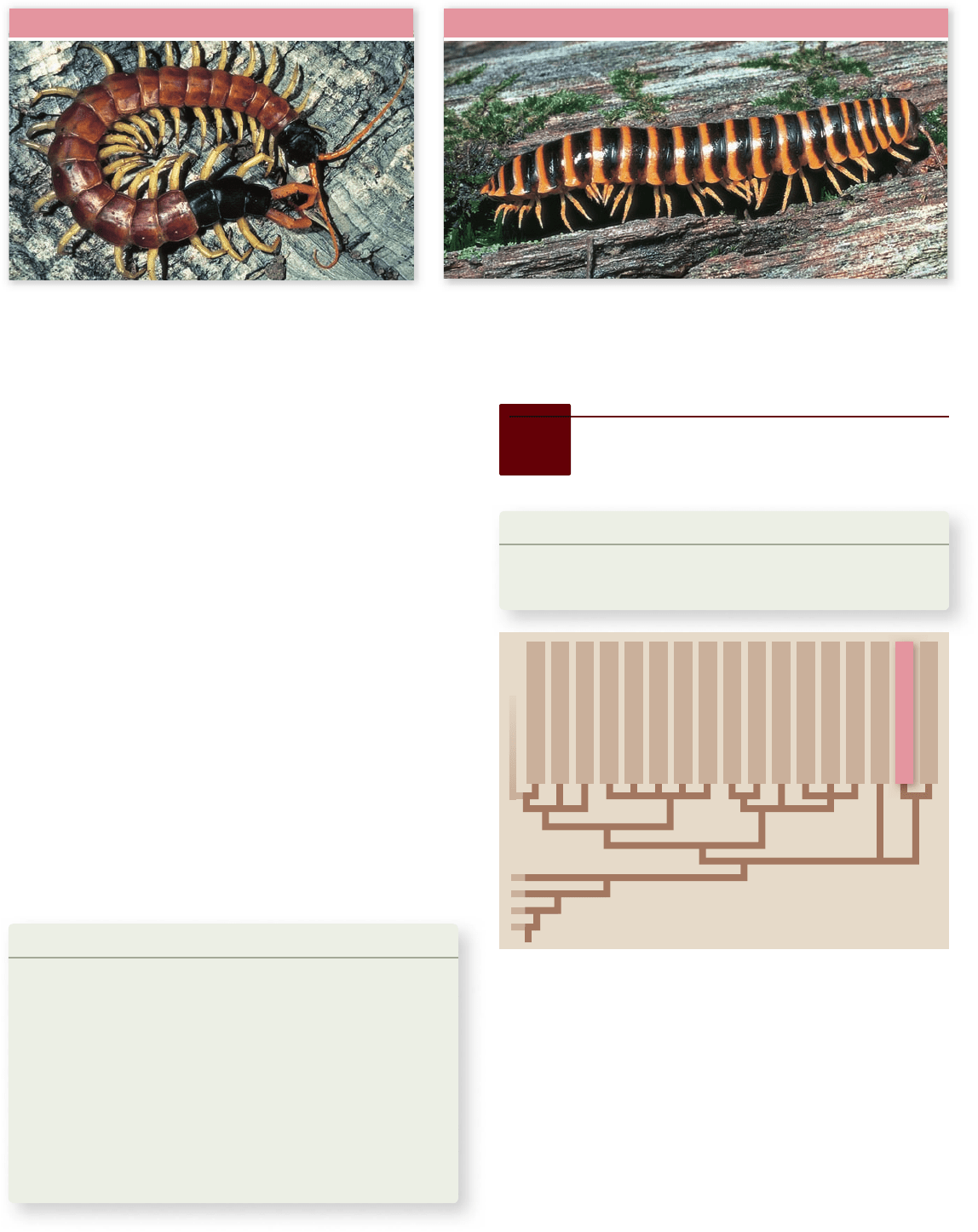
centipede have one pair of appendages (figure 34.37a) , and nearly
all segments of a millipede have two pairs of appendages
(figure 34.37b). Each segment of a millipede is a simple tagma de-
rived evolutionarily from two ancestral segments, which explains
why millipedes have twice as many legs per segment as centipedes.
Although the name centipede would imply an animal with 100 legs
and the name millipede one with 1000, an adult centipede usually
has fewer than 100 legs (most have 15, 21, or 23 pairs of legs); an
adult millipede never reaches 1000 legs, most having 100 or fewer.
Both centipedes and millipedes are gonochoric; fertiliza-
tion is internal, and all lay eggs. Young millipedes usually hatch
with three pairs of legs; they add segments and legs as they pass
(figure 34.36) . Veins strengthen wings. An insect’s thorax is al-
most entirely filled with muscles that operate the legs and
wings. Fleas and lice are considered secondarily wingless, hav-
ing descended from ancestors with wings. However, the ances-
tors of springtails and silverfish evolved before wings did, so
those hexapods are considered primarily wingless.
Internal organization
The internal features of insects resemble those of other arthro-
pods in many ways. The digestive tract is a tube about the same
length as the body in some groups. However, in insects that
feed on juices and so have sucking mouthparts, such as leafhop-
pers, cicadas, and many flies, the greatly coiled digestive tube
may be several times longer than the body. Digestion takes
place primarily in the stomach, or midgut, and excretion takes
place through Malpighian tubules. Digestive enzymes are
mainly secreted from the cells that line the midgut, although
some are contributed by the salivary glands near the mouth.
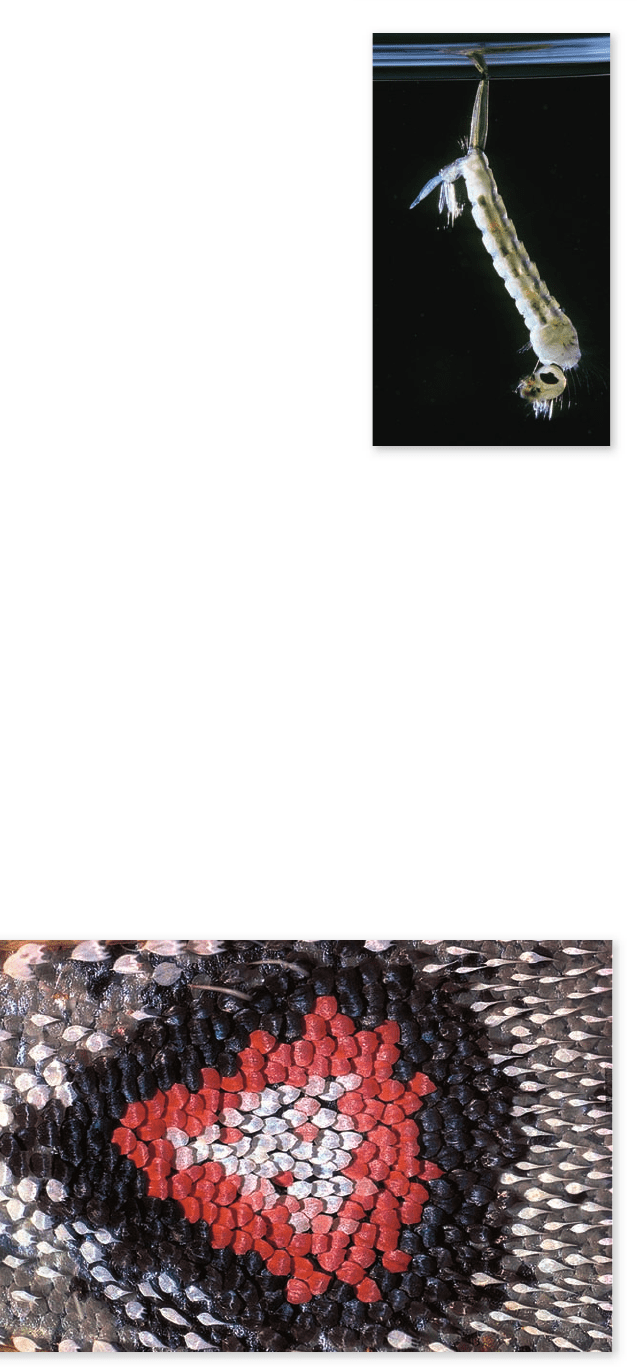
Figure 34.36
Scales on the wing of Parnassius
imperator, a butter y from China. Scales of this sort account
for most of the colored patterns on the wings of butter ies and moths.
Figure 34.35
Larva of a
mosquito, Culex pipiens.
The aquatic larvae of
mosquitoes are quite active.
They breathe through tubes at
the surface of the water, as
shown here. Covering the
water with a thin lm of oil
suffocates them.
686
part
V
Diversity of Life on Earth
rav32223_ch34_666-692.indd 686rav32223_ch34_666-692.indd 686 11/13/09 4:22:32 PM11/13/09 4:22:32 PM
Apago PDF Enhancer
a. b.
Millipede
Centipede
Nemertea
Loricifera
Kinorhyncha
Nematoda
Mollusca
Brachiopoda
Bryozoa (Ectoprocta)
Annelida
Rotifera
Cycliophora
Platyhelminthes
Tardigrada
Chordata
Echinodermata
Chaetognatha
Onychophora
Arthropoda
through growth stages, but they do not change in general ap-
pearance. Centipedes have several types of development, young
of some species hatching with their final number of legs and
others adding legs after hatching. Centipedes that do not add
legs as they grow tend to take care of their young, a behavior
rather uncommon among invertebrates.
Centipedes, of which some 3000 species are known, are
carnivorous, feeding mainly on insects. The appendages of the
first trunk segment are modified into a pair of poison fangs.
The poison may be toxic to humans, and although extremely
painful, centipede bites are never fatal. In contrast, most milli-
pedes are herbivores, feeding mainly on decaying vegetation
such as leaf litter and rotting logs (which are typical habitats for
the animals). Many millipedes can roll their bodies into a flat
coil or sphere to defend themselves. More than 12,000 species
of millipedes have been named, but this is estimated to be no
more than one-sixth of the number of species that exists.
In each segment of their body, many millipedes have a
pair of complex glands that produce a bad-smelling fluid, which
they exude for defense through openings along the sides of the
body. The chemistry of this material interests biologists be-
cause of the diversity of the compounds involved and their ef-
fectiveness in protecting millipedes from attack. Some species
produce cyanide gas from segments near their head.
Learning Outcomes Review 34.5
Arthropods are segmented animals with exoskeletons and jointed
appendages. The four living classes of arthropods are Chelicerata, with
mouthparts (chelicerae) that function as fangs or pincers; Crustacea, in
which all members have a nauplius developmental stage; Hexapoda, the
insects, having three pairs of legs attached to fused segments of the thorax
as adults; and Myriopoda, with one or two pairs of appendages on every
body segment. An exoskeleton provides protection and muscle attachment,
but growth requires molting. In some cases, larvae undergo metamorphosis
into an adult with very diff erent appearance.
■ What would explain why the largest arthropods are
found in marine environments?
34.6
Phylum Echinodermata:
The Echinoderms
Learning Outcomes
Explain what is meant by pentaradial symmetry.1.
Describe the five extant classes of echinoderms. 2.
Members of the exclusively marine phylum Echinodermata are
characterized by deuterostome development (see chapter 32)
and an endoskeleton. The endoskeleton is composed of hard,
calcium carbonate plates that lie just beneath the delicate skin.
The term echinoderm, which means “spiny skin,” refers to the
spines or bumps that occur on these plates in many species.
Echinoderms, including sea stars (figure 34.38) , brittle stars, sea
urchins, sand dollars, and sea cucumbers are some of the most
familiar animals on the seashore. All have five axes of symmetry
(that is, you could draw lines through their body in five different
places that produced mirror images on each side) and thus are
said to be pentaradially symmetrical.
Figure 34.37
Myriapods. a. Centipedes, such as this member of the genus Scolopendra, are active predators. b. Millipedes, such as this
member of the genus Sigmoria, are important herbivores and detritivores. Centipedes have one pair of legs per body segment, millipedes have
two pairs per segment.
chapter
34
Coelomate Invertebrates
687www.ravenbiology.com
rav32223_ch34_666-692.indd 687rav32223_ch34_666-692.indd 687 11/13/09 4:22:39 PM11/13/09 4:22:39 PM
Apago PDF Enhancer
Tube feet
Tube feet
Water vascular
system
Madreporite
Ampulla
Gonad
Anus
Skeletal plates
Digestive glands
Stomach
b.
Radial canal
a.
Mouth
Gut
Anus
Developing coelom and
water-vascular system
100 μm
Echinoderms are ancient and unmistakable
Echinodermata is an ancient group of marine animals that ap-
peared nearly 600 mya and that comprise about 6000 living spe-
cies. As with other deuterostomes, the mouth does not form
from the embryonic blastopore.
Because the skeletal elements of echinoderms are covered
by living tissue, they constitute an endoskeleton. A unique
feature of echinoderms is the hydraulic system that aids in
movement or feeding called a water-vascular system. This
fluid-filled system, which is a modification of one of several
coelomic spaces, is composed of a central ring canal from which
radial canals extend.
Although an excellent fossil record extends back into the
Cambrian period, the origin of echinoderms remains unclear.
They are thought to have evolved from bilaterally symmetrical
ancestors because echinoderm larvae are bilaterally symmetri-
cal (figure 34.39).
Echinoderm symmetry is bilateral in larvae
but pentaradial in adults
The body of echinoderms undergoes a fundamental shift during
development, from bilaterally symmetrical larvae (see figure 34.39)
to pentaradially symmetrical adults (see figure 34.38). Dorsal,
ventral, anterior, and posterior have no meaning without a head
or tail for orientation. Thus, orientation of the body of an adult
echinoderm is described in reference to the mouth, which de-
fines the oral surface. All systems of an adult echinoderm are
organized with branches radiating from a center. For example,
the nervous system consists of a central nerve ring from which
branches arise; although the animals are capable of complex
behavior patterns, there is no centralization of function.
In many echinoderms, the oral surface faces the substra-
tum, although in sea cucumbers, the animal’s axis is horizontal,
so the animal crawls oral surface foremost, and in crinoids (sea
lilies and feather stars), the oral surface is located opposite to
the substrate.
The endoskeleton
Echinoderms have a delicate epidermis that stretches over
an endoskeleton composed of calcium carbonate (calcite)
plates called ossicles. In echinoderms such as asteroids (sea
stars), the individual skeletal elements are loosely joined to
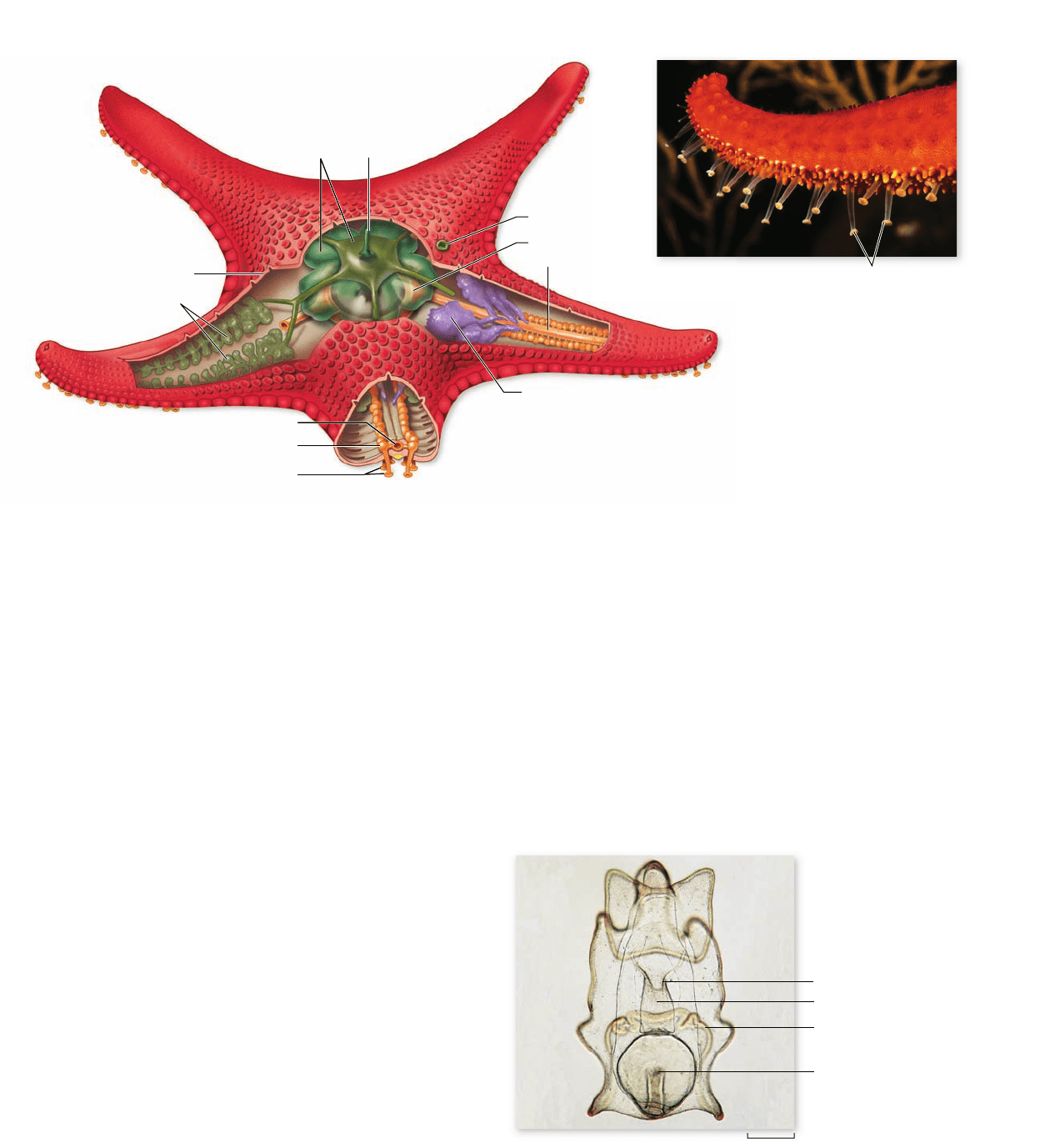
Figure 34.38
Phylum Echinodermata. a. Echinoderms, such as
sea stars (class Asteroidea), are coelomates with a deuterostomate pattern of
development and an endoskeleton made of calcium carbonate plates. The
water-vascular system of an echinoderm is shown in detail. Radial canals
transport liquid to the tube feet. As the ampulla in each tube foot
contracts, the tube foot extends and can attach to the substrate. When the
muscles in the tube feet contract, the tube foot bends, pulling the animal
forward. b. Extended nonsuckered tube feet of the sea star Luidia magni ca.
Figure 34.39
The free-swimming larva of the common
sea star, Asterias rubens. Such bilaterally symmetrical larvae
suggest that the ancestors of the echinoderms may not have been
radially symmetrical.
688
part
V
Diversity of Life on Earth
rav32223_ch34_666-692.indd 688rav32223_ch34_666-692.indd 688 11/13/09 4:22:43 PM11/13/09 4:22:43 PM
Apago PDF Enhancer
a.
b.
d.
e.
c.
Class: Asteroidea
Class: Holothuroidea
Class: Echinoidea
Class: Crinoidea
Class: Ophiuroidea
one another. In others, especially echinoids (sea urchins and
sand dollars), the ossicles abut one another tightly, forming
a rigid shell (called a test). In sea cucumbers, by contrast, the
ossicles are widely scattered, so the body wall is flexible. The
ossicles in certain portions of the body of some echinoderms
are perforated by pores. Through these pores extend tube
feet, part of the water-vascular system that is a unique fea-
ture of this phylum.
Members of this phylum have mutable collagenous tissue,
which can change in texture from tough and rubbery to weak
and fluid. This amazing tissue accounts for attributes of echino-
derms such as the ability to autotomize (cast off) parts. This
tissue is also responsible for a sea cucumber being able to
change from almost rigid to flaccid in a matter of seconds.
The water-vascular system
The water-vascular system is radially organized. From the ring
canal, which encircles the animal’s esophagus, a radial canal ex-
tends into each branch of the body (see figure 34.38 ). Water
enters the water-vascular system through a madreporite, a
sievelike plate that, in most echinoderms, is on the animal’s sur-
face, and flows to the ring canal through a stone canal, so named
because it is reinforced by calcium carbonate. Each radial canal,
in turn, extends through short side branches into the hollow
tube feet (see figure 34.38b). In some echinoderms, each tube
foot has a sucker at its end; in others, suckers are absent. At the
base of each tube foot in most types of echinoderms is a muscu-
lar sac, the ampulla. When the ampulla contracts, the fluid, pre-
vented from entering the radial canal by a one-way valve, is
forced into the tube foot, thus extending it. Contraction of lon-
gitudinal muscles on one side of the tube foot wall causes the
tube foot to bend; relaxation of the muscles in the ampulla and
contraction of all the longitudinal muscles in the tube foot
forces the fluid back into the ampulla.
In asteroids and echinoids, concerted action of a very
large number of small, individually weak tube feet causes the
animal to move across the sea floor. The tube feet around the
mouth of a holothurian are used in feeding. In crinoids, tube
feet that arise from the branches of the arms, which extend
from the margins of an upward-directed cup, are used in cap-
turing food from the surrounding water. Ophiuroid tube feet
are pointed and specialized for feeding.
Gas exchange in most echinoderms is through the body
surface and tube feet. In addition, a holothurian has paired re-
spiratory trees, which branch off the hindgut. Water is drawn
into them and exits from them through the anus. In an asteroid,
one of the coelomic spaces other than the water-vascular sys-
tem has branches into protrusions from the epidermis called
papulae through which gas exchange also occurs.
Regeneration and reproduction
Many echinoderms are able to regenerate lost parts. Some as-
teroids and especially ophiuroids can autotomize an arm. When
a holothurian of some species is disturbed, it can cast out its
entire digestive system. Some echinoderms can reproduce asex-
ually by splitting.
However, most reproduction in echinoderms is sexual. As a
rule, echinoderms are gonochoric. Gametes are generally released
into the water, where fertilization occurs, and free-swimming
bilaterally symmetrical larvae develop (see figure 34.39). Each
class of echinoderms has a characteristic type of larva. These lar-
vae develop in the plankton until they metamorphose into the
sedentary adults.
Echinodermata comprises ve extant classes
There are five classes of living echinoderms, but more than 20
others have gone extinct. Living ones are: (1) Asteroidea, sea
stars, or starfish, and sea daisies; (2) Crinoidea, sea lilies and
feather stars; (3) Echinoidea, sea urchins and sand dollars;
(4) Holothuroidea, sea cucumbers; and (5) Ophiuroidea, brittle
stars (figure 34.40).
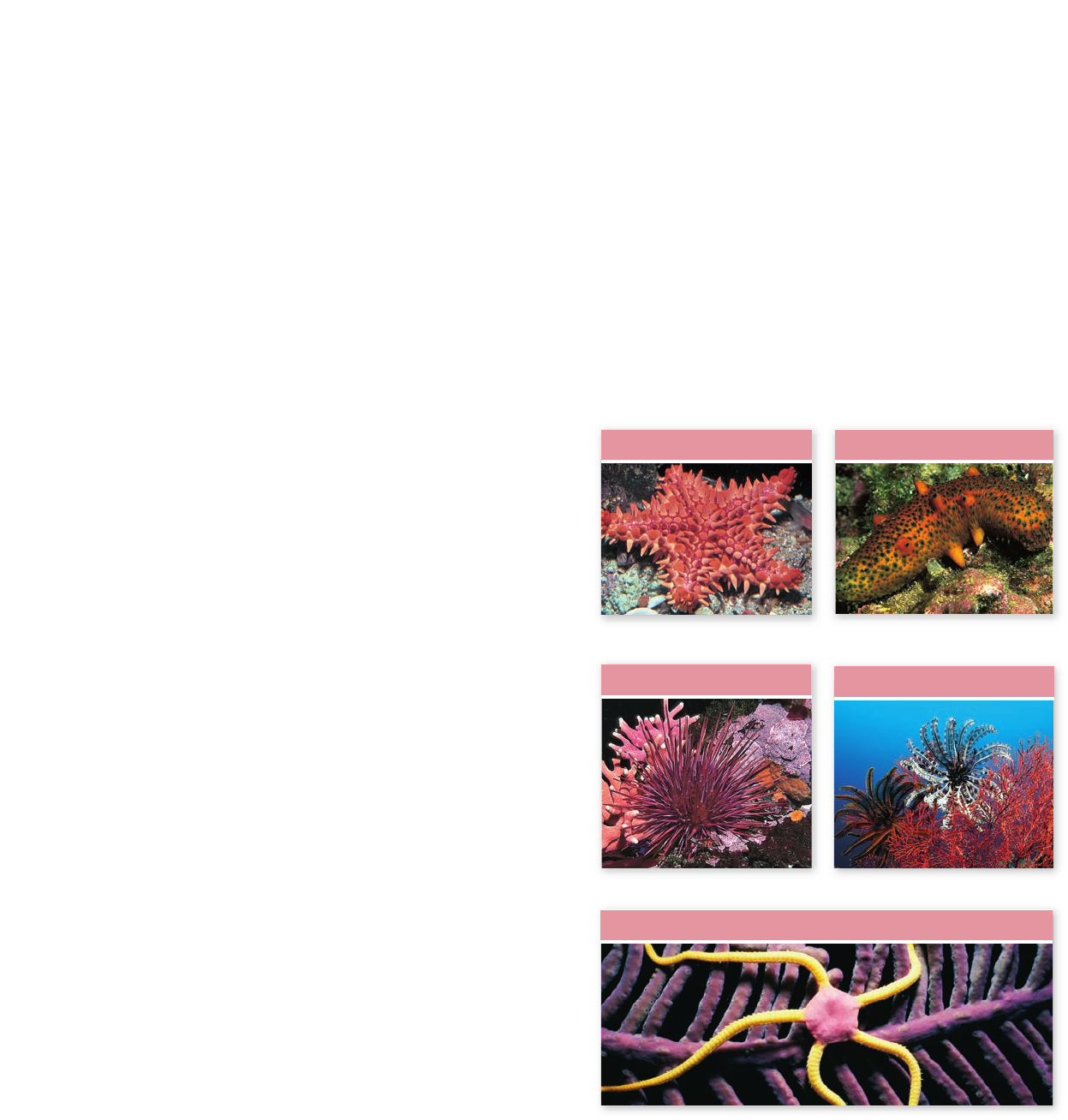
Figure 34.40
Diversity in echinoderms. a. Sea star,
Oreaster occidentalis (class Asteroidea), in the Gulf of California,
Mexico. b. Warty sea cucumber, Parastichopus parvimensis (class
Holothuroidea), Philippines. c. Sea urchin of the genus Echinometra
(class Echinoidea). d. Feather star (class Crinoidea) of the genus
Comatheria, from Indonesia. e. Gaudy brittle star, Ophioderma
ensiferum (class Ophiuroidea).
chapter
34
Coelomate Invertebrates
689www.ravenbiology.com
rav32223_ch34_666-692.indd 689rav32223_ch34_666-692.indd 689 11/13/09 4:22:54 PM11/13/09 4:22:54 PM

Apago PDF Enhancer
Adults of all classes exhibit a five-part body plan. Even sea
cucumbers, which are shaped like their fruit namesake, have
five longitudinal grooves along their bodies. Here we discuss
three of the living classes.
Class Asteroidea: Sea stars
Sea stars are perhaps the most familiar echinoderms. Important
predators in many marine ecosystems, they range in size from a
centimeter to a meter across. They are abundant in the inter-
tidal zone, but also occur at the greatest depths of the
ocean—10,000 m. Around 1500 species of sea stars are known.
A sea star consists of tapering arms that gradually merge
into a central disk. Most sea stars have five arms, but some have
many more, typically in multiples of five. The digestive space
and gonads extend into the arms. The body is somewhat flat-
tened, flexible, and covered with a pigmented epidermis. Aster-
oidea includes sea daisies, which were discovered in 1986 and
were once considered to constitute their own class.
Class Ophiuroidea: Brittle stars
Brittle stars constitute the largest class of echinoderms, with
about 2000 species, and are probably the most abundant also.
They resemble asteroids, but differ morphologically in several
ways. The arms, which are of nearly equal diameter their entire
length, tapering only slightly from base to tip, merge abruptly
into the central disk. They are nearly solid and can easily be
autotomized (the source of the name “brittle”). The tube feet
lack ampullae and suckers, being used for feeding, not locomo-
tion. The animal has no anus.
The most mobile of echinoderms, brittle stars move by
pulling themselves along by “rowing” over the substrate by
moving their slender arms, often in pairs or groups, from side
In many mollusks, an embryo develops into a free-swimming
trochophore larva (see gure 34.5a). In some bivalves and gastropods,
the embryo becomes a free-swimming veliger larva (see gure 34.5b).
Four classes of mollusks show the diversity of the phylum.
The four best-known classes are Polyplacophora (chitons),
Gastropoda (snails and slugs), Bivalvia (clams, mussels, and cockles),
and Cephalopoda (octopuses and squids).
34.2 Phylum Nemertea: The Ribbon Worms
Nemerteans super cially resemble acoelomate atworms, but they
have a closed circulatory system and a complete digestive tract.
34.3 Phylum Annelida: The Annelids
The annelid body is composed of ringlike segments.
The segments of the annelid body are separated by septa. Each
segment contains a pair of excretory organs, a ganglion, and, in most
34.1 Phylum Mollusca: The Mollusks
Mollusks are extremely diverse—and important to humans.
Mollusks range from microscopic to huge and exhibit many different
forms. They all have a coelom surrounding the heart.
The mollusk body plan is complex and varied.
Mollusks are generally bilaterally symmetrical, at least at some point
in their lives (see gure 34.3). They use a muscular foot (podium) for
locomotion, attachment, food capture, or a combination.
The mantle is a thick epidermal sheet that forms the mantle cavity.
It houses the respiratory structures (ctenidia or gills), and digestive,
excretory, and reproductive products are discharged into it.
The outer mantle secretes a protective calcium carbonate shell. Some
mollusks have internal or reduced shells, or none at all.
All mollusks except bivalves have a radula, a rasplike structure used in
feeding (see gure 34.4). Most have an open circulatory system, but
cephalopods have a closed circulatory system.
Chapter Review
to side. Some brittle stars use their arms to swim, an unusual
habit among echinoderms. A brittle star has five arms, but in
some larger ones (the basket stars), each arm may bifurcate
several times. Brittle stars avoid light and are more active
at night.
Class Echinoidea: Sea urchins and sand dollars
Sand dollars and sea urchins lack arms. Five double rows of tube
feet protrude through the plates of the calcareous skeleton. The
protective, moveable spines that are attached to the skeleton by
muscles and connective tissue, are also arrayed pentamerally.
About 950 living species constitute the class Echinoidea.
Their calcareous plates preserve well, so sea urchins and sand
dollars are well represented in the fossil record, with more
than 5000 extinct species described. Sand dollars are essen-
tially flattened sea urchins; heart urchins are intermediate be-
tween the two.
Like holothurians, sea urchins are eaten by humans. The
gonads, known as uni in Japan, are the part considered edible.
Learning Outcomes Review 34.6
Echinoderms are marine deuterostomes with endoskeletons. They are
characterized by pentaradial symmetry in the adult, in which a line drawn
in fi ve directions produces mirror images. The water-vascular system and
tube feet that act as suction cups aid in movement and feeding. The fi ve
living classes of echinoderms are Asteroidea (sea stars), Crinoidea (sea lilies),
Echinoidea (sea urchins and sand dollars), Holothuroidea (sea cucumbers),
and Ophiuroidea (brittle stars).
■ What is the significance of the bilateral larval form
of echinoderms?
690
part
V
Diversity of Life on Earth
rav32223_ch34_666-692.indd 690rav32223_ch34_666-692.indd 690 11/13/09 4:22:59 PM11/13/09 4:22:59 PM

Apago PDF Enhancer
marine annelids, a set of reproductive organs. Anterior and posterior
segments contain light-, chemo-, and touch receptors.
Segments are connected by a ventral nerve cord that includes an
anterior brain region, and by a closed circulatory system.
Annelids move by contracting their segments.
The uid- lled coelom acts as a hydrostatic skeleton. Each segment
typically possesses chaetae, chitin bristles that help anchor the worm.
Annelids have a common, closed circulatory system but a segmented
excretory system.
Annelids have a closed circulatory system; the dorsal vessel is
connected to the ventral vessel by smaller vessels in the body wall.
Each segment contains a pair of nephridia that excrete wastes out of
the body via the coelom and excretory tubes.
Annelids comprise two—or three—classes.
Annelids have been grouped into three classes, but the currently
accepted classication recognizes two: the Polychaeta, which exhibit
parapodia and are mostly marine; and the Clitellata, which includes
earthworms and leeches.
34.4 The Lophophorates: Bryozoa
and Brachiopoda
Bryozoa and Brachiopoda are characterized by a lophophore, a
U -shaped ridge around the mouth bearing ciliated tentacles.
The bryozoans, phylum Bryozoa, are the only exclusively colonial animals.
Each individual zooid produces a chitinous chamber called a zoecium
that attaches to substrates and other colony members. They have
deuterostome development.
The brachiopods and phoronids, phylum Brachiopoda, are solitary
lophophorates.
The body of brachiopods is enclosed between two calcied shells
that are dorsal and ventral, not lateral as in bivalves (see gure 34.20).
They also are deuterostomes.
The phoronids, tube worms, are included with bryozoans because
they are solitary lophophorates; however, they are protostomes.
34.5 Phylum Arthropoda: The Arthropods
Arthropods exhibit key features and organ systems.
Arthropods are segmented and exhibit an exoskeleton with muscles
attached to the inside. The exoskeleton is molted during ecdysis,
allowing the arthropod to grow. In some species, segments are fused
into units called tagmata.
Arthropods’ jointed appendages may be modied into mouth parts,
antennae, or legs.
An open circulatory system includes a muscular heart. The
respiratory system in terrestrial arthropods comprises spiracles,
tracheae, and tracheoles (see gure 34.26). The main components of
the nervous system are an inhibitory brain and a ventral nerve cord.
Many arthropods have compound eyes composed of ommatidia
(gure 34.25); others have simple eyes (ocelli).
The excretory system of terrestrial hexapods, myriapods, and chelicerates
consists of Malpighian tubules that eliminate uric acid or guanine.
Class Chelicerata includes spiders, mites, and horseshoe crabs.
Chelicerates have specialized anterior appendages, the chelicerae,
that function as fangs or pincers.
Class Crustacea includes crabs, shrimps, lobsters, and pill bugs.
Crustaceans have three tagmata, and the two anterior ones fused to
form a cephalothorax (see gure 34.29). Crustacea is characterized by
a nauplius larva (see gure 34.30).
Class Hexapoda comprises the insects.
The hexapods are extraordinarily diverse. Insects have three pairs of
legs attached to the thorax and may have wings. They have highly
developed sensory systems.
Myriapoda includes centipedes and millipedes.
Centipedes have one pair of appendages per segment, whereas
millipedes have two pairs.
34.6 Phylum Echinodermata: The Echinoderms
Echinoderms are ancient and unmistakable.
Echinoderms are characterized by deuterostome development,
pentameral symmetry, an endoskeleton covered by a delicate
epidermis, and a water-vascular system.
Echinoderm symmetry is bilateral in larvae but pentaradial in adults.
The larvae of echinoderms are bilateral, but the adult is pentaradial.
The water-vascular system, which is one of several coelomic compartments,
aids in movement, feeding, circulation, respiration, and excretion.
Echinodermata comprises ve extant classes.
The ve classes of echinoderms are Asteroidea (sea stars), Crinoidea
(sea lilies), Echinoidea (sea urchins and sand dollars), Holothuroidea
(sea cucumbers), and Ophiuroidea (brittle stars).
3. Intelligence and complex behaviors are characteristics of the
a. cephalopods. c. brachiopods.
b. polychaetes. d. echinoderms.
4. Serial segmentation is a key characteristic of which of the
following phyla?
a. Mollusca c. Bryozoa
b. Brachiopoda d. Annelida
UNDERSTAND
1. The __________ of a mollusk is a highly efcient respiratory
structure.
a. nephridium c. ctenidium
b. radula d. veliger
2. Torsion is a unique characteristic of the
a. bivalves. c. chitons.
b. gastropods. d. cephalopods.
Review Questions
chapter
34
Coelomate Invertebrates
691www.ravenbiology.com
rav32223_ch34_666-692.indd 691rav32223_ch34_666-692.indd 691 11/13/09 4:23:00 PM11/13/09 4:23:00 PM