
Raven P.H., Johnson G.B., Mason K.A. Biology (Ninth Edition)
Подождите немного. Документ загружается.


Apago PDF Enhancer
5. The distinguishing feature of the Bryozoa and Brachiopoda is
a. coelom. c. chaetae.
b. segmentation. d. a lophophore.
6. In terms of numbers of species, the most successful phylum on
the planet is the
a. Mollusca. c. Echinodermata.
b. Arthropoda. d. Annelida.
7. Which of the following characteristics is not found in the
arthropods?
a. Jointed appendages
b. Segmentation
c. Closed circulatory system
d. Segmented ganglia
8. Which of the following classes of arthropod possess chelicerae?
a. Chilopoda c. Hexapoda
b. Crustacea d. Chelicerata
9. Examples of decapods are
a. centipedes and millipedes.
b. barnacles.
c. ticks and mites.
d. lobsters and craysh.
10. What characteristic separates the Diptera, Lepidoptera, and
Hymenoptera?
a. Type of wings
b. Type of mouthparts
c. Type of legs
d. Method of reproduction
11. Which of the following structures is not a component of the
water-vascular system of an echinoderm?
a. Ossicles c. Radial canals
b. Ampullae d. Madreporites
APPLY
1. The fact that Arthropods molt means that they are considered
a. spiralians. c. deuterostomes.
b. ecdysozoans. d. parazoans.
2. Based on embryonic development, which of the following phyla
is the closest to the chordates?
a. Annelida c. Echinodermata
b. Arthropoda d. Mollusca
3. To which of the following groups would a species that does not
molt, possesses a coelom, and has a trochophore larva belong?
a. Ecdysozoa c. Platyzoa
b. Parazoa d. Lophotrochozoa
4. Nematodes once were thought to be closely related to rotifers
due to the presence of a pseudocoelom, but are now considered
closer to the arthropods due to
a. molting. c. wings.
b. jointed appendages. d. a coelom.
SYNTHESIZE
1. Scientists studying the Chesapeake Bay have discovered that the
decline in populations of clams and scallops has led to a drastic
increase in the levels of pollution. What characteristic of this
group could be attributed to this observation?
2. Chitin is present in a number of invertebrate coelomates, as
well as the fungi. What does this tell you about the origin and
importance of this substance?
ONLINE RESOURCE
www.ravenbiology.com
Understand, Apply, and Synthesize—enhance your study with
animations that bring concepts to life and practice tests to assess
your understanding. Your instructor may also recommend the
interactive eBook, individualized learning tools, and more.
692
part
V
Diversity of Life on Earth
rav32223_ch34_666-692.indd 692rav32223_ch34_666-692.indd 692 11/13/09 4:23:00 PM11/13/09 4:23:00 PM
Apago PDF Enhancer
M
Chapter
35
Vertebrates
Chapter Outline
35.1 The Chordates
35.2 The Nonvertebrate Chordates
35.3 The Vertebrate Chordates
35.4 Fishes
35.5 Amphibians
35.6 Reptiles
35.7 Birds
35.8 Mammals
35.9 Evolution of the Primates
Introduction
Members of the phylum Chordata exhibit great changes in the endoskeleton from what is seen in echinoderms. As you saw
in chapter 34, the endoskeleton of echinoderms is functionally similar to the exoskeleton of arthropods—a hard shell with
muscles attached to its inner surface. Chordates employ a very different kind of endoskeleton, one that is truly internal.
Members of the phylum Chordata are characterized by a flexible rod that develops along the back of the embryo. Muscles
attached to this rod allowed early chordates to swing their bodies from side to side, swimming through the water. This key
evolutionary advance, attaching muscles to an internal element, started chordates along an evolutionary path that led to
the vertebrates—and, for the first time, to truly large animals .
CHAPTER
rav32223_ch35_693-728.indd 693rav32223_ch35_693-728.indd 693 11/16/09 1:44:37 PM11/16/09 1:44:37 PM
Apago PDF Enhancer
Sponges
Cnidarians
Flatworms
Nematodes
Mollusks
Annelids
Arthropods
Echinoderms
Chordates
Postanal tail
Notochord
Hollow dorsal nerve cord
Pharyngeal pouches
500 µm
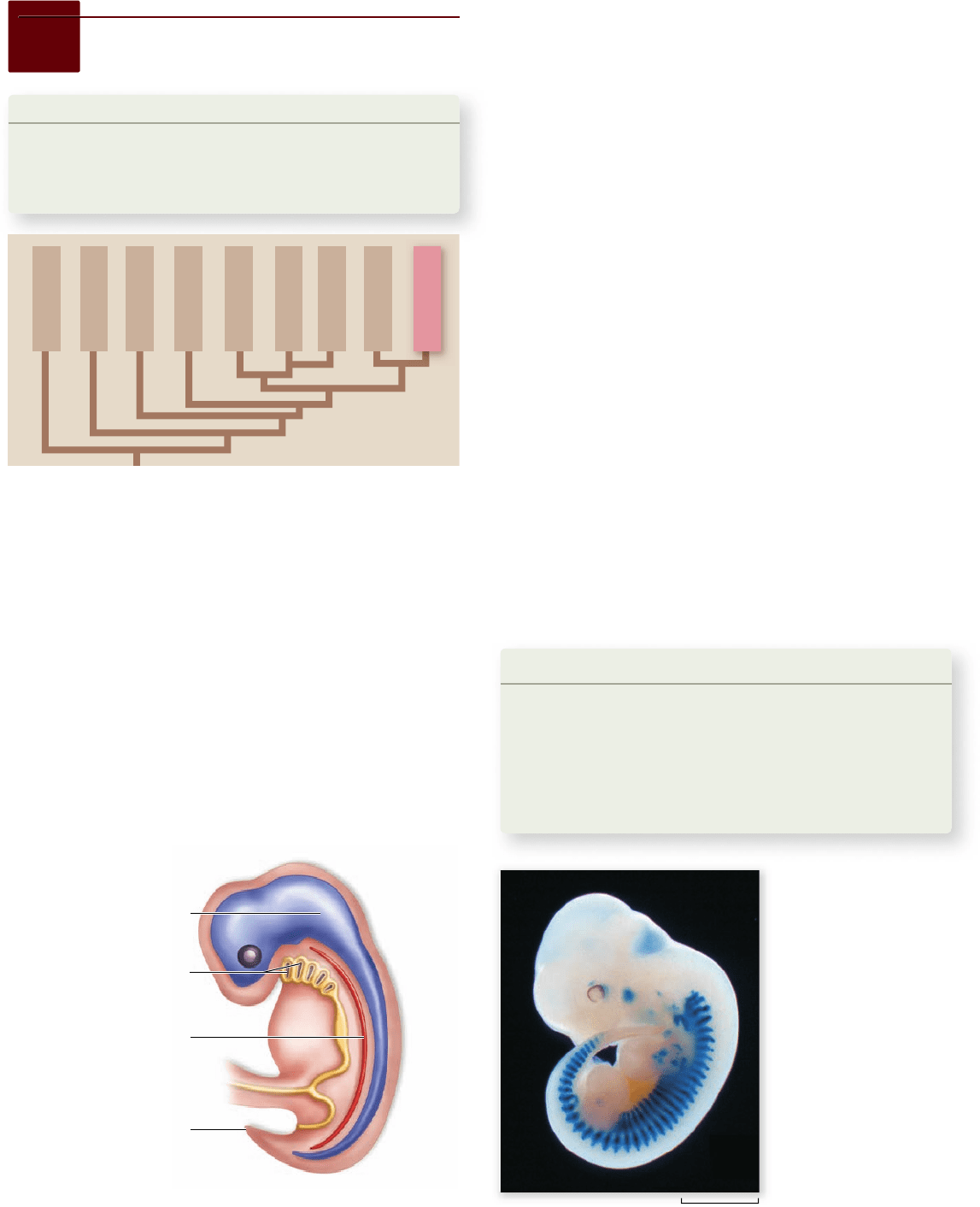
Figure 35.1
The four principal features of the
chordates, as shown in a generalized embr yo.
Figure 35.2
A mouse embryo.
At 11.5 days of
development, the
mesoderm is already
divided into segments
called somites (stained
dark in this photo),
re ecting the
fundamentally
segmented nature
of all chordates.
Pharyngeal slits3. connect the pharynx, a muscular tube
that links the mouth cavity and the esophagus, with the
external environment. In terrestrial vertebrates, the slits
do not actually connect to the outside and are better
termed pharyngeal pouches. Pharyngeal pouches are
present in the embryos of all vertebrates. They become
slits, open to the outside in animals with gills, but leave no
external trace in those lacking gills. The presence of these
structures in all vertebrate embryos provides evidence of
their aquatic ancestry.
Chordates have a 4. postanal tail that extends beyond the
anus, at least during their embryonic development. Nearly
all other animals have a terminal anus.
All chordates have all four of these characteristics at some
time in their lives. For example, humans as embryos have pha-
ryngeal pouches, a dorsal nerve cord, a postanal tail, and a no-
tochord. As adults, the nerve cord remains, and the notochord
is replaced by the vertebral column. All but one pair of pharyn-
geal pouches are lost; this remaining pair forms the Eustachian
tubes that connect the throat to the middle ear. The postanal
tail regresses, forming the tail bone (coccyx).
A number of other characteristics also fundamentally
distinguish the chordates from other animals. Chordate mus-
cles are arranged in segmented blocks that affect the basic or-
ganization of the chordate body and can often be clearly seen
in embryos of this phylum (figure 35.2) . Most chordates have
an internal skeleton against which the muscles work. Either
this internal skeleton or the notochord (figure 35.3) makes
possible the extraordinary powers of locomotion characteris-
tic of this group.
Learning Outcomes Review 35.1
Chordates are characterized by a hollow dorsal nerve cord, a notochord,
pharyngeal pouches, and a postanal tail at some point in their development.
The fl exible notochord anchors internal muscles and allows rapid, versatile
movement. Chordates are deuterostomes; their nearest relatives are
the echinoderms.
■ What distinguishes a chordate from an echinoderm?
35.1
The Chordates
Learning Outcomes
List the defining characteristics of chordates.1.
Describe the evolutionary relationships of chordates to 2.
other taxa.
Chordates (phylum Chordata) are deuterostome coelomates;
their nearest relatives in the animal kingdom are the echino-
derms, the only other major phylum of deuterostomes. There
are some 56,000 species of chordates, a phylum that includes
fishes, amphibians, reptiles, birds, and mammals.
Four features characterize the chordates and have played
an important role in the evolution of the phylum (figure 35.1) :
A single, hollow 1. nerve cord runs just beneath the dorsal
surface of the animal. In vertebrates, the dorsal nerve cord
differentiates into the brain and spinal cord.
A exible rod, the 2. notochord, forms on the dorsal side of
the primitive gut in the early embryo and is present at some
developmental stage in all chordates. The notochord is
located just below the nerve cord. The notochord may
persist in some chordates; in others it is replaced during
embryonic development by the vertebral column that forms
around the nerve cord.
694
part
V
Diversity of Life on Earth
rav32223_ch35_693-728.indd 694rav32223_ch35_693-728.indd 694 11/16/09 1:44:47 PM11/16/09 1:44:47 PM
Apago PDF Enhancer
Notochord
Dorsal nerve cord
Pharyngeal slits
Pharynx
Postanal tail
Anus
Intestine
Oral hood with tentacles
Muscle blocks
a.
b.
c.
Incurrent
siphon
Pharynx
Endostyle
Gill slit
Tunic
Gonad
Heart
Stomach
Genital duct
Intestine
Excurrent
siphon
Nerve ganglion
Hypophyseal
duct
Stomach
Heart
Pharynx with gill slits
Notochord
Dorsal nerve cord
Atriopore (excurrent siphon)
Mouth (incurrent siphon)
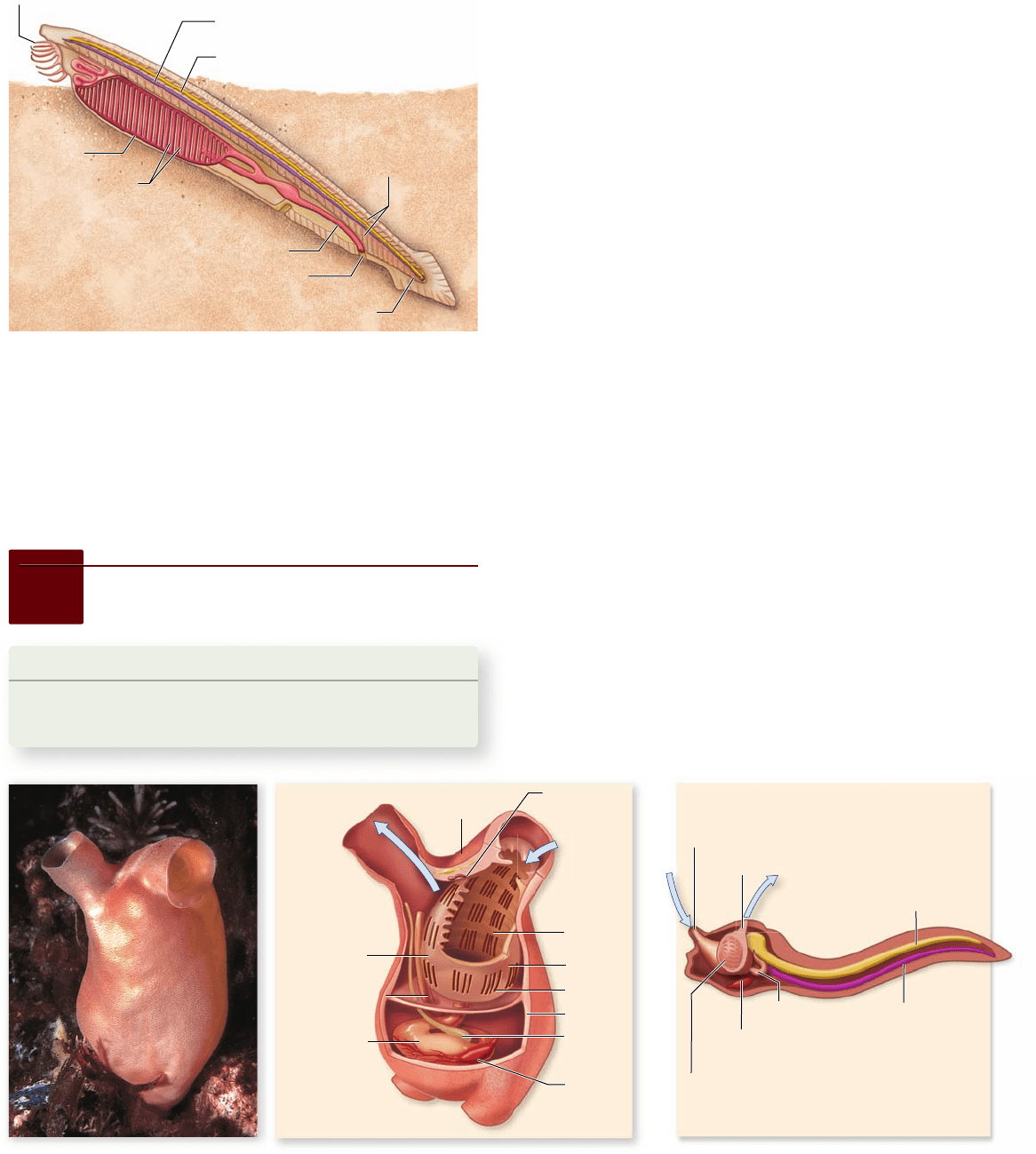
Figure 35.3
Phylum Chordata: Chordates. Vertebrates,
tunicates, and lancelets are chordates (phylum Chordata), coelomate
animals with a exible rod, th e notochord, that provides resistance
to muscle contraction and permits rapid lateral body movements.
Chordates also possess pharyngeal pouches or slits (re ecting their
aquatic ancestry and present habitat in some) and a hollow dorsal
nerve cord. In nearly all vertebrates, the notochord is replaced
during embryonic development by the vertebral column.
35.2
The Nonvertebrate Chordates
Learning Outcome
Describe the nonvertebrate chordates and their 1.
characteristics.
Phylum Chordata can be divided into three subphyla. Two of
these, Urochordata and Cephalochordata, are nonvertebrate;
the third subphylum is Vertebrata. The nonvertebrate chor-
dates do not form vertebrae or other bones, and in the case of
the urochordates, their adult form is greatly different from
what we expect chordates to look like.
Tunicates have chordate larval forms
The tunicates and salps (subphylum Urochordata) are a group
of about 1250 species of marine animals. Most of them are im-
mobile as adults, with only the larvae having a notochord and
nerve cord. As adults, they exhibit neither a major body cavity
nor visible signs of segmentation (figure 35.4a, b). Most species
occur in shallow waters, but some are found at great depths. In
some tunicates, adults are colonial, living in masses on the
ocean floor. The pharynx is lined with numerous cilia; beating
of the cilia draws a stream of water into the pharynx, where
microscopic food particles become trapped in a mucous sheet
secreted from a structure called an endostyle.
The tadpolelike larvae of tunicates plainly exhibit all of
the basic characteristics of chordates and mark the tunicates as
having the most primitive combination of features found in
any chordate (figure 35.4c). The larvae do not feed and have a
poorly developed gut. They remain free-swimming for only a
few days before settling to the bottom and attaching them-
selves to a suitable substrate by means of a sucker.
Tunicates change so much as they mature and adjust de-
velopmentally to an immobile, filter-feeding existence that it
would be difficult to discern their evolutionary relationships
solely by examining an adult. Many adult tunicates secrete a
tunic, a tough sac composed mainly of cellulose, a substance
frequently found in the cell walls of plants and algae but rarely
found in animals. The tunic surrounds the animal and gives the
subphylum its name. Colonial tunicates may have a common
sac and a common opening to the outside.
Figure 35.4
Tunicates (phylum Chordata, subphylum Urochordata). a. The sea peach, Halocynthia auranthium, like other tunicates,
does not move as an adult, but rather is rmly attached to the sea oor. b. Diagram of the structure of an adult tunicate. c. Diagram of the structure
of a larval tunicate, showing the characteristic tadpolelike form. Larval tunicates resemble the postulated common ancestor of the chordates.
chapter
35
Vertebrates
695www.ravenbiology.com
rav32223_ch35_693-728.indd 695rav32223_ch35_693-728.indd 695 11/16/09 1:44:51 PM11/16/09 1:44:51 PM

Apago PDF Enhancer
One group of Urochordates, the Larvacea, retains the tail
and notochord into adulthood. One theory of vertebrate ori-
gins involves a larval form, perhaps that of a tunicate, which
acquired the ability to reproduce.
Lancelets are small marine chordates
Lancelets (subphylum Cephalochordata) were given their Eng-
lish name because they resemble a lancet—a small, two-edged
surgical knife. These scaleless chordates, a few centimeters
long, occur widely in shallow water throughout the oceans of
the world. There are about 23 species of this subphylum. Most
of them belong to the genus Branchiostoma, formerly called
Amphioxus, a name still used widely. In lancelets, the notochord
runs the entire length of the dorsal nerve cord and persists
throughout the animal’s life.
Lancelets spend most of their time partly buried in sandy
or muddy substrates, with only their anterior ends protruding
(figure 35.5) . They can swim, although they rarely do so. Their
muscles can easily be seen through their thin, transparent skin
as a series of discrete blocks, called myomeres. Lancelets have
many more pharyngeal gill slits than fishes do. They lack pig-
ment in their skin, which has only a single layer of cells, unlike
the multilayered skin of vertebrates. The lancelet body is
pointed at both ends. There is no distinguishable head or sen-
sory structure other than pigmented light receptors.
Lancelets feed on microscopic plankton, using a current
created by beating cilia that line the oral hood, pharynx, and gill
slits. The gill slits provide an exit for the water and are an adap-
tation for filter feeding. The oral hood projects beyond the
mouth and bears sensory tentacles, which also ring the mouth.
The recent discovery of fossil forms similar to living lancelets
in rocks 550 million years old argues for the antiquity of this group.
Recent studies by molecular systematists further support the hy-
pothesis that lancelets are the closest relatives of vertebrates.
Learning Outcome Review 35.2
Nonvertebrate chordates have notochords but no vertebrae or bones.
Urochordates, such as tunicates, have obviously chordate larval forms but
drastically diff erent adult forms. Cephalochordates, such as lancelets, do not
change body form as adults.
■ How do lancelets and tunicates differ from each other,
and from vertebrates?
Figure 35.5
Lancelets. Two lancelets,
Branchiostoma lanceolatum
(phylum Chordata,
subphyl um
Cephalochordata), partly
buried in shell gravel, with
their anterior ends
protruding. The muscle
segments are clearly visible.
35.3
The Vertebrate Chordates
Learning Outcomes
Distinguish vertebrates from other chordates.1.
Explain how cartilage and bone contributed to increased 2.
size in vertebrates.
Vertebrates (subphylum Vertebrata) are chordates with a spinal col-
umn. The name vertebrate comes from the individual bony or carti-
laginous segments called vertebrae that make up the spine.
Vertebrates have vertebrae, a distinct head,
and other features
Vertebrates differ from the tunicates and lancelets in two im-
portant respects:
Vertebral column. In all vertebrates except the earliest diverging
shes, the notochord is replaced during embryonic
development by a vertebral column ( gure 35.6) . The
column is a series of bony or cartilaginous vertebrae that
enclose and protect the dorsal nerve cord like a sleeve.
Head. Vertebrates have a distinct and well-differentiated head
with three pairs of well-developed sensory organs; the
brain is encased within a protective box, the skull, or
cranium, made of bone or cartilage.
I n addition to these two key characteristics, vertebrates differ
from other chordates in other important respects (figure 35.7 ):
Neural crest. A unique group of embryonic cells called the
neural crest contributes to the development of many
vertebrate structures. These cells develop on the crest of the
neural tube as it forms by invagination and pinching
together of the neural plate (see chapter 54 for a detailed
account). Neural crest cells then migrate to various locations
in the developing embryo, where they participate in the
development of many different structures.
Internal organs. Internal organs characteristic of vertebrates
include a liver, kidneys, and endocrine glands. The
ductless endocrine glands secrete hormones that help
regulate many of the body’s functions. All vertebrates have
a heart and a closed circulatory system. In both their
circulatory and their excretory functions, vertebrates
differ markedly from other animals.
Endoskeleton. The endoskeleton of most vertebrates is made
of cartilage or bone. Cartilage and bone are specialized
tissues containing bers of the protein collagen
compacted together (see chapter 47). Bone also contains
crystals of a calcium phosphate salt. The great advantage
of bone over chitin as a structural material is that bone is
a dynamic, living tissue that is strong without being
brittle. The vertebrate endoskeleton makes possible the
great size and extraordinary powers of movement that
characterize this group.
696
part
V
Diversity of Life on Earth
rav32223_ch35_693-728.indd 696rav32223_ch35_693-728.indd 696 11/16/09 1:44:54 PM11/16/09 1:44:54 PM

Apago PDF Enhancer
Vertebral
body
developing
around
notochord
Ectoderm
Neural
tube
Notochord
Forming
neural arch
Blood vessels
Neural arch
Centrum
Rib
Head with brain (including endocrine
glands) encased in skull
Heart-powered
closed circulatory system
Liver
Kidney
Dorsal nerve cord
Vertebral column
(part of skeletal system)
Limbs (or fins)
Postanal tail
Vertebrates evolved half a billion
years ago: An overview
The first vertebrates evolved in the oceans about 545 mya, dur-
ing the Cambrian period. Many of them looked like a flattened
hot dog, with a mouth at one end and a fin at the other. The
appearance of a hinged jaw was a major advance, opening up
new food-gathering options, and jawed fishes became the dom-
inant creatures in the sea. Their descendants, the amphibians,
invaded the land. Amphibians, in turn, gave rise to the first rep-
tiles about 300 mya. Within 50 million years, reptiles, better
suited to living out of water, replaced amphibians as the domi-
nant land vertebrates.
With the success of reptiles, vertebrates truly came to
dominate the surface of the Earth. Many kinds of reptiles
evolved, ranging in size from smaller than a chicken to bigger
than a truck, and including some that flew and others that
swam. Among them evolved reptiles that gave rise to the
two remaining great lines of terrestrial vertebrates: birds
and mammals.
Dinosaurs and mammals appear at about the same time in
the fossil record, 220 mya. For over 150 million years, dinosaurs
dominated the face of the Earth. Over all these million-and-a-
half centuries, the largest mammal was no bigger than a
medium-sized dog. Then, in the Cretaceous mass extinction,
about 65 mya, the dinosaurs abruptly disappeared. In their ab-
sence, mammals and birds quickly took their place, becoming
abundant and diverse.
The history of vertebrates has been a series of evolution-
ary advances that have allowed vertebrates to first invade the
land and then the air. In this chapter, we examine the key evo-
lutionary advances that permitted vertebrates to invade the
land successfully. As you will see, this invasion was a staggering
evolutionary achievement, involving fundamental changes in
many body systems.
While considering vertebrate evolution, keep in mind
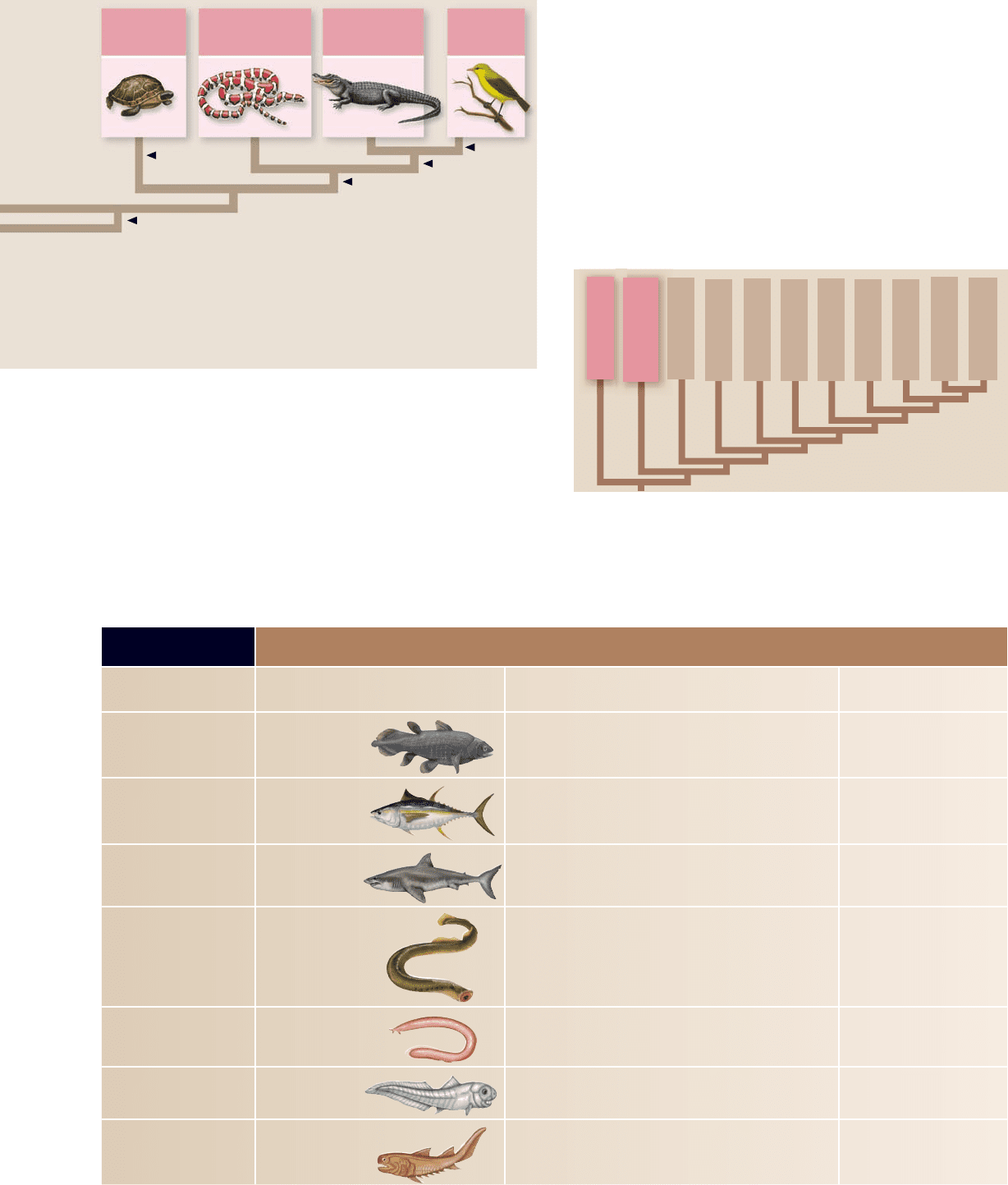
that two vertebrate groups—fish and reptiles—are paraphyletic
(figure 35.8) . Some fish are more closely related to other
vertebrates than they are to some other fish. Similarly, some
reptiles are more closely related to birds than they are to
other reptiles. Biologists are currently divided about how to
handle situations like this, as we discussed in chapter 23 (see
figure 23.5). For the time being, we continue to use the tradi-
tional classification of vertebrates, bearing in mind the evolu-
tionary implications of the paraphyly of fish and reptiles.
Learning Outcomes Review 35.3
Vertebrates are characterized by a vertebral column and a distinct head.
Other distinguishing features are the development of a neural crest, a
closed circulatory system, specialized organs, and a bony or cartilaginous
endoskeleton that has the strength to support larger body size and
powerful movements.
■ In what ways would an exoskeleton limit the size of
an organism?
Figure 35.6
Embryonic development of a vertebra. During the evolution of animal development, the exible notochord is
surrounded and eventually replaced by a cartilaginous or bony covering, the centrum. The neural tube is protected by an arch above the
centrum. The vertebral column functions as a strong, exible rod that the muscles pull against when the animal swims or moves.
Figure 35.7
Major characteristics of vertebrates. Adult
vertebrates are characterized by an internal skeleton of cartilage or
bone, including a vertebral column and a skull. Several other internal
and external features are characteristic of vertebrates.
chapter
35
Vertebrates
697www.ravenbiology.com
rav32223_ch35_693-728.indd 697rav32223_ch35_693-728.indd 697 11/16/09 1:44:58 PM11/16/09 1:44:58 PM
Apago PDF Enhancer
Myxini
(hagfish)
Cephalaspidomorphi
(lampreys)
Chondrichthyes
(cartilaginous fishes)
Actinopterygii
(ray-finned fishes)
Sarcopterygii
(lobe-finned fishes)
Amphibia
(amphibians)
Mammalia
(mammals)
Mammary glands,
4-chambered heart,
hair, synapsid skull
Legs with
multiple digits
Lobed fins
Rayed fins
Internal
bony skeleton
Jaws, two pairs
of appendages
Vertebral column
Head with 3 pairs of sense organs
Chordate ancestor
Figure 35.9
Fish. Fish are the most diverse vertebrates and
include more species than all other kinds of vertebrates combined.
Top, ribbon eel, Rhinomuraena quaesita; botto m left, leafy sea-
dragon, Phycodurus eques; bottom right, yellow n tuna,
Thunnus albacares.
entirely out of water. However varied, all fishes have important
characteristics in common:
Vertebral column.1. Fish have an internal skeleton with a
bony or cartilaginous spine surrounding the dorsal nerve
cord, and a bony or cartilaginous skull encasing the brain.
Exceptions are the jawless hag sh and lampreys. In
hag sh, a cartilaginous skull is present, but vertebrae are
not; the notochord persists and provides support. In
lampreys, a cartilaginous skeleton and notochord are
35.4
Fishes
Learning Outcomes
Describe the major groups of fishes.1.
List the evolutionary innovations of fishes.2.
Over half of all vertebrates are fishes. The most diverse verte-
brate group, fishes provided the evolutionary base for invasion
of land by amphibians. In many ways, amphibians can be viewed
as transitional—“fish out of water.”
The story of vertebrate evolution started in the ancient
seas of the Cambrian period (545 to 490 mya). Figure 35.8
shows the key vertebrate characteristics that evolved subse-
quently. Wriggling through the water, jawless and toothless, the
first fishes sucked up small food particles from the ocean floor
like miniature vacuum cleaners. Most were less than a foot long,
respired with gills, and had no paired fins or vertebrae (although
some had rudimentary vertebrae); they did have a head and a
primitive tail to push them through the water.
For 50 million years, during the Ordovician period
(490 to 438 mya), these simple fishes were the only vertebrates.
By the end of this period, fish had developed primitive fins to
help them swim and massive shields of bone for protection.
Jawed fishes first appeared during the Silurian period (438 to
408 mya), and along with them came a new mode of feeding.
Fishes exhibit ve key characteristics
From whale sharks 18 m long to tiny gobies no larger than your
fingernail, fishes vary considerably in size, shape, color, and ap-
pearance (figure 35.9) . Some live in freezing arctic seas, others
in warm, freshwater lakes, and still others spend a lot of time
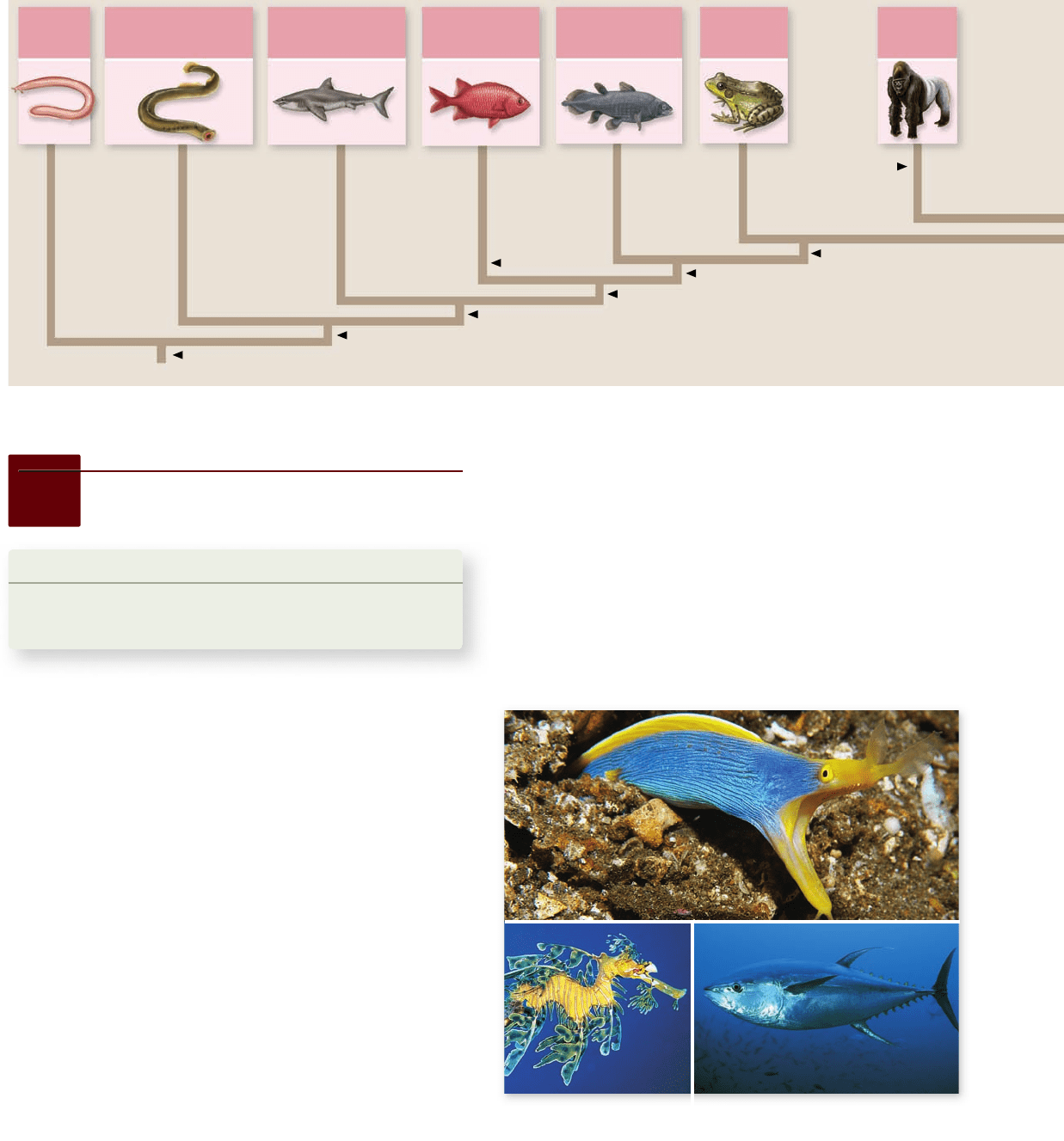
Figure 35.8
Phylogeny of the living vertebrates. Some of the key characteristics that evolved among the vertebrate groups are
shown in this phylogeny .
698
part
V
Diversity of Life on Earth
rav32223_ch35_693-728.indd 698rav32223_ch35_693-728.indd 698 11/16/09 1:45:00 PM11/16/09 1:45:00 PM
Apago PDF Enhancer
Feathers
Skull with
two additional
openings
Diapsid
skull
Anapsid skull,
bony shell
Amniotic egg
Testudines
(turtles)
Lepidosauria
(lizards, snakes,
tuataras)
Crocodilia
(crocodiles,
alligators)
Aves
(birds)
Cephalaspi-
domorphi
Mammalia
Chondrichthyes
Actinopterygii
Sarcopterygii
Amphibia
Testudines
Lepidosauria
Crocodilia
Aves
Mixini
present, but rudimentary cartilaginous vertebrae also
surround the notochord in places.
Jaws and paired appendages.2. Fishes other than
lampreys and hag sh all have jaws and paired appendages,
features that are also seen in tetrapods (see gure 35.8).
Jaws allowed these sh to capture larger and more active
prey. Most shes have two pairs of ns: a pair of pectoral
ns at the shoulder, and a pair of pelvic ns at the hip. In
the lobe- nned sh, these pairs of ns became jointed.
Internal gills.3. Fishes are water-dwelling creatures and must
extract oxygen dissolved in the water around them. They do
this by directing a ow of water through their mouths and
across their gills (see chapter 49). The gills are composed of
ne laments of tissue that are rich in blood vessels.
Single-loop blood circulation.4. Blood is pumped from
the heart to the gills. From the gills, the oxygenated blood
passes to the rest of the body, and then returns to the
heart. The heart is a muscular tube-pump made of two
chambers that contract in sequence.
Nutritional de ciencies.5. Fishes are unable to synthesize
the aromatic amino acids (phenylalanine, tryptophan, and
tyrosine; see chapter 3), and they must consume them in
their foods. This inability has been inherited by all of
their vertebrate descendants.
The first fishes
The first fishes did not have jaws, and instead had only a mouth
at the front end of the body that could be opened to take in
food. Two groups survive today as hagfish (class Myxini;
table 35.1) and lampreys (class Cephalaspidomorphi).
TABLE 35.1
Major Classes of Fishes
Class Typical Examples Key Characteristics
Approximate Number
of Living Species
Sarcopterygii Lobe- nned
s h e s
Largely extinct group of bony shes; ancestral to amphibians;
paired lobed ns
8
Actinopterygii Ray- nned
s h e s
Most diverse group of vertebrates; swim bladders and bony
skeletons; paired ns supported by bony rays
30,000
Chondrichthyes Sharks, skates,
rays
Cartilaginous skeletons; no swim bladders; internal fertilization 750
Cephalaspidomorphi Lampreys
Largely extinct group of jawless shes with no paired appendages;
parasitic and nonparasitic types; all breed in fresh water
35
Myxini Hag shes
Jawless shes with no paired appendages; scavengers; mostly
blind, but having a well-developed sense of smell
30
Placodermi Armored shes
Jawed shes with heavily armored heads; many were quite large Extinct
Acanthodii and
Ostracoderms
Spiny shes
Fishes with (acanthodians) or without (placoderms) jaws; paired
ns supported by sharp spines; head shields made of bone; rest of
skeleton cartilaginous
Extinct
rav32223_ch35_693-728.indd 699rav32223_ch35_693-728.indd 699 11/16/09 1:45:04 PM11/16/09 1:45:04 PM
Apago PDF Enhancer
Cephalaspi-
domorphi
Mammalia
Chondrichthyes
Actinopterygii
Sarcopterygii
Amphibia
Testudines
Lepidosauria
Crocodilia
Aves
Mixini
Skull
Gill slit
Anterior gill arch
Another group were the ostracoderms (a word meaning
“shell-skinned”). Only their head-shields were made of bone;
their elaborate internal skeletons were constructed of cartilage.
Many ostracoderms were bottom-dwellers, with a jawless
mouth underneath a flat head, and eyes on the upper surface.
Ostracoderms thrived in the Ordovician and Silurian periods
(490 to 408 mya), only to become almost completely extinct at
the close of the Devonian period (408 to 360 mya).
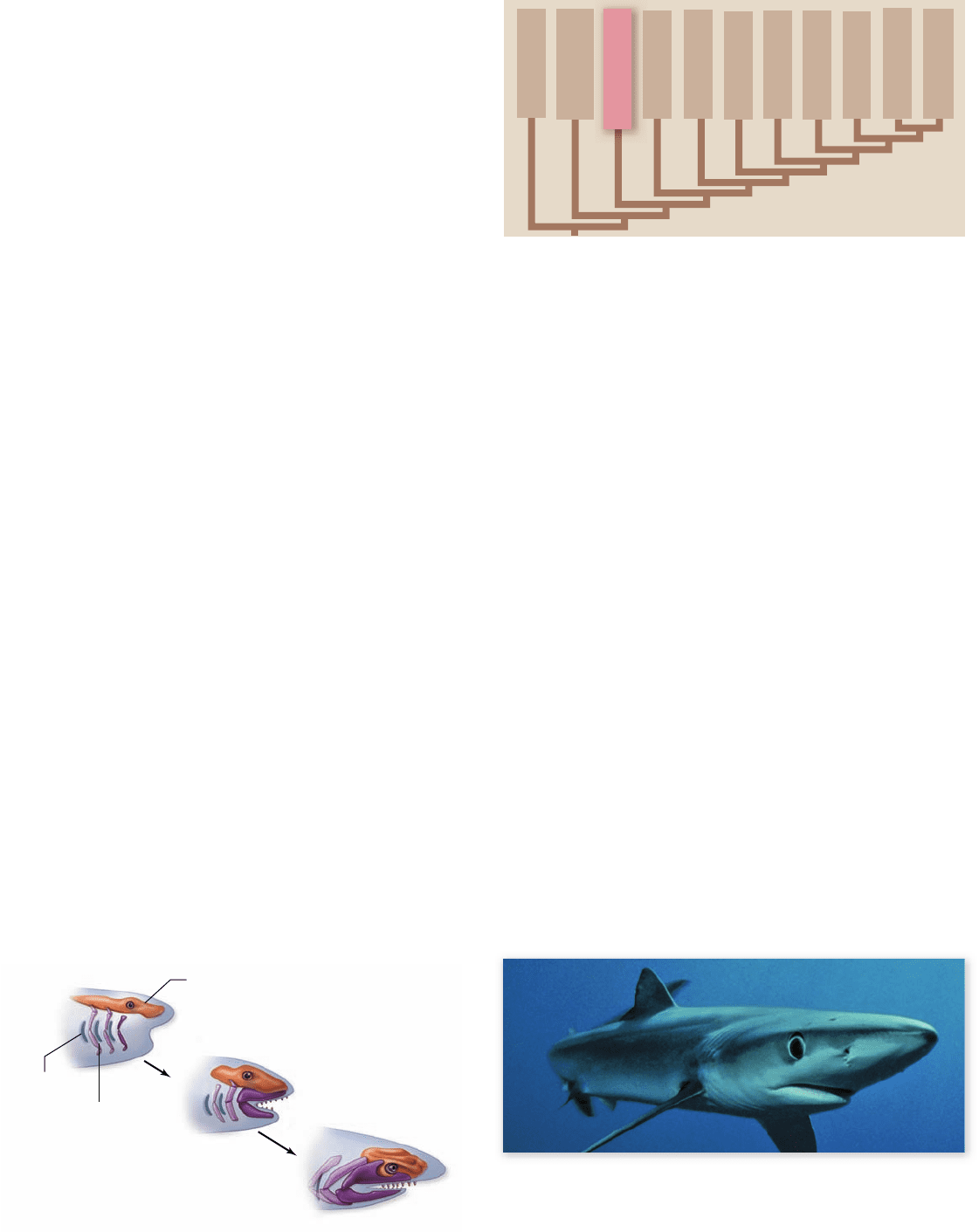
Evolution of the jaw
A fundamentally important evolutionary advance that occurred
in the late Silurian period was the development of jaws. Jaws
evolved from the most anterior of a series of arch-supports
made of cartilage, which were used to reinforce the tissue be-
tween gill slits to hold the slits open (figure 35.10) . This trans-
formation was not as radical as it might at first appear.
Each gill arch was formed by a series of several cartilages
(which later evolved to become bones) arranged somewhat in the
shape of a V turned on its side, with the point directed outward.
Imagine the fusion of the front pair of arches at top and bottom,
with hinges at the points, and you have the primitive vertebrate
jaw. The top half of the jaw is not attached to the skull directly
except at the rear. Teeth developed on the jaws from modified
scales on the skin that lined the mouth (see figure 35.10).
Armored fishes called placoderms and spiny fishes called
acanthodians both had jaws. Spiny fishes were very common
during the early Devonian period, largely replacing os tra co-
derms, but they became extinct themselves at the close of the
Permian. Like ostracoderms, they had internal skeletons made
of cartilage, but their scales contained small plates of bone,
foreshadowing the much larger role bone would play in the
future of vertebrates. Spiny fishes were jawed predators and far
better swimmers than ostracoderms, with as many as seven fins
to aid their swimming. All of these fins were reinforced with
strong spines, giving these fishes their name.
By the mid-Devonian period, the heavily armored placo-
derms became common. A very diverse and successful group,
seven orders of placoderms dominated the seas of the late De-
vonian, only to become extinct at the end of that period. The
placoderm jaw was much improved over the primitive jaw of
spiny fishes, with the upper jaw fused to the skull and the skull
hinged on the shoulder. Many of the placoderms grew to enor-
mous sizes, some over 30 feet long, with 2-foot skulls that had
an enormous bite.
Figure 35.11
Chondrichthyes. Members of the class
Chondrichthyes, such as this blue shark, Prionace glauca, are mainly
predators or scavengers.
Sharks, with cartilaginous skeletons,
became top predators
At the end of the Devonian period, essentially all of these pioneer
vertebrates disappeared, replaced by sharks and bony fishes in
one of several mass extinctions that occurred during Earth’s his-
tory (see chapter 22). Sharks and bony fishes first evolved in the
early Devonian, 400 mya. In these fishes, the jaw was improved
even further, with the upper part of the first gill arch behind the
jaws being transformed into a supporting strut or prop, joining
the rear of the lower jaw to the rear of the skull. This allowed the
mouth to open much wider than was previously possible.
During the Carboniferous period (360 to 280 mya), sharks
became the dominant predators in the sea. Sharks, as well as skates
and rays (all in the class Chondrichthyes), have a skeleton made of
cartilage, like primitive fishes, but it is “calcified,” strengthened by
granules of calcium carbonate deposited in the outer layers of
cartilage. The result is a very light and strong skeleton.
Streamlined, with paired fins and a light, flexible skeleton,
sharks are superior swimmers (figure 35.11) . Their pectoral fins
are particularly large, jutting out stiffly like airplane wings—
and that is how they function, adding lift to compensate for the
downward thrust of the tail fin. Sharks are very aggressive
predators, and some early sharks reached enormous size.
The evolution of teeth
Sharks were among the first vertebrates to develop teeth. These
teeth evolved from rough scales on the skin and are not set into
the jaw as human teeth are, but rather sit atop it. They are not
firmly anchored and are easily lost. In a shark’s mouth, the teeth
are arrayed in up to 20 rows; the teeth in front do the biting and
cutting, and behind them other teeth grow and wait their turn.
Figure 35.10
Evolution of the jaw.
Jaws evolved from the anterior gill arches of
ancient, jawles s shes.
700
part
V
Diversity of Life on Earth
rav32223_ch35_693-728.indd 700rav32223_ch35_693-728.indd 700 11/16/09 1:45:06 PM11/16/09 1:45:06 PM
Apago PDF Enhancer
Cephalaspi-
domorphi
Mammalia
Chondrichthyes
Actinopterygii
Sarcopterygii
Amphibia
Testudines
Lepidosauria
Crocodilia
Aves
Mixini
Dorsal aorta
Gas gland
Oval body
Swim bladder
Gill cover
(operculum)
Gills
To heart
When a tooth breaks or is worn down, a replacement from the
next row moves forward. A single shark may eventually use
more than 20,000 teeth in its lifetime.
A shark’s skin is covered with tiny, toothlike scales, giving
it a rough “sandpaper” texture. Like the teeth, these scales are
constantly replaced throughout the shark’s life.
The lateral line system
Sharks, as well as bony fishes, possess a fully developed lateral line
system. The lateral line system consists of a series of sensory or-
gans that project into a canal beneath the surface of the skin. The
canal runs the length of the fish’s body and is open to the exterior
through a series of sunken pits. Movement of water past the fish
forces water through the canal. The pits are oriented so that some
are stimulated no matter what direction the water moves. Details of
the lateral line system’s function are described in chapter 45. In a
very real sense, the lateral line system is a fish’s equivalent of hear-
ing and therefore is an additional means of mechanoreception.
Reproduction in cartilaginous fishes
Reproduction in the class Chondrichthyes differs from that of most
other fishes. Shark eggs are fertilized internally. During mating, the
male grasps the female with modified fins called claspers, and sperm
run from the male into the female through grooves in the claspers.
Although a few species lay fertilized eggs, the eggs of most species
develop within the female’s body, and the pups are born alive.
In recent times, this reproductive system has worked to
the detriment of sharks. Because of their long gestation periods
and relatively few offspring, shark populations are not able to
recover quickly from population declines. Unfortunately, in re-
cent times sharks have been fished very heavily because shark
fin soup has become popular in Asia and elsewhere. As a result,
shark populations have declined greatly, and there is concern
that many species may soon face extinction.
Shark evolution
Many of the early evolutionary lines of sharks died out during
the great extinction at the end of the Permian period (248 mya).
The survivors thrived and underwent a burst of diversification
during the Mesozoic era (248 to 65 mya), when most of the
mod ern groups of sharks appeared. Skates and rays, which are
dorsoventrally flattened relatives of sharks, evolved at this time,
some 200 million years after the sharks first appeared.
Bony shes dominate the waters
Bony fishes evolved at the same time as sharks, some 400 mya,
but took quite a different evolutionary road. Instead of gaining
speed through lightness, as sharks did, bony fishes adopted a
heavy internal skeleton made completely of bone.
Bone is very strong, providing a base against which very
strong muscles can pull. Not only is the internal skeleton ossi-
fied, but so is the outer covering of plates and scales. Most bony
fishes have highly mobile fins, very thin scales, and completely
symmetrical tails (which keep the fish on a straight course as it
swims through the water). Bony fishes are the most species-
rich group of fishes, indeed of all vertebrates. There are several
dozen orders containing more than 30,000 living species.
The remarkable success of the bony fishes has resulted
from a series of significant adaptations that have enabled them
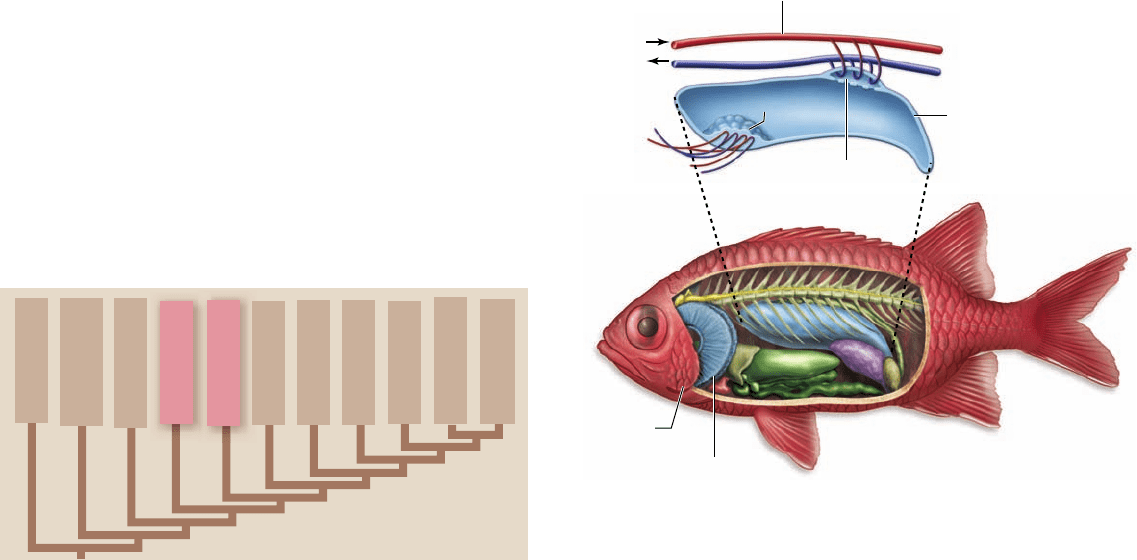
to dominate life in the water. These include the swim bladder
and the gill cover (figure 35.12) .
Swim bladder
Although bones are heavier than cartilaginous skeletons, most
bony fishes are still buoyant because they possess a swim bladder,
a gas-filled sac that allows them to regulate their buoyant density
and so remain suspended at any depth in the water effortlessly.
Sharks, by contrast, must move through the water or sink because,
lacking a swim bladder, their bodies are denser than water.
In primitive bony fishes, the swim bladder is a dorsal out-
pocketing of the pharynx behind the throat, and these species
fill the swim bladder by simply gulping air at the surface of the
water. In most of today’s bony fishes, the swim bladder is an
independent organ that is filled and drained of gases, mostly
nitrogen and oxygen, internally.
Figure 35.12
Diagram of a swim bladder. The bony shes
use this structure, which evolved as a dorsal outpocketing of the
pharynx, to control their buoyancy in water. The swim bladder can
be lled with or drained of gas to allow the sh to control buoyancy.
Gases are taken from the blood, and the gas gland secretes the gases
into the swim bladder; gas is released from the bladder by a
muscular valve, the oval body.
chapter
35
Vertebrates
701www.ravenbiology.com
rav32223_ch35_693-728.indd 701rav32223_ch35_693-728.indd 701 11/16/09 1:45:07 PM11/16/09 1:45:07 PM