
Raven P.H., Johnson G.B., Mason K.A. Biology (Ninth Edition)
Подождите немного. Документ загружается.

Apago PDF Enhancer
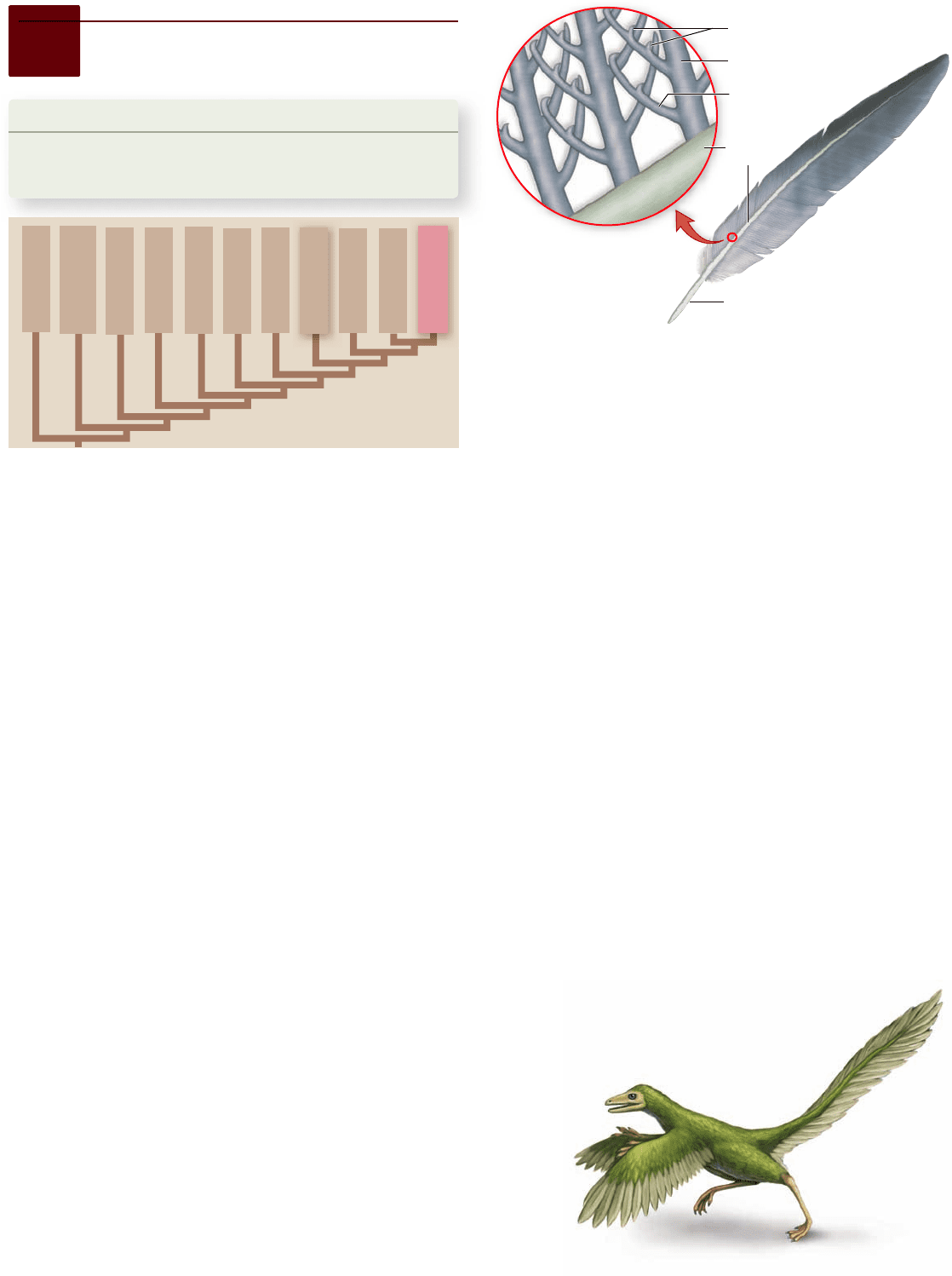
Shaft
Quill
Barbule
Hooks
Barb
Cephalaspi-
domorphi
Mammalia
Chondrichthyes
Actinopterygii
Sarcopterygii
Amphibia
Testudines
Lepidosauria
Crocodilia
Aves
Mixini
Figure 35.25
A feather. The enlargement shows how the
secondary branches and barbs of the vanes are linked together by
microscopic barbules.
Figure 35.26
Archaeopteryx. Closely
related to its ancestors among the bipedal dinosaurs,
the crow-sized Archaeopteryx lived in the forests of
central Europe 150 mya. The true feather colors of
Archaeopteryx are not known.
backbone and of the shoulder and hip girdles form a sturdy
frame that anchors muscles during ight. The power for
active ight comes from large breast muscles that can make
up 30% of a bird’s total body weight. They stretch down
from the wing and attach to the breastbone, which is greatly
enlarged and bears a prominent keel for muscle attachment.
Breast muscles also attach to the fused collarbones that form
the so-called wishbone. No other living vertebrates have a
fused collarbone or a keeled breastbone.
Birds arose about 150 MYA
A 150-million-year-old fossil of the first known bird, Archaeop-
teryx (see figures 21.11 and 35.26 ) was found in 1862 in a lime-
stone quarry in Bavaria, the impression of its feathers stamped
clearly into the rocks. The skeleton of Archaeopteryx shares
many features with small theropod dinosaurs. About the size of
a crow, Archeopteryx had a skull with teeth, and very few of its
bones were fused to one another. Its bones are thought to have
been solid, not hollow like a bird’s. Also, it had a long, reptilian
tail and no enlarged breastbone such as modern birds use to
anchor flight muscles. Finally, the skeletal structure of the fore-
limbs were nearly identical to those of theropods.
Because of its many dinosaur features, several Archaeopteryx
fossils were originally classified as Compsognathus, a small thero-
pod dinosaur of similar size—until feathers were discovered on
35.7
Birds
Learning Outcomes
Name the key characteristics of birds.1.
Explain why some consider birds to be one type of reptile. 2.
The success of birds lies in the development of a structure
unique in the animal world—the feather. Developed from rep-
tilian scales, feathers are the ideal adaptation for flight, serving
as lightweight airfoils that are easily replaced if damaged (un-
like the vulnerable skin wings of bats and the extinct ptero-
saurs). Today, birds (class Aves) are the most diverse of all
terrestrial vertebrates, with 28 orders containing a total of
166 families and about 8600 species (table 35.4).
Key characteristics of birds are feathers
and a lightweight skeleton
Modern birds lack teeth and have only vestigial tails, but they
still retain many reptilian characteristics. For instance, birds lay
amniotic eggs. Also, reptilian scales are present on the feet and
lower legs of birds. Two primary characteristics distinguish
birds from living reptiles:
Feathers.1. Feathers are modi ed reptilian scales made of
keratin, just like hair and scales. Feathers serve two
functions: providing lift for ight and conserving heat.
The structure of feathers combines maximum exibility
and strength with minimum weight ( gure 35.25).
Feathers develop from tiny pits in the skin called
follicles. In a typical ight feather, a shaft emerges from
the follicle, and pairs of vanes develop from its opposite
sides. At maturity, each vane has many branches called
barbs. The barbs, in turn, have many projections called
barbules that are equipped with microscopic hooks. These
hooks link the barbs to one another, giving the feather a
continuous surface and a sturdy but exible shape.
Like scales, feathers can be replaced. Among living
animals, feathers are unique to birds. Recent fossil nds
suggest that some dinosaurs may have had feathers.
Flight skeleton.2. The bones of birds are thin and hollow.
Many of the bones are fused, making the bird skeleton more
rigid than a reptilian skeleton. The fused sections of
712
part
V
Diversity of Life on Earth
rav32223_ch35_693-728.indd 712rav32223_ch35_693-728.indd 712 11/16/09 1:45:41 PM11/16/09 1:45:41 PM
Apago PDF Enhancer
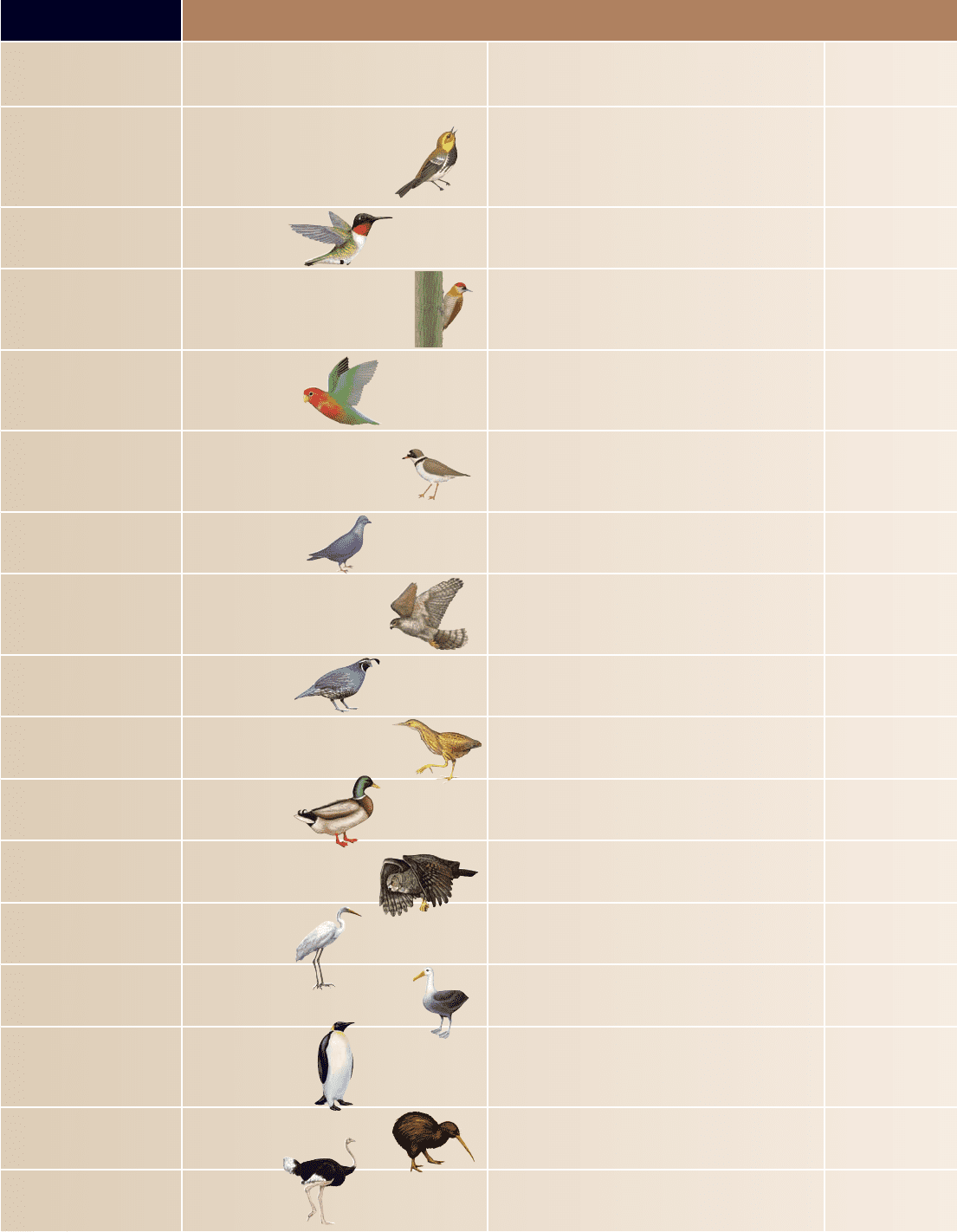
TABLE 35.4
Major Orders of Birds
Order Typical Examples Key Characteristics
Approximate
Number of Living
Species
Passeriformes Crows, mockingbirds,
robins, sparrows,
starlings, warblers
Songbirds
Well-developed vocal organs; perching feet; dependent young
5276 (largest of all
bird orders; contains
over 60% of all
species)
Apodiformes Hummingbirds,
swifts
Fast iers
Short legs; small bodies; rapid wing beat
428
Piciformes Honeyguides,
toucans,
woodpeckers
Woodpeckers or toucans
Grasping feet; chisel-like, sharp bills can break down wood
383
Psittaciformes Cockatoos,
parrots
Parrots
Large, powerful bills for crushing seeds; well-developed
vocal organs
340
Charadriiformes Auks, gulls,
plovers,
sandpipers, terns
Shorebirds
Long, stiltlike legs; slender, probing bills
331
Columbiformes Doves,
pigeons
Pigeons
Perching feet; rounded, stout bodies
303
Falconiformes Eagles, falcons,
hawks
Diurnal birds of prey
Carnivorous; keen vision; sharp, pointed beaks for tearing esh;
active during the day
288
Galliformes Chickens, grouse,
pheasants, quail
Gamebirds
Often limited ying ability; rounded bodies
268
Gruiformes Bitterns, coots,
cranes, rails
Marsh birds
Long, stiltlike legs; diverse body shapes; marsh-dwellers
209
Anseriformes Ducks, geese,
swans
Waterfowl
Webbed toes; broad bill with ltering ridges
150
Strigiformes Barn owls,
screech owls
Owls
Nocturnal birds of prey; strong beaks; powerful feet
146
Ciconiiformes Herons, ibises,
storks
Waders
Long-legged; large bodies
114
Procellariformes Albatrosses,
petrels
Seabirds
Tube-shaped bills; capable of ying for long periods of time
104
Sphenisciformes Emperor penguins,
crested penguins
Penguins
Marine; modi ed wings for swimming; ightless; found only in
southern hemisphere; thick coats of insulating feathers
18
Dinornithiformes Kiwis Kiwis
Flightless; small; con ned to New Zealand
2
Struthioniformes Ostriches Ostriches
Powerful running legs; ightless; only two toes; very large
1
chapter
35
Vertebrates
713www.ravenbiology.com
rav32223_ch35_693-728.indd 713rav32223_ch35_693-728.indd 713 11/16/09 1:45:44 PM11/16/09 1:45:44 PM
Apago PDF Enhancer
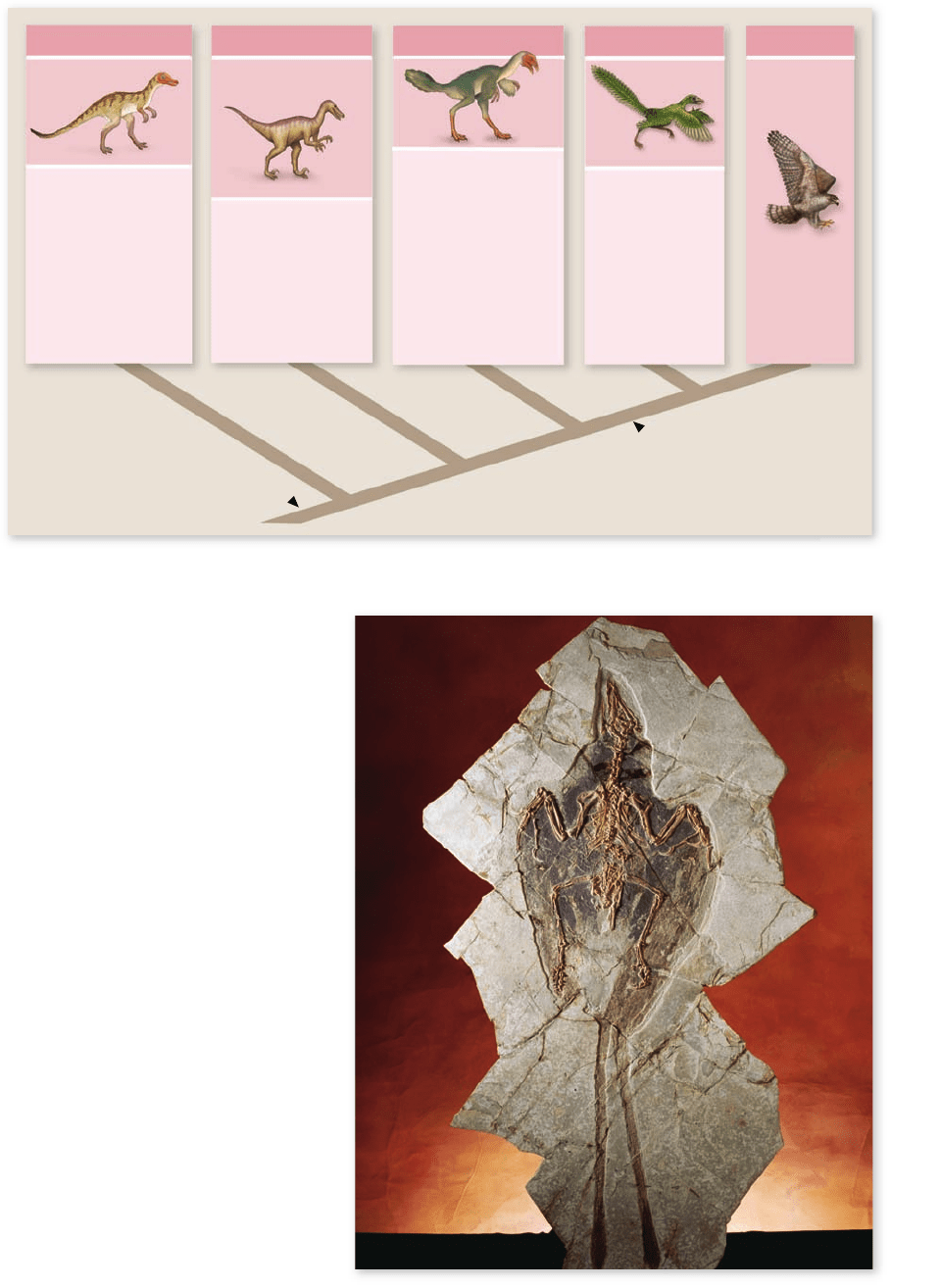
This theropod
dinosaur had short
arms and ran along
the ground. Its body
was covered with
filaments that may
have been used for
insulation and that
are the first evidence
of feathers.
Sinosauropteryx
This larger, carni-
vorous theropod
possessed a
swiveling wrist bone,
a type of joint that
is also found in birds
and is necessary
for flight.
Velociraptor
Recently discovered
fossils of this
theropod indicate
that it is intermediate
between dinosaurs
and birds. This small,
very fast runner was
covered with primitive
(symmetrical and
therefore flightless)
feathers.
Caudipteryx
This oldest
known bird had
asymmetrical
feathers, with a
narrower leading
edge and
streamlined
trailing edge. It
could probably fly
short distances.
Archaeopteryx Modern Birds
Dinosaurs
Birds
Figure 35.27
The evolutionary
path to the birds.
Almost all
paleontologists now
accept the theory that
birds are the direct
descendants of
theropod dinosaurs.
Figure 35.28
A fossil bird from the early cretaceous.
Confuciornis had long tail feathers. Some fossil specimens of this
species lack the long tail feathers, suggesting that this trait was
present in only one sex, as in some modern birds.
the fossils. What makes Archaeopteryx distinctly avian is the pres-
ence of feathers on its wings and tail.
The remarkable similarity of Archaeopteryx to Compsogna-
thus has led almost all paleontologists to conclude that Archae-
opteryx is the direct descendant of dinosaurs—indeed, that
today’s birds are “feathered dinosaurs.” Some even speak flip-
pantly of “carving the dinosaur” at Thanksgiving dinner. The
recent discovery of fossils of a feathered dinosaur in China
lends strong support to this inference. The dinosaur Caudip-
teryx, for example, is clearly intermediate between Archaeopteryx
and dinosaurs, having large feathers on its tail and arms but also
many features of dinosaurs like Velociraptor (figure 35.27) . Be-
cause the arms of Caudipteryx were too short to use as wings,
feathers probably didn’t evolve for flight, but instead served as
insulation, much as fur does for mammals.
Flight is an ability certain kinds of dinosaurs achieved as
they evolved longer arms. We call these dinosaurs birds. Despite
their close affinity to dinosaurs, birds exhibit three evolutionary
novelties: feathers, hollow bones, and physiological mechanisms
such as superefficient lungs that permit sustained, powered flight.
By the early Cretaceous period, only a few million years
after Archaeopteryx lived, a diverse array of birds had evolved, with
many of the features of modern birds. Fossils in Mongolia, Spain,
and China discovered within the last few years reveal a diverse
collection of toothed birds with the hollow bones and breastbones
necessary for sustained flight (figure 35.28 ). Other fossils reveal
highly specialized, flightless diving birds. These diverse birds
shared the skies with pterosaurs for 70 million years until the fly-
ing reptiles went extinct at the end of the Cretaceous.
Because the impression of feathers is rarely fossilized and
modern birds have hollow, delicate bones, the fossil record of
birds is incomplete. Relationships among the 166 families of
modern birds are mostly inferred from studies of the anatomy
and degree of DNA similarity among living birds.
714
part
V
Diversity of Life on Earth
rav32223_ch35_693-728.indd 714rav32223_ch35_693-728.indd 714 11/16/09 1:45:48 PM11/16/09 1:45:48 PM
Apago PDF Enhancer
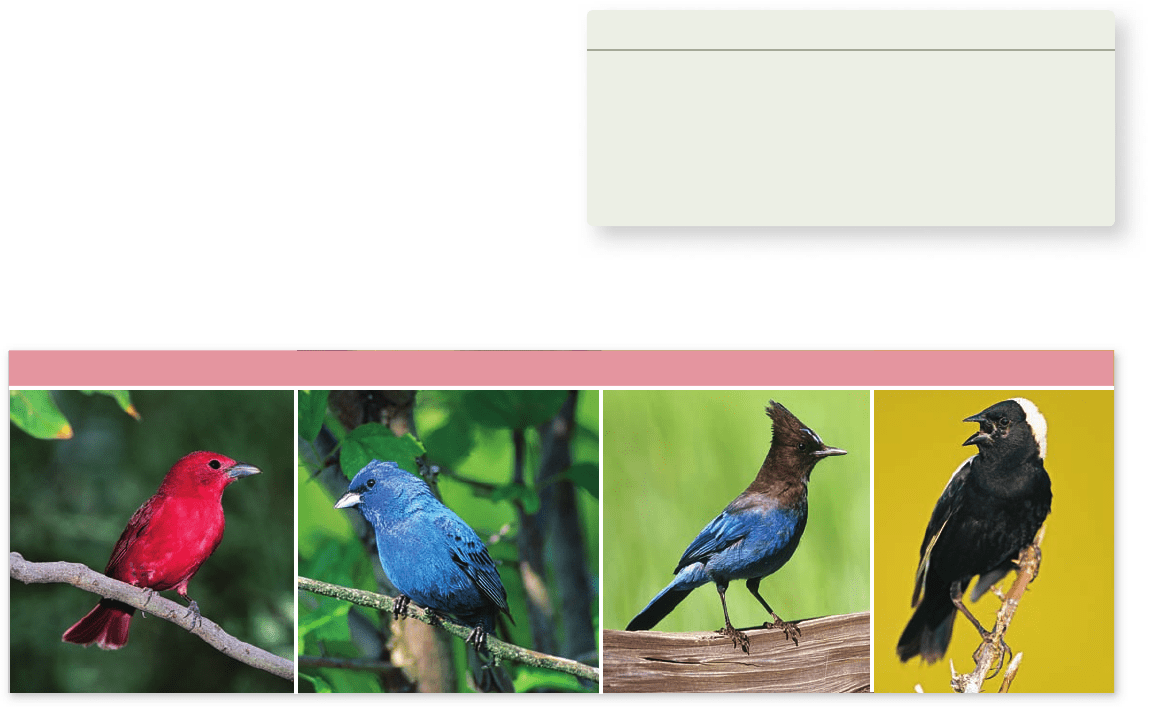
Order: Passeriformes
a. b. c. d.
Figure 35.29
Diversity of Passeriformes, the largest order of birds. a. Summer tanager, Piranga rubra; (b) Indigo bunting,
Passerina cyanea; (c) Stellar’s jay, Cyanositta stelleri; (d) Bobolink, Dolichonyx oryzivorus.
tured by the lungs can be delivered to the flight muscles quickly.
In the heart of most living reptiles, oxygen-rich blood coming
from the lungs mixes with oxygen-poor blood returning from
the body because the wall dividing the ventricle into two cham-
bers is not complete. In birds, the wall dividing the ventricle is
complete, and the two blood circulations do not mix—so flight
muscles receive fully oxygenated blood (see chapter 50 ).
In comparison with reptiles and most other vertebrates,
birds have a rapid heartbeat. A hummingbird’s heart beats about
600 times a minute, and an active chickadee’s heart beats 1000
times a minute. In contrast, the heart of the large, flightless
ostrich averages 70 beats per minute—the same rate as the hu-
man heart.
Endothermy
Birds, like mammals, are endothermic (anexample of conver-
gent evolution). Many paleontologists believe the dinosaurs
from which birds evolved were endothermic as well. Birds
maintain body temperatures significantly higher than those of
most mammals, ranging from 40° to 42°C (human body tem-
perature is 37°C). Feathers provide excellent insulation, help-
ing to conserve body heat.
The high temperatures maintained by endothermy
permit metabolism in the bird’s flight muscles to proceed at
a rapid pace, to provide the ATP necessary to drive rapid
muscle contraction.
Learning Outcomes Review 35.7
Birds have the greatest diversity of species of all terrestrial vertebrates.
Archaeopteryx, the oldest fossil bird, exhibited many traits shared with
theropod dinosaurs. Key features of birds are feathers and a lightweight,
hollow skeleton; additional features include auxiliary air sacs and a four-
chambered heart.
■ What traits do birds share with reptiles?
Modern birds are diverse but share
several characteristics
The most ancient living birds appear to be the flightless birds,
such as the ostrich. Ducks, geese, and other waterfowl evolved
next, in the early Cretaceous, followed by a diverse group of
woodpeckers, parrots, swifts, and owls. The largest of the bird
orders, Passeriformes, evolved in the mid-Cretaceous and com-
prise 60% of species alive today. Overall, there are 28 orders of
birds, the largest consisting of over 5000 species (figure 35.29) .
You can tell a great deal about the habits and food of a
bird by examining its beak and feet. For instance, carnivorous
birds such as owls have curved talons for seizing prey and sharp
beaks for tearing apart their meal. The beaks of ducks are flat
for shoveling through mud, and the beaks of finches are short,
thick seed-crushers.
Many adaptations enabled birds to cope with the heavy
energy demands of flight, including respiratory and circulatory
adaptations and endothermy.
Efficient respiration
Flight muscles consume an enormous amount of oxygen during
active flight. The reptilian lung has a limited internal surface
area, not nearly enough to absorb all the oxygen needed. Mam-
malian lungs have a greater surface area, but bird lungs satisfy
this challenge with a radical redesign.
When a bird inhales, the air goes past the lungs to a series of
air sacs located near and within the hollow bones of the back; from
there, the air travels to the lungs and then to a set of anterior air
sacs before being exhaled. Because air passes all the way through
the lungs in a single direction, gas exchange is highly efficient.
Respiration in birds is described in more detail in chapter 49 .
Efficient circulation
The revved-up metabolism needed to power active flight also
requires very efficient blood circulation, so that the oxygen cap-
chapter
35
Vertebrates
715www.ravenbiology.com
rav32223_ch35_693-728.indd 715rav32223_ch35_693-728.indd 715 11/16/09 1:45:52 PM11/16/09 1:45:52 PM
Apago PDF Enhancer
Cephalaspi-
domorphi
Mammalia
Chondrichthyes
Actinopterygii
Sarcopterygii
Amphibia
Testudines
Lepidosauria
Crocodilia
Aves
Mixini
Fetus
Umbilical
cord
Chorion
Placenta
Uterus
Amnion
Yolk sac
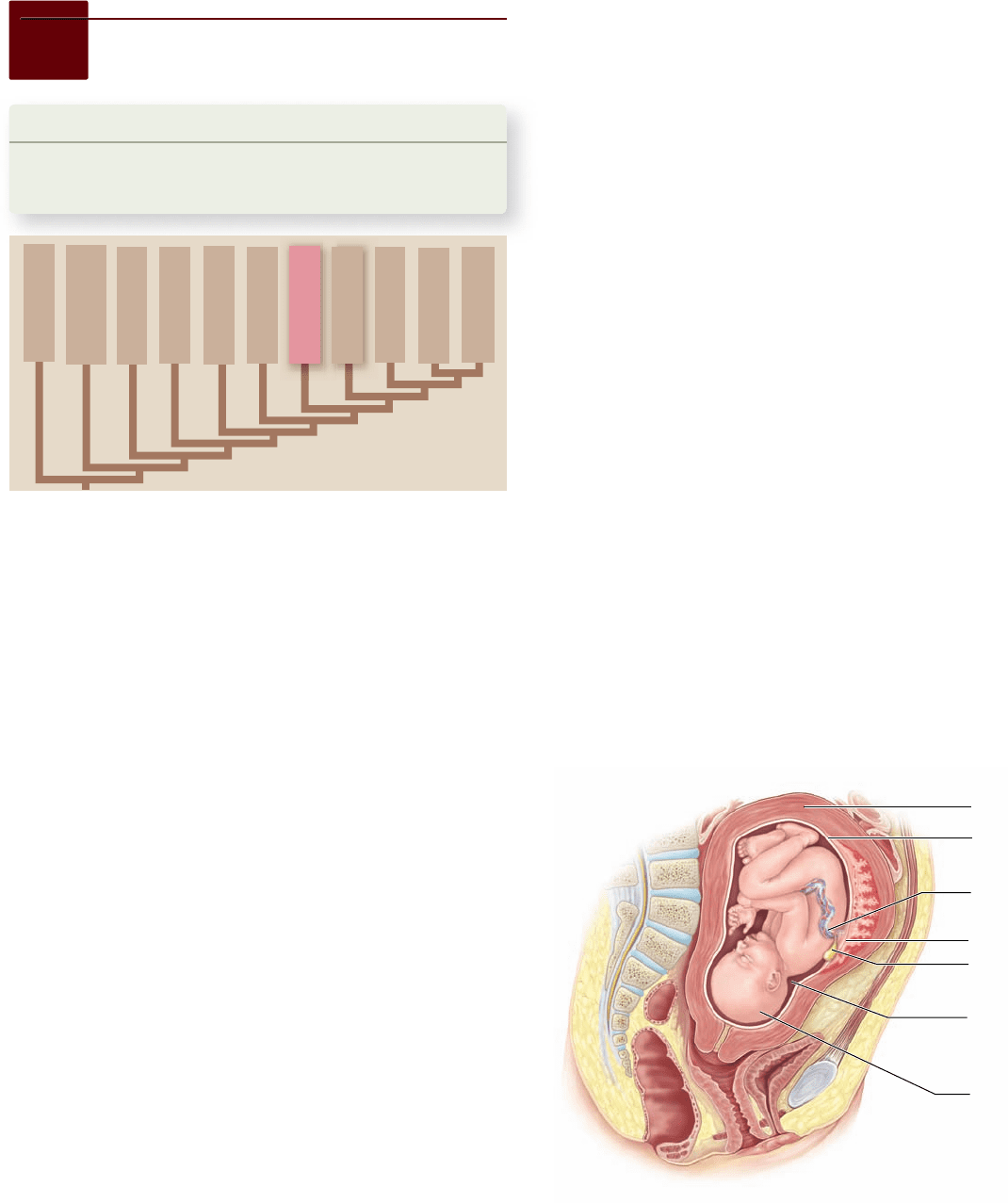
Figure 35.30
The placenta. The placenta is characteristic of
the largest group of mammals, the placental mammals. It evolved
from membran es in the amniotic egg. The umb ilical cord evolved
from the allantois. The chorion, or outermost part of the amniotic
egg, forms most of the placenta itself. The placenta serves as the
provisional lungs, intestine, and kidneys of the fetus, without ever
mixing maternal and fetal blood.
Unlike feathers, which evolved from modi ed
reptilian scales, mammalian hair is a completely different
form of skin structure. An individual mammalian hair is a
long, protein-rich lament that extends like a stiff thread
from a bulblike foundation beneath the skin known as a
hair follicle. The lament is composed mainly of dead
cells lled with the brous protein keratin.
Mammary glands.2. All female mammals possess
mammary glands that can secrete milk. Newborn
mammals, born without teeth, suckle this milk as their
primary food. Even baby whales are nursed by their
mother’s milk. Milk is a very high-calorie food (human
milk has 750 kcal per liter), important because of the high
energy needs of a rapidly growing newborn mammal.
About 50% of the energy in the milk comes from fat.
Endothermy.3. As stated previously, mammals are
endothermic, a crucial adaptation that has allowed them
to be active at any time of the day or night and to colonize
severe environments, from deserts to ice elds. Also,
more ef cient blood circulation provided by the four-
chambered heart (see chapter 50) and more ef cient
respiration provided by the diaphragm (a special sheet of
muscles below the rib cage that aids breathing; see
chapter 49 ) make possible the higher metabolic rate on
which endothermy depends.
Placenta.4. In most mammal species, females carry their
developing young internally in a uterus, nourishing them
through the placenta, and give birth to live young. The
placenta is a specialized organ that brings the bloodstream
of the fetus into close contact with the bloodstream of the
mother ( gure 35.30) . Food, water, and oxygen can pass
across from mother to child, and wastes can pass over to the
mother’s blood and be carried away.
35.8
Mammals
Learning Outcomes
Describe the characteristics of mammals.1.
Compare the three groups of living mammals. 2.
There are about 4500 living species of mammals (class
Mammalia) , fewer than the number of fishes, amphibians, rep-
tiles or birds. Most large, land-dwelling vertebrates are mam-
mals. When we look out over an African plain, we see the big
mammals—the lions, zebras, gazelles, and antelope. But the
typical mammal is not that large. Of the 4500 species of mam-
mals, 3200 are rodents, bats, shrews, or moles.
Mammals have hair, mammary glands,
and other characteristics
Mammals are distinguished from all other classes of vertebrates
by two fundamental characteristics—hair and mammary glands—
and are marked by several other notable features:
Hair.1. All mammals have hair. Even apparently hairless
whales and dolphins grow sensitive bristles on their
snouts. The evolution of fur and the ability to regulate
body temperature enabled mammals to invade colder
climates that ectothermic reptiles do not inhabit.
Mammals are endothermic animals, and typically
maintain body temperatures higher than the temperature
of their surroundings. The dense undercoat of many
mammals reduces the amount of body heat that escapes.
Another function of hair is camou age. The
coloration and pattern of a mammal’s coat usually matches
its background. A little brown mouse is practically invisible
against the brown leaf litter of a forest oor, and the
orange and black stripes of a Bengal tiger disappear against
the orange-brown color of the tall grass in which it hunts.
Hairs also function as sensory structures. The whiskers of
cats and dogs are stiff hairs that are very sensitive to touch.
Mammals that are active at night or live underground
often rely on their whiskers to locate prey or to avoid
colliding with objects. Finally, hair can serve as a defensive
weapon. Porcupines and hedgehogs protect themselves
with long, sharp, stiff hairs called quills.
716
part
V
Diversity of Life on Earth
rav32223_ch35_693-728.indd 716rav32223_ch35_693-728.indd 716 11/16/09 1:46:01 PM11/16/09 1:46:01 PM
Apago PDF Enhancer
Dog
Deer Beaver
Elephant Human
Grinding teeth
Ripping teeth
Chiseling teeth
Incisors Canine Premolars and molars
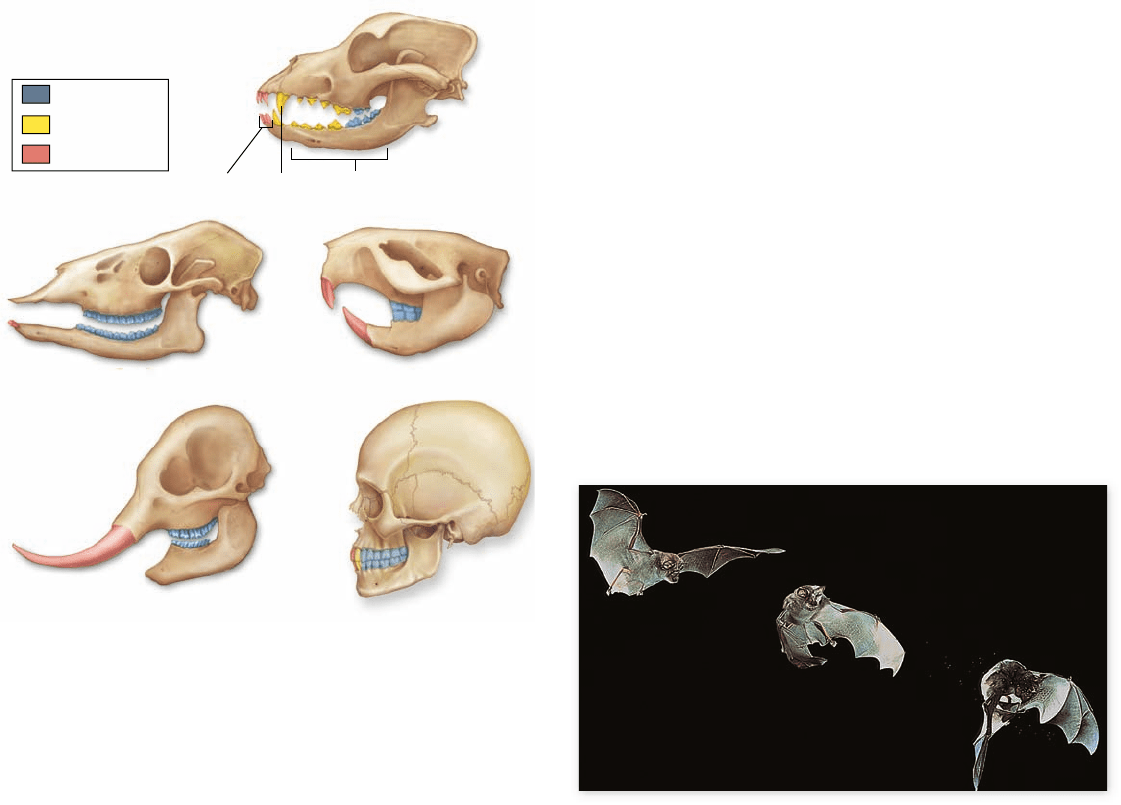
Figure 35.31
Mammals have di erent types of
specialized teeth. Carnivores, such as dogs, have canine teeth
that are able to rip food; some of the premolars and molars in dogs
are also ripping teeth. Herbivores, such as deer, have incisors to
chisel off vegetation and molars designed to grind up the plant
material. In the beaver, the chiseling incisors dominate. In the
elephant, the incisors have become specialized weapons, and molars
grind up vegetation. Humans are omnivores; we have all three
types: grinding, ripping, and chiseling teeth.
Figure 35.32
Greater horseshoe bat, Rhinolophus
ferrumequinum.
Bats are the only mammal capable of true ight.
enzymes, however, that break the links between glucose mole-
cules in cellulose. Herbivorous mammals rely on a mutualistic
partnership with bacteria in their digestive tracts that have the
necessary cellulose-splitting enzymes.
Mammals such as cows, buffalo, antelopes, goats, deer,
and giraffes have huge, four-chambered fermentation vats de-
rived from the esophagus and stomach. The first chamber is the
largest and holds a dense population of cellulose-digesting bac-
teria. Chewed plant material passes into this chamber, where
the bacteria attack the cellulose. The material is then digested
further in the other three chambers.
Rodents, horses, rabbits, and elephants, by contrast, have
relatively small stomachs, and instead digest plant material in
their large intestine, like a termite. The bacteria that actually
carry out the digestion of the cellulose live in a pouch called the
cecum that branches from the end of the small intestine.
Even with these complex adaptations for digesting cellu-
lose, a mouthful of plant is less nutritious than a mouthful of
meat. Herbivores must consume large amounts of plant mate-
rial to gain sufficient nutrition. An elephant eats 135 to 150 kg
(300 to 330 pounds) of plant foods each day.
Development of hooves and horns
Keratin, the protein of hair, is also the structural building mate-
rial in claws, fingernails, and hooves. Hooves are specialized
keratin pads on the toes of horses, cows, sheep, and antelopes.
The pads are hard and horny, protecting the toe and cushion-
ing it from impact.
The horns of cattle, sheep, and antelope are composed of
a core of bone surrounded by a sheath of keratin. The bony
core is attached to the skull, and the horn is not shed.
Deer antlers are made not of keratin, but of bone. Male
deer grow and shed a set of antlers each year. While growing
during the summer, antlers are covered by a thin layer of skin
known as velvet.
Flying mammals: Bats
Bats are the only mammals capable of powered flight
(figure 35.32) . Like the wings of birds and pterosaurs, bat wings
are modified forelimbs. The bat wing is a leathery membrane of
skin and muscle stretched over the bones of four fingers. The
edges of the membrane attach to the side of the body and to the
In addition to these main characteristics, the mammalian lin-
eage gave rise to several other adaptations in certain groups.
These include specialized teeth, the ability of grazing animals
to digest plants, hooves and horns made of keratin, and adapta-
tions for flight in the bats.
Specialized teeth
Mammals have different types of teeth that are highly special-
ized to match particular eating habits (figure 35.31). It is usu-
ally possible to determine a mammal’s diet simply by examining
its teeth. A dog’s long canine teeth, for example, are well suited
for biting and holding prey, and some of its premolar and molar
teeth are triangular and sharp for ripping off chunks of flesh.
In contrast, large herbivores such as deer lack canine teeth;
instead, deer clip off mouthfuls of plants with flat, chisel-like in-
cisors on its lower jaw. The deer’s molars are large and covered
with ridges to effectively grind and break up tough plant tissues.
Digestion of plants
Most mammals are herbivores, eating mostly or only plants.
Cellulose forms the bulk of a plant’s body and is a major source
of food for mammalian herbivores. Mammals do not have the
chapter
35
Vertebrates
717www.ravenbiology.com
rav32223_ch35_693-728.indd 717rav32223_ch35_693-728.indd 717 11/16/09 1:46:03 PM11/16/09 1:46:03 PM
Apago PDF Enhancer
Monotremes: Egg-laying mammals
The duck-billed platypus (Ornithorhynchus anatinus) and two spe-
cies of echidna are the only living monotremes (figure 35.33a) .
Among living mammals, only monotremes lay shelled eggs. The
structure of their shoulder and pelvis is more similar to that of the
early reptiles than to any other living mammal. Also like reptiles,
monotremes have a cloaca, a single opening through which feces,
urine, and reproductive products leave the body.
hind leg. When resting, most bats prefer to hang upside down
by their toe claws.
After rodents, bats are the second largest order of mam-
mals. They have been a particularly successful group because
many species have been able to utilize a food resource that most
birds do not use—night-flying insects.
How do bats navigate in the dark? Late in the eighteenth
century, the Italian biologist Lazzaro Spallanzani showed that a
blinded bat could fly without crashing into things and still cap-
ture insects. Clearly another sense other than vision was being
used by bats to navigate in the dark. When Spallanzani plugged
the ears of a bat, it was unable to navigate and collided with
objects. Spallanzani concluded that bats “hear” their way
through the night world.
Mammals diverged about 220 MYA
Mammals have been around since the time of the dinosaurs, about
220 mya. Tiny, shrewlike creatures that lived in trees eating insects,
the earliest mammals were only a minor element in a land that
quickly came to be dominated by dinosaurs. Fossils reveal that
these early mammals had large eye sockets, evidence that they may
have been active at night. Early mammals also had a single lower
jawbone. The fossil record shows a change in therapsids (the an-
cestors of mammals) from the reptile lower jaw, having several
bones, to a jaw closer to the mammalian type. Two of the bones
forming the therapsid jaw joint moved into the middle ear of
mammals, linking with a bone already there to produce a three-
bone structure that amplifies sound better than the reptilian ear.
The age of mammals
At the end of the Cretaceous period, 65 mya, the dinosaurs and
numerous other land and marine animals became extinct, but
mammals survived, possibly because of the insulation their fur
provided. In the Tertiary period (lasting from 65 mya to 2 mya),
mammals rapidly diversified, taking over many of the ecologi-
cal roles once dominated by dinosaurs.
Mammals reached their maximum diversity late in the
Tertiary period, about 15 mya. At that time, tropical conditions
existed over much of the world. During the last 15 million
years, world climates have changed, and the area covered by
tropical habitats has decreased, causing a decline in the total
number of mammalian species (table 35.5) .
Modern mammals are
placed into three groups.
For 155 million years, while the dinosaurs flourished, mammals
were a minor group of small insectivores and herbivores. The most
primitive mammals were members of the subclass Prototheria.
Most prototherians were small and resembled modern shrews. All
prototherians laid eggs, as did their synapsid ancestors. The only
prototherians surviving today are the monotremes.
The other major mamm alian group is the subclass Theria.
Therians are viviparous (that is, their young are born alive). The
two living therian groups are marsupials, or pouched mammals
(including kangaroos, opossums, and koalas), and the placental
mammals (dogs, cats, humans, horses, and most other mammals).
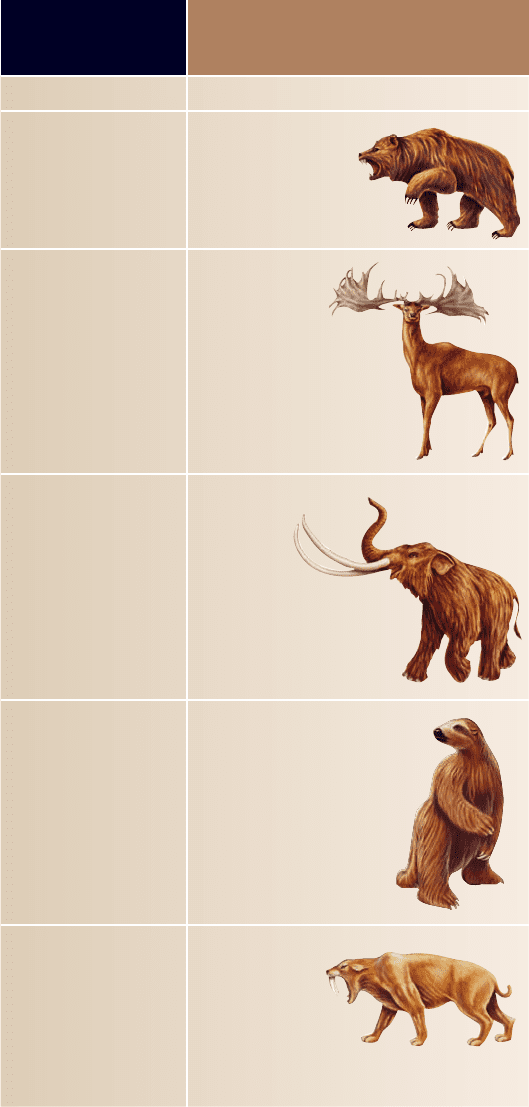
TABLE 35.5
Some Groups of Extinct
Mammals
Group Description
Cave bears Numerous in the ice ages;
this enormous bear had
a largely vegetarian diet
and slept through the winter
in large groups.
Irish elk Neither Irish nor an
elk (it is a kind of
deer), Megaloceros
was the largest deer
that ever lived, with horns
spanning 12 feet. Seen in
French cave paintings,
they became extinct about
2500 years ago.
Mammoths Although only two
species of
elephants
survive today,
the elephant family
was far more diverse during
the late Tertiary. Many were
cold-adapted mammoths with
long, shaggy fur.
Giant ground sloths Megatherium was a giant,
20-foot ground sloth that
weighed 3 tons and was as
large as a modern elephant.
Sabertooth cats The jaws of these
large, lionlike
cats opened an
incredible 120° to
allow the animal to
drive its huge upper pair
of saber teeth into prey.
718
part
V
Diversity of Life on Earth
rav32223_ch35_693-728.indd 718rav32223_ch35_693-728.indd 718 11/16/09 1:46:04 PM11/16/09 1:46:04 PM
Apago PDF Enhancer
c.
a.
b.
Monotremes
Marsupials
Placental Mammals
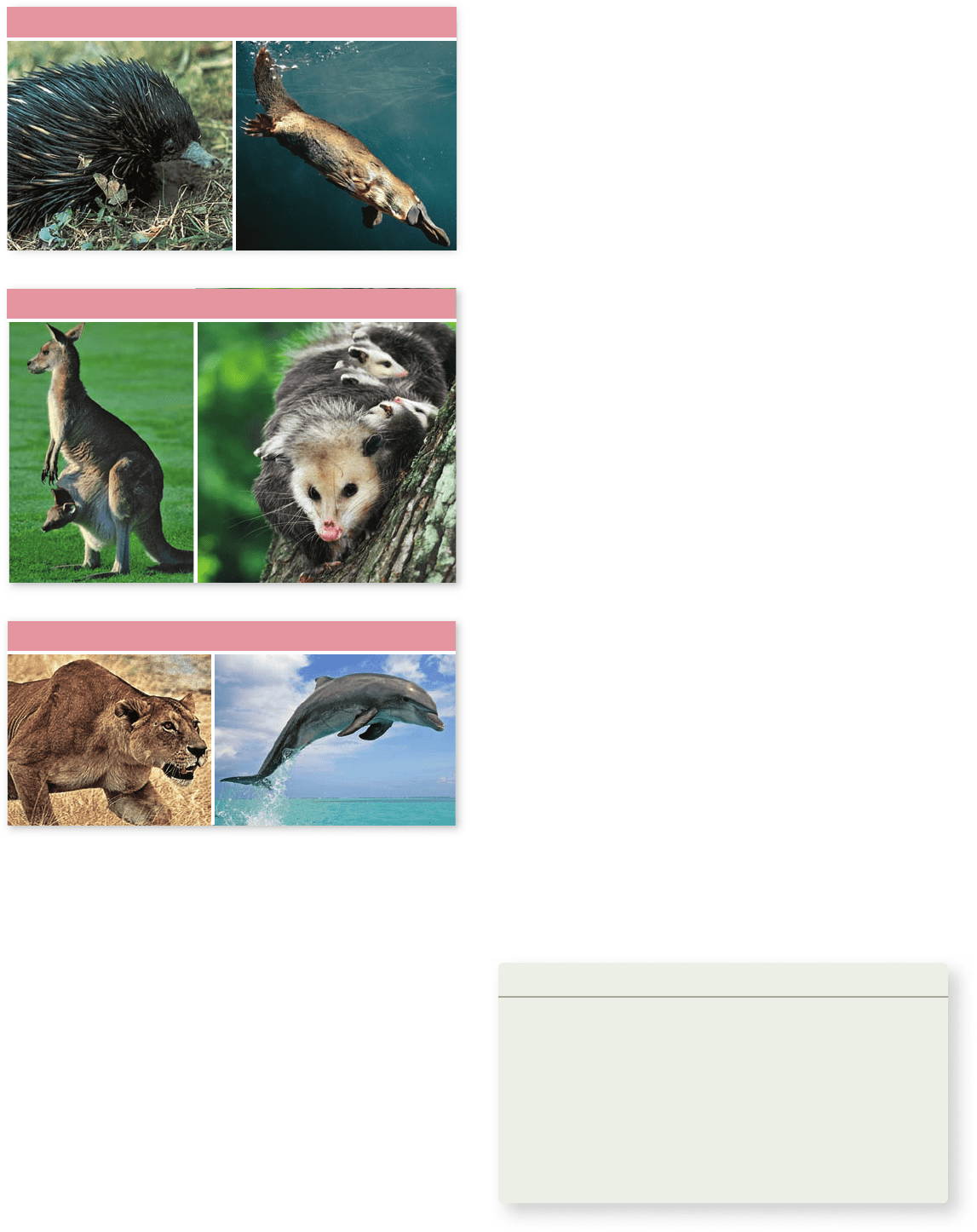
Figure 35.33
Today’s mammals. a. Monotremes, the
short-nosed echidna, Tachyglossus aculeatus (left), and the duck-billed
platypus, Ornithorhynchus anat inus (right); (b) Marsupials, the red
kangaroo, Macropus rufus (left) and the opossum, Didelphis
virginiana, (right); (c) Placental mammals, the lion, Panthera leo (left)
and the bottle-nosed dolphin, Tursiops tr uncatus (right).
bodied animals. Echidnas of Australia (Tachyglossus aculeatus, the
short-nosed echidna) and New Guinea (Zaglossus bruijni, the
long-nosed echidna) have very strong, sharp claws, which they
use for burrowing and digging. The echidna probes with its
snout for insects, especially ants and termites.
Marsupials: Pouched mammals
The major difference between marsupials (figure 35.33b) and
other mammals is their pattern of embryonic development. In
marsupials, a fertilized egg is surrounded by chorion and amni-
otic membranes, but no shell forms around the egg as it does in
monotremes. During most of its early development, the marsu-
pial embryo is nourished by an abundant yolk within the egg.
Shortly before birth, a short-lived placenta forms from the cho-
rion membrane. Soon after, sometimes within eight days of fer-
tilization, the embryonic marsupial is born. It emerges tiny and
hairless, and crawls into the marsupial pouch, where it latches
onto a mammary-gland nipple and continues its development.
Marsupials evolved shortly before placental mammals,
about 125 mya. Today, most species of marsupials live in Aus-
tralia and South America, areas that have undergone long pe-
riods of geographic isolation. Marsupials in Australia and New
Guinea have diversified to fill ecological positions occupied by
placental mammals elsewhere in the world (see figure 21.18).
The placental mammals in Australia and New Guinea today
arrived relatively recently and include some introduced by hu-
mans. The only marsupial found in North America is the Vir-
ginia opossum (Didelphis virginiana), which has migrated north
from Central America within the last three million years.
Placental mammals
A placenta that nourishes the embryo throughout its entire devel-
opment forms in the uterus of placental mammals (figure 35.33c).
Most species of mammals living today, including humans, are in
this group. Of the 19 orders of living mammals, 17 are placental
mammals (although some scientists recognize four orders of
marsupials, rather than one). Table 35.6 shows some of these
orders. They are a very diverse group, ranging in size from
1.5-g pygmy shrews to 100,000-kg whales.
Early in the course of embryonic development, the placenta
forms. Both fetal and maternal blood vessels are abundant in the
placenta, and substances can be exchanged efficiently between the
bloodstreams of mother and offspring (see figure 35.30). The fetal
placenta is formed from the membranes of the chorion and allan-
tois. In placental mammals, unlike in marsupials, the young un-
dergo a considerable period of development before they are born.
Learning Outcomes Review 35.8
Mammals are the only animals with hair and mammary glands. Other
mammalian specializations include endothermy, the placenta, a tooth
design suited to diet, and specialized sensory systems. Today three
subgroups of mammals are recognized: monotremes, which lay eggs;
marsupials, which feed embryonic young in a marsupial pouch; and
placental mammals, in which the placenta nourishes the embryo
throughout its development.
■ What features found in both mammals and birds are
examples of convergent evolution?
Despite the retention of some reptilian features, mono-
tremes have the diagnostic mammalian characters: a single bone
on each side of the lower jaw, fur, and mammary glands. Young
monotremes drink their mother’s milk after they hatch from eggs.
Females lack well-developed nipples; instead, the milk oozes onto
the mother’s fur, and the babies lap it off with their tongues.
The platypus, found only in Australia, lives much of its
life in the water and is a good swimmer. It uses its bill much as
a duck does, rooting in the mud for worms and other soft-
chapter
35
Vertebrates
719www.ravenbiology.com
rav32223_ch35_693-728.indd 719rav32223_ch35_693-728.indd 719 11/16/09 1:46:06 PM11/16/09 1:46:06 PM
Apago PDF Enhancer
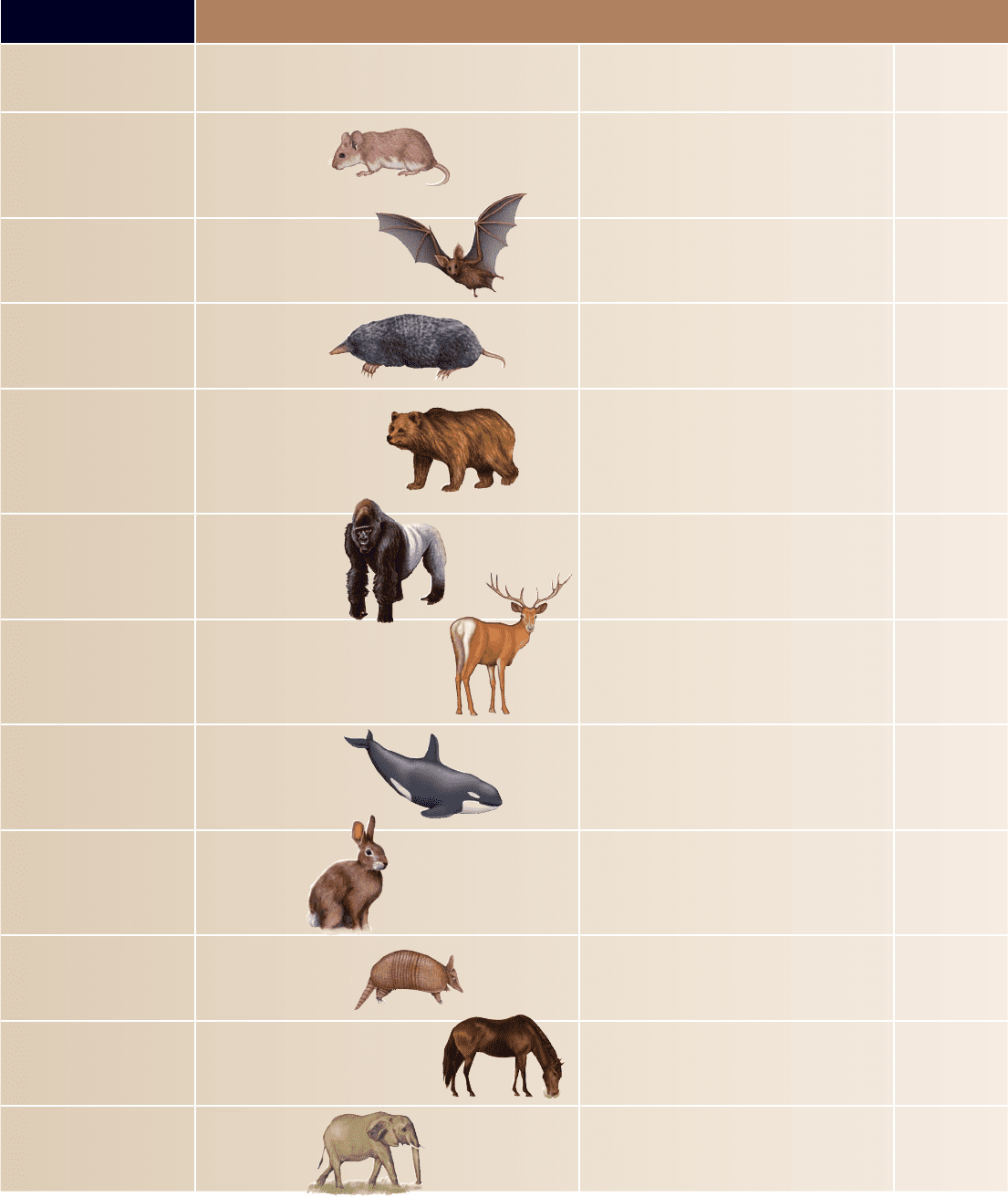
TABLE 35.6
Major Orders of Placental Mammals
Order Typical Examples Key Characteristics
Approximate
Number of
Living Species
Rodentia Beavers,
mice,
porcupines,
rats
Small plant-eaters
Chisel-like incisor teeth
1814
Chiroptera Bats Flying mammals
Primarily fruit- or insect-eaters; elongated ngers; thin
wing membrane; mostly nocturnal; navigate by sonar
986
Insectivora Moles,
shrews
Small, burrowing mammals
Insect-eaters; the most primitive placental mammals;
spend most of their time underground
390
Carnivora Bears,
cats,
raccoons,
weasels,
dogs
Carnivorous predators
Teeth adapted for shearing esh; no native families
in Australia
274
Primates Apes,
humans,
lemurs,
monkeys
Tree-dwellers
Large brain size; binocular vision; opposable thumb;
group that evolved from a line that branched o early
from other mammals
233
Artiodactyla Cattle,
deer,
gira es,
pigs
Hoofed mammals with two or four toes
Most species are herbivorous ruminants
211
Cetacea Dolphins,
porpoises,
whales
Fully marine mammals
Streamlined bodies; front limbs modi ed into ippers;
no hindlimbs; blowholes on top of head; no hair except
on muzzle
79
Lagomorpha Rabbits,
hares,
pika
Rodentlike jumpers
Four upper incisors (rather than the two seen in
rodents); hind legs often longer than forelegs, an
adaptation for jumping
69
Edentata Anteaters,
armadillos,
sloths
Toothless insect-eaters
Many are toothless, but some have degenerate,
peglike teeth
30
Perissodactyla Horses,
rhinoceroses,
tapirs
Hoofed mammals with odd number of toes
Herbivorous teeth adapted for chewing
17
Proboscidea Elephants Long-trunked herbivores
Two upper incisors elongated as tusks; largest living
land animal
2
720
part
V
Diversity of Life on Earth
rav32223_ch35_693-728.indd 720rav32223_ch35_693-728.indd 720 11/16/09 1:46:12 PM11/16/09 1:46:12 PM
Apago PDF Enhancer
a. b. c.
New World Monkeys Old World Monkeys Hominoids
Figure 35.34
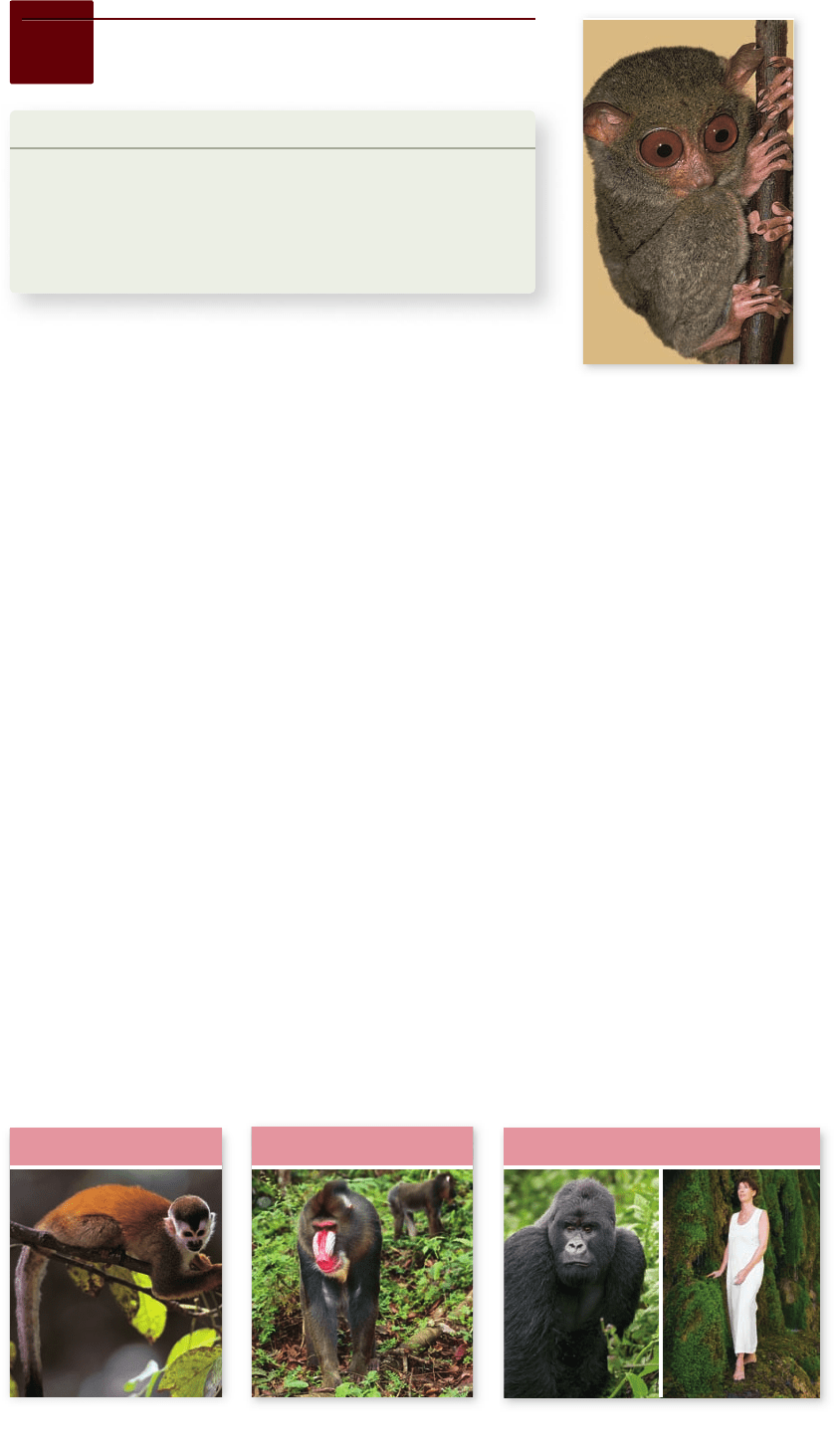
A prosimian.
This tarsier, Tarsius, a prosimian
native to tropical Asia, shows the
characteristic features of primates:
grasping ngers and toes and
binocular vision.
Figure 35.35
Anthropoids. a. New World
Monkey, the squirrel monkey,
Saimiri oerstedii; (b) Old World
Monkey, the mandrill,
Mandrillus sphinx; (c) hominoids,
gorilla, Gorilla gorilla (left) and
human, Homo sapiens (right).
vision, prosimians have large eyes with increased visual acuity.
Most prosimians are nocturnal, feeding on fruits, leaves, and
flowers, and many lemurs have long tails for balancing.
Anthropoids
Anthropoids include monkeys, apes, and humans. Anthropoids
are almost all diurnal—that is, active during the day—feeding
mainly on fruits and leaves. Natural selection favored many
changes in eye design, including color vision, that were adapta-
tions to daytime foraging. An expanded brain governs the im-
proved senses, with the braincase forming a larger portion of
the head.
Anthropoids, like the relatively few diurnal prosimians,
live in groups with complex social interactions. They tend to
care for their young for prolonged periods, allowing for a long
childhood of learning and brain development.
About 30 mya, some anthropoids migrated to South
America. Their descendants, known as the New World mon-
keys (figure 35.35a) , are easy to identify: All are arboreal; they
have flat, spreading noses; and many of them grasp objects with
long, prehensile tails.
Anthropoids that remained in Africa gave rise to two lin-
eages: the Old World monkeys (figure 35.35b) and the homi-
noids (apes and humans, figure 35.35c). Old World monkeys
include ground-dwelling as well as arboreal species. None of
them have prehensile tails, their nostrils are close together,
their noses point downward, and some have toughened pads of
skin on their rumps for prolonged sitting.
35.9
Evolution of the Primates
Learning Outcomes
Describe the characteristics and major groups of 1.
primates.
List the distinguishing characteristics of hominids.2.
Explain the variations that form the basis for human 3.
races and why races do not reflect speciation.
Primates are the mammalian group that gave rise to our own
species. Primates evolved two distinct features that allowed
them to succeed as arboreal (tree-dwelling) insectivores.
Grasping ngers and toes.1. Unlike the clawed feet of tree
shrews and squirrels, primates have grasping hands and
feet that enable them to grip limbs, hang from branches,
seize food, and in some primates, use tools. The rst digit
in many primates, namely the thumb, is opposable, and at
least some, if not all, of the digits have nails.
Binocular vision.2. Unlike the eyes of shrews and
squirrels, which sit on each side of the head, the eyes of
primates are shifted forward to the front of the face.
This produces overlapping binocular vision that lets the
brain judge distance precisely—important to an animal
moving through the trees and trying to grab or pick up
food items.
Other mammals have binocular vision—for example, car-
nivorous predators—but only primates have both binocular vi-
sion and grasping hands, making them particularly well adapted
to their arboreal environment.
The anthropoid lineage led
to the earliest humans
About 40 mya, the earliest primates split into two groups: the
prosimians and the anthropoids. The prosimians (“before mon-
keys”) looked something like a cross between a squirrel and a cat
and were common in North America, Europe, Asia, and Africa.
Only a few prosimians survive today—lemurs, lorises, and tarsi-
ers (figure 35.34) . In addition to grasping digits and binocular
chapter
35
Vertebrates
721www.ravenbiology.com
rav32223_ch35_693-728.indd 721rav32223_ch35_693-728.indd 721 11/16/09 1:46:16 PM11/16/09 1:46:16 PM