
Raven P.H., Johnson G.B., Mason K.A. Biology (Ninth Edition)
Подождите немного. Документ загружается.


Apago PDF Enhancer
5. Megaspores are produced in
a. anthers by mitosis. c. ovules by mitosis.
b. anthers by meiosis. d. ovules by meiosis.
6. A stamen contains a
a. style. c. lament.
b. stigma. d. carpel.
7. Unlike bee-pollinated owers, bird-pollinated owers
a. produce a strong fragrance.
b. contain a landing pad.
c. produce a bull’s-eye pattern.
d. are red.
8. Asexual reproduction is likely to be most common in which
ecosystem?
a. Tropical rainforest c. Arctic tundra
b. Temperate grassland d. Deciduous forest
9. Protoplasts are plant cells that lack
a. nuclei. c. plasma membranes.
b. cell walls. d. protoplasm.
10. Perennial plants are
a. always herbaceous.
b. always woody.
c. either herbaceous or woody.
d. neither herbaceous nor woody.
11. Senescence refers to
a. plant death. d. the accumulation of
b. reproductive growth. storage reserves.
c. pollination.
APPLY
1. Under which of the following conditions would pollen from
an S
2
S
5
plant successfully pollinate an S
1
S
5
ower?
a. Using pollen from a carpelate ower to fertilize a staminate
ower would be successful.
b. If the plants used gametophytic self-incompatibility,
half of the pollen would be successful.
c. If the plants used sporophytic self-incompatibility,
half of the pollen would be successful.
d. Pollen from an S
2
S
5
plant can never pollinate an S
1
S
5
ower.
2. Your roommate is taking biology with you this semester and thinks
he understands short- and long-day plants. He purchases one plant
of each type and decides to see the difference himself by rst trying
to cause the short-day plant to ower. He places both plants under
the same conditions and exposes each to a regimen of 10-hr days,
expecting that the short-day plant will ower, and the long-day
plant will not. You play a trick on your roommate and reverse the
outcome. Speci cally, what did you have to do?
a. Lengthen the time each is exposed to light
b. Shorten the time each is exposed to light
c. Quickly expose the plants to light during the middle of
the night
d. None of the above
3. In Iowa, a company called Team Corn works to ensure that
elds of seed corn outcross so that hybrid vigor can be
maintained. They do this by removing the staminate (that is,
pollen-producing) owers from the corn plants. In an attempt
to put Team Corn out of business, you would like to develop
genetically engineered corn plants that
a. contain Z genes to prevent germination of pollen
on the stigmatic surface.
b. contain S genes to stop pollen tube growth
during self-fertilization.
c. express B-type homeotic genes throughout developing owers.
d. express A-type homeotic genes throughout developing owers.
4. Monoecious plants such as corn have either staminate or
carpelate owers. Knowing what you do about the molecular
mechanisms of oral development, which of the following
might explain the development of single-sex owers?
a. Expression of B-type genes in the presumptive carpel whorl
will generate staminate owers.
b. Loss of A-type genes in the presumptive petal whorl will
allow C-type and B-type genes to produce stamens instead
of petals in that whorl.
c. Restricting B-type gene expression to the presumptive
petal whorl will generate carpelate owers.
d. All of these are correct.
5. One of the most notable differences between gamete formation
in most animals and gamete formation in plants is that
a. plants produce gametes in somatic tissue, whereas animals
produce gametes in germ tissue.
b. plants produce gametes by mitosis, whereas animals
produce gametes by meiosis.
c. plants produce only one of each gamete, but animals
produce many gametes.
d. plants produce gametes that are diploid, but animals
produce gametes that are haploid.
S Y N THES IZE
1. A commercial greenhouse in a remote location produces
poinsettias. However, after a highway is built near the greenhouse,
the poinsettias fail to ower. Explain what has happened.
2. If you live in a north temperate region, explain why it is
advantageous to grow spinach for your salad in early spring
rather than during the summer.
3. In wild columbine, ower morphology encourages cross-
pollination. However, during the middle of the receptive period
of the stigma, self-pollination can occur if the ower was not
previously pollinated. If cross-pollination occurs after self-
pollination, then that pollen reaches the base of the style before
the self-pollen. Discuss the adaptive signi cance of this
reproduction strategy.
4. In most parts of the world, commercial potato crops are
produced asexually by planting tubers. However, in some regions
of the world, such as Southeast Asia and the Andes, some potatoes
are grown from true seeds. Discuss the advantages and
disadvantages of growing potatoes from true seed.
O N LIN E RES OURCE
www.ravenbiology.com
Understand, Apply, and Synthesize—enhance your study with
animations that bring concepts to life and practice tests to assess
your understanding. Your instructor may also recommend the
interactive eBook, individualized learning tools, and more.
862
part
VI
Plant Form and Function
rav32223_ch42_839-862.indd 862rav32223_ch42_839-862.indd 862 11/16/09 2:33:00 PM11/16/09 2:33:00 PM
Apago PDF Enhancer
1
μ
m
W
Part
VII
Animal Form and Function
Chapter
43
The Animal Body
and
Principles
of Regulation
Chapter Outline
43.1 Organization of the Vertebrate Body
43.2 Epithelial Tissue
43.3 Connective Tissue
43.4 Muscle Tissue
43.5 Nerve Tissue
43.6 Overview of Vertebrate Organ Systems
43.7 Homeostasis
43.8 Regulating Body Temperature
Introduction
When people think of animals, they may think of pet dogs and cats, the animals in a zoo, on a farm, in an aquarium, or wild
animals living outdoors. When thinking about the diversity of animals, people may picture the differences between the
predatory lions and tigers and the herbivorous deer and antelope, or between a dangerous shark and a playful dolphin.
Despite the differences among these animals, they are all vertebrates. All vertebrates share the same basic body plan, with
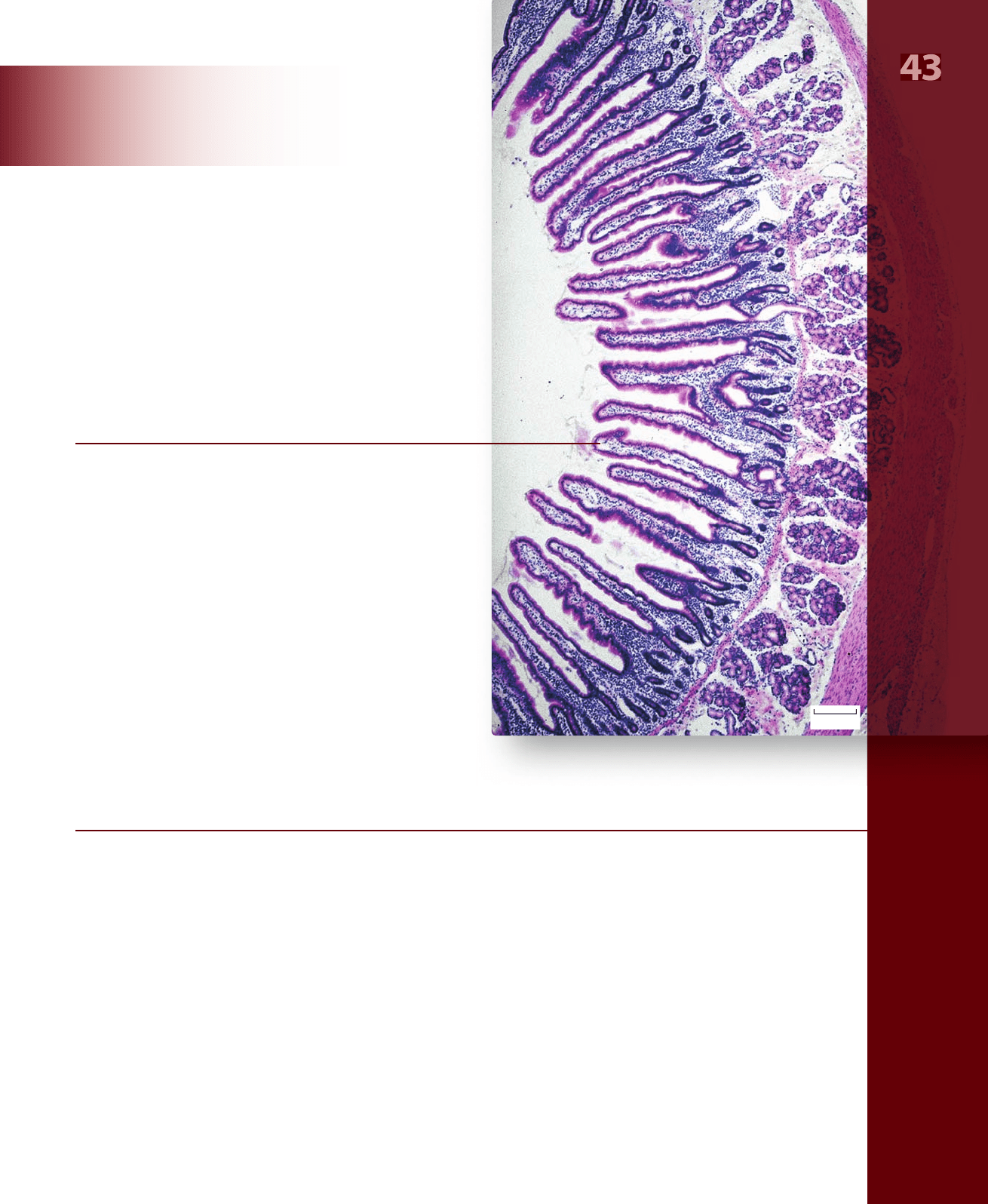
similar tissues and organs that operate in much the same way. The micrograph shows a portion of the duodenum, part of
the digestive system, which is made up of multiple types of tissues. In this chapter, we begin a detailed consideration of the
biology of the vertebrates and the fascinating structure and function of their bodies. We conclude this chapter by exploring
the principles involved in regulation and control of complex functional systems.
CHAPTER
rav32223_ch43_863-886.indd 863rav32223_ch43_863-886.indd 863 11/17/09 3:09:36 PM11/17/09 3:09:36 PM
Apago PDF Enhancer
Cardiac Muscle Cell Heart Cardiac Muscle Circulatory System
Cell Organ Tissue Organ System
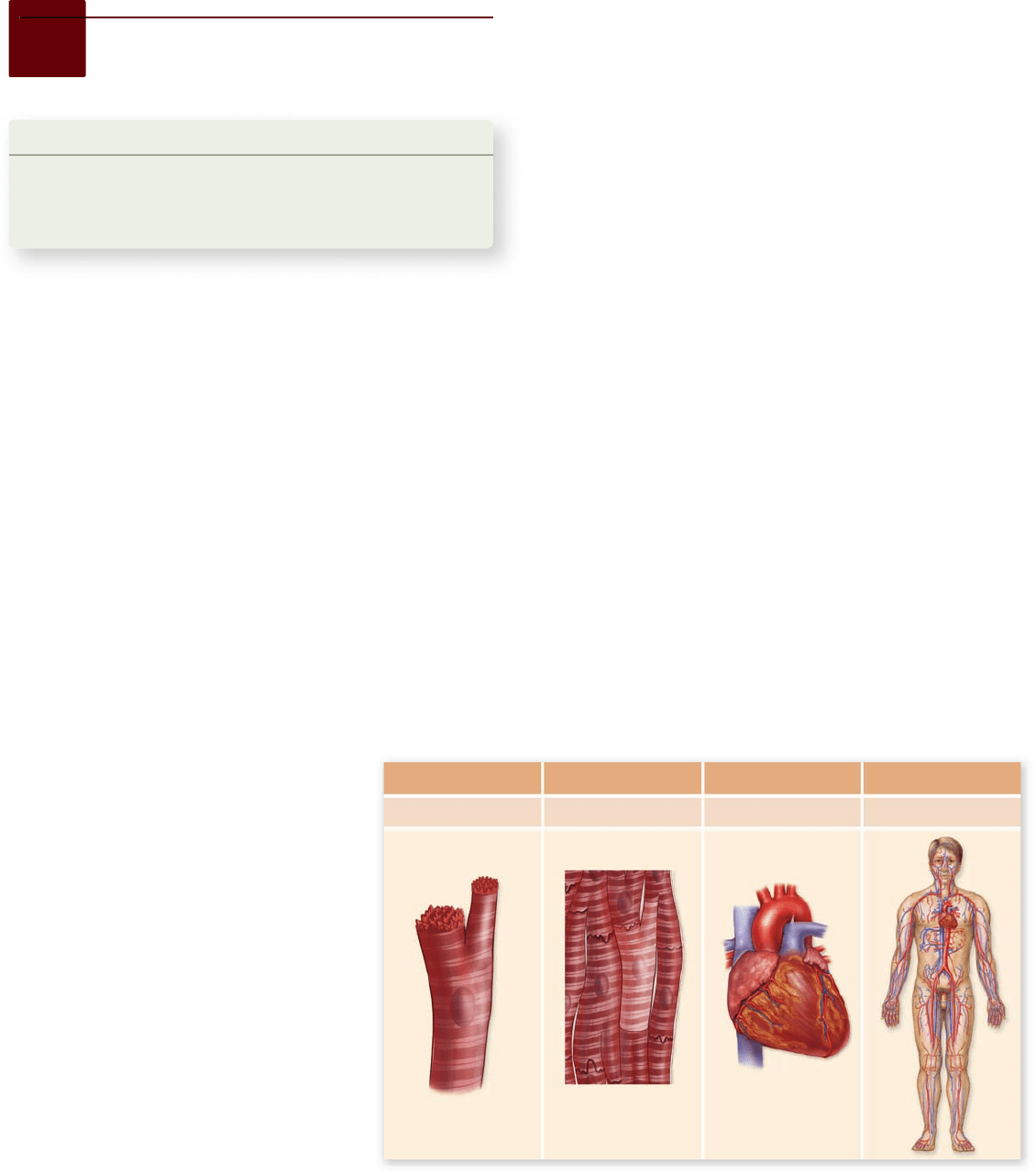
Figure 43.1
Levels of organization within the body. Similar cell types operate
together and form tissues. Tissues functioning together form organs such as the heart,
which is composed primarily of cardiac muscle with a lining of epithelial tissue. An organ
system consists of several organs working together to carry out a function for the body.
An example of an organ system is the circulatory system, which consists of the heart,
blood vessels, and blood.
The general body plan of vertebrates is a tube
within a tube, with internal support
The bodies of all vertebrates have the same general architecture.
The body plan is essentially a tube suspended within a tube. The
inner tube is the digestive tract, a long tube that travels from the
mouth to the anus. An internal skeleton made of jointed bones or
cartilage that grows as the body grows supports the outer tube,
which forms the main vertebrate body. The outermost layer of the
vertebrate body is the integument, or skin, and its many accessory
organs and parts—hair, feathers, scales, and sweat glands.
Vertebrates have both dorsal
and ventral body cavities
Inside the main vertebrate body are two identifiable cavities. The
dorsal body cavity forms within a bony skull and a column of bones,
the vertebrae. The skull surrounds the brain, and within the stacked
vertebrae is a channel that contains the spinal cord.
The ventral body cavity is much larger and extends anteri-
orly from the area bounded by the rib cage and vertebral col-
umn posteriorly to the area contained within the ventral body
muscles (the abdominals) and the pelvic girdle. In mammals, a
sheet of muscle, the diaphragm, breaks the ventral body cavity
anteriorly into the thoracic cavity, which contains the heart and
lungs, and posteriorly into the abdominopelvic cavity, which con-
tains many organs, including the stomach, intestines, liver, kid-
neys, and urinary bladder (figure 43.2a) .
Recall from the discussion of the animal body plan in
chapter 32 that a coelom is a fluid-filled body cavity completely
formed within the embryonic mesoderm layer of some animals
43.1
Organization of the
Vertebrate Body
Learning Outcomes
List the levels of organization in the vertebrate body.1.
Identify the tissue types found in vertebrates.2.
Describe how body cavities are organized.3.
The vertebrate body has four levels of organization:
(1) cells, (2) tissues, (3) organs, and (4) organ systems. Like
those of all animals, the bodies of vertebrates are composed
of different cell types. Depending on the group, between 50
and several hundred different kinds of cells contribute to
the adult vertebrate body. Humans have 210 different types
of cells.
Tissues are groups of cells of a single
type and function
Groups of cells that are similar in structure and function are
organized into tissues . Early in development, the cells of the
growing embryo differentiate into the three fundamental em-
bryonic tissues, called germ layers. From the innermost to the
outermost layers, these are the endoderm , mesoderm, and ecto-
derm . Each germ layer, in turn, differentiates into the scores of
different cell types and tissues that are characteristic of the ver-
tebrate body.
In adult vertebrates, there are four principal kinds of
tissues, or primary tissues: (1) epithelial,
(2) connective, (3) muscle, and (4) nerve
tissue. Each type is discussed in separate
sections of this chapter.
Organs and organ systems
provide specialized functions
Organs are body structures composed of
several different types of tissues that form a
structural and functional unit (figure 43.1) .
One example is the heart, which contains
cardiac muscle, connective tissue, and epi-
thelial tissue. Nerve tissue connects the
brain and spinal cord to the heart and helps
regulate the heartbeat.
An organ system is a group of or-
gans that cooperate to perform the major
activities of the body. For example, the cir-
culatory system is composed of the heart
and blood vessels (arteries, capillaries, and
veins) (see chapter 50). These organs co-
operate in the transport of blood and help
distribute substances about the body. The
vertebrate body contains 11 principal or-
gan systems.
864
part
VII
Animal Form and Function
rav32223_ch43_863-886.indd 864rav32223_ch43_863-886.indd 864 11/17/09 3:09:42 PM11/17/09 3:09:42 PM
Apago PDF Enhancer
a.
b.
Cranial
cavity
Section 1
Section 2
Section 3
Brain
Thoracic cavity
Diaphragm
Peritoneal
cavity
Vertebrae
Brain
Muscles
Muscles
Rib
Pharynx
Epiglottis
Vertebral
cavity
Vertebral
cavity
Vertebra
Esophagus
Trachea
Anterior
vena cava
Lungs
Sternum
Thoracic
cavity
Abdominal
cavity
Small
intestines
Spleen
Kidney
Spinal cord
Spinal
cord
Cecum
Colon
Pleural
cavity
Mandible
Cranial
cavity
Muscles
Section 1
Section 2
Section 3
Pericardial cavity
Ventral body
cavity
Dorsal
body
cavity
Right pleural
cavity
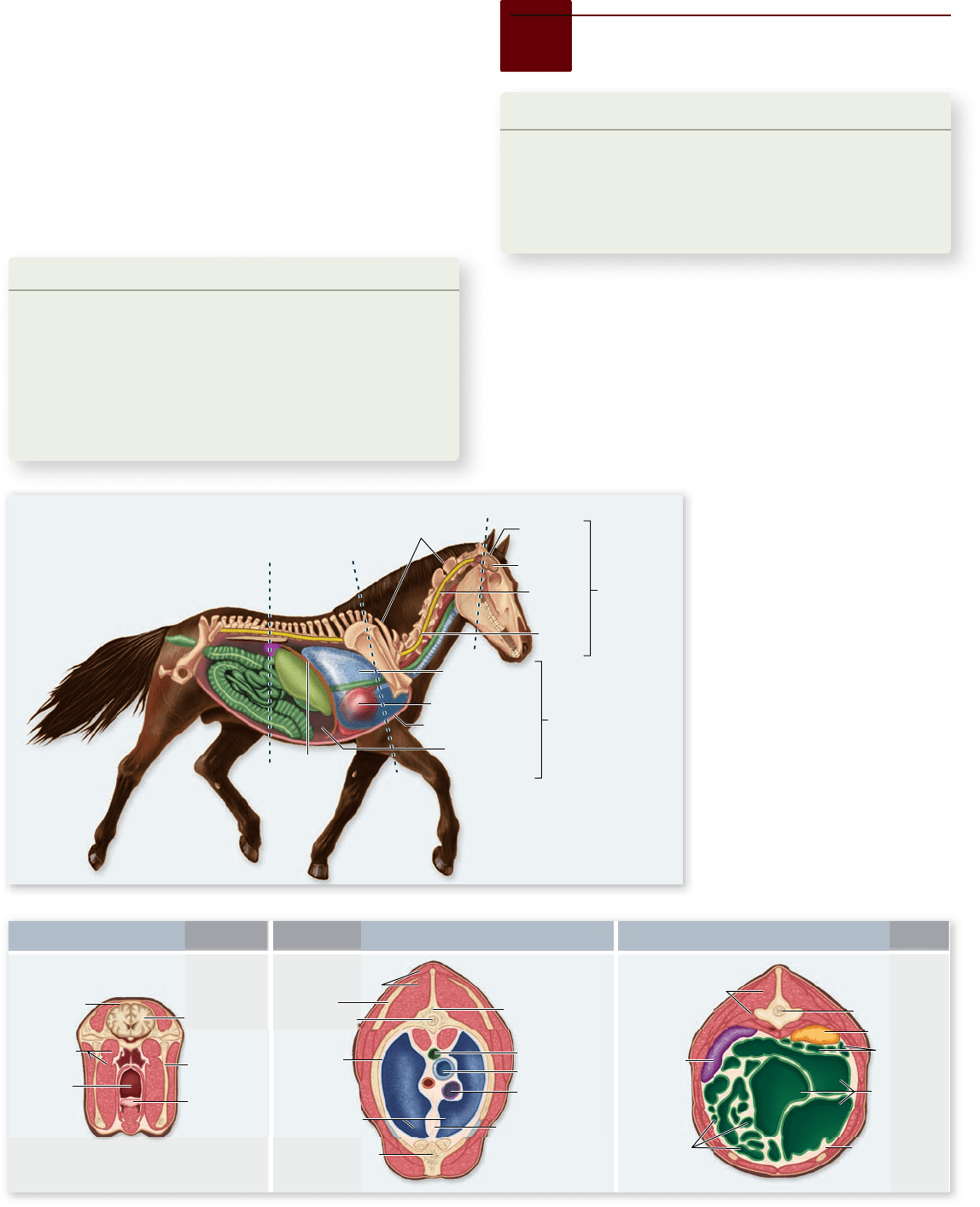
Figure 43.2
Architecture
of the vertebrate body. a. All
vertebrates have dorsal and ventral
body cavities. The dorsal cavity
divides into the cranial (contains
the brain) and vertebral (contains
the spinal cord) cavities. In
mammals, a muscular diaphragm
divides the ventral cavity into the
thoracic and abdominopelvic
cavities. b. Cross sections through
three body regions show the
relationships between body
cavities, major organs, and
coeloms (pericardial, pleural, and
peritoneal cavities).
(vertebrates included). The coelom is present in vertebrates,
but compared to invertebrates it is constricted, folded, and sub-
divided. The mesodermal layer that lines the coelom extends
from the body wall to envelop and suspend several organs with-
in the ventral body cavity (figure 43.2b). In the abdominopelvic
cavity, the coelomic space is the peritoneal cavity.
In the thoracic cavity, the heart and lungs invade and
greatly constrict the coelomic space. The thin space within mes-
odermal layers around the heart is the pericardial cavity, and
the two thin spaces around the lungs are the pleural cavities
(figure 43.2b).
Learning Outcomes Review 43.1
The body’s cells are organized into tissues, which in turn are organized into
organs and organ systems. The main types of tissues in vertebrates are
epithelial, connective, muscle, and nerve tissue. The bodies of humans and
other mammals contain dorsal and ventral cavities. The ventral cavity is
divided by the diaphragm into thoracic and abdominopelvic cavities. The adult
coelom subdivides into the peritoneal, pericardial, and pleural cavities.
■ Can an organ be made of more than one tissue?
43.2
Epithelial Tissue
Learning Outcomes
Describe the structure and function of an epithelium.1.
Identify the cell types found in an epithelial 2.
membrane.
Explain the structure and function of different 3.
epithelia.
An epithelial membrane, or epithelium (plural, epithelia), cov-
ers every surface of the vertebrate body. Epithelial membranes
can come from any of the three germ layers. For example, the
epidermis, derived from ectoderm, constitutes the outer por-
tion of the skin. An epithelium derived from endoderm lines
the inner surface of the digestive tract, and the inner surfaces of
blood vessels derive from mesoderm. Some epithelia change in
the course of embryonic development into glands, which are
specialized for secretion.
chapter
43
The Animal Body and Principles of Regulation
865www.ravenbiology.com
rav32223_ch43_863-886.indd 865rav32223_ch43_863-886.indd 865 11/17/09 3:09:43 PM11/17/09 3:09:43 PM

Apago PDF Enhancer
Epithelium forms a barrier
Because epithelial membranes cover all body surfaces, a substance
must pass through an epithelium in order to enter or leave the
body. Epithelial membranes thus provide a barrier that can im-
pede the passage of some substances while facilitating the passage
of others. For land-dwelling vertebrates, the relative imperme-
ability of the surface epithelium (the epidermis) to water offers
essential protection from dehydration and from airborne patho-
gens. The epithelial lining of the digestive tract, in contrast, must
allow selective entry of the products of digestion while providing
a barrier to toxic substances. The epithelium of the lungs must
allow for the rapid diffusion of gases into and out of the blood.
A characteristic of all epithelia is that the cells are tightly
bound together, with very little space between them. Nutrients
and oxygen must diffuse to the epithelial cells from blood ves-
sels supplying underlying connective tissues. This places a limit
on the thickness of epithelial membranes; most are only one or
a few cell layers thick.
Epithelial regeneration
Epithelium possesses remarkable regenerative powers, constantly
replacing its cells throughout the life of the animal. For example,
the liver, a gland formed from epithelial tissue, can readily regen-
erate, even after surgical removal of substantial portions. The epi-
dermis renews every two weeks, and the epithelium inside the
stomach is completely replaced every two to three days. This
ability to regenerate is useful in a surface tissue because it con-
stantly renews the surface and also allows quick replacement of
the protective layer should damage or injury occur.
Structure of epithelial tissues
Epithelial tissues attach to underlying connective tissues by a
fibrous membrane. The secured side of the epithelium is called
the basal surface, and the free side is the apical surface. This dif-
ference gives epithelial tissues an inherent polarity, which is
often important in the function of the tissue. For example, pro-
teins stud the basal surfaces of some epithelial tissues in the
kidney tubules; these proteins actively transport Na
+
into the
intercellular spaces, creating an osmotic gradient that helps re-
turn water to the blood (see chapter 51).
Epithelial types re ect their function
The two general classes of epithelial membranes are termed
simple (single layer of cells) and stratified (multiple layers of cells).
These classes are further subdivided into squamous, cuboidal,
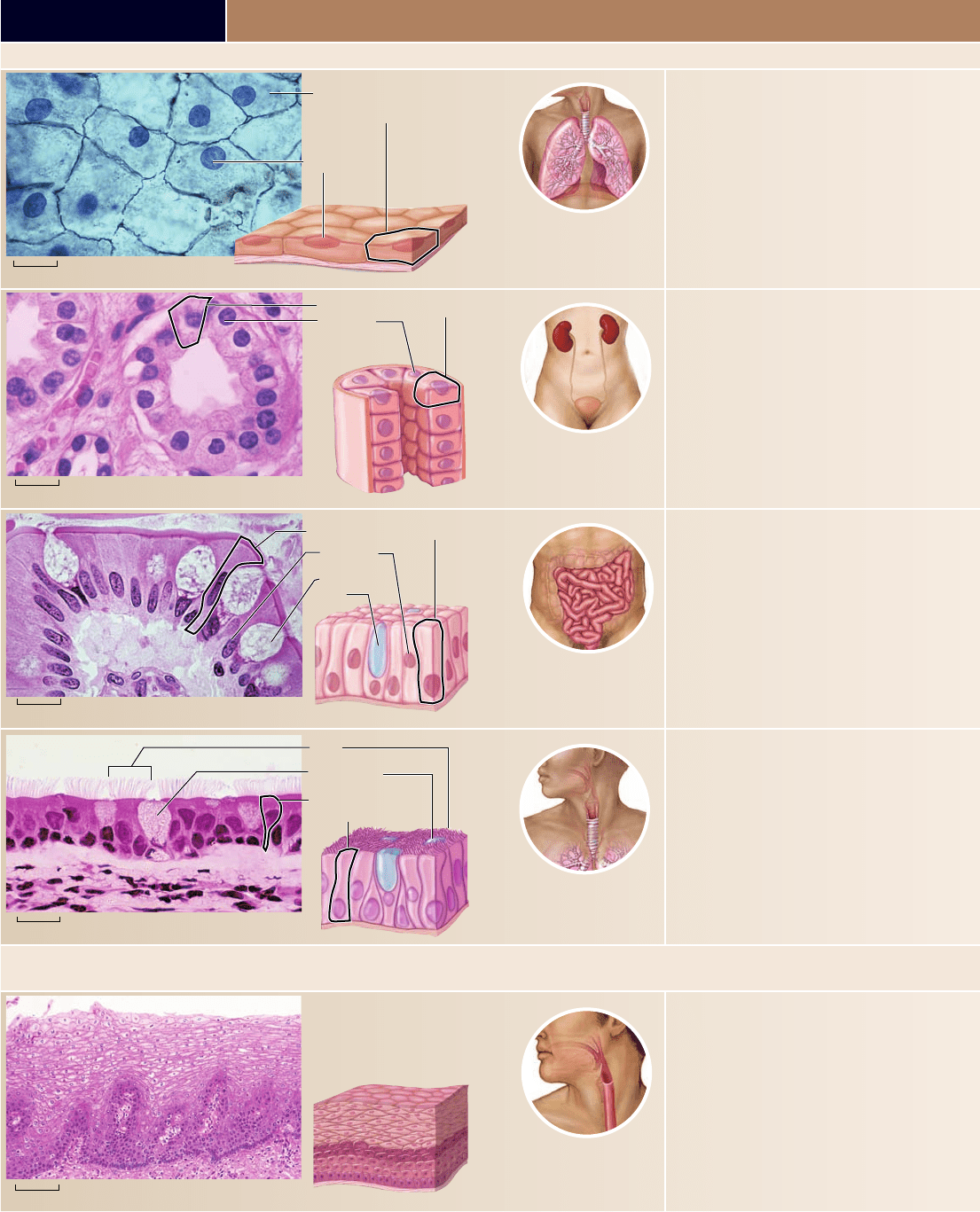
and columnar, based on the shape of the cells (table 43.1) .
Squamous cells are flat, cuboidal cells are about as wide as they are
tall, and columnar cells are taller than they are wide.
Simple epithelium
As mentioned, simple epithelial membranes are one cell thick. A
simple squamous epithelium is composed of squamous epithe-
lial cells that have a flattened shape when viewed in cross sec-
tion. Examples of such membranes are those that line the lungs
and blood capillaries, where the thin, delicate nature of these
membranes permits the rapid movement of molecules (such as
the diffusion of gases).
A simple cuboidal epithelium lines kidney tubules and
several glands. In the case of glands, these cells are specialized
for secretion.
A simple columnar epithelium lines the airways of the
respiratory tract and the inside of most of the gastrointestinal
tract, among other locations. Interspersed among the colum-
nar epithelial cells of mucous membranes are numerous goblet
cells, which are specialized to secrete mucus. The columnar
epithelial cells of the respiratory airways contain cilia on their
apical surface (the surface facing the lumen, or cavity), which
move mucus and dust particles toward the throat. In the small
intestine, the apical surface of the columnar epithelial cells
forms fingerlike projections called microvilli, which increase
the surface area for the absorption of food.
The expanded size of both cuboidal and columnar cells
accommodates the added intracellular machinery needed for
production of glandular secretions, active absorption of materi-
als, or both. The glands of vertebrates form from invaginated
epithelia. In exocrine glands, the connection between the
gland and the epithelial membrane remains as a duct. The duct
channels the product of the gland to the surface of the epithe-
lial membrane, and thus to the external environment (or to an
interior compartment that opens to the exterior, such as the
digestive tract). A few examples of exocrine glands include sweat
and sebaceous (oil) glands as well as the salivary glands.
Endocrine glands are ductless glands; their connections with
the epithelium from which they are derived has been lost dur-
ing development. Therefore, their secretions (hormones) do
not channel onto an epithelial membrane. Instead, hormones
enter blood capillaries and circulate through the body. Endo-
crine glands are covered in more detail in chapter 46.
Stratified epithelium
Stratified epithelial membranes are two to several cell layers
thick and are named according to the features of their apical cell
layers. For example, the epidermis is a stratified squamous epithe-
lium; its properties are discussed in chapter 52 . In terrestrial ver-
tebrates, the epidermis is further characterized as a keratinized
epithelium because its upper layer consists of dead squamous
cells and is filled with a water-resistant protein called keratin.
The deposition of keratin in the skin increases in response
to repeated abrasion, producing calluses. The water-resistant
property of keratin is evident when comparing the skin of the
face to the red portion of the lips, which can easily become
dried and chapped. Lips are covered by a nonkeratinized, strati-
fied squamous epithelium.
Learning Outcomes Review 43.2
Epithelial tissues generally form barriers and include membranes that cover all
body surfaces and glands. An epidermis has a basal surface that attaches to an
underlying connective tissue and an apical surface that is free. Some epithelia
are specialized for protection, whereas those that cover the surfaces of hollow
organs may be specialized for transport and secretion. Simple epithelium has
a single cell layer and may be classifi ed as squamous, cuboidal, columnar, or
pseudostratifi ed; stratifi ed epithelium is primarily squamous.
■ How does the epithelium in a gland function differently
from that in the lining of your gut?
866
part
VII
Animal Form and Function
rav32223_ch43_863-886.indd 866rav32223_ch43_863-886.indd 866 11/17/09 3:09:48 PM11/17/09 3:09:48 PM
Apago PDF Enhancer
TABLE 43.1
Epithelial Tissue
SIMPLE EPITHELIUM
Squamous
Typical Location
Lining of lungs, capillary walls, and blood vessels
Function
Cells form thin layer across which di usion can
readily occur
Characteristic Cell Types
Epithelial cells
Cuboidal
Typical Location
Lining of some glands and kidney tubules; covering
of ovaries
Function
Cells rich in speci c transport channels; functions in
secretion and absorption
Characteristic Cell Types
Gland cells
Columnar
Typical Location
Surface lining of stomach, intestines, and parts of
respiratory tract
Function
Thicker cell layer; provides protection and functions in
secretion and absorption
Characteristic Cell Types
Epithelial cells
Pseudostratifi ed Columnar
Typical Location
Lining of parts of the respiratory tract
Function
Secretes mucus; dense with cilia that aid in movement
of mucus; provides protection
Characteristic Cell Types
Gland cells; ciliated epithelial cells
STRATIFIED EPITHELIUM
Squamous
Typical Location
Outer layer of skin; lining of mouth
Function
Tough layer of cells; provides protection
Characteristic Cell Types
Epithelial cells
Simple squamous
epithelial cell
Nucleus
40 μm
Cuboidal epithelial cell
Nucleus
50
μ
m
Columnar epithelial cell
Nucleus
Goblet
cell
40 μm
Cilia
Pseudostratified
columnar cell
Goblet cell
40 μm
50 μm
chapter
43
The Animal Body and Principles of Regulation
867www.ravenbiology.com
rav32223_ch43_863-886.indd 867rav32223_ch43_863-886.indd 867 11/17/09 3:09:49 PM11/17/09 3:09:49 PM

Apago PDF Enhancer
1.1 µm
200 µm
Figure 43.3
Collagen bers. These bers, shown under an
electron microscope, are composed of many individual collagen
strands and can be very strong under tension.
weight, the cells become larger, and when weight is lost, the
cells shrink.
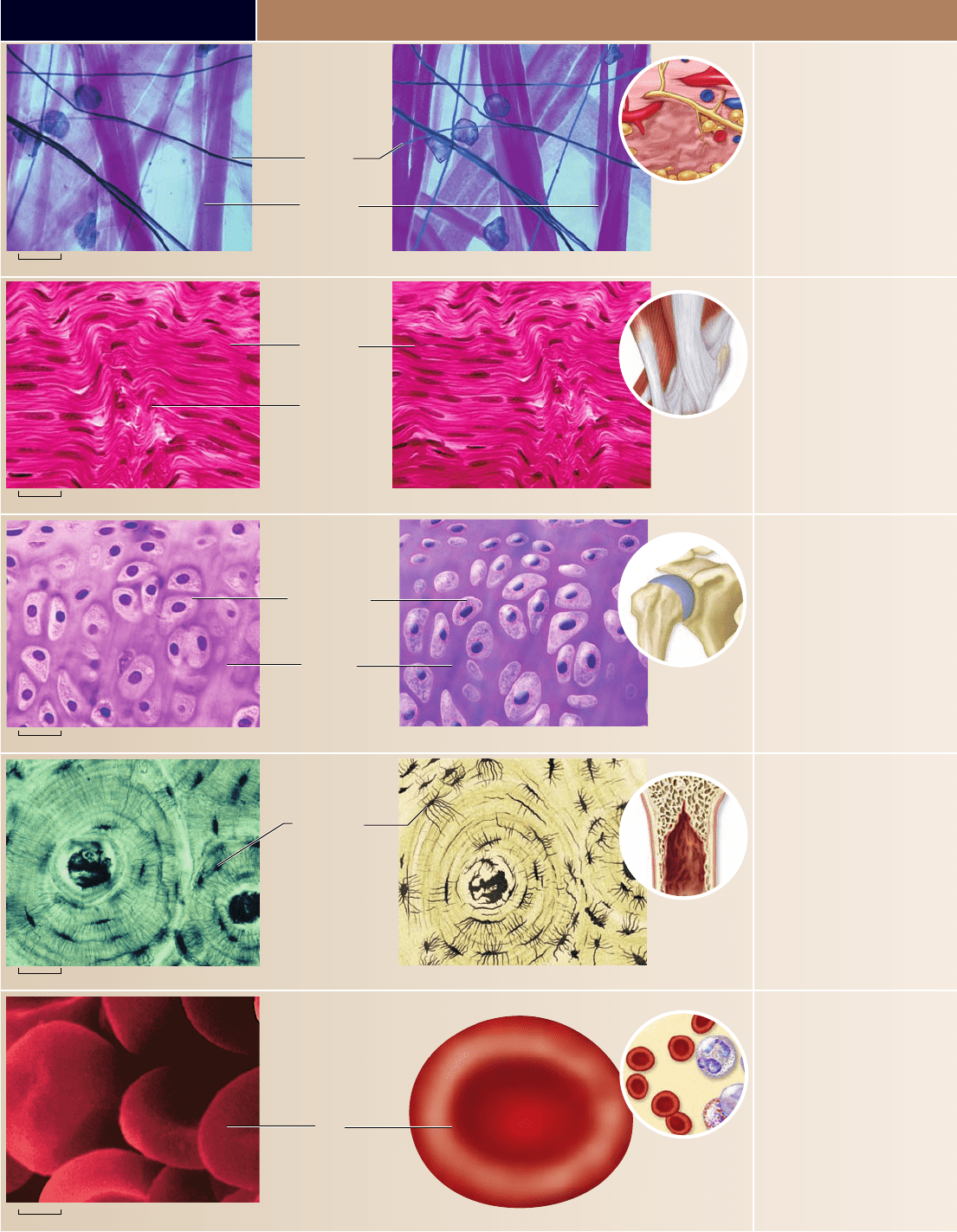
Dense connective tissue
Dense connective tissue, with less ground substance, contains
tightly packed collagen fibers, making it stronger than loose
connective tissue. It consists of two types: regular and irregular.
The collagen fibers of dense regular connective tissue line up in
parallel, like the strands of a rope. This is the structure of ten-
dons, which bind muscle to bone, and ligaments, which bind
bone to bone.
In contrast, the collagen fibers of dense irregular connective
tissue have many different orientations. This type of connective
tissue produces the tough coverings that package organs, such
as the capsules of the kidneys and adrenal glands. It also covers
muscle, nerves, and bones.
Special connective tissues have
unique characteristics
The special connective tissues—cartilage, bone, and blood—
each have unique cells and matrices that allow them to perform
their specialized functions.
43.3
Connective Tissue
Learning Outcomes
Describe the structure and function of connective tissue.1.
Identify the different kinds of connective tissue.2.
List the cells that make connective tissue.3.
Connective tissues derive from embryonic mesoderm and oc-
cur in many different forms (table 43.2) . We divide these vari-
ous forms into two major classes: connective tissue proper, which
further divides into loose and dense connective tissues, and
special connective tissues, which include cartilage, bone,
and blood.
At first glance, it may seem odd that such diverse tissues
are in the same category. Yet all connective tissues share a com-
mon structural feature: They all have abundant extracellular
material because their cells are spaced widely apart. This extra-
cellular material is called the matrix of the tissue. In bone, the
matrix contains crystals that make the bones hard; in blood, the
matrix is plasma, the fluid portion of the blood. The matrix it-
self consists of protein fibers and ground substance, the fluid
material between cells and fibers containing a diverse array of
proteins and polysaccharrides.
Connective tissue proper
may be either loose or dense
During the development of both loose and dense connective
tissues, cells called fibroblasts produce and secrete the extracel-
lular matrix. Loose connective tissue contains other cells as
well, including mast cells and macrophages—cells of the im-
mune system.
Loose connective tissue
Loose connective tissue consists of cells scattered within a
matrix that contains a large amount of ground substance. This
gelatinous material is strengthened by a loose scattering of pro-
tein fibers such as collagen, which supports the tissue by form-
ing a meshwork (figure 43.3), elastin, which makes the tissue
elastic, and reticulin, which helps support the network of col-
lagen. The flavored gelatin of certain desserts consists primar-
ily of extracellular material extracted from the loose connective
tissues of animals.
Adipose cells, more commonly termed fat cells, are im-
portant for nutrient storage, and they also occur in loose con-
nective tissue. In certain areas of the body, including under the
skin, in bone marrow, and around the kidneys, these cells can
develop in large groups, forming adipose tissue (figure 43.4).
Each adipose cell contains a droplet of triglycerides
within a storage vesicle. When needed for energy, the adipose
cell hydrolyzes its stored triglyceride and secretes fatty acids
into the blood for oxidation by the cells of the muscles, liver,
and other organs. Adipose cells cannot divide; the number of
adipose cells in an adult is generally fixed. When a person gains
Figure 43.4
Adipose tissue. Fat is stored in globules of
adipose tissue, a type of loose connective tissue. As a person gains
or loses weight, the size of the fat globules increases or decreases. A
person cannot decrease the number of fat cells by losing weight.
868
part
VII
Animal Form and Function
rav32223_ch43_863-886.indd 868rav32223_ch43_863-886.indd 868 11/17/09 3:09:56 PM11/17/09 3:09:56 PM
Apago PDF Enhancer
TABLE 43.2
Connective Tissue
Loose Connective Tissue
Typical Location
Beneath skin; between organs
Function
Provides support, insulation, food
storage, and nourishment for
epithelium
Characteristic Cell Types
Fibroblasts, macrophages, mast
cells, fat cells
Dense Connective Tissue
Typical Location
Tendons; sheath around muscles;
kidney; liver; dermis of skin
Function
Provides exible, strong
connections
Characteristic Cell Types
Fibroblasts
Cartilage
Typical Location
Spinal disks; knees and other joints;
ear; nose; tracheal rings
Function
Provides exible support,
shock absorption, and reduction of
friction on load-bearing surfaces
Characteristic Cell Types
Chondrocytes
Bone
Typical Location
Most of skeleton
Function
Protects internal organs; provides
rigid support for muscle attachment
Characteristic Cell Types
Osteocytes
Blood
Typical Location
Circulatory system
Function
Functions as highway of immune
system; carries nutrients and
waste; and is the primary means of
communication between organs
Characteristic Cell Types
Erythrocytes, leukocytes
Elastin
58 µm
Collagen
Nuclei of
fibroblasts
Collagen
fibers
Ground
substance
Chondrocyte
Red
blood cell
Osteocyte
0.16 µm
100 µm
100 µm
5.8 µm
chapter
43
The Animal Body and Principles of Regulation
86 9www.ravenbiology.com
rav32223_ch43_863-886.indd 869rav32223_ch43_863-886.indd 869 11/18/09 4:00:50 PM11/18/09 4:00:50 PM

Apago PDF Enhancer
Learning Outcomes Review 43.3
Connective tissues are characterized by abundant extracellular materials
forming a matrix between loosely organized cells. Connective tissue proper
is classifi ed as either loose or dense. Special connective tissues have unique
extracellular matrices between cells. The matrix of cartilage is composed of
organic materials, whereas that of bones is calcium crystals. The matrix of
blood is a fl uid, the plasma.
■ Why is blood considered connective tissue?
Cartilage
Cartilage (see table 43.2) is a specialized connective tissue
in which the ground substance forms from a characteristic
type of glycoprotein, called chondroitin, and collagen fibers
laid down along lines of stress in long, parallel arrays. The
result is a firm and flexible tissue that does not stretch, is far
tougher than loose or dense connective tissue, and has great
tensile strength.
Cartilage makes up the entire skeletal system of the mod-
ern agnathans and cartilaginous fishes (see chapter 35) . In most
adult vertebrates, however, cartilage is restricted to the joint
surfaces of bones that form freely movable joints and certain
other locations. In humans, for example, the tip of the nose, the
outer ear, the intervertebral disks of the backbone, the larynx,
and a few other structures are composed of cartilage.
Chondrocytes, the cells of cartilage, live within spaces called
lacunae within the cartilage ground substance. These cells re-
main alive even though there are no blood vessels within the
cartilage matrix; they receive oxygen and nutrients by diffusion
through the cartilage ground substance from surrounding
blood vessels. This diffusion can only occur because the carti-
lage matrix is well hydrated and not calcified, as is bone.
Bone
Bone cells, or osteocytes, remain alive even though the extra-
cellular matrix becomes hardened with crystals of calcium
phosphate. Blood vessels travel through central canals into the
bone, providing nutrients and removing wastes. Osteocytes ex-
tend cytoplasmic processes toward neighboring osteocytes
through tiny canals, or canaliculi. Osteocytes communicate with
the blood vessels in the central canal through this cytoplasmic
network. Bone is described in more detail in chapter 47 along
with muscle.
In the course of fetal development, the bones of verte-
brate fins, arms, and legs, among other appendages, are first
“modeled” in cartilage. The cartilage matrix then calcifies at
particular locations, so that the chondrocytes are no longer able
to obtain oxygen and nutrients by diffusion through the matrix.
Living bone replaces the dying and degenerating cartilage.
Blood
We classify blood as a connective tissue because it contains abun-
dant extracellular material, the fluid plasma. The cells of blood
are erythrocytes, or red blood cells, and leukocytes, or white blood
cells. Blood also contains platelets, or thrombocytes, which are
fragments of a type of bone marrow cell. We discuss blood
more fully in chapter 50 .
All connective tissues have similarities
Although the descriptions of the types of connective tissue sug-
gest numerous different functions for these tissues, they have
some similarities. As mentioned, connective tissues originate as
embryonic mesoderm, and they all contain abundant extracel-
lular material called matrix; however, the extracellular matrix
material is different in different types of connective tissue. Em-
bedded within the extracellular matrix of each tissue type are
varieties of cells, each with specialized functions.
43.4
Muscle Tissue
Learning Outcomes
Identify the unique features of muscle cells.1.
Describe the three kinds of muscle and muscle cells.2.
Muscles are the motors of the vertebrate body. The character-
istic that makes muscle cells unique is the relative abundance
and organization of actin and myosin filaments within them.
Although these filaments form a fine network in all eukaryotic
cells, where they contribute to movement of materials within
the cell, they are far more abundant and organized in muscle
cells, which are specialized for contraction.
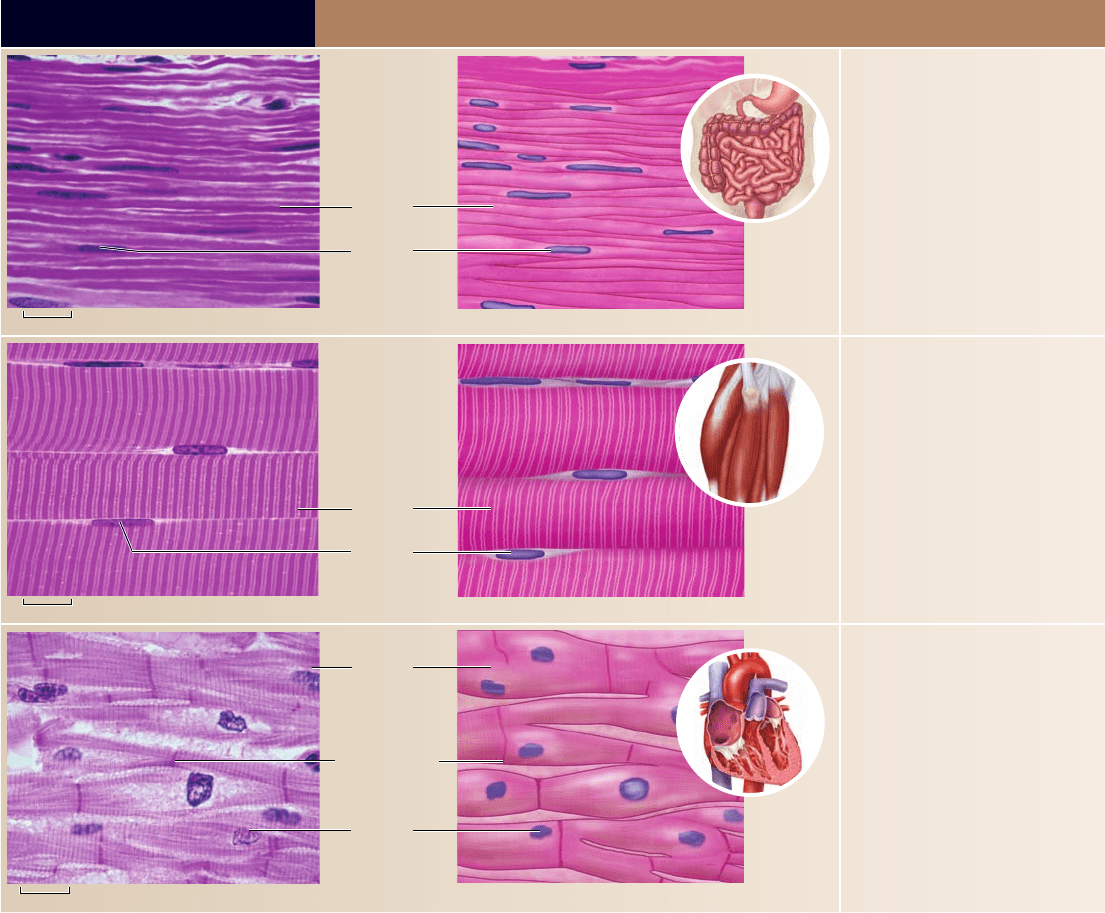
Vertebrates possess three kinds of muscle: smooth, skeletal,
and cardiac (table 43.3) . Skeletal and cardiac muscles are also
known as striated muscles because their cells appear to have
transverse stripes when viewed in longitudinal section under
the microscope. The contraction of each skeletal muscle is un-
der voluntary control, whereas the contraction of cardiac and
smooth muscles is generally involuntary.
Smooth muscle is found in most organs
Smooth muscle was the earliest form of muscle to evolve, and
it is found throughout most of the animal kingdom. In verte-
brates, smooth muscle occurs in the organs of the internal en-
vironment, or viscera, and is also called visceral muscle. Smooth
muscle tissue is arranged into sheets of long, spindle-shaped
cells, each cell containing a single nucleus. In some tissues, the
cells contract only when a nerve stimulates them—and then all
of the cells in the sheet contract as a unit.
In vertebrates, muscles of this type line the walls of many
blood vessels and make up the iris of the eye, which contracts in
bright light. In other smooth muscle tissues, such as those in the wall
of the digestive tract, the muscle cells themselves may spontaneously
initiate electrical impulses, leading to a slow, steady contraction of
the tissue. Here nerves regulate, rather than cause, the activity.
Skeletal muscle moves the body
Skeletal muscles are usually attached to bones by tendons, so
that their contraction causes the bones to move at their joints.
A skeletal muscle is made up of numerous, very long muscle
870
part
VII
Animal Form and Function
rav32223_ch43_863-886.indd 870rav32223_ch43_863-886.indd 870 11/17/09 3:10:07 PM11/17/09 3:10:07 PM
Apago PDF Enhancer
TABLE 43.3
Muscle Tissue
Smooth Muscle
Typical Location
Walls of blood vessels, stomach,
and intestines
Function
Powers rhythmic, involuntary
contractions commanded by the central
nervous system
Characteristic Cell Types
Smooth muscle cells
Skeletal Muscle
Typical Location
Voluntary muscles
Function
Powers walking, lifting, talking, and all
other voluntary movement
Characteristic Cell Types
Skeletal muscle cells
Cardiac Muscle
Typical Location
Walls of heart
Function
Highly interconnected cells; promotes
rapid spread of signal initiating
contraction
Characteristic Cell Types
Cardiac muscle cells
Smooth
muscle cell
Nucleus
Skeletal
muscle cell
Nucleus
Cardiac
muscle cell
Nucleus
Intercalated
disk
40 µm
100 µm
40 µm
cells called muscle fibers, which have multiple nuclei. The fi-
bers lie parallel to each other within the muscle and are con-
nected to the tendons on the ends of the muscle. Each skeletal
muscle fiber is stimulated to contract by a motor neuron.
The nervous system controls the overall strength of a
skeletal muscle contraction by controlling the number of mo-
tor neurons that fire, and therefore the number of muscle fibers
stimulated to contract. Each muscle fiber contracts by means of
substructures called myofibrils containing highly ordered ar-
rays of actin and myosin myofilaments. These filaments give
the muscle fiber its striated appearance.
Skeletal muscle fibers are produced during development
by the fusion of several cells, end to end. This embryological
development explains why a mature muscle fiber contains many
nuclei. The structure and function of skeletal muscle is ex-
plained in more detail in chapter 47.
The heart is composed of cardiac muscle
The hearts of vertebrates are made up of striated muscle cells
arranged very differently from the fibers of skeletal muscle. In-
stead of having very long, multinucleate cells running the
length of the muscle, cardiac muscle consists of smaller, inter-
connected cells, each with a single nucleus. The interconnec-
tions between adjacent cells appear under the microscope as
dark lines called intercalated disks. In reality, these lines are
regions where gap junctions link adjacent cells. As noted in
chapter 4 , gap junctions have openings that permit the move-
ment of small substances and ions from one cell to another.
These interconnections enable the cardiac muscle cells to form
a single functioning unit.
Certain specialized cardiac muscle cells can generate elec-
trical impulses spontaneously, but the nervous system usually
chapter
43
The Animal Body and Principles of Regulation
871www.ravenbiology.com
rav32223_ch43_863-886.indd 871rav32223_ch43_863-886.indd 871 11/17/09 3:10:07 PM11/17/09 3:10:07 PM