
Raven P.H., Johnson G.B., Mason K.A. Biology (Ninth Edition)
Подождите немного. Документ загружается.

Apago PDF Enhancer
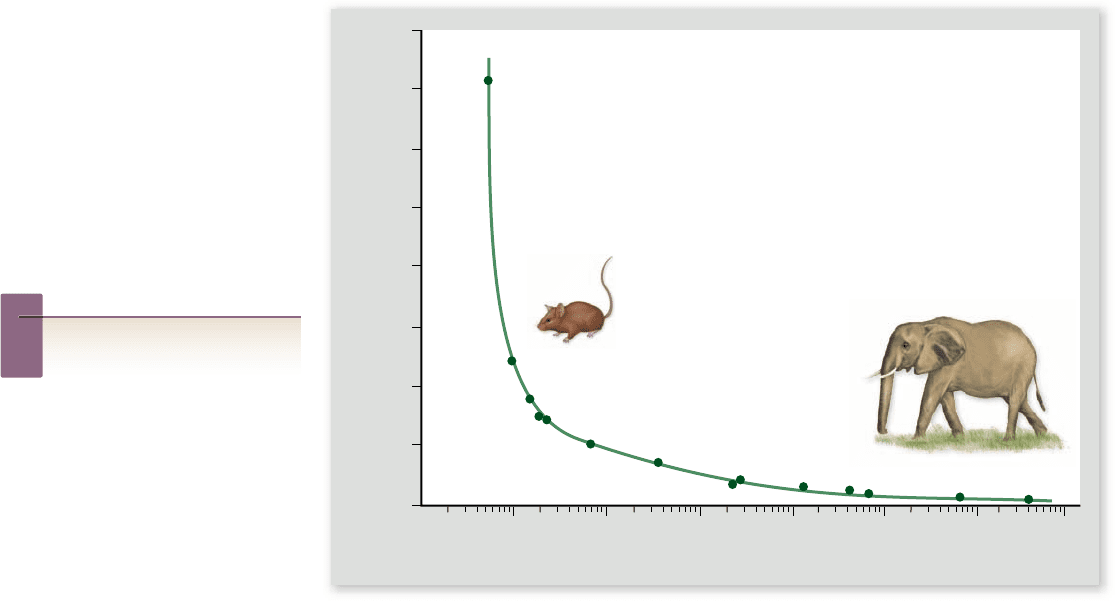
log Mass (kg)
Shrew
Harvest mouse
Kangaroo mouse
Cactus mouse
Mouse Flying squirrel
Cat
Rat
Rabbit
Dog
Sheep
Human Horse
1000 100 10 1
1
0
2
3
4
5
6
7
8
0.1 0.01
Elephant
Mass-specific metabolic rate
(mL O
2
!g
-1
! h
-1
)
Thus, small endotherms in cold environments require signifi-
cant insulation to maintain their body temperature. The amount
of insulation can also vary seasonally and geographically with
thicker coats in the north and in winter.
Conversely, large animals in hot environments have the
opposite problem: Although their metabolic rate is relatively
low, they still produce a large amount of heat with much less
relative surface area to dissipate this heat by conduction. Thus
large endotherms in hot environments usually have little insu-
lation and will use behavior to lose heat, such as elephants flap-
ping their ears to increase convective heat loss.
Thermogenesis
When temperatures fall below a critical lower threshold,
normal endothermic responses are not sufficient to warm an
animal. In this case, the animal resorts to thermogenesis,
or the use of normal energy metabolism to produce heat.
Thermogenesis takes two forms: shivering and nonshiver-
ing thermogenesis.
In nonshivering thermogenesis, fat metabolism is al-
tered to produce heat instead of ATP. Nonshivering thermo-
genesis takes place throughout the body, but in some mammals,
special stores of fat called brown fat are utilized specifically
for this purpose. This brown fat is stored in small deposits in
the neck and between the shoulders. This fat is highly vascu-
larized, allowing efficient transfer of heat away from the site
of production.
Shivering thermogenesis uses muscles to generate heat
without producing useful work. It occurs in some insects, such
as the earlier example of a butterfly warming its flight muscles,
and in endothermic vertebrates. Shivering involves the use of
antagonistic muscles to produce little net generation of move-
ment, but hydrolysis of ATP, generating heat.
Mammalian thermoregulation
is controlled by the hypothalamus
Mammals that maintain a relatively constant core temperature
need an overall control system (summarized in figure 43.15) .
The system functions much like the heating/cooling system in
your house that has a thermostat connected to a furnace to pro-
duce heat and an air conditioner to remove heat. Such a system
maintains the temperature of your house about a set point by
alternately heating or cooling as necessary.
When the temperature of your blood exceeds 37°C
(98.6°F), neurons in the hypothalamus detect the temperature
change (see chapters 44 and 45 ) . This leads to stimulation of
the heat-losing center in the hypothalamus. Nerves from this
area cause a dilation of peripheral blood vessels, bringing
more blood to the surface to dissipate heat. Other nerves
stimulate the production of sweat, leading to evaporative
cooling. Production of hormones that stimulate metabolism is
also inhibited.
When your temperature falls below 37°C, an antagonistic
set of effects are produced by the hypothalamus. This is under
control of the heat-promoting center, which has nerves that con-
strict blood vessels to reduce heat transfer, and inhibit sweating
to prevent evaporative cooling. The adrenal medulla is stimu-
lated to produce epinephrine, and the anterior pituitary to pro-
duce TSH, both of which stimulate metabolism. In the case of
TSH, this is indirect as it stimulates the thyroid to produce
thyroxin, which stimulates metabolism (see chapter 46). A
Figure 43.14
Relationship
between body mass and
metabolic rate in mammals.
Smaller animals have a much higher
metabolic rate per unit body mass
relative to larger animals. In the
gure, mass-speci c metabolic rate
(expressed as O
2
consumption per unit
mass) is plotted against body mass.
Note that the body mass axis is a
logarithmic scale.
Inquiry question
?
What does this graph predict
about the different challenges
faced by smaller versus larger
mammals in hot and cold
environments?
882
part
VII
Animal Form and Function
rav32223_ch43_863-886.indd 882rav32223_ch43_863-886.indd 882 11/17/09 3:10:27 PM11/17/09 3:10:27 PM
Apago PDF Enhancer
(-)
(-)
Body temperature
rises
Stimulus
Sun
Perturbing factor
Snow and ice
Perturbing factor
Body temperature
drops
Stimulus
Thermoreceptors
Sensor
Hypothalamus
Integrating Center
Negative
feedback
Negative
feedback
• Blood vessels dilate
• Glands release sweat
Effector
• Blood vessels constrict
• Skeletal muscles
contract, shiver
Effector
Body temperature
rises
Response
Body temperature
falls
Response
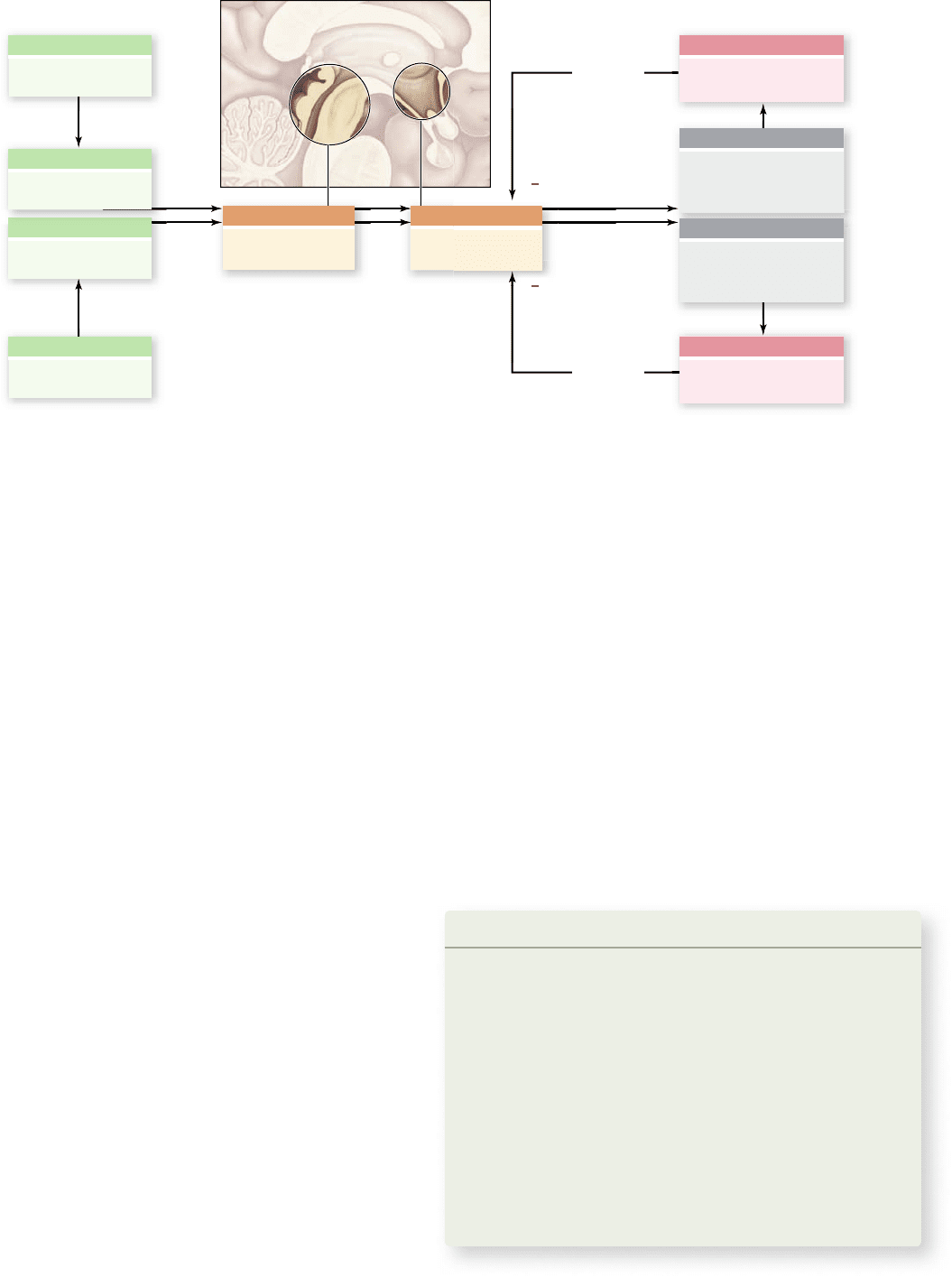
Figure 43.15
The control of body temperature by the hypothalamus. Central thermoreceptors in the brain and interior of the
abdomen sense changes in core temperature. These thermoreceptors synapse with neurons on the hypothalamus, which acts as an integrating
center. The hypothalamus then controls effectors such as blood vessels and sweat glands via sympathetic nerves. The hypothalamus also
causes the release of hormones that stimulate the thyroid to produce thyroxin, which modulates metabolism.
combination of epinephrine and autonomic nerve stimulation
of fat tissue can induce thermogenesis to produce more internal
heat. Again, as temperature rises, negative feedback to the hy-
pothalamus reduces the heat-producing response.
Fever
Substances that cause a rise in temperature are called pyrogens,
and they produce the state we call fever. Fever is a result of re-
setting the body’s normal set point to a higher temperature. A
number of gram-negative bacteria have components in their cell
walls called endotoxins that act as pyrogens. Substances pro-
duced by circulating white blood cells act as pyrogens as well.
Pyrogens act on the hypothalamus to increase the set point.
The adaptive value of fever seems to be that increased tem-
perature can inhibit the growth of bacteria. Evidence for this
comes from the observation that some ectotherms respond to py-
rogens as well. When desert iguanas were injected with pyrogen-
producing bacteria, they spent more time in the sun, producing
an elevated temperature: They induced fever behaviorally!
These observations have led to a reevaluation of fever as
a state that should be treated medically. Fever is a normal re-
sponse to infection, and treatment to reduce fever may be
working against this natural defense system. Extremely high
fevers, however, can be dangerous, inducing symptoms ranging
from seizures to delirium .
Torpor
Endotherms can also reduce both metabolic rate and body
temperature to produce a state of dormancy called torpor. To r -
por allows an animal to reduce the need for food intake by re-
ducing metabolism. Some birds, such as the hummingbird,
allow their body temperature to drop as much as 25°C at night.
This strategy is found in smaller endotherms; larger mammals
have too large a mass to allow rapid cooling.
Hibernation is an extreme state in which deep torpor lasts
for several weeks or even several months. In this case, the ani-
mal’s temperature may drop as much as 20°C below its normal
set point for an extended period of time. The animals that prac-
tice hibernation seem to be in the midrange of size; smaller
endotherms quickly consume more energy than they can easily
store, even by reducing their metabolic rate.
Very large mammals do not appear to hibernate. It was
long thought that bears hibernate, but in reality their tem-
perature is reduced only a few degrees. They instead undergo
a prolonged winter sleep. With their large thermal mass and
low rate of heat loss, they do not seem to require the addi-
tional energy savings of hibernation.
Learning Outcomes Review 43.8
The Q
10
value of an enzyme indicates how its activity changes with a 10°C
rise in temperature. The Q
10
can also be applied to an organism’s overall
metabolism. Body heat is equal to heat produced plus heat transferred.
Heat is transferred by conduction, convection, radiation, and evaporation.
Organisms that generate heat and can maintain a temperature above
ambient levels are called endotherms. Organisms that conform to their
surroundings are called ectotherms. Both types can regulate temperature,
but ectotherms mainly do so with behavior. Mammals maintain a
consistent body temperature through regulation of metabolic rate by
the hypothalamus. Two negative feedback loops act to raise or lower
temperature as needed.
■ Why are the terms “cold-blooded” and “warm-blooded”
outmoded and inaccurate?
chapter
43
The Animal Body and Principles of Regulation
883www.ravenbiology.com
rav32223_ch43_863-886.indd 883rav32223_ch43_863-886.indd 883 11/17/09 3:10:27 PM11/17/09 3:10:27 PM

Apago PDF Enhancer
43.1 Organization of the Vertebrate Body
(see gure 43.1)
Tissues are groups of cells of a single type and function.
Adult vertebrate primary tissues are epithelial,
connective, muscle,
and nerve tissues.
Organs and organ systems provide specialized function.
Organs consist of a group of different tissues that form a structural
and functional unit. An organ system is a group of organs that
collectively perform a function.
The general body plan of vertebrates is a tube within a tube, with
internal support (see gure 43.2).
The tube of the digestive tract is surrounded by the skeleton and
accessory organs and is enclosed in the integument.
Vertebrates have both dorsal and ventral body cavities.
The dorsal body cavity lies within the skull and vertebrae. The
ventral body cavity, bounded by the rib cage and abdominal muscles,
comprises the thoracic cavity and the abdominopelvic cavity.
The coelomic space of the abdominopelvic cavity is the peritoneal
cavity; that surrounding the heart is the pericardial cavity; and those
around the lungs are the pleural cavities.
43.2 Epithelial Tissue
Epithelium forms a barrier.
Epithelial cells are tightly bound together, forming a selective barrier.
Epithelial cells are replaced constantly and can regenerate in wound
healing. Epithelium has a basal surface attached to underlying
connective tissues, and a free apical surface.
Epithelial types re ect their function.
Epithelium is divided into two general classes: simple (one cell layer)
and strati ed (multiple cells thick). These are further divided into
squamous, cuboidal, and columnar based on the shape of cells (see
table 43.1). Vertebrate glands form from invaginated epithelia.
43.3 Connective Tissue
Connective tissue proper may be either loose or dense.
Connective tissues contain various cells in an extracellular matrix of
proteins and ground substance. Connective tissue proper is divided
into loose connective tissue and dense connective tissue.
Special connective tissues have unique characteristics.
Special connective tissues, such as cartilage, rigid bone, and blood,
have unique cells and matrices (see table 43.2). Cartilage is formed by
chondrocytes and bone by osteocytes.
All connective tissues have similarities.
All connective tissues originate from mesoderm and contain a variety
of cells within an extracellular matrix.
43.4 Muscle Tissue (see table 43.3)
Smooth muscle is found in most organs.
Involuntary smooth muscle occurs in the viscera and is composed of
long,
spindle-shaped cells with a single nucleus.
Skeletal muscle moves the body.
Voluntary skeletal or striated muscle is usually attached by tendons
to bones, and the cells ( bers) have multiple nuclei and contain
contractile myo brils.
The heart is composed of cardiac muscle.
Cardiac muscle consists of striated muscle cells connected
to each other by gap junctions that allow coordination.
43.5 Nerve Tissue (see table 43.4)
Neurons sometimes extend long distances.
Neurons have a cell body with a nucleus; dendrites,
which receive
impulses; and an axon, which transmits impulses away.
Neuroglia provide support for neurons.
Neuroglia help regulate the neuronal environment. Some types form
the myelin sheaths that surround some axons.
Two divisions of the nervous system coordinate activity.
The central nervous system is the brain and spinal cord, and the
peripheral nervous system contains nerves and ganglia.
43.6 Overview of Vertebrate Organ Systems
(see gure 43.6)
Communication and integration sense and respond to
the en
vironment.
The three organ systems involved in communication and integration
are the nervous, sensory, and endocrine systems.
Skeletal support and movement are vital to all animals.
The musculoskeletal system consists of muscles and the skeleton they
act upon.
Regulation and maintenance of the body’s chemistry ensures
continued life.
The digestive, circulatory, respiratory, and urinary systems
accomplish ingestion of nutrients and elimination of wastes.
The body can defend itself from attackers and invaders.
The integumentary system forms a barrier against attack; the
immune system mounts a counterattack to foreign pathogens.
Reproduction and development ensure continuity of species.
All vertebrate species are capable of sexual reproduction.
43.7 Homeostasis
Homeostasis refers to the dynamic constancy of the internal
environment and is essential for life.
Negative feedback mechanisms keep values within a range.
Negative feedback loops include a sensor, an integration center, and
effectors that respond to deviations from a set point.
Antagonistic e ectors act in opposite directions.
Negative feedback mechanisms often occur in antagonistic pairs that
push and pull against each other.
Positive feedback mechanisms enhance a change.
In a positive feedback loop changes in one direction bring about
further changes in the same direction.
43.8 Regulating Body Temperature
Q
10
is a measure of temperature sensitivity.
Q
10
is the ratio of reaction rates at two temperatures 10°C apart. For
chemical reactions Q
10
is about 2. Most organisms have a Q
10
around
2 to 3, indicating temperature affects mainly enzymatic reactions.
Chapter Review
884
part
VII
Animal Form and Function
rav32223_ch43_863-886.indd 884rav32223_ch43_863-886.indd 884 11/17/09 3:10:28 PM11/17/09 3:10:28 PM

Apago PDF Enhancer
UNDERSTAND
1. Which of the following cavities would contain your stomach?
a. Peritoneal c. Pleural
b. Pericardial d. Thoracic
2. Epithelial tissues do all of the following except
a. form barriers or boundaries.
b. absorb nutrients in the digestive tract.
c. transmit information in the central nervous system.
d. allow exchange of gases in the lung.
3. Ectotherms
a. cannot regulate their body temperatures.
b. regulate their internal temperature using metabolic energy.
c. can regulate temperature using behavior.
d. regulate temperature by dissipating but not
generating heat.
4. Connective tissues include a diverse group of cells, yet they
all share
a. cuboidal shape.
b. the ability to produce hormones.
c. the ability to contract.
d. the presence of an extracellular matrix.
5. Skeletal muscle cells differ from the “typical” mammalian cell
in that they
a. contain multiple nuclei.
b. have mitochondria.
c. have no plasma membrane.
d. are not derived from embryonic tissue.
6. Examples of smooth muscle sites include
a. the lining of blood vessels.
b. the iris of the eye.
c. the wall of the digestive tract.
d. all of these.
7. The function of neuroglia is to
a. carry messages from the PNS to the CNS.
b. support and protect neurons.
c. stimulate muscle contraction.
d. store memories.
8. Skeletal muscle cells are
a. large multinucleate cells that arise by growth.
b. large multinucleate cells that arise by fusion of smaller cells.
c. small cells connected by many gap junctions.
d. large cells with a single nucleus.
APPLY
1. Connective tissues, although quite diverse in structure and
location, do share a common theme; the connection between
other types of tissues. Although all of the following seem to t
that criterion, one of the tissues listed is not a type of
connective tissue. Which one?
a. Blood c. Adipose
b. Muscle d. Cartilage
2. What do all the organs of the body have in common?
a. Each contains the same kinds of cells.
b. Each is composed of several different kinds of tissue.
c. Each is derived from ectoderm.
d. Each can be considered part of the circulatory system.
3. Rheumatoid arthritis is an autoimmune disease that attacks the
linings of joints within the body. The cells that line these joints,
and whose destruction causes the symptoms of arthritis, are
known as
a. osteocytes. c. chondrocytes.
b. erythrocytes. d. thrombocytes.
4. Suppose that an alien virus arrives on Earth. This virus causes
damage to the nervous system by attacking the structures of
neurons. Which of the following structures would be immune
from attack?
a. Axon d. All of these would be attacked
b. Dendrite by the virus.
c. Neuroglia
5. Homeostasis
a. is a dynamic process.
b. describes the maintenance of the internal environment
of the body.
c. is essential to life.
d. is all of these.
Review Questions
Temperature is determined by internal and external factors.
Internal factors include metabolic rate; external factors affect
heat transfer. Heat is transferred through radiation, conduction,
convection, and evaporation (see gure 43.11).
Organisms are classi ed based on heat source.
Endotherms have high metabolic rates and generate heat
internally. Ectotherms have low metabolic rates and conform to
ambient temperature.
Ectotherms regulate temperature using behavior.
Ectotherms move around in an environment to alter their
temperature (see gures 43.12 and 43.13).
Endotherms create internal metabolic heat for conservation
or dissipation.
Endotherms regulate temperature by changes in metabolic rate,
blood ow, and sweating or panting. Thermogenesis occurs when
temperature falls below a critical level.
Mammalian thermoregulation is controlled by the hypothalamus
(see gure 43.15).
The hypothalamus acts through a heat-losing and heat-promoting
center to keep the blood temperature near a set point. Fever is an
increase in body temperature; torpor is a lowered metabolic state
associated with dormancy.
chapter
43
The Animal Body and Principles of Regulation
885www.ravenbiology.com
rav32223_ch43_863-886.indd 885rav32223_ch43_863-886.indd 885 11/17/09 3:10:29 PM11/17/09 3:10:29 PM

Apago PDF Enhancer
6. Which of the following scenarios correctly describes
positive feedback?
a. If the temperature increases in your room, your furnace
increases its output of warm air.
b. If you drink too much water, you produce more urine.
c. If the price of gasoline increases, drivers decrease the
length of their trips.
d. If you feel cold, you start to shiver.
7. The three types of muscle all share
a. a structure that includes striations.
b. a membrane that is electrically excitable.
c. the ability to contract.
d. the characteristic of self-excitation.
SYNTHESIZE
1. Suppose that you discover a new disease that affects nutrient
absorption in the gut as well as causes problems with the skin. Is
it possible that one disease could involve the same tissues? How
could this occur?
2. Which organ systems are involved in regulation and
maintenance? Why do you think they are linked in this way?
3. We have all experienced hunger pangs. Is hunger a positive or
negative feedback stimulus? Describe the steps involved
in the response to this stimulus.
4. Why is homeostasis described as a dynamic process? How does
negative feedback function in this process? How can
antagonistic effectors result in a constant level, and how does
this relate to the idea of a dynamic process?
ONLINE RESOURCE
www.ravenbiology.com
Understand, Apply, and Synthesize—enhance your study with
animations that bring concepts to life and practice tests to assess
your understanding. Your instructor may also recommend the
interactive eBook, individualized learning tools, and more.
886
part
VII
Animal Form and Function
rav32223_ch43_863-886.indd 886rav32223_ch43_863-886.indd 886 11/17/09 3:10:29 PM11/17/09 3:10:29 PM
Apago PDF Enhancer
A
20
μ
m
Chapter
44
The Nervous System
Chapter Outline
44.1 Nervous System Organization
44.2 The Mechanism of Nerve Impulse Transmission
44.3 Synapses: Where Neurons Communicate
with Other Cells
44.4 The Central Nervous System: Brain and Spinal Cord
44.5 The Peripheral Nervous System: Sensory
and Motor Neurons
Introduction
All animals except sponges use a network of nerve cells to gather information about the body’s condition and the external
environment, to process and integrate that information, and to issue commands to the body’s muscles and glands. As we saw
in chapter 43, homeostasis of the animal’s body is accomplished by negative feedback loops that maintain conditions within
narrow limits. Negative feedback implies not only detection of appropriate stimuli but also communication of information to
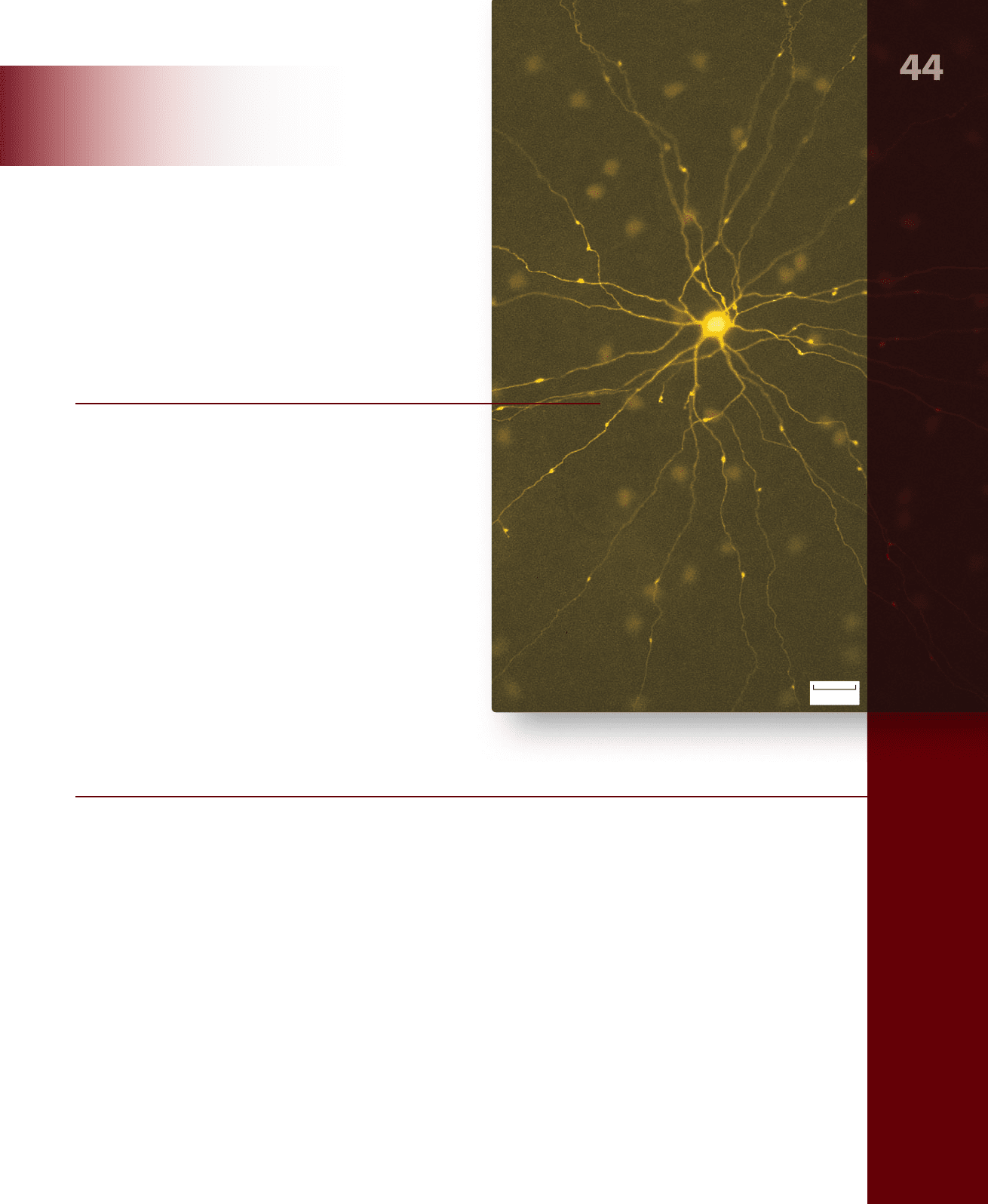
begin a response. The nervous system, composed of neurons, such as the one pictured here, is a fast communication system
and a part of many feedback systems in the body.
CHAPTERCHAPTER
rav32223_ch44_887-914.indd 887rav32223_ch44_887-914.indd 887 11/17/09 3:31:47 PM11/17/09 3:31:47 PM
Apago PDF Enhancer
Sensory Neurons
Motor Neurons
Interneuron
CNS PNS
Dendrites
Cell body
Direction of
conduction
Direction of
conduction
Axon
Axon
Cell body
Cell
bodies
Axon
terminals
Smooth
muscle
Skeletal
muscle
Ganglion
Touch
Taste
Dendrites
Direction of
conduction
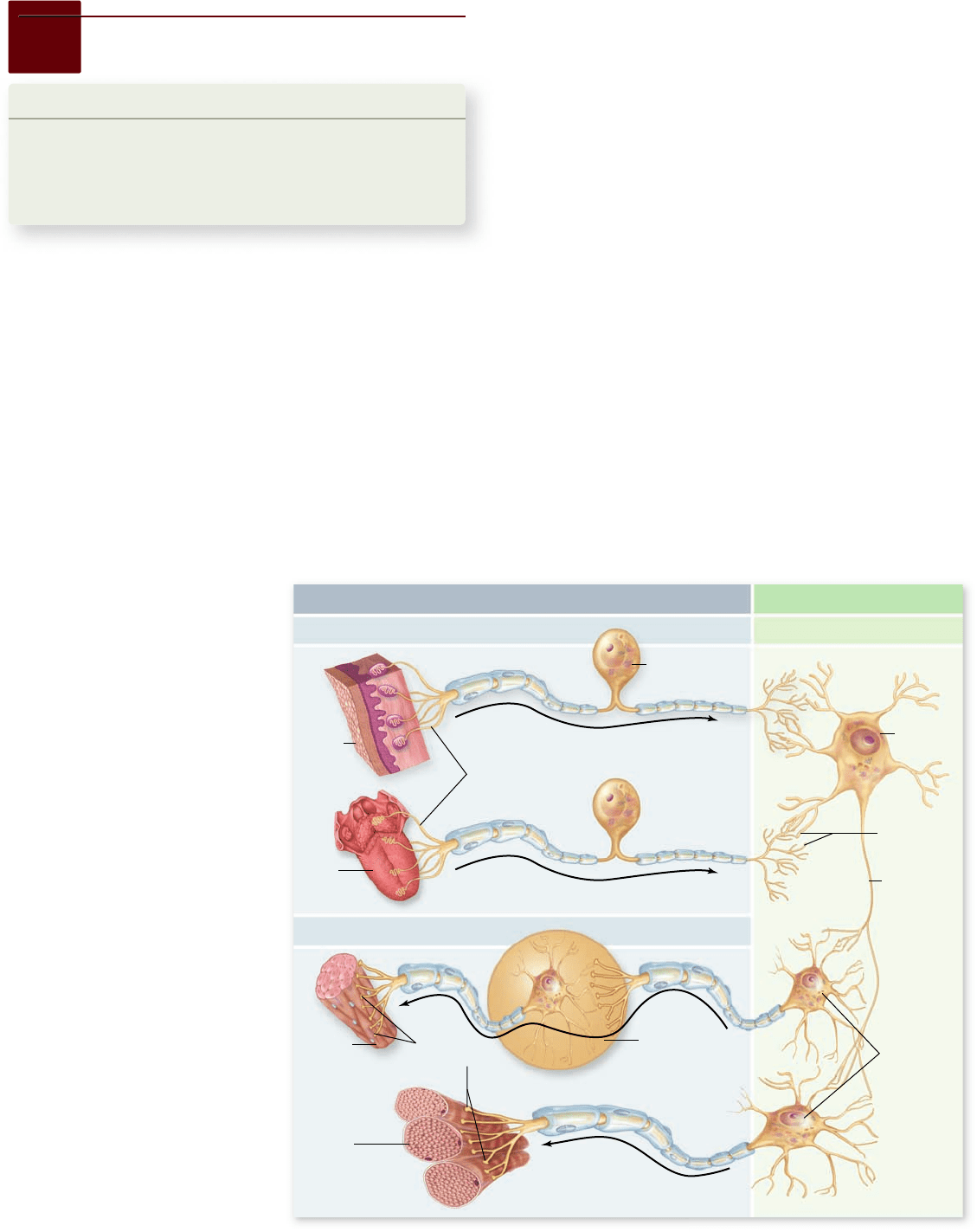
Figure 44.1
Three types of
neurons. The brain and spinal cord
form the central nervous system (CNS)
of vertebrates, and sensory and motor
neurons form the peripheral nervous
system (PNS). Sensory neurons of the
peripheral nervous system carry
information about the environment to
the CNS. Interneurons in the CNS
provide links between sensory and
motor neurons. Motor neurons of the
PNS system carry impulses or
“commands” to muscles and glands
(effectors).
neurons. In vertebrates, sensory neurons (or afferent neurons)
carry impulses from sensory receptors to the central nervous sys-
tem (CNS) , which is composed of the brain and spinal cord.
Motor neurons (or efferent neurons) carry impulses from the
CNS to effectors—muscles and glands. A third type of neuron
is present in the nervous systems of most invertebrates and all
vertebrates: interneurons (or association neurons). Inter-
neurons are located in the brain and spinal cord of vertebrates,
where they help provide more complex reflexes and higher as-
sociative functions, including learning and memory.
The peripheral nervous system collects
information and carries out responses
Together, sensory and motor neurons constitute the peripheral
nervous system (PNS) in vertebrates. Motor neurons that stim-
ulate skeletal muscles to contract make up the somatic
nervous system; those that regulate the activity of the smooth
muscles, cardiac muscle, and glands compose the autonomic
nervous system.
The autonomic nervous system is further broken down
into the sympathetic and parasympathetic divisions. These divi-
sions counterbalance each other in the regulation of many
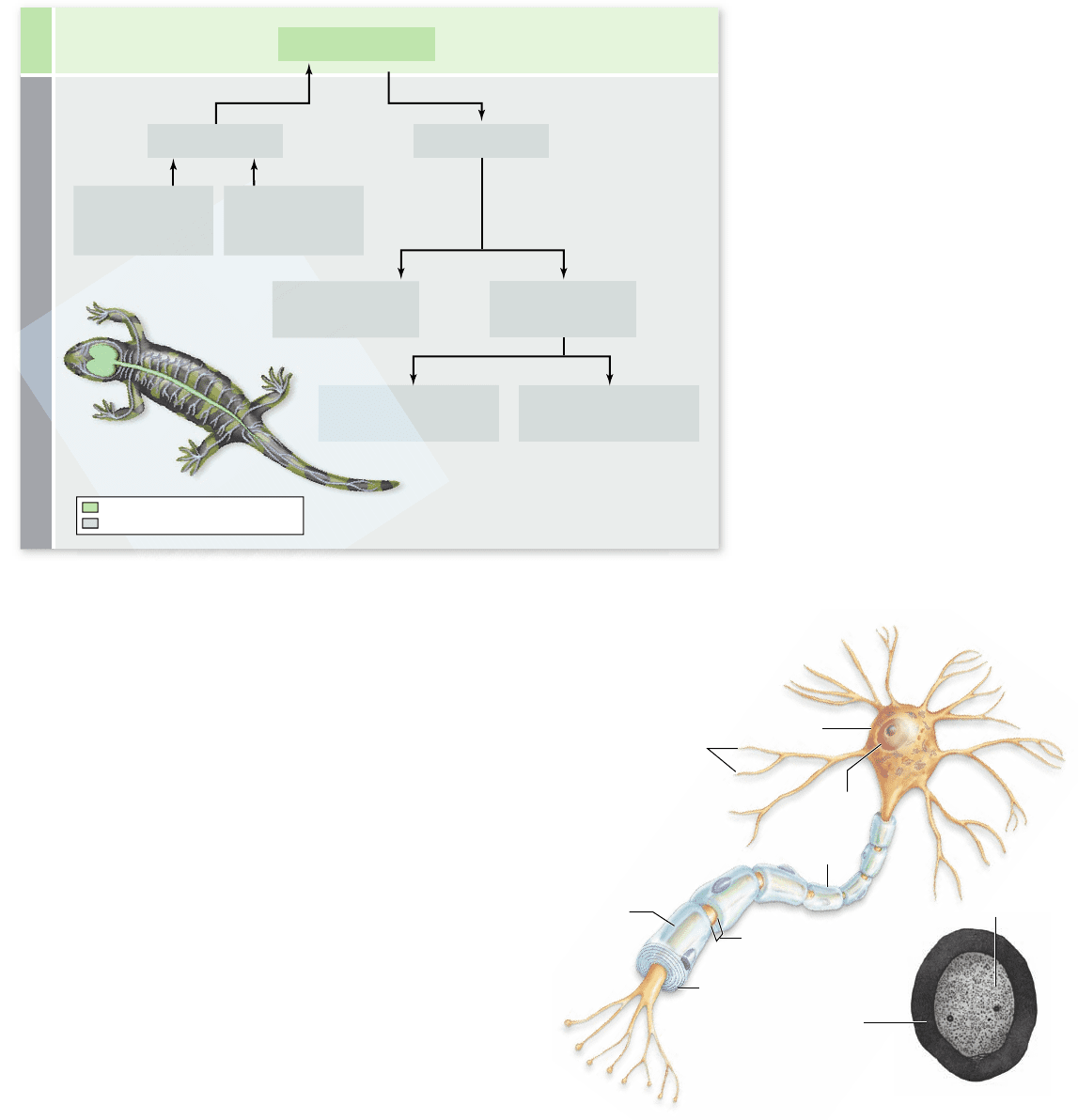
organ systems. Figure 44.2 illustrates the relationships among
the different parts of the vertebrate nervous system.
44.1
Nervous System Organization
Learning Outcomes
Distinguish the subdivisions of the vertebrate 1.
nervous system.
Identify the functional structure of neurons.2.
Name the different cell types in the nervous system.3.
An animal must be able to respond to environmental stimuli. A
fly escapes a flyswatter; the antennae of a crayfish detect food
and the crayfish moves toward it. To accomplish these actions,
animals must have sensory receptors that can detect the stimulus
and motor effectors that can respond to it. In most invertebrate
phyla and in all vertebrate classes, sensory receptors and motor
effectors are linked by way of the nervous system.
The central nervous system
is the “command center”
As described in chapter 43, the nervous system consists of neu-
rons and supporting cells. Figure 44.1 shows the three types of
888
part
VII
Animal Form and Function
rav32223_ch44_887-914.indd 888rav32223_ch44_887-914.indd 888 11/17/09 3:31:54 PM11/17/09 3:31:54 PM
Apago PDF Enhancer
central nervous system (CNS)
peripheral nervous system (PNS)
CNS
Brain and Spinal Cord
PNS
Sympathetic nervous
system
"fight or flight"
Parasympathetic nervous
system
"rest and repose"
Somatic nervous
system
(voluntary)
Sensory neurons
registering external
stimuli
Sensory neurons
registering internal
stimuli
Autonomic nervous
system
(involuntary)
Sensory Pathways Motor Pathways
Axon
Dendrites
Node of
Ranvier
Myelin
sheath
Schwann
cell
Nucleus
Cell body
Axon
Myelin
sheath
Figure 44.2
Divisions of the
vertebrate nervous system. The
major divisions are the central and
peripheral nervous systems. The brain and
spinal cord make up the central nervous
system (CNS). The peripheral nervous
system (PNS) includes everything outside
the CNS and is divided into sensory and
motor pathways. Sensory pathways can
detect either external or internal stimuli.
Motor pathways are divided into the
somatic nervous system that activates
voluntary muscles and the autonomic
nervous system that activate involuntary
muscles. The sympathetic and
parasympathetic nervous systems are
subsets of the autonomic nervous system
that trigger opposing actions.
Figure 44.3
Structure of a typical vertebrate neuron.
Extending from the cell body are many dendrites, which receive
information and carry it to the cell body. A single axon transmits
impulses away from the cell body. Many axons are encased by a
myelin sheath, with multiple membrane layers that insulate the
axon. Small gaps, called nodes of Ranvier, interrupt the sheath at
regular intervals. Schwann cells form myelin sheaths in the PNS (as
shown for this motor neuron); extensions of oligodendrocytes form
myelin sheaths in the CNS.
The structure of neurons
supports their function
Despite their varied appearances, most neurons have the same
functional architecture (figure 44.3) . The cell body is an en-
larged region containing the nucleus. Extending from the cell
body are one or more cytoplasmic extensions called dendrites.
Motor and association neurons possess a profusion of highly
branched dendrites, enabling those cells to receive information
from many different sources simultaneously. Some neurons
have extensions from the dendrites called dendritic spines that
increase the surface area available to receive stimuli.
The surface of the cell body integrates the information ar-
riving at its dendrites. If the resulting membrane excitation is
sufficient, it triggers the conduction of impulses away from the
cell body along an axon. Each neuron has a single axon leaving
its cell body, although an axon may also branch to stimulate a
number of cells. An axon can be quite long: The axons control-
ling the muscles in a person’s feet can be more than a meter
long, and the axons that extend from the skull to the pelvis in a
giraffe are about 3 m long.
Supporting cells include Schwann
cells and oligodendrocytes
Neurons are supported both structurally and functionally by
supporting cells, which are collectively called neuroglia . These
cells are one-tenth as big and 10 times more numerous than
neurons, and they serve a variety of functions, including supply-
ing the neurons with nutrients, removing wastes from neurons,
guiding axon migration, and providing immune functions.
chapter
44
The Nervous System
889www.ravenbiology.com
rav32223_ch44_887-914.indd 889rav32223_ch44_887-914.indd 889 11/17/09 3:31:55 PM11/17/09 3:31:55 PM
Apago PDF Enhancer
Nucleus
Myelin sheath
Schwann
cell
Axon
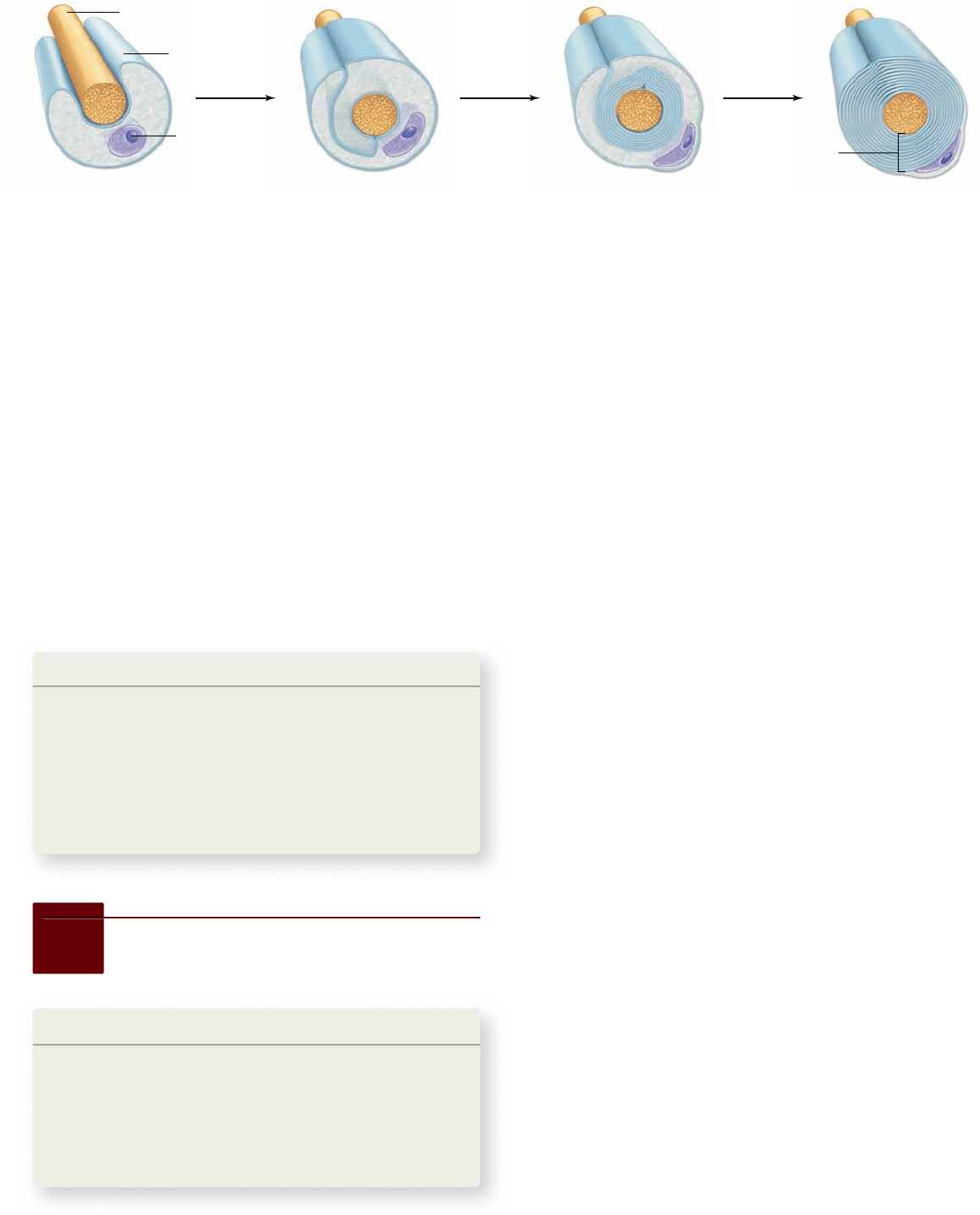
Figure 44.4
The formation of the myelin sheath around a peripheral axon. The myelin sheath forms by successive wrappings
of Schwann cell membranes around the axon.
44.2
The Mechanism of Nerve
Impulse Transmission
Learning Outcomes
Identify the ions involved in nerve impulse transmission 1.
and their relative concentrations inside and outside
the neuron.
Describe the production of the resting potential.2.
Explain how the action of voltage-gated channels 3.
produces an action potential.
Two of the most important kinds of neuroglia in verte-
brates are Schwann cells and oligodendrocytes, which pro-
duce myelin sheaths that surround the axons of many neurons.
Schwann cells produce myelin in the PNS, and oligodendro-
cytes produce myelin in the CNS. During development, these
cells wrap themselves around each axon several times to form
the myelin sheath—an insulating covering consisting of multi-
ple layers of compacted membrane (figure 44.4) .
Axons that have myelin sheaths are said to be myelin-
ated, and those that don’t are unmyelinated. In the CNS, my-
elinated axons form the white matter, and the unmyelinated
dendrites and cell bodies form the gray matter. In the PNS,
myelinated axons are bundled together, much like wires in a
cable, to form nerves .
Small gaps, known as nodes of Ranvier (see figure 44.3),
interrupt the myelin sheath at intervals of 1 to 2 μm. We dis-
cuss the role of the myelin sheath in impulse conduction in
the next section.
Learning Outcomes Review 44.1
The vertebrate nervous system consists of the central nervous system
(CNS) and peripheral nervous system (PNS). The PNS comprises the somatic
nervous system and autonomic nervous system; the latter has sympathetic
and parasympathetic divisions. A neuron consists of a cell body, dendrites
that receive information, and a single axon that sends signals. Neurons carry
out nervous system functions; they are supported by a variety of neuroglia.
■ Which division of the PNS is under conscious control?
Neuronal function depends on a changeable permeability to
ions. Upon stimulation, electrical changes in the plasma
membrane spread or propagate from one part of the cell to
another. The architecture of the neuron provides the mech-
anisms for the generation and spread of these membrane
electrical potentials.
The unique mechanisms of neurons primarily depend on
the presence of specialized membrane transport proteins, where
they are located, and how they are activated. First, we examine
some of the basic electrical properties common to the plasma
membranes of most animal cells, and then we look at how these
properties operate in neurons.
An electrical di erence exists across
the plasma membrane
You first learned about membrane potential in chapter 5, where
transport of ions across the cell membrane was discussed. Mem-
brane potential is similar to the electrical potential difference
that exists between the two poles of a flashlight or automobile
battery. One pole is positive, and the other is negative. Similarly,
a potential difference exists across every cell’s plasma mem-
brane. The side of the membrane exposed to the cytoplasm is
the negative pole, and the side exposed to the extracellular fluid
is the positive pole.
When a neuron is not being stimulated, it maintains a
resting potential. A cell is very small, and so its membrane
potential is very small. The resting membrane potential of
many vertebrate neurons ranges from –40 to –90 millivolts
(mV), or 0.04 to 0.09 volts (V). For the examples and figures in
this chapter, we use an average resting membrane potential
value of –70 mV. The minus sign indicates that the inside of the
cell is negative with respect to the outside.
Contributors to membrane potential
The inside of the cell is more negatively charged in relation to
the outside because of two factors:
The sodium–potassium pump ,1. described in chapter 5,
brings two potassium ions (K
+
) into the cell for every
three sodium ions (Na
+
) it pumps out ( gure 44.5) . This
helps establish and maintain concentration differences
that result in high K
+
and low Na
+
concentrations inside
the cell, and high Na
+
and low K
+
concentrations outside
the cell.
890
part
VII
Animal Form and Function
rav32223_ch44_887-914.indd 890rav32223_ch44_887-914.indd 890 11/17/09 3:31:58 PM11/17/09 3:31:58 PM
Apago PDF Enhancer
1. Carrier in membrane binds
intracellular sodium.
2. ATP phosphorylates protein with
bound sodium.
3. Phosphorylation causes
conformational change in protein,
reducing its affinity for Na
;
. The Na
;
then diffuses out.
4. This conformation has higher affinity
for K
;
. Extracellular potassium binds
to exposed sites.
5. Binding of potassium causes
dephosphorylation of protein.
6. Dephosphorylation of protein triggers
change back to original conformation,
with low affinity for K
;
. K
;
diffuses into
the cell, and the cycle repeats.
Extracellular
Intracellular
ATP
ADP
P
i
P
i
P
i
P
i
P
+
K
+
Na
+
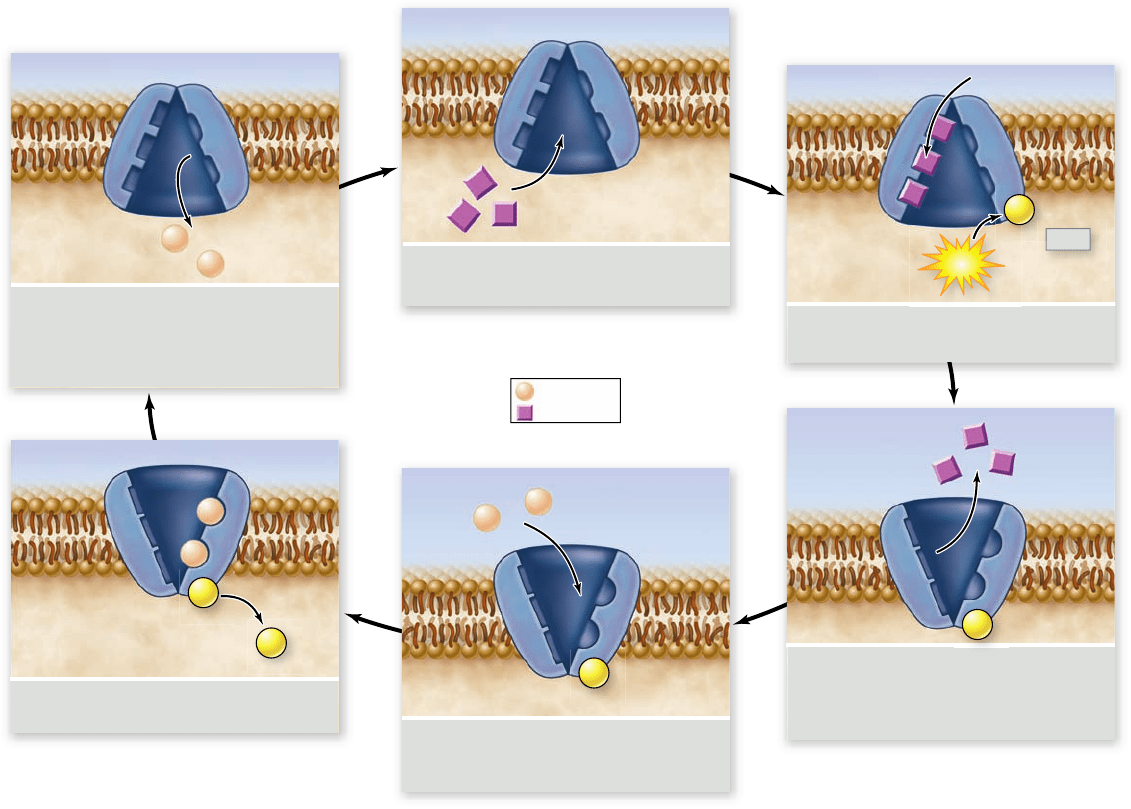
Figure 44.5
The sodium–potassium pump. This pump transports three Na
+
to the outside of the cell and simultaneously transports
two K
+
to the inside of the cell. This is an active transport carrier requiring the (phosphorylating) energy of ATP.
significant. The concentration of K
+
is much higher inside the cell
than outside, leading to diffusion of K
+
through open K
+
channels.
Since the membrane is not permeable to the negative ions that
could counterbalance this (mainly organic phosphates, amino ac-
ids, and proteins) it leads to a buildup of positive charge outside
the membrane and negative charge inside the membrane. This
electrical potential then is an attractive force pulling K
+
ions back
inside the cell. The balance between the diffusional force and the
electrical force leads to the equilibrium potential (table 44.1) . By
relating the work done by each type of force, we can derive a
quantitative expression for this equilibrium potential called the
Nernst equation. This assumes the action of a single ion, and for a
positive ion with charge equal to +1, the Nernst equation is:
E
K
= 58 mV log([K
+
]
out
/[K
+
]m
in
)
The calculated equilibrium potential for K
+
is –90 mV (see
table 44.1), close to the measured value of –70 mV. The calculated
value for Na
+
is +60 mV, clearly not at all close to the measured
value, but the leakage of a small amount of Na
+
back into the cell is
responsible for lowering the equilibrium potential of K
+
to the –70
mV value observed. The resting membrane potential of a neuron
2. Ion channels in the cell membrane are more numerous
for K
+
than for Na
+
making the membrane more perme-
able for K
+
. Ion channels are membrane proteins that
form pores through the membrane, allowing diffusion of
speci c ions across the membrane. Because there are
more ion channels for K
+
, the membrane is more perme-
able to K
+
and it will diffuse out of the cell.
Two major forces act on ions in establishing the resting
membrane potential: (1) The electrical potential produced by
unequal distribution of charges across the membrane, and
(2) the chemical force produced by unequal concentrations of
ions across the membrane.
The resting potential: Balance between two forces
The resting potential arises due to the action of the sodium–
potassium pump and the differential permeability of the mem-
brane to Na
+
and K
+
due to ion channels. The pump moves three
Na
+
outside for every two K
+
inside, which creates a small imbal-
ance in cations outside the cell. This has only a minor effect; how-
ever, the concentration gradients created by the pump are
chapter
44
The Nervous System
891www.ravenbiology.com
rav32223_ch44_887-914.indd 891rav32223_ch44_887-914.indd 891 11/17/09 3:32:01 PM11/17/09 3:32:01 PM