
Raven P.H., Johnson G.B., Mason K.A. Biology (Ninth Edition)
Подождите немного. Документ загружается.

Apago PDF Enhancer
G protein
Bipolar
cell
Photo-
receptor
cell
Dark
cGMP
Na
;
Ca
2;
K
;
Phospho-
diesterase
Rhodopsin
Fluid inside disk
11-cis-retinal
In the dark cGMP
levels are high and
keep chemically-
gated Na
;
channels
open. The Na
;
influx
depolarizes the
membrane causing
an influx of Ca
;
,
which leads to a
release of inhibitory
neurotransmitter.
This prevents
signaling from the
bipolar cell.
Bipolar
cell
Photo-
receptor
cell
Inhibitory
neurotransmitter
cGMP GMP
Na
;
Ca
2;
K
;
Phospho-
diesterase
all-trans-
retinal
When Rhodopsin
absorbs light, 11-
cis-retinal is
converted to all-
trans-retinal. This
causes Rhodopsin
to activate a G
protein that
stimulates
phosphodiesterase,
which converts
cGMP to GMP. The
reduced levels of
cGMP close the
Na
;
channels
hyperpolarizing the
membrane. This
prevents the release
of inhibitory
neurotransmitter
allowing bipolar cells
to fire.
Light
Fluid inside disk
( – )
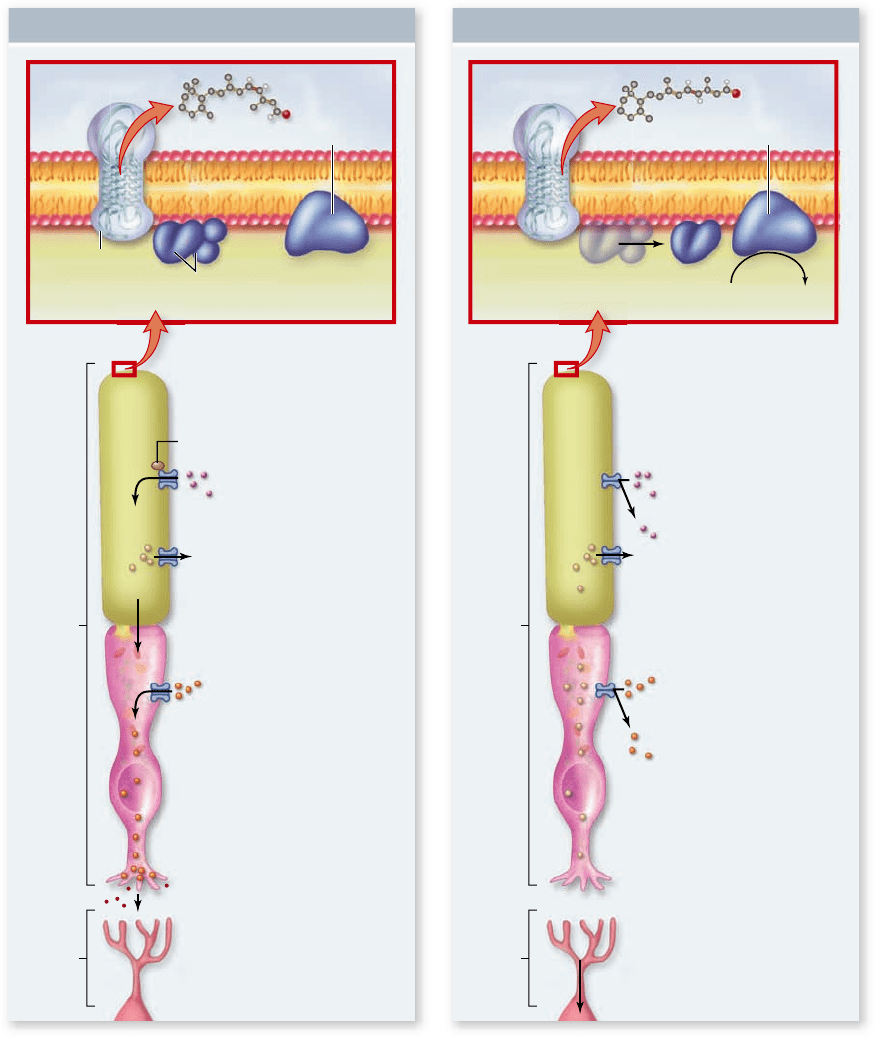
Figure 45.22
Signal
transduction in the
vertebrate eye. In the
absence of light, cGMP keeps
Na
+
channels open causing a
Na
+
in ux that leads to the
release of inhibitory
neurotransmitter. Light is
absorbed by the retinal in
rhodopsin, changing its
structure. This causes
rhodopsin to associate with
a G protein. The activated
G protein stimulates
phosphodiesterase, which
converts cGMP to GMP.
Loss of cGMP closes Na
+
channels and prevents
release of inhibitory
neurotransmitter, which
causes bipolar cells to
stimulate ganglion cells.
Visual processing takes place
in the cerebral cortex
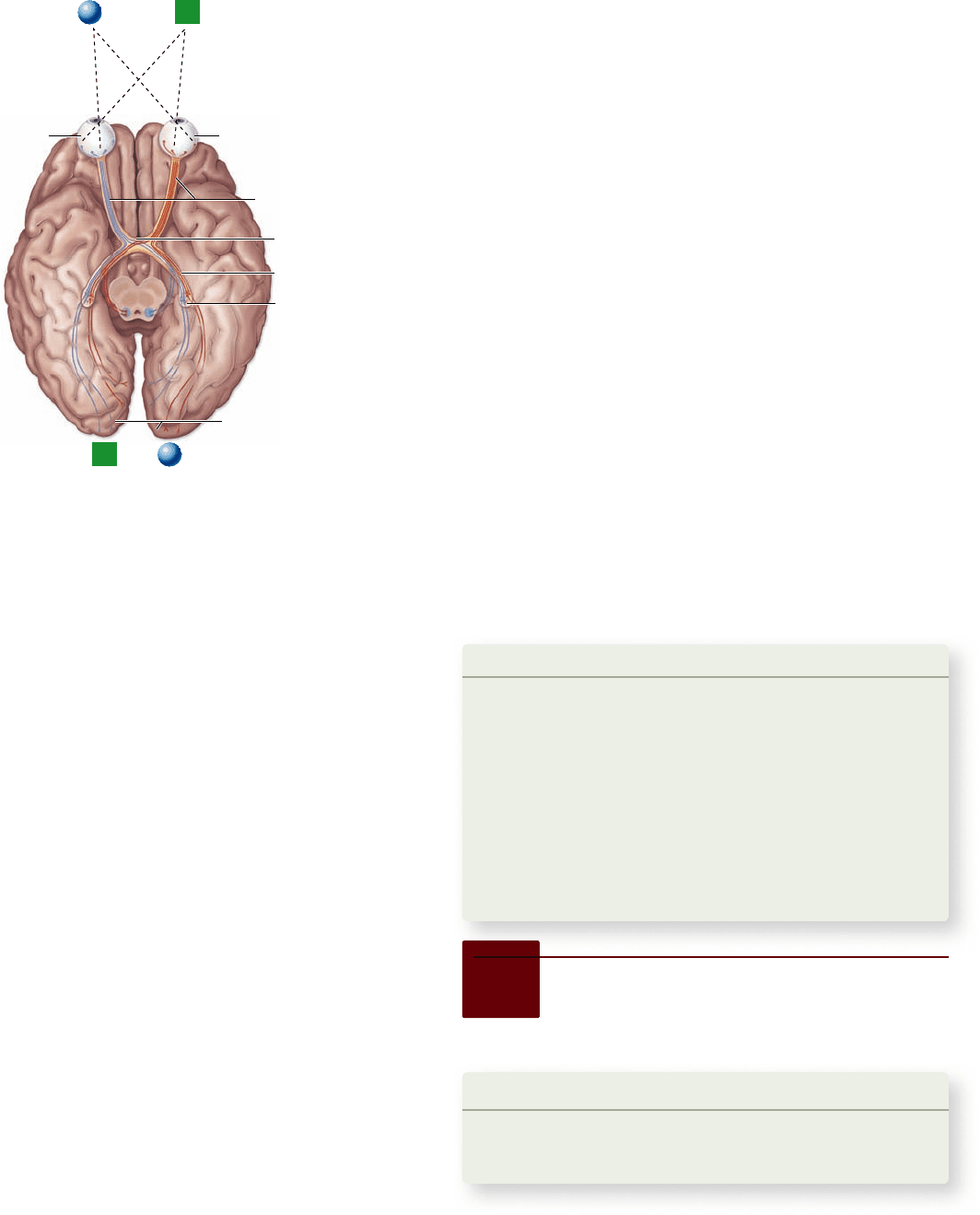
Action potentials propagated along the axons of ganglion cells
are relayed through structures called the lateral geniculate
nuclei of the thalamus and projected to the occipital lobe of the
cerebral cortex (see figure 45.23). There the brain interprets this
information as light in a specific region of the eye’s receptive
field. The pattern of activity among the ganglion cells across the
retina encodes a point-to-point map of the receptive field, allow-
ing the retina and brain to image objects in visual space.
The frequency of impulses in each ganglion cell provides in-
formation about the light intensity at each point. At the same time,
channels to close, reducing the dark current (figure 45.22) .
Each opsin is associated with over 100 regulatory G proteins,
which, when activated, release subunits that activate hundreds
of molecules of the phosphodiesterase enzyme. Each enzyme
molecule can convert thousands of cGMP to GMP, closing the
Na
+
channels at a rate of about 1000 per second and inhibiting
the dark current.
The absorption of a single photon of light can block
the entry of more than a million Na
+
, without changing K
+
permeability—the photoreceptor becomes hyperpolarized and
releases less inhibitory neurotransmitter. Freed from inhibi-
tion, the bipolar cells activate the ganglion cells, which send
impulses to the brain (figure 45.23) .
932
part
VII
Animal Form and Function
rav32223_ch45_915-936.indd 932rav32223_ch45_915-936.indd 932 11/17/09 3:55:29 PM11/17/09 3:55:29 PM
Apago PDF Enhancer
Optic chiasm
Lateral
geniculate
nuclei
Occipital lobes
of cerebrum
(visual cortex)
Left eye
Optic nerves
Optic tracts
Right eye
45.6
The Diversity of Sensory
Experiences
Learning Outcomes
List examples of uncommon special senses.1.
Explain how ampullae of Lorenzini work.2.
Vision is the primary sense used by all vertebrates that live in a
light-filled environment, but visible light is by no means the
only part of the electromagnetic spectrum that vertebrates use
to sense their environment.
the relative activity of ganglion cells connected (through bipolar
cells) with the three types of cones provides color information.
Visual acuity
The relationship between receptors, bipolar cells, and ganglion
cells varies in different parts of the retina. In the fovea, each
cone makes a one-to-one connection with a bipolar cell, and
each bipolar cell synapses with one ganglion cell. This point-
to-point relationship is responsible for the high acuity of foveal
vision.
Outside the fovea, many rods can converge on a single
bipolar cell, and many bipolar cells can converge on a single
ganglion cell. This convergence permits the summation of neu-
ral activity, making the area of the retina outside the fovea more
sensitive to dim light than the fovea, but at the expense of acu-
ity and color vision. This is why dim objects, such as faint stars
at night, are best seen when you don’t look directly at them. It
has been said that we use the periphery of the eye as a detector,
and the fovea as an inspector.
Color blindness can result from an inherited lack of one
or more types of cones. People with normal color vision are
trichromats; that is they have all three cones. Those with only
two types of cones are dichromats. For example, people with
red-green color blindness may lack red cones and have diffi-
culty distinguishing red from green. Color blindness resulting
from absence of one type of cone is a sex-linked recessive trait
(see chapter 13), and therefore it is most often exhibited in
Figure 45.23
The pathway of visual information. Action
potentials in the optic nerves are relayed from the retina to the
lateral geniculate nuclei, and from there to the visual cortex of the
occipital lobes. Note that half the optic nerves (the medial bers
arising from the inner portion of the retinas) cross to the other side
at the optic chiasm, so that each hemisphere of the cerebrum
receives input from both eyes.
males. Red-green color blindness can also result from a shift in
the sensitivity curve of the absorption spectrum for one type of
cone, resulting in the different cone types being stimulated by
the same electromagnetic wavelengths and causing the indi-
vidual to be unable to distinguish between red and green.
Binocular vision
Primates (including humans) and most predators have two
eyes, one located on each side of the face. When both eyes are
trained on the same object, the image that each eye sees is
slightly different because the views have a slightly different
angle. This slight displacement of the images (an effect called
parallax) permits binocular vision, the ability to perceive
three-dimensional images and to sense depth. Having eyes fac-
ing forward maximizes the field of overlap in which this stereo-
scopic vision occurs.
In contrast, prey animals generally have eyes located to
the sides of the head, preventing binocular vision but enlarging
the overall receptive field. It seems that natural selection has
favored the detection of potential predators over depth percep-
tion in many prey species. The eyes of the American woodcock
(Scolopax minor), for example, are located at exactly opposite
sides of the bird’s skull so that it has a 360
°
field of view without
turning its head.
Most birds have laterally placed eyes and, as an adapta-
tion, have two foveas in each retina. One fovea provides sharp
frontal vision, like the single fovea in the retina of mammals,
and the other fovea provides sharper lateral vision.
Learning Outcomes Review 45.5
Many invertebrate groups have eyespots that detect light without forming
images. Annelids, mollusks, arthropods, and chordates have independently
evolved image-forming eyes. The vertebrate eye admits light through a
pupil and then focuses it with an adjustable lens onto the retina, which
contains photoreceptors. Photoreceptor rods and cones contain the
photopigment cis-retinal, which indirectly activates bipolar neurons
and then ganglion cells. The latter then transmit action potentials that
ultimately reach the occipital lobe of the brain.
■ Can an individual with red-green color blindness learn
to distinguish these two colors? Why or why not?
chapter
45
Sensory Systems
933www.ravenbiology.com
rav32223_ch45_915-936.indd 933rav32223_ch45_915-936.indd 933 11/17/09 3:55:30 PM11/17/09 3:55:30 PM

Apago PDF Enhancer
Inner chamber Membrane
Outer chamber
Pi t
Figure 45.24
“Seeing” heat. The depression between
the nostril and the eye of this rattlesnake opens into the pit
organ. In the cutaway portion of the diagram, you can see that
the organ is composed of two chambers separated by a membrane.
Snakes known as pit vipers have the ability to sense infrared
radiation (heat).
Some snakes have receptors capable
of sensing infrared radiation
Electromagnetic radiation with wavelengths longer than those
of visible light is too low in energy to be detected by photo-
receptors. Radiation from this infrared portion of the spectrum
is what we normally think of as radiant heat.
Heat is an extremely poor environmental stimulus in wa-
ter because water readily absorbs heat. Air, in contrast, has a low
thermal capacity, so heat in air is a potentially useful stimulus.
The only vertebrates known to have the ability to sense infra-
red radiation, however, are several types of snakes.
One type, the pit vipers, possess a pair of heat-detecting
pit organs located on either side of the head between the eye
and the nostril (figure 45.24) . Each pit organ is composed of
two chambers separated by a membrane. The infrared radiation
falls on the membrane and warms it. Thermal receptors on the
membrane are stimulated. The nature of these receptors is not
known; they probably consist of temperature-sensitive neurons
innervating the two chambers.
The paired pit organs appear to provide stereoscopic in-
formation, in much the same way that two eyes do. In fact, the
nerves from the pits are connected to the optic tectum, the
same part of the brain that controls vision; recent research sug-
gests that information from the pits and from the eyes are over-
lain on each other, allowing snakes to combine visual and
infrared thermal data. In fact, the pits are designed like a pin-
hole camera, and to some extent can focus a thermal image!
As a result, these exteroceptors are extraordinarily sensi-
tive. Blind pit vipers can strike as accurately as a normal snake,
and snakes deprived of their senses of sight and smell can ac-
curately strike a target only 0.2º warmer than the background.
Many pit vipers hunt endothermic prey at night, so the value of
these capabilities is obvious.
Some vertebrates can
sense electrical currents
Although air does not readily conduct an electrical current, wa-
ter is a good conductor. All aquatic animals generate electrical
currents from contractions of their muscles. A number of dif-
ferent groups of fishes can detect these electrical currents. The
so-called electrical fish even have the ability to produce electri-
cal discharges from specialized electrical organs. Electrical fish
use these weak discharges to locate their prey and mates and to
construct a three-dimensional image of their environment,
even in murky water.
The elasmobranchs (sharks, rays, and skates) have elec-
troreceptors called the ampullae of Lorenzini. The recep-
tor cells are located in sacs that open through jelly-filled
canals to pores on the body surface. The jelly is a very good
conductor, so a negative charge in the opening of the canal
can depolarize the receptor at the base, causing the release
of neurotransmitter and increased activity of sensory neu-
rons. This allows sharks, for example, to detect the electrical
fields generated by the muscle contractions of their prey. Al-
though the ampullae of Lorenzini were lost in the evolution
of teleost fish (most of the bony fish), electroreception reap-
peared in some groups of tel e ost fish that developed analo-
gous sensory structures. Electro receptors evolved yet another
time, independently, in the duck-billed platypus, an egg-
laying mammal. The receptors in its bill can detect the elec-
trical currents created by the contracting muscles of shrimp
and fish, enabling the mammal to detect its prey at night and
in muddy water.
Some organisms detect magnetic elds
Eels, sharks, bees, and many birds appear to navigate along the
magnetic field lines of the Earth. Even some bacteria use such
forces to orient themselves.
Birds kept in dark cages, with no visual cues to guide
them, peck and attempt to move in the direction in which
they would normally migrate at the appropriate time of the
year. They do not do so, however, if the cage is shielded from
magnetic fields by steel. In addition, if the magnetic field of a
blind cage is deflected 120
°
clockwise by an artificial magnet,
a bird that normally orients to the north will orient toward
the east-southeast . The nature of magnetic receptors in these
vertebrates is the subject of much speculation, but the mecha-
nism remains very poorly understood.
Learning Outcomes Review 45.6
Pit vipers can detect infrared radiation (heat). Many aquatic vertebrates
can locate prey and perceive environmental contours by means of
electroreceptors. The ampullae of Lorenzini, electroreceptors found in
sharks and their relatives, contain a highly conductive jelly that triggers
sensory neurons. Magnetic receptors may aid in bird migration.
■ Would a heat-sensing organ be useful for hunting
ectothermic prey?
934
part
VII
Animal Form and Function
rav32223_ch45_915-936.indd 934rav32223_ch45_915-936.indd 934 11/17/09 3:55:34 PM11/17/09 3:55:34 PM

Apago PDF Enhancer
45.1 Overview of Sensory Receptors
Sensory receptors detect both external and internal stimuli.
Exteroreceptors sense stimuli from the external environment,
whereas interoreceptors sense stimuli from the internal environment.
Receptors can be grouped into three categories.
Receptors differ with respect to the environmental stimulus to which
they respond: mechanoreceptors, chemoreceptors, and energy-
detecting receptors.
Sensory information is conveyed in a four-step process.
Once detected, sensory information is conveyed in four steps:
stimulation, transduction, transmission, and interpretation.
Sensory transduction involves gated ion channels.
Sensory transduction produces a graded receptor potential. A single
potential or a sum of potentials may exceed a threshold to produce
an action potential (see gure 45.2). A logarithmic relationship exists
between stimulus intensity and action potential frequency.
45.2 Mechanoreceptors: Touch and Pressure
Pain receptors alert the body to damage or potential damage.
Nociceptors are free nerve endings located in the skin that respond
to damaging stimuli, which is perceived as pain. Extreme temperatures
can affect transient receptor potential (TRP) ion channels and cause
depolarization by in ow of Na
+
and Ca
2+
.
Thermoreceptors detect changes in heat energy.
Thermoreceptors are naked dendritic endings of sensory neurons
that also contain TRP ion channels and respond to cold or heat.
Di erent receptors detect touch, depending on intensity.
Various receptors in the skin respond to mechanical distortion of the
membrane to convey touch (see gure 45.3).
Muscle length and tension are monitored by proprioceptors.
Proprioceptors provide information about the relative position or
movement of body parts and the degree of muscle stretching.
Baroreceptors detect blood pressure.
45.3 Hearing, Vibration, and Detection
of Body Position
Hearing, the detection of sound or pressure waves, works best in
water and provides directional information.
The lateral line system in sh detects low-frequency vibrations (see
gure 45.5).
Ear structure is specialized to detect vibration.
The outer ear of terrestrial vertebrates channels sound to the
eardrum (tympanic membrane) (see gure 45.6). Vibrations are
transferred through middle ear bones to the oval window and into
the cochlea, where the organ of Corti transduces them.
Transduction occurs in the cochlea.
The basilar membrane of the cochlea consists of bers that respond
to different frequencies of sound (see gure 45.8).
Some vertebrates have the ability to navigate by sound.
Echolocation allows bats, whales, and other species to navigate
by sound.
Body position and movement are detected by systems associated with
hearing systems.
Body position is detected by statocysts, ciliated hair cells embedded
in a gelatinous matrix containing statoliths (see gure 45.9). Body
movement is detected by hair cells located in the saccule and utricle
(see gure 45.10).
45.4 Chemoreceptors: Taste, Smell, and pH
Taste detects and analyzes potential food.
Taste buds are collections of chemosensitive epithelial cells located
on papillae (see gure 45.11). Tastes are broken down into ve
categories: sweet, sour, salty, bitter, and umami.
Smell can identify a vast number of complex molecules.
Smell, or olfaction, involves chemoreceptors located in the upper
portion of the nasal passages (see gure 45.13). Their axons connect
directly to the cerebral cortex.
Internal chemoreceptors detect pH and other characteristics.
Internal chemoreceptors of the aorta detect changes in blood pH, and
central chemoreceptors in the medulla oblongata are sensitive to the
pH of the cerebrospinal uid.
45.5 Vision
Vision senses light and light changes at a distance.
Four phyla—annelids, mollusks, arthropods, and chordates—have
independently evolved image-forming eyes (see gure 45.15).
In the vertebrate eye, light enters through the pupil, with intensity
controlled by the iris. The lens, controlled by the ciliary muscle,
focuses the light on the retina (see gure 45.16).
Vertebrate photoreceptors are rod cells and cone cells.
Rods detect black and white; cones are necessary for visual acuity and
color vision (see gure 45.18).
In the retina, photoreceptors synapse with bipolar cells, which in turn
synapse with ganglion cells; the ganglion cells send action potentials
to the brain (see gure 45.20).
Visual processing takes place in the cerebral cortex (see gure 45.23).
In the fovea, a region of the retina responsible for high acuity, each
cone cell is connected to a single bipolar cell/ganglion cell, unlike in
areas outside the fovea.
Primates and most predators have binocular vision—images from
each eye overlap to produce a three-dimensional image.
45.6 The Diversity of Sensory Experiences
Some snakes have receptors capable of sensing infrared radiation.
The pit organ of pit vipers detects heat.
Some vertebrates can sense electrical currents.
Electroreceptors in elasmobranchs and the duck-billed platypuses
can detect electrical currents.
Some organisms detect magnetic elds.
Many organisms appear to navigate along magnetic eld lines, but
the mechanisms remains poorly understood.
Chapter Review
chapter
45
Sensory Systems
935www.ravenbiology.com
rav32223_ch45_915-936.indd 935rav32223_ch45_915-936.indd 935 11/17/09 3:55:35 PM11/17/09 3:55:35 PM

Apago PDF Enhancer
UNDERSTAND
1. Which of these is not a method by which sensory receptors
receive information about the internal or external environment?
a. Changes in pressure
b. Light or heat changes
c. Changes in molecular concentration
d. All of these are used by sensory receptors.
2. Which of the following correctly lists the steps of perception?
a. Interpretation, stimulation, transduction, transmission
b. Stimulation, transduction, transmission, interpretation
c. Interpretation, transduction, stimulation, transmission
d. Transduction, interpretation, stimulation, transmission
3. All sensory receptors are able to initiate nerve impulses
by opening or closing
a. voltage-gated ion channels.
b. exteroceptors.
c. interoceptors.
d. stimulus-gated ion channels.
4. In the fairy tale, Sleeping Beauty fell asleep after pricking her nger.
What kind of receptor responds to that kind of painful stimulus?
a. Mechanoreceptor c. Thermoreceptor
b. Nociceptor d. Touch receptor
5. The ear detects sound by the movement of
a. the basilar membrane.
b. the tectorial membrane.
c. the Eustachian tube.
d. uid in the semicircular canals.
6. Hair cells in the vestibular apparatus of terrestrial vertebrates
a. measure temperature changes within the body.
b. sense sound in very low range of hearing.
c. provide a sense of acceleration and balance.
d. measure changes in blood pressure.
7. ______ is the photopigment contained within both rods and
cones of the eye.
a. Carotene c. Photochrome
b. Cis-retinal d. Chlorophyll
8. Which of the following is not a method used by vertebrates to
gather information about their environment?
a. Infrared radiation
b. Magnetic elds
c. Electrical currents
d. All of these are methods used for sensory reception.
9. The lobe of the brain that recognizes and interprets visual
information is the
a. occipital lobe. c. parietal lobe.
b. frontal lobe. d. temporal lobe.
APPLY
1. What do the sensory systems of annelids, mollusks, arthropods,
and chordates have in common?
a. They all use the same stimuli for taste.
b. They all use neurons to detect vibration.
c. They all have image-forming eyes that evolved independently.
d. They all use chemoreceptors in their skin to detect food.
2. Animals can more easily tell the direction of a visual signal than
an auditory signal because
a. light travels in straight lines.
b. the wind provides too much background noise.
c. sound travels faster underwater.
d. eyes are more sensitive than ears.
3. The difference in the structure of the vertebrate and
mollusk eyes
a. results because mollusks live in water, causing images to be
upside down.
b. indicates that vertebrates have better vision than mollusks.
c. reveals a disadvantage of vertebrate eye structure.
d. makes color vision more ef cient in vertebrates.
4. The ability of some insects, birds, and lizards to see ultraviolet
light is
a. a result of a common diet eaten by those species.
b. an example of convergent evolution in cone cell sensitivity.
c. the ancestral state inherited from atworms.
d. an adaptation for nocturnal activity.
SYNTHESIZE
1. When blood pH falls too low, a potentially fatal condition
known as acidosis results. Among the variety of responses to this
condition, the body changes the breathing rate. How does the
body sense this change? How does the breathing rate change?
How does this increase pH?
2. The function of the vertebrate eye is unusual compared with
other processes found within the body. For example, the
direction in which sensory information ows is actually opposite
to path that light takes through the retina. Explain the sequence
of events involved in the movement of light and information
through the structures of the eye, and explain why they move in
opposite directions. Consider, also, how this sequence of events
compares to the functioning of the mollusk eye.
3. How would the otolith organs of an astronaut respond to zero
gravity? Would the astronaut still have a subjective impression
of motion? Would the semicircular canals detect angular
acceleration equally well at zero gravity?
Review Questions
ONLINE RESOURCE
www.ravenbiology.com
Understand, Apply, and Synthesize—enhance your study with
animations that bring concepts to life and practice tests to assess
your understanding. Your instructor may also recommend the
interactive eBook, individualized learning tools, and more.
936
part
VII
Animal Form and Function
rav32223_ch45_915-936.indd 936rav32223_ch45_915-936.indd 936 11/17/09 3:55:36 PM11/17/09 3:55:36 PM

Apago PDF Enhancer
D
Chapter
46
The Endocrine System
Chapter Outline
46.1 Regulation of Body Processes by Chemical
Messengers
46.2 Actions of Lipophilic Versus Hydrophilic Hormones
46.3 The Pituitary and Hypothalamus: The Body’s
Control Centers
46.4 The Major Peripheral Endocrine Glands
46.5 Other Hormones and Their Effects
Introduction
Diabetes is a disease in which well-fed people appear to starve to death. The disease was known to Roman and Greek
physicians, who described a “melting away of flesh” coupled with excessive urine production “like the opening of aqueducts.”
Until 1922, the diagnosis of diabetes in children was effectively a death sentence. In that year, Frederick Banting and Charles
Best extracted the molecule insulin from the pancreas. Injections of insulin into the bloodstream dramatically reversed the
symptoms of the disease. This served as an impressive confirmation of a new concept: that certain internal organs produced
powerful regulatory chemicals that were distributed via the blood.
We now know that the tissues and organs of the vertebrate body cooperate to maintain homeostasis through the
actions of many regulatory mechanisms. Two systems, however, are devoted exclusively to the regulation of the body organs:
the nervous system and the endocrine system. Both release regulatory molecules that control the body organs by binding
to receptor proteins on or in the cells of those organs. In this chapter, we examine the regulatory molecules of the endocrine
system, the cells and glands that produce them, and how they function to regulate the body’s activities.
CHAPTER
rav32223_ch46_937-960.indd 937rav32223_ch46_937-960.indd 937 11/17/09 4:58:57 PM11/17/09 4:58:57 PM
Apago PDF Enhancer
Axon
Neurotransmitters
Glands
Paracrine secretion
Hormones
carried by blood
Target cell
Extracellular
space
Receptor
proteins
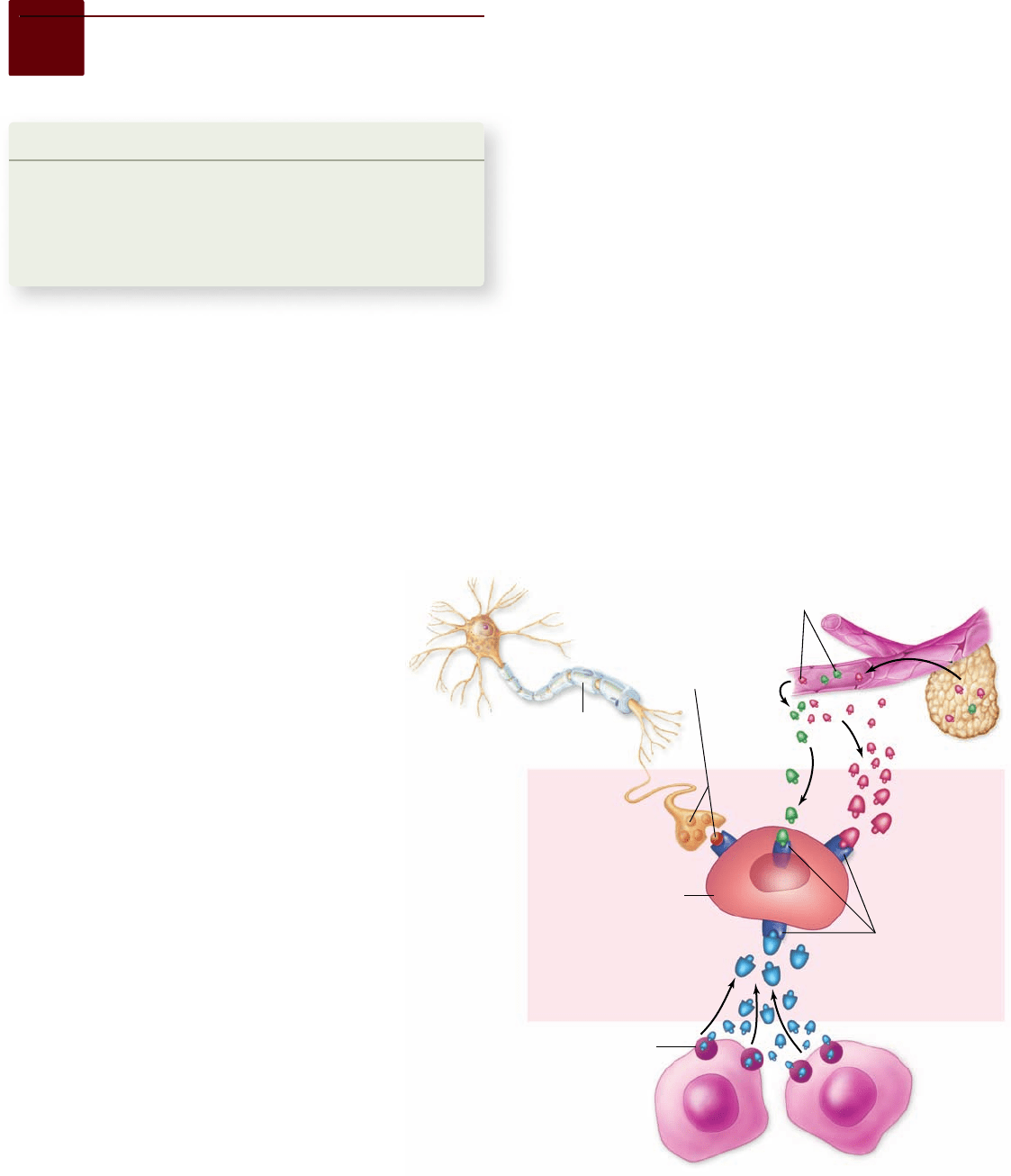
Figure 4 6.1
Di erent types of chemical messengers.
The functions of organs are in uenced by neural, paracrine, and
endocrine regulators. Each type of chemical regulator binds to
speci c receptor proteins on the surface or within the cells of
target organs.
and may alter the behavior or physiology of the receiver,
but are not involved in the normal metabolic regulation of
an animal.
Figure 46.1 compares the different types of chemical
messengers used for internal regulation.
Some molecules act as both circulating
hormones and neurotransmitters
Blood delivery of hormones enables endocrine glands to coor-
dinate the activity of large numbers of target cells distributed
throughout the body, but that may not be the only role for these
molecules. A molecule produced by an endocrine gland and used
as a hormone may also be produced and used as a neurotrans-
mitter by neurons. The hormone norepinephrine, for example,
is secreted into the blood by the adrenal glands, but it is also
released as a neurotransmitter by sympathetic nerve endings.
Norepinephrine acts as a hormone to coordinate the activity of
the heart, liver, and blood vessels during response to stress.
Neurons can also secrete a class of hormones called
neurohormones that are carried by blood. The neurohormone
antidiuretic hormone, for example, is secreted by neurons in
the brain. Some specialized regions of the brain contain not
only neurotransmitting neurons, but also clusters of neurons
46.1
Regulation of Body Processes
by Chemical Messengers
Learning Outcomes
Describe the role of hormones in regulating 1.
body processes.
Identify the different types of hormones. 2.
Differentiate between lipophilic and hydrophilic 3.
hormones.
There are four mechanisms of cell communication: direct con-
tact, synaptic signaling, endocrine signaling, and paracrine sig-
naling. Here we are concerned with signaling methods of com-
munication; we begin with the three signaling mechanisms.
As discussed in chapter 44 , the axons of neurons secrete
chemical messengers called neurotransmitters into the synap-
tic cleft. These chemicals diffuse only a short distance to the
postsynaptic membrane, where they bind to their receptor
proteins and stimulate the postsynaptic cell. Synaptic transmis-
sion generally affects only the postsynaptic cell that receives
the neurotransmitter.
A hormone , in contrast, is a regulatory chemical
that is secreted into extracellular fluid and carried
by the blood and can therefore act at a distance
from its source. Organs that are specialized to
secrete hormones are called endocrine glands , but
some organs, such as the liver and the kidney,
can produce hormones in addition to performing
other functions. The organs and tissues that produce
hormones are collectively called the endocrine system.
The blood carries hormones to every cell in the body, but
only target cells with the appropriate receptor for a given hor-
mone can respond to it. Hormone receptor proteins function
in a similar manner to neurotransmitter receptors. The recep-
tor proteins specifically bind the hormone and activate signal
transduction pathways that produce a response to the hormone.
The highly specific interaction between hormones and their
receptors enable hormones to be active at remarkably small
concentrations. It is not unusual to find hormones circulating
in the blood at concentrations of 10
–8
to 10
–10
M . In addition
to the chemical messengers released as neurotransmitters and
as hormones, other molecules are released and act within an
organ on nearby cells as local regulators. These chemicals are
termed paracrine regulators. They act in a way similar to
endocrine hormones, but they do not travel through the blood
to reach their target. This allows cells of an organ to regulate
one another.
Cells can also release signaling molecules that affect their
own behavior, or autocrine signaling. This is common in the
immune system, and is also seen in cancer cells that may release
growth factors that stimulate their own growth.
Chemical communication is not limited to cells with-
in an organism. Pheromones are chemicals released into the
environment to communicate among individuals of a sin-
gle species. These aid in communication between animals
938
part
VII
Animal Form and Function
rav32223_ch46_937-960.indd 938rav32223_ch46_937-960.indd 938 11/17/09 4:59:05 PM11/17/09 4:59:05 PM
Apago PDF Enhancer
Pituitary
gland
Adenohypophysis
H
Hypothalamus
Neurohypophysis
Pine
e
al gland e
Parathyroid glands
(behind thyroid)
Thymus
Adrenal
glands
Testes
(in males)
Pancreas
Thyroid gland
Ovaries (in females)
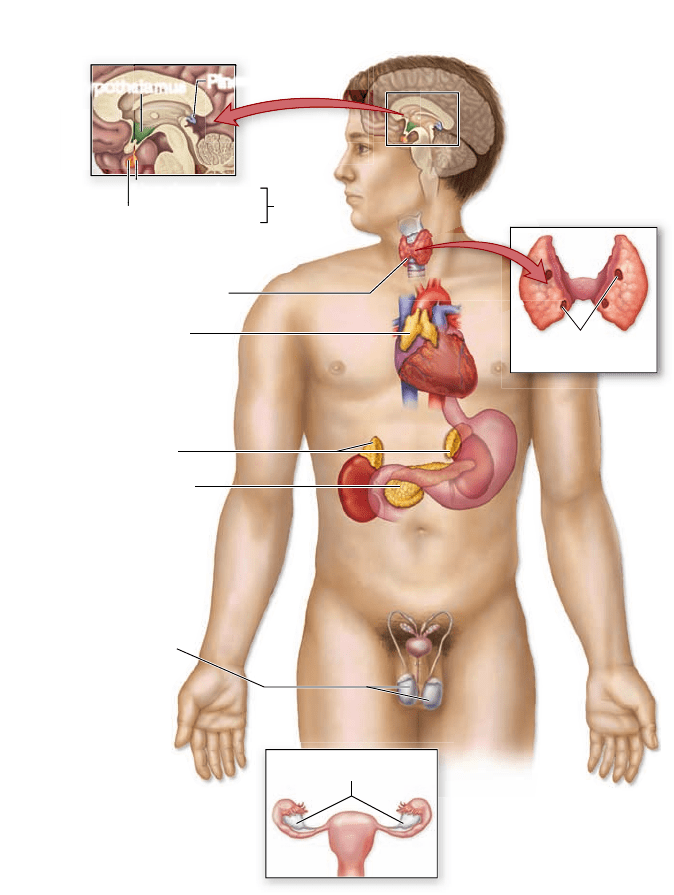
Figure 46.2
The human endocrine system. The major
endocrine glands are shown, but many other organs secrete
hormones in addition to their primary functions.
producing neurohormones. In this way, neurons can deliver
chemical messages beyond the nervous system itself.
The secretory activity of many endocrine glands is con-
trolled by the nervous system. As you will see, the hypothala-
mus controls the hormonal secretions of the anterior-pituitary
gland, and produces the hormones of the posterior pituitary.
The secretion of a number of hormones, however, can
be independent of neural control. For example, the release of
insulin by the pancreas and aldosterone by the adrenal cortex is
stimulated by increases in the blood concentrations of glucose
and potassium (K
+
), respectively.
Endocrine glands produce three
chemical classes of hormones
The endocrine system (figure 46.2) includes all of the organs
that secrete hormones—the thyroid gland, pituitary gland, ad-
renal glands, and so on (table 46.1) . Cells in these organs se-
crete hormones into extracellular fluid, where it diffuses into
surrounding blood capillaries. For this reason, hormones are
referred to as endocrine secretions. In contrast, cells of some
glands excrete their products into a duct to outside the body,
or into the gut. For example, the pancreas excretes hydrolytic
enzymes into the lumen of the small intestine. These glands are
termed exocrine glands , .
Molecules that function as hormones must exhibit two
basic characteristics. First, they must be sufficiently complex to
convey regulatory information to their targets. Simple molecules
such as carbon dioxide, or ions such as Ca
2+
, do not function as
hormones. Second, hormones must be adequately stable to resist
destruction prior to reaching their target cells. Three primary
chemical categories of molecules meet these requirements.
Peptides and proteins1. are composed of chains of amino
acids. Some important examples of peptide hormones
include antidiuretic hormone (9 amino acids), insulin
(51 amino acids), and growth hormone (191 amino acids).
These hormones are encoded in DNA and produced by
the same cellular machinery responsible for transcription
and translation of other peptide molecules. The most
complex are glycoproteins composed of two peptide
chains with attached carbohydrates. Examples include
thyroid-stimulating hormone and luteinizing hormone .
Amino acid derivatives2. are hormones manufactured by
enzymatic modi cation of speci c amino acids; this group
comprises the biogenic amines discussed in chapter 44 .
They include hormones secreted by the adrenal medulla
(the inner portion of the adrenal gland), thyroid, and
pineal glands. Those secreted by the adrenal medulla are
derived from tyrosine. Known as catecholamines, they
include epinephrine (adrenaline) and norepinephrine
(noradrenaline). Other hormones derived from tyrosine
are the thyroid hormones, secreted by the thyroid gland.
The pineal gland secretes a different amine hormone,
melatonin, derived from tryptophan.
Steroids3. are lipids manufactured by enzymatic
modi cations of cholesterol. They include the hormones
testosterone, estradiol, progesterone, aldosterone, and
cortisol. Steroid hormones can be subdivided into sex
steroids, secreted by the testes, ovaries, placenta, and
adrenal cortex, and corticosteroids (mineralocoricoids
and cortisol), secreted only by the adrenal cortex.
Hormones can be categorized
as lipophilic or hydrophilic
The manner in which hormones are transported and inter-
act with their targets differs depending on their chemical
nature. Hormones may be categorized as lipophilic (non-
polar), which are fat-soluble, or hydrophilic (polar), which
are water-soluble. The lipophilic hormones include the ste-
roid hormones and thyroid hormones. Most other hormones
are hydrophilic.
This distinction is important in understanding how these
hormones regulate their target cells. Hydrophilic hormones are
freely soluble in blood, but cannot pass through the membrane of
www.ravenbiology.com
chapter
46
The Endocrine System
939
rav32223_ch46_937-960.indd 939rav32223_ch46_937-960.indd 939 11/17/09 4:59:06 PM11/17/09 4:59:06 PM
Apago PDF Enhancer
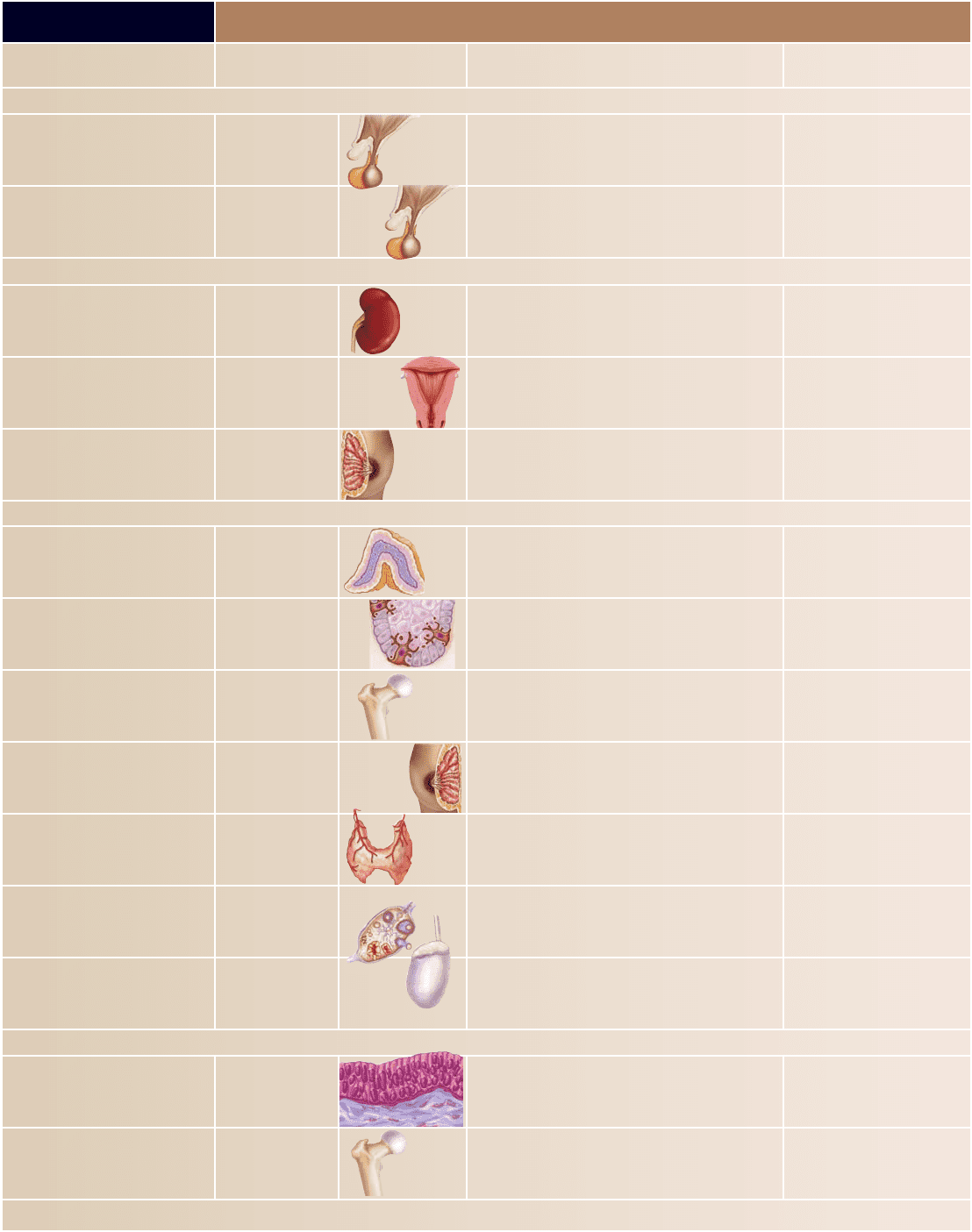
TABLE 46.1
Principal Mammalian Endocrine Glands and Their Hormones*
Endocrine Gland
and Hormone Target Tissue Principal Actions Chemical Nature
Hypothalamus
Releasing hormones Adenohypophysis Activate release of adenohypophyseal hormones Peptides
Inhibiting hormones Adenohypophysis Inhibit release of adenohypophyseal hormones Peptides (except prolactin-
inhibiting factor, which
is dopamine)
Neurohypophysis (Posterior-pituitary gland)
Antidiuretic hormone (ADH) Kidneys Conserves water by stimulating its reabsorption from urine Peptide (9 amino acids)
Oxytocin (OT) Uterus Stimulates contraction Peptide (9 amino acids)
Mammary glands Stimulates milk ejection
Adenohypophysis (Anterior-pituitary gland)
Adrenocorticotropic hormone (ACTH) Adrenal cortex Stimulates secretion of adrenal cortical hormones such
as cortisol
Peptide (39 amino acids)
Melanocyte-stimulating hormone
(MSH)
Skin Stimulates color change in reptiles and amphibians; various
functions in mammals
Peptide (two forms; 13 and 22
amino acids)
Growth hormone (GH) Many organs Stimulates growth by promoting bone growth, protein
synthesis, and fat breakdown
Protein
Prolactin (PRL) Mammary glands Stimulates milk production Protein
Thyroid-stimulating hormone (TSH) Thyroid gland Stimulates thyroxine secretion Glycoprotein
Luteinizing hormone (LH) Gonads Stimulates ovulation and corpus luteum formation in
females; stimulates secretion of testosterone in males
Glycoprotein
Follicle-stimulating hormone (FSH) Gonads Stimulates spermatogenesis in males; stimulates
development of ovarian follicles in females
Glycoprotein
Thyroid Gland
Thyroid hormones (thyroxine and
triiodothyronine)
Most cells Stimulates metabolic rate; essential to normal growth
and development
Amino acid derivative (iodinated)
Calcitonin Bone Inhibits loss of calcium from bone Peptide (32 amino acids)
*These are hormones released from endocrine glands. Hormones are released from organs that have additional, nonendocrine functions, such as the liver, kidney, and intestine.
940
part
VII
Animal Form and Function
rav32223_ch46_937-960.indd 940rav32223_ch46_937-960.indd 940 11/17/09 4:59:07 PM11/17/09 4:59:07 PM
Apago PDF Enhancer
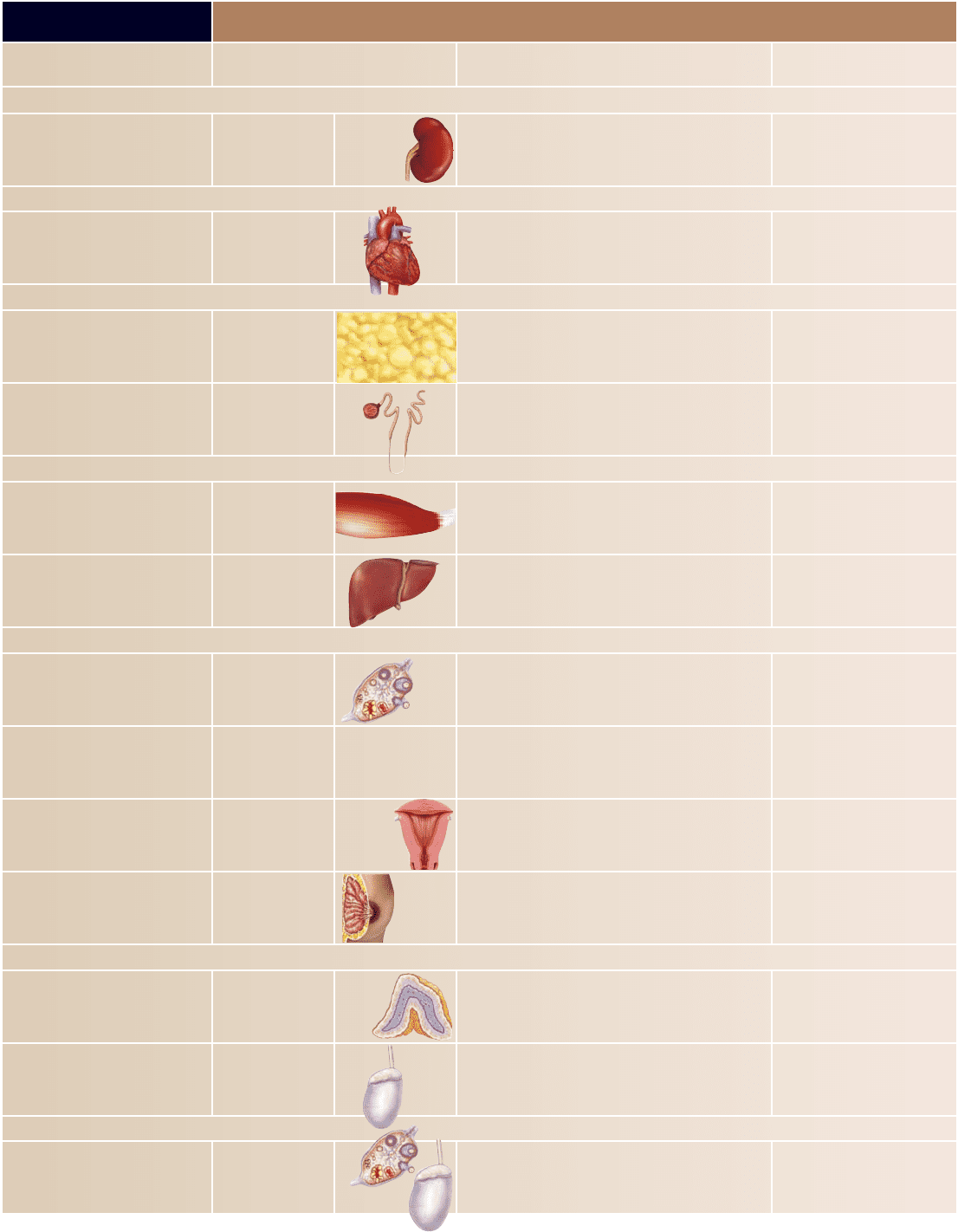
TABLE 46.1
Principal Mammalian Endocrine Glands and Their Hormones, continued
Endocrine Gland
and Hormone Target Tissue Principal Actions Chemical Nature
Parathyroid Glands
Parathyroid hormone (PTH) Bone, kidneys,
digestive tract
Raises blood calcium level by stimulating bone breakdown;
stimulates calcium reabsorption in kidneys; activates
vitamin D
Peptide (34 amino acids)
Adrenal Medulla
Epinephrine (adrenaline) and
norepinephrine (noradrenaline)
Smooth muscle,
cardiac muscle,
blood vessels
Initiates stress responses; raises heart rate, blood pressure,
metabolic rate; dilates blood vessels; mobilizes fat; raises
blood glucose level
Amino acid derivatives
Adrenal Cortex
Glucocorticoids (e.g., cortisol) Many organs Adaptation to long-term stress; raises blood glucose level;
mobilizes fat
Steroid
Mineralocorticoids (e.g., aldosterone) Kidney tubules
Maintains proper balance of Na
+
and K
+
in blood
Steroid
Pancreas
Insulin Liver, skeletal
muscles, adipose
tissue
Lowers blood glucose level; stimulates glycogen, fat,
protein synthesis
Peptide (51 amino acids)
Glucagon Liver, adipose tissue Raises blood glucose level; stimulates breakdown of glycogen
in liver
Peptide (29 amino acids)
Ovary
Estradiol General Stimulates development of female secondary
sex characteristics
Steroid
Female reproductive
structures
Stimulates growth of sex organs at puberty and monthly
preparation of uterus for pregnancy
Progesterone Uterus Completes preparation for pregnancy Steroid
Mammary glands Stimulates development
Testis
Testosterone Many organs Stimulates development of secondary sex characteristics in
males and growth spurt at puberty
Steroid
Male reproductive
structures
Stimulates development of sex organs; stimulates
spermatogenesis
Pineal Gland
Melatonin Gonads, brain,
pigment cells
Regulates biological rhythms Amino acid derivative
www.ravenbiology.com
chapter
46
The Endocrine System
941
rav32223_ch46_937-960.indd 941rav32223_ch46_937-960.indd 941 11/17/09 4:59:09 PM11/17/09 4:59:09 PM