
Schmuller J. Statistical Analysis with Excel For Dummies
Подождите немного. Документ загружается.

309
Chapter 15: Correlation: The Rise and Fall of Relationships
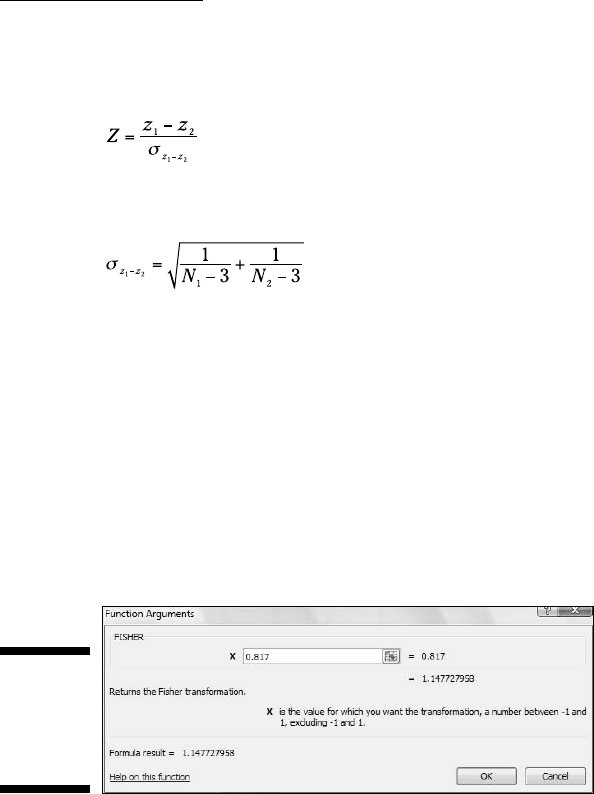
transforms r to z. FISHERINV does the reverse. Just to refresh your memory,
you use the transformed values in the formula
in which the denominator is
In the example I discussed earlier (Sahusket versus Farshimmelt), the corre-
lation coefficients were .817 and .752, and I did a two-tailed test. The first step
is to transform each correlation. I’ll go through the steps for using FISHER to
transform .817:
1. Select a cell for FISHER’s answer.
I selected B3 for the transformed value.
2. From the Statistical Functions menu, select FISHER to open its
Function Arguments dialog box.
The FISHER Function Arguments dialog box appears in Figure 15-8.
Figure 15-8:
The FISHER
Function
Arguments
dialog box.
3. In the Function Arguments dialog box, type the appropriate value for
the argument.
In the x box, I typed .817, the correlation coefficient. The answer,
1.147728, appears in the dialog box.
4. Click OK to put the answer into the selected cell.
21 454060-ch15.indd 30921 454060-ch15.indd 309 4/21/09 7:34:50 PM4/21/09 7:34:50 PM

310
Part III: Drawing Conclusions from Data
I selected B4 to store the transformation of .752. Next, I used this formula to
calculate Z
=(B3-B4)/SQRT((1/(20-3))+(1/(24-3)))
Finally, I used NORMSINV to find the critical value of z for rejecting H
0
with a
two-tailed α of .05. Because the result of the formula (0.521633) is less than
that critical value (1.96), the decision is to not reject H
0
.
21 454060-ch15.indd 31021 454060-ch15.indd 310 4/21/09 7:34:50 PM4/21/09 7:34:50 PM
Part IV
Working with
Probability
22 454060-pp04.indd 31122 454060-pp04.indd 311 4/21/09 7:35:31 PM4/21/09 7:35:31 PM

In this part . . .
S
tatistical analysis and decision-making rest on a foun-
dation of probability. Throughout the book, I give
a smattering of probability ideas — just enough to get
you through the statistics. Part IV gives a more in-depth
treatment and covers related Excel features. You find out
about discrete and continuous random variables, count-
ing rules, conditional probability, and probability distribu-
tions. In this part, I also discuss specific probability
distributions that are appropriate for specific purposes.
Part IV ends with an exploration of modeling, tests of how
well a model fits data, and how Excel deals with modeling
and testing.
22 454060-pp04.indd 31222 454060-pp04.indd 312 4/21/09 7:35:32 PM4/21/09 7:35:32 PM

Chapter 16
Introducing Probability
In This Chapter
▶ Defining probability
▶ Working with probability
▶ Dealing with random variables and their distributions
▶ Focusing on the binomial distribution
T
hroughout this book, I toss around the concept of probability, because
it’s the basis of hypothesis testing and inferential statistics. Most of the
time, I represent probability as the proportion of area under part of a distri-
bution. For example, the probability of a Type I error (a/k/a α) is the area in a
tail of the standard normal distribution or the t distribution.
In this chapter, I explore probability in greater detail, including random vari-
ables, permutations, and combinations. I examine probability’s fundamentals
and applications, zero in on a couple of specific probability distributions, and
I discuss probability-related Excel worksheet functions.
What is Probability?
Most of us have an intuitive idea about what probability is all about. Toss
a fair coin, and you have a 50-50 chance it comes up “Head.” Toss a fair die
(one of a pair of dice) and you have a one-in-six chance it comes up “2.”
If you wanted to be more formal in your definition, you’d most likely say
something about all the possible things that could happen, and the propor-
tion of those things you care about. Two things can happen when you toss a
coin, and if you only care about one of them (Head), the probability of that
event happening is one out of two. Six things can happen when you toss a
die, and if you only care about one of them (2), the probability of that event
happening is one out of six.
23 454060-ch16.indd 31323 454060-ch16.indd 313 4/21/09 7:35:55 PM4/21/09 7:35:55 PM
314
Part IV: Working with Probability
Experiments, trials, events,
and sample spaces
Statisticians and others who work with probability refer to a process like
tossing a coin or throwing a die as an experiment. Each time you go through
the process, that’s a trial.
This might not fit your personal definition of an experiment (or of a trial, for
that matter), but for a statistician, an experiment is any process that pro-
duces one of at least two distinct results (like a Head or a Tail).
Another piece of the definition of an experiment: You can’t predict the result
with certainty. Each distinct result is called an elementary outcome. Put a
bunch of elementary outcomes together and you have an event. For example,
with a die the elementary outcomes 2, 4, and 6 make up the event “even
number.”
Put all the possible elementary outcomes together and you’ve got yourself a
sample space. The numbers 1, 2, 3, 4, 5, and 6 make up the sample space for a
die. “Head” and “Tail” make up the sample space for a coin.
Sample spaces and probability
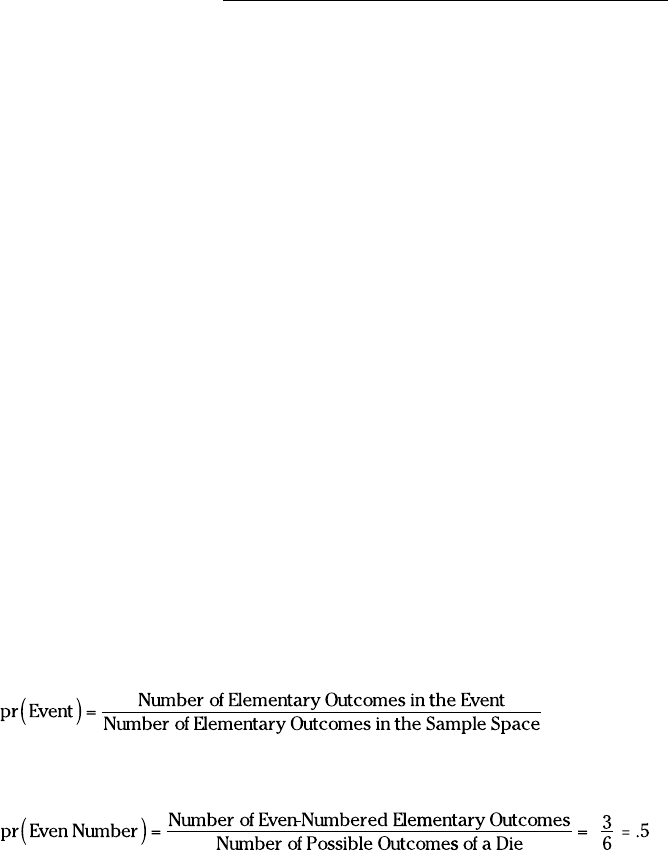
How does all this play into probability? If each elementary outcome in a
sample space is equally likely, the probability of an event is
So the probability of tossing a die and getting an even number is
If the elementary outcomes are not equally likely, you find the probability of
an event in a different way. First, you have to have some way of assigning a
probability to each one. Then you add up the probabilities of the elementary
outcomes that make up the event.
A couple of things to bear in mind about outcome probabilities: Each prob-
ability has to be between zero and one. All the probabilities of elementary
outcomes in a sample space have to add up to 1.00.
23 454060-ch16.indd 31423 454060-ch16.indd 314 4/21/09 7:35:56 PM4/21/09 7:35:56 PM

315
Chapter 16: Introducing Probability
How do you assign those probabilities? Sometimes you have advance infor-
mation — such as knowing that a coin is biased toward coming up Head 60
percent of the time. Sometimes you just have to think through the situation
to figure out the probability of an outcome.
Here’s a quick example of “thinking through.” Suppose a die is biased so that
the probability of an outcome is proportional to the numerical label of the out-
come: A 6 comes up six times as often as a 1, a 5 comes up five times as often
as a 1, and so on. What is the probability of each outcome? All the probabilities
have to add up to 1.00, and all the numbers on a die add up to 21 (1+2+3+4+5+
6 = 21), so the probabilities are: pr(1) = 1/21, pr(2) = 2/21, . . ., pr(6) = 6/21.
Compound Events
Some rules for dealing with compound events help you “think through.” A
compound event consists of more than one event. It’s possible to combine
events by either union or intersection (or both).
Union and intersection
On a toss of a fair die, what’s the probability of getting a 1 or a 4?
Mathematicians have a symbol for “or.” It looks like this , and it’s called
“union.” Using this symbol, the probability of a 1 or a 4 is pr(1 , 4).
In approaching this kind of probability, it’s helpful to keep track of the ele-
mentary outcomes. One elementary outcome is in each event, so the event
“1 or 4” has two elementary outcomes. With a sample space of six outcomes,
the probability is 2/6 or 1/3. Another way to calculate this is
pr(1 , 4) = pr(1) + pr(4) = (1/6) + (1/6) = 2/6 = 1/3
Here’s a slightly more involved one: What’s the probability of getting a
number between 1 and 3 or a number between 2 and 4?
Just adding the elementary outcomes in each event won’t get it done this
time. Three outcomes are in the event “between 1 and 3” and three are in the
event “between 2 and 4.” The probability can’t be 3 + 3 divided by the six out-
comes in the sample space because that’s 1.00, leaving nothing for pr(5) and
pr(6). For the same reason, you can’t just add the probabilities.
23 454060-ch16.indd 31523 454060-ch16.indd 315 4/21/09 7:35:56 PM4/21/09 7:35:56 PM
316
Part IV: Working with Probability
The challenge arises in the overlap of the two events. The elementary out-
comes in “between 1 and 3” are 1, 2, and 3. The elementary outcomes in
“between 2 and 4” are 2, 3, and 4. Two outcomes overlap: 2 and 3. In order to
not count them twice, the trick is to subtract them from the total.
A couple of things will make life easier as I proceed. I abbreviate “between 1
and 3” as A and “between 2 and 4” as B. Also, I use the mathematical symbol
for “overlap.” The symbol is + and it’s called intersection.
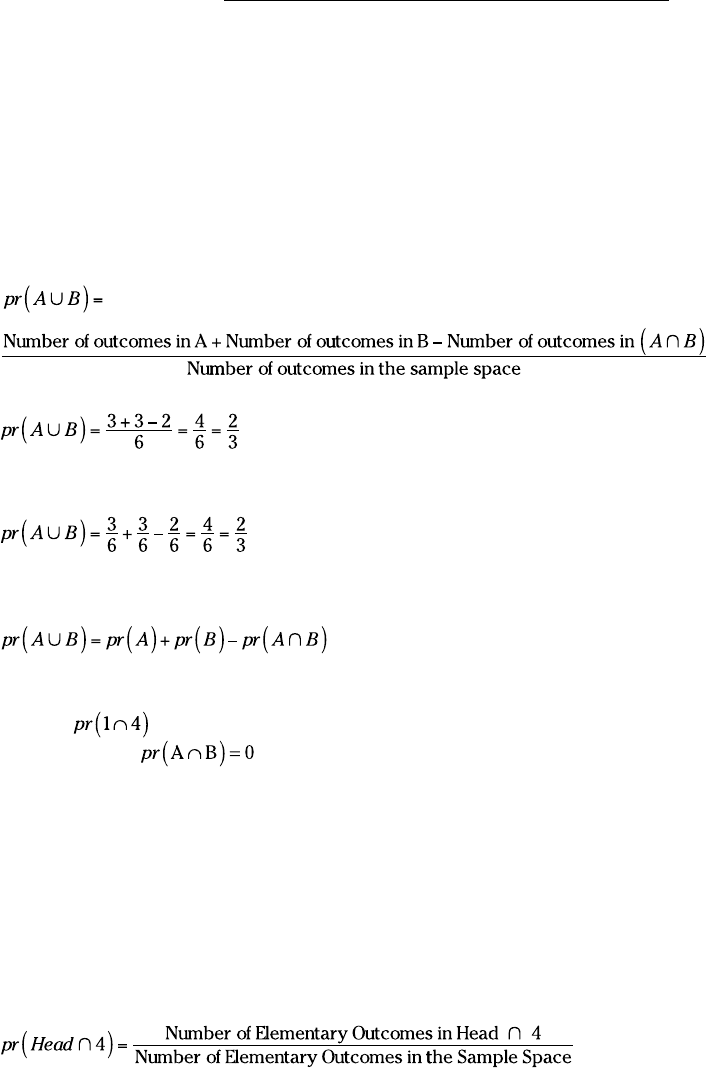
Using the symbols, the probability of “between 1 and 3” or “between 2 and 4” is
You can also work with the probabilities:
The general formula is:
Why was it okay to just add the probabilities together in the earlier example?
Because
is zero: It’s impossible to get a 1 and a 4 in the same toss of
a die. Whenever
, A and B are said to be mutually exclusive.
Intersection again
Imagine throwing a coin and rolling a die at the same time. These two experi-
ments are independent, because the result of one has no influence on the
result of the other.
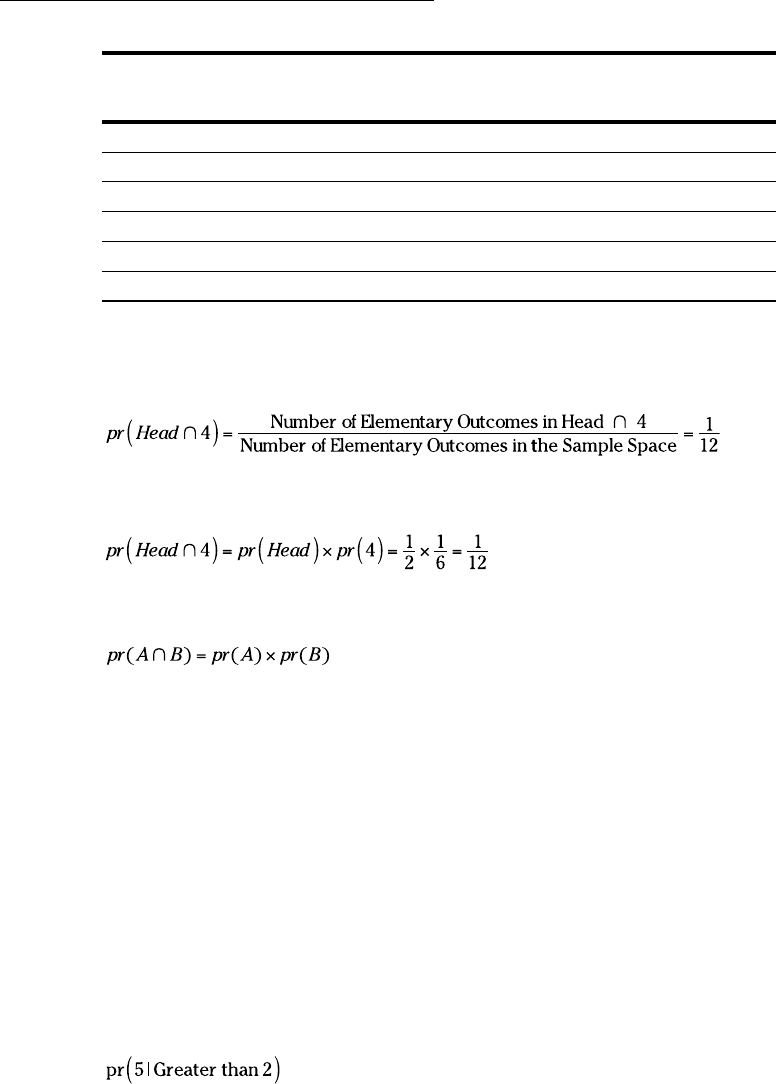
What’s the probability of getting a Head and a 4? You use the intersection
symbol and write this as pr(Head 4):
Start with the sample space. Table 16-1 lists all the elementary outcomes.
23 454060-ch16.indd 31623 454060-ch16.indd 316 4/21/09 7:35:56 PM4/21/09 7:35:56 PM
317
Chapter 16: Introducing Probability
Table 16-1 The Elementary Outcomes in the Sample Space
for Throwing a Coin and Rolling a Die
Head, 1 Tail, 1
Head, 2 Tail, 2
Head, 3 Tail, 3
Head, 4 Tail, 4
Head, 5 Tail, 5
Head, 6 Tail, 6
As the table shows, 12 outcomes are possible. How many outcomes are in the
event “Head and 4”? Just one. So
You can also work with the probabilities:
In general, if A and B are independent,
Conditional Probability
In some circumstances, you narrow the sample space. For example, suppose
I toss a die, and I tell you the result is greater than 2. What’s the probability
that it’s a 5?
Ordinarily, the probability of a 5 would be 1/6. In this case, however, the sample
space isn’t 1, 2, 3, 4, 5, and 6. When you know the result is greater than 2, the
sample space becomes 3, 4, 5, and 6. The probability of a 5 is now
1
⁄4.
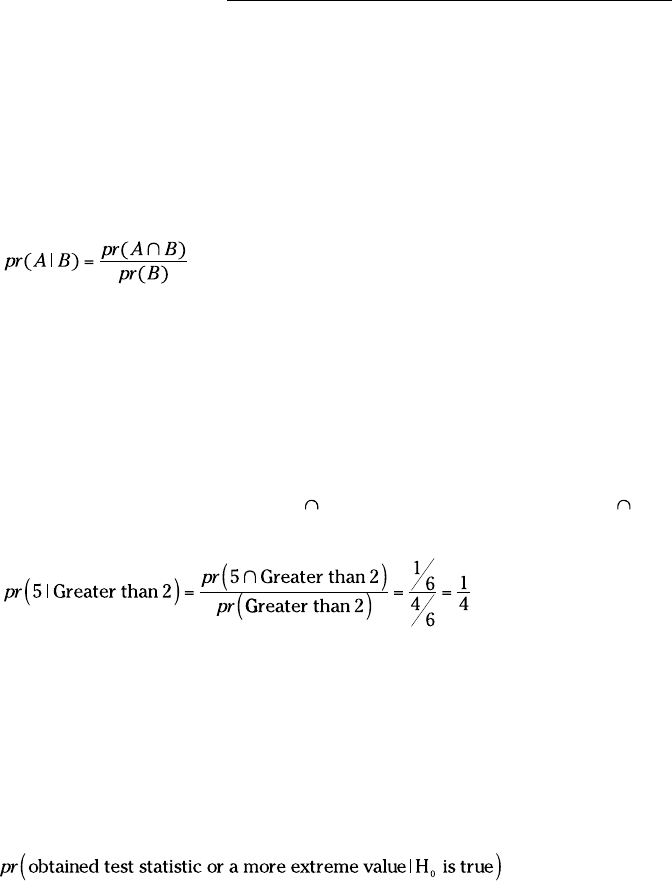
This is an example of conditional probability. It’s “conditional” because I’ve
given a “condition” — the toss resulted in a number greater than 2. The nota-
tion for this is
23 454060-ch16.indd 31723 454060-ch16.indd 317 4/21/09 7:35:56 PM4/21/09 7:35:56 PM
318
Part IV: Working with Probability
The vertical line is shorthand for the word given, and you read that notation
as “the probability of a 5 given Greater than 2.”
Working with the probabilities
In general, if you have two events A and B,
as long as pr(B) isn’t zero.
For the intersection in the numerator on the right, this is not a case where you
just multiply probabilities together. In fact, if you could do that, you wouldn’t
have a conditional probability, because that would mean A and B are inde-
pendent. If they’re independent, one event can’t be conditional on the other.
You have to think through the probability of the intersection. In a die, how
many outcomes are in the event “5
Greater than 2”? Just one, so pr(5
Greater than 2) is
1
⁄6, and
The foundation of hypothesis testing
All the hypothesis testing I’ve gone through in previous chapters involves
conditional probability. When you calculate a sample statistic, compute a sta-
tistical test, and then compare the test statistic against a critical value, you’re
looking for a conditional probability. Specifically, you’re trying to find
If that conditional probability is low (less than .05 in all the examples I show
you in hypothesis-testing chapters), you reject H
0
.
Large Sample Spaces
When dealing with probability, it’s important to understand the sample
space. In the examples I show you, the sample spaces are small. With a coin
or a die, it’s easy to list all the elementary outcomes.
23 454060-ch16.indd 31823 454060-ch16.indd 318 4/21/09 7:35:57 PM4/21/09 7:35:57 PM