
Schmuller J. Statistical Analysis with Excel For Dummies
Подождите немного. Документ загружается.

319
Chapter 16: Introducing Probability
The world, of course, isn’t that simple. In fact, probability problems that
live in statistics textbooks aren’t even that simple. Most of the time, sample
spaces are large and it’s not convenient to list every elementary outcome.
Take, for example, rolling a die twice. How many elementary outcomes are in
the sample space consisting of both tosses? You can sit down and list them,
but it’s better to reason it out: Six possibilities for the first toss, and each
of those six can pair up with six possibilities on the second. So the sample
space has 6 × 6 = 36 possible elementary outcomes. (This is similar to the
coin-and-die sample space in Table 16-1, where the sample space consists of
2 × 6 = 12 elementary outcomes. With 12 outcomes, it was easy to list them all
in a table. With 36 outcomes, it starts to get . . . well . . . dicey.)
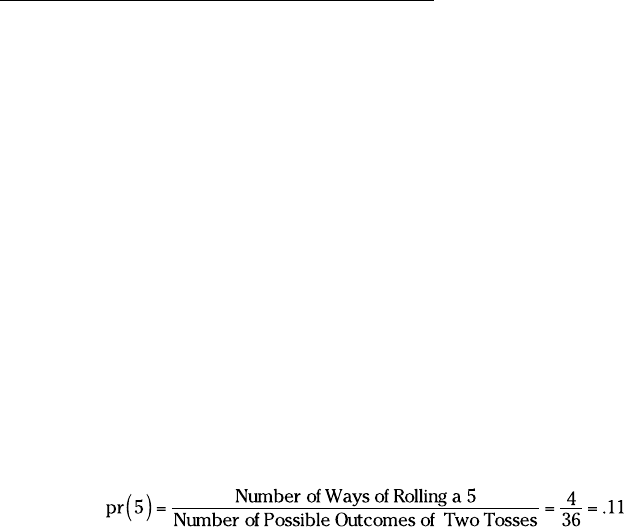
Events often require some thought, too. What’s the probability of rolling a die
twice and totaling five? You have to count the number of ways the two tosses
can total five, and then divide by the number of elementary outcomes in the
sample space (36). You total a five by getting any of these pairs of tosses: 1
and 4, 2 and 3, 3 and 2, or 4 and 1. That’s four ways and they don’t overlap
(excuse me, intersect), so
Listing all the elementary outcomes for the sample space is often a night-
mare. Fortunately, shortcuts are available, as I show in the upcoming sub-
sections. Because each shortcut quickly helps you count a number of items,
another name for a shortcut is a counting rule.
Believe it or not, I just slipped one counting rule past you. A couple of para-
graphs ago, I say that in two tosses of a die you have a sample space of 6 × 6
= 36 possible outcomes. This is the product rule: If N
1
outcomes are possible
on the first trial of an experiment, and N
2
outcomes on the second trial, the
number of possible outcomes is N
1
N
2
. Each possible outcome on the first trial
can associate with all possible outcomes on the second. What about three
trials? That’s N
1
N
2
N
3
.
Now for a couple more counting rules.
Permutations
Suppose you have to arrange five objects into a sequence. How many ways
can you do that? For the first position in the sequence, you have five choices.
After you make that choice, you have four choices for the second position.
Then you have three choices for the third, two for the fourth, and one for the
fifth. The number of ways is (5)(4)(3)(2)(1) = 120.
23 454060-ch16.indd 31923 454060-ch16.indd 319 4/21/09 7:35:57 PM4/21/09 7:35:57 PM
320
Part IV: Working with Probability
In general, the number of sequences of N objects is N(N-1)(N-2)…(2)(1). This
kind of computation occurs fairly frequently in probability-world and it has
its own notation, N! You don’t read this by screaming out “N” in a loud voice.
Instead, it’s “N factorial.” By definition, 1! = 1, and 0! = 1.
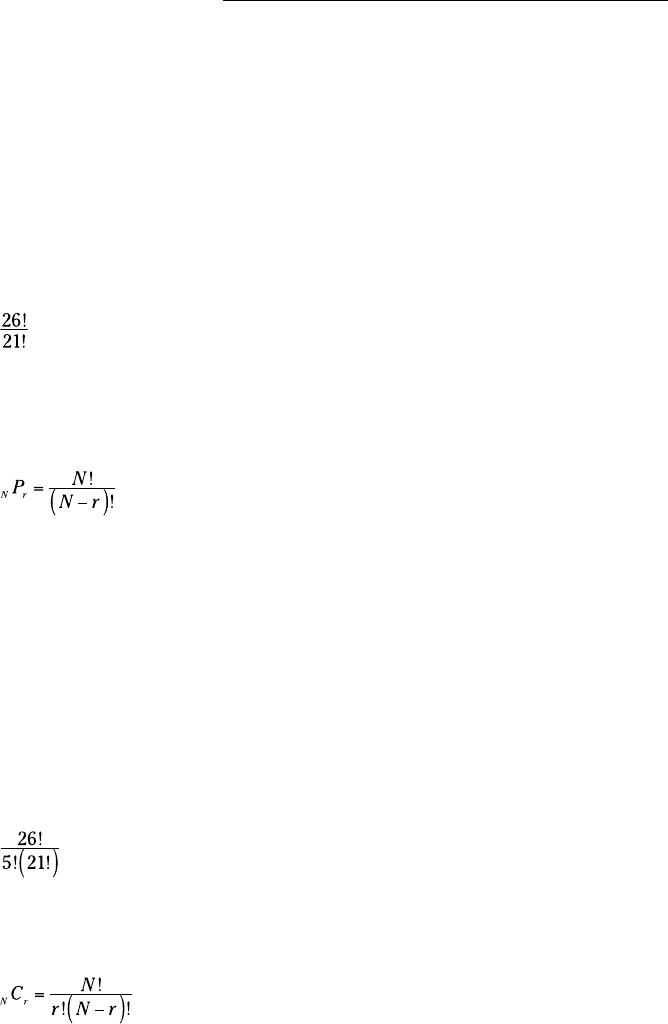
Now for the good stuff. If you have to order the 26 letters of the alphabet, the
number of possible sequences is 26!, a huge number. But suppose the task is
to create five-letter sequences so that no letter repeats in the sequence. How
many ways can you do that? You have 26 choices for the first letter, 25 for
the second, 24 for the third, 23 for the fourth, 22 for the fifth, and that’s it. So
that’s (26)(25(24)(23)(22). Here’s how that product is related to 26!:
Each sequence is called a permutation. In general, if you take permutations of
N things r at a time, the notation is NPr (the P stands for “permutation”). The
formula is
Combinations
In the example I just showed you, these sequences are different from one
another: abcde, adbce, dbcae, and on and on and on. In fact, you could come up
with 5! = 120 of these different sequences just for the letters a, b, c, d, and e.
Suppose I add the restriction that one of these sequences is no different from
another, and all I’m concerned about is having sets of five nonrepeating let-
ters in no particular order. Each set is called a combination. For this example,
the number of combinations is the number of permutations divided by 5!:
In general, the notation for combinations of N things taken r at a time is NCr
(the C stands for “combination”). The formula is
23 454060-ch16.indd 32023 454060-ch16.indd 320 4/21/09 7:35:57 PM4/21/09 7:35:57 PM

321
Chapter 16: Introducing Probability
Worksheet Functions
Three Excel functions help you with factorials, permutations, and combina-
tions. Excel categorizes one of them as a Statistical function, but, surpris-
ingly, not the other two.
FACT
FACT, which computes factorials, is one of the functions not categorized as
Statistical. Instead, you’ll find it in the Math & Trig Functions menu. It’s easy
to use. Supply it with a number, and it returns the factorial. Here are the steps:
1. Select a cell for FACT’s answer.
2. From the Math & Trig functions menu, select FACT to open its
Function Arguments dialog box.
3. In the Function Arguments dialog box, enter the appropriate value for
the argument.
In the Number box, I typed the number whose factorial I want to compute.
The answer appears in the dialog box. If I enter 5, for example, 120 appears.
4. Click OK to put the answer into the selected cell.
PERMUT
You’ll find this one in the Statistical Functions menu. As its name suggests,
PERMUT enables you to calculate
N
P
r
. Here’s how to use it to find
26
P
5
, the
number of five-letter sequences (no repeating letters) you can create from
the 26 letters of the alphabet. In a permutation, remember, abcde is consid-
ered different from bcdae. Follow these steps:
1. Select a cell for PERMUT’s answer.
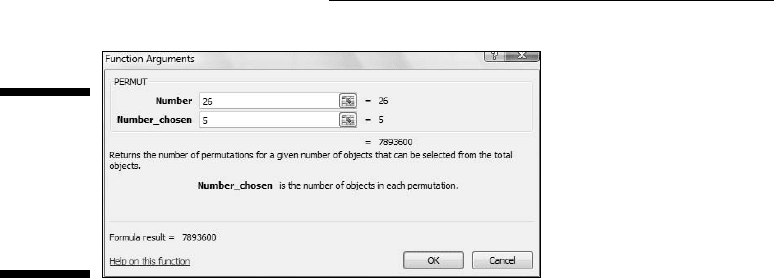
2. From the Statistical Functions menu, select PERMUT to open its
Function Arguments dialog box (Figure 16-1).
3. In the Function Arguments dialog box, type the appropriate values for
the arguments.
In the Number box, I entered the N in
N
P
r
. For this example, N is 26.
In the Number_chosen box, I entered the r in
N
P
r
. That would be 5.
With values entered for both arguments, the answer appears in the
dialog box. For this example, the answer is 7893600.
23 454060-ch16.indd 32123 454060-ch16.indd 321 4/21/09 7:35:57 PM4/21/09 7:35:57 PM
322
Part IV: Working with Probability
Figure 16-1:
The
Function
Arguments
dialog
box for
PERMUT.
4. Click OK to put the answer into the selected cell.
COMBIN
COMBIN works pretty much the same way as PERMUT. Excel categorizes
COMBIN as a Math & Trig function.
Here’s how you use it to find
26
C
5
, the number of ways to construct a 5-letter
sequence (no repeating letters) from the 26 letters of the alphabet. In a com-
bination, abcde is considered equivalent to bcdae.
1. Select a cell for COMBIN’s answer.
2. From the Math & Trig Functions menu, select COMBIN to open its
Function Arguments dialog box.
3. In the Function Arguments dialog box, type the appropriate values for
the arguments.
In the Number box, I entered the N in
N
C
r
. Once again, N is 26.
In the Number_chosen box, I entered the r in
N
C
r
. And again, r is 5.
With values entered for both arguments, the answer appears in the
dialog box. For this example, the answer is 65870.
4. Click OK to put the answer into the selected cell.
Random Variables: Discrete
and Continuous
Return to tosses of a fair die, where six elementary outcomes are possible. If I
use x to refer to the result of a toss, x can be any whole number from 1 to 6.
23 454060-ch16.indd 32223 454060-ch16.indd 322 4/21/09 7:35:57 PM4/21/09 7:35:57 PM
323
Chapter 16: Introducing Probability
Because x can take on a set of values, it’s a variable. Because x’s possible
values correspond to the elementary outcomes of an experiment (meaning you
can’t predict its values with absolute certainty) x is called a random variable.
Random variables come in two varieties. One variety is discrete, of which die-
tossing is a good example. A discrete random variable can only take on what
mathematicians like to call a countable number of values — like the numbers
1–6. Values between the whole numbers 1–6 (like 1.25 or 3.1416) are impos-
sible for a random variable that corresponds to the outcomes of die-tosses.
The other kind of random variable is continuous. A continuous random vari-
able can take on an infinite number of values. Temperature is an example.
Depending on the precision of a thermometer, it’s possible to have tempera-
tures like 34.516 degrees.
Probability Distributions
and Density Functions
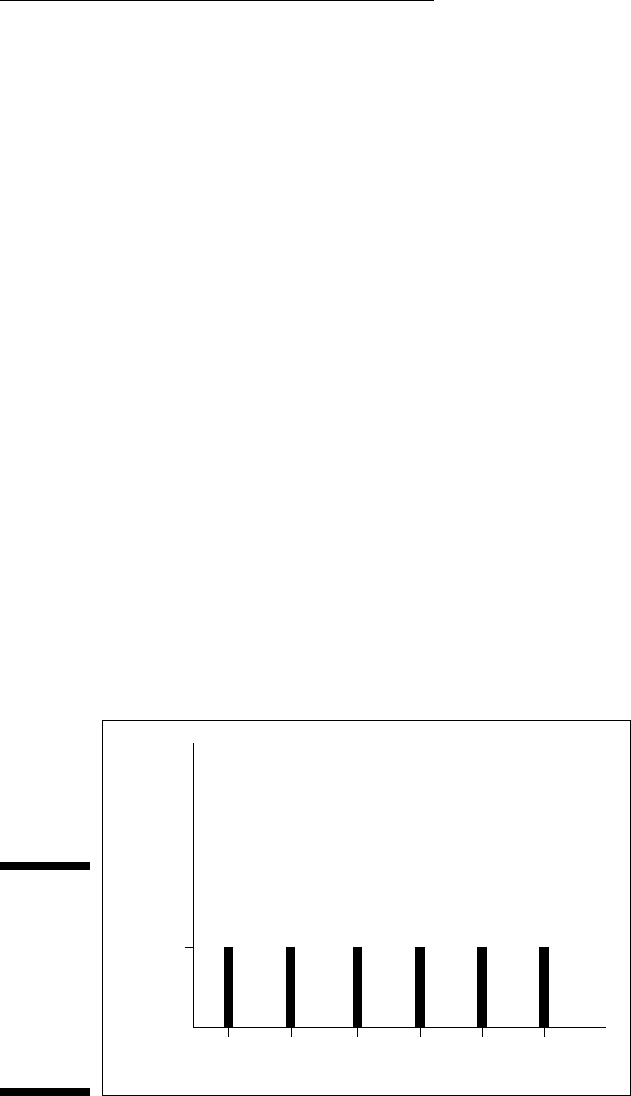
Back again to die-tossing. Each value of the random variable x (1–6, remem-
ber) has a probability. If the die is fair, each probability is 1/6. Pair each value
of a discrete random variable like x with its probability, and you have a prob-
ability distribution.
Probability distributions are easy enough to represent in graphs. Figure 16-2
shows the probability distribution for x.
Figure 16-2:
The
probability
distribution
for x, a ran-
dom variable
based on
the tosses
of a fair die.
1 2 3 4 5 6
x
pr(x)
1/6
23 454060-ch16.indd 32323 454060-ch16.indd 323 4/21/09 7:35:58 PM4/21/09 7:35:58 PM
324
Part IV: Working with Probability
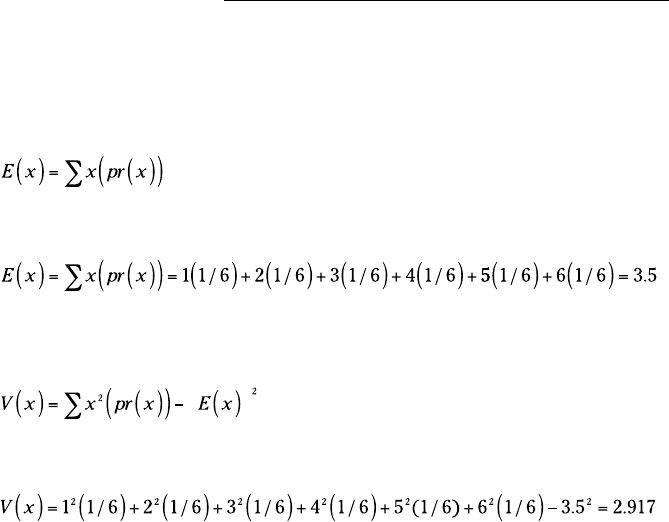
A random variable has a mean, a variance, and a standard deviation.
Calculating these parameters is pretty straightforward. In random-variable
world, the mean is called the expected value, and the expected value of
random variable x is abbreviated as E(x). Here’s how you calculate it:
For the probability distribution in Figure 16-2, that’s
The variance of a random variable is often abbreviated as V(x), and the for-
mula is
Working with the probability distribution in Figure 16-2 once again,
The standard deviation is the square root of the variance, which in this case
is 1.708.
For continuous random variables, things get a little trickier. You can’t pair a
value with a probability, because you can’t really pin down a value. Instead,
you associate a continuous random variable with a mathematical rule (an
equation) that generates probability density, and the distribution is called a
probability density function. To calculate the mean and variance of a continu-
ous random variable, you need calculus.
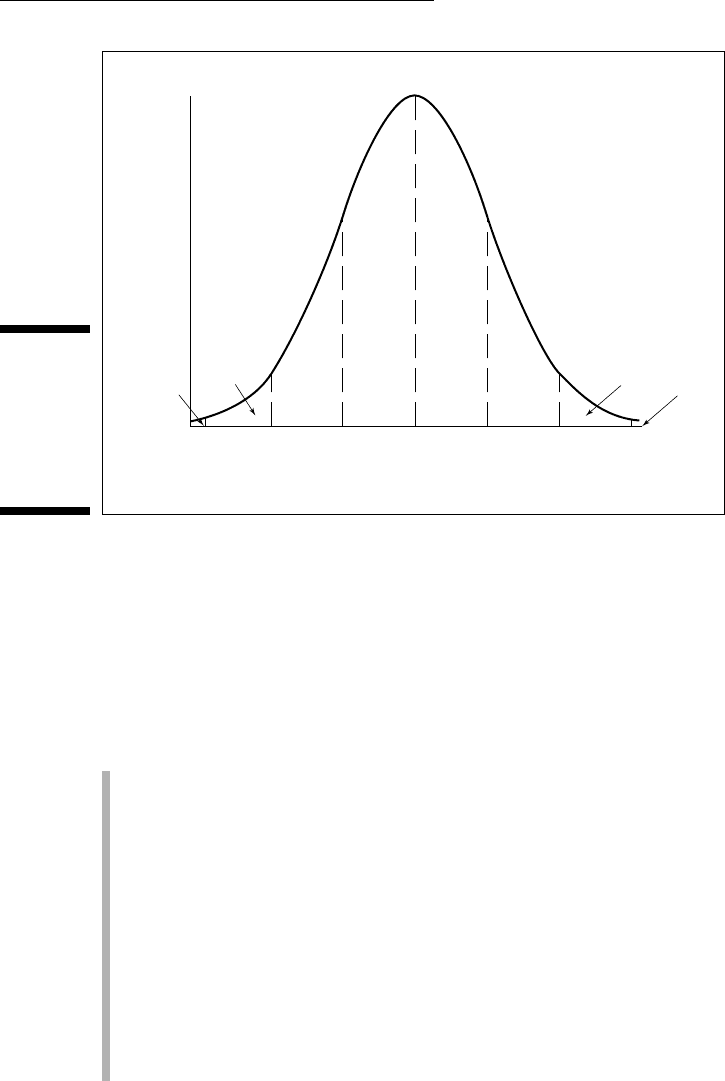
In Chapter 8, I show you a probability density function — the standard
normal distribution. I reproduce it here as Figure 16-3.
In the figure, f(x) represents the probability density. Because probability den-
sity can involve some heavyweight mathematical concepts, I won’t go into
it. As I mention in Chapter 8, think of probability density as something that
turns the area under the curve into probability.
While you can’t speak of the probability of a specific value of a continuous
random variable, you can work with the probability of an interval. To find
the probability that the random variable takes on a value within an interval,
you find the proportion of the total area under the curve that’s inside that
interval. Figure 16-3 shows this. The probability that x is between 0 and 1σ
is .3413.
23 454060-ch16.indd 32423 454060-ch16.indd 324 4/21/09 7:35:58 PM4/21/09 7:35:58 PM
325
Chapter 16: Introducing Probability
Figure 16-3:
The stan-
dard normal
distribution:
A probability
density
function.
f(x)
x
010-10-20-30 20 30
.3413
.3413
.1359
.1359
.0215
.0215
.0013
.0013
For the rest of this chapter, I deal just with discrete random variables. A spe-
cific one is up next.
The Binomial Distribution
Imagine an experiment that has these five characteristics:
✓ The experiment consists of N identical trials.
A trial could be a toss of a die, or a toss of a coin.
✓ Each trial results in one of two elementary outcomes.
✓ It’s standard to call one outcome a success and the other a failure. For
die-tossing, a success might be a toss that comes up 3, in which case a
failure is any other outcome.
✓ The probability of a success remains the same from trial to trial.
Again, it’s pretty standard to use p to represent the probability of a suc-
cess, and 1-p (or q) to represent the probability of a failure.
✓ The trials are independent.
✓ The discrete random variable x is the number of successes in the N trials.
23 454060-ch16.indd 32523 454060-ch16.indd 325 4/21/09 7:35:58 PM4/21/09 7:35:58 PM
326
Part IV: Working with Probability
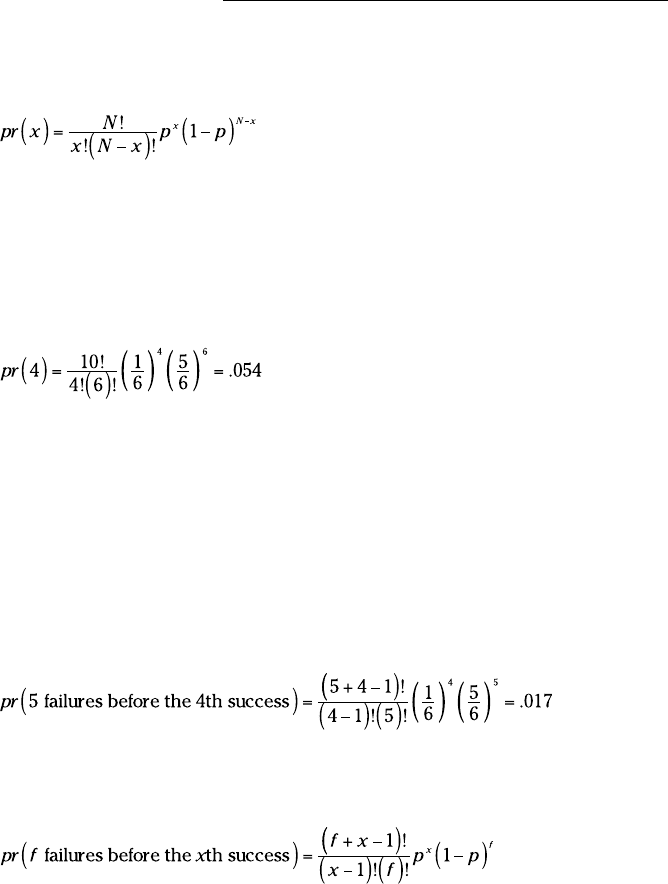
This type of experiment is called a binomial experiment. The probability dis-
tribution for x follows this rule:
On the extreme right, px(1-p)N-x is the probability of one combination of x
successes in N trials. The term to its immediate left is NCx, the number of
possible combinations of x successes in N trials.
This is called the binomial distribution. You use it to find probabilities like the
probability you’ll get four 3s in ten tosses of a die:
The negative binomial distribution is closely related. In this distribution, the
random variable is the number of trials before the xth success. For example,
you use the negative binomial to find the probability of 5 tosses that result in
anything but a 3 before the fourth time you roll a 3.
For this to happen, in the eight tosses before the fourth 3, you have to get
5 non-3s and 3 successes (tosses when a 3 comes up). Then, the next toss
results in a 3. The probability of a combination of 4 successes and 5 failures
is p
4
(1-p)
5
. The number of ways you can have a combination of 5 failures and
4-1 successes is
5+4-1
C
4-1
. So the probability is
In general, the negative binomial distribution (sometimes called the Pascal
distribution) is
Worksheet Functions
These distributions are computation intensive, so I get to the worksheet func-
tions right away.
23 454060-ch16.indd 32623 454060-ch16.indd 326 4/21/09 7:35:58 PM4/21/09 7:35:58 PM
327
Chapter 16: Introducing Probability
BINOMDIST
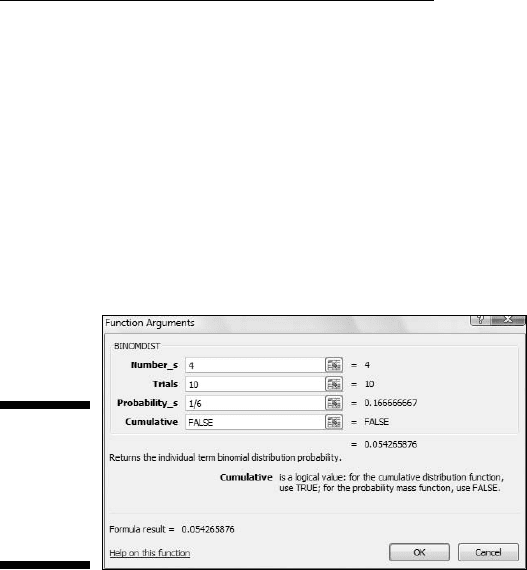
BINOMDIST is Excel’s worksheet function for the binomial distribution. As an
example, I use BINOMDIST to calculate the probability of getting four 3s in
ten tosses of a fair die:
1. Select a cell for BINOMDIST’s answer.
2. From the Statistical Functions menu, select BINOMDIST to open its
Function Arguments dialog box (Figure 16-4).
Figure 16-4:
The
BINOMDIST
Function
Arguments
dialog box.
3. In the Function Arguments dialog box, type the appropriate values for
the arguments.
In the Number_s box, I entered the number of successes. For this exam-
ple, the number of successes is 4.
In the Trials box, I entered the number of trials. The number of trials is 10.
In the Probability_s box, I entered the probability of a success. I entered
1/6, the probability of a 3 on a toss of a fair die.
In the Cumulative box, one possibility is FALSE for the probability of
exactly the number of successes entered in the Number_s box. The
other is TRUE for the probability of getting that number of successes or
fewer. I entered FALSE.
With values entered for all the arguments, the answer appears in the
dialog box.
4. Click OK to put the answer into the selected cell.
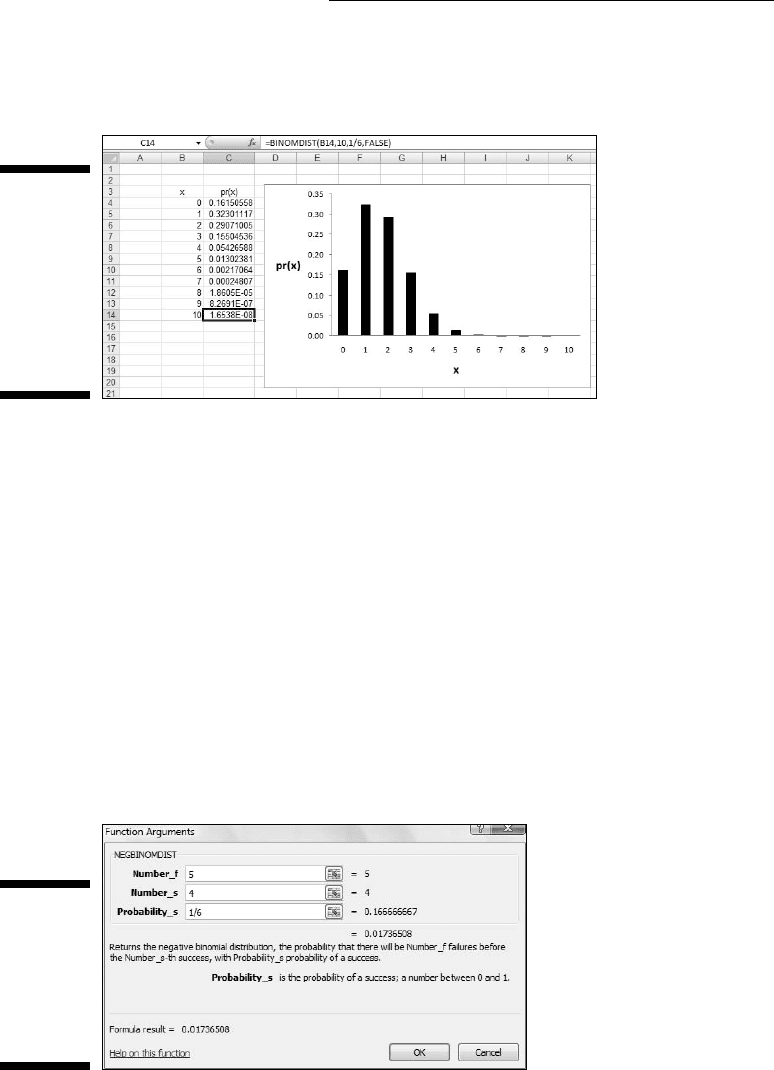
To give you a better idea of what the binomial distribution looks like, I use
BINOMDIST (with FALSE entered in the Cumulative box) to find pr(0) through
23 454060-ch16.indd 32723 454060-ch16.indd 327 4/21/09 7:35:58 PM4/21/09 7:35:58 PM
328
Part IV: Working with Probability
pr(10), and then I use Excel’s graphics capabilities (see Chapter 3) to graph
the results. Figure 16-5 shows the data and the graph.
Figure 16-5:
The
binomial
distribution
for x suc-
cesses in
ten tosses
of a die,
with p = 1/6.
Incidentally, if you type TRUE in the Cumulative box, the result is .984 (and
some more decimal places), which is pr(0) + pr(1) + pr(2) + pr(3) + pr(4).
NEGBINOMDIST
As its name suggests, NEGBINOMDIST handles the negative binomial distribu-
tion. I use it here to work out the example I gave you earlier — the probabil-
ity of getting five failures (tosses that result in anything but a 3) before the
fourth success (the fourth 3).
1. Select a cell for NEGBINOMDIST’s answer.
2. From the Statistical Functions menu, select NEGBINOMDIST to open its
Function Arguments dialog box (Figure 16-6).
Figure 16-6:
The
NEGBINOM
DIST
Function
Arguments
dialog box.
23 454060-ch16.indd 32823 454060-ch16.indd 328 4/21/09 7:35:58 PM4/21/09 7:35:58 PM