
Schmuller J. Statistical Analysis with Excel For Dummies
Подождите немного. Документ загружается.

Chapter 19
Ten Statistical and Graphical
Tips and Traps
In This Chapter
▶ Beware of significance
▶ Be wary of graphs
▶ Be cautious with regression
▶ Be careful with concepts
T
he world of statistics is full of pitfalls, but it’s also full of opportunities.
Whether you’re a user of statistics or someone who has to interpret them,
it’s possible to fall into the pitfalls. It’s also possible to walk around them. Here
are ten tips and traps from the areas of hypothesis testing, regression, correla-
tion, and graphs.
Significant Doesn’t Always
Mean Important
As I say earlier in the book, “significance” is, in many ways, a poorly chosen
term. When a statistical test yields a significant result, and the decision is to
reject H
0
, that doesn’t guarantee that the study behind the data is an impor-
tant one. Statistics can only help decision making about numbers and infer-
ences about the processes that produced them. They can’t make those
processes important or earth shattering. Importance is something you have
to judge for yourself — and no statistical test can do that for you.
27 454060-ch19.indd 36927 454060-ch19.indd 369 4/21/09 7:38:14 PM4/21/09 7:38:14 PM

370
Part V: The Part of Tens
Trying to Not Reject a Null Hypothesis
Has a Number of Implications
Let me tell you a story: Some years ago, an industrial firm was trying to show
it was finally in compliance with environmental cleanup laws. They took
numerous measurements of the pollution in the body of water surrounding
their factory, compared the measurements with a null hypothesis-generated
set of expectations, and found that they couldn’t reject H
0
with α = .05. Their
measurements didn’t differ significantly (there’s that word again) from
“clean” water.
This, the company claimed, was evidence that they had cleaned up their
act. Closer inspection revealed that their data approached significance, but
the pollution wasn’t quite of a high enough magnitude to reject H
0
. Does this
mean they’re not polluting?
Not at all. In striving to “prove” a null hypothesis, they had stacked the deck
in favor of themselves. They set a high barrier to get over, didn’t clear it, and
then patted themselves on the back.
Every so often, it’s appropriate to try and not reject H
0
. When you set out on
that path, be sure to set a high value of α (about .20-.30), so that small diver-
gences from H
0
cause rejection of H
0
. (I discuss this in Chapter 10 and I men-
tion it in other parts of the book. I think it’s important enough to mention
again here.)
Regression Isn’t Always linear
When trying to fit a regression model to a scatterplot, the temptation is to
immediately use a line. This is the best-understood regression model, and
when you get the hang of it, slopes and intercepts aren’t all that daunting.
But linear regression isn’t the only kind of regression. It’s possible to fit a
curve through a scatterplot. I won’t kid you: The statistical concepts behind
curvilinear regression are more difficult to understand than the concepts
behind linear regression.
It’s worth taking the time to master those concepts, however. Sometimes,
a curve is a much better fit than a line. (This is partly a plug for Chapter 20,
where I take you through curvilinear regression — and some of the concepts
behind it.)
27 454060-ch19.indd 37027 454060-ch19.indd 370 4/21/09 7:38:14 PM4/21/09 7:38:14 PM

371
Chapter 19: Ten Statistical and Graphical Tips and Traps
Extrapolating Beyond a Sample
Scatterplot Is a Bad Idea
Whether you’re working with linear regression or curvilinear regression,
keep in mind that it’s inappropriate to generalize beyond the boundaries of
the scatterplot.
Suppose you’ve established a solid predictive relationship between a test of
mathematics aptitude and performance in mathematics courses, and your
scatterplot only covers a narrow range of mathematics aptitude. You have
no way of knowing whether the relationship holds up beyond that range.
Predictions outside that range aren’t valid.
Your best bet is to expand the scatterplot by testing more people. You might
find that the original relationship only tells part of the story.
Examine the Variability Around
a Regression Line
Careful analysis of residuals (the differences between observed and pre-
dicted values) can tell you a lot about how well the line fits the data. A foun-
dational assumption is that variability around a regression line is the same
up and down the line. If it isn’t, the model might not be as predictive as you
think. If the variability is systematic (greater variability at one end than at
the other), curvilinear regression might be more appropriate than linear. The
standard error of estimate won’t always be the indicator.
A Sample Can Be Too Large
Believe it or not. This sometimes happens with correlation coefficients. A
very large sample can make a small correlation coefficient statistically sig-
nificant. For example, with 100 degrees of freedom and α = .05, a correlation
coefficient of .195 is cause for rejecting the null hypothesis that the popula-
tion correlation coefficient is equal to zero.
But what does that correlation coefficient really mean? The coefficient of
determination — r
2
— is just .038, meaning that the SS
Regression
is less than 4
percent of the SS
Total
(See Chapter 16.) That’s a very small association.
27 454060-ch19.indd 37127 454060-ch19.indd 371 4/21/09 7:38:14 PM4/21/09 7:38:14 PM

372
Part V: The Part of Tens
Bottom line: When looking at a correlation coefficient, be aware of the sample
size. If it’s large enough, it can make a trivial association turn out statistically
significant. (Hmmm . . . “significance” . . . there it is again!)
Consumers: Know Your Axes
When you look at a graph, make sure that you know what’s on each axis.
Make sure that you understand the units of measure. Do you understand the
independent variable? Do you understand the dependent variable? Can you
describe each one in your own words? If the answer to any of those ques-
tions is “No,” you don’t understand the graph you’re looking at.
When looking at a graph in a TV ad, be very wary if it disappears too quickly,
before you can see what’s on the axes. The advertiser may be trying to create
a lingering false impression about a bogus relationship inside the graph. The
graphed relationship might be as valid as that other staple of TV advertising —
scientific proof via animated cartoon: Tiny animated scrub brushes cleaning
cartoon teeth might not necessarily guarantee whiter teeth for you if you buy
the product. (I know that’s off-topic, but I had to get it in.)
Graphing a Categorical Variable as
Though It’s a Quantitative Variable
Is Just Wrong
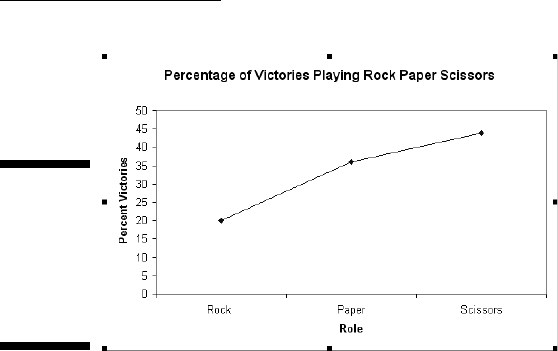
So you’re just about ready to compete in the Rock-Paper-Scissors World
Series. In preparation for this international tournament, you’ve tallied all
your matches from the past ten years, listing the percentage of times you
won when you played each role.
To summarize all the outcomes, you’re about to use Excel’s graphics capa-
bilities to create a graph. One thing’s sure: Whatever your preference rock-
paper-scissors-wise, the graph absolutely, positively had better NOT look like
Figure 19-1.
So many people create these kinds of graphs — people who should know
better. The line in the graph implies continuity from one point to another.
With these data, of course, that’s impossible. What’s between Rock and
Paper? Why are they equal units apart? Why are the three categories in that
order? (Can you tell this is my pet peeve?)
27 454060-ch19.indd 37227 454060-ch19.indd 372 4/21/09 7:38:14 PM4/21/09 7:38:14 PM
373
Chapter 19: Ten Statistical and Graphical Tips and Traps
Figure 19-1:
Absolutely
the wrong
way to
graph cat-
egorical
data.
Simply put, a line graph is not the proper graph when at least one of your
variables is a set of categories. Instead, create a column graph. A pie chart
works here, too, because the data are percentages and you have just a few
slices. (See Chapter 3 for Yogi Berra’s pie-slice guidelines.)
When I wrote the first edition of this book, I whimsically came up with the idea
of a Rock Paper Scissors World Series for this example. Between then and now,
I found out . . . there really is one! (The World RPS Society puts it on.)
Whenever Appropriate, Include
Variability in Your Graph
When the points in your graph represent means, make sure that the graph
includes the standard error of each mean. This gives the viewer an idea of
the variability in the data — which is an important aspect of the data. Here’s
another plug: In Chapter 20, I show you how to do that in Excel.
Means by themselves don’t always tell you the whole story. Take every
opportunity to examine variances and standard deviations. You may find
some hidden nuggets. Systematic variation — high values of variance associ-
ated with large means, for example — might be a clue about a relationship
you didn’t see before. (Appendix C shows you some additional ways to
explore data.)
27 454060-ch19.indd 37327 454060-ch19.indd 373 4/21/09 7:38:14 PM4/21/09 7:38:14 PM

374
Part V: The Part of Tens
Be Careful When Relating Statistics-Book
Concepts to Excel
If you’re serious about doing statistical work, you’ll probably have occasion
to look into a statistics text or two. Bear in mind that the symbols in some
areas of statistics aren’t standard: For example, some texts use M rather
than to represent the sample mean, and some represent a deviation from the
mean with just x.
Connecting textbook concepts to Excel’s statistical functions can be a chal-
lenge, because of the texts and because of Excel. Messages on dialog boxes
and in help files might contain symbols other than the ones you read about,
or they might use the same symbols but in a different way. The discrepancy
might lead you to make an incorrect entry into a parameter in a dialog box,
resulting in an error that’s hard to trace.
27 454060-ch19.indd 37427 454060-ch19.indd 374 4/21/09 7:38:15 PM4/21/09 7:38:15 PM
Chapter 20
Ten Things (Twelve, Actually) That
Didn’t Fit in Any Other Chapter
In This Chapter
▶ What’s in the forecast?
▶ Visualizing variability
▶ Odds and ends of probability
▶ Looking for independence
▶ Logging out
▶ Importing data
I
wrote this book to show you all of Excel’s statistical capabilities. My
intent was to tell you about them in the context of the world of statistics,
and I had a definite path in mind.
Some of the capabilities don’t neatly fit along that path. I still want you to be
aware of them, however, so here they are.
Some Forecasting
Here are a couple of useful techniques to help you come up with some fore-
casts. Although they didn’t quite fit into the regression chapter, and they
really didn’t go into the descriptive statistics chapters, so they deserve a sec-
tion of their own.
A moving experience
In many contexts, it makes sense to gather data over periods of time. When
you do this, you have a time series.
28 454060-ch20.indd 37528 454060-ch20.indd 375 4/21/09 7:38:51 PM4/21/09 7:38:51 PM
376
Part V: The Part of Tens
Investors often have to base their decisions on time series — like stock
prices — and the numbers in a time series typically show numerous ups
and downs. A mean that takes all the peaks and valleys into account might
obscure the big picture of the overall trend.
One way to smooth out the bumps and see the big picture is to calculate a
moving average. This is an average calculated from the most recent scores in
the time series. It moves because you keep calculating it over the time series.
As you add a score to the front end, you delete one from the back end.
Suppose you have daily stock prices of a particular stock for the last 20 days,
and you decide to keep a moving average for the most recent 5 days. Start
with the average from days 1–5 of those 20 days. Then average the prices
from days 2–6. Next, average days 3–7, and so on, until you average the final 5
days of the time series.
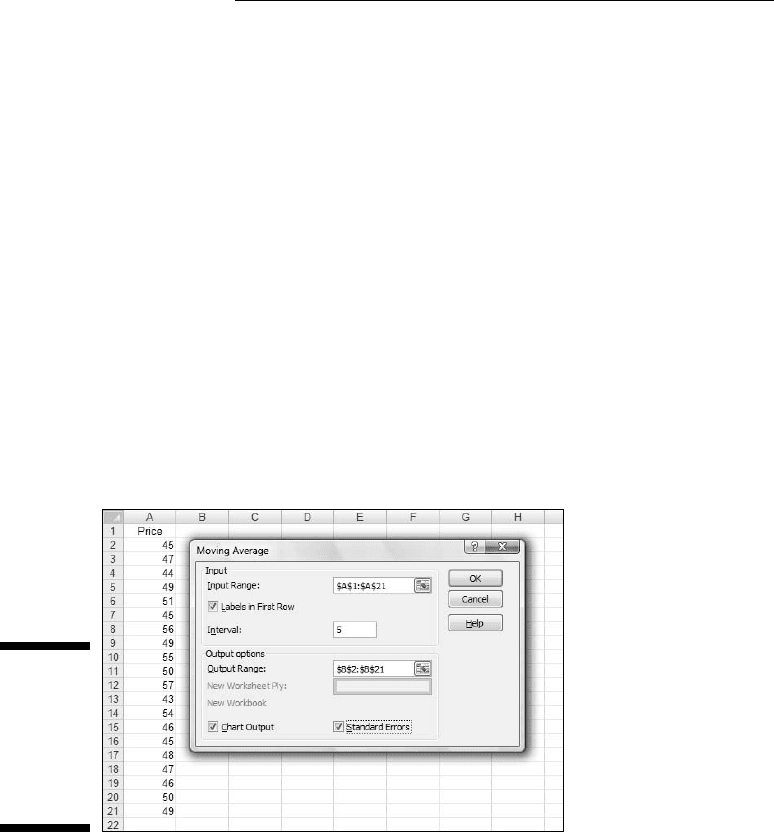
Excel’s Moving Average data analysis tool does the work for you. Figure 20-1
shows a fictional company’s stock prices for 20 days, and the dialog box for
the Moving Average tool.
Figure 20-1:
Fictional
stock prices
and the
Moving
Average
dialog box.
The figure shows my entries for Moving Average. The Input Range is cells A1
through A21, the Labels in First Row checkbox is checked, and the Interval
is 5. That means that each average consists of the most recent five days.
Cells B2 through B21 are the output range, and I checked the boxes for Chart
Output and for Standard Errors.
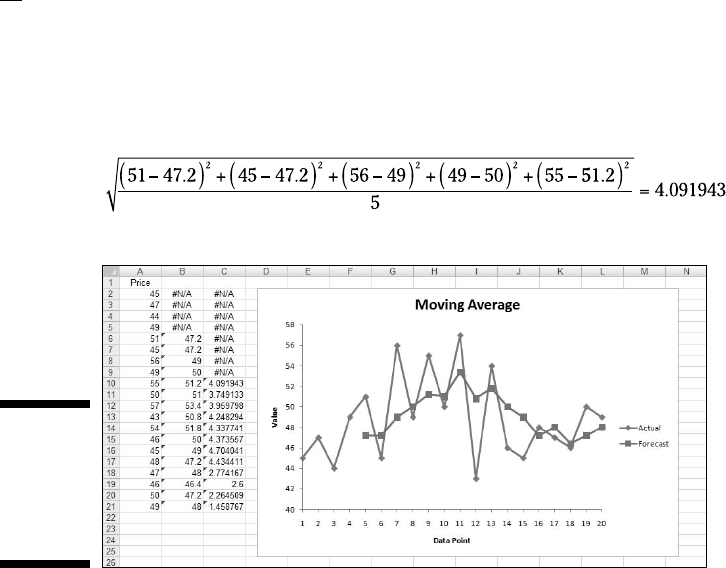
The results are in Figure 20-2. Ignore the ugly-looking #N/A symbols. Each
number in Column B is a moving average — a forecast of the price on the
basis of the most recent five days.
28 454060-ch20.indd 37628 454060-ch20.indd 376 4/21/09 7:38:51 PM4/21/09 7:38:51 PM
377
Chapter 20: Ten Things (Twelve, Actually) That Didn’t Fit in Any Other Chapter
Each number in Column C is a standard error. In this context, a standard
error is the square root of the average of the squared difference between the
price and the forecast for the previous five days. So the first standard error
in cell C10 is
Figure 20-2:
The results:
moving
averages
and stan-
dard errors.
The graph (stretched out from its original appearance and with a reformat-
ted vertical axis) shows the moving average in the series labeled Forecast.
Sometimes the forecast matches up with the data, sometimes it doesn’t.
As the figure shows, the moving average smoothes out the peaks and valleys
in the price data.
In general, how many scores do you include? That’s up to you. Include too
many and you risk obsolete data influencing your result. Include too few and
you risk missing something important.
How to be a smoothie, exponentially
Exponential smoothing is similar to a moving average. It’s a technique for
forecasting based on prior data. In contrast with the moving average, which
works just with a sequence of actual values, exponential smoothing takes its
previous prediction into account.
28 454060-ch20.indd 37728 454060-ch20.indd 377 4/21/09 7:38:51 PM4/21/09 7:38:51 PM
378
Part V: The Part of Tens
Exponential smoothing operates according to a damping factor, a number
between zero and one. With α representing the damping factor, the formula is
In terms of stock prices from the preceding example, yt’ represents the pre-
dicted stock price at a time t. If t is today, t-1 is yesterday. So yt-1 is yester-
day’s actual price and y’t-1 is yesterday’s predicted price. The sequence of
predictions begins with the first predicted value as the observed value from
the day before.
A larger damping factor gives more weight to yesterday’s prediction. A
smaller damping factor gives greater weight to yesterday’s actual value. A
damping factor of 0.5 weighs each one equally.
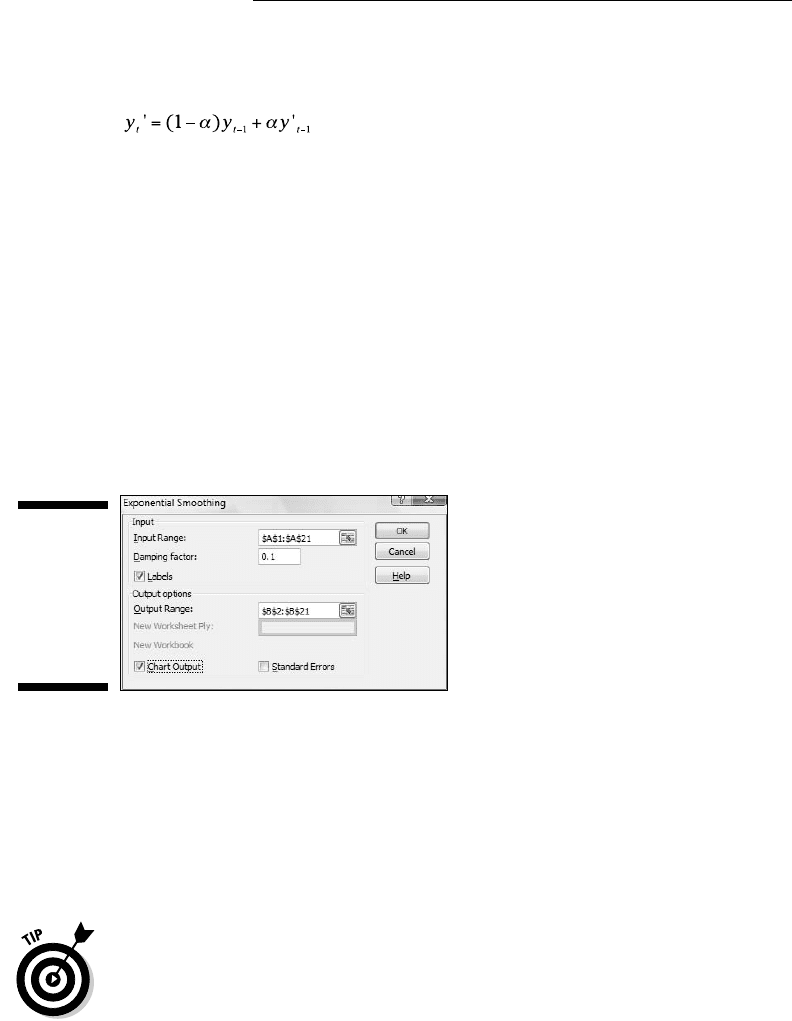
Figure 20-3 shows the dialog box for the Exponential Smoothing data
analysis tool. It’s similar to the Moving Average tool, except for the Damping
Factor box.
Figure 20-3:
The
Exponential
Smoothing
data
analysis tool
dialog box.
I applied Exponential Smoothing to the data from the previous example. I
did this three times with 0.1, 0.5, and 0.9 as the damping factors. Figure 20-4
shows the graphic output for each result.
The highest damping factor, 0.9, results in the flattest sequence of predic-
tions. The lowest, 0.1, predicts the most pronounced set of peaks and valleys.
How should you set the damping factor? Like the interval in the moving aver-
age, that’s up to you. Your experience and the specific area of application are
the determining factors.
In Appendix C, I show you another technique for smoothing. That one is based
on medians.
28 454060-ch20.indd 37828 454060-ch20.indd 378 4/21/09 7:38:52 PM4/21/09 7:38:52 PM