
Schmuller J. Statistical Analysis with Excel For Dummies
Подождите немного. Документ загружается.

389
Chapter 20: Ten Things (Twelve, Actually) That Didn’t Fit in Any Other Chapter
What could that answer possibly be? 10
2
means 10 × 10 and that gives you
100. 10
3
means 10 × 10 × 10 and that’s 1,000. But 453?
Here’s where you have to think outside the dialog box. You have to imag-
ine exponents that aren’t whole numbers. I know, I know . . . how can you
multiply a number by itself a fraction at a time? If you could, somehow, the
number in that 453 equation would have to be between 2 (which gets you to
100) and 3 (which gets you to 1,000).
In the 16th century, mathematician John Napier showed how to do it and
logarithms were born. Why did Napier bother with this? One reason is that
it was a great help to astronomers. Astronomers have to deal with numbers
that are . . . well . . . astronomical. Logarithms ease computational strain in a
couple of ways. One way is to substitute small numbers for large ones: The
logarithm of 1,000,000 is 6 and the logarithm of 100,000,000 is 8. Also, working
with logarithms opens up a helpful set of computational shortcuts. Before
calculators and computers appeared on the scene, this was a very big deal.
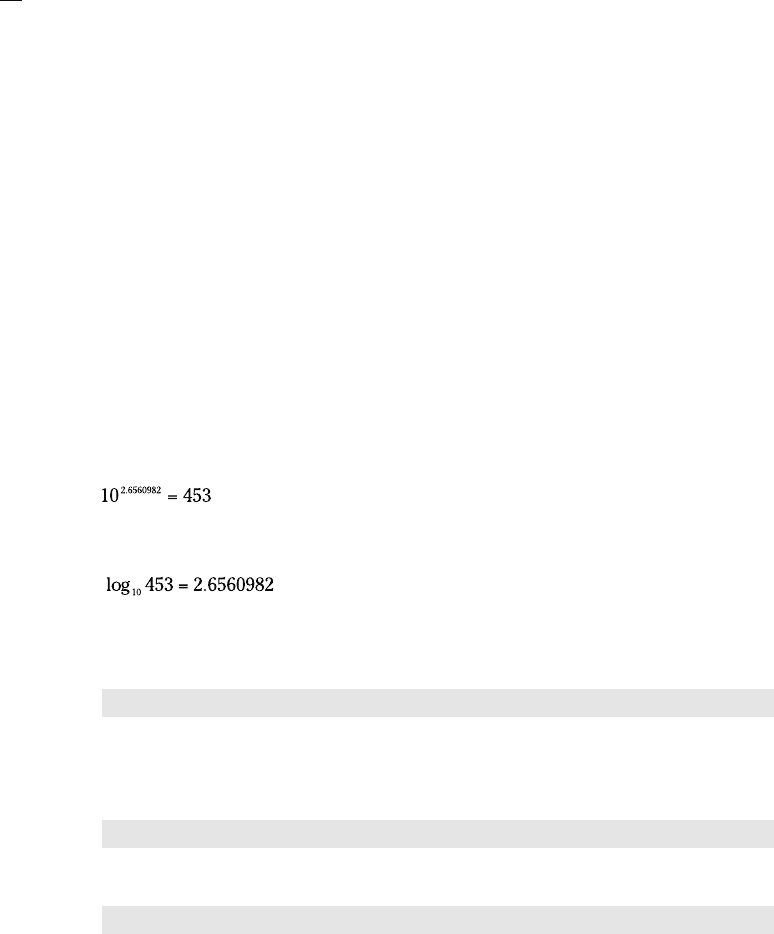
Incidentally,
meaning that
You can use Excel to check that out if you don’t believe me. Select a cell and
type
=LOG(453,10)
press Enter, and watch what happens. Then just to close the loop, reverse
the process. If your selected cell is — let’s say — D3, select another cell
and type
=POWER(10,D3)
or
=10^D3
Either way, the result is 453.
Ten, the number that’s raised to the exponent, is called the base. Because it’s
also the base of our number system and we’re so familiar with it, logarithms
of base 10 are called common logarithms.
28 454060-ch20.indd 38928 454060-ch20.indd 389 4/21/09 7:38:55 PM4/21/09 7:38:55 PM
390
Part V: The Part of Tens
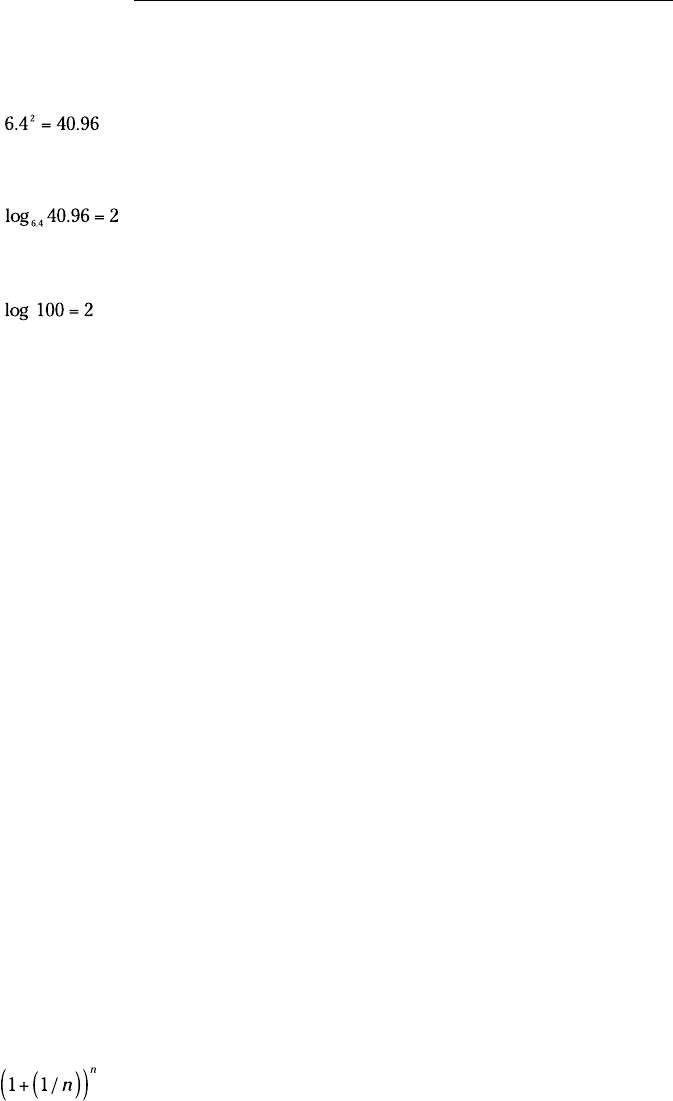
Does that mean you can have other bases? Absolutely. Any number (except 0
or 1 or a negative number) can be a base. For example,
So
If you ever see log without a base, base 10 is understood, so
In terms of bases, one number is special . . .
What is e?
Which brings me to e, a constant that’s all about growth. Before I get back to
logarithms, I’ll tell you about e.
Imagine the princely sum of $1 deposited in a bank account. Suppose the
interest rate is 2 percent a year. (Good luck with that.) If it’s simple interest,
the bank adds $.02 every year, and in 50 years you have $2.
If it’s compound interest, at the end of 50 years you have (1 + .02)
50
— which
is just a bit more than $2.68, assuming the bank compounds the interest once
a year.
Of course, if they compound it twice a year, each payment is $.01, and after
50 years they’ve compounded it 100 times. That gives you (1 + .01)
100
, or just
over $2.70. What about compounding it four times a year? After 50 years —
200 compoundings — you have (1 + .005)
200
which results in the don’t-spend-
it-all-in-one-place amount of $2.71 and a tiny bit more.
Focusing on “just a bit more” and a “tiny bit more,” and taking it to extremes,
after one hundred thousand compoundings you have $2.718268. After one
hundred million, you have $2.718282.
If you could get the bank to compound many more times in those 50 years,
your sum of money approaches a limit — an amount it gets ever so close to,
but never quite reaches. That limit is e.
The way I set up the example, the rule for calculating the amount is
28 454060-ch20.indd 39028 454060-ch20.indd 390 4/21/09 7:38:55 PM4/21/09 7:38:55 PM
391
Chapter 20: Ten Things (Twelve, Actually) That Didn’t Fit in Any Other Chapter
where n represents the number of payments. Two cents is 1/50th of a dollar
and I specified 50 years — 50 payments. Then I specified two payments a
year (and each year’s payments have to add up to 2 percent), so that in 50
years you have 100 payments of 1/100th of a dollar, and so on.
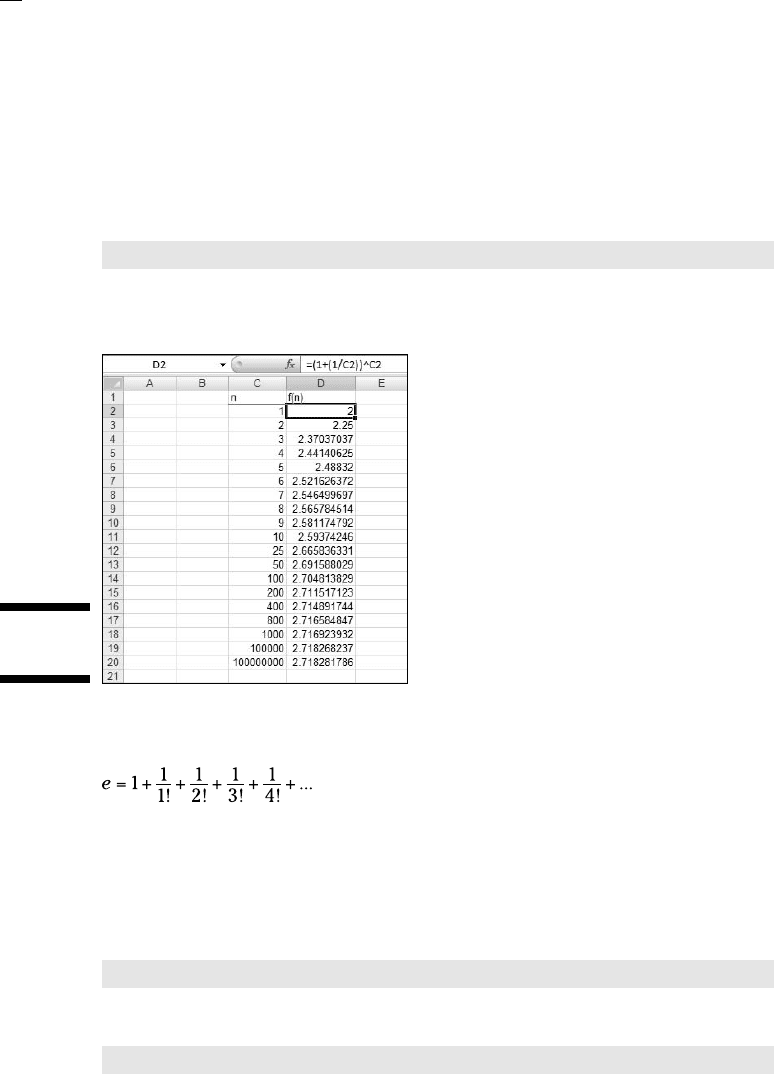
To see this in action, enter numbers into a column of a spreadsheet as I have
in Figure 20-14. In cells C2 through C20, I have the numbers 1 through 10 and
then selected steps through one hundred million. In D2, I put this formula
=(1+(1/C2))^C2
and then autofilled to D20. The entry in D20 is very close to e.
Figure 20-14:
Getting to e.
Mathematicians can tell you another way to get to e:
Those exclamation points signify factorial. 1! = 1, 2! = 2 X 1, 3! = 3 X 2 X 1. (For
more on factorials, see Chapter 16).
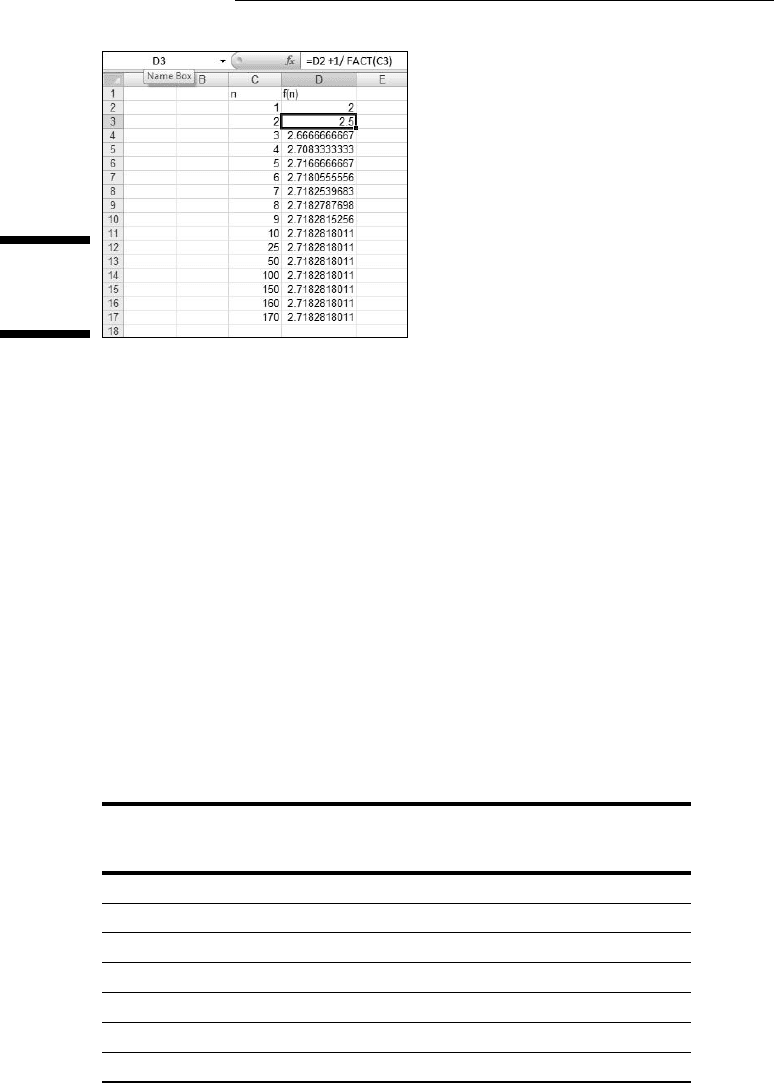
Excel helps visualize this one, too. Figure 20-15 lays out a spreadsheet with
selected numbers up to 170 in Column C. In D2, I put this formula:
=1+ 1/FACT(C2)
and, as the Formula Bar in the Figure shows, in D3 I put this one:
=D2 +1/ FACT(C3)
Then I autofilled up to D17. The entry in D17 is very close to e. In fact, from
D11 on, you see no change, even if you increase the amount of decimal places.
28 454060-ch20.indd 39128 454060-ch20.indd 391 4/21/09 7:38:55 PM4/21/09 7:38:55 PM
392
Part V: The Part of Tens
Figure 20-15:
Another
path to e.
Why did I stop at 170? Because that takes Excel to the max. At 171, you get an
error message.
So e is associated with growth. Its value is 2.781828 . . . The three dots mean
you never quite get to the exact value (like π, the constant that enables you
to find the area of a circle).
This number pops up in all kinds of places. It’s in the formula for the normal
distribution (see Chapter 8), and it’s in distributions I discuss in Chapter 17.
Many natural phenomena are related to e.
It’s so important that scientists, mathematicians, and business analysts use
it as the base for logarithms. Logarithms to the base e are called natural loga-
rithms. A natural logarithm is abbreviated as ln.
Table 20-2 presents some comparisons (rounded to three decimal places)
between common logarithms and natural logarithms:
Table 20-2 Some Common Logarithms (Log)
and Natural Logarithms (Ln)
Number Log Ln
e 0.434 1.000
10 1.000 2.303
50 1.699 3.912
100 2.000 4.605
453 2.656 6.116
1000 3.000 6.908
28 454060-ch20.indd 39228 454060-ch20.indd 392 4/21/09 7:38:56 PM4/21/09 7:38:56 PM
393
Chapter 20: Ten Things (Twelve, Actually) That Didn’t Fit in Any Other Chapter
One more thing. In many formulas and equations, it’s often necessary to raise
e to a power. Sometimes the power is a fairly complicated mathematical
expression. Because superscripts are usually printed in small font, it can be
a strain to have to constantly read them. To ease the eyestrain, mathemati-
cians have invented a special notation: exp. Whenever you see exp followed
by something in parentheses, it means to raise e to the power of whatever’s
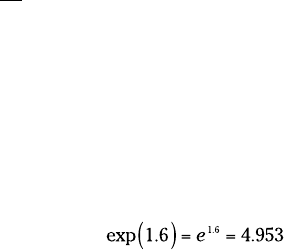
in the parentheses. For example,
Excel’s EXP function does that calculation for you.
Speaking of raising e, when Google, Inc., filed their IPO they said they wanted
to raise $2,718,281,828, which is e times a billion dollars rounded to the near-
est dollar.
On to the Excel functions.
LOGNORMDIST
A random variable is said to be lognormally distributed if its natural loga-
rithm is normally distributed. Maybe the name is a little misleading, because I
just said log means “common logarithm” and ln means “natural logarithm.”
Unlike the normal distribution, the lognormal can’t have a negative number
as a possible value for the variable. Also unlike the normal, the lognormal is
not symmetric — it’s skewed to the right.
Like the Weibull distribution I describe earlier, engineers use it to model the
breakdown of physical systems — particularly of the wear-and-tear variety.
Here’s where the large-numbers-to-small numbers property of logarithms
comes into play. When huge numbers of hours figure into a system’s life
cycle, it’s easier to think about the distribution of logarithms than the distri-
bution of the hours.
Excel’s LOGNORMDIST works with the lognormal distribution. You specify
a value, a mean, and a standard deviation for the lognormal. LOGNORMDIST
returns the probability that the variable is, at most, that value.
For example, the FarKlempt Robotics Inc. has gathered extensive hours-to-
failure data on a universal joint component that goes into their robots. They
find that hours-to-failure is lognormally distributed with a mean of 10 and a
standard deviation of 2.5. What is the probability that this component fails in,
at most, 10,000 hours?
28 454060-ch20.indd 39328 454060-ch20.indd 393 4/21/09 7:38:56 PM4/21/09 7:38:56 PM
394
Part V: The Part of Tens
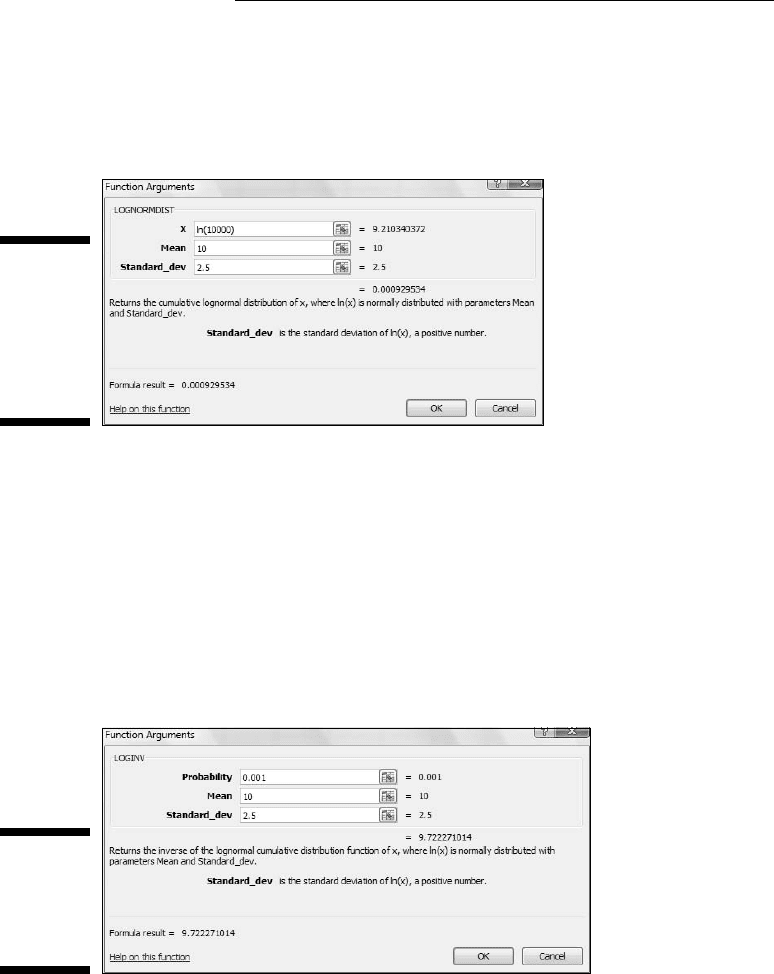
Figure 20-16 shows the LOGNORMDIST Function Arguments dialog box for
this example. In the X box, I entered ln(10000). I entered 10 into the Mean box
and 2.5 into the Standard_dev box. The dialog box shows the answer, .000929
(and some more decimals).
Figure 20-16:
The
LOGNORM
DIST
Function
Arguments
dialog box.
LOGINV
LOGINV turns LOGNORMDIST around. You supply a probability, a mean,
and a standard deviation for a lognormal distribution. LOGINV gives you the
value of the random variable that cuts off that probability.
To find the value that cuts off .001 in the preceding example’s distribution, I
used the LOGINV dialog box in Figure 20-17. With the indicated entries, the
dialog box shows that the value is 9.722 (and more decimals).
Figure 20-17:
The LOGINV
Function
Arguments
dialog box.
By the way, in terms of hours that’s 16,685 — just for .001.
28 454060-ch20.indd 39428 454060-ch20.indd 394 4/21/09 7:38:56 PM4/21/09 7:38:56 PM
395
Chapter 20: Ten Things (Twelve, Actually) That Didn’t Fit in Any Other Chapter
Array Function: LOGEST
In Chapter 14, I tell you all about linear regression. It’s also possible to have a
relationship between two variables that’s curvilinear rather than linear.
The equation for a line that fits a scatterplot is
One way to fit a curve through a scatterplot is with this equation:
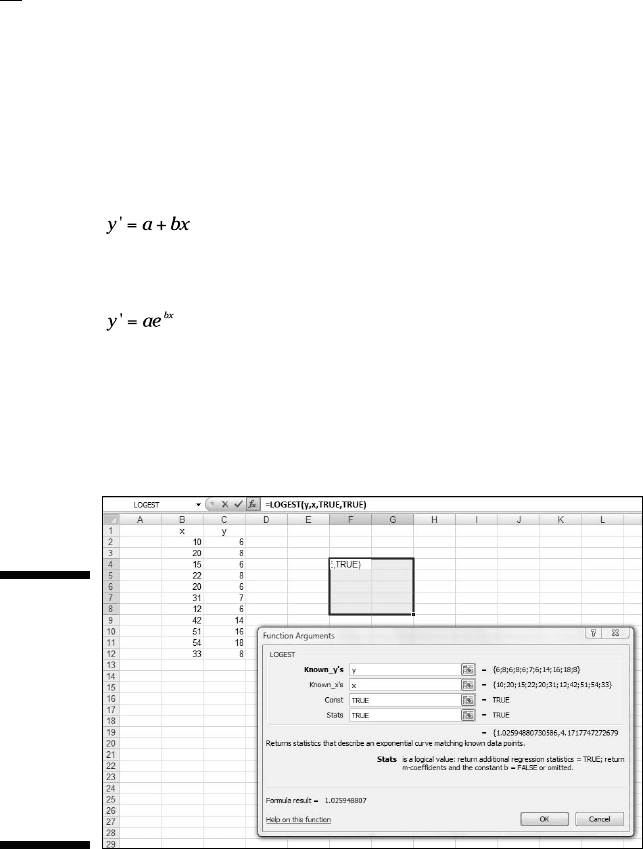
LOGEST estimates a and b for this curvilinear equation. Figure 20-18 shows
the LOGEST function arguments dialog box and the data for this example. It
also shows an array for the results. Before using this function, I attached the
name x to B2:B12 and y to C2:C12.
Figure 20-18:
The
Function
Arguments
dialog box
for LOGEST,
along with
the data and
the selected
array for the
results.
Here are the steps for this function:
1. With the data entered, select a five-row-by-two-column array of cells
for LOGEST’s results.
I selected F4:G8.
2. From the Statistical Functions menu, select LOGEST to open the
Function Arguments dialog box for LOGEST.
28 454060-ch20.indd 39528 454060-ch20.indd 395 4/21/09 7:38:56 PM4/21/09 7:38:56 PM
396
Part V: The Part of Tens
3. In the Function Arguments dialog box, type the appropriate values for
the arguments.
In the Known_y’s box, type the cell range that holds the scores for the
y-variable. For this example, that’s y (the name I gave to C2:C12).
In the Known_x’s box, type the cell range that holds the scores for the
x-variable. For this example, it’s x (the name I gave to B2:B12).
In the Const box, the choices are TRUE (or leave it blank) to calculate
the value of a in the curvilinear equation I showed you or FALSE to set a
to 1. I typed TRUE.
The dialog box uses b where I use a. No set of symbols is standard.
In the Stats box, the choices are TRUE to return the regression statistics
in addition to a and b, FALSE (or leave it blank) to return just a and b. I
typed TRUE.
Again, the dialog box uses b where I use a and m-coefficient where I use b.
4. IMPORTANT: Do NOT click OK. Because this is an array function,
press Ctrl+Shift+Enter to put LOGEST’s answers into the selected
array.
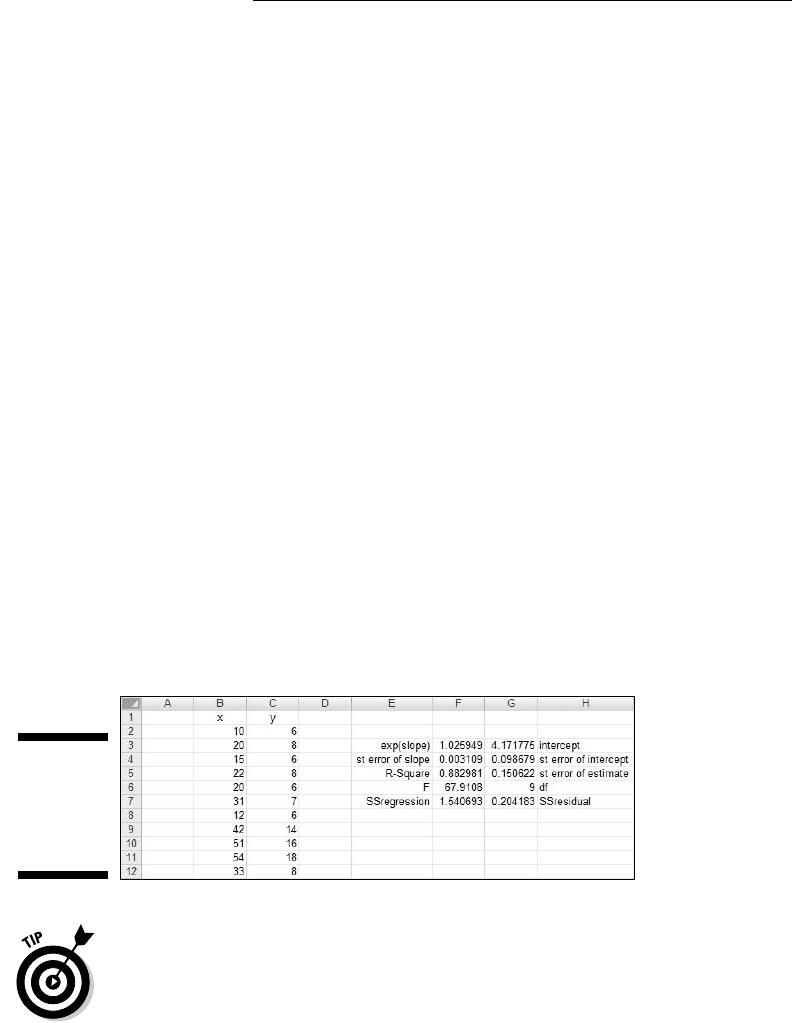
Figure 20-19 shows LOGEST’s results. They’re not labeled in any way, so I added
the labels for you in the worksheet. The left column gives you the exp(b) —
more on that in a moment, standard error of b, R Square, F, and the SS
regression
.
The right column provides a, standard error of a, standard error of estimate,
degrees of freedom, and SS
residual
. For more on these statistics, see Chapters
14 and 15.
Figure 20-19:
LOGEST’s
results in
the selected
array.
About exp(b). LOGEST, unfortunately, doesn’t return the value of b — the
exponent for the curvilinear equation. To find the exponent, you have to cal-
culate the natural logarithm of what it does return. Applying Excel’s LN work-
sheet function here gives 0.0256 as the value of the exponent.
28 454060-ch20.indd 39628 454060-ch20.indd 396 4/21/09 7:38:56 PM4/21/09 7:38:56 PM
397
Chapter 20: Ten Things (Twelve, Actually) That Didn’t Fit in Any Other Chapter
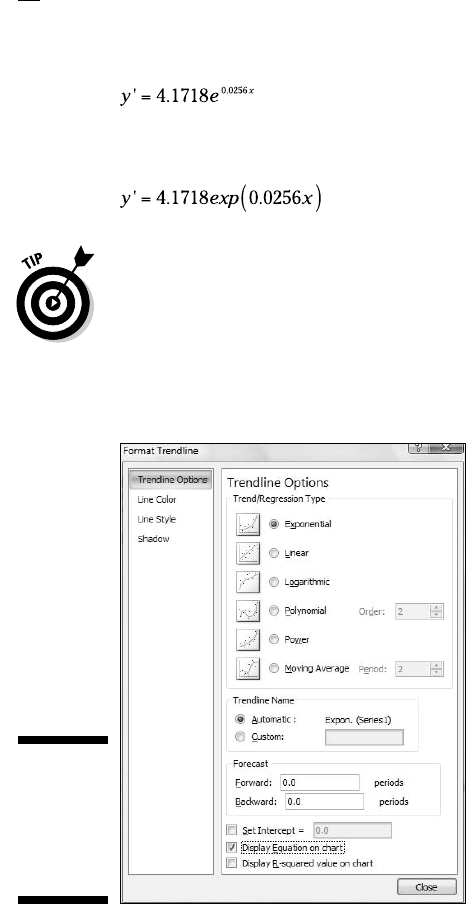
So the curvilinear regression equation for the sample data is:
or in that exp notation I told you about,
A good way to help yourself understand all of this is to use Excel’s graphics
capabilities to create a scatterplot. (See Chapter 3.) Then right-click on a data
point in the plot and select Add Trendline from the pop-up menu. That opens
the Format Trendline dialog box (Figure 20-20). Click the radio button next to
Exponential, as I’ve done in the figure. Also, as I’ve done in the figure, toward
the bottom of the dialog box click the checkbox next to Display Equation on
Chart.
Figure 20-20:
The Type
tab on
the Add
Trendline
dialog box.
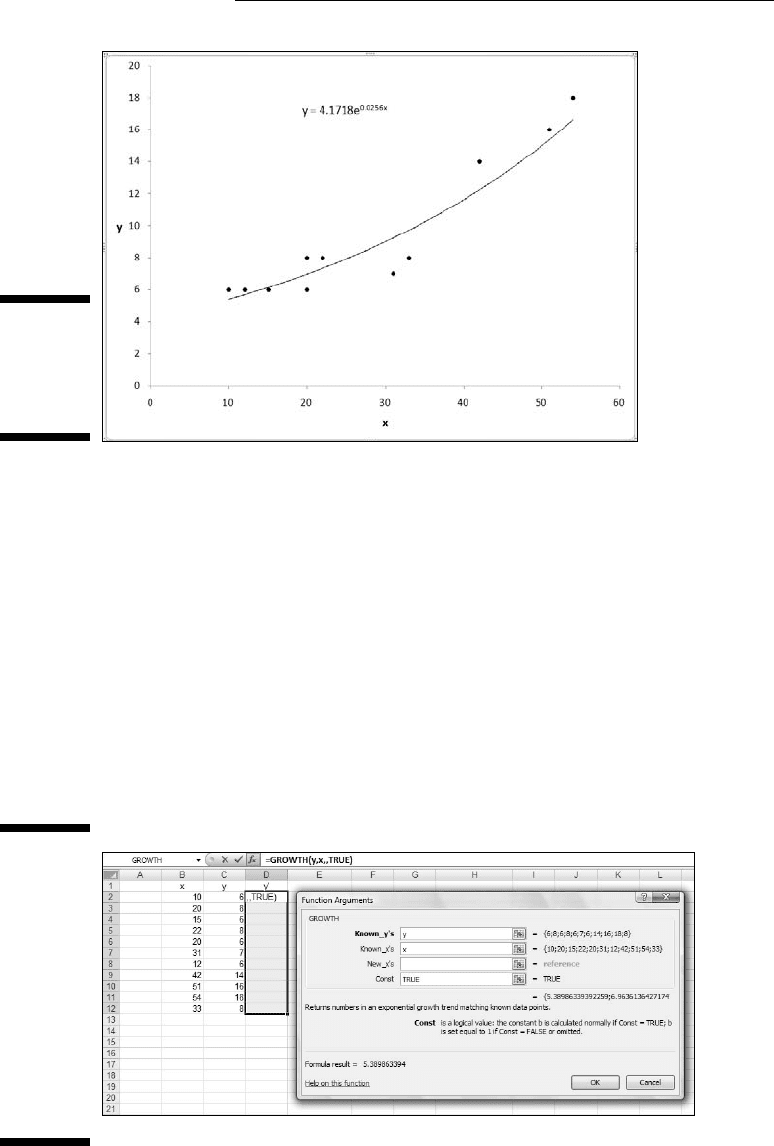
Click Close, and you have a scatterplot complete with curve and equation. I
reformatted mine in several ways to make it look clearer on the printed page.
Figure 20-21 shows the result.
28 454060-ch20.indd 39728 454060-ch20.indd 397 4/21/09 7:38:57 PM4/21/09 7:38:57 PM
398
Part V: The Part of Tens
Figure 20-21:
The scatter-
plot with
curve and
equation.
Array Function: GROWTH
GROWTH is curvilinear regression’s answer to TREND (Chapter 14). You can
use this function two ways — to predict a set of y-values for the x-values in
your sample, or to predict a set of y-values for a new set of x-values.
Predicting y’s for the x’s in your sample
Figure 20-22 shows GROWTH set up to calculate y’s for the x’s I already have.
I included the Formula Bar in this screen shot so you can see what the for-
mula looks like for this use of GROWTH.
Here are the steps:
Figure 20-22:
The Function
Arguments
dialog box
for GROWTH,
along with
the sample
data.
GROWTH
is set up
to predict
x’s for the
sample y’s.
28 454060-ch20.indd 39828 454060-ch20.indd 398 4/21/09 7:38:57 PM4/21/09 7:38:57 PM