
Seybold J.S. Introduction to RF Propagation
Подождите немного. Документ загружается.


In this case, the polarization loss factor will be greater than or less than 3 dB
depending upon the orientation and the axial ratio.
Figure 3.12 (b) shows the polarization loss factor for larger values of axial
ratio along the x-axis. Since a linearly polarized antenna can be represented
by an elliptical polarization with a large axial ratio, the far right-hand side of
Figure 3.12 (b) shows how the worst-case polarization loss levels-off when one
of the antennas tends toward linear polarization. From this plot, it can be seen
that if the circularly polarized antenna (or wave) has an ideal axial ratio of
0 dB, then the worst-case polarization loss is 3 dB. Otherwise, if the circularly
polarized antenna (or wave) is not ideal, then the actual circular-to-linear
polarization loss factor exceeds 3 dB as shown. A more precise estimate of the
polarization loss factor can be obtained by taking the limit of equation (3.12)
as either AR
w
or AR
w
go to infinity, if desired.
Example 3.5. A desired satellite signal is transmitted with right “circular”
polarization from an antenna having a 2-dB axial ratio. If the ground station
receive antenna has an axial ratio of 3 dB, what are the minimum and
maximum polarization loss that can be expected if environmental effects are
negligible? If another signal is simultaneously transmitted from the same satel-
lite antenna at the same frequency, but with left circular polarization, what is
the worst-case cross-polarization isolation that will occur?
The maximum polarization loss factor can be read from Figure 3.12 and is
The minimum can be found by setting t equal to 0 or 180 degrees and
evaluating either of the expressions for axial ratio. The resulting minimum
polarization loss factor is
which is negligible.
The cross-polarization isolation can be determined by using one minus the
worst-case polarization loss factor:
Thus the interfering cross-polarized signal will be only 11 dB below the desired
signal. 䊐
3.6 ANTENNA POINTING LOSS
In applications where directional antennas are used, it is customary to allow
for some antenna misalignment loss when computing the link budget.Antenna
XPD log dB
min
=-
()
=-10 1 10 11 1
10F
.
F
min
dB=-001.
F
max
dB=-035.
62 ANTENNA FUNDAMENTALS
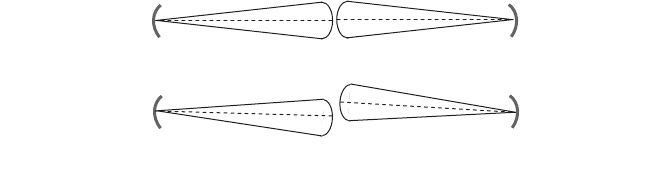
misalignment means that the received signal is not received at the peak of the
antenna beam and/or the portion of transmit signal that is received did not
come from the peak of the transmit antenna beam. This is shown pictorially
in Figure 3.13. While the potential for misalignment is intuitive for mobile
systems or systems tracking mobile satellites, it is also an issue for static links.
Pointing loss can occur in several ways.The initial antenna alignment is seldom
perfect; on a point-to-point link, each end must be aligned. In addition, effects
such as wind, age, and thermal effects may all contribute to changing the
antenna alignment over time. Variation in atmospheric refraction can produce
time-varying pointing error, which can be challenging to identify.
For systems with active tracking on one end of the link, the tracking loss
must take into account the track loop errors as well as any error introduced
by the tracking process.A track loop must move the peak of the antenna beam
about the actual track point to generate a tracking error signal for position
correction. This process of scanning will result in a certain amount of signal
loss (scan loss) that must be factored into the link budget. Most tracking loops
require 0.5 to 1 dB of tracking signal variation for stable tracking.
3.7 SUMMARY
The antenna serves as the interface between system electronics and the prop-
agation medium. The principle of reciprocity states that an antenna performs
the same whether transmitting or receiving, which simplifies analysis and
measurement. Antenna gain and directivity define the amplitude of the
antenna pattern in the direction of maximum radiation (or reception). The
gain of an antenna can be estimated using the concept of effective area for
aperture antennas or effective height for linear antennas. Antenna gain,
mainlobe width, and sidelobe levels are key concerns in antenna design or
analysis.
The performance of an antenna varies with the distance from the antenna.
The antenna’s far-field, where the distance is greater than twice the square of
the antennas largest linear dimension divided by the wavelength, is most often
the region where the parameters are defined and specified. The reactive near-
SUMMARY 63
Antennas Misaligned
Antennas Aligned
Figure 3.13 Antenna alignment and misalignment for a point-to-point link using
directional antennas.
field is defined as the region where the distance is less than the wavelength
divided by two pi. In the reactive near-field, the antenna pattern does not
apply, and in fact the illumination function of the antenna will be present.
Objects in the reactive near-field will couple with the antenna and alter the
far-field pattern. The radiating near-field is the region between the reactive
near-field and the far-field. In the radiating near-field, the antenna pattern is
starting to take shape, but the amplitude in a particular direction may still vary
with distance from the antenna. In this region, the radiated wave front is still
spherical, versus nearly planar in the far-field.
There are a wide variety of antenna types and development continues.
For most applications, antennas are required to transmit/receive either linear
(vertical or horizontal) or elliptical (right-hand or left-hand) polarization.
Any mismatch between the received wave and the receive antenna may lead
to signal loss and reduction in rejection of the orthogonal polarization at
the receive side of the link. The polarization loss factor and cross-polarization
discrimination are often included in link budgets, particularly for satellite
links.
REFERENCES
1. W. L. Stutzman and G. A. Thiele, Antenna Theory and Design, 2nd ed., Wiley,
Hoboken, NJ, 1998 pp. 404–409.
2. A. V. Oppenheim and R. W. Schafer, Digital Signal Processing, Prentice-Hall,
Englewood Cliffs, NJ, 1975, pp. 239–250.
3. F. J. Harris, On the use of windows for harmonic analysis with the discrete fourier
transform, Proceedings of the IEEE, Vol. 66, No. 1, January 1978, pp. 51–83.
4. M. I. Skolnik, Introduction to Radar Systems, 3rd ed., McGraw-Hill, New York,
2001, p. 541.
5. W. L. Stutzman and G. A. Thiele, Antenna Theory and Design, 2nd ed., Wiley,
Hoboken, NJ, 1998, p. 77.
6. J. D. Kraus and R. J. Marhefka, Antennas for All Applications, 3rd ed., McGraw-
Hill, New York, 2002, pp. 30–36.
7. J. D. Kraus and R. J. Marhefka, Antennas for All Applications, 3rd ed., McGraw-
Hill, New York, 2002, p. 31.
8. C.A. Balanis, Antenna Theory, Analysis and Design, 2nd ed.,Wiley, New York, 1997,
p. 164.
9. M. I. Skolnik, Introduction to Radar Systems, 3rd ed., McGraw-Hill, New York,
2001, p. 625.
10. The ARRL Handbook for Radio Amateurs, ARRL, Newington, CT, 1994, Table 41,
Chapter 35, p. 38.
11. The ARRL Handbook for Radio Amateurs, ARRL, Newington, CT, 1994, Figure
24, p. 16-5.
12. C.A. Balanis, Antenna Theory, Analysis and Design, 2nd ed.,Wiley, New York, 1997,
pp. 32–34.
64
ANTENNA FUNDAMENTALS
13. K. Siwiak, Radiowave Propagation and Antennas for Personal Communications,
2nd ed., Artech House, Norwood, MA, 1998, pp. 352–353.
14. W. L. Stutzman and G. A. Thiele, Antenna Theory and Design, 2nd ed., Wiley,
Hoboken, NJ, 1998, pp. 187–195.
15. J. Liberti, Jr. and T. S. Rappaport, Smart Antennas for Wireless Communications:
IS-95 and Third Generation CDMA Applications, Prentice-Hall, Upper Saddle
River, NJ, 1999.
16. J. D. Kraus and R. J. Marhefka, Antennas for All Applications, 3rd ed., McGraw-
Hill, New York, 2002, p. 45.
17. J. S. Hollis, T. J. Lyon, and L. Clayton, Microwave Antenna Measurements, 2nd ed.,
Scientific Atlanta, Atlanta, GA, 1970, Chapter 3.
18. J. D. Kraus and R. J. Marhefka, Antennas for All Applications, 3rd ed., McGraw-
Hill, New York, 2002, p. 46.
19. J. D. Kraus and R. J. Marhefka, Antennas for All Applications, 3rd ed., McGraw-
Hill, New York, 2002, pp. 47–52.
EXERCISES
1. What is the approximate gain of a circular dish antenna with 30-cm diam-
eter at 40 GHz? Assume a total efficiency of 65% and give your answer in
dB.
2. What is the approximate gain of a rectangular antenna dish with dimen-
sions 100 cm by 20 cm at 10 GHz? Assume a total efficiency of 60%.
3. If a system can tolerate 0.5 dB of antenna mismatch loss, what are the
minimum and maximum acceptable antenna driving point impedances?
Assume that the system’s characteristic impedance is 50ohms.
4. Generate a plot of antenna mismatch loss versus VSWR.
5. What is the minimum and maximum possible polarization loss factor for a
point-to-point communication system if each of the antennas used has an
axial ratio of 2 dB. You may neglect environmental effects.
6. What are the effective height and effective area of a 0.1 wavelength dipole
antenna if the antenna is resonant at 80 MHz?
7. If an aperture antenna has -17-dB sidelobes and the EIRP is 100dBW, what
is the worst-case power density that will be received at a distance of 2 m
from the antenna if the receiver is outside of the transmit antenna’s
mainlobe?
EXERCISES 65

66
Introduction to RF Propagation, by John S. Seybold
Copyright © 2005 by John Wiley & Sons, Inc.
CHAPTER 4
Communication Systems and
the Link Budget
4.1 INTRODUCTION
This chapter treats the basics of communication systems analysis. It is valuable
to design a communication system for the intended environment and to
predict, with relative certainty, the system performance prior to fabrication
and deployment. Radio-frequency (RF) planning for networks such as cellu-
lar telephone systems or wireless local area networks (LANs) is a key part of
network deployment. Insufficient planning can result in overdesign and wasted
resources or under design and poor system performance. Prior to planning a
network, the parameters controlling the performance of each individual link
must be understood.The essential parameters are the received signal strength,
the noise that accompanies the received signal, and any additional channel
impairments beyond attenuation, such as multipath or interference.
For link planning, a link budget is prepared that accounts for the transmit-
ter effective isotropically radiated power (EIRP) and all of the losses in the
link prior to the receiver [1]. Depending upon the application, the designer
may also have to compute the noise floor at the receiver to determine the
signal level required for signal detection. The link budget is computed in deci-
bels (dB), so that all of the factors become terms to be added or subtracted.
Very often the power levels are expressed in dBm rather than dBW due to
the power levels involved. It is important that consistency of units be main-
tained throughout a link budget analysis.
The link margin is obtained by comparing the expected received signal
strength to the receiver sensitivity or threshold (in satellite systems, the term
sensitivity has a different meaning). The link margin is a measure of how much
margin there is in the communications link between the operating point and the
point where the link can no longer be closed.The link margin can be found using
Link margin EIRP TH=-+-LG
Path Rx Rx

where
EIRP is the effective isotropically radiated power in dBW or dBm
L
Path
is the total path loss, including miscellaneous losses, reflections, and
fade margins in dB
G
Rx
is the receive gain in dB
TH
Rx
is the receiver threshold or the minimum received signal level that
will provide reliable operation (such as the desired bit error rate per-
formance) in dBW or dBm
The available link margin depends upon many factors, including the type of
modulation used, the transmitted power, the net antenna gain, any waveguide
or cable loss between transmitter and antenna, radome loss, and most signifi-
cantly the path loss. The modulation affects the link margin by changing the
required E
b
/N
0
* or SNR. The antenna gains, transmission losses, and trans-
mitted power all directly affect the link budget. The path loss is the most sig-
nificant factor because of its magnitude relative to the other terms. The path
loss includes geometric spreading loss or free-space loss (FSL) as well as envi-
ronmental factors. The term path loss is sometimes used to refer to free-space
loss and sometimes refers to the entire path loss experienced by a communi-
cation link. The intended meaning should be clear from the context.
4.2 PATH LOSS
Path loss is the link budget element of primary interest in this text as it relates
to the topic of RF propagation. The path loss elements include free-space loss
(if appropriate; otherwise a median loss is computed using other methods as
discussed in later chapters), atmospheric losses due to gaseous and water
vapor absorption, precipitation, fading loss due to multipath, and other mis-
cellaneous effects based on frequency and the environment.
If the principal path is governed by free-space loss, it is calculated using the
Friis free-space loss equation, which can be expressed as
(4.1)
As shown here, L is actually a gain (albeit less than unity) rather than a loss.
This will be addressed shortly. Note that the Friis equation includes transmit
and receive antenna gain. In certain applications, the exponent in the free-
space loss equation is a value other than 2. This reflects the geometry of the
environment and is covered in later chapters. If a so-called modified power
LGG
d
TR
=
Ê
Ë
ˆ
¯
l
p4
2
PATH LOSS 67
* E
b
/N
0
is the energy per bit divided by the noise power spectral density (see Section 4.5.5).

law is used, then, strictly speaking, it is not free-space loss, but rather repre-
sents a mean or median path loss in a lossy environment such as near-earth
propagation. The examples in this chapter are restricted to square-law free-
space loss.
The antenna gain accounts for the antenna directivity and efficiency,
while the inverse distance squared term accounts for the spherical wave-front
(geometric) spreading. The dependence on wavelength is an artifact of using
the receive antenna gain in the equation rather than the antenna effective
area.
The Friis free-space loss equation can be expressed in dB as
(4.2)
where a negative sign has been included so that the value of L
dB
is, in fact, a
loss. One way to look at this is that a loss is simply the negative of a gain when
expressed in dB. While the subtleties of this are not essential, keeping the signs
straight when performing a link budget certainly is.
In many applications, the antenna gains are excluded from the path loss
expression, in which case the free-space loss is
(4.3)
Example 4.1. Consider a 100-m link that operates in free space at 10 GHz.
Assume that the transmit power is 0.1 W, and both transmit and receive anten-
nas have 5-dB gain. If the receiver threshold is -85 dBm, what is the available
link margin?
The first step is to compute the EIRP of the transmitter. Since the receive
threshold is given in dBm, it is helpful to have EIRP in dBm as well.
Then, since
or, in dB
and the path loss is
PL
d
=-
Ê
Ë
ˆ
¯
=20
4
92 4log dB
l
p
.
EIRP 25 dBm
dB TdB TdB
PG=+ =
EIRP mW= PG
TT
P
T
==100 20mW dBm
L
d
FSL dB
=-
Ê
Ë
ˆ
¯
20
4
log
l
p
LGG d
dB TdB RdB
=- - -
()
+
()
+20 20 22log logl
68 COMMUNICATION SYSTEMS AND THE LINK BUDGET

The resulting link margin is
䊐
There are additional sources of signal loss within the transmitter and receiver.
These losses must also be accounted for (as was done in Example 4.1) in order
to accurately predict the received signal level and the resulting signal-to-noise
ratio. Sometimes the magnitude of these effects will be specified by the equip-
ment designer or manufacturer. When they are not known, an experienced
analyst can estimate them reasonably well.
Some of the additional loss factors include band-limiting and/or modula-
tion loss.Transmit filters control spectral spreading but add insertion loss, while
some types of digital modulation have lower efficiency due to transmitted
carrier components (i.e., the signal power is somewhat less that the bit energy
times the bit rate, E
b
R
b
).
If there is a radome covering the antenna, it may reduce the effective
antenna gain and increase antenna noise. This problem is exacerbated when
the radome is dirty or wet. In addition, any waveguide or cable used to connect
to the antenna is a source of loss and of additional noise. It is important that
waveguides be intact and fitted properly and that coaxial cables be appropri-
ate for the frequency and be in good condition. Kinked or deteriorated coaxial
cable can produce significant loss at either the transmitter or the receiver.
Point-to-point links often use directional antennas to increase the energy
directed at the receiver. This can either increase range or reduce the required
transmit power to close the link. If the directional antennas are not perfectly
aligned, however, the effective antenna gain is reduced. Depending upon the
application, a dB or two may be allocated to pointing loss in the link budget.
If there is a directional antenna on each end of the link, there will be some
pointing loss allocated to transmit and some to receive. Another loss contrib-
utor is polarization loss that depends upon the relative orientation of the trans-
mit and receive polarization vectors and the axial ratio of each antenna. A
mismatch in the transmit and receive polarization vector alignment reduces
energy transfer and becomes a source of loss. This is of minor importance on
fixed, point-to-point links, but is a consideration for mobile applications and
satellite systems. Finally, atmospheric loss due to such factors as rain, water
vapor absorption, and oxygen absorption can be significant for long links at
high frequencies.A detailed discussion concerning the prediction of rain atten-
uation is presented in Chapter 10, and a discussion of atmospheric losses is
presented in Chapter 6.
4.3 NOISE
The key receiver characteristic that determines link performance is the receive
threshold or sensitivity. The threshold is the minimum signal strength required
M
L
=- +--
()
=25 92 4 55 85 22 6..dB
NOISE 69

for acceptable operation. If the threshold is not known or specified, then a
required signal-to-noise ratio or bit energy to noise power spectral density
ratio (E
b
/N
0
) for desired operation or probability of detection must be pro-
vided. For most terrestrial systems, the noise is set by the receiver front-end
characteristics and the bandwidth. For satellite ground station receivers, the
antenna temperature may be very low, which will reduce the noise floor. Since
the antenna temperature for a skyward looking antenna may be less than
290 K, losses in the path may reduce the signal level and increase the noise
temperature. This is discussed in Chapter 11. For the purpose of this chapter,
all losses and antennas are at 290 K, so the effect of losses is simply to reduce
the signal level while the noise stays at the same level.
Receiver noise is caused by the thermal agitation of electrons, called
Brownian motion, in the front end of the receiver [2]. This noise is modeled
as having a Gaussian amplitude distribution. In addition, it is modeled as
having a flat (constant) power spectral density of N
0
/2, meaning that the power
density is the same over all frequencies of interest. Thus thermal noise usually
characterized as “white”. Finally, the thermal noise is additive in nature (i.e.,
independent of the actual signal involved). So thermal noise is modeled as
additive white Gaussian noise (AWGN).
The theoretical thermal noise power available to a matched load is
(4.4)
where
This represents the amount of noise power present at the input to a perfect
receiver that is driven by a matched load (such as an antenna).
The noise power available at the output of a linear filter is given by [3]
(4.5)
Since the power spectral density of the noise is constant for AWGN, it can be
brought out of the integral. Since
(4.5) can be rewritten as
(4.6)
N
N
Hf df=
()
-•
•
Ú
0
2
4p
Gf N kT
N
()
==
00
2
NGfHfdf
N
=
() ()
-•
•
Ú
1
2
2
p
k
T
B
=¥
()
=
()
=
()
-
138 10
290
23
0
. J K Boltzman’s constant
K standard noise temperature
noise-equivalent bandwidth Hz
NkTB=
0
70 COMMUNICATION SYSTEMS AND THE LINK BUDGET
Using the fact that the integrand in the above equation will be even for real
filters, the equation for the total noise power becomes
where B is the noise equivalent bandwidth, defined by [4]
(4.7)
and N
0
is twice the value of the (two-sided) noise power spectral density. Note
that the lower limit of integration was changed to accommodate the factor of
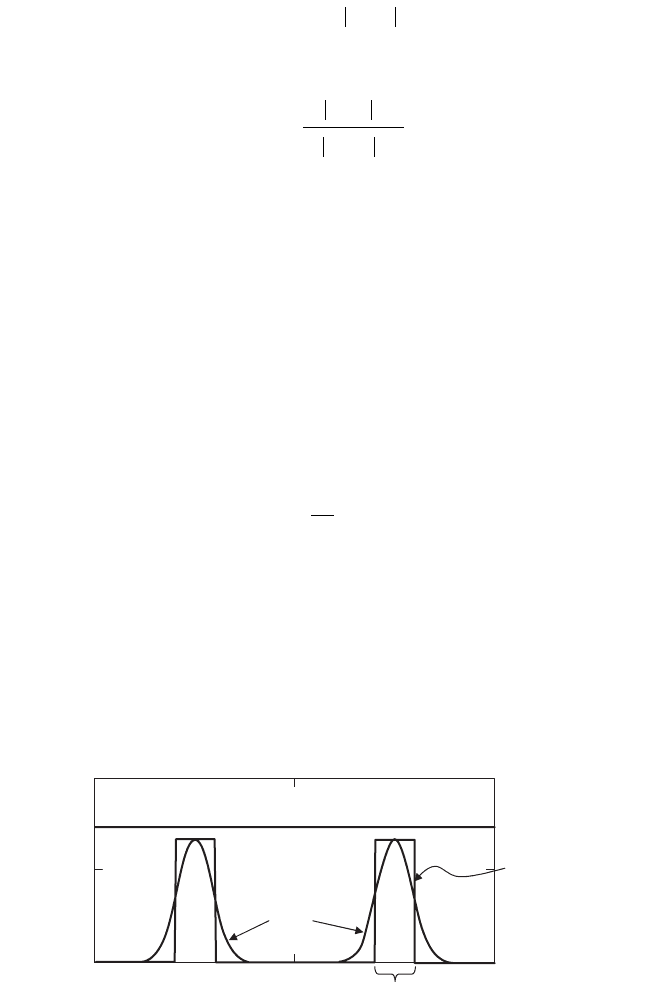
two that was included with the noise power spectral density. Figure 4.1 shows
the spectra of the noise power density, a representative band-pass character-
istic and the corresponding ideal bandpass filter. The noise equivalent band-
width is the width of the ideal bandpass filter as shown. Often the filter is
treated as unity gain, so that |H(f
0
)|
2
= 1. The actual gain or loss of the filter is
then included elsewhere in the computation.
The noise-equivalent bandwidth is the bandwidth of an ideal bandpass filter
that would pass the same amount of white noise power as the system being
analyzed. In most modern digital communication systems, it is closely approxi-
mated by
(4.8)
where a root-raised cosine or similar filter used to shape the symbol and T
S
is
the symbol duration. The 3-dB bandwidth is sometimes a good approximation
to the noise equivalent bandwidth and is often used as such, particularly when
detailed information on the system response is not available. Modern test
instruments provide the capability to rapidly measure the noise-equivalent
bandwidth, which greatly simplifies the task.
B
T
N
S
=
1
Hz
B
Hf df
Hf
=
()
()
•
Ú
2
0
0
2
NNBHf=
()
00
2
NOISE 71
Frequency
N
0
/2
|H( f )|
2
B
Ideal BPF
Figure 4.1 Noise power spectral density along with actual and ideal filter responses.