
Smith R., Minton R. Calculus
Подождите немного. Документ загружается.

P1: OSO/OVY P2: OSO/OVY QC: OSO/OVY T1: OSO
MHDQ256-Ch14 MHDQ256-Smith-v1.cls January 5, 2011 10:17
LT (Late Transcendental)
CONFIRMING PAGES
14-63 SECTION 14.8
..
Change of Variables in Multiple Integrals 963
also change the limits of integration to suit the new variable. In this case, when x = 0, we
have u = 0
2
+ 3 = 3 and when x = 2, u = 2
2
+ 3 = 7. This leaves us with
2
0
2xe
x
2
+3
dx =
2
0
e
x
2
+3
e
u
(2x)dx
du
=
7
3
e
u
du = e
u
7
3
= e
7
− e
3
.
The primary reason for making the preceding change of variable was to make it easier to
find an antiderivative. Notice that while we transformed the integrand, we also changed the
interval over which we were integrating.
y
x
3
3
R
FIGURE 14.66a
The region of integration in the
xy-plane
You should recognize that we have already implemented changes of variables in mul-
tiple integrals in the very special cases of polar coordinates (for double integrals) and
cylindrical and spherical coordinates (for triple integrals). There were several reasons for
doing this. For instance, the iterated integral
3
0
√
9−x
2
0
cos(x
2
+ y
2
)dydx
cannotbeevaluated asit iswritteninrectangularcoordinates.(Tryit!)However, recognizing
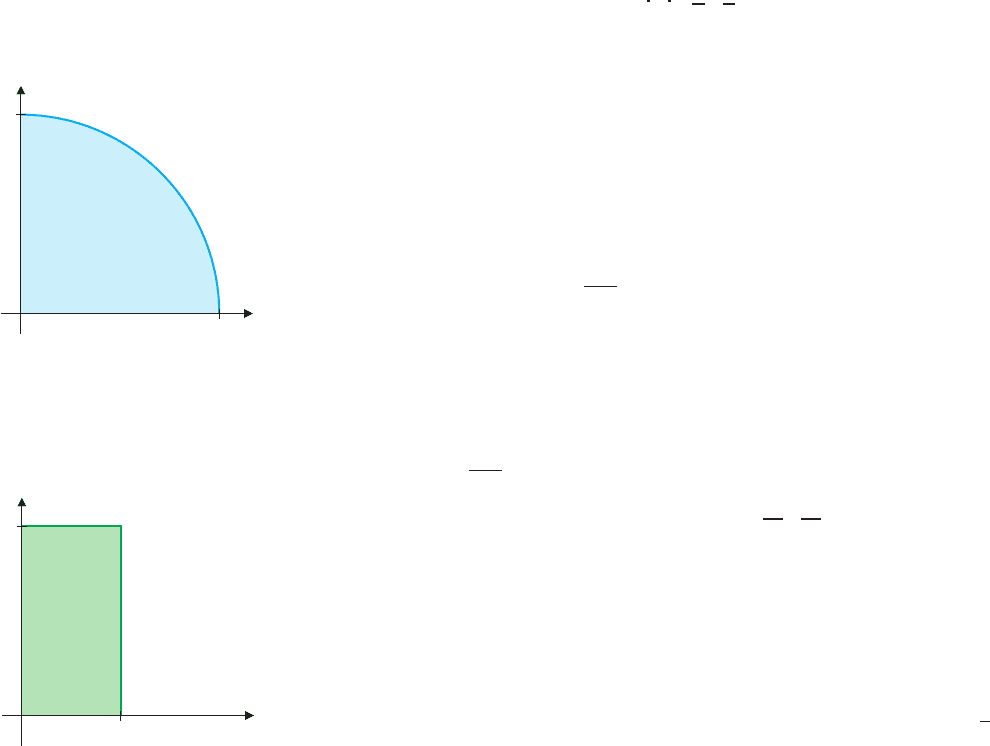
that the region of integration R is the portion of the circle of radius 3 centered at the origin
that lies in the first quadrant (see Figure 14.66a), and since the integrand includes the term
x
2
+ y
2
, it’s a good bet that polar coordinates will help. In fact, we have
3
0
√
9−x
2
0
cos(x
2
+ y
2
)dydx =
R
cos(x
2
+ y
2
)
r
2
dA
rdrdθ
=
π/2
0
3
0
cos(r
2
)rdrdθ,
whichisnowaneasyintegraltoevaluate.Noticethattherearetwothingsthathappenedhere.
First, we simplified the integrand (into one with a known antiderivative) and second, we
transformed the region over which we integrated, as follows. In the xy-plane, we integrated
over the circular sector indicated in Figure 14.66a, while in the rθ-plane, we integrated
over a (simpler) region: the rectangle S defined by S ={(r,θ)|0 ≤ r ≤ 3 and 0 ≤ θ ≤
π
2
},
as indicated in Figure 14.66b.
r
u
3
q
S
O
FIGURE 14.66b
The region of integration in the
rθ -plane
Recall that we changed to cylindrical or spherical coordinates in triple integrals for
similar reasons. In each case, we ended up simplifying the integrand and transforming the
region of integration. More generally, how do we change variables in a multiple integral?
Before we answer this question, we must first explore the concept of transformation in
several variables.
A transformation T from the uv-plane to the xy-plane is a function that maps points
in the uv-plane to points in the xy-plane, so that
T (u,v) = (x, y),
where
x = g(u,v) and y = h(u,v),
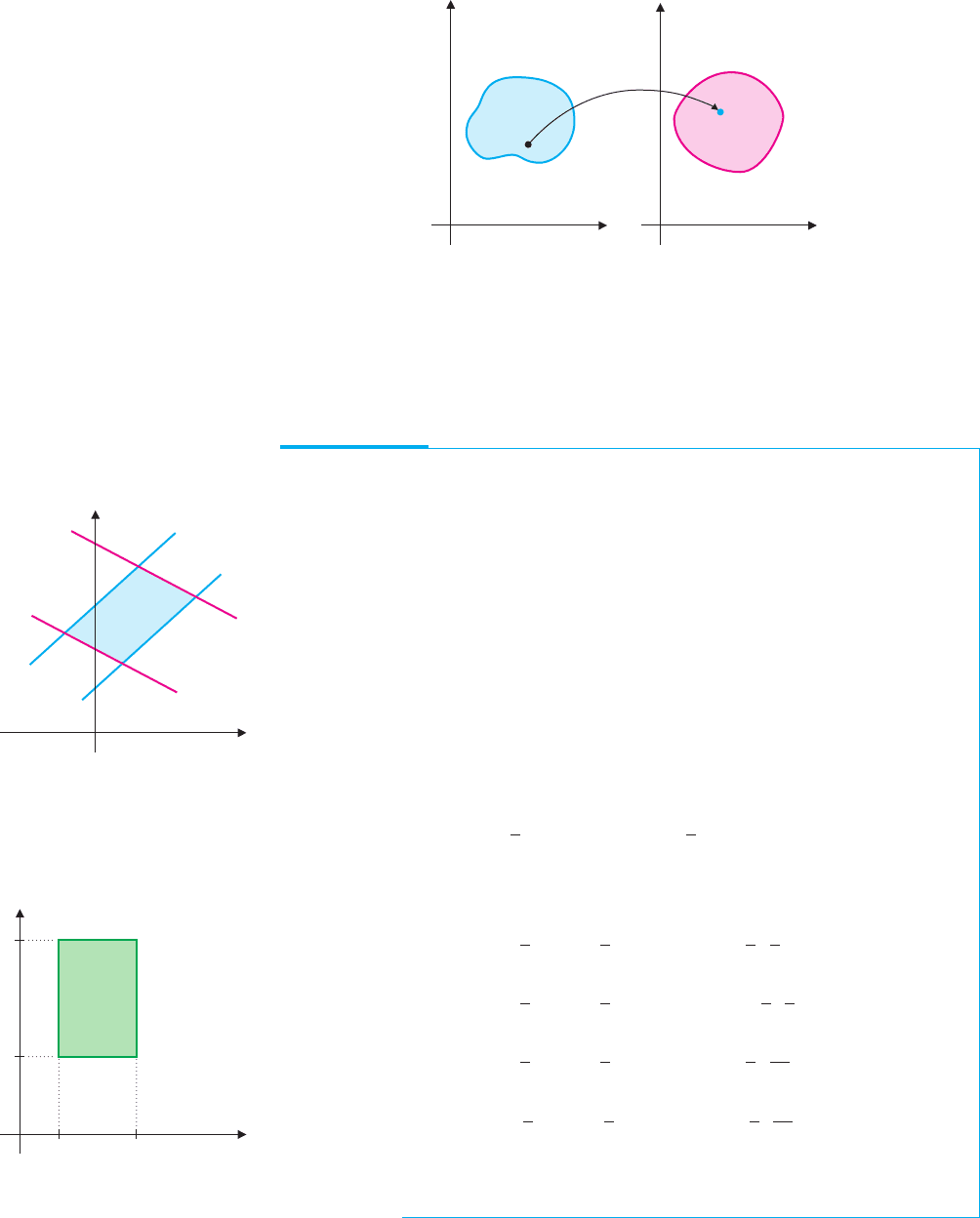
for some functions g and h. We consider changes of variables in double integrals as defined
by a transformation T from a region S in the uv-plane onto a region R in the xy-plane. (See
Figure14.67onthefollowingpage.)WerefertoR astheimage ofS underthetransformation
T . We say that T is one-to-one on S if for every point (x, y)inR there is exactly one point
(u,v)inS such that T (u,v) = (x, y). Notice that this says that (at least in principle), we
can solve for u and v in terms of x and y. Further, we consider only transformations for
which g and h have continuous first partial derivatives in the region S.
The primary reason for introducing a change of variables in a multiple integral is
to simplify the calculation of the integral. This is accomplished by simplifying the inte-
grand, the region over which you are integrating or both. Before exploring the effect of a
P1: OSO/OVY P2: OSO/OVY QC: OSO/OVY T1: OSO
MHDQ256-Ch14 MHDQ256-Smith-v1.cls January 5, 2011 10:17
LT (Late Transcendental)
CONFIRMING PAGES
964 CHAPTER 14
..
Multiple Integrals 14-64
u x
(x, y)
(u, v)
S
R
T
v y
FIGURE 14.67
The transformation T mapping S onto R
transformationonamultipleintegral,we examineseveralexamplesof howa transformation
can simplify a region in two dimensions.
EXAMPLE 8.1 The Transformation of a Simple Region
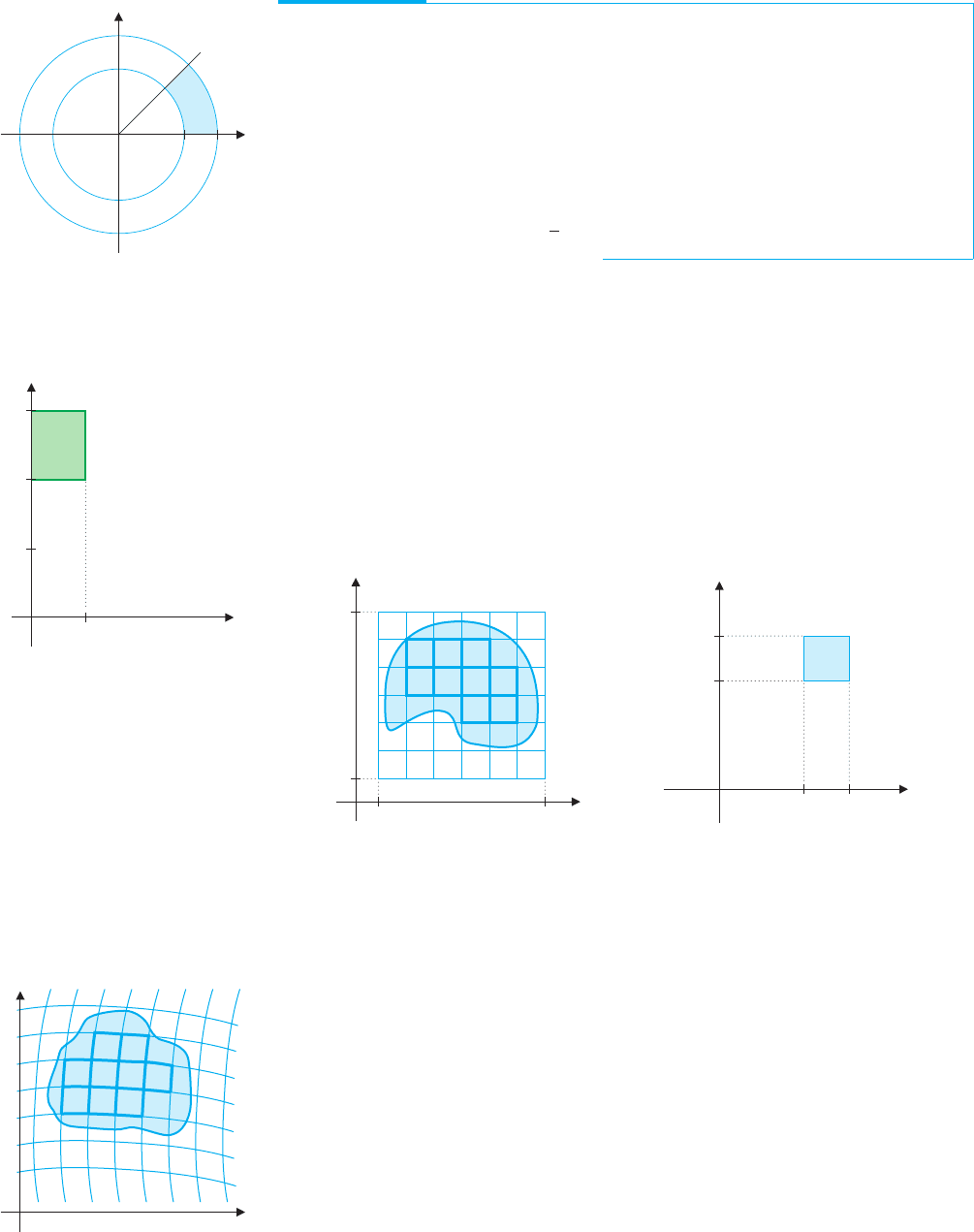
Let R be the region bounded by the straight lines y = 2x + 3, y = 2x +1, y = 5 − x
and y = 2 − x. Find a transformation T mapping a region S in the uv-plane onto R,
where S is a rectangular region, with sides parallel to the u- and v-axes.
x
y 2x 3
y 2x 1
y 2 x
y 5 x
R
y
FIGURE 14.68a
The region R in the xy-plane
Solution First, notice that the region R is a parallelogram in the xy-plane. (See
Figure 14.68a.) We can rewrite the equations for the lines forming the boundaries
of R as y − 2x = 3, y − 2x = 1, y + x = 5 and y + x = 2. This suggests the
change of variables
u = y − 2x and v = y + x. (8.1)
Observe that the lines forming the boundaries of R then correspond to the lines u = 3,
u = 1,v = 5 and v = 2, respectively, forming the boundaries of the corresponding
region S in the uv-plane. (See Figure 14.68b.) Solving equations (8.1) for x and y (Try
this yourself!), we have the transformation T defined by
x =
1
3
(v − u) and y =
1
3
(2v + u).
v
u
1 3
5
2
S
FIGURE 14.68b
The region S in the uv-plane
Note that this transformation maps the four corners of the rectangle S to the vertices of
the parallelogram R, as follows:
T (1, 2) =
1
3
(2 − 1),
1
3
[2(2) + 1]
=
1
3
,
5
3
,
T (3, 2) =
1
3
(2 − 3),
1
3
[2(2) + 3]
=
−
1
3
,
7
3
,
T (1, 5) =
1
3
(5 − 1),
1
3
[2(5) + 1]
=
4
3
,
11
3
and
T (3, 5) =
1
3
(5 − 3),
1
3
[2(5) + 3]
=
2
3
,
13
3
.
We leave it as an exercise to verify that the above four points are indeed the vertices of
the parallelogram R. (To do this, simply solve the system of equations for the points of
intersection.)
In example 8.2, we see how polar coordinates can be used to transform a rectangle in
the rθ-plane into a sector of a circular annulus.
P1: OSO/OVY P2: OSO/OVY QC: OSO/OVY T1: OSO
MHDQ256-Ch14 MHDQ256-Smith-v1.cls January 5, 2011 10:17
LT (Late Transcendental)
CONFIRMING PAGES
14-65 SECTION 14.8
..
Change of Variables in Multiple Integrals 965
EXAMPLE 8.2 A Transformation Involving Polar Coordinates
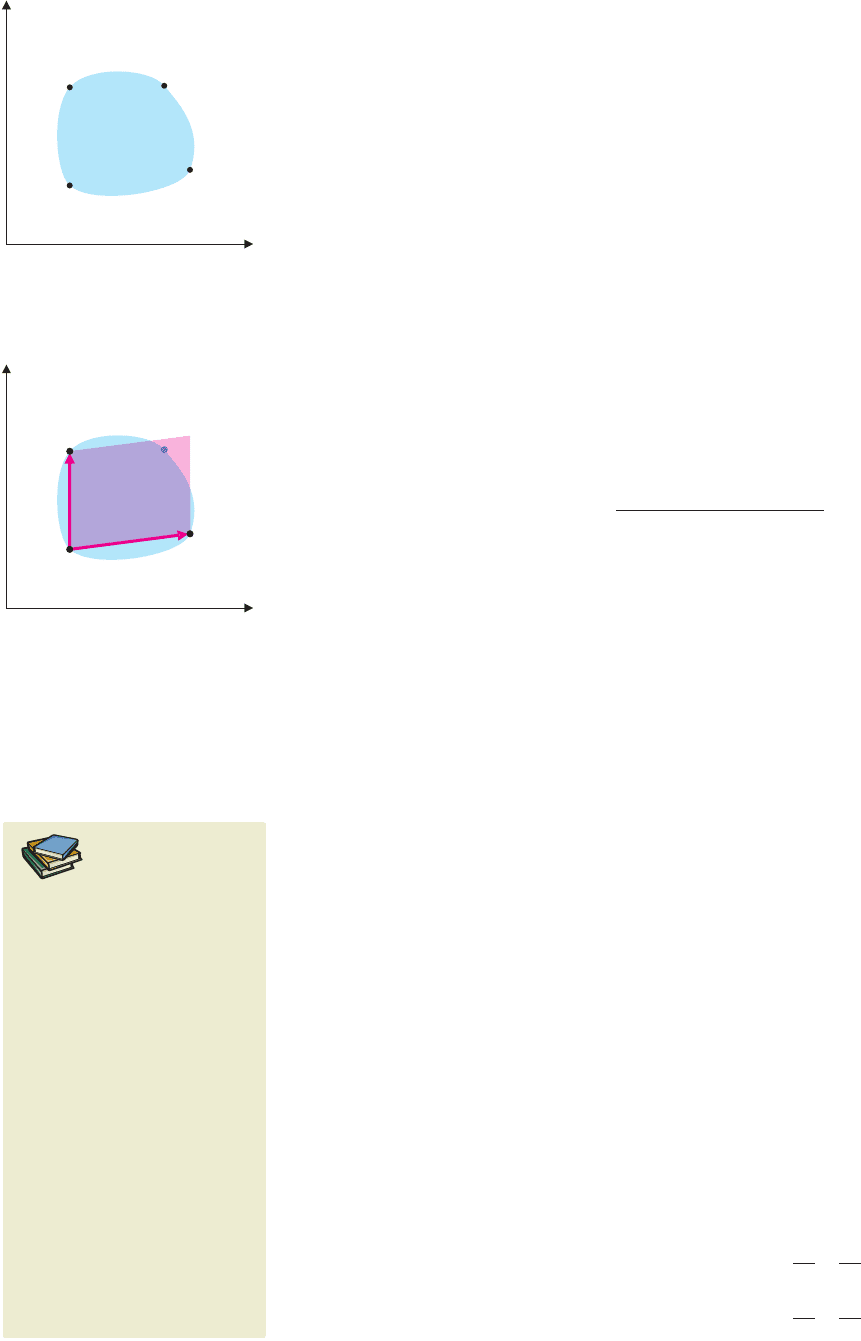
Let R be the region inside the circle x
2
+ y
2
= 9 and outside the circle x
2
+ y
2
= 4 and
lying in the first quadrant between the lines y = 0 and y = x. Find a transformation T
from a rectangular region S in the rθ-plane to the region R.
y
x
2 3
u d
R
FIGURE 14.69a
The region R in the xy-plane
r
d
2
3
1
u
S
O
FIGURE 14.69b
The region S in the rθ -plane
Solution First, we picture the region R (a sector of a circular annulus) in Figure 14.69a.
The obvious transformation is accomplished with polar coordinates. We let x = r cosθ
and y = r sinθ , so that x
2
+ y
2
= r
2
. The inner and outer circles forming a portion of
the boundary of R then correspond to r = 2 and r = 3, respectively. Further, the line
y = x corresponds to the line θ =
π
4
and the line y = 0 corresponds to the line θ = 0.
We show the region S in Figure 14.69b.
Now that we have introduced transformations, we consider our primary goal for this
section: to determine howa change of variablesin a multiple integral will affect the integral.
We consider the double integral
R
f (x, y) dA,
where f is continuous on R. Further, we assume that R is the image of a region S in the
uv-plane under the one-to-one transformation T. Recall that we originally constructed the
double integral by forming an inner partition of R and taking a limit of the corresponding
Riemannsums.WenowconsideraninnerpartitionoftheregionS intheuv-plane,consisting
of the n rectangles S
1
, S
2
,...,S
n
, as depicted in Figure 14.70a. We denote the lower left
v
u
ba
c
d
S
1
S
2
S
3
S
4
S
5
S
6
S
7
S
8
S
9
v
u
v
i
v
v
i
u
i
uu
i
u
v
S
i
FIGURE 14.70a FIGURE 14.70b
An inner partition of the region S in The rectangle S
i
the uv-plane
corner of each rectangle S
i
by (u
i
,v
i
)(i = 1, 2,...,n) and take all of the rectangles to
have the same dimensions u by v, as indicated in Figure 14.70b. Let R
1
, R
2
,...,R
n
be the images of S
1
, S
2
,...,S
n
, respectively, under the transformation T and let the
points (x
1
, y
1
), (x
2
, y
2
),...,(x
n
, y
n
) be the images of (u
1
,v
1
), (u
2
,v
2
),...,(u
n
,v
n
), re-
spectively. Notice that R
1
, R
2
,...,R
n
willthen form an inner partition oftheregionR in the
xy-plane (although it will not generally consist of rectangles), as indicated in Figure 14.71.
In particular, the image of the rectangle S
i
under T is the curvilinear region R
i
. From our
development of the double integral, we know that
R
f (x, y) dA ≈
n
i=1
f (x
i
, y
i
) A
i
, (8.2)
where A
i
is the area of R
i
, for i = 1, 2,...,n. The only problem with this approximation
is that we don’t know how to find A
i
, since the regions R
i
are not generally rectangles.
We can, however, find a reasonable approximation, as follows.
y
x
R
1
R
2
R
3
R
4
R
5
R
6
R
7
R
8
R
9
FIGURE 14.71
Curvilinear inner partition of the
region R in the xy-plane
Notice that T maps the four corners of S
i
:(u
i
,v
i
), (u
i
+ u,v
i
), (u
i
+ u,v
i
+ v)
and (u
i
,v
i
+ v) to four points denoted A, B, C and D, respectively, on the boundary of
P1: OSO/OVY P2: OSO/OVY QC: OSO/OVY T1: OSO
MHDQ256-Ch14 MHDQ256-Smith-v1.cls January 5, 2011 10:17
LT (Late Transcendental)
CONFIRMING PAGES
966 CHAPTER 14
..
Multiple Integrals 14-66
R
i
, as indicated below:
(u
i
,v
i
)
T
→ A(g(u
i
,v
i
), h(u
i
,v
i
)) = A(x
i
, y
i
),
(u
i
+ u,v
i
)
T
→ B(g(u
i
+ u,v
i
), h(u
i
+ u,v
i
)),
(u
i
+ u,v
i
+ v)
T
→ C(g(u
i
+ u,v
i
+ v), h(u
i
+ u,v
i
+ v))
and (u
i
,v
i
+ v)
T
→ D(g(u
i
,v
i
+ v), h(u
i
,v
i
+ v)).
We indicate these four points and a typical curvilinear region R
i
in Figure 14.72a. Notice
that as long as u and v are small, we can approximate the area of R
i
by the area of the
parallelogram determined by the vectors
−→
AB and
−→
AD, as indicated in Figure 14.72b. If we
consider
−→
AB and
−→
AD as three-dimensional vectors (with zero k components), recall from
our discussion in section 11.4 that the area of the parallelogram is simply
−→
AB ×
−→
AD.
We will take this as an approximation of the area A
i
. First, notice that
−→
AB =g(u
i
+ u,v
i
) − g(u
i
,v
i
), h(u
i
+ u,v
i
) − h(u
i
,v
i
), 0 (8.3)
and
−→
AD =g(u
i
,v
i
+ v) − g(u
i
,v
i
), h(u
i
,v
i
+ v) − h(u
i
,v
i
), 0. (8.4)
y
x
A(x
i
,
y
i)
B
C
D
R
i
FIGURE 14.72a
The region R
i
y
x
A
B
C
D
FIGURE 14.72b
The parallelogram determined by
the vectors
−→
AB and
−→
AD
HISTORICAL
NOTES
Carl Gustav Jacobi
(1804–1851) German
mathematician who made
important advances in the
functional determinant named
for him. As a child, Jacobi was
academically advanced beyond
what the German educational
system could offer and did much
independent research. He
obtained a university teaching
post after converting from
Judaism to Christianity. He was
considered the world’s top
researcher on elliptic functions
and made contributions to
number theory and partial
differential equations. An inspiring
teacher, Jacobi and his students
revived German mathematics.
From the definition of partial derivative, we have
g
u
(u
i
,v
i
) = lim
u→0
g(u
i
+ u,v
i
) − g(u
i
,v
i
)
u
.
This tells us that for u small,
g(u
i
+ u,v
i
) − g(u
i
,v
i
) ≈ g
u
(u
i
,v
i
)u.
Likewise, we have
h(u
i
+ u,v
i
) − h(u
i
,v
i
) ≈ h
u
(u
i
,v
i
)u.
Similarly, for v small, we have
g(u
i
,v
i
+ v) − g(u
i
,v
i
) ≈ g
v
(u
i
,v
i
)v
and
h(u
i
,v
i
+ v) − h(u
i
,v
i
) ≈ h
v
(u
i
,v
i
)v.
Together with (8.3) and (8.4), these give us
−→
AB ≈g
u
(u
i
,v
i
)u, h
u
(u
i
,v
i
)u=ug
u
(u
i
,v
i
), h
u
(u
i
,v
i
), 0
and
−→
AD≈g
v
(u
i
,v
i
)v, h
v
(u
i
,v
i
)v=vg
v
(u
i
,v
i
), h
v
(u
i
,v
i
), 0.
An approximation of the area of R
i
is then given by
A
i
≈
−→
AB ×
−→
AD, (8.5)
where
−→
AB ×
−→
AD ≈
ijk
ug
u
(u
i
,v
i
) uh
u
(u
i
,v
i
)0
vg
v
(u
i
,v
i
) vh
v
(u
i
,v
i
)0
=
g
u
(u
i
,v
i
) h
u
(u
i
,v
i
)
g
v
(u
i
,v
i
) h
v
(u
i
,v
i
)
u v k. (8.6)
For simplicity, we write the determinant as
g
u
(u
i
,v
i
) h
u
(u
i
,v
i
)
g
v
(u
i
,v
i
) h
v
(u
i
,v
i
)
=
g
u
(u
i
,v
i
) g
v
(u
i
,v
i
)
h
u
(u
i
,v
i
) h
v
(u
i
,v
i
)
=
∂x
∂u
∂x
∂v
∂y
∂u
∂y
∂v
(u
i
,v
i
).

P1: OSO/OVY P2: OSO/OVY QC: OSO/OVY T1: OSO
MHDQ256-Ch14 MHDQ256-Smith-v1.cls January 5, 2011 10:17
LT (Late Transcendental)
CONFIRMING PAGES
14-67 SECTION 14.8
..
Change of Variables in Multiple Integrals 967
We give this determinant a name and introduce some new notation in Definition 8.1.
DEFINITION 8.1
The determinant
∂x
∂u
∂x
∂v
∂y
∂u
∂y
∂v
is referred to as the Jacobian of the transformation T and
is written using the notation
∂(x, y)
∂(u,v)
.
From (8.5) and (8.6), we now have (since k is a unit vector) that
A
i
≈
−→
AB ×
−→
AD=
∂(x, y)
∂(u,v)
u v,
where the determinant is evaluated at the point (u
i
,v
i
). From (8.2), we now have
R
f (x, y) dA ≈
n
i=1
f (x
i
, y
i
) A
i
≈
n
i=1
f (x
i
, y
i
)
∂(x, y)
∂(u,v)
u v
=
n
i=1
f (g(u
i
,v
i
), h(u
i
,v
i
))
∂(x, y)
∂(u,v)
u v.
You should recognize this last expression as a Riemann sum for the double integral
S
f (g(u,v), h(u,v))
∂(x, y)
∂(u,v)
du dv.
The preceding analysis is a sketch of the more extensive proof of Theorem 8.1.
THEOREM 8.1 (Change of Variables in Double Integrals)
Suppose that the region S in the uv-plane is mapped onto the region R in the xy-plane
by the one-to-one transformation T defined by x = g(u,v) and y = h(u,v), where g
and h have continuous first partial derivatives on S.Iff is continuous on R and the
Jacobian
∂(x, y)
∂(u,v)
is nonzero on S, then
R
f (x, y) dA =
S
f (g(u,v), h(u,v))
∂(x, y)
∂(u,v)
du dv.
We first observe that the change of variables to polar coordinates in a double integral
is just a special case of Theorem 8.1.
EXAMPLE 8.3 Changing Variables to Polar Coordinates
Use Theorem 8.1 to derive the evaluation formula for polar coordinates (r > 0):
R
f (x, y) dA =
S
f (r cosθ,r sinθ )rdrdθ.
Solution First, recognize that a change of variables to polar coordinates consists of
the transformation from the rθ-plane to the xy-plane, defined by x = r cosθ and
y = r sinθ . This gives us the Jacobian
∂(x, y)
∂(r,θ)
=
∂x
∂r
∂x
∂θ
∂y
∂r
∂y
∂θ
=
cosθ −r sinθ
sinθ r cos θ
= r cos
2
θ +r sin
2
θ = r.
P1: OSO/OVY P2: OSO/OVY QC: OSO/OVY T1: OSO
MHDQ256-Ch14 MHDQ256-Smith-v1.cls January 5, 2011 10:17
LT (Late Transcendental)
CONFIRMING PAGES
968 CHAPTER 14
..
Multiple Integrals 14-68
By Theorem 8.1, we now have the familiar formula
R
f (x, y) dA =
S
f (r cosθ,r sinθ )
∂(x, y)
∂(r,θ)
dr dθ
=
S
f (r cosθ,r sinθ )rdrdθ.
In example 8.4, we show how a change of variables can be used to simplify the region
of integration (thereby also simplifying the integral).
EXAMPLE 8.4 Changing Variables to Transform a Region
Evaluate the integral
R
(x
2
+ 2xy)dA, where R is the region bounded by the lines
y = 2x + 3, y = 2x + 1, y = 5 − x and y = 2 − x.
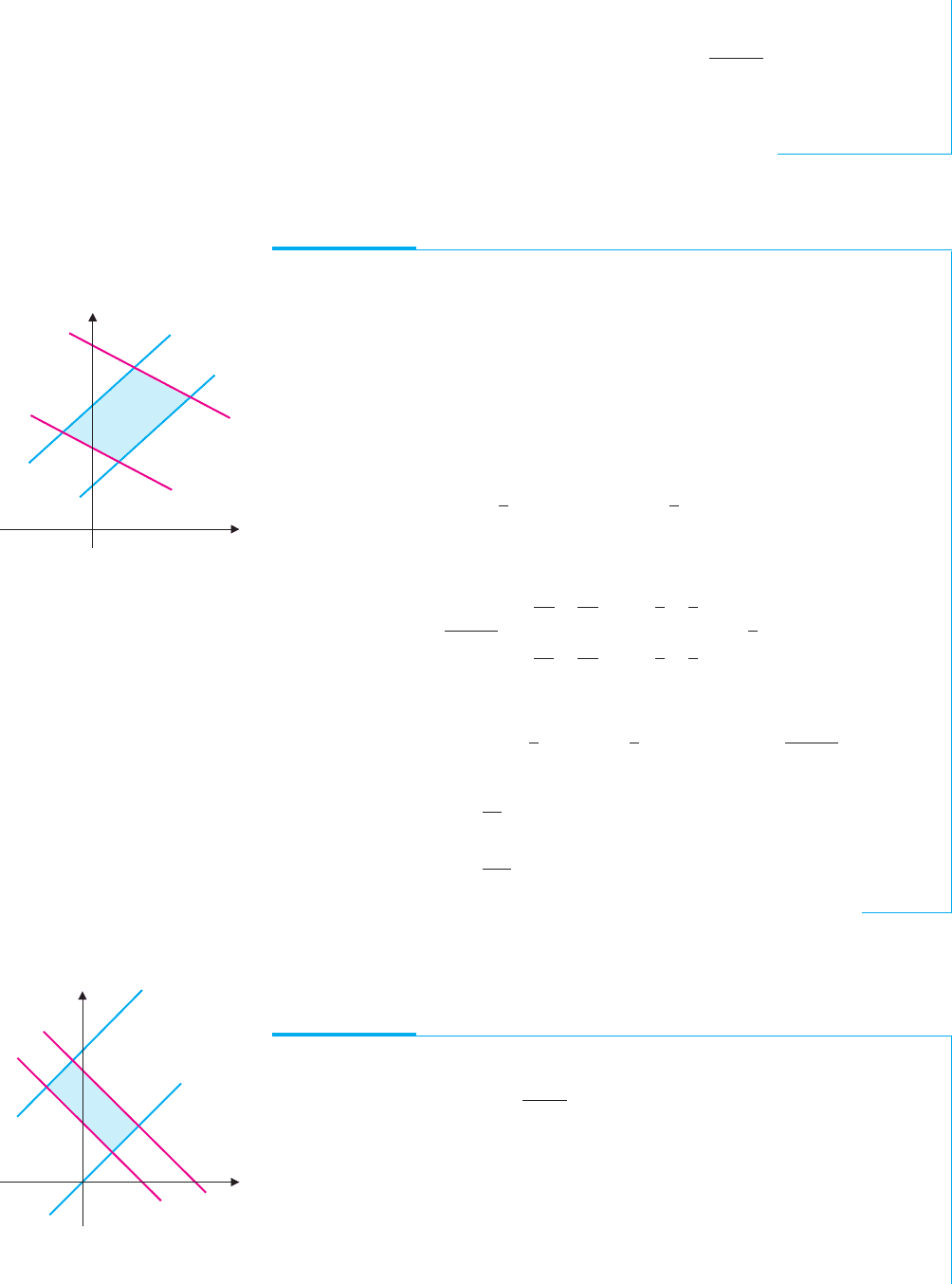
Solution The difficulty in evaluating this integral is that the region of integration (see
Figure 14.73) requires us to break the integral into three pieces. (Think about this
some!) An alternative is to find a change of variables corresponding to a transformation
from a rectangle in the uv-plane to R in the xy-plane. Recall that we did just this in
example 8.1. There, we had found that the change of variables
x =
1
3
(v − u) and y =
1
3
(2v + u)
maps the rectangle S ={(u,v)|1 ≤ u ≤ 3 and 2 ≤ v ≤ 5} to R. Notice that the Jacobian
of this transformation is
∂(x, y)
∂(u,v)
=
∂x
∂u
∂x
∂v
∂y
∂u
∂y
∂v
=
−
1
3
1
3
1
3
2
3
=−
1
3
.
By Theorem 8.1, we now have:
R
(x
2
+ 2xy)dA =
S
1
9
(v − u)
2
+
2
9
(v − u)(2v +u)
∂(x, y)
∂(u,v)
du dv
=
1
27
5
2
3
1
[(v − u)
2
+ 2(2v
2
− uv − u
2
)]du dv
=
196
27
,
where we leave the calculation of the final (routine) iterated integral to you.
Recall that for single definite integrals, we often must introduce a change of variable
in order to find an antiderivative for the integrand. This is also the case in double integrals,
as we see in example 8.5.
x
y 2x 3
y 2x 1
y 2 x
y 5 x
R
y
FIGURE 14.73
The region R
y x 5
y x
y 2 x
y 4 x
R
y
x
FIGURE 14.74a
The region R
EXAMPLE 8.5 A Change of Variables Required to Find an Antiderivative
Evaluate the double integral
R
e
x−y
x + y
dA, where R is the rectangle bounded by the
lines y = x, y = x + 5, y = 2 − x and y = 4 − x.
Solution First, notice that although the region over which you are to integrate is
simply a rectangle in the xy-plane, its sides are not parallel to the x- and y-axes. (See
Figure 14.74a.) This is the least of your problems right now, though. If you look
carefully at the integrand, you’ll recognize that you do not know an antiderivative for
this integrand (no matter which variable you integrate with respect to first). A
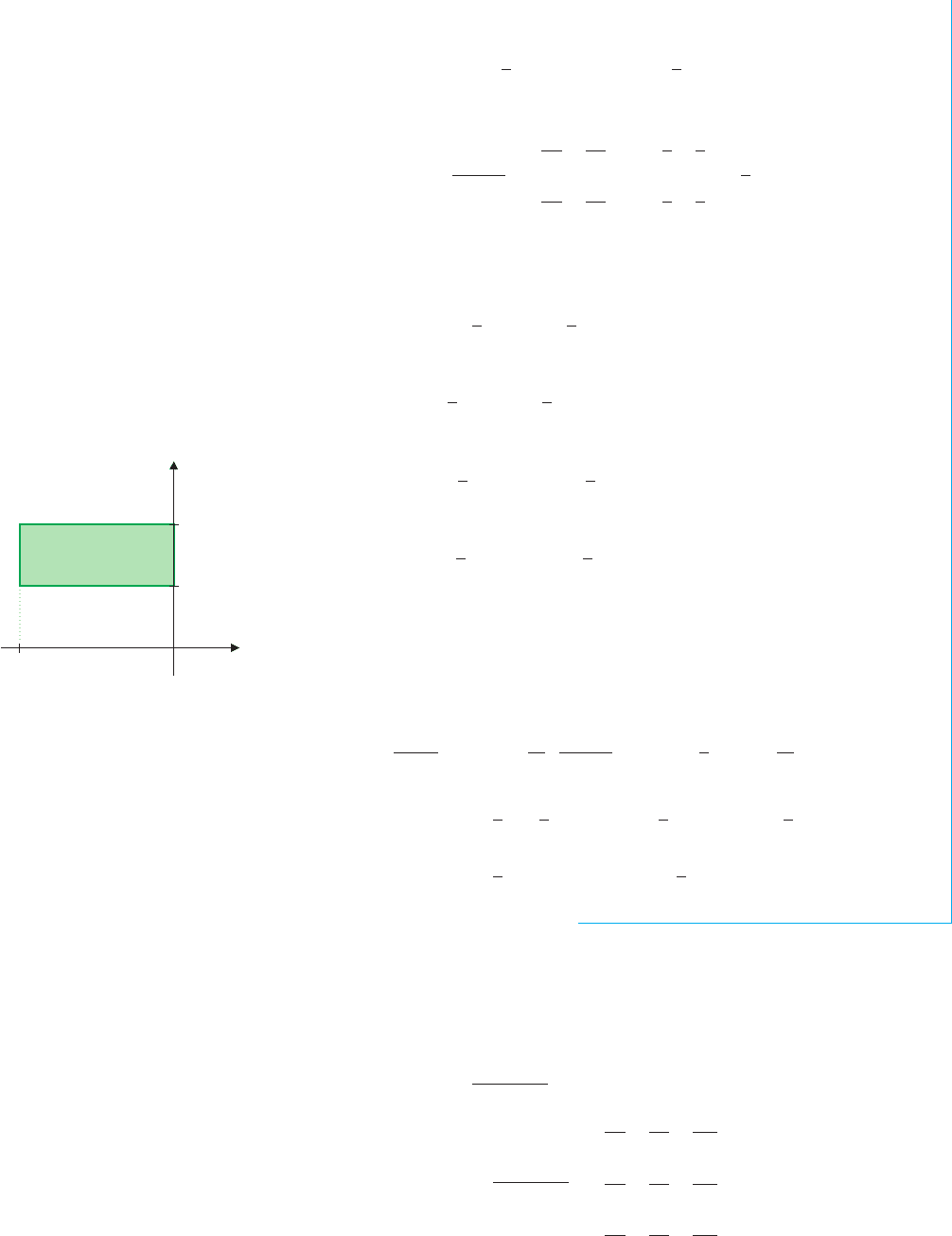
P1: OSO/OVY P2: OSO/OVY QC: OSO/OVY T1: OSO
MHDQ256-Ch14 MHDQ256-Smith-v1.cls January 5, 2011 10:17
LT (Late Transcendental)
CONFIRMING PAGES
14-69 SECTION 14.8
..
Change of Variables in Multiple Integrals 969
straightforward change of variables is to let u = x − y and v = x + y. Solving these
equations for x and y gives us
x =
1
2
(u + v) and y =
1
2
(v − u). (8.7)
The Jacobian of this transformation is then
∂(x, y)
∂(u,v)
=
∂x
∂u
∂x
∂v
∂y
∂u
∂y
∂v
=
1
2
1
2
−
1
2
1
2
=
1
2
.
The next issue is to find the region S in the uv-plane that is mapped onto the region R in
the xy-plane by this transformation. Remember that the boundary curves of the region S
are mapped to the boundary curves of R. From (8.7), we have that y = x corresponds to
1
2
(v − u) =
1
2
(u + v)oru = 0.
Likewise, y = x + 5 corresponds to
1
2
(v − u) =
1
2
(u + v) +5oru =−5,
y = 2 − x corresponds to
1
2
(v − u) = 2 −
1
2
(u + v)orv = 2
and y = 4 − x corresponds to
1
2
(v − u) = 4 −
1
2
(u + v)orv = 4.
This says that the region S in the uv-plane corresponding to the region R in the xy-plane
is the rectangle
S ={(u,v)|−5 ≤ u ≤ 0 and2 ≤ v ≤ 4},
as indicated in Figure 14.74b. You can now easily read off the limits of integration in the
uv-plane. By Theorem 8.1, we have
R
e
x−y
x + y
dA =
S
e
u
v
∂(x, y)
∂(u,v)
du dv =
1
2
4
2
0
−5
e
u
v
du dv
=
1
2
4
2
1
v
e
u
u=0
u=−5
dv =
1
2
(e
0
− e
−5
)
4
2
1
v
dv
=
1
2
(1 − e
−5
)ln|v|
v=4
v=2
=
1
2
(1 − e
−5
)(ln4 −ln2)
≈ 0.34424.
u
5
v
S
4
2
FIGURE 14.74b
The region S
Much as we have now done in two dimensions, we can develop a change of variables
formula for triple integrals. The proof of Theorem 8.2 can be found in most texts on
advanced calculus. We first define the Jacobian of a transformation in three dimensions.
For a transformation T from a region S of uvw-space onto a region R in xyz-space,
defined by x = g(u,v,w), y = h(u,v,w) and z = l(u,v,w), the Jacobian of the transfor-
mation is the determinant
∂(x, y, z)
∂(u,v,w)
defined by
∂(x, y, z)
∂(u,v,w)
=
∂x
∂u
∂x
∂v
∂x
∂w
∂y
∂u
∂y
∂v
∂y
∂w
∂z
∂u
∂z
∂v
∂z
∂w
.
Theorem 8.2 presents a result for triple integrals that corresponds to Theorem 8.1.

P1: OSO/OVY P2: OSO/OVY QC: OSO/OVY T1: OSO
MHDQ256-Ch14 MHDQ256-Smith-v1.cls January 5, 2011 10:17
LT (Late Transcendental)
CONFIRMING PAGES
970 CHAPTER 14
..
Multiple Integrals 14-70
THEOREM 8.2 (Change of Variables in Triple Integrals)
Suppose that the region S in uvw-space is mapped onto the region R in xyz-space by
the one-to-one transformation T defined by x = g(u,v,w), y = h(u,v,w) and
z = l(u,v,w), where g, h and l have continuous first partial derivatives in S.If f is
continuous in R and the Jacobian
∂(x, y, z)
∂(u,v,w)
is nonzero in S, then
R
f (x, y, z) dV =
S
f (g(u,v,w), h(u,v,w), l(u,v,w))
∂(x, y, z)
∂(u,v,w)
du dv dw.
We introduce a change of variables in a triple integral for precisely the same reasons as
we do in double integrals: in order to simplify the integrand or the region of integration or
both. In example 8.6, we use Theorem 8.2 to derive the change of variables formula for the
conversion from rectangular to spherical coordinates and see that this is simply a special
case of the general change of variables process given in Theorem 8.2.
EXAMPLE 8.6 Deriving the Evaluation Formula
for Spherical Coordinates
Use Theorem 8.2 to derive the evaluation formula for triple integrals in spherical
coordinates:
R
f (x, y, z) dV =
S
f (ρ sinφ cos θ,ρ sinφ sinθ,ρ cosφ)ρ
2
sinφ dρ dφ dθ.
Solution Suppose that the region R in xyz-space is the image of the region S in
ρφθ-space under the transformation T defined by the change to spherical coordinates.
Recall that we have
x = ρ sinφ cosθ, y = ρ sin φ sinθ and z = ρ cosφ.
The Jacobian of this transformation is then
∂(x, y, z)
∂(ρ,φ,θ)
=
∂x
∂ρ
∂x
∂φ
∂x
∂θ
∂y
∂ρ
∂y
∂φ
∂y
∂θ
∂z
∂ρ
∂z
∂φ
∂z
∂θ
=
sinφ cosθρcosφ cos θ −ρ sinφ sin θ
sinφ sinθρcos φ sinθρsinφ cosθ
cosφ −ρ sinφ 0
.
For the sake of convenience, we expand this determinant along the third row, rather than
the first row. This gives us
∂(x, y, z)
∂(ρ,φ,θ)
= cos φ
ρ cosφ cos θ −ρ sinφ sinθ
ρ cosφ sin θρsinφ cosθ
+ρ sinφ
sinφ cosθ −ρ sinφ sinθ
sinφ sinθρsinφ cosθ
= cos φ (ρ
2
sinφ cosφ cos
2
θ +ρ
2
sinφ cosφ sin
2
θ)
+ρ sinφ (ρ sin
2
φ cos
2
θ +ρ sin
2
φ sin
2
θ)
= ρ
2
sinφ cos
2
φ +ρ
2
sin
3
φ = ρ
2
sinφ (cos
2
φ +sin
2
φ)
= ρ
2
sinφ.

P1: OSO/OVY P2: OSO/OVY QC: OSO/OVY T1: OSO
MHDQ256-Ch14 MHDQ256-Smith-v1.cls January 5, 2011 10:17
LT (Late Transcendental)
CONFIRMING PAGES
14-71 SECTION 14.8
..
Change of Variables in Multiple Integrals 971
From Theorem 8.2, we now have that
R
f (x, y, z) dV =
S
f (ρ sinφ cos θ,ρ sin φ sinθ,ρ cos φ)
∂(x, y, z)
∂(ρ, φ,θ)
dρ dφ dθ
=
S
f (ρ sinφ cos θ,ρ sinφ sinθ,ρ cosφ)ρ
2
sinφ dρ dφ dθ,
where we have used the fact that 0 ≤ φ ≤ π to write |sinφ|=sinφ. Notice that this is
the same evaluation formula that we developed in section 14.7.
EXERCISES 14.8
WRITING EXERCISES
1. Explain what is meant by a “rectangular region” in the uv-
plane. In particular,explain what is rectangular about the polar
region 1 ≤ r ≤ 2 and 0 ≤ θ ≤ π .
2. The order of variables in the Jacobian is not important in the
sense that
∂(x, y)
∂(v, u)
=
∂(x, y)
∂(u,v)
but the order is very impor-
tant in the sense that
∂(x, y)
∂(u,v)
=
∂(u,v)
∂(x, y)
. Give a geometric
explanation of why
∂(x, y)
∂(u,v)
∂(u,v)
∂(x, y)
= 1.
In exercises 1–12, find a transformation from a rectangular
region S in the uv-plane to the region R.
1. R is bounded by y = 4x + 2, y = 4x + 5, y = 3 −2x and
y = 1 −2x
2. R is bounded by y = 2x − 1, y = 2x + 5, y = 1 −3x and
y =−1 −3x
3. R is bounded by y = 1 −3x, y = 3 −3x, y = x − 1 and
y = x − 3
4. R is bounded by y = 2x − 1, y = 2x + 1, y = 3 and y = 1
5. R is inside x
2
+ y
2
= 4, outside x
2
+ y
2
= 1 and in the first
quadrant
6. R is inside x
2
+ y
2
= 4, outside x
2
+ y
2
= 1 and in the first
quadrant between y = x and x = 0
7. R is inside x
2
+ y
2
= 9, outside x
2
+ y
2
= 4 and between
y = x and y =−x with y ≥ 0
8. R is inside x
2
+ y
2
= 9 with x ≥ 0
9. R is bounded by y = x
2
, y = x
2
+ 2, y = 4 − x
2
and
y = 2 − x
2
with x ≥ 0
10. R is bounded by y = x
2
, y = x
2
+ 2, y = 3 − x
2
and
y = 2 − x
2
with x ≤ 0
11. R is bounded by y = e
x
, y = e
x
+ 1, y = 3 − e
x
and
y = 5 −e
x
12. R is bounded by y = 2x
2
+ 1, y = 2x
2
+ 3, y = 2 − x
2
and
y = 4 − x
2
with x ≥ 0
............................................................
In exercises 13–22, evaluate the double integral.
13.
R
(y − 4x) dA, where R is given in exercise 1.
14.
R
(y + 3x) dA, where R is given in exercise 2.
15.
R
(y + 3x)
2
dA, where R is given in exercise 3.
16.
R
e
y−x
dA, where R is given in exercise 4.
17.
R
xdA, where R is given in exercise 5.
18.
R
e
√
x
2
+y
2
dA, where R is given in exercise 6.
19.
R
e
y−4x
y + 2x
dA, where R is given in exercise 1.
20.
R
e
y+3x
y − 2x
dA, where R is given in exercise 2.
21.
R
(x + 2y) dA, where R is given in exercise 2.
22.
R
(x + y)dA, where R is given in exercise 1.
............................................................
In exercises 23–26, find the Jacobian of the given transforma-
tion.
23. x = ue
v
, y = ue
−v
24. x = 2uv, y = 3u − v
25. x = u/v, y = v
2
26. x = 4u + v
2
, y = 2uv
............................................................
In exercises 27 and 28, find a transformation from a (three-
dimensional) rectangular region S in uvw-space to the solid Q.
27. Q is bounded by x + y + z = 1, x + y + z = 2, x + 2y = 0,
x + 2y = 1, y + z = 2 and y + z = 4.
28. Q is bounded by x + z = 1, x + z = 2, 2y + 3z = 0,
2y + 3z = 1, y + 2z = 2 and y + 2z = 4.
............................................................
In exercises 29 and 30, find the volume of the given solid.
29. Q in exercise 27
30. Q in exercise 28
............................................................

P1: OSO/OVY P2: OSO/OVY QC: OSO/OVY T1: OSO
MHDQ256-Ch14 MHDQ256-Smith-v1.cls January 5, 2011 10:17
LT (Late Transcendental)
CONFIRMING PAGES
972 CHAPTER 14
..
Multiple Integrals 14-72
In exercises 31–34, evaluate the double integral by transforming
coordinate systems.
31.
R
e
y−
√
x
2
√
x
dA, where R is bounded by y =
√
x,
y =
√
x + 2, y = 4 −
√
x and y = 6 −
√
x.
32.
R
x
2
dA, where R is bounded by y = 2x
2
, y = 2x
2
+ 2,
y = x
2
+ 4 and y = x
2
+ 5(x > 0).
33.
R
2(y − 2x)e
y+4x
dA, where R is bounded by y = 2x,
y = 2x + 1, y = 3 − 4x and y = 1 −4x.
34.
R
y
2
dA, where R is bounded by y = x + 1, y = x +2,
x
2
− 2xy =−1 and x
2
− 2xy =−2(x > 0).
............................................................
35. In Theorem 8.1, we required that the Jacobian be nonzero.
To see why this is necessary, consider a transformation where
x = u − v and y = 2v −2u. Show that the Jacobian is zero.
Then try solving for u and v.
36. Compute the Jacobian for the spherical-like transformation
x = ρ sin φ, y = ρ cos φ cos θ and z = ρ cos φ sin θ .
37. The integral
1
0
1
0
1
1 − (xy)
2
dx dy arises in the study
of the Riemann-zeta function. Use the transformation
x =
sinu
cosv
and y =
sinv
cosu
to write this integral in the form
π/2
0
π/2−v
0
f (u,v)du dv and then evaluate the integral.
38. Showthatthetransformation x =
sinu
cosv
and y =
sinv
cosu
inexer-
cise37transformsthesquare0 ≤ x ≤ 1, 0 ≤ y ≤ 1intothetri-
angle 0 ≤ u ≤
π
2
− v, 0 ≤ v ≤
π
2
. (Hint: Transform each side
of the square separately.)
EXPLORATORY EXERCISE
1. Transformations are involved in many important applications
of mathematics. The direct linear transformation discussed
in this exercise was used by Titleist golf researchers Gobush,
Pelletier and Days to study the motion of golf balls (see Sci-
ence and Golf II, 1996). Bright dots are drawn onto golf balls.
The dots are tracked by a pair of cameras as the ball is hit. The
challenge is to use this informationto reconstruct the exact po-
sition of the ball at various times, allowing the researchers to
estimate the speed, spin rate and launch angle of the ball. In the
direct linear transformation model developed by Abdel-Aziz
and Karara, a dot at actual position (x, y, z)will appear at pixel
(u
1
,v
1
) of camera 1’s digitized image where
u
1
=
c
11
x + c
21
y + c
31
z + c
41
d
11
x + d
21
y + d
31
z + 1
and
v
1
=
c
51
x + c
61
y + c
71
z + c
81
d
11
x + d
21
y + d
31
z + 1
,
for constants c
11
, c
21
,...,c
81
and d
11
, d
21
and d
31
. Similarly,
camera 2 “sees” this dot at pixel (u
2
,v
2
) where
u
2
=
c
12
x + c
22
y + c
32
z + c
42
d
12
x + d
22
y + d
32
z + 1
and
v
2
=
c
52
x + c
62
y + c
72
z + c
82
d
12
x + d
22
y + d
32
z + 1
,
for a different set ofconstants c
12
, c
22
,...,c
82
and d
12
, d
22
and
d
32
. The constants are determined by taking a series of mea-
surements of motionless balls to calibrate the model. Given
that the model for each camera consists of eleven constants,
explain why in theory, six different measurements would more
than suffice to determine the constants. In reality, more mea-
surements are taken and a least-squares criterion is used to find
thebest fit of the model to the data. Suppose that this procedure
gives us the model
u
1
=
2x + y + z + 1
x + y + 2z + 1
,v
1
=
3x + z
x + y + 2z + 1
,
u
2
=
x + z + 6
2x + 3z + 1
,v
2
=
4x + y + 3
2x + 3z + 1
.
If the screen coordinates of a dot are (u
1
,v
1
) = (0, −3) and
(u
2
,v
2
) = (5, 0), solve for the actual position (x, y, z) of the
dot. Actually, a dot would not show up as a single pixel, but
as a somewhat blurred image over several pixels. The dot is
officially located at the pixel nearest the center of mass of the
pixels involved. Suppose that a dot’s image activates the fol-
lowing pixels: (34, 42), (35, 42), (32, 41), (33, 41), (34, 41),
(35, 41), (36, 41), (34,40), (35, 40), (36, 40) and (36,39). Find
the center of mass of these pixels and round off to determine
the “location” of the dot.
Review Exercises
WRITING EXERCISES
The following list includes terms that are defined and theorems that
arestatedin this chapter. Foreach term or theorem,(1) givea precise
definition or statement, (2) state in general terms what it means and
(3) describe the types of problems with which it is associated.
Irregular partition Definite integral Double integral
Fubini’s Theorem Double Riemann sum Volume
Center of mass First moment Moment of inertia
Surface area Triple integral Mass
Cylindrical Spherical coordinates Rectangular
coordinates Transformation coordinates
Jacobian
TRUE OR FALSE
State whether each statement is true or false and briefly explain
why. If the statement is false, try to “fix it” by modifying the given
statement to a new statement that is true.