
Smith R., Minton R. Calculus
Подождите немного. Документ загружается.

P1: OSO/OVY P2: OSO/OVY QC: OSO/OVY T1: OSO
MHDQ256-Ch14 MHDQ256-Smith-v1.cls January 5, 2011 10:17
LT (Late Transcendental)
CONFIRMING PAGES
14-43 SECTION 14.5
..
Triple Integrals 943
where R is the triangle bounded by z = y, z = 0 and y = 4. (See Figure 14.45b.) In R, y
extends from y = z to y = 4, as z ranges from z = 0toz = 4. The integral then becomes
4
0
4
x
y
0
6
1 + 48z − z
3
dzdydx =
4
0
4
z
y
0
6
1 + 48z − z
3
dx dydz
=
4
0
4
z
6
1 + 48z − z
3
ydydz
=
4
0
6
1 + 48z − z
3
y
2
2
y=4
y=z
dz
=
4
0
48 − 3z
2
1 + 48z − z
3
dz
= ln
1 + 48z − z
3
z=4
z=0
= ln 129.
z
y
4
z y
R
FIGURE 14.45b
The region R
As you can see from example 5.4, there are clear advantages to considering alternative
approaches for calculating a triple integral. So, take an extra moment to look at a sketch
of a solid and consider your alternatives before jumping into the problem (i.e., look before
you leap).
NOTES
Try the original triple integral in
example 5.4 on your CAS. Many
integration packages are unable to
evaluate this triple integral
exactly. However, most packages
will correctly return ln (129) if
you ask them to evaluate the
integral with the order of
integration reversed. Technology
does not replace an understanding
of calculus techniques.
Recall that for double integrals, we had found that
R
dA gives the area of the region
R. Similarly, observe that if f (x, y, z) = 1 for all (x, y, z) ∈ Q, then from (5.3), we have
Q
1dV = lim
P→0
n
i=1
V
i
= V, (5.5)
where V is the volume of the solid Q.
EXAMPLE 5.5 Using a Triple Integral to Find Volume
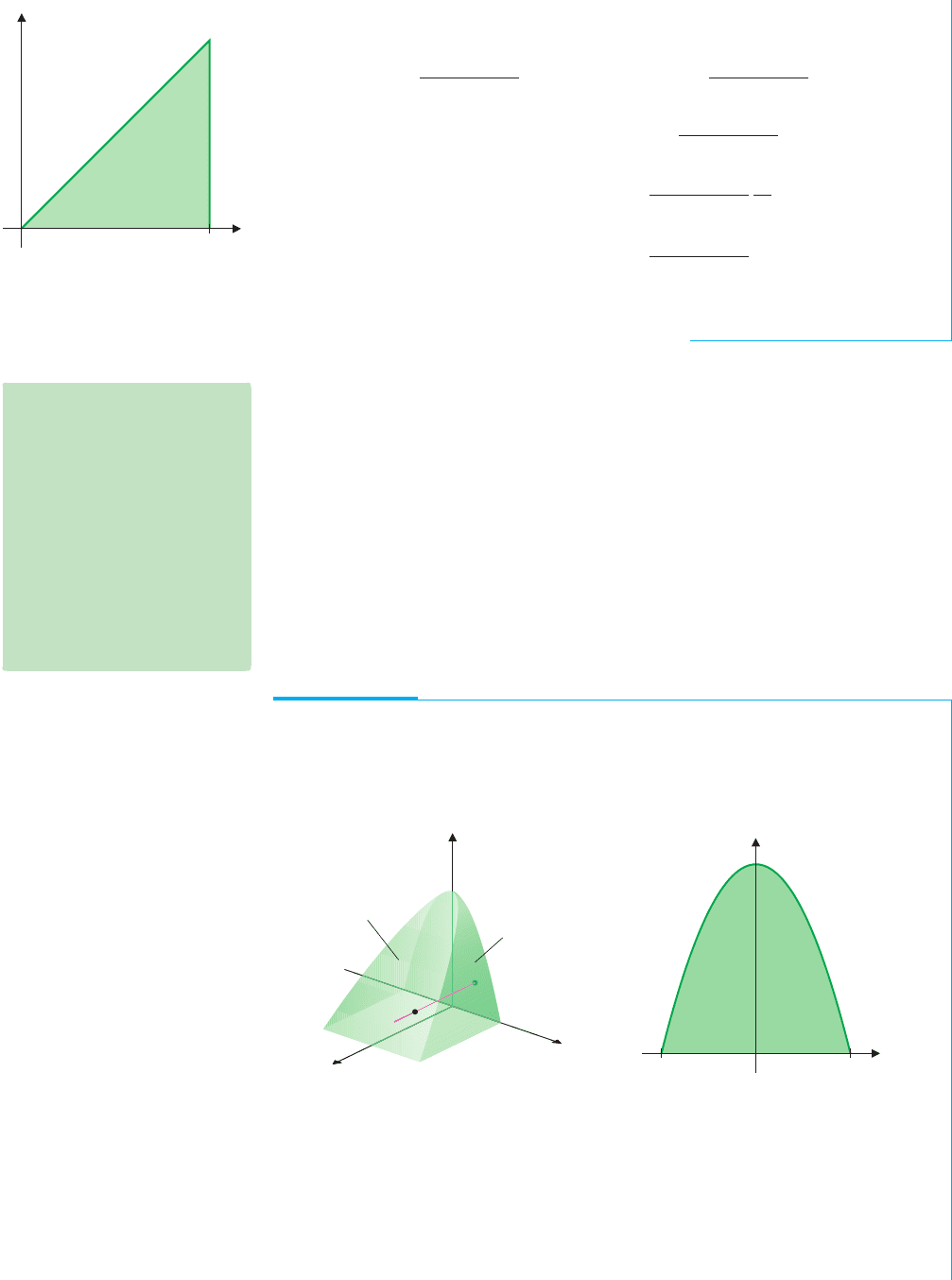
Find the volume of the solid bounded by the graphs of z = 4 − y
2
, x + z = 4, x = 0
and z = 0.
y
x
z
z 4 y
2
x z 4
z
R
y
22
z 4 y
2
FIGURE 14.46a FIGURE 14.46b
The solid Q Base R of the solid
Solution We show a sketch of the solid in Figure 14.46a. First, observe that we can
consider the base of the solid to be the region R formed by the projection of the solid
onto the yz-plane (x = 0). Notice that this is the region bounded by the parabola
z = 4 − y
2
and the y-axis. (See Figure 14.46b.) Then, for each fixed y and z, the
P1: OSO/OVY P2: OSO/OVY QC: OSO/OVY T1: OSO
MHDQ256-Ch14 MHDQ256-Smith-v1.cls January 5, 2011 10:17
LT (Late Transcendental)
CONFIRMING PAGES
944 CHAPTER 14
..
Multiple Integrals 14-44
corresponding values of x range from 0 to 4 − z. The volume of the solid is then given by
V =
Q
dV =
R
4−z
0
dx dA
=
2
−2
4−y
2
0
4−z
0
dx dzdy
=
2
−2
4−y
2
0
(4 − z)dzdy
=
2
−2
4z −
z
2
2
z=4−y
2
z=0
dy
=
2
−2
4(4 − y
2
) −
1
2
(4 − y
2
)
2
dy =
128
5
,
where we have left the details of the last integration to you.
NOTES
To integrate with respect to z first,
you must identify surfaces
forming the top and bottom of the
solid. To integrate with respect to
y first, you must identify surfaces
forming (from the standard
viewpoint) the right and left sides
of the solid. To integrate with
respect to x first, you must
identify surfaces forming the front
and back of the solid. Often, the
easiest pair of surfaces to identify
will indicate the best choice of
variable for the innermost
integration.
z
x
y
O
x
i
y
i
z
i
Q
i
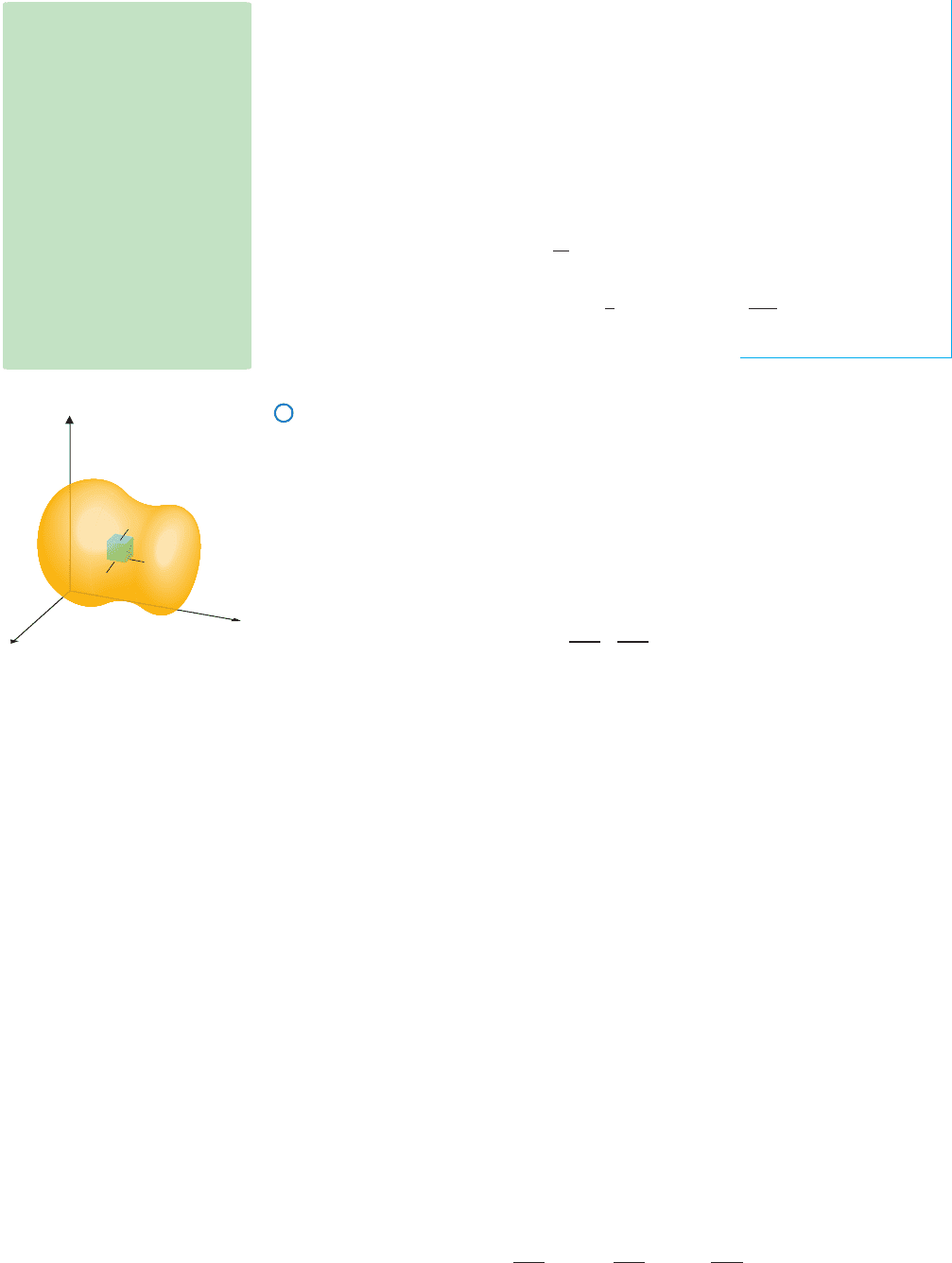
FIGURE 14.47
One box Q
i
of the inner
partition of Q
Mass and Center of Mass
In section 14.2, we discussed finding the mass and center of mass of a lamina (a thin, flat
plate). We now pause briefly to extend these results to three dimensions. Suppose that a
solid Q has mass density given by ρ(x, y, z) (in units of mass per unit volume). To find the
total mass of a solid, we proceed (as we did for laminas) by constructing an inner partition
of the solid: Q
1
, Q
2
,...,Q
n
. Realize that if each box Q
i
is small (see Figure 14.47), then
the density should be nearly constant on Q
i
and so, it is reasonable to approximatethe mass
m
i
of Q
i
by
m
i
≈ ρ (u
i
,v
i
,w
i
)
mass/unit volume
V
i
volume
,
for any point (u
i
,v
i
,w
i
) ∈ Q
i
, where V
i
is the volume of Q
i
. The total mass m of Q is
then given approximately by
m ≈
n
i=1
ρ(u
i
,v
i
,w
i
)V
i
.
Letting the norm of the partition P approach zero, we get the exact mass, which we
recognize as a triple integral:
m = lim
P→0
n
i=1
ρ (u
i
,v
i
,w
i
)V
i
=
Q
ρ (x, y, z) dV. (5.6)
Now, recall that the center of mass of a lamina was the point at which the lamina will
balance. For an object in three dimensions, you can think of this as balancing it left to right
(i.e., along the y-axis), front to back (i.e., along the x-axis) and top to bottom (i.e., along the
z-axis). To do this, we need to find first moments with respect to each of the three coordinate
planes. We define these moments as
M
yz
=
Q
xρ(x, y, z)dV, M
xz
=
Q
yρ(x, y, z) dV (5.7)
and M
xy
=
Q
zρ(x, y, z)dV, (5.8)
the first moments with respect to the yz-plane, the xz-plane and the xy-plane, respectively.
The center of mass is then given by the point (
¯
x,
¯
y,
¯
z), where
¯
x =
M
yz
m
,
¯
y =
M
xz
m
,
¯
z =
M
xy
m
. (5.9)
P1: OSO/OVY P2: OSO/OVY QC: OSO/OVY T1: OSO
MHDQ256-Ch14 MHDQ256-Smith-v1.cls January 5, 2011 10:17
LT (Late Transcendental)
CONFIRMING PAGES
14-45 SECTION 14.5
..
Triple Integrals 945
Notice that these are straightforward generalizations of the corresponding formulas for the
center of mass of a lamina.
y
x
z
x
2
y
2
z 4
z
FIGURE 14.48a
The solid Q
y
x
z
x
2
y
2
z 4
z
R
4
4
FIGURE 14.48b
Projection of the solid onto
the xy-plane
EXAMPLE 5.6 Center of Mass of a Solid
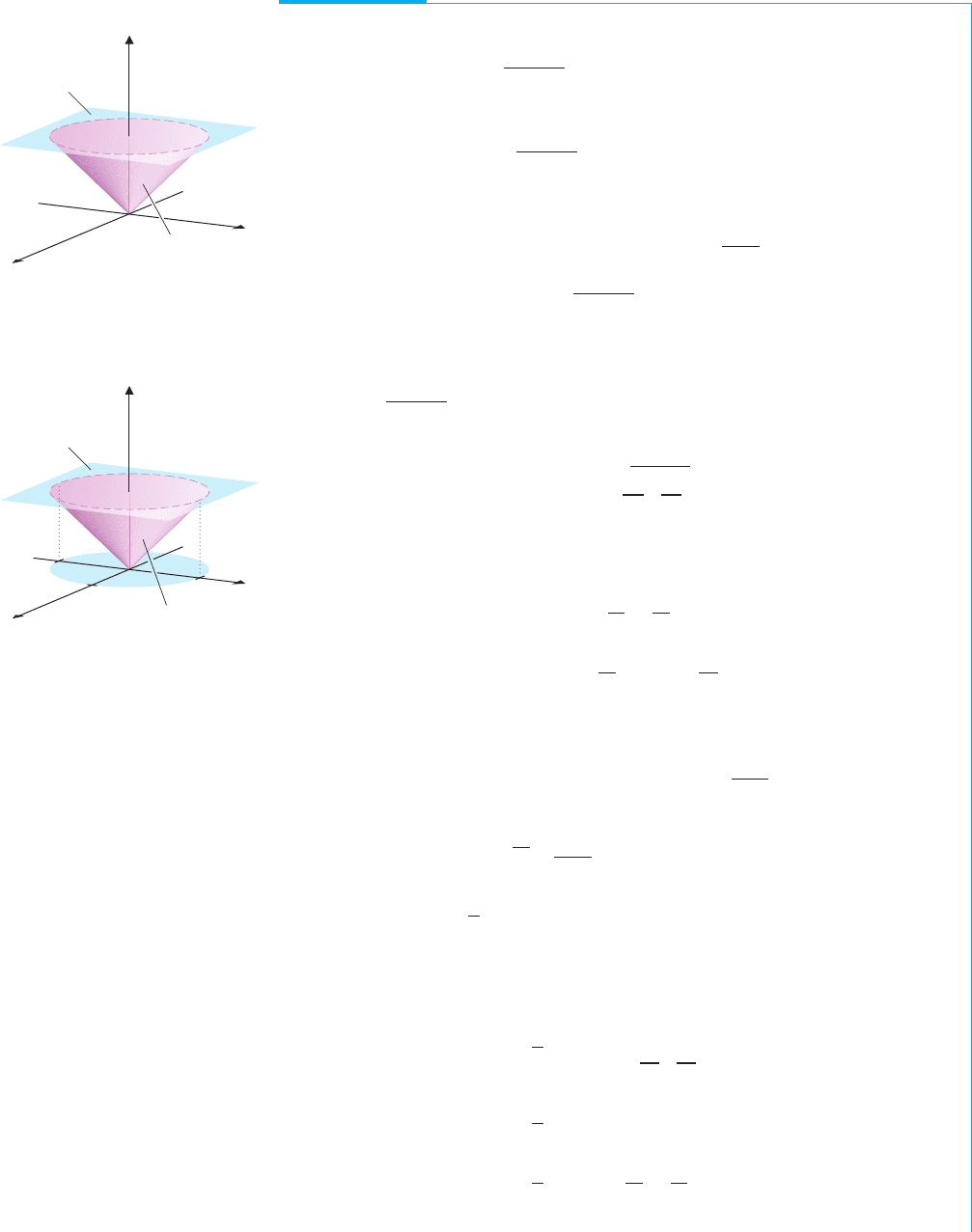
Find the center of mass of the solid of constant mass density ρ bounded by the graphs of
the right circular cone z =
x
2
+ y
2
and the plane z = 4. (See Figure 14.48a.)
Solution Notice that the projection R of the solid onto the xy-plane is the disk of
radius 4 centered at the origin. (See Figure 14.48b.) Further, for each (x, y) ∈ R,
z ranges from the cone (z =
x
2
+ y
2
) up to the plane z = 4. From (5.6), the total
mass of the solid is given by
m =
Q
ρ (x, y, z) dV = ρ
R
4
√
x
2
+y
2
dzdA
= ρ
R
4 −
x
2
+ y
2
dA,
where R is the disk of radius 4 in the xy-plane, centered at the origin, as indicated in
Figure 14.48b. Since the region R is circular and since the integrand contains a term
of the form
x
2
+ y
2
, we use polar coordinates for the remaining double integral.
We have
m = ρ
R
4 −
x
2
+ y
2
r
dA
rdrdθ
= ρ
2π
0
4
0
(4 − r)rdrdθ
= ρ
2π
0
4
r
2
2
−
r
3
3
r=4
r=0
dθ
= ρ
32 −
4
3
3
(2π) =
64
3
πρ.
From (5.8), we get that the moment with respect to the xy-plane is
M
xy
=
Q
z ρ (x, y, z)dV = ρ
R
4
√
x
2
+y
2
zdzdA
= ρ
R
z
2
2
4
√
x
2
+y
2
dA
=
ρ
2
R
[16 − (x
2
+ y
2
)]dA.
For the same reasons as when we computed the mass, we change to polar coordinates in
the double integral to get
M
xy
=
ρ
2
R
16 − (x
2
+ y
2
)
r
2
dA
rdrdθ
=
ρ
2
2π
0
4
0
(16 − r
2
)rdrdθ
=
ρ
2
2π
0
16
r
2
2
−
r
4
4
r=4
r=0
dθ
= 32ρ(2π) = 64πρ.
P1: OSO/OVY P2: OSO/OVY QC: OSO/OVY T1: OSO
MHDQ256-Ch14 MHDQ256-Smith-v1.cls January 5, 2011 10:17
LT (Late Transcendental)
CONFIRMING PAGES
946 CHAPTER 14
..
Multiple Integrals 14-46
Notice that the solid is symmetric with respect to both the xz-plane and the yz-plane
and so, the moments with respect to both of those planes are zero, since the density is
constant. (Why does constant density matter?) That is, M
xz
= M
yz
= 0. From (5.9), the
center of mass is then given by
(
¯
x,
¯
y,
¯
z) =
M
yz
m
,
M
xz
m
,
M
xy
m
=
0, 0,
64πρ
64πρ/3
= (0, 0, 3).
EXERCISES 14.5
WRITING EXERCISES
1. Discuss the importance ofhaving a reasonably accurate sketch
to help determine the limits (and order) of integration. Iden-
tify which features of a sketch are essential and which
are not. Discuss whether it’s important for your sketch to
distinguish between two surfaces like z = 4 − x
2
− y
2
and
z =
4 − x
2
− y
2
.
2. In example 5.2, explain why all six orders of integration are
equally simple. Given this choice, most people prefer to inte-
grate in the order of example 5.2 (dzdy dx). Discuss the visual
advantages of this order.
3. In example 5.4, identify any clues in the problem statement
that might indicate that y should be the innermost variable of
integration. In example 5.5, identify any clues that might indi-
cate that z should not be the innermost variable of integration.
(Hint: With how many surfaces is each variable associated?)
4. In example 5.6, we used polar coordinates in x and y. Explain
why this is permissible and when it is likely to be convenient
to do so.
In exercises 1–20, evaluate the triple integral
Q
f (x, y, z) dV.
1. f (x, y, z) = 2x + y − z,
Q ={(x, y, z)|0 ≤ x ≤ 2, −2 ≤ y ≤ 2, 0 ≤ z ≤ 2}
2. f (x, y, z) = 2x
2
+ y
3
,
Q ={(x, y, z)|0 ≤ x ≤ 3, −2 ≤ y ≤ 1, 1 ≤ z ≤ 2}
3. f (x, y, z) =
√
y − 3z
2
,
Q ={(x, y, z)|2 ≤ x ≤ 3, 0 ≤ y ≤ 1, −1 ≤ z ≤ 1}
4. f (x, y, z) = 2xy − 3xz
2
,
Q ={(x, y, z)|0 ≤ x ≤ 2, −1 ≤ y ≤ 1, 0 ≤ z ≤ 2}
5. f (x, y, z) = 4yz, Q is the tetrahedron bounded by
x + 2y + z = 2 and the coordinate planes
6. f (x, y, z) = 3x − 2y, Q is the tetrahedron bounded by
4x + y + 3z = 12 and the coordinate planes
7. f (x, y, z) = 3y
2
− 2z, Q is the tetrahedron bounded by
3x + 2y − z = 6 and the coordinate planes
8. f (x, y, z) = 6xz
2
, Q is the tetrahedron bounded by
−2x + y + z = 4 and the coordinate planes
9. f (x, y, z) = 2xy, Q isboundedby z = 1 − x
2
− y
2
andz = 0
10. f (x, y, z) = x − y, Q is bounded by z = x
2
+ y
2
and z = 4
11. f (x, y, z) = 2yz, Q is bounded by z + x = 2, z − x = 2,
z = 1, y =−2 and y = 2
12. f (x, y, z) = x
3
y, Q is bounded by z = 1 − y
2
, z = 0,
x =−1 and x = 1
13. f (x, y, z) = 15, Q is bounded by 2x + y + z = 4, z = 0,
x = 1 − y
2
and x = 0
14. f (x, y, z) = 2x + y, Q is bounded by z = 6 − x − y,
z = 0, y = 2 − x, y = 0 and x = 0
15. f (x, y, z) = 2x, Q is bounded by z = y
2
, z = 4, x = 0 and
x + z = 6
16. f (x, y, z) = 2y, Q is bounded by z = x
2
− 2, z = 0,
x + y = 1 and x − y = 1
17.
3
0
1
0
√
1−z
2
0
ze
y
dx dzdy 18.
2
1
e
z
0
y
2
yz
x
2
−1
dx dy dz
19.
1
0
u
0
w
0
ue
−w
2
dv dw du 20.
1
0
v
0
w
0
ue
−w
du dw dv
............................................................
21. SketchtheregionQ inexercise9andexplainwhythetripleinte-
gralequals0.Wouldtheintegralequal0for f (x, y, z) = 2x
2
y?
For f (x, y, z) = 2x
2
y
2
?
22. Show that
Q
(z − x)dV = 0, where Q is bounded by
z = 6 − x − y and the coordinate planes. Explain geometri-
cally why this is correct.
............................................................
In exercises 23–34, compute the volume of the solid bounded by
the given surfaces.
23. z = x
2
, z = 1, y = 0 and y = 2
24. z = 1 − y
2
, z = 0, x = 2 and x = 4
25. z = 1 − y
2
, z = 0, z = 4 − 2x and x = 4
26. z = x
2
, z = x + 2, y + z = 5 and y =−1
27. y = 4 − x
2
, z = 0 and z − y = 6
28. x = y
2
, x = 4, x + z = 6 and x + z = 8
29. y = 3 − x, y = 0, z = x
2
and z = 1
30. x = y
2
, x = 4, z = 2 + x and z = 0
31. z = 1 + x, z = 1 − x, z = 1 + y, z = 1 − y and z = 0
(a pyramid)
32. z = 5 − y
2
, z = 6 − x, z = 6 + x and z = 1
33. z = 4 − x
2
− y
2
and the xy-plane
34. z = 6 − x − y, x
2
+ y
2
= 1 and z =−1
............................................................
P1: OSO/OVY P2: OSO/OVY QC: OSO/OVY T1: OSO
MHDQ256-Ch14 MHDQ256-Smith-v1.cls January 5, 2011 10:17
LT (Late Transcendental)
CONFIRMING PAGES
14-47 SECTION 14.5
..
Triple Integrals 947
In exercises 35–38, find the mass and center of mass of the solid
with density ρ(x, y, z) and the given shape.
35. ρ(x, y, z) = 4, solid bounded by z = x
2
+ y
2
and z = 4
36. ρ(x, y, z) = 2 + x, solid bounded by z = x
2
+ y
2
and z = 4
37. ρ(x, y, z) = 10 + x, tetrahedron bounded by x + 3y + z = 6
and the coordinate planes
38. ρ(x, y, z) = 1 + x, tetrahedron bound by 2x + y + 4z = 4
and the coordinate planes
............................................................
39. Explain why the x-coordinate of the center of mass in exercise
35 is zero, but the x-coordinate in exercise 36 is not zero.
40. In exercise35, if ρ(x, y, z) = 2 + x
2
, is the x-coordinate of the
center of mass zero? Explain.
41. Inexercise5,evaluatetheintegralinthreedifferentways,using
each variable as the innermost variable once.
42. Inexercise6,evaluatetheintegralinthreedifferentways,using
each variable as the innermost variable once.
............................................................
In exercises 43–48, sketch the solid whose volume is given and
rewrite the iterated integral using a different innermost variable.
43.
2
0
4−2y
0
4−2y−z
0
dx dzdy
44.
1
0
2−2y
0
2−x−2y
0
dzdx dy
45.
1
0
√
1−x
2
0
√
1−x
2
−y
2
0
dzdydx
46.
1
0
1−x
2
0
2−x
0
dydzdx
47.
2
0
√
4−z
2
0
4
x
2
+z
2
dydx dz
48.
2
0
√
4−z
2
0
2
√
y
2
+z
2
dx dy dz
............................................................
49. Let T be the tetrahedron in the first octant with vertices
(0, 0, 0), (a, 0, 0), (0, b, 0) and (0, 0, c), for positive constants
a, b and c. Let C be the parallelepiped in the first octant with
the same vertices. Show that the volume of T is one-sixth the
volume of C.
50. Write
b
a
d
c
s
r
f (x)g(y)h(z)dzdydx as a product of three
single integrals. In general, can any triple integral with inte-
grand f (x)g(y)h(z) be factored as the product of three single
integrals?
51. Compute
Q
f (x, y, z)dV, where Q is the tetrahedron
bounded by 2x + y + 3z = 6 and the coordinate planes, and
f (x, y, z) = max{x, y, z}.
52. Repeat exercise 51 with f (x, y, z) = min{x, y, z}
APPLICATIONS
53. Suppose that the density of an airborne pollutant in a room is
givenby f (x, y, z) = xyze
−x
2
−2y
2
−4z
2
gramspercubicfoot for
0 ≤ x ≤ 12, 0 ≤ y ≤ 12 and 0 ≤ z ≤ 8. Find the total amount
of pollutant in the room. Divide by the volume of the room to
get the average density of pollutant in the room.
54. If the danger level for the pollutant in exercise 53 is 1 gram
per 1000 cubic feet, show that the room on the whole is below
the danger level, but there is a portion of the room that is well
above the danger level.
............................................................
Exercises 55–58 involve probability.
55. A function f (x, y, z) is a pdf on the three-dimensional solid Q
if f (x, y, z) ≥ 0 forall (x, y, z)inQ and
Q
f (x, y, z)dV = 1.
Find c such that f (x, y, z) = c is a pdf on the tetrahedron
bounded by x + 2y + z = 2 and the coordinate planes.
56. If a point is chosen at random from the tetrahedron in exercise
55, find the probability that z < 1.
57. Find the value of k such that the probability that z < k in ex-
ercise 55 equals
1
2
.
58. Compare your answer to exercise 57 to the z-coordinate of the
center of mass of the tetrahedron Q with constant density.
EXPLORATORY EXERCISES
1. In this exercise, you will examine several models of baseball
bats. Sketch the region extending from y = 0toy = 32 with
distance from the y-axis given by r =
1
2
+
3
128
y. This should
look vaguely like a baseball bat, with 32 representing the 32-
inch length of a typical bat. Assume a constant weight density
of ρ = 0.39 ounce per cubic inch. Compute the weight of the
bat and the center of mass of the bat. (Hint: Compute the y-
coordinate and argue that the x- and z-coordinates are zero.)
Sketch each of the following regions, explain what the name
meansand compute the mass and center of mass. (a) Long bat:
same as the original except y extends from y = 0toy = 34.
(b) Choked up: y goes from −2 to 30 with r =
35
64
+
3
128
y. (c)
Corked bat: same as the original with the cylinder 26 ≤ y ≤
32 and 0 ≤ r ≤
1
4
removed. (d) Aluminum bat: same as the
original with the section fromr = 0tor =
3
8
+
3
128
y, 0 ≤ y ≤
32 removedand density ρ = 1.56. Explain why itmakes sense
that the choked-up bat has the center of mass 2 inches to the
left of the original bat. Part of the “folklore” of baseball is that
batters with aluminum bats can hit “inside” pitches better than
batters with traditional wood bats. If “inside” means smaller
values of y and the center of mass represents the “sweet spot”
of the bat (the best place to hit the ball), discuss whether your
calculations support baseball’s folk wisdom.
2. In this exercise, we continue with the baseball bats of exer-
cise 1. This time, we want to compute the moment of inertia
Q
y
2
ρ dV for each of the bats. The smaller the moment of
inertia is, the easier it is to swing the bat. Use your calculations
to answer the following questions. How much harder is it to
swing a slightly longer bat? How much easier is it to swing
a bat that has been choked up 2 inches? Does corking really
make a noticeable difference in the ease with which a bat can
be swung? How much easier is it to swing a hollow aluminum
bat, even if it weighs the same as a regular bat?
P1: OSO/OVY P2: OSO/OVY QC: OSO/OVY T1: OSO
MHDQ256-Ch14 MHDQ256-Smith-v1.cls January 5, 2011 10:17
LT (Late Transcendental)
CONFIRMING PAGES
948 CHAPTER 14
..
Multiple Integrals 14-48
14.6 CYLINDRICAL COORDINATES
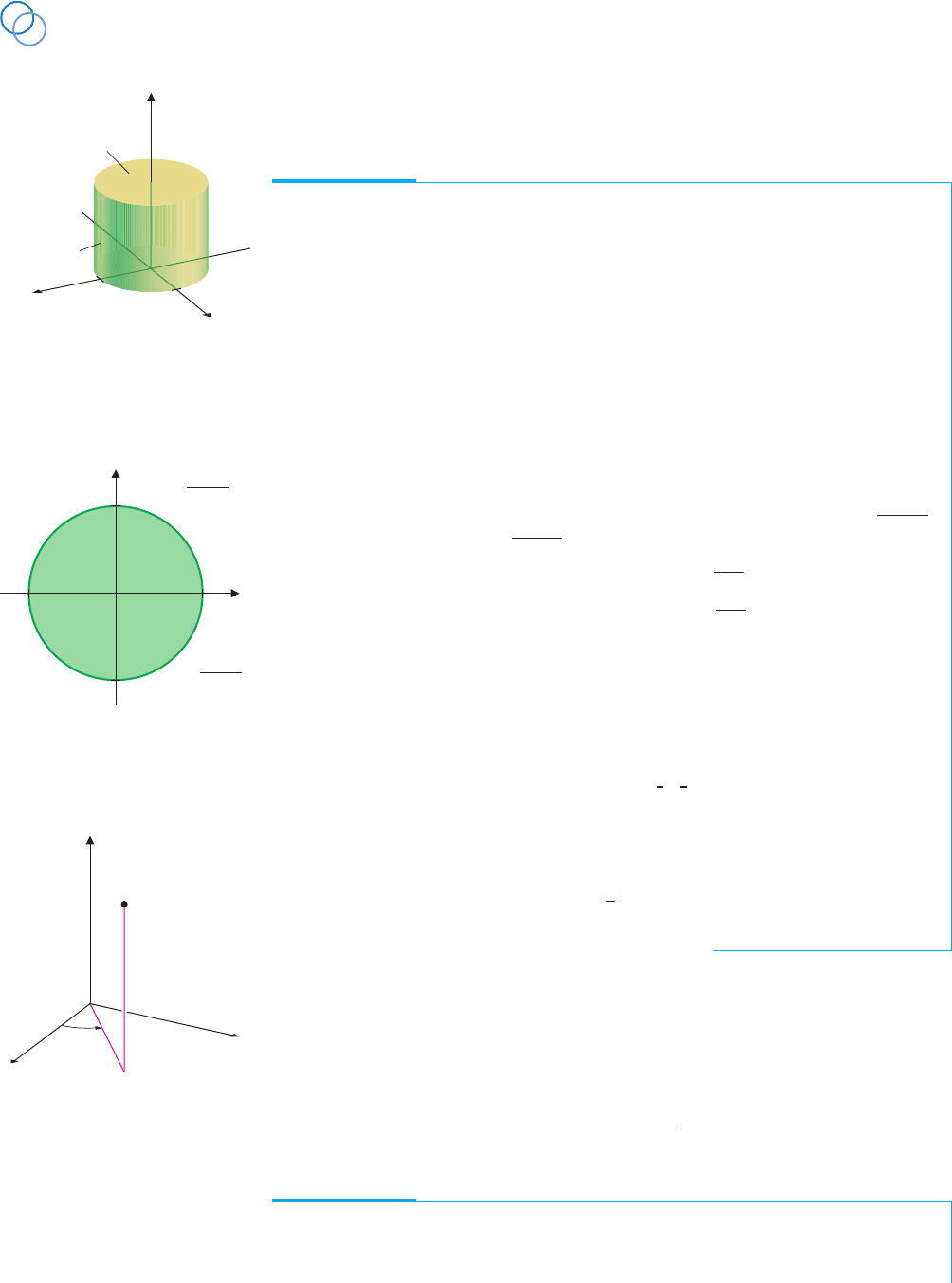
In example 5.6 of section 14.5, we found it convenient to introduce polar coordinates in
order to evaluate the outer double integral in a triple integral problem. Sometimes, this is
more than a mere convenience, as we see in example 6.1.
x
y
z
x
2
y
2
9
z 5
R
3
3
FIGURE 14.49a
The solid Q
y
x
33
R
y
9 x
2
y
9 x
2
FIGURE 14.49b
The region R
EXAMPLE 6.1 A Triple Integral Requiring Polar Coordinates
Evaluate
Q
e
x
2
+y
2
dV, where Q is the solid bounded by the cylinder x
2
+ y
2
= 9, the
xy-plane and the plane z = 5.
Solution We show a sketch of the solid in Figure 14.49a. Here, the base of the solid is
the circle R of radius 3 centered at the origin and lying in the xy-plane and for each
(x, y)inR, z ranges from 0 up to 5. So, we have
Q
e
x
2
+y
2
dV =
R
5
0
e
x
2
+y
2
dz dA
= 5
R
e
x
2
+y
2
dA.
From Figure 14.49b, observe that for each fixed x ∈ [−3, 3], y ranges from −
√
9 − x
2
(the bottom semicircle) up to
√
9 − x
2
(the top semicircle), so that
Q
e
x
2
+y
2
dV = 5
R
e
x
2
+y
2
dA = 5
3
−3
√
9−x
2
−
√
9−x
2
e
x
2
+y
2
dydx.
Unfortunately, we don’t know an antiderivative for e
x
2
+y
2
. Even the authors’ computer
algebra system has difficulty with this. On the other hand, if we introduce polar
coordinates: x = r cos θ and y = r sinθ, we get that for each θ ∈ [0, 2π], r ranges from
0 up to 3. We now have an integral requiring only a simple substitution:
Q
e
x
2
+y
2
dV = 5
R
e
x
2
+y
2
e
r
2
dA
rdrdθ
= 5
2π
0
3
0
e
r
2
rdrdθ
=
5
2
2π
0
e
r
2
r=3
r=0
dθ
= 5π (e
9
− 1).
The process of replacing two of the variables in a three-dimensional coordinate system
by polar coordinates, as we illustrated in example 6.1, is so common that we give this
coordinate system a name: cylindrical coordinates.
y
x
(r, u, z)
O
u
z
r
z
FIGURE 14.50
Cylindrical coordinates
To be precise, we specify a point P(x, y, z) ∈ R
3
by identifying polar coordinates for
the point (x, y) ∈ R
2
: x = r cosθ and y = r sinθ, where r
2
= x
2
+ y
2
and θ is the angle
made by the line segment connecting the origin and the point (x, y, 0) with the positive
x-axis, as indicated in Figure 14.50. Then, tanθ =
y
x
. We refer to (r,θ,z)ascylindrical
coordinates for the point P.
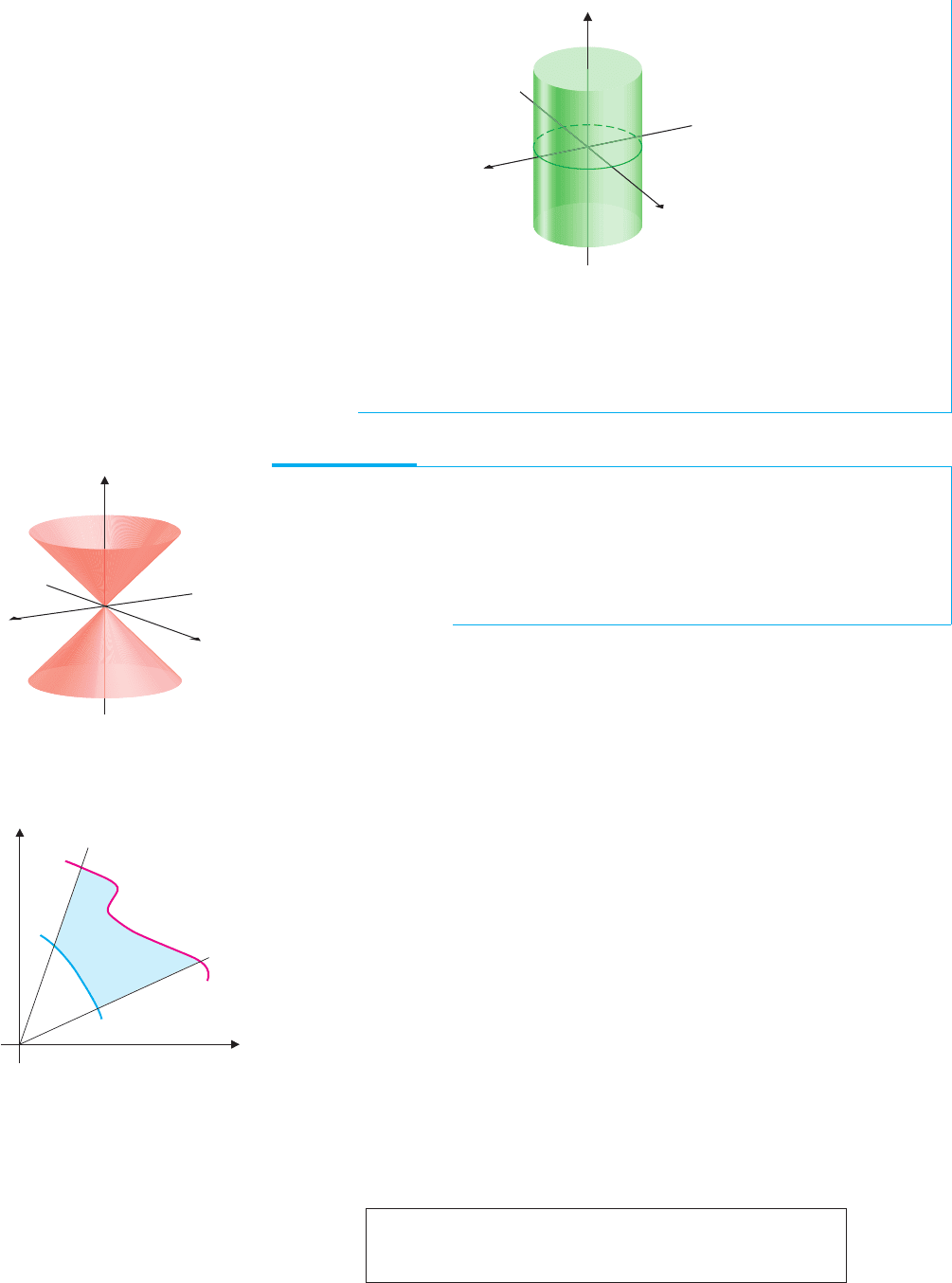
EXAMPLE 6.2 Equation of a Cylinder in Cylindrical Coordinates
Write the equation for the cylinder x
2
+ y
2
= 16 (see Figure 14.51) in cylindrical
coordinates.
P1: OSO/OVY P2: OSO/OVY QC: OSO/OVY T1: OSO
MHDQ256-Ch14 MHDQ256-Smith-v1.cls January 5, 2011 10:17
LT (Late Transcendental)
CONFIRMING PAGES
14-49 SECTION 14.6
..
Cylindrical Coordinates 949
x
2
y
2
16
z
y
x
4
4
FIGURE 14.51
The cylinder r = 4
Solution In cylindrical coordinates r
2
= x
2
+ y
2
, so the cylinder becomes r
2
= 16 or
r =±4. But note that since θ is not specified, the equation r = 4 describes the same
cylinder.
z
y
x
z
2
x
2
y
2
FIGURE 14.52
The cone z = r
y
x
u b
u a
r g
1
(u)
r g
2
(u)
R
FIGURE 14.53
The region R
EXAMPLE 6.3 Equation of a Cone in Cylindrical Coordinates
Write the equation for the cone z
2
= x
2
+ y
2
(see Figure 14.52) in cylindrical
coordinates.
Solution Since x
2
+ y
2
= r
2
, the cone becomes z
2
= r
2
or z =±r. In cases where
we need r to be positive, we write separate equations for the top cone z = r and the
bottom cone z =−r.
As we did on a case-by-case basis in example 5.6 and in example 6.1, we can use
cylindrical coordinates to simplify certain triple integrals. For instance, suppose that we
can write the solid Q as
Q ={(r,θ,z)|(r,θ) ∈ R and k
1
(r,θ) ≤ z ≤ k
2
(r,θ)},
where k
1
(r,θ) ≤ k
2
(r,θ), for all (r,θ) in the region R of the xy-plane defined by
R ={(r,θ)|α ≤ θ ≤ β andg
1
(θ) ≤ r ≤ g
2
(θ)},
where 0 ≤ g
1
(θ) ≤ g
2
(θ), for all θ in [α, β], as shown in Figure 14.53. Then, notice that
from (5.4), we can write
Q
f (r,θ,z)dV =
R
k
2
(r,θ)
k
1
(r,θ)
f (r,θ,z)dz
dA.
Since the outer double integral is a double integral in polar coordinates, we already know
how to write it as an iterated integral. We have
Q
f (r,θ,z)dV =
R
k
2
(r,θ)
k
1
(r,θ)
f (r,θ,z)dz
dA
rdrdθ
=
β
α
g
2
(θ)
g
1
(θ)
k
2
(r,θ)
k
1
(r,θ)
f (r,θ,z)dz
rdrdθ.
This gives us an evaluation formula for triple integrals in cylindrical coordinates:
Q
f (r,θ,z)dV =
β
α
g
2
(θ)
g
1
(θ)
k
2
(r,θ)
k
1
(r,θ)
f (r,θ,z)rdzdrdθ. (6.1)
P1: OSO/OVY P2: OSO/OVY QC: OSO/OVY T1: OSO
MHDQ256-Ch14 MHDQ256-Smith-v1.cls January 7, 2011 7:53
LT (Late Transcendental)
CONFIRMING PAGES
950 CHAPTER 14
..
Multiple Integrals 14-50
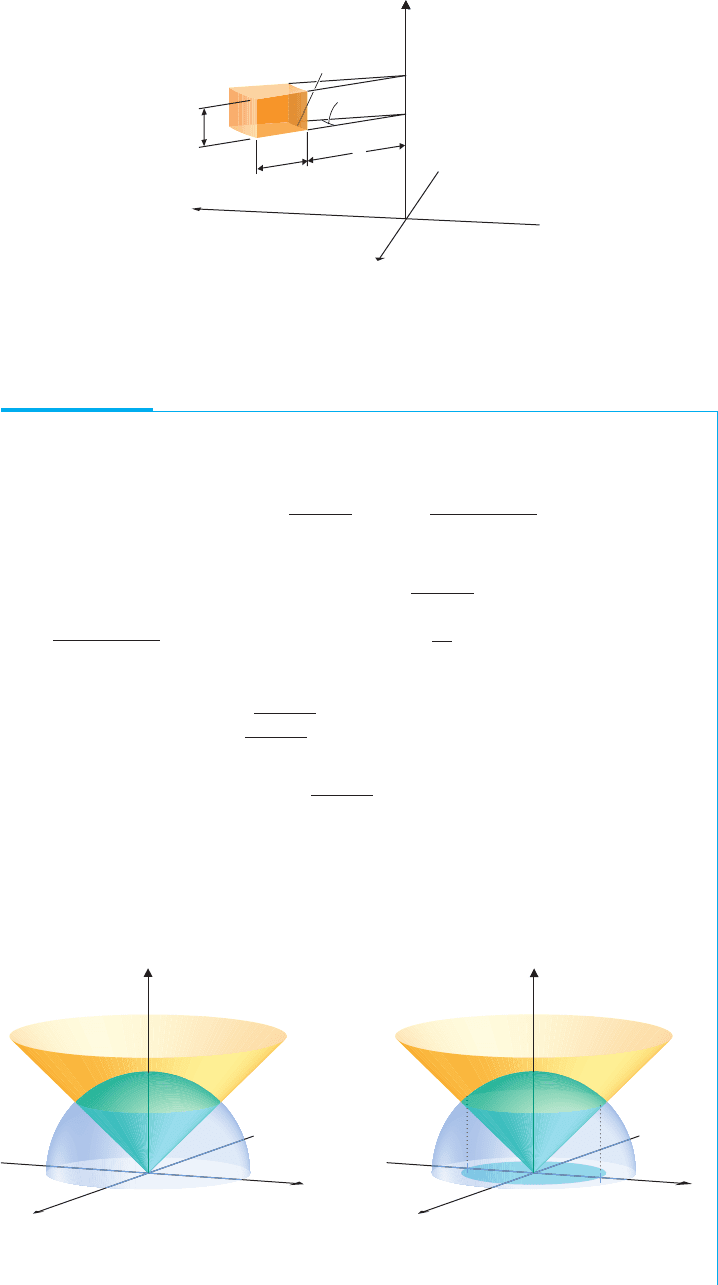
In setting up tripleintegrals in cylindrical coordinates, it often helps to visualize the volume
element dV = rdzdrdθ. (See Figure 14.54.)
r du
dz
dr
r
du
O
y
x
z
FIGURE 14.54
Volume element for cylindrical
coordinates
EXAMPLE 6.4 A Triple Integral in Cylindrical Coordinates
Write
Q
f (r,θ,z)dV as a triple iterated integral in cylindrical coordinates if
Q =
(x, y, z)|
x
2
+ y
2
≤ z ≤
18 − x
2
− y
2
.
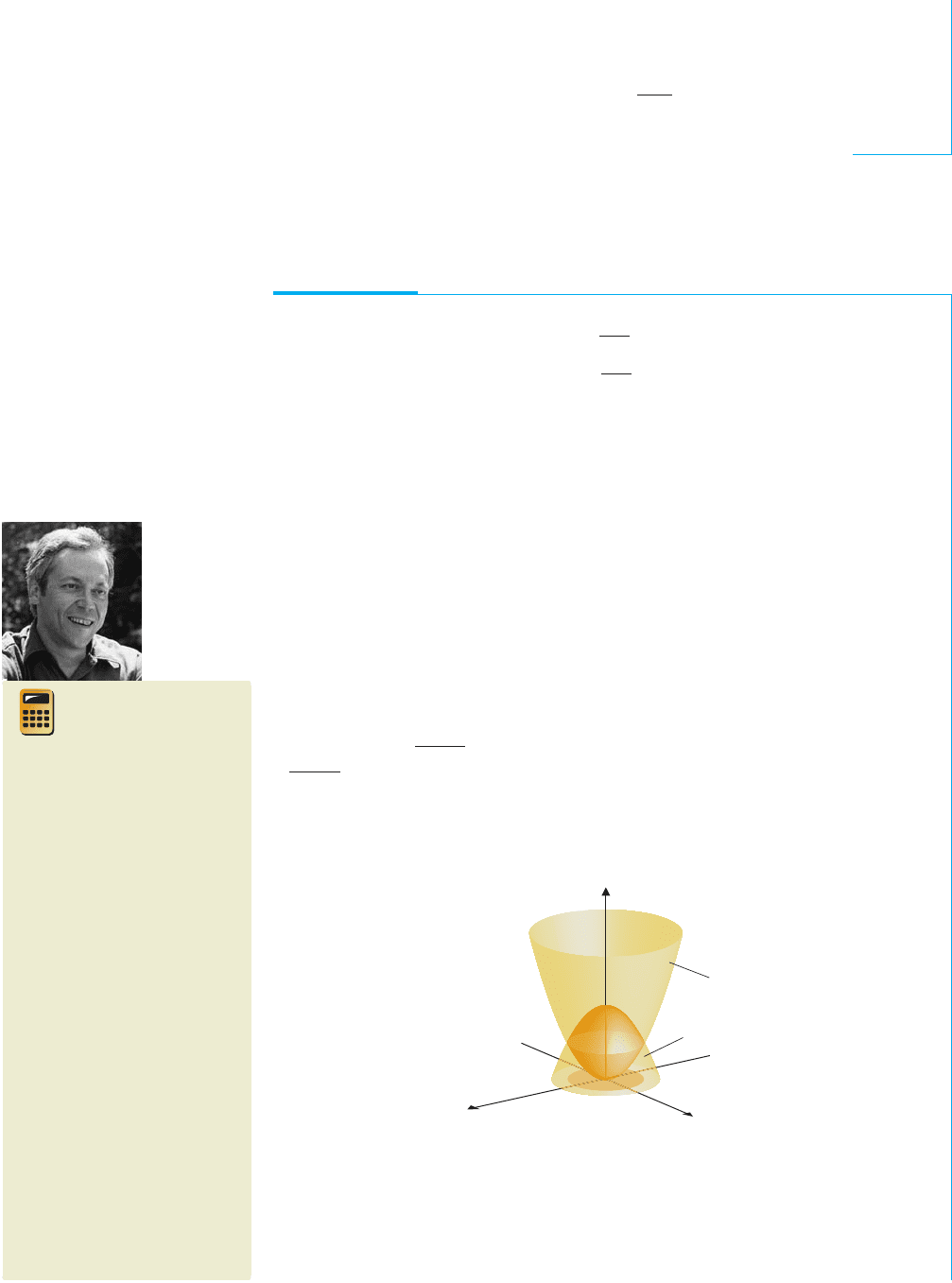
Solution The first task in setting up any iterated multiple integral is to sketch the
region over which you are integrating. Here, z =
x
2
+ y
2
is the top half of a right
circular cone, with vertex at the origin and axis lying along the z-axis, and
z =
18 − x
2
− y
2
is the top hemisphere of radius
√
18 centered at the origin. So, we
are looking for the set of all points lying above the cone and below the hemisphere. (See
Figure 14.55a.) Recognize that in cylindrical coordinates, the cone is written z = r and
the hemisphere becomes z =
√
18 − r
2
, since x
2
+ y
2
= r
2
. This says that for each r
and θ,z ranges from r up to
√
18 − r
2
. Notice that the cone and the hemisphere
intersect when
18 − r
2
= r
or 18 −r
2
= r
2
,
so that 18 = 2r
2
or r = 3.
z ⫽ r
z
x
y
z ⫽ 兹苶苶苶
苶
18 ⫺ r
2
z
x
y
FIGURE 14.55a FIGURE 14.55b
The solid Q Projection of Q onto the xy-plane
P1: OSO/OVY P2: OSO/OVY QC: OSO/OVY T1: OSO
MHDQ256-Ch14 MHDQ256-Smith-v1.cls January 5, 2011 10:17
LT (Late Transcendental)
CONFIRMING PAGES
14-51 SECTION 14.6
..
Cylindrical Coordinates 951
That is, the two surfaces intersect in a circle of radius 3 lying in the plane z = 3. The
projection of the solid down onto the xy-plane is then the circle of radius 3 centered at
the origin (see Figure 14.55b) and we have
Q
f (r,θ,z)dV =
2π
0
3
0
√
18−r
2
r
f (r,θ,z)rdzdrdθ.
Very often, a triple integral in rectangular coordinates is simpler to evaluate in cylindri-
cal coordinates. You must then recognize how to write the solid in cylindrical coordinates,
as well as how to rewrite the integral.
EXAMPLE 6.5 Changing from Rectangular to Cylindrical Coordinates
Evaluate the triple iterated integral
1
−1
√
1−x
2
−
√
1−x
2
2−x
2
−y
2
x
2
+y
2
(x
2
+ y
2
)
3/2
dzdydx.
TODAY IN
MATHEMATICS
Enrico Bombieri (1940– )
An Italian mathematician who
proved what is now known as the
Bombieri-Vinogradov Mean Value
Theorem on the distribution of
prime numbers. Bombieri is
known as a solver of “deep”
problems, which are fundamental
questions that baffle the world’s
best mathematicians. This is a
risky enterprise, because many
such problems are unsolvable.
One of Bombieri’s special talents
is a seemingly instinctual sense of
which problems are both solvable
and interesting. To see why this is
a true talent, think about how
hard it would be to write double
and triple integrals that are at the
same time interesting, challenging
and solvable (antiderivatives
found and evaluated) and then
imagine performing an equivalent
task for problems that nobody has
ever solved.
Solution As written, the integral is virtually impossible to evaluate exactly. (Even
our computer algebra system had trouble with it.) Notice that the integrand involves
x
2
+ y
2
, which is simply r
2
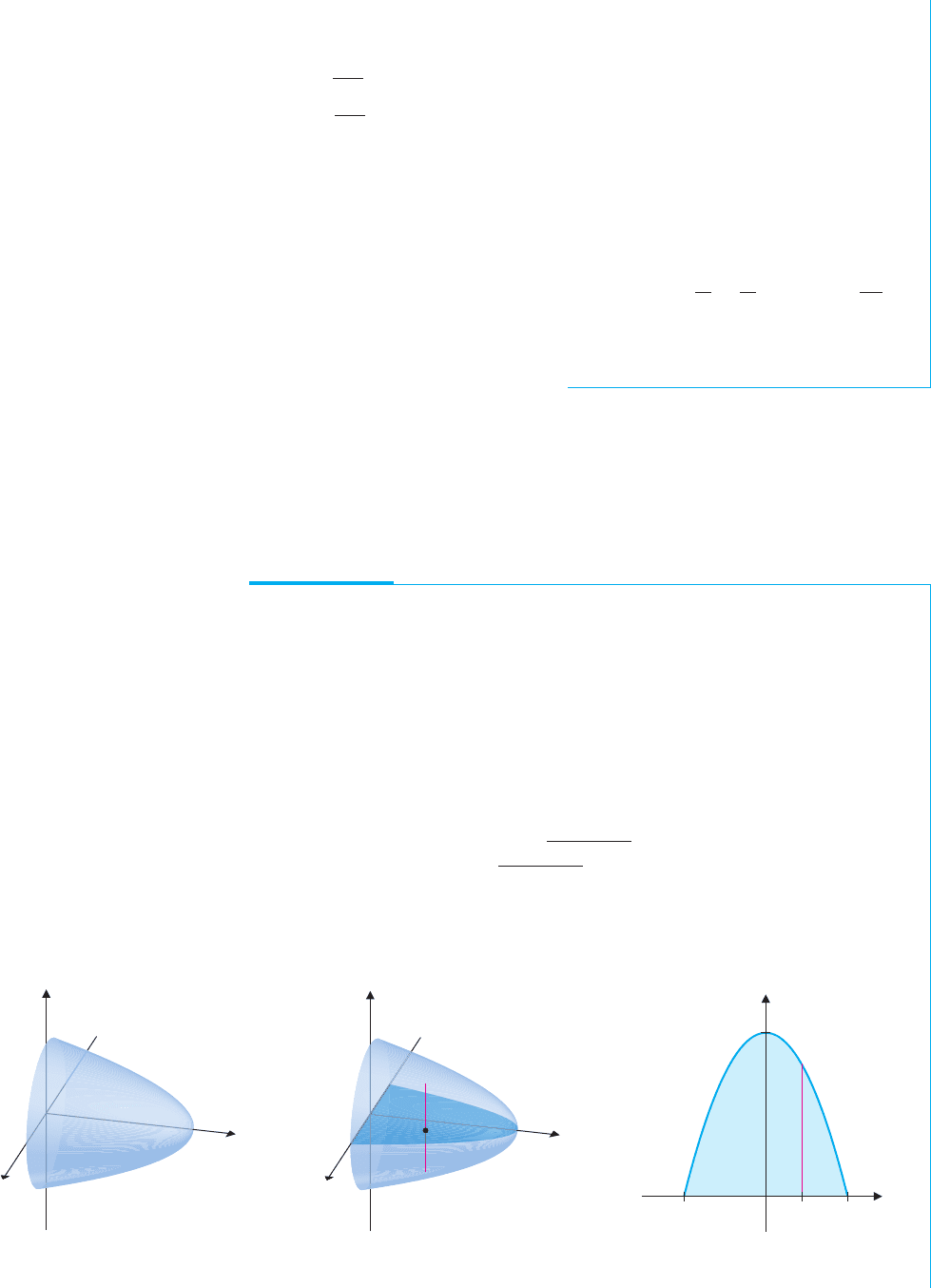
in cylindrical coordinates. You should also try to visualize
the region over which you are integrating. First, from the innermost limits of
integration, notice that z = 2 − x
2
− y
2
is a paraboloid opening downward, with vertex
at the point (0, 0, 2) and z = x
2
+ y
2
is a paraboloid opening upward with vertex at the
origin. So, the solid is some portion of the solid bounded by the two paraboloids. The
paraboloids intersect when
2 − x
2
− y
2
= x
2
+ y
2
or 1 = x
2
+ y
2
.
So, the intersection forms a circle of radius 1 lying in the plane z = 1 and centered at
the point (0, 0, 1). Looking at the outer two integrals, note that for each x ∈ [−1, 1],
y ranges from −
√
1 − x
2
(the bottom semicircle of radius 1 centered at the origin) to
√
1 − x
2
(the top semicircle of radius 1 centered at the origin). Since this corresponds to
the projection of the circle of intersection onto the xy-plane, the triple integral is over
the entire solid below the one paraboloid and above the other. (See Figure 14.56.)
x
z
y
z r
2
z 2 r
2
FIGURE 14.56
The solid Q
In cylindrical coordinates, the top paraboloid becomes z = 2 − x
2
− y
2
= 2 −r
2
and
the bottom paraboloid becomes z = x
2
+ y
2
= r
2
. So, for each fixed value of r and θ,
z varies from r
2
up to 2 −r
2
. Further, since the projection of the solid onto the xy-plane
P1: OSO/OVY P2: OSO/OVY QC: OSO/OVY T1: OSO
MHDQ256-Ch14 MHDQ256-Smith-v1.cls January 5, 2011 10:17
LT (Late Transcendental)
CONFIRMING PAGES
952 CHAPTER 14
..
Multiple Integrals 14-52
is the circle of radius 1 centered at the origin, r varies from 0 to 1 and θ varies from 0
to 2π. We can now write the triple integral in cylindrical coordinates as
1
−1
√
1−x
2
−
√
1−x
2
2−x
2
−y
2
x
2
+y
2
(x
2
+ y
2
)
3/2
dzdydx =
2π
0
1
0
2−r
2
r
2
(r
2
)
3/2
rdzdrdθ
=
2π
0
1
0
2−r
2
r
2
r
4
dzdr dθ
=
2π
0
1
0
r
4
(2 − 2r
2
)dr dθ
= 2
2π
0
r
5
5
−
r
7
7
r=1
r=0
dθ =
8π
35
.
Evaluating the triple integral in cylindrical coordinates was easy, compared to
evaluating the original integral directly.
When converting an iterated integral from rectangular to cylindrical coordinates, it’s
important to carefully visualize the solid over which you are integrating. While we have so
far defined cylindrical coordinates by replacing x and y by their polar coordinate represen-
tations, we can do this with any two of the three variables, as we see in example 6.6.
EXAMPLE 6.6 Using a Triple Integral to Find Volume
Use a triple integral to find the volume of the solid Q bounded by the graph of
y = 4 − x
2
− z
2
and the xz-plane.
Solution Notice that the graph of y = 4 − x
2
− z
2
is a paraboloid with vertex at
(0, 4, 0), whose axis is the y-axis and that opens toward the negative y-axis. We show
the solid in Figure 14.57a. Without thinking too much about it, we might consider
integration with respect to z first. In this case, the projection of the solid onto the
xy-plane is the parabola formed by the intersection of the paraboloid with the xy-plane.
(See Figure 14.57b.) Notice from Figure 14.57b that for each fixed x and y, the line
through the point (x, y, 0) and perpendicular to the xy-plane enters the solid on the
bottom half of the paraboloid (z =−
4 − x
2
− y) and exits the solid on the top
surface of the paraboloid (z =
4 − x
2
− y). This gives you the innermost limits of
integration. We get the rest from looking at the projection of the paraboloid onto the
xy-plane. (See Figure 14.57c.)
z
x
y
O
z
4 x
2
y
z 4 x
2
y
O
z
x
y
y 4 x
2
y
x
4
22
FIGURE 14.57a FIGURE 14.57b FIGURE 14.57c
The solid Q Solid, showing projection onto xy-plane Projection onto the xy-plane