
Smith R., Minton R. Calculus
Подождите немного. Документ загружается.

P1: OSO/OVY P2: OSO/OVY QC: OSO/OVY T1: OSO
MHDQ256-Ch14 MHDQ256-Smith-v1.cls January 7, 2011 7:53
LT (Late Transcendental)
CONFIRMING PAGES
14-53 SECTION 14.6
..
Cylindrical Coordinates 953
Reading the outer limits of integration from Figure 14.57c and using (5.5), we get
V =
Q
dV =
2
−2
4−x
2
0
√
4−x
2
−y
−
√
4−x
2
−y
dzdydx
=
2
−2
4−x
2
0
z
z=
√
4−x
2
−y
z=−
√
4−x
2
−y
dydx
=
2
−2
4−x
2
0
2
4 − x
2
− ydydx
=
2
−2
(−2)
2
3
(4 − x
2
− y)
3/2
y=4−x
2
y=0
dx
=
4
3
2
−2
(4 − x
2
)
3/2
dx = 8π.
Notice that the last integration here is challenging. (We used a CAS to carry it out.)
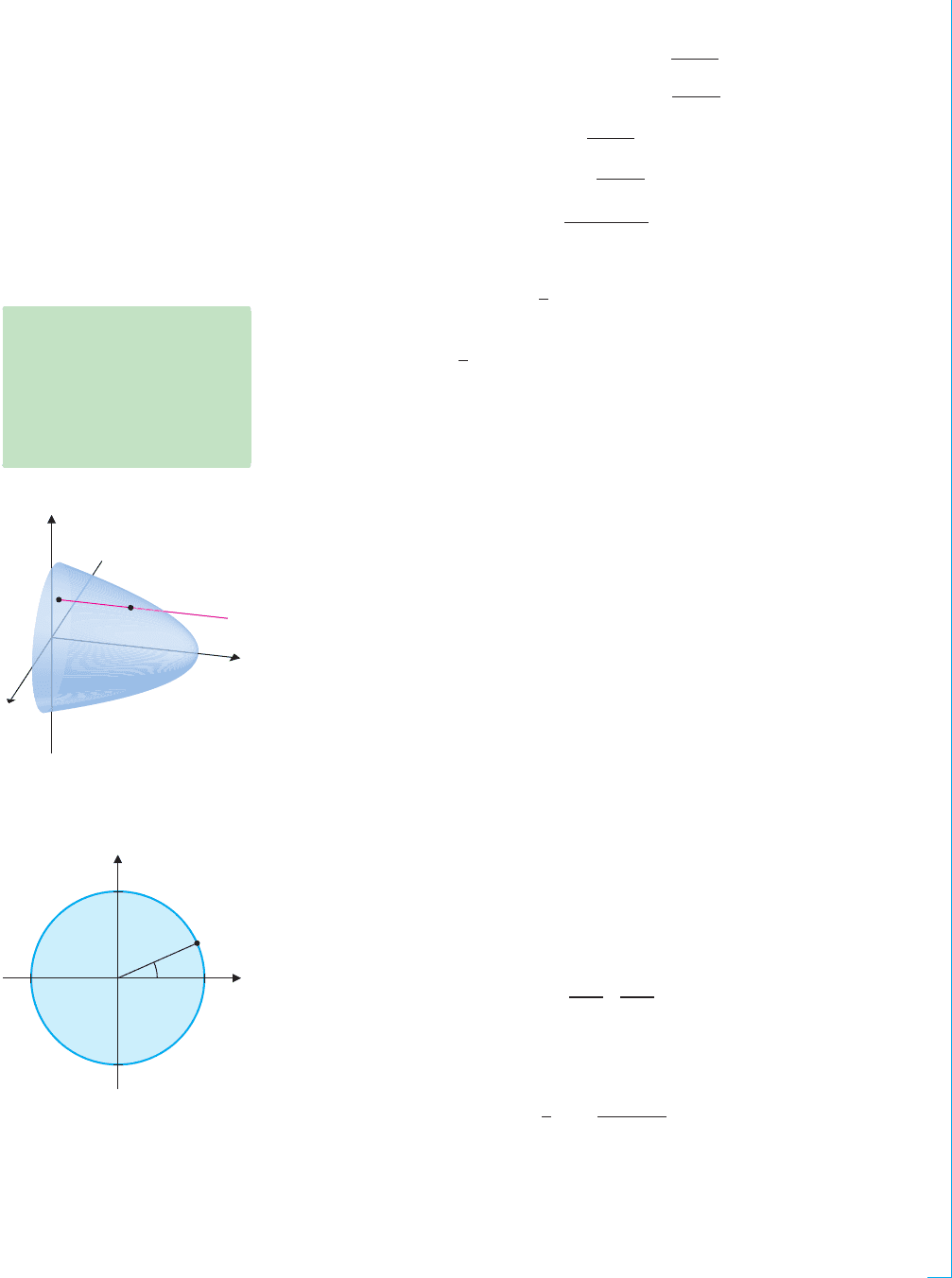
Alternatively, if you look at Figure 14.57a and turn your head to the side, you should
see a paraboloid with a circular base in the xz-plane. This suggests that you might want
to integrate first with respect to y. Referring to Figure 14.57d, observe that for each
point in the base of the solid in the xz-plane, y ranges from 0 to 4 − x
2
− z
2
. Notice that
the base in this case is formed by the intersection of the paraboloid with the xz-plane
(y = 0): 0 = 4 − x
2
− z
2
or x
2
+ z
2
= 4 (i.e., the circle of radius 2 centered at the
origin; see Figure 14.57e).
NOTES
Example 6.6 suggests that polar
coordinates may be used with any
two of x, y and z, to produce a
cylindrical coordinate
representation of a solid.
y 4 x
2
z
2
z
x
y
O
FIGURE 14.57d
Paraboloid with base in the xz-plane
z
x
22
2
2
R
u
r = 2
FIGURE 14.57e
Base of the solid
We can now write the volume as
V =
Q
dV =
R
4−x
2
−z
2
0
dydA
=
R
(4 − x
2
− z
2
)dA,
where R is the disk indicated in Figure 14.57e. Since the region R is a circle and the
integrand contains the combination of variables x
2
+ z
2
, we define polar coordinates
x = r cosθ and z = r sinθ. From Figure 14.57e, notice that for each fixed angle
θ ∈ [0, 2π], r runs from 0 to 2. This gives us
V =
R
(4 − x
2
− z
2
)
4 −r
2
dA
rdrdθ
=
2π
0
2
0
(4 − r
2
)rdrdθ
=−
1
2
2π
0
(4 − r
2
)
2
2
r=2
r=0
dθ
= 4
2π
0
dθ = 8π.
Notice that in some sense, viewing the solid as having its base in the xz-plane is more
natural than our first approach to the problem and the integrations are much simpler.

P1: OSO/OVY P2: OSO/OVY QC: OSO/OVY T1: OSO
MHDQ256-Ch14 MHDQ256-Smith-v1.cls January 5, 2011 10:17
LT (Late Transcendental)
CONFIRMING PAGES
954 CHAPTER 14
..
Multiple Integrals 14-54
EXERCISES 14.6
WRITING EXERCISES
1. Using the examples in this section as a guide, make a short list
of figures that are easily described in cylindrical coordinates.
2. In example 6.4, explainwhy the outer double integration limits
are determined by the intersection of the cone and the hemi-
sphere (and not, for example, by the trace of the hemisphere in
the xy-plane).
3. Carefully examine the rectangular and cylindrical limits of in-
tegration in example 6.5. Note that in both integrals, z is the
innermost variable of integration. In this case, explain why
the innermost limits of integration for the triple integral in
cylindrical coordinates can be obtained by substituting polar
coordinates into the innermost limits of integrationof the triple
integralinrectangular coordinates. Explain why this would not
be the case if the order of integration had been changed.
4. In example 6.6, the cylindrical coordinates used were r,θ
and y, and the integrand was 4 −r
2
. If the integrand had
been x − x
2
− z
2
, discuss whether x = r cos θ or x = r sin θ
would have been correct, or whether it would matter.
In exercises 1–8, write the given equation in cylindrical
coordinates.
1. x
2
+ y
2
= 16 2. x
2
+ y
2
= 1
3. (x −2)
2
+ y
2
= 4 4. x
2
+ (y − 3)
2
= 9
5. z = x
2
+ y
2
6. z =
x
2
+ y
2
7. y = 2x 8. z = e
−x
2
−y
2
............................................................
In exercises 9–24, set up the triple integral
Q
f (x, y, z) dV in
cylindrical coordinates.
9. Q is the solid above z =
x
2
+ y
2
and below
z =
8 − x
2
− y
2
.
10. Q is the solid above z =−
x
2
+ y
2
, below z = 0 and inside
x
2
+ y
2
= 4.
11. Q is the solid above the xy-plane and below z = 9 − x
2
− y
2
.
12. Q is the solid above the xy-plane and below z = 4 − x
2
− y
2
in the first octant.
13. Q isthesolidabovez = x
2
+ y
2
− 1,belowz = 8andbetween
x
2
+ y
2
= 3 and x
2
+ y
2
= 8.
14. Q is the solid above z = x
2
+ y
2
−4 and below z =−x
2
− y
2
.
15. Q is the solid bounded by y = 4 − x
2
− z
2
and y = 0.
16. Q is the solid bounded by y =
√
x
2
+ z
2
and y = 9.
17. Q is the solid bounded by x = y
2
+ z
2
and x = 2 − y
2
− z
2
.
18. Q is the solid bounded by x =
y
2
+ z
2
and x = 4.
19. Q is the frustum of a cone bounded by z = 2, z = 3 and
z =
x
2
+ y
2
.
20. Q is the solid bounded by z = 1 and z = 3 and under
z = 4 − x
2
− y
2
.
21. Q is the solid bounded by the hyperboloid x
2
− y
2
− z
2
= 1,
(x > 0) and x = 4.
22. Q is the solid bounded by the hyperboloid x
2
+ y
2
− z
2
= 1,
z =−2 and z = 2.
23. Q is the solid above z = e
√
x
2
+y
2
and below z = 2.
24. Q is the solid bounded by x = e
4−z
2
−y
2
and x = e
z
2
+y
2
.
............................................................
In exercises 25–40, set up and evaluate the indicated triple inte-
gral in the appropriate coordinate system.
25.
Q
e
x
2
+y
2
dV, where Q is the solid inside x
2
+ y
2
= 4 and
between z = 1 and z = 2.
26.
Q
ze
√
x
2
+y
2
dV, where Q is the solid inside x
2
+ y
2
= 4,
outside x
2
+ y
2
= 1 and between z = 0 and z = 3.
27.
Q
(x + z)dV, where Q is the solid below x +2y + 3z = 6
in the first octant.
28.
Q
(y + 2) dV, where Q is the solid below x + z = 4 in the
first octant between y = 1 and y = 2.
29.
Q
zdV, where Q is the solid between z =
x
2
+ y
2
and
z =
4 − x
2
− y
2
.
30.
Q
x
2
+ y
2
dV, where Q is the solid between
z =
x
2
+ y
2
and z = 0 and inside x
2
+ y
2
= 4.
31.
Q
(x + y)dV, where Q is the tetrahedron bounded by
x + 2y + z = 4 and the coordinate planes.
32.
Q
(2x − y)dV, where Q is the tetrahedron bounded by
3x + y + 2z = 6 and the coordinate planes.
33.
Q
e
z
dV, where Q is the solid above z =−
4 − x
2
− y
2
,
below the xy-plane and outside x
2
+ y
2
= 3.
34.
Q
x
2
+ y
2
e
z
dV, where Q is the solid inside x
2
+ y
2
= 1
and between z = (x
2
+ y
2
)
3/2
and z = 0.
35.
Q
2xdV, where Q is the solid between z =
x
2
+ y
2
and
z = 0 and inside x
2
+ (y − 1)
2
= 1.
36.
Q
ydV,where Q is the solid between z = x
2
+ y
2
and z = 0
and inside (x − 2)
2
+ y
2
= 4.
37.
Q
sin
y
2
+ z
2
dV, where Q is bounded by x =
y
2
+ z
2
and x = 4.
38.
Q
(x
2
+ z
2
)e
√
x
2
+z
2
dV, where Q is bounded by
y =
1
x
2
+ z
2
, y = 0, x
2
+ z
2
= 1 and x
2
+ z
2
= 2.
P1: OSO/OVY P2: OSO/OVY QC: OSO/OVY T1: OSO
MHDQ256-Ch14 MHDQ256-Smith-v1.cls January 5, 2011 10:17
LT (Late Transcendental)
CONFIRMING PAGES
14-55 SECTION 14.6
..
Cylindrical Coordinates 955
39.
Q
1
z
dV, where Q is bounded by z = e
xy
, z = 1, y = x + 1,
y = 0 and x = 0.
40.
Q
2xdV, where Q is bounded by z = sin(x + y), z = 0,
y = π − x, y = 0 and x = 0.
............................................................
In exercises 41–46, evaluate the iterated integral after changing
coordinate systems.
41.
1
−1
√
1−x
2
−
√
1−x
2
√
x
2
+y
2
0
3z
2
dzdydx
42.
1
0
√
1−x
2
−
√
1−x
2
2−x
2
−y
2
0
x
2
+ y
2
dzdydx
43.
2
0
√
4−y
2
−
√
4−y
2
√
8−x
2
−y
2
√
x
2
+y
2
2dzdx dy
44.
1
0
√
1−x
2
0
4
1−x
2
−y
2
x
2
+ y
2
dzdydx
45.
3
−3
0
−
√
9−x
2
x
2
+z
2
0
(x
2
+ z
2
)dydzdx
46.
0
−2
√
4−z
2
−
√
4−z
2
4
y
2
+z
2
(y
2
+ z
2
)
3/2
dx dy dz
............................................................
In exercises 47–54, sketch graphs of the cylindrical equations.
47. z = r 48. z = r
2
49. z = 4 − r
2
50. z =
√
4 −r
2
51. r = 2secθ 52. r = 2sinθ
53. θ = π/4 54. r = 4
............................................................
Exercises 55–64 relate to unit basis vectors in cylindrical
coordinates.
55. For the position vector r =x, y, 0=r cos θ,r sinθ,0 in
cylindrical coordinates, compute the unit vector
ˆ
r =
r
r
, where
r =r = 0.
56. Referring to exercise 55, for the unit vector
ˆ
θ =−sinθ,cosθ,0, show that
ˆ
r,
ˆ
θ and k are mutually
orthogonal.
57. The unit vectors
ˆ
r and
ˆ
θ in exercises 55 and 56 are not constant
vectors. This changes many of our calculations and interpre-
tations. For an object in motion (that is, where r,θ and z are
functions of time), compute the derivatives of
ˆ
r and
ˆ
θ in terms
of each other.
58. For the vector v from (0, 0, 0) to (2, 2, 0), show that v = r
ˆ
r.
59. For the vector v from (1, 1, 0) to (3, 3, 0), find a constant c such
that v = c
ˆ
r. Compare to exercise 58.
60. For the vector v from (−1, −1, 0) to (1, 1, 0), find a constant c
such that v = c
ˆ
r. Compare to exercise 59.
61. For the vector v from (1, −1, 0) to (1, 1, 0), find a constant c
such that v = c
π/4
−π/4
ˆ
θdθ.
62. For the vector v from (−1, −1, 0) to (1, 1, 0), write v in the
form c
b
a
ˆ
θ dθ. Compare to exercise 60.
63. For the point (−1, −1, 0), sketch the vectors
ˆ
r and
ˆ
θ. Illus-
trate graphically how the vector v from (−1, −1, 0) to
(1, 1, 0) can be represented both in terms of
ˆ
r and in terms of
ˆ
θ.
64. For the vector v from (−1, −1, 0) to (1,
√
3, 1), find constants
a, b,θ
1
,θ
2
and c such that v = a
ˆ
r + b
θ
2
θ
1
ˆ
θ dθ +ck.
APPLICATIONS
In exercises 65–68, find the mass and center of mass of the
solid with the given density and bounded by the graphs of the
indicated equations.
65. ρ(x, y, z) =
x
2
+ y
2
, bounded by z =
x
2
+ y
2
and z = 4.
66. ρ(x, y, z) = e
−x
2
−y
2
, bounded by z = 4 − x
2
− y
2
and the
xy-plane.
67. ρ(x, y, z) = 4, between z = x
2
+ y
2
and z = 4 and inside
x
2
+ (y − 1)
2
= 1.
68. ρ(x, y, z) = x
2
+ z
2
, bounded by y =
√
x
2
+ z
2
and
y =
√
8 − x
2
− z
2
.
EXPLORATORY EXERCISES
1. Manycomputer graphing packages will sketch graphs in cylin-
dricalcoordinates,withoneoption being to haver as afunction
of z and θ. In some cases, the graphs are very familiar. Sketch
the following and solve for z to write the equation in the
notation of this section: (a) r =
√
z, (b) r = z
2
, (c) r = ln z,
(d) r =
√
4 − z
2
, (e) r = z
2
cosθ. By leaving z out altogether,
some old polar curves get an interesting three-dimensional
extension: (f) r = sin
2
θ,0 ≤ z ≤ 4, (g) r = 2 −2cosθ,
0 ≤ z ≤ 4.Manygraphs are simply new.Explorethefollowing
graphs and others of your own creation: (h) r = cosθ − ln z,
(i) r = z
2
ln(θ +1), (j) r = ze
θ/8
, (k) r = θe
−z
.
2. In this exercise, you will explore a class of surfaces known as
Pl¨ucker’s conoids. In parametric equations, the conoid with
n folds is given by x = r cosθ, y = r sinθ and z = sin(nθ ).
Use a CASto sketch the conoid with 2 folds. Show that on this
surface z =
2xy
x
2
+y
2
. In vector notation, the parametric equa-
tions can be written as 0, 0, sin(nθ)+r cosθ,r sinθ,0,
with the interpretation that the conoid is generated by moving
a line around and perpendicular to the circle cosθ,sin θ,0.
For n = 2, sketch a parametric graph with 1 ≤ r ≤ 2 and
0 ≤ θ ≤ 2π and compare the surface to a M¨obius strip. Ex-
plain how the line segment moving around the circle rotates
according to the function sin 2θ . Sketch similar graphs for
n = 3, n = 4 and n = 5, and explain why n is referred to as
the number of folds.
P1: OSO/OVY P2: OSO/OVY QC: OSO/OVY T1: OSO
MHDQ256-Ch14 MHDQ256-Smith-v1.cls January 5, 2011 10:17
LT (Late Transcendental)
CONFIRMING PAGES
956 CHAPTER 14
..
Multiple Integrals 14-56
14.7 SPHERICAL COORDINATES
We introduce here another common coordinate system that is frequently more convenient
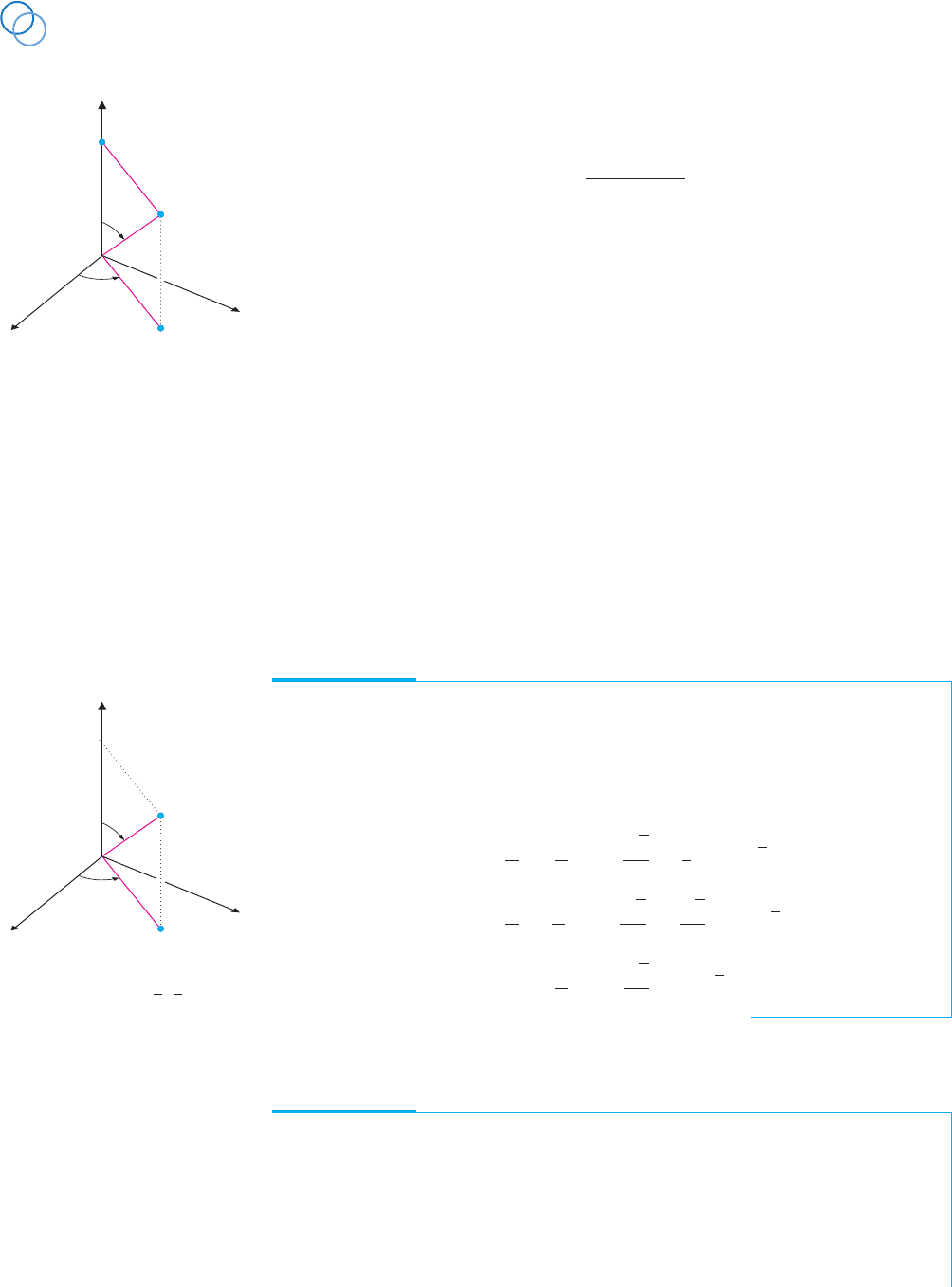
than either rectangular or cylindrical coordinates. We can specify a point P with rectangular
coordinates (x, y, z) by the corresponding spherical coordinates (ρ,φ,θ). Here, ρ is
defined to be the distance from the origin,
ρ =
x
2
+ y
2
+ z
2
. (7.1)
Q(0, 0, z)
P(x, y, z)
R(x, y, 0)
x
y
z
r
f
u
O
FIGURE 14.58
Spherical coordinates
Note that specifying the distance a point lies away from the origin specifies a sphere on
which the point must lie (i.e., the equation ρ = ρ
0
> 0 represents the sphere of radius ρ
0
centeredattheorigin).Toname aspecific pointon thesphere, we furtherspecify twoangles,
φ and θ ,as indicated in Figure 14.58. Notice that φ isthe angle from the positive z-axis to the
vector
−→
OP and θ is the angle from the positive x-axis to the vector
−→
OR, where R is the
point lying in the xy-plane with rectangular coordinates (x, y, 0) (i.e., R is the projection of
P onto the xy-plane). You should observe from this description that
ρ ≥ 0 and 0 ≤ φ ≤ π.
If you look closely at Figure 14.58, you can see how to relate rectangular and spherical
coordinates. Notice that
x =
−→
ORcosθ =
−→
QPcosθ.
Looking at the triangle OQP, we find that
−→
QP=ρ sinφ, so that
x = ρ sinφ cosθ. (7.2)
Similarly, we have
y =
−→
ORsinθ = ρ sin φ sinθ. (7.3)
Finally, focusing again on triangle OQP,wehave
z = ρ cosφ. (7.4)
EXAMPLE 7.1 Converting from Spherical to Rectangular Coordinates
Find rectangular coordinates for the point described by (8, π/4, π/3) in spherical
coordinates.
Solution We show a sketch of the point in Figure 14.59. From (7.2), (7.3) and (7.4),
we have
x = 8sin
π
4
cos
π
3
= 8
√
2
2
!
1
2
= 2
√
2,
y = 8 sin
π
4
sin
π
3
= 8
√
2
2
!
√
3
2
!
= 2
√
6
and
z = 8cos
π
4
= 8
√
2
2
!
= 4
√
2.
u
d
x
y
z
8
O
(
8, d, u
)
FIGURE 14.59
The point (8,
π
4
,
π
3
)
It’s often very helpful (especially when dealing with triple integrals) to represent com-
mon surfaces in spherical coordinates.
EXAMPLE 7.2 Equation of a Cone in Spherical Coordinates
Rewrite the equation of the cone z
2
= x
2
+ y
2
in spherical coordinates.
Solution Using (7.2), (7.3) and (7.4), the equation of the cone becomes
ρ
2
cos
2
φ = ρ
2
sin
2
φ cos
2
θ +ρ
2
sin
2
φ sin
2
θ
= ρ
2
sin
2
φ(cos
2
θ +sin
2
θ)
= ρ
2
sin
2
φ. Since cos
2
θ +sin
2
θ = 1.
P1: OSO/OVY P2: OSO/OVY QC: OSO/OVY T1: OSO
MHDQ256-Ch14 MHDQ256-Smith-v1.cls January 5, 2011 10:17
LT (Late Transcendental)
CONFIRMING PAGES
14-57 SECTION 14.7
..
Spherical Coordinates 957
Notice that in order to have ρ
2
cos
2
φ = ρ
2
sin
2
φ, we must either have ρ = 0 (which
corresponds to the origin) or cos
2
φ = sin
2
φ. For the latter to occur,we must haveφ =
π
4
or φ =
3π
4
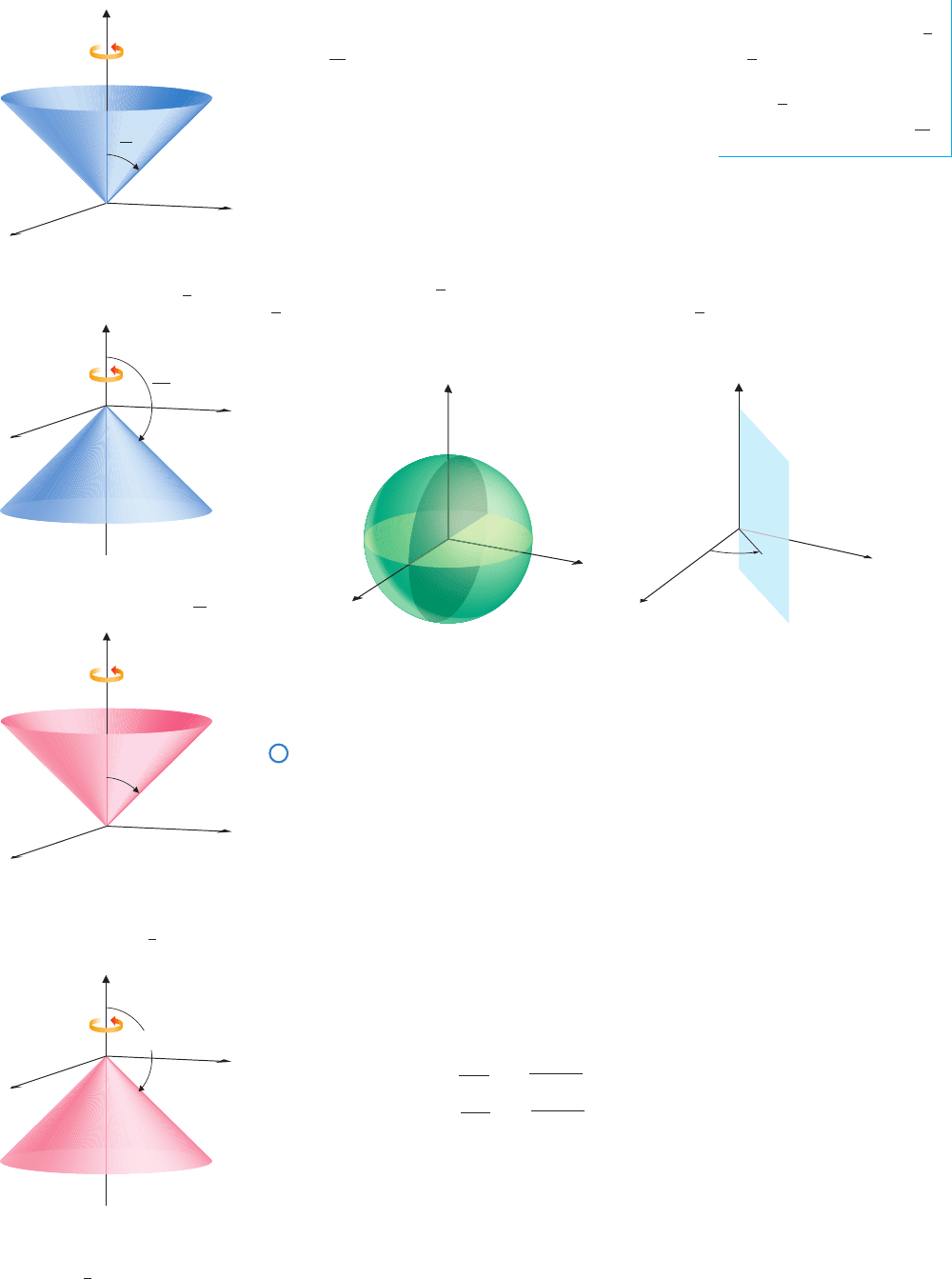
. (Recall that 0 ≤ φ ≤ π.) Observe that taking φ =
π
4
(and allowing ρ and θ
to be anything) describes the top half of the cone, as shown in Figure 14.60a. You can
O
x
y
z
4
p
FIGURE 14.60a
Top half-cone φ =
π
4
O
x
y
4
3p
z
FIGURE 14.60b
Bottom half-cone φ =
3π
4
think of this as taking a single ray (say in the yz-plane) with φ =
π
4
and revolving this
around the z-axis. (This is the effect of letting θ run from 0 to 2π.) Similarly, φ =
3π
4
describes the bottom half cone, as seen in Figure 14.60b.
Notice that, in general, the equation ρ = k (for any constant k > 0) represents the
sphere of radius k, centered at the origin. (See Figure 14.61a.) The equation θ = k
(for any constant k) represents a vertical half-plane, with its edge along the z-axis. (See
Figure 14.61b.) Further, the equation φ = k (for any constant k) represents the top half
of a cone if 0 < k <
π
2
(as in Figure 14.62a) and represents the bottom half of a cone if
π
2
< k <π(as in Figure 14.62b). Finally, note that φ =
π
2
describes the xy-plane. Can you
think of what the equations φ = 0 and φ = π represent?
O
z
f k
x
y
FIGURE 14.62a
Top half-cone φ = k, where
0 < k <
π
2
k
z
x
y
y
x
z
O
u k
FIGURE 14.61a FIGURE 14.61b
The sphere ρ = k The half-plane θ = k
O
z
f k
x
y
FIGURE 14.62b
Bottom half-cone φ = k, where
π
2
< k <π
Triple Integrals in Spherical Coordinates
Just as polar coordinates are indispensable in calculating double integrals over circular
regions, especially when the integrand involves the particular combination of variables
x
2
+ y
2
, spherical coordinates are an indispensable aid in dealing with triple integrals over
spherical regions, particularly with those where the integrand involves the combination
x
2
+ y
2
+ z
2
. Integrals of this type are encountered frequently in applications. Forinstance,
consider the triple integral
Q
cos(x
2
+ y
2
+ z
2
)
3/2
dV,
where Q is the unit ball: x
2
+ y
2
+ z
2
≤ 1. No matter which order you choose for the
integrations, you will arrive at a triple iterated integral that looks like
1
−1
√
1−x
2
−
√
1−x
2
√
1−x
2
−y
2
−
√
1−x
2
−y
2
cos(x
2
+ y
2
+ z
2
)
3/2
dzdydx.
In rectangular coordinates (or cylindrical coordinates, for that matter), you have little hope
of calculating this integral exactly. In spherical coordinates, however, this integral is a snap.
First, we need to see how to write triple integrals in spherical coordinates.
For the integral
Q
f (ρ,φ,θ)dV, we begin, as we have many times before, by con-
structing an inner partition of the solid Q.But, rather than slicing up Q using planes parallel
to the three coordinate planes, we divide Q by slicing it with spheres of the form ρ = ρ
k
,
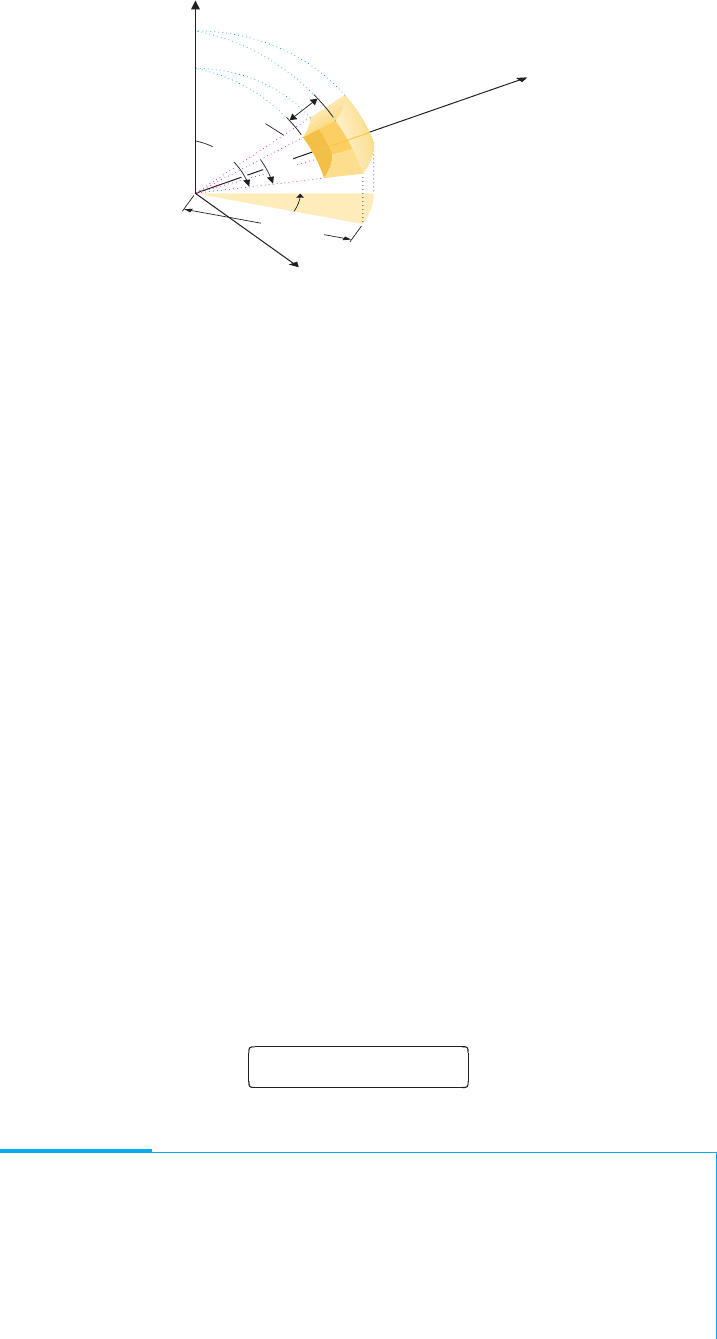
P1: OSO/OVY P2: OSO/OVY QC: OSO/OVY T1: OSO
MHDQ256-Ch14 MHDQ256-Smith-v1.cls January 5, 2011 10:17
LT (Late Transcendental)
CONFIRMING PAGES
958 CHAPTER 14
..
Multiple Integrals 14-58
y
x
z
r
k r
k
f
k
Q
k
f
k
f
k
r
k
O
u
k
r
k
sinf
k
r
k
sinf
k
u
k
FIGURE 14.63
The spherical wedge Q
k
half-planes of the form θ = θ
k
and half-cones of the form φ = φ
k
. Notice that instead
of subdividing Q into a number of rectangular boxes, this divides Q into a number of
spherical wedges of the form:
Q
k
={(ρ,φ,θ)|ρ
k−1
≤ ρ ≤ ρ
k
,φ
k−1
≤ φ ≤ φ
k
,θ
k−1
≤ θ ≤ θ
k
},
as depicted in Figure 14.63. Here, we have ρ
k
= ρ
k
− ρ
k−1
, φ
k
= φ
k
− φ
k−1
and
θ
k
= θ
k
− θ
k−1
. Notice that Q
k
is nearly a rectangular box and so, its volume V
k
is
approximately the same as that of a rectangular box with the same dimensions:
V
k
≈ ρ
k
(ρ
k
φ
k
)(ρ
k
sinφ
k
θ
k
)
= ρ
2
k
sinφ
k
ρ
k
φ
k
θ
k
.
We consider only those wedges that lie completely inside Q, to form an inner partition
Q
1
, Q
2
,...,Q
n
of the solid Q. Summing over the inner partition and letting the norm of
the partition P (here, the longest diagonal of any of the wedges in the inner partition)
approach zero, we get
Q
f (ρ,φ,θ)dV = lim
P→0
n
k=1
f (ρ
k
,φ
k
,θ
k
)V
k
= lim
P→0
n
k=1
f (ρ
k
,φ
k
,θ
k
)ρ
2
k
sinφ
k
ρ
k
φ
k
θ
k
=
Q
f (ρ,φ,θ)ρ
2
sinφ dρ dφ dθ, (7.5)
where the limits of integration for each of the three iterated integrals are found in much the
same way as we have done for other coordinate systems. From (7.5), notice that the volume
element in spherical coordinates is given by
dV = ρ
2
sinφ dρ dφ dθ.
We can now return to our introductory example.
EXAMPLE 7.3 A Triple Integral in Spherical Coordinates
Evaluate the triple integral
Q
cos(x
2
+ y
2
+ z
2
)
3/2
dV, where Q is the unit ball:
x
2
+ y
2
+ z
2
≤ 1.
Solution Notice that since Q is the unit ball, ρ (the radial distance from the origin)
ranges from 0 to 1. Further, the angle φ ranges from 0 to π (where φ = 0 starts us at the
top of the sphere, φ ∈ [0,π/2] corresponds to the top hemisphere and φ ∈ [π/2,π]
P1: OSO/OVY P2: OSO/OVY QC: OSO/OVY T1: OSO
MHDQ256-Ch14 MHDQ256-Smith-v1.cls January 5, 2011 10:17
LT (Late Transcendental)
CONFIRMING PAGES
14-59 SECTION 14.7
..
Spherical Coordinates 959
corresponds to the bottom hemisphere). Finally (to get all the way around the sphere),
the angle θ ranges from 0 to 2π . From (7.5), we have that since x
2
+ y
2
+ z
2
= ρ
2
,
Q
cos(x
2
+ y
2
+ z
2
)
3/2
ρ
2
dV
ρ
2
sinφ dρ dφ dθ
=
2π
0
π
0
1
0
cos(ρ
2
)
3/2
ρ
2
sinφ dρ dφ dθ
=
1
3
2π
0
π
0
1
0
cos(ρ
3
)(3ρ
2
)sin φ dρ dφ dθ
=
1
3
2π
0
π
0
sin(ρ
3
)
ρ=1
ρ=0
sinφ dφ dθ
=
sin1
3
2π
0
π
0
sinφ dφ dθ
=−
sin1
3
2π
0
cosφ
φ=π
φ=0
dθ
=−
sin1
3
2π
0
(cosπ − cos0)dθ
=
2
3
(sin1)(2π ) ≈ 3.525.
NOTES
In example 7.3, since the
integrand ρ
2
cos(ρ
3
)sin φ is in the
factored form f (ρ)g(φ)h(θ) and
the limits of integration are all
constant (which is frequently the
case for integrals in spherical
coordinates), the triple integral
may be rewritten as:
1
0
ρ
2
cos(ρ
3
)dρ
π
0
sinφ dφ
2π
0
1dθ
.
y
x
z
f d
FIGURE 14.64
The cone φ =
π
4
and the sphere
ρ = 2cosφ
Generally, spherical coordinates are useful in triple integrals when the solid overwhich
youare integratingisin some waysphericaland particularly when the integrandcontains the
term x
2
+ y
2
+ z
2
. In example 7.4, we use spherical coordinates to simplify the calculation
of a volume.
EXAMPLE 7.4 Finding a Volume Using Spherical Coordinates
Find the volume lying inside the sphere x
2
+ y
2
+ z
2
= 2z and inside the cone
z
2
= x
2
+ y
2
.
Solution Notice that by completing the square in the equation of the sphere, we get
x
2
+ y
2
+ (z
2
− 2z + 1) = 1
or
x
2
+ y
2
+ (z − 1)
2
= 1,
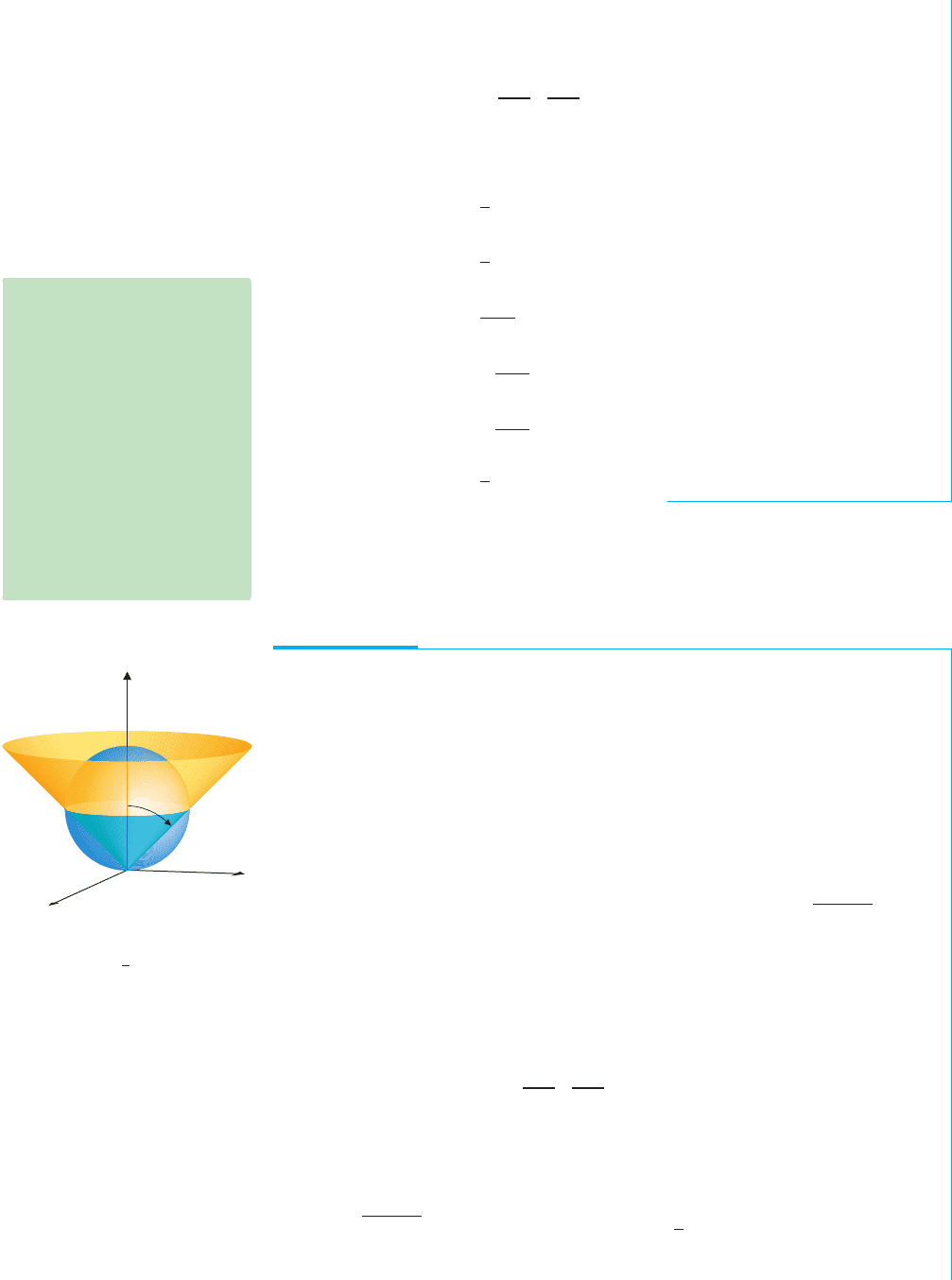
the sphere of radius 1, centered at the point (0, 0, 1). Notice, too, that since the sphere
sits completely above the xy-plane, only the top half of the cone, z =
x
2
+ y
2
intersects the sphere. See Figure 14.64 for a sketch of the solid. You might try to find
the volume using rectangular coordinates (but, don’t spend much time on it). Because of
the spherical geometry, we consider the problem in spherical coordinates. (Keep in
mind that cones have a very simple representation in spherical coordinates.) From (7.1),
(7.4) and the original equation of the sphere, we get
x
2
+ y
2
+ z
2
ρ
2
= 2 z
ρ cos φ
or
ρ
2
= 2ρ cos φ.
This equation is satisfied when ρ = 0 (corresponding to the origin) or when ρ = 2cos φ
(the equation of the sphere in spherical coordinates). For the top half of the cone, we
have z =
x
2
+ y
2
, or in spherical coordinates φ =
π
4
, as discussed in example 7.2.
Referring again to Figure 14.64, notice that to stay inside the cone and inside the
sphere, we have that for each fixed φ and θ,ρ can range from 0 up to 2 cosφ. For each
P1: OSO/OVY P2: OSO/OVY QC: OSO/OVY T1: OSO
MHDQ256-Ch14 MHDQ256-Smith-v1.cls January 5, 2011 10:17
LT (Late Transcendental)
CONFIRMING PAGES
960 CHAPTER 14
..
Multiple Integrals 14-60
fixed θ, to stay inside the cone, φ must range from 0 to
π
4
. Finally, to get all the way
around the solid, θ ranges from 0 to 2π. The volume of the solid is then given by
V =
Q
dV
ρ
2
sinφ dρ dφ dθ
=
2π
0
π/4
0
2cosφ
0
ρ
2
sinφ dρ dφ dθ
=
2π
0
π/4
0
1
3
ρ
3
ρ=2cosφ
ρ=0
sinφ dφ dθ
=
8
3
2π
0
π/4
0
cos
3
φ sin φ dφ dθ
=−
8
3
2π
0
cos
4
φ
4
φ=π/4
φ=0
dθ =−
2
3
2π
0
cos
4
π
4
− 1
dθ
=−
4π
3
cos
4
π
4
− 1
=−
4π
3
1
4
− 1
= π.
y
x
z
FIGURE 14.65
The solid Q
EXAMPLE 7.5 Changing an Integral from Rectangular
to Spherical Coordinates
Evaluate the triple iterated integral
2
−2
√
4−x
2
0
√
4−x
2
−y
2
0
(x
2
+ y
2
+ z
2
)dz dydx.
Solution Although the integrand is simply a polynomial, the limits of integration
make the second and third integrations very messy. Notice that the integrand contains
the combination of variables x
2
+ y
2
+ z
2
, which equals ρ
2
in spherical coordinates.
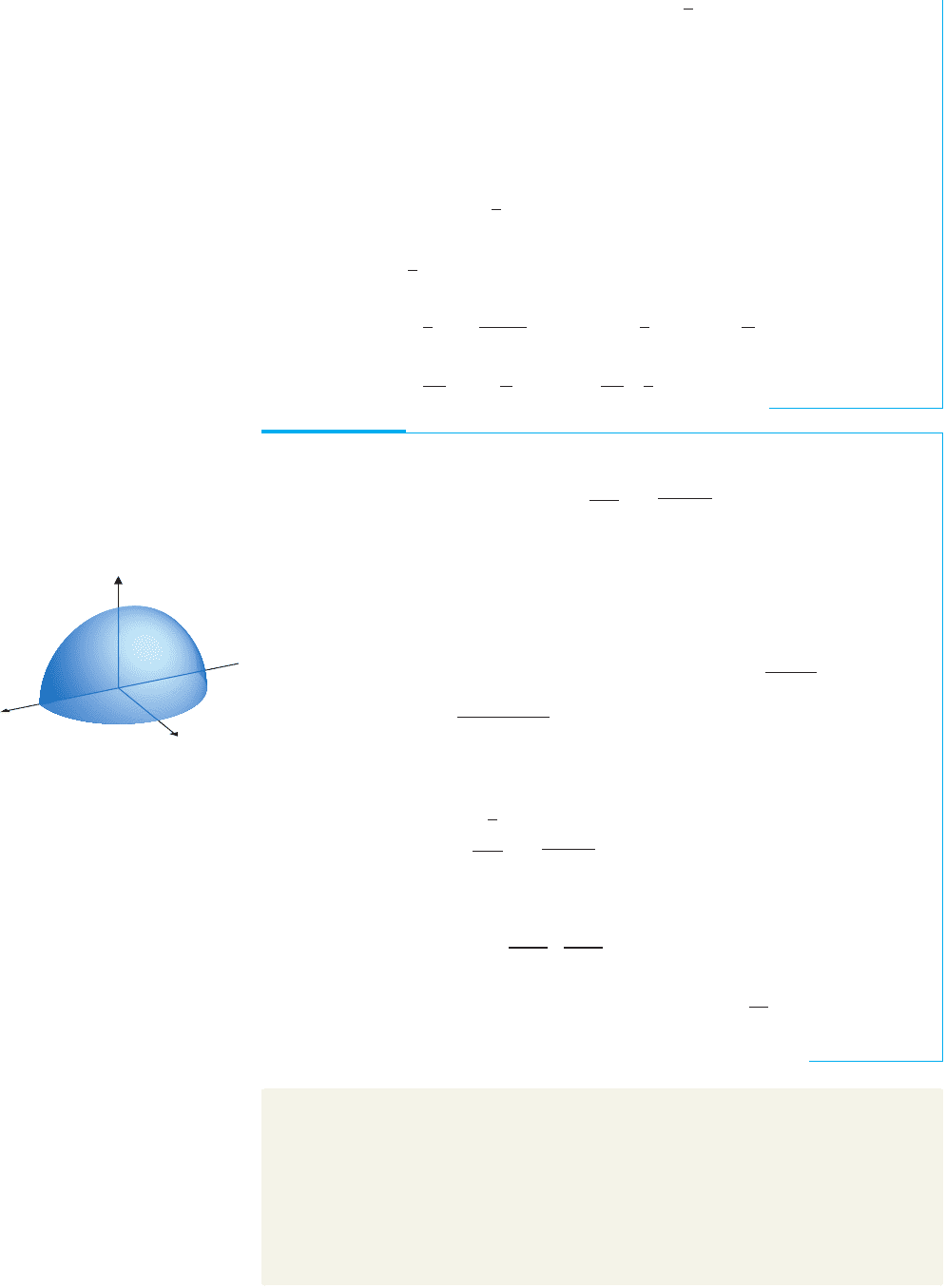
Further, the solid over which we are integrating is a portion of a sphere, as follows.
Notice that for each x in the interval [−2, 2] indicated by the outermost limits of
integration, y varies from 0 (corresponding to the x-axis) to y =
√
4 − x
2
(the top
semicircle of radius 2 centered at the origin). Finally, z varies from 0 (corresponding to
the xy-plane) up to z =
4 − x
2
− y
2
(the top hemisphere of radius 2 centered at the
origin). The solid Q over which we are integrating is then the half of the hemisphere that
lies above the first and second quadrants of the xy-plane, as illustrated in Figure 14.65.
In spherical coordinates, this portion of the sphere is obtained if we let ρ range from 0
up to 2,φ range from 0 up to
π
2
and θ range from 0 to π . The integral then becomes
2
−2
√
4−x
2
0
√
4−x
2
−y
2
0
(x
2
+ y
2
+ z
2
)dz dydx
=
Q
(x
2
+ y
2
+ z
2
)
ρ
2
dV
ρ
2
sinφ dρ dφ dθ
=
π
0
π/2
0
2
0
ρ
2
(ρ
2
sinφ)dρ dφ dθ =
32
5
π,
where we leave the details of this relatively simple integration to you.
BEYOND FORMULAS
Spherical coordinates are used in a variety of applications, usually to take advantage of
certain symmetries present in the structure or force being analyzed. In particular, if the
value of a function f (x, y, z) depends only on the distance of the point (x, y, z) from
the origin, then spherical coordinates can be convenient to use. This is analogous to
the use of polar coordinates in two dimensions to take advantage of radial symmetry.
In what way is r = c in two dimensions analogous to ρ = c in three dimensions?

P1: OSO/OVY P2: OSO/OVY QC: OSO/OVY T1: OSO
MHDQ256-Ch14 MHDQ256-Smith-v1.cls January 5, 2011 10:17
LT (Late Transcendental)
CONFIRMING PAGES
14-61 SECTION 14.7
..
Spherical Coordinates 961
EXERCISES 14.7
WRITING EXERCISES
1. Discuss the relationship between the spherical coordinates an-
gles φ and θ and the longitude and latitude angles on a map of
the Earth. Satellites in geosynchronous orbit remain at a con-
stant distance above a fixed point on the Earth. Discuss how
spherical coordinates could be used to represent the position
of the satellite.
2. Explain why any point in R
3
can be represented in spheri-
cal coordinates with ρ ≥ 0, 0 ≤ θ ≤ 2π and 0 ≤ φ ≤ π.In
particular, explain why it is not necessary to allow ρ<0or
π<φ≤ 2π. Discuss whether the ranges ρ ≥ 0, 0 ≤ θ ≤ π
and 0 ≤ φ ≤ 2π would suffice to describe all points.
3. Forsimplicity, we restricted ρ to be nonnegative. Discuss what
might be meant by spherical coordinates ρ =−1, φ =
π
4
and
θ =
π
2
. Discuss possible advantages of such a definition for
graphing functions ρ = f (φ,θ).
4. Using the examples in this section as a guide, make a short list
of surfaces that are simple to describein spherical coordinates.
In exercises 1–6, convert the spherical point (ρ, φ, θ) into rect-
angular coordinates.
1. (4, 0,π) 2. (4,
π
2
,π) 3. (2,
π
4
, 0)
4. (2,
π
4
,
2π
3
) 5. (
√
2,
π
6
,
π
3
) 6. (
√
2,
π
6
,
2π
3
)
............................................................
In exercises 7–14, convert the equation into spherical
coordinates.
7. x
2
+ y
2
+ z
2
= 9 8. x
2
+ y
2
+ z
2
= 6
9. y = x 10. z = 0
11. z = 2 12. x
2
+ y
2
+ (z − 1)
2
= 1
13. z =
3(x
2
+ y
2
) 14. z =−
x
2
+ y
2
............................................................
In exercises 15–20, sketch the graph of the spherical equation
and give a corresponding xy-equation.
15. ρ = 2 16. ρ = 4 17. φ =
π
4
18. φ =
π
2
19. θ = 0 20. θ =
π
4
............................................................
In exercises21–26, sketchthe region defined by the given ranges.
21. 0 ≤ ρ ≤ 4, 0 ≤ φ ≤
π
4
, 0 ≤ θ ≤ π
22. 0 ≤ ρ ≤ 4, 0 ≤ φ ≤
π
2
, 0 ≤ θ ≤ 2π
23. 0 ≤ ρ ≤ 3,
π
2
≤ φ ≤ π, 0 ≤ θ ≤ π
24. 0 ≤ ρ ≤ 3, 0 ≤ φ ≤
3π
4
,
π
2
≤ θ ≤
3π
2
25. 2 ≤ ρ ≤ 3,
π
4
≤ φ ≤
π
2
,π ≤ θ ≤ 2π
26. 2 ≤ ρ ≤ 3,
π
2
≤ φ ≤
3π
4
, 0 ≤ θ ≤
3π
2
............................................................
In exercises 27–36, set up and evaluate the indicated triple inte-
gral in an appropriate coordinate system.
27.
Q
e
(x
2
+y
2
+z
2
)
3/2
dV, where Q is bounded by the hemisphere
z =
4 − x
2
− y
2
and the xy-plane.
28.
Q
x
2
+ y
2
+ z
2
dV,whereQ isboundedbythehemisphere
z =−
9 − x
2
− y
2
and the xy-plane.
29.
Q
z
2
dV, where Q is inside x
2
+ y
2
+ z
2
= 2 and outside
x
2
+ y
2
= 1.
30.
Q
e
√
x
2
+y
2
+z
2
dV, where Q isbounded by y =
√
4 − x
2
− z
2
and y = 0.
31.
Q
(x
2
+ y
2
+z
2
)dV, where Q is the cube with 0 ≤ x ≤1,
1 ≤ y ≤ 2 and 3 ≤ z ≤ 4.
32.
Q
(x + y + z) dV, where Q is the tetrahedron bounded by
x + 2y + z = 4 and the coordinate planes.
33.
Q
(x
2
+ y
2
)dV, where Q is bounded by z = 4 − x
2
− y
2
and the xy-plane.
34.
Q
e
x
2
+y
2
dV, where Q is bounded by x
2
+ y
2
= 4, z = 0 and
z = 2.
35.
Q
x
2
+ y
2
+ z
2
dV, where Q is bounded by z =
x
2
+ y
2
and z =
2 − x
2
− y
2
.
36.
Q
(x
2
+ y
2
+ z
2
)
3/2
dV, where Q is the solid below
z =−
x
2
+ y
2
and inside z =−
4 − x
2
− y
2
.
............................................................
In exercises 37–48, use an appropriate coordinate system to find
the volume of the given solid.
37. The solid below x
2
+ y
2
+ z
2
= 4z and above z =
x
2
+ y
2
38. The solid above z =
x
2
+ y
2
and below x
2
+ y
2
+ z
2
= 4
39. Thesolidinsidez =
2x
2
+ 2y
2
andbetween z = 2and z = 4
40. The solid bounded by z = 4x
2
+ 4y
2
, z = 0, x
2
+ y
2
= 1 and
x
2
+ y
2
= 2
41. The solid under z =
x
2
+ y
2
and above the square
−1 ≤ x ≤ 1, −1 ≤ y ≤ 1
42. The solid bounded by x + 2y + z = 4 and the coordinate
planes
43. The solid below x
2
+ y
2
+ z
2
= 4, above z =
x
2
+ y
2
in the
first octant
44. The solid below x
2
+ y
2
+ z
2
= 4, above z =
x
2
+ y
2
,
between y = x and x = 0 with y ≥ 0
45. The solid below z =
x
2
+ y
2
, above the xy-plane and inside
x
2
+ y
2
= 4
46. The solid between z = 4 − x
2
− y
2
and the xy-plane
P1: OSO/OVY P2: OSO/OVY QC: OSO/OVY T1: OSO
MHDQ256-Ch14 MHDQ256-Smith-v1.cls January 5, 2011 10:17
LT (Late Transcendental)
CONFIRMING PAGES
962 CHAPTER 14
..
Multiple Integrals 14-62
47. The solid above z =
x
2
+ y
2
and below
x
2
+ y
2
+ (z − 1)
2
= 1
48. The solid above z =−
3x
2
+ 3y
2
and inside
x
2
+ y
2
+ z
2
= 4
............................................................
In exercises 49–56, evaluate the iterated integral by changing
coordinate systems.
49.
1
0
√
1−x
2
−
√
1−x
2
√
1−x
2
−y
2
−
√
1−x
2
−y
2
x
2
+ y
2
+ z
2
dzdydx
50.
1
−1
√
1−x
2
−
√
1−x
2
1+
√
1−x
2
−y
2
1−
√
1−x
2
−y
2
(x
2
+ y
2
+ z
2
)
3/2
dzdydx
51.
2
−2
√
4−x
2
0
√
8−x
2
−y
2
√
x
2
+y
2
(x
2
+ y
2
+ z
2
)
3/2
dzdydx
52.
4
0
√
16−x
2
0
4
√
x
2
+y
2
x
2
+ y
2
+ z
2
dzdydx
53.
2
−2
√
4−x
2
0
0
−
√
4−x
2
−y
2
e
√
x
2
+y
2
+z
2
dzdydx
54.
3
−3
0
−
√
9−y
2
√
9−z
2
−y
2
0
sin
x
2
+ y
2
+ z
2
dx dzdy
55.
π
0
2
0
√
4−r
2
0
x
2
+r
2
dx dr dθ
56.
π/4
0
√
3/2
0
√
1−r
2
r/
√
3
r
2
cos θ dzdr dθ
............................................................
57. Find the center of mass of the solid with constant density and
bounded by z =
x
2
+ y
2
and z =
4 − x
2
− y
2
.
58. Find the center of mass of the solid with constant den-
sity in the first quadrant and bounded by z =
x
2
+ y
2
and
z =
4 − x
2
− y
2
.
............................................................
Exercises 59–64 relate to unit basis vectors in spherical
coordinates.
59. For the position vector r =x, y, z=ρ cos θ sinφ,
ρ sinθ sinφ,ρ cosφ in spherical coordinates, compute the
unit vector ˆρ =
r
r
, where r =r = 0.
60. For the unit vectors
ˆ
θ =−sinθ,cos θ,0 and
ˆ
φ =cosθ cosφ,sin θ cos φ,−sinφ, show that ˆρ,
ˆ
θ and
ˆ
φ
are mutually orthogonal.
61. For the vector v from (1, 1,
√
2) to (2, 2, 2
√
2), find a constant
c such that v = c ˆρ.
62. Forthe vector v from (1, 1,
√
2) to (−1, 1,
√
2), find a constant
c such that v = c
3π/4
π/4
ˆ
θ dθ. Compare to exercise 61.
63. Forthe vector v from (1, 1,
√
2) to (
√
2,
√
2, 0), find a constant
c such that v = c
π/2
π/4
ˆ
φ dφ.
64. From the point (1, 1,
√
2), sketch the vectors ˆρ,
ˆ
θ and
ˆ
φ. Illus-
trate graphically the vectors v in exercises 61–63.
............................................................
65. Sketch the cardioid r = 2 − 2 sin θ in the xy-plane. Define
˜
r
and
˜
θ tobepolarcoordinatesintheyz-plane(thatis, y =
˜
r cos
˜
θ
and z =
˜
r sin
˜
θ). Show that
˜
θ =
π
2
− φ and cos φ = sin
˜
θ. Use
this information to graph ρ = 2 −2cosφ.
66. As in exercise 65, relate the graph of ρ = cos
2
3φ to the two-
dimensional graph of r = sin
2
3θ and use this information to
sketch the three-dimensional surface.
67. As in exercise 65, sketch the surface ρ = sin
2
φ by relating it
to a two-dimensional polar curve.
68. Asinexercise65,sketchthesurfaceρ = 1 + sin 3φ byrelating
it to a two-dimensional polar curve.
EXPLORATORY EXERCISES
1. If you have a graphing utility that will graph surfaces of the
form ρ = f (φ,θ), graph ρ = 2φ and ρ =
φ −
π
2
2
. Discuss
the symmetry that results from the variable θ not appearing in
the equation. Discuss the changes in ρ asyou movedownfrom
φ = 0toφ = π. Using whatyou havelearned, trygraphing the
following by hand and then compare your sketches to those of
your graphing utility: (a) ρ = e
−φ
, (b) ρ = e
φ
, (c) ρ = sin
2
φ
and (d) ρ = sin
2
φ −
π
2
.
2. Use a graphing utility to graph ρ = 5cos θ and ρ =
√
cosθ.
Discuss the symmetry that results from the variable φ not
appearing in the equation. Discuss the changes in ρ as you
move around from θ = 0toθ = 2π. Using what you have
learned, try graphing the following by hand and then compare
your sketches to those of your graphing utility: (a) ρ = sin
2
θ,
(b) ρ = sin
2
θ −
π
2
, (c) ρ = e
θ
and (d) ρ = e
−θ
.
3. Use a graphing utility to graph each of the following. Ad-
just the graphing window as needed to get a good idea of
what the graph looks like. (a) ρ = sin (φ + θ), (b) ρ = φ sinθ,
(c) ρ = sin
2
θ cosφ, (d) ρ = 4cos
2
θ +2 sin φ − 3 sin θ and
(e) ρ = 4cosθ sin5φ + 3cos
2
φ. Experiment and find your
own interesting graphs in spherical coordinates.
14.8 CHANGE OF VARIABLES IN MULTIPLE INTEGRALS
One of our most basic tools for evaluating a definite integral is substitution. For instance,
to evaluate the integral
2
0
2xe
x
2
+3
dx, you would make the substitution u = x
2
+ 3. Here,
du = 2xdxand don’t forget: when you change variables in a definite integral, you must