
Smith R., Minton R. Calculus
Подождите немного. Документ загружается.

P1: OSO/OVY P2: OSO/OVY QC: OSO/OVY T1: OSO
MHDQ256-Ch14 MHDQ256-Smith-v1.cls January 5, 2011 10:17
LT (Late Transcendental)
CONFIRMING PAGES
14-33 SECTION 14.4
..
Surface Area 933
14.4 SURFACE AREA
Recall that in section 5.4, we devised a method of finding the surface area for a surface of
revolution. In this section, we consider how to find surface area in a more general setting.
Suppose that f (x, y) ≥ 0 and f has continuous first partial derivatives in some region R
in the xy-plane. Our aim is to find a way to calculate the surface area of that portion of the
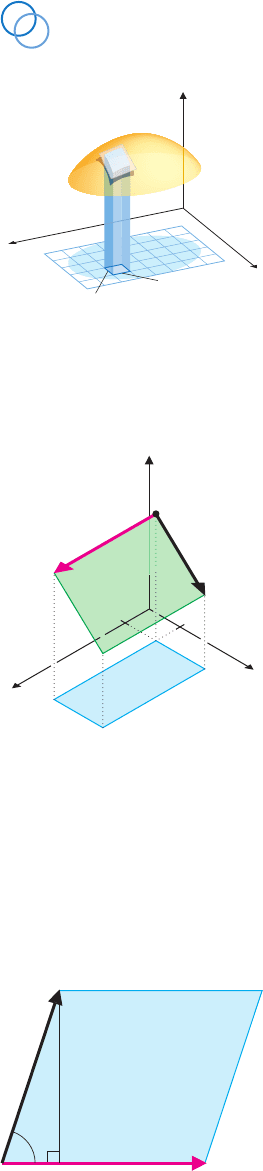
surface z = f (x, y) lying above R. As we have done innumerable times now, we begin by
forming an inner partition of R, consisting of the rectangles R
1
, R
2
,...,R
n
.
y
x
O
z
T
i
x
i
y
i
FIGURE 14.35a
Surface area
For each i = 1, 2,...,n, let (x
i
, y
i
, 0) represent the corner of R
i
closest to the origin
and construct the tangent plane to the surface z = f (x, y) at the point (x
i
, y
i
, f (x
i
, y
i
)).
Since the tangent plane stays close to the surface near the point of tangency, the area T
i
of
the portion of the tangent plane that lies above R
i
is an approximation to the surface area
above R
i
. (See Figure 14.35a.) Notice too, that the portion of the tangent plane lying above
R
i
is a parallelogram, T
i
, whose area T
i
you should be able to easily compute. Adding
together these approximations, we get that the total surface area S is approximately
S ≈
n
i=1
T
i
.
(x
i
, y
i
, f(x
i
, y
i
))
z
x
y
T
i
R
i
y
i
y
i
x
i
x
i
O
a
i
b
i
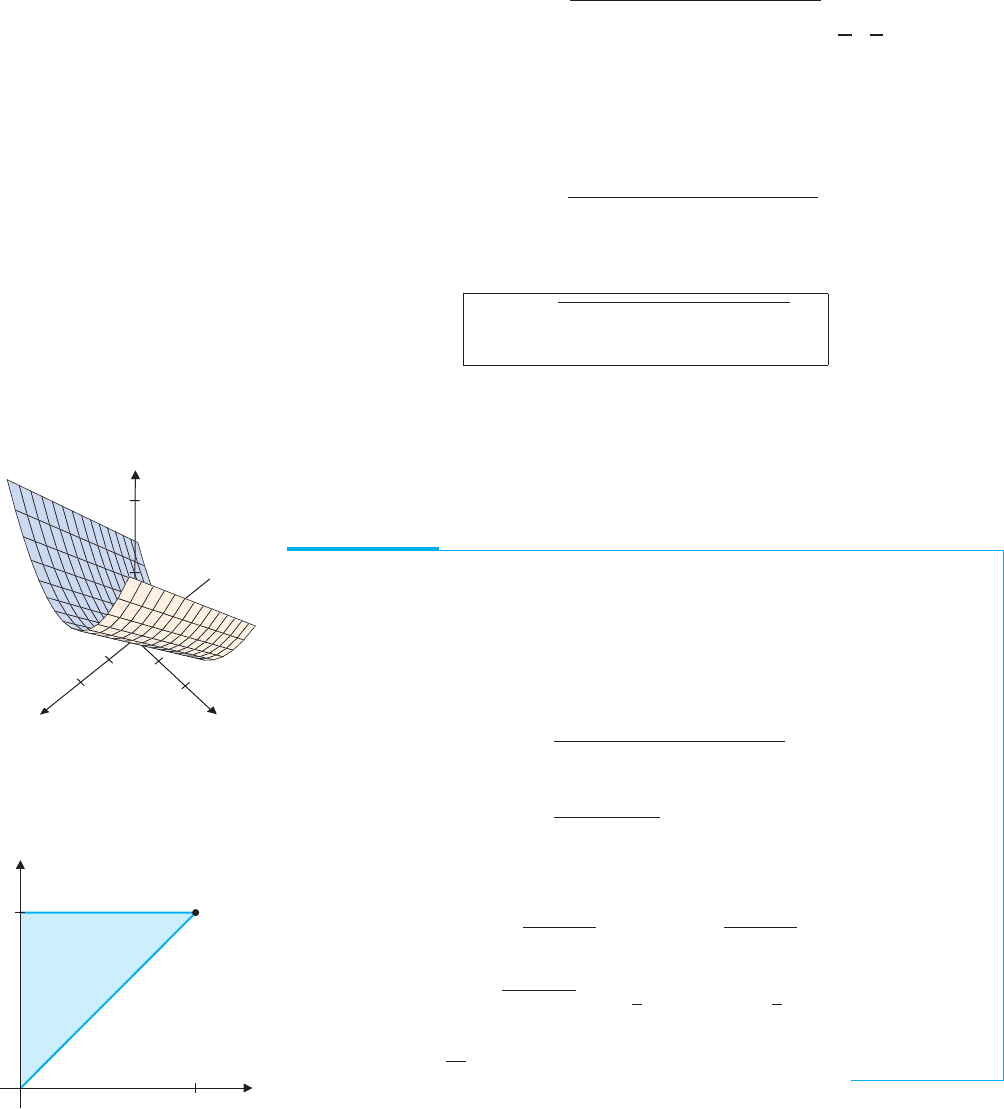
FIGURE 14.35b
Portion of the tangent plane
above R
i
Also note that as the norm of the partition P tends to zero, the approximations should
approach the exact surface area and so we have
S = lim
P→0
n
i=1
T
i
, (4.1)
assuming the limit exists. The only remaining question is how to find the values of T
i
, for
i = 1, 2,...,n. Let the dimensions of R
i
be x
i
and y
i
, and let the vectors a
i
and b
i
form
two adjacent sides of the parallelogram T
i
, as indicated in Figure 14.35b. Recall from our
discussion of tangent planes in section 13.4 that the tangent plane is given by
z − f (x
i
, y
i
) = f
x
(x
i
, y
i
)(x − x
i
) + f
y
(x
i
, y
i
)(y − y
i
). (4.2)
Look carefully at Figure 14.35b; the vector a
i
has its initial point at (x
i
, y
i
, f (x
i
, y
i
)). Its
terminal point is the point on the tangent plane corresponding to x = x
i
+ x
i
and y = y
i
.
From (4.2), we get that the z-coordinate of the terminal point satisfies
z − f (x
i
, y
i
) = f
x
(x
i
, y
i
)(x
i
+ x
i
− x
i
) + f
y
(x
i
, y
i
)(y
i
− y
i
)
= f
x
(x
i
, y
i
)x
i
.
This says that the vector a
i
is given by
b
i
sin u
b
i
a
i
u
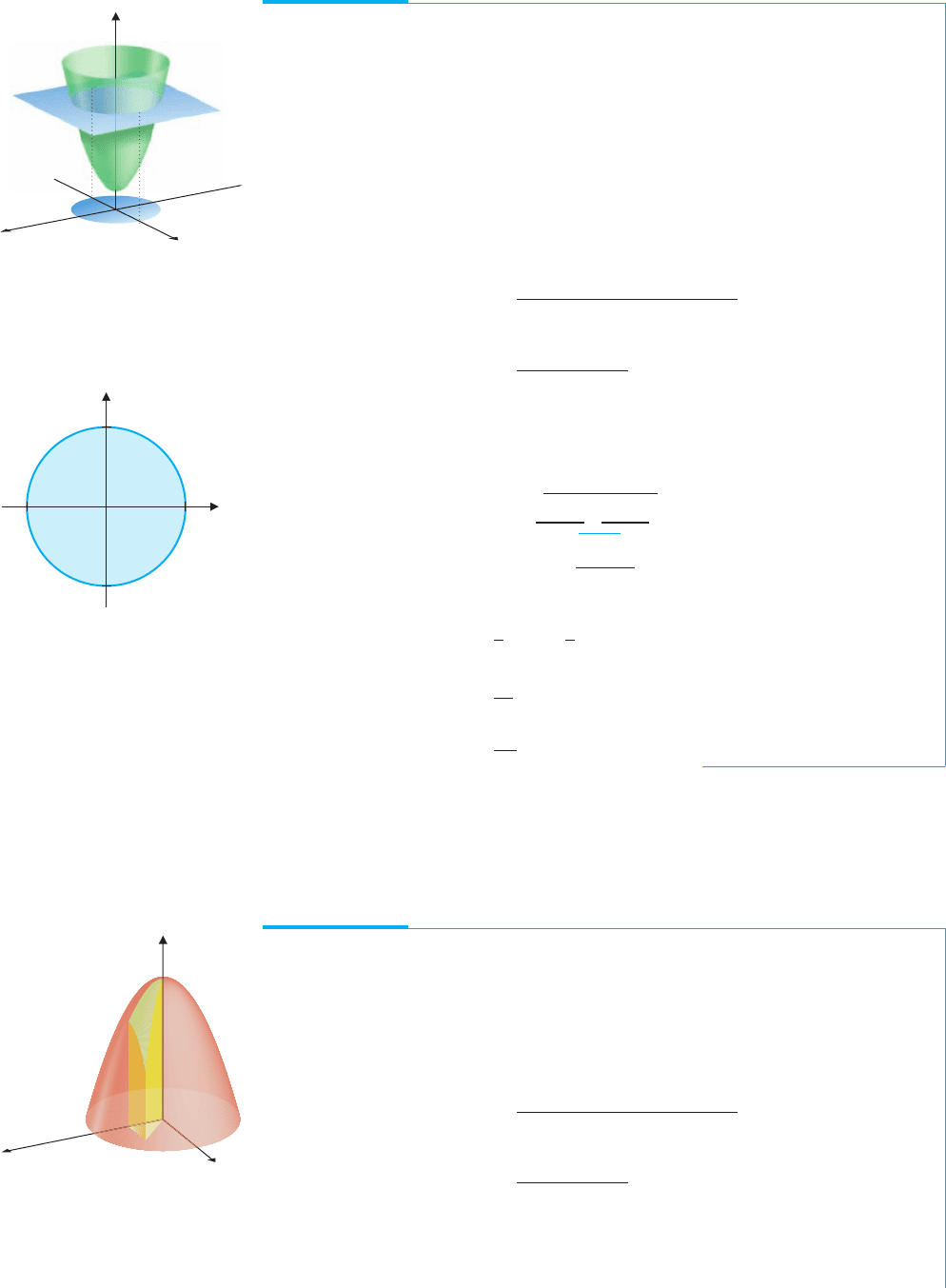
FIGURE 14.36
The parallelogram T
i
a
i
=x
i
, 0, f
x
(x
i
, y
i
)x
i
.
Likewise, b
i
has its initial point at (x
i
, y
i
, f (x
i
, y
i
)), but has its terminal point at the point
on the tangent plane corresponding to x = x
i
and y = y
i
+ y
i
. Again, using (4.2), we get
that the z-coordinate of this point is given by
z − f (x
i
, y
i
) = f
x
(x
i
, y
i
)(x
i
− x
i
) + f
y
(x
i
, y
i
)(y
i
+ y
i
− y
i
)
= f
y
(x
i
, y
i
)y
i
.
This says that b
i
is given by
b
i
=0, y
i
, f
y
(x
i
, y
i
)y
i
.
Notice that T
i
is the area of the parallelogram shown in Figure 14.36, which you should
recognize as
T
i
=a
i
b
i
sin θ =a
i
× b
i
,
P1: OSO/OVY P2: OSO/OVY QC: OSO/OVY T1: OSO
MHDQ256-Ch14 MHDQ256-Smith-v1.cls January 5, 2011 10:17
LT (Late Transcendental)
CONFIRMING PAGES
934 CHAPTER 14
..
Multiple Integrals 14-34
where θ indicates the angle between a
i
and b
i
.Wehave
a
i
× b
i
=
ij k
x
i
0 f
x
(x
i
, y
i
)x
i
0 y
i
f
y
(x
i
, y
i
)y
i
=−f
x
(x
i
, y
i
)x
i
y
i
i − f
y
(x
i
, y
i
)x
i
y
i
j + x
i
y
i
k.
This gives us
T
i
=a
i
× b
i
=
[ f
x
(x
i
, y
i
)]
2
+ [ f
y
(x
i
, y
i
)]
2
+ 1 x
i
y
i
A
i
,
where A
i
= x
i
y
i
is the area of the rectangle R
i
. From (4.1), we now have that the total
surface area is given by
S = lim
P→0
n
i=1
T
i
= lim
P→0
n
i=1
[ f
x
(x
i
, y
i
)]
2
+ [ f
y
(x
i
, y
i
)]
2
+ 1 A
i
.
You should recognize this limit as the double integral
S =
R
[ f
x
(x, y)]
2
+ [ f
y
(x, y)]
2
+ 1 dA. (4.3)
Surface area
There are several things to note here. First, you can easily show that the surface area
formula (4.3) also holds for the case where f (x, y) ≤ 0onR. Second, you should
note the similarity to the arc length formula derived in section 5.4. Further, recall that
n =f
x
(x, y), f
y
(x, y), −1 is a normal vector for the tangent plane to the surface
z = f (x, y)at(x, y). With this in mind, recognize that you can think of the integrand
in (4.3) as n, an idea we’ll develop more fully in Chapter 15.
y
z
x
40
4
4
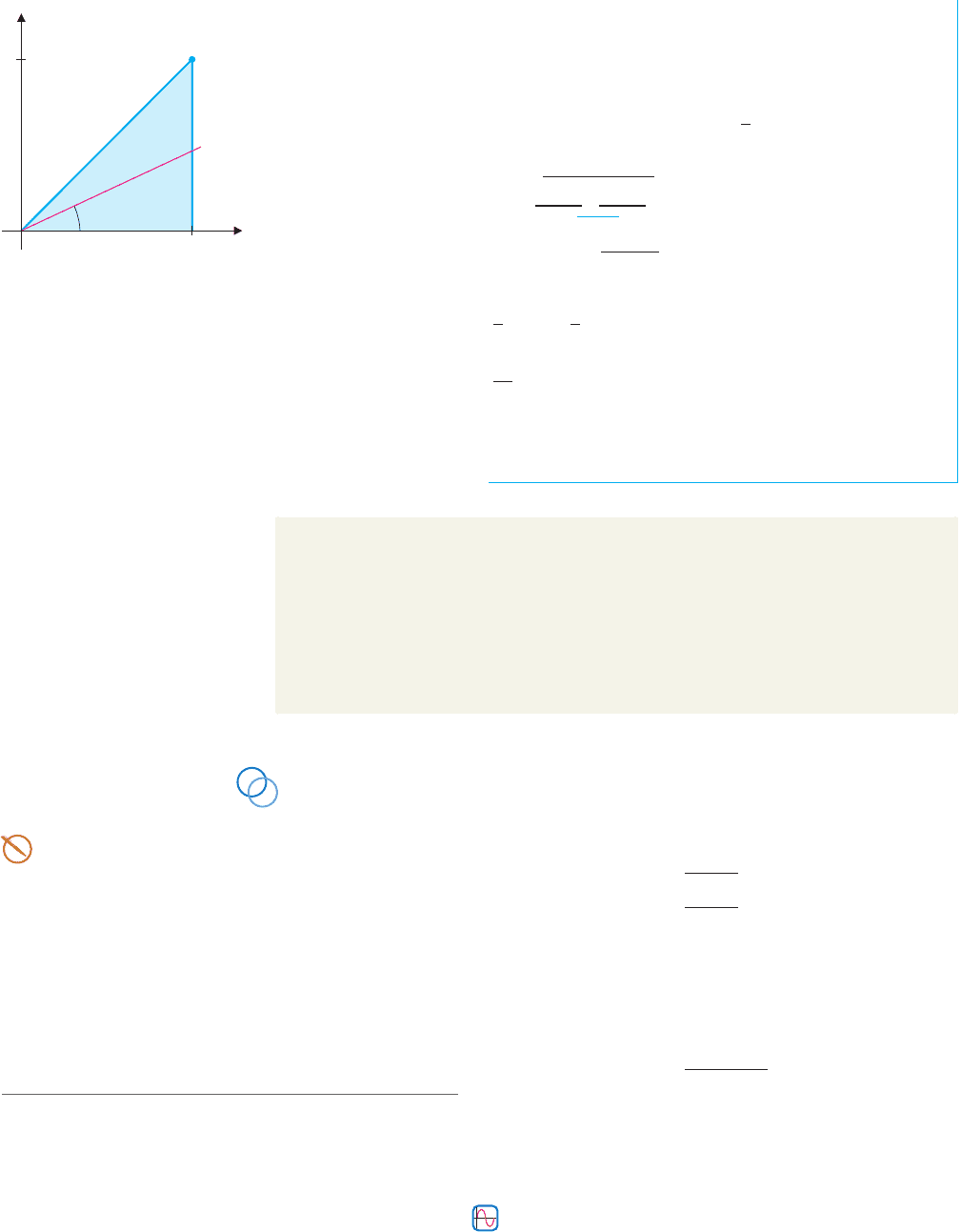
FIGURE 14.37a
The surface z = y
2
+ 4x
y
x
2
y x
2
R
(2, 2)
O
FIGURE 14.37b
The region R
EXAMPLE 4.1 Calculating Surface Area
Find the surface area of that portion of the surface z = y
2
+ 4x lying above the
triangular region R in the xy-plane with vertices at (0, 0), (0, 2) and (2, 2).
Solution We show a computer-generated sketch of the surface in Figure 14.37a and
the region R in Figure 14.37b. If we take f (x, y) = y
2
+ 4x, then we have f
x
(x, y) = 4
and f
y
(x, y) = 2y. From (4.3), we now have
S =
R
[ f
x
(x, y)]
2
+ [ f
y
(x, y)]
2
+ 1 dA
=
R
4
2
+ 4y
2
+ 1 dA.
Looking carefully at Figure 14.37b, you can read off the limits of integration, to obtain
S =
2
0
y
0
4y
2
+ 17 dx dy =
2
0
4y
2
+ 17 x
x=y
x=0
dy
=
2
0
y
4y
2
+ 17 dy =
1
8
(4y
2
+ 17)
3/2
2
3
2
0
=
1
12
[4(2
2
) + 17]
3/2
− [4(0)
2
+ 17]
3/2
≈ 9.956.
Computing surface area requires more than simply substituting into formula (4.3). You
will also need to carefully determine the region over which you’re integrating and the best
coordinate system to use, as in example 4.2.
P1: OSO/OVY P2: OSO/OVY QC: OSO/OVY T1: OSO
MHDQ256-Ch14 MHDQ256-Smith-v1.cls January 5, 2011 10:17
LT (Late Transcendental)
CONFIRMING PAGES
14-35 SECTION 14.4
..
Surface Area 935
EXAMPLE 4.2 Finding Surface Area Using Polar Coordinates
Find the surface area of that portion of the paraboloid z = 1 + x
2
+ y
2
that lies below
the plane z = 5.
z
x
y
z 5
FIGURE 14.38a
Intersection of the paraboloid with
the plane z = 5
y
x
2
2
2
2
R
FIGURE 14.38b
The region R
Solution First, note that we have not given you the region of integration; you’ll need
to determine that from a careful analysis of the graph. (See Figure 14.38a.) Next,
observe that the plane z = 5 intersects the paraboloid in a circle of radius 2, parallel to
the xy-plane and centered at the point (0, 0, 5). (Simply plug z = 5 into the equation of
the paraboloid to see why.) So, the surface area below the plane z = 5 lies above the
circle in the xy-plane of radius 2, centered at the origin. We show the region of
integration R in Figure 14.38b. Taking f (x, y) = 1 + x
2
+ y
2
,wehave f
x
(x, y) = 2x
and f
y
(x, y) = 2y, so that from (4.3), we have
S =
R
[ f
x
(x, y)]
2
+ [ f
y
(x, y)]
2
+ 1 dA
=
R
4x
2
+ 4y
2
+ 1 dA.
Note that since the region of integration is circular and the integrand contains the term
x
2
+ y
2
, polar coordinates are indicated. We have
S =
R
4(x
2
+ y
2
) + 1
√
4r
2
+ 1
dA
rdrdθ
=
2π
0
2
0
4r
2
+ 1rdrdθ
=
1
8
2π
0
2
3
(4r
2
+ 1)
3/2
r=2
r=0
dθ
=
1
12
2π
0
(17
3/2
− 1
3/2
)dθ
=
2π
12
(17
3/2
− 1) ≈ 36.18.
We must point out that ( just as with arc length) most surface area integrals cannot
be computed exactly. Most of the time, you must rely on numerical approximations of the
integrals. If possible, evaluate at least one of the iterated integrals and then approximate the
secondintegralnumerically(e.g.,usingSimpson’sRule).Thisisthesituationinexample4.3.
EXAMPLE 4.3 Surface Area That Must Be Approximated Numerically
Find the surface area of that portion of the paraboloid z = 4 − x
2
− y
2
that lies above
the triangular region R in the xy-plane with vertices at the points (0, 0), (1, 1) and (1, 0).
x
y
z
FIGURE 14.39a
z = 4 − x
2
− y
2
Solution We sketch the paraboloid and the region R in Figure 14.39a. Taking
f (x, y) = 4 − x
2
− y
2
,weget f
x
(x, y) =−2x and f
y
(x, y) =−2y. From (4.3),
we have
S =
R
[ f
x
(x, y)]
2
+ [ f
y
(x, y)]
2
+ 1 dA
=
R
4x
2
+ 4y
2
+ 1 dA.
Note that you have little hope of evaluating this double integral in rectangular
coordinates. (Think about this!) Even though the region of integration is not circular,
P1: OSO/OVY P2: OSO/OVY QC: OSO/OVY T1: OSO
MHDQ256-Ch14 MHDQ256-Smith-v1.cls January 5, 2011 10:17
LT (Late Transcendental)
CONFIRMING PAGES
936 CHAPTER 14
..
Multiple Integrals 14-36
we’ll try polar coordinates, since the integrand contains the term x
2
+ y
2
. We indicate
the region R in Figure 14.39b. The difficulty here is in describing the region R in terms
of polar coordinates. Look carefully at Figure 14.39b and notice that for each fixed
angle θ, the radius r varies from 0 out to a point on the line x = 1. Since in polar
coordinates x = r cosθ, the line x = 1 corresponds to r cosθ = 1orr = secθ , in polar
coordinates. Further, θ varies from θ = 0 (the x-axis) to θ =
π
4
(the line y = x). The
surface area integral now becomes
S =
R
4x
2
+ 4y
2
+ 1
√
4r
2
+ 1
dA
rdrdθ
=
π/4
0
secθ
0
4r
2
+ 1rdrdθ
=
1
8
π/4
0
2
3
(4r
2
+ 1)
3/2
r=secθ
r=0
dθ
=
1
12
π/4
0
[(4sec
2
θ +1)
3/2
− 1] dθ
≈ 0.93078,
where we have approximated the value of the final integral, since no exact means of
integration was available.
y
x
1
y x
1
R
(1, 1)
O
r sec u
(x 1)
u
FIGURE 14.39b
The region R
BEYOND FORMULAS
The surface area calculations in this section are important in their ownright. Architects
often need to know the surface area of the structure they are designing. However, for
our purposes, the ideas in this section will assume more importance when we introduce
surfaceintegralsin section15.6.Forsurfaceintegrals,surfaceareaisabasic component
used in the setup of the integral. This is similar to how the arc length formula is in-
corporated in the formula for the surface area of a surface of revolution in section 5.4.
EXERCISES 14.4
WRITING EXERCISES
1. Starting at equation (4.1), there are several ways to estimate
T
i
. Explain why it is important that we were able to find an
approximation of the form f (x
i
, y
i
)x
i
y
i
.
2. In example 4.3, we evaluated the inner integral before esti-
mating the remaining integral numerically. Discuss the num-
ber of calculations that would be necessary to use a rule such
as Simpson’s Rule to estimate an iterated integral. Explain
why we thought it important to evaluate the inner integral
first.
In exercises 1–12, find the surface area of the indicated surface.
1. The portion of z = x
2
+ 2y between y = x, y = 0 and
x = 4.
2. The portion of z = 4y + 3x
2
between y = 2x, y = 0 and
x = 2.
3. The portion of z = 4 − x
2
− y
2
above the xy-plane.
4. The portion of z = x
2
+ y
2
below z = 4.
5. The portion of z =
x
2
+ y
2
below z = 2.
6. The portion of z =
x
2
+ y
2
between y = x
2
and y = 4.
7. The portion of x + 3y + z = 6 in the first octant.
8. The portion of 2x + y + z = 8 in the first octant.
9. The portion of x − y − 2z = 4 with x ≥ 0, y ≤ 0 and z ≤ 0.
10. The portion of 2x + y − 4z = 4 with x ≥ 0, y ≥ 0 and z ≤ 0.
11. The portion of z =
4 − x
2
− y
2
above z = 0.
12. The portion of z = sin x +cos y with 0 ≤ x ≤ 2π and
0 ≤ y ≤ 2π.
............................................................
In exercises 13–20, numerically estimate the surface area.
13. The portion of z = e
x
2
+y
2
inside of x
2
+ y
2
= 4.
14. The portion of z = e
−x
2
−y
2
inside of x
2
+ y
2
= 1.
P1: OSO/OVY P2: OSO/OVY QC: OSO/OVY T1: OSO
MHDQ256-Ch14 MHDQ256-Smith-v1.cls January 5, 2011 10:17
LT (Late Transcendental)
CONFIRMING PAGES
14-37 SECTION 14.4
..
Surface Area 937
15. The portion of z = x
2
+ y
2
between z = 5 and z = 7.
16. The portion of z = x
2
+ y
2
inside r = 2 −2cosθ.
17. The portion of z = y
2
below z = 4 and between x =−2
and x = 2.
18. The portion of z = 4 − x
2
above z = 0 and between y = 0
and y = 4.
19. Theportion of z = sin x cos y with 0 ≤ x ≤ π and0 ≤ y ≤ π.
20. The portion of z =
x
2
+ y
2
− 4 below z = 1.
............................................................
21. (a) In exercises 5 and 6, determine the surface area of the
cone as a function of the area A of the base R of the
solid and the height of the cone. (b) Quickly find the sur-
face area of the portion of z =
x
2
+ y
2
above the rectangle
0 ≤ x ≤ 2, 1 ≤ y ≤ 4.
22. (a) In exercises 9 and 10, determine the surface area of the
portion of the plane indicated as a function of the area A of the
base R of the solid and the angle θ betweenthe givenplane and
the xy-plane. (b) Quickly find the surfacearea of the portion of
z = 1 + y above the rectangle −1 ≤ x ≤ 3, 0 ≤ y ≤ 2.
23. Generalizing exercises 17 and 18, determine the surface area
of the portion of the cylinder indicated as a function of the arc
length L of the base (two-dimensional) curve of the cylinder
and the height h of the surface in the third dimension.
24. Use your solution to exercise 23 to quickly find the surface
area of the portion of the cylinder with triangular cross sec-
tions parallel to the triangle with vertices (1, 0, 0), (0, 1, 0) and
the origin lying between the planes z = 0 and z = 4.
25. In example 4.2, find the value of k such that the plane z = k
slices off half ofthe surface area. Beforeworking the problem,
explain why k = 3 (halfway between z = 1 and z = 5) won’t
work.
26. Find the value of k such that the indicated surface area equals
that of example 4.2: the surface area of that portion of the
paraboloid z = x
2
+ y
2
that lies below the plane z = k.
............................................................
Exercises 27–30 involve parametric surfaces.
27. Let S be a surface defined by parametric equations
r(u,v) =x(u,v), y(u,v), z(u,v), for a ≤ u ≤ b and
c ≤ v ≤ d. Show that the surface area of S is given by
d
c
b
a
r
u
× r
v
du dv, where
r
u
(u,v) =
∂x
∂u
(u,v),
∂y
∂u
(u,v),
∂z
∂u
(u,v)
and
r
v
(u,v) =
∂x
∂v
(u,v),
∂y
∂v
(u,v),
∂z
∂v
(u,v)
.
28. Use the formula from exercise 27 to find the surface area
of the portion of the hyperboloid defined by parametric
equations x = 2cosu coshv, y = 2sinu cosh v, z = 2 sinh v
for 0 ≤ u ≤ 2π and −1 ≤ v ≤ 1. (Hint: Set up the double in-
tegral and approximate it numerically.)
29. Use the formula from exercise 27 to find the surface area
of the surface defined by x = u, y = v cosu, z = v sinu for
0 ≤ u ≤ 2π and 0 ≤ v ≤ 1.
30. Use the formula from exercise27 to find the surface area of the
surface defined by x = u, y = v +2, z = 2uv for 0 ≤ u ≤ 2
and 0 ≤ v ≤ 1.
............................................................
In exercises 31–33, use the surface area formula
S
R
∂r
ou
×
∂r
ov
dAfor a surface defined parametrically by
r(u,v).
31. If r =x, y, f (x, y), show that S reduces to equation (4.3).
32. Find the surface area of the prolate spheroid with
x = cosv cos u, y = cos v sinu and z = 2sinv.
33. Findthesurfaceareaofthetoruswithx = (c + a cos v) cos u,
y = (c + a cos v) sin u and z = a sin v for constants
c > a > 0.
EXPLORATORY EXERCISES
1. An old joke tells of the theoretical mathematician hired to
improve dairy production who starts his report with the as-
sumption, “Consider a spherical cow.” In this exercise, we will
approximate an animal’s body with ellipsoids. Estimate the
volume and surface area of the ellipsoids 16x
2
+ y
2
+ 4z
2
=
16 and 16x
2
+ y
2
+ 4z
2
= 36. Note that the second ellip-
soid retains the proportions of the first ellipsoid, but the
length of each dimension is multiplied by
3
2
. Show that the
volume increases by a much greater proportion than does
the surface area. In general, volume increases as the cube
of length (in this case,
3
2
3
= 3.375) and surface area in-
creases as the square of length (in this case,
3
2
2
= 2.25).
This has implications for the sizes of animals, since volume
tends to be proportional to weight and surface area tends to
be proportional to strength. Explain why a cow increased in
size proportionally by a factor of
3
2
might collapse under its
weight.
2. Fora surface z = f (x, y),recallthata normal vectorto the tan-
gent plane at (a, b, f (a, b)) is f
x
(a, b), f
y
(a, b), −1. Show
that the surface area formula can be rewritten as
Surface area =
R
n
|n · k|
dA,
where n is the unit normal vector to the surface. Use this for-
mula to set up a double integral for the surface area of the top
half of the sphere x
2
+ y
2
+ z
2
= 4 and compare this to the
work required to set up the same integral in exercise 17. (Hint:
Use the gradient to compute the normal vector and substitute
z =
4 − x
2
− y
2
towrite the integralin terms of x and y.) For
a surface such as y = 4 − x
2
− z
2
, it is convenient to think of
y as the dependent variable and double integrate with respect
to x and z. Write out the surface area formula in terms of the
normal vector for this orientation and use it to compute the sur-
face area of the portion of y = 4 − x
2
− z
2
inside x
2
+ z
2
= 1
and to the right of the xz-plane.
P1: OSO/OVY P2: OSO/OVY QC: OSO/OVY T1: OSO
MHDQ256-Ch14 MHDQ256-Smith-v1.cls January 5, 2011 10:17
LT (Late Transcendental)
CONFIRMING PAGES
938 CHAPTER 14
..
Multiple Integrals 14-38
14.5 TRIPLE INTEGRALS
We developed the definite integral of a function of one variable f (x) initially to compute
the area under the curve y = f (x) and first devised the double integral of a function of two
variables f (x, y) to compute the volume lying beneath the surface z = f (x, y). However,
we have no comparable geometric motivation for defining the triple integral of a function
of three variables f (x, y, z), since the graph of u = f (x, y, z)isahypersurface in four
dimensions. (We can’t even visualize a graph in four dimensions.) Despite this lack of
immediate geometric significance, integrals of functions of three variables have many very
significant applications. We’ll consider two of these applications (finding the mass and
center of mass of a solid) at the end of this section.
z
y
x
O
FIGURE 14.40a
Partition of the box Q
We pattern our development of the triple integral of a function of three variables after
our development of the double integral of a function of two variables. We first consider
the relatively simple case of a function f (x, y, z) defined on a rectangular box Q in three-
dimensional space defined by
Q ={(x, y, z)|a ≤ x ≤ b, c ≤ y ≤ d and r ≤ z ≤ s}.
We begin by partitioning the region Q by slicing it by planes parallel to the xy-plane, planes
parallel to the xz-plane and planes parallel to the yz-plane. Notice that this divides Q into
a number of smaller boxes. (See Figure 14.40a.) Number the smaller boxes in any order:
Q
1
, Q
2
,...,Q
n
. For each box Q
i
(i = 1, 2,...,n), call the x, y and z dimensions of the
box x
i
, y
i
and z
i
, respectively. (See Figure 14.40b.) The volume of the box Q
i
is then
V
i
= x
i
y
i
z
i
.Aswedidinbothoneandtwodimensions, we pick anypoint(u
i
,v
i
,w
i
)
in the box Q
i
and form the Riemann sum
n
i=1
f (u
i
,v
i
,w
i
)V
i
.
In this three-dimensional case, we define the norm of the partition P to be the longest
diagonal of any of the boxes Q
i
, i = 1, 2,...,n. We can now define the triple integral of
f (x, y, z) over Q.
z
y
x
O
y
i
x
i
z
i
Q
i
FIGURE 14.40b
Typical box Q
i
DEFINITION 5.1
For any function f (x, y, z) defined on the rectangular box Q, we define the triple
integral of f over Q by
Q
f (x, y, z) dV = lim
P→0
n
i=1
f (u
i
,v
i
,w
i
)V
i
, (5.1)
provided the limit exists and is the same for every choice of evaluation points
(u
i
,v
i
,w
i
)inQ
i
, for i = 1, 2,...,n. When this happens, we say that f is integrable
over Q.
REMARK 5.1
It can be shown that as long as f
is continuous over Q, f will be
integrable over Q.
Now that we have defined a triple integral, how can we calculate the value of one?
The answer should prove to be no surprise. Just as a double integral can be written as two
iterated integrals, a triple integral turns out to be equivalent to three iterated integrals.
THEOREM 5.1 (Fubini’s Theorem)
Suppose that f (x, y, z) is continuous on the box Q defined by
Q ={(x, y, z)|a ≤ x ≤ b, c ≤ y ≤ d and r ≤ z ≤ s}. Then, we can write the triple
integral over Q as a triple iterated integral:
Q
f (x, y, z) dV =
s
r
d
c
b
a
f (x, y, z) dx dy dz. (5.2)
P1: OSO/OVY P2: OSO/OVY QC: OSO/OVY T1: OSO
MHDQ256-Ch14 MHDQ256-Smith-v1.cls January 5, 2011 10:17
LT (Late Transcendental)
CONFIRMING PAGES
14-39 SECTION 14.5
..
Triple Integrals 939
As was the case for double integrals, the three iterated integrals in (5.2) are evaluated
from the inside out, using partial integrations. That is, in the innermost integral, we hold y
and z fixed and integrate with respect to x and in the second integration, we hold z fixed
and integrate with respect to y. Notice also that in this simple case (where Q is a rectangular
box) the order of the integrations in (5.2) is irrelevant, so that we might just as easily write
the triple integral as
Q
f (x, y, z) dV =
b
a
d
c
s
r
f (x, y, z) dzdy dx,
or in any of the four remaining orders.
EXAMPLE 5.1 Triple Integral over a Rectangular Box
Evaluate the triple integral
Q
2xe
y
sin zdV, where Q is the rectangular box defined by
Q ={(x, y, z)|1 ≤ x ≤ 2, 0 ≤ y ≤ 1 and 0 ≤ z ≤ π}.
Solution From (5.2), we have
Q
2xe
y
sin zdV =
π
0
1
0
2
1
2xe
y
sin zdxdydz
=
π
0
1
0
e
y
sin z
2x
2
2
x=2
x=1
dydz
= 3
π
0
sin ze
y
y=1
y=0
dz
= 3(e
1
− 1) (−cos z)
z=π
z=0
= 3(e − 1)(−cosπ + cos0)
= 6(e − 1).
You should pick one of the other five possible orders of integration and show that you
get the same result.
z
x
y
O
x
y
FIGURE 14.41a
Partition of a solid
z
x
y
O
x
i
y
i
z
i
Q
i
FIGURE 14.41b
Typical rectangle in inner partition
of solid
Aswe did for double integrals, we can define triple integralsfor more general regionsin
three dimensions by using an inner partition of the region. For any bounded solid Q in three
dimensions, we partition Q by slicing it with planes parallel to the three coordinate planes.
As in the case where Q was a box, these planes form a number of boxes. (See Figures 14.41a
and 14.41b.) In this case, we consider only those boxes Q
1
, Q
2
,...,Q
n
that lie entirely
in Q and call this an inner partition of the solid Q. For each i = 1, 2,...,n, we pick any
point (u
i
,v
i
,w
i
) ∈ Q
i
and form the Riemann sum
n
i=1
f (u
i
,v
i
,w
i
)V
i
,
where V
i
= x
i
y
i
z
i
represents the volume of Q
i
. We can then define a triple integral
over a general region Q as the limit of Riemann sums, as follows.
P1: OSO/OVY P2: OSO/OVY QC: OSO/OVY T1: OSO
MHDQ256-Ch14 MHDQ256-Smith-v1.cls January 5, 2011 10:17
LT (Late Transcendental)
CONFIRMING PAGES
940 CHAPTER 14
..
Multiple Integrals 14-40
DEFINITION 5.2
For a function f (x, y, z) defined on the (bounded) solid Q, we define the triple
integral of f (x, y, z) over Q by
Q
f (x, y, z) dV = lim
P→0
n
i=1
f (u
i
,v
i
,w
i
)V
i
, (5.3)
provided the limit exists and is the same for every choice of the evaluation points
(u
i
,v
i
,w
i
)inQ
i
, for i = 1, 2,...,n. When this happens, we say that f is integrable
over Q.
Observe that (5.3) is a generalization of (5.1), where in (5.3), we are summing over an
inner partition of a more general solid Q.
The (very) big remaining question is how to evaluate triple integrals over more general
regions. The fact that there are six different orders of integration possible in a triple iterated
integralmakes it difficultto write down a single result that will allow us to evaluate all triple
integrals. So, rather than write down an exhaustive list, we’ll indicate the general idea by
looking at several specific cases. For instance, if the region Q can be written in the form
Q ={(x, y, z)|(x, y) ∈ R and g
1
(x, y) ≤ z ≤ g
2
(x, y)},
where R is some region in the xy-plane and where g
1
(x, y) ≤ g
2
(x, y) for all (x, y)inR (as
in Figure 14.42), then it can be shown that
Q
f (x, y, z) dV =
R
g
2
(x,y)
g
1
(x,y)
f (x, y, z) dzdA. (5.4)
As we have seen before, the innermost integration in (5.4) is a partial integration, where we
hold x and y fixed and integrate with respect to z, and the outer double integral is evaluated
using the methods we have already developed in sections 14.1 and 14.3.
y
x
z
R
Q
z g
2
(x, y)
z g
1
(x, y)
FIGURE 14.42
Solid with defined top and bottom
surfaces
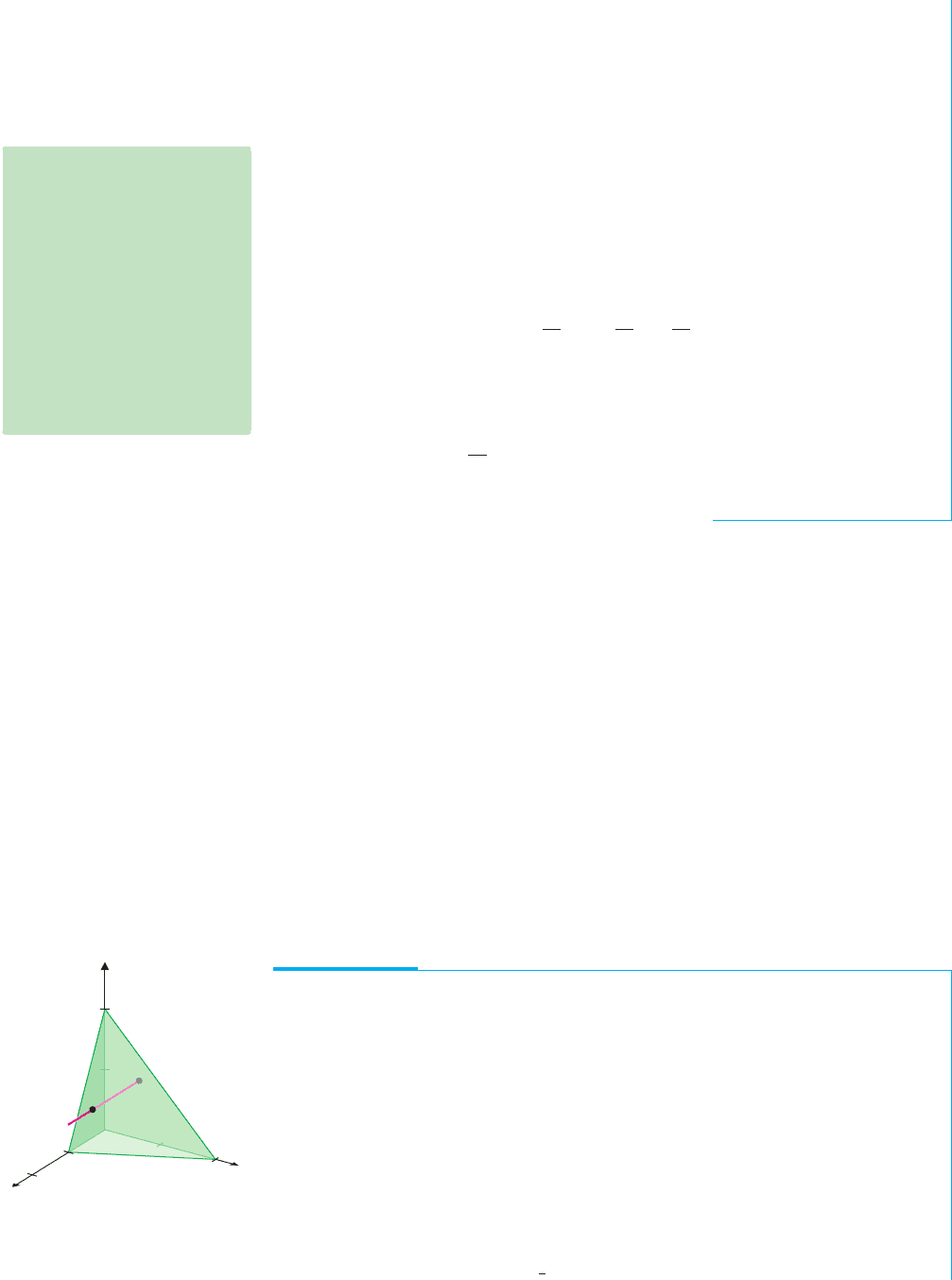
EXAMPLE 5.2 Triple Integral over a Tetrahedron
Evaluate
Q
6xydV, where Q is the tetrahedron bounded by the planes
x = 0, y = 0, z = 0 and 2x + y + z = 4. (See Figure 14.43a.)
x
y
4
2
4
2x y z 4
R
z
FIGURE 14.43a
Tetrahedron
y
x
24
2
4
y 4 2x
R
dy
dx
FIGURE 14.43b
The base of the solid in the xy-plane
Solution Notice that each point in the solid lies above the triangular region R in the
xy-plane indicated in Figures 14.43a and 14.43b. You can think of R as forming the base
of the solid. Notice that for each fixed point (x, y) ∈ R, z ranges from z = 0upto
z = 4 − 2x − y. It helps to draw a vertical line from the base and through the top
surface of the solid, as we have indicated in Figure 14.43a. The line first enters the solid
on the xy-plane (z = 0) and exits the solid on the plane z = 4 −2x − y. This tells you
that the innermost limits of integration (given that the first integration is with respect
to z) are z = 0 and z = 4 −2x − y. From (5.4), we now have
Q
6xydV =
R
4−2x−y
0
6xy dz dA.
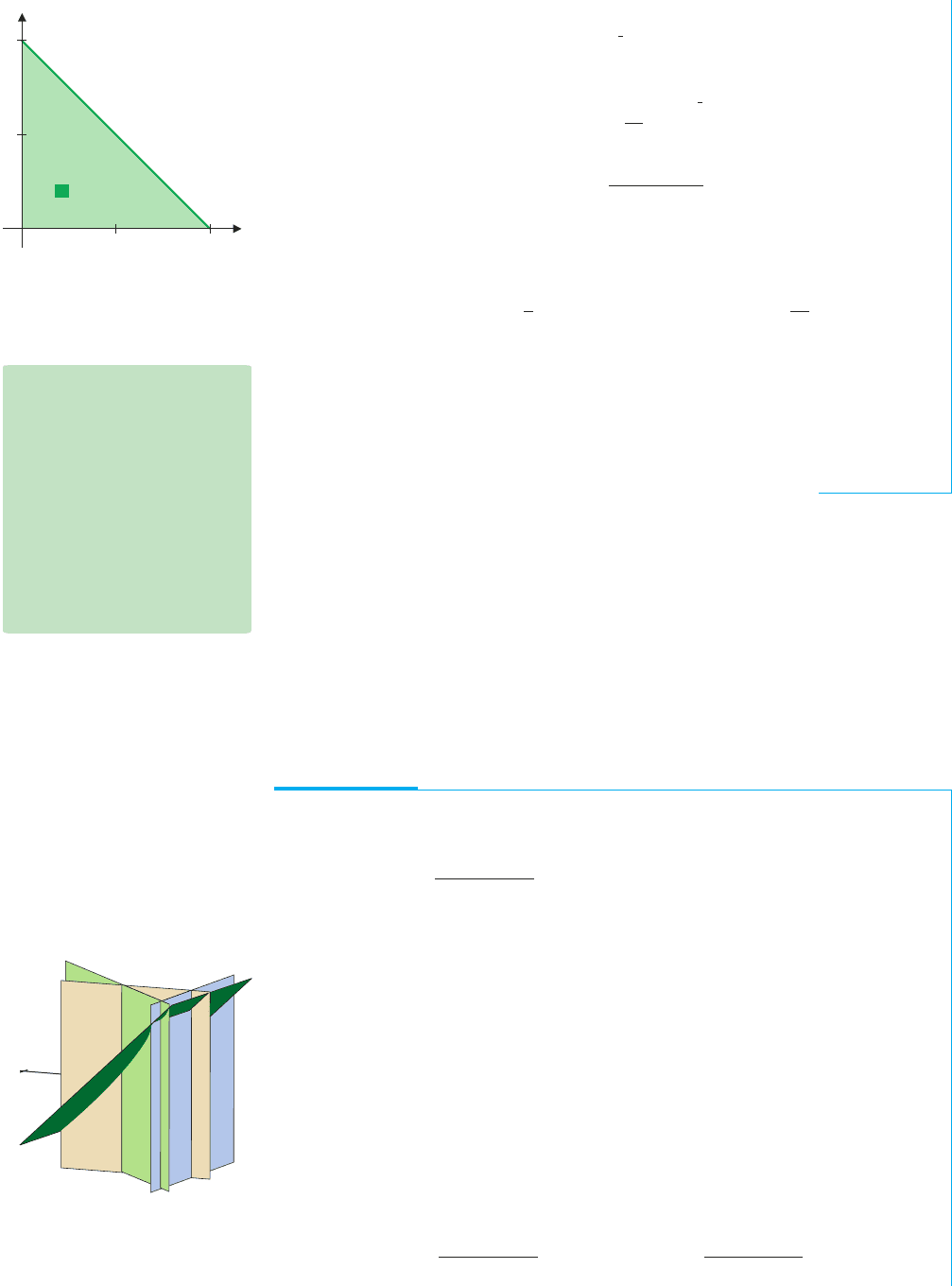
This leaves us with setting up the double integral over the triangular region shown in
Figure 14.43b. Notice that for each fixed x ∈ [0, 2], y ranges from 0 up to y = 4 −2x.
P1: OSO/OVY P2: OSO/OVY QC: OSO/OVY T1: OSO
MHDQ256-Ch14 MHDQ256-Smith-v1.cls January 5, 2011 10:17
LT (Late Transcendental)
CONFIRMING PAGES
14-41 SECTION 14.5
..
Triple Integrals 941
We now have
Q
6xydV =
R
4−2x−y
0
6xydzdA
=
2
0
4−2x
0
4−2x−y
0
6xydzdydx
=
2
0
4−2x
0
(6xyz)
z=4−2x−y
z=0
dydx
=
2
0
4−2x
0
6xy(4 −2x − y)dy dx
=
2
0
6
4x
y
2
2
− 2x
2
y
2
2
− x
y
3
3
y=4−2x
y=0
dx
=
2
0
12x(4 −2x)
2
− 6x
2
(4 − 2x)
2
− 2x(4 − 2x)
3
dx
=
64
5
,
where we leave the details of the last integration to you.
NOTES
Observe that in example 5.2, the
boundary of R consists of x = 0
and y = 0 (corresponding to the
defining surfaces of Q that do
not involve z) and y = 4 −2x
(corresponding to the intersection
of the two defining surfaces of Q
that do involve z). The limits of
integration for the outer two
integrals can typically be found in
this fashion.
The greatest challenge in setting up a triple integral is to get the limits of integration
correct.You can improveyourchances of doing thisbytakingthe time todrawagoodsketch
of the solid and identifying either the base of the solid in one of the coordinate planes (as
we did in example 5.2) or top and bottom boundaries of the solid when both lie above or
below the same region R in one of the coordinate planes. In particular, if the solid extends
from z = f (x, y)toz = g(x, y) for each (x, y) in some two-dimensional region R, then z
is a good choice for the innermost variable of integration. This may seem like a lot to keep
in mind, but we’ll illustrate these ideas generously in the examples that follow and in the
exercises. Be sure that you don’t rely on making guesses. Guessing may get you through
the first several exercises, but will not work in general.
Once you have identified a base or a top and bottom surface of a solid, draw a line from
a representative point in the base (or bottom surface) through the top surface of the solid, as
we did in Figure 14.43a, indicating the limits for the innermost integral. To illustrate this,
we take several different views of example 5.2.
x
y
4
2
4
2x y z 4
z
R
FIGURE 14.44a
Tetrahedron viewed with base
in the yz-plane
EXAMPLE 5.3 A Triple Integral Where the First Integration
Is with Respect to x
Evaluate
Q
6xydV, where Q is the tetrahedron bounded by the planes x = 0, y = 0,
z = 0 and 2x + y + z = 4, as in example 5.2, but this time, integrate first with respect
to x.
Solution You might object that our only evaluation result for triple integrals (5.4) is
for integration with respect to z first. While this is true, you need to realize that x, y
and z are simply variables that we represent by letters of the alphabet. Who cares
which letter is which? Notice that we can think of the tetrahedron as a solid with its
base in the triangular region R
of the yz-plane, as indicated in Figure 14.44a. In this
case, we draw a line orthogonal to the yz-plane, which enters the solid in the yz-plane
(x = 0) and exits in the plane x =
1
2
(4 − y − z). Adapting (5.4) to this situation (i.e.,
P1: OSO/OVY P2: OSO/OVY QC: OSO/OVY T1: OSO
MHDQ256-Ch14 MHDQ256-Smith-v1.cls January 5, 2011 10:17
LT (Late Transcendental)
CONFIRMING PAGES
942 CHAPTER 14
..
Multiple Integrals 14-42
interchanging the roles of x and z), we have
Q
6xydV =
R
1
2
(4−y−z)
0
6xydx dA
=
R
6
x
2
2
y
x=
1
2
(4−y−z)
x=0
dA
=
R
3
(4 − y − z)
2
4
ydA.
To evaluate the remaining double integral, we look at the region R
in the yz-plane, as
shown in Figure 14.44b. We now have
Q
6xydV =
3
4
4
0
4−y
0
(4 − y − z)
2
ydzdy=
64
5
,
where we have left the routine details for you to verify. Finally, we leave it to you to
show that we can also write this triple integral as a triple iterated integral where we
integrate with respect to y first, as in
Q
6xydV =
2
0
4−2x
0
4−2x−z
0
6xydydzdx.
z
y
2 4
2
4
z 4 y
R
dz
dy
FIGURE 14.44b
The region R
We want to emphasize again that the challenge here is to get the correct limits of
integration. While you can always use a computer algebra system to evaluate the integrals
(at least approximately), no computer algebra system will set up the limits of integration
for you! Keep in mind that the innermost limits of integration correspond to two three-
dimensional surfaces. (You can think of these as the top and the bottom of the solid, if
you orient yourself properly.) The limits of integration for the middle integral represent
two curves in one of the coordinate planes and can involve only the outermost variable
of integration. Keep these ideas in mind as you work through the examples and exercises.
Tripleintegralscanlookintimidating atfirst andthe only way to become proficient with these
is to work plenty of problems! Multiple integrals form the basis of much of the remainder
of the book, so don’t skimp on your effort now.
NOTES
Notice in example 5.3 that the
boundary of R
consists of y = 0
and z = 0 (the defining surfaces
of Q that do not involve x) and
z = 4 − y (the intersection of the
two defining surfaces that do
involve x). These are the typical
sources of surfaces for the limits
of integration in the outer two
integrals.
EXAMPLE 5.4 Evaluating a Triple Integral by Changing the Order
of Integration
Evaluate
4
0
4
x
y
0
6
1 + 48z − z
3
dzdydx.
Solution First, notice that evaluating the innermost integral requires a partial
fractions decomposition, which produces three natural logarithm terms. The second
integration is not pretty. We can significantly simplify the integral by changing the order
of integration, but we must first identify the surfaces that bound the solid over which we
are integrating. Starting with the inside limits, observe that the slanted plane z = y
forms the top of the solid and z = 0 forms the bottom.
5
2
x
FIGURE 14.45a
The middle limits of integration indicate that the solid is also bounded by the
planes y = x and y = 4. The outer limits of x = 0 and x = 4 indicate that the solid is
also bounded by the plane x = 0. (Here, x = 4 corresponds to the intersection of y = x
and y = 4.) A sketch of the solid is shown in Figure 14.45a. Notice that since y is
involved in three different boundary planes, it is a poor choice for the inner variable of
integration. To integrate with respect to x first, notice that a ray in the direction of the
positive x-axis enters the solid through the plane x = 0 and exits through the plane
x = y.Wenowhave
4
0
4
x
y
0
6
1 + 48z − z
3
dzdydx =
R
y
0
6
1 + 48z − z
3
dx dA,